

ISO 9924-3:2024
(Main)Rubber and rubber products — Determination of the composition of vulcanizates and uncured compounds by thermogravimetry — Part 3: Hydrocarbon rubbers, halogenated rubbers and polysiloxane rubbers
General Information
- Abstract
This document specifies a thermogravimetric method for the determination of the main constituents of rubber compounds such as elastomer(s), carbon black and mineral filler. It establishes the “fingerprint” of the tested material. However, the result does not always correspond exactly to the theoretical formula of the rubber. This method applies to raw or compounded rubbers, vulcanized and unvulcanised, with or without extraction. This method applies to rubbers with hydrocarbon backbones (NR, BR, SBR, IIR, EPDM, ACM, AEM, etc.) used alone or as mixtures. For the mixtures, the polymer content corresponds to the total rubber and it is not usually possible to identify individual polymers. This method applies to rubbers with halogenated hydrocarbon backbones (CR, CSM, FKM, CM, CO, ECO, etc.) or containing nitrogen (NBR, HNBR, NBR/PVC, etc.), as well as to their mixtures. However, these rubbers often form carbonaceous residues which interfere with the analysis. Application of an appropriate procedure minimizes these interferences. This method also applies to rubbers with a polysiloxane backbone (VMQ, etc.) and to rubbers not listed above.
- Status
- Published
- Publication Date
- 28-Feb-2024
- Technical Committee
- ISO/TC 45/SC 2 - Testing and analysis
- Drafting Committee
- ISO/TC 45/SC 2 - Testing and analysis
- Current Stage
- 6060 - International Standard published
- Start Date
- 29-Feb-2024
- Due Date
- 16-May-2024
- Completion Date
- 29-Feb-2024
Buy Documents

ISO 9924-3:2024 - Rubber and rubber products — Determination of the composition of vulcanizates and uncured compounds by thermogravimetry — Part 3: Hydrocarbon rubbers, halogenated rubbers and polysiloxane rubbers Released:29. 02. 2024

ISO 9924-3:2024 - Caoutchouc et produits a base de caoutchouc — Détermination de la composition des vulcanisats et des mélanges non vulcanisés par thermogravimétrie — Partie 3: Caoutchoucs hydrocarbonés, caoutchoucs halogénés et caoutchoucs polysiloxanes Released:29. 02. 2024
Overview - ISO 9924-3:2024 (Thermogravimetry for rubber composition)
ISO 9924-3:2024 specifies a thermogravimetric analysis (TGA) method to determine the main constituents of rubber compounds - notably elastomer(s), carbon black and mineral fillers - for vulcanizates and uncured compounds. The method produces a characteristic thermogram or “fingerprint” of the tested material. It applies to a wide range of rubbers including hydrocarbon rubbers (NR, BR, SBR, EPDM, etc.), halogenated and nitrogen-containing rubbers (CR, FKM, NBR, HNBR, etc.), and polysiloxane rubbers (VMQ). The standard covers raw and compounded materials, vulcanized and unvulcanized, with or without prior extraction.
Key technical topics and requirements
- Principle: Controlled heating of a weighed test portion under an inert atmosphere (nitrogen) followed by oxidation (air or oxygen) to record mass loss vs temperature/time (TGA curve) and its derivative (dw/dT).
- Reagents & gases: High-purity nitrogen (≥ 99.995% mass fraction, O2 < 10 mg/kg) and dry air (or reconstituted N2/O2 ≥ 99.5%).
- Apparatus: Thermogravimetric analyser (microbalance readable to 1 μg), controlled oven to ≈1000 °C, gas selector, gas flow measurement (recommended ~100 cm3/min), and data acquisition.
- Sample preparation: Test portion typically 8 mg ± 3 mg; conditioning per ISO 23529; optional solvent extraction (ISO 1407) to remove plasticizers before TGA.
- Procedures A & B: Two operating programmes defined - Procedure A for carbon-containing rubbers (target N2 temp 600 °C) and Procedure B for polysiloxane/fluorocarbon rubbers (target N2 temp 800 °C). Heating rates, switching temperature (400 °C), and final oxidation steps are specified in Table 1.
- Data analysis: Use mass change curve and derivative plot to identify key mass points (m0 initial, m1 after pyrolysis, m2 after carbon black combustion, m3 residue) and compute mass fractions. Note that some rubbers (halogenated, nitrogenous) may leave carbonaceous residues that can interfere; the standard prescribes mitigation and interpretation guidance.
- Reporting & precision: Requirements for recordings, interpretation, corrections for extractables, and test report content are specified. Annexes include recommended procedures, thermogram examples, and precision data.
Practical applications - who uses ISO 9924-3:2024
- Quality control and incoming inspection in rubber manufacturing and compounding plants.
- Material characterization in R&D laboratories developing new elastomers, fillers or formulations.
- Failure analysis and root-cause investigations where composition fingerprints help identify contamination or formulation shifts.
- Independent testing laboratories and OEMs requiring standardized compositional analysis of vulcanizates and uncured compounds.
- Regulatory and specification compliance where verified material composition or batch comparability is needed.
Related standards and references
- Other parts of the ISO 9924 series (list on ISO website) for complementary TGA methods.
- ISO 23529 (conditioning of samples) and ISO 1407 (extraction of plasticizers/additives) are referenced for sample preparation and extraction procedures.
Safety note: Users should follow normal laboratory safety and environmental-disposal practices as some procedures generate hazardous decomposition products.
Relations
- Effective Date
- 06-Jun-2022
Buy Documents
ISO 9924-3:2024 - Rubber and rubber products — Determination of the composition of vulcanizates and uncured compounds by thermogravimetry — Part 3: Hydrocarbon rubbers, halogenated rubbers and polysiloxane rubbers Released:29. 02. 2024
ISO 9924-3:2024 - Caoutchouc et produits a base de caoutchouc — Détermination de la composition des vulcanisats et des mélanges non vulcanisés par thermogravimétrie — Partie 3: Caoutchoucs hydrocarbonés, caoutchoucs halogénés et caoutchoucs polysiloxanes Released:29. 02. 2024
Get Certified
Connect with accredited certification bodies for this standard

DIN CERTCO
DIN Group product certification.

Smithers Quality Assessments
US management systems and product certification.
Sponsored listings
Frequently Asked Questions
ISO 9924-3:2024 is a standard published by the International Organization for Standardization (ISO). Its full title is "Rubber and rubber products — Determination of the composition of vulcanizates and uncured compounds by thermogravimetry — Part 3: Hydrocarbon rubbers, halogenated rubbers and polysiloxane rubbers". This standard covers: This document specifies a thermogravimetric method for the determination of the main constituents of rubber compounds such as elastomer(s), carbon black and mineral filler. It establishes the “fingerprint” of the tested material. However, the result does not always correspond exactly to the theoretical formula of the rubber. This method applies to raw or compounded rubbers, vulcanized and unvulcanised, with or without extraction. This method applies to rubbers with hydrocarbon backbones (NR, BR, SBR, IIR, EPDM, ACM, AEM, etc.) used alone or as mixtures. For the mixtures, the polymer content corresponds to the total rubber and it is not usually possible to identify individual polymers. This method applies to rubbers with halogenated hydrocarbon backbones (CR, CSM, FKM, CM, CO, ECO, etc.) or containing nitrogen (NBR, HNBR, NBR/PVC, etc.), as well as to their mixtures. However, these rubbers often form carbonaceous residues which interfere with the analysis. Application of an appropriate procedure minimizes these interferences. This method also applies to rubbers with a polysiloxane backbone (VMQ, etc.) and to rubbers not listed above.
This document specifies a thermogravimetric method for the determination of the main constituents of rubber compounds such as elastomer(s), carbon black and mineral filler. It establishes the “fingerprint” of the tested material. However, the result does not always correspond exactly to the theoretical formula of the rubber. This method applies to raw or compounded rubbers, vulcanized and unvulcanised, with or without extraction. This method applies to rubbers with hydrocarbon backbones (NR, BR, SBR, IIR, EPDM, ACM, AEM, etc.) used alone or as mixtures. For the mixtures, the polymer content corresponds to the total rubber and it is not usually possible to identify individual polymers. This method applies to rubbers with halogenated hydrocarbon backbones (CR, CSM, FKM, CM, CO, ECO, etc.) or containing nitrogen (NBR, HNBR, NBR/PVC, etc.), as well as to their mixtures. However, these rubbers often form carbonaceous residues which interfere with the analysis. Application of an appropriate procedure minimizes these interferences. This method also applies to rubbers with a polysiloxane backbone (VMQ, etc.) and to rubbers not listed above.
ISO 9924-3:2024 is classified under the following ICS (International Classification for Standards) categories: 83.060 - Rubber. The ICS classification helps identify the subject area and facilitates finding related standards.
ISO 9924-3:2024 has the following relationships with other standards: It is inter standard links to ISO 9924-3:2009. Understanding these relationships helps ensure you are using the most current and applicable version of the standard.
ISO 9924-3:2024 is available in PDF format for immediate download after purchase. The document can be added to your cart and obtained through the secure checkout process. Digital delivery ensures instant access to the complete standard document.
Standards Content (Sample)
International
Standard
ISO 9924-3
Second edition
Rubber and rubber products —
2024-02
Determination of the composition
of vulcanizates and uncured
compounds by thermogravimetry —
Part 3:
Hydrocarbon rubbers, halogenated
rubbers and polysiloxane rubbers
Caoutchouc et produits à base de caoutchouc — Détermination
de la composition des vulcanisats et des mélanges non vulcanisés
par thermogravimétrie —
Partie 3: Caoutchoucs hydrocarbonés, caoutchoucs halogénés et
caoutchoucs polysiloxanes
Reference number
© ISO 2024
All rights reserved. Unless otherwise specified, or required in the context of its implementation, no part of this publication may
be reproduced or utilized otherwise in any form or by any means, electronic or mechanical, including photocopying, or posting on
the internet or an intranet, without prior written permission. Permission can be requested from either ISO at the address below
or ISO’s member body in the country of the requester.
ISO copyright office
CP 401 • Ch. de Blandonnet 8
CH-1214 Vernier, Geneva
Phone: +41 22 749 01 11
Email: copyright@iso.org
Website: www.iso.org
Published in Switzerland
ii
Contents Page
Foreword .iv
1 Scope . 1
2 Normative references . 1
3 Terms and definitions . 1
4 Principle . 2
5 Reagents . 2
6 Apparatus . 2
7 Preparation of samples . 3
7.1 Conditioning of samples .3
7.2 Test portion .3
8 Procedure . 3
8.1 General .3
8.2 Description of the procedures .3
8.3 Test procedures .4
9 Expression of results . 4
9.1 Recordings .4
9.2 Calculation of the mass change from curves .4
9.3 Interpretation .5
9.3.1 General .5
9.3.2 Rubbers with hydrocarbon backbones (Figures B.2 and B.3) .5
9.3.3 Rubbers with a nitrogenous hydrocarbon backbone (Figure B.4) .6
9.3.4 Rubbers with a halogenated hydrocarbon backbone (Figure B.5) .6
9.3.5 Rubbers with a hydrocarbon, nitrogenous and oxygenated backbone .6
9.3.6 Rubbers with a hydrocarbon and sulfurated backbone .6
9.3.7 Rubbers with a polysiloxane backbone (Figure B.6) .6
9.4 Expression of results . .6
9.4.1 Result obtained from the TGA curve .6
9.4.2 Correction for extract in calculated percentage mass fractions of material.7
10 Test report . 7
11 Precision . 8
Annex A (informative) Recommended procedures . 9
Annex B (informative) Examples of thermogram . 10
Annex C (informative) Precision . 16
Bibliography .18
iii
Foreword
ISO (the International Organization for Standardization) is a worldwide federation of national standards
bodies (ISO member bodies). The work of preparing International Standards is normally carried out through
ISO technical committees. Each member body interested in a subject for which a technical committee
has been established has the right to be represented on that committee. International organizations,
governmental and non-governmental, in liaison with ISO, also take part in the work. ISO collaborates closely
with the International Electrotechnical Commission (IEC) on all matters of electrotechnical standardization.
The procedures used to develop this document and those intended for its further maintenance are described
in the ISO/IEC Directives, Part 1. In particular, the different approval criteria needed for the different types
of ISO document should be noted. This document was drafted in accordance with the editorial rules of the
ISO/IEC Directives, Part 2 (see www.iso.org/directives).
ISO draws attention to the possibility that the implementation of this document may involve the use of (a)
patent(s). ISO takes no position concerning the evidence, validity or applicability of any claimed patent
rights in respect thereof. As of the date of publication of this document, ISO had not received notice of (a)
patent(s) which may be required to implement this document. However, implementers are cautioned that
this may not represent the latest information, which may be obtained from the patent database available at
www.iso.org/patents. ISO shall not be held responsible for identifying any or all such patent rights.
Any trade name used in this document is information given for the convenience of users and does not
constitute an endorsement.
For an explanation of the voluntary nature of standards, the meaning of ISO specific terms and expressions
related to conformity assessment, as well as information about ISO's adherence to the World Trade
Organization (WTO) principles in the Technical Barriers to Trade (TBT), see www.iso.org/iso/foreword.html.
This document was prepared by Technical Committee ISO/TC 45, Rubber and rubber products, Subcommittee
SC 2, Testing and analysis.
This second edition cancels and replaces the first edition (ISO 9924-3:2009), which has been technically
revised.
The main changes are as follows:
— extension of the scope by deleting the mandatory preliminary extraction;
— the result of 2006 ITP has been deleted, the result of 2022 ITP has been added in Annex C.
A list of all parts in the ISO 9924 series can be found on the ISO website.
Any feedback or questions on this document should be directed to the user’s national standards body. A
complete listing of these bodies can be found at www.iso.org/members.html.
iv
International Standard ISO 9924-3:2024(en)
Rubber and rubber products — Determination of the
composition of vulcanizates and uncured compounds by
thermogravimetry —
Part 3:
Hydrocarbon rubbers, halogenated rubbers and
polysiloxane rubbers
WARNING 1 — Persons using this document should be familiar with normal laboratory practice. This
document does not purport to address all of the safety problems, if any, associated with its use. It is
the responsibility of the user to establish appropriate safety and health practices and to determine
the applicability of any other restrictions.
WARNING 2 — Certain procedures specified in this document might involve the use or generation of
substances, or the generation of waste, that could constitute a local environmental hazard. Reference
should be made to appropriate documentation on safe handling and disposal after use.
1 Scope
This document specifies a thermogravimetric method for the determination of the main constituents of
rubber compounds such as elastomer(s), carbon black and mineral filler.
It establishes the “fingerprint” of the tested material. However, the result does not always correspond
exactly to the theoretical formula of the rubber.
This method applies to raw or compounded rubbers, vulcanized and unvulcanised, with or without
extraction.
This method applies to rubbers with hydrocarbon backbones (NR, BR, SBR, IIR, EPDM, ACM, AEM, etc.) used
alone or as mixtures. For the mixtures, the polymer content corresponds to the total rubber and it is not
usually possible to identify individual polymers.
This method applies to rubbers with halogenated hydrocarbon backbones (CR, CSM, FKM, CM, CO, ECO, etc.)
or containing nitrogen (NBR, HNBR, NBR/PVC, etc.), as well as to their mixtures. However, these rubbers
often form carbonaceous residues which interfere with the analysis. Application of an appropriate procedure
minimizes these interferences.
This method also applies to rubbers with a polysiloxane backbone (VMQ, etc.) and to rubbers not listed above.
2 Normative references
There are no normative references in this document.
3 Terms and definitions
No terms and definitions are listed in this document.
ISO and IEC maintain terminology databases for use in standardization at the following addresses:
— ISO Online browsing platform: available at https:// www .iso .org/ obp
— IEC Electropedia: available at https:// www .electropedia .org/
4 Principle
A weighed test portion is heated following a pre-set programme in a known atmosphere.
Initial pyrolysis in an inert atmosphere (nitrogen) is followed by combustion in an oxidizing atmosphere.
Generally, the reactions that generate mass variations are decompositions, oxidations or reactions
volatilizing a constituent.
The loss in mass as a function of temperature indicates a quantitatively usable thermogram which is
characteristic of the material.
5 Reagents
5.1 Nitrogen of minimal purity 99,995 % mass fraction, with an oxygen content of less than
10 mg/kg (ppm) and hydrocarbon content less than 1,5 mg/kg (ppm).
5.2 Dry air, with no detectable trace of oil.
The air used may be reconstituted nitrogen and oxygen of purity minimum 99,5 % mass fraction. In some
cases, pure oxygen may be used.
6 Apparatus
6.1 Thermogravimetric analyser (TGA).
6.1.1 General. Various types of analyser are commercially available. The basic components of an analyser
are listed in 6.1.2 to 6.1.8.
6.1.2 Thermogravimetric balance, comprising a microbalance provided with a pan made from a
nonoxidizable material that can weigh up to 50 mg, is readable to the nearest 1 μg and equipped with an
oven capable of being maintained at temperatures from room temperature to approximately 1 000 °C.
6.1.3 Appropriate enclosure, allowing the sample to be kept under a specified atmosphere.
6.1.4 Pan or crucible, of size suitable to accommodate the sample and small enough to reduce the
influence of buoyancy.
6.1.5 Temperature-control system, allowing heating rates to be controlled from 10 °C/min
to 50 °C/min.
6.1.6 Gas selector, allowing successive introduction of the inert gas and oxidizing gas while controlling
the flow rate.
3 3
6.1.7 Measurement equipment, for gas flow rate in the range 10 cm /min to 250 cm /min.
6.1.8 Data acquisition and processing system.
7 Preparation of samples
7.1 Conditioning of samples
Test samples should be conditioned in standardized laboratory conditions of temperature and humidity in
accordance with ISO 23529. These conditions are preferred, but are not mandatory.
In order to refine the centesimal composition, prior extraction of plasticizers and additives with an
appropriate solvent might be useful. In this case, the method described in ISO 1407 can be applied. The
thermogravimetric analysis shall then be carried out on the non-extractable part previously dried until
constant weight.
7.2 Test portion
Prepare a test portion of 8 mg ± 3 mg cut into a single piece.
NOTE The preparation of the test portion can influence the kinetics of the phenomena.
8 Procedure
8.1 General
Considering the variety of the decomposition modes linked to the nature of polymers, two procedures are
defined:
a) procedure A for carbon rubbers;
b) procedure B for polysiloxane and fluorocarbon rubbers.
If procedure A does not result in a thermogram that achieves constant mass at 600 °C, procedure B shall apply.
A non-exhaustive list of the recommended procedures for each of the various rubber families is given in
Table A.1.
8.2 Description of the procedures
Table 1 gives details of the operating steps for procedures A and B.
Table 1 — Operating steps
Step Units Procedure A Procedure B
Initial temperature °C 35 ± 10 35 ± 10
Heating rate under nitrogen °C/min 20 20
Target temperature under nitrogen °C 600 800
Maintenance time at target temperature under nitrogen min 0 5
Cooling under nitrogen °C 600 to 400 800 to 400
Temperature at the change of atmosphere °C 400 400
Maintenance time at atmosphere change temperature under air min 2 2
Heating rate under air °C/min 20 20
a
Final temperature under air according to the equipment °C 800 to 850 800 to 850
Maintenance time at the final temperature under air min 10 to 20 10 to 20
a
If procedures do not result in a thermogram that achieves constant mass at final temperature under air, maintain the final
temperature condition until constant mass is achieved.
8.3 Test procedures
8.3.1 Connect the apparatus and adjust (6.1.6) the gas flow to a rate between 20 cm /min and
250 cm /min (6.1.7). Set the parameters according to the chosen process.
The recommended flow rate is 100 cm /min.
8.3.2 Before the test, ensure that the pan (6.1.4) or the crucible is clean and empty.
8.3.3 Close the thermobalance oven (6.1.2), purge with a nitrogen (5.1) flow at the preset rate. Wait until
stabilization. Adjust the zero to compensate for the mass of the pan or the crucible.
8.3.4 Place the test piece prepared in accordance with 7.2 in the pan or the crucible and weigh it under the
conditions specified in 8.3.3. Record the mass, m .
8.3.5 Conduct the test by following the operating steps specified in Table 1.
8.3.6 At the end of the test, allow the oven to cool to room temperature, open it and clean the pan or the
crucib
...
Norme
internationale
ISO 9924-3
Deuxième édition
Caoutchouc et produits à base de
2024-02
caoutchouc — Détermination de
la composition des vulcanisats et
des mélanges non vulcanisés par
thermogravimétrie —
Partie 3:
Caoutchoucs hydrocarbonés,
caoutchoucs halogénés et
caoutchoucs polysiloxanes
Rubber and rubber products — Determination of the composition
of vulcanizates and uncured compounds by thermogravimetry —
Part 3: Hydrocarbon rubbers, halogenated rubbers and
polysiloxane rubbers
Numéro de référence
DOCUMENT PROTÉGÉ PAR COPYRIGHT
© ISO 2024
Tous droits réservés. Sauf prescription différente ou nécessité dans le contexte de sa mise en œuvre, aucune partie de cette
publication ne peut être reproduite ni utilisée sous quelque forme que ce soit et par aucun procédé, électronique ou mécanique,
y compris la photocopie, ou la diffusion sur l’internet ou sur un intranet, sans autorisation écrite préalable. Une autorisation peut
être demandée à l’ISO à l’adresse ci-après ou au comité membre de l’ISO dans le pays du demandeur.
ISO copyright office
Case postale 401 • Ch. de Blandonnet 8
CH-1214 Vernier, Genève
Tél.: +41 22 749 01 11
E-mail: copyright@iso.org
Web: www.iso.org
Publié en Suisse
ii
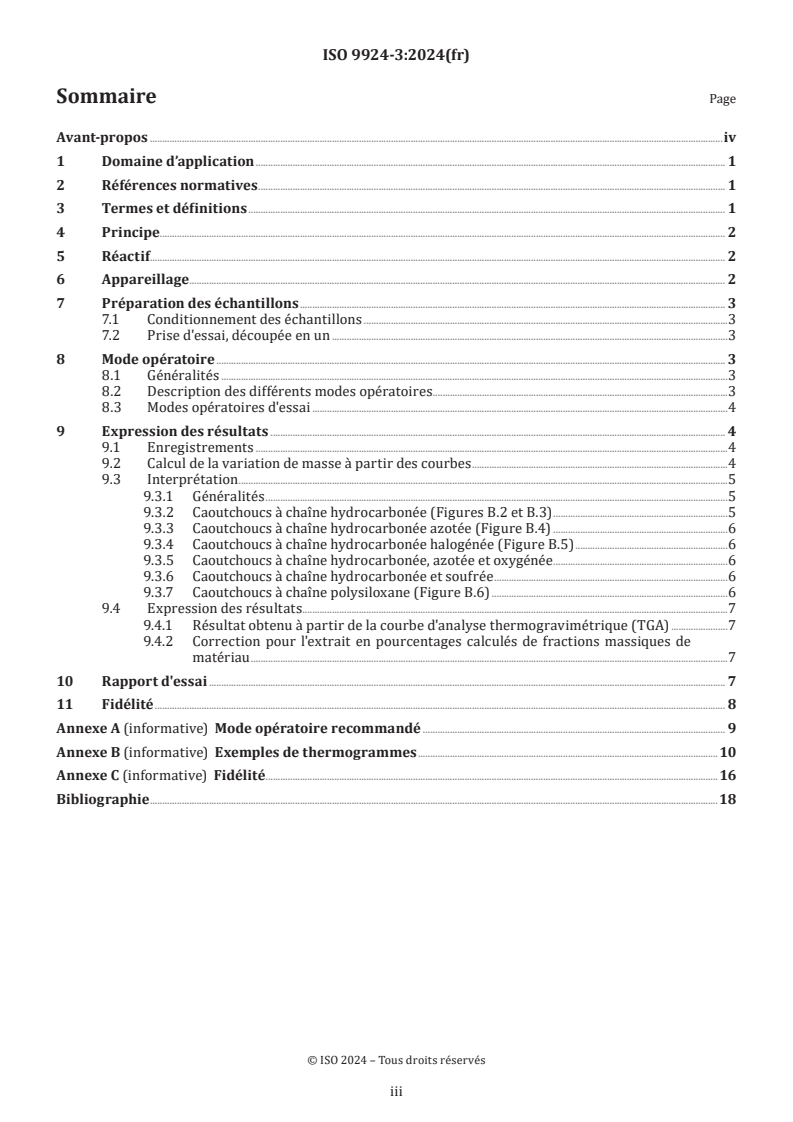
Sommaire Page
Avant-propos .iv
1 Domaine d’application . 1
2 Références normatives . 1
3 Termes et définitions . 1
4 Principe. 2
5 Réactif . 2
6 Appareillage . 2
7 Préparation des échantillons . 3
7.1 Conditionnement des échantillons .3
7.2 Prise d'essai, découpée en un .3
8 Mode opératoire . 3
8.1 Généralités .3
8.2 Description des différents modes opératoires .3
8.3 Modes opératoires d'essai .4
9 Expression des résultats . 4
9.1 Enregistrements .4
9.2 Calcul de la variation de masse à partir des courbes .4
9.3 Interprétation .5
9.3.1 Généralités .5
9.3.2 Caoutchoucs à chaîne hydrocarbonée (Figures B.2 et B.3) .5
9.3.3 Caoutchoucs à chaîne hydrocarbonée azotée (Figure B.4) .6
9.3.4 Caoutchoucs à chaîne hydrocarbonée halogénée (Figure B.5) .6
9.3.5 Caoutchoucs à chaîne hydrocarbonée, azotée et oxygénée .6
9.3.6 Caoutchoucs à chaîne hydrocarbonée et soufrée .6
9.3.7 Caoutchoucs à chaîne polysiloxane (Figure B.6) .6
9.4 Expression des résultats .7
9.4.1 Résultat obtenu à partir de la courbe d'analyse thermogravimétrique (TGA) .7
9.4.2 Correction pour l'extrait en pourcentages calculés de fractions massiques de
matériau .7
10 Rapport d'essai . 7
11 Fidélité . 8
Annexe A (informative) Mode opératoire recommandé . 9
Annexe B (informative) Exemples de thermogrammes . 10
Annexe C (informative) Fidélité . .16
Bibliographie .18
iii
Avant-propos
L'ISO (Organisation internationale de normalisation) est une fédération mondiale d'organismes nationaux
de normalisation (comités membres de l'ISO). L'élaboration des Normes internationales est en général
confiée aux comités techniques de l'ISO. Chaque comité membre intéressé par une étude a le droit de faire
partie du comité technique créé à cet effet. Les organisations internationales, gouvernementales et non
gouvernementales, en liaison avec l'ISO participent également aux travaux. L'ISO collabore étroitement avec
la Commission électrotechnique internationale (IEC) en ce qui concerne la normalisation électrotechnique.
Les procédures utilisées pour élaborer le présent document et celles destinées à sa mise à jour sont
décrites dans les Directives ISO/IEC, Partie 1. Il convient, en particulier, de prendre note des différents
critères d'approbation requis pour les différents types de documents ISO. Le présent document a
été rédigé conformément aux règles de rédaction données dans les Directives ISO/IEC, Partie 2 (voir
www.iso.org/directives).
L’ISO attire l’attention sur le fait que la mise en application du présent document peut entraîner l’utilisation
d’un ou de plusieurs brevets. L’ISO ne prend pas position quant à la preuve, à la validité et à l’applicabilité de
tout droit de brevet revendiqué à cet égard. À la date de publication du présent document, l’ISO n'avait pas
reçu notification qu’un ou plusieurs brevets pouvaient être nécessaires à sa mise en application. Toutefois,
il y a lieu d’avertir les responsables de la mise en application du présent document que des informations
plus récentes sont susceptibles de figurer dans la base de données de brevets, disponible à l'adresse
www.iso.org/brevets. L’ISO ne saurait être tenue pour responsable de ne pas avoir identifié tout ou partie de
tels droits de propriété.
Les appellations commerciales éventuellement mentionnées dans le présent document sont données pour
information, par souci de commodité, à l’intention des utilisateurs et ne sauraient constituer un engagement.
Pour une explication de la nature volontaire des normes, la signification des termes et expressions
spécifiques de l'ISO liés à l'évaluation de la conformité, ou pour toute information au sujet de l'adhésion de
l'ISO aux principes de l’Organisation mondiale du commerce (OMC) concernant les obstacles techniques au
commerce (OTC), voir www.iso.org/avant-propos.
Le présent document a été élaboré par le comité technique ISO/TC 45, Élastomères et produits à base
d'élastomères, sous-comité SC 2, Essais et analyses.
Cette deuxième édition annule et remplace la première édition (ISO 9924-3:2009) qui a fait l’objet d’une
révision technique.
Les principales modifications sont les suivantes:
— extension du domaine d'application par suppression de l'extraction préalable obligatoire;
— le résultat de l'ITP 2006 a été supprimé, le résultat de l'ITP 2022 a été ajouté à l'Annexe C.
Une liste de toutes les parties de la série ISO 9924 se trouve sur le site web de l’ISO.
Il convient que l’utilisateur adresse tout retour d’information ou toute question concernant le présent
document à l’organisme national de normalisation de son pays. Une liste exhaustive desdits organismes se
trouve à l’adresse www.iso.org/fr/members.html.
iv
Norme internationale ISO 9924-3:2024(fr)
Caoutchouc et produits à base de caoutchouc —
Détermination de la composition des vulcanisats et des
mélanges non vulcanisés par thermogravimétrie —
Partie 3:
Caoutchoucs hydrocarbonés, caoutchoucs halogénés et
caoutchoucs polysiloxanes
AVERTISSEMENT 1 — Il convient que l'utilisateur du présent document connaisse bien les pratiques
courantes de laboratoire. Le présent document n'a pas pour but de traiter tous les problèmes de
sécurité qui sont, le cas échéant, liés à son utilisation. Il incombe à l'utilisateur d'établir des pratiques
appropriées en matière d'hygiène et de sécurité, et de déterminer l'applicabilité de toute autre
restriction.
AVERTISSEMENT 2 — Certains modes opératoires spécifiés dans le présent document peuvent
impliquer l'utilisation ou la génération de substances ou de déchets pouvant représenter un danger
environnemental local. Il convient de se référer à la documentation appropriée concernant la
manipulation et l'élimination après usage en toute sécurité.
1 Domaine d’application
Le présent document spécifie une méthode thermogravimétrique permettant de déterminer les principaux
constituants des mélanges de caoutchouc tels qu'élastomère(s), noir de carbone et charges minérales.
Il permet d'établir la «fiche d'identité» du matériau soumis à essai. Cependant, le résultat obtenu ne
correspond pas toujours exactement à la formule théorique du caoutchouc.
Cette méthode est applicable aux caoutchoucs à l'état brut ou sous forme de mélanges vulcanisés et non
vulcanisés, avec ou sans extraction.
Cette méthode s'applique aux caoutchoucs à chaîne hydrocarbonée (NR, BR, SBR, IIR, EPDM, ACM, AEM,
etc.) utilisés seuls ou en combinaison dans des formulations. Dans ce dernier cas, la teneur en polymères
correspond au caoutchouc total et, la plupart du temps, il n'est pas possible de déterminer lesdits polymères
de manière individuelle.
Cette méthode s'applique aux caoutchoucs à chaîne hydrocarbonée halogénée (CR, CSM, FKM, CM, CO,
ECO, etc.) ou azotée (NBR, HNBR, NBR/PVC, etc.), ainsi qu'à leurs associations. Toutefois, ces caoutchoucs
forment fréquemment des résidus carbonés qui interfèrent avec l'analyse. L'utilisation d'un mode opératoire
approprié permet de minimiser ces interférences.
Cette méthode s'applique également aux caoutchoucs à chaîne polysiloxane (VMQ, etc.) et aux caoutchoucs
non cités ci-dessus.
2 Références normatives
Le présent document ne contient aucune référence normative.
3 Termes et définitions
Aucun terme n’est défini dans le présent document.
L’ISO et l’IEC tiennent à jour des bases de données terminologiques destinées à être utilisées en normalisation,
consultables aux adresses suivantes:
— ISO Online browsing platform: disponible à l’adresse https:// www .iso .org/ obp
— IEC Electropedia: disponible à l’adresse https:// www .electropedia .org/
4 Principe
Une prise d'essai pesée est chauffée suivant un programme préétabli, dans une atmosphère connue.
Une pyrolyse initiale sous atmosphère inerte (azote) est suivie d'une combustion sous atmosphère oxydante.
En général, les réactions qui engendrent des variations de masse sont des réactions de décomposition,
d'oxydation ou des réactions entraînant la volatilisation d'un constituant.
La perte en masse en fonction de la température indique un thermogramme exploitable quantitativement
qui est caractéristique du matériau.
5 Réactif
5.1 Azote, de pureté minimale 99,995 % en fraction massique, avec une teneur en oxygène inférieure à
10 mg/kg (ppm) et une teneur en hydrocarbures inférieure à 1,5 mg/kg (ppm).
5.2 Air sec, sans aucune trace détectable d'huile.
L'air utilisé peut être reconstitué à partir d'azote et d'oxygène de pureté minimale 99,5 %, en fraction
massique. Dans certains cas, il est possible d'utiliser de l'oxygène pur.
6 Appareillage
6.1 Analyseur thermogravimétrique (TGA).
6.1.1 Généralités. Plusieurs types d'analyseurs sont disponibles dans le commerce. Les composants de
base d'un analyseur sont listés de 6.1.2 à 6.1.8.
6.1.2 Balance thermogravimétrique, constituée d'une microbalance munie d'une nacelle fabriquée en
un matériau inoxydable pouvant peser jusqu'à 50 mg à 1 µg près et équipée d'un four pouvant être maintenu
à des températures depuis la température ambiante jusqu'à environ 1 000 °C.
6.1.3 Enceinte appropriée, permettant de maintenir l'échantillon dans une atmosphère spécifiée.
6.1.4 Nacelle ou creuset, de taille adaptée à l'échantillon et suffisamment petite pour limiter l'action de la
poussée d'Archimède.
6.1.5 Programmateur de température, permettant d'obtenir des vitesses de chauffe comprises entre
10 °C/min et 50 °C/min.
6.1.6 Distributeur de gaz, permettant d'introduire successivement le gaz inerte, puis le gaz oxydant tout
en régulant le débit.
3 3
6.1.7 Équipement de mesure, pour des débits gazeux dans une gamme de 10 cm /min à 250 cm /min.
6.1.8 Système d'acquisition et de traitement des données.
7 Préparation des échantillons
7.1 Conditionnement des échantillons
Il convient de conditionner les échantillons pour essai dans des conditions normalisées de laboratoire
en température et humidité conformément à l'ISO 23529. Ces conditions sont préférées mais ne sont pas
obligatoires.
Afin de préciser la composition centésimale, l'extraction préalable des plastifiants et des additifs à l'aide d'un
solvant approprié peut s'avérer utile. Dans ce cas, la méthode décrite dans l'ISO 1407 peut être appliquée.
L'analyse thermogravimétrique doit alors être effectuée sur la partie non extractible préalablement séchée
jusqu'à poids constant.
7.2 Prise d'essai, découpée en un
Préparer une prise d'essai de 8 mg ± 3 mg découpée en un seul morceau.
NOTE La préparation de la prise d'essai peut influencer la cinétique des phénomènes.
8 Mode opératoire
8.1 Généralités
Compte tenu de la variété des modes de décomposition liés à la nature des polymères, deux modes
opératoires sont définis:
a) mode opératoire A pour les caoutchoucs à chaîne carbonée;
b) mode opératoire B pour les caoutchoucs à chaîne polysiloxane et fluorocarbonée.
Si le mode opératoire A ne permet pas d'obtenir un thermogramme présentant une masse constante à
600 °C, le mode opératoire B doit être appliqué.
Une liste non exhaustive relative au mode opératoire recommandé pour les différentes familles de
caoutchouc est donnée dans le Tableau A.1.
8.2 Description des différents modes opératoires
Le Tableau 1 donne les étapes détaillées des modes opératoires A et B.
Tableau 1 — Étapes opératoires
Mode Mode
Étape Unités
opératoire A opératoire B
Température initiale °C 35 ± 10 35 ± 10
Vitesse de chauffage sous azote °C/min 20 20
Température finale sous azote °C 600 800
Durée de maintien à la température finale sous azote min 0 5
Refroidissement sous azote °C 600 à 400 800 à 400
Température au changement d'atmosphère °C 400 400
Durée de maintien à la température au changement
min 2 2
d'atmosphère sous air
a
Si les modes opératoires ne permettent pas d'obtenir un thermogramme présentant une masse constante à la température
finale sous air, maintenir la température finale jusqu'à obtention de la masse constante.
TTabableleaauu 1 1 ((ssuuiitte)e)
Mode Mode
Étape Unités
opératoire A opératoire B
Vitesse de chauffage sous air °C/min 20 20
a
Température finale sous air en fonction de l'équipement °C 800 à 850 800 à 850
Durée de maintien à la température finale sous air min 10 à 20 10 à 20
a
Si les modes opératoires ne permettent pas d'obtenir un thermogramme présentant une masse constante à la température
finale sous air, maintenir la température finale jusqu'à obtention de la masse constante.
8.3 Modes opératoires d'essai
8.3.1 Brancher l'appareillage et régler (6.1.6) le flux de gaz à un débit compris entre 20 cm /min et
250 cm /min (6.1.7). Régler les paramètres en fonction du procédé choisi.
Le débit recommandé est de 100 cm /min.
8.3.2 S'assurer, avant l'essai, que la nacelle ou le creuset (6.1.4) est propre et vide.
8.3.3 Fermer le four de la balance thermogravimétrique (6.1.2), purger avec un courant d'azote (5.1) au
débit préréglé. Attendre la stabilisation. Régler le zéro pour compenser la masse de la nacelle ou du creuset.
8.3.4 Placer la prise d'essai préparée conformément à 7.2, dans la nacelle ou le creuset, et la pes
...