

ISO 13405-3:2015
(Main)Prosthetics and orthotics — Classification and description of prosthetic components — Part 3: Description of upper limb prosthetic components
General Information
- Abstract
ISO 13405-3:2015 specifies a method for describing upper-limb prosthetic components.
- Status
- Published
- Publication Date
- 15-Jan-2015
- Technical Committee
- ISO/TC 168 - Prosthetics and orthotics
- Drafting Committee
- ISO/TC 168/WG 1 - Nomenclature and classification
- Current Stage
- 9092 - International Standard to be revised
- Start Date
- 16-Jun-2025
- Completion Date
- 12-Sep-2026
Buy Documents
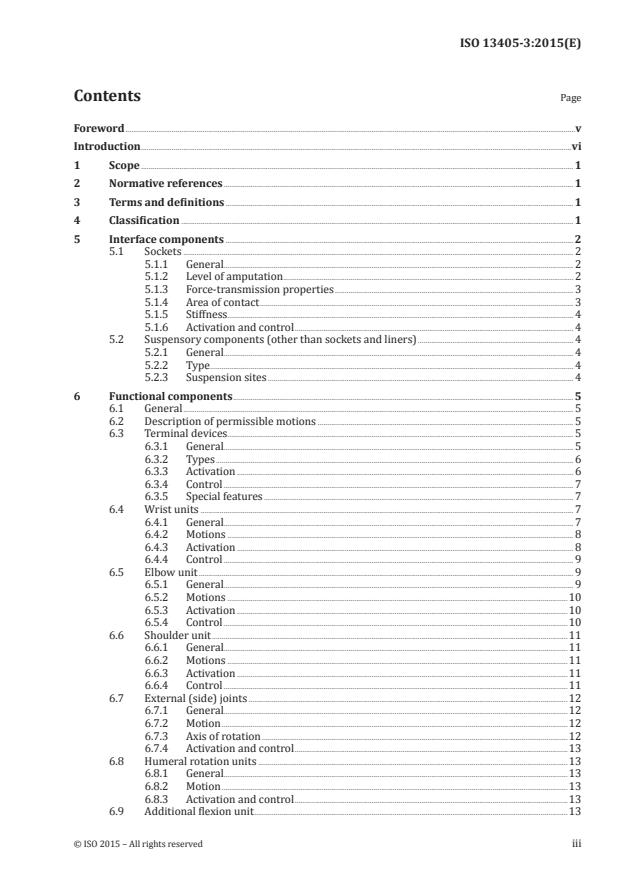
ISO 13405-3:2015 - Prosthetics and orthotics — Classification and description of prosthetic components — Part 3: Description of upper limb prosthetic components Released:1/16/2015
ISO 13405-3:2015 - Protheses et ortheses — Classification et description des composants de protheses — Partie 3: Description des composants de protheses des membres supérieurs Released:1/16/2015
Overview
ISO 13405-3:2015 - Prosthetics and orthotics - Classification and description of prosthetic components - Part 3: Description of upper limb prosthetic components - specifies a standardized method for describing components used in upper‑limb prostheses. The document provides a systematic vocabulary and classification approach so manufacturers, clinicians and service providers can describe sockets, suspensory systems, functional joints and finishing components in a consistent, unambiguous way.
Key topics and technical requirements
- Scope and normative references: Connects to ISO 13405‑1 (classification) and ISO 8549‑4 (amputation vocabulary) to ensure consistent terminology.
- Classification tree: Components are grouped into five classes - Interface, Functional, Alignment, Structural, and Finishing (cosmetic) - with a classification tree for upper limb prosthetic components.
- Interface components (sockets & suspension):
- Sockets: Require description of intended level of amputation (partial hand through scapulo‑thoracic), force‑transmission properties (axial vs distal vs total socket stabilization), transverse stabilization (anteroposterior, mediolateral, rotational), area of contact, stiffness, and activation/control features.
- Suspensory components: Classification by type and suspension sites.
- Functional components:
- Definition of permissible motions and standardized descriptions of terminal devices (types, activation, control, special features).
- Detailed descriptors for wrist, elbow, shoulder units, external (side) joints, humeral rotation units, and any additional flexion units (motions, activation and control methods).
- Alignment, Structural and Finishing components: Requirements for describing alignment adjustment features, load‑bearing structural parts, and cosmetic finishes.
Practical applications and users
- Manufacturers and product documentation: Use ISO 13405‑3 to produce clear, comparable product literature that describes component characteristics and intended amputation levels.
- Clinicians and prosthetists: Standardized descriptions aid component selection, reporting, and interdisciplinary communication in prosthetic fitting and rehabilitation.
- Regulatory bodies and procurement: Facilitates specification, tendering and regulatory review by providing consistent component descriptors.
- Researchers and educators: Provides a common language for publication, comparison and training in upper‑limb prosthetics.
Related standards and revision notes
- Part of the ISO 13405 series (see ISO 13405‑1 and ISO 13405‑2). This 2015 second edition expands the classification tree, extends amputation levels (including partial hand), and updates socket suspension and functional component types to reflect technological advances.
Keywords: ISO 13405‑3, upper limb prosthetic components, prosthetics and orthotics, socket classification, terminal devices, wrist unit, elbow unit, shoulder unit, amputation levels, prosthetic component description.
Relations
- Effective Date
- 28-Feb-2009
Buy Documents
ISO 13405-3:2015 - Prosthetics and orthotics — Classification and description of prosthetic components — Part 3: Description of upper limb prosthetic components Released:1/16/2015
ISO 13405-3:2015 - Protheses et ortheses — Classification et description des composants de protheses — Partie 3: Description des composants de protheses des membres supérieurs Released:1/16/2015
Get Certified
Connect with accredited certification bodies for this standard

BSI Group
BSI (British Standards Institution) is the business standards company that helps organizations make excellence a habit.

TÜV Rheinland
TÜV Rheinland is a leading international provider of technical services.

TÜV SÜD
TÜV SÜD is a trusted partner of choice for safety, security and sustainability solutions.
Sponsored listings
Frequently Asked Questions
ISO 13405-3:2015 is a standard published by the International Organization for Standardization (ISO). Its full title is "Prosthetics and orthotics — Classification and description of prosthetic components — Part 3: Description of upper limb prosthetic components". This standard covers: ISO 13405-3:2015 specifies a method for describing upper-limb prosthetic components.
ISO 13405-3:2015 specifies a method for describing upper-limb prosthetic components.
ISO 13405-3:2015 is classified under the following ICS (International Classification for Standards) categories: 11.040.40 - Implants for surgery, prosthetics and orthotics. The ICS classification helps identify the subject area and facilitates finding related standards.
ISO 13405-3:2015 has the following relationships with other standards: It is inter standard links to ISO 13405-3:1996. Understanding these relationships helps ensure you are using the most current and applicable version of the standard.
ISO 13405-3:2015 is available in PDF format for immediate download after purchase. The document can be added to your cart and obtained through the secure checkout process. Digital delivery ensures instant access to the complete standard document.
Standards Content (Sample)
INTERNATIONAL ISO
STANDARD 13405-3
Second edition
2015-01-15
Prosthetics and orthotics —
Classification and description of
prosthetic components —
Part 3:
Description of upper limb prosthetic
components
Prothèses et orthèses — Classification et description des composants
de prothèses —
Partie 3: Description des composants de prothèses des membres
supérieurs
Reference number
©
ISO 2015
© ISO 2015
All rights reserved. Unless otherwise specified, no part of this publication may be reproduced or utilized otherwise in any form
or by any means, electronic or mechanical, including photocopying, or posting on the internet or an intranet, without prior
written permission. Permission can be requested from either ISO at the address below or ISO’s member body in the country of
the requester.
ISO copyright office
Case postale 56 • CH-1211 Geneva 20
Tel. + 41 22 749 01 11
Fax + 41 22 749 09 47
E-mail copyright@iso.org
Web www.iso.org
Published in Switzerland
ii © ISO 2015 – All rights reserved
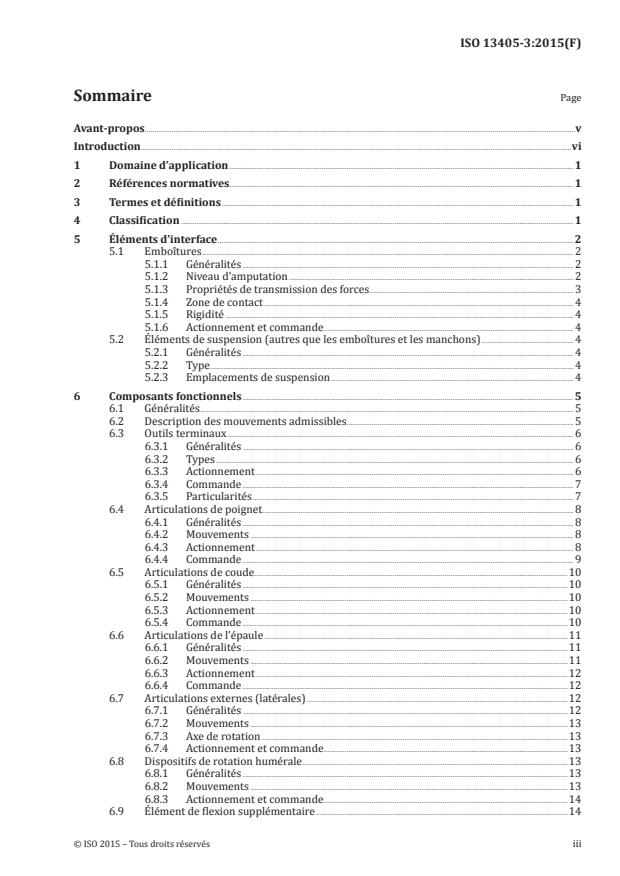
Contents Page
Foreword .v
Introduction .vi
1 Scope . 1
2 Normative references . 1
3 Terms and definitions . 1
4 Classification . 1
5 Interface components . 2
5.1 Sockets . 2
5.1.1 General. 2
5.1.2 Level of amputation . . 2
5.1.3 Force-transmission properties . 3
5.1.4 Area of contact . 3
5.1.5 Stiffness . 4
5.1.6 Activation and control . 4
5.2 Suspensory components (other than sockets and liners) . 4
5.2.1 General. 4
5.2.2 Type . . 4
5.2.3 Suspension sites . 4
6 Functional components . 5
6.1 General . 5
6.2 Description of permissible motions . 5
6.3 Terminal devices . 5
6.3.1 General. 5
6.3.2 Types . 6
6.3.3 Activation . 6
6.3.4 Control . 7
6.3.5 Special features . 7
6.4 Wrist units . 7
6.4.1 General. 7
6.4.2 Motions . 8
6.4.3 Activation . 8
6.4.4 Control . 9
6.5 Elbow unit . 9
6.5.1 General. 9
6.5.2 Motions .10
6.5.3 Activation .10
6.5.4 Control .10
6.6 Shoulder unit .11
6.6.1 General.11
6.6.2 Motions .11
6.6.3 Activation .11
6.6.4 Control .11
6.7 External (side) joints .12
6.7.1 General.12
6.7.2 Motion .12
6.7.3 Axis of rotation .12
6.7.4 Activation and control .13
6.8 Humeral rotation units .13
6.8.1 General.13
6.8.2 Motion .13
6.8.3 Activation and control .13
6.9 Additional flexion unit .13
7 Alignment components .14
8 Structural components .14
9 Finishing (cosmetic) components .14
iv © ISO 2015 – All rights reserved
Foreword
ISO (the International Organization for Standardization) is a worldwide federation of national standards
bodies (ISO member bodies). The work of preparing International Standards is normally carried out
through ISO technical committees. Each member body interested in a subject for which a technical
committee has been established has the right to be represented on that committee. International
organizations, governmental and non-governmental, in liaison with ISO, also take part in the work.
ISO collaborates closely with the International Electrotechnical Commission (IEC) on all matters of
electrotechnical standardization.
The procedures used to develop this document and those intended for its further maintenance are
described in the ISO/IEC Directives, Part 1. In particular the different approval criteria needed for the
different types of ISO documents should be noted. This document was drafted in accordance with the
editorial rules of the ISO/IEC Directives, Part 2 (see www.iso.org/directives).
Attention is drawn to the possibility that some of the elements of this document may be the subject of
patent rights. ISO shall not be held responsible for identifying any or all such patent rights. Details of any
patent rights identified during the development of the document will be in the Introduction and/or on
the ISO list of patent declarations received (see www.iso.org/patents).
Any trade name used in this document is information given for the convenience of users and does not
constitute an endorsement.
For an explanation on the meaning of ISO specific terms and expressions related to conformity
assessment, as well as information about ISO’s adherence to the WTO principles in the Technical Barriers
to Trade (TBT), see the following URL: Foreword - Supplementary Information.
The committee responsible for this document is ISO/TC 168, Prosthetics and orthotics.
This second edition cancels and replaces the first edition (ISO 13405-3:1996), which has been technically
revised with the following changes:
a) classification tree of upper limb prosthetic components added to Clause 4;
b) levels of amputation extended to include all partial hand levels;
c) methods of socket suspension extended;
d) classification tree for functional components added in Clause 5;
e) range of the types of terminal devices, wrist units, elbow units, and shoulder units extended;
f) range of adjustment of alignment components deleted.
ISO 13405 consists of the following parts, under the general title Prosthetics and orthotics — Classification
and description of prosthetic components:
— Part 1: Classification of prosthetic components
— Part 2: Description of lower limb prosthetic components
— Part 3: Description of upper limb prosthetic components
Introduction
This part of ISO 13405 was the first internationally accepted standard method to describe the
components of upper limb prostheses. It is designed to permit the users to describe systematically each
component which is incorporated in a finished prosthesis in a manner which clearly explains its principal
characteristics. This part of ISO 13405 is envisaged as being suitable for use by both manufacturers
producing literature describing their products and practitioners who are reporting on the components
used in the treatment of persons requiring prosthesis.
Prosthetic technology has made considerable advances since the publication of the first edition of this
part of ISO 13405. This first revision is designed to include the new types of components which have
come into use during this period.
Manufacturers’ trade names and details of the materials and manufacturing methods employed have
been avoided.
vi © ISO 2015 – All rights reserved
INTERNATIONAL STANDARD ISO 13405-3:2015(E)
Prosthetics and orthotics — Classification and description
of prosthetic components —
Part 3:
Description of upper limb prosthetic components
1 Scope
This part of ISO 13405 specifies a method for describing upper limb prosthetic components.
2 Normative references
The following documents, in whole or in part, are normatively referenced in this document and are
indispensable for its application. For dated references, only the edition cited applies. For undated
references, the latest edition of the referenced document (including any amendments) applies.
ISO 8549-4, Prosthetics and orthotics — Vocabulary — Part 4: Terms relating to limb amputation
ISO 13405-1:2014, Prosthetics and orthotics — Classification and description of prosthetic components —
Part 1: Classification of prosthetic components
3 Terms and definitions
For the purposes of this document, the following terms and definitions apply.
3.1
grip configuration
position of function of a prosthetic hand
4 Classification
The components of upper limb prostheses include the five classes identified in ISO 13405-1:2014, 3.1, as
shown in Figure 1 and Figure 2, and as described in Clauses 5 to 9.
5 6 7 8 9
Interface Functional Alignment Structural Finishing(cosmetic)
components components components components components
5.2
5.1
Suspensory
Sockets
components
5.1.3
5.1.2
5.1.6 5.2.3
Force- 5.2.2
5.1.4 5.1.5
Level of
Activation and Suspension
transmission Type
Area of contact Stiffness
amputation
control site
properties
5.1.3.3
5.1.3.2
5.1.3.4
Axial Transverse
Suspension
stabilization stabilization
Figure 1 — Upper limb prosthetic components — Classification tree
5 Interface components
5.1 Sockets
5.1.1 General
Describe the socket by including the following information.
5.1.2 Level of amputation
State the level of amputation for which the socket, and hence, the prosthesis, is intended by referring to
the list of levels defined in ISO 8549-4:2014, 3.1.3, that is, as one of the following:
a) partial hand amputations; these include:
— thumb;
— phalangeal;
— metacarpo-phalangeal disarticulation;
— metacarpal;
— carpo-metacarpal disarticulation;
— carpal;
b) wrist disarticulation;
c) trans-radial amputation;
d) elbow disarticulation;
e) trans-humeral amputation;
f) shoulder disarticulation;
g) scapulo-thoracic disarticulation amputation (forequarter).
2 © ISO 2015 – All rights reserved
5.1.3 Force-transmission properties
5.1.3.1 General
The force-transmission properties of a socket relate to that aspect of the shaping of the socket which is
concerned with axial stabilization, transverse stabilization, and suspension.
5.1.3.2 Axial stabilization
State the principal intended method of axial stabilization as one of the following:
a) proximal stabilization, in which the principal stabilization forces are generated by the shaping of
the proximal region of the socket;
b) distal stabilization, in which the principal stabilization forces are generated by the shaping of the
end of the socket;
c) total socket stabilization, in which the stabilization forces are generated by the shaping of the whole
surface of the socket.
5.1.3.3 Transverse stabilization
Transverse stabilization is necessary to minimize the angular movement between the stump and the
socket during prosthetic use. Three forms of stabilization are required: anteroposterior, mediolateral,
and rotational.
State when appropriate, any particular features of the socket shaping associated with transverse
stabilization.
State whether the
...
NORME ISO
INTERNATIONALE 13405-3
Deuxième édition
2015-01-15
Prothèses et orthèses —
Classification et description des
composants de prothèses —
Partie 3:
Description des composants de
prothèses des membres supérieurs
Prosthetics and orthotics — Classification and description of
prosthetic components —
Part 3: Description of upper limb prosthetic components
Numéro de référence
©
ISO 2015
DOCUMENT PROTÉGÉ PAR COPYRIGHT
© ISO 2015
Droits de reproduction réservés. Sauf indication contraire, aucune partie de cette publication ne peut être reproduite ni utilisée
sous quelque forme que ce soit et par aucun procédé, électronique ou mécanique, y compris la photocopie, l’affichage sur
l’internet ou sur un Intranet, sans autorisation écrite préalable. Les demandes d’autorisation peuvent être adressées à l’ISO à
l’adresse ci-après ou au comité membre de l’ISO dans le pays du demandeur.
ISO copyright office
Case postale 56 • CH-1211 Geneva 20
Tel. + 41 22 749 01 11
Fax + 41 22 749 09 47
E-mail copyright@iso.org
Web www.iso.org
Publié en Suisse
ii © ISO 2015 – Tous droits réservés
Sommaire Page
Avant-propos .v
Introduction .vi
1 Domaine d’application . 1
2 Références normatives . 1
3 Termes et définitions . 1
4 Classification . 1
5 Éléments d’interface . 2
5.1 Emboîtures . 2
5.1.1 Généralités . 2
5.1.2 Niveau d’amputation . 2
5.1.3 Propriétés de transmission des forces . 3
5.1.4 Zone de contact . 4
5.1.5 Rigidité . 4
5.1.6 Actionnement et commande . 4
5.2 Éléments de suspension (autres que les emboîtures et les manchons) . 4
5.2.1 Généralités . 4
5.2.2 Type . . 4
5.2.3 Emplacements de suspension . 4
6 Composants fonctionnels . 5
6.1 Généralités . 5
6.2 Description des mouvements admissibles. 5
6.3 Outils terminaux . 6
6.3.1 Généralités . 6
6.3.2 Types . 6
6.3.3 Actionnement . 6
6.3.4 Commande . 7
6.3.5 Particularités . 7
6.4 Articulations de poignet. 8
6.4.1 Généralités . 8
6.4.2 Mouvements . 8
6.4.3 Actionnement . 8
6.4.4 Commande . 9
6.5 Articulations de coude.10
6.5.1 Généralités .10
6.5.2 Mouvements .10
6.5.3 Actionnement .10
6.5.4 Commande .10
6.6 Articulations de l’épaule .11
6.6.1 Généralités .11
6.6.2 Mouvements .11
6.6.3 Actionnement .12
6.6.4 Commande .12
6.7 Articulations externes (latérales) .12
6.7.1 Généralités .12
6.7.2 Mouvements .13
6.7.3 Axe de rotation .13
6.7.4 Actionnement et commande .13
6.8 Dispositifs de rotation humérale .13
6.8.1 Généralités .13
6.8.2 Mouvements .13
6.8.3 Actionnement et commande .14
6.9 Élément de flexion supplémentaire .14
7 Dispositifs d’alignement .14
8 Composants structurels .14
9 Éléments de finition (esthétiques) .14
iv © ISO 2015 – Tous droits réservés
Avant-propos
L’ISO (Organisation internationale de normalisation) est une fédération mondiale d’organismes
nationaux de normalisation (comités membres de l’ISO). L’élaboration des Normes internationales est
en général confiée aux comités techniques de l’ISO. Chaque comité membre intéressé par une étude
a le droit de faire partie du comité technique créé à cet effet. Les organisations internationales,
gouvernementales et non gouvernementales, en liaison avec l’ISO participent également aux travaux.
L’ISO collabore étroitement avec la Commission électrotechnique internationale (IEC) en ce qui concerne
la normalisation électrotechnique.
Les procédures utilisées pour élaborer le présent document et celles destinées à sa mise à jour sont
décrites dans les Directives ISO/IEC, Partie 1. Il convient, en particulier de prendre note des différents
critères d’approbation requis pour les différents types de documents ISO. Le présent document a été
rédigé conformément aux règles de rédaction données dans les Directives ISO/IEC, Partie 2 (voir www.
iso.org/directives).
L’attention est appelée sur le fait que certains des éléments du présent document peuvent faire l’objet de
droits de propriété intellectuelle ou de droits analogues. L’ISO ne saurait être tenue pour responsable
de ne pas avoir identifié de tels droits de propriété et averti de leur existence. Les détails concernant les
références aux droits de propriété intellectuelle ou autres droits analogues identifiés lors de l’élaboration
du document sont indiqués dans l’Introduction et/ou dans la liste des déclarations de brevets reçues par
l’ISO (voir www.iso.org/brevets).
Les appellations commerciales éventuellement mentionnées dans le présent document sont données pour
information, par souci de commodité, à l’intention des utilisateurs et ne sauraient constituer un engagement.
Pour une explication de la signification des termes et expressions spécifiques de l’ISO liés à l’évaluation de
la conformité, ou pour toute information au sujet de l’adhésion de l’ISO aux principes de l’OMC concernant
les obstacles techniques au commerce (OTC), voir le lien suivant: Avant-propos — Informations
supplémentaires.
Le comité chargé de l’élaboration du présent document est l’ISO/TC 168, Prothèses et orthèses.
Cette deuxième édition annule et remplace la première édition (ISO 13405-3:1996), qui a fait l’objet
d’une révision technique avec les modifications suivantes:
a) ajout d’un arbre de classification des composants de prothèses de membres supérieurs à l’Article 4;
b) extension des niveaux d’amputation de façon à inclure tous les niveaux d’amputation partielle de la main;
c) compléments sur les méthodes de suspension de l’emboîture;
d) ajout d’un arbre de classification des composants fonctionnels à l’Article 5;
e) extension de la gamme des types d’outils terminaux, articulations de poignets, articulations de
coude et articulations de l’épaule;
f) suppression de la plage de réglage des composants d’alignement.
L’ISO 13405 comprend les parties suivantes, présentées sous le titre général Prothèses et orthèses —
Classification et description des composants de prothèses:
— Partie 1: Classification des composants de prothèses
— Partie 2: Description des composants de prothèses des membres inférieurs
— Partie 3: Description des composants de prothèses des membres supérieurs
Introduction
La présente partie de l’ISO 13405 a été la première méthode normalisée de description des composants
de prothèses de membres supérieurs reconnue au niveau international. Elle est conçue pour permettre
aux utilisateurs de décrire méthodiquement chaque composant d’une prothèse finie de manière à
expliquer clairement ses principales caractéristiques. La présente partie de l’ISO 13405 est considérée
comme étant appropriée pour être utilisée à la fois par les fabricants rédigeant des brochures décrivant
leurs produits et par les praticiens faisant des rapports sur les composants utilisés dans le traitement de
personnes nécessitant une prothèse.
La technologie des prothèses a considérablement progressé depuis la publication de la première édition
de la présente partie de l’ISO 13405. Cette première révision est conçue pour inclure les nouveaux types
de composants utilisés pendant cette période.
Les marques des fabricants et les détails concernant les matériaux et les méthodes de fabrication utilisés
ont été évités.
vi © ISO 2015 – Tous droits réservés
NORME INTERNATIONALE ISO 13405-3:2015(F)
Prothèses et orthèses — Classification et description des
composants de prothèses —
Partie 3:
Description des composants de prothèses des membres
supérieurs
1 Domaine d’application
La présente partie de l’ISO 13405 spécifie une méthode de description des composants de prothèses des
membres supérieurs.
2 Références normatives
Les documents suivants, en totalité ou en partie, sont référencés de manière normative dans le présent
document et sont indispensables pour son application. Pour les références datées, seule l’édition citée
s’applique. Pour les références non datées, la dernière édition du document de référence s’applique (y
compris les éventuels amendements).
ISO 8549-4, Prothèses et orthèses — Vocabulaire — Partie 4: Termes relatifs à l’amputation de membres
ISO 13405-1:2014, Prothèses et orthèses — Classification et description des composants de prothèses —
Partie 1: Classification des composants de prothèses
3 Termes et définitions
Pour les besoins du présent document, le terme et la définition suivants s’appliquent.
3.1
configuration de préhension
position de fonction d’une main prothétique
4 Classification
Les composants de prothèses des membres supérieurs comportent cinq catégories identifiées dans
l’ISO 13405-1:2014, 3.1, illustrées aux Figures 1 et 2 et décrites dans les Articles 5 à 9.
Figure 1 — Composants des prothèses de membres supérieurs – Arbre de classification
5 Éléments d’interface
5.1 Emboîtures
5.1.1 Généralités
Décrire l’emboîture en incluant les informations suivantes.
5.1.2 Niveau d’amputation
Indiquer le niveau d’amputation auquel l’emboîture et donc la prothèse sont destinées en se référant à la
liste des niveaux définis dans l’ISO 8549-4:2014, 3.1.3, c’est-à-dire à l’un des suivants:
a) amputation partielle de main, notamment
— amputation du pouce,
— amputation phalangienne,
— désarticulation métacarpo-phalangienne,
— amputation métacarpienne,
— désarticulation carpo-métacarpienne,
— amputation carpienne;
b) désarticulation de poignet;
c) amputation transradiale;
d) désarticulation de coude;
e) amputation transhumérale;
2 © ISO 2015 – Tous droits réservés
f) désarticulation d’épaule;
g) amputation inter-scapulo-thoracique.
5.1.3 Propriétés de transmission des forces
5.1.3.1 Généralités
Les propriétés de transmission des forces d’une emboîture sont en rapport avec la configuration de
I’emboîture qui est concernée par la stabilisation axiale, la stabilisation transversale et la suspension.
5.1.3.2 Stabilisation axiale
Indiquer la principale méthode de stabilisation axiale prévue qui sera l’une des suivantes:
a) stabilisation proximale dans laquelle les principales forces de stabilisation sont générées par la
configuration de la région proximale de l’emboîture;
b) stabilisation distale dans laquelle les principales forces de stabilisation sont générées par la
configuration de l’extrémité de l’emboîture;
c) stabilisation totale de l’emboîture dans laquelle les forces de stabilisation sont générées par la
configuration de toute la surface de l’emboîture.
5.1.3.3 Stabilisation transversale
La stabilisation transversale est nécessaire pour réduire au minimum le mouvement angulaire entre
le moignon et l’emboîture lors du port de la prothèse. Trois formes de stabilisation sont nécessaires:
antéro-postérieure, médio-latérale et rotationnelle.
Indiquer, le cas échéant, les particularités de la configuration de l’emboîture associée à la stabilisation
transversale.
Indiquer si les forces de stabilisation de l’emboîture sont modifiées par l’utilisation d’un manchon.
5.1.3.4 Suspension
La suspension est nécessaire pour réduire au minimum le mouvement axial entre le moignon et
l’emboîture lorsque les forces longitudinales externes sont dirigées dans le sens distal.
L’emboîture peut être suspendue de trois façons:
a) par une suspension anatomique dont les caractéristiques de suspension sont obtenues en modelant
l’emboîture sur l’anatomie sous-jacente (cela peut nécessiter l’ouverture de l’emboîture à l’aide
d’éléments amovibles, de manchons amovibles ou d’autres moyens facilitant la pose et le retrait);
b) par une suspension à différentiel de pression (en dépression) dont les propriétés de suspension sont
obtenues en utilisant une emboîture comportant une extrémité étanche qui ne s’enlève pas du fait
du différentiel de pression résultant de cette action; ou
c) par l’utilisation d’un manchon qui crée un différentiel de pression du fait de son contact intime avec
le moignon et qui est mécaniquement couplé à l’emboîture dans le sens distal.
...