

ISO 20579-1:2024
(Main)Surface chemical analysis — Sample handling, preparation and mounting — Part 1: Documenting and reporting the handling of specimens prior to analysis
General Information
- Abstract
This document identifies the information needed to ensure that a sample has been selected, processed, handled, and stored in a manner consistent with the analysis objectives, and to ensure the reliability and reproducibility of the surface analyses. Such information is also an important component of sample data record books, datasheets, certificates of analysis, reports, and other publications. This information is in addition to other details associated with the specimens to be analysed, such as source/synthesis information, processing history, and other characterizations that naturally become part of the data record (sometimes referred to as provenance information) regarding the origin of the sample and any changes to its original form. This document also includes normative annexes as an aid to understanding the special sample handling techniques and storage requirements of surface chemical analysis techniques, particularly: Auger electron spectroscopy (AES), secondary ion mass spectrometry (SIMS), and X-ray photoelectron spectroscopy (XPS). The information presented can also be applicable for other analytical techniques, such as total reflection X-ray fluorescence spectroscopy (TXRF), that is sensitive to surface composition, and scanning probe microscopy (SPM), that is sensitive to surface morphology. This document does not define the nature of instrumentation or operating procedures needed to ensure that the analytical measurements described have been appropriately conducted.
- Status
- Published
- Publication Date
- 17-Sep-2024
- Technical Committee
- ISO/TC 201/SC 2 - General procedures
- Drafting Committee
- ISO/TC 201/SC 2 - General procedures
- Current Stage
- 6060 - International Standard published
- Start Date
- 18-Sep-2024
- Due Date
- 17-Feb-2025
- Completion Date
- 18-Sep-2024


Overview
ISO 20579-1:2024 - Surface chemical analysis - Sample handling, preparation and mounting - Part 1 - specifies the information that must be documented and reported about specimen handling prior to surface analysis. The standard ensures samples are selected, processed, handled and stored in a way that is consistent with analysis objectives and that supports reliable, reproducible surface-sensitive measurements. It complements other provenance data (source, synthesis, processing history) but does not define instrumentation or analytical operating procedures.
Key topics and requirements
- Documentation of sample provenance: unique sample I.D., area(s) of interest, source/synthesis, and any prior processing or analyses.
- Analysis objectives: record the purpose and priority for the measurement (e.g., contamination detection, compositional mapping, chemical state).
- General sample handling protocols: avoid direct contact with the analysis surface, prevent contamination from gases/particles/outgassing, and document any unavoidable contact or deviations.
- Cleaning, cutting and preparation records: fully document cleaning procedures, cutting or sectioning methods and justify any steps that may alter the surface.
- Storage and transport information: container types, storage environment, dates and handling during transit (expanded in Annex C).
- Contamination control and order-of-analysis guidance: Annex B provides methods to minimize contamination and guidance on sequencing measurements to reduce surface alteration.
- Normative annexes:
- Annex A - overview of sample-handling issues and methods;
- Annex B - critical contamination-minimizing practices and analysis order;
- Annex C - storage and transport requirements.
- Technique focus: tailored for surface-sensitive methods such as AES, XPS and SIMS, with applicability to TXRF, SPM and other surface-sensitive techniques.
Practical applications
ISO 20579-1 is used to:
- Improve data reliability and reproducibility in surface chemical analysis projects.
- Provide standard content for sample datasheets, certificates of analysis, and laboratory reports.
- Guide specimen owners and submitters on how to prepare and describe samples to analytical laboratories.
- Support quality assurance and traceability in investigations of corrosion, coatings, thin films, catalysis, semiconductors, biomaterials and nanomaterials where surface composition or morphology is critical.
Who should use this standard
- Specimen owners and submitters requesting surface analysis.
- Surface-analysis laboratories and analysts preparing reports.
- R&D and QA teams in industries relying on surface-sensitive characterization.
- Technical writers and data stewards compiling provenance records and certificates of analysis.
Related standards
- ISO 20579 series (other parts addressing analyst reporting, biomaterials, nanomaterials).
- ISO 18115-1 and ISO 18115-2 (vocabulary for surface chemical analysis and SPM terms).
Keywords: ISO 20579-1:2024, surface chemical analysis, sample handling, sample preparation, sample mounting, sample provenance, AES, XPS, SIMS, surface contamination, sample storage and transport.
Relations
- Effective Date
- 16-Mar-2024
Get Certified
Connect with accredited certification bodies for this standard

ECOCERT
Organic and sustainability certification.

Eurofins Food Testing Global
Global leader in food, environment, and pharmaceutical product testing.

Intertek Bangladesh
Intertek certification and testing services in Bangladesh.
Sponsored listings
Frequently Asked Questions
ISO 20579-1:2024 is a standard published by the International Organization for Standardization (ISO). Its full title is "Surface chemical analysis — Sample handling, preparation and mounting — Part 1: Documenting and reporting the handling of specimens prior to analysis". This standard covers: This document identifies the information needed to ensure that a sample has been selected, processed, handled, and stored in a manner consistent with the analysis objectives, and to ensure the reliability and reproducibility of the surface analyses. Such information is also an important component of sample data record books, datasheets, certificates of analysis, reports, and other publications. This information is in addition to other details associated with the specimens to be analysed, such as source/synthesis information, processing history, and other characterizations that naturally become part of the data record (sometimes referred to as provenance information) regarding the origin of the sample and any changes to its original form. This document also includes normative annexes as an aid to understanding the special sample handling techniques and storage requirements of surface chemical analysis techniques, particularly: Auger electron spectroscopy (AES), secondary ion mass spectrometry (SIMS), and X-ray photoelectron spectroscopy (XPS). The information presented can also be applicable for other analytical techniques, such as total reflection X-ray fluorescence spectroscopy (TXRF), that is sensitive to surface composition, and scanning probe microscopy (SPM), that is sensitive to surface morphology. This document does not define the nature of instrumentation or operating procedures needed to ensure that the analytical measurements described have been appropriately conducted.
This document identifies the information needed to ensure that a sample has been selected, processed, handled, and stored in a manner consistent with the analysis objectives, and to ensure the reliability and reproducibility of the surface analyses. Such information is also an important component of sample data record books, datasheets, certificates of analysis, reports, and other publications. This information is in addition to other details associated with the specimens to be analysed, such as source/synthesis information, processing history, and other characterizations that naturally become part of the data record (sometimes referred to as provenance information) regarding the origin of the sample and any changes to its original form. This document also includes normative annexes as an aid to understanding the special sample handling techniques and storage requirements of surface chemical analysis techniques, particularly: Auger electron spectroscopy (AES), secondary ion mass spectrometry (SIMS), and X-ray photoelectron spectroscopy (XPS). The information presented can also be applicable for other analytical techniques, such as total reflection X-ray fluorescence spectroscopy (TXRF), that is sensitive to surface composition, and scanning probe microscopy (SPM), that is sensitive to surface morphology. This document does not define the nature of instrumentation or operating procedures needed to ensure that the analytical measurements described have been appropriately conducted.
ISO 20579-1:2024 is classified under the following ICS (International Classification for Standards) categories: 71.040.40 - Chemical analysis. The ICS classification helps identify the subject area and facilitates finding related standards.
ISO 20579-1:2024 has the following relationships with other standards: It is inter standard links to ISO 18117:2009. Understanding these relationships helps ensure you are using the most current and applicable version of the standard.
ISO 20579-1:2024 is available in PDF format for immediate download after purchase. The document can be added to your cart and obtained through the secure checkout process. Digital delivery ensures instant access to the complete standard document.
Standards Content (Sample)
International
Standard
ISO 20579-1
First edition
Surface chemical analysis —
2024-09
Sample handling, preparation and
mounting —
Part 1:
Documenting and reporting the
handling of specimens prior to
analysis
Analyse chimique des surfaces — Manipulation, préparation et
montage des échantillons —
Partie 1: Documentation et notification des données de
manipulation des échantillons avant analyse
Reference number
© ISO 2024
All rights reserved. Unless otherwise specified, or required in the context of its implementation, no part of this publication may
be reproduced or utilized otherwise in any form or by any means, electronic or mechanical, including photocopying, or posting on
the internet or an intranet, without prior written permission. Permission can be requested from either ISO at the address below
or ISO’s member body in the country of the requester.
ISO copyright office
CP 401 • Ch. de Blandonnet 8
CH-1214 Vernier, Geneva
Phone: +41 22 749 01 11
Email: copyright@iso.org
Website: www.iso.org
Published in Switzerland
ii
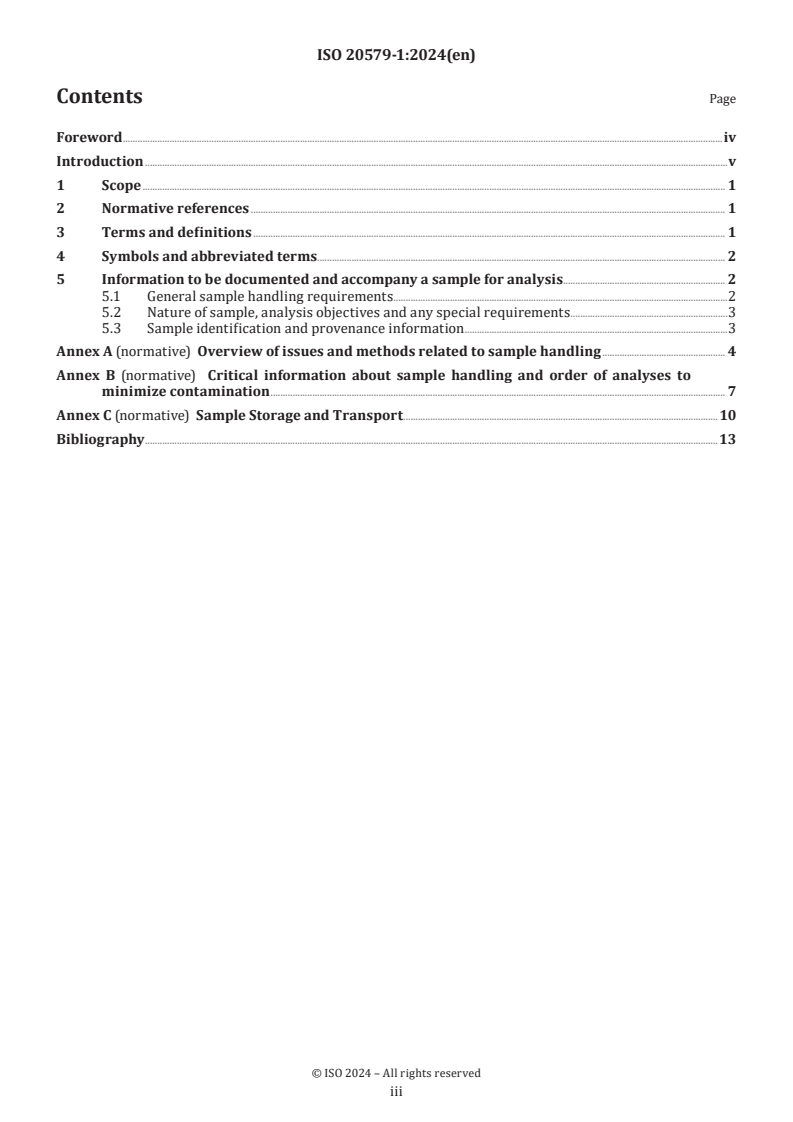
Contents Page
Foreword .iv
Introduction .v
1 Scope . 1
2 Normative references . 1
3 Terms and definitions . 1
4 Symbols and abbreviated terms. 2
5 Information to be documented and accompany a sample for analysis . 2
5.1 General sample handling requirements .2
5.2 Nature of sample, analysis objectives and any special requirements .3
5.3 Sample identification and provenance information .3
Annex A (normative) Overview of issues and methods related to sample handling . 4
Annex B (normative) Critical information about sample handling and order of analyses to
minimize contamination . 7
Annex C (normative) Sample Storage and Transport . 10
Bibliography .13
iii
Foreword
ISO (the International Organization for Standardization) is a worldwide federation of national standards
bodies (ISO member bodies). The work of preparing International Standards is normally carried out through
ISO technical committees. Each member body interested in a subject for which a technical committee
has been established has the right to be represented on that committee. International organizations,
governmental and non-governmental, in liaison with ISO, also take part in the work. ISO collaborates closely
with the International Electrotechnical Commission (IEC) on all matters of electrotechnical standardization.
The procedures used to develop this document and those intended for its further maintenance are described
in the ISO/IEC Directives, Part 1. In particular, the different approval criteria needed for the different types
of ISO document should be noted. This document was drafted in accordance with the editorial rules of the
ISO/IEC Directives, Part 2 (see www.iso.org/directives).
ISO draws attention to the possibility that the implementation of this document may involve the use of (a)
patent(s). ISO takes no position concerning the evidence, validity or applicability of any claimed patent
rights in respect thereof. As of the date of publication of this document, ISO had not received notice of (a)
patent(s) which may be required to implement this document. However, implementers are cautioned that
this may not represent the latest information, which may be obtained from the patent database available at
www.iso.org/patents. ISO shall not be held responsible for identifying any or all such patent rights.
Any trade name used in this document is information given for the convenience of users and does not
constitute an endorsement.
For an explanation of the voluntary nature of standards, the meaning of ISO specific terms and expressions
related to conformity assessment, as well as information about ISO's adherence to the World Trade
Organization (WTO) principles in the Technical Barriers to Trade (TBT), see www.iso.org/iso/foreword.html.
This document was prepared by Technical Committee ISO/TC 201, Surface Chemical Analysis, Subcommittee
SC 2, General procedures.
This first edition of ISO 20579-1 cancels and replaces ISO 18117:2009.
A list of all parts in the ISO 20579 series can be found on the ISO website.
Any feedback or questions on this document should be directed to the user’s national standards body. A
complete listing of these bodies can be found at www.iso.org/members.html.
iv
Introduction
0.1 Introduction to the ISO 20579 series
The handling and preparation of samples for surface analysis can physically or chemically alter the surface.
Therefore, reliable surface analysis depends upon knowing the analysis objectives and knowledge of the
sample history including aspects of how the sample has been prepared, stored, processed, and handled
prior to and during analysis. The ISO 20579 series describes the information that needs to be collected and
included as part of the sample history (sample provenance information). Both ISO 20579-1 and ISO 20579-2
describe information to be recorded regarding sample handling, and storage. This document describes
information needed regarding sample selection, handling, and preparation when requesting surface
analysis. ISO 20579-2 provides information about sample handling, preparation, mounting and processing
to be reported by an analyst. ISO 20579-3 and ISO 20579-4 focus on specific handling and reporting needs
associated with nanomaterials (ISO 20579-4) and biomaterials (ISO 20579-3). Each part of this series
can be used independently of the other parts, although the general reporting requirements described in
[1]
this document (ISO 20579-1) and in ISO 20579-2 are applicable to a wide range of materials and are not
reproduced in ISO 20579-3 and ISO 20579-4.
Although primarily prepared for the surface-analysis techniques of Auger-electron spectroscopy (AES),
X-ray photoelectron spectroscopy (XPS), and secondary-ion mass spectrometry (SIMS), the methods
described in this document are also applicable to many other surface-sensitive analytical techniques such
as ion-scattering spectrometry, scanning probe microscopy, low-energy electron diffraction and electron
energy-loss spectroscopy, where specimen handling can influence surface-sensitive measurements. AES,
XPS, and SIMS are sensitive to surface layers that are typically a few nanometers thick. Such thin layers
can be subject to severe perturbations caused by specimen handling or surface treatments that can be
necessary prior to introduction into the analytical chamber. Proper handling and preparation of specimens
is particularly critical for dependable analysis. Improper handling of specimens can result in alteration of
[2][3]
the surface composition and unreliable data.
0.2 Introduction to this document (ISO 20579-1)
This document is intended for the specimen owner or someone requesting surface analytical services.
It describes the minimum information regarding the analysis objectives and sample preparation that an
analyst needs to know to determine if and how the desired information can be obtained. This information
becomes part of sample provenance record to help validate the reliability and usefulness of data obtained
[4]
from surface-analysis methods.
Surface analysis methods measure the outer atomic layers of a specimen surface which can be inadvertently
altered by inappropriate handling or preparation. Therefore, the degree of care and cleanliness required
by surface-sensitive analytical techniques is usually much greater than for many other analysis methods.
Appropriate careful sample selection, preparation and storage are essential for reliable surface analysis and
the documentation and reporting of this information is critical to the ability to assess the validity of surface
analysis information.
Although the categories of needed reporting are similar for all specimens, the details of the required sample
handling can vary depending on the nature of the sample and analysis objectives. Annexes to this document
and references therein provide background information useful to assist in identification of the necessary
sample preparation, handling, storage, and transport requirements that maximize the ability for obtaining
the desired information.
Annex A identifies three categories of analysis objectives and provides an overview of the challenges
associated with sample preparation for surface analysis in the context of each desired objective. Included
is a table summarizing relevant sample handling methods and types of specimen containers needed for the
three types of analysis objectives and is intended to help those requiring surface analysis. Annex B discusses
common sources of contamination and issues along with methods to minimize contamination related to
sample handling. Annex C discusses topics related to sample storage and transportation.
v
International Standard ISO 20579-1:2024(en)
Surface chemical analysis — Sample handling, preparation
and mounting —
Part 1:
Documenting and reporting the handling of specimens prior
to analysis
1 Scope
This document identifies the information needed to ensure that a sample has been selected, processed,
handled, and stored in a manner consistent with the analysis objectives, and to ensure the reliability and
reproducibility of the surface analyses. Such information is also an important component of sample data record
books, datasheets, certificates of analysis, reports, and other publications. This information is in addition to
other details associated with the specimens to be analysed, such as source/synthesis information, processing
history, and other characterizations that naturally become part of the data record (sometimes referred to as
provenance information) regarding the origin of the sample and any changes to its original form.
This document also includes normative annexes as an aid to understanding the special sample handling
techniques and storage requirements of surface chemical analysis techniques, particularly: Auger electron
spectroscopy (AES), secondary ion mass spectrometry (SIMS), and X-ray photoelectron spectroscopy (XPS).
The information presented can also be applicable for other analytical techniques, such as total reflection
X-ray fluorescence spectroscopy (TXRF), that is sensitive to surface composition, and scanning probe
microscopy (SPM), that is sensitive to surface morphology.
This document does not define the nature of instrumentation or operating procedures needed to ensure
that the analytical measurements described have been appropriately conducted.
2 Normative references
The following documents are referred to in the text in such a way that some of their content constitutes
requirements of this document. For dated references, only the edition cited applies. For undated references,
the latest edition of the referenced document (including any amendments) applies.
ISO 18115-1, Surface chemical analysis — Vocabulary — Part 1: General terms and terms used in spectroscopy
ISO 18115-2, Surface chemical analysis — Vocabulary — Part 2: Terms used in scanning-probe microscopy
3 Terms and definitions
For the purposes of this document, the terms and definitions given in ISO 18115-1 and ISO 18115-2 apply.
ISO and IEC maintain terminology databases for use in standardization at the following addresses:
— ISO Online browsing platform: available at https:// www .iso .org/ obp
— IEC Electropedia: available at https:// www .electropedia .org/
4 Symbols and abbreviated terms
AES Auger electron spectroscopy
AFM atomic force microscopy
ALD atomic layer deposition
I.D. identification
ISS ion-scattering spectroscopy
PTFE polytetrafluoroethylene
SEM scanning electron microscopy
SIMS secondary ion mass spectrometry
SPM scanning probe microscopy
TEM transmission electron microscopy
TXRF total reflection X-ray fluorescence spectroscopy
XPS X-ray photoelectron Spectroscopy
5 Information to be documented and accompany a sample for analysis
5.1 General sample handling requirements
The generic sample handling protocols identified in 5.1 shall be followed to maintain the stringent
[5][6]
cleanliness required for meaningful surface analysis. The protocols are further described and justified
in Annex B and shall be carried out in accordance with B.2.2 and B.2.3. Any exceptions or deviations shall be
documented and discussed in advance with the analyst.
Specifically, avoid touching the surface to be analysed with any material. This includes tools, hands, and
containers. Avoid, to the extent possible, adventitious contact from gases, liquids, particulates, or outgassing
materials near the surface or present in the environment.
Thoroughly document all cleaning processes. Be extremely careful of any cleaning processes to make sure
they do not alter the sample surface. Be very careful to use only clean, pure, non-reactive gases (never blow
on the sample with your mouth!) and delivery systems (including lines, nozzles, etc.) if required to dust off
particulates.
If smaller samples need to be prepared for analysis, thoroughly document any cutting or sectioning
procedures, along with any associated cleaning. It is best to consult with the analyst in advance on how best
to prepare these samples. Consider having the analyst perform any such procedure. Justifications for these
measures and guidance for specific analysis objectives are described in Annex A, which also includes a table
identifying typical sample handling requirements in relation to the information desired. Information about
approaches needed to minimize sample contamination and information damage is provided in Annex B, and
information about sample storage and transport requirements in Annex C.
Other sample handling details, based on the guidance in the annexes, shall be reported as indicated in 5.2
and 5.3.
EXAMPLE 1 Because of the small sample size, touching the surface to be analysed with the cleaned mounting tools
was unavoidable. However, contact was minimized to the extent possible.
EXAMPLE 2 Sample obtained for failure analysis received unknown handling before it was submitted to the
laboratory for detailed study.
EXAMPLE 3 Sample surface might have been contacted by an ungloved hand during collection.
5.2 Nature of sample, analysis objectives and any special requirements
The type of sample and the analysis objectives, considering the hierarchy described in Annex A, shall be
recorded, and reported as they provide critical information related to the detailed processes an analyst
needs to consider in undertaking surface analysis measurements.
EXAMPLE 1 Thin film of strontium titanate to be examined for surface contamination.
EXAMPLE 2 As received battery electrode to be examined for composition before electrochemical cycling. Needs to
be handled in controlled atmosphere and analysed soon after receipt.
EXAMPLE 3 Catalyst particles to be examined to determine compositional and chemical state changes occurring
after surface activation using the processing system connected to the analysis chamber.
EXAMPLE 4 Section cut from corroded metal plate. Areas identified in optical photograph are to be examined for
compositional abnormalities.
EXAMPLE 5 ALD layers of Alumina to be examined for thickness and purity.
5.3 Sample identification and provenance information
Each sample shall have a unique identifier (sample I.D.), and the area of interest for analysis shall be indicated.
In accordance with the guidance in Annexes A, B and C, information related to the history, handling, storage,
and processing prior to surface analysis shall be provided.
a) Sample source, identifier/designation, and other useful identifying information.
EXAMPLE 1 Sample 1 was an area of high damage cut from a corroded metal section using cleaned scissors;
Sample 2 is a section of uncorroded metal of the same material.
EXAMPLE 2 Samples a, b, and c are three types of catalyst powders before activation, samples d, e and f are
after activation and need to be handled in a controlled environment.
EXAMPLE 3 Single crystal of TiO2 purchased from ACX crystal sources, serial number 12584, month/day/year.
b) Other information regarding the selection and handling prior to submission for surface analysis.
EXAMPLE 1 Selected samples with and without damage were selected for analysis.
EXAMPLE 2 The sample was rinsed with solvent isopropyl alcohol to remove organic surface contamination.
EXAMPLE 3 Sample was heated to 400 °C in oxygen to form a corrosion layer.
EXAMPLE 4 Coupon was selected from others synthesized by ALD and handled using cleaned metal tools.
c) Information regarding any analyses prior to surface analysis (recognizing that some other types of
analysis can alter the surface, see B.3).
EXAMPLE 1 Optical images of sample were collected to identify areas for surface analysis.
d) Information regarding storage time, containers, and transportation, in accordance with Annexes A and C.
EXAMPLE 1 Section of sample extracted from field corroded specimen on July 10, 2020, handled by cleaned tools
with gloved hands and placed in a cleaned glass tube that made no contact with the surface to be analysed.
EXAMPLE 2 Powders were packed in an argon filled sealed container.
EXAMPLE 3 Two sections of same sample were packed face to face in a clean glass container.
Annex A
(normative)
Overview of issues and methods related to sample handling
A.1 Analysis objectives
A.1.1 Types of analysis objectives and related sample handling requirements
Surface chemical analysis can be performed on a wide range of specimens and multiple approaches can
be used to obtain very different types of information about surfaces or interfaces. The degree of care that
needs to be taken depends upon the type of analysis that is required and the nature of the problem. The
information being sought usually falls into three general categories.
a) Analysis objective type 1 - information requiring integrity of the outermost surface.
b) Analysis objective type 2 - information as a function of depth (depth profile) or at a buried interface.
c) Analysis objective type 3 - information that will require subsequent specimen preparation by the
analyst, including bulk analysis or results from some type of sample processing.
Independent of the specific analysis objective, minimizing contamination of the surface of any sample to
undergo surface analysis is an essential requirement which places important requirements on sample
selection, handling, storage, transport, and related documentation. Some of the specific requirements
related to analysis objectives are indicated in this annex. General sample handling requirements are briefly
discussed in Annex B, while storage and transport issues are discussed in Annex C. Additional information
related to the specific analysis objectives and useful methods can be found in the clauses indicated, in ASTM
[7] [6] [5] [2]
E 1829, in a paper by Stevie et al. and book chapters by Lindfors and Geller.
Sometimes very special sample requirements are needed to obtain the desired information. Examples
include the analysis of catalysts after activation and analysis of soils or other environmentally relevant
materials from non-ambient environments. It is useful to discuss needs and opportunities with the relevant
surface analysts for their input and guidance before submitting such samples for surface analysis.
A.1.2 Objective type 1
Objective 1 specimens include those to be investigated for surface contamination, surface organic coatings,
biomaterials - except live organisms (cells, bacteria, etc.), surface stains, semiconductors, adhesion failures,
etc. Two types of samples can fit into this category, those with highly reactive surfaces that need to be
handled in controlled environments, and those for which the ambient-exposed surface needs to be analysed
in the as received condition. This category requires the most care in preparation and packaging. Nothing
should be allowed to contact the surface of interest. If certain elements are to be analysed at low levels,
ensure that, as far as possible, those elements are not contained in any handling tools, gloves, or container
materials. Type 1 specimens are described in the first two rows in Table A.1.
Types of specimens that fit Objective Type 1.
a) Reactive specimens where the reactive surface is to be analysed, without special processing by the
analyst or in the instrument, although a reactive surface might be handled in a protective or anaerobic
environment to minimize additional reaction.
b) Specimens with hydrocarbons, molecular films, or biomaterials on the surface that are the objective of
the analysis.
c) Specimens with a contamination layer that is the object of the analysis.
d) Specimens that have been exposed to the atmosphere and are to be analysed as received.
A.1.3 Objective type 2
Objective 2 specimens include those that require the investigation of thick or thin films, single layers,
multilayers, metal contact layers on semiconductors, coatings, dopant profiles, and the chemical and physical
properties at an interface. For such samples the information sought comes from a layer below the outermost
surface and identification of superficial surface contamination is not the primary goal of the analysis.
Consequently, the sample handling and packaging requirements are usually not as stringent for those
where the information is on the outer surface. Care is still required not to introduce contamination to the
specimen since surface diffusion of contaminates could compromise interpretation of the results. Because
the objective concerns material below the outer surface, these samples often require some treatment (such
as depth profiling) to expose the region of interest. Care is necessary to avoid carbonaceous
...