


ISO 9362:2009
(Main)Banking — Banking telecommunication messages — Business identifier code (BIC)
Banking — Banking telecommunication messages — Business identifier code (BIC)
ISO 9362:2009 specifies the elements and structure of a universal identifier code, the business identifier code (BIC), for financial and non-financial institutions and related entities, for which such an international identifier is required to facilitate automated processing of telecommunication messages in banking and related financial transaction environments.
Banque — Messages bancaires télétransmis — Code d'identification des entreprises (BIC)
General Information
- Status
- Withdrawn
- Publication Date
- 08-Oct-2009
- Withdrawal Date
- 08-Oct-2009
- Technical Committee
- ISO/TC 68 - Financial services
- Drafting Committee
- ISO/TC 68 - Financial services
- Current Stage
- 9599 - Withdrawal of International Standard
- Start Date
- 27-Nov-2014
- Completion Date
- 12-Feb-2026
Relations
- Revised
ISO 9362:2014 - Banking — Banking telecommunication messages — Business identifier code (BIC) - Effective Date
- 10-Sep-2011
- Effective Date
- 11-Oct-2008
Get Certified
Connect with accredited certification bodies for this standard

Great Wall Tianjin Quality Assurance Center
Established 1993, first batch to receive national accreditation with IAF recognition.
Hong Kong Quality Assurance Agency (HKQAA)
Hong Kong's leading certification body.

Innovative Quality Certifications Pvt. Ltd. (IQCPL)
Known for integrity, providing ethical & impartial Assessment & Certification. CMMI Institute Partner.
Sponsored listings
Frequently Asked Questions
ISO 9362:2009 is a standard published by the International Organization for Standardization (ISO). Its full title is "Banking — Banking telecommunication messages — Business identifier code (BIC)". This standard covers: ISO 9362:2009 specifies the elements and structure of a universal identifier code, the business identifier code (BIC), for financial and non-financial institutions and related entities, for which such an international identifier is required to facilitate automated processing of telecommunication messages in banking and related financial transaction environments.
ISO 9362:2009 specifies the elements and structure of a universal identifier code, the business identifier code (BIC), for financial and non-financial institutions and related entities, for which such an international identifier is required to facilitate automated processing of telecommunication messages in banking and related financial transaction environments.
ISO 9362:2009 is classified under the following ICS (International Classification for Standards) categories: 03.060 - Finances. Banking. Monetary systems. Insurance. The ICS classification helps identify the subject area and facilitates finding related standards.
ISO 9362:2009 has the following relationships with other standards: It is inter standard links to ISO 9362:2014, ISO 9362:1994. Understanding these relationships helps ensure you are using the most current and applicable version of the standard.
ISO 9362:2009 is available in PDF format for immediate download after purchase. The document can be added to your cart and obtained through the secure checkout process. Digital delivery ensures instant access to the complete standard document.
Standards Content (Sample)
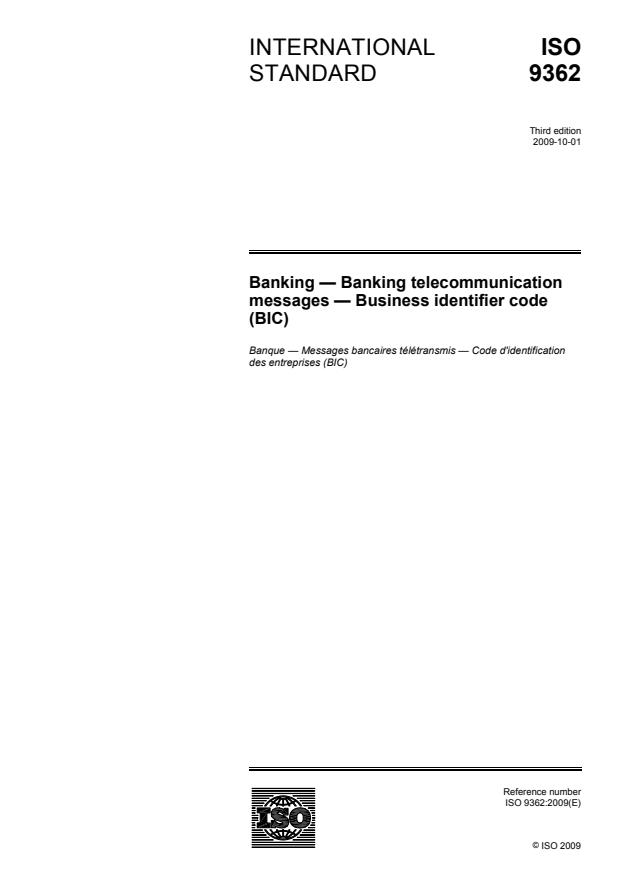
INTERNATIONAL ISO
STANDARD 9362
Third edition
2009-10-01
Banking — Banking telecommunication
messages — Business identifier code
(BIC)
Banque — Messages bancaires télétransmis — Code d'identification
des entreprises (BIC)
Reference number
©
ISO 2009
PDF disclaimer
This PDF file may contain embedded typefaces. In accordance with Adobe's licensing policy, this file may be printed or viewed but
shall not be edited unless the typefaces which are embedded are licensed to and installed on the computer performing the editing. In
downloading this file, parties accept therein the responsibility of not infringing Adobe's licensing policy. The ISO Central Secretariat
accepts no liability in this area.
Adobe is a trademark of Adobe Systems Incorporated.
Details of the software products used to create this PDF file can be found in the General Info relative to the file; the PDF-creation
parameters were optimized for printing. Every care has been taken to ensure that the file is suitable for use by ISO member bodies. In
the unlikely event that a problem relating to it is found, please inform the Central Secretariat at the address given below.
© ISO 2009
All rights reserved. Unless otherwise specified, no part of this publication may be reproduced or utilized in any form or by any means,
electronic or mechanical, including photocopying and microfilm, without permission in writing from either ISO at the address below or
ISO's member body in the country of the requester.
ISO copyright office
Case postale 56 • CH-1211 Geneva 20
Tel. + 41 22 749 01 11
Fax + 41 22 749 09 47
E-mail copyright@iso.org
Web www.iso.org
Published in Switzerland
ii © ISO 2009 – All rights reserved
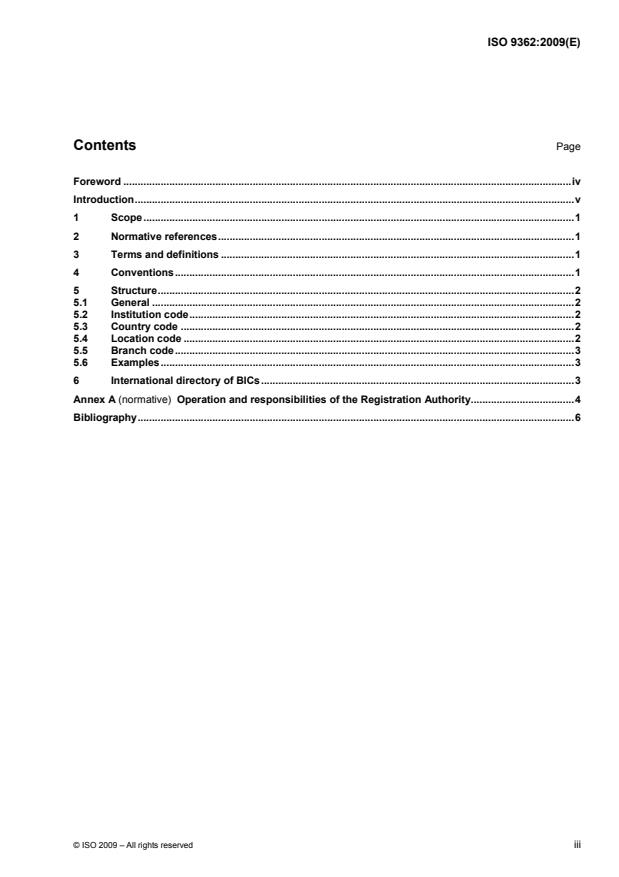
Contents Page
Foreword .iv
Introduction.v
1 Scope.1
2 Normative references.1
3 Terms and definitions .1
4 Conventions.1
5 Structure.2
5.1 General .2
5.2 Institution code.2
5.3 Country code .2
5.4 Location code .2
5.5 Branch code.3
5.6 Examples.3
6 International directory of BICs.3
Annex A (normative) Operation and responsibilities of the Registration Authority.4
Bibliography.6
Foreword
ISO (the International Organization for Standardization) is a worldwide federation of national standards bodies
(ISO member bodies). The work of preparing International Standards is normally carried out through ISO
technical committees. Each member body interested in a subject for which a technical committee has been
established has the right to be represented on that committee. International organizations, governmental and
non-governmental, in liaison with ISO, also take part in the work. ISO collaborates closely with the
International Electrotechnical Commission (IEC) on all matters of electrotechnical standardization.
International Standards are drafted in accordance with the rules given in the ISO/IEC Directives, Part 2.
The main task of technical committees is to prepare International Standards. Draft International Standards
adopted by the technical committees are circulated to the member bodies for voting. Publication as an
International Standard requires approval by at least 75 % of the member bodies casting a vote.
Attention is drawn to the possibility that some of the elements of this document may be the subject of patent
rights. ISO shall not be held responsible for identifying any or all such patent rights.
ISO 9362 was prepared by Technical Committee ISO/TC 68, Financial services, Subcommittee SC 7, Core
banking.
This third edition cancels and replaces the second edition (ISO 9362:1994), which has been technically
revised.
iv © ISO 2009 – All rights reserved
Introduction
This International Standard specifies a universal method of identifying institutions within the financial services
industry, in order to facilitate automated processing of telecommunication messages in banking and related
financial transaction environments. The coding system specified in this International Standard is in full
conformity with ISO/IEC 6523-1 and has been proposed for registration in accordance with ISO/IEC 6523-2.
The original scope of this International Standard was limited to the identification of banks; consequently, the
acronym “BIC” was used as an abbreviation for “bank identifier code”. The scope of this International Standard
has since been extended, in the first place to cover all types of financial institutions, and now, in this third
edition of this International Standard, to cover non-financial institutions as well. In order to avoid unnecessary
costs that would have resulted from abandoning a well-known and widely-used acronym, the acronym “BIC”
has been retained for the purposes of this International Standard, but is now used as an abbreviation for
“business identifier code”.
Annex A outlines the operation and responsibilities of the Registration Authority, and describes the procedures
for the registration of BICs and publication of these codes in directory form.
INTERNATIONAL STANDARD ISO 9362:2009(E)
Banking — Banking telecommunication messages — Business
identifier code (BIC)
1 Scope
This International Standard specifies the elements and structure of a universal identifier code, the business
identifier code (BIC), for financial and non-financial institutions and related entities, for which such an
international identifier is required to facilitate automated processing of telecommunication messages in
banking and related financial transaction environments.
2 Normative references
The following referenced documents are indispensable for the application of this document. For dated
references, only the edition cited applies. For undated references
...
Questions, Comments and Discussion
Ask us and Technical Secretary will try to provide an answer. You can facilitate discussion about the standard in here.
Loading comments...