

ISO 20984:2020
(Main)Cornelian cherry — Specification and test methods
General Information
- Abstract
This document specifies requirements and test methods for the fresh cornelian fruit of the tree Cornus mas L. It does not apply to processed cornelian cherries.
- Status
- Published
- Publication Date
- 03-Jun-2020
- Technical Committee
- ISO/TC 34/SC 3 - Fruits and vegetables and their derived products
- Drafting Committee
- ISO/TC 34/SC 3 - Fruits and vegetables and their derived products
- Current Stage
- 9060 - Close of review
- Completion Date
- 02-Dec-2030
Buy Documents

ISO 20984:2020 - Cornelian cherry -- Specification and test methods
ISO 20984:2020 - Cornelian cherry — Specification and test methods/4/2020
Overview
ISO 20984:2020 sets the international specification and test methods for fresh Cornelian cherry fruit, derived from the tree Cornus mas L. This standard aims to ensure consistent quality, safety, and proper classification for fresh Cornelian cherries marketed globally. Notably, ISO 20984:2020 applies exclusively to fresh fruit and does not cover processed Cornelian cherries. Published by the International Organization for Standardization (ISO) in June 2020, the document provides detailed requirements on classification, tolerances, testing, packaging, storage, and hygiene.
Key Topics
- Scope and Application
Defines requirements for fresh Cornelian cherries to maintain standardization in international trade and quality control. - Classification System
Cornelian cherries are categorized into five color groups-yellow, red, white, pink, and violet. They are further divided into three quality classes, namely Extra class (superior quality), Class I (good quality), and Class II (minimum acceptable quality) based on diameter and appearance. - Quality Requirements
Fresh Cornelian cherries must be whole, sound, clean, free from foreign matter, pests, rots, and have a fresh appearance and smell. Specific size ranges and defect tolerances are defined for each class. - Test Methods
Includes internationally recognized procedures to assess titratable acidity, water-insoluble solids, mineral impurities, pH, and soluble solids content in the fruit. These methods rely on related ISO standards (e.g., ISO 750, ISO 751, ISO 762). - Sampling Procedures
Sampling policies align with ISO 874 and ISO 2859-1 to ensure representative and statistically valid analysis of Cornelian cherry lots. - Packaging and Labelling
Specifies packaging materials should protect the fruit and avoid contamination. Mandatory labelling details include product name, producer, batch code, net or gross mass, product class, country of origin, expiry date, and optional reference to the ISO 20984 standard. - Storage and Transportation
Guidance mandates that cherries must be stored in shade, protected from rain, cold, and freezing conditions during transport and handling. - Safety and Hygiene
Recommends adherence to Codex Alimentarius guidelines on contaminants and pesticide residues, ensuring food safety for consumers.
Applications
ISO 20984:2020 is essential for:
- Growers and Producers: Provides clear grading and quality control criteria to maintain consistency in fresh Cornelian cherry harvests.
- Exporters and Importers: Facilitates international trade by standardizing product quality, packaging, and labelling requirements.
- Quality Inspectors and Laboratories: Offers standardized methods for physical and chemical testing, enabling reliable quality assessments.
- Retailers and Distributors: Helps ensure the fruit received meets specified quality standards, improving consumer satisfaction.
- Food Safety Authorities: Assists in the enforcement of hygiene, contaminant, and pesticide residue controls in fresh produce markets.
Related Standards
ISO 20984:2020 references and complements various ISO standards that cover fruit testing and sampling processes:
- ISO 874 – Fresh fruits and vegetables - Sampling
- ISO 2859-1 – Sampling procedures for inspection by attributes
- ISO 750 – Determination of titratable acidity in fruit and vegetable products
- ISO 751 – Determination of water-insoluble solids
- ISO 762 – Determination of mineral impurities content
- ISO 1842 – Determination of pH
- ISO 2173 – Determination of soluble solids (refractometric method)
Additionally, hygiene guidelines reference Codex Alimentarius codes such as CAC/RCP 1-1969 and CAC/RCP 53-2003, along with CODEX STAN 193-1995 for pesticide residues.
Ensure compliance with ISO 20984:2020 to guarantee fresh Cornelian cherries meet internationally recognized quality and safety standards, facilitating reliable trade and consumer confidence worldwide.
Buy Documents
ISO 20984:2020 - Cornelian cherry -- Specification and test methods
ISO 20984:2020 - Cornelian cherry — Specification and test methods/4/2020
Get Certified
Connect with accredited certification bodies for this standard

BSI Group
BSI (British Standards Institution) is the business standards company that helps organizations make excellence a habit.

Bureau Veritas
Bureau Veritas is a world leader in laboratory testing, inspection and certification services.

DNV
DNV is an independent assurance and risk management provider.
Sponsored listings
Frequently Asked Questions
ISO 20984:2020 is a standard published by the International Organization for Standardization (ISO). Its full title is "Cornelian cherry — Specification and test methods". This standard covers: This document specifies requirements and test methods for the fresh cornelian fruit of the tree Cornus mas L. It does not apply to processed cornelian cherries.
This document specifies requirements and test methods for the fresh cornelian fruit of the tree Cornus mas L. It does not apply to processed cornelian cherries.
ISO 20984:2020 is classified under the following ICS (International Classification for Standards) categories: 67.080.10 - Fruits and derived products. The ICS classification helps identify the subject area and facilitates finding related standards.
ISO 20984:2020 is available in PDF format for immediate download after purchase. The document can be added to your cart and obtained through the secure checkout process. Digital delivery ensures instant access to the complete standard document.
Standards Content (Sample)
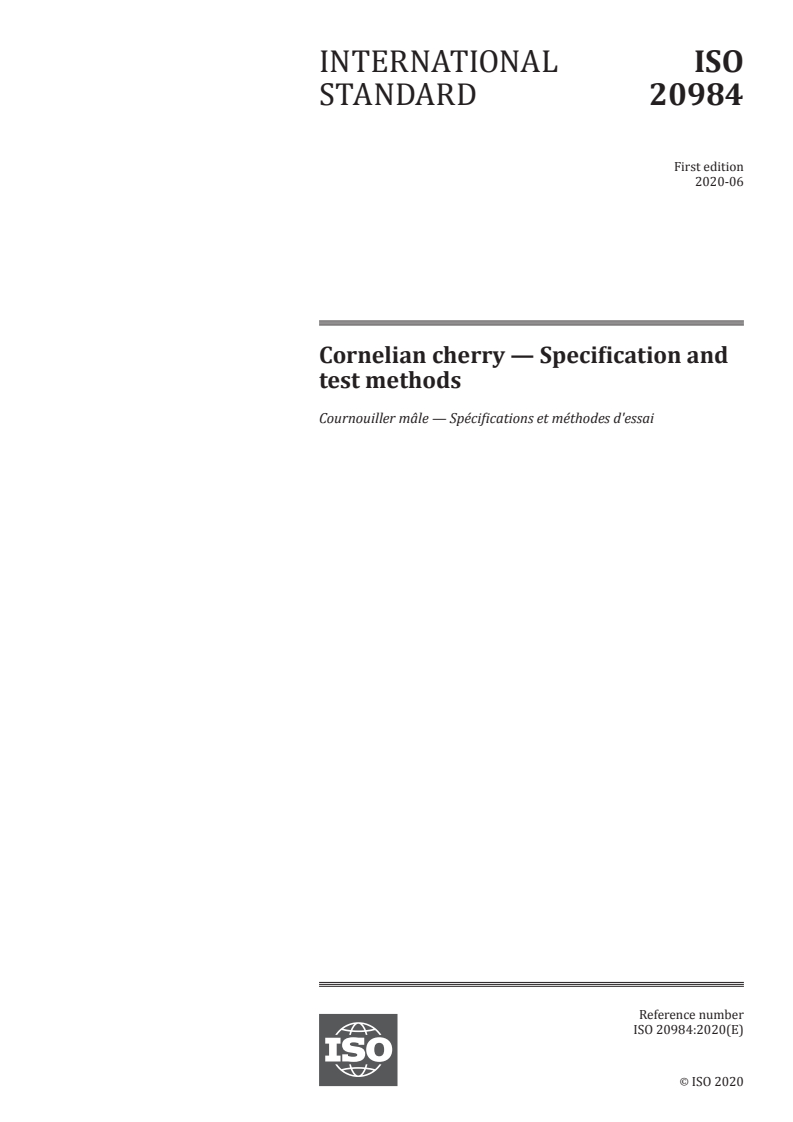
INTERNATIONAL ISO
STANDARD 20984
First edition
2020-06
Cornelian cherry — Specification and
test methods
Cournouiller mâle — Spécifications et méthodes d'essai
Reference number
©
ISO 2020
© ISO 2020
All rights reserved. Unless otherwise specified, or required in the context of its implementation, no part of this publication may
be reproduced or utilized otherwise in any form or by any means, electronic or mechanical, including photocopying, or posting
on the internet or an intranet, without prior written permission. Permission can be requested from either ISO at the address
below or ISO’s member body in the country of the requester.
ISO copyright office
CP 401 • Ch. de Blandonnet 8
CH-1214 Vernier, Geneva
Phone: +41 22 749 01 11
Fax: +41 22 749 09 47
Email: copyright@iso.org
Website: www.iso.org
Published in Switzerland
ii © ISO 2020 – All rights reserved
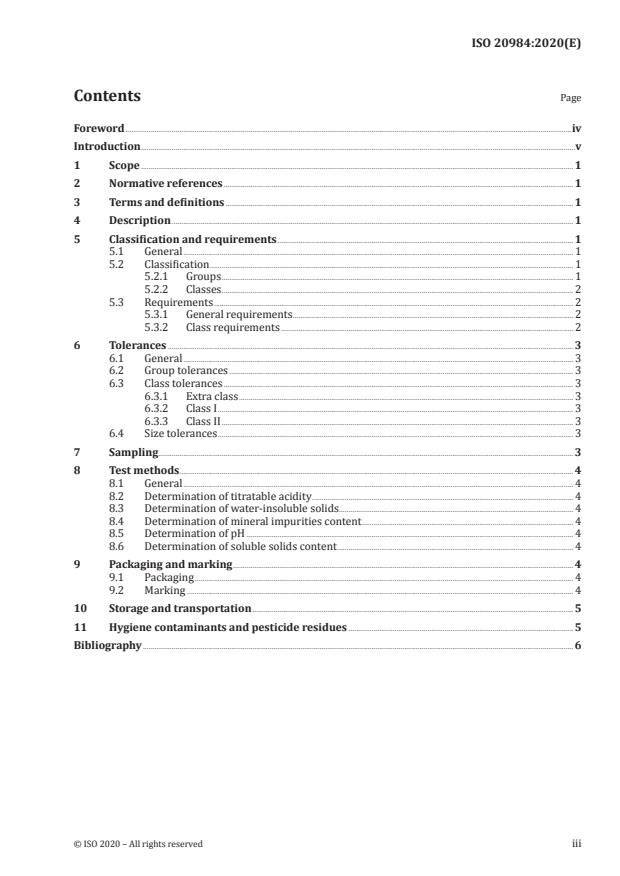
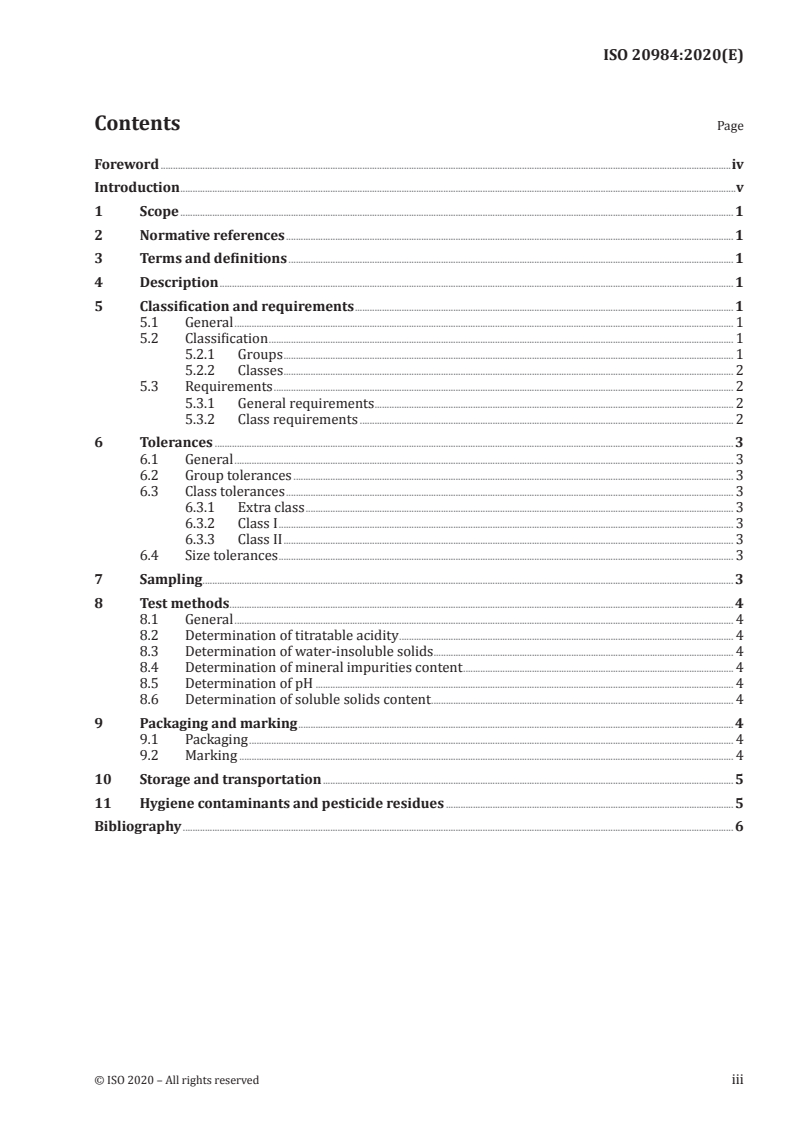
Contents Page
Foreword .iv
Introduction .v
1 Scope . 1
2 Normative references . 1
3 Terms and definitions . 1
4 Description . 1
5 Classification and requirements . 1
5.1 General . 1
5.2 Classification . 1
5.2.1 Groups . 1
5.2.2 Classes . 2
5.3 Requirements . 2
5.3.1 General requirements . 2
5.3.2 Class requirements . 2
6 Tolerances . 3
6.1 General . 3
6.2 Group tolerances . 3
6.3 Class tolerances . 3
6.3.1 Extra class . 3
6.3.2 Class I . 3
6.3.3 Class II . 3
6.4 Size tolerances . 3
7 Sampling . 3
8 Test methods . 4
8.1 General . 4
8.2 Determination of titratable acidity . 4
8.3 Determination of water-insoluble solids . 4
8.4 Determination of mineral impurities content . 4
8.5 Determination of pH . 4
8.6 Determination of soluble solids content . 4
9 Packaging and marking . 4
9.1 Packaging . 4
9.2 Marking . 4
10 Storage and transportation . 5
11 Hygiene contaminants and pesticide residues . 5
Bibliography . 6
Foreword
ISO (the International Organization for Standardization) is a worldwide federation of national standards
bodies (ISO member bodies). The work of preparing International Standards is normally carried out
through ISO technical committees. Each member body interested in a subject for which a technical
committee has been established has the right to be represented on that committee. International
organizations, governmental and non-governmental, in liaison with ISO, also take part in the work.
ISO collaborates closely with the International Electrotechnical Commission (IEC) on all matters of
electrotechnical standardization.
The procedures used to develop this document and those intended for its further maintenance are
described in the ISO/IEC Directives, Part 1. In particular, the different approval criteria needed for the
different types of ISO documents should be noted. This document was drafted in accordance with the
editorial rules of the ISO/IEC Directives, Part 2 (see www .iso .org/ directives).
Attention is drawn to the possibility that some of the elements of this document may be the subject of
patent rights. ISO shall not be held responsible for identifying any or all such patent rights. Details of
any patent rights identified during the development of the document will be in the Introduction and/or
on the ISO list of patent declarations received (see www .iso .org/ patents).
Any trade name used in this document is information given for the convenience of users and does not
constitute an endorsement.
For an explanation of the voluntary nature of standards, the meaning of ISO specific terms and
expressions related to conformity assessment, as well as information about ISO’s adherence to the
World Trade Organization (WTO) principles in the Technical
...
INTERNATIONAL ISO
STANDARD 20984
First edition
2020-06
Cornelian cherry — Specification and
test methods
Cournouiller mâle — Spécifications et méthodes d'essai
Reference number
©
ISO 2020
© ISO 2020
All rights reserved. Unless otherwise specified, or required in the context of its implementation, no part of this publication may
be reproduced or utilized otherwise in any form or by any means, electronic or mechanical, including photocopying, or posting
on the internet or an intranet, without prior written permission. Permission can be requested from either ISO at the address
below or ISO’s member body in the country of the requester.
ISO copyright office
CP 401 • Ch. de Blandonnet 8
CH-1214 Vernier, Geneva
Phone: +41 22 749 01 11
Fax: +41 22 749 09 47
Email: copyright@iso.org
Website: www.iso.org
Published in Switzerland
ii © ISO 2020 – All rights reserved
Contents Page
Foreword .iv
Introduction .v
1 Scope . 1
2 Normative references . 1
3 Terms and definitions . 1
4 Description . 1
5 Classification and requirements . 1
5.1 General . 1
5.2 Classification . 1
5.2.1 Groups . 1
5.2.2 Classes . 2
5.3 Requirements . 2
5.3.1 General requirements . 2
5.3.2 Class requirements . 2
6 Tolerances . 3
6.1 General . 3
6.2 Group tolerances . 3
6.3 Class tolerances . 3
6.3.1 Extra class . 3
6.3.2 Class I . 3
6.3.3 Class II . 3
6.4 Size tolerances . 3
7 Sampling . 3
8 Test methods . 4
8.1 General . 4
8.2 Determination of titratable acidity . 4
8.3 Determination of water-insoluble solids . 4
8.4 Determination of mineral impurities content . 4
8.5 Determination of pH . 4
8.6 Determination of soluble solids content . 4
9 Packaging and marking . 4
9.1 Packaging . 4
9.2 Marking . 4
10 Storage and transportation . 5
11 Hygiene contaminants and pesticide residues . 5
Bibliography . 6
Foreword
ISO (the International Organization for Standardization) is a worldwide federation of national standards
bodies (ISO member bodies). The work of preparing International Standards is normally carried out
through ISO technical committees. Each member body interested in a subject for which a technical
committee has been established has the right to be represented on that committee. International
organizations, governmental and non-governmental, in liaison with ISO, also take part in the work.
ISO collaborates closely with the International Electrotechnical Commission (IEC) on all matters of
electrotechnical standardization.
The procedures used to develop this document and those intended for its further maintenance are
described in the ISO/IEC Directives, Part 1. In particular, the different approval criteria needed for the
different types of ISO documents should be noted. This document was drafted in accordance with the
editorial rules of the ISO/IEC Directives, Part 2 (see www .iso .org/ directives).
Attention is drawn to the possibility that some of the elements of this document may be the subject of
patent rights. ISO shall not be held responsible for identifying any or all such patent rights. Details of
any patent rights identified during the development of the document will be in the Introduction and/or
on the ISO list of patent declarations received (see www .iso .org/ patents).
Any trade name used in this document is information given for the convenience of users and does not
constitute an endorsement.
For an explanation of the voluntary nature of standards, the meaning of ISO specific terms and
expressions related to conformity assessment, as well as information about ISO’s adherence to the
World Trade Organization (WTO) principles in the Technical
...