

ISO 7752-2:2025
(Main)Cranes — Control layout and characteristics — Part 2: Basic arrangement and requirements for mobile cranes
General Information
- Abstract
This document establishes the arrangement, requirements and direction of movement of the basic controls for slewing, load lifting and lowering, and boom luffing and telescoping, on mobile cranes as defined in ISO 4306-2. It deals with bi-directional controls and the basic arrangement and requirements for cross-shift levers (multi-directional controls). It is intended to be used in conjunction with ISO 7752-1.
- Status
- Published
- Publication Date
- 17-Dec-2025
- Technical Committee
- ISO/TC 96/SC 9 - Bridge and gantry cranes
- Drafting Committee
- ISO/TC 96/SC 6 - Mobile cranes
- Current Stage
- 6060 - International Standard published
- Start Date
- 18-Dec-2025
- Due Date
- 30-Nov-2026
- Completion Date
- 18-Dec-2025
Overview
ISO 7752-2:2025 - "Cranes - Control layout and characteristics - Part 2: Basic arrangement and requirements for mobile cranes" specifies the basic control arrangement, movement directions and functional requirements for controls on mobile cranes (as defined in ISO 4306-2). Published as the third edition, it updates control layouts to include telescoping and luffing fly jibs and complements ISO 7752-1 (general principles). The standard aims to reduce operator confusion and improve safety and interoperability when operators move between different mobile crane models.
Key topics and technical requirements
- Control arrangement and direction of movement: Defines the location and directional movement for primary crane controls such as slewing, hoisting (lifting/lowering), boom luffing and telescoping. (Examples from the standard: pushing the slewing lever forward slews towards the boom; pulling hoisting levers back lifts the load.)
- Bi-directional and cross-shift (multi-directional) controls: Covers both two-direction levers and multi-axis cross-shift levers for cranes with fixed-length and telescoping booms, including selection-switch behavior.
- Ergonomics and accessibility: Controls must be within easy reach of the operator at the control station and designed to minimize fatigue, consistent with ISO 7752-1.
- Control safety features:
- Neutral return: levers and pedals must return to neutral automatically when released.
- Preventing duplicate assignments: means to ensure the same function is not available on multiple levers simultaneously.
- Indicators for multi-function selectors and requirements for illumination or cabin lighting for night visibility.
- Winch convention: Hoisting 1 and Hoisting 2 denote primary and secondary winch movements; the primary hoisting control should be on the right-hand side.
- Remote control stations and optional arrangements: Includes provisions for remote control stations and alternative layouts (e.g., foot-pedal luffing arrangements).
Applications and practical value
- Ensures consistent control layout across mobile crane models to reduce human error during operation and in emergencies.
- Useful for manufacturers designing operator cabins, control consoles, and remote-control interfaces to meet international expectations for ergonomics and safety.
- Guides fleet managers, safety engineers and training organizations to standardize operator instruction, reduce transition risks when crews move between crane types, and support compliance and procurement decisions.
Who should use this standard
- Mobile crane manufacturers and OEM engineers
- Cab/control-system designers and integrators
- Safety managers, inspection authorities and certification bodies
- Crane operators, trainers and fleet procurement teams
Related standards
- ISO 7752-1 - Cranes: Control layout and characteristics - Part 1: General principles
- ISO 4306-2 - Cranes: Vocabulary - Part 2: Mobile cranes
Keywords: ISO 7752-2:2025, mobile crane controls, control layout, bi-directional levers, cross-shift levers, slewing, hoisting, boom luffing, telescoping, operator ergonomics, crane safety.
Relations
- Effective Date
- 02-Dec-2023
Frequently Asked Questions
ISO 7752-2:2025 is a standard published by the International Organization for Standardization (ISO). Its full title is "Cranes — Control layout and characteristics — Part 2: Basic arrangement and requirements for mobile cranes". This standard covers: This document establishes the arrangement, requirements and direction of movement of the basic controls for slewing, load lifting and lowering, and boom luffing and telescoping, on mobile cranes as defined in ISO 4306-2. It deals with bi-directional controls and the basic arrangement and requirements for cross-shift levers (multi-directional controls). It is intended to be used in conjunction with ISO 7752-1.
This document establishes the arrangement, requirements and direction of movement of the basic controls for slewing, load lifting and lowering, and boom luffing and telescoping, on mobile cranes as defined in ISO 4306-2. It deals with bi-directional controls and the basic arrangement and requirements for cross-shift levers (multi-directional controls). It is intended to be used in conjunction with ISO 7752-1.
ISO 7752-2:2025 is classified under the following ICS (International Classification for Standards) categories: 53.020.20 - Cranes. The ICS classification helps identify the subject area and facilitates finding related standards.
ISO 7752-2:2025 has the following relationships with other standards: It is inter standard links to ISO 7752-2:2011. Understanding these relationships helps ensure you are using the most current and applicable version of the standard.
ISO 7752-2:2025 is available in PDF format for immediate download after purchase. The document can be added to your cart and obtained through the secure checkout process. Digital delivery ensures instant access to the complete standard document.
Standards Content (Sample)
International
Standard
ISO 7752-2
Third edition
Cranes — Control layout and
2025-12
characteristics —
Part 2:
Basic arrangement and
requirements for mobile cranes
Appareils de levage à charge suspendue — Disposition et
caractéristiques des commandes —
Partie 2: Disposition et exigences de base pour les grues mobiles
Reference number
© ISO 2025
All rights reserved. Unless otherwise specified, or required in the context of its implementation, no part of this publication may
be reproduced or utilized otherwise in any form or by any means, electronic or mechanical, including photocopying, or posting on
the internet or an intranet, without prior written permission. Permission can be requested from either ISO at the address below
or ISO’s member body in the country of the requester.
ISO copyright office
CP 401 • Ch. de Blandonnet 8
CH-1214 Vernier, Geneva
Phone: +41 22 749 01 11
Email: copyright@iso.org
Website: www.iso.org
Published in Switzerland
ii
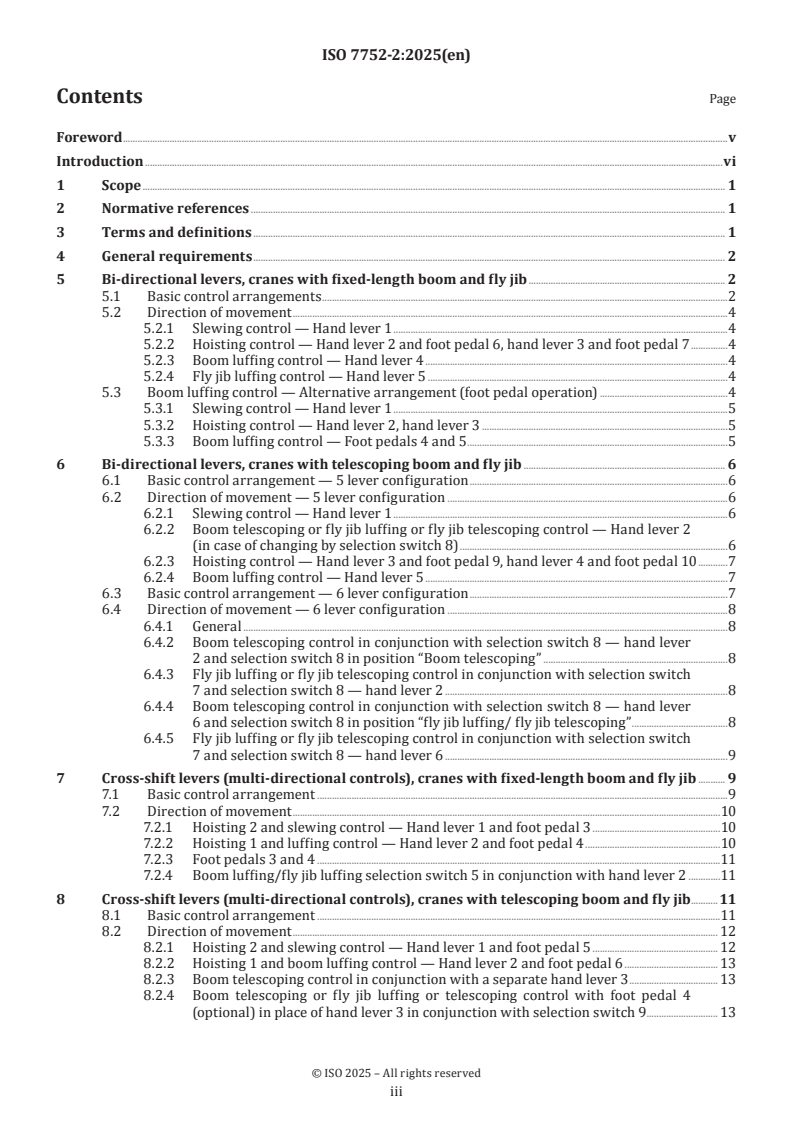
Contents Page
Foreword .v
Introduction .vi
1 Scope . 1
2 Normative references . 1
3 Terms and definitions . 1
4 General requirements . 2
5 Bi-directional levers, cranes with fixed-length boom and fly jib . 2
5.1 Basic control arrangements .2
5.2 Direction of movement .4
5.2.1 Slewing control — Hand lever 1 .4
5.2.2 Hoisting control — Hand lever 2 and foot pedal 6, hand lever 3 and foot pedal 7 .4
5.2.3 Boom luffing control — Hand lever 4 .4
5.2.4 Fly jib luffing control — Hand lever 5 .4
5.3 Boom luffing control — Alternative arrangement (foot pedal operation) .4
5.3.1 Slewing control — Hand lever 1 .5
5.3.2 Hoisting control — Hand lever 2, hand lever 3 .5
5.3.3 Boom luffing control — Foot pedals 4 and 5 .5
6 Bi-directional levers, cranes with telescoping boom and fly jib . 6
6.1 Basic control arrangement — 5 lever configuration .6
6.2 Direction of movement — 5 lever configuration .6
6.2.1 Slewing control — Hand lever 1 .6
6.2.2 Boom telescoping or fly jib luffing or fly jib telescoping control — Hand lever 2
(in case of changing by selection switch 8) .6
6.2.3 Hoisting control — Hand lever 3 and foot pedal 9, hand lever 4 and foot pedal 10 .7
6.2.4 Boom luffing control — Hand lever 5 .7
6.3 Basic control arrangement — 6 lever configuration .7
6.4 Direction of movement — 6 lever configuration .8
6.4.1 General .8
6.4.2 Boom telescoping control in conjunction with selection switch 8 — hand lever
2 and selection switch 8 in position “Boom telescoping” .8
6.4.3 Fly jib luffing or fly jib telescoping control in conjunction with selection switch
7 and selection switch 8 — hand lever 2 .8
6.4.4 Boom telescoping control in conjunction with selection switch 8 — hand lever
6 and selection switch 8 in position “fly jib luffing/ fly jib telescoping” .8
6.4.5 Fly jib luffing or fly jib telescoping control in conjunction with selection switch
7 and selection switch 8 — hand lever 6 .9
7 Cross-shift levers (multi-directional controls), cranes with fixed-length boom and fly jib . 9
7.1 Basic control arrangement .9
7.2 Direction of movement .10
7.2.1 Hoisting 2 and slewing control — Hand lever 1 and foot pedal 3 .10
7.2.2 Hoisting 1 and luffing control — Hand lever 2 and foot pedal 4 .10
7.2.3 Foot pedals 3 and 4 .11
7.2.4 Boom luffing/fly jib luffing selection switch 5 in conjunction with hand lever 2 .11
8 Cross-shift levers (multi-directional controls), cranes with telescoping boom and fly jib .11
8.1 Basic control arrangement .11
8.2 Direction of movement . 12
8.2.1 Hoisting 2 and slewing control — Hand lever 1 and foot pedal 5 . 12
8.2.2 Hoisting 1 and boom luffing control — Hand lever 2 and foot pedal 6 . 13
8.2.3 Boom telescoping control in conjunction with a separate hand lever 3 . 13
8.2.4 Boom telescoping or fly jib luffing or telescoping control with foot pedal 4
(optional) in place of hand lever 3 in conjunction with selection switch 9. 13
iii
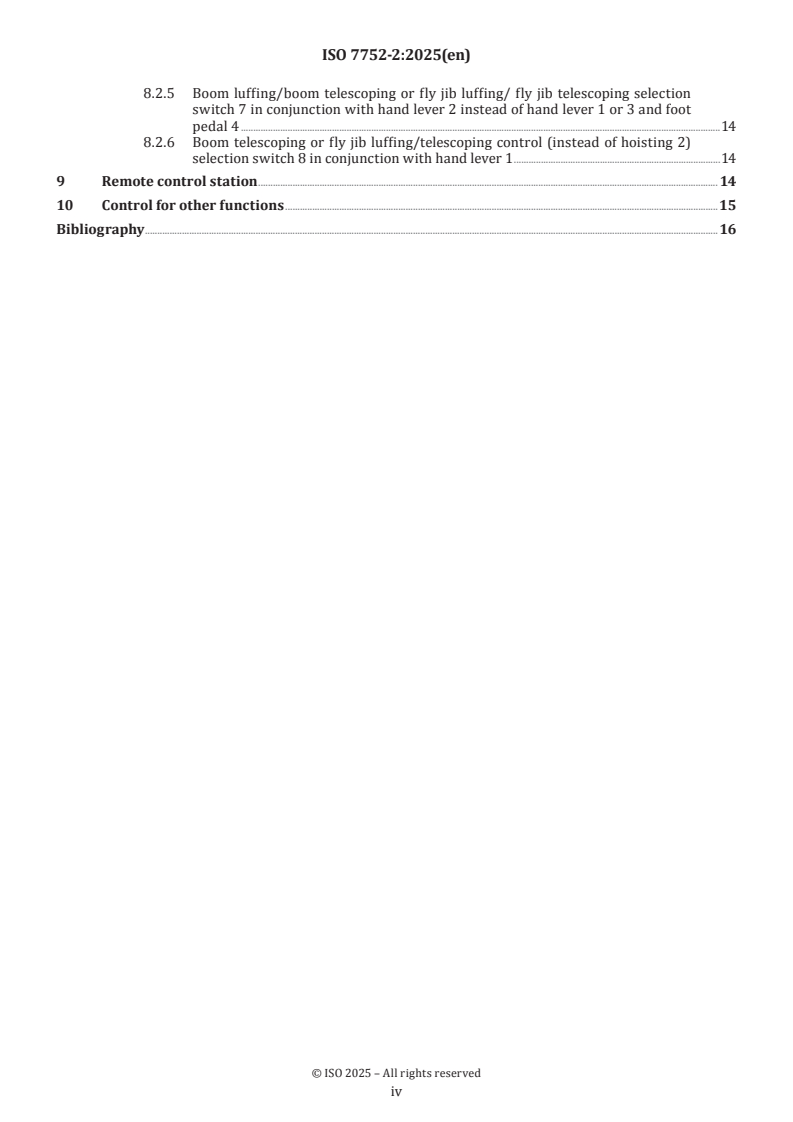
8.2.5 Boom luffing/boom telescoping or fly jib luffing/ fly jib telescoping selection
switch 7 in conjunction with hand lever 2 instead of hand lever 1 or 3 and foot
pedal 4 .14
8.2.6 Boom telescoping or fly jib luffing/telescoping control (instead of hoisting 2)
selection switch 8 in conjunction with hand lever 1 .14
9 Remote control station . 14
10 Control for other functions .15
Bibliography .16
iv
Foreword
ISO (the International Organization for Standardization) is a worldwide federation of national standards
bodies (ISO member bodies). The work of preparing International Standards is normally carried out through
ISO technical committees. Each member body interested in a subject for which a technical committee
has been established has the right to be represented on that committee. International organizations,
governmental and non-governmental, in liaison with ISO, also take part in the work. ISO collaborates closely
with the International Electrotechnical Commission (IEC) on all matters of electrotechnical standardization.
The procedures used to develop this document and those intended for its further maintenance are described
in the ISO/IEC Directives, Part 1. In particular, the different approval criteria needed for the different types
of ISO document should be noted. This document was drafted in accordance with the editorial rules of the
ISO/IEC Directives, Part 2 (see www.iso.org/directives).
ISO draws attention to the possibility that the implementation of this document may involve the use of (a)
patent(s). ISO takes no position concerning the evidence, validity or applicability of any claimed patent
rights in respect thereof. As of the date of publication of this document, ISO had not received notice of (a)
patent(s) which may be required to implement this document. However, implementers are cautioned that
this may not represent the latest information, which may be obtained from the patent database available at
www.iso.org/patents. ISO shall not be held responsible for identifying any or all such patent rights.
Any trade name used in this document is information given for the convenience of users and does not
constitute an endorsement.
For an explanation of the voluntary nature of standards, the meaning of ISO specific terms and expressions
related to conformity assessment, as well as information about ISO's adherence to the World Trade
Organization (WTO) principles in the Technical Barriers to Trade (TBT), see www.iso.org/iso/foreword.html.
This document was prepared by Technical Committee ISO/TC 96, Cranes, Subcommittee SC 6, Mobile cranes.
This third edition cancels and replaces the second edition (ISO 7752-2:2011), which has been technically
revised.
The main changes are as follows:
— introduction of the telescoping fly jib;
— introduction of the luffing fly jib with the bi-directional levers.
A list of all parts in the ISO 7752 series can be found on the ISO website.
Any feedback or questions on this document should be directed to the user’s national standards body. A
complete listing of these bodies can be found at www.iso.org/members.html.
v
Introduction
Mobile crane operators frequently transfer from one crane to another of different model or manufacturer.
This document establishes a consistent arrangement and movement for the basic controls used during the
crane-operating cycle, to reduce operator confusion or incorrect control in an emergency. Some cranes may
not be equipped with all functions shown in the figures of this document.
vi
International Standard ISO 7752-2:2025(en)
Cranes — Control layout and characteristics —
Part 2:
Basic arrangement and requirements for mobile cranes
1 Scope
This document establishes the arrangement, requirements and direction of movement of the basic controls
for slewing, load lifting and lowering, and boom luffing and telescoping, on mobile cranes as defined in
ISO 4306-2. It deals with bi-directional controls and the basic arrangement and requirements for cross-shift
levers (multi-directional controls). It is intended to be used in conjunction with ISO 7752-1.
2 Normative references
The following documents are referred to in the text in such a way that some or all of their content constitutes
requirements of this document. For dated references, only the edition cited applies. For undated references,
the latest edition of the referenced document (including any amendments) applies.
ISO 4306-2, Cranes — Vocabulary — Part 2: Mobile cranes
ISO 7752-1, Cranes — Control layout and characteristics — Part 1: General principles
3 Terms and definitions
For the purposes of this document, the terms and definitions given in ISO 4306-2 and the following apply.
ISO and IEC maintain terminology databases for use in standardization at the following addresses:
— ISO Online browsing platform: available at https:// www .iso .org/ obp
— IEC Electropedia: available at https:// www .electropedia .org/
3.1
operator
person who is operating the crane for the purpose of positioning loads or operating for erection of the crane
1)
[SOURCE: ISO 4306-1:— , 11.1.3, modified — The term was originally crane operator and Note 1 to entry
has been deleted.]
3.2
control
actuating device which forms an interface between the crane operator (3.1) and crane control system
[SOURCE: ISO 7752-1:2010, 3.6]
3.3
control station
assembly of one or more control devices fixed on the same panel or located in the same enclosure
2)
[SOURCE: ISO 4306-1:— ,4.7.5]
1) Fifth edition under preparation. Stage at the time of publication: ISO 4306-1:2025.
2) Fifth edition under preparation. Stage at the time of publication: ISO 4306-1:2025.
4 General requirements
The basic control arrangement of a mobile crane and the direction of movement of the controls shall not
differ from those specified in Clause 5 through Clause 8, to avoid the operator's confusion and physical
interference when operating different cranes. Some cranes may not be equipped with all functions shown.
Other arrangements for control devices may be chosen due to the nature and work of the machine, provided
the same directions of movement of this document are followed.
a) The basic controls used during the crane operating cycle (see Figures 1 to 7) shall be located within
easy reach of the operator while he/she is at his station.
b) For controls with multiple functions assign
...