

ISO/TS 19278:2019
(Main)Plastics — Instrumented micro-indentation test for hardness measurement
General Information
- Abstract
This document specifies a hardness test method for plastics using instrumented indentation in the micro scale with one clearly defined test condition to ensure reproducibility and comparability of test results. The test method is selectively suitable for use with the following materials: — moulding, extrusion and cast thermoplastic materials; rigid and semi-rigid thermoplastics sheets; — rigid and semi-rigid thermosetting moulding materials; thermosetting sheets. This test method could also be utilized for nanometric filled system, considering the fillers are distributed uniformly in the polymer matrix. This test method allows dumbbell type specimen, strip type specimen, platens and specimen cut from any finished parts or products. This test method is useful for quality control, material selection, and screening of new formulations. NOTE This document does not aim to describe all scientific or technical aspects of microhardness testing on plastics in general.
- Status
- Published
- Publication Date
- 31-Mar-2019
- Technical Committee
- ISO/TC 61/SC 2 - Mechanical behavior
- Drafting Committee
- ISO/TC 61/SC 2/WG 2 - Hardness and surface properties
- Current Stage
- 9020 - International Standard under periodical review
- Start Date
- 15-Jul-2026
- Completion Date
- 15-Jul-2026
Buy Documents
ISO/TS 19278:2019 - Plastics -- Instrumented micro-indentation test for hardness measurement
ISO/TS 19278:2019 - Plastics — Instrumented micro-indentation test for hardness measurement/1/2019
Overview
ISO/TS 19278:2019 - Plastics: Instrumented micro‑indentation test for hardness measurement defines a single, reproducible instrumented micro‑indentation method for measuring the hardness of selected plastics. The specification standardizes test conditions (indenter, force, timing, specimen preparation and environment) so results are comparable across laboratories. It is aimed at moulding, extrusion and cast thermoplastics, rigid/semi‑rigid thermosetting materials and sheets, and can be applied to uniformly nanofilled polymer systems.
Key topics and technical requirements
- Test principle: A calibrated Berkovich indenter is forced into the plastic; indentation depth is measured under load and hardness is calculated from the applied force and the contact area derived from indentation depth (see clause 10.1).
- Apparatus:
- Original Berkovich indenter per ISO 14577‑1 (calibration per ISO 14577‑2).
- Instrument must record force, displacement and time, compensate for machine compliance and apply the correct indenter area function.
- Loading and timing:
- Maximum test force: 500 mN.
- Force application and removal times: 30 s each.
- Hold at maximum force: 40 s.
- Force repeatability: ±1.5%; force application time tolerance ±10%.
- Displacement accuracy: Maximum permissible error ±1% of indentation depth when depth > 6 μm.
- Specimen requirements:
- Thickness: at least 40 × h_max (to avoid substrate effects).
- Surface roughness Ra ≤ h_max / 20.
- Parallel, untwisted surfaces; minimum spacing between indentations and from free edges ≥ 4 × indentation diameter (cut edges ≥ 10 mm away).
- Environment & conditioning: Preferred atmospheric conditions 23 ± 2 °C, 50 ± 10% RH (ISO 291).
- Quality assurance: Periodic apparatus checks using control charts and suitable reference materials.
Applications and who uses it
- Quality control in manufacturing of plastic parts and sheets.
- Material selection and specification for product design (comparing formulations and grades).
- R&D and formulation screening, including evaluation of uniformly nanofilled polymers.
- Typical users: materials laboratories, plastics manufacturers, testing labs, R&D teams, and third‑party certification bodies.
Related standards
- ISO 14577‑1 / ISO 14577‑2 (instrumented indentation for materials)
- ISO 291 (conditioning and testing atmospheres)
- ISO 4287 (surface texture)
- ISO 2602, ISO 294 series, ISO 6507 and ISO 2039 (context and complementary hardness methods)
ISO/TS 19278:2019 helps ensure reproducible, comparable microhardness data for plastics - useful for reliable quality assessment, benchmarking and material development.
Buy Documents
ISO/TS 19278:2019 - Plastics -- Instrumented micro-indentation test for hardness measurement
ISO/TS 19278:2019 - Plastics — Instrumented micro-indentation test for hardness measurement/1/2019
Get Certified
Connect with accredited certification bodies for this standard

DIN CERTCO
DIN Group product certification.

Smithers Quality Assessments
US management systems and product certification.
Sponsored listings
Frequently Asked Questions
ISO/TS 19278:2019 is a technical specification published by the International Organization for Standardization (ISO). Its full title is "Plastics — Instrumented micro-indentation test for hardness measurement". This standard covers: This document specifies a hardness test method for plastics using instrumented indentation in the micro scale with one clearly defined test condition to ensure reproducibility and comparability of test results. The test method is selectively suitable for use with the following materials: — moulding, extrusion and cast thermoplastic materials; rigid and semi-rigid thermoplastics sheets; — rigid and semi-rigid thermosetting moulding materials; thermosetting sheets. This test method could also be utilized for nanometric filled system, considering the fillers are distributed uniformly in the polymer matrix. This test method allows dumbbell type specimen, strip type specimen, platens and specimen cut from any finished parts or products. This test method is useful for quality control, material selection, and screening of new formulations. NOTE This document does not aim to describe all scientific or technical aspects of microhardness testing on plastics in general.
This document specifies a hardness test method for plastics using instrumented indentation in the micro scale with one clearly defined test condition to ensure reproducibility and comparability of test results. The test method is selectively suitable for use with the following materials: — moulding, extrusion and cast thermoplastic materials; rigid and semi-rigid thermoplastics sheets; — rigid and semi-rigid thermosetting moulding materials; thermosetting sheets. This test method could also be utilized for nanometric filled system, considering the fillers are distributed uniformly in the polymer matrix. This test method allows dumbbell type specimen, strip type specimen, platens and specimen cut from any finished parts or products. This test method is useful for quality control, material selection, and screening of new formulations. NOTE This document does not aim to describe all scientific or technical aspects of microhardness testing on plastics in general.
ISO/TS 19278:2019 is classified under the following ICS (International Classification for Standards) categories: 83.080.01 - Plastics in general. The ICS classification helps identify the subject area and facilitates finding related standards.
ISO/TS 19278:2019 is available in PDF format for immediate download after purchase. The document can be added to your cart and obtained through the secure checkout process. Digital delivery ensures instant access to the complete standard document.
Standards Content (Sample)
TECHNICAL ISO/TS
SPECIFICATION 19278
First edition
2019-04
Plastics — Instrumented micro-
indentation test for hardness
measurement
Plastiques — Essai instrumenté de micro-indentation pour le
mesurage de la dureté
Reference number
©
ISO 2019
© ISO 2019
All rights reserved. Unless otherwise specified, or required in the context of its implementation, no part of this publication may
be reproduced or utilized otherwise in any form or by any means, electronic or mechanical, including photocopying, or posting
on the internet or an intranet, without prior written permission. Permission can be requested from either ISO at the address
below or ISO’s member body in the country of the requester.
ISO copyright office
CP 401 • Ch. de Blandonnet 8
CH-1214 Vernier, Geneva
Phone: +41 22 749 01 11
Fax: +41 22 749 09 47
Email: copyright@iso.org
Website: www.iso.org
Published in Switzerland
ii © ISO 2019 – All rights reserved
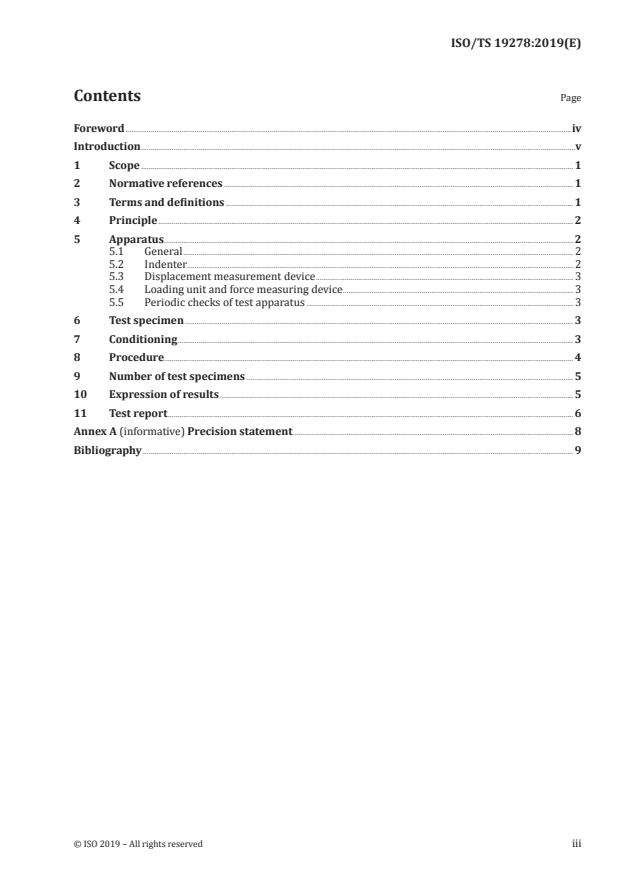
Contents Page
Foreword .iv
Introduction .v
1 Scope . 1
2 Normative references . 1
3 Terms and definitions . 1
4 Principle . 2
5 Apparatus . 2
5.1 General . 2
5.2 Indenter . . 2
5.3 Displacement measurement device . 3
5.4 Loading unit and force measuring device . 3
5.5 Periodic checks of test apparatus . 3
6 Test specimen . 3
7 Conditioning . 3
8 Procedure. 4
9 Number of test specimens . 5
10 Expression of results . 5
11 Test report . 6
Annex A (informative) Precision statement . 8
Bibliography . 9
Foreword
ISO (the International Organization for Standardization) is a worldwide federation of national standards
bodies (ISO member bodies). The work of preparing International Standards is normally carried out
through ISO technical committees. Each member body interested in a subject for which a technical
committee has been established has the right to be represented on that committee. International
organizations, governmental and non-governmental, in liaison with ISO, also take part in the work.
ISO collaborates closely with the International Electrotechnical Commission (IEC) on all matters of
electrotechnical standardization.
The procedures used to develop this document and those intended for its further maintenance are
described in the ISO/IEC Directives, Part 1. In particular, the different approval criteria needed for the
different types of ISO documents should be noted. This document was drafted in accordance with the
editorial rules of the ISO/IEC Directives, Part 2 (see www .iso .org/directives).
Attention is drawn to the possibility that some of the elements of this document may be the subject of
patent rights. ISO shall not be held responsible for identifying any or all such patent rights. Details of
any patent rights identified during the development of the document will be in the Introduction and/or
on the ISO list of patent declarations received (see www .iso .org/patents).
Any trade name used in this document is information given for the convenience of users and does not
constitute an endorsement.
For an explanation of the voluntary nature of standards, the meaning of ISO specific terms and
expressions related to conformity assessment, as well as information about ISO's adherence to the
World Trade Organization (WTO) principles in the Technical Barriers to Trade (TBT), see www .iso
.org/iso/foreword .html.
This document was prepared by Technical Committee ISO/TC 61, Plastics, Subcommittee SC 2,
Mechanical behaviour.
Any feedback or questions on this document should be directed to the user’s national standards body. A
complete listing of these bodies can be found at www .iso .org/members .html.
iv © ISO 2019 – All rights reserved
Introduction
This document was developed in response to a demand to define an instrumented indentation hardness
test method in the micro scale for quality control of plastics materials and material selection. The test
conditions are defined to ensure reproducibility and comparability of test results.
The Rockwell hardness method (ISO 2039-2) and the ball indentation method (ISO 2039-1) have been
formulated for determining the indentation hardness of plastics. These test methods use different
scales depending on the hardness of the material and it is difficult to compare hardness values of
materials when they are measured on different scales.
The Vickers hardness test method (ISO 6507-1), used for metallic materials, is a method that does not
use different scales. The Vickers hardness is calculated as the ratio of indentation load and the residual
area of contact of the indenter. However, when this method is applied to plastics materials, it is difficult
to measure the residual area of contact of the indenter because the edge of the indentation cannot be
specified.
The instrumented indentation hardness test method (ISO 14577-1) is intended for hardness
measurement in the range from nano-indentation to macro-indentation. In this method, since the
contact area of the indenter is directly determined from the indentation depth, the above-mentioned
problem is solved. It is therefore possible to determine the indentation hardness of the plastic materials.
In this document, in order to avoid errors due to detection of initial contact, a test force that can result in
sufficient indentation depth within the range of micro-indentation is specified. For example, the range
of indentation depth under this condition, which is from 10 μm to 50 μm in the case of the four types of
materials described in this document, also corresponds to the dimension (scale) of the diagonal length
range of 0,020 mm to 1,400 mm specified by the Vickers hardness test method (ISO 6507-1). In this
document, the measurement time of a single condition is specified similarly to the Rockwell hardness
method (ISO 2039-2).
TECHNICAL SPECIFICATION ISO/TS 19278:2019(E)
Plastics — Instrumented micro-indentation test for
hardness measurement
1 Scope
This document specifies a hardness test method for plastics using instrumented indentation in the
micro scale with one clearly defined test condition to ensure reproducibility and comparability of test
results.
The test method is selectively suitable for use with the following materials:
— moulding, extrusion and cast thermoplastic materials; rigid and semi-rigid thermoplastics sheets;
— rigid and semi-rigid thermosetting moulding materials; thermosetting sheets.
This test method could also be utilized for nanometric filled system, considering the fillers are
distributed uniformly in the polymer matrix.
This test method allows dumbbell type specimen, strip type specimen, platens and specimen cut from
any finished parts or products.
This test method is useful for quality control, material selection, and screening of new formulations.
NOTE This document does not aim to describe all scientific or technical aspects of microhardness testing on
plastics in general.
2 Normative references
The following documents are referred to in the text in such a way that some or all of their content
constitutes requirements of this document. For dated references, only the edition cited applies. For
undated references, the latest edition of the referenced document (including any amendments) applies.
ISO 291, Plastics — Standard atmospheres for conditioning and testing
ISO 2602, Statistical interpretation of test results — Estimation of the mean — Confidence interval
ISO 4287, Geometrical Product Specifications (GPS) — Surface texture: Profile method — Terms, definitions
and surface texture parameters
ISO 14577-1, Metallic materials — Instrumented indentation test for hardness and materials parameters —
Part 1: Test method
3 Terms and definitions
No terms and definitions are listed in this document.
ISO and IEC maintain terminological databases for use in standardization at the following addresses:
— ISO Online browsing platform: available at https: //www .iso .org/obp
— IEC Electropedia: available at http: //www .electropedia .org/
4 Principle
The original Berkovich indenter is forced under a specified load into the surface of the test specimen.
The depth of indentation is measured under load. Indentation hardness H is calculated from F and
IT max
A (see 10.1).
p
5 Apparatus
5.1 General
The testing apparatus comprises of a rigid frame, a stage, a test specimen holder, an indenter, a loading
unit, and a displacement measuring device. The apparatus is required to measure and record the applied
force, the indentation depth, and the time throughout the testing cycle. The apparatus shall have the
capability of compensating for the machine compliance and of utilizing the appropriate indenter area
function in accordance with ISO 14577-1. The general design is as shown in Figure 1.
Key
1 machine frame 5 stage
2 indenter 6 test specimen holder
3 loading unit 7 test specimen
4 displacement measuring device
F test force
Figure 1 — Example of testing apparatus
5.2 Indenter
The testing apparatus shall be equipped with an original Berkovich indenter in accordance with
ISO 14577-1. The indenter should be calibrated according to ISO 14577-2.
2 © ISO 2019 – All rights reserved
ISO/TS 19278
...
TECHNICAL ISO/TS
SPECIFICATION 19278
First edition
2019-04
Plastics — Instrumented micro-
indentation test for hardness
measurement
Plastiques — Essai instrumenté de micro-indentation pour le
mesurage de la dureté
Reference number
©
ISO 2019
© ISO 2019
All rights reserved. Unless otherwise specified, or required in the context of its implementation, no part of this publication may
be reproduced or utilized otherwise in any form or by any means, electronic or mechanical, including photocopying, or posting
on the internet or an intranet, without prior written permission. Permission can be requested from either ISO at the address
below or ISO’s member body in the country of the requester.
ISO copyright office
CP 401 • Ch. de Blandonnet 8
CH-1214 Vernier, Geneva
Phone: +41 22 749 01 11
Fax: +41 22 749 09 47
Email: copyright@iso.org
Website: www.iso.org
Published in Switzerland
ii © ISO 2019 – All rights reserved
Contents Page
Foreword .iv
Introduction .v
1 Scope . 1
2 Normative references . 1
3 Terms and definitions . 1
4 Principle . 2
5 Apparatus . 2
5.1 General . 2
5.2 Indenter . . 2
5.3 Displacement measurement device . 3
5.4 Loading unit and force measuring device . 3
5.5 Periodic checks of test apparatus . 3
6 Test specimen . 3
7 Conditioning . 3
8 Procedure. 4
9 Number of test specimens . 5
10 Expression of results . 5
11 Test report . 6
Annex A (informative) Precision statement . 8
Bibliography . 9
Foreword
ISO (the International Organization for Standardization) is a worldwide federation of national standards
bodies (ISO member bodies). The work of preparing International Standards is normally carried out
through ISO technical committees. Each member body interested in a subject for which a technical
committee has been established has the right to be represented on that committee. International
organizations, governmental and non-governmental, in liaison with ISO, also take part in the work.
ISO collaborates closely with the International Electrotechnical Commission (IEC) on all matters of
electrotechnical standardization.
The procedures used to develop this document and those intended for its further maintenance are
described in the ISO/IEC Directives, Part 1. In particular, the different approval criteria needed for the
different types of ISO documents should be noted. This document was drafted in accordance with the
editorial rules of the ISO/IEC Directives, Part 2 (see www .iso .org/directives).
Attention is drawn to the possibility that some of the elements of this document may be the subject of
patent rights. ISO shall not be held responsible for identifying any or all such patent rights. Details of
any patent rights identified during the development of the document will be in the Introduction and/or
on the ISO list of patent declarations received (see www .iso .org/patents).
Any trade name used in this document is information given for the convenience of users and does not
constitute an endorsement.
For an explanation of the voluntary nature of standards, the meaning of ISO specific terms and
expressions related to conformity assessment, as well as information about ISO's adherence to the
World Trade Organization (WTO) principles in the Technical Barriers to Trade (TBT), see www .iso
.org/iso/foreword .html.
This document was prepared by Technical Committee ISO/TC 61, Plastics, Subcommittee SC 2,
Mechanical behaviour.
Any feedback or questions on this document should be directed to the user’s national standards body. A
complete listing of these bodies can be found at www .iso .org/members .html.
iv © ISO 2019 – All rights reserved
Introduction
This document was developed in response to a demand to define an instrumented indentation hardness
test method in the micro scale for quality control of plastics materials and material selection. The test
conditions are defined to ensure reproducibility and comparability of test results.
The Rockwell hardness method (ISO 2039-2) and the ball indentation method (ISO 2039-1) have been
formulated for determining the indentation hardness of plastics. These test methods use different
scales depending on the hardness of the material and it is difficult to compare hardness values of
materials when they are measured on different scales.
The Vickers hardness test method (ISO 6507-1), used for metallic materials, is a method that does not
use different scales. The Vickers hardness is calculated as the ratio of indentation load and the residual
area of contact of the indenter. However, when this method is applied to plastics materials, it is difficult
to measure the residual area of contact of the indenter because the edge of the indentation cannot be
specified.
The instrumented indentation hardness test method (ISO 14577-1) is intended for hardness
measurement in the range from nano-indentation to macro-indentation. In this method, since the
contact area of the indenter is directly determined from the indentation depth, the above-mentioned
problem is solved. It is therefore possible to determine the indentation hardness of the plastic materials.
In this document, in order to avoid errors due to detection of initial contact, a test force that can result in
sufficient indentation depth within the range of micro-indentation is specified. For example, the range
of indentation depth under this condition, which is from 10 μm to 50 μm in the case of the four types of
materials described in this document, also corresponds to the dimension (scale) of the diagonal length
range of 0,020 mm to 1,400 mm specified by the Vickers hardness test method (ISO 6507-1). In this
document, the measurement time of a single condition is specified similarly to the Rockwell hardness
method (ISO 2039-2).
TECHNICAL SPECIFICATION ISO/TS 19278:2019(E)
Plastics — Instrumented micro-indentation test for
hardness measurement
1 Scope
This document specifies a hardness test method for plastics using instrumented indentation in the
micro scale with one clearly defined test condition to ensure reproducibility and comparability of test
results.
The test method is selectively suitable for use with the following materials:
— moulding, extrusion and cast thermoplastic materials; rigid and semi-rigid thermoplastics sheets;
— rigid and semi-rigid thermosetting moulding materials; thermosetting sheets.
This test method could also be utilized for nanometric filled system, considering the fillers are
distributed uniformly in the polymer matrix.
This test method allows dumbbell type specimen, strip type specimen, platens and specimen cut from
any finished parts or products.
This test method is useful for quality control, material selection, and screening of new formulations.
NOTE This document does not aim to describe all scientific or technical aspects of microhardness testing on
plastics in general.
2 Normative references
The following documents are referred to in the text in such a way that some or all of their content
constitutes requirements of this document. For dated references, only the edition cited applies. For
undated references, the latest edition of the referenced document (including any amendments) applies.
ISO 291, Plastics — Standard atmospheres for conditioning and testing
ISO 2602, Statistical interpretation of test results — Estimation of the mean — Confidence interval
ISO 4287, Geometrical Product Specifications (GPS) — Surface texture: Profile method — Terms, definitions
and surface texture parameters
ISO 14577-1, Metallic materials — Instrumented indentation test for hardness and materials parameters —
Part 1: Test method
3 Terms and definitions
No terms and definitions are listed in this document.
ISO and IEC maintain terminological databases for use in standardization at the following addresses:
— ISO Online browsing platform: available at https: //www .iso .org/obp
— IEC Electropedia: available at http: //www .electropedia .org/
4 Principle
The original Berkovich indenter is forced under a specified load into the surface of the test specimen.
The depth of indentation is measured under load. Indentation hardness H is calculated from F and
IT max
A (see 10.1).
p
5 Apparatus
5.1 General
The testing apparatus comprises of a rigid frame, a stage, a test specimen holder, an indenter, a loading
unit, and a displacement measuring device. The apparatus is required to measure and record the applied
force, the indentation depth, and the time throughout the testing cycle. The apparatus shall have the
capability of compensating for the machine compliance and of utilizing the appropriate indenter area
function in accordance with ISO 14577-1. The general design is as shown in Figure 1.
Key
1 machine frame 5 stage
2 indenter 6 test specimen holder
3 loading unit 7 test specimen
4 displacement measuring device
F test force
Figure 1 — Example of testing apparatus
5.2 Indenter
The testing apparatus shall be equipped with an original Berkovich indenter in accordance with
ISO 14577-1. The indenter should be calibrated according to ISO 14577-2.
2 © ISO 2019 – All rights reserved
ISO/TS 19278
...