


ISO/FDIS 10451
(Main)Dentistry - Contents of a technical file for dental implant systems
Dentistry - Contents of a technical file for dental implant systems
Médecine bucco-dentaire — Contenu du dossier technique pour les systèmes d'implants dentaires
General Information
- Status
- Not Published
- Technical Committee
- ISO/TC 106/SC 8 - Dental implants
- Drafting Committee
- ISO/TC 106/SC 8 - Dental implants
- Current Stage
- 5020 - FDIS ballot initiated: 2 months. Proof sent to secretariat
- Start Date
- 11-Dec-2025
- Completion Date
- 11-Dec-2025
Relations
- Effective Date
- 03-Sep-2022
- Effective Date
- 06-Jun-2022
Overview
ISO/FDIS 10451:2025 is an international standard developed by ISO Technical Committee ISO/TC 106 Subcommittee SC 8 focused on dentistry, specifically dental implant systems. This standard specifies the required content of a technical file for endosseous dental implant systems, which is crucial for compliance with regulatory requirements worldwide. It covers various implant components, including implant bodies, abutments, screws, and healing components.
The technical file outlined by this standard ensures a comprehensive documentation framework that manufacturers must maintain to demonstrate the safety, performance, and regulatory adherence of dental implant devices. The updated 2025 edition reflects technical revisions and incorporates changes to align with new medical device regulations, providing manufacturers, regulatory authorities, and conformity assessment bodies with a harmonized reference.
Key Topics
Technical File Requirements
The standard details what must be included in the technical file for dental implants, emphasizing current regulatory needs. Key sections include:- Device description and specifications
- Risk analysis related to device safety and performance
- Infection control and microbial contamination information
- Manufacturing process and quality assurances
- Verification and validation activities to demonstrate device conformity
- Clinical evaluation and investigation reports
- Post-market surveillance and information dissemination from the manufacturer
Device Components Covered
The scope includes implant bodies, abutments, screws (abutment, prosthetic, cover), implant connecting parts, and transmucosal healing components. It excludes dental implants with animal or bioactive materials, custom-made devices lacking pre-fabricated connections, and materials used for bone augmentation or guided tissue regeneration.Risk and Quality Management
The standard integrates risk management processes aligned with ISO 14971 and emphasizes biocompatibility per ISO 10993 standards, alongside manufacturing best practices covered under ISO 13485.Clinical Data and Evaluation
ISO/FDIS 10451 requires thorough clinical evaluation and investigation data to validate the implant’s safety and performance, essential in regulatory filing and market approval.
Applications
ISO/FDIS 10451 serves as a critical reference for:
Dental Implant Manufacturers
Ensuring the technical documentation fulfills international regulatory and health authority requirements for product approval and market access.Regulatory Authorities and Conformity Assessment Bodies
Providing a benchmark to assess the completeness and adequacy of technical files submitted by implant manufacturers during conformity assessments and audits.Design and Quality Teams in Medical Device Industry
Assisting in the development of compliant products by detailing expected documentation regarding design, manufacturing, risk mitigation, and post-market activities.Healthcare Providers and Clinical Researchers
Utilizing uniform documentation standards to support clinical evaluations and evidence-based practice in dental implantology.
Related Standards
ISO/FDIS 10451 references and complements several key standards to cover all aspects of dental implant safety and performance, including:
- ISO 14971 - Risk management for medical devices
- ISO 10993 (Parts 1 & 17) - Biological evaluation and toxicological risk assessment
- ISO 13485 - Quality management systems for medical devices
- ISO 11135, ISO 11137, ISO 17665 - Sterilization processes for medical devices
- ISO 11607 - Packaging for terminally sterilized medical devices
- ISO 14155 - Clinical investigation of medical devices
- ISO 15223 - Symbols used on medical device labels and information
- ISO 16443 - Vocabulary specific to dental implant systems
- ISO 14801 - Dynamic loading test for endosseous dental implants
These standards collectively ensure rigorous assessment and documentation frameworks that fortify patient safety and product reliability in dental implantology.
By adhering to ISO/FDIS 10451, dental implant manufacturers can maintain up-to-date, comprehensive technical files that facilitate regulatory compliance, enhance product safety, and streamline market entry in multiple jurisdictions globally. This standard is indispensable for advancing consistency and quality in dental implant documentation.
ISO/FDIS 10451 - Dentistry — Contents of a technical file for dental implant systems Released:11/27/2025
REDLINE ISO/FDIS 10451 - Dentistry — Contents of a technical file for dental implant systems Released:11/27/2025
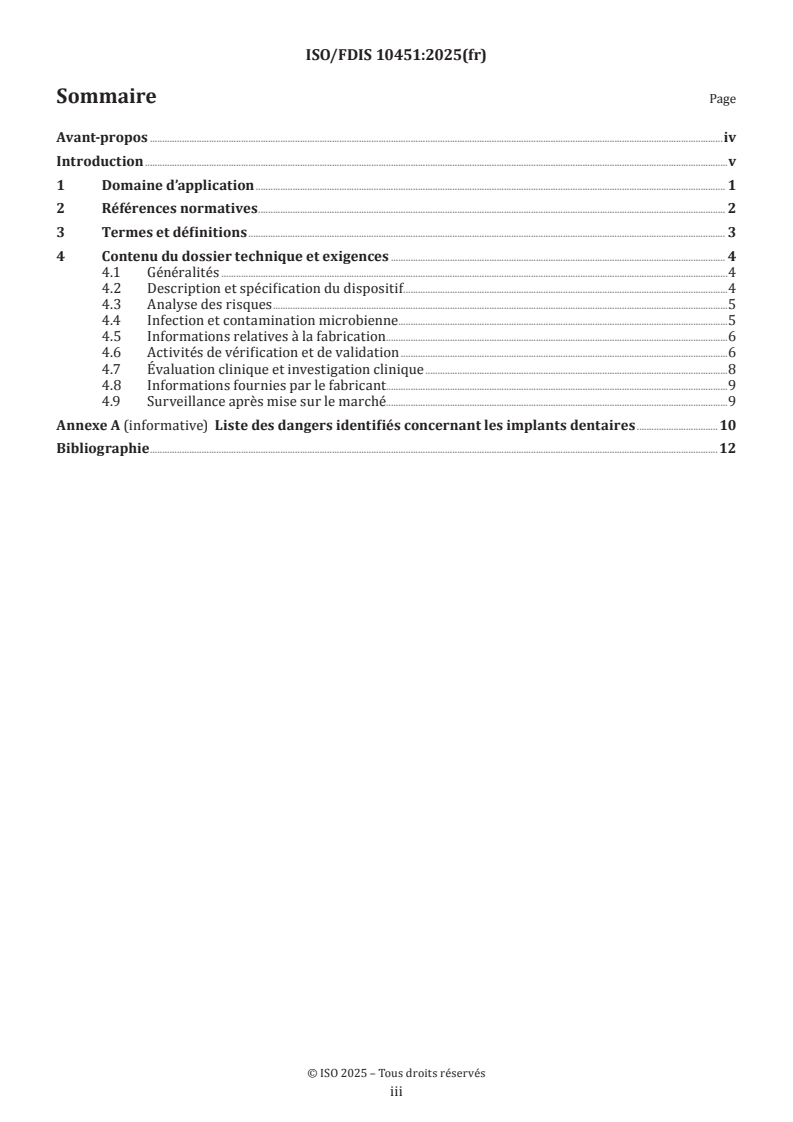
ISO/FDIS 10451 - Médecine bucco-dentaire — Contenu du dossier technique pour les systèmes d'implants dentaires Released:19. 12. 2025
Frequently Asked Questions
ISO/FDIS 10451 is a draft published by the International Organization for Standardization (ISO). Its full title is "Dentistry - Contents of a technical file for dental implant systems". This standard covers: Dentistry - Contents of a technical file for dental implant systems
Dentistry - Contents of a technical file for dental implant systems
ISO/FDIS 10451 is classified under the following ICS (International Classification for Standards) categories: 11.060.15 - Dental implants. The ICS classification helps identify the subject area and facilitates finding related standards.
ISO/FDIS 10451 has the following relationships with other standards: It is inter standard links to ISO 4387:2019, ISO 10451:2010. Understanding these relationships helps ensure you are using the most current and applicable version of the standard.
ISO/FDIS 10451 is available in PDF format for immediate download after purchase. The document can be added to your cart and obtained through the secure checkout process. Digital delivery ensures instant access to the complete standard document.
Standards Content (Sample)
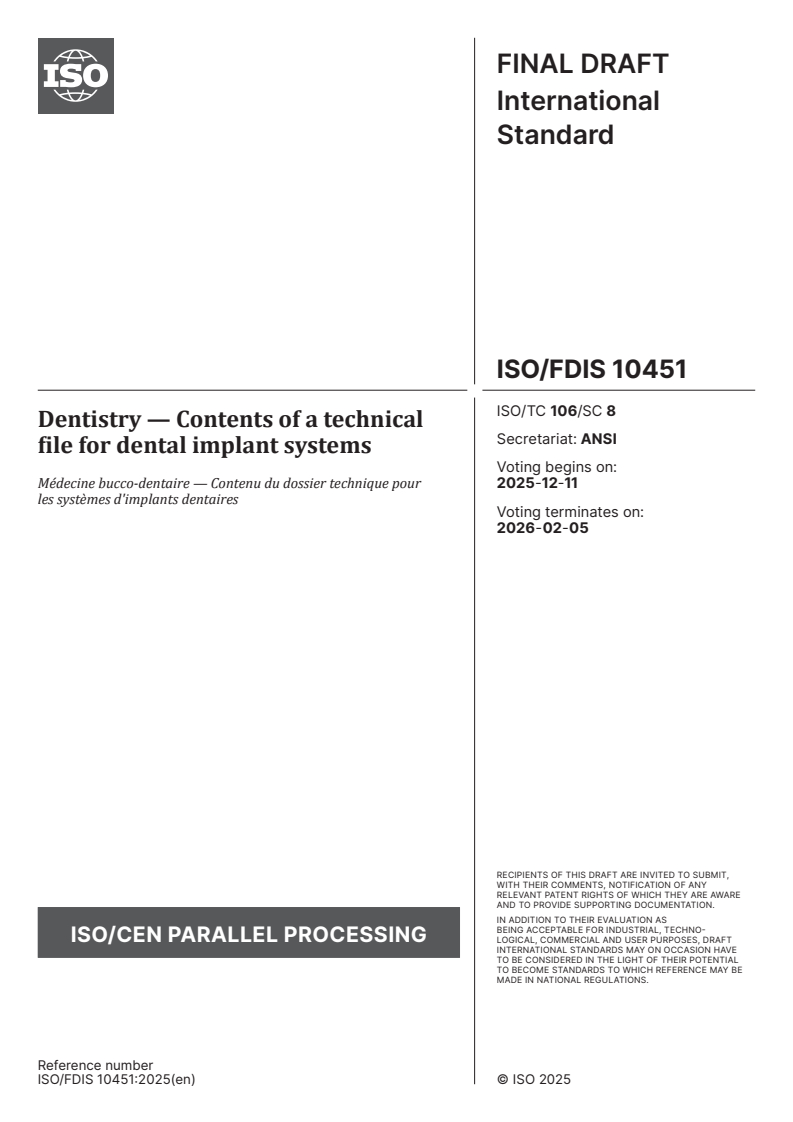
FINAL DRAFT
International
Standard
ISO/TC 106/SC 8
Dentistry — Contents of a technical
Secretariat: ANSI
file for dental implant systems
Voting begins on:
Médecine bucco-dentaire — Contenu du dossier technique pour 2025-12-11
les systèmes d'implants dentaires
Voting terminates on:
2026-02-05
RECIPIENTS OF THIS DRAFT ARE INVITED TO SUBMIT,
WITH THEIR COMMENTS, NOTIFICATION OF ANY
RELEVANT PATENT RIGHTS OF WHICH THEY ARE AWARE
AND TO PROVIDE SUPPOR TING DOCUMENTATION.
IN ADDITION TO THEIR EVALUATION AS
BEING ACCEPTABLE FOR INDUSTRIAL, TECHNO
ISO/CEN PARALLEL PROCESSING LOGICAL, COMMERCIAL AND USER PURPOSES, DRAFT
INTERNATIONAL STANDARDS MAY ON OCCASION HAVE
TO BE CONSIDERED IN THE LIGHT OF THEIR POTENTIAL
TO BECOME STAN DARDS TO WHICH REFERENCE MAY BE
MADE IN NATIONAL REGULATIONS.
Reference number
FINAL DRAFT
International
Standard
ISO/TC 106/SC 8
Dentistry — Contents of a technical
Secretariat: ANSI
file for dental implant systems
Voting begins on:
Médecine bucco-dentaire — Contenu du dossier technique pour
les systèmes d'implants dentaires
Voting terminates on:
RECIPIENTS OF THIS DRAFT ARE INVITED TO SUBMIT,
WITH THEIR COMMENTS, NOTIFICATION OF ANY
RELEVANT PATENT RIGHTS OF WHICH THEY ARE AWARE
AND TO PROVIDE SUPPOR TING DOCUMENTATION.
© ISO 2025
IN ADDITION TO THEIR EVALUATION AS
All rights reserved. Unless otherwise specified, or required in the context of its implementation, no part of this publication may
BEING ACCEPTABLE FOR INDUSTRIAL, TECHNO
ISO/CEN PARALLEL PROCESSING
LOGICAL, COMMERCIAL AND USER PURPOSES, DRAFT
be reproduced or utilized otherwise in any form or by any means, electronic or mechanical, including photocopying, or posting on
INTERNATIONAL STANDARDS MAY ON OCCASION HAVE
the internet or an intranet, without prior written permission. Permission can be requested from either ISO at the address below
TO BE CONSIDERED IN THE LIGHT OF THEIR POTENTIAL
or ISO’s member body in the country of the requester.
TO BECOME STAN DARDS TO WHICH REFERENCE MAY BE
MADE IN NATIONAL REGULATIONS.
ISO copyright office
CP 401 • Ch. de Blandonnet 8
CH-1214 Vernier, Geneva
Phone: +41 22 749 01 11
Email: copyright@iso.org
Website: www.iso.org
Published in Switzerland Reference number
ii
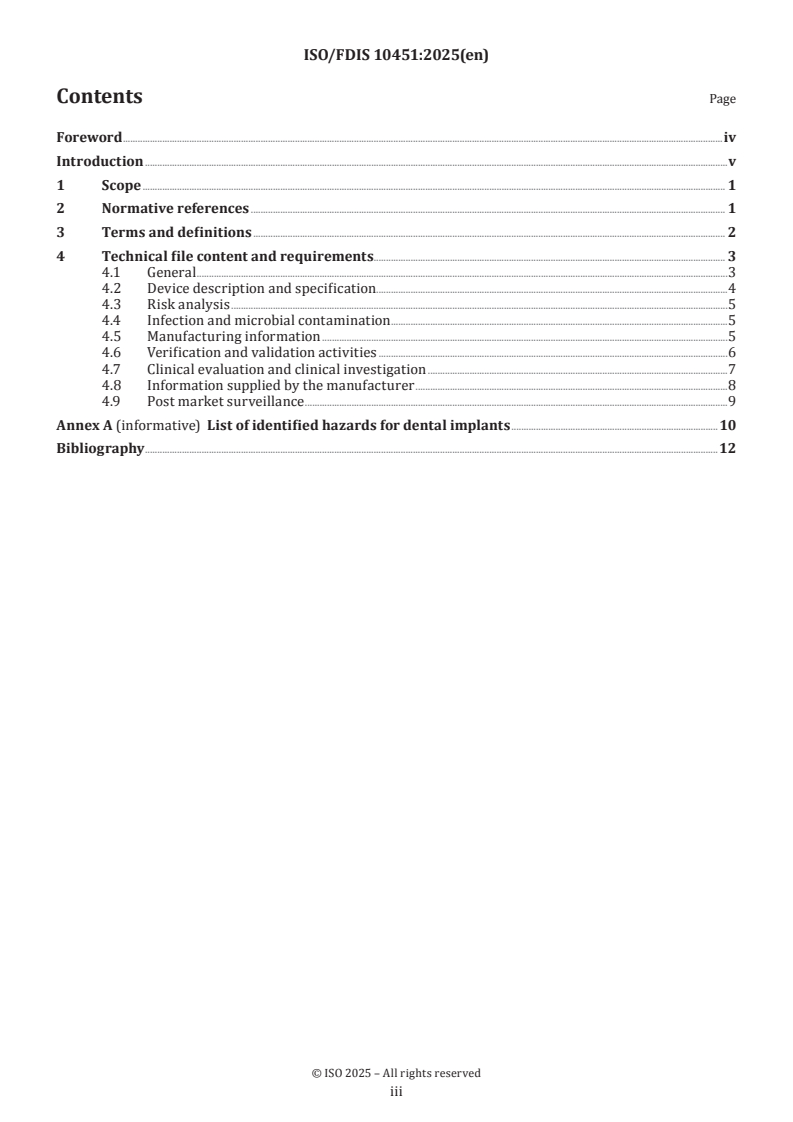
Contents Page
Foreword .iv
Introduction .v
1 Scope . 1
2 Normative references . 1
3 Terms and definitions . 2
4 Technical file content and requirements. 3
4.1 General .3
4.2 Device description and specification.4
4.3 Risk analysis .5
4.4 Infection and microbial contamination .5
4.5 Manufacturing information .5
4.6 Verification and validation activities .6
4.7 Clinical evaluation and clinical investigation .7
4.8 Information supplied by the manufacturer .8
4.9 Post market surveillance .9
Annex A (informative) List of identified hazards for dental implants .10
Bibliography .12
iii
Foreword
ISO (the International Organization for Standardization) is a worldwide federation of national standards
bodies (ISO member bodies). The work of preparing International Standards is normally carried out through
ISO technical committees. Each member body interested in a subject for which a technical committee
has been established has the right to be represented on that committee. International organizations,
governmental and non-governmental, in liaison with ISO, also take part in the work. ISO collaborates closely
with the International Electrotechnical Commission (IEC) on all matters of electrotechnical standardization.
The procedures used to develop this document and those intended for its further maintenance are described
in the ISO/IEC Directives, Part 1. In particular, the different approval criteria needed for the different types
of ISO document should be noted. This document was drafted in accordance with the editorial rules of the
ISO/IEC Directives, Part 2 (see www.iso.org/directives).
ISO draws attention to the possibility that the implementation of this document may involve the use of (a)
patent(s). ISO takes no position concerning the evidence, validity or applicability of any claimed patent
rights in respect thereof. As of the date of publication of this document, ISO had not received notice of (a)
patent(s) which may be required to implement this document. However, implementers are cautioned that
this may not represent the latest information, which may be obtained from the patent database available at
www.iso.org/patents. ISO shall not be held responsible for identifying any or all such patent rights.
Any trade name used in this document is information given for the convenience of users and does not
constitute an endorsement.
For an explanation of the voluntary nature of standards, the meaning of ISO specific terms and expressions
related to conformity assessment, as well as information about ISO's adherence to the World Trade
Organization (WTO) principles in the Technical Barriers to Trade (TBT), see www.iso.org/iso/foreword.html.
This document was prepared by Technical Committee ISO/TC 106, Dentistry, Subcommittee SC 8, Dental
implants, in collaboration with the European Committee for Standardization (CEN) Technical Committee
CEN/TC 55, Dentistry, in accordance with the Agreement on technical cooperation between ISO and CEN
(Vienna Agreement).
This third edition cancels and replaces the second edition (ISO 10451:2010), which has been technically
revised.
The main changes compared to the previous edition are as follows:
[1]
— technical file has been reworked to take into account the new European Medical Device Regulation ;
— Annex A has been added.
Any feedback or questions on this document should be directed to the user’s national standards body. A
complete listing of these bodies can be found at www.iso.org/members.html.
iv
Introduction
Legal and regulatory requirements on the documentation of the design, manufacture and performance of
dental implants are developing in different ways around the world. As the dental implant industry is already
active on a global basis, and is becoming more so, concern is growing as to the need for international and
mutually recognized standards for the documentation of the design and performance of such devices.
v
FINAL DRAFT International Standard ISO/FDIS 10451:2025(en)
Dentistry — Contents of a technical file for dental implant
systems
1 Scope
This document specifies requirements for the contents of a technical file to demonstrate the fulfilment of
regulatory requirements for an endosseous dental implant that can include:
— implant body;
— implant abutment;
— abutment screw;
— implant connecting part;
— implant connecting part screw;
— prosthetic screw;
— implant cover screw;
— transmucosal healing component.
This document also specifies requirements for intended use and performance, design attributes, components,
biocompatibility, manufacturing, packaging, sterilization, shelf life, marking, labelling and information
supplied by the manufacturer.
This document does not apply to the following devices:
— dental implants incorporating animal or human components or bioactive characteristics;
— custom-made devices that have no pre-fabricated connection;
— implantable materials for bone filling and augmentation in oral and maxillofacial surgery;
— membrane materials for guided tissue regeneration in oral and maxillofacial surgery;
— specific instruments indicated to be used as part of a dental implant system.
NOTE 1 ISO 22794 specifies the necessary content of technical files for implantable materials for bone filling
and augmentation in oral and maxillofacial surgery. ISO 22803 specifies the necessary content of technical files for
membrane materials for guided tissue regeneration in oral and maxillofacial surgery. These materials require a
separate technical file.
NOTE 2 ISO 13504 gives the general requirements for specific instruments indicated to be used as part of a dental
implant system. These instruments require a separate technical file.
[5]
NOTE 3 Custom-made devices are defined in IMDRF/PMD WG/N49 .
2 Normative references
The following documents are referred to in the text in such a way that some or all of their content constitutes
requirements of this document. For dated references, only the edition cited applies. For undated references,
the latest edition of the referenced document (including any amendments) applies.
ISO 1942, Dentistry — Vocabulary
ISO 3950, Dentistry — Designation system for teeth and areas of the oral cavity
ISO 7405, Dentistry — Evaluation of biocompatibility of medical devices used in dentistry
ISO 10271, Dentistry — Corrosion test methods for metallic materials
ISO 10993-1, Biological evaluation of medical devices — Part 1: Evaluation and testing within a risk management
process
ISO 10993-17, Biological evaluation of medical devices — Part 17: Toxicological risk assessment of medical
device constituents
ISO 11135, Sterilization of health-care products — Ethylene oxide — Requirements for the development,
validation and routine control of a sterilization process for medical devices
ISO 11137-1, Sterilization of health care products — Radiation — Part 1: Requirements for the development,
validation and routine control of a sterilization process for medical devices
ISO 11137-2, Sterilization of health care products — Radiation — Part 2: Establishing the sterilization dose
ISO 11607-1, Packaging for terminally sterilized medical devices — Part 1: Requirements for materials, sterile
barrier systems and packaging systems
ISO 11607-2, Packaging for terminally sterilized medical devices — Part 2: Validation requirements for forming,
sealing and assembly processes
ISO 13485, Medical devices — Quality management systems — Requirements for regulatory purposes
ISO 14155, Clinical investigation of medical devices for human subjects — Good clinical practice
ISO 14644-1, Cleanrooms and associated controlled environments — Part 1: Classification of air cleanliness by
particle concentration
ISO 14801, Dentistry — Implants — Dynamic loading test for endosseous dental implants
ISO 14971, Medical devices — Application of risk management to medical devices
ISO 15223-1, Medical devices — Symbols to be used with information to be supplied by the manufacturer — Part
1: General requirements
ISO 15223-2, Medical devices — Symbols to be used with medical device labels, labelling, and information to be
supplied — Part 2: Symbol development, selection and validation
ISO 16443, Dentistry — Vocabulary for dental implants systems and related procedure
ISO 17664-1, Processing of health care products — Information to be provided by the medical device
manufacturer for the processing of medical devices — Part 1: Critical and semi-critical medical devices
ISO 17665, Sterilization of health care products — Moist heat — Requirements for the development, validation
and routine control of a sterilization process for medical devices
ISO 20417, Medical devices — Information to be supplied by the manufacturer
ISO 22683, Dentistry — Rotational adaptability test between implant body and implant abutment in dental
implant systems
IEC 62366-1, Medical devices — Part 1: Application of usability engineering to medical devices
3 Terms and definitions
For the purposes of this document, the terms and definitions given in ISO 1942, ISO 3950, ISO 16443,
ISO 13485 and the following apply.
ISO and IEC maintain terminological databases for use in standardization at the following addresses:
— ISO Online browsing platform: available at https:// www .iso .org/ obp
— IEC Electropedia: available at https:// www .electropedia .org/
3.1
clinical evaluation
assessment and analysis of clinical data pertaining to a medical device to verify the clinical safety and
performance of the device when used as intended by the manufacturer
[SOURCE: ISO 13485:2016, 3.3]
3.2
dental implant assembly
assembly of dental implant components as recommended by the manufacturer to serve the purposes of a
dental implant
[SOURCE: ISO 16443:2014, 3.2.3]
3.3
implant component coating
layer of material, different from the constitutive material of the implant component, used to cover or
partially cover a defined surface of an implant body or an implant component
[SOURCE: ISO 1942:2020, 3.7.2.7]
3.4
technical documentation
manufacturer's set of data showing conformity of a device to a list of requirements of this document and
which is intended to be used as part of the technical documentation required for conformity assessment
procedures performed by conformity assessment bodies (3.2)
Note 1 to entry: See Reference [6] for an explanation of the term “conformity assessment body”.
Note 2 to entry: In Europe, notified bodies are considered as being conformity assessment bodies and every member
state has a national regulatory authority (e.g. Zentralstelle der Länder für Gesundheitsschutz for Germany, Agence
Nationale de Sécurité du Médicament et des Produits de Santé for France). In the United States, the Food and Drug
Agency is both a regulatory authority and a conformity assessment body.
3.5
subtractive surface treatment
process that modifies a component’s surface by subtraction of material
EXAMPLE Sandblasting and acid etching are considered subtractive surface treatments.
4 Technical file content and requirements
4.1 General
The technical file should be kept up-to-date and kept for a defined period after the last device has been
placed on the market.
The technical file shall contain, or reference the location of, at least the information required in 4.2 to 4.9.
NOTE Subclauses 4.2 to 4.9 are not supposed to be strictly followed as chapter headers for the technical
documentation.
4.2 Device description and specification
The technical file shall include the following information:
a) device name;
b) representative images;
c) variations in the family;
d) patient population;
e) intended use;
f) indications for use and contra-indications (especially if the implant component is suitable for either
single or multi-unit restorations or both, delayed or immediate loading);
g) specifications including:
1) design and dimensions;
EXAMPLE 1 Height, length, diameter, connection platform types including size, taper, conical feature, internal or
external hexagon when relevant and description of surface modification(s).
NOTE Surface modifications can include, but are not limited to, various processes like coating (ceramic, metallic,
hydroxyapatite, etc.), sandblasting, acid-etching.
2) implant abutment and prosthetic fixation design;
EXAMPLE 2 Screw-retained, cement-retained, friction-fit or combination.
3) composition of the raw material in accordance with relevant standard(s);
4) chemical properties of the raw materials in accordance with relevant standard(s);
5) physical properties of the raw material in accordance with relevant standard(s).
h) explanation of novel features;
i) description of accessories to be used in combination with the device;
j) description of unique device identification number;
k) if appropriate, justification of the classification criteria and rationale used to select the conformity
assessment route;
l) market history;
m) ref
...
ISO/TC 106/SC 8
Secretariat: ANSI
Date: 2025-09-3011-27
Dentistry - — Contents of a technical file for dental implantsimplant
systems
Médecine bucco-dentaire - — Contenu du dossier technique pour implantsles systèmes d'implants dentaires
FDIS stage
TThhiiss d drraft iaft iss su subbmmiitted tted to to a pa parallearallel vl vote ote iinn IS ISOO, CE, CENN.
ISO /FDIS 10451:####(X:2025(en)
All rights reserved. Unless otherwise specified, or required in the context of its implementation, no part of this publication
may be reproduced or utilized otherwise in any form or by any means, electronic or mechanical, including photocopying,
or posting on the internet or an intranet, without prior written permission. Permission can be requested from either ISO
at the address below or ISO’s member body in the country of the requester.
ISO copyright office
CP 401 • Ch. de Blandonnet 8
CH-1214 Vernier, Geneva
Phone: + 41 22 749 01 11
EmailE-mail: copyright@iso.org
Website: www.iso.orgwww.iso.org
Published in Switzerland
ii © ISO #### 2025 – All rights reserved
ii
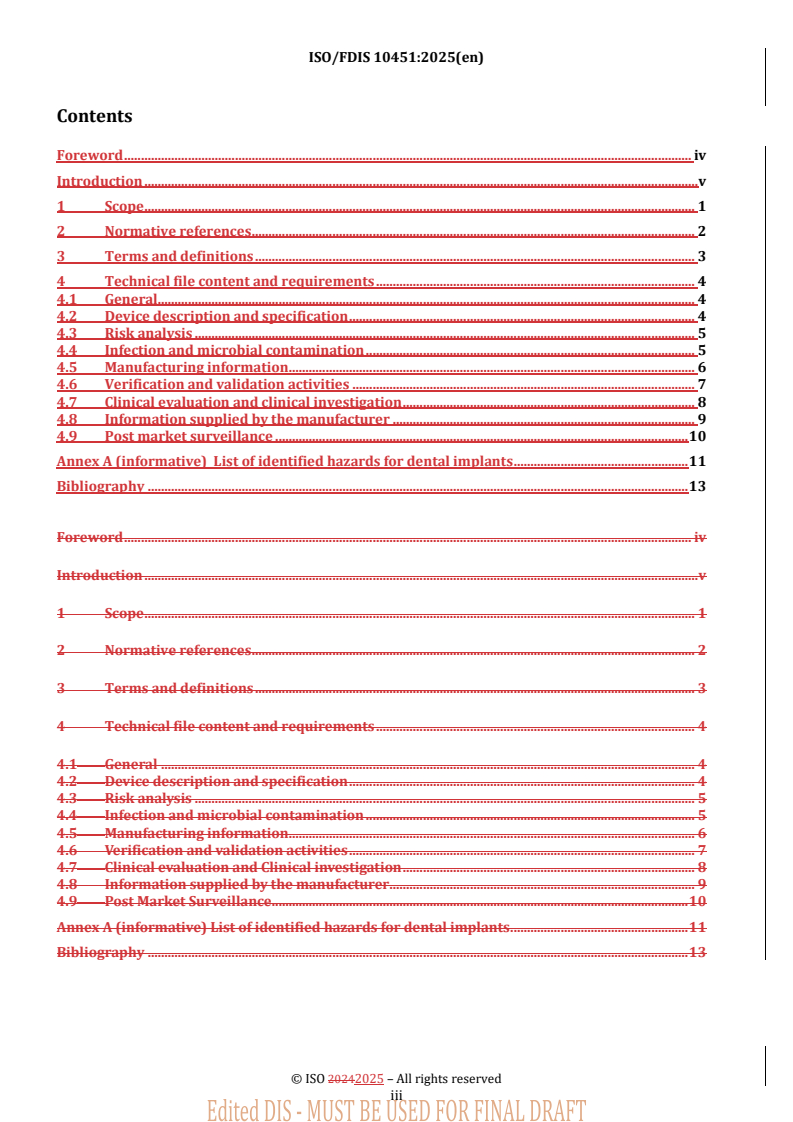
Contents
Foreword . iv
Introduction . v
1 Scope . 1
2 Normative references . 2
3 Terms and definitions . 3
4 Technical file content and requirements . 4
4.1 General. 4
4.2 Device description and specification . 4
4.3 Risk analysis . 5
4.4 Infection and microbial contamination . 5
4.5 Manufacturing information . 6
4.6 Verification and validation activities . 7
4.7 Clinical evaluation and clinical investigation . 8
4.8 Information supplied by the manufacturer . 9
4.9 Post market surveillance . 10
Annex A (informative) List of identified hazards for dental implants . 11
Bibliography . 13
Foreword . iv
Introduction . v
1 Scope . 1
2 Normative references . 2
3 Terms and definitions . 3
4 Technical file content and requirements . 4
4.1 General . 4
4.2 Device description and specification . 4
4.3 Risk analysis . 5
4.4 Infection and microbial contamination . 5
4.5 Manufacturing information . 6
4.6 Verification and validation activities . 7
4.7 Clinical evaluation and Clinical investigation . 8
4.8 Information supplied by the manufacturer . 9
4.9 Post Market Surveillance . 10
Annex A (informative) List of identified hazards for dental implants . 11
Bibliography . 13
iii
ISO /FDIS 10451:####(X:2025(en)
Foreword
ISO (the International Organization for Standardization) is a worldwide federation of national standards
bodies (ISO member bodies). The work of preparing International Standards is normally carried out through
ISO technical committees. Each member body interested in a subject for which a technical committee has been
established has the right to be represented on that committee. International organizations, governmental and
non-governmental, in liaison with ISO, also take part in the work. ISO collaborates closely with the
International Electrotechnical Commission (IEC) on all matters of electrotechnical standardization.
The procedures used to develop this document and those intended for its further maintenance are described
in the ISO/IEC Directives, Part 1. In particular, the different approval criteria needed for the different types of
ISO document should be noted. This document was drafted in accordance with the editorial rules of the
ISO/IEC Directives, Part 2 (see www.iso.org/directives).
ISO draws attention to the possibility that the implementation of this document may involve the use of (a)
patent(s). ISO takes no position concerning the evidence, validity or applicability of any claimed patent rights
in respect thereof. As of the date of publication of this document, ISO had not received notice of (a) patent(s)
which may be required to implement this document. However, implementers are cautioned that this may not
represent the latest information, which may be obtained from the patent database available at
www.iso.org/patents. ISO shall not be held responsible for identifying any or all such patent rights.
Any trade name used in this document is information given for the convenience of users and does not
constitute an endorsement.
For an explanation of the voluntary nature of standards, the meaning of ISO specific terms and expressions
related to conformity assessment, as well as information about ISO's adherence to the World Trade
Organization (WTO) principles in the Technical Barriers to Trade (TBT), see www.iso.org/iso/foreword.html.
This document was prepared by Technical Committee ISO/TC 106, Dentistry, Subcommittee SC 8, Dental
implants, in collaboration with the European Committee for Standardization (CEN) Technical Committee
CEN/TC 55, Dentistry, in accordance with the Agreement on technical cooperation between ISO and CEN
(Vienna Agreement).
This third edition cancels and replaces the second edition (ISO 10451:2010), which has been technically
revised.
The main changes compared to the previous edition are as follows:
[1]
— technical file has been reworked to take into account the new European Medical Device Regulation ;
— Annex A has been added.
Any feedback or questions on this document should be directed to the user’s national standards body. A
complete listing of these bodies can be found at www.iso.org/members.html.
iv © ISO #### 2025 – All rights reserved
iv
Introduction
Legal and regulatory requirements on the documentation of the design, manufacture and performance of
dental implants are developing in different ways around the world. As the dental implant industry is already
active on a global basis, and is becoming more so, concern is growing as to the need for international and
mutually recognized standards for the documentation of the design and performance of such devices.
v
DRAFT International Standard ISO/FDIS 10451:2025(en)
Dentistry - — Contents of a technical file for dental implantsimplant
systems
1 Scope
This document specifies requirements for the contents of a technical file to demonstrate the fulfilment of
regulatory requirements for an endosseous dental implant that can include:
— implant body;
— implant abutment;
— abutment screw;
— implant connecting part;
— implant connecting part screw;
— prosthetic screw;
— implant cover screw;
— transmucosal healing component.
This document also specifies requirements for intended use and performance, design attributes, components,
biocompatibility, manufacturing, packaging, sterilization, shelf life, marking, labelling and information
supplied by the manufacturer.
This document does not apply to the following devices:
— dental implants incorporating animal or human components or bioactive characteristics;
— custom-made devices that have no pre-fabricated connection;
— implantable materials for bone filling and augmentation in oral and maxillofacial surgery;
— membrane materials for guided tissue regeneration in oral and maxillofacial surgery;
— specific instruments indicated to be used as part of a dental implant system.
[2]
NOTE 1 ISO 22794 specifies the necessary content of technical files for implantable materials for bone filling and
[3]
augmentation in oral and maxillofacial surgery. ISO 22803 specifies the necessary content of technical files for
membrane materials for guided tissue regeneration in oral and maxillofacial surgery. These materials require a separate
technical file.
[4]
NOTE 2 ISO 13504 gives the general requirements for specific instruments indicated to be used as part of a dental
implant system. These instruments require a separate technical file.
[5] [Error! Reference source not found.]
NOTE 3 Custom-made devices are defined in IMDRF/PMD WG/N49 . .
ISO /FDIS 10451:####(X:2025(en)
2 Normative references
The following documents are referred to in the text in such a way that some or all of their content constitutes
requirements of this document. For dated references, only the edition cited applies. For undated references,
the latest edition of the referenced document (including any amendments) applies.
ISO 1942, Dentistry — Vocabulary
ISO 3950, Dentistry — Designation system for teeth and areas of the oral cavity
ISO 7405, Dentistry — Evaluation of biocompatibility of medical devices used in dentistry
ISO 10271, Dentistry — Corrosion test methods for metallic materials
ISO 10993-1, Biological evaluation of medical devices — Part 1: Evaluation and testing within a risk
management process
ISO 10993--17, Biological evaluation of medical devices — Part 17: Toxicological risk assessment of medical
device constituents
ISO 11135, Sterilization of health-care products — Ethylene oxide — Requirements for the development,
validation and routine control of a sterilization process for medical devices
ISO 11137--1, Sterilization of health care products — Radiation — Part 1: Requirements for the development,
validation and routine control of a sterilization process for medical devices
ISO 11137--2, Sterilization of health care products — Radiation — Part 2: Establishing the sterilization dose
ISO 11607--1, Packaging for terminally sterilized medical devices — Part 1: Requirements for materials, sterile
barrier systems and packaging systems
ISO 11607--2, Packaging for terminally sterilized medical devices — Part 2: Validation requirements for forming,
sealing and assembly processes
ISO 13485, Medical devices — Quality management systems — Requirements for regulatory purposes
ISO 14155, Clinical investigation of medical devices for human subjects — Good clinical practice
ISO 14644 (all parts),-1, Cleanrooms and associated controlled environments — Part 1: Classification of air
cleanliness by particle concentration
ISO 14801, Dentistry — Implants — Dynamic loading test for endosseous dental implants
ISO 14971, Medical devices — Application of risk management to medical devices
ISO 15223--1, Medical devices — Symbols to be used with information to be supplied by the manufacturer —
Part 1: General requirements
ISO 15223--2, Medical devices — Symbols to be used with medical device labels, labelling, and information to be
supplied by the manufacturer — Part 2: Symbol development, selection and validation
ISO 16443, Dentistry — Vocabulary for dental implants systems and related procedure
ISO 17664--1, Processing of health care products — Information to be provided by the medical device
manufacturer for the processing of medical devices — Part 1: Critical and semi-critical medical devices
2 © ISO #### 2025 – All rights reserved
ISO 17665, Sterilization of health care products — Moist heat — Requirements for the development, validation
and routine control of a sterilization process for medical devices
ISO 20417, Medical devices — Information to be supplied by the manufacturer
ISO 22683, Dentistry — Rotational adaptability test between implant body and implant abutment in dental
implant systems
IEC 62366--1, Medical devices — Part 1: Application of usability engineering to medical devices
3 Terms and definitions
For the purposes of this document, the terms and definitions given in ISO 1942, ISO 3950, ISO 16443, ISO
13485 and the following apply.
ISO and IEC maintain terminological databases for use in standardization at the following addresses:
— ISO Online browsing platform: available at https://www.iso.org/obp
— IEC Electropedia: available at https://www.electropedia.org/
3.1 3.1
clinical evaluation
assessment and analysis of clinical data pertaining to a medical device to verify the clinical safety and
performance of the device when used as intended by the manufacturer
[SOURCE: ISO 13485:2016, 3.3]
3.2
conformity assessment body
a body other than a regulatory authority engaged in determining whether the relevant requirements in
technical regulations or standards are fulfilled
EXAMPLE In Europe, notified bodies are considered as being conformity assessment body and every member state has a
national regulatory authority (e.g. Zentralstelle der Länder für Gesundheitsschutz for Germany, Agence Nationale de
Sécurité du Médicament et des Produits de Santé for France). In the United States, the Food and Drug Agency is both a
regulatory authority and a conformity assessment body.
[6]
[SOURCE IMDRF/GRRP WG/N040:2024 , modified, example added]
3.2 3.3
dental implant assembly
assembly of dental implant components as recommended by the manufacturer to serve the purposes of a
dental implant
[SOURCE: ISO 16443:2014, 3.2.3]
3.3 3.4
implant component coating
layer of material, different from the constitutive material of the implant component, used to cover or partially
cover a defined surface of an implant body or an implant component
[SOURCE: ISO 1942:2020, 3.7.2.7]
ISO /FDIS 10451:####(X:2025(en)
3.4 3.5
technical documentation
manufacturer's set of data showing conformity of a device to a list of requirements of this document and which
is intended to be used as part of the technical documentation required for conformity assessment procedures
performed by conformity assessment bodies (3.2)(Error! Reference source not found.)
3.6Note 1 to entry: See Reference [Error! Reference source not found.] for an explanation of the term “conformity
assessment body”.
Note 2 to entry: In Europe, notified bodies are considered as being conformity assessment bodies and every member
state has a national regulatory authority (e.g. Zentralstelle der Länder für Gesundheitsschutz for Germany, Agence
Nationale de Sécurité du Médicament et des Produits de Santé for France). In the United States, the Food and Drug Agency
is both a regulatory authority and a conformity assessment body.
3.5
subtractive surface treatment
process that modifies a component’s surface by subtraction of material
EXAMPLE Sandblasting and acid etching are considered subtractive surface treatments.
4 Technical file content and requirements
4.1 General
The technical file should be kept up-to-date and kept for a defined period after the last device has been placed
on the market.
The technical file shall contain, or reference the location of, at least the information required in 4.2 to 4.9.4.2
to 4.9.
NOTE Subclauses 4.2 to 4.9NOTE 4.2 to 4.9 are not supposed to be strictly followed as chapter headers
for the technical documentation.
4.2 Device description and specification
The technical file shall include the following information:
a) device name;
b) representative images;
c) variations in the family;
d) patient population;
e) intended use;
f) indications for use and contra-indications (especially if the implant component is suitable for either single
or multi-unit restorations or both, delayed or immediate loading);
g) specifications including:
1) design and dimensions;
EXAMPLE 1 Height, length, diameter, connection platform types including size, taper, conical feature, internal or
external hexagon when relevant and description of surface modification(s).
4 © ISO #### 2025 – All rights reserved
NOTE Surface modifications can include, but are not limited to, various processes like coating (ceramic, metallic,
hydroxyapatite…),, etc.), sandblasting, acid-etching.
2) implant abutment and prosthetic fixation design;
EXAMPLE 2 Screw-retained, cement-retained, friction-fit or combination.
3) composition of the raw material in accordance with relevant standard(s);
4) chemical propert
...
PROJET FINAL
Norme
internationale
ISO/TC 106/SC 8
Médecine bucco-dentaire —
Secrétariat: ANSI
Contenu du dossier technique pour
Début de vote:
les systèmes d'implants dentaires
2025-12-11
Dentistry — Contents of a technical file for dental implant
Vote clos le:
systems
2026-02-05
LES DESTINATAIRES DU PRÉSENT PROJET SONT
INVITÉS À PRÉSENTER, AVEC LEURS OBSERVATIONS,
NOTIFICATION DES DROITS DE PROPRIÉTÉ DONT ILS
AURAIENT ÉVENTUELLEMENT CONNAISSANCE ET À
FOURNIR UNE DOCUMENTATION EXPLICATIVE.
OUTRE LE FAIT D’ÊTRE EXAMINÉS POUR
ÉTABLIR S’ILS SONT ACCEPTABLES À DES FINS
INDUSTRIELLES, TECHNOLOGIQUES ET COM-MERCIALES,
AINSI QUE DU POINT DE VUE DES UTILISATEURS, LES
PROJETS DE NORMES
TRAITEMENT PARALLÈLE ISO/CEN
INTERNATIONALES DOIVENT PARFOIS ÊTRE CONSIDÉRÉS
DU POINT DE VUE DE LEUR POSSI BILITÉ DE DEVENIR DES
NORMES POUVANT
SERVIR DE RÉFÉRENCE DANS LA RÉGLEMENTATION
NATIONALE.
Numéro de référence
PROJET FINAL
Norme
internationale
ISO/TC 106/SC 8
Médecine bucco-dentaire —
Secrétariat: ANSI
Contenu du dossier technique pour
Début de vote:
les systèmes d'implants dentaires
2025-12-11
Dentistry — Contents of a technical file for dental implant
Vote clos le:
systems
2026-02-05
LES DESTINATAIRES DU PRÉSENT PROJET SONT
INVITÉS À PRÉSENTER, AVEC LEURS OBSERVATIONS,
NOTIFICATION DES DROITS DE PROPRIÉTÉ DONT ILS
AURAIENT ÉVENTUELLEMENT CONNAISSANCE ET À
FOURNIR UNE DOCUMENTATION EXPLICATIVE.
DOCUMENT PROTÉGÉ PAR COPYRIGHT
OUTRE LE FAIT D’ÊTRE EXAMINÉS POUR
ÉTABLIR S’ILS SONT ACCEPTABLES À DES FINS
© ISO 2025 INDUSTRIELLES, TECHNOLOGIQUES ET COM-MERCIALES,
AINSI QUE DU POINT DE VUE DES UTILISATEURS, LES
Tous droits réservés. Sauf prescription différente ou nécessité dans le contexte de sa mise en œuvre, aucune partie de cette
PROJETS DE NORMES
TRAITEMENT PARALLÈLE ISO/CEN
INTERNATIONALES DOIVENT PARFOIS ÊTRE CONSIDÉRÉS
publication ne peut être reproduite ni utilisée sous quelque forme que ce soit et par aucun procédé, électronique ou mécanique,
DU POINT DE VUE DE LEUR POSSI BILITÉ DE DEVENIR DES
y compris la photocopie, ou la diffusion sur l’internet ou sur un intranet, sans autorisation écrite préalable. Une autorisation peut
NORMES POUVANT
être demandée à l’ISO à l’adresse ci-après ou au comité membre de l’ISO dans le pays du demandeur.
SERVIR DE RÉFÉRENCE DANS LA RÉGLEMENTATION
NATIONALE.
ISO copyright office
Case postale 401 • Ch. de Blandonnet 8
CH-1214 Vernier, Genève
Tél.: +41 22 749 01 11
E-mail: copyright@iso.org
Web: www.iso.org
Publié en Suisse Numéro de référence
ii
Sommaire Page
Avant-propos .iv
Introduction .v
1 Domaine d’application . 1
2 Références normatives . 2
3 Termes et définitions . 3
4 Contenu du dossier technique et exigences . 4
4.1 Généralités .4
4.2 Description et spécification du dispositif .4
4.3 Analyse des risques .5
4.4 Infection et contamination microbienne.5
4.5 Informations relatives à la fabrication .6
4.6 Activités de vérification et de validation .6
4.7 Évaluation clinique et investigation clinique .8
4.8 Informations fournies par le fabricant.9
4.9 Surveillance après mise sur le marché.9
Annexe A (informative) Liste des dangers identifiés concernant les implants dentaires .10
Bibliographie .12
iii
Avant-propos
L’ISO (Organisation internationale de normalisation) est une fédération mondiale d’organismes nationaux
de normalisation (comités membres de l’ISO). L’élaboration des Normes internationales est en général
confiée aux comités techniques de l’ISO. Chaque comité membre intéressé par une étude a le droit de faire
partie du comité technique créé à cet effet. Les organisations internationales, gouvernementales et non
gouvernementales, en liaison avec l’ISO participent également aux travaux. L’ISO collabore étroitement avec
la Commission électrotechnique internationale (IEC) en ce qui concerne la normalisation électrotechnique.
Les procédures utilisées pour élaborer le présent document et celles destinées à sa mise à jour sont
décrites dans les Directives ISO/IEC, Partie 1. Il convient, en particulier, de prendre note des différents
critères d’approbation requis pour les différents types de documents ISO. Le présent document
a été rédigé conformément aux règles de rédaction données dans les Directives ISO/IEC, Partie 2
(voir www.iso.org/directives).
L’ISO attire l’attention sur le fait que la mise en application du présent document peut entraîner l’utilisation
d’un ou de plusieurs brevets. L’ISO ne prend pas position quant à la preuve, à la validité et à l’applicabilité de
tout droit de brevet revendiqué à cet égard. À la date de publication du présent document, l’ISO n’avait pas
reçu notification qu’un ou plusieurs brevets pouvaient être nécessaires à sa mise en application. Toutefois,
il y a lieu d’avertir les responsables de la mise en application du présent document que des informations
plus récentes sont susceptibles de figurer dans la base de données de brevets, disponible à l’adresse
www.iso.org/brevets. L’ISO ne saurait être tenue pour responsable de ne pas avoir identifié de tels droits de
propriété et averti de leur existence.
Les appellations commerciales éventuellement mentionnées dans le présent document sont données pour
information, par souci de commodité, à l’intention des utilisateurs et ne sauraient constituer un engagement.
Pour une explication de la nature volontaire des normes, la signification des termes et expressions
spécifiques de l’ISO liés à l’évaluation de la conformité, ou pour toute information au sujet de l’adhésion de
l’ISO aux principes de l’Organisation mondiale du commerce (OMC) concernant les obstacles techniques au
commerce (OTC), voir www.iso.org/avant-propos.
Le présent document a été élaboré par le comité technique ISO/TC 106, Médecine bucco-dentaire, sous-comité
SC 8, Implants dentaires, en collaboration avec le comité technique CEN/TC 55, Médecine bucco-dentaire,
du Comité européen de normalisation (CEN), conformément à l’Accord de coopération technique entre l’ISO
et le CEN (Accord de Vienne).
Cette troisième édition annule et remplace la deuxième édition (ISO 10451:2010), qui a fait l’objet d’une
révision technique.
Les principales modifications par rapport à l’édition précédente sont les suivantes:
— refonte du dossier technique pour tenir compte du nouveau règlement européen relatif aux dispositifs
[1]
médicaux ;
— ajout de l’Annexe A.
Il convient que l’utilisateur adresse tout retour d’information ou toute question concernant le présent
document à l’organisme national de normalisation de son pays. Une liste exhaustive desdits organismes se
trouve à l’adresse www.iso.org/fr/members.html.
iv
Introduction
Les exigences légales et réglementaires relatives à la documentation concernant la conception, la fabrication
et les performances des implants dentaires évoluent de différentes manières à travers le monde. Étant donné
que l’industrie des implants dentaires est déjà très active à l’échelle mondiale et connaît une croissance
constante, le besoin en Normes internationales et en normes reconnues mutuellement traitant de la
documentation relative à la conception et aux performances de dispositifs de ce type se fait de plus en plus
sentir.
v
PROJET FINAL Norme internationale ISO/FDIS 10451:2025(fr)
Médecine bucco-dentaire — Contenu du dossier technique
pour les systèmes d'implants dentaires
1 Domaine d’application
Le présent document spécifie les exigences relatives au contenu d’un dossier technique visant à démontrer la
conformité aux exigences réglementaires d’un implant dentaire endo-osseux, y compris:
— le corps d’implant;
— le pilier implantaire;
— la vis de fixation de pilier;
— l’élément de connexion implantaire;
— la vis de l’élément de connexion implantaire;
— la vis de prothèse;
— la vis de couverture de l’implant;
— l’élément de cicatrisation transmuqueux.
Le présent document spécifie également des exigences relatives à l’utilisation prévue et aux performances,
aux attributs de conception, aux éléments, à la biocompatibilité, à la fabrication, à l’emballage, à la
stérilisation, à la conservation, au marquage, à l’étiquetage et aux informations fournies par le fabricant.
Le présent document ne s’applique pas aux dispositifs suivants:
— implants dentaires constitués de composants d’origine animale ou humaine ou ayant des caractéristiques
bioactives;
— dispositifs sur mesure sans connexion préfabriquée;
— matériaux implantables destinés au comblement et à l’augmentation osseux en chirurgie buccale et
maxillofaciale;
— matériaux membranaires destinés à la régénération tissulaire guidée en chirurgie buccale et
maxillofaciale;
— instruments spécifiques utilisés dans le cadre d’un système d’implant dentaire.
NOTE 1 L’ISO 22794 spécifie le contenu nécessaire des dossiers techniques relatifs aux matériaux implantables
destinés au comblement et à l’augmentation osseux en chirurgie buccale et maxillofaciale. L’ISO 22803 spécifie le
contenu nécessaire des dossiers techniques relatifs aux matériaux membranaires destinés à la régénération tissulaire
guidée en chirurgie buccale et maxillofaciale. Ces matériaux nécessitent un dossier technique distinct.
NOTE 2 L’ISO 13504 donne les exigences générales relatives aux instruments spécifiques utilisés dans le cadre d’un
système d’implant dentaire. Ces instruments nécessitent un dossier technique distinct.
[5]
NOTE 3 Les dispositifs sur mesure sont définis dans la recommandation IMDRF/PMD WG/N49 .
2 Références normatives
Les documents suivants sont cités dans le texte de sorte qu’ils constituent, pour tout ou partie de leur
contenu, des exigences du présent document. Pour les références datées, seule l’édition citée s’applique. Pour
les références non datées, la dernière édition du document de référence s’applique (y compris les éventuels
amendements).
ISO 1942, Médecine bucco-dentaire — Vocabulaire
ISO 3950, Médecine bucco-dentaire — Code de désignation des dents et des régions de la cavité buccale
ISO 7405, Médecine bucco-dentaire — Évaluation de la biocompatibilité des dispositifs médicaux utilisés en
médecine bucco-dentaire
ISO 10271, Médecine bucco-dentaire — Méthodes d'essai de corrosion des matériaux métalliques
ISO 10993-1, Évaluation biologique des dispositifs médicaux — Partie 1: Exigences et principes généraux pour
l’évaluation de la sécurité biologique au sein d’un processus de gestion des risques
ISO 10993-17, Évaluation biologique des dispositifs médicaux — Partie 17: Appréciation du risque toxicologique
des constituants des dispositifs médicaux
ISO 11135, Stérilisation des produits de santé — Oxyde d’éthylène — Exigences de développement, de validation
et de contrôle de routine d’un processus de stérilisation pour des dispositifs médicaux
ISO 11137-1, Stérilisation des produits de santé — Irradiation — Partie 1: Exigences relatives à la mise au point,
à la validation et au contrôle de routine d'un procédé de stérilisation pour les dispositifs médicaux
ISO 11137-2, Stérilisation des produits de santé — Irradiation — Partie 2: Établissement de la dose stérilisante
ISO 11607-1, Emballages des dispositifs médicaux stérilisés au stade terminal — Partie 1: Exigences relatives
aux matériaux, aux systèmes de barrière stérile et aux systèmes d'emballage
ISO 11607-2, Emballages des dispositifs médicaux stérilisés au stade terminal — Partie 2: Exigences de validation
pour les procédés de formage, scellage et assemblage
ISO 13485, Dispositifs médicaux — Systèmes de management de la qualité — Exigences à des fins réglementaires
ISO 14155, Investigation clinique des dispositifs médicaux pour sujets humains — Bonnes pratiques cliniques
ISO 14644-1, Salles propres et environnements maîtrisés apparentés — Partie 1: Classification de la propreté
particulaire de l'air
ISO 14801, Médecine bucco-dentaire — Implants — Essai de charge dynamique pour implants dentaires endo-
osseux
ISO 14971, Dispositifs médicaux — Application de la gestion des risques aux dispositifs médicaux
ISO 15223-1, Dispositifs médicaux — Symboles à utiliser avec les informations à fournir par le fabricant —
Partie 1: Exigences générales
ISO 15223-2, Dispositifs médicaux — Symboles à utiliser avec les étiquettes, l'étiquetage et les informations à
fournir relatifs aux dispositifs médicaux — Partie 2: Développement, sélection et validation de symboles
ISO 16443, Médecine bucco-dentaire — Vocabulaire des systèmes d'implants dentaires et procédures associées
ISO 17664-1, Traitement de produits de soins de santé — Informations relatives au traitement des dispositifs
médicaux à fournir par le fabricant du dispositif — Partie 1: Dispositifs médicaux critiques et semi-critiques
ISO 17665, Stérilisation des produits de santé — Chaleur humide — Exigences pour le développement, la
validation et le contrôle de routine d’un procédé de stérilisation des dispositifs médicaux
ISO 20417, Dispositifs médicaux — Informations à fournir par le fabricant
ISO 22683, Médecine bucco-dentaire — Essai d'évaluation de la liberté rotationnelle entre le corps d'implant et
le pilier implantaire des systèmes d'implants dentaires
IEC 62366-1, Dispositifs médicaux — Partie 1: Application de l'ingénierie de l'aptitude à l'utilisation aux
dispositifs médicaux
3 Termes et définitions
Pour les besoins du présent document, les termes et définitions de l’ISO 1942, l’ISO 3950, l’ISO 16443 et
l’ISO 13485 ainsi que les suivants s’appliquent.
L’ISO et l’IEC tiennent à jour des bases de données terminologiques destinées à être utilisées en normalisation,
consultables aux adresses suivantes:
— ISO Online browsing platform: disponible à l’adresse https:// www .iso .org/ obp
— IEC Electropedia: disponible à l’adresse https:// www .electropedia .org/
3.1
évaluation clinique
évaluation et analyse des données cliniques relatives à un dispositif médical pour vérifier la sécurité clinique
et les performances du dispositif lorsqu’il est utilisé comme prévu par le fabricant
[SOURCE: ISO 13485:2016, 3.3]
3.2
assemblage implantaire
assemblage de composants implantaires tel que recommandé par le ou les fabricants, pour constituer un
implant dentaire fonctionnel
[SOURCE: ISO 16443:2014, 3.2.3]
3.3
revêtement d’un composant implantaire
couche de matériau, différente du matériau constitutif du composant implantaire, utilisée pour recouvrir
partiellement ou entièrement une surface définie d’un corps d’implant ou d’un composant implantaire
[SOURCE: ISO 1942:2020, 3.7.2.7]
3.4
documentation technique
ensemble de données du fabricant, indiquant la conformité d’un dispositif à une liste d’exigences de ce
document et destiné à être utilisé dans le cadre de la documentation technique requise pour les procédures
d’évaluation de la conformité effectuées par les organismes d’évaluation de la conformité (3.2)
Note 1 à l'article: Voir la Référence [6] pour une explication du terme «organisme d’évaluation de la conformité».
Note 2 à l'article: En Europe, les organismes notifiés sont considérés comme des organismes d’évaluation de la
conformité et chaque état membre possède une autorité réglementaire nationale (par exemple, la Zentralstelle der
Länder für Gesundheitsschutz pour l’Allemagne, l’Agence nationale de sécurité du médicament et des produits de santé
pour la France). Aux États-Unis, la Food and Drug Agency est à la fois une autorité réglementaire et un organisme
d’évaluation de la conformité.
3.5
traitement de surface soustractif
procédé modifiant la surface d’un composant par soustraction de matière
EXEMPLE Le sablage et l’attaque à l’acide sont considérés comme des traitements de surface soustractifs.
4 Contenu du dossier technique et exigences
4.1 Généralités
Il convient que le dossier technique soit tenu à jour et conservé pendant une période définie après la mise
sur le marché du dernier dispositif.
Le dossier technique doit au moins contenir ou mentionner l’emplacement des informations requises de 4.2
à 4.9.
NOTE Les paragraphes 4.2 à 4.9 ne sont pas destinés à être strictement respectés en tant qu’en-têtes de chapitre
pour la documentation technique.
4.2 Description et spécification du dispositif
Le dossier technique doit comprendre les informations suivantes:
a) nom du dispositif;
b) images représentatives;
c) variations au sein de la famille;
d) population de patients;
e) utilisation prévue;
f) indications et contre-indications (notamment si le composant implantaire est adapté à des restaurations
soit unitaires, soit multiples, soit les deux, avec mise en charge retardée ou immédiate);
g) spécifications incluant:
1) conception et dimensions;
EXEMPLE 1 hauteur, longueur, diamètre, types de plateforme connective, y compris taille, cône, composant conique,
hexagone interne ou externe le cas échéant et description des modifications de surface.
NOTE Les modifications de surface peuvent comprendre, entre autres, différents procédés tels que le revêtement
(à base de céramique, métal, hydroxyapatite, etc.), le sablage et l’attaque à l’acide.
2) conception du pilier implantaire et de la fixation de la prothèse;
EXEMPLE 2 Fixation par vis, fixation par ciment, fixation par friction ou une combinaison de ces méthodes.
3) composition des matières premières conformément à la ou aux normes applicables;
4) propriétés chimiques des matières premières conformément à la ou aux normes applicables;
5) propriétés physiques des matières premières conformément à la ou aux normes applicables;
h) explication des nouvelles caractéristiques;
i) description des accessoires à utiliser avec le dispositif;
j) description du numéro d’identification unique du dispositif;
k) le cas échéant, justification des critères de classification et raisonnement appliqué pour sélectionner la
méthode d’évaluation de la conformité;
l) historique de commercialisation;
m) référence aux générations antérieures et similaires du dispositif.
...
Questions, Comments and Discussion
Ask us and Technical Secretary will try to provide an answer. You can facilitate discussion about the standard in here.
Loading comments...