

ISO 16826:2025
(Main)Non-destructive testing — Ultrasonic testing — Testing for discontinuities perpendicular to the surface
General Information
- Abstract
This document specifies principles for the tandem technique and the longitudinal-longitudinal-transverse wave (LLT) technique for detection of discontinuities perpendicular to the surface or almost perpendicular to the surface. The general principles for ultrasonic testing of industrial products are described in ISO 16810. The tandem or LLT techniques can be used for the detection of embedded planar discontinuities. This document gives guidelines for the testing of metallic materials with a thickness between 40 mm and 500 mm with parallel or concentric surfaces. The procedures provided in this document can be used for testing of other materials or smaller thickness if special measures are taken according to a written testing procedure. Phased array techniques can also be applied for the tandem technique and the LLT technique, but additional steps or verifications can be needed.
- Status
- Published
- Publication Date
- 04-Mar-2025
- Technical Committee
- ISO/TC 135/SC 3 - Ultrasonic testing
- Drafting Committee
- ISO/TC 135/SC 3 - Ultrasonic testing
- Current Stage
- 6060 - International Standard published
- Start Date
- 05-Mar-2025
- Due Date
- 13-Jan-2026
- Completion Date
- 05-Mar-2025
Buy Documents
ISO 16826:2025 - Non-destructive testing — Ultrasonic testing — Testing for discontinuities perpendicular to the surface Released:5. 03. 2025
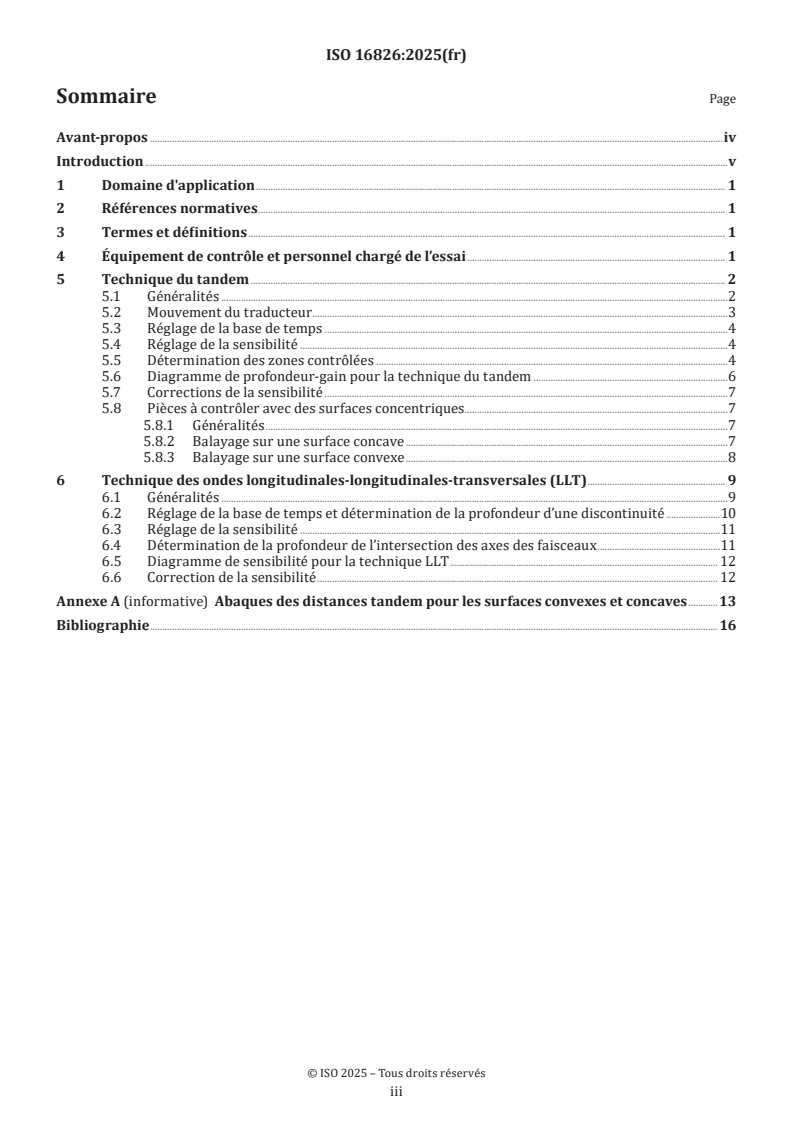
ISO 16826:2025 - Essais non destructifs — Contrôle par ultrasons — Contrôle des discontinuités perpendiculaires a la surface Released:5. 03. 2025
Overview - ISO 16826:2025 (Ultrasonic testing for discontinuities perpendicular to the surface)
ISO 16826:2025 defines principles and practical guidance for ultrasonic non-destructive testing (NDT) using the tandem technique and the longitudinal-longitudinal-transverse (LLT) technique to detect discontinuities that are perpendicular - or nearly perpendicular - to the testing surface. The standard focuses on metallic materials with thicknesses between 40 mm and 500 mm and covers objects with parallel or concentric surfaces. Phased array ultrasonic testing can be used with these techniques but may require extra verification steps.
Key topics and technical requirements
- Scope and applicability: Tandem and LLT techniques for embedded planar discontinuities; provisions for other materials or thinner sections with a written testing procedure.
- Test equipment and personnel: Applies ISO 16810 principles for equipment, qualification and competence of test personnel.
- Tandem technique essentials:
- Normally uses two similar 45° angle-beam transverse-wave probes (transmitter and receiver).
- Guidance on probe spacing, probe movement (fixed spacing or simultaneous opposite movement), and avoidance of beam angles causing mode conversion.
- Sensitivity setting options: back-wall echo, disc-shaped (flat-bottom) reflectors, side‑drilled holes.
- Determination and sizing of test zones, allowance for beam divergence, and acceptable sensitivity variation (edge sensitivity limits).
- LLT technique essentials:
- Principles for generating and interpreting LLT wave interactions to detect perpendicular discontinuities, with time‑base and sensitivity setting guidance.
- Depth-gain and sensitivity diagrams: Depth‑gain diagrams and DGS-derived guidance help set gain and assess detectability across the thickness.
- Special cases: Procedures for concentric (convex/concave) surfaces and recommendations when probe sizes differ (e.g., >160 mm wall thickness).
- Annexes and tools: Nomograms and graphical methods for probe spacing and zone determination; formulas and diagrams provided for practical setup.
Practical applications and users
ISO 16826:2025 is used by:
- NDT/ultrasonic inspectors and technicians performing in-service inspection and shop testing
- QA/QC engineers, welding inspectors, and integrity specialists
- Industries with thick metallic components - heavy fabrication, pressure vessels, power generation, petrochemical, pipeline and structural steel Benefits include reliable detection of embedded planar defects (e.g., cracks, lack-of-fusion) oriented perpendicular to the surface and standardized setup procedures for repeatable results.
Related standards
- ISO 16810 - Ultrasonic testing - General principles
- ISO 16811 - Sensitivity and range setting
- ISO 16823 - Through‑transmission technique
- ISO 16827 - Characterization and sizing of discontinuities
- ISO 16828 - Time‑of‑flight diffraction (TOFD) technique
Keywords: ISO 16826:2025, non-destructive testing, ultrasonic testing, tandem technique, LLT technique, phased array, test zones, sensitivity setting, depth-gain diagram.
Relations
- Effective Date
- 12-Feb-2026
- Consolidates
ISO 6915:2019 - Flexible cellular polymeric materials — Polyurethane foam for laminate use — Specification - Effective Date
- 28-Jan-2023
- Effective Date
- 14-Jan-2023
Buy Documents
ISO 16826:2025 - Non-destructive testing — Ultrasonic testing — Testing for discontinuities perpendicular to the surface Released:5. 03. 2025
ISO 16826:2025 - Essais non destructifs — Contrôle par ultrasons — Contrôle des discontinuités perpendiculaires a la surface Released:5. 03. 2025
Get Certified
Connect with accredited certification bodies for this standard

IMP NDT d.o.o.
Non-destructive testing services. Radiography, ultrasonic, magnetic particle, penetrant, visual inspection.
Inštitut za kovinske materiale in tehnologije
Institute of Metals and Technology. Materials testing, metallurgical analysis, NDT.
Q Techna d.o.o.
NDT and quality assurance specialist. 30+ years experience. NDT personnel certification per ISO 9712, nuclear and thermal power plant inspections, QA/
Sponsored listings
Frequently Asked Questions
ISO 16826:2025 is a standard published by the International Organization for Standardization (ISO). Its full title is "Non-destructive testing — Ultrasonic testing — Testing for discontinuities perpendicular to the surface". This standard covers: This document specifies principles for the tandem technique and the longitudinal-longitudinal-transverse wave (LLT) technique for detection of discontinuities perpendicular to the surface or almost perpendicular to the surface. The general principles for ultrasonic testing of industrial products are described in ISO 16810. The tandem or LLT techniques can be used for the detection of embedded planar discontinuities. This document gives guidelines for the testing of metallic materials with a thickness between 40 mm and 500 mm with parallel or concentric surfaces. The procedures provided in this document can be used for testing of other materials or smaller thickness if special measures are taken according to a written testing procedure. Phased array techniques can also be applied for the tandem technique and the LLT technique, but additional steps or verifications can be needed.
This document specifies principles for the tandem technique and the longitudinal-longitudinal-transverse wave (LLT) technique for detection of discontinuities perpendicular to the surface or almost perpendicular to the surface. The general principles for ultrasonic testing of industrial products are described in ISO 16810. The tandem or LLT techniques can be used for the detection of embedded planar discontinuities. This document gives guidelines for the testing of metallic materials with a thickness between 40 mm and 500 mm with parallel or concentric surfaces. The procedures provided in this document can be used for testing of other materials or smaller thickness if special measures are taken according to a written testing procedure. Phased array techniques can also be applied for the tandem technique and the LLT technique, but additional steps or verifications can be needed.
ISO 16826:2025 is classified under the following ICS (International Classification for Standards) categories: 19.100 - Non-destructive testing. The ICS classification helps identify the subject area and facilitates finding related standards.
ISO 16826:2025 has the following relationships with other standards: It is inter standard links to EN ISO 16826:2025, ISO 6915:2019, ISO 16826:2012. Understanding these relationships helps ensure you are using the most current and applicable version of the standard.
ISO 16826:2025 is available in PDF format for immediate download after purchase. The document can be added to your cart and obtained through the secure checkout process. Digital delivery ensures instant access to the complete standard document.
Standards Content (Sample)
International
Standard
ISO 16826
Second edition
Non-destructive testing — Ultrasonic
2025-03
testing — Testing for discontinuities
perpendicular to the surface
Essais non destructifs — Contrôle par ultrasons — Contrôle des
discontinuités perpendiculaires à la surface
Reference number
© ISO 2025
All rights reserved. Unless otherwise specified, or required in the context of its implementation, no part of this publication may
be reproduced or utilized otherwise in any form or by any means, electronic or mechanical, including photocopying, or posting on
the internet or an intranet, without prior written permission. Permission can be requested from either ISO at the address below
or ISO’s member body in the country of the requester.
ISO copyright office
CP 401 • Ch. de Blandonnet 8
CH-1214 Vernier, Geneva
Phone: +41 22 749 01 11
Email: copyright@iso.org
Website: www.iso.org
Published in Switzerland
ii
Contents Page
Foreword .iv
Introduction .v
1 Scope . 1
2 Normative references . 1
3 Terms and definitions . 1
4 Test equipment and test personnel . 1
5 Tandem technique . 2
5.1 General .2
5.2 Probe movement .3
5.3 Time base setting .3
5.4 Sensitivity setting .3
5.5 Determination of test zones .4
5.6 Depth-gain diagram for tandem technique .5
5.7 Corrections of sensitivity .6
5.8 Test objects with concentric surfaces .6
5.8.1 General .6
5.8.2 Scanning on a concave surface .7
5.8.3 Scanning on a convex surface .7
6 Longitudinal-longitudinal-transverse wave technique . 8
6.1 General .8
6.2 Time base setting and determination of depth of a discontinuity .9
6.3 Sensitivity setting .10
6.4 Determination of the depth of the intersection of the beam axes .10
6.5 Sensitivity diagram for LLT technique .11
6.6 Correction of sensitivity .11
Annex A (informative) Nomograms for tandem distances for convex and concave surfaces .12
Bibliography .15
iii
Foreword
ISO (the International Organization for Standardization) is a worldwide federation of national standards
bodies (ISO member bodies). The work of preparing International Standards is normally carried out through
ISO technical committees. Each member body interested in a subject for which a technical committee
has been established has the right to be represented on that committee. International organizations,
governmental and non-governmental, in liaison with ISO, also take part in the work. ISO collaborates closely
with the International Electrotechnical Commission (IEC) on all matters of electrotechnical standardization.
The procedures used to develop this document and those intended for its further maintenance are described
in the ISO/IEC Directives, Part 1. In particular, the different approval criteria needed for the different types
of ISO document should be noted. This document was drafted in accordance with the editorial rules of the
ISO/IEC Directives, Part 2 (see www.iso.org/directives).
ISO draws attention to the possibility that the implementation of this document may involve the use of (a)
patent(s). ISO takes no position concerning the evidence, validity or applicability of any claimed patent
rights in respect thereof. As of the date of publication of this document, ISO had not received notice of (a)
patent(s) which may be required to implement this document. However, implementers are cautioned that
this may not represent the latest information, which may be obtained from the patent database available at
www.iso.org/patents. ISO shall not be held responsible for identifying any or all such patent rights.
Any trade name used in this document is information given for the convenience of users and does not
constitute an endorsement.
For an explanation of the voluntary nature of standards, the meaning of ISO specific terms and expressions
related to conformity assessment, as well as information about ISO's adherence to the World Trade
Organization (WTO) principles in the Technical Barriers to Trade (TBT), see www.iso.org/iso/foreword.html.
This document was prepared by Technical Committee ISO/TC 135, Non-destructive testing, Subcommittee
SC 3, Ultrasonic testing, in collaboration with the European Committee for Standardization (CEN) Technical
Committee CEN/TC 138, Non-destructive testing, in accordance with the Agreement on technical cooperation
between ISO and CEN (Vienna Agreement).
This second edition cancels and replaces the first edition (ISO 16826:2012), which has been technically
revised.
The main changes are as follows:
— revised figures and formulae;
— editorial revisions.
Any feedback or questions on this document should be directed to the user’s national standards body. A
complete listing of these bodies can be found at www.iso.org/members.html.
iv
Introduction
The following documents on ultrasonic testing are linked:
ISO 16810, Non-destructive testing — Ultrasonic testing — General principles
ISO 16811, Non-destructive testing — Ultrasonic testing — Sensitivity and range setting
ISO 16823, Non-destructive testing — Ultrasonic testing — Through-transmission technique
ISO 16826, Non-destructive testing — Ultrasonic testing — Testing for discontinuities perpendicular to the surface
ISO 16827, Non-destructive testing — Ultrasonic testing — Characterization and sizing of discontinuities
ISO 16828, Non-destructive testing — Ultrasonic testing — Time-of-flight diffraction technique as a method for
detection and sizing of discontinuities
v
International Standard ISO 16826:2025(en)
Non-destructive testing — Ultrasonic testing — Testing for
discontinuities perpendicular to the surface
1 Scope
This document specifies principles for the tandem technique and the longitudinal-longitudinal-transverse
wave (LLT) technique for detection of discontinuities perpendicular to the surface or almost perpendicular
to the surface.
The general principles for ultrasonic testing of industrial products are described in ISO 16810.
The tandem or LLT techniques can be used for the detection of embedded planar discontinuities.
This document gives guidelines for the testing of metallic materials with a thickness between 40 mm and
500 mm with parallel or concentric surfaces.
The procedures provided in this document can be used for testing of other materials or smaller thickness if
special measures are taken according to a written testing procedure.
Phased array techniques can also be applied for the tandem technique and the LLT technique, but additional
steps or verifications can be needed.
2 Normative references
The following documents are referred to in the text in such a way that some or all of their content constitutes
requirements of this document. For dated references, only the edition cited applies. For undated references,
the latest edition of the referenced document (including any amendments) applies.
ISO 5577, Non-destructive testing — Ultrasonic testing — Vocabulary
ISO 16810, Non-destructive testing — Ultrasonic testing — General principles
3 Terms and definitions
For the purposes of this document, the terms and definitions given in ISO 5577 apply.
ISO and IEC maintain terminology databases for use in standardization at the following addresses:
— ISO Online browsing platform: available at https:// www .iso .org/ obp
— IEC Electropedia: available at https:// www .electropedia .org/
4 Test equipment and test personnel
The requirements of ISO 16810 on test equipment and test personnel shall be applied unless stated
otherwise.
5 Tandem technique
5.1 General
a) The testing normally shall be carried out using two similar 45° angle-beam transverse wave probes, one
probe operating as transmitter and the other probe as receiver.
b) For wall thicknesses larger than 160 mm, different transducer sizes for the transmitter probe and the
receiver probe should be used to ensure approximately the same beam dimensions in the test zone.
c) The use of beam angles other than 45° may be necessary to comply with particular geometrical
conditions of the test object and/or the orientation of the expected discontinuity.
d) Beam angles that give rise to mode conversion shall be avoided.
NOTE For a test object with parallel surfaces, the use of transverse wave probes with a beam angle of 60°
results in the beam impinging on the reference line at 30°, which can result in mode conversion on a discontinuity
in steel test objects.
e) The probes shall be located in a line with their beam axes in the same direction.
The sound beam from the rear probe will, after reflection from the opposite surface, intersect the sound
beam from the front probe, as shown in Figure 1. The area of intersection of the beams is the test zone. The
intersection of the beam axes is the centre of the test zone, located at the reference line.
Key
1 front probe d material thickness
2 rear probe t depth of the intersection of the beam axes
m
3 test zone y probe distance
4 reference line α beam angle
a projected distance
Figure 1 — Basic principle of tandem technique
When testing objects with plane parallel surfaces, the distance between the probes can be determined using
Formula (1):
yd=−2()t tanα (1)
m
For 45° beam angles Formula (2) can be used:
yd=−2()t (2)
m
where
d is the material thickness;
t is the depth of the intersection of the beam axes;
m
α is the beam angle.
5.2 Probe movement
Probe movement (scanning) shall be performed in either of the following ways:
a) both probes shall be moved along the surface with a fixed probe distance (y).
In this way only one test zone is covered at a time, and the scanning shall be repeated with different
probe distances until the complete test volume has been tested;
b) both probes shall be moved simultaneously but in opposite directions (forward and backward
respectively), such that the sum of their distances from the reference line [a + (a + y)] remains constant,
thereby scanning the full thickness of the test object in one continuous movement, as shown in Figure 2.
For example, the reference line can be the vertical weld axis.
Key
1 reference line
a a , a projected distance
1, 2 3
y y , y probe distance
1, 2 3
Figure 2 — Probes at different distances for test zones at different depths (schematic)
5.3 Time base setting
All relevant echoes will appear at the same sound path distance, which corresponds to the sound path for full
skip for probes with the beams in opposite directions. Therefore, the setting of the time base is not critical.
However, the
...
Norme
internationale
ISO 16826
Deuxième édition
Essais non destructifs — Contrôle
2025-03
par ultrasons — Contrôle des
discontinuités perpendiculaires à
la surface
Non-destructive testing — Ultrasonic testing — Testing for
discontinuities perpendicular to the surface
Numéro de référence
DOCUMENT PROTÉGÉ PAR COPYRIGHT
© ISO 2025
Tous droits réservés. Sauf prescription différente ou nécessité dans le contexte de sa mise en œuvre, aucune partie de cette
publication ne peut être reproduite ni utilisée sous quelque forme que ce soit et par aucun procédé, électronique ou mécanique,
y compris la photocopie, ou la diffusion sur l’internet ou sur un intranet, sans autorisation écrite préalable. Une autorisation peut
être demandée à l’ISO à l’adresse ci-après ou au comité membre de l’ISO dans le pays du demandeur.
ISO copyright office
Case postale 401 • Ch. de Blandonnet 8
CH-1214 Vernier, Genève
Tél.: +41 22 749 01 11
E-mail: copyright@iso.org
Web: www.iso.org
Publié en Suisse
ii
Sommaire Page
Avant-propos .iv
Introduction .v
1 Domaine d'application . 1
2 Références normatives . 1
3 Termes et définitions . 1
4 Équipement de contrôle et personnel chargé de l’essai . 1
5 Technique du tandem . 2
5.1 Généralités .2
5.2 Mouvement du traducteur . .3
5.3 Réglage de la base de temps .4
5.4 Réglage de la sensibilité .4
5.5 Détermination des zones contrôlées .4
5.6 Diagramme de profondeur-gain pour la technique du tandem .6
5.7 Corrections de la sensibilité .7
5.8 Pièces à contrôler avec des surfaces concentriques .7
5.8.1 Généralités .7
5.8.2 Balayage sur une surface concave .7
5.8.3 Balayage sur une surface convexe .8
6 Technique des ondes longitudinales-longitudinales-transversales (LLT) . 9
6.1 Généralités .9
6.2 Réglage de la base de temps et détermination de la profondeur d’une discontinuité .10
6.3 Réglage de la sensibilité .11
6.4 Détermination de la profondeur de l’intersection des axes des faisceaux .11
6.5 Diagramme de sensibilité pour la technique LLT . 12
6.6 Correction de la sensibilité . 12
Annexe A (informative) Abaques des distances tandem pour les surfaces convexes et concaves .13
Bibliographie .16
iii
Avant-propos
L’ISO (Organisation internationale de normalisation) est une fédération mondiale d’organismes nationaux
de normalisation (comités membres de l’ISO). L’élaboration des Normes internationales est en général
confiée aux comités techniques de l’ISO. Chaque comité membre intéressé par une étude a le droit de faire
partie du comité technique créé à cet effet. Les organisations internationales, gouvernementales et non
gouvernementales, en liaison avec l’ISO participent également aux travaux. L’ISO collabore étroitement avec
la Commission électrotechnique internationale (IEC) en ce qui concerne la normalisation électrotechnique.
Les procédures utilisées pour élaborer le présent document et celles destinées à sa mise à jour sont
décrites dans les Directives ISO/IEC, Partie 1. Il convient, en particulier, de prendre note des différents
critères d’approbation requis pour les différents types de documents ISO. Le présent document
a été rédigé conformément aux règles de rédaction données dans les Directives ISO/IEC, Partie 2
(voir www.iso.org/directives).
L’ISO attire l’attention sur le fait que la mise en application du présent document peut entraîner l’utilisation
d’un ou de plusieurs brevets. L’ISO ne prend pas position quant à la preuve, à la validité et à l’applicabilité
de tout droit de propriété revendiqué à cet égard. À la date de publication du présent document, l’ISO
n’avait pas reçu notification qu’un ou plusieurs brevets pouvaient être nécessaires à sa mise en application.
Toutefois, il y a lieu d’avertir les responsables de la mise en application du présent document que des
informations plus récentes sont susceptibles de figurer dans la base de données de brevets, disponible à
l’adresse www.iso.org/brevets. L’ISO ne saurait être tenue pour responsable de ne pas avoir identifié tout ou
partie de tels droits de brevet.
Les appellations commerciales éventuellement mentionnées dans le présent document sont données pour
information, par souci de commodité, à l’intention des utilisateurs et ne sauraient constituer un engagement.
Pour une explication de la nature volontaire des normes, la signification des termes et expressions
spécifiques de l’ISO liés à l’évaluation de la conformité, ou pour toute information au sujet de l’adhésion de
l’ISO aux principes de l’Organisation mondiale du commerce (OMC) concernant les obstacles techniques au
commerce (OTC), voir le lien suivant: www.iso.org/iso/fr/avant-propos.html.
Le présent document a été élaboré par le comité technique ISO/TC 135, Essais non destructifs, sous-
comité SC 3, Contrôle par ultrasons, en collaboration avec le comité technique CEN/TC 138, Essais non
destructifs, du Comité européen de normalisation (CEN), conformément à l'Accord de coopération technique
entre l'ISO et le CEN (Accord de Vienne).
Cette deuxième édition annule et remplace la première édition (ISO 16826:2012), qui a fait l’objet d’une
révision technique.
Les principales modifications sont les suivantes:
— révision des figures et des formules;
— révision rédactionnelle.
Il convient que l’utilisateur adresse tout retour d’information ou toute question concernant le présent
document à l’organisme national de normalisation de son pays. Une liste exhaustive desdits organismes se
trouve à l’adresse www.iso.org/fr/members.html.
iv
Introduction
Les documents suivants relatifs au contrôle par ultrasons sont liés:
ISO 16810, Essais non destructifs — Contrôle par ultrasons — Principes généraux
ISO 16811, Essais non destructifs — Contrôle par ultrasons — Réglage de la sensibilité et de la base de temps
ISO 16823, Essais non destructifs — Contrôle par ultrasons — Technique par transmission
ISO 16826, Essais non destructifs — Contrôle par ultrasons — Contrôle des discontinuités perpendiculaires à
la surface
ISO 16827, Essais non destructifs — Contrôle par ultrasons — Caractérisation et dimensionnement des
discontinuités
ISO 16828, Essais non destructifs — Contrôle par ultrasons — Technique de diffraction du temps de vol utilisée
comme méthode de détection et de dimensionnement des discontinuités
v
Norme internationale ISO 16826:2025(fr)
Essais non destructifs — Contrôle par ultrasons — Contrôle
des discontinuités perpendiculaires à la surface
1 Domaine d'application
Le présent document spécifie les principes de la technique du tandem et de la technique des ondes
longitudinales-longitudinales-transversales (LLT) pour la détection des discontinuités perpendiculaires à la
surface ou quasiment perpendiculaires à la surface.
Les principes généraux relatifs au contrôle par ultrasons de produits industriels sont décrits dans
l’ISO 16810.
Les techniques du tandem ou LLT peuvent être utilisées pour la détection des discontinuités planes internes.
Le présent document fournit des lignes directrices pour contrôler les matériaux métalliques dont l’épaisseur
est comprise entre 40 mm et 500 mm, et ayant des surfaces parallèles ou concentriques.
Les modes opératoires fournis dans le présent document peuvent être utilisés pour contrôler d’autres
matériaux et des épaisseurs inférieures, à condition que des mesures spécifiques soient prises, conformément
à une procédure de contrôle écrite.
Des techniques multiéléments peuvent aussi être appliquées pour la technique du tandem et la technique
LLT, mais des étapes ou des vérifications supplémentaires peuvent être nécessaires.
2 Références normatives
Les documents suivants sont cités dans le texte de sorte qu’ils constituent, pour tout ou partie de leur
contenu, des exigences du présent document. Pour les références datées, seule l’édition citée s’applique. Pour
les références non datées, la dernière édition du document de référence s'applique (y compris les éventuels
amendements).
ISO 5577, Essais non destructifs — Contrôle par ultrasons — Vocabulaire
ISO 16810, Essais non destructifs — Contrôle par ultrasons — Principes généraux
3 Termes et définitions
Pour les besoins du présent document, les termes et définitions donnés dans l’ISO 5577 s’appliquent.
L'ISO et l'IEC tiennent à jour des bases de données terminologiques destinées à être utilisées en normalisation,
consultables aux adresses suivantes:
— ISO Online browsing platform: disponible à l’adresse https:// www .iso .org/ obp
— IEC Electropedia: disponible à l’adresse https:// www .electropedia .org/
4 Équipement de contrôle et personnel chargé de l’essai
Sauf indications contraires, les exigences de l’ISO 16810 relatives à l’équipement de contrôle et au personnel
chargé de l’essai doivent s’appliquer.
5 Technique du tandem
5.1 Généralités
a) En règle générale, le contrôle s’effectue à l’aide de deux traducteurs d’angle à ondes transversales de 45°
semblables, l’un servant d’émetteur et l’autre de récepteur.
b) Pour des parois d’épaisseur supérieure à 160 mm, il convient d’utiliser des traducteurs présentant
différentes dimensions de transducteur pour le traducteur émetteur et le traducteur récepteur, dans le
but d’assurer des dimensions de faisceau comparables dans la zone contrôlée.
c) L’utilisation d’angles de faisceau différents de 45° peut s’avérer nécessaire pour tenir compte de
conditions géométriques particulières de la pièce à contrôler et/ou de l’orientation de la discontinuité
attendue.
d) Les traducteurs d’angle donnant lieu à une conversion de mode doivent être évités.
NOTE Pour une pièce à contrôler avec des surfaces parallèles, l’utilisation de traducteurs d’ondes
transversales avec un angle de faisceau de 60° conduit au fait que le faisceau rencontre la ligne de référence à 30°,
ce qui peut conduire à une conversion de mode sur une discontinuité dans des pièces à contrôler en acier.
e) Les traducteurs doivent être alignés, leurs axes de faisceaux étant orientés dans la même direction.
Le faisceau ultrasonore émis par le traducteur arrière, après avoir été réfléchi par la surface opposée, coupe
le faisceau ultrasonore émis par le traducteur avant comme illustré à la Figure 1. La zone d’intersection des
faisceaux est la zone contrôlée. L’intersection des axes des faisceaux est au centre de la zone contrôlée, sur la
ligne de référence.
Légende
1 traducteur avant d épaisseur du matériau
2 traducteur arrière t profondeur de l’intersection des axes des faisceaux
m
3 zone contrôlée y écartement entre les traducteurs
4 ligne de référence α angle du faisceau
a distance projetée
Figure 1 — Principe de base de la technique du tandem
Lorsque les pièces à contrôler présentent des surfaces planes parallèles, il est possible de déterminer
l’écartement entre les traducteurs à l’aide de la Formule (1):
yd=−2()t tanα (1)
m
Pour des angles de faisceau de 45°, la Formule (2) peut être utilisée:
yd=−2()t (2)
m
où
d est l'épaisseur du matériau;
t est la profondeur de l’intersection des axes des faisceaux;
m
α est l'angle du faisceau.
5.2 Mouvement du traducteur
Le mouvement du traducteur (balayage) doit être effectué selon l’un des modes suivants:
a) les deux traducteurs doivent être déplacés sur la surface en maintenant un écartement fixe entre les
traducteurs (y).
De cette façon, la zone contrôlée est maintenue à profondeur constante. Le balayage devra être répété
en modifiant l’écartement entre les traducteurs jusqu’à ce que le volume à contrôler ait été examiné
dans sa totalité;
b) les deux traducteurs doivent être déplacés simultanément dans des directions opposées (en avant et
en arrière respectivement) pour que la somme de leurs distances par rapport à la ligne de référence
[a + (a + y)] reste constante, en balayant ainsi l’épaisseur complète de la pièce à contrôler en un seul
mouvement continu, comme illustré à la Figure 2.
Par exemple, la ligne de référence peut être l’axe de soudure vertical.
Légende
1 ligne de référence
a a , a distance projetée
1, 2 3
y y , y écartement entre les traducteurs
1, 2 3
Figure 2 — Traducteurs à des distances différentes pour des zones contrôlées à des profondeurs
différentes (schématiques)
5.3 Réglage de la base de temps
Tous les échos pertinents apparaissent à la même longueur de trajet ultrasonore, ce qui correspond à un trajet
ultrasonore avec un bond complet pour des traducteurs avec les faisceaux dans des directions opposées. Par
conséquent, le réglage de la base de temps n’est pas critique. Cependant, il convient que l’écho du signal le
long de ce trajet se situe à une position spécifiée, par exemple à 80 % de la largeur totale d’écran. Il convient
également que les indications à proximité de cette position spécifiée soient affichées/enregistrées.
5.4 Réglage de la sensibilité
Le réglage de la sensibilité doit être réalisé à l’aide d’un des types de réflecteurs suivants:
a) la surface opposée, où l’écho de fond est utilisé;
b) des réflecteurs en forme de disques perpendiculaires à la
...