


ISO/IEC 29199-2:2012
(Main)Information technology — JPEG XR image coding system — Part 2: Image coding specification
Information technology — JPEG XR image coding system — Part 2: Image coding specification
ISO/IEC 29199-2:2012 specifies a coding format, referred to as JPEG XR, which is designed primarily for continuous-tone photographic content.
Technologies de l'information — Système de codage d'image JPEG XR — Partie 2: Spécification de codage d'image
General Information
- Status
- Withdrawn
- Publication Date
- 15-Mar-2012
- Withdrawal Date
- 15-Mar-2012
- Current Stage
- 9599 - Withdrawal of International Standard
- Start Date
- 28-May-2020
- Completion Date
- 12-Feb-2026
Relations
- Effective Date
- 26-Nov-2021
- Effective Date
- 23-Apr-2020
- Effective Date
- 10-Dec-2011


Get Certified
Connect with accredited certification bodies for this standard

BSI Group
BSI (British Standards Institution) is the business standards company that helps organizations make excellence a habit.

NYCE
Mexican standards and certification body.
Sponsored listings
Frequently Asked Questions
ISO/IEC 29199-2:2012 is a standard published by the International Organization for Standardization (ISO). Its full title is "Information technology — JPEG XR image coding system — Part 2: Image coding specification". This standard covers: ISO/IEC 29199-2:2012 specifies a coding format, referred to as JPEG XR, which is designed primarily for continuous-tone photographic content.
ISO/IEC 29199-2:2012 specifies a coding format, referred to as JPEG XR, which is designed primarily for continuous-tone photographic content.
ISO/IEC 29199-2:2012 is classified under the following ICS (International Classification for Standards) categories: 35.040 - Information coding; 35.040.30 - Coding of graphical and photographical information. The ICS classification helps identify the subject area and facilitates finding related standards.
ISO/IEC 29199-2:2012 has the following relationships with other standards: It is inter standard links to ISO/IEC 29199-2:2012/Amd 1:2017, ISO/IEC 29199-2:2020, ISO/IEC 29199-2:2010. Understanding these relationships helps ensure you are using the most current and applicable version of the standard.
ISO/IEC 29199-2:2012 is available in PDF format for immediate download after purchase. The document can be added to your cart and obtained through the secure checkout process. Digital delivery ensures instant access to the complete standard document.
Standards Content (Sample)
INTERNATIONAL ISO/IEC
STANDARD 29199-2
Third edition
2012-03-15
Information technology — JPEG XR
image coding system —
Part 2:
Image coding specification
Technologies de l'information — Système de codage d'image
JPEG XR —
Partie 2: Spécification de codage d'image
Reference number
©
ISO/IEC 2012
© ISO/IEC 2012
All rights reserved. Unless otherwise specified, no part of this publication may be reproduced or utilized in any form or by any means,
electronic or mechanical, including photocopying and microfilm, without permission in writing from either ISO at the address below or
ISO's member body in the country of the requester.
ISO copyright office
Case postale 56 • CH-1211 Geneva 20
Tel. + 41 22 749 01 11
Fax + 41 22 749 09 47
E-mail copyright@iso.org
Web www.iso.org
Published in Switzerland
© ISO/IEC 2012 – All rights reserved
ii
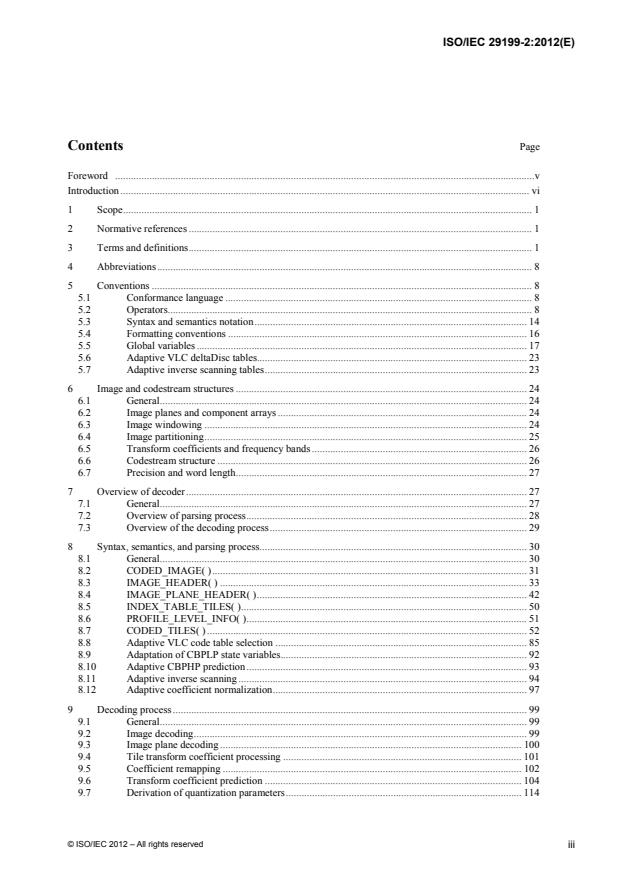
Contents Page
Foreword .v
Introduction . vi
1 Scope. 1
2 Normative references . 1
3 Terms and definitions. 1
4 Abbreviations. 8
5 Conventions . 8
5.1 Conformance language . 8
5.2 Operators. 8
5.3 Syntax and semantics notation. 14
5.4 Formatting conventions . 16
5.5 Global variables . 17
5.6 Adaptive VLC deltaDisc tables. 23
5.7 Adaptive inverse scanning tables. 23
6 Image and codestream structures . 24
6.1 General. 24
6.2 Image planes and component arrays .24
6.3 Image windowing . 24
6.4 Image partitioning. 25
6.5 Transform coefficients and frequency bands . 26
6.6 Codestream structure . 26
6.7 Precision and word length. 27
7 Overview of decoder. 27
7.1 General. 27
7.2 Overview of parsing process. 28
7.3 Overview of the decoding process. 29
8 Syntax, semantics, and parsing process. 30
8.1 General. 30
8.2 CODED_IMAGE( ). 31
8.3 IMAGE_HEADER( ) . 33
8.4 IMAGE_PLANE_HEADER( ). 42
8.5 INDEX_TABLE_TILES( ). 50
8.6 PROFILE_LEVEL_INFO( ).51
8.7 CODED_TILES( ) . 52
8.8 Adaptive VLC code table selection . 85
8.9 Adaptation of CBPLP state variables. 92
8.10 Adaptive CBPHP prediction. 93
8.11 Adaptive inverse scanning . 94
8.12 Adaptive coefficient normalization. 97
9 Decoding process . 99
9.1 General. 99
9.2 Image decoding. 99
9.3 Image plane decoding . 100
9.4 Tile transform coefficient processing . 101
9.5 Coefficient remapping . 102
9.6 Transform coefficient prediction . 104
9.7 Derivation of quantization parameters. 114
© ISO/IEC 2012 – All rights reserved
iii
9.8 Dequantization. 117
9.9 Sample reconstruction. 120
9.10 Output formatting . 151
Annex A (normative) Tag-based file format . 168
Annex B (normative) Profiles and Levels . 194
Annex C (informative) Color imagery representation and color management. 197
Annex D (informative) Encoder processing. 200
Annex E (informative) Patent Rights . 215
Bibliography. 216
© ISO/IEC 2012 – All rights reserved
iv
Foreword
ISO (the International Organization for Standardization) and IEC (the International Electrotechnical
Commission) form the specialized system for worldwide standardization. National bodies that are members of
ISO or IEC participate in the development of International Standards through technical committees
established by the respective organization to deal with particular fields of technical activity. ISO and IEC
technical committees collaborate in fields of mutual interest. Other international organizations, governmental
and non-governmental, in liaison with ISO and IEC, also take part in the work. In the field of information
technology, ISO and IEC have established a joint technical committee, ISO/IEC JTC 1.
International Standards are drafted in accordance with the rules given in the ISO/IEC Directives, Part 2.
The main task of the joint technical committee is to prepare International Standards. Draft International
Standards adopted by the joint technical committee are circulated to national bodies for voting. Publication as
an International Standard requires approval by at least 75 % of the national bodies casting a vote.
ISO/IEC 29199-2 was prepared by Joint Technical Committee ISO/IEC JTC 1, Information technology,
Subcommittee SC 29, Coding of audio, picture, multimedia and hypermedia information, in collaboration with
ITU-T.
This part of ISO/IEC 29199 is technically aligned with ITU-T Rec. T.832 but is not published as identical text.
This third edition cancels and replaces the second edition (ISO/IEC 29199-2:2010), which has been
technically revised.
ISO/IEC 29199 consists of the following parts, under the general title Information technology — JPEG XR
image coding system:
⎯ Part 1: System architecture [Technical Report]
⎯ Part 2: Image coding specification
⎯ Part 3: Motion JPEG XR
⎯ Part 4: Conformance testing
⎯ Part 5: Reference software
© ISO/IEC 2012 – All rights reserved
v
Introduction
This part of ISO/IEC 29199 specifies requirements and implementation guidelines for the compressed representation of
digital images for storage and interchange in a form referred to as JPEG XR. The JPEG XR design provides a practical
coding technology for a broad range of applications with excellent compression capability and important additional
functionalities. An input image is typically operated on by an encoder to create a JPEG XR coded image. The decoder
then operates on the coded image to produce an output image that is either an exact or approximate reconstruction of the
input image.
The primary intended application of JPEG XR is the representation of continuous-tone still images such as photographic
images. The manner of representation of the compressed image data and the associated decoding process are specified.
These processes and representations are generic, that is, they are applicable to a broad range of applications using
compressed color and grayscale images in communications and computer systems and within embedded applications,
including mobile devices.
As of 2008, the most widely used digital photography format is a nominal implementation of the first JPEG coding
format as specified in ITU-T Recommendation T.81 | ISO/IEC 10918-1. This encoding uses a bit depth of 8 for each of
three channels, resulting in 256 representable values per channel (a total of 16 777 216 representable color values).
More demanding applications may require a bit depth of 16, providing 65 536 representable values for each channel, and
resulting in over 2.8 * 10 color values. Additional scenarios may necessitate even greater bit depths and sample
representation formats. When memory or processing power is at a premium, as few as five or six bits per channel may be
used.
The JPEG XR specification enables greater effective use of compressed imagery with this broadened diversity of
application requirements. JPEG XR supports a wide range of color encoding formats including monochrome, RGB,
CMYK and n-component encodings using a variety of unsigned integer, fixed point, and floating point decoded
numerical representations with a variety of bit depths. The primary goal is to provide a compressed format specification
appropriate for a wide range of applications while keeping the implementation requirements for encoders and decoders
simple. A special focus of the design is support for emerging high dynamic range (HDR) imagery applications.
JPEG XR combines the benefits of optimized image quality and compression efficiency together with low-complexity
encoding and decoding implementation requirements. It also provides an extensive set of additional functionalities,
including:
– High compression capability
– Low computational and memory resource requirements
– Lossless and lossy compression
– Image tile segmentation for random access and large image formats
– Support for low-complexity compressed-domain image manipulations
– Support for embedded thumbnail images and progressive resolution refinement
– Embedded codestream scalability for both image resolution and fidelity
– Alpha plane support
– Bit-exact decoder results for fixed and floating point image formats.
Important detailed design properties include:
– High performance, embedded system friendly compression
– Small memory footprint
– Integer-only operations with no divides
– A signal processing structure that is highly amenable to parallel processing
– Use of the same signal processing operations for both lossless and lossy compression operation
© ISO/IEC 2012 – All rights reserved
vi
– Support for a wide range of decoded sample formats (many of which support high dynamic range imagery):
• Monochrome, RGB, CMYK or n-component image representation
• 8- or 16-bit unsigned integer
• 16- or 32-bit fixed point
• 16- or 32-bit floating point
• Several packed bit formats
• 1-bit per sample monochrome
• 5- or 10-bit per sample RGB
• Radiance RGBE
The algorithm uses a reversible hierarchical lifting-based lapped biorthogonal transform. The transform has lossless
image representation capability and requires only a small number of integer processing operations for both encoding and
decoding. The processing is based on 16×16 macroblocks in the transform domain, which may or may not affect
overlapping areas in the spatial domain (with the overlapping property selected under the control of the encoder). The
design provides encoding and decoding with a minimal memory footprint suitable for embedded implementations.
The algorithm provides native support for both RGB and CMYK color types by converting these color formats to an
internal luma-dominant format through the use of a reversible color transform. In addition, YUV, monochrome and
arbitrary n-channel color formats are supported.
The transforms employed are reversible; both lossless and lossy operations are supported using the same algorithm.
Using the same algorithm for both types of operation simplifies implementation, which is especially important for
embedded applications.
A wide range of numerical encodings at multiple bit depths are supported: 8-bit and 16-bit formats, as well as additional
specialized packed bit formats, are supported for both lossy and lossless compression. (32-bit formats are supported using
lossy compression.) Up to 24 bits are retained through the various transforms. While only integer arithmetic is used for
internal processing, lossless and lossy coding are supported for floating point and fixed point image data – as well as for
integer image formats.
The main body of this part of ISO/IEC 29199 specifies the syntax and semantics of JPEG XR coded images and the
associated decoding process that produces an output image from a coded image. Annex A specifies a tag-based file
storage format for storage and interchange of such coded images. Annex B specifies profiles and levels, which determine
conformance requirements for classes of encoders and decoders. Aspects of color imagery representations and color
management are discussed in Annex C. The typical expected encoding process is described in Annex D.
The International Organization for Standardization (ISO) and International Electrotechnical Commission (IEC) draw
attention to the fact that it is claimed that compliance with this document may involve the use of patents.
ISO and IEC take no position concerning the evidence, validity and scope of these patent rights.
The holders of these patent rights have assured ISO and IEC that they are willing to negotiate licences under reasonable
and non-discriminatory terms and conditions with applicants throughout the world. In this respect, the statements of the
holders of these patent rights are registered with ISO and IEC. Information may be obtained from the companies listed in
Annex E.
Attention is drawn to the possibility that some of the elements of this document may be the subject of patent rights other
than those identified above. ISO and IEC shall not be held responsible for identifying any or all such patent rights.
© ISO/IEC 2012 – All rights reserved
vii
INTERNATIONAL STANDARD ISO/IEC 29199-2:2012(E)
Information technology — JPEG XR image coding system —
Part 2:
Image coding specification
1 Scope
This part of ISO/IEC 29199 specifies a coding format, referred to as JPEG XR, which is designed primarily for
continuous-tone photographic content.
2 Normative references
Normative references having a scope that is limited to the use of the file format specified in Annex A are listed in A.2.
3 Terms and definitions
For the purposes of this document, the following terms and definitions apply.
NOTE Definitions of terms having a scope that is limited to the use of the file format specified in Annex A are listed
in A.2.
3.1
adaptive coefficient normalization
parsing sub-process where transform coefficients are dynamically partitioned into a VLC-coded part and a fixed-length
coded part, in a manner designed to control (i.e., "normalize") bits used to represent the VLC-coded part
NOTE The fixed-length coded part of DC coefficients and low-pass coefficients is called FLC refinement and the
fixed-length coded part of high-pass coefficients is called flexbits.
3.2
adaptive inverse scanning
parsing sub-process where the zigzag scan order associated with a set of transform coefficients is dynamically
modified, based on the statistics of previously-parsed transform coefficients
3.3
adaptive VLC
parsing sub-process where the code table associated with VLC parsing of a particular syntax element is switched,
among a finite set of fixed tables, based on the statistics of previously-parsed instances of this syntax element
3.4
alpha image plane
optional secondary image plane associated with an image of the same dimensions as the luma component of the primary
image plane
NOTE The alpha image plane has one component, a luma component.
3.5
block
m×n array of samples, or an m×n array of transform coefficients
© ISO/IEC 2012 – All rights reserved
3.6
block index
integer in the range 0 to 15 identifying, by its position in raster scan order, a particular 4×4 block within a partition of a
16×16 block into 16 4×4 blocks
3.7
byte
sequence of 8 bits
3.8
byte-aligned
bit in a codestream is byte-aligned if its position is an integer multiple of 8 bits from the beginning of the codestream,
where the first bit in the codestream is at position 0
3.9
chroma
component of the primary image plane with non-zero index, or the transform coefficients and sample values
associated with this component
3.10
coded block pattern high-pass
coded block pattern high-pass is a syntax element indicating the coded block status, i.e. the presence or absence of
non-zero high-pass transform coefficients, for each of the blocks in the macroblock
3.11
coded block pattern low-pass
coded block pattern low-pass is a syntax element indicating the presence or absence of non-zero low-pass transform
coefficients in the macroblock
3.12
coded block status
coded block status is an indication of the presence or absence of non-zero transform coefficients in that block
3.13
codestream
sequence of bits contained in a sequence of bytes from which syntax elements are parsed, such that the most significant
bit of the first byte is the first bit of the codestream, the next most significant bit of the first byte is the second bit of the
codestream, and so on, to the least significant bit of the first byte (which is the eighth bit of the codestream), followed
by the most significant bit of the second byte (which is the ninth bit of the codestream), and so on, up to and including
the least significant bit of the last byte of the sequence of bytes (which is the last bit of the codestream)
3.14
component
array of samples associated with an image plane
3.15
context
possible value of a specific instance of a context variable
3.16
context variable
variable used in the parsing process to select which data structure is to be used for the adaptive VLC parsing of a given
syntax element
3.17
DC coefficient
first subset when the transform coefficients, that are contained in a specific macroblock and a specific component, are
partitioned into 3 subsets
© ISO/IEC 2012 – All rights reserved
3.18
DC-LP array
array of all DC and low-pass transform coefficients, for all macroblocks associated with a specific component
3.19
decoder
embodiment of a parsing process and decoding process
3.20
decoding process
process of computing output sample values from the parsed syntax elements of the codestream
3.21
dequantization
process of rescaling the quantized transform coefficients after their value has been parsed from the codestream and
before they are presented to the inverse transform process
3.22
discriminant
collective term for one of DiscrimVal1 or DiscrimVal2, which are the two member variables of an instance of the
adaptive VLC data structure specified in subclause 5.5.5.
3.23
encoder
embodiment of an encoding process
3.24
encoding process
process of converting source sample values into a codestream conforming to this part of ISO/IEC 29199
3.25
extended image
image produced by the decoding process prior to windowing
NOTE The extended image has a luma array that is an integer multiple of 16 in width and height.
3.26
file
finite-length sequence of bytes that is accessible to a decoder in a manner such that the decoder can obtain access to the
data at specified positions within the sequence of bytes (e.g. by storing the entire sequence of bytes in random access
memory or by performing "position seek" operations to specified positions within the sequence of bytes)
3.27
file format
specified structure for the content of a file
3.28
fixed-length code (FLC)
code which assigns a finite set of allowable bit patterns to a specific set of values, where each bit pattern has the same
length
3.29
FLC refinement
fixed-length coded part of a DC coefficient or low-pass coefficient that is parsed using adaptive fixed-length codes
3.30
flexbits
fixed-length-coded part of the high-pass coefficient information which is parsed using adaptive fixed-length codes
© ISO/IEC 2012 – All rights reserved
3.31
frequency band
collective term for one of the following three subsets of the transform coefficients for an image, which are separately
parsed: DC coefficients, low-pass coefficients, and high-pass coefficients
3.32
frequency mode
codestream structure mode where the DC, low-pass, high-pass and flexbits frequency bands for each tile are grouped
separately
3.33
hard tiles
codestream structure mode where the overlap operators are not applied across tile boundaries; instead, boundary overlap
operators are applied at tile boundaries
3.34
high-pass coefficient
third subset, when the transform coefficients that are contained in a specific macroblock and a specific component are
partitioned into 3 subsets
3.35
image
result of the decoding process, consisting of a primary image plane and an optional alpha image plane
3.36
image plane
collective term for a grouping of the components of the image
3.37
initial level value
one of two values used to compute the VLC-coded part of a transform coefficient
3.38
internal color format
color format associated with the spatial-domain samples obtained through the inverse transform process and the sample
reconstruction process, and distinguished from the output color format associated with the output formatting process
3.39
inverse core transform (ICT)
two steps of the inverse transform process that involve processing of transform coefficients associated with each
macroblock independently, with no overlap filtering
3.40
inverse transform process
part of the decoding process by which a set of dequantized transform coefficients are converted into spatial-domain
values
3.41
inverse scanning
process of reordering an ordered set of parsed syntax elements from the codestream to form an array of transform
coefficients associated with a specific component and macroblock
3.42
little-endian form
ordering of the bytes that represent a numerical value as an integer number of bytes in which the bytes representing the
number are in ascending order of significance, i.e. with the least significant byte first, followed by the next least
significant byte, etc.
© ISO/IEC 2012 – All rights reserved
3.43
low-pass coefficient
second subset, when the transform coefficients that are contained in a specific macroblock and a specific component
are partitioned into 3 subsets
3.44
luma
component of an image plane with index zero, and the transform coefficients and sample values associated with this
component
NOTE Although this term is commonly associated with a signal that conveys perceptual brightness information, as used
in this International Standard the term is primarily an identifier of a particular array of samples or transform coefficients for an
image.
3.45
macroblock
collection of transform coefficients or samples, across all components, that have the same indices i and j with respect to
a macroblock partition
3.46
macroblock partition
partitioning of each component, into 16×16, 8×8, or 16×8 blocks, depending on the internal color format
3.47
output bit depth
representation, including the number of bits and the interpretation of the bit pattern, used for the sample values of the
output image that are the result of the decoding process
3.48
output color format
color format associated with the output image that is the result of the decoding process
3.49
output formatting process
process of converting the arrays of samples (that are the result of the sample reconstruction process) into the output
samples that constitute the output of the decoding process
NOTE This specifies a conversion (if necessary) into the appropriate output color format and output bit depth.
3.50
output image height
height of the sub-array of the luma component of the primary image plane that is output by the decoding process
3.51
output image width
width of the sub-array, of the luma component of the primary image plane that is output by the decoding process
3.52
overlap filtering
steps of the inverse transform process that involve processing of transform coefficients across adjacent blocks and
macroblocks
NOTE When overlap filtering is applied, it is applied across macroblock boundaries as well as block boundaries. When
the codestream uses soft tiles, the overlap filtering is also applied across tile boundaries. Otherwise, overlap filtering does not
occur across tile boundaries.
3.53
parsing process
process of extracting bit sequences from the codestream, converting these bit sequences to syntax element values, and
setting the values of global variables for use in the decoding process
© ISO/IEC 2012 – All rights reserved
3.54
prediction
process of computing an estimate of the sample value or data element that is currently being decoded
3.55
prediction residual
difference between the result of the prediction process invoked for a sample or data element, and its intended value
3.56
primary image plane
image plane that consists of all image components that are not a part of the alpha image plane
3.57
QP index
integer, which for a particular frequency band and macroblock specifies the index into the table of quantization
parameters available for this frequency band and tile
NOTE The QP index thereby selects, for this macroblock, the quantization parameter used for the dequantization of
the transform coefficients in the specific frequency band.
3.58
QP set
set of quantization parameters associated with a particular frequency band, corresponding to the luma and chroma
components
3.59
quantization parameter (QP)
value used to compute the scaling factor for the dequantization of a transform coefficient, before the inverse
transform process is applied
3.60
raster scan order
scan order in which a two-dimensional array of values is scanned row-wise from left to right, and the rows are scanned
from the top row to the bottom
3.61
refinement
process of modifying a predicted or partially-computed transform coefficient
3.62
run
number of zero valued coefficient levels that precede a non-zero valued coefficient level in the zigzag scan order during
the inverse scanning process
3.63
sample reconstruction process
process of converting dequantized transform coefficients into samples of the image
3.64
soft tiles
codestream structure mode where the overlap operators are applied across tile boundaries
3.65
spatial co-location
sub-arrays of samples are spatially co-located across components when they correspond to the same spatial region of
the decoded image
NOTE The macroblock partition of the image ensures that the i-th macroblock horizontally and j-th macroblock
vertically across all components are spatially co-located.
© ISO/IEC 2012 – All rights reserved
3.66
spatial mode
codestream structure mode where the DC, low-pass, high-pass and flexbits frequency bands for each specific
macroblock are grouped together
3.67
spatial transformation
element in the codestream indicating the preferred final displayed orientation of the decoded image, as specified in
subclause 8.3.8
NOTE The spatial transformation is only a suggestion, and decoder conformance is checked only for the decoded
image prior to the application of this transformation (i.e. for orientation 0).
3.68
start code
bit pattern that specifies the beginning of a tile packet or other distinguished, contiguous set of syntax elements in the
codestream
3.69
tile
collection of macroblocks that have the same indices i and j with respect to a tile partition
NOTE Each tile corresponds to the macroblocks for a rectangular region of the image.
3.70
tile packet
contiguous subset of the codestream, which contains the coded syntax elements associated with a specific tile
3.71
tile partition
partition of the image into rectangular arrays of macroblocks, as specified in subclause 6.4
3.72
transform coefficients
values, associated with each specific macroblock and specific component, that — after dequantization — form the
input arrays into the inverse transform process
3.73
variable-length code (VLC)
code which assigns a finite set of allowable bit patterns to a specific set of values, where each bit pattern is potentially of
a different length
3.74
VLC refinement
one of two values used to compute the VLC-coded part of a transform coefficient
NOTE The number of bits required to specify the VLC-refinement is dependent on the value of the initial level value.
The VLC refinement is added to the initial level value to produce the VLC-coded part of the transform coefficient.
3.75
windowing
selection of spatially co-located sub-arrays of the components of all present image planes associated with an image
that are output by the decoding process
3.76
zigzag scan order
adaptive ordering for the inverse scanning process, which assigns array indices to each subsequent transform
coefficient parsed from the codestream
© ISO/IEC 2012 – All rights reserved
4 Abbreviations
For the purposes of this document, the following abbreviations apply. Abbreviations having a scope that is limited to the
use of the file format specified in Annex A are listed in subclause A.4.
CBPHP Coded block pattern high-pass
CBPLP Coded block pattern low-pass
FCT Forward core transform
FLC Fixed-length code
HP High-pass
ICT Inverse core transform
JPEG Joint Photographic Experts Group
LP Low-pass
LSB Least significant bit
MSB Most significant bit
QP Quantization parameter
VLC Variable-length code
5 Conventions
5.1 Conformance language
This International Standard consists of normative and informative text.
Normative text is that text which expresses mandatory requirements. The word "shall" is used to express mandatory
requirements to be followed strictly in order to conform to this Specification and from which no deviation is permitted. A
conforming implementation is one that fulfils all mandatory requirements.
Informative text is text that is potentially helpful to the user, but not indispensable and can be removed, changed or added
editorially without affecting interoperability. All text in this International Standard is normative, with the following
exceptions: the Introduction, any parts of the text that are explicitly labelled as "informative", statements appearing with
the preamble "NOTE", behaviour described using the word "should", and pseudocode comments delimited as specified in
subclause 5.2.7. The word "should" is used to describe behaviour that is preferred but is not necessarily required for
conformance to this Specification.
The keywords "may" and "need not" indicate a course of action that is permissible in a conforming implementation.
The keyword "reserved" indicates a provision that is not specified at this time, shall not be used in implementations
conforming to this version of this Specification and may be specified in the future. The keyword "forbidden" indicates
"reserved" and in addition indicates that the provision will never be specified in the future.
5.2 Operators
NOTE – Many of the operators used in this Specification are similar to those used in the C programming language (e.g. as
specified in ISO/IEC 9899).
© ISO/IEC 2012 – All rights reserved
5.2.1 Arithmetic operators
+ Addition
− Subtraction (as a binary operator) or negation (as a unary prefix operator)
++ Increment by one as a unary postfix operator
− − Decrement by one as a unary postfix operator
* Multiplication
/ Integer division, where the result is truncated towards zero
÷ Division in mathematical equations where no truncation or rounding is intended
x
Division in mathematical equations where no truncation or rounding is intended
y
% x % a is defined as the modulus operator for x >= 0 and a > 0
x % a is defined as −(((−x) % a)) for x < 0 and a > 0
NOTE 1 – Although sometimes used as unary prefix operators in the C programming language, the "++" and "− −" arithmetic
operators are not used as unary prefix operators in this Specification.
NOTE 2 – The division operators used in this Specification differ somewhat from those used in the C programming language.
5.2.2 Logical operators
| | Logical OR
&& Logical AND
! Logical NOT
TRUE/FALSE convention:
– When a variable or arithmetic expression having a non-zero value is evaluated as a logical condition or as an
element of a logical expression, it is evaluated as TRUE, and when a variable or expression having a zero value is
evaluated as a logical condition or as an element of a logical expression, it is evaluated as FALSE.
– When the value of a variable or arithmetic expression is compared to the value TRUE (in text or using a relational
operator), it is compared to the value 1, and when the value of a variable or arithmetic expression is compared to
the value FALSE (in text or using a relational operator), it is compared to the value 0.
– When a variable is set to the value TRUE, it is set to the value 1; and when a variable is set to the value FALSE, it
is set to the value 0.
5.2.3 Relational operators
> Greater than
>= Greater than or equal to
< Less than
<= Less than or equal to
= = Equal to
!= Not equal to
© ISO/IEC 2012 – All rights reserved
5.2.4 Bit-wise operators
Bit-wise operators operate on bit pattern values that are produced by conversion of an integer value to an equivalent bit
pattern value. Bit-wise operators operate on a two's complement representation of the integer value using a number of
bits sufficient to represent the integer value (with a bit equal to 0 in the MSB of non-negative integer value
representations and otherwise with a bit equal to 1 in the MSB). The result of a bit-wise operator is then interpreted as a
two's complement representation of an integer value. The following bit-wise operators are defined:
& AND. When operating on a bit pattern argument that contains fewer bits than the other
argument, the shorter argument is extended by adding more significant bits equal to
the MSB of the shorter argument such that the number of bits representing the shorter
argument is made the same as the number of bits for the longer argument.
| OR. When operating on a bit pattern argument that contains fewer bits than the other
argument, the shorter argument is extended by adding more significant bits equal to
the MSB of the shorter argument such that the number of bits representing the shorter
argument is made the same as the number of bits for the longer argument.
^ XOR. When operating on a bit pattern argument that contains fewer bits than the other
argument, the shorter argument is extended by adding more significant bits equal to
the MSB of the shorter argument such that the number of bits representing the shorter
argument is made the same as the number of bits for the longer argument.
x >> b Arithmetic right shift of a two's complement integer representation of x by b binary
digits, where b is a non-negative integer. Bits shifted into the MSBs as a result of the
right shift have a value equal to the MSB of x prior to the shift operation.
x << b Arithmetic left shift of a two's complement integer representation of x by b binary
digits, where b is a non-negative integer. Bits shifted into the LSBs as a result of the
left shift have a value equal to 0.
5.2.5 Assignment operators
= Assignment operator
+= x += a is defined as x = x + a
−= x −= a is defined as x = x − a
^= x ^= a is defined as x = x ^ a
*= x *= a is defined as x = x * a
<<= x <<= a is defined as x = (x << a)
>>= x >>= a is defined as x = (x >> a)
5.2.6 Precedence order of operators
Operators are listed below in descending order of precedence. If several operators appear in the same line, they have
equal precedence. When several operators of equal precedence appear at the same level in an expression, evaluation
proceeds according to the associativity of the operator either from right to left or from left to right.
© ISO/IEC 2012 – All rights reserved
Table 1 – Precedence order of operators
Operators Type of operation Associativity
( ), [ ], . Expression Left to Right
++, − − Postfix operators Right to Left
−, ! Unary
Multiplication and division Left to Right
x
*, /, %,
y
+, − Addition and subtraction Left to Right
<<, >> Arithmetic shift Left to Right
< , >, <=, >= Relational Left to Right
= =, != Equality test Left to Right
&, |, ^ Bit-wise operator Left to Right
&&, | | Logical operators Left to Right
?, =, *=, +=, −=, ^=, <<=, >>= Assignment operators Right to Left
5.2.7 Pseudocode operations
Pseudocode is organized into "functions" that are specified in tabular form. A sample pseudocode table is presented in
Table 2. Pseudocode statements are each expressed as a row of the table. A group of statements enclosed in curly
brackets "{…}" is a compound statement and is treated functionally as a single statement. Each function definition
begins with a table row specifying the name of the function, the arguments of the function, and containing the opening
curly bracket of a compound statement.
Arguments passed to a pseudocode function are listed in parenthesis after the function name, and are comma delimited.
Two types of arguments are used in pseudocode function definitions, as follows:
– Non-array variables, which are passed by value (e.g. valueArgument1 in Table 2).
– Arrays, which are passed by reference (e.g. arrayArgument2[ ] in Table 2).
Non-array variables that are passed to a function are addressed within the function using a local variable name, even
when a global variable (subclause 5.5) has been used when calling the function. Since non-array variables are passed by
value rather than by reference, any changes made to the value of the local variable within the function do not affect the
value of the (local or global) variable that was used as a calling argument by the invoking process when the function was
called. Since arrays are passed to a function by reference rather than by value, any changes made within the function to
the values of entries in such an array (specified using a local array name within the function) do persist after the
completion of the pseudocode function. Changes made to the values of global variables (subclause 5.5) that are specified
within a function using the name of the global variable also persist after the completion of the pseudocode function.
Pseudocode functions may or may not return a value. When a function returns a value, the value that is returned is
specified by a "return" statement that appears as the last statement in the compound statement that specifies the function,
and the value that is returned
...
Questions, Comments and Discussion
Ask us and Technical Secretary will try to provide an answer. You can facilitate discussion about the standard in here.
Loading comments...