

ISO 18924:2013
(Main)Imaging materials — Test method for Arrhenius-type predictions
General Information
- Abstract
ISO 18924:2013 specifies a test method for the prediction of certain physical or chemical property changes of imaging materials. ISO 18924:2013 is applicable to the Arrhenius test portion of ISO 18901, ISO 18905, ISO 18909, ISO 18912 and ISO 18919. ISO 18924:2013 is applicable to the prediction of the optical-density (D) loss or gain of imaging materials. Photographic dye images may be produced by chromogenic processing, by formation of diazo dyes, or by non-chromogenic methods such as dye diffusion and silver dye-bleaching processing. ISO 18924:2013 also covers density changes caused by residual coupler changes in dye images, excess residual processing chemicals in silver black-and-white materials, temperature effects on thermally processed silver images. This International Standard is applicable to the prediction of support degradation.
- Status
- Published
- Publication Date
- 04-Feb-2013
- Technical Committee
- ISO/TC 42 - Photography
- Current Stage
- 9093 - International Standard confirmed
- Start Date
- 20-Dec-2023
- Completion Date
- 29-Aug-2026
Buy Documents

ISO 18924:2013 - Imaging materials -- Test method for Arrhenius-type predictions

ISO 18924:2013 - Imaging materials — Test method for Arrhenius-type predictions/5/2013
Overview
ISO 18924:2013 - "Imaging materials - Test method for Arrhenius-type predictions" specifies an accelerated test method to predict certain physical and chemical property changes of imaging materials using Arrhenius-type analysis. The standard is focused on predicting optical-density (D) loss or gain, support degradation (for example acetic acid generation from cellulose acetate), and density changes caused by residual couplers, residual processing chemicals in silver materials, or temperature effects on thermally processed silver images. It is intended for the Arrhenius portion of related ISO imaging stability standards.
Key topics and technical requirements
- Arrhenius methodology: Measure time-to-change at multiple elevated temperatures, then plot the logarithm of time versus the reciprocal of absolute temperature to extrapolate lifetimes at lower temperatures.
- Minimum test conditions: A meaningful prediction requires testing at a minimum of four temperatures to allow statistical evaluation and avoid biased extrapolation.
- Humidity control: Tests can be run in either constant relative humidity (free-hanging) or sealed-bag (constant moisture content) modes. If humidity effects are relevant, experiments at different RH levels (at least 10% RH apart, preferably 20% RH) are required.
- Sealed-bag vs free-hanging: Sealed-bag tests simulate trapped volatiles (e.g., acetic acid), whereas free-hanging simulates ventilated storage. Pre-equilibration and RH compensation for sealed bags are necessary because RH inside sealed bags rises with temperature.
- Data treatment and limits: Only linear portions of Arrhenius plots should be extrapolated. Nonlinear behavior can indicate multiple reaction pathways or irrelevant high-temperature reactions; Annexes detail limitations and examples.
- Experimental steps: Prepare specimens, take initial readings, incubate at multiple temperatures, measure properties over time, determine times to predetermined changes, plot/log and extrapolate.
Applications and users
ISO 18924 is used for:
- Predicting image fading (chromogenic, diazo, dye-diffusion, silver dye-bleaching)
- Assessing support degradation (cellulose acetate, paper tensile properties)
- Evaluating effects of residual chemicals and thermal processing on image stability
Primary users:
- Photographic and film manufacturers
- Conservation scientists and archives
- Testing laboratories and quality control groups
- Film preservationists and collection managers
Related standards
- ISO 18901, ISO 18905, ISO 18909, ISO 18912, ISO 18919 (ISO 18924 provides the Arrhenius test portion for these)
- Prepared by ISO/TC 42 (Photography)
Keywords: ISO 18924, Arrhenius, imaging materials, accelerated aging, optical density, photographic dye fading, sealed-bag testing, free-hanging testing, relative humidity, support degradation.
Relations
- Effective Date
- 18-Aug-2012
Buy Documents
ISO 18924:2013 - Imaging materials -- Test method for Arrhenius-type predictions
ISO 18924:2013 - Imaging materials — Test method for Arrhenius-type predictions/5/2013
Frequently Asked Questions
ISO 18924:2013 is a standard published by the International Organization for Standardization (ISO). Its full title is "Imaging materials — Test method for Arrhenius-type predictions". This standard covers: ISO 18924:2013 specifies a test method for the prediction of certain physical or chemical property changes of imaging materials. ISO 18924:2013 is applicable to the Arrhenius test portion of ISO 18901, ISO 18905, ISO 18909, ISO 18912 and ISO 18919. ISO 18924:2013 is applicable to the prediction of the optical-density (D) loss or gain of imaging materials. Photographic dye images may be produced by chromogenic processing, by formation of diazo dyes, or by non-chromogenic methods such as dye diffusion and silver dye-bleaching processing. ISO 18924:2013 also covers density changes caused by residual coupler changes in dye images, excess residual processing chemicals in silver black-and-white materials, temperature effects on thermally processed silver images. This International Standard is applicable to the prediction of support degradation.
ISO 18924:2013 specifies a test method for the prediction of certain physical or chemical property changes of imaging materials. ISO 18924:2013 is applicable to the Arrhenius test portion of ISO 18901, ISO 18905, ISO 18909, ISO 18912 and ISO 18919. ISO 18924:2013 is applicable to the prediction of the optical-density (D) loss or gain of imaging materials. Photographic dye images may be produced by chromogenic processing, by formation of diazo dyes, or by non-chromogenic methods such as dye diffusion and silver dye-bleaching processing. ISO 18924:2013 also covers density changes caused by residual coupler changes in dye images, excess residual processing chemicals in silver black-and-white materials, temperature effects on thermally processed silver images. This International Standard is applicable to the prediction of support degradation.
ISO 18924:2013 is classified under the following ICS (International Classification for Standards) categories: 37.040.20 - Photographic paper, films and plates. Cartridges. The ICS classification helps identify the subject area and facilitates finding related standards.
ISO 18924:2013 has the following relationships with other standards: It is inter standard links to ISO 18924:2000. Understanding these relationships helps ensure you are using the most current and applicable version of the standard.
ISO 18924:2013 is available in PDF format for immediate download after purchase. The document can be added to your cart and obtained through the secure checkout process. Digital delivery ensures instant access to the complete standard document.
Standards Content (Sample)
INTERNATIONAL ISO
STANDARD 18924
Second edition
2013-02-01
Imaging materials — Test method for
Arrhenius-type predictions
Matériaux d’image — Méthode d’essai pour les prédictions de type
Arrhenius
Reference number
©
ISO 2013
© ISO 2013
All rights reserved. Unless otherwise specified, no part of this publication may be reproduced or utilized otherwise in any form
or by any means, electronic or mechanical, including photocopying, or posting on the internet or an intranet, without prior
written permission. Permission can be requested from either ISO at the address below or ISO’s member body in the country of
the requester.
ISO copyright office
Case postale 56 • CH-1211 Geneva 20
Tel. + 41 22 749 01 11
Fax + 41 22 749 09 47
E-mail copyright@iso.org
Web www.iso.org
Published in Switzerland
ii © ISO 2013 – All rights reserved
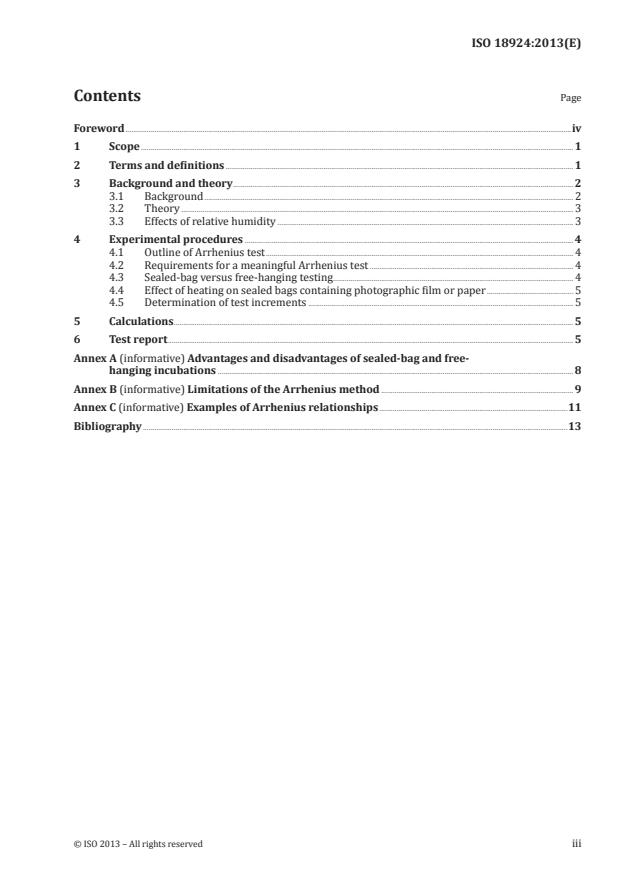
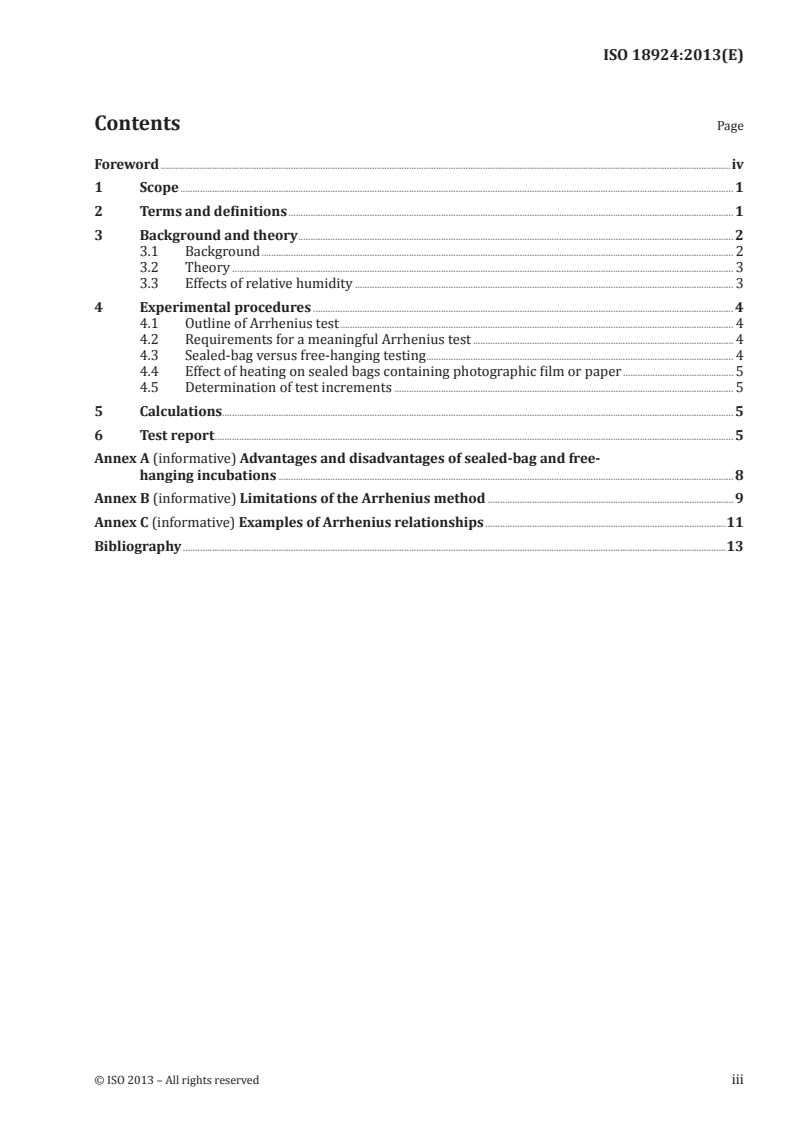
Contents Page
Foreword .iv
1 Scope . 1
2 Terms and definitions . 1
3 Background and theory . 2
3.1 Background . 2
3.2 Theory . 3
3.3 Effects of relative humidity . 3
4 Experimental procedures . 4
4.1 Outline of Arrhenius test . 4
4.2 Requirements for a meaningful Arrhenius test . 4
4.3 Sealed-bag versus free-hanging testing . 4
4.4 Effect of heating on sealed bags containing photographic film or paper . 5
4.5 Determination of test increments . 5
5 Calculations. 5
6 Test report . 5
Annex A (informative) Advantages and disadvantages of sealed-bag and free-
hanging incubations . 8
Annex B (informative) Limitations of the Arrhenius method . 9
Annex C (informative) Examples of Arrhenius relationships .11
Bibliography .13
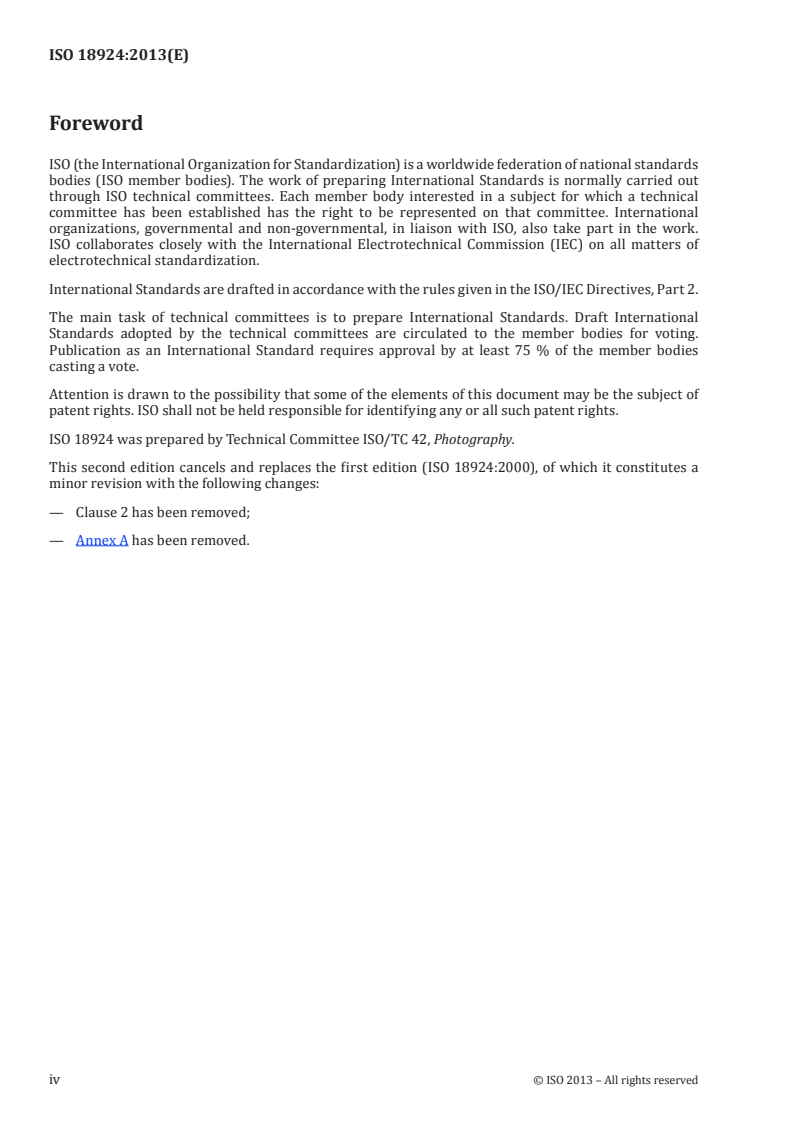
Foreword
ISO (the International Organization for Standardization) is a worldwide federation of national standards
bodies (ISO member bodies). The work of preparing International Standards is normally carried out
through ISO technical committees. Each member body interested in a subject for which a technical
committee has been established has the right to be represented on that committee. International
organizations, governmental and non-governmental, in liaison with ISO, also take part in the work.
ISO collaborates closely with the International Electrotechnical Commission (IEC) on all matters of
electrotechnical standardization.
International Standards are drafted in accordance with the rules given in the ISO/IEC Directives, Part 2.
The main task of technical committees is to prepare International Standards. Draft International
Standards adopted by the technical committees are circulated to the member bodies for voting.
Publication as an International Standard requires approval by at least 75 % of the member bodies
casting a vote.
Attention is drawn to the possibility that some of the elements of this document may be the subject of
patent rights. ISO shall not be held responsible for identifying any or all such patent rights.
ISO 18924 was prepared by Technical Committee ISO/TC 42, Photography.
This second edition cancels and replaces the first edition (ISO 18924:2000), of which it constitutes a
minor revision with the following changes:
— Clause 2 has been removed;
— Annex A has been removed.
iv © ISO 2013 – All rights reserved
INTERNATIONAL STANDARD ISO 18924:2013(E)
Imaging materials — Test method for Arrhenius-type
predictions
1 Scope
This International Standard specifies a test method for the prediction of certain physical or chemical
property changes of imaging materials.
This International Standard is applicable to the Arrhenius test portion of ISO 18901, ISO 18905,
ISO 18909, ISO 18912, and ISO 18919.
This International Standard is applicable to the prediction of the optical-density (D) loss or gain of
imaging materials. Photographic dye images may be produced by chromogenic processing, by formation
of diazo dyes, or by non-chromogenic methods such as dye diffusion and silver dye-bleaching processing.
This International Standard also covers density changes caused by
— residual coupler changes in dye images,
— excess residual processing chemicals in silver black-and-white materials,
— temperature effects on thermally processed silver images.
This International Standard is applicable to the prediction of support degradation. One such example
is the generation of acetic acid by degradation of cellulose acetate film support. Another example is the
change in tensile energy absorption of black-and-white paper support.
2 Terms and definitions
For the purposes of this document, the following terms and definitions apply.
2.1
Arrhenius plot
plot of the logarithm of the time for a given change in a characteristic proportional to the reaction rate
(dye loss, tensile strength change, D yellowing, etc.) versus the reciprocal of the temperature, in kelvins
min
Note 1 to entry: The Arrhenius plot may be used to predict behaviour at a temperature lower than those at which
the tests are run.
2.2
glass transition
reversible change in an amorphous polymer from, or to, a viscous or rubbery condition to, or from, a
hard and relatively brittle one
2.3
glass transition temperature
T
g
approximate mid-point of the temperature range over which glass transition takes place
Note 1 to entry: T can be determined readily only by observing the temperature at which a significant change
g
[1]
takes place in a specific electrical, mechanical, or other physical property.
Note 2 to entry: T can also be sensitive to the moisture content of the polymer (see 4.4, Annex A, and B.3 of
g
Annex B for information).
Note 3 to entry: For imaging materials containing gelatin, T is very humidity dependent.
g
2.4
irrelevant physical or chemical reactions
chemical or physical reactions that take place only at high temperatures and/or humidities and do not
take place at the temperatures at which the Arrhenius predictions are to be made
Note 1 to entry: Such reactions may nevertheless affect the quality of the image, binder, or support.
2.5
morphological changes
changes in the physical structure of the association of the molecules
2.6
thermodynamic temperature
temperature measured on the absolute scale which is based on absolute zero (–273,15 °C) and having an
interval of measurement that is equivalent to degrees Celsius
Note 1 to entry: The temperature unit in the absolute scale is the kelvin.
3 Background and theory
3.1 Background
In the 1890s, Svante Arrhenius discovered that the rate of some chemical reactions is proportional to
the reciprocal of the absolute temperature. This relationship has been used with phenomena related to
a chemical change, such as the loss of a particular physical property or the change in the optical density
of film. If a linear relationship exists between the logarithm of the time for a change of a particular
property and the reciprocal of the temperature, then this plot can be extrapolated to lower temperatures
than those used in laboratory studies. This allows the prediction of the time required for the change to
happen at room temperature or lower.
[2]
This relationship was first used for the rates of chemical reactions and was later applied to paper
[3,4] [5]
materials. This theory became the basis for TAPPI Standard 453. The approach was also applied to
[6] [7,8]
textiles and to physical properties of photographic film supports. More recently, it has been used
[9-11]
to predict the fading of both chromogenic and non-chromogenic photographic dyes.
Predictions based on the Arrhenius equation require the reactions to be run under a series of
temperatures at either constant relative humidity (free-hanging) or constant moisture content inside
the enclosure. The investigator shall determine which of the above conditions is more relevant to the
system being tested.
There may also be cases where elevated temperatures cause different reaction pathways from those
occurring at ambient or sub-ambient conditions. In these cases, the plot of the logarithm of time versus
the reciprocal of the absolute temperature will be nonlinear and great caution shall be taken in drawing
conclusions. Only the linear and lower temperature portion of the plot can be extrapolated to ambient
conditions or below.
The drawback to elimination of higher temperature data is that the experiment will then take longer
because of the slow reaction rate at lower temperatures. Patience is the only solution for getting the
correct answer when this happens. When incubations are limited to a few of the higher temperatures,
this can lead to incorrect or misleading results and shall be done with extreme caution.
Confidence in the Arrhenius methodology is obtained when predictions for phenomena with reasonably
short lifetimes correspond to the real-time results. Such data do exist for the fading of photographic
[12,13] [8,14]
dyes and the stability of cellulose ester film supports.
2 © ISO 2013 – All rights reserved
3.2 Theory
The basic relationship in the study of chemical reaction rates is the Arrhenius equation:
−E
log k = +C (1)
2,30 RT
where
k is the rate of reaction (change per time);
E is the energy of activation for a specific reaction;
R is the gas constant;
T is the temperature (in kelvins);
C is a constant for the specific reaction.
By combining all the constant terms (E/2,30 R) into a constant “a” and measuring the time for a given
change, this equation can be rewritten as:
a
log (time) =+C (2)
T
Consequently, when the logarithm of the time is plotted against the reciprocal of the absolute
temperature, a straight line is produced. This relationship can be used to predict the time required for a
given change to occur at lower temperatures where the reaction might require hundreds of years. This
is done experimentally by determining the time required for a given change at a number of elevated
temperatures (where the times required are reasonable), plotting these points, and extending the
straight-line graph to the lower temperatures of interest. This “Arrhenius method” of predicting long-
term ageing behaviour is widely used and accepted by experts in the photographic industry.
In the chemical literature, the equation has been widely applied to relatively simple, chemical reactions
where both reactants and products have been identified. However, there may be circumstances in which
the fit of the Arrhenius prediction line is less than perfect. In these cases, there may be more than one
reaction occurring and this may result in nonlinear behaviour or two distinct linear portions to the
prediction line. In other situations, physical properties are measured, although the changes are the
result of chemical reactions. More details of these phenomena are given for information in Annex B.
However, despite the complex reactions involved, this equation applies very well to many complicated
reactions that occur with photographic materials.
3.3 Effects of relative humidity
The Arrhenius method is run at either constant relative humidity or constant moisture content in
the enclosure. It should be noted that many of the responses evaluated by the Arrhenius method are
[15]
humidity dependent and that rates can change quite drastically as a function of relative humidity.
The effect of moisture may be determined by several separate experiments at multiple temperatures,
with each experiment at a constant relative humidity or moisture content.
4 Experimental procedures
4.1 Outline of Arrhenius test
An Arrhenius test should have the following steps that are explained in more detail in several of the
[16,17]
references.
a) Prepare specimens; this may include exposing, processing, cutting, trimming, etc.
b) Take initial readings of the property of interest on the non-incubated specimens.
c) Incubate the specimens at a minimum of four temperatures, using either the free-hanging or the
sealed-bag technique (see 4.3).
d) Measure the property of interest on the incubated specimens after different incubation times.
e) Determine the incubation time at each incubation temperature for the property of interest to reach
a predetermined level.
f) Plot the log of the incubation time determined in e) against the reciprocal of the thermodynamic
temperature to obtain an Arrhenius plot.
g) Predict the time for the property of interest to change the desired amount at the desired temperature
by extrapolation of the Arrhenius plot.
h) Examples of Arrhenius plots are given in Annex C.
4.2 Requirements for a meaningful Arrhenius test
Although a straight line can be drawn between two points and an Arrhenius prediction may be made by
plotting the results of two different incubation temperatures, there can be no evaluation of the statistical
significance of this experiment unless three or more temperatures are used. Because a smaller number
of data points is apt to lead to a strongly biase
...
INTERNATIONAL ISO
STANDARD 18924
Second edition
2013-02-01
Imaging materials — Test method for
Arrhenius-type predictions
Matériaux d’image — Méthode d’essai pour les prédictions de type
Arrhenius
Reference number
©
ISO 2013
© ISO 2013
All rights reserved. Unless otherwise specified, no part of this publication may be reproduced or utilized otherwise in any form
or by any means, electronic or mechanical, including photocopying, or posting on the internet or an intranet, without prior
written permission. Permission can be requested from either ISO at the address below or ISO’s member body in the country of
the requester.
ISO copyright office
Case postale 56 • CH-1211 Geneva 20
Tel. + 41 22 749 01 11
Fax + 41 22 749 09 47
E-mail copyright@iso.org
Web www.iso.org
Published in Switzerland
ii © ISO 2013 – All rights reserved
Contents Page
Foreword .iv
1 Scope . 1
2 Terms and definitions . 1
3 Background and theory . 2
3.1 Background . 2
3.2 Theory . 3
3.3 Effects of relative humidity . 3
4 Experimental procedures . 4
4.1 Outline of Arrhenius test . 4
4.2 Requirements for a meaningful Arrhenius test . 4
4.3 Sealed-bag versus free-hanging testing . 4
4.4 Effect of heating on sealed bags containing photographic film or paper . 5
4.5 Determination of test increments . 5
5 Calculations. 5
6 Test report . 5
Annex A (informative) Advantages and disadvantages of sealed-bag and free-
hanging incubations . 8
Annex B (informative) Limitations of the Arrhenius method . 9
Annex C (informative) Examples of Arrhenius relationships .11
Bibliography .13
Foreword
ISO (the International Organization for Standardization) is a worldwide federation of national standards
bodies (ISO member bodies). The work of preparing International Standards is normally carried out
through ISO technical committees. Each member body interested in a subject for which a technical
committee has been established has the right to be represented on that committee. International
organizations, governmental and non-governmental, in liaison with ISO, also take part in the work.
ISO collaborates closely with the International Electrotechnical Commission (IEC) on all matters of
electrotechnical standardization.
International Standards are drafted in accordance with the rules given in the ISO/IEC Directives, Part 2.
The main task of technical committees is to prepare International Standards. Draft International
Standards adopted by the technical committees are circulated to the member bodies for voting.
Publication as an International Standard requires approval by at least 75 % of the member bodies
casting a vote.
Attention is drawn to the possibility that some of the elements of this document may be the subject of
patent rights. ISO shall not be held responsible for identifying any or all such patent rights.
ISO 18924 was prepared by Technical Committee ISO/TC 42, Photography.
This second edition cancels and replaces the first edition (ISO 18924:2000), of which it constitutes a
minor revision with the following changes:
— Clause 2 has been removed;
— Annex A has been removed.
iv © ISO 2013 – All rights reserved
INTERNATIONAL STANDARD ISO 18924:2013(E)
Imaging materials — Test method for Arrhenius-type
predictions
1 Scope
This International Standard specifies a test method for the prediction of certain physical or chemical
property changes of imaging materials.
This International Standard is applicable to the Arrhenius test portion of ISO 18901, ISO 18905,
ISO 18909, ISO 18912, and ISO 18919.
This International Standard is applicable to the prediction of the optical-density (D) loss or gain of
imaging materials. Photographic dye images may be produced by chromogenic processing, by formation
of diazo dyes, or by non-chromogenic methods such as dye diffusion and silver dye-bleaching processing.
This International Standard also covers density changes caused by
— residual coupler changes in dye images,
— excess residual processing chemicals in silver black-and-white materials,
— temperature effects on thermally processed silver images.
This International Standard is applicable to the prediction of support degradation. One such example
is the generation of acetic acid by degradation of cellulose acetate film support. Another example is the
change in tensile energy absorption of black-and-white paper support.
2 Terms and definitions
For the purposes of this document, the following terms and definitions apply.
2.1
Arrhenius plot
plot of the logarithm of the time for a given change in a characteristic proportional to the reaction rate
(dye loss, tensile strength change, D yellowing, etc.) versus the reciprocal of the temperature, in kelvins
min
Note 1 to entry: The Arrhenius plot may be used to predict behaviour at a temperature lower than those at which
the tests are run.
2.2
glass transition
reversible change in an amorphous polymer from, or to, a viscous or rubbery condition to, or from, a
hard and relatively brittle one
2.3
glass transition temperature
T
g
approximate mid-point of the temperature range over which glass transition takes place
Note 1 to entry: T can be determined readily only by observing the temperature at which a significant change
g
[1]
takes place in a specific electrical, mechanical, or other physical property.
Note 2 to entry: T can also be sensitive to the moisture content of the polymer (see 4.4, Annex A, and B.3 of
g
Annex B for information).
Note 3 to entry: For imaging materials containing gelatin, T is very humidity dependent.
g
2.4
irrelevant physical or chemical reactions
chemical or physical reactions that take place only at high temperatures and/or humidities and do not
take place at the temperatures at which the Arrhenius predictions are to be made
Note 1 to entry: Such reactions may nevertheless affect the quality of the image, binder, or support.
2.5
morphological changes
changes in the physical structure of the association of the molecules
2.6
thermodynamic temperature
temperature measured on the absolute scale which is based on absolute zero (–273,15 °C) and having an
interval of measurement that is equivalent to degrees Celsius
Note 1 to entry: The temperature unit in the absolute scale is the kelvin.
3 Background and theory
3.1 Background
In the 1890s, Svante Arrhenius discovered that the rate of some chemical reactions is proportional to
the reciprocal of the absolute temperature. This relationship has been used with phenomena related to
a chemical change, such as the loss of a particular physical property or the change in the optical density
of film. If a linear relationship exists between the logarithm of the time for a change of a particular
property and the reciprocal of the temperature, then this plot can be extrapolated to lower temperatures
than those used in laboratory studies. This allows the prediction of the time required for the change to
happen at room temperature or lower.
[2]
This relationship was first used for the rates of chemical reactions and was later applied to paper
[3,4] [5]
materials. This theory became the basis for TAPPI Standard 453. The approach was also applied to
[6] [7,8]
textiles and to physical properties of photographic film supports. More recently, it has been used
[9-11]
to predict the fading of both chromogenic and non-chromogenic photographic dyes.
Predictions based on the Arrhenius equation require the reactions to be run under a series of
temperatures at either constant relative humidity (free-hanging) or constant moisture content inside
the enclosure. The investigator shall determine which of the above conditions is more relevant to the
system being tested.
There may also be cases where elevated temperatures cause different reaction pathways from those
occurring at ambient or sub-ambient conditions. In these cases, the plot of the logarithm of time versus
the reciprocal of the absolute temperature will be nonlinear and great caution shall be taken in drawing
conclusions. Only the linear and lower temperature portion of the plot can be extrapolated to ambient
conditions or below.
The drawback to elimination of higher temperature data is that the experiment will then take longer
because of the slow reaction rate at lower temperatures. Patience is the only solution for getting the
correct answer when this happens. When incubations are limited to a few of the higher temperatures,
this can lead to incorrect or misleading results and shall be done with extreme caution.
Confidence in the Arrhenius methodology is obtained when predictions for phenomena with reasonably
short lifetimes correspond to the real-time results. Such data do exist for the fading of photographic
[12,13] [8,14]
dyes and the stability of cellulose ester film supports.
2 © ISO 2013 – All rights reserved
3.2 Theory
The basic relationship in the study of chemical reaction rates is the Arrhenius equation:
−E
log k = +C (1)
2,30 RT
where
k is the rate of reaction (change per time);
E is the energy of activation for a specific reaction;
R is the gas constant;
T is the temperature (in kelvins);
C is a constant for the specific reaction.
By combining all the constant terms (E/2,30 R) into a constant “a” and measuring the time for a given
change, this equation can be rewritten as:
a
log (time) =+C (2)
T
Consequently, when the logarithm of the time is plotted against the reciprocal of the absolute
temperature, a straight line is produced. This relationship can be used to predict the time required for a
given change to occur at lower temperatures where the reaction might require hundreds of years. This
is done experimentally by determining the time required for a given change at a number of elevated
temperatures (where the times required are reasonable), plotting these points, and extending the
straight-line graph to the lower temperatures of interest. This “Arrhenius method” of predicting long-
term ageing behaviour is widely used and accepted by experts in the photographic industry.
In the chemical literature, the equation has been widely applied to relatively simple, chemical reactions
where both reactants and products have been identified. However, there may be circumstances in which
the fit of the Arrhenius prediction line is less than perfect. In these cases, there may be more than one
reaction occurring and this may result in nonlinear behaviour or two distinct linear portions to the
prediction line. In other situations, physical properties are measured, although the changes are the
result of chemical reactions. More details of these phenomena are given for information in Annex B.
However, despite the complex reactions involved, this equation applies very well to many complicated
reactions that occur with photographic materials.
3.3 Effects of relative humidity
The Arrhenius method is run at either constant relative humidity or constant moisture content in
the enclosure. It should be noted that many of the responses evaluated by the Arrhenius method are
[15]
humidity dependent and that rates can change quite drastically as a function of relative humidity.
The effect of moisture may be determined by several separate experiments at multiple temperatures,
with each experiment at a constant relative humidity or moisture content.
4 Experimental procedures
4.1 Outline of Arrhenius test
An Arrhenius test should have the following steps that are explained in more detail in several of the
[16,17]
references.
a) Prepare specimens; this may include exposing, processing, cutting, trimming, etc.
b) Take initial readings of the property of interest on the non-incubated specimens.
c) Incubate the specimens at a minimum of four temperatures, using either the free-hanging or the
sealed-bag technique (see 4.3).
d) Measure the property of interest on the incubated specimens after different incubation times.
e) Determine the incubation time at each incubation temperature for the property of interest to reach
a predetermined level.
f) Plot the log of the incubation time determined in e) against the reciprocal of the thermodynamic
temperature to obtain an Arrhenius plot.
g) Predict the time for the property of interest to change the desired amount at the desired temperature
by extrapolation of the Arrhenius plot.
h) Examples of Arrhenius plots are given in Annex C.
4.2 Requirements for a meaningful Arrhenius test
Although a straight line can be drawn between two points and an Arrhenius prediction may be made by
plotting the results of two different incubation temperatures, there can be no evaluation of the statistical
significance of this experiment unless three or more temperatures are used. Because a smaller number
of data points is apt to lead to a strongly biase
...