

ISO 2355:1972
(Main)Chemical analysis of magnesium and its alloys — Determination of rare earths — Gravimetric method
General Information
- Abstract
The method is applicable to the determination of contents of rare earths between 0,2 and 10 %, in the absence of thorium. Specifies principle and procedure of the method, reagents, apparatus, sampling, expression of results and test report.
- Status
- Published
- Publication Date
- 30-Apr-1972
- Technical Committee
- ISO/TC 79 - Light metals and their alloys
- Drafting Committee
- ISO/TC 79 - Light metals and their alloys
- Current Stage
- 9060 - Close of review
- Completion Date
- 02-Sep-2027
Buy Documents
ISO 2355:1972 - Chemical analysis of magnesium and its alloys -- Determination of rare earths -- Gravimetric method
ISO 2355:1972 - Chemical analysis of magnesium and its alloys — Determination of rare earths — Gravimetric method/1/1972
ISO 2355:1972 - Analyse chimique du magnésium et de ses alliages -- Dosage des terres rares -- Méthode gravimétrique
ISO 2355:1972 - Analyse chimique du magnésium et de ses alliages -- Dosage des terres rares -- Méthode gravimétrique
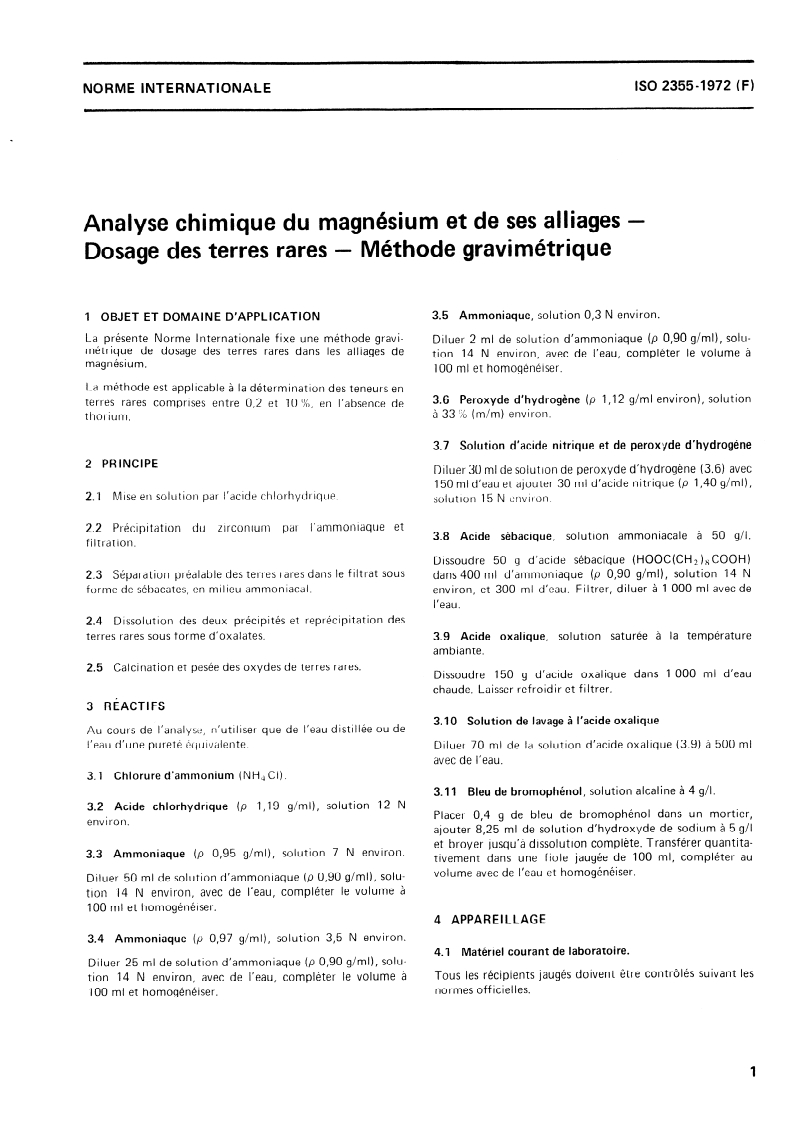
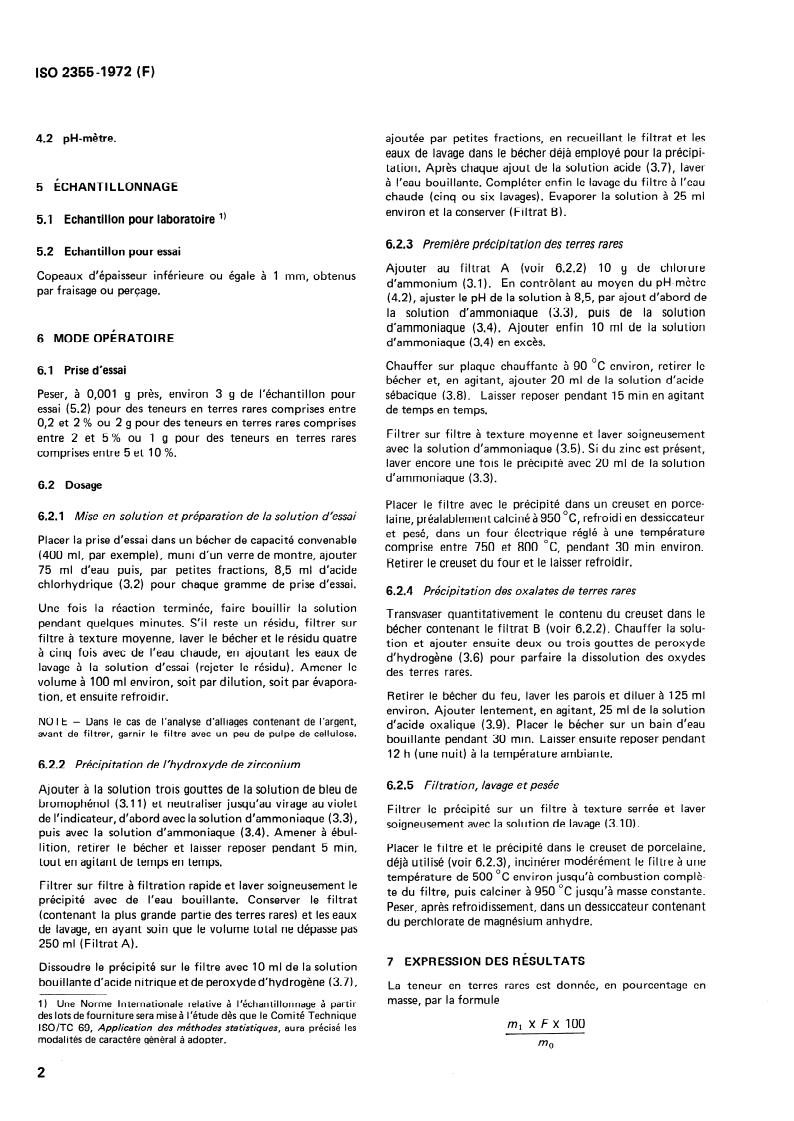
ISO 2355:1972 - Analyse chimique du magnésium et de ses alliages — Dosage des terres rares — Méthode gravimétrique/1/1972
ISO 2355:1972 - Analyse chimique du magnésium et de ses alliages — Dosage des terres rares — Méthode gravimétrique/1/1972
Overview
ISO 2355:1972 specifies a standardized gravimetric method for the chemical analysis of magnesium and its alloys, focusing on the determination of rare earth element (REE) content. This internationally recognized standard applies to the measurement of rare earths ranging from 0.2% to 10% by mass, specifically in samples devoid of thorium. It covers the entire analytical procedure including sample preparation, reagent use, apparatus requirements, testing method, result expression, and reporting.
This method is vital for industries where precise quantification of rare earths in magnesium alloys is required for quality control, material certification, and research and development purposes.
Key Topics
Scope and Application
- Determination of rare earth elements content in magnesium alloys between 0.2% and 10% by weight.
- Excludes samples containing thorium.
Analytical Principle
- Dissolution of magnesium alloy samples by hydrochloric acid.
- Precipitation of zirconium hydroxide for separation purposes.
- Separation of rare earth elements as their sebacates in an ammoniacal medium.
- Oxalate precipitation of rare earths, followed by calcination and gravimetric quantification of the resulting oxides.
Reagents and Solutions
- Ammonia solutions of varying normalities.
- Peroxide of hydrogen and a mixture of nitric acid with peroxide for oxidation.
- Sebacic acid ammoniacal solutions for rare earth separation.
- Oxalic acid for oxalate precipitation.
- Indicator solutions such as bromophenol blue for pH control.
Apparatus Requirements
- Standard laboratory vessels and devices compliant with official standards.
- Use of a pH meter to accurately adjust precipitation conditions.
Sampling Guidance
- Recommended sample sizes vary according to expected rare earth content: from 1 g to 3 g.
- Sample form should be in chips or small particles (≤1 mm thickness).
Test Report and Result Expression
- Results expressed as percentage mass of rare earth oxides calculated using a conventional conversion factor.
- Inclusion of test conditions, specifics of the method, any deviations or optional steps in test reports.
Applications
Metallurgy and Materials Engineering
ISO 2355:1972 is essential for ensuring the quality and composition control of magnesium alloys used in aerospace, automotive, electronics, and other high-performance applications where precise rare earth content affects material properties.Quality Assurance in Alloy Production
Provides a reliable, reproducible method for manufacturers and testing laboratories to verify compliance with composition specifications.Research and Development
Enables researchers to accurately measure and adjust rare earth content during the development of new magnesium-based materials with enhanced mechanical and chemical properties.Regulatory Compliance
Supports conformity with international trade and material standards by providing a universally accepted analytical method.
Related Standards
ISO/TC 79 - Light Metals and Their Alloys
The technical committee responsible for developing standards related to light metals, including methods for chemical analysis like ISO 2355.Other Gravimetric and Chemical Analysis Standards for Magnesium Alloys
Complementary methods addressing different elements or techniques for comprehensive alloy analysis.Standards for Sampling and Statistical Methods
Guidelines under ISO/TC 69 that address appropriate sampling techniques and statistical evaluation consistent with ISO 2355’s analytical accuracy goals.
Keywords: ISO 2355:1972, chemical analysis, magnesium alloys, rare earths determination, gravimetric method, magnesium alloy testing, REE analysis, international standard, metallurgical analysis, quality control.
Buy Documents
ISO 2355:1972 - Chemical analysis of magnesium and its alloys -- Determination of rare earths -- Gravimetric method
ISO 2355:1972 - Chemical analysis of magnesium and its alloys — Determination of rare earths — Gravimetric method/1/1972
ISO 2355:1972 - Analyse chimique du magnésium et de ses alliages -- Dosage des terres rares -- Méthode gravimétrique
ISO 2355:1972 - Analyse chimique du magnésium et de ses alliages -- Dosage des terres rares -- Méthode gravimétrique
ISO 2355:1972 - Analyse chimique du magnésium et de ses alliages — Dosage des terres rares — Méthode gravimétrique/1/1972
ISO 2355:1972 - Analyse chimique du magnésium et de ses alliages — Dosage des terres rares — Méthode gravimétrique/1/1972
Get Certified
Connect with accredited certification bodies for this standard

Element Materials Technology
Materials testing and product certification.

Inštitut za kovinske materiale in tehnologije
Institute of Metals and Technology. Materials testing, metallurgical analysis, NDT.
Sponsored listings
Frequently Asked Questions
ISO 2355:1972 is a standard published by the International Organization for Standardization (ISO). Its full title is "Chemical analysis of magnesium and its alloys — Determination of rare earths — Gravimetric method". This standard covers: The method is applicable to the determination of contents of rare earths between 0,2 and 10 %, in the absence of thorium. Specifies principle and procedure of the method, reagents, apparatus, sampling, expression of results and test report.
The method is applicable to the determination of contents of rare earths between 0,2 and 10 %, in the absence of thorium. Specifies principle and procedure of the method, reagents, apparatus, sampling, expression of results and test report.
ISO 2355:1972 is classified under the following ICS (International Classification for Standards) categories: 77.120.20 - Magnesium and magnesium alloys. The ICS classification helps identify the subject area and facilitates finding related standards.
ISO 2355:1972 is available in PDF format for immediate download after purchase. The document can be added to your cart and obtained through the secure checkout process. Digital delivery ensures instant access to the complete standard document.
Standards Content (Sample)
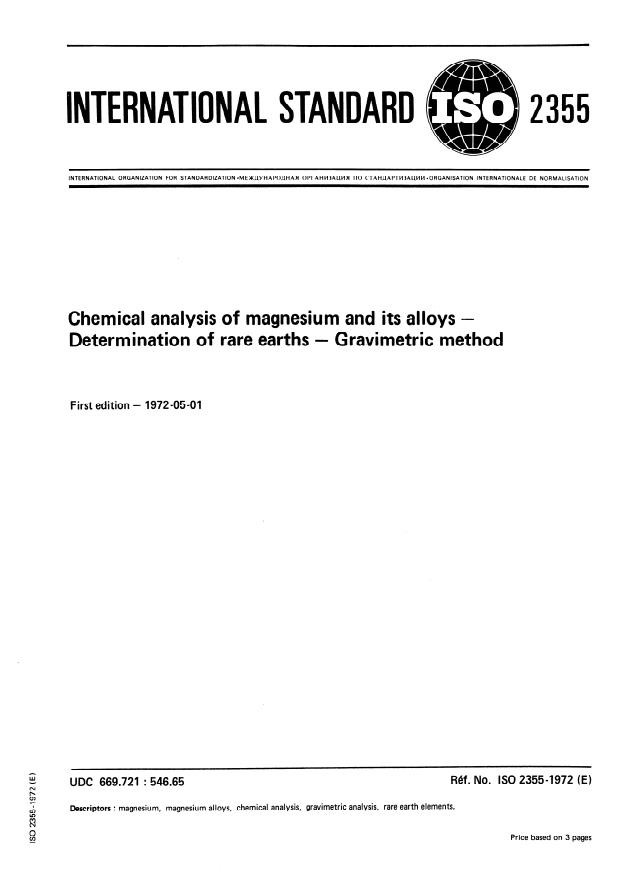
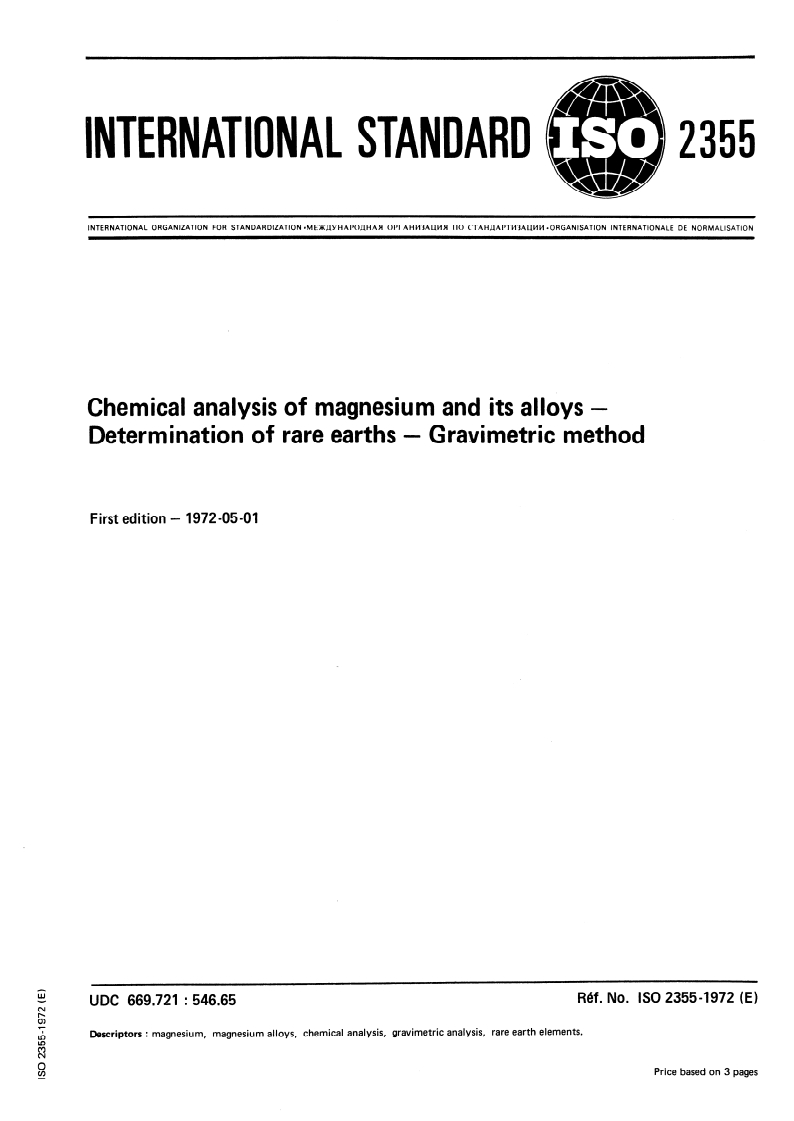
INTERNATIONAL STANDARD
INTERNATIONAL ORGANIZATION FOR STANDARDIZATION l MElKAYHAPOllHA5i OPI-AHM3AUM/I IlO CTAHLlAPTM3AUMM l 0RGANISATION INTERNATIONALE DE NORMALISATION
Chemical analysis of magnesium and its alloys -
Determination of rare earths - Gravimetric method
First edition - 1972-05-01
_---
Rbf. No. IS0 2355-1972 (E)
UDC 669.721 : 546.65
magnesium alloys, chemical analysis, gravimetric analysis, rare earth elements.
Descriptors : magnesium,
Price based on 3 pages
IS0 (the International Organization for Standardization) is a worldwide federation
of national standards institutes (IS0 Member Bodies). The work of developing
International Standards is carried out through IS0 Technical Committees. Every
Member Body interested in a subject for which a Technical Committee has been set
up has the right to be represented on that Committee. International organizations,
governmental and non-governmental, in liaison with ISO, also take part in the work.
Draft International Standards adopted by the Technical Committees are circulated
to the Member Bodies for approval before their acceptance as International
Standards by the IS0 Council,
International Standard IS0 2355 was drawn up by Technical Committee
ISO/TC 79, Light metals and their alloys.
It was approved in October 1971 by the Member Bodies of the following
countries :
Austria Ireland South Africa, Rep. of
Sweden
Belgium Italy
Switzerland
Canada Japan
Turkey
Egypt, Arab Rep. of Korea, Rep. of
United Kingdom
Finland Netherlands
France New Zealand U.S.A.
Germany Norway U.S.S.R.
Hungary Poland
India Romania
No Member Body expressed disapproval of the document.
@ International Organization for Standardization, 1972 l
Printed in Switzerland
INTERNATIONAL STANDARD IS0 23554972 (E)
Chemical analysis of magnesium and its alloys -
Determination of rare earths - Gravimetric method
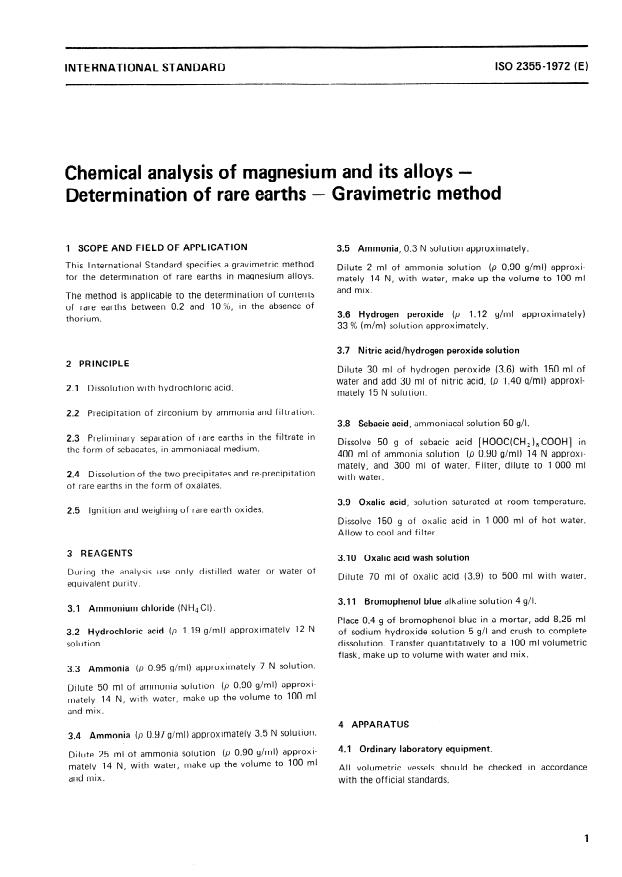
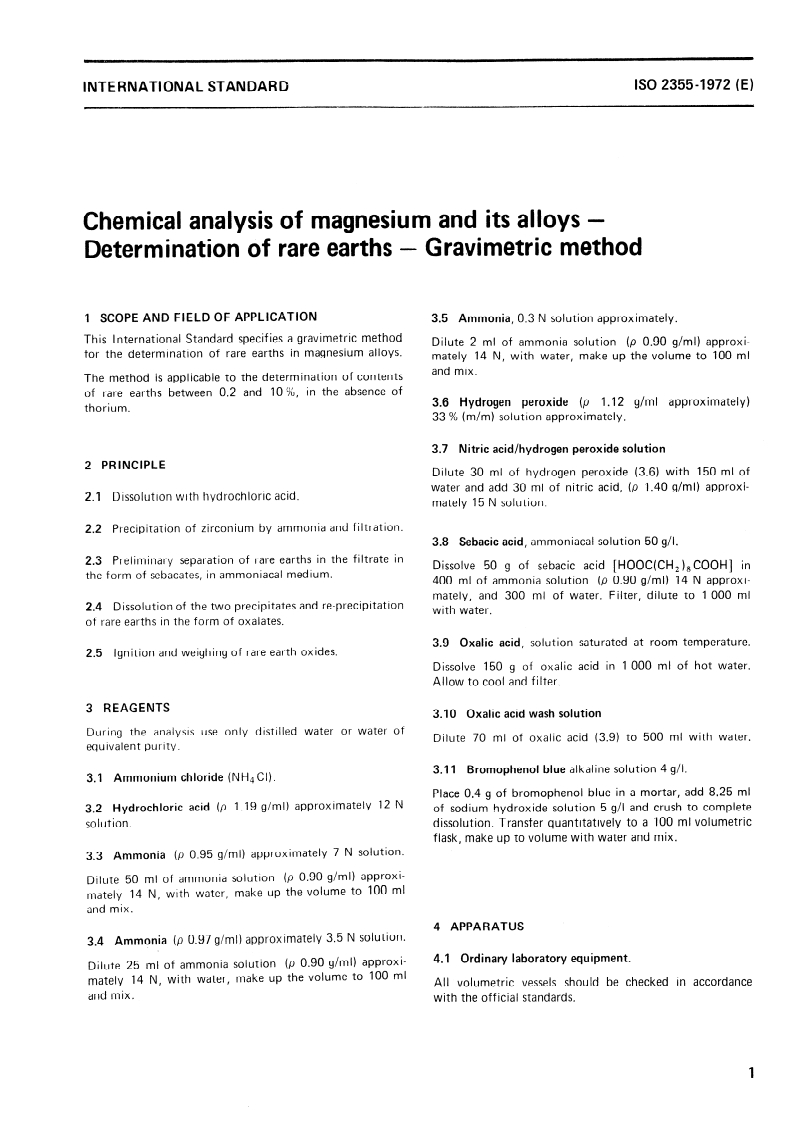
1 SCOPE AND FIELD OF APPLICATION
3.5 Ammonia, 0.3 N solution approximately.
This International Standard specifies a gravimetric method
Dilute 2 ml of ammonia solution (p 0.90 g/ml) approxi-
for the determination of rare earths in magnesium alloys.
mately 14 N, with water, make up the volume to 100 ml
and mix.
The method is applicable to the determination of contents
of rare earths between 0.2 and 10 %, in the absence of
3.6 Hydrogen peroxide (p 1 .I 2 g/ml approximately)
thorium.
33 % (m/m) solution approximately.
3.7 Nitric acid/hydrogen peroxide solution
2 PRINCIPLE
Dilute 30 ml of hydrogen peroxide (3.6) with 150 ml of
water and add 30 ml of nitric acid, (p 1.40 g/ml) approxi-
2.1 Dissolution with hydrochloric acid.
mately 15 N solution.
2.2 Precipitation of zirconium by ammonia and filtration.
3.8 Sebacic acid, ammoniacal solution 50 g/l.
2.3 Preliminary separation of rare earths in the filtrate in
Dissolve 50 g of sebacic acid [HOOC(CH,),COOH] in
the form of sebacates, in ammoniacal medium.
400 ml of ammonia solution (p 0.90 g/ml) 14 N approxi-
mately, and 300 ml of water. Filter, dilute to 1 000 ml
2.4 Dissolution of the two precipitates and re-precipitation
with water.
of rare earths in the form of oxalates.
3.9 Oxalic acid, solution saturated at room temperature.
2.5 Ignition and weighing of rare earth oxides.
Dissolve 150 g of oxalic acid in 1 000 ml of hot water.
Allow to cool and filter.
3 REAGENTS
3.10 Oxalic acid wash solution
During the analysis use only distilled water or water of
Dilute 70 ml of oxalic acid (3.9) to 500 ml with water.
equivalent purity.
3.11 Bromophenol blue alkaline solution 4 g/l.
3. I Ammonium chloride (N H4 Cl).
Place 0.4 g of bromophenol blue in a mortar, add 8.25 ml
3.2 Hydrochloric acid (p 1.19 g/ml) approximately 12 N
of sodium hydroxide solution 5 g/l and crush to complete
solution.
dissolution. Transfer quantitatively to a 100 ml volumetric
flask, make up to volume with water and mix.
3.3 Ammonia (p 0.95 g/ml) approximately 7 N solution.
Dilute 50 ml of ammonia solution (p 0.90 g/ml) approxi-
make up the volume to 100 ml
mately 14 N, with water,
and mix.
4 APPARATUS
3.4 Ammonia (p 0.97 g/ml) approximately 3.5 N solution.
4.1 Ordinary laboratory equipment.
Dilute 25 ml of ammonia solution (p 0.90 g/ml) approxi-
make up the volume to 100 ml
mately 14 N, with water,
All volumetric vessels should be checked in accordance
and mix.
with the official standards.
IS0 23554972 (E)
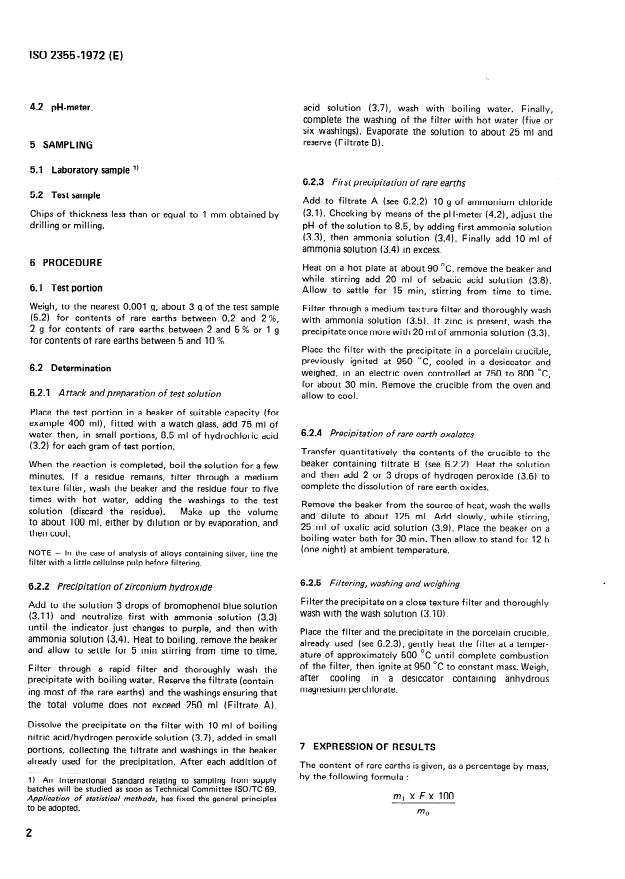
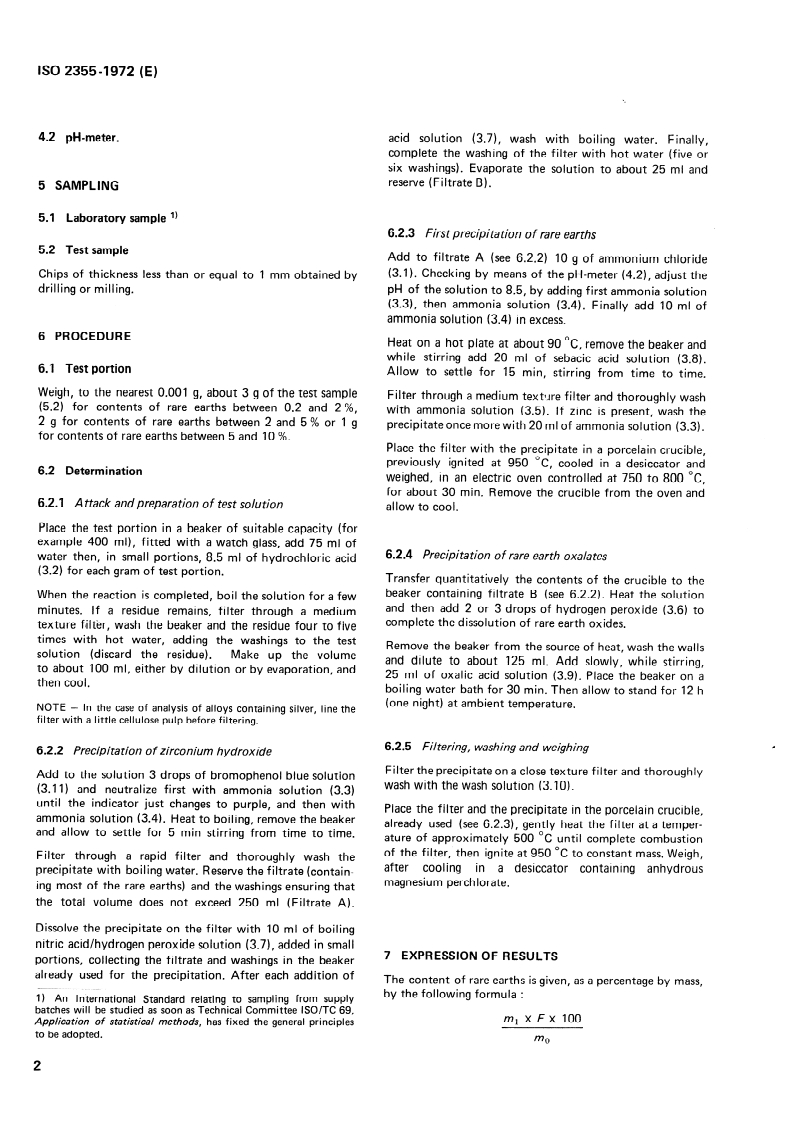
acid solution (3.7) wash with boiling water. Finally,
4.2 pH-meter.
complete the washing of the filter wi th hot wa ter (five or
six washings). Evapora te the solution to about 25 ml and
reserve (Filtrate B).
5 SAMPLING
5.1 Laboratory sample I)
6.2.3 First precipitation of rare earths
5.2 Test sample
Add to filtrate A (see 6.2.2) IO g of ammonium chloride
(3.1). Checking by means of the pH-meter (4.2) adjust the
Ch ips of thickness less than or equal to 1 mm obtained by
pH of the solution to 8.5, by ad
...
INTERNATIONAL STANDARD
INTERNATIONAL ORGANIZATION FOR STANDARDIZATION l MElKAYHAPOllHA5i OPI-AHM3AUM/I IlO CTAHLlAPTM3AUMM l 0RGANISATION INTERNATIONALE DE NORMALISATION
Chemical analysis of magnesium and its alloys -
Determination of rare earths - Gravimetric method
First edition - 1972-05-01
_---
Rbf. No. IS0 2355-1972 (E)
UDC 669.721 : 546.65
magnesium alloys, chemical analysis, gravimetric analysis, rare earth elements.
Descriptors : magnesium,
Price based on 3 pages
IS0 (the International Organization for Standardization) is a worldwide federation
of national standards institutes (IS0 Member Bodies). The work of developing
International Standards is carried out through IS0 Technical Committees. Every
Member Body interested in a subject for which a Technical Committee has been set
up has the right to be represented on that Committee. International organizations,
governmental and non-governmental, in liaison with ISO, also take part in the work.
Draft International Standards adopted by the Technical Committees are circulated
to the Member Bodies for approval before their acceptance as International
Standards by the IS0 Council,
International Standard IS0 2355 was drawn up by Technical Committee
ISO/TC 79, Light metals and their alloys.
It was approved in October 1971 by the Member Bodies of the following
countries :
Austria Ireland South Africa, Rep. of
Sweden
Belgium Italy
Switzerland
Canada Japan
Turkey
Egypt, Arab Rep. of Korea, Rep. of
United Kingdom
Finland Netherlands
France New Zealand U.S.A.
Germany Norway U.S.S.R.
Hungary Poland
India Romania
No Member Body expressed disapproval of the document.
@ International Organization for Standardization, 1972 l
Printed in Switzerland
INTERNATIONAL STANDARD IS0 23554972 (E)
Chemical analysis of magnesium and its alloys -
Determination of rare earths - Gravimetric method
1 SCOPE AND FIELD OF APPLICATION
3.5 Ammonia, 0.3 N solution approximately.
This International Standard specifies a gravimetric method
Dilute 2 ml of ammonia solution (p 0.90 g/ml) approxi-
for the determination of rare earths in magnesium alloys.
mately 14 N, with water, make up the volume to 100 ml
and mix.
The method is applicable to the determination of contents
of rare earths between 0.2 and 10 %, in the absence of
3.6 Hydrogen peroxide (p 1 .I 2 g/ml approximately)
thorium.
33 % (m/m) solution approximately.
3.7 Nitric acid/hydrogen peroxide solution
2 PRINCIPLE
Dilute 30 ml of hydrogen peroxide (3.6) with 150 ml of
water and add 30 ml of nitric acid, (p 1.40 g/ml) approxi-
2.1 Dissolution with hydrochloric acid.
mately 15 N solution.
2.2 Precipitation of zirconium by ammonia and filtration.
3.8 Sebacic acid, ammoniacal solution 50 g/l.
2.3 Preliminary separation of rare earths in the filtrate in
Dissolve 50 g of sebacic acid [HOOC(CH,),COOH] in
the form of sebacates, in ammoniacal medium.
400 ml of ammonia solution (p 0.90 g/ml) 14 N approxi-
mately, and 300 ml of water. Filter, dilute to 1 000 ml
2.4 Dissolution of the two precipitates and re-precipitation
with water.
of rare earths in the form of oxalates.
3.9 Oxalic acid, solution saturated at room temperature.
2.5 Ignition and weighing of rare earth oxides.
Dissolve 150 g of oxalic acid in 1 000 ml of hot water.
Allow to cool and filter.
3 REAGENTS
3.10 Oxalic acid wash solution
During the analysis use only distilled water or water of
Dilute 70 ml of oxalic acid (3.9) to 500 ml with water.
equivalent purity.
3.11 Bromophenol blue alkaline solution 4 g/l.
3. I Ammonium chloride (N H4 Cl).
Place 0.4 g of bromophenol blue in a mortar, add 8.25 ml
3.2 Hydrochloric acid (p 1.19 g/ml) approximately 12 N
of sodium hydroxide solution 5 g/l and crush to complete
solution.
dissolution. Transfer quantitatively to a 100 ml volumetric
flask, make up to volume with water and mix.
3.3 Ammonia (p 0.95 g/ml) approximately 7 N solution.
Dilute 50 ml of ammonia solution (p 0.90 g/ml) approxi-
make up the volume to 100 ml
mately 14 N, with water,
and mix.
4 APPARATUS
3.4 Ammonia (p 0.97 g/ml) approximately 3.5 N solution.
4.1 Ordinary laboratory equipment.
Dilute 25 ml of ammonia solution (p 0.90 g/ml) approxi-
make up the volume to 100 ml
mately 14 N, with water,
All volumetric vessels should be checked in accordance
and mix.
with the official standards.
IS0 23554972 (E)
acid solution (3.7) wash with boiling water. Finally,
4.2 pH-meter.
complete the washing of the filter wi th hot wa ter (five or
six washings). Evapora te the solution to about 25 ml and
reserve (Filtrate B).
5 SAMPLING
5.1 Laboratory sample I)
6.2.3 First precipitation of rare earths
5.2 Test sample
Add to filtrate A (see 6.2.2) IO g of ammonium chloride
(3.1). Checking by means of the pH-meter (4.2) adjust the
Ch ips of thickness less than or equal to 1 mm obtained by
pH of the solution to 8.5, by ad
...
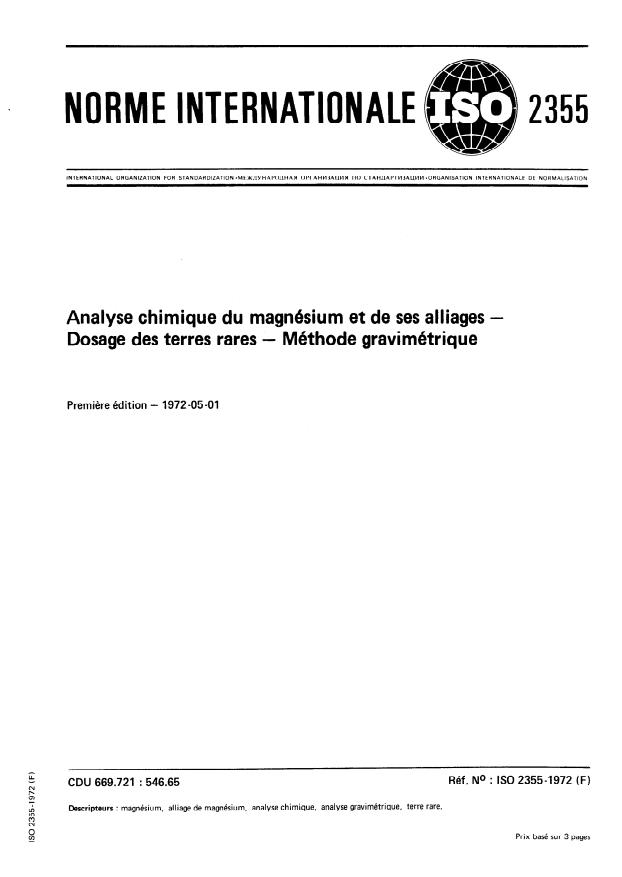
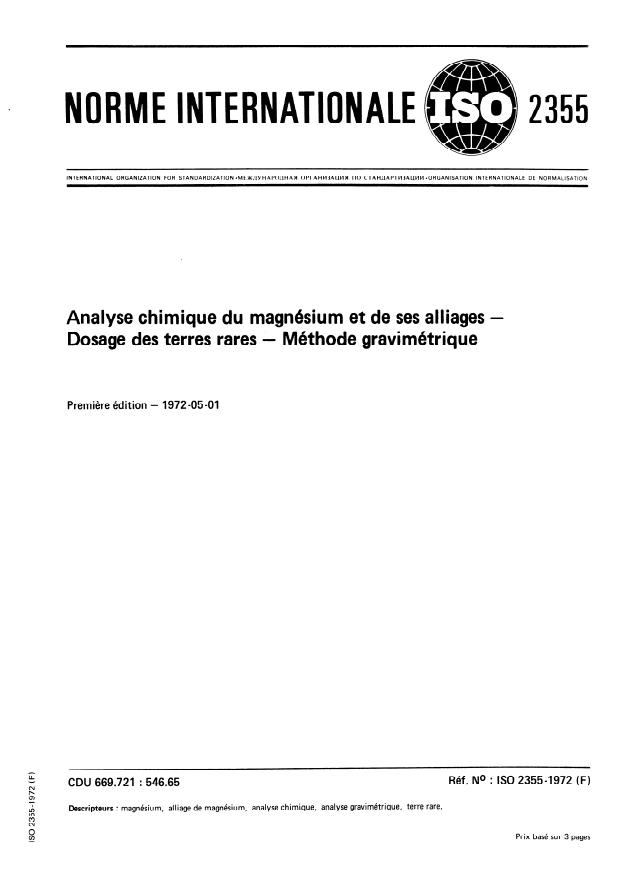
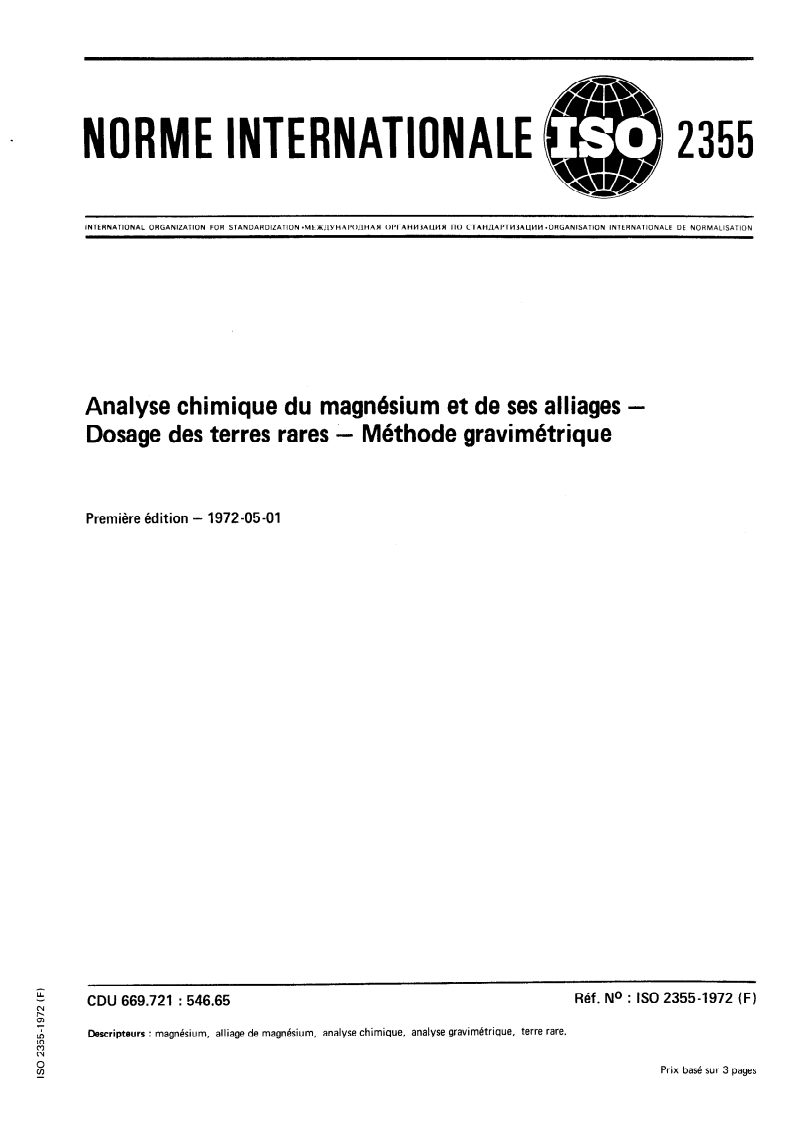
NORME INTERNATIONALE
INTERNATIONAL (-JRGANIZATION F()R STANDARDIZATION l MtJ+(jlY HAI’OLlHAII OI’r‘AHMîAUM~ Il0 CTAHLIAPTM3AUMM -ORGANISATION INTERNATIONALE DE NORMALISATION
Analyse chimique du magnésium et de ses alliages -
Dosage des terres rares i Méthode gravimétrique
Première édition - 1972-05-01
Réf. No : ISO 2355-1972 (F)
CDU 669.721 : 546.65
analyse chimique, analyse gravimétrique, terre rare.
Descripteurs : magnésium, alliage de magnésium,
Prix basé sur 3 pages
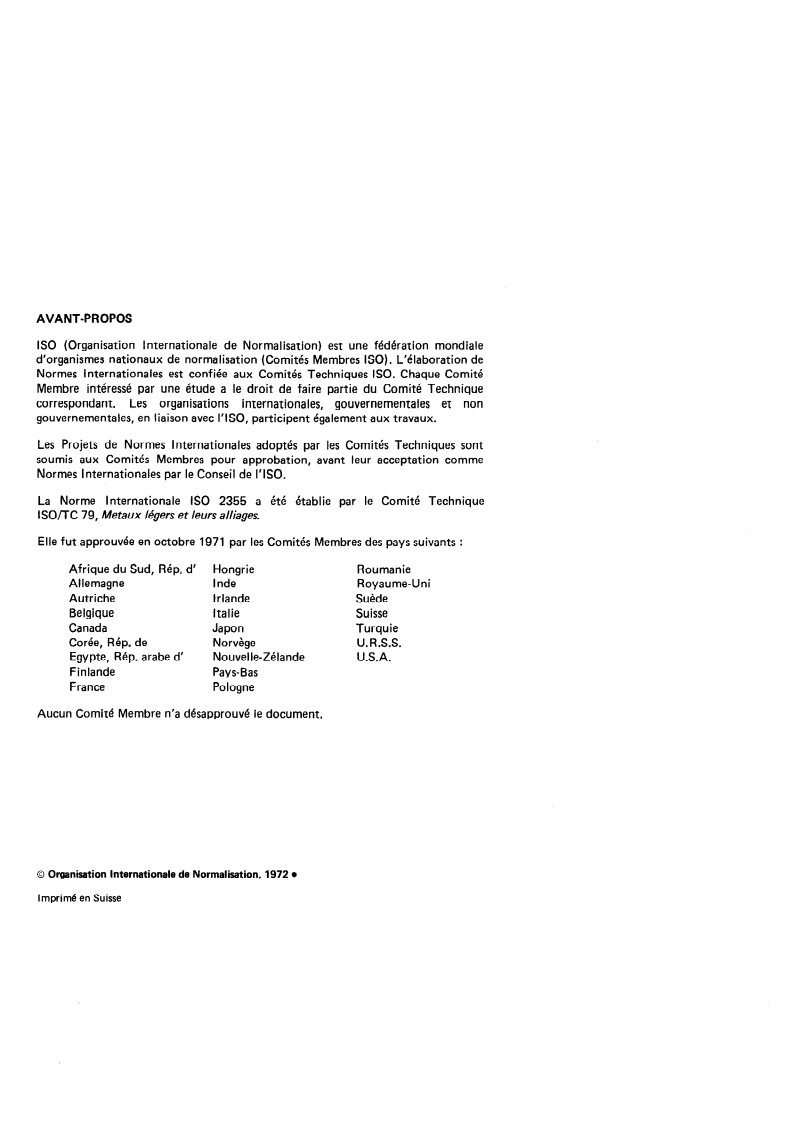
ISO (Organisation Internationale de Normalisation) est une fédération mondiale
d’organismes nationaux de normalisation (Comités Membres ISO). L’élaboration de
Normes Internationales est confiée aux Comités Techniques ISO. Chaque Comité
Membre intéressé par une étude a le droit de faire partie du Comité Technique
correspondant.
Les organisations internationales, gouvernementales et non
gouvernementales, en liaison avec I’ISO, participent également aux travaux.
Les Projets de Normes Internationales adoptés par les Comités Techniques sont
soumis aux Comités Membres pour approbation, avant leur acceptation comme
Normes Internationales par le Conseil de I’ISO.
La Norme Internationale ISO 2355 a été établie par le Comité Technique
lSO/TC 79, Metaux légers et leurs alliages.
Elle fut approuvée en octobre 1971 par les Comités Membres des pays suivants :
Afrique du Sud, Rép, d’ Hongrie Roumanie
Allemagne Inde Royaume-Uni
Autriche Irlande Suède
Belgique Italie Suisse
Canada Japon Turquie
Corée, Rép. de Norvège U.R.S.S.
Egypte, Rép. arabe d’ Nouvel le-Zélande U.S.A.
Finlande Pays-Bas
France Pologne
Aucun Comité Membre n’a désapprouvé le document.
0 Organisation Internationale de Normalisation, 1972 l
Imprimé en Suisse
ISO 23554972 (F)
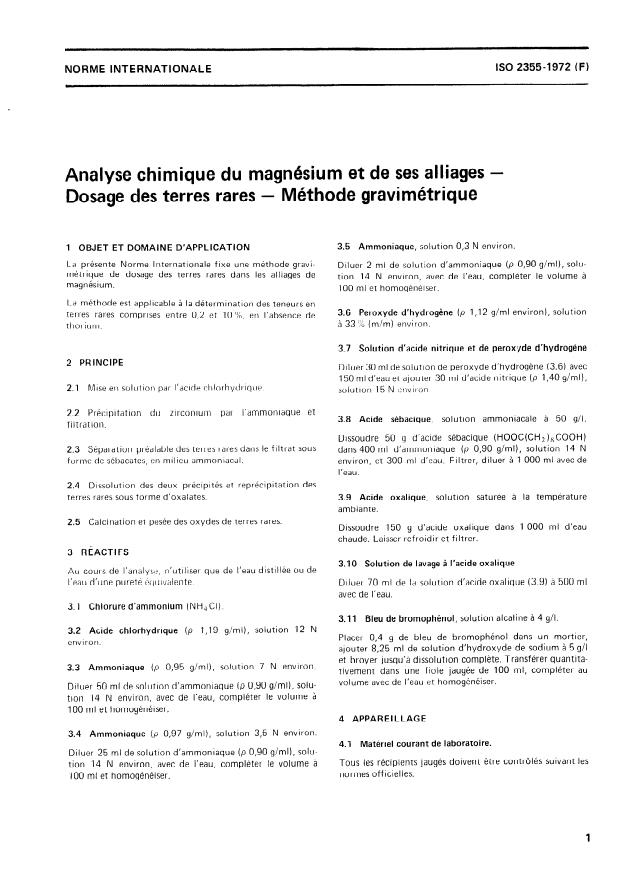
NORME INTERNATIONALE
Analyse chimique du magnésium et de ses alliages -
- Méthode gravimétrique
Dosage des terres rares
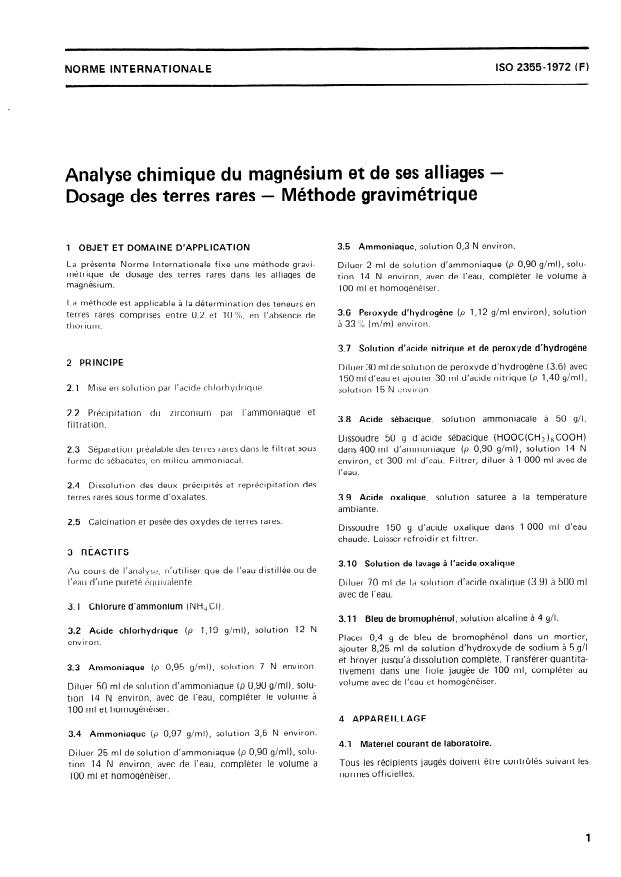
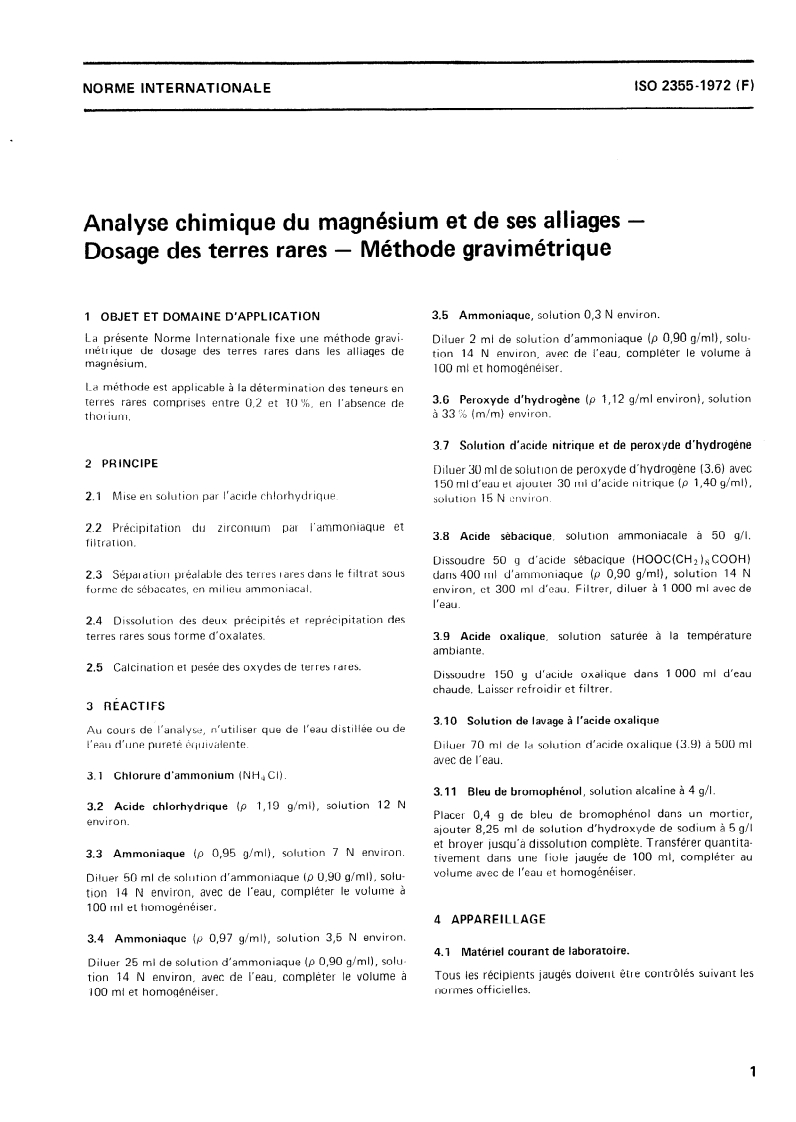
1 OBJET ET DOMAINE D’APPLICATION 3.5 Ammoniaque, solution 0,3 N environ.
La présente Norme Internationale fixe une méthode gravi-
Diluer 2 ml de solution d’ammoniaque (p 0,90 g/ml), solu-
métrique de dosage des terres rares dans les alliages de
tion 14 N environ, avec de l’eau, compléter le volume à
magnésium.
100 ml et homogénéiser.
La méthode est applicable à la détermination des teneurs en
3.6 Peroxyde d’hydrogène (p 1,12 g/ml environ), solution
terres rares comprises entre 0,2 et 10 %, en l’absence de
à 33 Y6 (m/m) environ.
t hot-ium.
3.7 Solution d’acide nitrique et de peroxyde d’hydrogène
2 PRINCIPE
Diluer 30 ml de solution de peroxyde d’hydrogène (3.6) avec
150 ml d’eau et ajouter 30 ml d’acide nitrique (p 1,40 g/ml),
2.1 M ise en solution par l’acide c~‘rIorhydriqIre.
solutwn 15 N ewit’on.
2.2 Précipitation du zircon&-n par l’ammoniaque et
3.8 Acide sébacique, solution ammoniacale à 50 g/l.
filtration.
Dissoudre 50 y d’acide sébacique (HOOC(CHI )ri COOH)
2-3 Sépateation préalable des terres tares dans le filtrat sous dans 400 ml d’ammoniaque (p 0,90 g/ml), solution 14 N
forme de séhacates, en milieu ammoniacal.
environ, et 300 ml d’eau. Filtrer, diluer à 1 000 ml avec de
l’eau.
2.4 Dissolution des deux précipités et reprécipitation des
terres rares sous forme d’oxalates. solution saturée à la température
3.9 Acide oxalique,
ambiante.
2.5 Calcination et pesée des oxydes de terres rares.
Dissoudre 150 g d’acide oxalique dans 1 000 ml d’eau
chaude. Laisser refroidir et filtrer.
3 RÉACTIFS
3.10 Solution de lavage à l’acide oxalique
r-l’utiliser que de l’eau distillée ou de
Au cour-s de l’analyse,
l’eau d’une pureté &luivalente.
Diluer 70 ml de la solution d’acide oxalique (3.9) à 500 ml
avec de l’eau.
3.1 Chlorure d’ammonium ( NH4 Cl).
3.11 Bleu de bromophénol, solution alcaline à 4 g/l.
3.2 Acide chlorhydrique (p 1,19 g/ml), solution 12 N
Placer 0,4 g de bleu de bromophénol dans un mortier,
environ.
ajouter 8,25 ml de solution d’hydroxyde de sodium à 5 g/l
et broyer jusqu’à dissolution complète. Transférer quantita-
3.3 Ammoniaque (p 0,95 g/ml), solution 7 N environ.
tivement dans une fiole jaugée de 100 ml, compléter au
volume avec de l’eau et homogénéiser.
Diluer 50 ml de solution d’ammoniaque (p 0,90 g/ml), SO~U-
tion 14 N environ, avec de l’eau, compléter le volume à
100 ml et homogénéiser.
4 APPAREILLAGE
3.4 Ammoniaque (p 0,97 g/ml), solution 3,5 N environ.
4.1 Matériel courant de laboratoire.
Diluer 25 ml de solution d’ammoniaque (p 0,90 g/ml), SO~U-
Tous les récipients jaugés doivent être contrôlés suivant les
tion 14 N environ, avec de l’eau, compléter le volume à
normes off icielles.
100 ml et homogénéiser.
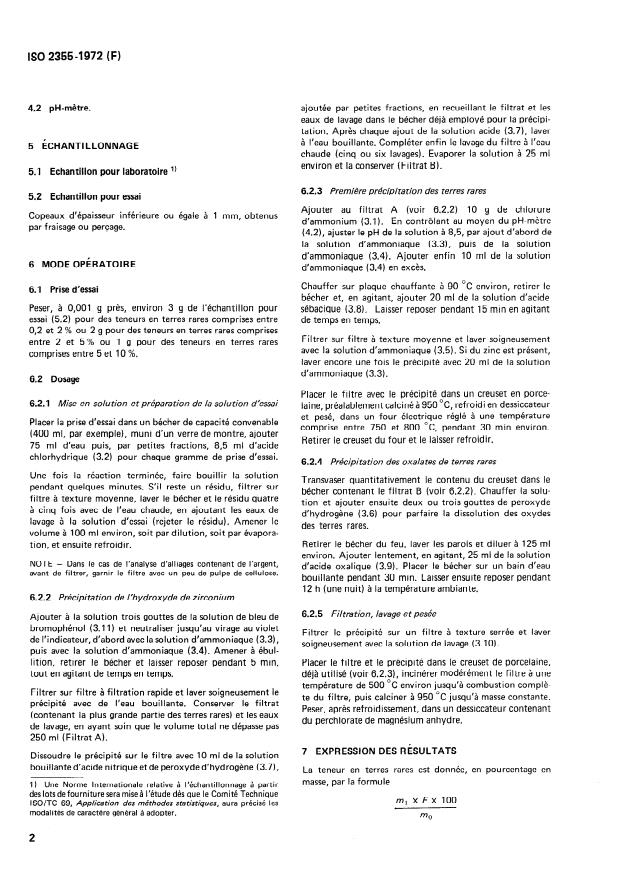
ISO 23554972 (F)
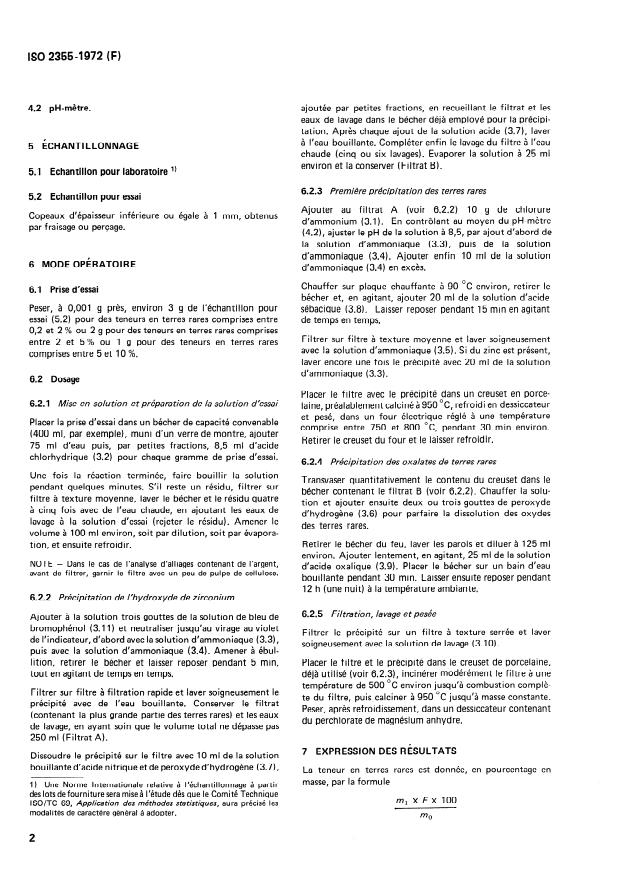
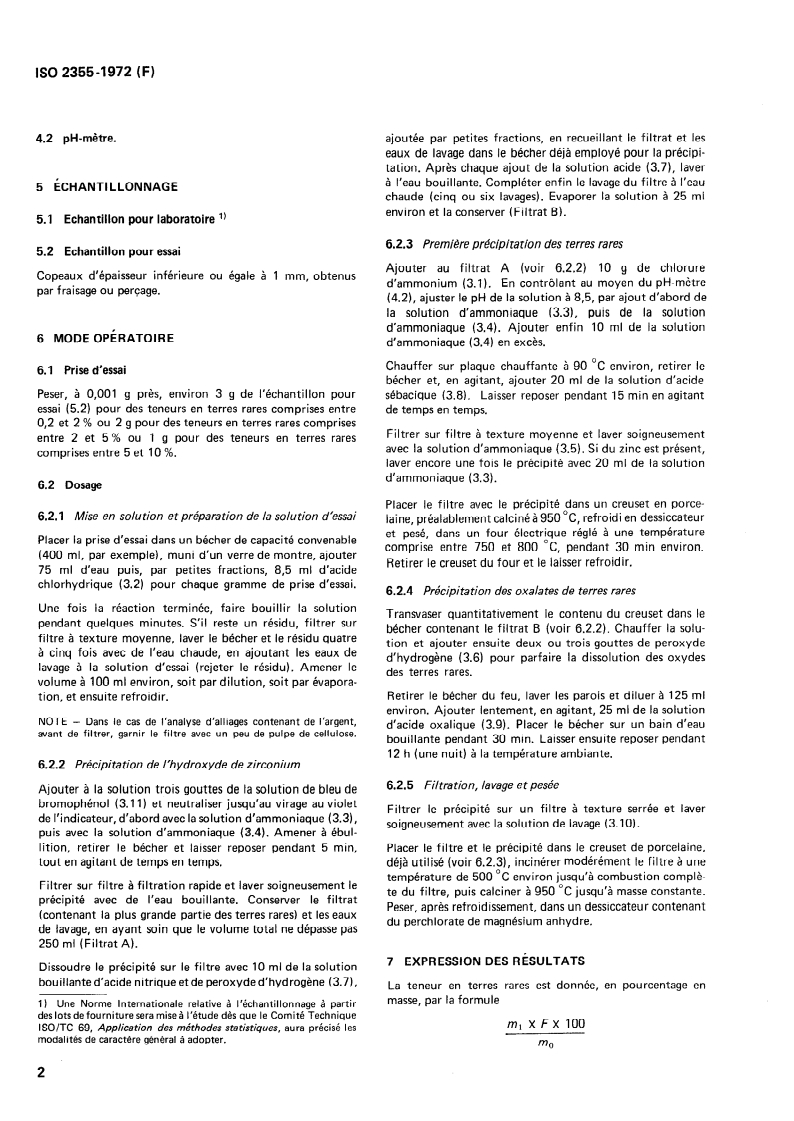
4.2 pH-mètre. ajoutée par petites fractions, en recueillant le filtrat et les
eaux de lavage dans le bécher déjà employé pour la précipi-
tation. Après chaque ajout de la solution acide (3.7), laver
à l’eau bouillante, Compléter enfin le lavage du filtre à l’eau
5 ÉCHANTILLONNAGE
chaude (cinq ou six lavages). Evaporer la solution à 25 ml
environ et la conserver (Filtrat B).
5.1 Echantillon pour laboratoire ‘1
6.2.3 Première précipitation des terres rares
5.2 Echantillon pour essai
Ajouter au filtrat A (voir 6.2.2) 10 g de chlorure
Copeaux d’épaisseur in férieure ou égale à 1
obtenus
mm,
d’ammonium (3.1). En contrôlant au moyen du pH-mètre
par fraisage ou pet-cage.
(4.2), ajuster l
...
NORME INTERNATIONALE
INTERNATIONAL (-JRGANIZATION F()R STANDARDIZATION l MtJ+(jlY HAI’OLlHAII OI’r‘AHMîAUM~ Il0 CTAHLIAPTM3AUMM -ORGANISATION INTERNATIONALE DE NORMALISATION
Analyse chimique du magnésium et de ses alliages -
Dosage des terres rares i Méthode gravimétrique
Première édition - 1972-05-01
Réf. No : ISO 2355-1972 (F)
CDU 669.721 : 546.65
analyse chimique, analyse gravimétrique, terre rare.
Descripteurs : magnésium, alliage de magnésium,
Prix basé sur 3 pages
ISO (Organisation Internationale de Normalisation) est une fédération mondiale
d’organismes nationaux de normalisation (Comités Membres ISO). L’élaboration de
Normes Internationales est confiée aux Comités Techniques ISO. Chaque Comité
Membre intéressé par une étude a le droit de faire partie du Comité Technique
correspondant.
Les organisations internationales, gouvernementales et non
gouvernementales, en liaison avec I’ISO, participent également aux travaux.
Les Projets de Normes Internationales adoptés par les Comités Techniques sont
soumis aux Comités Membres pour approbation, avant leur acceptation comme
Normes Internationales par le Conseil de I’ISO.
La Norme Internationale ISO 2355 a été établie par le Comité Technique
lSO/TC 79, Metaux légers et leurs alliages.
Elle fut approuvée en octobre 1971 par les Comités Membres des pays suivants :
Afrique du Sud, Rép, d’ Hongrie Roumanie
Allemagne Inde Royaume-Uni
Autriche Irlande Suède
Belgique Italie Suisse
Canada Japon Turquie
Corée, Rép. de Norvège U.R.S.S.
Egypte, Rép. arabe d’ Nouvel le-Zélande U.S.A.
Finlande Pays-Bas
France Pologne
Aucun Comité Membre n’a désapprouvé le document.
0 Organisation Internationale de Normalisation, 1972 l
Imprimé en Suisse
ISO 23554972 (F)
NORME INTERNATIONALE
Analyse chimique du magnésium et de ses alliages -
- Méthode gravimétrique
Dosage des terres rares
1 OBJET ET DOMAINE D’APPLICATION 3.5 Ammoniaque, solution 0,3 N environ.
La présente Norme Internationale fixe une méthode gravi-
Diluer 2 ml de solution d’ammoniaque (p 0,90 g/ml), solu-
métrique de dosage des terres rares dans les alliages de
tion 14 N environ, avec de l’eau, compléter le volume à
magnésium.
100 ml et homogénéiser.
La méthode est applicable à la détermination des teneurs en
3.6 Peroxyde d’hydrogène (p 1,12 g/ml environ), solution
terres rares comprises entre 0,2 et 10 %, en l’absence de
à 33 Y6 (m/m) environ.
t hot-ium.
3.7 Solution d’acide nitrique et de peroxyde d’hydrogène
2 PRINCIPE
Diluer 30 ml de solution de peroxyde d’hydrogène (3.6) avec
150 ml d’eau et ajouter 30 ml d’acide nitrique (p 1,40 g/ml),
2.1 M ise en solution par l’acide c~‘rIorhydriqIre.
solutwn 15 N ewit’on.
2.2 Précipitation du zircon&-n par l’ammoniaque et
3.8 Acide sébacique, solution ammoniacale à 50 g/l.
filtration.
Dissoudre 50 y d’acide sébacique (HOOC(CHI )ri COOH)
2-3 Sépateation préalable des terres tares dans le filtrat sous dans 400 ml d’ammoniaque (p 0,90 g/ml), solution 14 N
forme de séhacates, en milieu ammoniacal.
environ, et 300 ml d’eau. Filtrer, diluer à 1 000 ml avec de
l’eau.
2.4 Dissolution des deux précipités et reprécipitation des
terres rares sous forme d’oxalates. solution saturée à la température
3.9 Acide oxalique,
ambiante.
2.5 Calcination et pesée des oxydes de terres rares.
Dissoudre 150 g d’acide oxalique dans 1 000 ml d’eau
chaude. Laisser refroidir et filtrer.
3 RÉACTIFS
3.10 Solution de lavage à l’acide oxalique
r-l’utiliser que de l’eau distillée ou de
Au cour-s de l’analyse,
l’eau d’une pureté &luivalente.
Diluer 70 ml de la solution d’acide oxalique (3.9) à 500 ml
avec de l’eau.
3.1 Chlorure d’ammonium ( NH4 Cl).
3.11 Bleu de bromophénol, solution alcaline à 4 g/l.
3.2 Acide chlorhydrique (p 1,19 g/ml), solution 12 N
Placer 0,4 g de bleu de bromophénol dans un mortier,
environ.
ajouter 8,25 ml de solution d’hydroxyde de sodium à 5 g/l
et broyer jusqu’à dissolution complète. Transférer quantita-
3.3 Ammoniaque (p 0,95 g/ml), solution 7 N environ.
tivement dans une fiole jaugée de 100 ml, compléter au
volume avec de l’eau et homogénéiser.
Diluer 50 ml de solution d’ammoniaque (p 0,90 g/ml), SO~U-
tion 14 N environ, avec de l’eau, compléter le volume à
100 ml et homogénéiser.
4 APPAREILLAGE
3.4 Ammoniaque (p 0,97 g/ml), solution 3,5 N environ.
4.1 Matériel courant de laboratoire.
Diluer 25 ml de solution d’ammoniaque (p 0,90 g/ml), SO~U-
Tous les récipients jaugés doivent être contrôlés suivant les
tion 14 N environ, avec de l’eau, compléter le volume à
normes off icielles.
100 ml et homogénéiser.
ISO 23554972 (F)
4.2 pH-mètre. ajoutée par petites fractions, en recueillant le filtrat et les
eaux de lavage dans le bécher déjà employé pour la précipi-
tation. Après chaque ajout de la solution acide (3.7), laver
à l’eau bouillante, Compléter enfin le lavage du filtre à l’eau
5 ÉCHANTILLONNAGE
chaude (cinq ou six lavages). Evaporer la solution à 25 ml
environ et la conserver (Filtrat B).
5.1 Echantillon pour laboratoire ‘1
6.2.3 Première précipitation des terres rares
5.2 Echantillon pour essai
Ajouter au filtrat A (voir 6.2.2) 10 g de chlorure
Copeaux d’épaisseur in férieure ou égale à 1
obtenus
mm,
d’ammonium (3.1). En contrôlant au moyen du pH-mètre
par fraisage ou pet-cage.
(4.2), ajuster l
...
NORME INTERNATIONALE
INTERNATIONAL (-JRGANIZATION F()R STANDARDIZATION l MtJ+(jlY HAI’OLlHAII OI’r‘AHMîAUM~ Il0 CTAHLIAPTM3AUMM -ORGANISATION INTERNATIONALE DE NORMALISATION
Analyse chimique du magnésium et de ses alliages -
Dosage des terres rares i Méthode gravimétrique
Première édition - 1972-05-01
Réf. No : ISO 2355-1972 (F)
CDU 669.721 : 546.65
analyse chimique, analyse gravimétrique, terre rare.
Descripteurs : magnésium, alliage de magnésium,
Prix basé sur 3 pages
ISO (Organisation Internationale de Normalisation) est une fédération mondiale
d’organismes nationaux de normalisation (Comités Membres ISO). L’élaboration de
Normes Internationales est confiée aux Comités Techniques ISO. Chaque Comité
Membre intéressé par une étude a le droit de faire partie du Comité Technique
correspondant.
Les organisations internationales, gouvernementales et non
gouvernementales, en liaison avec I’ISO, participent également aux travaux.
Les Projets de Normes Internationales adoptés par les Comités Techniques sont
soumis aux Comités Membres pour approbation, avant leur acceptation comme
Normes Internationales par le Conseil de I’ISO.
La Norme Internationale ISO 2355 a été établie par le Comité Technique
lSO/TC 79, Metaux légers et leurs alliages.
Elle fut approuvée en octobre 1971 par les Comités Membres des pays suivants :
Afrique du Sud, Rép, d’ Hongrie Roumanie
Allemagne Inde Royaume-Uni
Autriche Irlande Suède
Belgique Italie Suisse
Canada Japon Turquie
Corée, Rép. de Norvège U.R.S.S.
Egypte, Rép. arabe d’ Nouvel le-Zélande U.S.A.
Finlande Pays-Bas
France Pologne
Aucun Comité Membre n’a désapprouvé le document.
0 Organisation Internationale de Normalisation, 1972 l
Imprimé en Suisse
ISO 23554972 (F)
NORME INTERNATIONALE
Analyse chimique du magnésium et de ses alliages -
- Méthode gravimétrique
Dosage des terres rares
1 OBJET ET DOMAINE D’APPLICATION 3.5 Ammoniaque, solution 0,3 N environ.
La présente Norme Internationale fixe une méthode gravi-
Diluer 2 ml de solution d’ammoniaque (p 0,90 g/ml), solu-
métrique de dosage des terres rares dans les alliages de
tion 14 N environ, avec de l’eau, compléter le volume à
magnésium.
100 ml et homogénéiser.
La méthode est applicable à la détermination des teneurs en
3.6 Peroxyde d’hydrogène (p 1,12 g/ml environ), solution
terres rares comprises entre 0,2 et 10 %, en l’absence de
à 33 Y6 (m/m) environ.
t hot-ium.
3.7 Solution d’acide nitrique et de peroxyde d’hydrogène
2 PRINCIPE
Diluer 30 ml de solution de peroxyde d’hydrogène (3.6) avec
150 ml d’eau et ajouter 30 ml d’acide nitrique (p 1,40 g/ml),
2.1 M ise en solution par l’acide c~‘rIorhydriqIre.
solutwn 15 N ewit’on.
2.2 Précipitation du zircon&-n par l’ammoniaque et
3.8 Acide sébacique, solution ammoniacale à 50 g/l.
filtration.
Dissoudre 50 y d’acide sébacique (HOOC(CHI )ri COOH)
2-3 Sépateation préalable des terres tares dans le filtrat sous dans 400 ml d’ammoniaque (p 0,90 g/ml), solution 14 N
forme de séhacates, en milieu ammoniacal.
environ, et 300 ml d’eau. Filtrer, diluer à 1 000 ml avec de
l’eau.
2.4 Dissolution des deux précipités et reprécipitation des
terres rares sous forme d’oxalates. solution saturée à la température
3.9 Acide oxalique,
ambiante.
2.5 Calcination et pesée des oxydes de terres rares.
Dissoudre 150 g d’acide oxalique dans 1 000 ml d’eau
chaude. Laisser refroidir et filtrer.
3 RÉACTIFS
3.10 Solution de lavage à l’acide oxalique
r-l’utiliser que de l’eau distillée ou de
Au cour-s de l’analyse,
l’eau d’une pureté &luivalente.
Diluer 70 ml de la solution d’acide oxalique (3.9) à 500 ml
avec de l’eau.
3.1 Chlorure d’ammonium ( NH4 Cl).
3.11 Bleu de bromophénol, solution alcaline à 4 g/l.
3.2 Acide chlorhydrique (p 1,19 g/ml), solution 12 N
Placer 0,4 g de bleu de bromophénol dans un mortier,
environ.
ajouter 8,25 ml de solution d’hydroxyde de sodium à 5 g/l
et broyer jusqu’à dissolution complète. Transférer quantita-
3.3 Ammoniaque (p 0,95 g/ml), solution 7 N environ.
tivement dans une fiole jaugée de 100 ml, compléter au
volume avec de l’eau et homogénéiser.
Diluer 50 ml de solution d’ammoniaque (p 0,90 g/ml), SO~U-
tion 14 N environ, avec de l’eau, compléter le volume à
100 ml et homogénéiser.
4 APPAREILLAGE
3.4 Ammoniaque (p 0,97 g/ml), solution 3,5 N environ.
4.1 Matériel courant de laboratoire.
Diluer 25 ml de solution d’ammoniaque (p 0,90 g/ml), SO~U-
Tous les récipients jaugés doivent être contrôlés suivant les
tion 14 N environ, avec de l’eau, compléter le volume à
normes off icielles.
100 ml et homogénéiser.
ISO 23554972 (F)
4.2 pH-mètre. ajoutée par petites fractions, en recueillant le filtrat et les
eaux de lavage dans le bécher déjà employé pour la précipi-
tation. Après chaque ajout de la solution acide (3.7), laver
à l’eau bouillante, Compléter enfin le lavage du filtre à l’eau
5 ÉCHANTILLONNAGE
chaude (cinq ou six lavages). Evaporer la solution à 25 ml
environ et la conserver (Filtrat B).
5.1 Echantillon pour laboratoire ‘1
6.2.3 Première précipitation des terres rares
5.2 Echantillon pour essai
Ajouter au filtrat A (voir 6.2.2) 10 g de chlorure
Copeaux d’épaisseur in férieure ou égale à 1
obtenus
mm,
d’ammonium (3.1). En contrôlant au moyen du pH-mètre
par fraisage ou pet-cage.
(4.2), ajuster l
...
NORME INTERNATIONALE
INTERNATIONAL (-JRGANIZATION F()R STANDARDIZATION l MtJ+(jlY HAI’OLlHAII OI’r‘AHMîAUM~ Il0 CTAHLIAPTM3AUMM -ORGANISATION INTERNATIONALE DE NORMALISATION
Analyse chimique du magnésium et de ses alliages -
Dosage des terres rares i Méthode gravimétrique
Première édition - 1972-05-01
Réf. No : ISO 2355-1972 (F)
CDU 669.721 : 546.65
analyse chimique, analyse gravimétrique, terre rare.
Descripteurs : magnésium, alliage de magnésium,
Prix basé sur 3 pages
ISO (Organisation Internationale de Normalisation) est une fédération mondiale
d’organismes nationaux de normalisation (Comités Membres ISO). L’élaboration de
Normes Internationales est confiée aux Comités Techniques ISO. Chaque Comité
Membre intéressé par une étude a le droit de faire partie du Comité Technique
correspondant.
Les organisations internationales, gouvernementales et non
gouvernementales, en liaison avec I’ISO, participent également aux travaux.
Les Projets de Normes Internationales adoptés par les Comités Techniques sont
soumis aux Comités Membres pour approbation, avant leur acceptation comme
Normes Internationales par le Conseil de I’ISO.
La Norme Internationale ISO 2355 a été établie par le Comité Technique
lSO/TC 79, Metaux légers et leurs alliages.
Elle fut approuvée en octobre 1971 par les Comités Membres des pays suivants :
Afrique du Sud, Rép, d’ Hongrie Roumanie
Allemagne Inde Royaume-Uni
Autriche Irlande Suède
Belgique Italie Suisse
Canada Japon Turquie
Corée, Rép. de Norvège U.R.S.S.
Egypte, Rép. arabe d’ Nouvel le-Zélande U.S.A.
Finlande Pays-Bas
France Pologne
Aucun Comité Membre n’a désapprouvé le document.
0 Organisation Internationale de Normalisation, 1972 l
Imprimé en Suisse
ISO 23554972 (F)
NORME INTERNATIONALE
Analyse chimique du magnésium et de ses alliages -
- Méthode gravimétrique
Dosage des terres rares
1 OBJET ET DOMAINE D’APPLICATION 3.5 Ammoniaque, solution 0,3 N environ.
La présente Norme Internationale fixe une méthode gravi-
Diluer 2 ml de solution d’ammoniaque (p 0,90 g/ml), solu-
métrique de dosage des terres rares dans les alliages de
tion 14 N environ, avec de l’eau, compléter le volume à
magnésium.
100 ml et homogénéiser.
La méthode est applicable à la détermination des teneurs en
3.6 Peroxyde d’hydrogène (p 1,12 g/ml environ), solution
terres rares comprises entre 0,2 et 10 %, en l’absence de
à 33 Y6 (m/m) environ.
t hot-ium.
3.7 Solution d’acide nitrique et de peroxyde d’hydrogène
2 PRINCIPE
Diluer 30 ml de solution de peroxyde d’hydrogène (3.6) avec
150 ml d’eau et ajouter 30 ml d’acide nitrique (p 1,40 g/ml),
2.1 M ise en solution par l’acide c~‘rIorhydriqIre.
solutwn 15 N ewit’on.
2.2 Précipitation du zircon&-n par l’ammoniaque et
3.8 Acide sébacique, solution ammoniacale à 50 g/l.
filtration.
Dissoudre 50 y d’acide sébacique (HOOC(CHI )ri COOH)
2-3 Sépateation préalable des terres tares dans le filtrat sous dans 400 ml d’ammoniaque (p 0,90 g/ml), solution 14 N
forme de séhacates, en milieu ammoniacal.
environ, et 300 ml d’eau. Filtrer, diluer à 1 000 ml avec de
l’eau.
2.4 Dissolution des deux précipités et reprécipitation des
terres rares sous forme d’oxalates. solution saturée à la température
3.9 Acide oxalique,
ambiante.
2.5 Calcination et pesée des oxydes de terres rares.
Dissoudre 150 g d’acide oxalique dans 1 000 ml d’eau
chaude. Laisser refroidir et filtrer.
3 RÉACTIFS
3.10 Solution de lavage à l’acide oxalique
r-l’utiliser que de l’eau distillée ou de
Au cour-s de l’analyse,
l’eau d’une pureté &luivalente.
Diluer 70 ml de la solution d’acide oxalique (3.9) à 500 ml
avec de l’eau.
3.1 Chlorure d’ammonium ( NH4 Cl).
3.11 Bleu de bromophénol, solution alcaline à 4 g/l.
3.2 Acide chlorhydrique (p 1,19 g/ml), solution 12 N
Placer 0,4 g de bleu de bromophénol dans un mortier,
environ.
ajouter 8,25 ml de solution d’hydroxyde de sodium à 5 g/l
et broyer jusqu’à dissolution complète. Transférer quantita-
3.3 Ammoniaque (p 0,95 g/ml), solution 7 N environ.
tivement dans une fiole jaugée de 100 ml, compléter au
volume avec de l’eau et homogénéiser.
Diluer 50 ml de solution d’ammoniaque (p 0,90 g/ml), SO~U-
tion 14 N environ, avec de l’eau, compléter le volume à
100 ml et homogénéiser.
4 APPAREILLAGE
3.4 Ammoniaque (p 0,97 g/ml), solution 3,5 N environ.
4.1 Matériel courant de laboratoire.
Diluer 25 ml de solution d’ammoniaque (p 0,90 g/ml), SO~U-
Tous les récipients jaugés doivent être contrôlés suivant les
tion 14 N environ, avec de l’eau, compléter le volume à
normes off icielles.
100 ml et homogénéiser.
ISO 23554972 (F)
4.2 pH-mètre. ajoutée par petites fractions, en recueillant le filtrat et les
eaux de lavage dans le bécher déjà employé pour la précipi-
tation. Après chaque ajout de la solution acide (3.7), laver
à l’eau bouillante, Compléter enfin le lavage du filtre à l’eau
5 ÉCHANTILLONNAGE
chaude (cinq ou six lavages). Evaporer la solution à 25 ml
environ et la conserver (Filtrat B).
5.1 Echantillon pour laboratoire ‘1
6.2.3 Première précipitation des terres rares
5.2 Echantillon pour essai
Ajouter au filtrat A (voir 6.2.2) 10 g de chlorure
Copeaux d’épaisseur in férieure ou égale à 1
obtenus
mm,
d’ammonium (3.1). En contrôlant au moyen du pH-mètre
par fraisage ou pet-cage.
(4.2), ajuster l
...