


ISO/IEC 18000-6:2004
(Main)Information technology — Radio frequency identification for item management — Part 6: Parameters for air interface communications at 860 MHz to 960 MHz
Information technology — Radio frequency identification for item management — Part 6: Parameters for air interface communications at 860 MHz to 960 MHz
ISO/IEC 18000-6:2004 defines the air interface for radio-frequency identification (RFID) devices operating in the 860 MHz to 960 MHz Industrial, Scientific, and Medical (ISM) band used in item management applications. Its purpose is to provide a common technical specification for RFID devices that may be used by ISO committees developing RFID application standards. ISO/IEC 18000-6:2004 is intended to allow for compatibility and to encourage inter-operability of products for the growing RFID market in the international marketplace. ISO/IEC 18000-6:2004 defines the forward and return link parameters for technical attributes including, but not limited to, operating frequency, operating channel accuracy, occupied channel bandwidth, maximum EIRP, spurious emissions, modulation, duty cycle, data coding, bit rate, bit rate accuracy, bit transmission order, and where appropriate operating channels, frequency hop rate, hop sequence, spreading sequence, and chip rate. It further defines the communications protocol used in the air interface. ISO/IEC 18000-6:2004 contains one mode with two types. Both types use a common return link and are reader talks first. Type A uses Pulse Interval Encoding (PIE) in the forward link, and an adaptive ALOHA collision arbitration algorithm. Type B uses Manchester in the forward link and an adaptive binary tree collision arbitration algorithm. The detailed technical differences between the two types are shown in the parameter tables.
Technologies de l'information — Identification par radiofréquence (RFID) pour la gestion d'objets — Partie 6: Paramètres de communications d'une interface d'air entre 860 MHz et 960 MHz
General Information
- Status
- Withdrawn
- Publication Date
- 30-Aug-2004
- Withdrawal Date
- 30-Aug-2004
- Technical Committee
- ISO/IEC JTC 1/SC 31 - Automatic identification and data capture techniques
- Drafting Committee
- ISO/IEC JTC 1/SC 31/WG 4 - Radio communications
- Current Stage
- 9599 - Withdrawal of International Standard
- Start Date
- 24-Nov-2010
- Completion Date
- 12-Feb-2026
Relations
- Effective Date
- 06-Jun-2022
- Effective Date
- 15-Apr-2008
- Effective Date
- 15-Apr-2008
Get Certified
Connect with accredited certification bodies for this standard

BSI Group
BSI (British Standards Institution) is the business standards company that helps organizations make excellence a habit.

NYCE
Mexican standards and certification body.
Sponsored listings
Frequently Asked Questions
ISO/IEC 18000-6:2004 is a standard published by the International Organization for Standardization (ISO). Its full title is "Information technology — Radio frequency identification for item management — Part 6: Parameters for air interface communications at 860 MHz to 960 MHz". This standard covers: ISO/IEC 18000-6:2004 defines the air interface for radio-frequency identification (RFID) devices operating in the 860 MHz to 960 MHz Industrial, Scientific, and Medical (ISM) band used in item management applications. Its purpose is to provide a common technical specification for RFID devices that may be used by ISO committees developing RFID application standards. ISO/IEC 18000-6:2004 is intended to allow for compatibility and to encourage inter-operability of products for the growing RFID market in the international marketplace. ISO/IEC 18000-6:2004 defines the forward and return link parameters for technical attributes including, but not limited to, operating frequency, operating channel accuracy, occupied channel bandwidth, maximum EIRP, spurious emissions, modulation, duty cycle, data coding, bit rate, bit rate accuracy, bit transmission order, and where appropriate operating channels, frequency hop rate, hop sequence, spreading sequence, and chip rate. It further defines the communications protocol used in the air interface. ISO/IEC 18000-6:2004 contains one mode with two types. Both types use a common return link and are reader talks first. Type A uses Pulse Interval Encoding (PIE) in the forward link, and an adaptive ALOHA collision arbitration algorithm. Type B uses Manchester in the forward link and an adaptive binary tree collision arbitration algorithm. The detailed technical differences between the two types are shown in the parameter tables.
ISO/IEC 18000-6:2004 defines the air interface for radio-frequency identification (RFID) devices operating in the 860 MHz to 960 MHz Industrial, Scientific, and Medical (ISM) band used in item management applications. Its purpose is to provide a common technical specification for RFID devices that may be used by ISO committees developing RFID application standards. ISO/IEC 18000-6:2004 is intended to allow for compatibility and to encourage inter-operability of products for the growing RFID market in the international marketplace. ISO/IEC 18000-6:2004 defines the forward and return link parameters for technical attributes including, but not limited to, operating frequency, operating channel accuracy, occupied channel bandwidth, maximum EIRP, spurious emissions, modulation, duty cycle, data coding, bit rate, bit rate accuracy, bit transmission order, and where appropriate operating channels, frequency hop rate, hop sequence, spreading sequence, and chip rate. It further defines the communications protocol used in the air interface. ISO/IEC 18000-6:2004 contains one mode with two types. Both types use a common return link and are reader talks first. Type A uses Pulse Interval Encoding (PIE) in the forward link, and an adaptive ALOHA collision arbitration algorithm. Type B uses Manchester in the forward link and an adaptive binary tree collision arbitration algorithm. The detailed technical differences between the two types are shown in the parameter tables.
ISO/IEC 18000-6:2004 is classified under the following ICS (International Classification for Standards) categories: 35.040 - Information coding; 35.040.50 - Automatic identification and data capture techniques. The ICS classification helps identify the subject area and facilitates finding related standards.
ISO/IEC 18000-6:2004 has the following relationships with other standards: It is inter standard links to ISO/IEC 18000-6:2004/Amd 1:2006, ISO/IEC 18000-6:2010; is excused to ISO/IEC 18000-6:2004/Amd 1:2006. Understanding these relationships helps ensure you are using the most current and applicable version of the standard.
ISO/IEC 18000-6:2004 is available in PDF format for immediate download after purchase. The document can be added to your cart and obtained through the secure checkout process. Digital delivery ensures instant access to the complete standard document.
Standards Content (Sample)
INTERNATIONAL ISO/IEC
STANDARD 18000-6
First edition
2004-08-15
Information technology —
Radio frequency identification for item
management —
Part 6:
Parameters for air interface
communications at 860 MHz to 960 MHz
Technologies de l'information — Identification par radiofréquence
(RFID) pour la gestion d'objets —
Partie 6: Paramètres pour les communications d'une interface d'air
entre 860 MHz et 960 MHz
Reference number
©
ISO/IEC 2004
PDF disclaimer
This PDF file may contain embedded typefaces. In accordance with Adobe's licensing policy, this file may be printed or viewed but
shall not be edited unless the typefaces which are embedded are licensed to and installed on the computer performing the editing. In
downloading this file, parties accept therein the responsibility of not infringing Adobe's licensing policy. The ISO Central Secretariat
accepts no liability in this area.
Adobe is a trademark of Adobe Systems Incorporated.
Details of the software products used to create this PDF file can be found in the General Info relative to the file; the PDF-creation
parameters were optimized for printing. Every care has been taken to ensure that the file is suitable for use by ISO member bodies. In
the unlikely event that a problem relating to it is found, please inform the Central Secretariat at the address given below.
© ISO/IEC 2004
All rights reserved. Unless otherwise specified, no part of this publication may be reproduced or utilized in any form or by any means,
electronic or mechanical, including photocopying and microfilm, without permission in writing from either ISO at the address below or
ISO's member body in the country of the requester.
ISO copyright office
Case postale 56 • CH-1211 Geneva 20
Tel. + 41 22 749 01 11
Fax + 41 22 749 09 47
E-mail copyright@iso.org
Web www.iso.org
Published in Switzerland
ii © ISO/IEC 2004 – All rights reserved
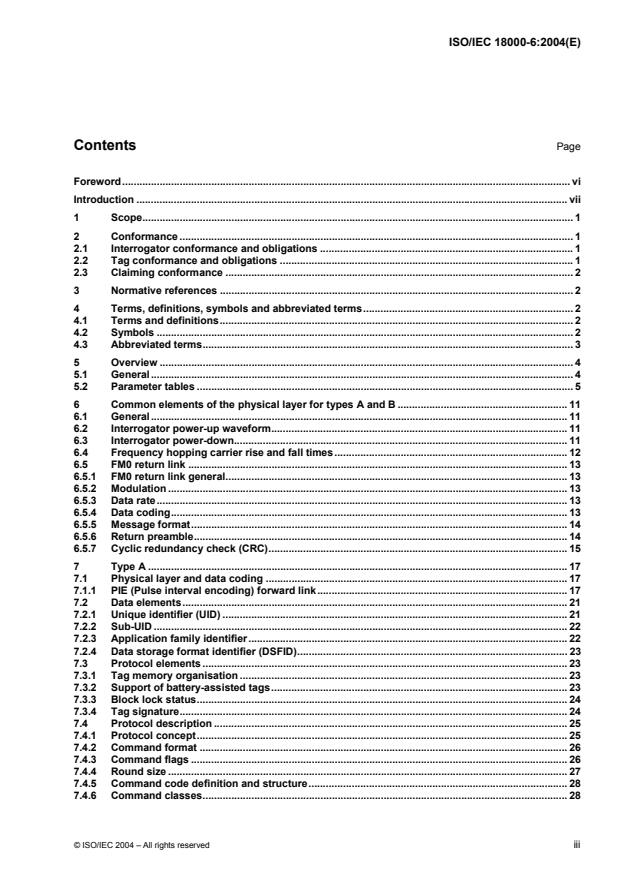
Contents Page
Foreword. vi
Introduction . vii
1 Scope. 1
2 Conformance. 1
2.1 Interrogator conformance and obligations . 1
2.2 Tag conformance and obligations . 1
2.3 Claiming conformance. 2
3 Normative references. 2
4 Terms, definitions, symbols and abbreviated terms. 2
4.1 Terms and definitions. 2
4.2 Symbols. 2
4.3 Abbreviated terms. 3
5 Overview. 4
5.1 General. 4
5.2 Parameter tables. 5
6 Common elements of the physical layer for types A and B . 11
6.1 General. 11
6.2 Interrogator power-up waveform. 11
6.3 Interrogator power-down. 11
6.4 Frequency hopping carrier rise and fall times. 12
6.5 FM0 return link . 13
6.5.1 FM0 return link general. 13
6.5.2 Modulation. 13
6.5.3 Data rate. 13
6.5.4 Data coding. 13
6.5.5 Message format. 14
6.5.6 Return preamble. 14
6.5.7 Cyclic redundancy check (CRC). 15
7 Type A. 17
7.1 Physical layer and data coding . 17
7.1.1 PIE (Pulse interval encoding) forward link. 17
7.2 Data elements. 21
7.2.1 Unique identifier (UID) . 21
7.2.2 Sub-UID. 22
7.2.3 Application family identifier. 22
7.2.4 Data storage format identifier (DSFID). 23
7.3 Protocol elements. 23
7.3.1 Tag memory organisation . 23
7.3.2 Support of battery-assisted tags. 23
7.3.3 Block lock status. 24
7.3.4 Tag signature. 24
7.4 Protocol description. 25
7.4.1 Protocol concept. 25
7.4.2 Command format. 26
7.4.3 Command flags. 26
7.4.4 Round size. 27
7.4.5 Command code definition and structure. 28
7.4.6 Command classes. 28
© ISO/IEC 2004 – All rights reserved iii
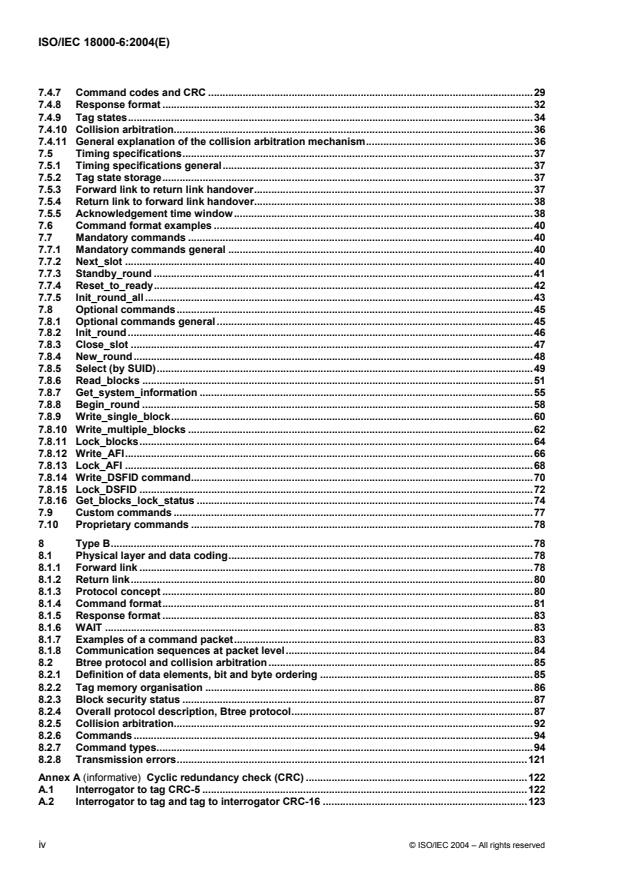
7.4.7 Command codes and CRC .29
7.4.8 Response format.32
7.4.9 Tag states.34
7.4.10 Collision arbitration.36
7.4.11 General explanation of the collision arbitration mechanism.36
7.5 Timing specifications.37
7.5.1 Timing specifications general.37
7.5.2 Tag state storage.37
7.5.3 Forward link to return link handover.37
7.5.4 Return link to forward link handover.38
7.5.5 Acknowledgement time window.38
7.6 Command format examples .40
7.7 Mandatory commands.40
7.7.1 Mandatory commands general .40
7.7.2 Next_slot.40
7.7.3 Standby_round.41
7.7.4 Reset_to_ready.42
7.7.5 Init_round_all.43
7.8 Optional commands.45
7.8.1 Optional commands general .45
7.8.2 Init_round.46
7.8.3 Close_slot.47
7.8.4 New_round.48
7.8.5 Select (by SUID).49
7.8.6 Read_blocks.51
7.8.7 Get_system_information.55
7.8.8 Begin_round.58
7.8.9 Write_single_block.60
7.8.10 Write_multiple_blocks .62
7.8.11 Lock_blocks.64
7.8.12 Write_AFI.66
7.8.13 Lock_AFI.68
7.8.14 Write_DSFID command.70
7.8.15 Lock_DSFID.72
7.8.16 Get_blocks_lock_status.74
7.9 Custom commands.77
7.10 Proprietary commands.78
8 Type B.78
8.1 Physical layer and data coding.78
8.1.1 Forward link.78
8.1.2 Return link.80
8.1.3 Protocol concept.80
8.1.4 Command format.81
8.1.5 Response format.83
8.1.6 WAIT.83
8.1.7 Examples of a command packet.83
8.1.8 Communication sequences at packet level.84
8.2 Btree protocol and collision arbitration.85
8.2.1 Definition of data elements, bit and byte ordering .85
8.2.2 Tag memory organisation .86
8.2.3 Block security status .87
8.2.4 Overall protocol description, Btree protocol.87
8.2.5 Collision arbitration.92
8.2.6 Commands.94
8.2.7 Command types.94
8.2.8 Transmission errors.121
Annex A (informative) Cyclic redundancy check (CRC) .122
A.1 Interrogator to tag CRC-5 .122
A.2 Interrogator to tag and tag to interrogator CRC-16 .123
iv © ISO/IEC 2004 – All rights reserved
A.2.1 CRC-16 general. 123
A.2.2 CRC calculation examples. 125
Annex B (normative) Memory mapping for Type B. 128
B.1 Unique identifier (normative) . 128
B.1.1 Unique identifier general. 128
B.1.2 Unique identifier format. 128
B.1.3 Unique identifier according to ANSI 256 . 128
B.1.4 Remaining system memory. 129
Annex C (informative) Tag Memory Map for Type B . 133
C.1 Tag memory map . 133
Bibliography . 134
© ISO/IEC 2004 – All rights reserved v
Foreword
ISO (the International Organization for Standardization) and IEC (the International Electrotechnical
Commission) form the specialized system for worldwide standardization. National bodies that are members of
ISO or IEC participate in the development of International Standards through technical committees
established by the respective organization to deal with particular fields of technical activity. ISO and IEC
technical committees collaborate in fields of mutual interest. Other international organizations, governmental
and non-governmental, in liaison with ISO and IEC, also take part in the work. In the field of information
technology, ISO and IEC have established a joint technical committee, ISO/IEC JTC 1.
International Standards are drafted in accordance with the rules given in the ISO/IEC Directives, Part 2.
The main task of the joint technical committee is to prepare International Standards. Draft International
Standards adopted by the joint technical committee are circulated to national bodies for voting. Publication as
an International Standard requires approval by at least 75 % of the national bodies casting a vote.
ISO/IEC 18000-6 was prepared by Technical Committee ISO/IEC JTC 1, Information technology,
Subcommittee SC 31, Automatic identification and data capture techniques.
ISO/IEC 18000 consists of the following parts, under the general title Information technology — Radio
frequency identification for item management:
Part 1: Reference architecture and definition of parameters to be standardized
Part 2: Parameters for air interface communications below 135 kHz
Part 3: Parameters for air interface communications at 13,56 MHz
Part 4: Parameters for air interface communications at 2,45 GHz
Part 6: Parameters for air interface communications at 860 MHz to 960 MHz
Part 7: Parameters for active air interface communications at 433 MHz
vi © ISO/IEC 2004 – All rights reserved
Introduction
This part of ISO/IEC 18000 describes a passive backscatter RFID system that supports the following system
capabilities:
• Identification and communication with multiple tags in the field
• Selection of a subgroup of tags for identification or with which to communicate
• Reading from and writing to or rewriting data many times to individual tags
• User-controlled permanently lockable memory
• Data integrity protection
• Interrogator-to-tag communications link with error detection
• Tag-to-interrogator communications link with error detection.
• Support for both passive back-scatter tags with or without batteries.
In this RFID system, the interrogator powers and communicates with the tags that are within range. Tags
receive data as amplitude modulation of the power/data signal from the interrogator. During the time that the
tag responds to the interrogator, the interrogator transmits at a constant radio frequency power level, while the
tag modulates the impedance of its radio frequency load attached to the tag antenna terminals. The
interrogator then receives the data back from the tag as a variation in a reflection of its transmitted power.
The International Organization for Standardization (ISO) and International Electrotechnical Commission (IEC)
draw attention to the fact that it is claimed that compliance with this document may involve the use of patents
concerning radio-frequency identification technology given in the clauses identified below.
ISO and IEC take no position concerning the evidence, validity and scope of these patent rights.
The holders of these patent rights have assured the ISO and IEC that they are willing to negotiate licences
under reasonable and non-discriminatory terms and conditions with applicants throughout the world. In this
respect, the statements of the holders of these patent rights are registered with ISO and IEC.
Information on the declared patents may be obtained from:
Affected clause(s) in this part
Contact details Patent number
of ISO/IEC 18000
BTG plc US 5,537,105, US 5,966,083,
ATTN: Mr David Armstrong US 5,995,017, US 5,557,280,
10 Fleet Place US 5,699,066, US 5,519,381,
Limeburner Lane US 5,726,630, EP 0494114B1,
London EC4M 7SB EP 0585132B1, EP 0598624B1,
6, 7
UK WO 98/52142 and WO 99/26081
Tel: +44 20 7575 0000
Fax: +44 20 7575 0010
Website: www.btgplc.com,
Email: david.armstrong@btgplc.com,
© ISO/IEC 2004 – All rights reserved vii
Affected clause(s) in this part
Contact details Patent number
of ISO/IEC 18000
Intercode US 5426423, EP 90909459.1,
12, Rue des Petits Ruisseaux CA 2058 947, US 6177858B1,
Z.I. des Godets EP 96402556.3, CA 2191787,
91370 Verrières le Buisson US 5923251, EP 96402554.8,
7, 8
France CA 21911788, US 5808550,
Tel : + 33-1-6975 2170 EP 96402555.5 and CA 2191794
Fax : + 33.1.60.11.00.31
Email: intercode.sarl@wanadoo.fr
Intermec Technologies Corporation US 5942987, US 5521601,
ATTN: Ronald D. Payne, US 5995019, US 5030807,
Vice President, Contracts, US 5828693, US 5850181,
6001 36th Ave, West, US 4786907, US 5550547,
Everett, WA 98203 US 5673037, US 5777561
USA and US 5828318
Koninklijke Philips Electronics N.V EP 1034503B, JP 00-560535,
ATTN: Mr.Harald Röggla Intellectual US 09/352317, WO 00/04485,
Property & Standards, JP 03-502778,
7, 8
Triester Strasse 64 US 2002/0186789A1 and
A-1101 Vienna WO 02/099741 A1
Austria
Matrics Technology US 6002344
ATTN: Mr Kevin J Powell
Senior Director,
Product Development
8850 Stanford Blvd, Suite 3000
7, 8
Columbia, MD 21045
USA
+1-410-872-0300 (Voice)
+1-443-782-0230 (eFax)
kpowell@matrics.com
SAMSys Technologies, Inc. US 6617962
ATTN: James Wiley, President, 2525
Meridian Parkway, Suite 60,
Durham, NC 27713, 2
USA
Tel: +1-919- 281-1541,
E-mail: tres.wiley@samsys.com
SUPERSENSOR ( Pty ) Ltd ZA 9810199, US 6480143 B1,
ATTN: Mr. Adelhart Kruger, EP 1001366, JP 200230978 and
D.M. Kisch Inc., CN 1255689
P O Box 3668,
6, 7
Pretoria 0001,
South Africa.
Tel: +27-12-460-3203.
E-mail: adelhartk@dmkisch.com
TAGSYS Australia Pty Ltd, EP 0578701B1, AU 664544,
ATTN: Alfio R. Grasso, TECHNICAL AU PCT AU/00/01493,
MANAGER WO 01/41043,
212 Pirie Street, AU PCT AU98/00017,
ADELAIDE SA 5000 WO 98/32092, US 5523749,
Australia, AU PCT AU01/01676,
Tel: +61-8-8100 8324, WO02/054365, FR FR00/01704,
and WO 01/01326
E-mail: alfio.grasso@tagsys.net
Attention is drawn to the possibility that some of the elements of this document may be the subject of patent
rights other than those identified above. ISO and IEC shall not be held responsible for identifying any or all
such patent rights.
viii © ISO/IEC 2004 – All rights reserved
INTERNATIONAL STANDARD ISO/IEC 18000-6:2004(E)
Information technology — Radio frequency identification for
item management —
Part 6:
Parameters for air interface communications at 860 MHz to
960 MHz
1 Scope
This part of ISO/IEC 18000 defines the air interface for radio frequency identification (RFID) devices operating
in the 860 MHz to 960 MHz Industrial, Scientific, and Medical (ISM) band used in item management
applications. Its purpose is to provide a common technical specification for RFID devices that may be used by
ISO committees developing RFID application standards. This part of ISO/IEC 18000 is intended to allow for
compatibility and to encourage inter-operability of products for the growing RFID market in the international
marketplace. This part of ISO/IEC 18000 defines the forward and return link parameters for technical
attributes including, but not limited to, operating frequency, operating channel accuracy, occupied channel
bandwidth, maximum EIRP, spurious emissions, modulation, duty cycle, data coding, bit rate, bit rate
accuracy, bit transmission order, and where appropriate operating channels, frequency hop rate, hop
sequence, spreading sequence, and chip rate. It further defines the communications protocol used in the air
interface.
This part of ISO/IEC 18000 contains one mode with two types. Both types use a common return link and are
reader talks first. Type A uses Pulse Interval Encoding (PIE) in the forward link, and an adaptive ALOHA
collision arbitration algorithm. Type B uses Manchester in the forward link and an adaptive binary tree collision
arbitration algorithm. The detailed technical differences between the two types are shown in the parameter
tables.
2 Conformance
2.1 Interrogator conformance and obligations
To conform to this part of ISO/IEC 18000, the interrogator shall support both communication types. It shall be
able to switch from one type to the other.
The interrogator shall be locally programmable by the user to switch from one type to the other and to control
the sequence and allocation of the ratio of time between the two types.
The proportion of the total time spent by the interrogator in addressing each type of tag shall be field-
programmable from 0% to 100%.
Interrogators shall be set up to operate within local regulations.
2.2 Tag conformance and obligations
To conform to this part of ISO/IEC 18000, the tag shall support at least one type. It may optionally support
both.
© ISO/IEC 2004 – All rights reserved 1
The tag shall operate over the frequency range of 860 MHz to 960 MHz.
NOTE Depending on the tag antenna characteristics, the operating performance (i.e. operating range) may vary
depending on the actual frequency used in the 860-960 MHz band.
When the tag receives a modulated signal from the interrogator that it does not support or recognise, it shall
remain silent.
2.3 Claiming conformance
In order to claim conformance with this part of ISO/IEC 18000 it is necessary to comply with all of the
relevant clauses of this part of ISO/IEC 18000 except those marked ‘optional’ and it is also necessary to
operate within the local national radio regulations (which may require further restrictions).
Relevant conformance test methods will be given in a future Technical Report (ISO/IEC TR 18047-6).
3 Normative references
ISO/IEC 19762-3, Information technology — Automatic identification and data capture (AIDC) techniques —
1)
Harmonized vocabulary — Part 3: Radio frequency identification (RFID)
ISO/IEC 7816-6, ldentification cards — lntegrated circuit cards — Interindustry data elements for interchange
4 Terms, definitions, symbols and abbreviated terms
4.1 Terms and definitions
For the purposes of this document, the terms, definitions, symbols and abbreviated terms given in ISO/IEC
19762-3 and the following apply.
4.1.1
collision arbitration loop
algorithm used to prepare for and handle a dialogue between an interrogator and a tag. This is also known as
collision arbitration.
4.1.2
byte
8 bits of data designated b1 to b8, from the most significant bit (MSB, b8) to the least significant bit (LSB, b1).
4.2 Symbols
Cht Carrier high-level tolerance
Clt Carrier low-level tolerance
D Modulation depth of data coding pulse
f Frequency of operating field (carrier frequency)
c
M Modulation Index
Ma Modulation upper tolerance type B
Mb Modulation lower tolerance type B
1) To be published.
2 © ISO/IEC 2004 – All rights reserved
Taq Quiet time - type A
Tapf Pulse fall time - type A
Tapr Pulse rise time - type A
Tapw Pulse width - type A
Tari Reference interval time - type A
Tbmf Manchester fall time – type B
Tbmr Manchester rise time – type B
Tcf Carrier fall time
Tcr Carrier rise time
Tcs Carrier steady state time
Tf Fall time
Tfhf Carrier FHSS fall time
Tfhr Carrier FHSS rise time
Tfhs Carrier FHSS steady time
Tr Rise Time
Trlb Return link bit time
4.3 Abbreviated terms
AFI Application family identifier
CRC Cyclic redundancy check
CRC-5 Five bit CRC used in type a Interrogator to tag commands, used in Type A
CRC-16 Sixteen bit CRC used in both Type A and Type B commands and responses
DSFID Data storage format identifier
DSSS Direct Sequence Spread Spectrum
EOF End of frame
FHSS Frequency Hopping Spread Spectrum
LSB Least significant bit
MSB Most significant bit
NRZ Non Return to Zero
PIE Pulse interval encoding, used in Type A
RFU Reserved for future use
© ISO/IEC 2004 – All rights reserved 3
SOF Start of frame
SUID Sub unique identifier
TEL Tag excitation level
UID Unique identifier
5 Overview
5.1 General
This part of ISO/IEC 18000 specifies two communication types: Type A and Type B.
Figure 1, Figure 2, and Figure 3 show their architecture; Table 1 provides a comparison.
Figure 1 — Interrogator architecture
Figure 2 — Type A tag architecture
4 © ISO/IEC 2004 – All rights reserved
Figure 3— Type B tag architecture
Table 1 — Comparison of Type A and Type B
Parameter Type A Type B
Forward link encoding PIE Manchester
Modulation index 27% to 100% 18% or 100%
Data rate 33 kbit/s (mean) 10 or 40 kbit/s (according to
local regulations)
Return link encoding FM0 FM0
Collision arbitration ALOHA Binary Tree
Tag unique identifier 64 bits (40 bit SUID) 64 bits
Memory addressing Blocks up to 256 bits Byte blocks, 1,2,3 or 4 byte
writes.
Error detection forward link 5 bit CRC for all 16 bit CRC
commands (with an
additional 16 bit CRC
appended for all long
commands)
Error detection return link 16 bit CRC 16 bit CRC
Collision arbitration linearity Up to 250 tags Up to 2
5.2 Parameter tables
Table 2, Table 3, Table 4 and Table 5 contain the parameters for both types A and B in accordance with
ISO/IEC 18000-1. Detailed description of the operating modes and parameters are specified in the
subsequent clauses.
© ISO/IEC 2004 – All rights reserved 5
Table 2 — Interrogator to tag link parameters
Interrogator Parameter name Description
to tag
Int: 1 Operating frequency range 860 – 960 MHz
The interrogator operating frequency range shall be
determined by the radio regulations in force in a particular
regulatory jurisdiction and by the type approval requirements
of the particular jurisdiction.
Before an interrogator may be used, it shall meet the local
radio regulations of the country in which it is to be used.
It is envisaged that there will be more than one version of
interrogator having different frequency and power
characteristics in order to comply with local regulations.
NOTE Performance will vary according to bandwidth and
power output permitted by local regulations.
Int: 1a Default operating frequency In accordance with the local radio regulations.
See Int: 1
Int: 1b Operating channels In accordance with the local radio regulations.
See Int: 1
Int: 1c Operating frequency accuracy In accordance with the local radio regulations
See Int: 1
Int: 1d Frequency hop rate Not applicable for single fixed frequency or channelized
Adaptive Frequency Agile systems.
(for frequency hopping [FHSS] systems)
Where FHSS is permitted, the hop rate shall be in
accordance with the local radio regulations.
Int: 1e Frequency hop sequence In accordance with the local radio regulations. Where not
specified by such regulations a pseudo-random hopping
(for frequency hopping [FHSS] systems)
sequence shall be used that ensures an even distribution of
transmissions over the available channels.
Int: 2 Occupied channel bandwidth In accordance with the local radio regulations.
Int:2a Minimum receiver bandwidth In accordance with the local radio regulations.
Int: 3 Interrogator transmitter maximum EIRP In accordance with the local radio regulations
Int: 4 Interrogator transmitter spurious In accordance with the local radio regulations.
emissions
Int: 4a Interrogator transmitter spurious In accordance with the local radio regulations.
emissions, in-band
(for spread spectrum systems)
Int: 4b Interrogator transmitter spurious In accordance with the local radio regulations.
emissions, out-of-band
Int: 5 Interrogator transmitter spectrum mask As per Int: 2 and Int: 4a.
Int:6 Timing See below Int: 6x.
Int: 6a Transmit to receive turn around time The interrogator transmit/receive settling time shall not
exceed 85µs.
Int: 6b Receive to transmit turn around time As determined by the communication protocol – refer Tag:
6a.
Int: 6c Dwell time or interrogator transmit power Maximum 1.5ms.
on ramp
Int: 6d Decay time of interrogator transmitter Maximum 1ms.
power down ramp
6 © ISO/IEC 2004 – All rights reserved
Table 2 (continued)
Interrogator
Parameter name Description
to tag
Int: 7 Modulation Amplitude Modulation.
Int: 7a Spreading sequence Not applicable.
(for direct sequence [DSSS] systems)
Int: 7b Chip rate Not applicable.
(for spread spectrum systems)
Int: 7c Chip rate accuracy Not applicable.
(for spread spectrum systems)
Int: 7d Modulation index Type A: Nominal 30 % to 100 %. See Table 11 and clause
7.1.1.
Type B: Nominal 18% or 100% .
Int: 7e Duty cycle In accordance with local regulations.
Int: 7f FM deviation Not applicable.
Int: 7g Transmitter modulation pulse shape The modulation pulse fall and rise times shall conform to the
(falling and rising slopes) detailed specifications in subsequent clauses. Type A see
Figure 11 and Table 11, and Type B see Figure 20, Figure
21, Table 93 and Table 94.
Int: 8 Data coding Type A: Pulse Interval Encoding
Type B: Manchester bi-phase
Int: 9 Bit rate Type A: 33 kbit/s as constrained by the local radio
regulations
Type B: 10 kbit/s or 40 kbit/s as constrained by the local
radio regulations.
Int: 9a Bit rate accuracy 100 ppm
Int: 10 Interrogator transmit modulation Not applicable.
accuracy
Int: 11 Preamble Type A : has no preamble
Type B: See clause 8.1.4.3
Type A: not applicable.
Int:11a Preamble length
Type B: 9 bits. See clause 8.1.4.3.
Int:11b Preamble waveform Type A: not applicable .
Type B: See clause 8.1.4.3.
Int: 11c Bit sync sequence Type A: not applicable.
Type B: see clause 8.1.4.3
Int: 11d Frame sync sequence Not applicable.
Int: 12 Scrambling Not Applicable
(for spread spectrum systems)
Int: 13 Bit transmission order MSB first
Int: 14 Wake-up process Presence of an appropriate RF signal at the tag followed by
a wake-up command as required by the tag type. See
relevant clauses.
Int: 15 Polarization
Interrogator dependent. Not defined in this part of
ISO/IEC 18000.
© ISO/IEC 2004 – All rights reserved 7
Table 3 — Tag to interrogator link parameters
Tag to
Parameter name Description
interrogator
Tag:1 Operating frequency range 860 MHz – 960 MHz
Tag:1a Default operating frequency The tag shall respond to an interrogator signal within the
frequency range specified in Tag: 1.
Tag:1b Operating channels (for spread spectrum The tag shall respond to an interrogator signal within the
systems) frequency range specified in Tag: 1.
Tag:1c Operating frequency accuracy The tag shall respond to an interrogator signal within the
frequency range specified in Tag: 1.
Tag:1d Frequency hop rate Not applicable
(for frequency hopping [FHSS] systems)
Tag:1e Frequency hop sequence Not applicable
(for frequency hopping [FHSS] systems)
Tag:2 Occupied channel bandwidth As permitted by the local radio regulations.
Tag:3 Transmit maximum EIRP As permitted by the local radio regulations.
Tag:4 Transmit spurious emissions As permitted by the local radio regulations.
Tag:4a Transmit spurious emissions, in-band As permitted by the local radio regulations.
(for spread spectrum systems)
Tag:4b Transmit spurious emissions, out-of- As permitted by the local radio regulations.
band
Tag:5 Transmit spectrum mask As permitted by the local radio regulations.
Tag:6a Transmit to receive turn around time Type A: The tag shall open its receive command window
within 2 bit periods of the end of its response.
Type B: 400 µs
Tag:6b Receive to transmit turn around time Type A : Range from 150 to 1150 µs (see clause 7.5.3 and
Table 28)
Type B : Range 85 to 460 µs (see clause 8.1.5.2)
Tag:6c Dwell time or transmit power on ramp Not applicable.
Tag:6d Decay time or transmit power down Not applicable.
ramp
Tag:7 Modulation Bi-state amplitude modulated backscatter.
Tag:7a Spreading sequence Not applicable.
(for direct sequence [DSSS] systems)
Tag:7b Chip rate Not applicable.
(for spread spectrum systems)
Tag:7c Chip rate accuracy Not applicable.
(for spread spectrum systems)
Tag:7d On-off ratio The tag Delta RCS (Varying Radar Cross Sectional area)
affects system performance. A typical value is greater than
0.005m .
Tag:7e Sub-carrier frequency Not applicable.
Tag:7f Sub-carrier frequency accuracy Not applicable.
Tag:7g Sub-carrier modulation Not applicable.
8 © ISO/IEC 2004 – All rights reserved
Table 3 (continued)
Tag to
Parameter name Description
interrogator
Tag:7h Duty cycle The tag shall transmit its response when commanded to do
so by the interrogator.
Tag:7i FM deviation Not applicable
Tag:8 Data coding Bi-phase space (FM0)
Tag:9 Bit rate Typical 40 kbit/s or 160 kbit/s (subject to tag clock tolerance
see Table 9),
The return bit rate selection for 160 kbit/s for Type B is
defined in clause 8.1.4.4.5.
Tag:9a Bit rate accuracy +/- 15% (refer to Table 9)
Tag:10 Tag transmit modulation accuracy (for Not applicable.
frequency hopping [fhss] systems)
Tag:11 Preamble The preamble is defined in clause 6.5.6
Tag:11a Preamble length 16 bits made up of a quiet period, followed by sync, followed
by a code violation followed by an orthogonal code.
Tag:11b Preamble waveform Bi-phase encoded data ‘1’.
Tag:11c Bit sync sequence Included in the preamble.
Tag:11d Frame sync sequence Included in the preamble.
Tag:12 Scrambling Not applicable.
(for spread spectrum systems)
Tag:13 Bit transmission order MSB first.
Tag:14 Reserved Deliberately left blank.
Tag:15 Polarization Product design feature. Not defined in this part of ISO/IEC
18000.
Tag:16 Minimum tag receiver bandwidth 860 – 960 MHz
Table 4 — Protocol parameters
Ref. Parameter name Description
P:1 Who talks first Interrogator talks first.
P:2 Tag addressing capability Type A see clause 7.3.1
Type B see clause 8.2.2
P:3 Tag unique identifier (UID) Contained in tag memory and accessible by means of a
command.
P:3a UID length Type A: 64 bits. An SUID of 40 bits is used during census
or collision arbitration transactions.
Type B: 64 bits
P:3b UID format The UID format is different for types A and B.
See clause 7.2.1 for type A.
See clause B.2 for type B.
© ISO/IEC 2004 – All rights reserved 9
Table 4 (continued)
Ref. Parameter name Description
P:4 Read size Type A: Addressable in blocks of up to 256 bits, but always
an integer multiple of bytes.
Type B: Addressable in byte blocks.
P:5 Write size Type A: Addressable in blocks of up to 256 bits, but always
an integer multiple of bytes.
Type B: Addressable in byte blocks. Writing in blocks of 1,
2, 3 or 4 bytes. See details in relevant clauses.
P:6 Read transaction time A single tag can typically be identified and have its first 128
bits of user memory read in less than 10 ms. This time may
vary depending on the data rate used as constrained by the
local radio regulations.
P:7 Write transaction time Once a tag has been identified and selected, a 32-bit data
block can typically be written in less than 20 ms. This time
may vary depending on the data rate used as constrained
by the local radio regulations.
P:8 Error detection Interrogator to tag
Type A: 16-bit commands: CRC-5.
Commands of more than 16 bits have an additional CRC-
16, bit protection.
Type B: CRC-16
Tag to interrogator: CRC-16 for both types.
P:9 Error correction
...
Questions, Comments and Discussion
Ask us and Technical Secretary will try to provide an answer. You can facilitate discussion about the standard in here.
Loading comments...