

ISO/TS 18870:2014
(Main)Lifts (elevators) — Requirements for lifts used to assist in building evacuation
General Information
- Abstract
ISO/TS 18870:2014 details requirements for passenger carrying lifts, which are installed in buildings having a suitable comprehensive building evacuation strategy. It does not define building requirements that will have to be provided as part of the overall evacuation strategy for the building. Excluded from ISO/TS 18870:2014 are the following: details of a building evacuation strategy; details of building features to reduce risks or eliminate hazards; national building requirements which might demand special features.
- Status
- Published
- Publication Date
- 18-Aug-2014
- Technical Committee
- ISO/TC 178 - Lifts, escalators and moving walks
- Drafting Committee
- ISO/TC 178/WG 6 - Lift installation
- Current Stage
- 9093 - International Standard confirmed
- Start Date
- 17-Jan-2024
- Completion Date
- 29-Aug-2026
Buy Documents

ISO/TS 18870:2014 - Lifts (elevators) — Requirements for lifts used to assist in building evacuation Released:8/19/2014

ISO/TS 18870:2014 - Lifts (elevators) — Requirements for lifts used to assist in building evacuation/19/2014
Overview
ISO/TS 18870:2014 - "Lifts (elevators) - Requirements for lifts used to assist in building evacuation" specifies requirements for passenger lifts intended to support a building's evacuation strategy. It defines lift-side features, operational modes and information exchange needed so lifts can be used safely during emergencies. The Technical Specification complements, but does not replace, building evacuation strategy or national building codes - those remain the responsibility of building designers and fire engineers.
Key topics and technical requirements
ISO/TS 18870:2014 covers practical lift design and operation issues for evacuation, including:
- Determination of number and size of lifts - principles for calculating lift handling capacity and accounting for lift unavailability.
- Protection of lift equipment - enclosure, temperature control, and pit water detection with graded responses (warnings vs. removal from service).
- Waiting and travelling environment - safe areas, car size considerations (wheelchair access), and prevention of panic/overloading.
- Operational reliability and recovery - measures for lift system reliability and automatic recovery after faults.
- Remote surveillance and control - integration with Fire Command Centre (FCC) and Building Management System (BMS) for supervision and decision-making.
- Communications and information - in-car and building signs, passenger announcements, and interfaces to emergency control systems.
- Overload prevention and detection - requirements to avoid unsafe loading of cars during evacuation.
- Evacuation service logic - initiation, description, cancellation, removal of cars, and role of Main Evacuation Exit Floor (MEEF) and Alternative Evacuation Exit Floor (AEEF).
- Documentation and information - data that lift suppliers must provide to building owners to support evacuation planning.
The specification also defines important terms (MEEF, AEEF, lift evacuation time/handling capacity) to ensure consistent design and testing of evacuation lifts.
Practical applications and who uses it
ISO/TS 18870 is intended for:
- Lift manufacturers and suppliers - to design evacuation-capable lifts and components.
- Lift designers and contractors - to calculate required handling capacity and layout.
- Building designers, fire engineers and architects - to coordinate lift capabilities with building evacuation strategy.
- Facility managers, emergency planners and building management teams - to integrate lifts with BMS and FCC and prepare evacuation procedures.
- Consultants assessing retrofit or new-build buildings where lifts are to assist evacuation.
Typical uses: specifying evacuation lift features in tender documents, validating lift performance for emergency scenarios, designing building control interfaces, and preparing operation and maintenance information for safety planning.
Related standards
- ISO 4190-5 (Lift installation - control devices, signals and additional fittings) - normative reference.
- ISO/TR 25743 - feasibility study referenced in the Specification’s introduction.
Keywords: lifts, elevators, building evacuation, evacuation lifts, MEEF, AEEF, lift evacuation time, handling capacity, BMS, Fire Command Centre.
Buy Documents
ISO/TS 18870:2014 - Lifts (elevators) — Requirements for lifts used to assist in building evacuation Released:8/19/2014
ISO/TS 18870:2014 - Lifts (elevators) — Requirements for lifts used to assist in building evacuation/19/2014
Get Certified
Connect with accredited certification bodies for this standard

DIBt (Deutsches Institut für Bautechnik)
German Institute for Building Technology.
DIN CERTCO
DIN Group product certification.

Aboma Certification B.V.
Specialized in construction, metal, and transport sectors.
Sponsored listings
Frequently Asked Questions
ISO/TS 18870:2014 is a technical specification published by the International Organization for Standardization (ISO). Its full title is "Lifts (elevators) — Requirements for lifts used to assist in building evacuation". This standard covers: ISO/TS 18870:2014 details requirements for passenger carrying lifts, which are installed in buildings having a suitable comprehensive building evacuation strategy. It does not define building requirements that will have to be provided as part of the overall evacuation strategy for the building. Excluded from ISO/TS 18870:2014 are the following: details of a building evacuation strategy; details of building features to reduce risks or eliminate hazards; national building requirements which might demand special features.
ISO/TS 18870:2014 details requirements for passenger carrying lifts, which are installed in buildings having a suitable comprehensive building evacuation strategy. It does not define building requirements that will have to be provided as part of the overall evacuation strategy for the building. Excluded from ISO/TS 18870:2014 are the following: details of a building evacuation strategy; details of building features to reduce risks or eliminate hazards; national building requirements which might demand special features.
ISO/TS 18870:2014 is classified under the following ICS (International Classification for Standards) categories: 91.140.90 - Lifts. Escalators. The ICS classification helps identify the subject area and facilitates finding related standards.
ISO/TS 18870:2014 is available in PDF format for immediate download after purchase. The document can be added to your cart and obtained through the secure checkout process. Digital delivery ensures instant access to the complete standard document.
Standards Content (Sample)
TECHNICAL ISO/TS
SPECIFICATION 18870
First edition
2014-08-15
Lifts (elevators) — Requirements
for lifts used to assist in building
evacuation
Ascenseurs — Exigences pour les ascenseurs utilisés en cas
d’évacuation de bâtiments
Reference number
©
ISO 2014
© ISO 2014
All rights reserved. Unless otherwise specified, no part of this publication may be reproduced or utilized otherwise in any form
or by any means, electronic or mechanical, including photocopying, or posting on the internet or an intranet, without prior
written permission. Permission can be requested from either ISO at the address below or ISO’s member body in the country of
the requester.
ISO copyright office
Case postale 56 • CH-1211 Geneva 20
Tel. + 41 22 749 01 11
Fax + 41 22 749 09 47
E-mail copyright@iso.org
Web www.iso.org
Published in Switzerland
ii © ISO 2014 – All rights reserved
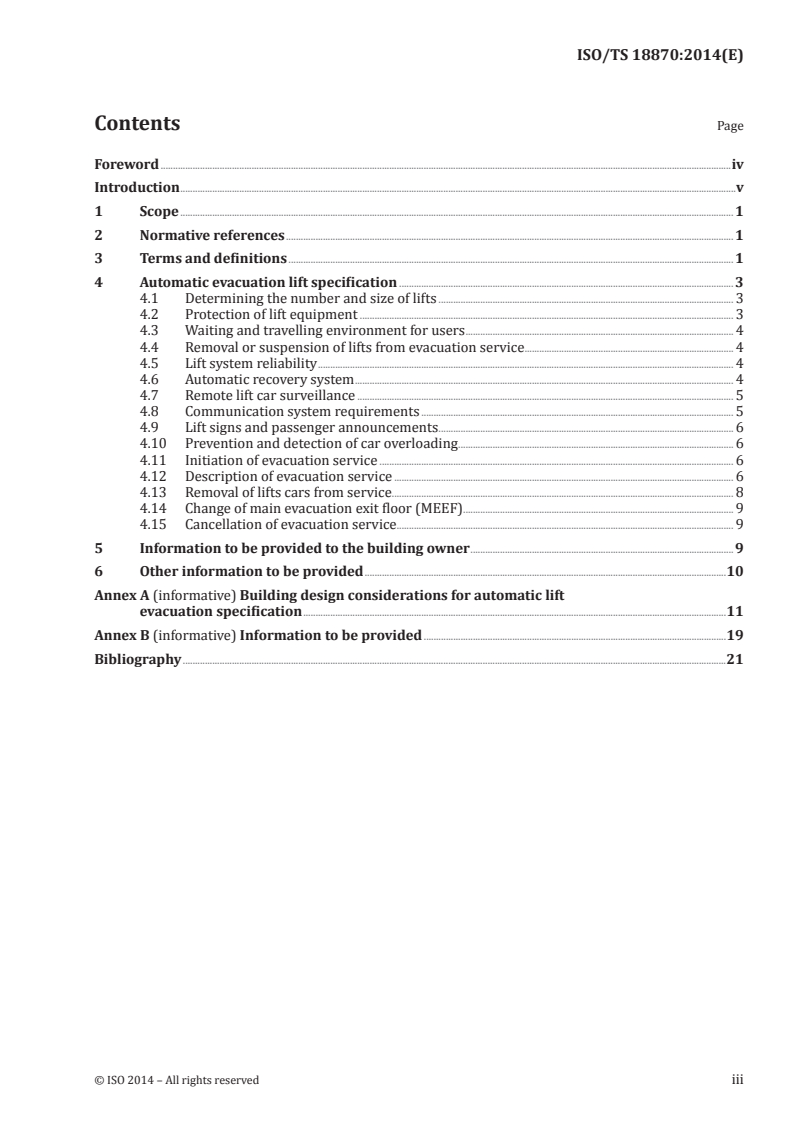
Contents Page
Foreword .iv
Introduction .v
1 Scope . 1
2 Normative references . 1
3 Terms and definitions . 1
4 Automatic evacuation lift specification . 3
4.1 Determining the number and size of lifts . 3
4.2 Protection of lift equipment . 3
4.3 Waiting and travelling environment for users . 4
4.4 Removal or suspension of lifts from evacuation service . 4
4.5 Lift system reliability . 4
4.6 Automatic recovery system . 4
4.7 Remote lift car surveillance . 5
4.8 Communication system requirements . 5
4.9 Lift signs and passenger announcements . 6
4.10 Prevention and detection of car overloading . 6
4.11 Initiation of evacuation service . 6
4.12 Description of evacuation service . 6
4.13 Removal of lifts cars from service . 8
4.14 Change of main evacuation exit floor (MEEF) . 9
4.15 Cancellation of evacuation service . 9
5 Information to be provided to the building owner . 9
6 Other information to be provided .10
Annex A (informative) Building design considerations for automatic lift
evacuation specification .11
Annex B (informative) Information to be provided .19
Bibliography .21
Foreword
ISO (the International Organization for Standardization) is a worldwide federation of national standards
bodies (ISO member bodies). The work of preparing International Standards is normally carried out
through ISO technical committees. Each member body interested in a subject for which a technical
committee has been established has the right to be represented on that committee. International
organizations, governmental and non-governmental, in liaison with ISO, also take part in the work.
ISO collaborates closely with the International Electrotechnical Commission (IEC) on all matters of
electrotechnical standardization.
The procedures used to develop this document and those intended for its further maintenance are
described in the ISO/IEC Directives, Part 1. In particular the different approval criteria needed for the
different types of ISO documents should be noted. This document was drafted in accordance with the
editorial rules of the ISO/IEC Directives, Part 2 (see www.iso.org/directives).
Attention is drawn to the possibility that some of the elements of this document may be the subject of
patent rights. ISO shall not be held responsible for identifying any or all such patent rights. Details of any
patent rights identified during the development of the document will be in the Introduction and/or on
the ISO list of patent declarations received (see www.iso.org/patents).
Any trade name used in this document is information given for the convenience of users and does not
constitute an endorsement.
For an explanation on the meaning of ISO specific terms and expressions related to conformity
assessment, as well as information about ISO’s adherence to the WTO principles in the Technical Barriers
to Trade (TBT) see the following URL: Foreword - Supplementary information
The committee responsible for this document is ISO/TC 178, Lifts, escalators, and moving walks.
iv © ISO 2014 – All rights reserved
Introduction
This Technical Specification has been prepared in response to ISO/TC 178 Resolution 273/2007 in which
the Technical Committee requested that WG 6 undertake to write a specification for lift features that
if incorporated into an appropriate lift would enable it to be used in safety to evacuate persons from a
building that was suitably designed.
This work results from a detailed study undertaken by TC 178/WG6 into the feasibility of using lifts for
evacuation of persons. The study ISO/TR 25743 indicated that it was feasible to use lifts, provided that
certain features were incorporated in the lift and also in the building.
Lift engineers and other specialists have been involved in the production of this specification.
It has been recognized that lift engineers are not experts in building design or fire engineering. The
writing of this Technical Specification does not indicate if it is acceptable or permitted to use lifts for
building evacuations. It only indicates the features required should those persons responsible wish to
make such a decision. This Technical Specification does not define, in any detail, building features that
will have to be provided in conjunction with a lift intended to be used for evacuation. Its aim is to make
clear to those persons involved in building design and fire engineering the issues that they shall address
to enable the lift to be used safely.
There are many reasons why a building might need to be evacuated, such as a fire, explosion, chemical or
biological attack, flooding, storm damage, earthquake, etc. Not all of these are relevant to every building
and other hazardous situations, while existing, are so unlikely to occur that they can be disregarded.
Designers of buildings have to determine if a particular hazard is sufficiently great as to require
addressing.
If, for example, a small office block is being designed that will be located in a mid-town area, it is within
the realm of possibility that it could be subjected to an explosion or chemical attack (terrorism). It is not,
however, very likely to be the case unless it has some particular reason to make it vulnerable. In most
cases, the risk of these events is probably so low as to make it unnecessary for them to be addressed.
If the building is to be the headquarters of National Security, this will increase the likelihood of it being
subjected to some form of attack. It might be necessary to consider the effects of an explosion in or close
to the building or a chemical agent being introduced into the building.
Clearly, a building constructed in an area where earthquakes do not normally occur need not have
provisions made for such an event.
If a building is to be built in the centre of a major city to form a prestigious landmark, it might be essential
to consider all likely events that could occur.
The designer of the building has to determine, by risk assessment or other methods, what hazardous
events needs to be reasonably addressed. Once this is completed, ISO/TR 25743 can be used to understand
the lift and building features that might be required for each evacuation scenario envisaged.
A lift or lifts can enable disabled persons to evacuate a building in relative ease, but if it is thought,
lifts could play a role in general evacuation, they might or might not make a significant contribution to
reducing the general evacuation time. It will depend on the building size, number of lifts, etc.
This Technical Specification defines lift requirements to address common hazards that all users could
be exposed to if lifts are used for evacuation.
Even if it is thought that lifts could play a part in a general evacuation, it might prove to be uneconomical.
It is not suggested for lifts to replace or change the requirements for escape stairs, and that using lifts
instead of stairs can increase evacuation times in many building designs. The intention is to allow lifts
to play a positive role in assisting and improving the efficiency of the building evacuation strategy.
This Technical Specification is divided into sections covering the key items that have to be addressed.
There is no priority intended from the order in which the items are listed.
TECHNICAL SPECIFICATION ISO/TS 18870:2014(E)
Lifts (elevators) — Requirements for lifts used to assist in
building evacuation
1 Scope
This Technical Specification details requirements for passenger carrying lifts, which are installed in
buildings having a suitable comprehensive building evacuation strategy. It does not define building
requirements that will have to be provided as part of the overall evacuation strategy for the building.
Excluded from this Technical Specification are the following:
— details of a building evacuation strategy;
— details of building features to reduce risks or eliminate hazards;
— national building requirements which might demand special features.
2 Normative references
The following documents, in whole or in part, are normatively referenced in this document and are
indispensable for its application. For dated references, only the edition cited applies. For undated
references, the latest edition of the referenced document (including any amendments) applies.
ISO 4190-5, Lift (Elevator) installation — Part 5: Control devices, signals and additional fittings
3 Terms and definitions
For the purposes of this document, the following terms and definitions apply.
3.1
Alternative Evacuation Exit Floor
AEEF
level defined by the building designer to be used for evacuation when systems or management determine
it should be used
3.2
Building Management System
BMS
system capable of making appropriate decisions based on information sent to it
3.3
chemical incident
introduction of a gas, chemical, bacterial agent, or substance into the building
3.4
building management
persons or organization responsible for ensuring the day-to-day safe efficient running of the building
and for ensuring the building is safely evacuated in line with the evacuation strategy
3.5
ETA
estimated time of arrival of the lift
3.6
fire
combustion of material producing, heat, sometimes smoke, and/or flame
3.7
Fire Command Centre
FCC
room or area provided in the building where information is displayed showing the status of a fire
detection system and lifts, etc. and where management can receive audible and visual information to
determine what actions to take if lifts are to be used
3.8
fire compartment
fire separated area
area within a building bounded by walls, floor, and ceiling constructed from fire resisting material so as
to provide resistance to fire for a defined period
3.9
fire warden
person appointed by the building management to assist in managing the evacuation of a floor or area of
building during an emergency
3.10
hazardous area
area where due to heat, smoke, gas, etc. the environment is considered dangerous to persons
3.11
hazard detection system
system of sensors capable of automatically detecting fire, smoke, gas, etc
3.12
impaired mobility
difficulty in using stairs because of a physical impairment
3.13
lift evacuation time
time a person spends using a lift to evacuate
Note 1 to entry: It is expressed in s.
Note 2 to entry: This is measured from initiation of evacuation service for a given floor plus the time spent
travelling to the floor plus the time to open doors, load the car return nonstop to main exit for evacuation, open
doors, and empty lift car.
3.14
Main Evacuation Exit Floor
MEEF
floor designated by the building designer where persons should exit lifts to leave the building
Note 1 to entry: This might or might not be the normal exit floor or ground floor of the building.
3.15
required lift evacuation handling capacity
number of persons who can be moved to the main evacuation exit floor in a five-minute period, expressed
as a percentage of the total number of persons to be evacuated by lifts
Note 1 to entry: This is not to be confused with normal lift handling capacity.
3.16
required lift evacuation time
time measured from start of the lift evacuation service to completion of the evacuation of a floor or
number of floors
2 © ISO 2014 – All rights reserved
3.17
safe area
safe floor
area of the building, where it is known that heat, smoke, etc. are not present and where it will be safe for
people to wait, travel in, or leave the lift
3.18
total lift evacuation time
time required to move all persons requiring evacuation by lifts to the Main Evacuation Exit Floor (3.14)
Note 1 to entry: This time is measured from start of evacuation service with lift(s) at MEEF to evacuation of all
persons and return of lifts to the MEEF.
3.19
building sign
information display provided by the building, not the lift, informing building users of the location of
evacuation lifts available for use
4 Automatic evacuation lift specification
4.1 Determining the number and size of lifts
To calculate the number and size of lifts required to provide an adequate evacuation service, the handling
capacity of a given lift or group of lifts shall be determined. To calculate lift handling capacity, the lift
designer will require certain information as detailed in Annex B.
Any other building specific information that might affect the handling capacity or assist the lift designer
in understanding the issues related to the evacuation strategy should also be provided.
It shall be recognized that there is always a reasonable possibility that a lift or lifts might not be available
for some reason. This might occur due to planned maintenance, repairs, etc. An allowance should be
made in the handling capacity calculations to take account of this. This shall be done by assuming that in
a building with multiple lifts, at least one lift will not be available at any given time and should therefore
be removed from any calculation.
In determining the size of the lift, it should be assumed that if a lift car arrives at a floor and there is not
enough space for people to enter, there is a risk of panic and/or overloading. This might occur where a
wheelchair is in the lift consuming a relatively large amount of floor area in relation to its load. To avoid
this situation, the size of lift car chosen should be suitable to accept a wheel chair while still providing
room for a number of additional occupant(s).
A lift contractor will be able to calculate the number of lifts and their speed provided that the information
contained in Annex B is provided.
4.2 Protection of lift equipment
Lift shafts and machine rooms or machinery spaces located outside the shaft should be fully enclosed.
The temperature in the enclosures should be maintained to acceptable levels for the equipment, as
determined by the lift supplier in consultation with the building management.
Water can come from a number of sources including fire hoses although it is not anticipated that hoses
will be deliberately directed at the lift or its equipment.
To avoid unnecessary failures from the ingress of water, a number of provisions shall be made. Sensors
in the lift pit shall monitor for the presence of water. For example,
a) if water is detected below the level of pit equipment, sheave, etc. so as not to affect operation; for this
condition, a warning shall be sent to the FCC and any BMS, but lifts shall continue to operate, and/or
b) if the water reaches sheaves or other equipment, the lift shall be removed from service (see 4.5).
4.3 Waiting and travelling environment for users
To ensure the safety of users, lift machine spaces, lift shaft, and landing areas outside the lift should be
monitored for the presence of smoke or high temperatures likely to harm persons or cause failures of
the lift equipment.
The lifts shall not monitor these conditions but respond appropriately to information sent to them by
those providing the monitoring equipment.
When an unsafe condition is detected at a floor, the lift shall be prevented from stopping at the relevant
floor or floors.
If an unsafe condition is detected in the well or machinery space, the lift shall be removed from service
at the first available safe area.
The lift shall inform the FCC and any BMS that it is no longer available for service.
4.4 Removal or suspension of lifts from evacuation service
Where a lift receives a command from a BMS or manual signal to stop or suspend service to a floor or
area of the building, any stop shall be a controlled stop at a safe area. A controlled stop means allowing
the lift to slow down and stop at a floor in the normal manner.
Where a lift or lifts are instructed to suspend service, the lift(s) shall inform the FCC and any BMS once
it is no longer available for service.
4.5 Lift system reliability
Lift reliability is an important issue but it should be noted that this specification already calls for many
features that will increase reliability, such as water protection. The lift will also have an automatic
recovery system that minimizes the risk to passengers if a stoppage occurs. For this reason, no further
additional provisions are required.
Loss of a bank of lifts is much more serious but is only likely to occur due to loss of the power supply. For
this reason, it is vital that secondary (emergency supplies) are provided (see Annex A).
4.6 Automatic recovery system
Whenever a lift containing passengers has stopped for some reason, it needs to be, if possible,
automatically recovered to a safe floor. If it is not close enough to a safe floor to open its doors, it should
be provided with a means to enable it to attempt an automatic recovery and during this process both car
and landing doors should be locked closed and passengers should be informed that a recovery is taking
place.
Whenever a car stops, it is a natural reaction for passengers to try and pull the car door open. For this
reason, car doors should be locked shut during automatic recovery operation. The doors should remain
locked shut until it is determined that the car has recovered to a floor.
During any recovery or attempted recovery, passengers shall be kept informed of what is going on. This
information shall be both audible and visual.
A recovery attempt might fail for some reasons, therefore, passengers should be informed of any recovery
or failure to recover. If it is not possible to recover the lift and passengers are trapped, they should be
provided with visual and audible information that the alarm has been automatically raised and they will
be rescued shortly. They shall also be able to communicate with those in charge of evacuation.
If a lift fails for some reason, it shall
a) determine if the lift contains passengers and is outside a door zone,
b) automatically lock the car doors if outside the door zone,
4 © ISO 2014 – All rights reserved
c) inform the FCC and any BMS that it has stalled with passengers and will attempt a recovery to the
main floor,
d) inform passengers that automatic recovery is to take place, and
e) establish a hands-free communications link between itself and the FCC.
Those in charge of evacuation or a BMS shall inform the lift system of an alternate safe floor if the main
floor is unsafe.
If this information is not received within 20 s, recovery shall be made to the main floor. The automatic
recovery system shall permit recovery under the following conditions:
— failure of a control system;
— failure of the drive system excluding the machine;
— failure of a landing or car door lock circuit, provided that the closed condition of doors is monitored.
This means additional monitoring of the position of door panels is required;
— failure of a safety circuit controlling car speed or over speed. This means the self-rescue system
shall employ its own independent speed-monitoring device.
If automatic recovery fails for any reason, the lift shall automatically inform those in charge of evacuation
and any BMS.
NOTE A failure of the main driving motor or brake is not considered likely and therefore not addressed.
4.7 Remote lift car surveillance
At times of emergency, it is vital to be able to see that lifts do not contain trapped passengers who might
be incapacitated.
A means to display the entire floor area of the car shall be provided.
Whenever the means is made operative, a sign shall illuminate in the car stating “LIFT UNDER
SURVEILLANCE” and an audible message shall be given stating the same message.
The means shall be activated automatically whenever the lift is running on evacuation service. At least
one viewing terminal shall be located in the FCC and clearly marked “LIFT CAR SURVEILLANCE” with
the lift designation identified.
4.8 Communication system requirements
As a minimum, a two-way communication system shall be available for passenger use to permit direct
communications between the lift car and an FCC (see 4.13). National regulations might have additional
requirements for the communication system.
Each lift shall be provided with a communication system allowing communication between the FCC, any
lift machine room or emergency and inspection panel in the case of machine room-less lift.
Operation of the communication device in the lift car shall be simply by means of a single button,
operation of which shall connect the system to the FCC. Further operation of the device in the lift car
shall be hands-free and permit simultaneous two-way speech.
The button shall be mounted in the lift car-operating panel or adjacent to it (within 100 mm). Its size,
marking, and location should meet the requirements for buttons within ISO 4190-5.
It shall be possible to establish communication with the car from the machine room, any emergency and
inspection panel or FCC, again by use of simple buttons.
4.9 Lift signs and passenger announcements
Where a lift is being automatically removed from service, passengers and those waiting on landings
shall be clearly informed of the situation. This information shall be given visually and audibly within the
lift car and on the landing adjacent to the relevant lift. Audible information shall be repeated at short
intervals (every 5 s to 10 s), until the announcement is no longer required.
Information shall be provided whenever a car is loading, unloading, performing an automatic recovery,
parking, or instructed to run to a particular floor, at any floor, and wherever passengers shall exit.
Audible information shall be adjustable in volume between 35 db (A) and 80 db (A) but shall be initially
set at 75 db (A). The provision of signs and announcements shall be coordinated with those responsible
for building signage. All lift car and landing displays should satisfy ISO 4190-5, if necessary.
The position of each lift car shall be displayed on the landing at the floor(s) where evacuation service is
being provided.
Whenever a lift is instructed to do something, such as run an evacuation service, park, go to the MEEF
or AEEF, etc. it shall inform any FCC or BMS of what it is doing and confirm when it has completed the
task. Its operational status shall be observable at the FCC and known at any BMS at all times normal or
standby power is available.
On or close to the car operating panel, a sign shall clearly show the lifts’ unique designation. This
information shall be permanent and with characters at least 25 mm high.
The same designation shall be displayed on the landing adjacent to the lift entrance.
4.10 Prevention and detection of car overloading
The car shall be provided with a load device set to operate at approximately 80 % of duty load. When
operated, it shall cause an audible and visual warning to be given stating CAR FULL and the car shall
travel non-stop to the MEEF/AEEF and on arrival, inform passengers to “EXIT THE LIFT”.
If car is overloaded, the overload device shall operate and shall cause doors to remain open until the
overload condition is cleared.
It is assumed that the car load and size shall be one selected from the ISO 4190-1 range of sizes where
the car floor area is restricted in relation to the load, thus discouraging overloading.
4.11 Initiation of evacuation service
Evacuation service can be initiated by a device such as a button or lever, key, etc. or from a signal sent by
a BMS or hazard detection system. Where a button or other manual activated device is used, it shall be
protected against unauthorized use.
Its purpose shall be clearly marked with a symbol and/or the words “LIFT EVACUATION SERVICE”.
4.12 Description of evacuation service
4.12.1 Any lift will be automatically removed from evacuation service if, where provided, it is turned to
firefighters service.
4.12.2 On receipt of a signal, any designated lift(s) travelling away from the main evacuation exit floor
(MEEF) shall slow down and stop in a controlled manner at the first available opportunity, reverse
direction without opening its doors, and proceed directly to the MEEF or AEEF as instructed. During this
return journey, audible and visual information shall be provided in the lift car stating “LIFT RETURNING
TO EVACUATION FLOOR, LEAVE LIFT WHEN DOORS OPEN”.
6 © ISO 2014 – All rights reserved
4.12.3 Lifts travelling towards the MEEF or AEEF shall continue uninterrupted to the exit floor. Cancel
car calls and return without delay to the designated evacuation exit floor. During this return journey,
audible and visual information shall be provided in the lift car stating: “LIFT RETURNING TO EVACUATION
FLOOR, LEAVE LIFT WHEN DOORS OPEN”.
4.12.4 On arrival at the MEEF, the doors shall open and stay open for approximately 15 s. During this
period, signs on the landing and in the car shall display the words “LIFT ON EVACUATION SERVICE, DO
NOT ENTER”. An audible announcement shall repeat this message.
4.12.5 Stationary lifts not at the required evacuation floor that receives an evacuation signal shall display
and announce “LIFT REQUIRED FOR EVACUATION SERVICE”. The lift shall then close its doors without
delay. Door open buttons and passenger detection devices shall remain operative during door closing.
However, passenger detection devices might be disabled if doors are closed at reduced speed to limit
their kinetic energy. Lifts already at an evacuation floor, on receiving an evacuation signal, shall open their
doors, announce, and display “LIFT ON EVACUATION SERVICE”.
4.12.6 When the door time expires, the doors shall close and the lift shall travel non-stop to whatever
floor it has been instructed to evacuate. The instruction can come from either a BMS or manual input at a
FCC.
4.12.7 Upon arrival at the floor, the doors shall stay open to provide adequate time for loading, including
those with disabilities.
During this period, landing and car visual and audible information shall be given stating “ENTER CAR”.
4.12.8 The car shall close its doors and return to the MEEF/AEEF, as soon as the loading time period
has expired or when the car is fully loaded. On return to the MEEF/AEEF, if the car is not fully loaded,
additional stops are permitted at floors that have received an evacuation signal (see 4.8).
4.12.9 When loading is completed, if the doors are obstructed, any door close protection devices other
than the door open button shall be disabled and doors closed at reduced speed. An audible and visual
warning shall be given stating “DOORS CLOSING”.
4.12.10 During the journey to the MEEF/AEEF, visual and audible information should be provided
in the car, stating “LIFT RETURNING TO EVACUATION FLOOR, LEAVE LIFT WHEN DOORS OPEN”.
Upon arrival at the MEEF/AEEF, the doors shall open and stay open for approximately 15 s, then the
doors shall close and the operation should be repeated.
During each journey, the car door(s) should be locked to prevent forced opening. In the event of the car
stopping between floors, the doors should remain locked until the car is recovered to within 200 mm of
a floor.
The evacuation service shall continue to be provided to the floor to be evacuated until the lift is instructed
to provide evacuation service to a new floor. When this occurs, the car shall make one return journey to
the MEEF prior to travelling to the new floor requiring evacuation service.
Whenever a given floor is being provided with evacuation service, building signs on the landing shall
state “LIFT EVACUATION SERVICE”. This information shall also be given audibly and visually.
Lift landing signs on the floor with evacuation service should display the ETA of the next lift to arrive,
if possible.
If at any time during the lift evacuation service, an instruction is received by the lift system to suspend
the service, lift cars being loaded or travelling towards the MEEF/AEEF shall complete their journey. Any
lifts travelling away from the MEEF/AEEF shall stop at the first available opportunity, reverse direction
without operating doors, and return non-stop to the MEEF/AEEF.
Building signs on landings and lift information displays, both in lift cars and at landings, shall provide
audible and visual information on all floors stating “LIFT EVACUATION SERVICE SUSPENDED”.
Evacuation service shall be terminated by either a manual reset by an authorized person or from a BMS.
If the service has been started due to a signal from a hazard detection system, cancellation of the signal
from the hazard detection system shall not cause evacuation service to stop.
When an instruction is received to stop evacuation service, the service shall end for a given lift the next
time that lift returns to the MEEF/AEEF and opens its doors fully.
4.13 Removal of lifts cars from service
4.13.1 There can be times when it is no longer desirable for the lifts to remain in service. As an example,
if a poisonous substance is in the building, it can be advantageous to stop lift operation rather than run
them for evacuation service. Management or civil authorities might determine that the building is not yet
to be evacuated. What is to be done in such circumstances shall be determined by the building designer
in the evacuation strategy. If lifts are not to be used, they should be removed from service, if possible, at a
safe area.
4.13.2 To satisfy this requirement, the lift(s) shall, on receipt of a signal from the BMS or FCC, inform
passengers at landings stating “LIFT REMOVED FROM SERVICE, DO NOT ENTER”.
4.13.3 If the lift is travelling at the time, audible and visual information shall be provided stating “LIFT
REMOVED FROM SERVICE AT NEXT STOP”. On arrival at the next stop, the car and landing doors shall
open and passengers are to be informed to “EXIT LIFT” by visual and audible means.
4.13.4 If the lift is at a landing with its doors open, the door should be made to close; any passenger
detection system should be disabled. While closing at slow speed, a visual and audible warning shall be
given stating “EXIT THE LIFT, CAR DOORS CLOSING” When closed, the lift should travel to, and park at a
safe floor, normally the MEEF or AEEF.
4.13.5 If a “REMOVE FROM SERVICE SIGNAL” is received while the lift is in travel, the lift shall complete
its current journey, provided that the destination is a safe area. If the destination floor is not a safe floor,
the lift shall be instructed to park at a new safe area, normally the MEEF or AEEF.
4.13.6 On arrival at the safe floor, the door shall open and any passengers shall be informed visually and
audibly stating “REMOVED FROM SERVICE, EXIT LIFT”.
4.13.7 After a short delay of approximately 10 s to allow passengers to exit, a sign on the landing and in
the car shall illuminate, stating “LIFT REMOVED FROM SERVICE, DO NOT ENTER”.
4.13.8 Door should be parked open to allow emergency service personnel to see if the lift is empty. If
local building code requires the doors to be closed, the doors shall close but the door open button in the
car shall remain operative.
4.13.9 The lift shall notify the BMS or FCC of its safe arrival at the parking floor and its status, e.g. lift
removed from service at floor number x.
NOTE Removed from service means “removed from evacuation service”.
4.13.10 If the lift is instructed to be removed from service but fails to arrive at its designated
parking floor within a defined time, then it shall automatically alert the BMS and FCC and notify its
location. The defined time is the time to run non-stop from bottom to top multiplied by two.
8 © ISO 2014 – All rights reserved
4.13.11 It shall be possible to reinstate the lift to evacuation service by operation of a simple key
or button within the FCC or via instruction from a BMS.
4.13.12 It shall be possible to return lifts to normal service only by way of a key switch.
4.14 Change of main evacuation exit floor (MEEF)
4.14.1 There can be times during an evacuation when it is determined that, for some reason, the MEEF
is no longer suitable or safe for use. If this arises, it should be possible to either manually or automatically
define an alternate floor, AEEF.
4.14.2 On receipt of the appropriate signal, all lifts shall use AEEF. Lifts already travelling towards the
first allocated MEEF shall slow down and stop at the newly designated AEEF if it is in the current travel
path of the lift.
4.14.3 If it is not in the current path of the lift, it shall slow and stop at the first available safe area. Reverse
direction without opening doors and run non-stop to the AEEF. During this stop and reversal of direction,
passengers should be informed to wait while car travels to a new safe area (e.g. “DO NOT ATTEMPT TO
LEAVE THE LIFT, LIFT IS PROCEEDING TO A NEW FLOOR”). The reversing procedure should be conducted
without delay.
4.14.4 If the MEEF becomes unsafe, as indicated by the BMS, and a new safe floor is not given to the lift
system, the evacuation service shall be cancelled in accordance with 4.13.
4.15 Cancellation of evacuation service
4.15.1 On cancellation of a signal from the device that initiated the service and receipt of a signal from
an “EVACUATION SERVICE CANCELLATION” switch, all lifts not at the main landing shall complete any
allocated task and return to the main landing.
On arrival at the main landing, the doors shall open and then the lift evacuation for that particular lift
shall be cancelled.
Any lift already at the main landing shall, on opening its doors, cancel its evacuation service.
4.15.2 If during the cancellation of the service a further evacuation initiation signal is received, any lift
not at the main landing shall be returned to the main landing and again start to operate the evacuation
service.
Determination of how the lift is placed back into normal service should be described in the evacuation
strategy.
5 Information to be provided to the building owner
5.1 Upon completion of all work, the lift manufacturer shall provide to the building owner a manual
describing how the lift system is to operate on evacuation service, the importance of proper comprehensive
maintenance, and the level of checks the owner should make to ensure the systems continues reliable
operation.
5.2 A draft copy of this manual shall also be provided to the building design team at the earliest
opportunity.
NOTE This Technical Specification does not explain the evacuation strategy as that is the responsibility of
the building design team.
6 Other information to be provided
See Annex B for information to be provided by the lift manufacturer to the building design team and
information required by the lift designer from the building design team.
10 © ISO 2014 – All rights reserved
Annex A
(informative)
Building design considerations for automatic lift evacuation
specification
A.1 Introduction
It shall be recognized that, depending on the given emergency, different lift routines might be required.
For example, if a fire is detected, it might be planned to use the lifts for general evacuation and the lifts
might be given a particular area of the building for evacuation, whereas if gas is detected, it can be
more important to stop lift operation that might cause spreading of the gas through the building. It is
important that the designer considers carefully the types of emergencies that should be managed by
building systems and lifts in an automated manner.
It can be acceptable to manage many of the possible events without a sophisticated automated system
by using building management procedures instead.
The building designer shall determine the types of event that will be detected automatically and with
what degree of precision. If a simple fire detection system is installed, which is only capable of sending
one signal (fire in building), then it will not be possible to run complex lift evacuation routines. It will
probably be necessary in many cases to employ a detection system that can detect if a fire is present and
where exactly in the building it is. Such information can then be used to direct lifts to critical area or
keep them away from hazardous ones.
A.2 Examples
The following examples further clarify this important point.
EXAMPLE 1 A 12-storey office building is to be erected in the middle of Paris. The building, once completed,
will be let to various tenants. Fire is always one possibility to be considered. The building is close to a river but
at an elevated position, that makes flooding from the river impossible. Paris is not an earthquake risk area; and
although a terrorist attack is possible in any building, as a general office building, it has no reason to be more
attractive to terrorists than any other in Paris. The building does not have a gas supply, so it would appear that
the main risks to be managed in an automated manner are fire and false alarms.
EXAMPLE 2 A 9-storey office building is to be erected in the centre of London for the ministry of national
defence. The building is on the banks of the river Thames, and the risk of flooding exists, although environmental
experts consider this to be a once in 50 year risk (low risk). If it were to occur, there would be at least 7 h prior
warning so the building could be easily evacuated prior to this event. Any automated system need not manage
this event as it can be left to building management procedures. Earthquakes do not occur in London, but as it
is a ministry building, the risk from a bomb threat can thought to be significant, but again does not need an
automated system of detection. This bomb event can also be managed by building management procedures. The
introduction of a biological agent in to the building is also thought to be significant although not to the point of
requiring automatic detection. Detection will be left to building management procedures but once a chemical is
detected, evacuation could be automated.
A.3 General building provisions for lifts
It is assumed the lift or lifts and their machinery will be within an enclosed fire resistant lift well,
forming a fire compartment in accordance with local building regulations. In addition, the enclosure
will be capable of preventing the transmission of heat, smoke, or flame into the well for a period of at
least 1,5 × the anticipated time to complete a full evacuation using 80 % of the available evacuation lifts
where multiple lifts are provided.
These provisions are not only critical for safety of users but also for reliability of the lift.
Where the lift pit is in an area liable to flooding, provision shall be made to remove water from the pit.
This provision shall consist of either a suitable drain or a sump wit
...
TECHNICAL ISO/TS
SPECIFICATION 18870
First edition
2014-08-15
Lifts (elevators) — Requirements
for lifts used to assist in building
evacuation
Ascenseurs — Exigences pour les ascenseurs utilisés en cas
d’évacuation de bâtiments
Reference number
©
ISO 2014
© ISO 2014
All rights reserved. Unless otherwise specified, no part of this publication may be reproduced or utilized otherwise in any form
or by any means, electronic or mechanical, including photocopying, or posting on the internet or an intranet, without prior
written permission. Permission can be requested from either ISO at the address below or ISO’s member body in the country of
the requester.
ISO copyright office
Case postale 56 • CH-1211 Geneva 20
Tel. + 41 22 749 01 11
Fax + 41 22 749 09 47
E-mail copyright@iso.org
Web www.iso.org
Published in Switzerland
ii © ISO 2014 – All rights reserved
Contents Page
Foreword .iv
Introduction .v
1 Scope . 1
2 Normative references . 1
3 Terms and definitions . 1
4 Automatic evacuation lift specification . 3
4.1 Determining the number and size of lifts . 3
4.2 Protection of lift equipment . 3
4.3 Waiting and travelling environment for users . 4
4.4 Removal or suspension of lifts from evacuation service . 4
4.5 Lift system reliability . 4
4.6 Automatic recovery system . 4
4.7 Remote lift car surveillance . 5
4.8 Communication system requirements . 5
4.9 Lift signs and passenger announcements . 6
4.10 Prevention and detection of car overloading . 6
4.11 Initiation of evacuation service . 6
4.12 Description of evacuation service . 6
4.13 Removal of lifts cars from service . 8
4.14 Change of main evacuation exit floor (MEEF) . 9
4.15 Cancellation of evacuation service . 9
5 Information to be provided to the building owner . 9
6 Other information to be provided .10
Annex A (informative) Building design considerations for automatic lift
evacuation specification .11
Annex B (informative) Information to be provided .19
Bibliography .21
Foreword
ISO (the International Organization for Standardization) is a worldwide federation of national standards
bodies (ISO member bodies). The work of preparing International Standards is normally carried out
through ISO technical committees. Each member body interested in a subject for which a technical
committee has been established has the right to be represented on that committee. International
organizations, governmental and non-governmental, in liaison with ISO, also take part in the work.
ISO collaborates closely with the International Electrotechnical Commission (IEC) on all matters of
electrotechnical standardization.
The procedures used to develop this document and those intended for its further maintenance are
described in the ISO/IEC Directives, Part 1. In particular the different approval criteria needed for the
different types of ISO documents should be noted. This document was drafted in accordance with the
editorial rules of the ISO/IEC Directives, Part 2 (see www.iso.org/directives).
Attention is drawn to the possibility that some of the elements of this document may be the subject of
patent rights. ISO shall not be held responsible for identifying any or all such patent rights. Details of any
patent rights identified during the development of the document will be in the Introduction and/or on
the ISO list of patent declarations received (see www.iso.org/patents).
Any trade name used in this document is information given for the convenience of users and does not
constitute an endorsement.
For an explanation on the meaning of ISO specific terms and expressions related to conformity
assessment, as well as information about ISO’s adherence to the WTO principles in the Technical Barriers
to Trade (TBT) see the following URL: Foreword - Supplementary information
The committee responsible for this document is ISO/TC 178, Lifts, escalators, and moving walks.
iv © ISO 2014 – All rights reserved
Introduction
This Technical Specification has been prepared in response to ISO/TC 178 Resolution 273/2007 in which
the Technical Committee requested that WG 6 undertake to write a specification for lift features that
if incorporated into an appropriate lift would enable it to be used in safety to evacuate persons from a
building that was suitably designed.
This work results from a detailed study undertaken by TC 178/WG6 into the feasibility of using lifts for
evacuation of persons. The study ISO/TR 25743 indicated that it was feasible to use lifts, provided that
certain features were incorporated in the lift and also in the building.
Lift engineers and other specialists have been involved in the production of this specification.
It has been recognized that lift engineers are not experts in building design or fire engineering. The
writing of this Technical Specification does not indicate if it is acceptable or permitted to use lifts for
building evacuations. It only indicates the features required should those persons responsible wish to
make such a decision. This Technical Specification does not define, in any detail, building features that
will have to be provided in conjunction with a lift intended to be used for evacuation. Its aim is to make
clear to those persons involved in building design and fire engineering the issues that they shall address
to enable the lift to be used safely.
There are many reasons why a building might need to be evacuated, such as a fire, explosion, chemical or
biological attack, flooding, storm damage, earthquake, etc. Not all of these are relevant to every building
and other hazardous situations, while existing, are so unlikely to occur that they can be disregarded.
Designers of buildings have to determine if a particular hazard is sufficiently great as to require
addressing.
If, for example, a small office block is being designed that will be located in a mid-town area, it is within
the realm of possibility that it could be subjected to an explosion or chemical attack (terrorism). It is not,
however, very likely to be the case unless it has some particular reason to make it vulnerable. In most
cases, the risk of these events is probably so low as to make it unnecessary for them to be addressed.
If the building is to be the headquarters of National Security, this will increase the likelihood of it being
subjected to some form of attack. It might be necessary to consider the effects of an explosion in or close
to the building or a chemical agent being introduced into the building.
Clearly, a building constructed in an area where earthquakes do not normally occur need not have
provisions made for such an event.
If a building is to be built in the centre of a major city to form a prestigious landmark, it might be essential
to consider all likely events that could occur.
The designer of the building has to determine, by risk assessment or other methods, what hazardous
events needs to be reasonably addressed. Once this is completed, ISO/TR 25743 can be used to understand
the lift and building features that might be required for each evacuation scenario envisaged.
A lift or lifts can enable disabled persons to evacuate a building in relative ease, but if it is thought,
lifts could play a role in general evacuation, they might or might not make a significant contribution to
reducing the general evacuation time. It will depend on the building size, number of lifts, etc.
This Technical Specification defines lift requirements to address common hazards that all users could
be exposed to if lifts are used for evacuation.
Even if it is thought that lifts could play a part in a general evacuation, it might prove to be uneconomical.
It is not suggested for lifts to replace or change the requirements for escape stairs, and that using lifts
instead of stairs can increase evacuation times in many building designs. The intention is to allow lifts
to play a positive role in assisting and improving the efficiency of the building evacuation strategy.
This Technical Specification is divided into sections covering the key items that have to be addressed.
There is no priority intended from the order in which the items are listed.
TECHNICAL SPECIFICATION ISO/TS 18870:2014(E)
Lifts (elevators) — Requirements for lifts used to assist in
building evacuation
1 Scope
This Technical Specification details requirements for passenger carrying lifts, which are installed in
buildings having a suitable comprehensive building evacuation strategy. It does not define building
requirements that will have to be provided as part of the overall evacuation strategy for the building.
Excluded from this Technical Specification are the following:
— details of a building evacuation strategy;
— details of building features to reduce risks or eliminate hazards;
— national building requirements which might demand special features.
2 Normative references
The following documents, in whole or in part, are normatively referenced in this document and are
indispensable for its application. For dated references, only the edition cited applies. For undated
references, the latest edition of the referenced document (including any amendments) applies.
ISO 4190-5, Lift (Elevator) installation — Part 5: Control devices, signals and additional fittings
3 Terms and definitions
For the purposes of this document, the following terms and definitions apply.
3.1
Alternative Evacuation Exit Floor
AEEF
level defined by the building designer to be used for evacuation when systems or management determine
it should be used
3.2
Building Management System
BMS
system capable of making appropriate decisions based on information sent to it
3.3
chemical incident
introduction of a gas, chemical, bacterial agent, or substance into the building
3.4
building management
persons or organization responsible for ensuring the day-to-day safe efficient running of the building
and for ensuring the building is safely evacuated in line with the evacuation strategy
3.5
ETA
estimated time of arrival of the lift
3.6
fire
combustion of material producing, heat, sometimes smoke, and/or flame
3.7
Fire Command Centre
FCC
room or area provided in the building where information is displayed showing the status of a fire
detection system and lifts, etc. and where management can receive audible and visual information to
determine what actions to take if lifts are to be used
3.8
fire compartment
fire separated area
area within a building bounded by walls, floor, and ceiling constructed from fire resisting material so as
to provide resistance to fire for a defined period
3.9
fire warden
person appointed by the building management to assist in managing the evacuation of a floor or area of
building during an emergency
3.10
hazardous area
area where due to heat, smoke, gas, etc. the environment is considered dangerous to persons
3.11
hazard detection system
system of sensors capable of automatically detecting fire, smoke, gas, etc
3.12
impaired mobility
difficulty in using stairs because of a physical impairment
3.13
lift evacuation time
time a person spends using a lift to evacuate
Note 1 to entry: It is expressed in s.
Note 2 to entry: This is measured from initiation of evacuation service for a given floor plus the time spent
travelling to the floor plus the time to open doors, load the car return nonstop to main exit for evacuation, open
doors, and empty lift car.
3.14
Main Evacuation Exit Floor
MEEF
floor designated by the building designer where persons should exit lifts to leave the building
Note 1 to entry: This might or might not be the normal exit floor or ground floor of the building.
3.15
required lift evacuation handling capacity
number of persons who can be moved to the main evacuation exit floor in a five-minute period, expressed
as a percentage of the total number of persons to be evacuated by lifts
Note 1 to entry: This is not to be confused with normal lift handling capacity.
3.16
required lift evacuation time
time measured from start of the lift evacuation service to completion of the evacuation of a floor or
number of floors
2 © ISO 2014 – All rights reserved
3.17
safe area
safe floor
area of the building, where it is known that heat, smoke, etc. are not present and where it will be safe for
people to wait, travel in, or leave the lift
3.18
total lift evacuation time
time required to move all persons requiring evacuation by lifts to the Main Evacuation Exit Floor (3.14)
Note 1 to entry: This time is measured from start of evacuation service with lift(s) at MEEF to evacuation of all
persons and return of lifts to the MEEF.
3.19
building sign
information display provided by the building, not the lift, informing building users of the location of
evacuation lifts available for use
4 Automatic evacuation lift specification
4.1 Determining the number and size of lifts
To calculate the number and size of lifts required to provide an adequate evacuation service, the handling
capacity of a given lift or group of lifts shall be determined. To calculate lift handling capacity, the lift
designer will require certain information as detailed in Annex B.
Any other building specific information that might affect the handling capacity or assist the lift designer
in understanding the issues related to the evacuation strategy should also be provided.
It shall be recognized that there is always a reasonable possibility that a lift or lifts might not be available
for some reason. This might occur due to planned maintenance, repairs, etc. An allowance should be
made in the handling capacity calculations to take account of this. This shall be done by assuming that in
a building with multiple lifts, at least one lift will not be available at any given time and should therefore
be removed from any calculation.
In determining the size of the lift, it should be assumed that if a lift car arrives at a floor and there is not
enough space for people to enter, there is a risk of panic and/or overloading. This might occur where a
wheelchair is in the lift consuming a relatively large amount of floor area in relation to its load. To avoid
this situation, the size of lift car chosen should be suitable to accept a wheel chair while still providing
room for a number of additional occupant(s).
A lift contractor will be able to calculate the number of lifts and their speed provided that the information
contained in Annex B is provided.
4.2 Protection of lift equipment
Lift shafts and machine rooms or machinery spaces located outside the shaft should be fully enclosed.
The temperature in the enclosures should be maintained to acceptable levels for the equipment, as
determined by the lift supplier in consultation with the building management.
Water can come from a number of sources including fire hoses although it is not anticipated that hoses
will be deliberately directed at the lift or its equipment.
To avoid unnecessary failures from the ingress of water, a number of provisions shall be made. Sensors
in the lift pit shall monitor for the presence of water. For example,
a) if water is detected below the level of pit equipment, sheave, etc. so as not to affect operation; for this
condition, a warning shall be sent to the FCC and any BMS, but lifts shall continue to operate, and/or
b) if the water reaches sheaves or other equipment, the lift shall be removed from service (see 4.5).
4.3 Waiting and travelling environment for users
To ensure the safety of users, lift machine spaces, lift shaft, and landing areas outside the lift should be
monitored for the presence of smoke or high temperatures likely to harm persons or cause failures of
the lift equipment.
The lifts shall not monitor these conditions but respond appropriately to information sent to them by
those providing the monitoring equipment.
When an unsafe condition is detected at a floor, the lift shall be prevented from stopping at the relevant
floor or floors.
If an unsafe condition is detected in the well or machinery space, the lift shall be removed from service
at the first available safe area.
The lift shall inform the FCC and any BMS that it is no longer available for service.
4.4 Removal or suspension of lifts from evacuation service
Where a lift receives a command from a BMS or manual signal to stop or suspend service to a floor or
area of the building, any stop shall be a controlled stop at a safe area. A controlled stop means allowing
the lift to slow down and stop at a floor in the normal manner.
Where a lift or lifts are instructed to suspend service, the lift(s) shall inform the FCC and any BMS once
it is no longer available for service.
4.5 Lift system reliability
Lift reliability is an important issue but it should be noted that this specification already calls for many
features that will increase reliability, such as water protection. The lift will also have an automatic
recovery system that minimizes the risk to passengers if a stoppage occurs. For this reason, no further
additional provisions are required.
Loss of a bank of lifts is much more serious but is only likely to occur due to loss of the power supply. For
this reason, it is vital that secondary (emergency supplies) are provided (see Annex A).
4.6 Automatic recovery system
Whenever a lift containing passengers has stopped for some reason, it needs to be, if possible,
automatically recovered to a safe floor. If it is not close enough to a safe floor to open its doors, it should
be provided with a means to enable it to attempt an automatic recovery and during this process both car
and landing doors should be locked closed and passengers should be informed that a recovery is taking
place.
Whenever a car stops, it is a natural reaction for passengers to try and pull the car door open. For this
reason, car doors should be locked shut during automatic recovery operation. The doors should remain
locked shut until it is determined that the car has recovered to a floor.
During any recovery or attempted recovery, passengers shall be kept informed of what is going on. This
information shall be both audible and visual.
A recovery attempt might fail for some reasons, therefore, passengers should be informed of any recovery
or failure to recover. If it is not possible to recover the lift and passengers are trapped, they should be
provided with visual and audible information that the alarm has been automatically raised and they will
be rescued shortly. They shall also be able to communicate with those in charge of evacuation.
If a lift fails for some reason, it shall
a) determine if the lift contains passengers and is outside a door zone,
b) automatically lock the car doors if outside the door zone,
4 © ISO 2014 – All rights reserved
c) inform the FCC and any BMS that it has stalled with passengers and will attempt a recovery to the
main floor,
d) inform passengers that automatic recovery is to take place, and
e) establish a hands-free communications link between itself and the FCC.
Those in charge of evacuation or a BMS shall inform the lift system of an alternate safe floor if the main
floor is unsafe.
If this information is not received within 20 s, recovery shall be made to the main floor. The automatic
recovery system shall permit recovery under the following conditions:
— failure of a control system;
— failure of the drive system excluding the machine;
— failure of a landing or car door lock circuit, provided that the closed condition of doors is monitored.
This means additional monitoring of the position of door panels is required;
— failure of a safety circuit controlling car speed or over speed. This means the self-rescue system
shall employ its own independent speed-monitoring device.
If automatic recovery fails for any reason, the lift shall automatically inform those in charge of evacuation
and any BMS.
NOTE A failure of the main driving motor or brake is not considered likely and therefore not addressed.
4.7 Remote lift car surveillance
At times of emergency, it is vital to be able to see that lifts do not contain trapped passengers who might
be incapacitated.
A means to display the entire floor area of the car shall be provided.
Whenever the means is made operative, a sign shall illuminate in the car stating “LIFT UNDER
SURVEILLANCE” and an audible message shall be given stating the same message.
The means shall be activated automatically whenever the lift is running on evacuation service. At least
one viewing terminal shall be located in the FCC and clearly marked “LIFT CAR SURVEILLANCE” with
the lift designation identified.
4.8 Communication system requirements
As a minimum, a two-way communication system shall be available for passenger use to permit direct
communications between the lift car and an FCC (see 4.13). National regulations might have additional
requirements for the communication system.
Each lift shall be provided with a communication system allowing communication between the FCC, any
lift machine room or emergency and inspection panel in the case of machine room-less lift.
Operation of the communication device in the lift car shall be simply by means of a single button,
operation of which shall connect the system to the FCC. Further operation of the device in the lift car
shall be hands-free and permit simultaneous two-way speech.
The button shall be mounted in the lift car-operating panel or adjacent to it (within 100 mm). Its size,
marking, and location should meet the requirements for buttons within ISO 4190-5.
It shall be possible to establish communication with the car from the machine room, any emergency and
inspection panel or FCC, again by use of simple buttons.
4.9 Lift signs and passenger announcements
Where a lift is being automatically removed from service, passengers and those waiting on landings
shall be clearly informed of the situation. This information shall be given visually and audibly within the
lift car and on the landing adjacent to the relevant lift. Audible information shall be repeated at short
intervals (every 5 s to 10 s), until the announcement is no longer required.
Information shall be provided whenever a car is loading, unloading, performing an automatic recovery,
parking, or instructed to run to a particular floor, at any floor, and wherever passengers shall exit.
Audible information shall be adjustable in volume between 35 db (A) and 80 db (A) but shall be initially
set at 75 db (A). The provision of signs and announcements shall be coordinated with those responsible
for building signage. All lift car and landing displays should satisfy ISO 4190-5, if necessary.
The position of each lift car shall be displayed on the landing at the floor(s) where evacuation service is
being provided.
Whenever a lift is instructed to do something, such as run an evacuation service, park, go to the MEEF
or AEEF, etc. it shall inform any FCC or BMS of what it is doing and confirm when it has completed the
task. Its operational status shall be observable at the FCC and known at any BMS at all times normal or
standby power is available.
On or close to the car operating panel, a sign shall clearly show the lifts’ unique designation. This
information shall be permanent and with characters at least 25 mm high.
The same designation shall be displayed on the landing adjacent to the lift entrance.
4.10 Prevention and detection of car overloading
The car shall be provided with a load device set to operate at approximately 80 % of duty load. When
operated, it shall cause an audible and visual warning to be given stating CAR FULL and the car shall
travel non-stop to the MEEF/AEEF and on arrival, inform passengers to “EXIT THE LIFT”.
If car is overloaded, the overload device shall operate and shall cause doors to remain open until the
overload condition is cleared.
It is assumed that the car load and size shall be one selected from the ISO 4190-1 range of sizes where
the car floor area is restricted in relation to the load, thus discouraging overloading.
4.11 Initiation of evacuation service
Evacuation service can be initiated by a device such as a button or lever, key, etc. or from a signal sent by
a BMS or hazard detection system. Where a button or other manual activated device is used, it shall be
protected against unauthorized use.
Its purpose shall be clearly marked with a symbol and/or the words “LIFT EVACUATION SERVICE”.
4.12 Description of evacuation service
4.12.1 Any lift will be automatically removed from evacuation service if, where provided, it is turned to
firefighters service.
4.12.2 On receipt of a signal, any designated lift(s) travelling away from the main evacuation exit floor
(MEEF) shall slow down and stop in a controlled manner at the first available opportunity, reverse
direction without opening its doors, and proceed directly to the MEEF or AEEF as instructed. During this
return journey, audible and visual information shall be provided in the lift car stating “LIFT RETURNING
TO EVACUATION FLOOR, LEAVE LIFT WHEN DOORS OPEN”.
6 © ISO 2014 – All rights reserved
4.12.3 Lifts travelling towards the MEEF or AEEF shall continue uninterrupted to the exit floor. Cancel
car calls and return without delay to the designated evacuation exit floor. During this return journey,
audible and visual information shall be provided in the lift car stating: “LIFT RETURNING TO EVACUATION
FLOOR, LEAVE LIFT WHEN DOORS OPEN”.
4.12.4 On arrival at the MEEF, the doors shall open and stay open for approximately 15 s. During this
period, signs on the landing and in the car shall display the words “LIFT ON EVACUATION SERVICE, DO
NOT ENTER”. An audible announcement shall repeat this message.
4.12.5 Stationary lifts not at the required evacuation floor that receives an evacuation signal shall display
and announce “LIFT REQUIRED FOR EVACUATION SERVICE”. The lift shall then close its doors without
delay. Door open buttons and passenger detection devices shall remain operative during door closing.
However, passenger detection devices might be disabled if doors are closed at reduced speed to limit
their kinetic energy. Lifts already at an evacuation floor, on receiving an evacuation signal, shall open their
doors, announce, and display “LIFT ON EVACUATION SERVICE”.
4.12.6 When the door time expires, the doors shall close and the lift shall travel non-stop to whatever
floor it has been instructed to evacuate. The instruction can come from either a BMS or manual input at a
FCC.
4.12.7 Upon arrival at the floor, the doors shall stay open to provide adequate time for loading, including
those with disabilities.
During this period, landing and car visual and audible information shall be given stating “ENTER CAR”.
4.12.8 The car shall close its doors and return to the MEEF/AEEF, as soon as the loading time period
has expired or when the car is fully loaded. On return to the MEEF/AEEF, if the car is not fully loaded,
additional stops are permitted at floors that have received an evacuation signal (see 4.8).
4.12.9 When loading is completed, if the doors are obstructed, any door close protection devices other
than the door open button shall be disabled and doors closed at reduced speed. An audible and visual
warning shall be given stating “DOORS CLOSING”.
4.12.10 During the journey to the MEEF/AEEF, visual and audible information should be provided
in the car, stating “LIFT RETURNING TO EVACUATION FLOOR, LEAVE LIFT WHEN DOORS OPEN”.
Upon arrival at the MEEF/AEEF, the doors shall open and stay open for approximately 15 s, then the
doors shall close and the operation should be repeated.
During each journey, the car door(s) should be locked to prevent forced opening. In the event of the car
stopping between floors, the doors should remain locked until the car is recovered to within 200 mm of
a floor.
The evacuation service shall continue to be provided to the floor to be evacuated until the lift is instructed
to provide evacuation service to a new floor. When this occurs, the car shall make one return journey to
the MEEF prior to travelling to the new floor requiring evacuation service.
Whenever a given floor is being provided with evacuation service, building signs on the landing shall
state “LIFT EVACUATION SERVICE”. This information shall also be given audibly and visually.
Lift landing signs on the floor with evacuation service should display the ETA of the next lift to arrive,
if possible.
If at any time during the lift evacuation service, an instruction is received by the lift system to suspend
the service, lift cars being loaded or travelling towards the MEEF/AEEF shall complete their journey. Any
lifts travelling away from the MEEF/AEEF shall stop at the first available opportunity, reverse direction
without operating doors, and return non-stop to the MEEF/AEEF.
Building signs on landings and lift information displays, both in lift cars and at landings, shall provide
audible and visual information on all floors stating “LIFT EVACUATION SERVICE SUSPENDED”.
Evacuation service shall be terminated by either a manual reset by an authorized person or from a BMS.
If the service has been started due to a signal from a hazard detection system, cancellation of the signal
from the hazard detection system shall not cause evacuation service to stop.
When an instruction is received to stop evacuation service, the service shall end for a given lift the next
time that lift returns to the MEEF/AEEF and opens its doors fully.
4.13 Removal of lifts cars from service
4.13.1 There can be times when it is no longer desirable for the lifts to remain in service. As an example,
if a poisonous substance is in the building, it can be advantageous to stop lift operation rather than run
them for evacuation service. Management or civil authorities might determine that the building is not yet
to be evacuated. What is to be done in such circumstances shall be determined by the building designer
in the evacuation strategy. If lifts are not to be used, they should be removed from service, if possible, at a
safe area.
4.13.2 To satisfy this requirement, the lift(s) shall, on receipt of a signal from the BMS or FCC, inform
passengers at landings stating “LIFT REMOVED FROM SERVICE, DO NOT ENTER”.
4.13.3 If the lift is travelling at the time, audible and visual information shall be provided stating “LIFT
REMOVED FROM SERVICE AT NEXT STOP”. On arrival at the next stop, the car and landing doors shall
open and passengers are to be informed to “EXIT LIFT” by visual and audible means.
4.13.4 If the lift is at a landing with its doors open, the door should be made to close; any passenger
detection system should be disabled. While closing at slow speed, a visual and audible warning shall be
given stating “EXIT THE LIFT, CAR DOORS CLOSING” When closed, the lift should travel to, and park at a
safe floor, normally the MEEF or AEEF.
4.13.5 If a “REMOVE FROM SERVICE SIGNAL” is received while the lift is in travel, the lift shall complete
its current journey, provided that the destination is a safe area. If the destination floor is not a safe floor,
the lift shall be instructed to park at a new safe area, normally the MEEF or AEEF.
4.13.6 On arrival at the safe floor, the door shall open and any passengers shall be informed visually and
audibly stating “REMOVED FROM SERVICE, EXIT LIFT”.
4.13.7 After a short delay of approximately 10 s to allow passengers to exit, a sign on the landing and in
the car shall illuminate, stating “LIFT REMOVED FROM SERVICE, DO NOT ENTER”.
4.13.8 Door should be parked open to allow emergency service personnel to see if the lift is empty. If
local building code requires the doors to be closed, the doors shall close but the door open button in the
car shall remain operative.
4.13.9 The lift shall notify the BMS or FCC of its safe arrival at the parking floor and its status, e.g. lift
removed from service at floor number x.
NOTE Removed from service means “removed from evacuation service”.
4.13.10 If the lift is instructed to be removed from service but fails to arrive at its designated
parking floor within a defined time, then it shall automatically alert the BMS and FCC and notify its
location. The defined time is the time to run non-stop from bottom to top multiplied by two.
8 © ISO 2014 – All rights reserved
4.13.11 It shall be possible to reinstate the lift to evacuation service by operation of a simple key
or button within the FCC or via instruction from a BMS.
4.13.12 It shall be possible to return lifts to normal service only by way of a key switch.
4.14 Change of main evacuation exit floor (MEEF)
4.14.1 There can be times during an evacuation when it is determined that, for some reason, the MEEF
is no longer suitable or safe for use. If this arises, it should be possible to either manually or automatically
define an alternate floor, AEEF.
4.14.2 On receipt of the appropriate signal, all lifts shall use AEEF. Lifts already travelling towards the
first allocated MEEF shall slow down and stop at the newly designated AEEF if it is in the current travel
path of the lift.
4.14.3 If it is not in the current path of the lift, it shall slow and stop at the first available safe area. Reverse
direction without opening doors and run non-stop to the AEEF. During this stop and reversal of direction,
passengers should be informed to wait while car travels to a new safe area (e.g. “DO NOT ATTEMPT TO
LEAVE THE LIFT, LIFT IS PROCEEDING TO A NEW FLOOR”). The reversing procedure should be conducted
without delay.
4.14.4 If the MEEF becomes unsafe, as indicated by the BMS, and a new safe floor is not given to the lift
system, the evacuation service shall be cancelled in accordance with 4.13.
4.15 Cancellation of evacuation service
4.15.1 On cancellation of a signal from the device that initiated the service and receipt of a signal from
an “EVACUATION SERVICE CANCELLATION” switch, all lifts not at the main landing shall complete any
allocated task and return to the main landing.
On arrival at the main landing, the doors shall open and then the lift evacuation for that particular lift
shall be cancelled.
Any lift already at the main landing shall, on opening its doors, cancel its evacuation service.
4.15.2 If during the cancellation of the service a further evacuation initiation signal is received, any lift
not at the main landing shall be returned to the main landing and again start to operate the evacuation
service.
Determination of how the lift is placed back into normal service should be described in the evacuation
strategy.
5 Information to be provided to the building owner
5.1 Upon completion of all work, the lift manufacturer shall provide to the building owner a manual
describing how the lift system is to operate on evacuation service, the importance of proper comprehensive
maintenance, and the level of checks the owner should make to ensure the systems continues reliable
operation.
5.2 A draft copy of this manual shall also be provided to the building design team at the earliest
opportunity.
NOTE This Technical Specification does not explain the evacuation strategy as that is the responsibility of
the building design team.
6 Other information to be provided
See Annex B for information to be provided by the lift manufacturer to the building design team and
information required by the lift designer from the building design team.
10 © ISO 2014 – All rights reserved
Annex A
(informative)
Building design considerations for automatic lift evacuation
specification
A.1 Introduction
It shall be recognized that, depending on the given emergency, different lift routines might be required.
For example, if a fire is detected, it might be planned to use the lifts for general evacuation and the lifts
might be given a particular area of the building for evacuation, whereas if gas is detected, it can be
more important to stop lift operation that might cause spreading of the gas through the building. It is
important that the designer considers carefully the types of emergencies that should be managed by
building systems and lifts in an automated manner.
It can be acceptable to manage many of the possible events without a sophisticated automated system
by using building management procedures instead.
The building designer shall determine the types of event that will be detected automatically and with
what degree of precision. If a simple fire detection system is installed, which is only capable of sending
one signal (fire in building), then it will not be possible to run complex lift evacuation routines. It will
probably be necessary in many cases to employ a detection system that can detect if a fire is present and
where exactly in the building it is. Such information can then be used to direct lifts to critical area or
keep them away from hazardous ones.
A.2 Examples
The following examples further clarify this important point.
EXAMPLE 1 A 12-storey office building is to be erected in the middle of Paris. The building, once completed,
will be let to various tenants. Fire is always one possibility to be considered. The building is close to a river but
at an elevated position, that makes flooding from the river impossible. Paris is not an earthquake risk area; and
although a terrorist attack is possible in any building, as a general office building, it has no reason to be more
attractive to terrorists than any other in Paris. The building does not have a gas supply, so it would appear that
the main risks to be managed in an automated manner are fire and false alarms.
EXAMPLE 2 A 9-storey office building is to be erected in the centre of London for the ministry of national
defence. The building is on the banks of the river Thames, and the risk of flooding exists, although environmental
experts consider this to be a once in 50 year risk (low risk). If it were to occur, there would be at least 7 h prior
warning so the building could be easily evacuated prior to this event. Any automated system need not manage
this event as it can be left to building management procedures. Earthquakes do not occur in London, but as it
is a ministry building, the risk from a bomb threat can thought to be significant, but again does not need an
automated system of detection. This bomb event can also be managed by building management procedures. The
introduction of a biological agent in to the building is also thought to be significant although not to the point of
requiring automatic detection. Detection will be left to building management procedures but once a chemical is
detected, evacuation could be automated.
A.3 General building provisions for lifts
It is assumed the lift or lifts and their machinery will be within an enclosed fire resistant lift well,
forming a fire compartment in accordance with local building regulations. In addition, the enclosure
will be capable of preventing the transmission of heat, smoke, or flame into the well for a period of at
least 1,5 × the anticipated time to complete a full evacuation using 80 % of the available evacuation lifts
where multiple lifts are provided.
These provisions are not only critical for safety of users but also for reliability of the lift.
Where the lift pit is in an area liable to flooding, provision shall be made to remove water from the pit.
This provision shall consist of either a suitable drain or a sump wit
...