


ISO/FDIS 25184
(Main)Molecular biomarker analysis — Nucleotide sequencing — Verified next generation sequences (VNGS)
Molecular biomarker analysis — Nucleotide sequencing — Verified next generation sequences (VNGS)
This document provides requirements for reference nucleotide sequences. This document applies to all nucleotide sequences determined by next-generation sequencing (NGS) technology that are accessible on the semantic web and included in a genetic database (public or private).
Analyse des biomarqueurs moléculaires — Séquençage nucléotidique — Séquences vérifiées de nouvelle génération (VNGS)
General Information
- Status
- Not Published
- Technical Committee
- ISO/TC 34/SC 16 - Horizontal methods for molecular biomarker analysis
- Drafting Committee
- ISO/TC 34/SC 16 - Horizontal methods for molecular biomarker analysis
- Current Stage
- 5020 - FDIS ballot initiated: 2 months. Proof sent to secretariat
- Start Date
- 05-Jan-2026
- Completion Date
- 05-Jan-2026
Overview
ISO/FDIS 25184:2025 establishes international requirements for Verified Next Generation Sequences (VNGS) derived from next-generation sequencing (NGS) technologies. This standard specifically addresses the rigor, accuracy, and reliability necessary for reference nucleotide sequences accessible via the semantic web and included in both public and private genetic databases. Developed by ISO Technical Committee ISO/TC 34/SC 16 in collaboration with AOAC INTERNATIONAL, the standard supports molecular biomarker analysis with a focus on nucleotide sequencing across diverse life science fields including agriculture, food production, and biomedical research.
Key Topics
- Scope and Application: Specifies quality requirements for reference nucleotide sequences generated through NGS, ensuring these sequences can be universally accessed and interoperated within genetic databases.
- VNGS Identification and Versioning:
- Use of stable Universal Resource Identifiers (URIs) for sequence identification.
- Version control mechanisms to maintain sequence history, updates, and traceability.
- Format and Data Standards:
- Requirements for data formats such as FASTA, FASTQ, pod5, JSON, and XML to ensure machine readability and compatibility.
- Emphasis on semantic interoperability allowing data to be understood in terms of defined biological concepts.
- Technical and Organizational Criteria:
- Procedures for establishing, maintaining, and updating VNGS.
- Documentation requirements, including metadata and annotation standards.
- Compatibility, extensibility, compression, and quality metrics for sequencing data.
- Ontologies and Knowledge Representation:
- Integration with standardized ontologies such as OBO Foundry and Ontology Web Language (OWL) to facilitate structured domain knowledge.
- Quality Metrics and Validation:
- Criteria for achieving accuracy, precision, repeatability, and reproducibility.
- Inclusion of raw and aligned sequence data quality measures.
- Use Cases:
- Application of VNGS for reliable reference sequences in bioinformatics pipelines, sequence alignment, and molecular identification tasks.
Applications
- Agriculture and Food Safety: Reliable molecular biomarker reference sequences for detecting genetically modified organisms (GMOs), pathogens, and food authenticity.
- Biomedical Research and Diagnostics: Reference sequences supporting pathogen identification, genetic variant analysis, and clinical molecular diagnostics.
- Bioinformatics and Data Sharing: Facilitates interoperability and data exchange in global genetic databases, critical for research reproducibility and data integration.
- Surveillance Programs: Supports microbial surveillance through standardized sequence references enhancing epidemiological investigations.
- Quality Assurance: Enables laboratories to validate sequencing workflows against standardized reference sequences to ensure data quality.
Related Standards
- ISO 16577 – Molecular biomarker analysis vocabulary for agriculture and food production, providing foundational terminology used in ISO/FDIS 25184.
- ISO/IEC Directives Part 1 & Part 2 – Editorial and procedural rules applicable to development and maintenance of ISO standards.
- AOAC INTERNATIONAL Official Methods of Analysis, Appendix T – Complementary guidelines aligned with the VNGS concept for biothreat agent detection and quantification.
- Ontology and Data Interchange Standards:
- OBO Foundry ontologies for biomedical terms.
- Ontology Web Language (OWL) for knowledge representation.
- Resource Description Framework (RDF) for metadata encoding.
- FASTA, FASTQ, pod5 formats for sequence data storage.
Keywords: ISO/FDIS 25184, Verified Next Generation Sequences, VNGS, next generation sequencing, NGS, nucleotide sequencing standards, reference nucleotide sequences, semantic web, bioinformatics, molecular biomarker analysis, sequence data formats, genetic databases, sequence versioning, ontology, data interoperability, sequence quality metrics.
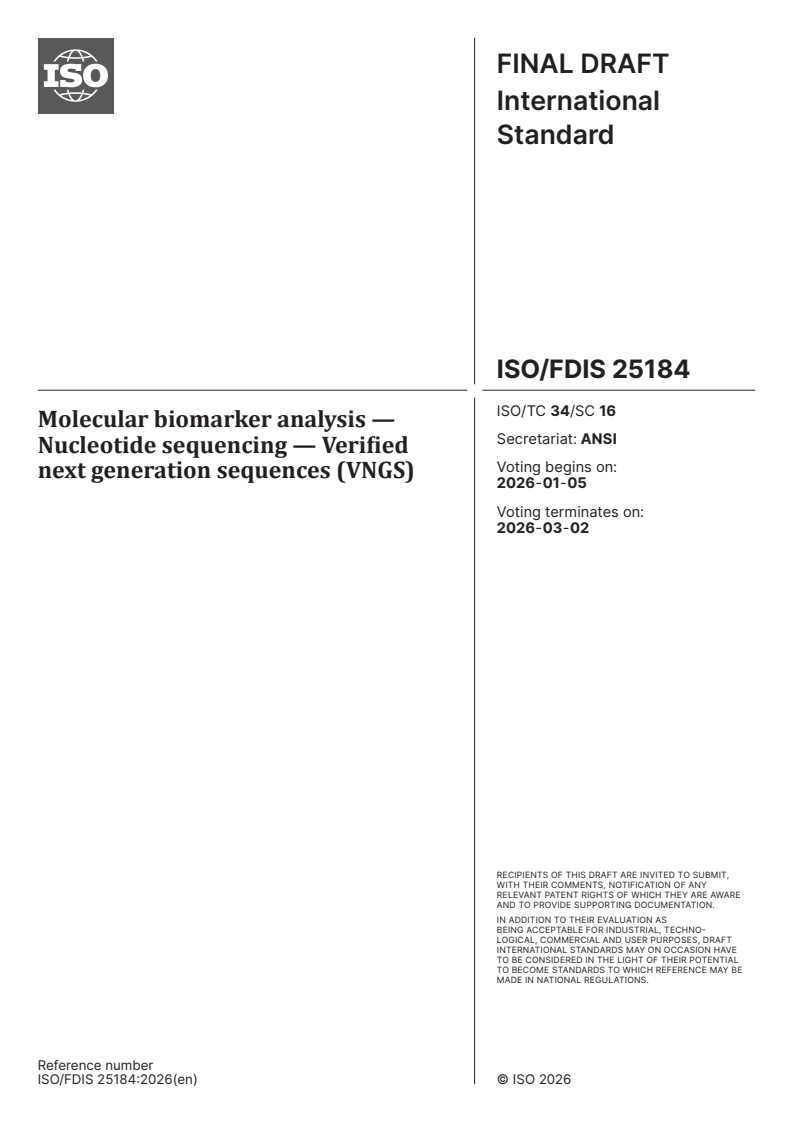

ISO/FDIS 25184 - Molecular biomarker analysis — Nucleotide sequencing — Verified next generation sequences (VNGS) Released:22. 12. 2025
REDLINE ISO/FDIS 25184 - Molecular biomarker analysis — Nucleotide sequencing — Verified next generation sequences (VNGS) Released:22. 12. 2025

ISO/FDIS 25184 - Analyse des biomarqueurs moléculaires — Séquençage nucléotidique — Séquences vérifiées de nouvelle génération (VNGS) Released:28. 01. 2026
Frequently Asked Questions
ISO/FDIS 25184 is a draft published by the International Organization for Standardization (ISO). Its full title is "Molecular biomarker analysis — Nucleotide sequencing — Verified next generation sequences (VNGS)". This standard covers: This document provides requirements for reference nucleotide sequences. This document applies to all nucleotide sequences determined by next-generation sequencing (NGS) technology that are accessible on the semantic web and included in a genetic database (public or private).
This document provides requirements for reference nucleotide sequences. This document applies to all nucleotide sequences determined by next-generation sequencing (NGS) technology that are accessible on the semantic web and included in a genetic database (public or private).
ISO/FDIS 25184 is classified under the following ICS (International Classification for Standards) categories: 07.080 - Biology. Botany. Zoology. The ICS classification helps identify the subject area and facilitates finding related standards.
ISO/FDIS 25184 is available in PDF format for immediate download after purchase. The document can be added to your cart and obtained through the secure checkout process. Digital delivery ensures instant access to the complete standard document.
Standards Content (Sample)
FINAL DRAFT
International
Standard
ISO/TC 34/SC 16
Molecular biomarker analysis —
Secretariat: ANSI
Nucleotide sequencing — Verified
Voting begins on:
next generation sequences (VNGS)
2026-01-05
Voting terminates on:
2026-03-02
RECIPIENTS OF THIS DRAFT ARE INVITED TO SUBMIT,
WITH THEIR COMMENTS, NOTIFICATION OF ANY
RELEVANT PATENT RIGHTS OF WHICH THEY ARE AWARE
AND TO PROVIDE SUPPOR TING DOCUMENTATION.
IN ADDITION TO THEIR EVALUATION AS
BEING ACCEPTABLE FOR INDUSTRIAL, TECHNO
LOGICAL, COMMERCIAL AND USER PURPOSES, DRAFT
INTERNATIONAL STANDARDS MAY ON OCCASION HAVE
TO BE CONSIDERED IN THE LIGHT OF THEIR POTENTIAL
TO BECOME STAN DARDS TO WHICH REFERENCE MAY BE
MADE IN NATIONAL REGULATIONS.
Reference number
FINAL DRAFT
International
Standard
ISO/TC 34/SC 16
Molecular biomarker analysis —
Secretariat: ANSI
Nucleotide sequencing — Verified
Voting begins on:
next generation sequences (VNGS)
2026-01-05
Voting terminates on:
RECIPIENTS OF THIS DRAFT ARE INVITED TO SUBMIT,
WITH THEIR COMMENTS, NOTIFICATION OF ANY
RELEVANT PATENT RIGHTS OF WHICH THEY ARE AWARE
AND TO PROVIDE SUPPOR TING DOCUMENTATION.
© ISO 2026
IN ADDITION TO THEIR EVALUATION AS
All rights reserved. Unless otherwise specified, or required in the context of its implementation, no part of this publication may
BEING ACCEPTABLE FOR INDUSTRIAL, TECHNO
LOGICAL, COMMERCIAL AND USER PURPOSES, DRAFT
be reproduced or utilized otherwise in any form or by any means, electronic or mechanical, including photocopying, or posting on
INTERNATIONAL STANDARDS MAY ON OCCASION HAVE
the internet or an intranet, without prior written permission. Permission can be requested from either ISO at the address below
TO BE CONSIDERED IN THE LIGHT OF THEIR POTENTIAL
or ISO’s member body in the country of the requester.
TO BECOME STAN DARDS TO WHICH REFERENCE MAY BE
MADE IN NATIONAL REGULATIONS.
ISO copyright office
CP 401 • Ch. de Blandonnet 8
CH-1214 Vernier, Geneva
Phone: +41 22 749 01 11
Email: copyright@iso.org
Website: www.iso.org
Published in Switzerland Reference number
ii
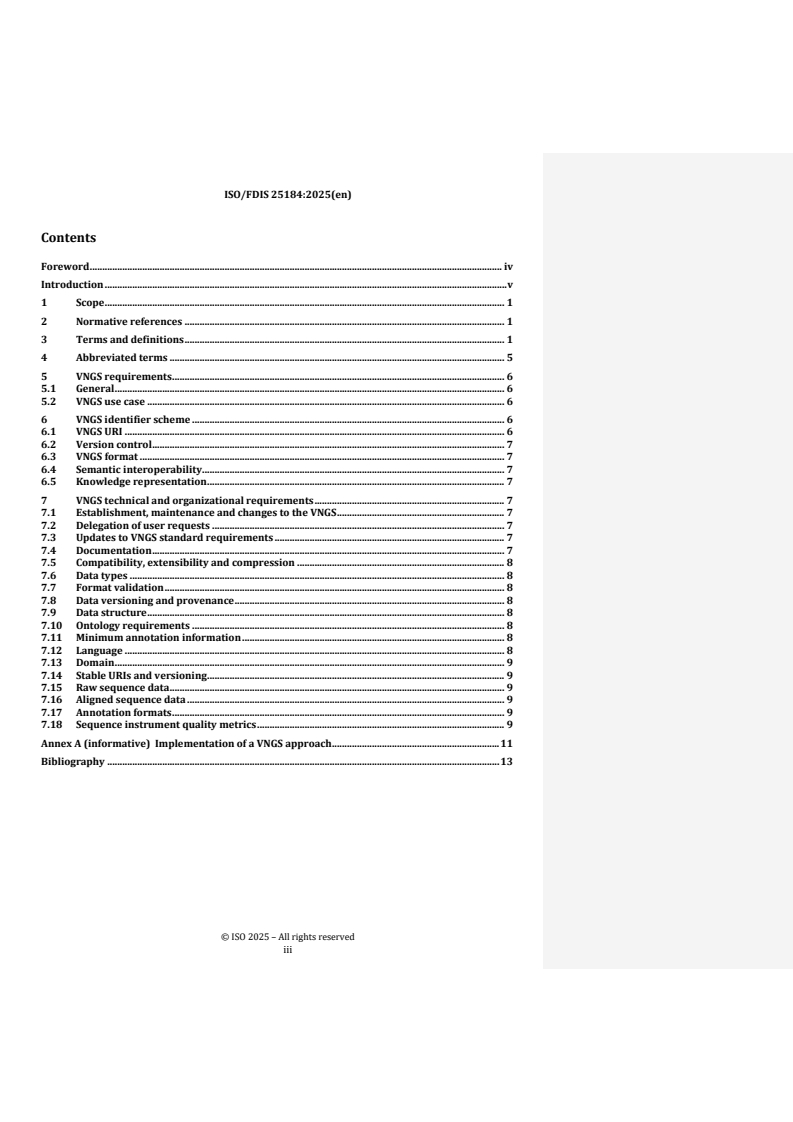
Contents Page
Foreword .v
Introduction .vi
1 Scope . 1
2 Normative references . 1
3 Terms and definitions . 1
4 Abbreviated terms . 5
5 VNGS requirements . 5
5.1 General .5
5.2 VNGS use case.6
6 VNGS identifier scheme . 6
6.1 VNGS URI .6
6.2 Version control .6
6.3 VNGS format .6
6.4 Semantic interoperability .7
6.5 Knowledge representation .7
7 VNGS technical and organizational requirements . 7
7.1 Establishment, maintenance and changes to the VNGS .7
7.2 Delegation of user requests . . .7
7.3 Updates to VNGS standard requirements .7
7.4 Documentation .7
7.5 Compatibility, extensibility and compression .7
7.6 Data types .7
7.7 Format validation .8
7.8 Data versioning and provenance .8
7.9 Data structure .8
7.10 Ontology requirements .8
7.11 Minimum annotation information .8
7.12 Language .8
7.13 Domain.8
7.14 Stable URIs and versioning .8
7.15 Raw sequence data.8
7.16 Aligned sequence data .8
7.17 Annotation formats .9
7.18 Sequence instrument quality metrics . . .9
7.18.1 Base quality score .9
7.18.2 Artefacts .9
7.18.3 Sequencing platform specific error profiles .9
7.18.4 Variation in quality scores across the sequence read .9
7.18.5 Biases in sequence data driven by base composition .9
7.18.6 Departure from suboptimal library fragment sizes .9
7.18.7 Contamination from known and unknown species other than the sequencing
target.9
7.18.8 Insert size .9
7.18.9 Number of reads .9
7.18.10 Base calling.9
7.18.11 Sequence length distribution .9
7.18.12 Length of longest contig .9
7.18.13 N50 .10
7.18.14 NG50 .10
7.18.15 Number of contigs .10
7.18.16 Base composition .10
7.18.17 Coverage . .10
iii
7.18.18 Breadth of coverage .10
7.18.19 Cluster density .10
Annex A (informative) Implementation of a VNGS approach .11
Bibliography .13
iv
Foreword
ISO (the International Organization for Standardization) is a worldwide federation of national standards
bodies (ISO member bodies). The work of preparing International Standards is normally carried out through
ISO technical committees. Each member body interested in a subject for which a technical committee
has been established has the right to be represented on that committee. International organizations,
governmental and non-governmental, in liaison with ISO, also take part in the work. ISO collaborates closely
with the International Electrotechnical Commission (IEC) on all matters of electrotechnical standardization.
The procedures used to develop this document and those intended for its further maintenance are described
in the ISO/IEC Directives, Part 1. In particular, the different approval criteria needed for the different types
of ISO document should be noted. This document was drafted in accordance with the editorial rules of the
ISO/IEC Directives, Part 2 (see www.iso.org/directives).
ISO draws attention to the possibility that the implementation of this document may involve the use of (a)
patent(s). ISO takes no position concerning the evidence, validity or applicability of any claimed patent rights
in respect thereof. As of the date of publication of this document, ISO had not received notice of (a) patent(s)
which may be required to implement this document. However, implementers are cautioned that this may not
represent the latest information, which may be obtained from the patent database available at www.iso.org/
patents. ISO shall not be held responsible for identifying any or all such patent rights.
Any trade name used in this document is information given for the convenience of users and does not
constitute an endorsement.
For an explanation of the voluntary nature of standards, the meaning of ISO specific terms and expressions
related to conformity assessment, as well as information about ISO’s adherence to the World Trade
Organization (WTO) principles in the Technical Barriers to Trade (TBT), see www.iso.org/iso/foreword.html.
This document was prepared by Technical Committee ISO/TC 34, Food products, Subcommittee SC 16,
Horizontal methods for molecular biomarker analysis, in collaboration with AOAC INTERNATIONAL. It
is being published by ISO and separately by AOAC INTERNATIONAL. The requirements described in this
document are equivalent to the Official Methods of Analysis of AOAC INTERNATIONAL, Appendix T, Standard
Requirements for Nucleotide Sequences used in Biothreat Agent Detection, Identification, and Quantification:
Verified New Generation Sequences (VNGS).
Any feedback or questions on this document should be directed to the user’s national standards body. A
complete listing of these bodies can be found at www.iso.org/members.html.
v
Introduction
Nucleotide sequencing is cross-cutting across biomolecular methods in agriculture, food production and
the life sciences. Bioinformatic analytical methods and pipelines require reliable reference sequences for
comparison with unknown sample sequences. The verified next generation sequence (VNGS) concept was
developed by the AOAC INTERNATIONAL. It is designed to provide the requirements necessary for a reliable
and accurately determined new generation reference sequence. This document provides the requirements
for a VNGS.
vi
FINAL DRAFT International Standard ISO/FDIS 25184:2026(en)
Molecular biomarker analysis — Nucleotide sequencing —
Verified next generation sequences (VNGS)
1 Scope
[1][2]
This document specifies requirements for reference next generation nucleotide sequences.
This document is applicable to all verified next generation (VNGS) nucleotide sequences determined by next
generation sequence (NGS) technology that are accessible on the semantic web and included in a database
[3][4][5][6]
(public or private).
2 Normative references
The following documents are referred to in the text in such a way that some or all of their content constitutes
requirements of this document. For dated references, only the edition cited applies. For undated references,
the latest edition of the referenced document (including any amendments) applies.
ISO 16577, Molecular biomarker analysis — Vocabulary for molecular biomarker analytical methods in
agriculture and food production
3 Terms and definitions
For the purposes of this document, the terms and definitions given in ISO 16577 and the following apply.
ISO and IEC maintain terminology databases for use in standardization at the following addresses:
— ISO Online browsing platform: available at https:// www .iso .org/ obp
— IEC Electropedia: available at https:// www .electropedia .org/
3.1
alignment
sequence alignment
arrangement of nucleotide sequences (3.27) so that regions of similarity versus dissimilarity, polymorphic
regions and haplotype are shown
3.2
ASCII character set
American Standard Code for Information Interchange character set
character encoding standard for electronic communication
3.3
assemblies
set of DNA segments or sequences that overlap in a way that provides a contiguous representation of a
genomic region
3.4
base calling
computational process in massively parallel sequencing for translating raw optical and electrical signals to
nucleotide sequence (3.27)
3.5
GC composition
GC content
percentage of GC base pairs in the genome
3.6
breadth of coverage
percentage of genome bases that are sequenced a given number of times
EXAMPLE A genome sequenced to 30× average depth, achieving a 95% breadth of coverage of the reference
genome at a minimum depth of 10 reads.
[7]
[SOURCE: Reference ]
3.7
cluster density
number of templates present on a next generation sequencing cell/chip
3.8
context
circumstance, purpose, and perspective under which an object is defined or used
3.9
contig
continuous stretch of DNA sequence that results from the assembly of smaller, overlapping DNA sequence
reads
3.10
coverage
number of times that a given base or k-mer position is read in a sequencing run given base position or across
a sliding window of multiple bases
[8] [9]
Note 1 to entry: See References and .
3.11
detection
recognition of the presence of the target nucleic acid
3.12
extensible markup language
XML
markup language that encodes information in a way that is machine processable as well as human-readable
3.13
FAST5
standard sequencing output for nanopore sequencers
3.14
FASTQ
text-based format for storing both a biological sequence (usually nucleotide sequence (3.27)) and its
corresponding quality scores
Note 1 to entry: Both the sequence letter and quality score are encoded with a single American Standard Code for
Information Interchange (ASCII) character for brevity.
3.15
forward compatibility
design that is compatible with future versions of the article
3.16
backward compatibility
design that is compatible with previous versions of the article
3.17
identification
establishment of the identity of an organism or virus by next generation sequence (NGS) (3.25) analysis
3.18
insert size
length of the sequence between the sequencing adapters
[10]
[SOURCE: Reference ]
3.19
JavaScript object notation
JSON
open and text-based exchange format
3.20
knowledge representation
process or result of encoding and storing information so that it can be interpreted and used by a computer
3.21
length of longest contig
size of the longest consensus region of DNA produced from a set of overlapping DNA segment reads
3.22
machine readable
data in a format that is easily interpretable by a machine while not necessarily recognizable by humans
3.23
metadata
data that describe other data
3.24
N50
fifty per cent of the entire next generation sequence (NGS) (3.25) assembly that is contained in contigs (3.9) or
scaffolds equal to or larger than this value in base length
Note 1 to entry: Individual sequencing reads are processed to remove linkers and barcodes and then assembled into
overlapping contigs. The next step is to assemble the contigs into progressively larger scaffolds by bridging the gaps
between contigs with additional sequence reads until the entire genome is assembled.
3.25
next generation sequence
NGS
nucleotide sequence (3.27) produced using a massively parallel sequencing methodology
3.26
NG50
N50 (3.24) except the metric relates to the genome size rather than the assembly size
[11]
[SOURCE: Reference ]
3.27
nucleotide sequence
order of purine or pyrimidine nucleosides linked by a phosphodiester backbone and hydrogen bonding in a
deoxyribonucleotide or ribonucleotide molecule
3.28
number of contigs
total count of contiguous DNA sequences after assembly of the whole genome sequence
3.29
number of reads
total quantity of sequenced DNA fragments, or reads, generated during a sequencing run
3.30
OBO Foundry
Open Biological and Biomedical Ontologies Foundry
open biological and biomedical ontology
3.31
ontology
logical structure of the terms used to describe a domain of knowledge, including both the definitions of the
applicable terms and their relationships
3.32
Ontology Web Language
OWL
family of knowledge representation (3.20) or ontology (3.31) languages for authoring ontologies or knowledge
bases
3.33
pod5
specialized nucleotide sequence (3.27) format interconvertible with FASTA, consisting of universally unique
identifiers based on a custom container with the extension
Note 1 to entry: pod 5 is usually used for nanopore based sequencing.
3.34
quantification
determination of the amount of biological material in a sample
3.35
raw read
initial, unaligned data generated by a sequencing instrument
3.36
reifiable
capable of being made more concrete or real
3.37
resource description framework
RDF
extensible markup language (XML) syntax for describing metadata (3.23)
3.38
responsible party
perso
...
ISO/TC 34/SC 16
Secretariat: ANSI
Date: 2025-11-12-19
Molecular biomarker analysis — Nucleotide sequencing — Verified
next generation sequences (VNGS)
FDIS stage
All rights reserved. Unless otherwise specified, or required in the context of its implementation, no part of this publication
may be reproduced or utilized otherwise in any form or by any means, electronic or mechanical, including photocopying,
or posting on the internet or an intranet, without prior written permission. Permission can be requested from either ISO
at the address below or ISO’s member body in the country of the requester.
ISO copyright office
CP 401 • Ch. de Blandonnet 8
CH-1214 Vernier, Geneva
Phone: + 41 22 749 01 11
E-mail: copyright@iso.org
Website: www.iso.org
Published in Switzerland
ii
Contents
Foreword . iv
Introduction . v
1 Scope . 1
2 Normative references . 1
3 Terms and definitions . 1
4 Abbreviated terms . 5
5 VNGS requirements . 6
5.1 General . 6
5.2 VNGS use case . 6
6 VNGS identifier scheme . 6
6.1 VNGS URI . 6
6.2 Version control . 7
6.3 VNGS format . 7
6.4 Semantic interoperability . 7
6.5 Knowledge representation . 7
7 VNGS technical and organizational requirements . 7
7.1 Establishment, maintenance and changes to the VNGS . 7
7.2 Delegation of user requests . 7
7.3 Updates to VNGS standard requirements . 7
7.4 Documentation . 7
7.5 Compatibility, extensibility and compression . 8
7.6 Data types . 8
7.7 Format validation . 8
7.8 Data versioning and provenance . 8
7.9 Data structure . 8
7.10 Ontology requirements . 8
7.11 Minimum annotation information . 8
7.12 Language . 8
7.13 Domain . 9
7.14 Stable URIs and versioning . 9
7.15 Raw sequence data . 9
7.16 Aligned sequence data . 9
7.17 Annotation formats . 9
7.18 Sequence instrument quality metrics . 9
Annex A (informative) Implementation of a VNGS approach . 11
Bibliography . 13
iii
Foreword
ISO (the International Organization for Standardization) is a worldwide federation of national standards
bodies (ISO member bodies). The work of preparing International Standards is normally carried out through
ISO technical committees. Each member body interested in a subject for which a technical committee has been
established has the right to be represented on that committee. International organizations, governmental and
non-governmental, in liaison with ISO, also take part in the work. ISO collaborates closely with the
International Electrotechnical Commission (IEC) on all matters of electrotechnical standardization.
The procedures used to develop this document and those intended for its further maintenance are described
in the ISO/IEC Directives, Part 1. In particular, the different approval criteria needed for the different types of
ISO document should be noted. This document was drafted in accordance with the editorial rules of the
ISO/IEC Directives, Part 2 (see www.iso.org/directives).
ISO draws attention to the possibility that the implementation of this document may involve the use of (a)
patent(s). ISO takes no position concerning the evidence, validity or applicability of any claimed patent rights
in respect thereof. As of the date of publication of this document, ISO had not received notice of (a) patent(s)
which may be required to implement this document. However, implementers are cautioned that this may not
represent the latest information, which may be obtained from the patent database available at
www.iso.org/patents. ISO shall not be held responsible for identifying any or all such patent rights.
Any trade name used in this document is information given for the convenience of users and does not
constitute an endorsement.
For an explanation of the voluntary nature of standards, the meaning of ISO specific terms and expressions
related to conformity assessment, as well as information about ISO’s adherence to the World Trade
Organization (WTO) principles in the Technical Barriers to Trade (TBT), see www.iso.org/iso/foreword.html.
This document was prepared by Technical Committee ISO/TC 34, Food products, Subcommittee SC 16,
Horizontal methods for molecular biomarker analysis, in collaboration with AOAC INTERNATIONAL. It is being
published by ISO and separately by AOAC INTERNATIONAL. The requirements described in this document are
equivalent to the Official Methods of Analysis of AOAC INTERNATIONAL, Appendix T, Standard Requirements
for Nucleotide Sequences used in Biothreat Agent Detection, Identification, and Quantification: Verified New
Generation Sequences (VNGS).
Any feedback or questions on this document should be directed to the user’s national standards body. A
complete listing of these bodies can be found at www.iso.org/members.html.
iv
Introduction
Nucleotide sequencing is cross-cutting across biomolecular methods in agriculture, food production and the
life sciences. Bioinformatic analytical methods and pipelines require reliable reference sequences for
comparison with unknown sample sequences. The verified next generation sequence (VNGS) concept was
developed by the AOAC INTERNATIONAL. It is designed to provide the requirements necessary for a reliable
and accurately determined new generation reference sequence. This document provides the requirements for
a VNGS.
v
Molecular biomarker analysis — Nucleotide sequencing — Verified
next generation sequences (VNGS)
1 Scope
[1][2]
This document providesspecifies requirements for reference next generation nucleotide sequences.
This document is applicable to all verified next generation (VNGS) nucleotide sequences determined by next
generation sequence (NGS) technology that are accessible on the semantic web and included in a database
[3][4][5][6]
(public or private).
2 Normative references
The following documents are referred to in the text in such a way that some or all of their content constitutes
requirements of this document. For dated references, only the edition cited applies. For undated references,
the latest edition of the referenced document (including any amendments) applies.
ISO 16577, Molecular biomarker analysis — Vocabulary for molecular biomarker analytical methods in
agriculture and food production
3 Terms and definitions
For the purposes of this document, the terms and definitions given in ISO 16577 and the following apply.
ISO and IEC maintain terminology databases for use in standardization at the following addresses:
— ISO Online browsing platform: available at https://www.iso.org/obp
— IEC Electropedia: available at https://www.electropedia.org/
3.1
alignment
sequence alignment
arrangement of nucleotide sequences (3.27) so that regions of similarity versus dissimilarity, polymorphic
regions and haplotype are shown
3.2
ASCII character set
American Standard Code for Information Interchange character set
character encoding standard for electronic communication
3.3
assemblies
set of DNA segments or sequences that overlap in a way that provides a contiguous representation of a
genomic region
3.4
base calling
computational process in massively parallel sequencing for translating raw optical and electrical signals to
nucleotide sequence (3.27)
3.5
GC composition
GC content
percentage of GC base pairs in the genome
3.6
breadth of coverage
percentage of genome bases that are sequenced a given number of times
EXAMPLE A genome sequenced to 30× average depth, achieving a 95% breadth of coverage of the reference genome
at a minimum depth of 10 reads.
[7]
[SOURCE: Reference This reference is informative]]
3.7
cluster density
number of templates present on a next generation sequencing cell/chip
3.8
context
circumstance, purpose, and perspective under which an object is defined or used
3.9
contig
continuous stretch of DNA sequence that results from the assembly of smaller, overlapping DNA sequence
reads
3.10
coverage
number of times that a given base or k-mer position is read in a sequencing run given base position or across
a sliding window of multiple bases
[8] [9]
Note 1 to entry: See References and .
3.11
detection
recognition of the presence of the target nucleic acid
3.12
extensible markup language
XML
markup language that encodes information in a way that is machine processable as well as human-readable
3.13
FAST5
standard sequencing output for nanopore sequencers
3.14
FASTQ
text-based format for storing both a biological sequence (usually nucleotide sequence (3.27)) and its
corresponding quality scores
Note 1 to entry: Both the sequence letter and quality score are encoded with a single American Standard Code for
Information Interchange (ASCII) character for brevity.
3.15
forward compatibility
design that is compatible with future versions of the article
3.16
backward compatibility
design that is compatible with previous versions of the article
3.17
identification
establishment of the identity of an organism or virus by next generation sequence (NGS) (3.25) analysis
3.18
insert size
length of the sequence between the sequencing adapters
[10]
[SOURCE: Reference This reference is informative]]
3.19
JavaScript object notation
JSON
open and text-based exchange format
3.20
knowledge representation
process or result of encoding and storing information so that it can be interpreted and used by a computer
3.21
length of longest contig
size of the longest consensus region of DNA produced from a set of overlapping DNA segment reads
3.22
machine readable
data in a format that is easily interpretable by a machine while not necessarily recognizable by humans
3.23
metadata
data that describe other data
3.24
N50
fifty per cent of the entire next generation sequence (NGS) (3.25) assembly that is contained in contigs (3.9) or
scaffolds equal to or larger than this value in base length
Note 1 to entry: Individual sequencing reads are processed to remove linkers and barcodes and then assembled into
overlapping contigs. The next step is to assemble the contigs into progressively larger scaffolds by bridging the gaps
between contigs with additional sequence reads until the entire genome is assembled.
3.25
next generation sequence
NGS
nucleotide sequence (3.27) produced using a massively parallel sequencing methodology
3.26
NG50
resembles N50 (3.24) except the metric relates to the genome size rather than the assembly size
[11]
[SOURCE: Reference This reference is informative]]
3.27
nucleotide sequence
order of purine or pyrimidine nucleosides linked by a phosphodiester backbone and hydrogen bonding in a
deoxyribonucleotide or ribonucleotide molecule
3.28
number of contigs
total count of contiguous DNA sequences after assembly of the whole genome sequence
3.29
number of reads
total quantity of sequenced DNA fragments, or reads, generated during a sequencing run
3.30
OBO Foundry
Open Biological and Biomedical Ontologies Foundry
open biological and biomedical ontology
3.31
ontology
logical structure of the terms used to describe a domain of knowledge, including both the definitions of the
applicable terms and their relationships
3.32
Ontology Web Language
OWL
family of knowledge representation (3.20) or ontology (3.31) languages for authoring ontologies or knowledge
bases
3.33
pod5
specialized nucleotide sequence (3.27) format interconvertible with FASTA, consisting of universally unique
identifiers based on a custom container with the extension
Note 1 to entry: pod 5 is usually used for nanopore based sequencing.
3.34
quantification
determination of the amount of biological material in a sample
3.35
raw read
initial, unaligned data generated by a sequencing instrument
3.36
reifiable
capable of being made more concrete or real
3.37
resource description framework
RDF
extensible markup language (XML) syntax for describing metadata (3.23)
3.38
responsible party
person(s) responsible for the provision of the standard requirements
3.39
semantic interoperability
ability of data shared by systems to be understood at the level of fully defined domain concepts
3.40
sequence length distribution
spread of sequence read sizes in next generation sequence (NGS) (3.25) run
[SOURCE: ]
3.41
surveillance
close observation through microbiological sampling and analysis
3.42
universal character set
UCS
character set encoding standard for international electronic communication
3.43
universal resource identifier
URI
sequence of characters, capable of uniquely identifying the thing with which it is associated, within a specified
context (3.8)
Note 1 to entry: URI is an internet protocol standard that builds on the uniform resource indicator protocol by greatly
expanding the set of permitted characters.
3.44
variant
nucleotide polymorphism, insertion, or deletion found in one or more sequences compared to other sequences
3.45
verified
provision of objective evidence that a given item fulfils specified requirements.
3.46
verified next generation sequence
VNGS
next generation nucleotide sequence that conforms with validation criteria to ensure precision, accuracy,
reliability, repeatability and reproducibility for use in sequence analysis and bioinformatics
3.47
FASTA format
text-based file format and a set of bioinformatics programs used for alignments
4 Abbreviated terms
FHRJSON JavaScript object notationFair bioHeaders Reference Genome Assembly
JSONFHR Fair bioHeader reference genome assemblyJavaScript Object Notation
NGS next generation sequence
OWL Ontology web languageWeb Language
RDF Resourceresource data framework
UCS Universal character setCharacter Set
URI Universal resource identifierResource Identifier
VNGS Verifiedverified next generation sequence
XML extenisble markup languageExtensible Markup Language
5 VNGS requirements
5.1 General
These requirements are not dependent upon a particular NGS platform. Nucleotide sequence and motif
[1312]
identification techniques can vary dependent upon the methods used.
Field Code Changed
5.2 VNGS use case
Nucleotide sequences referred to as verified next generation sequences (VNGS) can be used as reference
sequences as part of method development, verification, and validation in detection, identification, and
quantification for determination, surveillance, diagnosis, genomics and bioinformatics.
6 VNGS identifier scheme
6.1 VNGS URI
The VNGS shall be considered fit for purpose if it possesses a specific namespace and context. The VNGS URI
shall be in the form:
Scheme: //hierarchical namespace qualifier(s)/name
where the ASCII character set is used,.
NOTE In the case of a VNGS IRI, UCS characters are used in place of ASCII characters.
The VNGS URI can be represented in any scheme, e.g. http: urn (www.iana.org). All metadata connected to the
VNGS URI shall be capturable and shall be kept over the whole lifetime of the data. The VNGS URI shall be
persistent and shall remain independent of its mapping on a server, and its notation. The VNGS URI should not
attempt to infer from properties of the NGS data and metadata, including raw data, base quality metadata,
metadata, alignments, variants, features, etc. TheVNGSThe VNGS URI shall identify a single VNGS and each
[13]
VNGS shall be assigned to only one URI. .
Using the same VNGS URI to identify more than one organism or virus is discouraged; e
...
PROJET FINAL
Norme
internationale
ISO/TC 34/SC 16
Analyse des biomarqueurs
Secrétariat: ANSI
moléculaires — Séquençage
Début de vote:
nucléotidique — Séquences
2026-01-05
vérifiées de nouvelle génération
Vote clos le:
(VNGS)
2026-03-02
Molecular biomarker analysis — Nucleotide sequencing —
Verified next generation sequences (VNGS)
LES DESTINATAIRES DU PRÉSENT PROJET SONT
INVITÉS À PRÉSENTER, AVEC LEURS OBSERVATIONS,
NOTIFICATION DES DROITS DE PROPRIÉTÉ DONT ILS
AURAIENT ÉVENTUELLEMENT CONNAISSANCE ET À
FOURNIR UNE DOCUMENTATION EXPLICATIVE.
OUTRE LE FAIT D’ÊTRE EXAMINÉS POUR
ÉTABLIR S’ILS SONT ACCEPTABLES À DES FINS
INDUSTRIELLES, TECHNOLOGIQUES ET COM-MERCIALES,
AINSI QUE DU POINT DE VUE DES UTILISATEURS, LES
PROJETS DE NORMES
INTERNATIONALES DOIVENT PARFOIS ÊTRE CONSIDÉRÉS
DU POINT DE VUE DE LEUR POSSI BILITÉ DE DEVENIR DES
NORMES POUVANT
SERVIR DE RÉFÉRENCE DANS LA RÉGLEMENTATION
NATIONALE.
Numéro de référence
PROJET FINAL
Norme
internationale
ISO/TC 34/SC 16
Analyse des biomarqueurs
Secrétariat: ANSI
moléculaires — Séquençage
Début de vote:
nucléotidique — Séquences
2026-01-05
vérifiées de nouvelle génération
Vote clos le:
(VNGS)
2026-03-02
Molecular biomarker analysis — Nucleotide sequencing —
Verified next generation sequences (VNGS)
LES DESTINATAIRES DU PRÉSENT PROJET SONT
INVITÉS À PRÉSENTER, AVEC LEURS OBSERVATIONS,
NOTIFICATION DES DROITS DE PROPRIÉTÉ DONT ILS
AURAIENT ÉVENTUELLEMENT CONNAISSANCE ET À
FOURNIR UNE DOCUMENTATION EXPLICATIVE.
DOCUMENT PROTÉGÉ PAR COPYRIGHT
OUTRE LE FAIT D’ÊTRE EXAMINÉS POUR
ÉTABLIR S’ILS SONT ACCEPTABLES À DES FINS
© ISO 2026 INDUSTRIELLES, TECHNOLOGIQUES ET COM-MERCIALES,
AINSI QUE DU POINT DE VUE DES UTILISATEURS, LES
Tous droits réservés. Sauf prescription différente ou nécessité dans le contexte de sa mise en œuvre, aucune partie de cette
PROJETS DE NORMES
INTERNATIONALES DOIVENT PARFOIS ÊTRE CONSIDÉRÉS
publication ne peut être reproduite ni utilisée sous quelque forme que ce soit et par aucun procédé, électronique ou mécanique,
DU POINT DE VUE DE LEUR POSSI BILITÉ DE DEVENIR DES
y compris la photocopie, ou la diffusion sur l’internet ou sur un intranet, sans autorisation écrite préalable. Une autorisation peut
NORMES POUVANT
être demandée à l’ISO à l’adresse ci-après ou au comité membre de l’ISO dans le pays du demandeur.
SERVIR DE RÉFÉRENCE DANS LA RÉGLEMENTATION
NATIONALE.
ISO copyright office
Case postale 401 • Ch. de Blandonnet 8
CH-1214 Vernier, Genève
Tél.: +41 22 749 01 11
E-mail: copyright@iso.org
Web: www.iso.org
Publié en Suisse Numéro de référence
ii
Sommaire Page
Avant-propos .v
Introduction .vi
1 Domaine d’application . 1
2 Références normatives . 1
3 Termes et définitions . 1
4 Termes abrégés . 6
5 Exigences relatives aux VNGS . . 6
5.1 Généralités .6
5.2 Cas d’utilisation des VNGS .6
6 Schéma d’identification d’une VNGS . 6
6.1 URI d’une VNGS .6
6.2 Contrôle de version .7
6.3 Format des VNGS .7
6.4 Interopérabilité sémantique .7
6.5 Représentation des connaissances .7
7 Exigences techniques et organisationnelles des VNGS . 7
7.1 Établissement, maintenance et modifications des VNGS.7
7.2 Délégation des demandes des utilisateurs .7
7.3 Mise à jour des exigences standards relatives aux VNGS .7
7.4 Documentation .8
7.5 Compatibilité, extensibilité et compression .8
7.6 Types de données .8
7.7 Validation du format .8
7.8 Versionnage et provenance des données .8
7.9 Structure des données .8
7.10 Exigences ontologiques .8
7.11 Informations minimales d’annotation .9
7.12 Langue .9
7.13 Domaine .9
7.14 URI stables et versionnage . .9
7.15 Données brutes de séquences .9
7.16 Données de séquences alignées .9
7.17 Formats d’annotation .9
7.18 Métriques de qualité des instruments de séquençage .9
7.18.1 Score de qualité de la base .9
7.18.2 Artefacts .9
7.18.3 Profils d’erreur spécifiques à la plateforme de séquençage .9
7.18.4 Variation des scores de qualité sur l’ensemble de la séquence lue .10
7.18.5 Biais dans les données de séquence déterminés par la composition des bases .10
7.18.6 Écart par rapport aux tailles sous-optimales des fragments contenus dans la
bibliothèque .10
7.18.7 Contamination par des espèces connues et inconnues autres que la cible de
séquençage.10
7.18.8 Taille de l’insert .10
7.18.9 Nombre de lectures .10
7.18.10 Attribution des bases .10
7.18.11 Distribution de longueurs de séquences .10
7.18.12 Longueur du contig le plus long .10
7.18.13 N50 .10
7.18.14 NG50 .10
7.18.15 Nombre de contigs .10
7.18.16 Composition des bases .10
iii
7.18.17 Couverture .10
7.18.18 Étendue de couverture .11
7.18.19 Densité de clusters.11
Annexe A (informative) Mise en place d’une approche spécifique aux VNGS .12
Bibliographie . 14
iv
Avant-propos
L’ISO (Organisation internationale de normalisation) est une fédération mondiale d’organismes nationaux
de normalisation (comités membres de l’ISO). L’élaboration des Normes internationales est en général
confiée aux comités techniques de l’ISO. Chaque comité membre intéressé par une étude a le droit de faire
partie du comité technique créé à cet effet. Les organisations internationales, gouvernementales et non
gouvernementales, en liaison avec l’ISO participent également aux travaux. L’ISO collabore étroitement avec
la Commission électrotechnique internationale (IEC) en ce qui concerne la normalisation électrotechnique.
Les procédures utilisées pour élaborer le présent document et celles destinées à sa mise à jour sont
décrites dans les Directives ISO/IEC, Partie 1. Il convient, en particulier, de prendre note des différents
critères d’approbation requis pour les différents types de documents ISO. Le présent document
a été rédigé conformément aux règles de rédaction données dans les Directives ISO/IEC, Partie 2
(voir www.iso.org/directives).
L’ISO attire l’attention sur le fait que la mise en application du présent document peut entraîner l’utilisation
d’un ou de plusieurs brevets. L’ISO ne prend pas position quant à la preuve, à la validité et à l’applicabilité
de tout droit de brevet revendiqué à cet égard. À la date de publication du présent document, l’ISO n’avait
pas reçu notification qu’un ou plusieurs brevets pouvaient être nécessaires à sa mise en application.
Toutefois, il y a lieu d’avertir les responsables de la mise en application du présent document que des
informations plus récentes sont susceptibles de figurer dans la base de données de brevets, disponible à
l’adresse www.iso.org/brevets. L’ISO ne saurait être tenue pour responsable de ne pas avoir identifié de tels
droits de propriété et averti de leur existence.
Les appellations commerciales éventuellement mentionnées dans le présent document sont données pour
information, par souci de commodité, à l’intention des utilisateurs et ne sauraient constituer un engagement.
Pour une explication de la nature volontaire des normes, la signification des termes et expressions
spécifiques de l’ISO liés à l’évaluation de la conformité, ou pour toute information au sujet de l’adhésion de
l’ISO aux principes de l’Organisation mondiale du commerce (OMC) concernant les obstacles techniques au
commerce (OTC), voir www.iso.org/iso/fr/avant-propos.html.
Ce document a été élaboré par le comité technique ISO/TC 34, Produits alimentaires, sous-comité SC 16,
Méthodes horizontales pour l’analyse de biomarqueurs moléculaires, en collaboration avec l’AOAC
INTERNATIONAL. Il est publié par l’ISO et séparément par l’AOAC INTERNATIONAL. Les exigences décrites
dans le présent document sont équivalentes aux méthodes officielles d’analyse de l’AOAC INTERNATIONAL,
Annexe T, Standard Requirements for Nucleotide Sequences used in Biothreat Agent Detection, Identification,
and Quantification: Verified New Generation Sequences (VNGS).
Il convient que l’utilisateur adresse tout retour d’information ou toute question concernant le présent
document à l’organisme national de normalisation de son pays. Une liste exhaustive desdits organismes se
trouve à l’adresse www.iso.org/fr/members.html.
v
Introduction
Le séquençage des nucléotides est une technique transversale aux méthodes biomoléculaires utilisées
dans l’agriculture, la production alimentaire et les sciences de la vie. Les méthodes et pipelines d’analyse
bio-informatique requièrent des séquences de référence fiables afin de permettre la comparaison avec des
séquences d’échantillons inconnus. Le concept de séquence vérifiée de nouvelle génération (VNGS) a été
développé par l’AOAC INTERNATIONAL. Il est conçu pour définir les exigences nécessaires à une séquence
de nouvelle génération de référence fiable et déterminée avec précision. Le présent document présente les
exigences relatives à une VNGS.
vi
PROJET FINAL Norme internationale ISO/FDIS 25184:2026(fr)
Analyse des biomarqueurs moléculaires — Séquençage
nucléotidique — Séquences vérifiées de nouvelle génération
(VNGS)
1 Domaine d’application
Le présent document définit les exigences relatives aux séquences nucléotidiques de nouvelle génération de
référence [1] [2].
Le présent document est applicable à toutes les séquences nucléotidiques vérifiées de nouvelle génération
(VNGS) déterminées par la technologie des séquences de nouvelle génération (NGS) qui sont accessibles sur
[3][4][5][6]
le Web sémantique et incluses dans une base de données (publique ou privée).
2 Références normatives
Les documents suivants sont cités dans le texte de sorte qu’ils constituent, pour tout ou partie de leur
contenu, des exigences du présent document. Pour les références datées, seule l’édition citée s’applique. Pour
les références non datées, la dernière édition du document de référence s'applique (y compris les éventuels
amendements).
ISO 16577, Analyse de biomarqueurs moléculaires — Vocabulaire pour les méthodes d’analyse de biomarqueurs
moléculaires dans l’agriculture et la production agroalimentaire
3 Termes et définitions
Pour les besoins du présent document, les termes et les définitions de l’ISO 16577 ainsi que les suivants
s’appliquent.
L’ISO et l’IEC tiennent à jour des bases de données terminologiques destinées à être utilisées en normalisation,
consultables aux adresses suivantes:
— ISO Online browsing platform: disponible à l’adresse https:// www .iso .org/ obp
— IEC Electropedia: disponible à l’adresse https:// www .electropedia .org/
3.1
alignement
alignement de séquences
organisation des séquences nucléotidiques (3.27) de manière à mettre en évidence les régions de similitude et
de dissemblance, les régions polymorphes et les haplotypes
3.2
jeu de caractères ASCII
jeu de caractères American Standard Code for Information Interchange
norme d’encodage des caractères pour la communication électronique
3.3
assemblages
ensemble de segments ou de séquences d’ADN qui se superposent de manière à représenter de manière
contiguë une région génomique
3.4
attribution des bases
lors du séquençage massivement parallèle, processus de calcul consistant à traduire les signaux optiques et
électriques bruts en séquence nucléotidique (3.27)
3.5
composition GC
teneur en GC
pourcentage des paires de bases GC dans le génome
3.6
étendue de couverture
pourcentage des bases du génome qui sont séquencées un certain nombre de fois
EXEMPLE Génome séquencé à une profondeur moyenne de 30 × , avec une étendue de couverture de 95 % du
génome de référence à une profondeur minimale de 10 lectures.
[SOURCE: Référence [7]]
3.7
densité de clusters
nombre de matrices d’acide nucléique présentes sur une cellule/puce de séquençage de nouvelle génération
3.8
contexte
circonstances, finalité et perspective pour lesquelles un objet est défini ou utilisé
3.9
contig
fragment continu de séquence d’ADN résultant de l’assemblage de lectures de séquences d’ADN plus petites
se superposant
3.10
couverture
nombre de fois qu’une position de base ou k-mer donnée est lue dans un cycle de séquençage, compte tenu de
la position de base donnée ou dans une fenêtre glissante de plusieurs bases
Note 1 à l'article: Voir Références [8] et [9].
3.11
détection
reconnaissance de la présence de l’acide nucléique cible
3.12
Extensible Markup Language (langage de balisage extensible)
XML
langage de balisage qui encode les informations de sorte qu’elles puissent être traitées par une machine et
lues par l’homme
3.13
FAST5
format du résultat de séquençage standard pour les séquenceurs à nanopores
3.14
FASTQ
format texte permettant de stocker à la fois une séquence biologique (généralement une séquence
nucléotidique (3.27)) et les scores de qualité correspondants
Note 1 à l'article: Pour des raisons de concision, la lettre de séquence et le score de qualité sont tous deux codés avec un
seul caractère American Standard Code for Information Interchange (ASCII).
3.15
compatibilité descendante
conception assurant la compatibilité avec les versions futures de l’article
3.16
compatibilité ascendante
conception assurant la compatibilité avec les versions précédentes de l’article
3.17
identification
établissement de l’identité d’un organisme ou d’un virus par analyse de séquence de nouvelle génération (NGS)
(3.25)
3.18
taille de l’insert
longueur de la séquence située entre les adaptateurs de séquençage
[SOURCE: Référence [10]]
3.19
JavaScript Object Notation (format de notation d’objet JavaScript)
JSON
format ouvert d’échange de texte
3.20
représentation des connaissances
processus ou résultat d’encodage et de stockage des informations de sorte qu’elles puissent être interprétées
et utilisées par un ordinateur
3.21
longueur du contig le plus long
taille de la région de consensus d’ADN la plus longue obtenue à partir d’un ensemble de lectures de segments
d’ADN qui se superposent
3.22
lisible par une machine
données dans un format facilement interprétable par une machine, mais pas nécessairement reconnaissable
par l’homme
3.23
métadonnées
données qui décrivent d’autres données
3.24
N50
valeur de longueur de base telle que cinquante pour cent de l’assemblage de la séquence de nouvelle génération
(NGS) (3.25) est contenu dans des contigs (3.9) ou scaffolds d’au moins cette longueur
Note 1 à l'article: Les lectures de séquençage individuelles sont traitées pour supprimer les liaisons et les codes-
barres, puis assemblées en contigs qui se superposent. L’étape suivante consiste à assembler les contigs en scaffolds
de taille croissante en comblant les intervalles entre contigs par des lectures de séquences supplémentaires jusqu’à
reconstituer le génome complet.
3.25
Next Generation Sequence (séquence de nouvelle génération)
NGS
séquence nucléotidique (3.27) produite à l’aide d’une méthode de séquençage massivement parallèle
3.26
NG50
similaire au N50 (3.24), à la différence que la métrique se rapporte à la taille du génome plutôt qu’à celle de
l’assemblage
[SOURCE: Référence [11]]
3.27
séquence nucléotidique
ordre des nucléosides, puriques ou pyrimidiques, liés par un squelette phosphodiester et une liaison
hydrogène, dans une molécule de désoxyribonucléotide ou de ribonucléotide
3.28
nombre de contigs
nombre total de séquences d’ADN contiguës après l’assemblage de la séquence du génome complet
3.29
nombre de lectures
quantité totale de fragments d’ADN séquencés, ou lectures, générés au cours d’un cycle de séquençage
3.30
OBO Foundry
Open Biological and Biomedical Ontologies Foundry
ontologie biologique et biomédicale accessible
3.31
ontologie
structure logique des termes utilisés pour décrire un domaine de connaissance, comprenant à la fois les
définitions des termes applicables et leurs relations
3.32
Ontology Web Language (langage d’ontologie Web)
OWL
famille de langages de représentation des connaissances (3.20) ou d’ontologie (3.31) permettant de créer des
ontologies ou des bases de connaissances
3.33
pod5
format spécialisé de séquence nucléotidique (3.27) interconvertible avec le format FASTA, composé
d’identifiants universellement uniques basés sur un conteneur personnalisé avec l’extension
Note 1 à l'article: pod 5 est généralement utilisé pour le séquençage par nanopores.
3.34
quantification
détermination de la quantité de matériel biologique dans un échantillon
3.35
lecture brute
données initiales, non alignées, générées par un instrument de séquençage
3.36
réifiable
pouvant être rendu plus concret ou plus réel
3.37
Resource Description Framework (cadre de description de ressource)
RDF
syntaxe XML (langage de balisage extensible) utilisée pour décrire les métadonnées (3.23)
3.38
partie responsable
une ou plusieurs personnes responsables de la fourniture des exigences standards
3.39
interopérabilité sémantique
capacité de données partagées par des systèmes à être comprises au niveau de concepts de domaines
complètement définis
3.40
distribution de longueurs de séquences
répartition des tailles de lecture de séquence dans un cycle de séquence de nouvelle génération (NGS) (3.25)
3.41
surveillance
observation minutieuse par échantillonnage et analyse microbiologiques
3.42
Universal Character Set (jeu de caractères universel)
UCS
norme d’encodage de jeux de caractères pour la communication électronique internationale
3.43
identificateur de ressource universel
URI
séquence de caractères capable d’identifier de manière unique la chose à laquelle elle est associée, dans un
c
...
Questions, Comments and Discussion
Ask us and Technical Secretary will try to provide an answer. You can facilitate discussion about the standard in here.
Loading comments...