

ISO 24220:2020
(Main)Pao cai (salted fermented vegetables) — Specification and test methods
General Information
- Abstract
This document specifies the categories of pao cai (salted fermented vegetables) and its requirements, including sensory, physical and chemical, safety, labelling, transport and storage. It also describes the corresponding test methods. This document does not apply to kimchi.
- Status
- Published
- Publication Date
- 20-Dec-2020
- Technical Committee
- ISO/TC 34/SC 3 - Fruits and vegetables and their derived products
- Drafting Committee
- ISO/TC 34/SC 3 - Fruits and vegetables and their derived products
- Current Stage
- 9060 - Close of review
- Completion Date
- 04-Jun-2031
Buy Documents


ISO 24220:2020 - Pao cai (salted fermented vegetables) -- Specification and test methods
ISO 24220:2020 - Pao cai (salted fermented vegetables) — Specification and test methods/21/2020
Overview
ISO 24220:2020 is the international standard specifying the requirements for pao cai, a traditional salted fermented vegetable product. This standard defines the classification, sensory, physical, chemical, microbiological, and safety criteria for pao cai, along with detailed test methods to ensure product quality and safety. While pao cai shares similarities with other fermented vegetables, this document explicitly excludes kimchi from its scope.
Developed by ISO Technical Committee ISO/TC 34/Subcommittee SC 3 for fruits and vegetables and their derivatives, ISO 24220:2020 aims to unify product specifications to facilitate international trade and consumer confidence. The standard addresses product testing, labelling, transport, and storage of pao cai, contributing to the widespread availability of safe and high-quality fermented vegetables in global markets.
Key Topics
Product Classification
Pao cai products are categorized based on processing technology into sterilized and non-sterilized types. Sterilization parameters adjust according to product composition and microbial safety thresholds.Sensory Requirements
Pao cai must retain inherent characteristics such as:- Colour consistent with natural product types
- Flavor typical of salted fermented vegetables without off-odors
- Crisp and tender texture, free from deterioration
- Clear appearance with vegetables cut in various forms and free from white mildew films
- Absence of visible external impurities
Physical and Chemical Parameters
Essential quality indicators include:- Filtration mass ratio to net mass ≥ 50%
- Titration acidity (as lactic acid) between 0.2 to 2.5 g/100 g
- Salinity (as sodium chloride) ranging from 0.5 to 10.0 g/100 g
Microbial Safety Limits
Strict limits are set for coliform bacteria and Staphylococcus aureus, with different thresholds depending on sterilization. Non-sterilized products allow higher microbial counts but remain carefully regulated.Additives, Heavy Metals, and Pesticide Residues
Compliance with Codex Alimentarius standards ensures that food additives are within safe limits. Heavy metal content is tested per ISO methods and must meet established maximum residue levels. Pesticide residues are similarly controlled via recognized analytical methods, safeguarding consumer health.Sampling and Testing Methods
Sampling follows ISO 2859-1 protocols for lot inspection. Sensory evaluation uses visual and olfactory inspection under natural light. Physical and chemical properties are tested using established methods like AOAC 968.30, ISO 750, and ISO 3634. Microbial enumeration employs ISO standards 4832 and 6888-1 for coliforms and Staphylococcus aureus, respectively.Labelling, Transport, and Storage
Labelling adheres to the Codex General Standard for Labelling Prepacked Foods (CXS 1-1985), using the unified product name "pao cai (salted fermented vegetables)." Transport and storage require protection from weather elements and separate handling from toxic or odorous materials. Storage should occur in dry, well-ventilated environments to maintain product quality.
Applications
ISO 24220:2020 serves as a vital resource for food manufacturers, quality control professionals, regulatory authorities, and exporters/importers dealing with pao cai products. Its practical value includes:
Ensuring Consistent Quality
Manufacturers can uniformly produce pao cai meeting international sensory, chemical, and microbiological standards.Enhancing Consumer Safety
Compliance with microbial and contaminant limits protects consumers from health risks associated with fermented vegetables.Facilitating International Trade
The standard removes technical barriers by aligning product specifications and testing procedures globally, enabling smoother market access.Supporting Regulatory Compliance
Food safety authorities can reference the standard to evaluate pao cai products in domestic and export markets.Optimizing Handling and Storage Practices
Guidance reduces losses due to spoilage and contamination throughout the supply chain.
Related Standards
- ISO 2859-1: Sampling procedures for inspection by attributes – relevant to pao cai sample collection
- ISO 750: Determination of titratable acidity – used for acidity testing in pao cai
- ISO 3634: Determination of chloride content – applied in salinity measurement of pao cai
- ISO 4832 and ISO 6888-1: Microbiological detection methods for coliform and Staphylococcus aureus bacteria
- Codex Alimentarius Standards (CXS 1-1985, CXS 192-1995, CXS 193-1995): General standards for labelling, food additives, and contaminants
- CXG 90-2017 and EN 15662: Methods for pesticide residue analysis in food products
By integrating these documents, stakeholders can ensure comprehensive quality control and regulatory compliance for pao cai production and distribution.
ISO 24220:2020 is essential for anyone involved in the production and trade of pao cai, offering a clear framework to maintain traditional flavors and textures while meeting modern safety and quality expectations. It supports the growth of a trusted global market for salted fermented vegetables by providing internationally recognized specifications and test methods.
Buy Documents
ISO 24220:2020 - Pao cai (salted fermented vegetables) -- Specification and test methods
ISO 24220:2020 - Pao cai (salted fermented vegetables) — Specification and test methods/21/2020
Get Certified
Connect with accredited certification bodies for this standard

BSI Group
BSI (British Standards Institution) is the business standards company that helps organizations make excellence a habit.

Bureau Veritas
Bureau Veritas is a world leader in laboratory testing, inspection and certification services.

DNV
DNV is an independent assurance and risk management provider.
Sponsored listings
Frequently Asked Questions
ISO 24220:2020 is a standard published by the International Organization for Standardization (ISO). Its full title is "Pao cai (salted fermented vegetables) — Specification and test methods". This standard covers: This document specifies the categories of pao cai (salted fermented vegetables) and its requirements, including sensory, physical and chemical, safety, labelling, transport and storage. It also describes the corresponding test methods. This document does not apply to kimchi.
This document specifies the categories of pao cai (salted fermented vegetables) and its requirements, including sensory, physical and chemical, safety, labelling, transport and storage. It also describes the corresponding test methods. This document does not apply to kimchi.
ISO 24220:2020 is classified under the following ICS (International Classification for Standards) categories: 67.080.20 - Vegetables and derived products. The ICS classification helps identify the subject area and facilitates finding related standards.
ISO 24220:2020 is available in PDF format for immediate download after purchase. The document can be added to your cart and obtained through the secure checkout process. Digital delivery ensures instant access to the complete standard document.
Standards Content (Sample)
INTERNATIONAL ISO
STANDARD 24220
First edition
2020-12
Pao cai (salted fermented
vegetables) — Specification and test
methods
Pao cai (légumes fermentés salés) — Spécification et méthodes
d'essais
Reference number
©
ISO 2020
© ISO 2020
All rights reserved. Unless otherwise specified, or required in the context of its implementation, no part of this publication may
be reproduced or utilized otherwise in any form or by any means, electronic or mechanical, including photocopying, or posting
on the internet or an intranet, without prior written permission. Permission can be requested from either ISO at the address
below or ISO’s member body in the country of the requester.
ISO copyright office
CP 401 • Ch. de Blandonnet 8
CH-1214 Vernier, Geneva
Phone: +41 22 749 01 11
Email: copyright@iso.org
Website: www.iso.org
Published in Switzerland
ii © ISO 2020 – All rights reserved
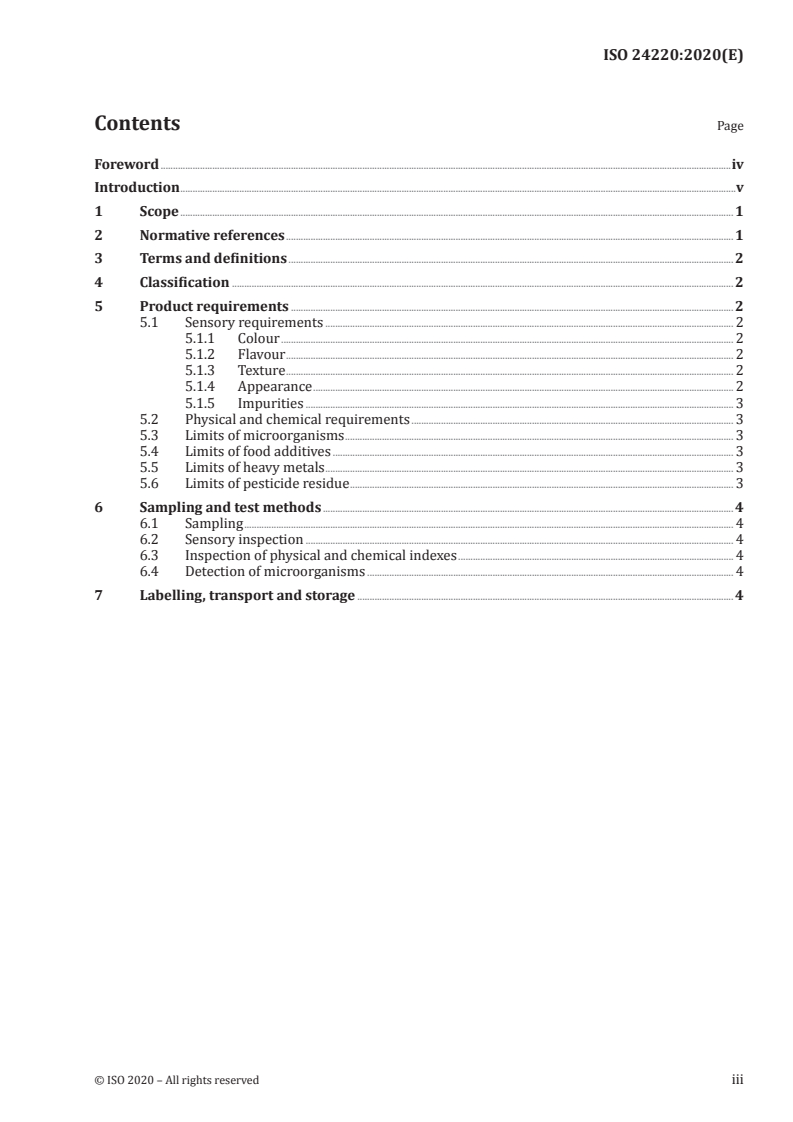
Contents Page
Foreword .iv
Introduction .v
1 Scope . 1
2 Normative references . 1
3 Terms and definitions . 2
4 Classification . 2
5 Product requirements . 2
5.1 Sensory requirements . 2
5.1.1 Colour . 2
5.1.2 Flavour . 2
5.1.3 Texture . 2
5.1.4 Appearance . 2
5.1.5 Impurities . 3
5.2 Physical and chemical requirements . 3
5.3 Limits of microorganisms . 3
5.4 Limits of food additives . 3
5.5 Limits of heavy metals . 3
5.6 Limits of pesticide residue . 3
6 Sampling and test methods . 4
6.1 Sampling . 4
6.2 Sensory inspection . 4
6.3 Inspection of physical and chemical indexes . 4
6.4 Detection of microorganisms . 4
7 Labelling, transport and storage . 4
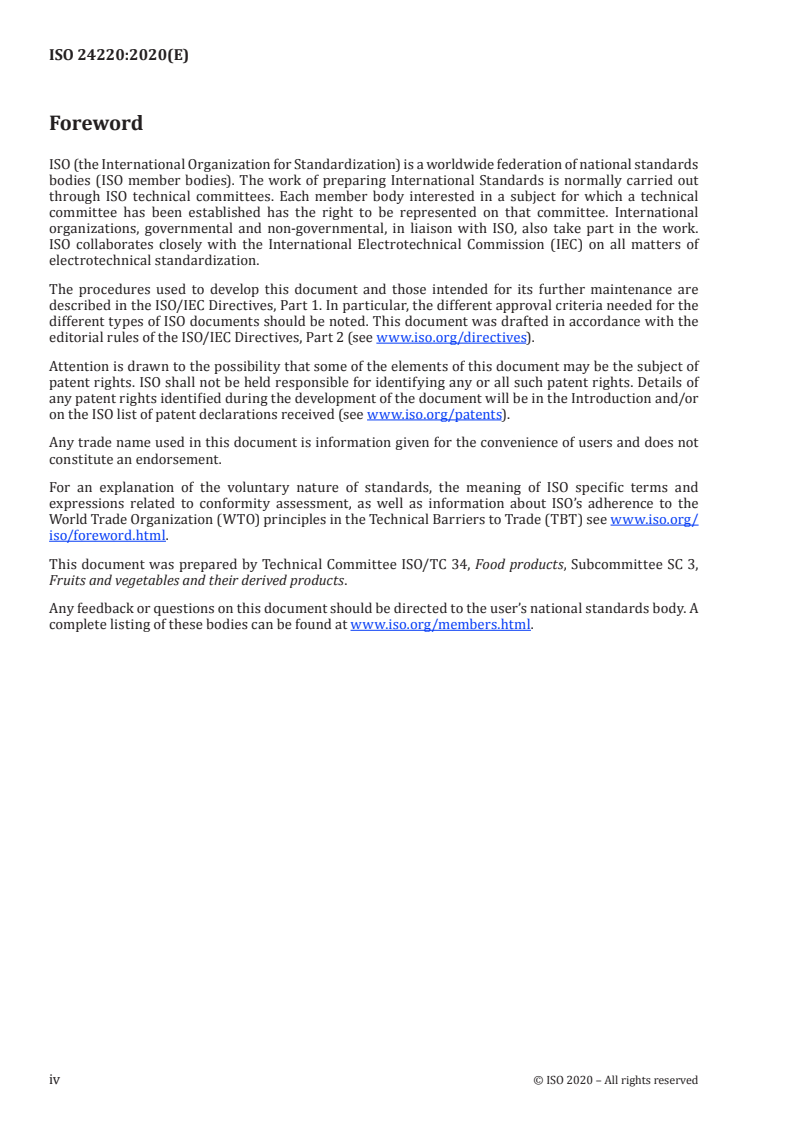
Foreword
ISO (the International Organization for Standardization) is a worldwide federation of national standards
bodies (ISO member bodies). The work of preparing International Standards is normally carried out
through ISO technical committees. Each member body interested in a subject for which a technical
committee has been established has the right to be represented on that committee. International
organizations, governmental and non-governmental, in liaison with ISO, also take part in the work.
ISO collaborates closely with the International Electrotechnical Commission (IEC) on all matters of
electrotechnical standardization.
The procedures used to develop this document and those intended for its further maintenance are
described in the ISO/IEC Directives, Part 1. In particular, the different approval criteria needed for the
different types of ISO documents should be noted. This document was drafted in accordance with the
editorial rules of the ISO/IEC Directives, Part 2 (see www .iso .org/ directives).
Attention is drawn to the possibility that some of the elements of this document may be the subject of
patent rights. ISO shall not be held responsible for identifying any or all such patent rights. Details of
any patent rights identified during the development of the document will be in the Introduction and/or
on the ISO list of patent declarations received (see www .iso .org/ patents).
Any trade name used in this document is information given for the convenience of users and does not
constitute an endorsement.
For an explanation of the voluntary nature of standards, the meaning of ISO specific terms and
expressions related to conformity assessment, as well as information about ISO’s adherence to the
World Trade Organization (WTO) principles in the Technical Barriers to Trade (TBT) see www .iso .org/
iso/ foreword .html.
This document was prepared by Technical Committee ISO/TC 34, Food products, Subcommittee SC 3,
Fruits and vegetables and their derived products.
Any feedback or questions on this document should be directed to the user’s national standards body. A
complete listing of these bodies can be found at www .iso .org/ members .html.
iv © ISO 2020 – All rights reserved
Introduction
Pao cai (salted fermented vegetables) is a traditional fermented vegetable product, rich in organic acids,
amino acids and other nutrients. It is recognized as being conducive to human health and has become
one of the world’s recognized healthy fermented vegetable products.
Pao cai has a long history of production. It was introduced into Europe in the 17th century. Nowadays, it
sells well all over the world, especially in countries and regions where it is regularly consumed, such as
in China, Japan, Korea and Europe. Accordingly, an industry to supply pao cai h
...
INTERNATIONAL ISO
STANDARD 24220
First edition
2020-12
Pao cai (salted fermented
vegetables) — Specification and test
methods
Pao cai (légumes fermentés salés) — Spécification et méthodes
d'essais
Reference number
©
ISO 2020
© ISO 2020
All rights reserved. Unless otherwise specified, or required in the context of its implementation, no part of this publication may
be reproduced or utilized otherwise in any form or by any means, electronic or mechanical, including photocopying, or posting
on the internet or an intranet, without prior written permission. Permission can be requested from either ISO at the address
below or ISO’s member body in the country of the requester.
ISO copyright office
CP 401 • Ch. de Blandonnet 8
CH-1214 Vernier, Geneva
Phone: +41 22 749 01 11
Email: copyright@iso.org
Website: www.iso.org
Published in Switzerland
ii © ISO 2020 – All rights reserved
Contents Page
Foreword .iv
Introduction .v
1 Scope . 1
2 Normative references . 1
3 Terms and definitions . 2
4 Classification . 2
5 Product requirements . 2
5.1 Sensory requirements . 2
5.1.1 Colour . 2
5.1.2 Flavour . 2
5.1.3 Texture . 2
5.1.4 Appearance . 2
5.1.5 Impurities . 3
5.2 Physical and chemical requirements . 3
5.3 Limits of microorganisms . 3
5.4 Limits of food additives . 3
5.5 Limits of heavy metals . 3
5.6 Limits of pesticide residue . 3
6 Sampling and test methods . 4
6.1 Sampling . 4
6.2 Sensory inspection . 4
6.3 Inspection of physical and chemical indexes . 4
6.4 Detection of microorganisms . 4
7 Labelling, transport and storage . 4
Foreword
ISO (the International Organization for Standardization) is a worldwide federation of national standards
bodies (ISO member bodies). The work of preparing International Standards is normally carried out
through ISO technical committees. Each member body interested in a subject for which a technical
committee has been established has the right to be represented on that committee. International
organizations, governmental and non-governmental, in liaison with ISO, also take part in the work.
ISO collaborates closely with the International Electrotechnical Commission (IEC) on all matters of
electrotechnical standardization.
The procedures used to develop this document and those intended for its further maintenance are
described in the ISO/IEC Directives, Part 1. In particular, the different approval criteria needed for the
different types of ISO documents should be noted. This document was drafted in accordance with the
editorial rules of the ISO/IEC Directives, Part 2 (see www .iso .org/ directives).
Attention is drawn to the possibility that some of the elements of this document may be the subject of
patent rights. ISO shall not be held responsible for identifying any or all such patent rights. Details of
any patent rights identified during the development of the document will be in the Introduction and/or
on the ISO list of patent declarations received (see www .iso .org/ patents).
Any trade name used in this document is information given for the convenience of users and does not
constitute an endorsement.
For an explanation of the voluntary nature of standards, the meaning of ISO specific terms and
expressions related to conformity assessment, as well as information about ISO’s adherence to the
World Trade Organization (WTO) principles in the Technical Barriers to Trade (TBT) see www .iso .org/
iso/ foreword .html.
This document was prepared by Technical Committee ISO/TC 34, Food products, Subcommittee SC 3,
Fruits and vegetables and their derived products.
Any feedback or questions on this document should be directed to the user’s national standards body. A
complete listing of these bodies can be found at www .iso .org/ members .html.
iv © ISO 2020 – All rights reserved
Introduction
Pao cai (salted fermented vegetables) is a traditional fermented vegetable product, rich in organic acids,
amino acids and other nutrients. It is recognized as being conducive to human health and has become
one of the world’s recognized healthy fermented vegetable products.
Pao cai has a long history of production. It was introduced into Europe in the 17th century. Nowadays, it
sells well all over the world, especially in countries and regions where it is regularly consumed, such as
in China, Japan, Korea and Europe. Accordingly, an industry to supply pao cai h
...