

ISO 6520-2:2013
(Main)Welding and allied processes — Classification of geometric imperfections in metallic materials — Part 2: Welding with pressure
General Information
- Abstract
ISO 6520-2:2013 collects and classifies the possible imperfections in welds made with pressure. A uniform designation is specified. Only the type, shape, and dimensions of the different imperfections caused by welding with pressure are included. Metallurgical deviations are not taken into account. Imperfections produced other than by the welding operation, e.g. additional stresses, loads or environmental factors, are not covered by ISO 6520-2:2013. Information concerning the consequences of the imperfections mentioned and the use of particular structures is not given, because this depends on the specific requirements of the joint.
- Status
- Published
- Publication Date
- 23-Jul-2013
- Technical Committee
- ISO/TC 44/SC 7 - Representation and terms
- Drafting Committee
- ISO/TC 44/SC 7 - Representation and terms
- Current Stage
- 9093 - International Standard confirmed
- Start Date
- 08-Nov-2023
- Completion Date
- 29-Aug-2026
Overview
ISO 6520-2:2013 - Welding and allied processes: Classification of geometric imperfections in metallic materials - Part 2: Welding with pressure defines a uniform system to identify and name geometric imperfections that arise specifically from welding processes performed under pressure (press welding). The standard focuses only on the type, shape and dimensions of these imperfections and provides a consistent designation system for reporting and documentation. It does not address metallurgical deviations, causes outside the welding operation (e.g., environmental damage, applied loads), nor the structural consequences or acceptance criteria for those imperfections.
Key topics and technical requirements
- Scope and limitations: Only imperfections caused by welding with pressure are classified; metallurgical issues and external damage are excluded. The standard explicitly does not give guidance on consequence assessment or acceptance criteria.
- Classification structure: Imperfections are grouped into six main classes:
- P1 - Cracks
- P2 - Cavities
- P3 - Solid inclusions
- P4 - Lack of fusion
- P5 - Imperfect shape
- P6 - Any other imperfections not in P1–P5
- (The letter “P” denotes welding with pressure.)
- Designation and numbering: A uniform designation and a multi‑digit reference numbering system (three figures for principal imperfection; additional figures for sub-terms) are specified; the numbering follows the approach used in ISO 6520-1.
- Documentation format: Table 1 in the standard provides reference numbers, multilingual designations (English, French, German), explanations and, where necessary, illustrative figures to clarify defect forms.
- Normative references and editorial notes: The document is part of the ISO 6520 series and aligns with ISO/TC 44 terminology and representation rules.
Practical applications and who uses it
ISO 6520-2:2013 is a reference tool used to standardize the way welding-with-pressure imperfections are described and recorded across industries:
- Welding engineers and designers - to specify defect reporting language in fabrication documentation.
- Quality control and inspection teams - to classify and record observed geometric imperfections consistently during visual inspection and non-destructive testing (NDT).
- NDT technicians and inspectors - to annotate reports and link detected anomalies to a recognized defect taxonomy.
- Procurement and contract writers - to reference a common defect nomenclature in acceptance and inspection clauses.
- Standards writers and trainers - to harmonize terminology and instructional materials.
Note: For fusion-welding defect classification, refer to ISO 6520-1; ISO 6520-2 is specifically for press-welding contexts.
Related standards
- ISO 6520-1 - Welding and allied processes - Classification of geometric imperfections - Part 1: Fusion welding (numbering system alignment and complementary scope)
- ISO/TC 44 (Welding and allied processes) publications for related terminology and representation guidance
Keywords: ISO 6520-2:2013, welding with pressure, press welding, classification of geometric imperfections, weld defects, welding inspection, NDT, welding quality.
Relations
- Effective Date
- 09-Feb-2026
- Effective Date
- 09-Feb-2026
- Effective Date
- 12-Feb-2026
- Effective Date
- 21-Jul-2012
Get Certified
Connect with accredited certification bodies for this standard

DVS-ZERT GmbH
German welding certification society.
CARES (UK Certification Authority for Reinforcing Steels)
UK certification for reinforcing steels and construction.
EWF/IIW (European/International Welding Federation)
International welding personnel certification.
Sponsored listings
Frequently Asked Questions
ISO 6520-2:2013 is a standard published by the International Organization for Standardization (ISO). Its full title is "Welding and allied processes — Classification of geometric imperfections in metallic materials — Part 2: Welding with pressure". This standard covers: ISO 6520-2:2013 collects and classifies the possible imperfections in welds made with pressure. A uniform designation is specified. Only the type, shape, and dimensions of the different imperfections caused by welding with pressure are included. Metallurgical deviations are not taken into account. Imperfections produced other than by the welding operation, e.g. additional stresses, loads or environmental factors, are not covered by ISO 6520-2:2013. Information concerning the consequences of the imperfections mentioned and the use of particular structures is not given, because this depends on the specific requirements of the joint.
ISO 6520-2:2013 collects and classifies the possible imperfections in welds made with pressure. A uniform designation is specified. Only the type, shape, and dimensions of the different imperfections caused by welding with pressure are included. Metallurgical deviations are not taken into account. Imperfections produced other than by the welding operation, e.g. additional stresses, loads or environmental factors, are not covered by ISO 6520-2:2013. Information concerning the consequences of the imperfections mentioned and the use of particular structures is not given, because this depends on the specific requirements of the joint.
ISO 6520-2:2013 is classified under the following ICS (International Classification for Standards) categories: 25.160.40 - Welded joints and welds. The ICS classification helps identify the subject area and facilitates finding related standards.
ISO 6520-2:2013 has the following relationships with other standards: It is inter standard links to EN ISO 15614-13:2023, EN ISO 15614-13:2021, EN ISO 6520-2:2013, ISO 6520-2:2001. Understanding these relationships helps ensure you are using the most current and applicable version of the standard.
ISO 6520-2:2013 is available in PDF format for immediate download after purchase. The document can be added to your cart and obtained through the secure checkout process. Digital delivery ensures instant access to the complete standard document.
Standards Content (Sample)
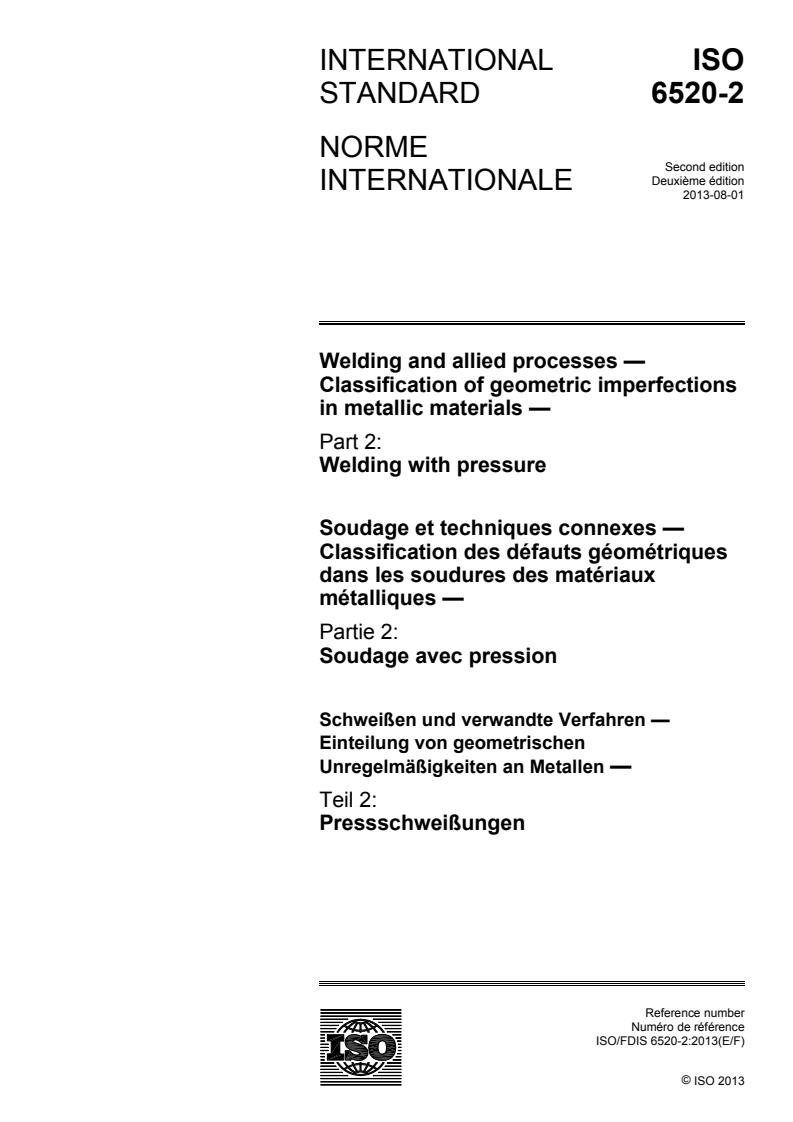
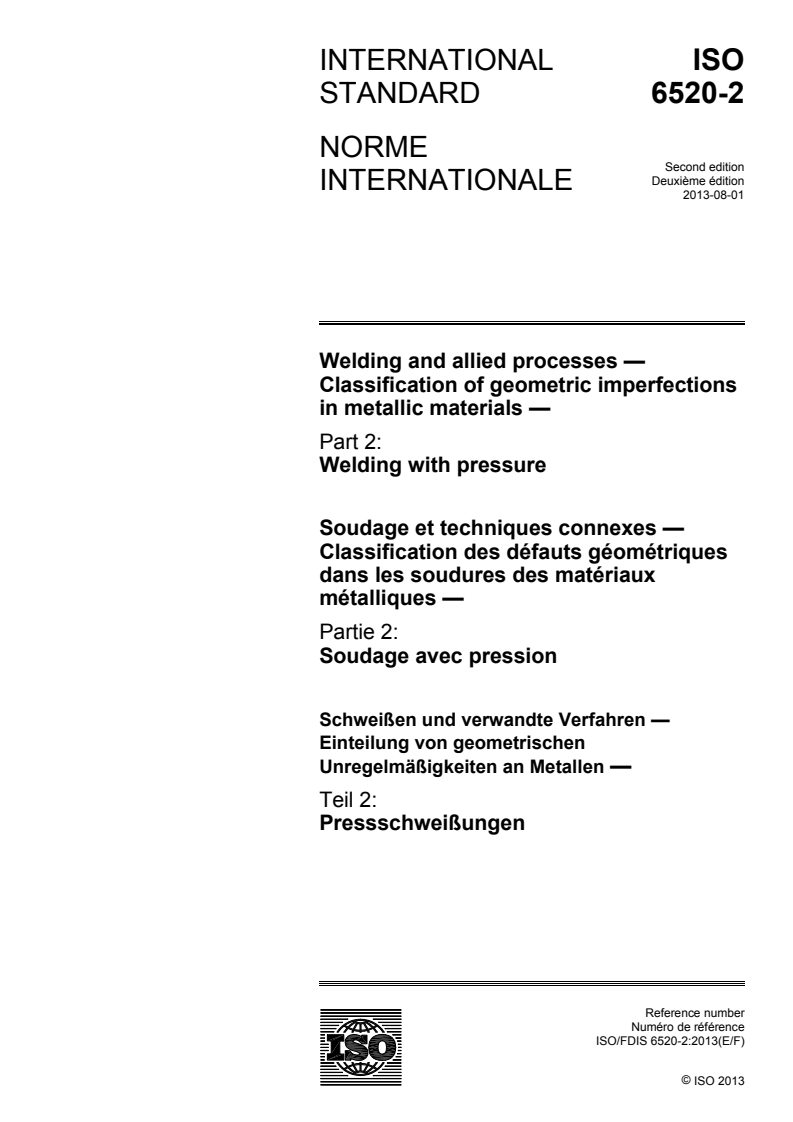
INTERNATIONAL ISO
STANDARD 6520-2
NORME
Second edition
Deuxième édition
INTERNATIONALE
2013-08-01
Welding and allied processes —
Classification of geometric imperfections
in metallic materials —
Part 2:
Welding with pressure
Soudage et techniques connexes —
Classification des défauts géométriques
dans les soudures des matériaux
métalliques —
Partie 2:
Soudage avec pression
Schweißen und verwandte Verfahren —
Einteilung von geometrischen
Unregelmäßigkeiten an Metallen —
Teil 2:
Pressschweißungen
Reference number
Numéro de référence
ISO/FDIS 6520-2:2013(E/F)
©
ISO 2013
DOCUMENT PROTÉGÉ PAR COPYRIGHT
© ISO 2013
The reproduction of the terms and definitions contained in this International Standard is permitted in teaching manuals, instruction
booklets, technical publications and journals for strictly educational or implementation purposes. The conditions for such reproduction are:
that no modifications are made to the terms and definitions; that such reproduction is not permitted for dictionaries or similar publications
offered for sale; and that this International Standard is referenced as the source document.
With the sole exceptions noted above, no other part of this publication may be reproduced or utilized in any form or by any means,
electronic or mechanical, including photocopying and microfilm, without permission in writing from either ISO at the address below or
ISO's member body in the country of the requester.
La reproduction des termes et des définitions contenus dans la présente Norme internationale est autorisée dans les manuels
d'enseignement, les modes d'emploi, les publications et revues techniques destinés exclusivement à l'enseignement ou à la mise en
application. Les conditions d'une telle reproduction sont les suivantes: aucune modification n'est apportée aux termes et définitions; la
reproduction n'est pas autorisée dans des dictionnaires ou publications similaires destinés à la vente; la présente Norme internationale
est citée comme document source.
À la seule exception mentionnée ci-dessus, aucune partie de cette publication ne peut être reproduite ni utilisée sous quelque forme que
ce soit et par aucun procédé, électronique ou mécanique, y compris la photocopie et les microfilms, sans l'accord écrit de l'ISO à
l'adresse ci-après ou du comité membre de l'ISO dans le pays du demandeur.
ISO copyright office
Case postale 56 CH-1211 Geneva 20
Tel. + 41 22 749 01 11
Fax + 41 22 749 09 47
E-mail copyright@iso.org
Web www.iso.org
Published in Switzerland/Publié en Suisse
ii © ISO 2013 – All rights reserved/Tous droits réservés
Copyright notice
This ISO document is a Draft International Standard and is copyright-protected by ISO. Except as permitted
under the applicable laws of the user's country, neither this ISO draft nor any extract from it may be
reproduced, stored in a retrieval system or transmitted in any form or by any means, electronic,
photocopying, recording or otherwise, without prior written permission being secured.
Requests for permission to reproduce should be addressed to either ISO at the address below or ISO's
member body in the country of the requester.
ISO copyright office
Case postale 56 CH-1211 Geneva 20
Tel. + 41 22 749 01 11
Fax + 41 22 749 09 47
E-mail copyright@iso.org
Web www.iso.org
Reproduction may be subject to royalty payments or a licensing agreement.
Violators may be prosecuted.
Notice de droit d'auteur
Ce document de l'ISO est un projet de Norme internationale qui est protégé par les droits d'auteur de l'ISO.
Sauf autorisé par les lois en matière de droits d'auteur du pays utilisateur, aucune partie de ce projet ISO
ne peut être reproduite, enregistrée dans un système d'extraction ou transmise sous quelque forme que ce
soit et par aucun procédé, électronique ou mécanique, y compris la photocopie, les enregistrements ou
autres, sans autorisation écrite préalable.
Les demandes d'autorisation de reproduction doivent être envoyées à l'ISO à l'adresse ci-après ou au
comité membre de l'ISO dans le pays du demandeur.
ISO copyright office
Case postale 56 CH-1211 Geneva 20
Tel. + 41 22 749 01 11
Fax + 41 22 749 09 47
E-mail copyright@iso.org
Web www.iso.org
Toute reproduction est soumise au paiement de droits ou à un contrat de licence.
Les contrevenants pourront être poursuivis.
Foreword
ISO (the International Organization for Standardization) is a worldwide federation of national standards bodies
(ISO member bodies). The work of preparing International Standards is normally carried out through ISO
technical committees. Each member body interested in a subject for which a technical committee has been
established has the right to be represented on that committee. International organizations, governmental and
non-governmental, in liaison with ISO, also take part in the work. ISO collaborates closely with the
International Electrotechnical Commission (IEC) on all matters of electrotechnical standardization.
International Standards are drafted in accordance with the rules given in the ISO/IEC Directives, Part 2.
The main task of technical committees is to prepare International Standards. Draft International Standards
adopted by the technical committees are circulated to the member bodies for voting. Publication as an
International Standard requires approval by at least 75 % of the member bodies casting a vote.
Attention is drawn to the possibility that some of the elements of this document may be the subject of patent
rights. ISO shall not be held responsible for identifying any or all such patent rights.
ISO 6520-2 was prepared by Technical Committee ISO/TC 44, Welding and allied processes, Subcommittee
SC 7, Representation and terms.
This second edition cancels and replaces the first edition (ISO 6520-2:2001) which has been technically
revised.
ISO 6520 consists of the following parts, under the general title Welding and allied processes — Classification
of geometric imperfections in metallic materials:
— Part 1: Fusion welding
— Part 2: Welding with pressure
Requests for official interpretations of any aspect of this part of ISO 6520 should be directed to the Secretariat
of ISO/TC 44/SC 7 via your national standards body. A complete listing of these bodies can be found at
www.iso.org.
iv © ISO 2013 – All rights reserved/Tous droits réservés
Avant-propos
L'ISO (Organisation internationale de normalisation) est une fédération mondiale d'organismes nationaux de
normalisation (comités membres de l'ISO). L'élaboration des Normes internationales est en général confiée
aux comités techniques de l'ISO. Chaque comité membre intéressé par une étude a le droit de faire partie du
comité technique créé à cet effet. Les organisations internationales, gouvernementales et non
gouvernementales, en liaison avec l'ISO participent également aux travaux. L'ISO collabore étroitement avec
la Commission électrotechnique internationale (CEI) en ce qui concerne la normalisation électrotechnique.
Les Normes internationales sont rédigées conformément aux règles données dans les Directives ISO/CEI,
Partie 2.
La tâche principale des comités techniques est d'élaborer les Normes internationales. Les projets de Normes
internationales adoptés par les comités techniques sont soumis aux comités membres pour vote. Leur
publication comme Normes internationales requiert l'approbation de 75 % au moins des comités membres
votants.
L'attention est appelée sur le fait que certains des éléments du présent document peuvent faire l'objet de
droits de propriété intellectuelle ou de droits analogues. L'ISO ne saurait être tenue pour responsable de ne
pas avoir identifié de tels droits de propriété et averti de leur existence.
L’ISO 6520-2 a été élaborée par le comité technique ISO/TC 44, Soudage et techniques connexes,
sous-comité SC 7, Représentation et terminologie.
Cette deuxième édition annule et remplace la première édition (6520-2:2001), qui a fait l'objet d'une révision
technique.
L'ISO 6520 comprend les parties suivantes, présentées sous le titre général Soudage et techniques
connexes — Classification des défauts géométriques dans les soudures des matériaux métalliques:
— Partie 1: Soudage par fusion
— Partie 2: Soudage avec pression
Il convient d'adresser les demandes d’interprétation officielles de l’un quelconque des aspects de la présente
partie de l’ISO 6520 au secrétariat de l’ISO/TC 44/SC 7 via votre organisme national de normalisation. La liste
exhaustive de ces organismes peut être trouvée à l’adresse www.iso.org.
Vorwort
Die ISO (Internationale Organisation für Normung) ist die weltweite Vereinigung nationaler Normungsinstitute
(ISO-Mitgliedskörperschaften). Die Erarbeitung Internationaler Normen obliegt den Technischen Komitees der
ISO. Jede Mitgliedskörperschaft, die sich für ein Thema interessiert, für das ein Technisches Komitee
eingesetzt wurde, ist berechtigt, in diesem Komitee mitzuarbeiten. Internationale (staatliche und
nichtstaatliche) Organisationen, die mit der ISO in Verbindung stehen, sind an den Arbeiten ebenfalls beteiligt.
Die ISO arbeitet bei allen Angelegenheiten der elektrotechnischen Normung eng mit der Internationalen
Elektrotechnischen Kommission (IEC) zusammen.
Internationale Normen werden in Übereinstimmung mit den Gestaltungsregeln der ISO/IEC-Direktiven, Teil 2,
erarbeitet.
Die Hauptaufgabe von Technischen Komitees ist die Erarbeitung Internationaler Normen. Die von den
Technischen Komitees verabschiedeten internationalen Norm-Entwürfe werden den Mitgliedskörperschaften
zur Abstimmung vorgelegt. Die Veröffentlichung als Internationale Norm erfordert Zustimmung von
mindestens 75 % der abstimmenden Mitgliedskörperschaften.
Es wird auf die Möglichkeit aufmerksam gemacht, dass einige der Festlegungen in diesem Dokument
Gegenstand von Patentrechten sein können. Die ISO ist nicht dafür verantwortlich, einzelne oder alle solcher
Patentrechte zu kennzeichnen.
ISO 6520-2 wurde vom Technischen Komitee ISO/TC 44, Schweißen und verwandte Prozesse, Unterkomitee
SC 7, Darstellung und Begriffe, erarbeitet.
Diese zweite Ausgabe ersetzt die erste Ausgabe (ISO 6520-2:2001), die technisch überarbeitet wurde.
ISO 6520-2 besteht aus den folgenden Teilen, unter dem Haupttitel Schweißen und verwandte Prozesse —
Einteilung von geometrischen Unregelmäßigkeiten an metallischen Werkstoffen:
— Teil 1: Schmelzschweißen
— Teil 2: Preßschweissungen
Anfragen für offizielle Auslegungen von Testlegungen zu diesen Norm können an das Sekretariat des
ISO/TC 44/SC 7 über ihre nationalen Normungsorganisationen gerichtet werden. Eine vollständige Auflistung
kann unter www.iso.org gefunden werden.
vi © ISO 2013 – All rights reserved/Tous droits réservés
INTERNATIONAL STANDARD
NORME INTERNATIONALE
Welding and allied processes — Classification of geometric
imperfections in metallic materials —
Part 2:
Welding with pressure
Soudage et techniques connexes — Classification des défauts
géométriques dans les soudures des matériaux métalliques —
Partie 2:
Soudage avec pression
Schweißen und verwandte Verfahren — Einteilung von geometrischen
Unregelmäßigkeiten an Metallen —
Teil 2:
Pressschweißungen
1 Scope 1 Domaine d'application 1 Anwendungsbereich
This part of ISO 6520 collects and La présente partie de l'ISO 6520 In dieser Internationalen Norm sind
classifies the possible réunit et classifie les défauts die an Pressschweißverbindungen
imperfections in welds made with éventuels des soudures par möglichen Unregelmäßigkeiten
pressure. A uniform designation is pression. On y spécifie une zusammengestellt und eingeteilt.
specified. Only the type, shape, désignation uniforme. Elle ne Hierfür sind einheitliche
and dimensions of the different comprend que le type, la forme et Benennungen festgelegt. Die Norm
imperfections caused by welding les dimensions des différents umfasst nur Art, Form und Lage von
with pressure are included. défauts dus au soudage par Unregelmäßigkeiten, die durch
Metallurgical deviations are not pression et ne tient pas compte des Pressschweißen verursacht
taken into account. Imperfections différences métallurgiques. Les wurden. Metallurgische
produced other than by the welding défauts provoqués par des Veränderungen bleiben
operation, e.g. additional stresses, opérations autres que le soudage, unberücksichtigt.
loads or environmental factors, are par exemple des contraintes ou des Unregelmäßigkeiten, die nicht durch
not covered by this part of sollicitations supplémentaires ou das Schweißen entstanden sind,
ISO 6520. des facteurs liés à l’environnement, z.B. zusätzliche Spannungen,
ne sont pas couverts par la Belastungen oder Umwelteinflüsse,
Information concerning the
présente partie de l'ISO 6520. sind nicht Bestandteil dieser Norm.
consequences of the imperfections
mentioned and the use of particular Aucune information concernant les Es wird nichts darüber ausgesagt,
structures is not given, because conséquences des défauts men- wie die Unregelmäßigkeiten im
this depends on the specific tionnés et l’utilisation de structures Einzelfall zu beurteilen sind, da dies
requirements of the joint. particulières n’est donnée, ces von den jeweiligen Anforderungen
informations dépendant des exi- an die Schweißverbindungen
NOTE In addition to terms used in
gences spécifiques qui s’appliquent abhängt.
English and French, two of the three
au joint.
official ISO languages, this document
gives the equivalent terms in German;
NOTE En complément des termes et
these are published under the
définitions utilisés en anglais et en
responsibility of the member body for
français, deux des trois langues
Germany (DIN) and are given for
officielles de l’ISO, le présent document
information only. Only the terms and
donne les termes équivalents en
definitions given in the official
langue allemande; ces termes sont
languages can be considered as ISO
publiés sous la responsabilité du
terms.
comité membre allemand (DIN) et sont
donnés uniquement pour information.
Seuls les termes et définitions donnés
dans les langues officielles peuvent
être considérés comme étant des
termes et des définitions de l’ISO.
2 © ISO 2013 – All rights reserved/Tous droits réservés
2 Normative references 2 Références normatives 2 Normative
Verweisungen
The following referenced Les documents de référence
documents are indispensable for suivants sont indispensables pour
Die folgenden zitierten Dokumente
the application of this document. l'application du présent document.
sind für die Anwendung dieses
For dated references, only the Pour les références datées, seule
Dokuments erforderlich. Bei
edition cited applies. For undated l'édition citée s'applique. Pour les
datierten Verweisungen gilt nur die
references, the latest edition of the références non datées, la dernière
in Bezug genommene Ausgabe. Bei
referenced document (including édition du document de référence
undatierten Verweisungen gilt die
any amendments) applies. s'applique (y compris les éventuels
letzte Ausgabe des in Bezug
amendements).
genommenen Dokuments
ISO 6520-1, Welding and allied
(einschließlich aller Änderungen).
processes — Classification of ISO 6520-1, Soudage et tech-
geometric imperfections in metallic niques connexes — Classification
ISO 6520-1, Welding and allied
materials — Part 1: Fusion welding des défauts géométriques dans les
processes — Classification of
soudures des matériaux métal-
geometric imperfections in metallic
liques — Partie 1: Soudage par
materials — Part 1: Fusion welding
fusion
3 Classification 3 Classification 3 Einteilung
The imperfections are classified Les défauts sont classifiés en six Die Unregelmäßigkeiten sind in
into six groups: groupes: sechs Gruppen eingeteilt:
— P1 — Cracks; — P1 — Fissures; — P1 -Risse
— P2 — Cavities; — P2 — Cavités; — P2 -Hohlräume
— P3 — Solid inclusions; — P3 — Inclusions solides; — P3 -Feste Einschlüsse
— P4 — Lack of fusion; — P4 — Manque de fusion; — P4 -Bindefehler
— P5 — Imperfect shape; — P5 — Défauts de forme; — P5 -Form und Maßabweichung
— P6 — Any other imperfections — P6 — Autres défauts n’entrant — P6 -Sonstige
not included in groups P1 to pas dans les groupes P1 à P5. Unregelmäßigkeiten
P5.
La lettre «P» signifie soudage par Der Buchstabe “P” kennzeichnet
The letter “P” stands for welding pression. das Pressschweißen.
with pressure.
As regards Table 1 it has to be En ce qui concerne le Tableau 1, Bezüglich der Tabelle 1 ist auf
noted that: on notera que: folgendes hinzuweisen:
a) column 1 gives a three figure a) la colonne 1 donne un numéro
a) Spalte 1 enthält eine
reference number for each de référence à trois chiffres
dreistellige Ordnungsnummer
principal imperfection and a pour chaque défaut principal et
für grundsätzliche Unregelmä-
four or five figure number for un nombre de quatre ou cinq
ßigkeiten und eine vier- oder
each sub term; chiffres pour chaque sous-
fünfstellige Ordnungsnummer
terme;
für Untergruppen.
b) column 2 gives the designation
or name of each imperfection b) la colonne 2 donne la désigna-
b) Spalte 2 enthält die Bezeich-
in English, French and tion ou le nom de chaque
nung oder Benennung jeder
German; défaut en anglais, français et
Unregelmäßigkeit in Englisch,
allemand;
c) columns 3 to 5 give explana- Französisch und Deutsch.
tions in English, French and c) les colonnes 3 à 5 donnent, si
c) Spalten 3 bis 5 enthalten -
German where necessary; nécessaire, les commentaires
sofern zweckmäßig- Erklärun-
en anglais, français et
d) column 6 provides, where
gen in Englisch, Französisch
allemand;
necessary, illustrations for
und Deutsch.
supplementary explanations. d) la colonne 6 donne, si
nécessaire, des illustrations d) Spalte 6 enthält -sofern
fournissant des explications
zweckmäßig- Darstellungen zur
supplémentaires. Ergänzung der Erklärungen.
The numbering system shall follow Le système de numérotation doit Das Nummernsystem muss analog
that used in ISO 6520-1. suivre celui utilisé dans dem Nummernsystem nach
l’ISO 6520-1. EN ISO 6520-1 sein.
Table A.1 gives guidance on the
welding processes in which the Le Tableau A.1 donne les procédés Tabelle A.1 gibt eine Orientierung
imperfections listed in this part of de soudage pour lesquels les welche Unregelmäßigkeiten die in
ISO 6250 can occur. défauts figurant dans la présente diesem Teil von ISO 6250
partie de l'ISO 6520 sont aufgezählt werden bei welchem
susceptibles de se produire. Schweißprozess auftreten können.
4 © ISO 2013 – All rights reserved/Tous droits réservés
Table 1 — Classification
Tableau 1 — Classification
Tabelle 1 — Einteilung
Reference Designation Illustrations
Explanation Commentaires Erklärung
Réference Désignation Illustrations
English Français Deutsch
Nummer Benennung Darstellung
1 2 3 4 5 6
o
Group 1 — Cracks; Groupe n 1 — Fissures; Gruppe 1 — Risse
P 100 Crack A discontinuity arising from the Discontinuité pouvant se Örtliche Werkstofftrennung, die
effect of cooling or stresses produire en cours de durch Vorgänge beim
Fissure
refroidissement ou sous l’effet Abkühlen oder durch
Riß
de contraintes Spannungen entstehen kann
P 1001 Micro-crack A crack usually only visible Fissure généralement visible Ein Riß, der üblicherweise nur
under a microscope seulement au microscope unter einem Mikroskop
Microfissure
sichtbar ist
Mikroriß
P 101 Longitudinal crack A crack substantially parallel to Fissure sensiblement parallèle Riß in Richtung der
the axis of the weld. It can be à l’axe de la soudure. Elle peut Schweißnaht verlaufend. Er
Fissure longitudinale
situated: se situer: kann liegen:
Längsriß
P 1011 — in the weld; dans la soudure; — in der Schweißnaht;
P 1013 — in the heat affected zone dans la zone affectée — in der Wärmeeinflußzone
(HAZ); thermiquement (ZAT); (WEZ);
P 1014 — in the unaffected parent dans le métal de base — im unbeeinflußten
metal Grundwerkstoff
P 102 Transverse crack A crack substantially Fissure sensiblement Riß, quer zur Schweißnaht
transverse to the axis of the perpendiculaire à l’axe de la verlaufend. Er kann liegen:
Fissure transversale
weld. It may be situated: soudure. Elle peut se situer:
Querriß
P 1021 — in the weld; dans la soudure; — in der Schweißnaht;
P 1023 — in the HAZ; dans la ZAT; — in der WEZ;
P 1024 — in the unaffected parent dans le métal de base non — im unbeeinflußten
metal affecté Grundwerkstoff
Table 1 (continued)
Tableau 1 (suite)
Tabelle 1 (fortgesetzt)
Reference Designation Illustrations
Explanation Commentaires Erklärung
Réference Désignation Illustrations
English Français Deutsch
Nummer Benennung Darstellung
1 2 3 4 5 6
P 1100 Star-crack Multiple cracks radiating from a Fissures multiples issues d’un Riß, vielfach sternförmig von
common central point and même point, généralement einer Stelle ausgehend
Fissure rayonnante (au
usually contained within the situées dans les limites du
centre du noyau)
nugget noyau
Riß in Linsenmitte
P 1200 Crack at the edge of Crack, often in the shape of a Fissure, souvent en forme de Riß, vielfach kommaförmig,
the nugget comma, which can extend into virgule, se prolongeant jusque u.U. bis in die WEZ verlaufend
the HAZ dans la ZAT
Fissure au bord du
noyau
Riß am Linsenrand
P 1300 Crack in the joining Cracks usually directed to the Fissure généralement orientée Riß, üblicherweise zum
plane edge of the nugget vers le bord du noyau Linsenrand gerichtet
Fissure dans le plan de
joint
Riß in der
Verbindungsebene
P 1400 Crack in the HAZ
Fissure dans la zone
affectée
See column 2 Voir colonne 2 Siehe Spalte 2
thermiquement (ZAT)
Riß in der Wärme-
einflußzone (WEZ)
6 © ISO 2013 – All rights reserved/Tous droits réservés
Table 1 (continued)
Tableau 1 (suite)
Tabelle 1 (fortgesetzt)
Reference Designation Illustrations
Explanation Commentaires Erklärung
Réference Désignation Illustrations
English Français Deutsch
Nummer Benennung Darstellung
1 2 3 4 5 6
P 1500 Crack in the
(unaffected) parent
metal
See column 2 Voir colonne 2 Siehe Spalte 2
Fissure dans le métal
de base
Riß im unbeeinflußten
Grundwerkstoff
P 1600 Surface-breaking crack Crack, open at the surface, Fissure située dans la zone Zur Werkstückoberfläche
found in the weld zone fondue et débouchant en offener Riß in der Schweiß-
Fissure débouchante
surface zone
Oberflächenriß
P 1700 “Hook” crack Crack in the area of the upset Fissure située dans le métal Riß im Bereich des Stauch-
metal often starting from refoulé et souvent issue wulstes, häufig von
Fissure en forme de
inclusions d’inclusions Einschlüssen ausgehend
virgule
Hakenriß
Group 2 — Cavities; Groupe no 2 — Cavités; Gruppe 2 — Risse
P 200 Cavity
See column 2 Voir colonne 2 Siehe Spalte 2
Cavité
Hohlraum
P 201 Gas cavity A cavity formed by entrapped Cavité formée par du (ou des) Gasgefüllter Hohlraum in der
gas in the nugget, in the weld gaz emprisonné(s) dans le Linse, in der Schweißnaht oder
Soufflure
or in the HAZ noyau, située dans la soudure in der WEZ
ou dans la zoneaffectée
Gaseinschluß
thermiquement (ZAT)
Table 1 (continued)
Tableau 1 (suite)
Tabelle 1 (fortgesetzt)
Reference Designation Illustrations
Explanation Commentaires Erklärung
Réference Désignation Illustrations
English Français Deutsch
Nummer Benennung Darstellung
1 2 3 4 5 6
P 2011 Gas pore A gas cavity of essentially Soufflure de forme Kugelförmiger Gaseinschluß
spherical form sensiblement sphérique
Soufflure sphéroïdale
Gaspore
P 2012 Uniformly distributed A number of gas pores Soufflures sphéroïdales Zahlreiche, gleichmäßig
porosity distributed in a substantially essentiellement distribuées de verteilte Poren im Schweißgut
uniform manner throughout the façon régulière dans le métal
Soufflures sphéroï-
weld metal fondu
dales uniformément
réparties
Gleichmäßig verteilte
Porosität
P 2013 Localized (clustered) Evenly distributed group of Groupe de soufflures réparties Örtlich gehäufte Poren
porosity pores de manière quelconque
Nid de soufflures
Porennest
P 2016 Worm-hole A tubular cavity in the weld Soufflure en forme de galerie Ein röhrenförmiger Hohlraum
metal, generally grouped in de ver dans le métal fondu. im Schweißgut. Schlauchporen
Soufflure vermiculaire
clusters and distributed in a Ces soufflures sont sind im allgemeinen zu
herringbone formation généralement groupées et Nestern gruppiert und wie
Schlauchpore
disposées en arête de poisson Krähenfüße verteilt
8 © ISO 2013 – All rights reserved/Tous droits réservés
Table 1 (continued)
Tableau 1 (suite)
Tabelle 1 (fortgesetzt)
Reference Designation Illustrations
Explanation Commentaires Erklärung
Réference Désignation Illustrations
English Français Deutsch
Nummer Benennung Darstellung
1 2 3 4 5 6
P 202 Shrinkage cavity A cavity produced in the weld Cavité due au retrait du métal Hohlraum infolge Erstarrungs-
metal during solidification. pendant la solidification schwindung.
Retassure
Lunker
P 203 Forging cavity A forging cavity can be Les retassures par forgeage Hohlraum durch Vertiefungen
accentuated by shrinkage peuvent être accentuées sous an den Grenzflächen. Er kann
Retassure de forgeage
l’effet d’un retrait durch Schrumpfen verstärkt
werden
Schmiedelunker
Group 3 — Solid inclusions; Groupe no 3 — Inclusions solides; Gruppe 3 — Feste Einschlüsse
P 300 Solid inclusion Solid foreign substance Corps solide étranger Feste Fremdstoffeinlagerung in
entrapped in the weld emprisonné dans la soudure der Schweißverbindung
Inclusion solide
Feststoffeinschluß
P 301 Slag inclusion Non-metallic inclusions in the Laitier emprisonné dans le Nichtmetallische Einschlüsse
weld (isolated or clustered) métal fondu. Les inclusions de in der Schweißverbindung;
I
...
INTERNATIONAL ISO
STANDARD 6520-2
NORME
Second edition
Deuxième édition
INTERNATIONALE
2013-08-01
Welding and allied processes —
Classification of geometric imperfections
in metallic materials —
Part 2:
Welding with pressure
Soudage et techniques connexes —
Classification des défauts géométriques
dans les soudures des matériaux
métalliques —
Partie 2:
Soudage avec pression
Schweißen und verwandte Verfahren —
Einteilung von geometrischen
Unregelmäßigkeiten an Metallen —
Teil 2:
Pressschweißungen
Reference number
Numéro de référence
ISO/FDIS 6520-2:2013(E/F)
©
ISO 2013
DOCUMENT PROTÉGÉ PAR COPYRIGHT
© ISO 2013
The reproduction of the terms and definitions contained in this International Standard is permitted in teaching manuals, instruction
booklets, technical publications and journals for strictly educational or implementation purposes. The conditions for such reproduction are:
that no modifications are made to the terms and definitions; that such reproduction is not permitted for dictionaries or similar publications
offered for sale; and that this International Standard is referenced as the source document.
With the sole exceptions noted above, no other part of this publication may be reproduced or utilized in any form or by any means,
electronic or mechanical, including photocopying and microfilm, without permission in writing from either ISO at the address below or
ISO's member body in the country of the requester.
La reproduction des termes et des définitions contenus dans la présente Norme internationale est autorisée dans les manuels
d'enseignement, les modes d'emploi, les publications et revues techniques destinés exclusivement à l'enseignement ou à la mise en
application. Les conditions d'une telle reproduction sont les suivantes: aucune modification n'est apportée aux termes et définitions; la
reproduction n'est pas autorisée dans des dictionnaires ou publications similaires destinés à la vente; la présente Norme internationale
est citée comme document source.
À la seule exception mentionnée ci-dessus, aucune partie de cette publication ne peut être reproduite ni utilisée sous quelque forme que
ce soit et par aucun procédé, électronique ou mécanique, y compris la photocopie et les microfilms, sans l'accord écrit de l'ISO à
l'adresse ci-après ou du comité membre de l'ISO dans le pays du demandeur.
ISO copyright office
Case postale 56 CH-1211 Geneva 20
Tel. + 41 22 749 01 11
Fax + 41 22 749 09 47
E-mail copyright@iso.org
Web www.iso.org
Published in Switzerland/Publié en Suisse
ii © ISO 2013 – All rights reserved/Tous droits réservés
Copyright notice
This ISO document is a Draft International Standard and is copyright-protected by ISO. Except as permitted
under the applicable laws of the user's country, neither this ISO draft nor any extract from it may be
reproduced, stored in a retrieval system or transmitted in any form or by any means, electronic,
photocopying, recording or otherwise, without prior written permission being secured.
Requests for permission to reproduce should be addressed to either ISO at the address below or ISO's
member body in the country of the requester.
ISO copyright office
Case postale 56 CH-1211 Geneva 20
Tel. + 41 22 749 01 11
Fax + 41 22 749 09 47
E-mail copyright@iso.org
Web www.iso.org
Reproduction may be subject to royalty payments or a licensing agreement.
Violators may be prosecuted.
Notice de droit d'auteur
Ce document de l'ISO est un projet de Norme internationale qui est protégé par les droits d'auteur de l'ISO.
Sauf autorisé par les lois en matière de droits d'auteur du pays utilisateur, aucune partie de ce projet ISO
ne peut être reproduite, enregistrée dans un système d'extraction ou transmise sous quelque forme que ce
soit et par aucun procédé, électronique ou mécanique, y compris la photocopie, les enregistrements ou
autres, sans autorisation écrite préalable.
Les demandes d'autorisation de reproduction doivent être envoyées à l'ISO à l'adresse ci-après ou au
comité membre de l'ISO dans le pays du demandeur.
ISO copyright office
Case postale 56 CH-1211 Geneva 20
Tel. + 41 22 749 01 11
Fax + 41 22 749 09 47
E-mail copyright@iso.org
Web www.iso.org
Toute reproduction est soumise au paiement de droits ou à un contrat de licence.
Les contrevenants pourront être poursuivis.
Foreword
ISO (the International Organization for Standardization) is a worldwide federation of national standards bodies
(ISO member bodies). The work of preparing International Standards is normally carried out through ISO
technical committees. Each member body interested in a subject for which a technical committee has been
established has the right to be represented on that committee. International organizations, governmental and
non-governmental, in liaison with ISO, also take part in the work. ISO collaborates closely with the
International Electrotechnical Commission (IEC) on all matters of electrotechnical standardization.
International Standards are drafted in accordance with the rules given in the ISO/IEC Directives, Part 2.
The main task of technical committees is to prepare International Standards. Draft International Standards
adopted by the technical committees are circulated to the member bodies for voting. Publication as an
International Standard requires approval by at least 75 % of the member bodies casting a vote.
Attention is drawn to the possibility that some of the elements of this document may be the subject of patent
rights. ISO shall not be held responsible for identifying any or all such patent rights.
ISO 6520-2 was prepared by Technical Committee ISO/TC 44, Welding and allied processes, Subcommittee
SC 7, Representation and terms.
This second edition cancels and replaces the first edition (ISO 6520-2:2001) which has been technically
revised.
ISO 6520 consists of the following parts, under the general title Welding and allied processes — Classification
of geometric imperfections in metallic materials:
— Part 1: Fusion welding
— Part 2: Welding with pressure
Requests for official interpretations of any aspect of this part of ISO 6520 should be directed to the Secretariat
of ISO/TC 44/SC 7 via your national standards body. A complete listing of these bodies can be found at
www.iso.org.
iv © ISO 2013 – All rights reserved/Tous droits réservés
Avant-propos
L'ISO (Organisation internationale de normalisation) est une fédération mondiale d'organismes nationaux de
normalisation (comités membres de l'ISO). L'élaboration des Normes internationales est en général confiée
aux comités techniques de l'ISO. Chaque comité membre intéressé par une étude a le droit de faire partie du
comité technique créé à cet effet. Les organisations internationales, gouvernementales et non
gouvernementales, en liaison avec l'ISO participent également aux travaux. L'ISO collabore étroitement avec
la Commission électrotechnique internationale (CEI) en ce qui concerne la normalisation électrotechnique.
Les Normes internationales sont rédigées conformément aux règles données dans les Directives ISO/CEI,
Partie 2.
La tâche principale des comités techniques est d'élaborer les Normes internationales. Les projets de Normes
internationales adoptés par les comités techniques sont soumis aux comités membres pour vote. Leur
publication comme Normes internationales requiert l'approbation de 75 % au moins des comités membres
votants.
L'attention est appelée sur le fait que certains des éléments du présent document peuvent faire l'objet de
droits de propriété intellectuelle ou de droits analogues. L'ISO ne saurait être tenue pour responsable de ne
pas avoir identifié de tels droits de propriété et averti de leur existence.
L’ISO 6520-2 a été élaborée par le comité technique ISO/TC 44, Soudage et techniques connexes,
sous-comité SC 7, Représentation et terminologie.
Cette deuxième édition annule et remplace la première édition (6520-2:2001), qui a fait l'objet d'une révision
technique.
L'ISO 6520 comprend les parties suivantes, présentées sous le titre général Soudage et techniques
connexes — Classification des défauts géométriques dans les soudures des matériaux métalliques:
— Partie 1: Soudage par fusion
— Partie 2: Soudage avec pression
Il convient d'adresser les demandes d’interprétation officielles de l’un quelconque des aspects de la présente
partie de l’ISO 6520 au secrétariat de l’ISO/TC 44/SC 7 via votre organisme national de normalisation. La liste
exhaustive de ces organismes peut être trouvée à l’adresse www.iso.org.
Vorwort
Die ISO (Internationale Organisation für Normung) ist die weltweite Vereinigung nationaler Normungsinstitute
(ISO-Mitgliedskörperschaften). Die Erarbeitung Internationaler Normen obliegt den Technischen Komitees der
ISO. Jede Mitgliedskörperschaft, die sich für ein Thema interessiert, für das ein Technisches Komitee
eingesetzt wurde, ist berechtigt, in diesem Komitee mitzuarbeiten. Internationale (staatliche und
nichtstaatliche) Organisationen, die mit der ISO in Verbindung stehen, sind an den Arbeiten ebenfalls beteiligt.
Die ISO arbeitet bei allen Angelegenheiten der elektrotechnischen Normung eng mit der Internationalen
Elektrotechnischen Kommission (IEC) zusammen.
Internationale Normen werden in Übereinstimmung mit den Gestaltungsregeln der ISO/IEC-Direktiven, Teil 2,
erarbeitet.
Die Hauptaufgabe von Technischen Komitees ist die Erarbeitung Internationaler Normen. Die von den
Technischen Komitees verabschiedeten internationalen Norm-Entwürfe werden den Mitgliedskörperschaften
zur Abstimmung vorgelegt. Die Veröffentlichung als Internationale Norm erfordert Zustimmung von
mindestens 75 % der abstimmenden Mitgliedskörperschaften.
Es wird auf die Möglichkeit aufmerksam gemacht, dass einige der Festlegungen in diesem Dokument
Gegenstand von Patentrechten sein können. Die ISO ist nicht dafür verantwortlich, einzelne oder alle solcher
Patentrechte zu kennzeichnen.
ISO 6520-2 wurde vom Technischen Komitee ISO/TC 44, Schweißen und verwandte Prozesse, Unterkomitee
SC 7, Darstellung und Begriffe, erarbeitet.
Diese zweite Ausgabe ersetzt die erste Ausgabe (ISO 6520-2:2001), die technisch überarbeitet wurde.
ISO 6520-2 besteht aus den folgenden Teilen, unter dem Haupttitel Schweißen und verwandte Prozesse —
Einteilung von geometrischen Unregelmäßigkeiten an metallischen Werkstoffen:
— Teil 1: Schmelzschweißen
— Teil 2: Preßschweissungen
Anfragen für offizielle Auslegungen von Testlegungen zu diesen Norm können an das Sekretariat des
ISO/TC 44/SC 7 über ihre nationalen Normungsorganisationen gerichtet werden. Eine vollständige Auflistung
kann unter www.iso.org gefunden werden.
vi © ISO 2013 – All rights reserved/Tous droits réservés
INTERNATIONAL STANDARD
NORME INTERNATIONALE
Welding and allied processes — Classification of geometric
imperfections in metallic materials —
Part 2:
Welding with pressure
Soudage et techniques connexes — Classification des défauts
géométriques dans les soudures des matériaux métalliques —
Partie 2:
Soudage avec pression
Schweißen und verwandte Verfahren — Einteilung von geometrischen
Unregelmäßigkeiten an Metallen —
Teil 2:
Pressschweißungen
1 Scope 1 Domaine d'application 1 Anwendungsbereich
This part of ISO 6520 collects and La présente partie de l'ISO 6520 In dieser Internationalen Norm sind
classifies the possible réunit et classifie les défauts die an Pressschweißverbindungen
imperfections in welds made with éventuels des soudures par möglichen Unregelmäßigkeiten
pressure. A uniform designation is pression. On y spécifie une zusammengestellt und eingeteilt.
specified. Only the type, shape, désignation uniforme. Elle ne Hierfür sind einheitliche
and dimensions of the different comprend que le type, la forme et Benennungen festgelegt. Die Norm
imperfections caused by welding les dimensions des différents umfasst nur Art, Form und Lage von
with pressure are included. défauts dus au soudage par Unregelmäßigkeiten, die durch
Metallurgical deviations are not pression et ne tient pas compte des Pressschweißen verursacht
taken into account. Imperfections différences métallurgiques. Les wurden. Metallurgische
produced other than by the welding défauts provoqués par des Veränderungen bleiben
operation, e.g. additional stresses, opérations autres que le soudage, unberücksichtigt.
loads or environmental factors, are par exemple des contraintes ou des Unregelmäßigkeiten, die nicht durch
not covered by this part of sollicitations supplémentaires ou das Schweißen entstanden sind,
ISO 6520. des facteurs liés à l’environnement, z.B. zusätzliche Spannungen,
ne sont pas couverts par la Belastungen oder Umwelteinflüsse,
Information concerning the
présente partie de l'ISO 6520. sind nicht Bestandteil dieser Norm.
consequences of the imperfections
mentioned and the use of particular Aucune information concernant les Es wird nichts darüber ausgesagt,
structures is not given, because conséquences des défauts men- wie die Unregelmäßigkeiten im
this depends on the specific tionnés et l’utilisation de structures Einzelfall zu beurteilen sind, da dies
requirements of the joint. particulières n’est donnée, ces von den jeweiligen Anforderungen
informations dépendant des exi- an die Schweißverbindungen
NOTE In addition to terms used in
gences spécifiques qui s’appliquent abhängt.
English and French, two of the three
au joint.
official ISO languages, this document
gives the equivalent terms in German;
NOTE En complément des termes et
these are published under the
définitions utilisés en anglais et en
responsibility of the member body for
français, deux des trois langues
Germany (DIN) and are given for
officielles de l’ISO, le présent document
information only. Only the terms and
donne les termes équivalents en
definitions given in the official
langue allemande; ces termes sont
languages can be considered as ISO
publiés sous la responsabilité du
terms.
comité membre allemand (DIN) et sont
donnés uniquement pour information.
Seuls les termes et définitions donnés
dans les langues officielles peuvent
être considérés comme étant des
termes et des définitions de l’ISO.
2 © ISO 2013 – All rights reserved/Tous droits réservés
2 Normative references 2 Références normatives 2 Normative
Verweisungen
The following referenced Les documents de référence
documents are indispensable for suivants sont indispensables pour
Die folgenden zitierten Dokumente
the application of this document. l'application du présent document.
sind für die Anwendung dieses
For dated references, only the Pour les références datées, seule
Dokuments erforderlich. Bei
edition cited applies. For undated l'édition citée s'applique. Pour les
datierten Verweisungen gilt nur die
references, the latest edition of the références non datées, la dernière
in Bezug genommene Ausgabe. Bei
referenced document (including édition du document de référence
undatierten Verweisungen gilt die
any amendments) applies. s'applique (y compris les éventuels
letzte Ausgabe des in Bezug
amendements).
genommenen Dokuments
ISO 6520-1, Welding and allied
(einschließlich aller Änderungen).
processes — Classification of ISO 6520-1, Soudage et tech-
geometric imperfections in metallic niques connexes — Classification
ISO 6520-1, Welding and allied
materials — Part 1: Fusion welding des défauts géométriques dans les
processes — Classification of
soudures des matériaux métal-
geometric imperfections in metallic
liques — Partie 1: Soudage par
materials — Part 1: Fusion welding
fusion
3 Classification 3 Classification 3 Einteilung
The imperfections are classified Les défauts sont classifiés en six Die Unregelmäßigkeiten sind in
into six groups: groupes: sechs Gruppen eingeteilt:
— P1 — Cracks; — P1 — Fissures; — P1 -Risse
— P2 — Cavities; — P2 — Cavités; — P2 -Hohlräume
— P3 — Solid inclusions; — P3 — Inclusions solides; — P3 -Feste Einschlüsse
— P4 — Lack of fusion; — P4 — Manque de fusion; — P4 -Bindefehler
— P5 — Imperfect shape; — P5 — Défauts de forme; — P5 -Form und Maßabweichung
— P6 — Any other imperfections — P6 — Autres défauts n’entrant — P6 -Sonstige
not included in groups P1 to pas dans les groupes P1 à P5. Unregelmäßigkeiten
P5.
La lettre «P» signifie soudage par Der Buchstabe “P” kennzeichnet
The letter “P” stands for welding pression. das Pressschweißen.
with pressure.
As regards Table 1 it has to be En ce qui concerne le Tableau 1, Bezüglich der Tabelle 1 ist auf
noted that: on notera que: folgendes hinzuweisen:
a) column 1 gives a three figure a) la colonne 1 donne un numéro
a) Spalte 1 enthält eine
reference number for each de référence à trois chiffres
dreistellige Ordnungsnummer
principal imperfection and a pour chaque défaut principal et
für grundsätzliche Unregelmä-
four or five figure number for un nombre de quatre ou cinq
ßigkeiten und eine vier- oder
each sub term; chiffres pour chaque sous-
fünfstellige Ordnungsnummer
terme;
für Untergruppen.
b) column 2 gives the designation
or name of each imperfection b) la colonne 2 donne la désigna-
b) Spalte 2 enthält die Bezeich-
in English, French and tion ou le nom de chaque
nung oder Benennung jeder
German; défaut en anglais, français et
Unregelmäßigkeit in Englisch,
allemand;
c) columns 3 to 5 give explana- Französisch und Deutsch.
tions in English, French and c) les colonnes 3 à 5 donnent, si
c) Spalten 3 bis 5 enthalten -
German where necessary; nécessaire, les commentaires
sofern zweckmäßig- Erklärun-
en anglais, français et
d) column 6 provides, where
gen in Englisch, Französisch
allemand;
necessary, illustrations for
und Deutsch.
supplementary explanations. d) la colonne 6 donne, si
nécessaire, des illustrations d) Spalte 6 enthält -sofern
fournissant des explications
zweckmäßig- Darstellungen zur
supplémentaires. Ergänzung der Erklärungen.
The numbering system shall follow Le système de numérotation doit Das Nummernsystem muss analog
that used in ISO 6520-1. suivre celui utilisé dans dem Nummernsystem nach
l’ISO 6520-1. EN ISO 6520-1 sein.
Table A.1 gives guidance on the
welding processes in which the Le Tableau A.1 donne les procédés Tabelle A.1 gibt eine Orientierung
imperfections listed in this part of de soudage pour lesquels les welche Unregelmäßigkeiten die in
ISO 6250 can occur. défauts figurant dans la présente diesem Teil von ISO 6250
partie de l'ISO 6520 sont aufgezählt werden bei welchem
susceptibles de se produire. Schweißprozess auftreten können.
4 © ISO 2013 – All rights reserved/Tous droits réservés
Table 1 — Classification
Tableau 1 — Classification
Tabelle 1 — Einteilung
Reference Designation Illustrations
Explanation Commentaires Erklärung
Réference Désignation Illustrations
English Français Deutsch
Nummer Benennung Darstellung
1 2 3 4 5 6
o
Group 1 — Cracks; Groupe n 1 — Fissures; Gruppe 1 — Risse
P 100 Crack A discontinuity arising from the Discontinuité pouvant se Örtliche Werkstofftrennung, die
effect of cooling or stresses produire en cours de durch Vorgänge beim
Fissure
refroidissement ou sous l’effet Abkühlen oder durch
Riß
de contraintes Spannungen entstehen kann
P 1001 Micro-crack A crack usually only visible Fissure généralement visible Ein Riß, der üblicherweise nur
under a microscope seulement au microscope unter einem Mikroskop
Microfissure
sichtbar ist
Mikroriß
P 101 Longitudinal crack A crack substantially parallel to Fissure sensiblement parallèle Riß in Richtung der
the axis of the weld. It can be à l’axe de la soudure. Elle peut Schweißnaht verlaufend. Er
Fissure longitudinale
situated: se situer: kann liegen:
Längsriß
P 1011 — in the weld; dans la soudure; — in der Schweißnaht;
P 1013 — in the heat affected zone dans la zone affectée — in der Wärmeeinflußzone
(HAZ); thermiquement (ZAT); (WEZ);
P 1014 — in the unaffected parent dans le métal de base — im unbeeinflußten
metal Grundwerkstoff
P 102 Transverse crack A crack substantially Fissure sensiblement Riß, quer zur Schweißnaht
transverse to the axis of the perpendiculaire à l’axe de la verlaufend. Er kann liegen:
Fissure transversale
weld. It may be situated: soudure. Elle peut se situer:
Querriß
P 1021 — in the weld; dans la soudure; — in der Schweißnaht;
P 1023 — in the HAZ; dans la ZAT; — in der WEZ;
P 1024 — in the unaffected parent dans le métal de base non — im unbeeinflußten
metal affecté Grundwerkstoff
Table 1 (continued)
Tableau 1 (suite)
Tabelle 1 (fortgesetzt)
Reference Designation Illustrations
Explanation Commentaires Erklärung
Réference Désignation Illustrations
English Français Deutsch
Nummer Benennung Darstellung
1 2 3 4 5 6
P 1100 Star-crack Multiple cracks radiating from a Fissures multiples issues d’un Riß, vielfach sternförmig von
common central point and même point, généralement einer Stelle ausgehend
Fissure rayonnante (au
usually contained within the situées dans les limites du
centre du noyau)
nugget noyau
Riß in Linsenmitte
P 1200 Crack at the edge of Crack, often in the shape of a Fissure, souvent en forme de Riß, vielfach kommaförmig,
the nugget comma, which can extend into virgule, se prolongeant jusque u.U. bis in die WEZ verlaufend
the HAZ dans la ZAT
Fissure au bord du
noyau
Riß am Linsenrand
P 1300 Crack in the joining Cracks usually directed to the Fissure généralement orientée Riß, üblicherweise zum
plane edge of the nugget vers le bord du noyau Linsenrand gerichtet
Fissure dans le plan de
joint
Riß in der
Verbindungsebene
P 1400 Crack in the HAZ
Fissure dans la zone
affectée
See column 2 Voir colonne 2 Siehe Spalte 2
thermiquement (ZAT)
Riß in der Wärme-
einflußzone (WEZ)
6 © ISO 2013 – All rights reserved/Tous droits réservés
Table 1 (continued)
Tableau 1 (suite)
Tabelle 1 (fortgesetzt)
Reference Designation Illustrations
Explanation Commentaires Erklärung
Réference Désignation Illustrations
English Français Deutsch
Nummer Benennung Darstellung
1 2 3 4 5 6
P 1500 Crack in the
(unaffected) parent
metal
See column 2 Voir colonne 2 Siehe Spalte 2
Fissure dans le métal
de base
Riß im unbeeinflußten
Grundwerkstoff
P 1600 Surface-breaking crack Crack, open at the surface, Fissure située dans la zone Zur Werkstückoberfläche
found in the weld zone fondue et débouchant en offener Riß in der Schweiß-
Fissure débouchante
surface zone
Oberflächenriß
P 1700 “Hook” crack Crack in the area of the upset Fissure située dans le métal Riß im Bereich des Stauch-
metal often starting from refoulé et souvent issue wulstes, häufig von
Fissure en forme de
inclusions d’inclusions Einschlüssen ausgehend
virgule
Hakenriß
Group 2 — Cavities; Groupe no 2 — Cavités; Gruppe 2 — Risse
P 200 Cavity
See column 2 Voir colonne 2 Siehe Spalte 2
Cavité
Hohlraum
P 201 Gas cavity A cavity formed by entrapped Cavité formée par du (ou des) Gasgefüllter Hohlraum in der
gas in the nugget, in the weld gaz emprisonné(s) dans le Linse, in der Schweißnaht oder
Soufflure
or in the HAZ noyau, située dans la soudure in der WEZ
ou dans la zoneaffectée
Gaseinschluß
thermiquement (ZAT)
Table 1 (continued)
Tableau 1 (suite)
Tabelle 1 (fortgesetzt)
Reference Designation Illustrations
Explanation Commentaires Erklärung
Réference Désignation Illustrations
English Français Deutsch
Nummer Benennung Darstellung
1 2 3 4 5 6
P 2011 Gas pore A gas cavity of essentially Soufflure de forme Kugelförmiger Gaseinschluß
spherical form sensiblement sphérique
Soufflure sphéroïdale
Gaspore
P 2012 Uniformly distributed A number of gas pores Soufflures sphéroïdales Zahlreiche, gleichmäßig
porosity distributed in a substantially essentiellement distribuées de verteilte Poren im Schweißgut
uniform manner throughout the façon régulière dans le métal
Soufflures sphéroï-
weld metal fondu
dales uniformément
réparties
Gleichmäßig verteilte
Porosität
P 2013 Localized (clustered) Evenly distributed group of Groupe de soufflures réparties Örtlich gehäufte Poren
porosity pores de manière quelconque
Nid de soufflures
Porennest
P 2016 Worm-hole A tubular cavity in the weld Soufflure en forme de galerie Ein röhrenförmiger Hohlraum
metal, generally grouped in de ver dans le métal fondu. im Schweißgut. Schlauchporen
Soufflure vermiculaire
clusters and distributed in a Ces soufflures sont sind im allgemeinen zu
herringbone formation généralement groupées et Nestern gruppiert und wie
Schlauchpore
disposées en arête de poisson Krähenfüße verteilt
8 © ISO 2013 – All rights reserved/Tous droits réservés
Table 1 (continued)
Tableau 1 (suite)
Tabelle 1 (fortgesetzt)
Reference Designation Illustrations
Explanation Commentaires Erklärung
Réference Désignation Illustrations
English Français Deutsch
Nummer Benennung Darstellung
1 2 3 4 5 6
P 202 Shrinkage cavity A cavity produced in the weld Cavité due au retrait du métal Hohlraum infolge Erstarrungs-
metal during solidification. pendant la solidification schwindung.
Retassure
Lunker
P 203 Forging cavity A forging cavity can be Les retassures par forgeage Hohlraum durch Vertiefungen
accentuated by shrinkage peuvent être accentuées sous an den Grenzflächen. Er kann
Retassure de forgeage
l’effet d’un retrait durch Schrumpfen verstärkt
werden
Schmiedelunker
Group 3 — Solid inclusions; Groupe no 3 — Inclusions solides; Gruppe 3 — Feste Einschlüsse
P 300 Solid inclusion Solid foreign substance Corps solide étranger Feste Fremdstoffeinlagerung in
entrapped in the weld emprisonné dans la soudure der Schweißverbindung
Inclusion solide
Feststoffeinschluß
P 301 Slag inclusion Non-metallic inclusions in the Laitier emprisonné dans le Nichtmetallische Einschlüsse
weld (isolated or clustered) métal fondu. Les inclusions de in der Schweißverbindung;
I
...