

ISO 11124-6:2025
(Main)Preparation of steel substrates before application of paints and related products — Specifications for metallic blast-cleaning abrasives — Part 6: Stainless steel (shot and irregulars)
General Information
- Abstract
This document specifies requirements for stainless steel (shot and irregulars), as supplied for blast-cleaning processes. It specifies ranges of particle sizes, together with corresponding grade designations. Values are specified for hardness, density, defect/structural requirements, metallographic structure and chemical composition. The requirements specified in this document apply to abrasives supplied in the new condition only. Test methods for metallic blast-cleaning abrasives are given in the various parts of ISO 11125. Stainless steel shot and irregulars are used in both static and site blasting equipment. They are most often selected where there is a possibility for the recovery and re-use of the abrasive. NOTE 1 Although this document has been developed for preparation of steelwork, these materials are predominantly used for non-ferrous substrates. The properties specified will generally be appropriate for use when preparing other material surfaces, or components, using blast-cleaning techniques, and can be used for applications where no subsequent coating is applied. NOTE 2 Whenever dissimilar metals are used together, galvanic corrosion can occur.
- Status
- Published
- Publication Date
- 24-Jul-2025
- Current Stage
- 6060 - International Standard published
- Start Date
- 25-Jul-2025
- Due Date
- 22-May-2026
- Completion Date
- 25-Jul-2025
Buy Documents
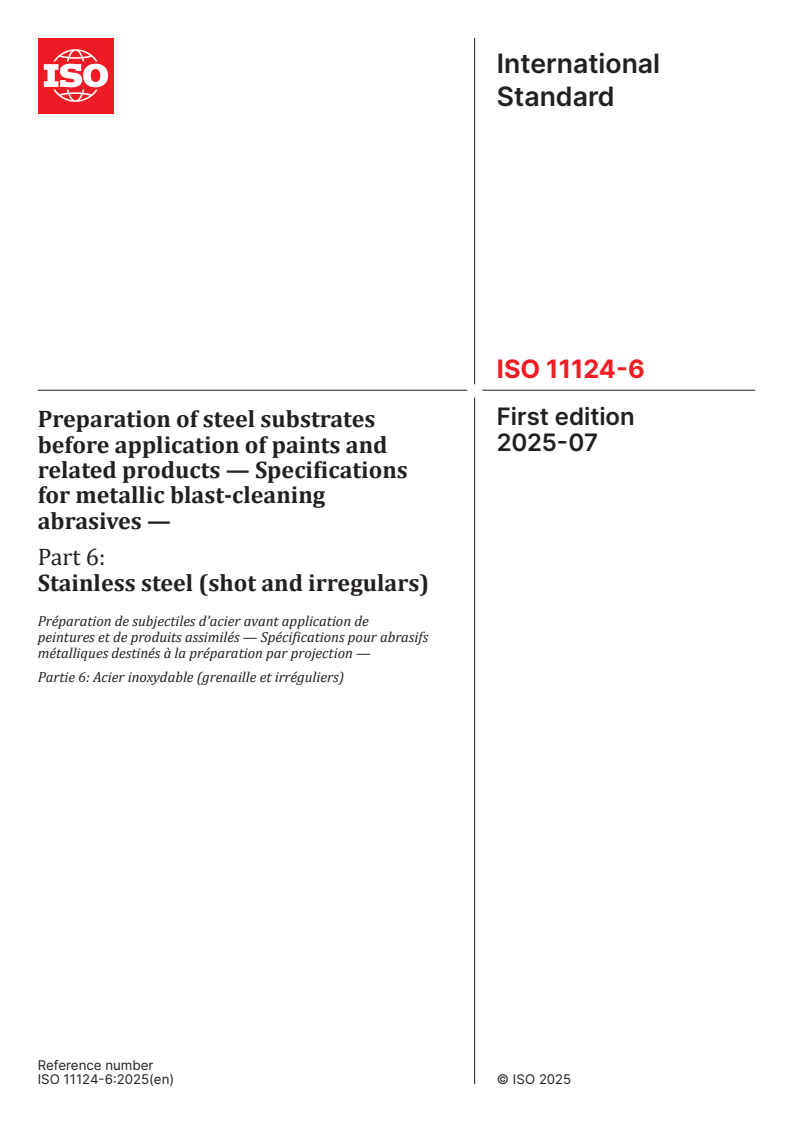
ISO 11124-6:2025 - Preparation of steel substrates before application of paints and related products — Specifications for metallic blast-cleaning abrasives — Part 6: Stainless steel (shot and irregulars) Released:25. 07. 2025
Overview
ISO 11124-6:2025 is the international standard specifying the requirements for stainless steel metallic blast-cleaning abrasives used in surface preparation prior to the application of paints and related products. This part of ISO 11124 focuses on stainless steel shot and irregular abrasives supplied in new condition for blast-cleaning processes. It defines particle size ranges, hardness, density, defects, metallographic structure, and chemical composition critical for ensuring abrasive quality and performance.
Stainless steel abrasives covered by this standard are mainly used in blast-cleaning of non-ferrous substrates, though originally developed for steelwork preparation. These abrasives are particularly suited for applications where abrasive recovery and reuse are feasible. The standard also addresses potential galvanic corrosion concerns when used with dissimilar metals.
Key Topics
Particle Size and Grade Designation: The standard specifies detailed particle size distributions for stainless steel shot and irregular shapes, classified by numeric grade codes linked to nominal particle sizes in millimeters.
Hardness and Density Requirements: Stainless steel abrasives must meet defined hardness ranges (SS1 and SS2 types) measured in Vickers hardness (HV), with minimum apparent density values ensuring durability and effectiveness in blast cleaning.
Defect Limits: Strict limits on defects such as voids, shrinkages, cracks, and shape irregularities are established to maintain abrasive quality and performance consistency.
Metallographic Structure: The standard distinguishes abrasives by their microstructure types-ferritic, martensitic, or austenitic-with limits on the percentage of undesirable microstructure particles.
Chemical Composition: Defined ranges for chromium, nickel, carbon, manganese, silicon, and moisture content ensure the abrasives’ chemical stability and suitability for blast cleaning across various substrates.
Sampling and Testing: Sampling methods follow ISO 11125-1, while tests for particle size, hardness, density, defects, chemical composition, and moisture are detailed in other parts of ISO 11125 series.
Identification and Traceability: Abrasives must be clearly labeled with standardized designations indicating metallic type, microstructure, particle shape, and grade. Marking for lot traceability is recommended for quality control.
Applications
Surface Preparation for Coating: ISO 11124-6 abrasives are essential in removing contaminants and preparing metal and non-metal surfaces before painting or coating applications, ensuring adhesion and longevity of protective layers.
Blast-Cleaning Operations: Applicable in both static (fixed) and site (mobile) blast-cleaning equipment to prepare substrates for industrial, automotive, marine, and architectural uses.
Reusable Abrasive Media: Designed for efficient recovery and reuse in blast-cleaning operations, stainless steel shot and irregular abrasives reduce waste and provide cost-effectiveness.
Non-Ferrous Substrate Treatment: While developed for steel, these abrasives serve well for cleaning and surface conditioning of minerals, plastics, and other non-ferrous materials.
Industrial Maintenance: Utilized in refurbishing and maintaining equipment and structures, preventing corrosion and surface degradation through effective abrasive blasting.
Related Standards
ISO 11124 Series: Covers general preparation of steel substrates and specifications for various metallic blast-cleaning abrasives beyond stainless steel.
ISO 11125 Series: Provides standardized test methods for metallic blast-cleaning abrasives, including procedures for sampling, hardness, particle size distribution, density, defect detection, and moisture measurement.
ISO 439, 629, 9556, 10138, 4940: Referenced chemical analysis standards ensuring control of silicon, manganese, carbon, chromium, and nickel content in stainless steel abrasives.
ISO/IEC Directives: Governing the development and maintenance of international standards ensuring consistent application and conformity assessment procedures.
Keywords: ISO 11124-6:2025, stainless steel blast-cleaning abrasives, metallic abrasives, surface preparation, paint substrate preparation, stainless steel shot, stainless steel irregular abrasives, particle size distribution, abrasive hardness, chemical composition standards, blast cleaning abrasives, reusable abrasives, industrial surface treatment.
Relations
- Effective Date
- 12-Aug-2026
Buy Documents
ISO 11124-6:2025 - Preparation of steel substrates before application of paints and related products — Specifications for metallic blast-cleaning abrasives — Part 6: Stainless steel (shot and irregulars) Released:25. 07. 2025
Get Certified
Connect with accredited certification bodies for this standard

DVS-ZERT GmbH
German welding certification society.
CARES (UK Certification Authority for Reinforcing Steels)
UK certification for reinforcing steels and construction.
EWF/IIW (European/International Welding Federation)
International welding personnel certification.
Sponsored listings
Frequently Asked Questions
ISO 11124-6:2025 is a standard published by the International Organization for Standardization (ISO). Its full title is "Preparation of steel substrates before application of paints and related products — Specifications for metallic blast-cleaning abrasives — Part 6: Stainless steel (shot and irregulars)". This standard covers: This document specifies requirements for stainless steel (shot and irregulars), as supplied for blast-cleaning processes. It specifies ranges of particle sizes, together with corresponding grade designations. Values are specified for hardness, density, defect/structural requirements, metallographic structure and chemical composition. The requirements specified in this document apply to abrasives supplied in the new condition only. Test methods for metallic blast-cleaning abrasives are given in the various parts of ISO 11125. Stainless steel shot and irregulars are used in both static and site blasting equipment. They are most often selected where there is a possibility for the recovery and re-use of the abrasive. NOTE 1 Although this document has been developed for preparation of steelwork, these materials are predominantly used for non-ferrous substrates. The properties specified will generally be appropriate for use when preparing other material surfaces, or components, using blast-cleaning techniques, and can be used for applications where no subsequent coating is applied. NOTE 2 Whenever dissimilar metals are used together, galvanic corrosion can occur.
This document specifies requirements for stainless steel (shot and irregulars), as supplied for blast-cleaning processes. It specifies ranges of particle sizes, together with corresponding grade designations. Values are specified for hardness, density, defect/structural requirements, metallographic structure and chemical composition. The requirements specified in this document apply to abrasives supplied in the new condition only. Test methods for metallic blast-cleaning abrasives are given in the various parts of ISO 11125. Stainless steel shot and irregulars are used in both static and site blasting equipment. They are most often selected where there is a possibility for the recovery and re-use of the abrasive. NOTE 1 Although this document has been developed for preparation of steelwork, these materials are predominantly used for non-ferrous substrates. The properties specified will generally be appropriate for use when preparing other material surfaces, or components, using blast-cleaning techniques, and can be used for applications where no subsequent coating is applied. NOTE 2 Whenever dissimilar metals are used together, galvanic corrosion can occur.
ISO 11124-6:2025 is classified under the following ICS (International Classification for Standards) categories: 25.220.10 - Surface preparation. The ICS classification helps identify the subject area and facilitates finding related standards.
ISO 11124-6:2025 has the following relationships with other standards: It is inter standard links to EN ISO 21809-2:2026. Understanding these relationships helps ensure you are using the most current and applicable version of the standard.
ISO 11124-6:2025 is available in PDF format for immediate download after purchase. The document can be added to your cart and obtained through the secure checkout process. Digital delivery ensures instant access to the complete standard document.
Standards Content (Sample)
International
Standard
ISO 11124-6
First edition
Preparation of steel substrates
2025-07
before application of paints and
related products — Specifications
for metallic blast-cleaning
abrasives —
Part 6:
Stainless steel (shot and irregulars)
Préparation de subjectiles d'acier avant application de
peintures et de produits assimilés — Spécifications pour abrasifs
métalliques destinés à la préparation par projection —
Partie 6: Acier inoxydable (grenaille et irréguliers)
Reference number
© ISO 2025
All rights reserved. Unless otherwise specified, or required in the context of its implementation, no part of this publication may
be reproduced or utilized otherwise in any form or by any means, electronic or mechanical, including photocopying, or posting on
the internet or an intranet, without prior written permission. Permission can be requested from either ISO at the address below
or ISO’s member body in the country of the requester.
ISO copyright office
CP 401 • Ch. de Blandonnet 8
CH-1214 Vernier, Geneva
Phone: +41 22 749 01 11
Email: copyright@iso.org
Website: www.iso.org
Published in Switzerland
ii
Contents Page
Foreword .iv
1 Scope . 1
2 Normative references . 1
3 Terms and definitions . 2
4 Designation of abrasives . 3
5 Sampling . 4
6 Requirements for stainless steel (shot and irregulars) . 5
7 Package identification and lot traceability . 5
8 Information to be provided by the manufacturer or supplier . 6
iii
Foreword
ISO (the International Organization for Standardization) is a worldwide federation of national standards
bodies (ISO member bodies). The work of preparing International Standards is normally carried out through
ISO technical committees. Each member body interested in a subject for which a technical committee
has been established has the right to be represented on that committee. International organizations,
governmental and non-governmental, in liaison with ISO, also take part in the work. ISO collaborates closely
with the International Electrotechnical Commission (IEC) on all matters of electrotechnical standardization.
The procedures used to develop this document and those intended for its further maintenance are described
in the ISO/IEC Directives, Part 1. In particular, the different approval criteria needed for the different types
of ISO document should be noted. This document was drafted in accordance with the editorial rules of the
ISO/IEC Directives, Part 2 (see www.iso.org/directives).
ISO draws attention to the possibility that the implementation of this document may involve the use of (a)
patent(s). ISO takes no position concerning the evidence, validity or applicability of any claimed patent
rights in respect thereof. As of the date of publication of this document, ISO had not received notice of (a)
patent(s) which may be required to implement this document. However, implementers are cautioned that
this may not represent the latest information, which may be obtained from the patent database available at
www.iso.org/patents. ISO shall not be held responsible for identifying any or all such patent rights.
Any trade name used in this document is information given for the convenience of users and does not
constitute an endorsement.
For an explanation of the voluntary nature of standards, the meaning of ISO specific terms and expressions
related to conformity assessment, as well as information about ISO's adherence to the World Trade
Organization (WTO) principles in the Technical Barriers to Trade (TBT), see www.iso.org/iso/foreword.html.
This document was prepared by Technical Committee ISO/TC 35 Paints and varnishes, Subcommittee SC 12,
Preparation of steel substrates before application of paints and related products.
A list of all parts in the ISO 11124 series can be found on the ISO website.
Any feedback or questions on this document should be directed to the user’s national standards body. A
complete listing of these bodies can be found at www.iso.org/members.html.
iv
International Standard ISO 11124-6:2025(en)
Preparation of steel substrates before application of paints
and related products — Specifications for metallic blast-
cleaning abrasives —
Part 6:
Stainless steel (shot and irregulars)
1 Scope
This document specifies requirements for stainless steel (shot and irregulars), as supplied for blast-cleaning
processes. It specifies ranges of particle sizes, together with corresponding grade designations. Values are
specified for hardness, density, defect/structural requirements, metallographic structure and chemical
composition.
The requirements specified in this document apply to abrasives supplied in the new condition only.
Test methods for metallic blast-cleaning abrasives are given in the various parts of ISO 11125.
Stainless steel shot and irregulars are used in both static and site blasting equipment. They are most often
selected where there is a possibility for the recovery and re-use of the abrasive.
NOTE 1 Although this document has been developed for preparation of steelwork, these materials are
predominantly used for non-ferrous substrates. The properties specified will generally be appropriate for use when
preparing other material surfaces, or components, using blast-cleaning techniques, and can be used for applications
where no subsequent coating is applied.
NOTE 2 Whenever dissimilar metals are used together, galvanic corrosion can occur.
2 Normative references
The following documents are referred to in the text in such a way that some or all of their content constitutes
requirements of this document. For dated references, only the edition cited applies. For undated references,
the latest edition of the referenced document (including any amendments) applies.
ISO 439, Steel and cast iron — Determination of silicon content — Gravimetric method
ISO 629, Steel and cast iron — Determination of manganese content — Spectrophotometric method
ISO 9556, Steel and iron — Determination of total carbon content — Infrared absorption method after
combustion in an induction furnace
ISO 10138, Steel and iron — Determination of chromium content — Flame atomic absorption spectrometric method
ISO 4940, Steel and cast iron — Determination of nickel content — Flame atomic absorption spectrometric method
ISO 11125-1, Preparation of steel substrates before application of paints and related products — Test methods
for metallic blast-cleaning abrasives — Part 1: Sampling
ISO 11125-2, Preparation of steel substrates before application of paints and related products — Test methods
for metallic blast-cleaning abrasives — Part 2: Determination of particle size distribution
ISO 11125-3, Preparation of steel substrates before application of paints and related products — Test methods
for metallic blast-cleaning abrasives — Part 3: Determination of hardness
ISO 11125-4, Preparation of steel substrates before application of paints and related products — Test methods
for metallic blast-cleaning abrasives — Part 4: Determination of apparent density
ISO 11125-5, Preparation of steel substrates before application of paints and related products — Test
methods for metallic blast-cleaning abrasives — Part 5: Determination of percentage defective particles and of
microstructure
ISO 11125-6, Preparation of steel substrates before application of paints and related products — Test methods
for metallic blast-cleaning abrasives — Part 6: Determination of foreign matter
ISO 11125-7, Preparation of steel substrates before application of paints and related products — Test methods
for metallic blast-cleaning abrasives — Part 7: Determination of moisture
3 Terms and definitions
For the purposes of this document, the following terms and definitions apply.
ISO and IEC maintain terminology databases for us
...