


ISO/IEC TR 9126-3:2003
(Main)Software engineering — Product quality — Part 3: Internal metrics
Software engineering — Product quality — Part 3: Internal metrics
ISO/IEC TR 9126-3:2003 provides internal metrics for measuring attributes of six external quality characteristics defined in ISO/IEC 9126-1. ISO/IEC TR 9126-2 defines external metrics, ISO/IEC TR 9126-3:2003 defines internal metrics and ISO/IEC 9126-4 defines quality in use metrics, for measurement of the characteristics or the subcharacteristics. Internal metrics measure the software itself, external metrics measure the behaviour of the computer-based system that includes the software, and quality in use metrics measure the effects of using the software in a specific context of use. The metrics listed in ISO/IEC TR 9126-3:2003 are not intended to be an exhaustive set. Developers, evaluators, quality managers, maintainers, suppliers, users and acquirers may select metrics from ISO/IEC TR 9126-3:2003 for defining requirements, evaluating software products, measuring quality aspects and other purposes. Users of ISO/IEC TR 9126-3:2003 can select or modify and apply metrics and measures from ISO/IEC TR 9126-3:2003 or may define application-specific metrics for their individual application domain. For internal metrics view, there are pure internal metrics proposed for reference purposes. ISO/IEC TR 9126-3:2003 is intended to be used together with ISO/IEC 9126-1. ISO/IEC TR 9126-3:2003 contains: an explanation of how to apply software quality metrics; a basic set of metrics for each subcharacteristic; an example of how to apply metrics during the software product life cycle. ISO/IEC TR 9126-3:2003 does not assign ranges of values of these metrics to rated levels or to grades of compliance, because these values are defined for each software product or a part of the software product, by its nature, depending on such factors as category of the software, integrity level and users' needs. Some attributes may have a desirable range of values, which does not depend on specific user needs but depends on generic factors; for example, human cognitive factors.
Génie du logiciel — Qualité des produits — Partie 3: Métrologie interne
General Information
- Status
- Withdrawn
- Publication Date
- 08-Jul-2003
- Withdrawal Date
- 08-Jul-2003
- Technical Committee
- ISO/IEC JTC 1/SC 7 - Software and systems engineering
- Drafting Committee
- ISO/IEC JTC 1/SC 7/WG 6 - Software Product and System Quality
- Current Stage
- 9599 - Withdrawal of International Standard
- Start Date
- 13-Jun-2016
- Completion Date
- 12-Feb-2026
Relations
- Effective Date
- 06-Jun-2022
- Effective Date
- 09-Mar-2013
- Effective Date
- 07-May-2011
Get Certified
Connect with accredited certification bodies for this standard

BSI Group
BSI (British Standards Institution) is the business standards company that helps organizations make excellence a habit.

BSCIC Certifications Pvt. Ltd.
Established 2006, accredited by NABCB, JAS-ANZ, EIAC, IAS. CDSCO Notified Body.

Intertek India Pvt. Ltd.
Delivers Assurance, Testing, Inspection & Certification since 1993 with 26 labs and 32 offices.
Sponsored listings
Frequently Asked Questions
ISO/IEC TR 9126-3:2003 is a technical report published by the International Organization for Standardization (ISO). Its full title is "Software engineering — Product quality — Part 3: Internal metrics". This standard covers: ISO/IEC TR 9126-3:2003 provides internal metrics for measuring attributes of six external quality characteristics defined in ISO/IEC 9126-1. ISO/IEC TR 9126-2 defines external metrics, ISO/IEC TR 9126-3:2003 defines internal metrics and ISO/IEC 9126-4 defines quality in use metrics, for measurement of the characteristics or the subcharacteristics. Internal metrics measure the software itself, external metrics measure the behaviour of the computer-based system that includes the software, and quality in use metrics measure the effects of using the software in a specific context of use. The metrics listed in ISO/IEC TR 9126-3:2003 are not intended to be an exhaustive set. Developers, evaluators, quality managers, maintainers, suppliers, users and acquirers may select metrics from ISO/IEC TR 9126-3:2003 for defining requirements, evaluating software products, measuring quality aspects and other purposes. Users of ISO/IEC TR 9126-3:2003 can select or modify and apply metrics and measures from ISO/IEC TR 9126-3:2003 or may define application-specific metrics for their individual application domain. For internal metrics view, there are pure internal metrics proposed for reference purposes. ISO/IEC TR 9126-3:2003 is intended to be used together with ISO/IEC 9126-1. ISO/IEC TR 9126-3:2003 contains: an explanation of how to apply software quality metrics; a basic set of metrics for each subcharacteristic; an example of how to apply metrics during the software product life cycle. ISO/IEC TR 9126-3:2003 does not assign ranges of values of these metrics to rated levels or to grades of compliance, because these values are defined for each software product or a part of the software product, by its nature, depending on such factors as category of the software, integrity level and users' needs. Some attributes may have a desirable range of values, which does not depend on specific user needs but depends on generic factors; for example, human cognitive factors.
ISO/IEC TR 9126-3:2003 provides internal metrics for measuring attributes of six external quality characteristics defined in ISO/IEC 9126-1. ISO/IEC TR 9126-2 defines external metrics, ISO/IEC TR 9126-3:2003 defines internal metrics and ISO/IEC 9126-4 defines quality in use metrics, for measurement of the characteristics or the subcharacteristics. Internal metrics measure the software itself, external metrics measure the behaviour of the computer-based system that includes the software, and quality in use metrics measure the effects of using the software in a specific context of use. The metrics listed in ISO/IEC TR 9126-3:2003 are not intended to be an exhaustive set. Developers, evaluators, quality managers, maintainers, suppliers, users and acquirers may select metrics from ISO/IEC TR 9126-3:2003 for defining requirements, evaluating software products, measuring quality aspects and other purposes. Users of ISO/IEC TR 9126-3:2003 can select or modify and apply metrics and measures from ISO/IEC TR 9126-3:2003 or may define application-specific metrics for their individual application domain. For internal metrics view, there are pure internal metrics proposed for reference purposes. ISO/IEC TR 9126-3:2003 is intended to be used together with ISO/IEC 9126-1. ISO/IEC TR 9126-3:2003 contains: an explanation of how to apply software quality metrics; a basic set of metrics for each subcharacteristic; an example of how to apply metrics during the software product life cycle. ISO/IEC TR 9126-3:2003 does not assign ranges of values of these metrics to rated levels or to grades of compliance, because these values are defined for each software product or a part of the software product, by its nature, depending on such factors as category of the software, integrity level and users' needs. Some attributes may have a desirable range of values, which does not depend on specific user needs but depends on generic factors; for example, human cognitive factors.
ISO/IEC TR 9126-3:2003 is classified under the following ICS (International Classification for Standards) categories: 35.080 - Software. The ICS classification helps identify the subject area and facilitates finding related standards.
ISO/IEC TR 9126-3:2003 has the following relationships with other standards: It is inter standard links to ISO 8502-2:2005, ISO/IEC 25023:2016, ISO/IEC 25022:2016. Understanding these relationships helps ensure you are using the most current and applicable version of the standard.
ISO/IEC TR 9126-3:2003 is available in PDF format for immediate download after purchase. The document can be added to your cart and obtained through the secure checkout process. Digital delivery ensures instant access to the complete standard document.
Standards Content (Sample)
TECHNICAL ISO/IEC
REPORT TR
9126-3
First edition
2003-07-01
Software engineering — Product
quality —
Part 3:
Internal metrics
Génie du logiciel — Qualité des produits —
Partie 3: Métrologie interne
Reference number
©
ISO/IEC 2003
PDF disclaimer
This PDF file may contain embedded typefaces. In accordance with Adobe's licensing policy, this file may be printed or viewed but
shall not be edited unless the typefaces which are embedded are licensed to and installed on the computer performing the editing. In
downloading this file, parties accept therein the responsibility of not infringing Adobe's licensing policy. The ISO Central Secretariat
accepts no liability in this area.
Adobe is a trademark of Adobe Systems Incorporated.
Details of the software products used to create this PDF file can be found in the General Info relative to the file; the PDF-creation
parameters were optimized for printing. Every care has been taken to ensure that the file is suitable for use by ISO member bodies. In
the unlikely event that a problem relating to it is found, please inform the Central Secretariat at the address given below.
© ISO/IEC 2003
All rights reserved. Unless otherwise specified, no part of this publication may be reproduced or utilized in any form or by any means,
electronic or mechanical, including photocopying and microfilm, without permission in writing from either ISO at the address below or
ISO's member body in the country of the requester.
ISO copyright office
Case postale 56 • CH-1211 Geneva 20
Tel. + 41 22 749 01 11
Fax + 41 22 749 09 47
E-mail copyright@iso.org
Web www.iso.org
Published in Switzerland
ii © ISO/IEC 2003 – All rights reserved
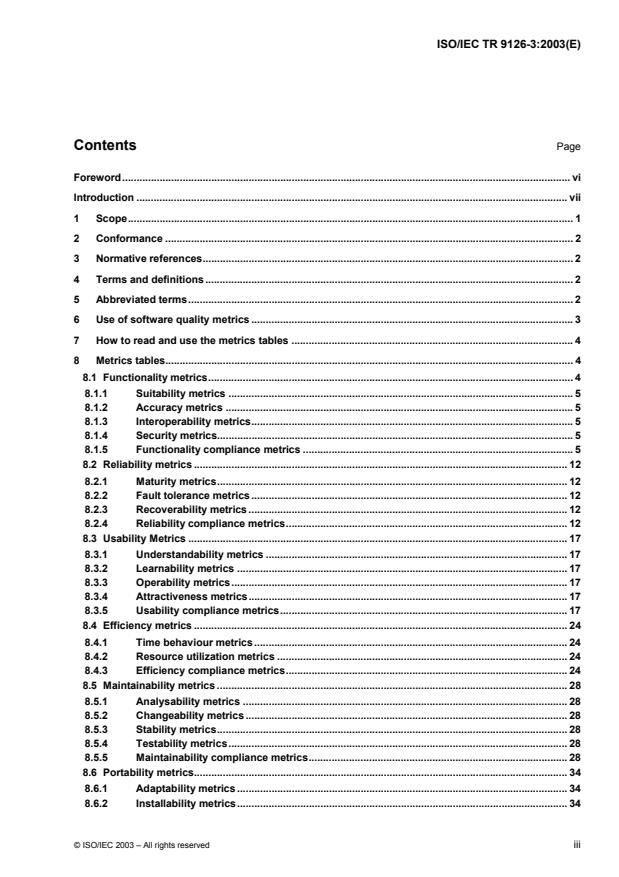
Contents Page
Foreword. vi
Introduction . vii
1 Scope. 1
2 Conformance. 2
3 Normative references. 2
4 Terms and definitions . 2
5 Abbreviated terms. 2
6 Use of software quality metrics . 3
7 How to read and use the metrics tables . 4
8 Metrics tables. 4
8.1 Functionality metrics. 4
8.1.1 Suitability metrics. 5
8.1.2 Accuracy metrics. 5
8.1.3 Interoperability metrics. 5
8.1.4 Security metrics. 5
8.1.5 Functionality compliance metrics. 5
8.2 Reliability metrics. 12
8.2.1 Maturity metrics. 12
8.2.2 Fault tolerance metrics . 12
8.2.3 Recoverability metrics. 12
8.2.4 Reliability compliance metrics. 12
8.3 Usability Metrics. 17
8.3.1 Understandability metrics. 17
8.3.2 Learnability metrics. 17
8.3.3 Operability metrics. 17
8.3.4 Attractiveness metrics. 17
8.3.5 Usability compliance metrics. 17
8.4 Efficiency metrics. 24
8.4.1 Time behaviour metrics . 24
8.4.2 Resource utilization metrics . 24
8.4.3 Efficiency compliance metrics. 24
8.5 Maintainability metrics. 28
8.5.1 Analysability metrics. 28
8.5.2 Changeability metrics. 28
8.5.3 Stability metrics. 28
8.5.4 Testability metrics. 28
8.5.5 Maintainability compliance metrics. 28
8.6 Portability metrics. 34
8.6.1 Adaptability metrics. 34
8.6.2 Installability metrics. 34
© ISO/IEC 2003 – All rights reserved iii
8.6.3 Co-existence metrics.34
8.6.4 Replaceability metrics.34
8.6.5 Portability compliance metrics.34
Annex A (informative) Considerations When Using Metrics.41
A.1 Interpretation of measures.41
A.1.1 Potential differences between test and operational contexts of use .41
A.1.2 Issues affecting validity of results .42
A.1.3 Balance of measurement resources .42
A.1.4 Correctness of specification.42
A.2 Validation of Metrics .42
A.2.1 Desirable Properties for Metrics .42
A.2.2 Demonstrating the Validity of Metrics .43
A.3 Use of metrics for estimation (judgement) and prediction (forecast) .44
A.3.1 Quality characteristics prediction by current data.44
A.3.2 Current quality characteristics estimation on current facts .44
A.4 Detecting deviations and anomalies in quality problem prone components .45
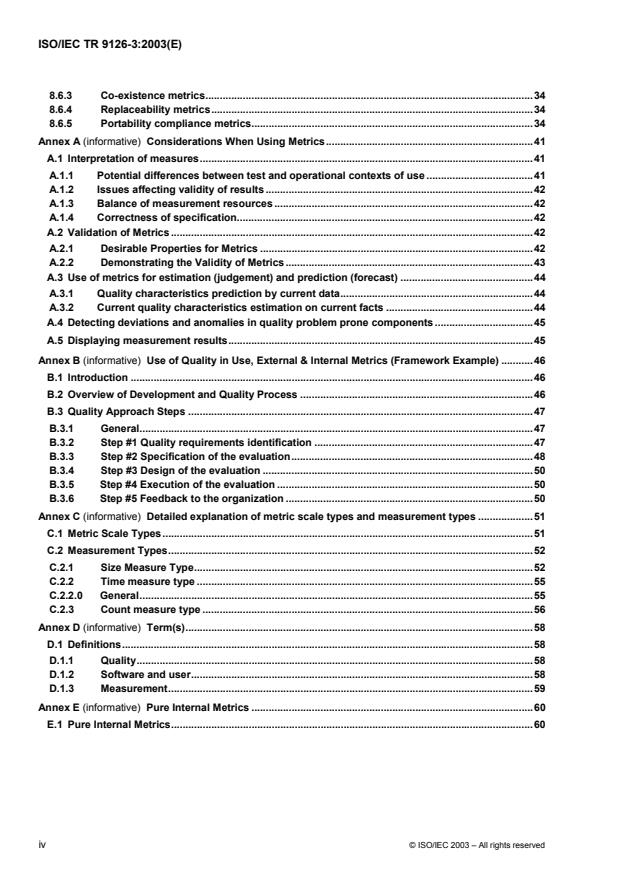
A.5 Displaying measurement results.45
Annex B (informative) Use of Quality in Use, External & Internal Metrics (Framework Example) .46
B.1 Introduction .46
B.2 Overview of Development and Quality Process .46
B.3 Quality Approach Steps .47
B.3.1 General.47
B.3.2 Step #1 Quality requirements identification .47
B.3.3 Step #2 Specification of the evaluation.48
B.3.4 Step #3 Design of the evaluation .50
B.3.5 Step #4 Execution of the evaluation .50
B.3.6 Step #5 Feedback to the organization .50
Annex C (informative) Detailed explanation of metric scale types and measurement types .51
C.1 Metric Scale Types.51
C.2 Measurement Types.52
C.2.1 Size Measure Type.52
C.2.2 Time measure type .55
C.2.2.0 General.55
C.2.3 Count measure type .56
Annex D (informative) Term(s).58
D.1 Definitions.58
D.1.1 Quality.58
D.1.2 Software and user.58
D.1.3 Measurement.59
Annex E (informative) Pure Internal Metrics .60
E.1 Pure Internal Metrics.60
iv © ISO/IEC 2003 – All rights reserved
Table 8.1.1 Suitability metrics. 6
Table 8.1.2 Accuracy metrics. 8
Table 8.1.3 Interoperability metrics. 9
Table 8.1.4 Security metrics. 10
Table 8.1.5 Functionality compliance metrics. 11
Table 8.2.1 Maturity metrics. 13
Table 8.2.2 Fault tolerance metrics . 14
Table 8.2.3 Recoverability metrics . 15
Table 8.2.4 Reliability compliance metrics. 16
Table 8.3.1 Understandability metrics . 18
Table 8.3.2 Learnability metrics. 19
Table 8.3.3 Operability metrics . 20
Table 8.3.4 Attractiveness metrics . 22
Table 8.3.5 Usability compliance metrics. 23
Table 8.4.1 Time behaviour metrics . 25
Table 8.4.2 Resource utilisation metrics . 26
Table 8.4.3 Efficiency compliance metrics. 27
Table 8.5.1 Analysability metrics. 29
Table 8.5.2 Changeability metrics . 30
Table 8.5.3 Stability metrics. 31
Table 8.5.4 Testability metrics . 32
Table 8.5.5 Maintainability compliance metrics. 33
Table 8.6.1 Adaptability metrics . 35
Table 8.6.2 Installability metrics . 37
Table 8.6.3 Co-existence metrics . 38
Table 8.6.4 Replaceability metrics. 39
Table 8.6.5 Portability compliance metrics . 40
Table B.1 Quality Measurement Model . 46
Table B.2 User Needs Characteristics & Weights . 47
Table B.3 Quality measurement tables . 48
Table B.4 Measurement plan. 50
© ISO/IEC 2003 – All rights reserved v
Foreword
ISO (the International Organization for Standardization) and IEC (the International Electrotechnical
Commission) form the specialized system for worldwide standardization. National bodies that are members of
ISO or IEC participate in the development of International Standards through technical committees
established by the respective organization to deal with particular fields of technical activity. ISO and IEC
technical committees collaborate in fields of mutual interest. Other international organizations, governmental
and non-governmental, in liaison with ISO and IEC, also take part in the work. In the field of information
technology, ISO and IEC have established a joint technical committee, ISO/IEC JTC 1.
International Standards are drafted in accordance with the rules given in the ISO/IEC Directives, Part 2.
The main task of the joint technical committee is to prepare International Standards. Draft International
Standards adopted by the joint technical committee are circulated to national bodies for voting. Publication as
an International Standard requires approval by at least 75 % of the national bodies casting a vote.
In exceptional circumstances, the joint technical committee may propose the publication of a Technical Report
of one of the following types:
— type 1, when the required support cannot be obtained for the publication of an International Standard,
despite repeated efforts;
— type 2, when the subject is still under technical development or where for any other reason there is the
future but not immediate possibility of an agreement on an International Standard;
— type 3, when the joint technical committee has collected data of a different kind from that which is normally
published as an International Standard (“state of the art”, for example).
Technical Reports of types 1 and 2 are subject to review within three years of publication, to decide whether
they can be transformed into International Standards. Technical Reports of type 3 do not necessarily have to
be reviewed until the data they provide are considered to be no longer valid or useful.
Attention is drawn to the possibility that some of the elements of this document may be the subject of patent
rights. ISO and IEC shall not be held responsible for identifying any or all such patent rights.
ISO/IEC JTC 1, Information technology, Subcommittee SC 7, Software and system engineering.
This document is being issued in the Technical Report (type 2) series of publications (according to the
Procedures for the technical work of ISO/IEC JTC 1) as a “prospective standard for provisional application” in
the field of external metrics for quantitatively measuring external software because there is an urgent need for
guidance on how standards in this field should be used to meet an identified need.
This document is not to be regarded as an “International Standard”. It is proposed for provisional application
so that information and experience of its use in practice may be gathered. Comments on the content of this
document should be sent to the ISO Central Secretariat.
A review of this Technical Report (type 2) will be carried out not later than three years after its publication with
the options of: extension for another three years; conversion into an International Standard; or withdrawal.
ISO/IEC 9126 consists of the following parts, under the general title Software engineering — Product quality:
Part 1: Quality model
Part 2: External metrics
Part 3: Internal metrics
Part 4: Quality in use metrics
vi © ISO/IEC 2003 – All rights reserved
Introduction
This Technical Report provides internal metrics for measuring attributes of six external quality characteristics
defined in ISO/IEC 9126-1. The metrics listed in this Technical Report are not intended to be an exhaustive
set. Developers, evaluators, quality managers and acquirers may select metrics from this Technical Report for
defining requirements, evaluating software products, measuring quality aspects and other purposes. They
may also modify the metrics or use metrics which are not included here. This Technical Report is applicable to
any kind of software product, although each of the metrics is not always applicable to every kind of software
product.
ISO/IEC 9126-1 defines terms for the software quality characteristics and how these characteristics are
decomposed into subcharacteristics. ISO/IEC 9126-1, however, does not describe how any of these
subcharacteristics could be measured. ISO/IEC TR 9126-2 defines external metrics, ISO/IEC TR 9126-3
defines internal metrics and ISO/IEC 9126-4 defines quality in use metrics, for measurement of the
characteristics or the subcharacteristics. Internal metrics measure the software itself, external metrics
measure the behaviour of the computer-based system that includes the software, and quality in use metrics
measure the effects of using the software in a specific context of use.
This Technical Report is intended to be used together with ISO/IEC 9126-1. It is strongly recommended to
read ISO/IEC 14598-1 and ISO/IEC 9126-1, prior to using this Technical Report, particularly if the reader is
not familiar with the use of software metrics for product specification and evaluation.
Clauses 1 to 7 and Annexes A to D are common to ISO/IEC TR 9126-2, ISO/IEC TR 9126-3, and
ISO/IEC 9126-4. Annex E is for ISO/IEC TR 9126-3 use.
© ISO/IEC 2003 – All rights reserved vii
TECHNICAL REPORT ISO/IEC TR 9126-3:2003(E)
Software engineering — Product quality —
Part 3:
Internal metrics
1 Scope
This Technical Report defines internal metrics for quantitatively measuring external software quality in terms
of characteristics and subcharacteristics defined in ISO/IEC 9126-1, and is intended to be used together with
ISO/IEC 9126-1.
This Technical Report contains:
I. an explanation of how to apply software quality metrics
II. a basic set of metrics for each subcharacteristic
III. an example of how to apply metrics during the software product life cycle
This Technical Report does not assign ranges of values of these metrics to rated levels or to grades of
compliance, because these values are defined for each software product or a part of the software product, by
its nature, depending on such factors as category of the software, integrity level and users' needs. Some
attributes may have a desirable range of values, which does not depend on specific user needs but depends
on generic factors; for example, human cognitive factors.
This Technical Report can be applied to any kind of software for any application. Users of this Technical
Report can select or modify and apply metrics and measures from this Technical Report or may define
application-specific metrics for their individual application domain. For example, the specific measurement of
quality characteristics such as safety or security may be found in International Standards or Technical Reports
provided by IEC 65 and ISO/IEC JTC 1/SC 27.
Intended users of this Technical Report include:
— Acquirer (an individual or organization that acquires or procures a system, software product or software
service from a supplier);
— Evaluator (an individual or organization that performs an evaluation. An evaluator may, for example, be a
testing laboratory, the quality department of a software development organization, a government
organization or a user);
— Developer (an individual or organization that performs development activities, including requirements
analysis, design, and testing through acceptance during the software life cycle process);
— Maintainer (an individual or organization that performs maintenance activities);
— Supplier (an individual or organization that enters into a contract with the acquirer for the supply of a
system, software product or software service under the terms of the contract) when validating software
quality at qualification test;
— User (an individual or organization that uses the software product to perform a specific function) when
evaluating quality of software product at acceptance test;
— Quality manager (an individual or organization that performs a systematic examination of the software
product or software services) when evaluating software quality as part of quality assurance and quality
control.
© ISO/IEC 2003 – All rights reserved 1
2 Conformance
There are no conformance requirements in this Technical Report.
NOTE General conformance requirements for metrics are in ISO/IEC 9126-1 Quality model.
3 Normative references
ISO/IEC 9126-1:2001, Software engineering — Product quality — Part 1: Quality model
1)
ISO/IEC TR 9126-2 , Software engineering — Product quality — Part 2: External metrics
1)
ISO/IEC 9126-4 , Software engineering — Product quality — Part 4: Quality in use metrics
ISO/IEC 14598-1:1999, Information technology — Software product evaluation — Part 1: General overview
ISO/IEC 14598-2:2000, Software engineering — Product evaluation — Part 2: Planning and management
ISO/IEC 14598-3:2000, Software engineering — Product evaluation — Part 3: Process for developers
ISO/IEC 14598-4:1999, Software engineering — Product evaluation — Part 4: Process for acquirers
ISO/IEC 14598-5:1998, Information technology — Software product evaluation — Part 5: Process for
evaluators
ISO/IEC 14598-6:2001, Software engineering — Product evaluation — Part 6: Documentation of evaluation
modules
ISO/IEC 12207:1995, Information technology — Software life cycle processes
ISO/IEC 14143-1:1998, Information technology — Software measurement — Functional size measurement —
Part 1: Definition of concepts
ISO 2382-20:1990, Information technology — Vocabulary — Part 20: System development
ISO 9241-10:1996, Ergonomic requirements for office work with visual display terminals (VDTs) — Part 10:
Dialogue principles
4 Terms and definitions
For the purposes of this document, the terms and definitions given in ISO/IEC 14598-1:1999 and
ISO/IEC 9126-1:2001 apply. They are also listed in Annex D.
5 Abbreviated terms
The following abbreviations are used in this Technical Report:
SQA — Software Quality Assurance (Group)
SLCP — Software Life Cycle Processes
1) To be published.
2 © ISO/IEC 2003 – All rights reserved
6 Use of software quality metrics
These Technical Reports (ISO/IEC TR 9126-2 External metrics, ISO/IEC TR 9126-3 Internal metrics and
ISO/IEC 9126-4 Quality in use metrics) provide a suggested set of software quality metrics (external, internal
and quality in use metrics) to be used with the ISO/IEC 9126-1 Quality model. The user of these Technical
Reports may modify the metrics defined, and/or may also use metrics not listed. When using a modified or a
new metric not identified in these Technical Reports, the user should specify how the metrics relate to the
ISO/IEC 9126-1 quality model or any other substitute quality model that is being used.
The user of these Technical Reports should select the quality characteristics and subcharacteristics to be
evaluated, from ISO/IEC 9126-1; identify the appropriate direct and indirect measures, identify the relevant
metrics and then interpret the measurement result in an objective manner. The user of these Technical
Reports also may select product quality evaluation processes during the software life cycle from the
ISO/IEC 14598 series of standards. These give methods for measurement, assessment and evaluation of
software product quality. They are intended for use by developers, acquirers and independent evaluators,
particularly those responsible for software product evaluation (see Figure 1).
effect of software
software product
product
influences influences
internal external quality in
quality quality use
contexts of
depends on depends on
use
internal metrics external metrics quality in use
metrics
Figure 1 – Relationship between types of metrics
The internal metrics may be applied to a non-executable software product during its development stages
(such as request for proposal, requirements definition, design specification or source code). Internal metrics
provide the users with the ability to measure the quality of the intermediate deliverables and thereby predict
the quality of the final product. This allows the user to identify quality issues and initiate corrective action as
early as possible in the development life cycle.
The external metrics may be used to measure the quality of the software product by measuring the behaviour
of the system of which it is a part. The external metrics can only be used during the testing stages of the life
cycle process and during any operational stages. The measurement is performed when executing the
software product in the system environment in which it is intended to operate.
The quality in use metrics measure whether a product meets the needs of specified users to achieve specified
goals with effectiveness, productivity, safety and satisfaction in a specified context of use. This can be only
achieved in a realistic system environment.
User quality needs can be specified as quality requirements by quality in use metrics, by external metrics, and
sometimes by internal metrics. These requirements specified by metrics should be used as criteria when a
product is evaluated.
It is recommended to use internal metrics having a relationship as strong as possible with the target external
metrics so that they can be used to predict the values of external metrics. However, it is often difficult to
design a rigorous theoretical model that provides a strong relationship between internal metrics and external
metrics. Therefore, a hypothetical model that may contain ambiguity may be designed and the extent of the
relationship may be modelled statistically during the use of metrics.
Recommendations and requirements related to validity and reliability are given in ISO/IEC 9126-1, Clause A.4.
Additional detailed considerations when using metrics are given in Annex A of this Technical Report.
© ISO/IEC 2003 – All rights reserved 3
7 How to read and use the metrics tables
The metrics listed in Clause 8 are categorized by the characteristics and subcharacteristics in ISO/IEC 9126-1.
The following information is given for each metric in the table:
a) Metric name: Corresponding metrics in the internal metrics table and external metrics table have similar
names.
b) Purpose of the metric: This is expressed as the question to be answered by the application of the metric.
c) Method of application: Provides an outline of the application.
d) Measurement, formula and data element computations: Provides the measurement formula and
explains the meanings of the used data elements.
NOTE In some situations more than one formula is proposed for a metric.
e) Interpretation of measured value: Provides the range and preferred values.
f) Metric scale type: Type of scale used by the metric. Scale types used are; Nominal scale, Ordinal scale,
Interval scale, Ratio scale and Absolute scale.
NOTE A more detailed explanation is given in Annex C.
g) Measure type: Types used are; Size type (e.g. Function size, Source size), Time type (e.g. Elapsed time,
User time), Count type (e.g. Number of changes, Number of failures).
NOTE A more detailed explanation is given in Annex C.
h) Input to measurement: Source of data used in the measurement.
i) ISO/IEC 12207 SLCP Reference: Identifies software life cycle process(es) where the metric is applicable.
j) Target audience: Identifies the user(s) of the measurement results.
8 Metrics tables
The metrics listed in this clause are not intended to be an exhaustive set and may not have been validated.
They are listed by software quality characteristics and subcharacteristics, in the order introduced in
ISO/IEC 9126-1.
Metrics, which may be applicable, are not limited to these listed here. Additional specific metrics for particular
purposes are provided in other related documents, such as functional size measurement or precise time
efficiency measurement.
NOTE 1 It is recommended to refer a specific metric or measurement form from specific standards, technical reports or
guidelines. Functional size measurement is defined in ISO/IEC 14143. An example of precise time efficiency
measurement can be referred from ISO/IEC 14756.
Metrics should be validated before application in a specific environment (see Annex A).
NOTE 2 This list of metrics is not finalized, and may be revised in future versions of this Technical Report. Readers of
this Technical Report are invited to provide feedback.
8.1 Functionality metrics
Internal functionality metrics are used for predicting if the software product in question will satisfy prescribed
functional requirements and implied user needs.
4 © ISO/IEC 2003 – All rights reserved
8.1.1 Suitability metrics
Internal suitability metrics indicate a set of attributes for assessing explicitly functions to prescribed tasks, and
for determining their adequacy for performing the tasks.
8.1.2 Accuracy metrics
Internal accuracy metrics indicate a set of attributes for assessing the capability of the software product to
achieve correct or agreeable results.
8.1.3 Interoperability metrics
Internal Interoperability metrics indicate a set of attributes for assessing the capability of the software
product’s interaction with designated systems.
8.1.4 Security metrics
Internal security metrics indicate a set of attributes for assessing the capability of the software product to avoid
illegal access to the system and/or data.
8.1.5 Functionality compliance metrics
Internal compliance metrics indicate a set of attributes for assessing the capability of the software product to
comply to such items as standards, conventions or regulations of the user organization in relation to
functionality.
© ISO/IEC 2003 – All rights reserved 5
6 © ISO/IEC 2003 – All rights reserved
Table 8.1.1 Suitability metrics
Internal suitability metrics
Metric name Purpose of the Method of application Measurement, formula and Interpretation Metric Measure Sources of ISO/IEC Target
metrics data element computations of measured scale type input to 12207 audience
value type measure- SLCP
ment Reference
Functional
How adequate are the Count the number of X=1-A/B 0 <= X <= 1 absolute X=count/ Req spec 6.5 Requirers
adequacy checked functions? implemented functions that count Validation
A= Number of functions in which problems The closer to Design Developers
are suitable for performing A=count
are detected in evaluation 1, the more 6.6
Source code
the specified tasks, then B=count
adequate. Joint review
B= Number of functions checked
Review report
measure the ratio of it to
functions implemented.
The following may be
measured;
-all or parts of design
specifications
-completed modules/parts
of software products
Functional
How complete is the Count the number of X=1-A/B 0 <= X <= 1 absolute X=count/ Req spec 6.5 Requirers
implementation functional missing functions detected count Validation
A=Number of missing functions detected in The closer to Design Developers
implementation? in evaluation and compare A=count
completeness
evaluation. 1, the more 6.6
Source code
with the number of function B=count
complete. Joint review
B=Number of functions described in
Review report
described in the
requirement specifications
requirement specifications.
FOOTNOTE
Input to the measurement process is the updated requirement specifications. Any changes identified during life cycle must be applied to the requirement specifications before using in measurement
process.
© ISO/IEC 2003 – All rights reserved 7
Table 8.1.1 (continued)
Internal suitability metrics
Metric name Purpose of the Method of application Measurement, formula and Interpretation Metric Measure Sources of ISO/IEC Target
metrics data element computations of measured scale type input to 12207 audience
value type measure- SLCP
ment Reference
Functional
How correct is the Count the number of X=1-A/B 0 <= X <= 1 absolute X=count/ Req spec 6.5 Requirers
implementation functional incorrectly implemented or count Validation
A= Number of incorrectly implemented or The closer to Design Developers
implementation? missing functions and A=count
coverage
missing functions detected 1, the more 6.6
Source code
compare with the number of B=count
correct. Joint review
B= Number of functions described in
Review report
functions described in the
requirement specifications
requirement specifications.
FOOTNOTES
1 Review by functional item.
2 Input to the measurement process is the updated requirement specifications. Any changes identified during life cycle must be applied to the requirement specifications before using in measurement
process.
Functional
How stable is the Count the number of X=1-A/B 0 <= X <= 1 absolute A=Count Requirement 6.5 Developers
specification functional specification functions changed (added, specifications Validation
A=Number of functions changed during The closer to 1 B=Count Maintainers
during the modified, or deleted) during
stability
development life cycle phases the more Review report 6.3
X=Count/
development life development life cycle
stable. Quality
(volatility)
B=Number of functions described in Count
cycle? phase, then compare with
Assurance
requirement specifications
the number of functions
5.3
described in the
Qualification
requirement specifications.
testing
6.8
Problem
Resolution
5.4
Operation
8 © ISO/IEC 2003 – All rights reserved
Table 8.1.2 Accuracy metrics
Internal accuracy metrics
Metric name Purpose of the Method of application Measurement, formula and Interpretation Metric Measure Input to ISO/IEC Target
metrics data element computations of measured scale type measure- 12207 SLCP audience
value type ment Reference
Computational
How completely have Count the number of X=A/B 0 <= X <= 1. absolute X=count/ Requirement Verification Requirers
Accuracy the accuracy functions that have count specification
A= Number of functions in which specific The closer to Joint review Developers
requirements been implemented the accuracy A=count
accuracy requirements had been 1, the more Design
implemented? requirements and compare B=count
implemented, as confirmed in evaluation complete.
Source code
with the number of
B= Number of functions for which specific
Review report
functions with specific
accuracy requirements need to be
accuracy requirements.
implemented
Precision
How complete was the Count the number of data X=A/B 0 <= X <= 1. absolute X=count/ Requirement Verification Requirers
implementation of items that meet the count specification
A= Number of data items implemented with The closer to Joint review Developers
specific levels of requirements of specific A=count
specific levels of precision, confirmed in 1, the more Design
precision for the data levels of precision and B=count
evaluation complete.
Source code
items? compare to the total
B= Number of data items that require specific
Review report
number of data items with
levels of precision
specific level of precision
requirements.
© ISO/IEC 2003 – All rights reserved 9
Table 8.1.3 Interoperability metrics
Internal interoperability metrics
Metric name Purpose of the Method of application Measurement, formula and Interpretation Metric Measure Input to ISO/IEC Target
metrics data element computations of measured scale type measure- 12207 SLCP audience
value type ment Reference
Data
How correctly have Count the number of X=A/B 0 <= X <= 1. absolute X=count/ Req spec Verification Developers
exchangeability the interface data interface data formats that count
A=Number of interface data formats that have The closer to Design Joint review Requirers
formats been have been implemented A=count
(Data format
been implemented correctly as in the 1, the more
Source code
implemented? correctly as in the B=count
specifications correct.
based)
specifications and compare Review report
B=Number of data formats to be exchanged
to the number of data
as in the specifications
formats to be exchanged
as in the specifications.
Interface How correctly have Count the number of X=A/B 0 <= X <= 1 absolute X=count/ Req spec Verification Developers
consistency the interface protocols interface protocols that count
A=Number of interface protocols The closer to Design Joint review Requirers
(protocol)
been implemented? were implemented correctly A=count
implementing consistent format as in the 1, the more
Source code
as in the specifications and B=count
specification confirmed in review consistent.
compare with the number Review report
B=Number of interface protocols to be
of interface protocols to be
implemented as in the specifications
implemented as in the
specifications.
10 © ISO/IEC 2003 – All rights reserved
Table 8.1.4 Security metrics
Internal security metric
...
Questions, Comments and Discussion
Ask us and Technical Secretary will try to provide an answer. You can facilitate discussion about the standard in here.
Loading comments...