

ISO 21195:2020
(Main)Ships and marine technology — Systems for the detection of persons while going overboard from ships (man overboard detection)
General Information
- Abstract
This document specifies technical requirements for systems designed to detect a person who has gone overboard from a ship. This document does not cover man overboard (MOB) detection systems that require the passengers or crew to wear or carry a device to trigger an MOB event.
- Status
- Published
- Publication Date
- 21-Jun-2020
- Technical Committee
- ISO/TC 8/SC 1 - Maritime safety
- Drafting Committee
- ISO/TC 8/SC 1/WG 1 - Lifesaving appliances and arrangements
- Current Stage
- 9093 - International Standard confirmed
- Start Date
- 04-Dec-2025
- Completion Date
- 29-Aug-2026
Buy Documents

ISO 21195:2020 - Ships and marine technology -- Systems for the detection of persons while going overboard from ships (man overboard detection)

ISO 21195:2020 - Ships and marine technology — Systems for the detection of persons while going overboard from ships (man overboard detection)/22/2020
Overview
ISO 21195:2020 - Ships and marine technology - Systems for the detection of persons while going overboard (man overboard detection) - specifies technical requirements and test methods for shipboard MOB detection systems. The standard defines how systems should detect persons who have gone overboard, verify and indicate MOB events, and record relevant data. It explicitly excludes systems that rely on passengers or crew wearing or carrying a device to trigger an MOB event.
Key topics and technical requirements
ISO 21195 structures system requirements and performance verification across sensor, control, and data domains. Major topics include:
- Principle of operation & system description - required behavior of sensor units and whole-system operation.
- Control station - human observation, verification and control interfaces.
- Design and testing - requirements for light-emitting and noise-emitting components, power, electromagnetic compatibility (EMC), ingress protection, environmental vibration and thermal performance.
- MOB detection performance - defined probability of detection, false alarm rate, detection zone, and standby mode behavior; includes controlled-environment and shipboard performance requirements.
- MOB indication & verification - visual and audible indications, MOB verification data for acknowledging/confirming alerts.
- Event handling and logging - MOB event messages, event logs, captured data, timestamps, data storage and retention.
- Security and integrity - user account types, access controls, anti-tamper protection and security logs.
- Testing & conformity - test manikin specifications (see clause 5.24), nominal operating conditions (wave height 0–2.5 m, no precipitation, ship speed 0–25 kn), and laboratory testing by ISO/IEC 17025 accredited bodies or approved testing by manufacturers with accredited validation.
Applications and users
ISO 21195 is practical for:
- MOB system manufacturers and developers - design to a consistent set of performance and environmental requirements.
- Shipowners, operators and shipyards - select, install and commission reliable MOB detection systems.
- Classification societies and testing laboratories - evaluate conformity, perform performance testing and approve installations.
- Maritime safety regulators and flag states - reference for procurement specifications and safety audits.
- System integrators and naval architects - integrate MOB systems with bridge systems (e.g., ECDIS, VDR/S‑VDR) and ship alarm management.
Benefits include consistent evaluation criteria, improved maritime safety, repeatable performance testing, and reduced ambiguity when comparing MOB technologies.
Related standards (normative references)
Key referenced documents include IEC 60945, IEC 61162 (all parts), IMO Resolutions A.1021(26), MSC.302(87), MSC.337(91) and ISO/IEC 17025 for laboratory competency. These support EMC, digital interfaces, alarms and laboratory testing requirements.
Relations
- Effective Date
- 16-Jun-2018
Buy Documents
ISO 21195:2020 - Ships and marine technology -- Systems for the detection of persons while going overboard from ships (man overboard detection)
ISO 21195:2020 - Ships and marine technology — Systems for the detection of persons while going overboard from ships (man overboard detection)/22/2020
Get Certified
Connect with accredited certification bodies for this standard

DNV
DNV is an independent assurance and risk management provider.

Lloyd's Register
Lloyd's Register is a global professional services organisation specialising in engineering and technology.

FSC International
Forest Stewardship Council certification.
Sponsored listings
Frequently Asked Questions
ISO 21195:2020 is a standard published by the International Organization for Standardization (ISO). Its full title is "Ships and marine technology — Systems for the detection of persons while going overboard from ships (man overboard detection)". This standard covers: This document specifies technical requirements for systems designed to detect a person who has gone overboard from a ship. This document does not cover man overboard (MOB) detection systems that require the passengers or crew to wear or carry a device to trigger an MOB event.
This document specifies technical requirements for systems designed to detect a person who has gone overboard from a ship. This document does not cover man overboard (MOB) detection systems that require the passengers or crew to wear or carry a device to trigger an MOB event.
ISO 21195:2020 is classified under the following ICS (International Classification for Standards) categories: 47.020.01 - General standards related to shipbuilding and marine structures. The ICS classification helps identify the subject area and facilitates finding related standards.
ISO 21195:2020 has the following relationships with other standards: It is inter standard links to ISO/PAS 21195:2018. Understanding these relationships helps ensure you are using the most current and applicable version of the standard.
ISO 21195:2020 is available in PDF format for immediate download after purchase. The document can be added to your cart and obtained through the secure checkout process. Digital delivery ensures instant access to the complete standard document.
Standards Content (Sample)
INTERNATIONAL ISO
STANDARD 21195
First edition
2020-06
Ships and marine technology —
Systems for the detection of persons
while going overboard from ships
(man overboard detection)
Navires et technologie maritime — Systèmes pour la détection des
personnes passant par-dessus bord (détection d’un homme à la mer)
Reference number
©
ISO 2020
© ISO 2020
All rights reserved. Unless otherwise specified, or required in the context of its implementation, no part of this publication may
be reproduced or utilized otherwise in any form or by any means, electronic or mechanical, including photocopying, or posting
on the internet or an intranet, without prior written permission. Permission can be requested from either ISO at the address
below or ISO’s member body in the country of the requester.
ISO copyright office
CP 401 • Ch. de Blandonnet 8
CH-1214 Vernier, Geneva
Phone: +41 22 749 01 11
Email: copyright@iso.org
Website: www.iso.org
Published in Switzerland
ii © ISO 2020 – All rights reserved
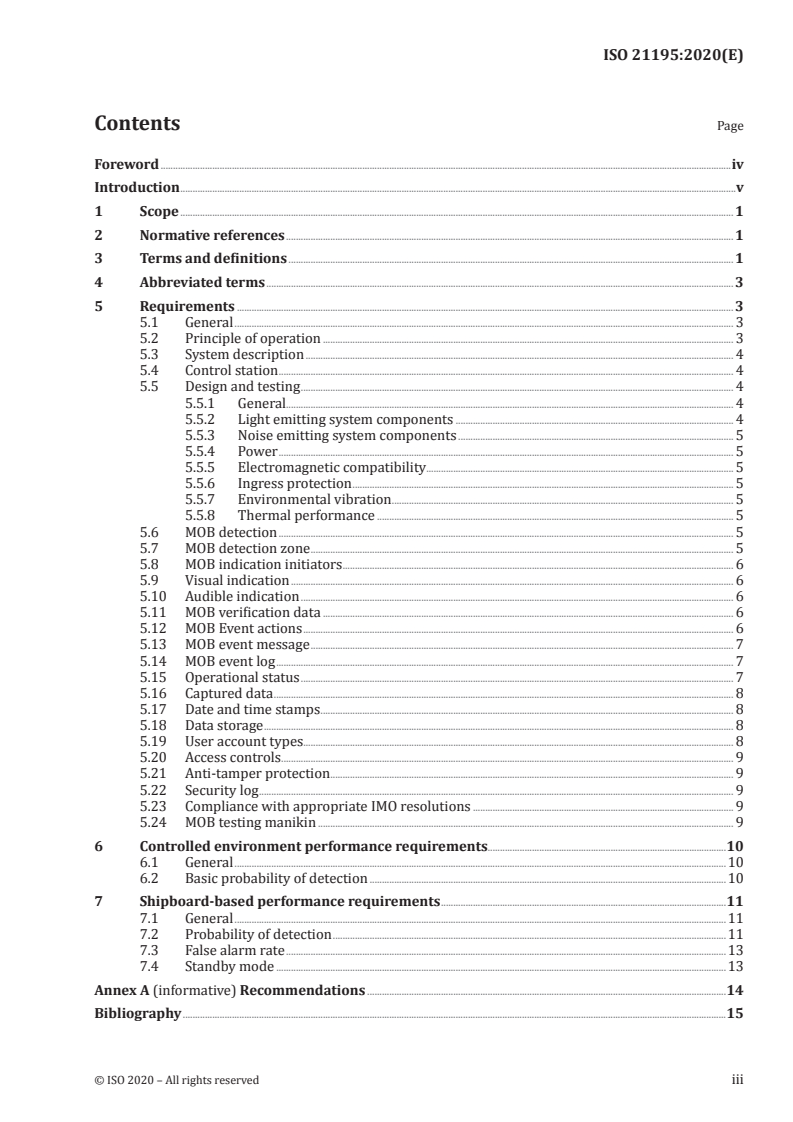
Contents Page
Foreword .iv
Introduction .v
1 Scope . 1
2 Normative references . 1
3 Terms and definitions . 1
4 Abbreviated terms . 3
5 Requirements . 3
5.1 General . 3
5.2 Principle of operation . 3
5.3 System description . 4
5.4 Control station . 4
5.5 Design and testing . 4
5.5.1 General. 4
5.5.2 Light emitting system components . 4
5.5.3 Noise emitting system components . 5
5.5.4 Power . 5
5.5.5 Electromagnetic compatibility. 5
5.5.6 Ingress protection . 5
5.5.7 Environmental vibration . 5
5.5.8 Thermal performance . 5
5.6 MOB detection . 5
5.7 MOB detection zone . 5
5.8 MOB indication initiators . 6
5.9 Visual indication . 6
5.10 Audible indication . 6
5.11 MOB verification data . 6
5.12 MOB Event actions . 6
5.13 MOB event message . 7
5.14 MOB event log . 7
5.15 Operational status . 7
5.16 Captured data . 8
5.17 Date and time stamps . 8
5.18 Data storage . 8
5.19 User account types. 8
5.20 Access controls . 9
5.21 Anti-tamper protection . 9
5.22 Security log . 9
5.23 Compliance with appropriate IMO resolutions . 9
5.24 MOB testing manikin . 9
6 Controlled environment performance requirements.10
6.1 General .10
6.2 Basic probability of detection .10
7 Shipboard-based performance requirements .11
7.1 General .11
7.2 Probability of detection .11
7.3 False alarm rate .13
7.4 Standby mode .13
Annex A (informative) Recommendations .14
Bibliography .15
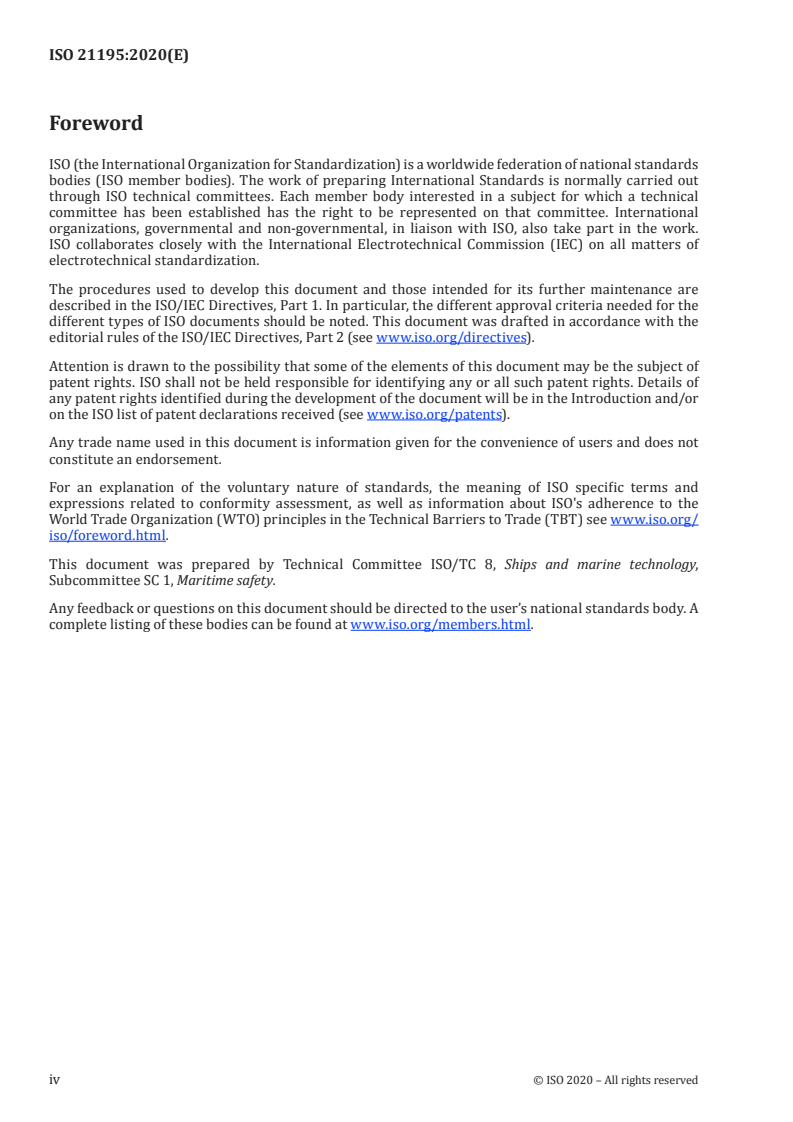
Foreword
ISO (the International Organization for Standardization) is a worldwide federation of national standards
bodies (ISO member bodies). The work of preparing International Standards is normally carried out
through ISO technical committees. Each member body interested in a subject for which a technical
committee has been established has the right to be represented on that committee. International
organizations, governmental and non-governmental, in liaison with ISO, also take part in the work.
ISO collaborates closely with the International Electrotechnical Commission (IEC) on all matters of
electrotechnical standardization.
The procedures used to develop this document and those intended for its further maintenance are
described in the ISO/IEC Directives, Part 1. In particular, the different approval criteria needed for the
different types of ISO documents should be noted. This document was drafted in accordance with the
editorial rules of the ISO/IEC Directives, Part 2 (see www .iso .org/ directives).
Attention is drawn to the possibility that some of the elements of this document may be the subject of
patent rights. ISO shall not be held responsible for identifying any or all such patent rights. Details of
any patent rights identified during the development of the document will be in the Introduction and/or
on the ISO list of patent declarations received (see www .iso .org/ patents).
Any trade name used in this document is information given for the convenience of users and does not
constitute an endorsement.
For an explanation of the voluntary nature of standards, the meaning of ISO specific terms and
expressions related to conformity assessment, as well as information about ISO's adherence to the
World Trade Organization (WTO) principles in the Technical Barriers to Trade (TBT) see www .iso .org/
iso/ foreword .html.
This document was prepared by Technical Committee ISO/TC 8, Ships and marine technology,
Subcommittee SC 1, Maritime safety.
Any feedback or questions on this document should be directed to the user’s national standards body. A
complete listing of these bodies can be found at www .iso .org/ members .html.
iv © ISO 2020 – All rights reserved
Introduction
The lack of standardized man overboard (MOB) detection system requirements has made it difficult for
end users to objectively evaluate the safety and effectiveness of such systems. This document addresses
these issues by clearly defining the technical specifications for the equipment, thereby allowing
manufacturers to develop systems against a common set of requirements and enabling end-users to
evaluate the safety, effectiveness, performance and reliability of MOB detection systems.
This document provides a method to verify that a system operates to the required performance in a
specified environmental window (Table 1) and against a manikin of the size described in 5.24. Systems
that are operational outside the prescribed environmental conditions or used to detect people that
do not conform to the effective manikin size can suffer some degradation in performance. It is not
currently possible to quantify that degradation.
INTERNATIONAL STANDARD ISO 21195:2020(E)
Ships and marine technology — Systems for the detection
of persons while going overboard from ships (man
overboard detection)
1 Scope
This document specifies technical requirements for systems designed to detect a person who has gone
overboard from a ship.
This document does not cover man overboard (MOB) detection systems that require the passengers or
crew to wear or carry a device to trigger an MOB event.
2 Normative references
The following documents are referred to in the text in such a way that some or all of their content
constitutes requirements of this document. For dated references, only the edition cited applies. For
undated references, the latest edition of the referenced document (including any amendments) applies.
IEC 60945:2002, Maritime navigation and radiocommunication equipment and systems — General
requirements — Methods of testing and required test results
IEC 61162 (all parts), Maritime navigation and radiocommunication equipment and systems — Digital
interfaces
IMO Resolution A., 1021(26), Code on alerts and indicators, 2009
IMO Resolution MSC., 302(87), Bridge alert management
IMO Resolution MSC, 337(91), Adoption Of The Code On Noise Levels On Board Ships
3 Terms and definitions
For the purposes of this document, the following terms and definitions apply.
ISO and IEC maintain terminological databases for use in standardization at the following addresses:
— ISO Online browsing platform: available at https:// www. iso. org/o bp
— IEC Electropedia: available at https:// www.e lectropedia. org/
3.1
accessible open area
area of the ship accessible to either passengers or crew and open to the outside, where a person who fell
would end up overboard
3.2
active state
state in which the system is on
3.3
alarm action
action available within the system when a MOB alert or alarm is triggered or changes status
3.4
control station
equipment that provides the facilities for human observation and control of the MOB detection system
3.5
data
information captured and/or generated by the MOB detection system
Note 1 to entry: Data can be in either a raw or a processed form and includes basic (e.g. text, numeric, Boolean),
composite (e.g. array, class, and list) and multimedia (e.g. images, audio, and video) data types.
3.6
environmental vibration
periodic motion of equipment installed aboard ships as a result of environmental forces
3.7
false alarm
system activation not caused by an actual MOB event
3.8
heading
angle between the direction in which the ship’s bow is pointing and a reference direction, e.g. true
north, expressed in degrees, usually from 000° clockwise through 360°
3.9
laboratory
body that performs one or more of the following activities:
— testing
— calibration
— sampling associated with subsequent testing or calibration
[SOURCE: ISO/IEC 17025:2017, 3.6, modified — Note 1 to entry has been omitted.]
3.10
man overboard event
MOB event
incident in which person(s) has accidently or intentionally gone over the side/front/back of a ship and
into the water
3.11
man overboard verification data
MOB verification data
system data (3.5) that may be used by user to acknowledge, deny, confirm or terminate a MOB alert or
alarm at the control station (3.4)
3.12
nominal operating conditions
set of ship and environmental conditions
Note 1 to entry: See Table 1.
Table 1 — Nominal operating conditions
Condition Value
Wave height 0 m to 2,5 m
Precipitation None
Ship speed over ground 0 knots to 25 knots
2 © ISO 2020 – All rights reserved
3.13
sensor unit
device or system of devices that detects and responds to one or more physical stimuli
3.14
underway
not at anchor, made fast to the shore, or aground
4 Abbreviated terms
ECDIS electronic chart display and information system
MOB man overboard
RAID redundant array of independent disks
S-VDR simplified voyage data recorder
VDR voyage data recorder
5 Requirements
5.1 General
The testing outlined in this document shall be conducted by a laboratory meeting the requirements of
ISO 17025 or may be conducted by the manufacturer, provided the tests conducted by the manufacturer
are approved by a laboratory meeting the requirements of ISO 17025 or classification society that
complies with the applicable unified interpretations and requirements posted by the International
Association of Classification Societies (IACS) or other recognized organization.
NOTE IACS is an organization that establishes, reviews, promotes and develops minimum technical
requirements in relation to the design, construction, maintenance and survey of ships and other marine related
facilities. It also assists international regulatory bodies and standards organizations to develop, implement and
interpret statutory regulations and industry standards in ship design, construction and maintenance, with a
view to improving safety at sea and the prevention of marine pollution.
The intent of the following requirements is to measure the system level of performance in the intended,
nominal operational environment.
Annex A provides additional recommendations for guidance to those developing, installing, testing and
using MOB detection systems.
5.2 Principle of operation
An MOB system shall operate in accordance with the principles described in this subclause.
The MOB system sensors shall detect persons and other objects passing through the detection zone
(see 5.7). Processing or analysis of the raw data may be conducted in the sensor(s), a server, the control
station or any combination of the three.
Once the analysis is complete, the system shall have automatically excluded any event that is not a man
overboard event (plus allowable rate of false alarms). For each event that passes the threshold for an
MOB event, the system shall generate an indication. A human operator shall be required to review the
event and determine if the event is a man overboard event or a false alarm.
False alarms shall be recorded in the system with a comment from the operator on the cause. This will
be used to further develop understanding of the behaviour of such systems during normal operations
and varied environmental conditions.
Man overboard events shall remain active on the control station until marked complete by a human
operator with comments on outcome.
The MOB system shall be designed with the possibility to connect to integrated navigation systems
(ECDIS) to display geospatially referenced MOB event markers.
The MOB system shall be designed with input interfaces for time, position and available
environmental data.
5.3 System description
A general MOB detection system described in this document consists of a control station, sensor units,
cables and associated software (Figure 1).
NOTE Depending on the system, the associated software can be installed on the control station and/or
sensor units.
Figure 1 — Block diagram of a general MOB detection system with logical links
5.4 Control station
The system shall include a control station where alarms and data can be reviewed.
The system shall have the capability for an operator to manually select an imaging sensor and timeline
for playback at the control station.
5.5 Design and testing
5.5.1 General
The MOB system shall be designed and tested to comply with the requirements of IEC 60945 for
protected or exposed components as appropriate for each system sub-assembly.
Specific requirements described in 5.5.2 to 5.5.8.
5.5.2 Light emitting system components
The intensity of light emitting system components located or installed in the bridge area shall be fully
dimmable and capable of being controlled at the control station.
4 © ISO 2020 – All rights reserved
5.5.3 Noise emitting system components
All parts of the system that is installed in the navigating bridge and/or chartrooms shall have a
combined noise level of less than 60dB(A) at a distance of 1 m from any part of the equipment under test
(EUT), as defined in IEC 60945:2002, 11.1. The MOB audible alarm is exempt from this requirement.
System components installed in locations other than the navigating bridge or chartroom shall follow
the maximum noise levels set forth by IMO Resolution MSC.337(91) The MOB audible alarm is exempt
from this requirement.
5.5.4 Power
The equipment shall be compatible with ship’s power as specified and tested in accordance with
IEC 60945 for nominal AC power input between 100 Vrms a
...
INTERNATIONAL ISO
STANDARD 21195
First edition
2020-06
Ships and marine technology —
Systems for the detection of persons
while going overboard from ships
(man overboard detection)
Navires et technologie maritime — Systèmes pour la détection des
personnes passant par-dessus bord (détection d’un homme à la mer)
Reference number
©
ISO 2020
© ISO 2020
All rights reserved. Unless otherwise specified, or required in the context of its implementation, no part of this publication may
be reproduced or utilized otherwise in any form or by any means, electronic or mechanical, including photocopying, or posting
on the internet or an intranet, without prior written permission. Permission can be requested from either ISO at the address
below or ISO’s member body in the country of the requester.
ISO copyright office
CP 401 • Ch. de Blandonnet 8
CH-1214 Vernier, Geneva
Phone: +41 22 749 01 11
Email: copyright@iso.org
Website: www.iso.org
Published in Switzerland
ii © ISO 2020 – All rights reserved
Contents Page
Foreword .iv
Introduction .v
1 Scope . 1
2 Normative references . 1
3 Terms and definitions . 1
4 Abbreviated terms . 3
5 Requirements . 3
5.1 General . 3
5.2 Principle of operation . 3
5.3 System description . 4
5.4 Control station . 4
5.5 Design and testing . 4
5.5.1 General. 4
5.5.2 Light emitting system components . 4
5.5.3 Noise emitting system components . 5
5.5.4 Power . 5
5.5.5 Electromagnetic compatibility. 5
5.5.6 Ingress protection . 5
5.5.7 Environmental vibration . 5
5.5.8 Thermal performance . 5
5.6 MOB detection . 5
5.7 MOB detection zone . 5
5.8 MOB indication initiators . 6
5.9 Visual indication . 6
5.10 Audible indication . 6
5.11 MOB verification data . 6
5.12 MOB Event actions . 6
5.13 MOB event message . 7
5.14 MOB event log . 7
5.15 Operational status . 7
5.16 Captured data . 8
5.17 Date and time stamps . 8
5.18 Data storage . 8
5.19 User account types. 8
5.20 Access controls . 9
5.21 Anti-tamper protection . 9
5.22 Security log . 9
5.23 Compliance with appropriate IMO resolutions . 9
5.24 MOB testing manikin . 9
6 Controlled environment performance requirements.10
6.1 General .10
6.2 Basic probability of detection .10
7 Shipboard-based performance requirements .11
7.1 General .11
7.2 Probability of detection .11
7.3 False alarm rate .13
7.4 Standby mode .13
Annex A (informative) Recommendations .14
Bibliography .15
Foreword
ISO (the International Organization for Standardization) is a worldwide federation of national standards
bodies (ISO member bodies). The work of preparing International Standards is normally carried out
through ISO technical committees. Each member body interested in a subject for which a technical
committee has been established has the right to be represented on that committee. International
organizations, governmental and non-governmental, in liaison with ISO, also take part in the work.
ISO collaborates closely with the International Electrotechnical Commission (IEC) on all matters of
electrotechnical standardization.
The procedures used to develop this document and those intended for its further maintenance are
described in the ISO/IEC Directives, Part 1. In particular, the different approval criteria needed for the
different types of ISO documents should be noted. This document was drafted in accordance with the
editorial rules of the ISO/IEC Directives, Part 2 (see www .iso .org/ directives).
Attention is drawn to the possibility that some of the elements of this document may be the subject of
patent rights. ISO shall not be held responsible for identifying any or all such patent rights. Details of
any patent rights identified during the development of the document will be in the Introduction and/or
on the ISO list of patent declarations received (see www .iso .org/ patents).
Any trade name used in this document is information given for the convenience of users and does not
constitute an endorsement.
For an explanation of the voluntary nature of standards, the meaning of ISO specific terms and
expressions related to conformity assessment, as well as information about ISO's adherence to the
World Trade Organization (WTO) principles in the Technical Barriers to Trade (TBT) see www .iso .org/
iso/ foreword .html.
This document was prepared by Technical Committee ISO/TC 8, Ships and marine technology,
Subcommittee SC 1, Maritime safety.
Any feedback or questions on this document should be directed to the user’s national standards body. A
complete listing of these bodies can be found at www .iso .org/ members .html.
iv © ISO 2020 – All rights reserved
Introduction
The lack of standardized man overboard (MOB) detection system requirements has made it difficult for
end users to objectively evaluate the safety and effectiveness of such systems. This document addresses
these issues by clearly defining the technical specifications for the equipment, thereby allowing
manufacturers to develop systems against a common set of requirements and enabling end-users to
evaluate the safety, effectiveness, performance and reliability of MOB detection systems.
This document provides a method to verify that a system operates to the required performance in a
specified environmental window (Table 1) and against a manikin of the size described in 5.24. Systems
that are operational outside the prescribed environmental conditions or used to detect people that
do not conform to the effective manikin size can suffer some degradation in performance. It is not
currently possible to quantify that degradation.
INTERNATIONAL STANDARD ISO 21195:2020(E)
Ships and marine technology — Systems for the detection
of persons while going overboard from ships (man
overboard detection)
1 Scope
This document specifies technical requirements for systems designed to detect a person who has gone
overboard from a ship.
This document does not cover man overboard (MOB) detection systems that require the passengers or
crew to wear or carry a device to trigger an MOB event.
2 Normative references
The following documents are referred to in the text in such a way that some or all of their content
constitutes requirements of this document. For dated references, only the edition cited applies. For
undated references, the latest edition of the referenced document (including any amendments) applies.
IEC 60945:2002, Maritime navigation and radiocommunication equipment and systems — General
requirements — Methods of testing and required test results
IEC 61162 (all parts), Maritime navigation and radiocommunication equipment and systems — Digital
interfaces
IMO Resolution A., 1021(26), Code on alerts and indicators, 2009
IMO Resolution MSC., 302(87), Bridge alert management
IMO Resolution MSC, 337(91), Adoption Of The Code On Noise Levels On Board Ships
3 Terms and definitions
For the purposes of this document, the following terms and definitions apply.
ISO and IEC maintain terminological databases for use in standardization at the following addresses:
— ISO Online browsing platform: available at https:// www. iso. org/o bp
— IEC Electropedia: available at https:// www.e lectropedia. org/
3.1
accessible open area
area of the ship accessible to either passengers or crew and open to the outside, where a person who fell
would end up overboard
3.2
active state
state in which the system is on
3.3
alarm action
action available within the system when a MOB alert or alarm is triggered or changes status
3.4
control station
equipment that provides the facilities for human observation and control of the MOB detection system
3.5
data
information captured and/or generated by the MOB detection system
Note 1 to entry: Data can be in either a raw or a processed form and includes basic (e.g. text, numeric, Boolean),
composite (e.g. array, class, and list) and multimedia (e.g. images, audio, and video) data types.
3.6
environmental vibration
periodic motion of equipment installed aboard ships as a result of environmental forces
3.7
false alarm
system activation not caused by an actual MOB event
3.8
heading
angle between the direction in which the ship’s bow is pointing and a reference direction, e.g. true
north, expressed in degrees, usually from 000° clockwise through 360°
3.9
laboratory
body that performs one or more of the following activities:
— testing
— calibration
— sampling associated with subsequent testing or calibration
[SOURCE: ISO/IEC 17025:2017, 3.6, modified — Note 1 to entry has been omitted.]
3.10
man overboard event
MOB event
incident in which person(s) has accidently or intentionally gone over the side/front/back of a ship and
into the water
3.11
man overboard verification data
MOB verification data
system data (3.5) that may be used by user to acknowledge, deny, confirm or terminate a MOB alert or
alarm at the control station (3.4)
3.12
nominal operating conditions
set of ship and environmental conditions
Note 1 to entry: See Table 1.
Table 1 — Nominal operating conditions
Condition Value
Wave height 0 m to 2,5 m
Precipitation None
Ship speed over ground 0 knots to 25 knots
2 © ISO 2020 – All rights reserved
3.13
sensor unit
device or system of devices that detects and responds to one or more physical stimuli
3.14
underway
not at anchor, made fast to the shore, or aground
4 Abbreviated terms
ECDIS electronic chart display and information system
MOB man overboard
RAID redundant array of independent disks
S-VDR simplified voyage data recorder
VDR voyage data recorder
5 Requirements
5.1 General
The testing outlined in this document shall be conducted by a laboratory meeting the requirements of
ISO 17025 or may be conducted by the manufacturer, provided the tests conducted by the manufacturer
are approved by a laboratory meeting the requirements of ISO 17025 or classification society that
complies with the applicable unified interpretations and requirements posted by the International
Association of Classification Societies (IACS) or other recognized organization.
NOTE IACS is an organization that establishes, reviews, promotes and develops minimum technical
requirements in relation to the design, construction, maintenance and survey of ships and other marine related
facilities. It also assists international regulatory bodies and standards organizations to develop, implement and
interpret statutory regulations and industry standards in ship design, construction and maintenance, with a
view to improving safety at sea and the prevention of marine pollution.
The intent of the following requirements is to measure the system level of performance in the intended,
nominal operational environment.
Annex A provides additional recommendations for guidance to those developing, installing, testing and
using MOB detection systems.
5.2 Principle of operation
An MOB system shall operate in accordance with the principles described in this subclause.
The MOB system sensors shall detect persons and other objects passing through the detection zone
(see 5.7). Processing or analysis of the raw data may be conducted in the sensor(s), a server, the control
station or any combination of the three.
Once the analysis is complete, the system shall have automatically excluded any event that is not a man
overboard event (plus allowable rate of false alarms). For each event that passes the threshold for an
MOB event, the system shall generate an indication. A human operator shall be required to review the
event and determine if the event is a man overboard event or a false alarm.
False alarms shall be recorded in the system with a comment from the operator on the cause. This will
be used to further develop understanding of the behaviour of such systems during normal operations
and varied environmental conditions.
Man overboard events shall remain active on the control station until marked complete by a human
operator with comments on outcome.
The MOB system shall be designed with the possibility to connect to integrated navigation systems
(ECDIS) to display geospatially referenced MOB event markers.
The MOB system shall be designed with input interfaces for time, position and available
environmental data.
5.3 System description
A general MOB detection system described in this document consists of a control station, sensor units,
cables and associated software (Figure 1).
NOTE Depending on the system, the associated software can be installed on the control station and/or
sensor units.
Figure 1 — Block diagram of a general MOB detection system with logical links
5.4 Control station
The system shall include a control station where alarms and data can be reviewed.
The system shall have the capability for an operator to manually select an imaging sensor and timeline
for playback at the control station.
5.5 Design and testing
5.5.1 General
The MOB system shall be designed and tested to comply with the requirements of IEC 60945 for
protected or exposed components as appropriate for each system sub-assembly.
Specific requirements described in 5.5.2 to 5.5.8.
5.5.2 Light emitting system components
The intensity of light emitting system components located or installed in the bridge area shall be fully
dimmable and capable of being controlled at the control station.
4 © ISO 2020 – All rights reserved
5.5.3 Noise emitting system components
All parts of the system that is installed in the navigating bridge and/or chartrooms shall have a
combined noise level of less than 60dB(A) at a distance of 1 m from any part of the equipment under test
(EUT), as defined in IEC 60945:2002, 11.1. The MOB audible alarm is exempt from this requirement.
System components installed in locations other than the navigating bridge or chartroom shall follow
the maximum noise levels set forth by IMO Resolution MSC.337(91) The MOB audible alarm is exempt
from this requirement.
5.5.4 Power
The equipment shall be compatible with ship’s power as specified and tested in accordance with
IEC 60945 for nominal AC power input between 100 Vrms a
...