

ISO/TR 16178:2021
(Main)Footwear — Critical substances potentially present in footwear and footwear components — Lists of critical chemical substances
General Information
- Abstract
This document defines lists of critical chemical substances potentially present in footwear and footwear components. This document describes the critical chemical substances, their potential risks of nocuousness, in which materials they could be found, and which test method(s) can be used to quantify them. The test methods listed indicate the state of the art. For some substances, a test method is not available. This document is applicable to any kind of footwear and footwear components.
- Status
- Published
- Publication Date
- 21-Sep-2021
- Technical Committee
- ISO/TC 216 - Footwear
- Drafting Committee
- ISO/TC 216/WG 2 - Footwear and environmental aspects
- Current Stage
- 6060 - International Standard published
- Start Date
- 22-Sep-2021
- Completion Date
- 22-Sep-2021
Buy Documents
ISO/TR 16178:2021 - Footwear — Critical substances potentially present in footwear and footwear components — Lists of critical chemical substances Released:9/22/2021
ISO/TR 16178:2021 - Footwear — Critical substances potentially present in footwear and footwear components — Lists of critical chemical substances/22/2021
ISO/TR 16178:2021 - Chaussures — Substances critiques potentiellement présentes dans la chaussure et les composants de chaussures — Listes des substances chimiques critiques Released:12/17/2021
ISO/TR 16178:2021 - Chaussures — Substances critiques potentiellement présentes dans la chaussure et les composants de chaussures — Listes des substances chimiques critiques/17/2021
Overview
ISO/TR 16178:2021 - Footwear - Critical substances potentially present in footwear and footwear components is a technical report that defines lists of critical chemical substances that can occur in footwear and footwear components. The document describes each substance or substance group, the potential risks of nocuousness, the materials where they may be present, and the test method(s) that can be used to quantify them. The test methods referenced reflect the state of the art; for some substances a validated test method is not available. This TR is applicable to any kind of footwear and footwear components (upper, lining, sole, adhesives, trims).
Key topics and technical requirements
- Comprehensive substance lists: includes classes and specific chemicals such as acrylonitrile, alkylphenols and ethoxylates, aromatic amines, benzene, biocides (e.g., OIT, triclosan), bisphenols, cadmium, chlorinated paraffins, chromium (including Cr VI), formaldehyde, heavy metals, DMFu, dispersive dyes, flame retardants, nitrosamines, organotin compounds, PAHs and more.
- Substance profiles: for each entry the TR provides:
- General description and where the chemical is used or can occur in footwear materials
- Potential health and environmental risks (nocuousness)
- Recommended or referenced test methods to detect or quantify the substance (where available)
- Material focus: guidance on which leather, textiles, polymers, adhesives, foams and coatings are likely to contain particular chemicals.
- Testing guidance: identification of state-of-the-art test methods and note when analytical methods are not yet established.
Practical applications - who uses this standard
- Footwear manufacturers and component suppliers: to define safe material specifications and supplier requirements.
- Product safety & compliance teams: for risk assessments, compliance with market regulations, and preparation for regulatory inspections.
- Testing laboratories: to prioritize analytes and select appropriate methods when analysing footwear samples.
- Procurement and supply-chain managers: to set chemical limits in contracts and to screen suppliers.
- Retailers and brand owners: for product safety assurance, sustainability reporting and market access.
- Regulators and standards developers: as reference material when drafting or harmonizing chemical restrictions for consumer products.
Related standards and regulatory context
ISO/TR 16178:2021 is intended to be used alongside other ISO testing standards for footwear materials and analytical chemistry methods, and in the context of regional chemical regulations and restrictions (for example, EU REACH or national consumer product safety rules). It serves as a practical reference for selecting target chemicals, understanding risks, and planning analytical testing.
Keywords: ISO/TR 16178:2021, footwear chemical substances, critical chemical substances in footwear, footwear safety testing, chemical risk in footwear, test methods for footwear.
Relations
- Effective Date
- 12-Feb-2026
- Effective Date
- 05-Nov-2015
Buy Documents
ISO/TR 16178:2021 - Footwear — Critical substances potentially present in footwear and footwear components — Lists of critical chemical substances Released:9/22/2021
ISO/TR 16178:2021 - Footwear — Critical substances potentially present in footwear and footwear components — Lists of critical chemical substances/22/2021
ISO/TR 16178:2021 - Chaussures — Substances critiques potentiellement présentes dans la chaussure et les composants de chaussures — Listes des substances chimiques critiques Released:12/17/2021
ISO/TR 16178:2021 - Chaussures — Substances critiques potentiellement présentes dans la chaussure et les composants de chaussures — Listes des substances chimiques critiques/17/2021
Frequently Asked Questions
ISO/TR 16178:2021 is a technical report published by the International Organization for Standardization (ISO). Its full title is "Footwear — Critical substances potentially present in footwear and footwear components — Lists of critical chemical substances". This standard covers: This document defines lists of critical chemical substances potentially present in footwear and footwear components. This document describes the critical chemical substances, their potential risks of nocuousness, in which materials they could be found, and which test method(s) can be used to quantify them. The test methods listed indicate the state of the art. For some substances, a test method is not available. This document is applicable to any kind of footwear and footwear components.
This document defines lists of critical chemical substances potentially present in footwear and footwear components. This document describes the critical chemical substances, their potential risks of nocuousness, in which materials they could be found, and which test method(s) can be used to quantify them. The test methods listed indicate the state of the art. For some substances, a test method is not available. This document is applicable to any kind of footwear and footwear components.
ISO/TR 16178:2021 is classified under the following ICS (International Classification for Standards) categories: 61.060 - Footwear. The ICS classification helps identify the subject area and facilitates finding related standards.
ISO/TR 16178:2021 has the following relationships with other standards: It is inter standard links to CEN ISO/TR 16178:2021, ISO/TR 16178:2012. Understanding these relationships helps ensure you are using the most current and applicable version of the standard.
ISO/TR 16178:2021 is available in PDF format for immediate download after purchase. The document can be added to your cart and obtained through the secure checkout process. Digital delivery ensures instant access to the complete standard document.
Standards Content (Sample)
TECHNICAL ISO/TR
REPORT 16178
Third edition
2021-09
Footwear — Critical substances
potentially present in footwear and
footwear components — Lists of
critical chemical substances
Chaussures — Substances critiques potentiellement présentes dans la
chaussure et les composants de chaussures — Listes des substances
chimiques critiques
Reference number
©
ISO 2021
© ISO 2021
All rights reserved. Unless otherwise specified, or required in the context of its implementation, no part of this publication may
be reproduced or utilized otherwise in any form or by any means, electronic or mechanical, including photocopying, or posting
on the internet or an intranet, without prior written permission. Permission can be requested from either ISO at the address
below or ISO’s member body in the country of the requester.
ISO copyright office
CP 401 • Ch. de Blandonnet 8
CH-1214 Vernier, Geneva
Phone: +41 22 749 01 11
Email: copyright@iso.org
Website: www.iso.org
Published in Switzerland
ii © ISO 2021 – All rights reserved
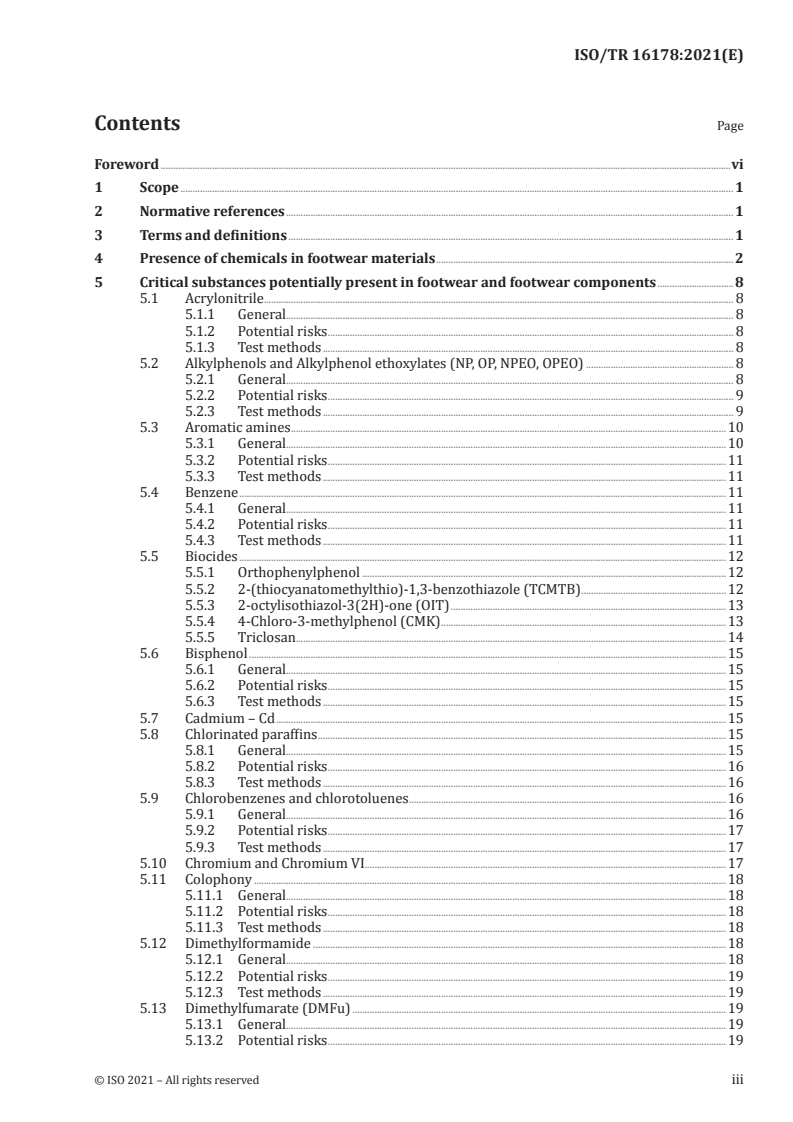
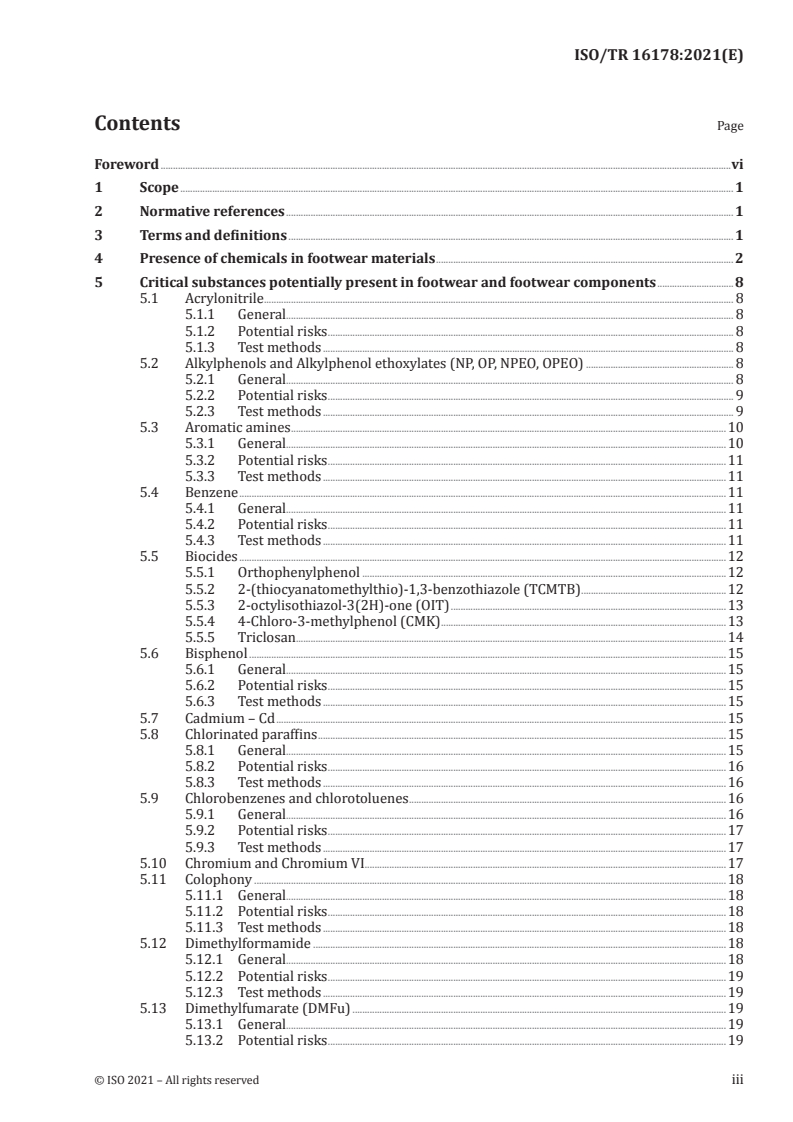
Contents Page
Foreword .vi
1 Scope . 1
2 Normative references . 1
3 Terms and definitions . 1
4 Presence of chemicals in footwear materials . 2
5 Critical substances potentially present in footwear and footwear components .8
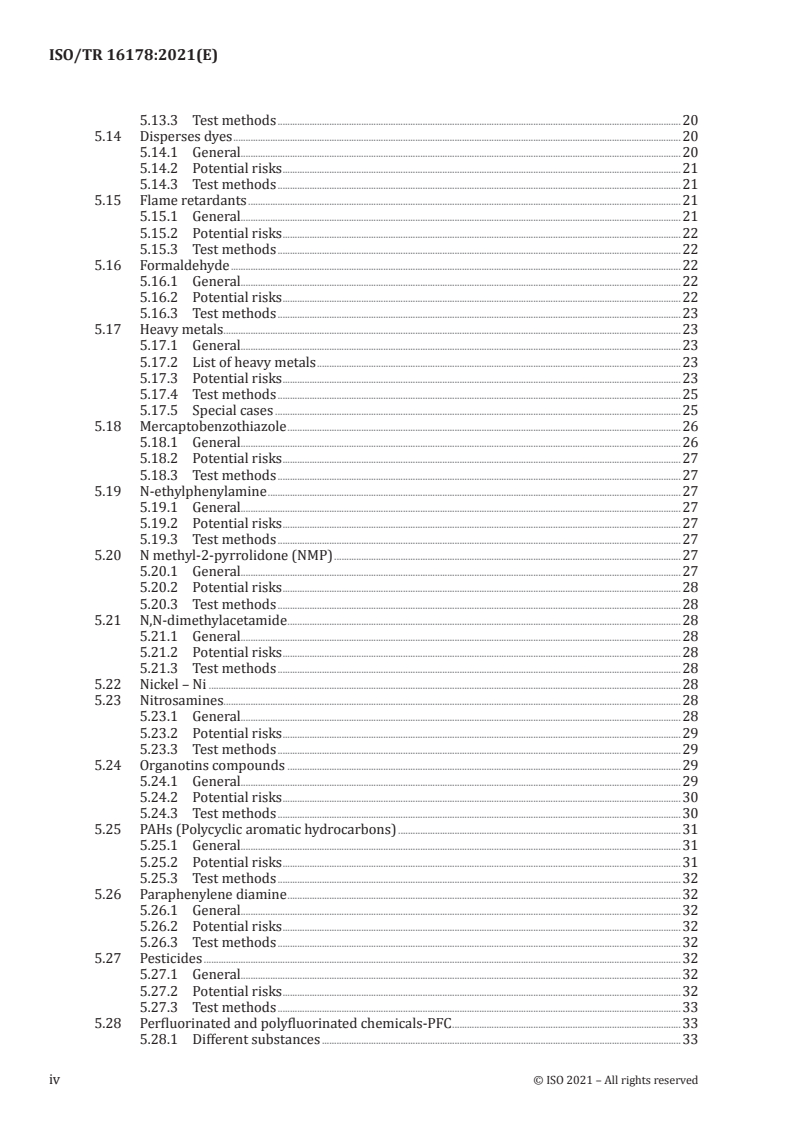
5.1 Acrylonitrile . 8
5.1.1 General. 8
5.1.2 Potential risks . 8
5.1.3 Test methods . 8
5.2 Alkylphenols and Alkylphenol ethoxylates (NP, OP, NPEO, OPEO) . 8
5.2.1 General. 8
5.2.2 Potential risks . 9
5.2.3 Test methods . 9
5.3 Aromatic amines .10
5.3.1 General.10
5.3.2 Potential risks .11
5.3.3 Test methods .11
5.4 Benzene .11
5.4.1 General.11
5.4.2 Potential risks .11
5.4.3 Test methods .11
5.5 Biocides .12
5.5.1 Orthophenylphenol .12
5.5.2 2-(thiocyanatomethylthio)-1,3-benzothiazole (TCMTB) .12
5.5.3 2-octylisothiazol-3(2H)-one (OIT) .13
5.5.4 4-Chloro-3-methylphenol (CMK) .13
5.5.5 Triclosan.14
5.6 Bisphenol .15
5.6.1 General.15
5.6.2 Potential risks .15
5.6.3 Test methods .15
5.7 Cadmium – Cd .15
5.8 Chlorinated paraffins .15
5.8.1 General.15
5.8.2 Potential risks .16
5.8.3 Test methods .16
5.9 Chlorobenzenes and chlorotoluenes .16
5.9.1 General.16
5.9.2 Potential risks .17
5.9.3 Test methods .17
5.10 Chromium and Chromium VI .17
5.11 Colophony .18
5.11.1 General.18
5.11.2 Potential risks .18
5.11.3 Test methods .18
5.12 Dimethylformamide .18
5.12.1 General.18
5.12.2 Potential risks .19
5.12.3 Test methods .19
5.13 Dimethylfumarate (DMFu) .19
5.13.1 General.19
5.13.2 Potential risks .19
5.13.3 Test methods .20
5.14 Disperses dyes .20
5.14.1 General.20
5.14.2 Potential risks .21
5.14.3 Test methods .21
5.15 Flame retardants .21
5.15.1 General.21
5.15.2 Potential risks .22
5.15.3 Test methods .22
5.16 Formaldehyde .22
5.16.1 General.22
5.16.2 Potential risks .22
5.16.3 Test methods .23
5.17 Heavy metals .23
5.17.1 General.23
5.17.2 List of heavy metals .23
5.17.3 Potential risks .23
5.17.4 Test methods .25
5.17.5 Special cases .25
5.18 Mercaptobenzothiazole .26
5.18.1 General.26
5.18.2 Potential risks .27
5.18.3 Test methods .27
5.19 N-ethylphenylamine .27
5.19.1 General.27
5.19.2 Potential risks .27
5.19.3 Test methods .27
5.20 N methyl-2-pyrrolidone (NMP) .27
5.20.1 General.27
5.20.2 Potential risks .28
5.20.3 Test methods .28
5.21 N,N-dimethylacetamide .28
5.21.1 General.28
5.21.2 Potential risks .28
5.21.3 Test methods .28
5.22 Nickel – Ni .28
5.23 Nitrosamines.28
5.23.1 General.28
5.23.2 Potential risks .29
5.23.3 Test methods .29
5.24 Organotins compounds .29
5.24.1 General.29
5.24.2 Potential risks .30
5.24.3 Test methods .30
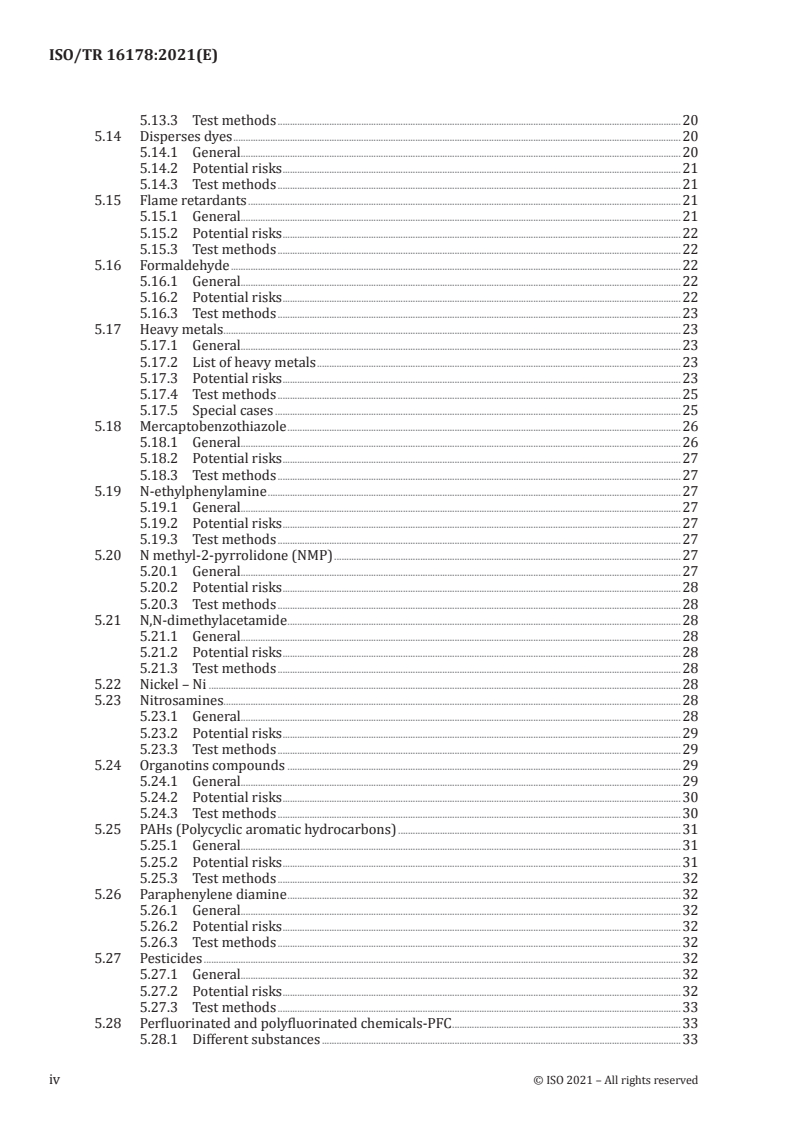
5.25 PAHs (Polycyclic aromatic hydrocarbons) .31
5.25.1 General.31
5.25.2 Potential risks .31
5.25.3 Test methods .32
5.26 Paraphenylene diamine .32
5.26.1 General.32
5.26.2 Potential risks .32
5.26.3 Test methods .32
5.27 Pesticides .32
5.27.1 General.32
5.27.2 Potential risks .32
5.27.3 Test methods .33
5.28 Perfluorinated and polyfluorinated chemicals-PFC .33
5.28.1 Different substances .33
iv © ISO 2021 – All rights reserved
5.28.2 Potential risks .36
5.29 pH .36
5.29.1 General.36
5.29.2 Potential risks .37
5.29.3 Test methods .37
5.30 Phenol .37
5.30.1 General.37
5.30.2 Potential risks .37
5.30.3 Test methods .37
5.31 Phenyl mercury .37
5.31.1 General.37
5.31.2 Potential risks .38
5.31.3 Test methods .38
5.32 Phthalates .38
5.32.1 General.38
5.32.2 Potential risks .40
5.32.3 Test methods .40
5.33 Polychlorophenols .40
5.33.1 General.40
5.33.2 Potential risks .42
5.33.3 Test methods .42
5.34 Paratertiary butyl phenol formaldehyde (PTBF) .42
5.34.1 General.42
5.34.2 Potential risks .42
5.34.3 Test methods .42
5.35 Quinoline .42
5.35.1 General.42
5.35.2 Potential risks .43
5.35.3 Test methods .43
5.36 Thiuram and thiocarbamate.43
5.36.1 General.43
5.36.2 Potential risks .43
5.36.3 Test methods .43
5.37 Volatile organic compounds (VOC) .44
5.37.1 General.44
5.37.2 Potential risks .44
5.37.3 Test methods .44
Bibliography .46
Foreword
ISO (the International Organization for Standardization) is a worldwide federation of national standards
bodies (ISO member bodies). The work of preparing International Standards is normally carried out
through ISO technical committees. Each member body interested in a subject for which a technical
committee has been established has the right to be represented on that committee. International
organizations, governmental and non-governmental, in liaison with ISO, also take part in the work.
ISO collaborates closely with the International Electrotechnical Commission (IEC) on all matters of
electrotechnical standardization.
The procedures used to develop this document and those intended for its further maintenance are
described in the ISO/IEC Directives, Part 1. In particular, the different approval criteria needed for the
different types of ISO documents should be noted. This document was drafted in accordance with the
editorial rules of the ISO/IEC Directives, Part 2 (see www .iso .org/ directives).
Attention is drawn to the possibility that some of the elements of this document may be the subject of
patent rights. ISO shall not be held responsible for identifying any or all such patent rights. Details of
any patent rights identified during the development of the document will be in the Introduction and/or
on the ISO list of patent declarations received (see www .iso .org/ patents).
Any trade name used in this document is information given for the convenience of users and does not
constitute an endorsement.
For an explanation of the voluntary nature of standards, the meaning of ISO specific terms and
expressions related to conformity assessment, as well as information about ISO's adherence to the
World Trade Organization (WTO) principles in the Technical Barriers to Trade (TBT), see www .iso .org/
iso/ foreword .html.
This document was prepared by Technical Committee ISO/TC 216, Footwear, in collaboration with
the European Committee for Standardization (CEN) Technical Committee CEN/TC 309, Footwear, in
accordance with the Agreement on technical cooperation between ISO and CEN (Vienna Agreement).
This third edition cancels and replaces the second edition (ISO/TR 16178:2012), which has been
technically revised.
The main changes compared to the previous edition are as follows:
— new Table 1 including a new system of grading;
— withdrawn substances:
proteins in latex, substances destroying ozone layer, polychlorobiphenyls, polychloroprene, vinyl
chloride;
— added substances:
benzene, bisphenol, NMP, DMAC, phenyl mercury, quinoline, VOC;
— biocides are grouped together (CMK, OIT, OPP, TCMTB);
[67]
— Annex A is now in ISO 21061 ;
— Annex B is now Clause 5;
— bibliography, updated.
Any feedback or questions on this document should be directed to the user’s national standards body. A
complete listing of these bodies can be found at www .iso .org/ members .html.
vi © ISO 2021 – All rights reserved
TECHNICAL REPORT ISO/TR 16178:2021(E)
Footwear — Critical substances potentially present in
footwear and footwear components — Lists of critical
chemical substances
1 Scope
This document defines lists of critical chemical substances potentially present in footwear and footwear
components.
This document describes the critical chemical substances, their potential risks of nocuousness, in which
materials they could be found, and which test method(s) can be used to quantify them.
The test methods listed indicate the state of the art. For some substances, a test method is not available.
This document is applicable to any kind of footwear and footwear components.
2 Normative references
There are no normative references in this document.
3 Terms and definitions
For the purposes of this document, the following terms and definitions apply.
ISO and IEC maintain terminological databases for use in standardization at the following addresses:
— ISO Online browsing platform: available at https:// www .iso .org/ obp
— IEC Electropedia: available at http:// www .electropedia .org/
3.1
allergen
substance that is capable of inducing an allergic reaction
3.2
allergy
immunologically mediated response to certain specific substances (allergens)
Note 1 to entry: Type-1 allergy (respiratory allergy) is mediated by IgE antibodies, can cause asthma, rhinitis,
urticaria. Type-4 allergy (dermal allergy) is mediated by T-cells, can cause dermatitis.
3.3
limit of detection
value from which a substance is considered as detectable
Note 1 to entry: This means that the signal associated to the substance is three times bigger than the background
noise signal. The limit of detection is determined experimentally by the laboratory for each substance.
3.4
critical substances
chemical substance that can be found in footwear or footwear components and can have an effect on
the wearer and/or environmental impact due to its chemical reactivity
Note 1 to entry: The effects caused by critical substances vary. It can be carcinogenic or mutagenic effects,
allergy, reaction to toxics, etc.
3.4.1
critical substances category 1
substances with proven dangerous effect on the wearer
Note 1 to entry: These substances are widely restricted by national regulation in several countries.
3.4.2
critical substances category 2
substances with dangerous effect on the wearer
Note 1 to entry: These substances are restricted by national regulation in a limited number of countries.
3.4.3
critical substances category 3
substances that are highly suspected to have an effect on the wearer
Note 1 to entry: These substances might not be restricted by regulation at the time of publication but they are
frequently requested by the market stakeholders.
3.4.4
critical substances category 4
substances that are suspected to have an effect on the wearer
Note 1 to entry: These substances might not be restricted by regulation. Substances known to have an allergenic
effect on the wearer are included in category 4 for reference.
4 Presence of chemicals in footwear materials
A number of chemicals are present in footwear materials. Table 1 lists the following:
a) in which materials they are supposed to be. The possible materials potentially used in the footwear
[67]
industry are given in ISO 21061:2021 , Annex C.
b) a list of critical chemicals, (see Clause 5 for information);
c) test methods that can be used to quantify them (see Bibliography);
d) the potential risks associated with their use, assessed by the use of the critical substances’ category
scale
1) stand for “critical substances category 1”;
2) stand for “critical substances category 2”;
3) stand for “critical substances category 3”;
4) stand for “critical substances category 4”.
For composite materials, the tests should be conducted on the entire component.
EXAMPLE 1 Coated textile (cotton + PVC coating). Test on PVC and test on cellulosic natural fibres should be
done.
EXAMPLE 2 Mixed textile (PES + cotton). Test on cellulosic natural textile and test on PES textile should be
done.
2 © ISO 2021 – All rights reserved
Table 1 — Critical chemicals potentially present in footwear and footwear components
Leather Synthetic material Natural material Miscellaneous
Substance
Test method
(see Annex B)
Acrylonitrile 4 4 4
ISO 18218-1
Alkylphenols( OP, NP) and Alkylpheno-
3 3 3
lethoxylates, (OPEO, NPEO)
ISO 18218-2
ISO 18254-1
Alkylphenols( OP, NP) and Alkylpheno-
2 2 2 2 2 2 2
lethoxylates, (OPEO, NPEO)
ISO 21084
AZO - arylamines ISO 17234-1 1 1 1
When 4-aminoa-
AZO - arylamines zobenzene is sus- ISO 17234-2 1 1 1
pected
AZO - arylamines ISO 14362-1 1 1 1 1 1 1 1
When 4-aminoa-
AZO - arylamines zobenzene is sus- ISO 14362-3 1 1 1 1 1 1 1
pected
Benzene 1 1 1 1 1 1 2
ISO 13365-1
Biocides
and ISO 13365- 4 4 4 4 4 4 4 4 4 4 4 4 4
(TCMTB, OIT, CMK)
ISO 13365-1
Biocides (OPP) and ISO 13365- 2 2 2 2 2 2 2 2 2 2 2 2 2
Biocides (triclosan) EN 17134 2 2 2 2 2 2 2 2 2 2 2 2 2 2 2 2 2 2
Bisphenol 2 2 2
All plastics
Cadmium EN 1122 1 1 1 1 1 1 1
(mainly PVC)
Chlorinated paraffin’s (Short chained
ISO 18219-1 2 2 2 2 2 2 2 2 2 2 2
[C10-C13])
Leather
Coated leather
Leather board
PVC
EVA
Rubber
PU –
TPU elastane
PE-T PP
Polyester
Polyamide
Chloride fibre
Polyacrylic
Latex
Cellulosic natu-
ral textile
Proteinic natural
textile
Wood - cork
Adhesives
Metal hardware
Prints for textile
Cellulose
4 © ISO 2021 – All rights reserved
Table 1 (continued)
Leather Synthetic material Natural material Miscellaneous
Substance
Test method
(see Annex B)
Chlorinated paraffin’s (Middle chained
ISO 18219-2 3 3 3 3 3 3 3 3 3 3 3
[C14-C17])
Chlorobenzene and chlorotoluene EN 17137 2
Chlorobenzene and chlorotoluene (tetra-
chorotoluene, trichlorotoluene, αchlo- EN 17137 2 2 2 2 2 2
rotoluene)
ISO 17075-1
Chromium VI 1 1 1
ISO 17075-2
Chromium VI With ageing ISO 10195 3 3 3
Colophony 4
Dimethylformamide (DMF) ISO 16189 2 2
Dimethylfumarate (DMFu) ISO 16186 1 1 1 1 1 1 1 1 1 1 1 1 1 1 1 1 1 1
ISO 16373-2
Disperses dyes and dyestuffs 2 2 2 2 2 2 2
ISO 16373-3
Flame retard-
ant
ISO 17881-1
Only for product claim-
(Phosphorated 1 1 1 1 1 1 1 1 1 1 1 1 1 1 1 1 1 1
ing FR properties
ISO 17881-2
and brominat-
ed)
ISO 17226-1
Formaldehyde 2 2 2
ISO 17226-2
EN 120
Formaldehyde 2 2
EN 717-3
Formaldehyde ISO 27587 3
Formaldehyde ISO 14184-1 1 1 1 1 1 1 1
Leather
Coated leather
Leather board
PVC
EVA
Rubber
PU –
TPU elastane
PE-T PP
Polyester
Polyamide
Chloride fibre
Polyacrylic
Latex
Cellulosic natu-
ral textile
Proteinic natural
textile
Wood - cork
Adhesives
Metal hardware
Prints for textile
Cellulose
Table 1 (continued)
Leather Synthetic material Natural material Miscellaneous
Substance
Test method
(see Annex B)
Extractible
ISO 17072-1
3 3 3 3 3 3 3 3 3 3 3 3 3 3 3 3 3 3 3
(Sb – As –Cd – Cr – Co –
EN 16711-2
Cu – Ni – Hg – Zn)
E x t r a c t i b le
Footwear for children
less than 36 months ISO 17072-1
2 2 2 2 2 2 2 2 2 2 2 2 2 2 2 2 2 2 2
Heavy metals
(Sb – As –Cd – Cr – Co EN 16711-2
– Cu – Ni – Hg – Zn –
Ba – Se)
Total content
ISO 17072-2
(Sb – As –Cd (leather
EN 16711-1 3 3 3 3 3 3 3 3 3 3 3 3 3 3 3 3 3 3 3
and textile) – Cr – Co –
ISO 19050
Cu – Ni – Hg – Zn)
ISO 17072-2
Lead 1 1 1 1 1 1 1 1 1 1 1 1 1 1 1 1 1 1 1 1
EN 16711-1
Mercaptobenzothiazole 4
N-ethylphenyl-amine 4 4
N methyl pyrrolidone ISO 19070 2 2 2 2 2 2 2 2 2
N,N-dimethylacetamide (DMAC) 2 2 2 2 2 2 2
EN 1811
Nickel Skin contact (with or with- 1
out EN 12472)
Footwear for chil-
Nitrosamines dren less than 36 ISO 19577 2
months
Nitrosamines ISO 19577 4
Organotin compounds (TBT, TPT) ISO/TS 16179 1 1 1 1 1 1 1 1 1 1 1 1 1 1 1 1 1 1 1
Leather
Coated leather
Leather board
PVC
EVA
Rubber
PU –
TPU elastane
PE-T PP
Polyester
Polyamide
Chloride fibre
Polyacrylic
Latex
Cellulosic natu-
ral textile
Proteinic natural
textile
Wood - cork
Adhesives
Metal hardware
Prints for textile
Cellulose
6 © ISO 2021 – All rights reserved
Table 1 (continued)
Leather Synthetic material Natural material Miscellaneous
Substance
Test method
(see Annex B)
Organotin compounds(DBT, DOT) ISO/TS 16179 2 2 2 2 2 2 2 2 2 2 2 2 2 2 2 2 2 2 2
Organotin compounds(others) ISO/TS 16179 3 3 3 3 3 3 3 3 3 3 3 3 3 3 3 3 3 3 3
PAH – polycyclic aromatic hydrocarbons ISO/TS 16190 1 1 1 1 1 1 1 1 2 2 2 2 2 1 2
Paraphenylene diamine 4 4 4 4 4 4 4
Pesticides ISO 22517 3 3 3 3 3 3
PFCs perfluorinated compounds (PFOS/
CEN/TS 15968 1 1 1 1 1 1
PFOA)
PFCs perfluorinated compounds ISO 23702-1 1 1 1
pH ISO 4045 2 2 2
pH ISO 3071 2 2 2 2 2 2
Phenol ISO 20536 4 4 4 4 4 4 4 4
Phenyl mercury 1
Footwear for chil- ISO 16181 (all
d r e n l e s s t h a n parts)
Phthalates 1 1 1 1 1 1 1
14 years
ISO 14389
ISO 16181 (all
parts)
Phthalates 2 2 2 2 2 2 2
ISO 14389
Polychorophenol (PCP pentachlorophenol) ISO 17070 1 1 1
Polychorophenol TeCP ISO 17070 2 2 2
Polychorophenol TriCP – DiCP ISO 17070 3 3 3
Polychorophenol (PCP pentachlorophenol) CEN/TR 14823 1
Polychorophenol (PCP pentachlorophenol) XP G 08-015 1 1 1 1 1 1 1
Polychorophenol TeCP XP G 08-015 2 2 2
Polychorophenol TriCP – DiCP – MoCP XP G 08-015 3 3 3
Leather
Coated leather
Leather board
PVC
EVA
Rubber
PU –
TPU elastane
PE-T PP
Polyester
Polyamide
Chloride fibre
Polyacrylic
Latex
Cellulosic natu-
ral textile
Proteinic natural
textile
Wood - cork
Adhesives
Metal hardware
Prints for textile
Cellulose
Table 1 (continued)
Leather Synthetic material Natural material Miscellaneous
Substance
Test method
(see Annex B)
PTBF Paratertiary butyl phenol formal-
dehyde
Quinoline 2 2 2 2 2 2
Thiuram and Thiocarbamate 4
Volatile organic compounds 4 4 4 4 4 4 4 4 4 4
Leather
Coated leather
Leather board
PVC
EVA
Rubber
PU –
TPU elastane
PE-T PP
Polyester
Polyamide
Chloride fibre
Polyacrylic
Latex
Cellulosic natu-
ral textile
Proteinic natural
textile
Wood - cork
Adhesives
Metal hardware
Prints for textile
Cellulose
5 Critical substances potentially present in footwear and footwear components
1)
In this document, the chemicals are identified by their CAS Registry Number® (CAS RN®).
5.1 Acrylonitrile
5.1.1 General
Chemical compound with the formula CH CHCN.
Figure 1 — Acrylonitrile molecular structure
This pungent-smelling colourless liquid often appears yellow due to impurities. It is an important
monomer for the manufacture of useful plastics. In terms of its molecular structure, it consists of a
vinyl group linked to a nitrile.
Acrylonitrile (CAS RN® 107-13-1) is used principally as a monomer in the manufacture of synthetic
polymers, especially polyacrylonitrile, which comprises acrylic fibres. Acryli
...
TECHNICAL ISO/TR
REPORT 16178
Third edition
2021-09
Footwear — Critical substances
potentially present in footwear and
footwear components — Lists of
critical chemical substances
Chaussures — Substances critiques potentiellement présentes dans la
chaussure et les composants de chaussures — Listes des substances
chimiques critiques
Reference number
©
ISO 2021
© ISO 2021
All rights reserved. Unless otherwise specified, or required in the context of its implementation, no part of this publication may
be reproduced or utilized otherwise in any form or by any means, electronic or mechanical, including photocopying, or posting
on the internet or an intranet, without prior written permission. Permission can be requested from either ISO at the address
below or ISO’s member body in the country of the requester.
ISO copyright office
CP 401 • Ch. de Blandonnet 8
CH-1214 Vernier, Geneva
Phone: +41 22 749 01 11
Email: copyright@iso.org
Website: www.iso.org
Published in Switzerland
ii © ISO 2021 – All rights reserved
Contents Page
Foreword .vi
1 Scope . 1
2 Normative references . 1
3 Terms and definitions . 1
4 Presence of chemicals in footwear materials . 2
5 Critical substances potentially present in footwear and footwear components .8
5.1 Acrylonitrile . 8
5.1.1 General. 8
5.1.2 Potential risks . 8
5.1.3 Test methods . 8
5.2 Alkylphenols and Alkylphenol ethoxylates (NP, OP, NPEO, OPEO) . 8
5.2.1 General. 8
5.2.2 Potential risks . 9
5.2.3 Test methods . 9
5.3 Aromatic amines .10
5.3.1 General.10
5.3.2 Potential risks .11
5.3.3 Test methods .11
5.4 Benzene .11
5.4.1 General.11
5.4.2 Potential risks .11
5.4.3 Test methods .11
5.5 Biocides .12
5.5.1 Orthophenylphenol .12
5.5.2 2-(thiocyanatomethylthio)-1,3-benzothiazole (TCMTB) .12
5.5.3 2-octylisothiazol-3(2H)-one (OIT) .13
5.5.4 4-Chloro-3-methylphenol (CMK) .13
5.5.5 Triclosan.14
5.6 Bisphenol .15
5.6.1 General.15
5.6.2 Potential risks .15
5.6.3 Test methods .15
5.7 Cadmium – Cd .15
5.8 Chlorinated paraffins .15
5.8.1 General.15
5.8.2 Potential risks .16
5.8.3 Test methods .16
5.9 Chlorobenzenes and chlorotoluenes .16
5.9.1 General.16
5.9.2 Potential risks .17
5.9.3 Test methods .17
5.10 Chromium and Chromium VI .17
5.11 Colophony .18
5.11.1 General.18
5.11.2 Potential risks .18
5.11.3 Test methods .18
5.12 Dimethylformamide .18
5.12.1 General.18
5.12.2 Potential risks .19
5.12.3 Test methods .19
5.13 Dimethylfumarate (DMFu) .19
5.13.1 General.19
5.13.2 Potential risks .19
5.13.3 Test methods .20
5.14 Disperses dyes .20
5.14.1 General.20
5.14.2 Potential risks .21
5.14.3 Test methods .21
5.15 Flame retardants .21
5.15.1 General.21
5.15.2 Potential risks .22
5.15.3 Test methods .22
5.16 Formaldehyde .22
5.16.1 General.22
5.16.2 Potential risks .22
5.16.3 Test methods .23
5.17 Heavy metals .23
5.17.1 General.23
5.17.2 List of heavy metals .23
5.17.3 Potential risks .23
5.17.4 Test methods .25
5.17.5 Special cases .25
5.18 Mercaptobenzothiazole .26
5.18.1 General.26
5.18.2 Potential risks .27
5.18.3 Test methods .27
5.19 N-ethylphenylamine .27
5.19.1 General.27
5.19.2 Potential risks .27
5.19.3 Test methods .27
5.20 N methyl-2-pyrrolidone (NMP) .27
5.20.1 General.27
5.20.2 Potential risks .28
5.20.3 Test methods .28
5.21 N,N-dimethylacetamide .28
5.21.1 General.28
5.21.2 Potential risks .28
5.21.3 Test methods .28
5.22 Nickel – Ni .28
5.23 Nitrosamines.28
5.23.1 General.28
5.23.2 Potential risks .29
5.23.3 Test methods .29
5.24 Organotins compounds .29
5.24.1 General.29
5.24.2 Potential risks .30
5.24.3 Test methods .30
5.25 PAHs (Polycyclic aromatic hydrocarbons) .31
5.25.1 General.31
5.25.2 Potential risks .31
5.25.3 Test methods .32
5.26 Paraphenylene diamine .32
5.26.1 General.32
5.26.2 Potential risks .32
5.26.3 Test methods .32
5.27 Pesticides .32
5.27.1 General.32
5.27.2 Potential risks .32
5.27.3 Test methods .33
5.28 Perfluorinated and polyfluorinated chemicals-PFC .33
5.28.1 Different substances .33
iv © ISO 2021 – All rights reserved
5.28.2 Potential risks .36
5.29 pH .36
5.29.1 General.36
5.29.2 Potential risks .37
5.29.3 Test methods .37
5.30 Phenol .37
5.30.1 General.37
5.30.2 Potential risks .37
5.30.3 Test methods .37
5.31 Phenyl mercury .37
5.31.1 General.37
5.31.2 Potential risks .38
5.31.3 Test methods .38
5.32 Phthalates .38
5.32.1 General.38
5.32.2 Potential risks .40
5.32.3 Test methods .40
5.33 Polychlorophenols .40
5.33.1 General.40
5.33.2 Potential risks .42
5.33.3 Test methods .42
5.34 Paratertiary butyl phenol formaldehyde (PTBF) .42
5.34.1 General.42
5.34.2 Potential risks .42
5.34.3 Test methods .42
5.35 Quinoline .42
5.35.1 General.42
5.35.2 Potential risks .43
5.35.3 Test methods .43
5.36 Thiuram and thiocarbamate.43
5.36.1 General.43
5.36.2 Potential risks .43
5.36.3 Test methods .43
5.37 Volatile organic compounds (VOC) .44
5.37.1 General.44
5.37.2 Potential risks .44
5.37.3 Test methods .44
Bibliography .46
Foreword
ISO (the International Organization for Standardization) is a worldwide federation of national standards
bodies (ISO member bodies). The work of preparing International Standards is normally carried out
through ISO technical committees. Each member body interested in a subject for which a technical
committee has been established has the right to be represented on that committee. International
organizations, governmental and non-governmental, in liaison with ISO, also take part in the work.
ISO collaborates closely with the International Electrotechnical Commission (IEC) on all matters of
electrotechnical standardization.
The procedures used to develop this document and those intended for its further maintenance are
described in the ISO/IEC Directives, Part 1. In particular, the different approval criteria needed for the
different types of ISO documents should be noted. This document was drafted in accordance with the
editorial rules of the ISO/IEC Directives, Part 2 (see www .iso .org/ directives).
Attention is drawn to the possibility that some of the elements of this document may be the subject of
patent rights. ISO shall not be held responsible for identifying any or all such patent rights. Details of
any patent rights identified during the development of the document will be in the Introduction and/or
on the ISO list of patent declarations received (see www .iso .org/ patents).
Any trade name used in this document is information given for the convenience of users and does not
constitute an endorsement.
For an explanation of the voluntary nature of standards, the meaning of ISO specific terms and
expressions related to conformity assessment, as well as information about ISO's adherence to the
World Trade Organization (WTO) principles in the Technical Barriers to Trade (TBT), see www .iso .org/
iso/ foreword .html.
This document was prepared by Technical Committee ISO/TC 216, Footwear, in collaboration with
the European Committee for Standardization (CEN) Technical Committee CEN/TC 309, Footwear, in
accordance with the Agreement on technical cooperation between ISO and CEN (Vienna Agreement).
This third edition cancels and replaces the second edition (ISO/TR 16178:2012), which has been
technically revised.
The main changes compared to the previous edition are as follows:
— new Table 1 including a new system of grading;
— withdrawn substances:
proteins in latex, substances destroying ozone layer, polychlorobiphenyls, polychloroprene, vinyl
chloride;
— added substances:
benzene, bisphenol, NMP, DMAC, phenyl mercury, quinoline, VOC;
— biocides are grouped together (CMK, OIT, OPP, TCMTB);
[67]
— Annex A is now in ISO 21061 ;
— Annex B is now Clause 5;
— bibliography, updated.
Any feedback or questions on this document should be directed to the user’s national standards body. A
complete listing of these bodies can be found at www .iso .org/ members .html.
vi © ISO 2021 – All rights reserved
TECHNICAL REPORT ISO/TR 16178:2021(E)
Footwear — Critical substances potentially present in
footwear and footwear components — Lists of critical
chemical substances
1 Scope
This document defines lists of critical chemical substances potentially present in footwear and footwear
components.
This document describes the critical chemical substances, their potential risks of nocuousness, in which
materials they could be found, and which test method(s) can be used to quantify them.
The test methods listed indicate the state of the art. For some substances, a test method is not available.
This document is applicable to any kind of footwear and footwear components.
2 Normative references
There are no normative references in this document.
3 Terms and definitions
For the purposes of this document, the following terms and definitions apply.
ISO and IEC maintain terminological databases for use in standardization at the following addresses:
— ISO Online browsing platform: available at https:// www .iso .org/ obp
— IEC Electropedia: available at http:// www .electropedia .org/
3.1
allergen
substance that is capable of inducing an allergic reaction
3.2
allergy
immunologically mediated response to certain specific substances (allergens)
Note 1 to entry: Type-1 allergy (respiratory allergy) is mediated by IgE antibodies, can cause asthma, rhinitis,
urticaria. Type-4 allergy (dermal allergy) is mediated by T-cells, can cause dermatitis.
3.3
limit of detection
value from which a substance is considered as detectable
Note 1 to entry: This means that the signal associated to the substance is three times bigger than the background
noise signal. The limit of detection is determined experimentally by the laboratory for each substance.
3.4
critical substances
chemical substance that can be found in footwear or footwear components and can have an effect on
the wearer and/or environmental impact due to its chemical reactivity
Note 1 to entry: The effects caused by critical substances vary. It can be carcinogenic or mutagenic effects,
allergy, reaction to toxics, etc.
3.4.1
critical substances category 1
substances with proven dangerous effect on the wearer
Note 1 to entry: These substances are widely restricted by national regulation in several countries.
3.4.2
critical substances category 2
substances with dangerous effect on the wearer
Note 1 to entry: These substances are restricted by national regulation in a limited number of countries.
3.4.3
critical substances category 3
substances that are highly suspected to have an effect on the wearer
Note 1 to entry: These substances might not be restricted by regulation at the time of publication but they are
frequently requested by the market stakeholders.
3.4.4
critical substances category 4
substances that are suspected to have an effect on the wearer
Note 1 to entry: These substances might not be restricted by regulation. Substances known to have an allergenic
effect on the wearer are included in category 4 for reference.
4 Presence of chemicals in footwear materials
A number of chemicals are present in footwear materials. Table 1 lists the following:
a) in which materials they are supposed to be. The possible materials potentially used in the footwear
[67]
industry are given in ISO 21061:2021 , Annex C.
b) a list of critical chemicals, (see Clause 5 for information);
c) test methods that can be used to quantify them (see Bibliography);
d) the potential risks associated with their use, assessed by the use of the critical substances’ category
scale
1) stand for “critical substances category 1”;
2) stand for “critical substances category 2”;
3) stand for “critical substances category 3”;
4) stand for “critical substances category 4”.
For composite materials, the tests should be conducted on the entire component.
EXAMPLE 1 Coated textile (cotton + PVC coating). Test on PVC and test on cellulosic natural fibres should be
done.
EXAMPLE 2 Mixed textile (PES + cotton). Test on cellulosic natural textile and test on PES textile should be
done.
2 © ISO 2021 – All rights reserved
Table 1 — Critical chemicals potentially present in footwear and footwear components
Leather Synthetic material Natural material Miscellaneous
Substance
Test method
(see Annex B)
Acrylonitrile 4 4 4
ISO 18218-1
Alkylphenols( OP, NP) and Alkylpheno-
3 3 3
lethoxylates, (OPEO, NPEO)
ISO 18218-2
ISO 18254-1
Alkylphenols( OP, NP) and Alkylpheno-
2 2 2 2 2 2 2
lethoxylates, (OPEO, NPEO)
ISO 21084
AZO - arylamines ISO 17234-1 1 1 1
When 4-aminoa-
AZO - arylamines zobenzene is sus- ISO 17234-2 1 1 1
pected
AZO - arylamines ISO 14362-1 1 1 1 1 1 1 1
When 4-aminoa-
AZO - arylamines zobenzene is sus- ISO 14362-3 1 1 1 1 1 1 1
pected
Benzene 1 1 1 1 1 1 2
ISO 13365-1
Biocides
and ISO 13365- 4 4 4 4 4 4 4 4 4 4 4 4 4
(TCMTB, OIT, CMK)
ISO 13365-1
Biocides (OPP) and ISO 13365- 2 2 2 2 2 2 2 2 2 2 2 2 2
Biocides (triclosan) EN 17134 2 2 2 2 2 2 2 2 2 2 2 2 2 2 2 2 2 2
Bisphenol 2 2 2
All plastics
Cadmium EN 1122 1 1 1 1 1 1 1
(mainly PVC)
Chlorinated paraffin’s (Short chained
ISO 18219-1 2 2 2 2 2 2 2 2 2 2 2
[C10-C13])
Leather
Coated leather
Leather board
PVC
EVA
Rubber
PU –
TPU elastane
PE-T PP
Polyester
Polyamide
Chloride fibre
Polyacrylic
Latex
Cellulosic natu-
ral textile
Proteinic natural
textile
Wood - cork
Adhesives
Metal hardware
Prints for textile
Cellulose
4 © ISO 2021 – All rights reserved
Table 1 (continued)
Leather Synthetic material Natural material Miscellaneous
Substance
Test method
(see Annex B)
Chlorinated paraffin’s (Middle chained
ISO 18219-2 3 3 3 3 3 3 3 3 3 3 3
[C14-C17])
Chlorobenzene and chlorotoluene EN 17137 2
Chlorobenzene and chlorotoluene (tetra-
chorotoluene, trichlorotoluene, αchlo- EN 17137 2 2 2 2 2 2
rotoluene)
ISO 17075-1
Chromium VI 1 1 1
ISO 17075-2
Chromium VI With ageing ISO 10195 3 3 3
Colophony 4
Dimethylformamide (DMF) ISO 16189 2 2
Dimethylfumarate (DMFu) ISO 16186 1 1 1 1 1 1 1 1 1 1 1 1 1 1 1 1 1 1
ISO 16373-2
Disperses dyes and dyestuffs 2 2 2 2 2 2 2
ISO 16373-3
Flame retard-
ant
ISO 17881-1
Only for product claim-
(Phosphorated 1 1 1 1 1 1 1 1 1 1 1 1 1 1 1 1 1 1
ing FR properties
ISO 17881-2
and brominat-
ed)
ISO 17226-1
Formaldehyde 2 2 2
ISO 17226-2
EN 120
Formaldehyde 2 2
EN 717-3
Formaldehyde ISO 27587 3
Formaldehyde ISO 14184-1 1 1 1 1 1 1 1
Leather
Coated leather
Leather board
PVC
EVA
Rubber
PU –
TPU elastane
PE-T PP
Polyester
Polyamide
Chloride fibre
Polyacrylic
Latex
Cellulosic natu-
ral textile
Proteinic natural
textile
Wood - cork
Adhesives
Metal hardware
Prints for textile
Cellulose
Table 1 (continued)
Leather Synthetic material Natural material Miscellaneous
Substance
Test method
(see Annex B)
Extractible
ISO 17072-1
3 3 3 3 3 3 3 3 3 3 3 3 3 3 3 3 3 3 3
(Sb – As –Cd – Cr – Co –
EN 16711-2
Cu – Ni – Hg – Zn)
E x t r a c t i b le
Footwear for children
less than 36 months ISO 17072-1
2 2 2 2 2 2 2 2 2 2 2 2 2 2 2 2 2 2 2
Heavy metals
(Sb – As –Cd – Cr – Co EN 16711-2
– Cu – Ni – Hg – Zn –
Ba – Se)
Total content
ISO 17072-2
(Sb – As –Cd (leather
EN 16711-1 3 3 3 3 3 3 3 3 3 3 3 3 3 3 3 3 3 3 3
and textile) – Cr – Co –
ISO 19050
Cu – Ni – Hg – Zn)
ISO 17072-2
Lead 1 1 1 1 1 1 1 1 1 1 1 1 1 1 1 1 1 1 1 1
EN 16711-1
Mercaptobenzothiazole 4
N-ethylphenyl-amine 4 4
N methyl pyrrolidone ISO 19070 2 2 2 2 2 2 2 2 2
N,N-dimethylacetamide (DMAC) 2 2 2 2 2 2 2
EN 1811
Nickel Skin contact (with or with- 1
out EN 12472)
Footwear for chil-
Nitrosamines dren less than 36 ISO 19577 2
months
Nitrosamines ISO 19577 4
Organotin compounds (TBT, TPT) ISO/TS 16179 1 1 1 1 1 1 1 1 1 1 1 1 1 1 1 1 1 1 1
Leather
Coated leather
Leather board
PVC
EVA
Rubber
PU –
TPU elastane
PE-T PP
Polyester
Polyamide
Chloride fibre
Polyacrylic
Latex
Cellulosic natu-
ral textile
Proteinic natural
textile
Wood - cork
Adhesives
Metal hardware
Prints for textile
Cellulose
6 © ISO 2021 – All rights reserved
Table 1 (continued)
Leather Synthetic material Natural material Miscellaneous
Substance
Test method
(see Annex B)
Organotin compounds(DBT, DOT) ISO/TS 16179 2 2 2 2 2 2 2 2 2 2 2 2 2 2 2 2 2 2 2
Organotin compounds(others) ISO/TS 16179 3 3 3 3 3 3 3 3 3 3 3 3 3 3 3 3 3 3 3
PAH – polycyclic aromatic hydrocarbons ISO/TS 16190 1 1 1 1 1 1 1 1 2 2 2 2 2 1 2
Paraphenylene diamine 4 4 4 4 4 4 4
Pesticides ISO 22517 3 3 3 3 3 3
PFCs perfluorinated compounds (PFOS/
CEN/TS 15968 1 1 1 1 1 1
PFOA)
PFCs perfluorinated compounds ISO 23702-1 1 1 1
pH ISO 4045 2 2 2
pH ISO 3071 2 2 2 2 2 2
Phenol ISO 20536 4 4 4 4 4 4 4 4
Phenyl mercury 1
Footwear for chil- ISO 16181 (all
d r e n l e s s t h a n parts)
Phthalates 1 1 1 1 1 1 1
14 years
ISO 14389
ISO 16181 (all
parts)
Phthalates 2 2 2 2 2 2 2
ISO 14389
Polychorophenol (PCP pentachlorophenol) ISO 17070 1 1 1
Polychorophenol TeCP ISO 17070 2 2 2
Polychorophenol TriCP – DiCP ISO 17070 3 3 3
Polychorophenol (PCP pentachlorophenol) CEN/TR 14823 1
Polychorophenol (PCP pentachlorophenol) XP G 08-015 1 1 1 1 1 1 1
Polychorophenol TeCP XP G 08-015 2 2 2
Polychorophenol TriCP – DiCP – MoCP XP G 08-015 3 3 3
Leather
Coated leather
Leather board
PVC
EVA
Rubber
PU –
TPU elastane
PE-T PP
Polyester
Polyamide
Chloride fibre
Polyacrylic
Latex
Cellulosic natu-
ral textile
Proteinic natural
textile
Wood - cork
Adhesives
Metal hardware
Prints for textile
Cellulose
Table 1 (continued)
Leather Synthetic material Natural material Miscellaneous
Substance
Test method
(see Annex B)
PTBF Paratertiary butyl phenol formal-
dehyde
Quinoline 2 2 2 2 2 2
Thiuram and Thiocarbamate 4
Volatile organic compounds 4 4 4 4 4 4 4 4 4 4
Leather
Coated leather
Leather board
PVC
EVA
Rubber
PU –
TPU elastane
PE-T PP
Polyester
Polyamide
Chloride fibre
Polyacrylic
Latex
Cellulosic natu-
ral textile
Proteinic natural
textile
Wood - cork
Adhesives
Metal hardware
Prints for textile
Cellulose
5 Critical substances potentially present in footwear and footwear components
1)
In this document, the chemicals are identified by their CAS Registry Number® (CAS RN®).
5.1 Acrylonitrile
5.1.1 General
Chemical compound with the formula CH CHCN.
Figure 1 — Acrylonitrile molecular structure
This pungent-smelling colourless liquid often appears yellow due to impurities. It is an important
monomer for the manufacture of useful plastics. In terms of its molecular structure, it consists of a
vinyl group linked to a nitrile.
Acrylonitrile (CAS RN® 107-13-1) is used principally as a monomer in the manufacture of synthetic
polymers, especially polyacrylonitrile, which comprises acrylic fibres. Acryli
...
RAPPORT ISO/TR
TECHNIQUE 16178
Troisième édition
2021-09
Chaussures — Substances critiques
potentiellement présentes dans
la chaussure et les composants de
chaussures — Listes des substances
chimiques critiques
Footwear — Critical substances potentially present in footwear and
footwear components — Lists of critical chemical substances
Numéro de référence
DOCUMENT PROTÉGÉ PAR COPYRIGHT
© ISO 2021
Tous droits réservés. Sauf prescription différente ou nécessité dans le contexte de sa mise en œuvre, aucune partie de cette
publication ne peut être reproduite ni utilisée sous quelque forme que ce soit et par aucun procédé, électronique ou mécanique,
y compris la photocopie, ou la diffusion sur l’internet ou sur un intranet, sans autorisation écrite préalable. Une autorisation peut
être demandée à l’ISO à l’adresse ci-après ou au comité membre de l’ISO dans le pays du demandeur.
ISO copyright office
Case postale 401 • Ch. de Blandonnet 8
CH-1214 Vernier, Genève
Tél.: +41 22 749 01 11
E-mail: copyright@iso.org
Web: www.iso.org
Publié en Suisse
ii
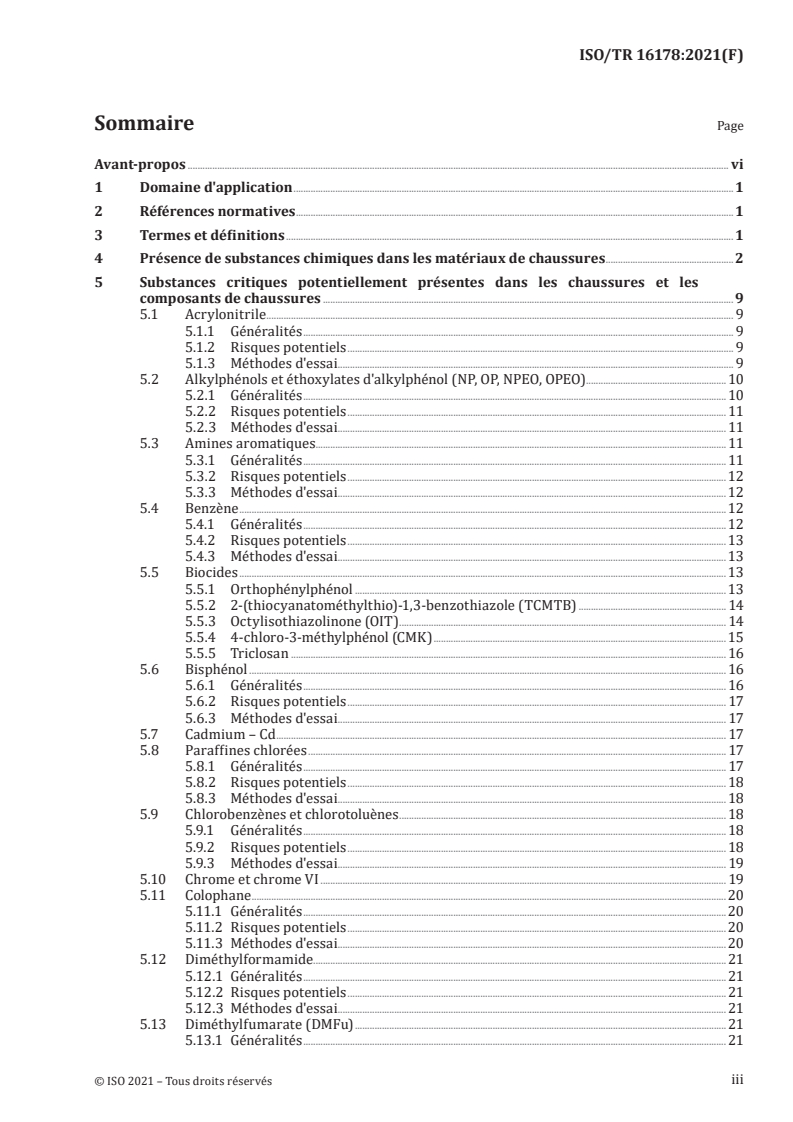
Sommaire Page
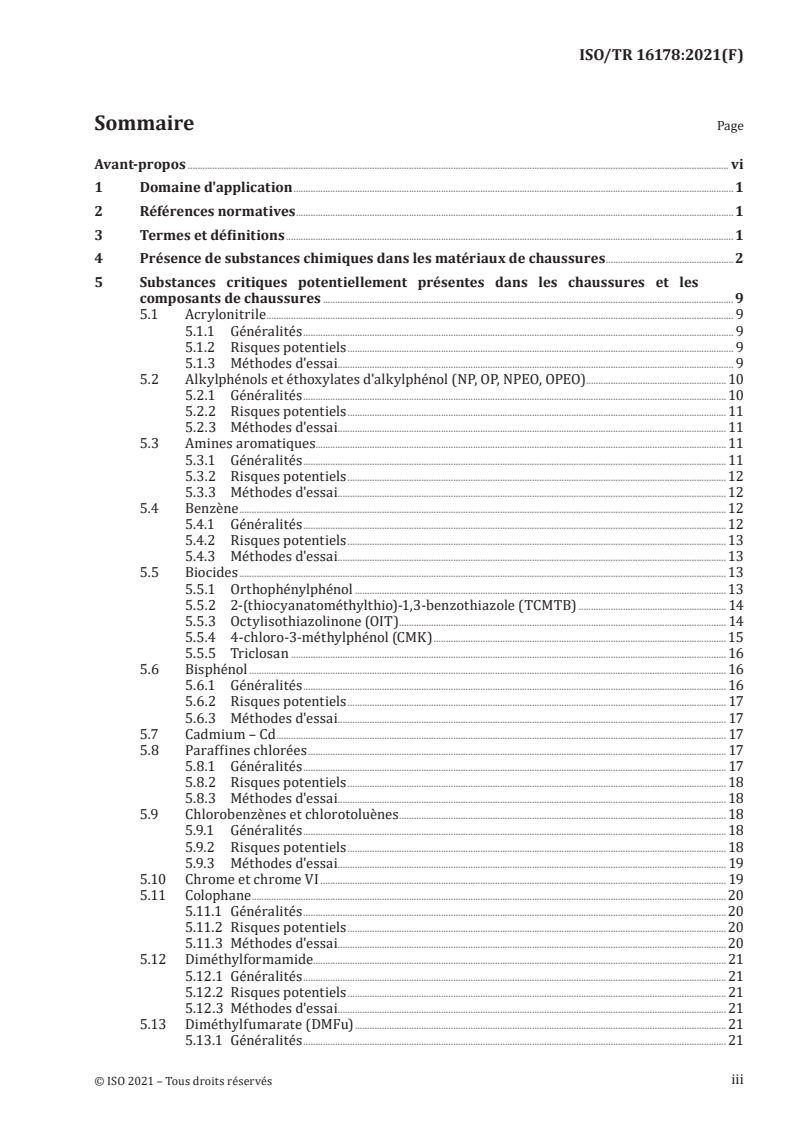
Avant-propos . vi
1 Domaine d'application .1
2 Références normatives .1
3 Termes et définitions . 1
4 Présence de substances chimiques dans les matériaux de chaussures .2
5 Substances critiques potentiellement présentes dans les chaussures et les
composants de chaussures . 9
5.1 Acrylonitrile . 9
5.1.1 Généralités . 9
5.1.2 Risques potentiels . 9
5.1.3 Méthodes d'essai . . 9
5.2 Alkylphénols et éthoxylates d'alkylphénol (NP, OP, NPEO, OPEO) . 10
5.2.1 Généralités . 10
5.2.2 Risques potentiels . 11
5.2.3 Méthodes d'essai . 11
5.3 Amines aromatiques. 11
5.3.1 Généralités . 11
5.3.2 Risques potentiels .12
5.3.3 Méthodes d'essai . 12
5.4 Benzène .12
5.4.1 Généralités .12
5.4.2 Risques potentiels . 13
5.4.3 Méthodes d'essai . 13
5.5 Biocides .13
5.5.1 Orthophénylphénol . 13
5.5.2 2-(thiocyanatométhylthio)-1,3-benzothiazole (TCMTB) . 14
5.5.3 Octylisothiazolinone (OIT) . 14
5.5.4 4-chloro-3-méthylphénol (CMK) . 15
5.5.5 Triclosan . 16
5.6 Bisphénol . 16
5.6.1 Généralités . 16
5.6.2 Risques potentiels . 17
5.6.3 Méthodes d'essai . . 17
5.7 Cadmium – Cd . 17
5.8 Paraffines chlorées . 17
5.8.1 Généralités . 17
5.8.2 Risques potentiels . 18
5.8.3 Méthodes d'essai . 18
5.9 Chlorobenzènes et chlorotoluènes . 18
5.9.1 Généralités . 18
5.9.2 Risques potentiels . 18
5.9.3 Méthodes d'essai . 19
5.10 Chrome et chrome VI . 19
5.11 Colophane . 20
5.11.1 Généralités .20
5.11.2 Risques potentiels . 20
5.11.3 Méthodes d'essai . 20
5.12 Diméthylformamide. 21
5.12.1 Généralités . 21
5.12.2 Risques potentiels . 21
5.12.3 Méthodes d'essai . 21
5.13 Diméthylfumarate (DMFu) . 21
5.13.1 Généralités . 21
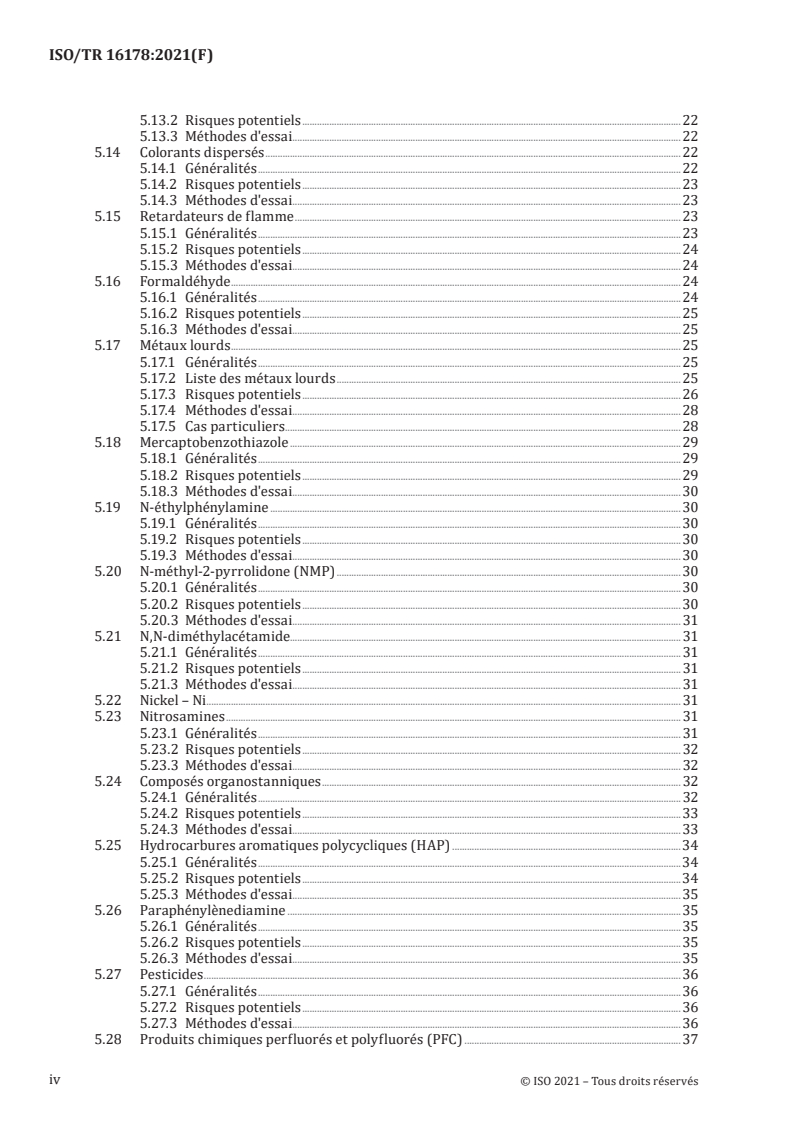
iii
5.13.2 Risques potentiels . 22
5.13.3 Méthodes d'essai . . 22
5.14 Colorants dispersés . 22
5.14.1 Généralités .22
5.14.2 Risques potentiels .23
5.14.3 Méthodes d'essai . 23
5.15 Retardateurs de flamme . 23
5.15.1 Généralités .23
5.15.2 Risques potentiels . 24
5.15.3 Méthodes d'essai . 24
5.16 Formaldéhyde . 24
5.16.1 Généralités . 24
5.16.2 Risques potentiels .25
5.16.3 Méthodes d'essai . 25
5.17 Métaux lourds . 25
5.17.1 Généralités . 25
5.17.2 Liste des métaux lourds . 25
5.17.3 Risques potentiels . 26
5.17.4 Méthodes d'essai .28
5.17.5 Cas particuliers . .28
5.18 Mercaptobenzothiazole .29
5.18.1 Généralités .29
5.18.2 Risques potentiels .29
5.18.3 Méthodes d'essai . 30
5.19 N-éthylphénylamine . 30
5.19.1 Généralités .30
5.19.2 Risques potentiels .30
5.19.3 Méthodes d'essai . 30
5.20 N-méthyl-2-pyrrolidone (NMP) . 30
5.20.1 Généralités .30
5.20.2 Risques potentiels .30
5.20.3 Méthodes d'essai . 31
5.21 N,N-diméthylacétamide. 31
5.21.1 Généralités . 31
5.21.2 Risques potentiels . 31
5.21.3 Méthodes d'essai . 31
5.22 Nickel – Ni . 31
5.23 Nitrosamines . 31
5.23.1 Généralités . 31
5.23.2 Risques potentiels . 32
5.23.3 Méthodes d'essai . . 32
5.24 Composés organostanniques . 32
5.24.1 Généralités . 32
5.24.2 Risques potentiels .33
5.24.3 Méthodes d'essai . 33
5.25 Hydrocarbures aromatiques polycycliques (HAP) .34
5.25.1 Généralités .34
5.25.2 Risques potentiels .34
5.25.3 Méthodes d'essai . 35
5.26 Paraphénylènediamine . 35
5.26.1 Généralités . 35
5.26.2 Risques potentiels . 35
5.26.3 Méthodes d'essai . 35
5.27 Pesticides . 36
5.27.1 Généralités .36
5.27.2 Risques potentiels .36
5.27.3 Méthodes d'essai . 36
5.28 Produits chimiques perfluorés et polyfluorés (PFC) . 37
iv
5.28.1 Les différentes substances . 37
5.28.2 Risques potentiels .39
5.29 pH .40
5.29.1 Généralités .40
5.29.2 Risques potentiels .40
5.29.3 Méthodes d'essai . .40
5.30 Phénol .40
5.30.1 Généralités .40
5.30.2 Risques potentiels .40
5.30.3 Méthodes d'essai . 41
5.31 Phénylmercure . 41
5.31.1 Généralités . 41
5.31.2 Risques potentiels . 41
5.31.3 Méthodes d'essai . . 41
5.32 Phtalates . 42
5.32.1 Généralités . 42
5.32.2 Risques potentiels . 43
5.32.3 Méthodes d'essai . 43
5.33 Polychlorophénols .44
5.33.1 Généralités .44
5.33.2 Risques potentiels . 45
5.33.3 Méthodes d'essai . 45
5.34 Formaldéhyde paratertiaire-butylphénol (PTBF) . 45
5.34.1 Généralités . 45
5.34.2 Risques potentiels . 45
5.34.3 Méthodes d'essai .46
5.35 Quinoléine .46
5.35.1 Généralités .46
5.35.2 Risques potentiels .46
5.35.3 Méthodes d'essai . .46
5.36 Thiuram et thiocarbamate .46
5.36.1 Généralités .46
5.36.2 Risques potentiels . 47
5.36.3 Méthodes d'essai . 47
5.37 Composés organiques volatils (COV) . 47
5.37.1 Généralités . 47
5.37.2 Risques potentiels . 47
5.37.3 Méthodes d'essai . 47
Bibliographie .49
v
Avant-propos
L'ISO (Organisation internationale de normalisation) est une fédération mondiale d'organismes
nationaux de normalisation (comités membres de l'ISO). L'élaboration des Normes internationales est
en général confiée aux comités techniques de l'ISO. Chaque comité membre intéressé par une étude
a le droit de faire partie du comité technique créé à cet effet. Les organisations internationales,
gouvernementales et non gouvernementales, en liaison avec l'ISO participent également aux travaux.
L'ISO collabore étroitement avec la Commission électrotechnique internationale (IEC) en ce qui
concerne la normalisation électrotechnique.
Les procédures utilisées pour élaborer le présent document et celles destinées à sa mise à jour sont
décrites dans les Directives ISO/IEC, Partie 1. Il convient, en particulier, de prendre note des différents
critères d'approbation requis pour les différents types de documents ISO. Le présent document a
été rédigé conformément aux règles de rédaction données dans les Directives ISO/IEC, Partie 2 (voir
www.iso.org/directives).
L'attention est attirée sur le fait que certains des éléments du présent document peuvent faire l'objet de
droits de propriété intellectuelle ou de droits analogues. L'ISO ne saurait être tenue pour responsable
de ne pas avoir identifié de tels droits de propriété et averti de leur existence. Les détails concernant
les références aux droits de propriété intellectuelle ou autres droits analogues identifiés lors de
l'élaboration du document sont indiqués dans l'Introduction et/ou dans la liste des déclarations de
brevets reçues par l'ISO (voir www.iso.org/brevets).
Les appellations commerciales éventuellement mentionnées dans le présent document sont données
pour information, par souci de commodité, à l’intention des utilisateurs et ne sauraient constituer un
engagement.
Pour une explication de la nature volontaire des normes, la signification des termes et expressions
spécifiques de l'ISO liés à l'évaluation de la conformité, ou pour toute information au sujet de l'adhésion
de l'ISO aux principes de l’Organisation mondiale du commerce (OMC) concernant les obstacles
techniques au commerce (OTC), voir www.iso.org/avant-propos.
Le présent document a été élaboré par le comité technique ISO/TC 216, Chaussure, en collaboration avec
le comité technique CEN/TC 309, Chaussure, du Comité européen de normalisation (CEN) conformément
à l’Accord de coopération technique entre l’ISO et le CEN (Accord de Vienne).
Cette troisième édition annule et remplace la deuxième édition (ISO/TR 16178:2012), qui a fait l'objet
d'une révision technique.
Les principales modifications sont les suivantes:
— le Tableau 1 a été modifié pour inclure un nouveau système de classification;
— les substances suivantes ont été retirées:
protéines du latex, substances détruisant la couche d'ozone, polychlorobiphényles, polychloroprène,
chlorure de vinyle;
— les substances suivantes ont été ajoutées:
benzène, bisphénol, NMP, DMAC, phénylmercure, quinoléine, COV;
— les biocides ont été regroupés (CMK, OIT, OPP, TCMTB);
[67]
— l'Annexe A figure désormais dans l'ISO 21061 ;
— l'Annexe B correspond à présent à l'Article 5;
— la Bibliographie a été mise à jour.
vi
Il convient que l’utilisateur adresse tout retour d’information ou toute question concernant le présent
document à l’organisme national de normalisation de son pays. Une liste exhaustive desdits organismes
se trouve à l’adresse www.iso.org/fr/members.html.
vii
RAPPORT TECHNIQUE ISO/TR 16178:2021(F)
Chaussures — Substances critiques potentiellement
présentes dans la chaussure et les composants de
chaussures — Listes des substances chimiques critiques
1 Domaine d'application
Le présent document définit des listes de substances chimiques critiques potentiellement présentes
dans les chaussures et les composants de chaussures.
Le présent document décrit les substances chimiques critiques, leurs risques potentiels de nocivité,
les matériaux dans lesquels on peut les trouver, ainsi que la ou les méthodes d'essai permettant de les
quantifier.
Les méthodes d'essai énumérées reflètent l'état de la technique. Pour certaines substances, il n'existe
pas de méthode d'essai.
Le présent document s'applique à tout type de chaussure et de composant de chaussure.
2 Références normatives
Le présent document ne contient aucune référence normative.
3 Termes et définitions
Pour les besoins du présent document, les termes et définitions suivants s’appliquent.
L’ISO et l’IEC tiennent à jour des bases de données terminologiques destinées à être utilisées en
normalisation, consultables aux adresses suivantes:
— ISO Online browsing platform: disponible à l’adresse https:// www .iso .org/ obp
— IEC Electropedia: disponible à l’adresse https:// www .electropedia .org/
3.1
allergène
substance pouvant induire une réaction allergique
3.2
allergie
réponse à médiation immunitaire à certaines substances spécifiques (allergènes)
Note 1 à l'article: L'allergie de type 1 (allergie respiratoire) est médiée par les anticorps IgE; elle peut entraîner
de l'asthme, une rhinite et de l'urticaire. L'allergie de type 4 (allergie dermique)est médiée par les lymphocytes T;
elle peut entraîner une dermatite.
3.3
limite de détection
valeur à partir de laquelle une substance est considérée comme étant détectable
Note 1 à l'article: Cela signifie que le signal associé à la substance est trois fois plus fort que celui du bruit de fond.
La limite de détection de chaque substance est déterminée de manière expérimentale par le laboratoire.
3.4
substances critiques
substance chimique éventuellement détectée dans les chaussures ou les composants de chaussures et
ayant éventuellement un effet sur le porteur et/ou un impact environnemental en raison de sa réactivité
chimique
Note 1 à l'article: Les effets des substances critiques sont divers. Il peut s'agir d'effets cancérigènes ou mutagènes,
d'allergies, de réactions à des produits toxiques, etc.
3.4.1
substances critiques de catégorie 1
substances dont la dangerosité est avérée pour le porteur
Note 1 à l'article: Dans plusieurs pays, l'utilisation de ces substances est largement restreinte par une législation
nationale.
3.4.2
substances critiques de catégorie 2
substances dangereuses pour le porteur
Note 1 à l'article: Dans un petit nombre de pays, l'utilisation de ces substances est limitée par une législation
nationale.
3.4.3
substances critiques de catégorie 3
substances fortement suspectées d'avoir un effet sur le porteur
Note 1 à l'article: L'utilisation de ces substances peut ne pas être limitée par une quelconque législation au
moment de la publication, mais les acteurs du marché en font fréquemment la demande.
3.4.4
substances critiques de catégorie 4
substances suspectées d'avoir un effet sur le porteur
Note 1 à l'article: L'utilisation de ces substances peut ne pas être limitée par une quelconque législation.
Les substances connues pour avoir un effet allergénique sur le porteur sont incluses dans la catégorie 4 pour
référence.
4 Présence de substances chimiques dans les matériaux de chaussures
De nombreuses substances chimiques sont présentes dans les matériaux de chaussures. Le Tableau 1
expose les points suivants, à savoir:
a) les matériaux dans lesquels elles sont supposées se trouver. Les matériaux potentiellement utilisés
[67]
dans l'industrie de la chaussure sont indiqués dans l'ISO 21061:2021 , Annexe C;
b) une liste de substances chimiques critiques, (voir Article 5 pour plus d'informations);
c) les méthodes d'essai susceptibles d'être utilisées pour les quantifier (voir la Bibliographie);
d) les risques potentiels liés à leur utilisation, évalués au moyen d'une échelle par catégories de
substances critiques:
« 1 » correspond à « substances critiques de catégorie 1 »;
« 2 » correspond à « substances critiques de catégorie 2 »;
« 3 » correspond à « substances critiques de catégorie 3 »;
« 4 » correspond à « substances critiques de catégorie 4 ».
Pour les matériaux composites, il convient que les essais soient menés sur la totalité du composant.
EXEMPLE 1 Textile enduit (coton + revêtement PVC). Il convient qu'un essai porte sur le PVC et un autre sur
les fibres cellulosiques naturelles.
EXEMPLE 2 Textile mélangé (polyester + coton). Il convient qu'un essai porte sur les fibres cellulosiques
naturelles et un autre sur le polyester.
Tableau 1 — Substances chimiques critiques potentiellement présentes dans les chaussures et les composants de chaussures
Matériaux natu-
Cuir Matériaux synthétiques Divers
rels
Substance
Méthode
d'essai
(voir Annexe B)
Acrylonitrile 4 4 4
ISO 18218-1
Alkylphénols (OP, NP) et éthoxylates
3 3 3
d'alkylphénol (OPEO, NPEO)
ISO 18218-2
ISO 18254-1
Alkylphénols (OP, NP) et éthoxylates
2 2 2 2 2 2 2
d'alkylphénol (OPEO, NPEO)
ISO 21084
Colorants azoïques – arylamines ISO 17234-1 1 1 1
En cas de suspicion
Colorants azoïques –
de 4-aminoazoben- ISO 17234-2 1 1 1
arylamines
zène
Colorants azoïques – arylamines ISO 14362-1 1 1 1 1 1 1 1
En cas de suspicion
Colorants azoïques –
de 4-aminoazoben- ISO 14362-3 1 1 1 1 1 1 1
arylamines
zène
Benzène 1 1 1 1 1 1 2
Biocides ISO 13365-1 et
4 4 4 4 4 4 4 4 4 4 4 4 4
(TCMTB, OIT, CMK) ISO 13365-2
ISO 13365-1 et
Biocides (OPP) 2 2 2 2 2 2 2 2 2 2 2 2 2
ISO 13365-2
Biocides (triclosan) EN 17134 2 2 2 2 2 2 2 2 2 2 2 2 2 2 2 2 2 2
Bisphénol 2 2 2
Tous les plastiques
Cadmium (principalement le EN 1122 1 1 1 1 1 1 1
PVC)
Paraffines chlorées (à chaîne courte
ISO 18219-1 2 2 2 2 2 2 2 2 2 2 2
[C10-C13])
Cuir
Cuir enduit
Synderme
PVC
EVA
Caoutchouc
PU –
TPU élasthanne
PE-T PP
Polyester
Polyamide
Chlorofibre
Polyacrylique
Latex
Textile cellulosique
Textile protéinique
Bois – liège
Adhésifs
Accessoires métal-
liques
Impressions pour
textile
Cellulose
Tableau 1 (suite)
Matériaux natu-
Cuir Matériaux synthétiques Divers
rels
Substance
Méthode
d'essai
(voir Annexe B)
Paraffines chlorées (à chaîne moyenne
ISO 18219-2 3 3 3 3 3 3 3 3 3 3 3
[C14-C17])
Chlorobenzène et chlorotoluène EN 17137 2
Chlorobenzène et chlorotoluène (té-
trachlorotoluène, trichlorotoluène, EN 17137 2 2 2 2 2 2
αchlorotoluène)
ISO 17075-1
Chrome VI 1 1 1
ISO 17075-2
Chrome VI Avec vieillissement ISO 10195 3 3 3
Colophane 4
Diméthylformamide (DMF) ISO 16189 2 2
Diméthylfumarate (DMFu) ISO 16186 1 1 1 1 1 1 1 1 1 1 1 1 1 1 1 1 1 1
ISO 16373-2
Colorants dispersés 2 2 2 2 2 2 2
ISO 16373-3
Retardateurs Uniquement pour les
ISO 17881-1
de flamme produits revendiquant
1 1 1 1 1 1 1 1 1 1 1 1 1 1 1 1 1 1
(phosphorés et des propriétés de retar-
ISO 17881-2
bromés) dateur de flamme
ISO 17226-1
Formaldéhyde 2 2 2
ISO 17226-2
EN 120
Formaldéhyde 2 2
EN 717-3
Formaldéhyde ISO 27587 3
Formaldéhyde ISO 14184-1 1 1 1 1 1 1 1
Cuir
Cuir enduit
Synderme
PVC
EVA
Caoutchouc
PU –
TPU élasthanne
PE-T PP
Polyester
Polyamide
Chlorofibre
Polyacrylique
Latex
Textile cellulosique
Textile protéinique
Bois – liège
Adhésifs
Accessoires métal-
liques
Impressions pour
textile
Cellulose
Tableau 1 (suite)
Matériaux natu-
Cuir Matériaux synthétiques Divers
rels
Substance
Méthode
d'essai
(voir Annexe B)
Extractibles
ISO 17072-1
3 3 3 3 3 3 3 3 3 3 3 3 3 3 3 3 3 3 3
(Sb – As –Cd – Cr – Co –
EN 16711-2
Cu – Ni – Hg – Zn)
E x t r a c t ib l e s
Chaussures pour
enfants de moins de
ISO 17072-1
36 mois
2 2 2 2 2 2 2 2 2 2 2 2 2 2 2 2 2 2 2
Métaux lourds
EN 16711-2
(Sb – As –Cd – Cr – Co
– Cu – Ni – Hg – Zn –
Ba – Se)
Teneur totale
ISO 17072-2
(Sb – As –Cd (cuir et
EN 16711-1 3 3 3 3 3 3 3 3 3 3 3 3 3 3 3 3 3 3 3
textile) – Cr – Co – Cu
ISO 19050
– Ni – Hg – Zn)
ISO 17072-2
Plomb 1 1 1 1 1 1 1 1 1 1 1 1 1 1 1 1 1 1 1 1
EN 16711-1
Mercaptobenzothiazole 4
N-éthylphénylamine 4 4
N-méthyl pyrrolidone ISO 19070 2 2 2 2 2 2 2 2 2
N,N-diméthylacétamide (DMAC) 2 2 2 2 2 2 2
EN 1811
Nickel Contact avec la peau (avec ou sans 1
l'EN 12472)
Cuir
Cuir enduit
Synderme
PVC
EVA
Caoutchouc
PU –
TPU élasthanne
PE-T PP
Polyester
Polyamide
Chlorofibre
Polyacrylique
Latex
Textile cellulosique
Textile protéinique
Bois – liège
Adhésifs
Accessoires métal-
liques
Impressions pour
textile
Cellulose
Tableau 1 (suite)
Matériaux natu-
Cuir Matériaux synthétiques Divers
rels
Substance
Méthode
d'essai
(voir Annexe B)
Chaussures pour
Nitrosamines enfants de moins de ISO 19577 2
36 mois
Nitrosamines ISO 19577 4
Composés organostanniques (TBT, TPT) ISO/TS 16179 1 1 1 1 1 1 1 1 1 1 1 1 1 1 1 1 1 1 1
Composés organostanniques (DBT, DOT) ISO/TS 16179 2 2 2 2 2 2 2 2 2 2 2 2 2 2 2 2 2 2 2
Composés organostanniques (autres) ISO/TS 16179 3 3 3 3 3 3 3 3 3 3 3 3 3 3 3 3 3 3 3
Hydrocarbures aromatiques polycy-
ISO/TS 16190 1 1 1 1 1 1 1 1 2 2 2 2 2 1 2
cliques (HAP)
Paraphénylènediamine 4 4 4 4 4 4 4
Pesticides ISO 22517 3 3 3 3 3 3
Composés perfluorés (PFC) (PFOS/PFOA) CEN/TS 15968 1 1 1 1 1 1
Composés perfluorés (PFC) ISO 23702-1 1 1 1
pH ISO 4045 2 2 2
pH ISO 3071 2 2 2 2 2 2
Phénol ISO 20536 4 4 4 4 4 4 4 4
Phénylmercure 1
Chaussures pour ISO 16181
enfants de moins de (toutes les
Phtalates 1 1 1 1 1 1 1
14 ans parties)
ISO 14389
Cuir
Cuir enduit
Synderme
PVC
EVA
Caoutchouc
PU –
TPU élasthanne
PE-T PP
Polyester
Polyamide
Chlorofibre
Polyacrylique
Latex
Textile cellulosique
Textile protéinique
Bois – liège
Adhésifs
Accessoires métal-
liques
Impressions pour
textile
Cellulose
Tableau 1 (suite)
Matériaux natu-
Cuir Matériaux synthétiques Divers
rels
Substance
Méthode
d'essai
(voir Annexe B)
ISO 16181
(toutes les
Phtalates 2 2 2
...
RAPPORT ISO/TR
TECHNIQUE 16178
Troisième édition
2021-09
Chaussures — Substances critiques
potentiellement présentes dans
la chaussure et les composants de
chaussures — Listes des substances
chimiques critiques
Footwear — Critical substances potentially present in footwear and
footwear components — Lists of critical chemical substances
Numéro de référence
DOCUMENT PROTÉGÉ PAR COPYRIGHT
© ISO 2021
Tous droits réservés. Sauf prescription différente ou nécessité dans le contexte de sa mise en œuvre, aucune partie de cette
publication ne peut être reproduite ni utilisée sous quelque forme que ce soit et par aucun procédé, électronique ou mécanique,
y compris la photocopie, ou la diffusion sur l’internet ou sur un intranet, sans autorisation écrite préalable. Une autorisation peut
être demandée à l’ISO à l’adresse ci-après ou au comité membre de l’ISO dans le pays du demandeur.
ISO copyright office
Case postale 401 • Ch. de Blandonnet 8
CH-1214 Vernier, Genève
Tél.: +41 22 749 01 11
E-mail: copyright@iso.org
Web: www.iso.org
Publié en Suisse
ii
Sommaire Page
Avant-propos . vi
1 Domaine d'application .1
2 Références normatives .1
3 Termes et définitions . 1
4 Présence de substances chimiques dans les matériaux de chaussures .2
5 Substances critiques potentiellement présentes dans les chaussures et les
composants de chaussures . 9
5.1 Acrylonitrile . 9
5.1.1 Généralités . 9
5.1.2 Risques potentiels . 9
5.1.3 Méthodes d'essai . . 9
5.2 Alkylphénols et éthoxylates d'alkylphénol (NP, OP, NPEO, OPEO) . 10
5.2.1 Généralités . 10
5.2.2 Risques potentiels . 11
5.2.3 Méthodes d'essai . 11
5.3 Amines aromatiques. 11
5.3.1 Généralités . 11
5.3.2 Risques potentiels .12
5.3.3 Méthodes d'essai . 12
5.4 Benzène .12
5.4.1 Généralités .12
5.4.2 Risques potentiels . 13
5.4.3 Méthodes d'essai . 13
5.5 Biocides .13
5.5.1 Orthophénylphénol . 13
5.5.2 2-(thiocyanatométhylthio)-1,3-benzothiazole (TCMTB) . 14
5.5.3 Octylisothiazolinone (OIT) . 14
5.5.4 4-chloro-3-méthylphénol (CMK) . 15
5.5.5 Triclosan . 16
5.6 Bisphénol . 16
5.6.1 Généralités . 16
5.6.2 Risques potentiels . 17
5.6.3 Méthodes d'essai . . 17
5.7 Cadmium – Cd . 17
5.8 Paraffines chlorées . 17
5.8.1 Généralités . 17
5.8.2 Risques potentiels . 18
5.8.3 Méthodes d'essai . 18
5.9 Chlorobenzènes et chlorotoluènes . 18
5.9.1 Généralités . 18
5.9.2 Risques potentiels . 18
5.9.3 Méthodes d'essai . 19
5.10 Chrome et chrome VI . 19
5.11 Colophane . 20
5.11.1 Généralités .20
5.11.2 Risques potentiels . 20
5.11.3 Méthodes d'essai . 20
5.12 Diméthylformamide. 21
5.12.1 Généralités . 21
5.12.2 Risques potentiels . 21
5.12.3 Méthodes d'essai . 21
5.13 Diméthylfumarate (DMFu) . 21
5.13.1 Généralités . 21
iii
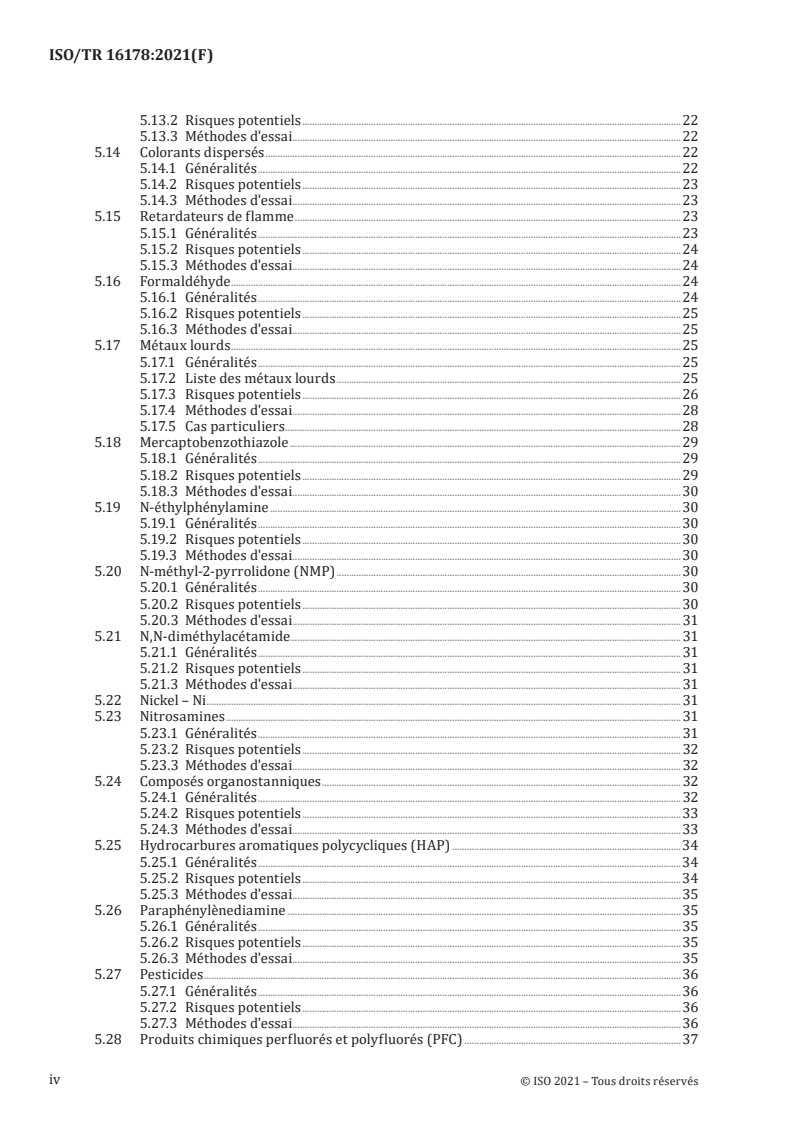
5.13.2 Risques potentiels . 22
5.13.3 Méthodes d'essai . . 22
5.14 Colorants dispersés . 22
5.14.1 Généralités .22
5.14.2 Risques potentiels .23
5.14.3 Méthodes d'essai . 23
5.15 Retardateurs de flamme . 23
5.15.1 Généralités .23
5.15.2 Risques potentiels . 24
5.15.3 Méthodes d'essai . 24
5.16 Formaldéhyde . 24
5.16.1 Généralités . 24
5.16.2 Risques potentiels .25
5.16.3 Méthodes d'essai . 25
5.17 Métaux lourds . 25
5.17.1 Généralités . 25
5.17.2 Liste des métaux lourds . 25
5.17.3 Risques potentiels . 26
5.17.4 Méthodes d'essai .28
5.17.5 Cas particuliers . .28
5.18 Mercaptobenzothiazole .29
5.18.1 Généralités .29
5.18.2 Risques potentiels .29
5.18.3 Méthodes d'essai . 30
5.19 N-éthylphénylamine . 30
5.19.1 Généralités .30
5.19.2 Risques potentiels .30
5.19.3 Méthodes d'essai . 30
5.20 N-méthyl-2-pyrrolidone (NMP) . 30
5.20.1 Généralités .30
5.20.2 Risques potentiels .30
5.20.3 Méthodes d'essai . 31
5.21 N,N-diméthylacétamide. 31
5.21.1 Généralités . 31
5.21.2 Risques potentiels . 31
5.21.3 Méthodes d'essai . 31
5.22 Nickel – Ni . 31
5.23 Nitrosamines . 31
5.23.1 Généralités . 31
5.23.2 Risques potentiels . 32
5.23.3 Méthodes d'essai . . 32
5.24 Composés organostanniques . 32
5.24.1 Généralités . 32
5.24.2 Risques potentiels .33
5.24.3 Méthodes d'essai . 33
5.25 Hydrocarbures aromatiques polycycliques (HAP) .34
5.25.1 Généralités .34
5.25.2 Risques potentiels .34
5.25.3 Méthodes d'essai . 35
5.26 Paraphénylènediamine . 35
5.26.1 Généralités . 35
5.26.2 Risques potentiels . 35
5.26.3 Méthodes d'essai . 35
5.27 Pesticides . 36
5.27.1 Généralités .36
5.27.2 Risques potentiels .36
5.27.3 Méthodes d'essai . 36
5.28 Produits chimiques perfluorés et polyfluorés (PFC) . 37
iv
5.28.1 Les différentes substances . 37
5.28.2 Risques potentiels .39
5.29 pH .40
5.29.1 Généralités .40
5.29.2 Risques potentiels .40
5.29.3 Méthodes d'essai . .40
5.30 Phénol .40
5.30.1 Généralités .40
5.30.2 Risques potentiels .40
5.30.3 Méthodes d'essai . 41
5.31 Phénylmercure . 41
5.31.1 Généralités . 41
5.31.2 Risques potentiels . 41
5.31.3 Méthodes d'essai . . 41
5.32 Phtalates . 42
5.32.1 Généralités . 42
5.32.2 Risques potentiels . 43
5.32.3 Méthodes d'essai . 43
5.33 Polychlorophénols .44
5.33.1 Généralités .44
5.33.2 Risques potentiels . 45
5.33.3 Méthodes d'essai . 45
5.34 Formaldéhyde paratertiaire-butylphénol (PTBF) . 45
5.34.1 Généralités . 45
5.34.2 Risques potentiels . 45
5.34.3 Méthodes d'essai .46
5.35 Quinoléine .46
5.35.1 Généralités .46
5.35.2 Risques potentiels .46
5.35.3 Méthodes d'essai . .46
5.36 Thiuram et thiocarbamate .46
5.36.1 Généralités .46
5.36.2 Risques potentiels . 47
5.36.3 Méthodes d'essai . 47
5.37 Composés organiques volatils (COV) . 47
5.37.1 Généralités . 47
5.37.2 Risques potentiels . 47
5.37.3 Méthodes d'essai . 47
Bibliographie .49
v
Avant-propos
L'ISO (Organisation internationale de normalisation) est une fédération mondiale d'organismes
nationaux de normalisation (comités membres de l'ISO). L'élaboration des Normes internationales est
en général confiée aux comités techniques de l'ISO. Chaque comité membre intéressé par une étude
a le droit de faire partie du comité technique créé à cet effet. Les organisations internationales,
gouvernementales et non gouvernementales, en liaison avec l'ISO participent également aux travaux.
L'ISO collabore étroitement avec la Commission électrotechnique internationale (IEC) en ce qui
concerne la normalisation électrotechnique.
Les procédures utilisées pour élaborer le présent document et celles destinées à sa mise à jour sont
décrites dans les Directives ISO/IEC, Partie 1. Il convient, en particulier, de prendre note des différents
critères d'approbation requis pour les différents types de documents ISO. Le présent document a
été rédigé conformément aux règles de rédaction données dans les Directives ISO/IEC, Partie 2 (voir
www.iso.org/directives).
L'attention est attirée sur le fait que certains des éléments du présent document peuvent faire l'objet de
droits de propriété intellectuelle ou de droits analogues. L'ISO ne saurait être tenue pour responsable
de ne pas avoir identifié de tels droits de propriété et averti de leur existence. Les détails concernant
les références aux droits de propriété intellectuelle ou autres droits analogues identifiés lors de
l'élaboration du document sont indiqués dans l'Introduction et/ou dans la liste des déclarations de
brevets reçues par l'ISO (voir www.iso.org/brevets).
Les appellations commerciales éventuellement mentionnées dans le présent document sont données
pour information, par souci de commodité, à l’intention des utilisateurs et ne sauraient constituer un
engagement.
Pour une explication de la nature volontaire des normes, la signification des termes et expressions
spécifiques de l'ISO liés à l'évaluation de la conformité, ou pour toute information au sujet de l'adhésion
de l'ISO aux principes de l’Organisation mondiale du commerce (OMC) concernant les obstacles
techniques au commerce (OTC), voir www.iso.org/avant-propos.
Le présent document a été élaboré par le comité technique ISO/TC 216, Chaussure, en collaboration avec
le comité technique CEN/TC 309, Chaussure, du Comité européen de normalisation (CEN) conformément
à l’Accord de coopération technique entre l’ISO et le CEN (Accord de Vienne).
Cette troisième édition annule et remplace la deuxième édition (ISO/TR 16178:2012), qui a fait l'objet
d'une révision technique.
Les principales modifications sont les suivantes:
— le Tableau 1 a été modifié pour inclure un nouveau système de classification;
— les substances suivantes ont été retirées:
protéines du latex, substances détruisant la couche d'ozone, polychlorobiphényles, polychloroprène,
chlorure de vinyle;
— les substances suivantes ont été ajoutées:
benzène, bisphénol, NMP, DMAC, phénylmercure, quinoléine, COV;
— les biocides ont été regroupés (CMK, OIT, OPP, TCMTB);
[67]
— l'Annexe A figure désormais dans l'ISO 21061 ;
— l'Annexe B correspond à présent à l'Article 5;
— la Bibliographie a été mise à jour.
vi
Il convient que l’utilisateur adresse tout retour d’information ou toute question concernant le présent
document à l’organisme national de normalisation de son pays. Une liste exhaustive desdits organismes
se trouve à l’adresse www.iso.org/fr/members.html.
vii
RAPPORT TECHNIQUE ISO/TR 16178:2021(F)
Chaussures — Substances critiques potentiellement
présentes dans la chaussure et les composants de
chaussures — Listes des substances chimiques critiques
1 Domaine d'application
Le présent document définit des listes de substances chimiques critiques potentiellement présentes
dans les chaussures et les composants de chaussures.
Le présent document décrit les substances chimiques critiques, leurs risques potentiels de nocivité,
les matériaux dans lesquels on peut les trouver, ainsi que la ou les méthodes d'essai permettant de les
quantifier.
Les méthodes d'essai énumérées reflètent l'état de la technique. Pour certaines substances, il n'existe
pas de méthode d'essai.
Le présent document s'applique à tout type de chaussure et de composant de chaussure.
2 Références normatives
Le présent document ne contient aucune référence normative.
3 Termes et définitions
Pour les besoins du présent document, les termes et définitions suivants s’appliquent.
L’ISO et l’IEC tiennent à jour des bases de données terminologiques destinées à être utilisées en
normalisation, consultables aux adresses suivantes:
— ISO Online browsing platform: disponible à l’adresse https:// www .iso .org/ obp
— IEC Electropedia: disponible à l’adresse https:// www .electropedia .org/
3.1
allergène
substance pouvant induire une réaction allergique
3.2
allergie
réponse à médiation immunitaire à certaines substances spécifiques (allergènes)
Note 1 à l'article: L'allergie de type 1 (allergie respiratoire) est médiée par les anticorps IgE; elle peut entraîner
de l'asthme, une rhinite et de l'urticaire. L'allergie de type 4 (allergie dermique)est médiée par les lymphocytes T;
elle peut entraîner une dermatite.
3.3
limite de détection
valeur à partir de laquelle une substance est considérée comme étant détectable
Note 1 à l'article: Cela signifie que le signal associé à la substance est trois fois plus fort que celui du bruit de fond.
La limite de détection de chaque substance est déterminée de manière expérimentale par le laboratoire.
3.4
substances critiques
substance chimique éventuellement détectée dans les chaussures ou les composants de chaussures et
ayant éventuellement un effet sur le porteur et/ou un impact environnemental en raison de sa réactivité
chimique
Note 1 à l'article: Les effets des substances critiques sont divers. Il peut s'agir d'effets cancérigènes ou mutagènes,
d'allergies, de réactions à des produits toxiques, etc.
3.4.1
substances critiques de catégorie 1
substances dont la dangerosité est avérée pour le porteur
Note 1 à l'article: Dans plusieurs pays, l'utilisation de ces substances est largement restreinte par une législation
nationale.
3.4.2
substances critiques de catégorie 2
substances dangereuses pour le porteur
Note 1 à l'article: Dans un petit nombre de pays, l'utilisation de ces substances est limitée par une législation
nationale.
3.4.3
substances critiques de catégorie 3
substances fortement suspectées d'avoir un effet sur le porteur
Note 1 à l'article: L'utilisation de ces substances peut ne pas être limitée par une quelconque législation au
moment de la publication, mais les acteurs du marché en font fréquemment la demande.
3.4.4
substances critiques de catégorie 4
substances suspectées d'avoir un effet sur le porteur
Note 1 à l'article: L'utilisation de ces substances peut ne pas être limitée par une quelconque législation.
Les substances connues pour avoir un effet allergénique sur le porteur sont incluses dans la catégorie 4 pour
référence.
4 Présence de substances chimiques dans les matériaux de chaussures
De nombreuses substances chimiques sont présentes dans les matériaux de chaussures. Le Tableau 1
expose les points suivants, à savoir:
a) les matériaux dans lesquels elles sont supposées se trouver. Les matériaux potentiellement utilisés
[67]
dans l'industrie de la chaussure sont indiqués dans l'ISO 21061:2021 , Annexe C;
b) une liste de substances chimiques critiques, (voir Article 5 pour plus d'informations);
c) les méthodes d'essai susceptibles d'être utilisées pour les quantifier (voir la Bibliographie);
d) les risques potentiels liés à leur utilisation, évalués au moyen d'une échelle par catégories de
substances critiques:
« 1 » correspond à « substances critiques de catégorie 1 »;
« 2 » correspond à « substances critiques de catégorie 2 »;
« 3 » correspond à « substances critiques de catégorie 3 »;
« 4 » correspond à « substances critiques de catégorie 4 ».
Pour les matériaux composites, il convient que les essais soient menés sur la totalité du composant.
EXEMPLE 1 Textile enduit (coton + revêtement PVC). Il convient qu'un essai porte sur le PVC et un autre sur
les fibres cellulosiques naturelles.
EXEMPLE 2 Textile mélangé (polyester + coton). Il convient qu'un essai porte sur les fibres cellulosiques
naturelles et un autre sur le polyester.
Tableau 1 — Substances chimiques critiques potentiellement présentes dans les chaussures et les composants de chaussures
Matériaux natu-
Cuir Matériaux synthétiques Divers
rels
Substance
Méthode
d'essai
(voir Annexe B)
Acrylonitrile 4 4 4
ISO 18218-1
Alkylphénols (OP, NP) et éthoxylates
3 3 3
d'alkylphénol (OPEO, NPEO)
ISO 18218-2
ISO 18254-1
Alkylphénols (OP, NP) et éthoxylates
2 2 2 2 2 2 2
d'alkylphénol (OPEO, NPEO)
ISO 21084
Colorants azoïques – arylamines ISO 17234-1 1 1 1
En cas de suspicion
Colorants azoïques –
de 4-aminoazoben- ISO 17234-2 1 1 1
arylamines
zène
Colorants azoïques – arylamines ISO 14362-1 1 1 1 1 1 1 1
En cas de suspicion
Colorants azoïques –
de 4-aminoazoben- ISO 14362-3 1 1 1 1 1 1 1
arylamines
zène
Benzène 1 1 1 1 1 1 2
Biocides ISO 13365-1 et
4 4 4 4 4 4 4 4 4 4 4 4 4
(TCMTB, OIT, CMK) ISO 13365-2
ISO 13365-1 et
Biocides (OPP) 2 2 2 2 2 2 2 2 2 2 2 2 2
ISO 13365-2
Biocides (triclosan) EN 17134 2 2 2 2 2 2 2 2 2 2 2 2 2 2 2 2 2 2
Bisphénol 2 2 2
Tous les plastiques
Cadmium (principalement le EN 1122 1 1 1 1 1 1 1
PVC)
Paraffines chlorées (à chaîne courte
ISO 18219-1 2 2 2 2 2 2 2 2 2 2 2
[C10-C13])
Cuir
Cuir enduit
Synderme
PVC
EVA
Caoutchouc
PU –
TPU élasthanne
PE-T PP
Polyester
Polyamide
Chlorofibre
Polyacrylique
Latex
Textile cellulosique
Textile protéinique
Bois – liège
Adhésifs
Accessoires métal-
liques
Impressions pour
textile
Cellulose
Tableau 1 (suite)
Matériaux natu-
Cuir Matériaux synthétiques Divers
rels
Substance
Méthode
d'essai
(voir Annexe B)
Paraffines chlorées (à chaîne moyenne
ISO 18219-2 3 3 3 3 3 3 3 3 3 3 3
[C14-C17])
Chlorobenzène et chlorotoluène EN 17137 2
Chlorobenzène et chlorotoluène (té-
trachlorotoluène, trichlorotoluène, EN 17137 2 2 2 2 2 2
αchlorotoluène)
ISO 17075-1
Chrome VI 1 1 1
ISO 17075-2
Chrome VI Avec vieillissement ISO 10195 3 3 3
Colophane 4
Diméthylformamide (DMF) ISO 16189 2 2
Diméthylfumarate (DMFu) ISO 16186 1 1 1 1 1 1 1 1 1 1 1 1 1 1 1 1 1 1
ISO 16373-2
Colorants dispersés 2 2 2 2 2 2 2
ISO 16373-3
Retardateurs Uniquement pour les
ISO 17881-1
de flamme produits revendiquant
1 1 1 1 1 1 1 1 1 1 1 1 1 1 1 1 1 1
(phosphorés et des propriétés de retar-
ISO 17881-2
bromés) dateur de flamme
ISO 17226-1
Formaldéhyde 2 2 2
ISO 17226-2
EN 120
Formaldéhyde 2 2
EN 717-3
Formaldéhyde ISO 27587 3
Formaldéhyde ISO 14184-1 1 1 1 1 1 1 1
Cuir
Cuir enduit
Synderme
PVC
EVA
Caoutchouc
PU –
TPU élasthanne
PE-T PP
Polyester
Polyamide
Chlorofibre
Polyacrylique
Latex
Textile cellulosique
Textile protéinique
Bois – liège
Adhésifs
Accessoires métal-
liques
Impressions pour
textile
Cellulose
Tableau 1 (suite)
Matériaux natu-
Cuir Matériaux synthétiques Divers
rels
Substance
Méthode
d'essai
(voir Annexe B)
Extractibles
ISO 17072-1
3 3 3 3 3 3 3 3 3 3 3 3 3 3 3 3 3 3 3
(Sb – As –Cd – Cr – Co –
EN 16711-2
Cu – Ni – Hg – Zn)
E x t r a c t ib l e s
Chaussures pour
enfants de moins de
ISO 17072-1
36 mois
2 2 2 2 2 2 2 2 2 2 2 2 2 2 2 2 2 2 2
Métaux lourds
EN 16711-2
(Sb – As –Cd – Cr – Co
– Cu – Ni – Hg – Zn –
Ba – Se)
Teneur totale
ISO 17072-2
(Sb – As –Cd (cuir et
EN 16711-1 3 3 3 3 3 3 3 3 3 3 3 3 3 3 3 3 3 3 3
textile) – Cr – Co – Cu
ISO 19050
– Ni – Hg – Zn)
ISO 17072-2
Plomb 1 1 1 1 1 1 1 1 1 1 1 1 1 1 1 1 1 1 1 1
EN 16711-1
Mercaptobenzothiazole 4
N-éthylphénylamine 4 4
N-méthyl pyrrolidone ISO 19070 2 2 2 2 2 2 2 2 2
N,N-diméthylacétamide (DMAC) 2 2 2 2 2 2 2
EN 1811
Nickel Contact avec la peau (avec ou sans 1
l'EN 12472)
Cuir
Cuir enduit
Synderme
PVC
EVA
Caoutchouc
PU –
TPU élasthanne
PE-T PP
Polyester
Polyamide
Chlorofibre
Polyacrylique
Latex
Textile cellulosique
Textile protéinique
Bois – liège
Adhésifs
Accessoires métal-
liques
Impressions pour
textile
Cellulose
Tableau 1 (suite)
Matériaux natu-
Cuir Matériaux synthétiques Divers
rels
Substance
Méthode
d'essai
(voir Annexe B)
Chaussures pour
Nitrosamines enfants de moins de ISO 19577 2
36 mois
Nitrosamines ISO 19577 4
Composés organostanniques (TBT, TPT) ISO/TS 16179 1 1 1 1 1 1 1 1 1 1 1 1 1 1 1 1 1 1 1
Composés organostanniques (DBT, DOT) ISO/TS 16179 2 2 2 2 2 2 2 2 2 2 2 2 2 2 2 2 2 2 2
Composés organostanniques (autres) ISO/TS 16179 3 3 3 3 3 3 3 3 3 3 3 3 3 3 3 3 3 3 3
Hydrocarbures aromatiques polycy-
ISO/TS 16190 1 1 1 1 1 1 1 1 2 2 2 2 2 1 2
cliques (HAP)
Paraphénylènediamine 4 4 4 4 4 4 4
Pesticides ISO 22517 3 3 3 3 3 3
Composés perfluorés (PFC) (PFOS/PFOA) CEN/TS 15968 1 1 1 1 1 1
Composés perfluorés (PFC) ISO 23702-1 1 1 1
pH ISO 4045 2 2 2
pH ISO 3071 2 2 2 2 2 2
Phénol ISO 20536 4 4 4 4 4 4 4 4
Phénylmercure 1
Chaussures pour ISO 16181
enfants de moins de (toutes les
Phtalates 1 1 1 1 1 1 1
14 ans parties)
ISO 14389
Cuir
Cuir enduit
Synderme
PVC
EVA
Caoutchouc
PU –
TPU élasthanne
PE-T PP
Polyester
Polyamide
Chlorofibre
Polyacrylique
Latex
Textile cellulosique
Textile protéinique
Bois – liège
Adhésifs
Accessoires métal-
liques
Impressions pour
textile
Cellulose
Tableau 1 (suite)
Matériaux natu-
Cuir Matériaux synthétiques Divers
rels
Substance
Méthode
d'essai
(voir Annexe B)
ISO 16181
(toutes les
Phtalates 2 2 2
...