

ISO 4273:2024
(Main)Intelligent transport systems — Automated braking during low-speed manoeuvring (ABLS) — Requirements and test procedures
General Information
- Abstract
This document provides minimum requirements and test procedures for automated braking at velocities below 2,8 m/s (10 km/h) with the specific aim of avoiding or mitigating collisions with pedestrians, other road users (e.g. vehicles) and stationary objects, including infrastructure elements (e.g. walls, pillars). These collisions mainly occur during reversing manoeuvres, but this document also addresses collisions in other directions during low-speed manoeuvring. Automated braking during low-speed manoeuvring (ABLS) requires information about the position and motion of the object, the motion of the subject vehicle, and the driver actions. It then determines if the evaluated situation represents a collision risk. If an imminent collision risk exists, ABLS will automatically activate a brake action to avoid or at least mitigate the collision. The document does not define test objects, but refers to the ISO 19206 series for test objects to be used. The human driver is assumed to perform or at least supervise all driving manoeuvres because the ABLS application is restricted to support only systems of SAE Level 0 – 2. Evasive steering manoeuvres are not within the scope of this document. This document applies to light vehicles only. Vehicles equipped with trailers are not within the scope of this document.
- Status
- Published
- Publication Date
- 03-Jan-2024
- Technical Committee
- ISO/TC 204 - Intelligent transport systems
- Drafting Committee
- ISO/TC 204/WG 14 - Vehicle/roadway warning and control systems
- Current Stage
- 6060 - International Standard published
- Start Date
- 04-Jan-2024
- Due Date
- 09-Feb-2024
- Completion Date
- 04-Jan-2024

Overview
ISO 4273:2024 sets forth the requirements and standardized test procedures for automated braking during low-speed manoeuvring (ABLS) in light vehicles. As part of ISO’s Intelligent Transport Systems (ITS) family, this standard addresses the growing need for effective collision avoidance or mitigation technologies in parking and slow maneuvering scenarios-particularly where risks to vulnerable road users and damage to property are significant.
ABLS functions are designed to operate at velocities below 2.8 m/s (10 km/h), focusing on scenarios such as reversing or parking where collisions with pedestrians, other vehicles, and stationary infrastructure (like walls, posts, or pillars) are most prevalent. The standard only applies to light vehicles without trailers and supports ABLS systems operating under SAE Level 0–2, requiring driver supervision or control.
Key Topics
Scope of ABLS Application
- Targets low-speed manoeuvring, primarily in parking or reverse scenarios
- Addresses collision avoidance with pedestrians, cyclists, vehicles, and static obstacles
ABLS System Requirements
- Detects the position and movement of objects and the subject vehicle
- Evaluates collision risk in real time
- Automatically activates braking if an imminent collision risk is identified
System Classification
- Type A: Manual driving (SAE Level 0)
- Type B: Assisted parking (SAE Level 1)
- Type C: Partially automated parking (SAE Level 2)
Performance Classes
- Base Class: Minimum functionality, focuses on stationary obstacles and/or stationary pedestrians
- Enhanced Class: Broader detection, includes moving objects and a wider range of manoeuvring directions
Testing Procedures
- Specifies minimum requirements for environmental conditions and test object types (referencing the ISO 19206 series)
- Defines pass/fail criteria and test repetitions for various scenarios, ensuring reproducibility and reliability in ABLS performance
Applications
Automotive Industry
Vehicle Manufacturers
- Integrate ABLS systems in new vehicle models to improve safety compliance and support advanced driver assistance systems.
- Use standardized test procedures to validate ABLS system functionality and meet regulatory/market requirements.
Component Suppliers
- Design and supply sensors, controllers, and software that align with ISO 4273:2024 requirements.
- Reference the standard during product development and certification processes.
Testing & Certification Bodies
- Employ ISO 4273:2024 as the benchmark to conduct conformity assessments for ABLS-equipped vehicles.
- Select appropriate test objects and procedures as outlined in referenced standards, such as the ISO 19206 series.
Road Safety and Urban Mobility
Urban Planning and Policy
- Encourage adoption of ABLS in public and private transportation to reduce the frequency and severity of low-speed collisions.
- Define safety guidelines for parking facilities, garages, and dense urban environments.
Consumer Awareness
- Automotive dealers and organizations can communicate ABLS capabilities and limitations to users, supporting safe vehicle operation.
Related Standards
- ISO 17386: Manoeuvring aids for low-speed operation-Performance requirements and test procedures
- ISO 19206 Series: Test devices for target vehicles, vulnerable road users, and objects-essential for realistic and reliable ABLS testing
- ISO 20900: Partially automated parking systems (PAPS)-Performance requirements and test procedures
Practical Value
Adopting ISO 4273:2024 ensures a consistent, safety-focused approach to automated braking at low speeds. This supports the development, validation, and deployment of intelligent transport systems that can significantly reduce parking-related accidents, property damage, and injuries to pedestrians and cyclists. The standard also helps automotive stakeholders streamline product development and regulatory compliance through well-defined requirements and robust, repeatable test procedures.
Get Certified
Connect with accredited certification bodies for this standard

BSI Group
BSI (British Standards Institution) is the business standards company that helps organizations make excellence a habit.

Great Wall Tianjin Quality Assurance Center
Established 1993, first batch to receive national accreditation with IAF recognition.
Hong Kong Quality Assurance Agency (HKQAA)
Hong Kong's leading certification body.
Sponsored listings
Frequently Asked Questions
ISO 4273:2024 is a standard published by the International Organization for Standardization (ISO). Its full title is "Intelligent transport systems — Automated braking during low-speed manoeuvring (ABLS) — Requirements and test procedures". This standard covers: This document provides minimum requirements and test procedures for automated braking at velocities below 2,8 m/s (10 km/h) with the specific aim of avoiding or mitigating collisions with pedestrians, other road users (e.g. vehicles) and stationary objects, including infrastructure elements (e.g. walls, pillars). These collisions mainly occur during reversing manoeuvres, but this document also addresses collisions in other directions during low-speed manoeuvring. Automated braking during low-speed manoeuvring (ABLS) requires information about the position and motion of the object, the motion of the subject vehicle, and the driver actions. It then determines if the evaluated situation represents a collision risk. If an imminent collision risk exists, ABLS will automatically activate a brake action to avoid or at least mitigate the collision. The document does not define test objects, but refers to the ISO 19206 series for test objects to be used. The human driver is assumed to perform or at least supervise all driving manoeuvres because the ABLS application is restricted to support only systems of SAE Level 0 – 2. Evasive steering manoeuvres are not within the scope of this document. This document applies to light vehicles only. Vehicles equipped with trailers are not within the scope of this document.
This document provides minimum requirements and test procedures for automated braking at velocities below 2,8 m/s (10 km/h) with the specific aim of avoiding or mitigating collisions with pedestrians, other road users (e.g. vehicles) and stationary objects, including infrastructure elements (e.g. walls, pillars). These collisions mainly occur during reversing manoeuvres, but this document also addresses collisions in other directions during low-speed manoeuvring. Automated braking during low-speed manoeuvring (ABLS) requires information about the position and motion of the object, the motion of the subject vehicle, and the driver actions. It then determines if the evaluated situation represents a collision risk. If an imminent collision risk exists, ABLS will automatically activate a brake action to avoid or at least mitigate the collision. The document does not define test objects, but refers to the ISO 19206 series for test objects to be used. The human driver is assumed to perform or at least supervise all driving manoeuvres because the ABLS application is restricted to support only systems of SAE Level 0 – 2. Evasive steering manoeuvres are not within the scope of this document. This document applies to light vehicles only. Vehicles equipped with trailers are not within the scope of this document.
ISO 4273:2024 is classified under the following ICS (International Classification for Standards) categories: 03.220.20 - Road transport; 35.240.60 - IT applications in transport. The ICS classification helps identify the subject area and facilitates finding related standards.
ISO 4273:2024 is available in PDF format for immediate download after purchase. The document can be added to your cart and obtained through the secure checkout process. Digital delivery ensures instant access to the complete standard document.
Standards Content (Sample)
International
Standard
ISO 4273
First edition
Intelligent transport systems —
2024-01
Automated braking during low-
speed manoeuvring (ABLS) —
Requirements and test procedures
Systèmes de transport intelligents — Freinage automatique lors
de manœuvres à basse vitesse (ABLS) — Exigences et procédures
d'essai
Reference number
© ISO 2024
All rights reserved. Unless otherwise specified, or required in the context of its implementation, no part of this publication may
be reproduced or utilized otherwise in any form or by any means, electronic or mechanical, including photocopying, or posting on
the internet or an intranet, without prior written permission. Permission can be requested from either ISO at the address below
or ISO’s member body in the country of the requester.
ISO copyright office
CP 401 • Ch. de Blandonnet 8
CH-1214 Vernier, Geneva
Phone: +41 22 749 01 11
Email: copyright@iso.org
Website: www.iso.org
Published in Switzerland
ii
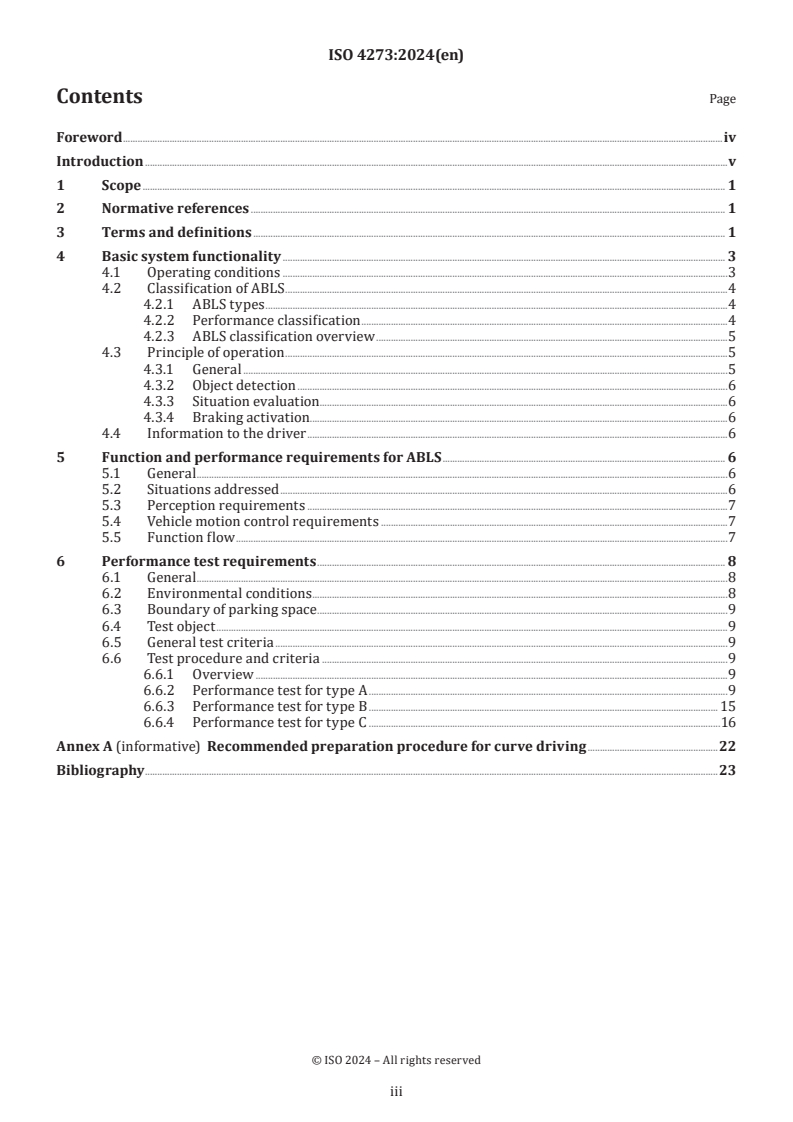
Contents Page
Foreword .iv
Introduction .v
1 Scope . 1
2 Normative references . 1
3 Terms and definitions . 1
4 Basic system functionality . 3
4.1 Operating conditions .3
4.2 Classification of ABLS .4
4.2.1 ABLS types .4
4.2.2 Performance classification .4
4.2.3 ABLS classification overview .5
4.3 Principle of operation .5
4.3.1 General .5
4.3.2 Object detection .6
4.3.3 Situation evaluation.6
4.3.4 Braking activation.6
4.4 Information to the driver .6
5 Function and performance requirements for ABLS . 6
5.1 General .6
5.2 Situations addressed .6
5.3 Perception requirements .7
5.4 Vehicle motion control requirements .7
5.5 Function flow .7
6 Performance test requirements . 8
6.1 General .8
6.2 Environmental conditions . .8
6.3 Boundary of parking space .9
6.4 Test object .9
6.5 General test criteria .9
6.6 Test procedure and criteria .9
6.6.1 Overview .9
6.6.2 Performance test for type A .9
6.6.3 Performance test for type B . 15
6.6.4 Performance test for type C .16
Annex A (informative) Recommended preparation procedure for curve driving .22
Bibliography .23
iii
Foreword
ISO (the International Organization for Standardization) is a worldwide federation of national standards
bodies (ISO member bodies). The work of preparing International Standards is normally carried out through
ISO technical committees. Each member body interested in a subject for which a technical committee
has been established has the right to be represented on that committee. International organizations,
governmental and non-governmental, in liaison with ISO, also take part in the work. ISO collaborates closely
with the International Electrotechnical Commission (IEC) on all matters of electrotechnical standardization.
The procedures used to develop this document and those intended for its further maintenance are described
in the ISO/IEC Directives, Part 1. In particular, the different approval criteria needed for the different types
of ISO document should be noted. This document was drafted in accordance with the editorial rules of the
ISO/IEC Directives, Part 2 (see www.iso.org/directives).
ISO draws attention to the possibility that the implementation of this document may involve the use of (a)
patent(s). ISO takes no position concerning the evidence, validity or applicability of any claimed patent
rights in respect thereof. As of the date of publication of this document, ISO had not received notice of (a)
patent(s) which may be required to implement this document. However, implementers are cautioned that
this may not represent the latest information, which may be obtained from the patent database available at
www.iso.org/patents. ISO shall not be held responsible for identifying any or all such patent rights.
Any trade name used in this document is information given for the convenience of users and does not
constitute an endorsement.
For an explanation of the voluntary nature of standards, the meaning of ISO specific terms and expressions
related to conformity assessment, as well as information about ISO's adherence to the World Trade
Organization (WTO) principles in the Technical Barriers to Trade (TBT), see www.iso.org/iso/foreword.html.
This document was prepared by Technical Committee ISO/TC 204, Intelligent transport systems.
Any feedback or questions on this document should be directed to the user’s national standards body. A
complete listing of these bodies can be found at www.iso.org/members.html.
iv
Introduction
Existing International Standards for automated emergency braking, such as ISO 22839 or ISO 19237, are
focused on collision mitigation or avoidance at moderate vehicle speeds in the forward direction, typically
using front sensors such as radar. The implementation and utilization of additional perception sensors (i.e.
around the entire vehicle) creates the possibility of advanced collision mitigation and avoidance systems
covering the whole area surrounding the vehicle.
Low-speed collisions during parking and especially during reversing manoeuvres represent a high share of
[6]
road traffic accidents, including both accidents with material damage leading to high monetary expenses,
and accidents leading to injuries or even fatalities of human road users. This document addresses such
collisions.
v
International Standard ISO 4273:2024(en)
Intelligent transport systems — Automated braking during
low-speed manoeuvring (ABLS) — Requirements and test
procedures
1 Scope
This document provides minimum requirements and test procedures for automated braking at velocities
below 2,8 m/s (10 km/h) with the specific aim of avoiding or mitigating collisions with pedestrians, other
road users (e.g. vehicles) and stationary objects, including infrastructure elements (e.g. walls, pillars). These
collisions mainly occur during reversing manoeuvres, but this document also addresses collisions in other
directions during low-speed manoeuvring.
Automated braking during low-speed manoeuvring (ABLS) requires information about the position and
motion of the object, the motion of the subject vehicle, and the driver actions. It then determines if the
evaluated situation represents a collision risk. If an imminent collision risk exists, ABLS will automatically
activate a brake action to avoid or at least mitigate the collision.
The document does not define test objects, but refers to the ISO 19206 series for test objects to be used.
The human driver is assumed to perform or at least supervise all driving manoeuvres because the ABLS
application is restricted to support only systems of SAE Level 0 – 2. Evasive steering manoeuvres are not
within the scope of this document.
[7]
This document applies to light vehicles only. Vehicles equipped with trailers are not within the scope of
this document.
2 Normative references
The following documents are referred to in the text in such a way that some or all of their content constitutes
requirements of this document. For dated references, only the edition cited applies. For undated references,
the latest edition of the referenced document (including any amendments) applies.
ISO 17386, Intelligent transport systems — Manoeuvring aids for low-speed operation (MALSO) — Performance
requirements and test procedures
ISO 19206-2, Road vehicles — Test devices for target vehicles, vulnerable road users and other objects, for
assessment of active safety functions — Part 2: Requirements for pedestrian targets
ISO 20900:2023, Intelligent transport systems — Partially-automated parking systems (PAPS) — Performance
requirements and test procedures
3 Terms and definitions
For the purposes of this document, the terms and definitions given in ISO 17386, ISO 19206-2, ISO 20900
and the following apply.
ISO and IEC maintain terminology databases for use in standardization at the following addresses:
— ISO Online browsing platform: available at https:// www .iso .org/ obp
— IEC Electropedia: available at https:// www .electropedia .org/
3.1
ABLS function
function capable of reducing the velocity of the vehicle to avoid or mitigate a collision during low-speed
manoeuvring
3.2
ABLS types
types A to C which are related to the automation level of the driving function supported by ABLS
3.3
low-speed manoeuvring
LSM
driving manoeuvre of a vehicle at a velocity ≤ 2,8 m/s (10 km/h) mainly intended to park the subject vehicle
Note 1 to entry: Within the context of this document, continuous forward driving (e.g. in congested situations such as
a traffic jam) where the velocity can potentially drop temporarily below 2,8 m/s (10 km/h) is not considered as low-
speed manoeuvring.
3.4
vulnerable road user
VRU
human such as a pedestrian or cyclist, independent of age and size
3.5
subject vehicle
SV
vehicle under test in which ABLS is implemented
3.6
parked vehicle
PV
static vehicle that represents the boundary of an adjacent parking space or the obstacle within the driving
path
3.7
manual driving
manoeuvre where the driver is in control of longitudinal and lateral movement of the vehicle and which
corresponds to SAE Level 0 (no automation)
3.8
assisted parking system
APS
system which supports the driver during parking by controlling the lateral movement/steering of the vehicle
and which corresponds to SAE Level 1 (Driver Assistance)
Note 1 to entry: See ISO 16787 for further information on APS.
3.9
partially automated parking system
PAPS
system which supports the driver during parking by controlling both the longitudinal and lateral movement
of the vehicle and which corresponds to SAE Level 2 (Partial Automation)
Note 1 to entry: See ISO 20900 for further information on PAPS.
3.10
parking
parking in
manoeuvring into a parking space
3.11
leaving
parking out
manoeuvring out of a parking space
3.12
object
item representing any kind of thing or creature
3.13
obstacle
object in or close to the driving path of the subject vehicle (SV) which is deemed to be collision-relevant
Note 1 to entry: All vulnerable road users are considered as collision-relevant obstacles if they are in or close to the SV
driving path.
Note 2 to entry: It is assumed that an obstacle can either be damaged by the SV or has a certain size which can cause
damages to the SV within the situation of a collision.
3.14
toddler target
TT
1)
test device representing a two-year-old toddler according to ISO/TS 19206-9:— , used for testing ABLS
4 Basic system functionality
The ABLS function shall avoid or mitigate a collision during low-speed manoeuvring (LSM). The risk of a
collision is determined based on the detection of objects. If necessary, the ABLS function automatically
initiates braking to avoid or to mitigate a collision. If the driver does not intervene to override the function,
ABLS continues the braking until the vehicle comes to a full stop.
This document concerns the achievement of collision avoidance via deceleration of the subject vehicle (SV)
regardless of the specific braking method. Evasive steering intervention to avoid a collision is not considered
within this document.
4.1 Operating conditions
The ABLS function shall be active during LSM [manoeuvring at or under 2,8 m/s (10 km/h)] regardless of the
applied steering angle. If the vehicle velocity exceeds the upper limit, v , specified by the manufacturer,
standby
the ABLS function shall no longer be active. The ABLS function may only be activated if an LSM event is
detected. It is the responsibility of the manufacturer to identify criteria for an LSM event.
ABLS shall always be automatically activated without driver initiation.
The ABLS function may be deactivated by the driver. It is the responsibility of the manufacturer to
determine a procedure for deactivation of the function. However, the procedure shall be designed to prevent
an unintentional deactivation of ABLS function.
It shall be possible for the driver to override the ABLS function at any time. The specific detection and
realization of an intended driver overriding intervention is not defined within this document and is left to
the manufacturer’s discretion.
The state transition of the ABLS function is shown in Figure 1.
The vehicle operator’s handbook (owner’s manual) should include an advisory note that clearly indicates the
system availability conditions.
1) Under preparation. Stage at the time of publication: ISO/AWI TS 19206-9:2023.
Figure 1 — State transition diagram of the ABLS function
4.2 Classification of ABLS
4.2.1 ABLS types
4.2.1.1 General
ABLS is classified into three types based on how the vehicle is being controlled prior to the activation of the
ABLS function.
4.2.1.2 Type A — manual driving mode
ABLS type A is active during the manual driving of the vehicle. The longitudinal and lateral movement of the
vehicle is under the control of the driver. This type of manoeuvring control corresponds to SAE Level 0.
4.2.1.3 Type B — assisted parking mode
ABLS type B is active when an SAE Level 1 parking automation system is engaged. The longitudinal
movement is controlled by the driver. The lateral motion control is provided by the SAE Level 1 parking
automation system and may be implemented in accordance with ISO 16787, for example.
4.2.1.4 Type C — partially-automated parking mode
ABLS type C is active when an SAE Level 2 parking automation system is engaged. Both longitudinal and
lateral movement are provided by the SAE Level 2 parking automation system. This type of manoeuvring
control corresponds to SAE Level 2 parking automation and may be implemented in accordance with
ISO 20900.
4.2.2 Performance classification
4.2.2.1 General
The following ABLS performance classifications reflect the diversity of performance levels. Each ABLS type
is split into the classes "base" and "enhanced", which represent a base performance that a driver can expect
from all ABLS functions and an enhanced performance.
4.2.2.2 Class "base"
The performance class "base" represents the minimum requirements for ensuring a basic ABLS performance
level for all three types (A, B, and C). The class "base" mainly aims to prevent collisions with stationary
objects.
The type "class A base" only covers reverse driving and is separated into “object” and “pedestrian” variants
reflecting the diversity of state-of-the-art systems in the market. The scope of the “object” variant is to avoid
or mitigate collisions with static obstacles such as poles and vehicles. The scope of the “pedestrian” variant is
to avoid or mitigate collisions with stationary pedestrians. A combination of these two variants is possible.
4.2.2.3 Class "enhanced"
The performance class "enhanced" provides additional characteristics which lead to an improved collision
avoidance performance in other LSM conditions. In addition to the base performance, the class "enhanced"
includes an improved collision avoidance performance for moving objects in all movement directions of the
LSM system in use, for example (see Table 1).
4.2.3 ABLS classification overview
Based on the types and performance classes of ABLS, different combinations of system characteristics
are possible reflecting the range of system use cases. An overview of these use cases is shown in Table 1.
More detailed performance requirements are described in Clause 6. The test requirements in 6.6 for the
minimal performance of all types and classes are derived from the use cases in Table 1 and the performance
requirements in Clause 5.
Different kinds of ABLS systems may be implemented within one vehicle. For example, an ABLS type A1
pedestrian for manual driving and an ABLS type C2 for partially-automated parking may be available within
one vehicle.
NOTE The class "enhanced" always includes all performance requirements of the class base.
The vehicle user’s manual (owner’s manual) should include an advisory note that clearly indicates what kind
of ABLS system is implemented, including the driver’s responsibility and limitations of the system.
Table 1 — ABLS classification overview
Type Class Variant Objects addressed Object movement Moving direction
A1 base object objects stationary reverse
A1 base pedestrian pedestrian stationary reverse
A2 enhanced n.a. objects+pedestrian stationary+moving reverse+forward
a
B1 base n.a. objects+pedestrian stationary design specific
a
B2 enhanced n.a. objects+pedestrian stationary+moving design specific
a
C1 base n.a. objects+pedestrian stationary design specific
a
C2 enhanced n.a. objects+pedestrian stationary+moving design specific
a
Direction of movement depends on the design of the LSM function supported by ABLS.
n.a. = non-applicable
4.3 Principle of operation
4.3.1 General
The OEDR (object and event detection and response) of ABLS contains the following elements for performing
the vehicle manoeuvre:
— object detection;
— situation evaluation;
— brake activation.
4.3.2 Object detection
ABLS functions use surround sensors to detect objects around the SV as well as their position and velocity
relative to the SV. This document does not endorse or prescribe any sensor technology. Therefore, the
sensing technology utilized is not specified.
4.3.3 Situation evaluation
Based on the information provided by object detection, the ABLS function "situation evaluation" evaluates
the risk of an imminent collision with the object within the driving path. The situation evaluation also
decides whether or not the SV can overrun the object (for example, in the case of a speedbump) without
damaging the SV or harming the object. If the object is considered as collision-relevant, the situation
evaluation triggers a braking activation.
4.3.4 Braking activation
Based on the results of the situation evaluation, the braking activation executes a deceleration of the SV
to avoid the collision. ABLS brakes, bringing the vehicle to a complete standstill, and keeps the vehicle
stationary until the driver authorizes the deactivation of the ABLS function or ABLS automatically requests
it (see 5.4).
4.4 Information to the driver
The ABLS function warns the driver about a potential collision via an acoustical and/or visual signal prior
to the braking intervention to gain the driver’s attention. In situations where a prompt braking activation is
required, the alert signal may be provided in parallel to the brake activation.
The driver is immediately informed about each ABLS braking activation conducted via a visual and either an
acoustical or haptic signal where the brake jerk may be recognized as a haptic signal.
5 Function and performance requirements for ABLS
5.1 General
The ABLS function is intended to avoid or mitigate collisions during LSM, thereby avoiding or mitigating
injuries of humans and any kind property damages. Due to technical system limitations it is not achievable
to detect all objects under all environmental conditions. It is recommended to include an advisory note in
the vehicle operator’s handbook (owner’s manual) that clearly indicates the system limitation.
5.2 Situations addressed
ABLS shall be active according to the conditions in 4.1 during LSM SAE Level 0 (type A, manual manoeuvring),
LSM SAE Level 1 (type B, assisted parking) or LSM SAE Level 2 (type C, partially-automated parking).
Depending on the specific functionality offered by the manufacturer, ABLS addresses different situations.
These may include following examples.
Type of parking space:
— parallel parking limited by vehicles or ground markings;
— perpendicular parking limited by vehicles or ground markings;
— garage parking.
Type of manoeuvre:
— entering the parking space (parking in, forward/backward);
— leaving the parking space (parking out, forward/backward).
Driver position (for L2 systems only, e.g. PAPS):
— driver in the driver seat;
— driver outside the vehicle in near range (remote parking).
5.3 Perception requirements
The system shall detect collision relevant objects in or close to the driving path according to the requirements
of the different classes in Table 1. Addressed obstacles are:
— stationary pedestrians;
— static objects (e.g. parked vehicle, road signs, walls, pillars);
— slow-moving obstacles up to 1,4 m/s (5 km/h) (e.g. walking pedestrians).
The ABLS function is not required to (but may optionally) address situations with objects such as:
— fast-moving objects above 1,4 m/s (5 km/h) (e.g. moving cyclists, motorbikes, other vehicles);
— objects which are not collision-relevant for specific vehicles (e.g. curb stones, stones, bottles);
NOTE As the relevance of collision depends on the characteristics (e.g. shape, material, height) of the vehicle
and the object, this document does not provide a specific definition.
— overhanging objects which have no contact point with the ground in the driving path.
5.4 Vehicle motion control requirements
In situations according to 5.2 and 5.3, the vehicle motion control (VMC) requests a brake activation to bring
the vehicle to standstill to avoid or mitigate a collision with the obstacle. ABLS may activate at an earlier
point in time that ensures a safety distance to the object at standstill. The definition of the safety distance is
left to the discretion of the original equipment manufacturer (OEM).
After the vehicle comes to standstill, the VMC shall continue to hold the brakes to avoid further movement of
the vehicle until the driver authorizes the release of the hold (for example, by pushing the accelerator pedal),
or until the function releases the standstill automatically in the case that a collision is no longer imminent or
when another OEM-defined condition is reached. In case of automatic release, it is recommended
...