


ISO 7270-2:2012
(Main)Rubber — Analysis by pyrolytic gas-chromatographic methods — Part 2: Determination of styrene/butadiene/isoprene ratio
Rubber — Analysis by pyrolytic gas-chromatographic methods — Part 2: Determination of styrene/butadiene/isoprene ratio
ISO 7270-2:2012 specifies a pyrolytic gas-chromatographic method for the determination of the styrene/butadiene/isoprene ratio in copolymers, or blends of homopolymers and/or copolymers, in raw rubbers or in unvulcanized or vulcanized compounds. It is applicable to copolymers/terpolymers consisting of styrene, butadiene and isoprene, and blends of these polymers.
Caoutchouc — Méthodes d'analyse par pyrolyse et chromatographie en phase gazeuse — Partie 2: Détermination du rapport styrène/butadiène/isoprène
L'ISO 7270-2:2012 spécifie une méthode de détermination, par pyrolyse et chromatographie en phase gazeuse, du rapport styrène/butadiène/isoprène dans les copolymères ou mélanges d'homopolymères et/ou de copolymères, dans les caoutchoucs bruts ou les mélanges vulcanisés ou non. Elle s'applique aux copolymères/terpolymères composés de styrène, de butadiène et d'isoprène, et aux mélanges de ces polymères.
General Information
- Status
- Withdrawn
- Publication Date
- 12-Sep-2012
- Technical Committee
- ISO/TC 45/SC 2 - Testing and analysis
- Drafting Committee
- ISO/TC 45/SC 2/WG 5 - Chemical tests
- Current Stage
- 9599 - Withdrawal of International Standard
- Start Date
- 24-May-2024
- Completion Date
- 12-Feb-2026
Relations
- Effective Date
- 06-Jan-2024
- Effective Date
- 18-Dec-2008

ISO 7270-2:2012 - Rubber -- Analysis by pyrolytic gas-chromatographic methods

ISO 7270-2:2012 - Caoutchouc -- Méthodes d'analyse par pyrolyse et chromatographie en phase gazeuse
Get Certified
Connect with accredited certification bodies for this standard

Smithers Quality Assessments
US management systems and product certification.

DIN CERTCO
DIN Group product certification.
Sponsored listings
Frequently Asked Questions
ISO 7270-2:2012 is a standard published by the International Organization for Standardization (ISO). Its full title is "Rubber — Analysis by pyrolytic gas-chromatographic methods — Part 2: Determination of styrene/butadiene/isoprene ratio". This standard covers: ISO 7270-2:2012 specifies a pyrolytic gas-chromatographic method for the determination of the styrene/butadiene/isoprene ratio in copolymers, or blends of homopolymers and/or copolymers, in raw rubbers or in unvulcanized or vulcanized compounds. It is applicable to copolymers/terpolymers consisting of styrene, butadiene and isoprene, and blends of these polymers.
ISO 7270-2:2012 specifies a pyrolytic gas-chromatographic method for the determination of the styrene/butadiene/isoprene ratio in copolymers, or blends of homopolymers and/or copolymers, in raw rubbers or in unvulcanized or vulcanized compounds. It is applicable to copolymers/terpolymers consisting of styrene, butadiene and isoprene, and blends of these polymers.
ISO 7270-2:2012 is classified under the following ICS (International Classification for Standards) categories: 83.060 - Rubber. The ICS classification helps identify the subject area and facilitates finding related standards.
ISO 7270-2:2012 has the following relationships with other standards: It is inter standard links to ISO 7270-2:2024, ISO 7270-2:2005. Understanding these relationships helps ensure you are using the most current and applicable version of the standard.
ISO 7270-2:2012 is available in PDF format for immediate download after purchase. The document can be added to your cart and obtained through the secure checkout process. Digital delivery ensures instant access to the complete standard document.
Standards Content (Sample)
INTERNATIONAL ISO
STANDARD 7270-2
Second edition
2012-09-15
Rubber — Analysis by pyrolytic gas-
chromatographic methods —
Part 2:
Determination of styrene/butadiene/
isoprene ratio
Caoutchouc — Méthodes d’analyse par pyrolyse et chromatographie en
phase gazeuse —
Partie 2: Détermination du rapport styrène/butadiène/isoprène
Reference number
©
ISO 2012
All rights reserved. Unless otherwise specified, no part of this publication may be reproduced or utilized in any form or by any means,
electronic or mechanical, including photocopying and microfilm, without permission in writing from either ISO at the address below or ISO’s
member body in the country of the requester.
ISO copyright office
Case postale 56 • CH-1211 Geneva 20
Tel. + 41 22 749 01 11
Fax + 41 22 749 09 47
E-mail copyright@iso.org
Web www.iso.org
Published in Switzerland
ii © ISO 2012 – All rights reserved
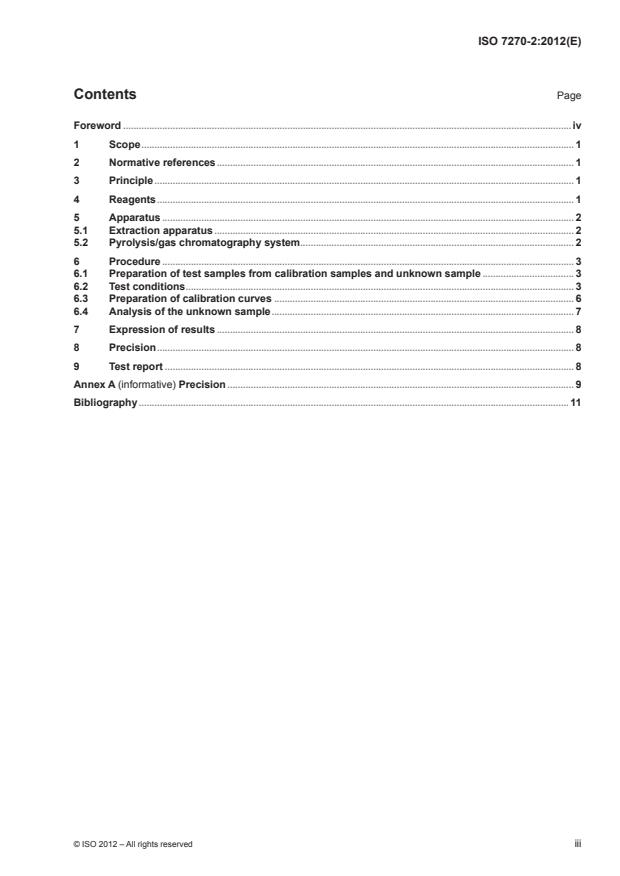
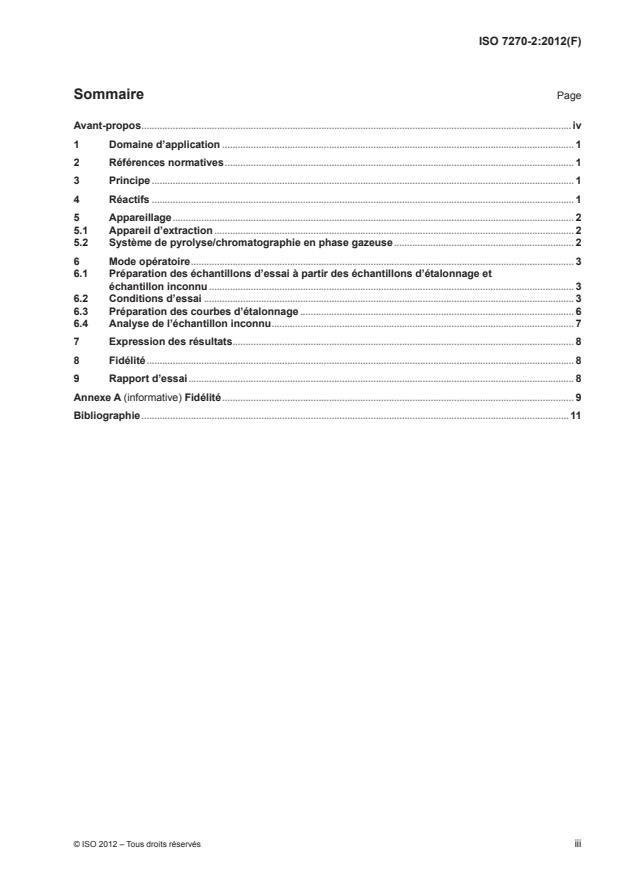
Contents Page
Foreword .iv
1 Scope . 1
2 Normative references . 1
3 Principle . 1
4 Reagents . 1
5 Apparatus . 2
5.1 Extraction apparatus . 2
5.2 Pyrolysis/gas chromatography system . 2
6 Procedure . 3
6.1 Preparation of test samples from calibration samples and unknown sample . 3
6.2 Test conditions . 3
6.3 Preparation of calibration curves . 6
6.4 Analysis of the unknown sample . 7
7 Expression of results . 8
8 Precision . 8
9 Test report . 8
Annex A (informative) Precision . 9
Bibliography . 11
Foreword
ISO (the International Organization for Standardization) is a worldwide federation of national standards bodies
(ISO member bodies). The work of preparing International Standards is normally carried out through ISO
technical committees. Each member body interested in a subject for which a technical committee has been
established has the right to be represented on that committee. International organizations, governmental and
non-governmental, in liaison with ISO, also take part in the work. ISO collaborates closely with the International
Electrotechnical Commission (IEC) on all matters of electrotechnical standardization.
International Standards are drafted in accordance with the rules given in the ISO/IEC Directives, Part 2.
The main task of technical committees is to prepare International Standards. Draft International Standards
adopted by the technical committees are circulated to the member bodies for voting. Publication as an
International Standard requires approval by at least 75 % of the member bodies casting a vote.
Attention is drawn to the possibility that some of the elements of this document may be the subject of patent
rights. ISO shall not be held responsible for identifying any or all such patent rights.
ISO 7270-2 was prepared by Technical Committee ISO/TC 45, Rubber and rubber products, Subcommittee
SC 2, Testing and analysis.
This second edition cancels and replaces the first edition (ISO 7270-2:2005), which has been technically revised.
ISO 7270 consists of the following parts, under the general title Rubber — Analysis by pyrolytic gas-
chromatographic methods:
— Part 1: Identification of polymers (single polymers and polymer blends)
— Part 2: Determination of styrene/butadiene/isoprene ratio
iv © ISO 2012 – All rights reserved
INTERNATIONAL STANDARD ISO 7270-2:2012(E)
Rubber — Analysis by pyrolytic gas-chromatographic methods —
Part 2:
Determination of styrene/butadiene/isoprene ratio
WARNING — Persons using this part of ISO 7270 should be familiar with normal laboratory practice.
This part of ISO 7270 does not purport to address all of the safety problems, if any, associated with
its use. It is the responsibility of the user to establish appropriate safety and health practices and to
ensure compliance with any national regulatory conditions.
CAUTION — Certain procedures specified in this part of ISO 7270 might involve the use or generation of
substances, or the generation of waste, that could constitute a local environmental hazard. Reference
should be made to appropriate documentation on safe handling and disposal after use.
1 Scope
This part of ISO 7270 specifies a pyrolytic gas-chromatographic method for the determination of the
styrene/butadiene/isoprene ratio in copolymers, or blends of homopolymers and/or copolymers, in raw rubbers
or in unvulcanized or vulcanized compounds. It is applicable to copolymers/terpolymers consisting of styrene,
butadiene and isoprene, and blends of these polymers.
NOTE 1 The use of this part of ISO 7270 pre-supposes sufficient working knowledge of the principles and techniques
of gas chromatography for the analyst to perform the operations described and interpret the results correctly.
NOTE 2 The styrene/butadiene/isoprene ratio determined by this test method is affected by the presence of resin and
by a high level of sulfur.
2 Normative references
The following referenced documents are indispensable for the application of this document. For dated
references, only the edition cited applies. For undated references, the latest edition of the referenced document
(including any amendments) applies.
ISO 1407:2011, Rubber — Determination of solvent extract
3 Principle
Calibration curves are first prepared by pyrolysing samples with known styrene/butadiene/isoprene ratios
and analysing the pyrolysis products by gas chromatography to determine the percentage content of each
component (styrene, butadiene and isoprene), relative to the total of the three components.
Samples of unknown composition are then pyrolysed, and the pyrolysis products are analysed under the same
conditions. The styrene/butadiene/isoprene ratio in these samples is determined from the calibration curves.
4 Reagents
All reagents shall be of analytical grade.
4.1 Solvents for extraction purposes.
The following solvents are suitable:
— acetone;
— methanol;
— methylethylketone.
4.2 Carrier gas:
— nitrogen;
or
— helium.
4.3 Gas for flame-ionization detector: hydrogen plus purified compressed air.
5 Apparatus
5.1 Extraction apparatus
As specified in ISO 1407.
5.2 Pyrolysis/gas chromatography system
5.2.1 General
The apparatus utilized to obtain pyrograms consists of four parts: the pyrolysis device, the gas chromatograph,
the gas-chromatographic column and the data-handling equipment.
5.2.2 Pyrolysis device
The following types of pyrolysis device are suitable:
— micro-furnace pyrolyser;
— Curie-point pyrolyser;
— platinum-filament pyrolyser.
5.2.3 Gas chromatograph
A wide variety of gas chromatographs using either a flame-ionization detector (FID) or a thermal-conductivity
detector (TCD) are suitable for use in this part of ISO 7270. An FID is preferable for use with capillary columns.
5.2.4 Chromatographic columns
A variety of column materials, column lengths, column diameters and stationary and liquid phases are suitable
for use in this part of ISO 7270, the main requirement being high resolution of the volatile pyrolysis products
styrene, butadiene and isoprene.
NOTE 1 Capillary columns, which have a separation efficiency which is better than that of packed columns, are suitable,
but not essential.
NOTE 2 Capillary columns containing non-polar polydimethylsiloxanes and partially modified (diphenyl-,
cyanopropylphenyl- or other) semi-polar silicones are suitable.
NOTE 3 When using an ordinary (30 m) capillary column, it is difficult to separate isobutene from butadiene completely.
The reason is that, in pyrolytic gas-chromatographic methods, isobutene, which is a decomposition product of rubber
containing the isoprene unit, is detected close to the retention time of butadiene. It is possible, however, to discriminate
between isoprene and butadiene, even without complete separation, by means of the calibration curves.
2 © ISO 2012 – All rights reserved
5.2.5 Data-handling equipment
A recorder, an integrator or a computer data-analysis system may be used.
6 Procedure
6.1 Preparation of test samples from calibration samples and unknown sample
6.1.1 A minimum of three calibration samples shall be used for the preparation of the calibration curves,
including a calibration sample with the composition expected for the unknown sample under test.
6.1.2 The nature (raw, unvulcanized, or vulcanized) of the calibration samples should preferably be the same
as that of the unknown sample under test.
6.1.3 Process or extender oil and additives in both the calibration samples and the unknown sample shall
be extracted in accordance with ISO 1407:2011, method B, using a solvent suitable for the type of compound
concerned (vulcanized or unvulcanized). The solvent chosen shall not affect the polymer and shall remove as
much of the proc
...
NORME ISO
INTERNATIONALE 7270-2
Deuxième édition
2012-09-15
Caoutchouc — Méthodes d’analyse par
pyrolyse et chromatographie en phase
gazeuse —
Partie 2:
Détermination du rapport styrène/
butadiène/isoprène
Rubber — Analysis by pyrolytic gas-chromatographic methods —
Part 2: Determination of styrene/butadiene/isoprene ratio
Numéro de référence
©
ISO 2012
DOCUMENT PROTÉGÉ PAR COPYRIGHT
Droits de reproduction réservés. Sauf prescription différente, aucune partie de cette publication ne peut être reproduite ni utilisée sous
quelque forme que ce soit et par aucun procédé, électronique ou mécanique, y compris la photocopie et les microfilms, sans l’accord écrit
de l’ISO à l’adresse ci-après ou du comité membre de l’ISO dans le pays du demandeur.
ISO copyright office
Case postale 56 • CH-1211 Geneva 20
Tel. + 41 22 749 01 11
Fax + 41 22 749 09 47
E-mail copyright@iso.org
Web www.iso.org
Publié en Suisse
ii © ISO 2012 – Tous droits réservés
Sommaire Page
Avant-propos .iv
1 Domaine d’application . 1
2 Références normatives . 1
3 Principe . 1
4 Réactifs . 1
5 Appareillage . 2
5.1 Appareil d’extraction . 2
5.2 Système de pyrolyse/chromatographie en phase gazeuse . 2
6 Mode opératoire . 3
6.1 Préparation des échantillons d’essai à partir des échantillons d’étalonnage et
échantillon inconnu . 3
6.2 Conditions d’essai . 3
6.3 Préparation des courbes d’étalonnage . 6
6.4 Analyse de l’échantillon inconnu . 7
7 Expression des résultats . 8
8 Fidélité . 8
9 Rapport d’essai . 8
Annexe A (informative) Fidélité . 9
Bibliographie . 11
Avant-propos
L’ISO (Organisation internationale de normalisation) est une fédération mondiale d’organismes nationaux de
normalisation (comités membres de l’ISO). L’élaboration des Normes internationales est en général confiée aux
comités techniques de l’ISO. Chaque comité membre intéressé par une étude a le droit de faire partie du comité
technique créé à cet effet. Les organisations internationales, gouvernementales et non gouvernementales,
en liaison avec l’ISO participent également aux travaux. L’ISO collabore étroitement avec la Commission
électrotechnique internationale (CEI) en ce qui concerne la normalisation électrotechnique.
Les Normes internationales sont rédigées conformément aux règles données dans les Directives ISO/CEI, Partie 2.
La tâche principale des comités techniques est d’élaborer les Normes internationales. Les projets de Normes
internationales adoptés par les comités techniques sont soumis aux comités membres pour vote. Leur publication
comme Normes internationales requiert l’approbation de 75 % au moins des comités membres votants.
L’attention est appelée sur le fait que certains des éléments du présent document peuvent faire l’objet de droits
de propriété intellectuelle ou de droits analogues. L’ISO ne saurait être tenue pour responsable de ne pas avoir
identifié de tels droits de propriété et averti de leur existence.
L’ISO 7270-2 a été élaborée par le comité technique ISO/TC 45, Élastomères et produits à base d’élastomères,
sous-comité SC 2, Essais et analyses.
Cette deuxième édition annule et remplace la première édition (ISO 7270-2:2005), qui fait l’objet d’une
révision technique.
L’ISO 7270 comprend les parties suivantes, présentées sous le titre général Caoutchouc — Méthodes d’analyse
par pyrolyse et chromatographie en phase gazeuse:
— Partie 1: Identification des polymères (un seul polymère ou un mélange de polymères)
— Partie 2: Détermination du rapport styrène/butadiène/isoprène
iv © ISO 2012 – Tous droits réservés
NORME INTERNATIONALE ISO 7270-2:2012(F)
Caoutchouc — Méthodes d’analyse par pyrolyse et
chromatographie en phase gazeuse —
Partie 2:
Détermination du rapport styrène/butadiène/isoprène
AVERTISSEMENT — Il convient que l’utilisateur de la présente partie de l’ISO 7270 connaisse bien les
pratiques courantes de laboratoire. La présente partie de l’ISO 7270 n’a pas pour but de traiter tous les
problèmes de sécurité qui sont, le cas échéant, liés à son utilisation. Il incombe à l’utilisateur d’établir
des pratiques appropriées en matière d’hygiène et de sécurité, et de s’assurer de la conformité à la
réglementation nationale en vigueur.
ATTENTION — Certains modes opératoires spécifiés dans la présente partie de l’ISO 7270 peuvent
impliquer l’utilisation ou la génération de substances, ou bien la production de déchets, pouvant
constituer un risque pour l’environnement local. Il convient de se référer à la documentation appropriée
concernant la manipulation et l’élimination après usage en toute sécurité.
1 Domaine d’application
La présente partie de l’ISO 7270 spécifie une méthode de détermination, par pyrolyse et chromatographie en
phase gazeuse, du rapport styrène/butadiène/isoprène dans les copolymères ou mélanges d’homopolymères
et/ou de copolymères, dans les caoutchoucs bruts ou les mélanges vulcanisés ou non. Elle s’applique aux
copolymères/terpolymères composés de styrène, de butadiène et d’isoprène, et aux mélanges de ces polymères.
NOTE 1 L’utilisation de la présente partie de l’ISO 7270 présuppose une connaissance suffisante des principes et
des techniques de chromatographie en phase gazeuse pour pouvoir effectuer les opérations décrites et pour interpréter
correctement les résultats.
NOTE 2 Le rapport styrène/butadiène/isoprène déterminé par cette méthode d’essai est affecté par la présence de
résine et par une teneur élevée en soufre.
2 Références normatives
Les documents de référence suivants sont indispensables pour l’application du présent document. Pour les
références datées, seule l’édition citée s’applique. Pour les références non datées, la dernière édition du
document de référence s’applique (y compris les éventuels amendements).
ISO 1407:2011, Caoutchouc — Détermination de l’extrait par les solvants
3 Principe
En premier lieu, des courbes d’étalonnage sont préparées en procédant à la pyrolyse d’échantillons présentant
des rapports styrène/butadiène/isoprène connus et à l’analyse des produits de pyrolyse par chromatographie
en phase gazeuse afin de déterminer la teneur en pourcentage de chaque composant (styrène, butadiène et
isoprène) par rapport au total des trois composants.
Des échantillons de composition inconnue sont ensuite pyrolysés et les produits de pyrolyse sont analysés
dans les mêmes conditions. Le rapport styrène/butadiène/isoprène dans ces échantillons est déterminé à
partir des courbes d’étalonnage.
4 Réactifs
Tous les réactifs doivent être de pureté analytique reconnue.
4.1 Solvants pour l’extraction.
Les solvants suivants conviennent:
— acétone;
— méthanol;
— méthyléthylcétone.
4.2 Gaz vecteur:
— azote;
ou
— hélium.
4.3 Gaz pour détecteur à ionisation de flamme: hydrogène plus air comprimé purifié.
5 Appareillage
5.1 Appareil d’extraction
Tel que spécifié dans l’ISO 1407.
5.2 Système de pyrolyse/chromatographie en phase gazeuse
5.2.1 Généralités
L’appareillage utilisé pour obtenir des pyrogrammes comprend quatre éléments: le dispositif de pyrolyse,
le chromatographe en phase gazeuse, la colonne chromatographique en phase gazeuse et le système
d’acquisition et de traitement de données.
5.2.2 Dispositif de pyrolyse
Les types suivants de dispositif de pyrolyse conviennent:
— micro-four;
— pyrolyseur à point de Curie;
— pyrolyseur à filaments de platine.
5.2.3 Chromatographe en phase gazeuse
Une grande variété de chromatographes en phase gazeuse employant un détecteur à ionisation de flamme
(FID) ou un détecteur à conductivité thermique (TCD) peuvent être utilisés pour la présente partie de l’ISO 7270.
Il est préférable d’utiliser un FID avec colonnes capillaires.
5.2.4 Colonnes chromatographiques
Des colonnes de longueurs, diamètres, phases stationnaires et liquides très différents peuvent être utilisées
pour la présente partie de l’ISO 7270, l’exigence principale étant de pouvoir séparer parfaitement les produits
de pyrolyse volatils des styrène, butadiène et isoprène.
NOTE 1 Des colonnes capillaires présentant une meilleure efficacité de séparation que les colonnes remplies
conviennent, mais ne sont pas essentielles.
2 © ISO 2012 – Tous droits réservés
NOTE 2 Des colonnes capillaires contenant des diméthyl polysiloxanes apolaires et des silicones semi-polaires
partiellement modifiés (diphényl-, cyanopropylphényl- ou autre) conviennent.
NOTE 3 Si l’on utilise une colonne capillaire ordinaire (30 m), il est difficile d’obtenir une séparation complète entre
l’isobutène et le butadiène. Cela s’explique par le fait que, dans les méthodes par chromatographie en phase gazeuse
pyrolytique, l’isobutène, qui est un produit de décomposition de caoutchouc contenant de l’isoprène, est détecté à
proximité du temps de rétention du butadiène. Il est cependant possible de différencier l’isoprène du butadiène, même
sans séparation complète, en utilisant les courbes d’étalonnage.
5.2.5 Système d’acquisition et de traitement de données
Un enregistreur, un intégrateur ou un système informatique d’analyse de données peut être utilisé.
6 Mode opératoire
6.1 Préparation des échantillons d’essai à partir des échantillons d’étalonnage et échan-
tillon inconnu
6.1.1 Au moins trois échantillons d’étalonnage doivent être utilisés pour la préparation des courbes
d’étalonnage, y compris un échantillon d’étalonnage avec la composition prévue de l’échantillon d’essai inconnu.
6.1.2 Il convient, de préférence, que la nature (brute, non vulcanisée ou vulcanisée) des échantillons
d’étalonnage soit la même que celle de l’échantillon inconnu soumis à essai.
6.1.3 Les additifs et les huiles d’extension ou de traitement, à la fois dans les échantillons d’étalonnage et
l’échantillon d’essai inconnu, doivent être extraits conformément à l’ISO 1407:2011, méthode B, en utilisant
un solvant approprié au type de mélange concerné (vulcanisé ou non). Le solvant choisi ne doit pas affecter
le polymère et doit éliminer autant d’additifs et d’huiles d’extension ou de traitement que possible. Tous les
échantillons doivent être séchés après extraction, en utilisant le mode opératoire de séchage spécifié d
...
Questions, Comments and Discussion
Ask us and Technical Secretary will try to provide an answer. You can facilitate discussion about the standard in here.
Loading comments...