

ISO 1155:1978
(Main)Information processing — Use of longitudinal parity to detect errors in information messages
General Information
- Abstract
- Status
- Published
- Publication Date
- 31-Oct-1978
- Drafting Committee
- ISO/IEC JTC 1/SC 6/WG 1 - Physical and data link layers
- Current Stage
- 9093 - International Standard confirmed
- Start Date
- 18-Sep-2001
- Completion Date
- 29-Aug-2026
Buy Documents

ISO 1155:1978 - Information processing — Use of longitudinal parity to detect errors in information messages Released:11/1/1978
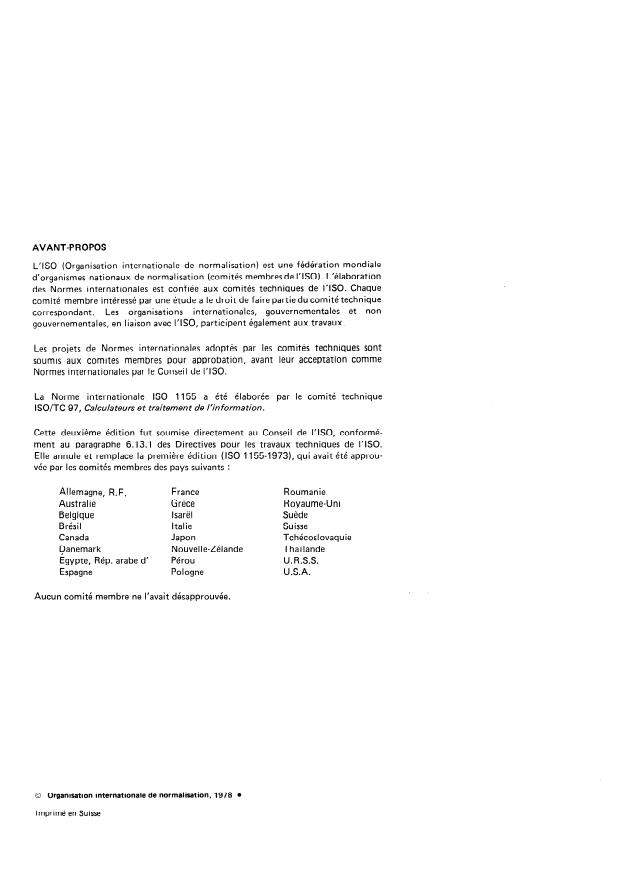
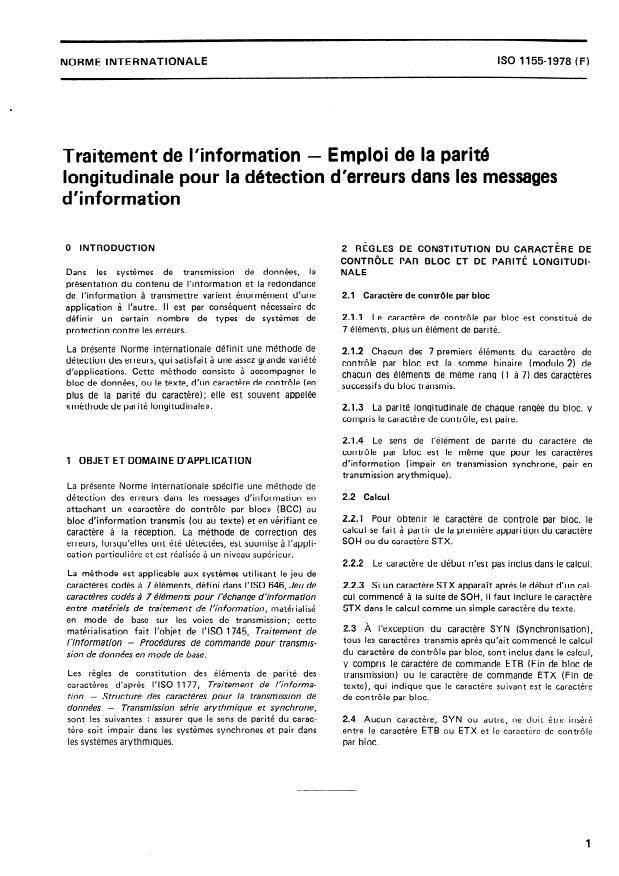

ISO 1155:1978 - Traitement de l'information — Emploi de la parité longitudinale pour la détection d'erreurs dans les messages d'information Released:11/1/1978
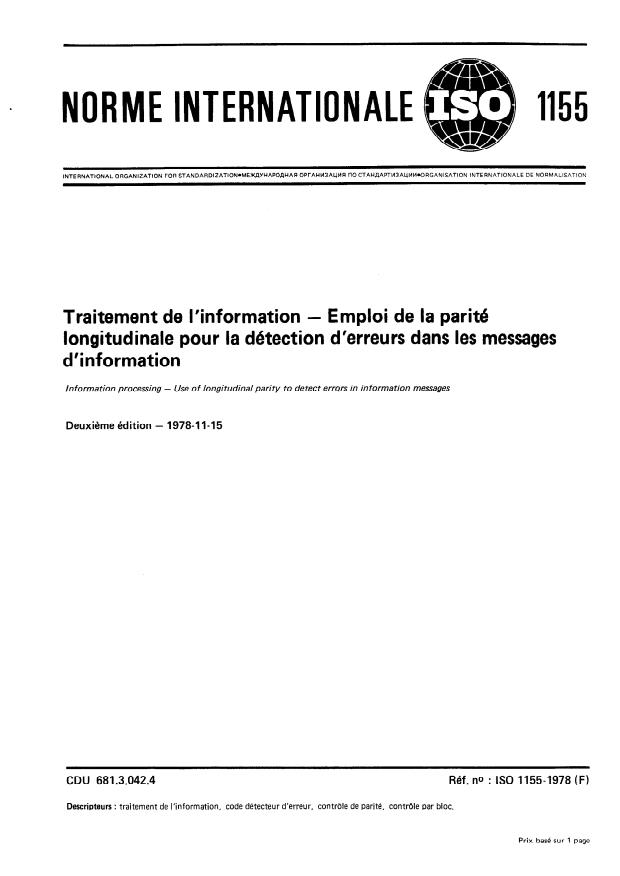
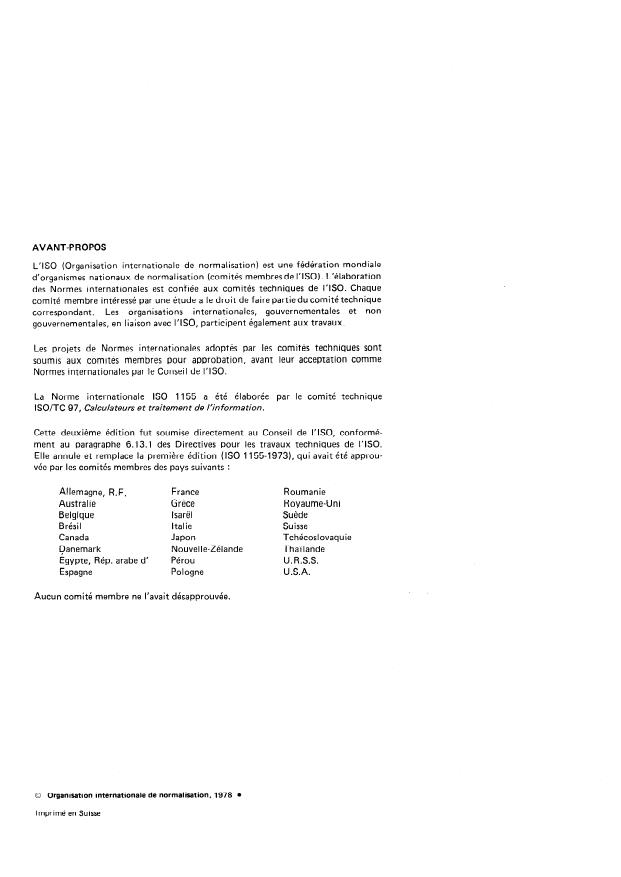
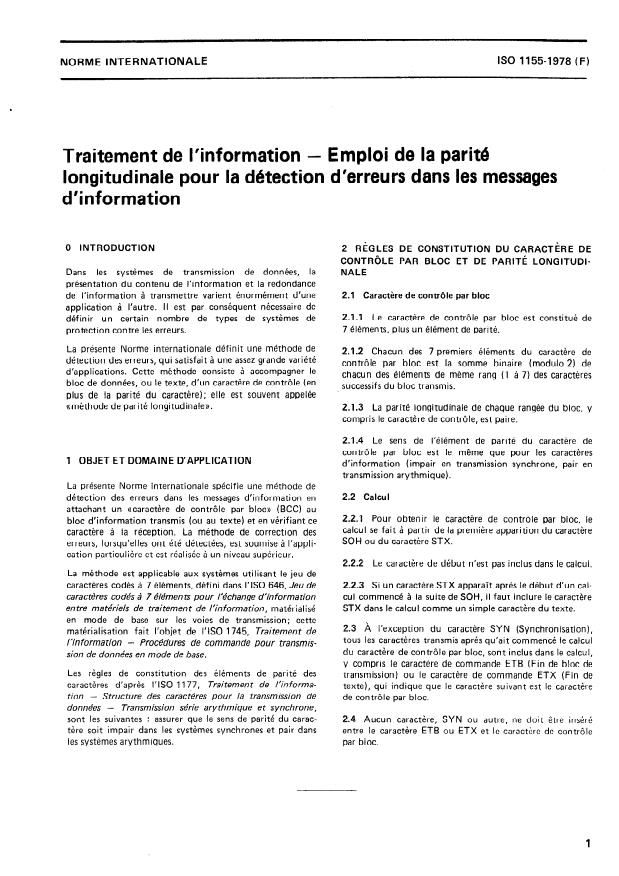

ISO 1155:1978 - Traitement de l'information — Emploi de la parité longitudinale pour la détection d'erreurs dans les messages d'information Released:11/1/1978
ISO 1155:1978 Overview
ISO 1155:1978 is an international standard developed by the International Organization for Standardization (ISO) that defines the use of longitudinal parity for detecting errors in information messages during data communication and processing. This standard addresses the need for reliable error detection in systems transmitting data using the 7-bit coded character set (ISO 646) and provides a robust method to identify errors by attaching a block check character to information blocks or text.
The standard was published in 1978 and is positioned within the broader scope of data communication protocols and error detection mechanisms to enhance data integrity during transmission.
Key Concepts in ISO 1155:1978
Longitudinal Parity Method
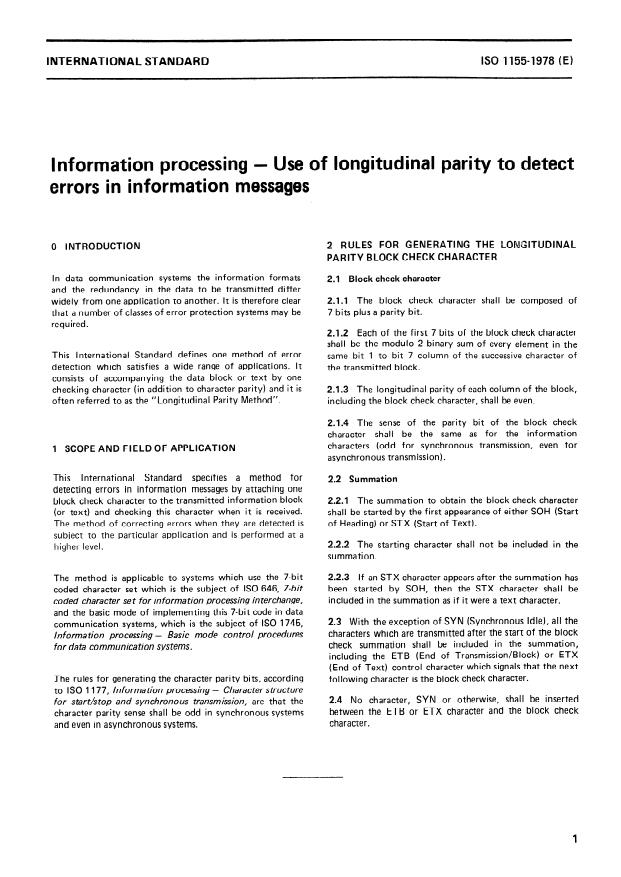
The core of ISO 1155:1978 is the longitudinal parity method, a technique for error detection that involves appending a block check character to the data block, which acts as an additional parity check beyond character-level parity.
- The block check character consists of 7 bits plus a parity bit.
- Each of the first 7 bits of the block check character is computed as the modulo 2 binary sum of all bits in the corresponding bit position across the transmitted characters in the block.
- The overall parity, including the block check character, must be even to ensure error detection.
- The parity bit sense follows the communication mode-odd parity for synchronous transmission, even parity for asynchronous transmission.
Block Check Character Generation
ISO 1155:1978 stipulates precise rules to generate the block check character:
- Summation for the block check character begins after the Start of Heading (SOH) or Start of Text (STX) characters.
- The SOH or STX character starting the block is excluded or included as specified when summing bits.
- All characters in the block-except certain control characters like SYN (Synchronous Idle)-are included in the checksum calculation up to the End of Transmission/Block (ETB) or End of Text (ETX).
- No characters may be introduced between the ETB/ETX and the block check character to maintain parity integrity.
Practical Applications
ISO 1155:1978 is vital for various data communication systems, particularly those employing 7-bit ASCII encoding. Common practical use cases include:
- Error detection in serial data transmission: Minimizes corrupted data reception in computer networks and telecommunications by identifying transmission errors through parity checks.
- Data integrity in messaging protocols: Ensures that information messages between devices are correct, reducing retransmissions.
- Embedded systems and industrial communication: Used in systems where reliable data exchange is critical and retransmission overhead must be minimized.
- Legacy system interoperability: Facilitates communication between devices adhering to older 7-bit coding and parity protocols.
By standardizing the longitudinal parity check method, ISO 1155 helps systems maintain a high level of data quality and integrity, providing a simple yet effective error detection mechanism.
Related Standards
ISO 1155:1978 works in concert with the following standards for comprehensive data communication and error handling:
- ISO 646: Specifies the 7-bit coded character set used for information processing interchange.
- ISO 1177: Defines character structure and parity bit rules for start/stop and synchronous transmission.
- ISO 1745: Covers basic mode control procedures for data communication systems using the 7-bit basic coded character set.
- Other error detection codes: Like cyclic redundancy checks (CRC) and checksum standards, complement parity checks for more robust error handling.
Understanding and implementing ISO 1155 alongside these standards ensures effective data exchange protocols adhering to international best practices.
Keywords: ISO 1155, longitudinal parity, error detection, information processing, block check character, 7-bit coded character, parity check, data communication, error detection code, ISO standards.
Relations
- Effective Date
- 25-Aug-2026
- Effective Date
- 25-Aug-2026
Buy Documents
ISO 1155:1978 - Information processing — Use of longitudinal parity to detect errors in information messages Released:11/1/1978
ISO 1155:1978 - Traitement de l'information — Emploi de la parité longitudinale pour la détection d'erreurs dans les messages d'information Released:11/1/1978
ISO 1155:1978 - Traitement de l'information — Emploi de la parité longitudinale pour la détection d'erreurs dans les messages d'information Released:11/1/1978
Get Certified
Connect with accredited certification bodies for this standard

BSI Group
BSI (British Standards Institution) is the business standards company that helps organizations make excellence a habit.

NYCE
Mexican standards and certification body.
Sponsored listings
Frequently Asked Questions
ISO 1155:1978 is a standard published by the International Organization for Standardization (ISO). Its full title is "Information processing — Use of longitudinal parity to detect errors in information messages". This standard covers: Information processing — Use of longitudinal parity to detect errors in information messages
Information processing — Use of longitudinal parity to detect errors in information messages
ISO 1155:1978 is classified under the following ICS (International Classification for Standards) categories: 35.100.20 - Data link layer. The ICS classification helps identify the subject area and facilitates finding related standards.
ISO 1155:1978 has the following relationships with other standards: It is inter standard links to EN 13757-1:2014, EN 13757-1:2002. Understanding these relationships helps ensure you are using the most current and applicable version of the standard.
ISO 1155:1978 is available in PDF format for immediate download after purchase. The document can be added to your cart and obtained through the secure checkout process. Digital delivery ensures instant access to the complete standard document.
Standards Content (Sample)
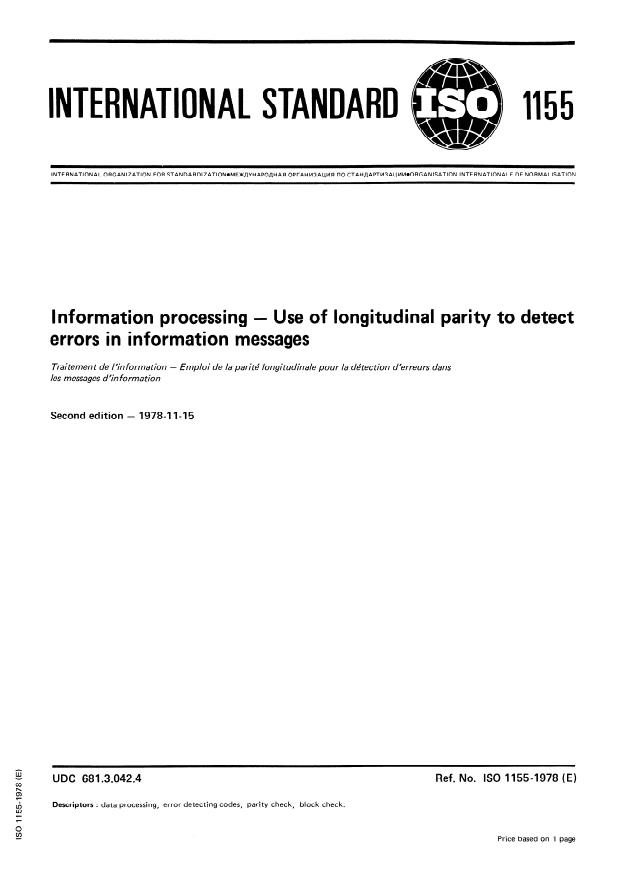
INTERNATIONAL STANDARD
INTERNATIONAL ORGANIZATION FOR STANDARDIZATION.MElK~YHAPO~HAR OPrAHM3A~MR I-IO CTAH~APTbl3AlJ4M.ORGANISATION INTERNATIONALE DE NORMALISATION
Information processing - Use of longitudinal parity to detect
errors in information messages
Trai temen t de / ‘in forma tion - Emploi de Ia parite longitudinale pour Ia detection d ’erreurs dans
les messages d ’in formation
Second edition - 1978-11-15
w
-
UDC 681.3.042.4 Ref. No. ISO 1155-1978 (E)
Descriptors : data processing, error detecting Codes, parity check, block check,
Price based on 1 page
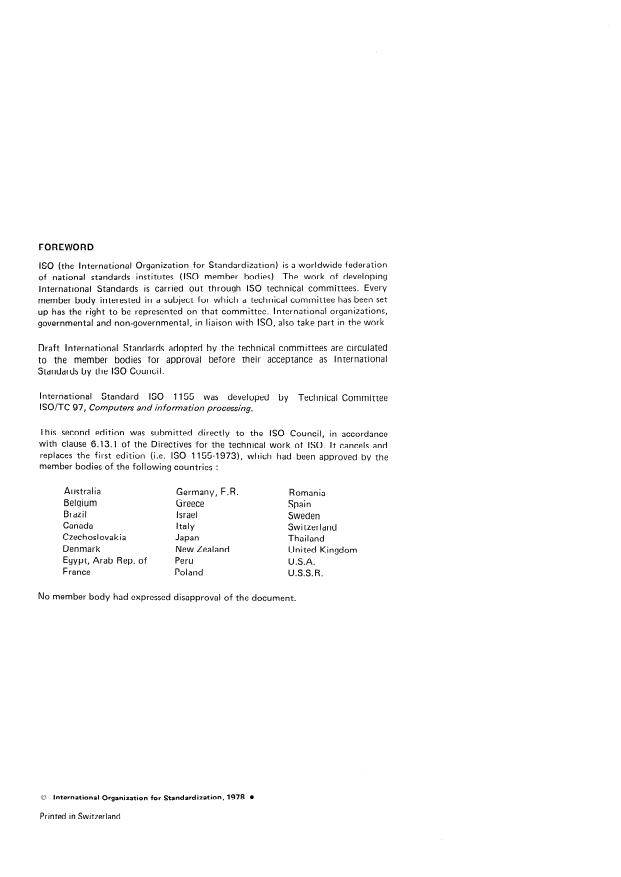
FOREWORD
ISO (the International Organization for Standardization) is a worldwide federation
of national Standards institutes (ISO member bodies). The work of developing
International Standards is carried out through ISO technical committees. Every
member body interested in a subject for which a technical committee has been set
up has the right to be represented on that committee. International organizations,
governmental and non-governmental, in liaison with ISO, also take part in the work.
Draft International Standards adopted by the technical committees are circulated
to the member bodies for approval before their acceptance as International
Standards by the ISO Council.
International Standard ISO 1155 was developed by Technical Committee
ISOITC 97, Computers and information processing.
This second edition was submitted directly to the ISO Council, in accordance
with clause 6.13.1 of the Directives for the technical work of ISO. lt canceis and
replaces the first edition (i.e. ISO 1155-1973) which had been approved by the
member bodies of the following countries :
Australia Germany, FR.
Romania
Belgium G reece
Spain
Brazil Israel
Sweden
Canada Italy
Switzerland
Czechoslovakia Japan
Thailand
Denmark New Zealand
United Kingdom
Egypt, Arab Rep. of
Peru U.S.A.
France
Poland U.S.S.R.
No member body had expressed disapproval of the document.
cc> International Organization for Standard izat ion, 1978 l
Printed in Switzerland
INTERNATIONAL STANDARD ISO 1155-1978 (E)
Information processing - Use of longitudinal parity to detect
errors in information messages
0 INTRODUCTION 2 RULES FOR GENERATING THE LONGITUDINAL
PARITY BLOCK CHECK CHARACTER
In data communication Systems the information formats
2.1 Block check Character
and the redundancy in the data to be transmitted differ
widely from one application to another. lt is therefore clear 2.1.1 The block check Character shall be composed of
that a number of classes of error protection Systems may be 7 bits plus a parity bit.
required.
2.1.2 Esch of the first 7 bits of the block check Character
shall be th
...
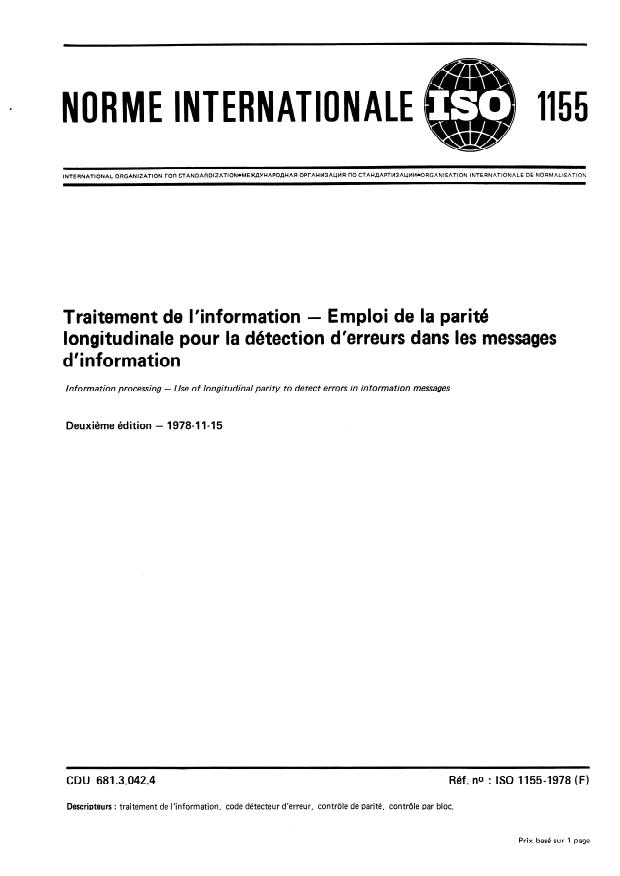
NORME INTERNATIONALE
INTERNATIONAL ORGANIZATION FOR STANDARDIZATION~MEWYHAPO~HAR OPTAHM3ALlMR Il0 CTAHC1APTM3ALWIM.ORGANISATION INTERNATIONALE DE NORMALISATION
Traitement de l’information - Emploi de la parité
longitudinale pour la détection d’erreurs dans les messages
d’information
Use of longitudinal parity to detect errqrs in information messages
Information processing -
Deuxième édition - 1978-11-15
CDU 681.3.042.4 Réf. no : ISO 1155-1978 (F)
Descripteurs : traitement de l’information, code détecteur d’erreur, contrôle de parité, contr8le par bloc.
Prix basé sur 3 page
AVANT-PROPOS
L’ISO (Organisation internationale de normalisation) est une fédération mondiale
d’organismes nationaux de normalisation (comités membres de I’ISO). L’élaboration
des Normes internationales est confiée aux comités techniques de I’ISO. Chaque
comité membre intéressé par une étude a le droit de faire partie du comité technique
correspondant. Les organisations internationales, gouvernementales et non
gouvernementales, en liaison avec I’ISO, participent également aux travaux.
Les projets de Normes internationales adoptés par les comités techniques sont
avant leur acceptation comme
soumis aux comités membres pour approbation,
Normes internationales par le Conseil de I’ISO.
La Norme internationale ISO 1155 a été élaborée par le comité technique
I SO/TC 97, Calculateurs et traitement de l’in formation.
Cette deuxième édition fut soumise directement au Conseil de I’ISO, conformé-
ment au paragraphe 6.13.1 des Directives pour les travaux techniques de I’ISO.
Elle annule et remplace la première édition (ISO 1155~1973), qui avait été approu-
vée par les comités membres des pays suivants :
Al lemagne, R. F. France Roumanie
Australie Grèce Royaume-Uni
Belgique Isarël Suède
Brésil Italie Suisse
Canada Japon Tchécoslovaquie
Danemark Nouvelle-Zélande
Thallande
Egypte, Rép. arabe d’ Pérou U.R.S.S.
Espagne Pologne U.S.A.
Aucun comité membre ne l’avait désapprouvée.
0 Organisation internationale de normalisation, 1978 e
Imprimé en Suisse
BO 1155-1978 (F)
NORME INTERNATIONALE
Traitement de l’information - mploi de la parité
longitudinale pour la ddtection d’erreurs dans les messages
d’information
0 INTRODUCTlON
2 RÈGLES DE CONSTITUTION DU CARACTÈRE DE
CONTRÔLE PAR BLOC ET DE PARITÉ LONGITUDI-
Dans les systèmes de transmission de données, la NALE
présentation du contenu de l’information et la redondance
de l’information à transmettre varient énormément d’une 2.1 Caractiire de contrôle par bloc
II est par conséquent nécessaire de
application à l’autre.
2.1.1 Le caractère de contrôle par bloc est constitue de
définir un certain nombre de types de systèmes de
7 éléments, plus un élément de parité.
protection contre les erreurs.
La présente Norme internationale définit une méthode de
2.1.2 Chacun des 7 premiers éléments du caractère de
...
NORME INTERNATIONALE
INTERNATIONAL ORGANIZATION FOR STANDARDIZATION~MEWYHAPO~HAR OPTAHM3ALlMR Il0 CTAHC1APTM3ALWIM.ORGANISATION INTERNATIONALE DE NORMALISATION
Traitement de l’information - Emploi de la parité
longitudinale pour la détection d’erreurs dans les messages
d’information
Use of longitudinal parity to detect errqrs in information messages
Information processing -
Deuxième édition - 1978-11-15
CDU 681.3.042.4 Réf. no : ISO 1155-1978 (F)
Descripteurs : traitement de l’information, code détecteur d’erreur, contrôle de parité, contr8le par bloc.
Prix basé sur 3 page
AVANT-PROPOS
L’ISO (Organisation internationale de normalisation) est une fédération mondiale
d’organismes nationaux de normalisation (comités membres de I’ISO). L’élaboration
des Normes internationales est confiée aux comités techniques de I’ISO. Chaque
comité membre intéressé par une étude a le droit de faire partie du comité technique
correspondant. Les organisations internationales, gouvernementales et non
gouvernementales, en liaison avec I’ISO, participent également aux travaux.
Les projets de Normes internationales adoptés par les comités techniques sont
avant leur acceptation comme
soumis aux comités membres pour approbation,
Normes internationales par le Conseil de I’ISO.
La Norme internationale ISO 1155 a été élaborée par le comité technique
I SO/TC 97, Calculateurs et traitement de l’in formation.
Cette deuxième édition fut soumise directement au Conseil de I’ISO, conformé-
ment au paragraphe 6.13.1 des Directives pour les travaux techniques de I’ISO.
Elle annule et remplace la première édition (ISO 1155~1973), qui avait été approu-
vée par les comités membres des pays suivants :
Al lemagne, R. F. France Roumanie
Australie Grèce Royaume-Uni
Belgique Isarël Suède
Brésil Italie Suisse
Canada Japon Tchécoslovaquie
Danemark Nouvelle-Zélande
Thallande
Egypte, Rép. arabe d’ Pérou U.R.S.S.
Espagne Pologne U.S.A.
Aucun comité membre ne l’avait désapprouvée.
0 Organisation internationale de normalisation, 1978 e
Imprimé en Suisse
BO 1155-1978 (F)
NORME INTERNATIONALE
Traitement de l’information - mploi de la parité
longitudinale pour la ddtection d’erreurs dans les messages
d’information
0 INTRODUCTlON
2 RÈGLES DE CONSTITUTION DU CARACTÈRE DE
CONTRÔLE PAR BLOC ET DE PARITÉ LONGITUDI-
Dans les systèmes de transmission de données, la NALE
présentation du contenu de l’information et la redondance
de l’information à transmettre varient énormément d’une 2.1 Caractiire de contrôle par bloc
II est par conséquent nécessaire de
application à l’autre.
2.1.1 Le caractère de contrôle par bloc est constitue de
définir un certain nombre de types de systèmes de
7 éléments, plus un élément de parité.
protection contre les erreurs.
La présente Norme internationale définit une méthode de
2.1.2 Chacun des 7 premiers éléments du caractère de
...