

ISO 20916:2019
(Main)In vitro diagnostic medical devices — Clinical performance studies using specimens from human subjects — Good study practice
General Information
- Abstract
This document defines good study practice for the planning, design, conduct, recording and reporting of clinical performance studies carried out to assess the clinical performance and safety of in vitro diagnostic (IVD) medical devices for regulatory purposes. NOTE 1 The purpose of these studies is to assess the ability of an IVD medical device in the hands of the intended user, to yield results pertaining to a particular medical condition or physiological/pathological state, in the intended population. The document is not intended to describe whether the technical specifications of the IVD medical device in question are adequately addressed by the clinical performance study. This document identifies the principles that underpin clinical performance studies and specifies general requirements intended to — ensure the conduct of the clinical performance study will lead to reliable and robust study results, — define the responsibilities of the sponsor and principal investigator, — assist sponsors, clinical research organization, investigators, ethics committees, regulatory authorities and other bodies involved in the conformity assessment of IVD medical devices, and — protect the rights, safety, dignity and well-being of the subjects providing specimens for use in clinical performance studies. Analytical performance studies are out of the scope of this document. NOTE 2 When the collection of specimens specifically for the analytical performance study creates an additional collection risk for subjects, some of the elements of this document (particularly the annexes) can be useful for ensuring subject safety. Clinical performance studies that are performed for reasons other than pre- and post-market regulatory purposes, such as for re-imbursement purposes, are out of the scope of this document. NOTE 3 Some of the elements of this document can be useful for the design of such studies, including subject safety and data integrity. This document does not include safety information for laboratory workers or other personnel collecting the study specimens. NOTE 4 Such information is included in other publications[1][12][13]. NOTE 5 Users of this document can consider whether other standards and/or requirements also apply to the IVD medical device which is the subject of the clinical performance study, for instance, in the situation for which there is an IVD medical device and a medical device used in an integrated system (e.g. a lancet, an IVD test strip, and a glucose meter), aspects of both this document and ISO 14155 can be considered.
- Status
- Published
- Publication Date
- 03-Jun-2019
- Drafting Committee
- ISO/TC 212/WG 3 - In vitro diagnostic products
- Current Stage
- 9093 - International Standard confirmed
- Start Date
- 06-Feb-2025
- Completion Date
- 29-Aug-2026
Buy Documents


ISO 20916:2019 - In vitro diagnostic medical devices — Clinical performance studies using specimens from human subjects — Good study practice Released:6/4/2019


ISO 20916:2019 - Dispositifs médicaux de diagnostic in vitro — Études des performances cliniques utilisant des prélevements de sujets humains — Bonnes pratiques d'étude Released:6/4/2019
Overview
ISO 20916:2019 - "In vitro diagnostic medical devices - Clinical performance studies using specimens from human subjects - Good study practice" provides a structured framework for planning, designing, conducting, recording and reporting clinical performance studies of in vitro diagnostic (IVD) devices for regulatory purposes. It defines principles and general requirements to ensure reliable, robust study results while protecting the rights, safety and well‑being of human subjects who provide specimens. Note: analytical performance studies and studies for non‑regulatory purposes (e.g., reimbursement-only studies) are out of scope.
Key topics and requirements
ISO 20916:2019 covers practical and procedural elements for IVD clinical performance studies, including:
- Ethical considerations: informed consent, ethics committee involvement, avoiding improper influence.
- Study planning and risk evaluation: study design, risk assessment when specimens are collected specifically for the study.
- Clinical Performance Study Protocol (CPSP): required contents, principal investigator responsibilities and protocol structure.
- Investigator brochure and case report forms: content and use to support study conduct.
- Specimen handling: recording specimen information, specimen accountability, integrity and labelling.
- Site management: site qualification, selection, initiation, training and monitoring plans.
- Sponsor and investigator responsibilities: duties for study conduct, monitoring and documentation.
- Data protection and security: confidentiality and recordkeeping.
- Study close‑out and reporting: clinical performance study report, document retention, suspension/termination procedures.
- Auditing and adverse event categorization: processes to ensure compliance and subject safety.
- Annexes: normative annexes provide templates and additional requirements (CPSP, investigator brochure, informed consent, study report, adverse event categorization); informative annexes address documentation and auditing.
Special provisions are included for interventional studies or when specimen collection poses additional risks; these are detailed in specific annexes.
Practical applications and users
ISO 20916:2019 is intended for organizations and professionals involved in IVD clinical performance studies, including:
- IVD device manufacturers and sponsors preparing regulatory submissions.
- Clinical research organizations (CROs) managing study conduct and monitoring.
- Principal investigators and clinical sites implementing study protocols and specimen handling.
- Ethics committees and regulatory authorities reviewing study plans and reports.
- Quality and regulatory affairs teams ensuring conformity with good study practice.
Use cases: designing study protocols, preparing investigator brochures and informed consent forms, establishing specimen chain‑of‑custody, developing monitoring plans, and compiling clinical performance study reports for regulatory review.
Related standards
- ISO 14155 (clinical investigation of medical devices) may be relevant when an IVD is part of an integrated system (e.g., lancet + strip + meter); jurisdictions determine applicability.
- Analytical performance studies are excluded from ISO 20916 and are addressed by other guidance and standards.
Keywords: ISO 20916:2019, in vitro diagnostic, IVD clinical performance studies, good study practice, CPSP, investigator brochure, specimen integrity, regulatory compliance.
Relations
- Effective Date
- 06-Jun-2022
Buy Documents
ISO 20916:2019 - In vitro diagnostic medical devices — Clinical performance studies using specimens from human subjects — Good study practice Released:6/4/2019
ISO 20916:2019 - Dispositifs médicaux de diagnostic in vitro — Études des performances cliniques utilisant des prélevements de sujets humains — Bonnes pratiques d'étude Released:6/4/2019
Get Certified
Connect with accredited certification bodies for this standard

BSI Group
BSI (British Standards Institution) is the business standards company that helps organizations make excellence a habit.

TÜV Rheinland
TÜV Rheinland is a leading international provider of technical services.

TÜV SÜD
TÜV SÜD is a trusted partner of choice for safety, security and sustainability solutions.
Sponsored listings
Frequently Asked Questions
ISO 20916:2019 is a standard published by the International Organization for Standardization (ISO). Its full title is "In vitro diagnostic medical devices — Clinical performance studies using specimens from human subjects — Good study practice". This standard covers: This document defines good study practice for the planning, design, conduct, recording and reporting of clinical performance studies carried out to assess the clinical performance and safety of in vitro diagnostic (IVD) medical devices for regulatory purposes. NOTE 1 The purpose of these studies is to assess the ability of an IVD medical device in the hands of the intended user, to yield results pertaining to a particular medical condition or physiological/pathological state, in the intended population. The document is not intended to describe whether the technical specifications of the IVD medical device in question are adequately addressed by the clinical performance study. This document identifies the principles that underpin clinical performance studies and specifies general requirements intended to — ensure the conduct of the clinical performance study will lead to reliable and robust study results, — define the responsibilities of the sponsor and principal investigator, — assist sponsors, clinical research organization, investigators, ethics committees, regulatory authorities and other bodies involved in the conformity assessment of IVD medical devices, and — protect the rights, safety, dignity and well-being of the subjects providing specimens for use in clinical performance studies. Analytical performance studies are out of the scope of this document. NOTE 2 When the collection of specimens specifically for the analytical performance study creates an additional collection risk for subjects, some of the elements of this document (particularly the annexes) can be useful for ensuring subject safety. Clinical performance studies that are performed for reasons other than pre- and post-market regulatory purposes, such as for re-imbursement purposes, are out of the scope of this document. NOTE 3 Some of the elements of this document can be useful for the design of such studies, including subject safety and data integrity. This document does not include safety information for laboratory workers or other personnel collecting the study specimens. NOTE 4 Such information is included in other publications[1][12][13]. NOTE 5 Users of this document can consider whether other standards and/or requirements also apply to the IVD medical device which is the subject of the clinical performance study, for instance, in the situation for which there is an IVD medical device and a medical device used in an integrated system (e.g. a lancet, an IVD test strip, and a glucose meter), aspects of both this document and ISO 14155 can be considered.
This document defines good study practice for the planning, design, conduct, recording and reporting of clinical performance studies carried out to assess the clinical performance and safety of in vitro diagnostic (IVD) medical devices for regulatory purposes. NOTE 1 The purpose of these studies is to assess the ability of an IVD medical device in the hands of the intended user, to yield results pertaining to a particular medical condition or physiological/pathological state, in the intended population. The document is not intended to describe whether the technical specifications of the IVD medical device in question are adequately addressed by the clinical performance study. This document identifies the principles that underpin clinical performance studies and specifies general requirements intended to — ensure the conduct of the clinical performance study will lead to reliable and robust study results, — define the responsibilities of the sponsor and principal investigator, — assist sponsors, clinical research organization, investigators, ethics committees, regulatory authorities and other bodies involved in the conformity assessment of IVD medical devices, and — protect the rights, safety, dignity and well-being of the subjects providing specimens for use in clinical performance studies. Analytical performance studies are out of the scope of this document. NOTE 2 When the collection of specimens specifically for the analytical performance study creates an additional collection risk for subjects, some of the elements of this document (particularly the annexes) can be useful for ensuring subject safety. Clinical performance studies that are performed for reasons other than pre- and post-market regulatory purposes, such as for re-imbursement purposes, are out of the scope of this document. NOTE 3 Some of the elements of this document can be useful for the design of such studies, including subject safety and data integrity. This document does not include safety information for laboratory workers or other personnel collecting the study specimens. NOTE 4 Such information is included in other publications[1][12][13]. NOTE 5 Users of this document can consider whether other standards and/or requirements also apply to the IVD medical device which is the subject of the clinical performance study, for instance, in the situation for which there is an IVD medical device and a medical device used in an integrated system (e.g. a lancet, an IVD test strip, and a glucose meter), aspects of both this document and ISO 14155 can be considered.
ISO 20916:2019 is classified under the following ICS (International Classification for Standards) categories: 11.100.10 - In vitro diagnostic test systems. The ICS classification helps identify the subject area and facilitates finding related standards.
ISO 20916:2019 has the following relationships with other standards: It is inter standard links to ISO 23856:2021. Understanding these relationships helps ensure you are using the most current and applicable version of the standard.
ISO 20916:2019 is available in PDF format for immediate download after purchase. The document can be added to your cart and obtained through the secure checkout process. Digital delivery ensures instant access to the complete standard document.
Standards Content (Sample)
INTERNATIONAL ISO
STANDARD 20916
First edition
2019-05
In vitro diagnostic medical devices —
Clinical performance studies using
specimens from human subjects —
Good study practice
Dispositifs médicaux de diagnostic in vitro — Études des
performances cliniques utilisant des prélèvements de sujets humains
— Bonnes pratiques d'étude
Reference number
©
ISO 2019
© ISO 2019
All rights reserved. Unless otherwise specified, or required in the context of its implementation, no part of this publication may
be reproduced or utilized otherwise in any form or by any means, electronic or mechanical, including photocopying, or posting
on the internet or an intranet, without prior written permission. Permission can be requested from either ISO at the address
below or ISO’s member body in the country of the requester.
ISO copyright office
CP 401 • Ch. de Blandonnet 8
CH-1214 Vernier, Geneva
Phone: +41 22 749 01 11
Fax: +41 22 749 09 47
Email: copyright@iso.org
Website: www.iso.org
Published in Switzerland
ii © ISO 2019 – All rights reserved
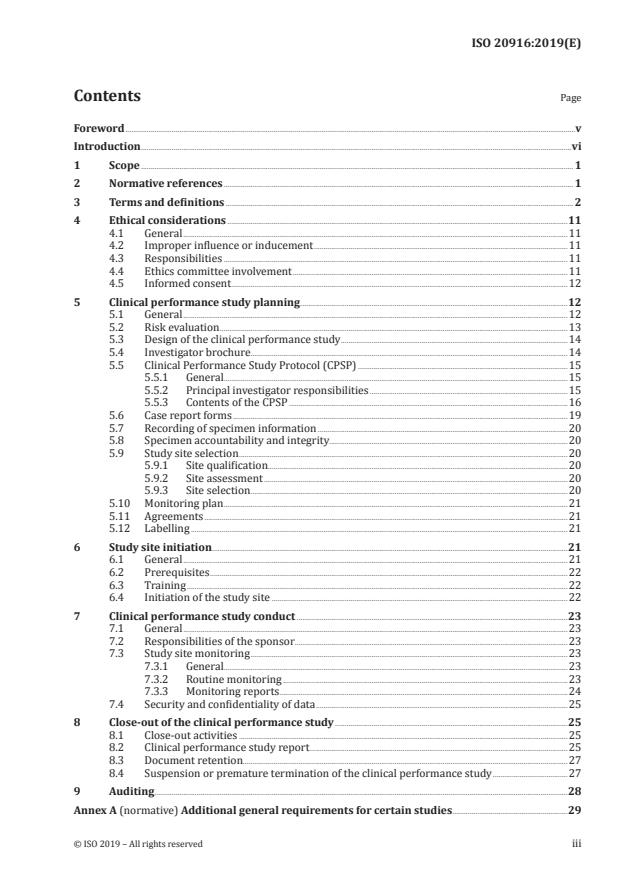
Contents Page
Foreword .v
Introduction .vi
1 Scope . 1
2 Normative references . 1
3 Terms and definitions . 2
4 Ethical considerations .11
4.1 General .11
4.2 Improper influence or inducement .11
4.3 Responsibilities .11
4.4 Ethics committee involvement .11
4.5 Informed consent .12
5 Clinical performance study planning .12
5.1 General .12
5.2 Risk evaluation .13
5.3 Design of the clinical performance study .14
5.4 Investigator brochure.14
5.5 Clinical Performance Study Protocol (CPSP) .15
5.5.1 General.15
5.5.2 Principal investigator responsibilities .15
5.5.3 Contents of the CPSP .16
5.6 Case report forms .19
5.7 Recording of specimen information .20
5.8 Specimen accountability and integrity.20
5.9 Study site selection .20
5.9.1 Site qualification.20
5.9.2 Site assessment .20
5.9.3 Site selection .20
5.10 Monitoring plan .21
5.11 Agreements .21
5.12 Labelling .21
6 Study site initiation .21
6.1 General .21
6.2 Prerequisites .22
6.3 Training .22
6.4 Initiation of the study site .22
7 Clinical performance study conduct .23
7.1 General .23
7.2 Responsibilities of the sponsor .23
7.3 Study site monitoring .23
7.3.1 General.23
7.3.2 Routine monitoring .23
7.3.3 Monitoring reports.24
7.4 Security and confidentiality of data .25
8 Close-out of the clinical performance study .25
8.1 Close-out activities .25
8.2 Clinical performance study report .25
8.3 Document retention.27
8.4 Suspension or premature termination of the clinical performance study .27
9 Auditing .28
Annex A (normative) Additional general requirements for certain studies .29
Annex B (normative) Clinical performance study protocol (CPSP) .32
Annex C (normative) Investigator brochure .36
Annex D (normative) Clinical performance study report .38
Annex E (normative) Communication with the ethics committee .41
Annex F (normative) Informed consent .43
Annex G (normative) Adverse event categorization .47
Annex H (informative) Good clinical performance study documentation .51
Annex I (informative) Auditing .56
Bibliography .57
iv © ISO 2019 – All rights reserved
Foreword
ISO (the International Organization for Standardization) is a worldwide federation of national standards
bodies (ISO member bodies). The work of preparing International Standards is normally carried out
through ISO technical committees. Each member body interested in a subject for which a technical
committee has been established has the right to be represented on that committee. International
organizations, governmental and non-governmental, in liaison with ISO, also take part in the work.
ISO collaborates closely with the International Electrotechnical Commission (IEC) on all matters of
electrotechnical standardization.
The procedures used to develop this document and those intended for its further maintenance are
described in the ISO/IEC Directives, Part 1. In particular, the different approval criteria needed for the
different types of ISO documents should be noted. This document was drafted in accordance with the
editorial rules of the ISO/IEC Directives, Part 2 (see www .iso .org/directives).
Attention is drawn to the possibility that some of the elements of this document may be the subject of
patent rights. ISO shall not be held responsible for identifying any or all such patent rights. Details of
any patent rights identified during the development of the document will be in the Introduction and/or
on the ISO list of patent declarations received (see www .iso .org/patents).
Any trade name used in this document is information given for the convenience of users and does not
constitute an endorsement.
For an explanation of the voluntary nature of standards, the meaning of ISO specific terms and
expressions related to conformity assessment, as well as information about ISO's adherence to the
World Trade Organization (WTO) principles in the Technical Barriers to Trade (TBT) see www .iso
.org/iso/foreword .html.
This document was prepared by Technical Committee ISO/TC 212, Clinical laboratory testing and in
vitro diagnostic test systems.
Any feedback or questions on this document should be directed to the user’s national standards body. A
complete listing of these bodies can be found at www .iso .org/members .html.
Introduction
In vitro diagnostic (IVD) medical devices are used to conduct tests outside of the human body to provide
valuable information regarding a person’s health or physiological status. They include tests and related
devices, such as test strips and reagents, using specimens such as blood, tissue or urine, to carry out
screening, diagnosis, prognosis, predictive testing, and monitoring of conditions. IVD medical devices
are fundamentally different from other medical devices because they perform their function outside
of the body on specimens taken from the human body. Human subjects are typically not exposed to
risks with the performance testing of IVD medical devices, except for the risk associated with specimen
collection procedures or when the obtained information is used for patient management. The specimens
are obtained via normal body functions (e.g. urine) or through the use of invasive medical devices to
allow for the specimen to be obtained (e.g. biopsy). The specimens are never reintroduced into the
human body. These differences make the performance and risk characteristics of IVD medical devices
different and unique from other medical devices.
Most of the studies for IVD medical devices are performed using samples resulting from the remnants
of specimens taken for purposes of standard of care (leftover or archived). In these studies, there is no
risk for the subjects arising from either the information provided by the IVD medical device or from
the collection procedure of the specimen. However, when leftover specimens are not used, additional
requirements should be considered
— when the specimens are collected specifically for the study and the specimen collection procedures
present additional risk of direct harm for the subject (e.g. lumbar puncture or tissue biopsy, blood
collection from neonates or critically ill patients), and/or
— when the information obtained from the IVD medical devices during the study is used to make
patient management decision (i.e. interventional studies), presenting a risk of indirect harm for
the subject (e.g. false negative or false positive result leading to inappropriate patient management
decisions).
For the majority of IVD clinical performance studies, issues related to the use of vulnerable subjects
might not arise but should be considered on a case by case basis.
Considering the reliance on specimens taken from the body and the absence of direct contact of the
IVD with the patient, issues related to procedures for obtaining informed consent for IVD clinical
performance studies differ from those associated with other medical devices, especially for studies
with leftover or archived specimens. This document will provide guidance on the requirements for the
various situations described above for IVD medical devices.
This document is intended for clinical performance studies as these studies involve specimens taken
from the human body. When specimens other than leftover or archived specimens are used, there might
be additional collection risks for the subject. Also in interventional studies, there might be a risk for the
subject coming from the information provided by the result of the IVD under investigation.
This document is specific for IVD medical devices and therefore uses definitions and concepts that are
appropriate for IVD medical devices. It is a stand-alone standard for clinical performance studies for
IVD medical devices. In the situation for which there is an IVD medical device and a medical device used
in an integrated system (e.g. a lancet, an IVD test strip and a glucose meter), the respective jurisdiction’s
regulation will define it as either an IVD medical device or a medical device and subsequently, aspects
of both this document and ISO 14155 might need to be considered.
Except for these situations, this document should not be read in conjunction with ISO 14155, which
excludes IVD medical devices from its scope.
The flowchart represented in Figure 1 provides guidance on how to use this document.
vi © ISO 2019 – All rights reserved
Figure 1 — Clinical performance study flow chart
The main body of the document, in addition to Annex G, includes minimum requirements for all studies.
No additional requirements apply for studies using leftover/archived specimens or studies with
specimen collection procedures that pose no additional risks to the subject.
However, additional requirements for interventional studies, and those studies in which the specimen
collection procedures pose a risk to subjects primarily recruited for the study, are found in Annexes A to
F. The nature of these studies warrants an increased level of stringency in the requirements for conduct
of the study. The flowchart indicates the annexes which describe the additional requirements for each
type of more complex studies. When necessary, the annexes describe differences in the requirements
for the different types of study. Additionally, informative annexes are included to provide information
on good study practice documentation (see Annex H) and auditing (see Annex I).
INTERNATIONAL STANDARD ISO 20916:2019(E)
In vitro diagnostic medical devices — Clinical performance
studies using specimens from human subjects — Good
study practice
1 Scope
This document defines good study practice for the planning, design, conduct, recording and reporting
of clinical performance studies carried out to assess the clinical performance and safety of in vitro
diagnostic (IVD) medical devices for regulatory purposes.
NOTE 1 The purpose of these studies is to assess the ability of an IVD medical device in the hands of the
intended user, to yield results pertaining to a particular medical condition or physiological/pathological state, in
the intended population.
The document is not intended to describe whether the technical specifications of the IVD medical device
in question are adequately addressed by the clinical performance study.
This document identifies the principles that underpin clinical performance studies and specifies general
requirements intended to
— ensure the conduct of the clinical performance study will lead to reliable and robust study results,
— define the responsibilities of the sponsor and principal investigator,
— assist sponsors, clinical research organization, investigators, ethics committees, regulatory
authorities and other bodies involved in the conformity assessment of IVD medical devices, and
— protect the rights, safety, dignity and well-being of the subjects providing specimens for use in
clinical performance studies.
Analytical performance studies are out of the scope of this document.
NOTE 2 When the collection of specimens specifically for the analytical performance study creates an
additional collection risk for subjects, some of the elements of this document (particularly the annexes) can be
useful for ensuring subject safety.
Clinical performance studies that are performed for reasons other than pre- and post-market regulatory
purposes, such as for re-imbursement purposes, are out of the scope of this document.
NOTE 3 Some of the elements of this document can be useful for the design of such studies, including subject
safety and data integrity.
This document does not include safety information for laboratory workers or other personnel collecting
the study specimens.
[1][12][13]
NOTE 4 Such information is included in other publications .
NOTE 5 Users of this document can consider whether other standards and/or requirements also apply to the
IVD medical device which is the subject of the clinical performance study, for instance, in the situation for which
there is an IVD medical device and a medical device used in an integrated system (e.g. a lancet, an IVD test strip,
and a glucose meter), aspects of both this document and ISO 14155 can be considered.
2 Normative references
There are no normative references in this document.
3 Terms and definitions
For the purposes of this document, the following terms and definitions apply.
ISO and IEC maintain terminological databases for use in standardization at the following addresses:
— ISO Online browsing platform: available at https: //www .iso .org/obp
— IEC Electropedia: available at http: //www .electropedia .org/
3.1
adverse device effect
adverse event (3.2) related to the use of an IVD medical device under investigation
Note 1 to entry: This definition includes any adverse event resulting from insufficient or inadequate instructions
for use, installation, operation, or any malfunction of the IVD medical device under investigation.
Note 2 to entry: This definition includes any event resulting from use error or from intentional misuse of the IVD
medical device under investigation.
1)
[SOURCE: ISO 14155:— , 3.1, modified — Adapted for IVD medical devices.]
3.2
adverse event
AE
any untoward medical occurrence, inappropriate patient management decision, unintended disease or
injury, or untoward clinical signs in subjects, users, or other persons, with any connection to study
related activities, whether or not related to the IVD medical device under investigation
Note 1 to entry: Adverse events can be caused by, for instance, insufficient or inadequate instructions for use,
deployment, installation, operation, or any malfunction of the IVD medical device under investigation.
Note 2 to entry: This definition includes the malfunction or deterioration of a device which has not yet caused
death or serious injury, but which could lead to death or serious injury.
Note 3 to entry: This definition is not intended to be used in determining whether an event is reportable to a
regulatory authority.
Note 4 to entry: For users or other persons, this definition is restricted to events related to investigational (IVD)
medical devices.
Note 5 to entry: False negative or false positive results are not considered an adverse event unless in an
interventional study, inappropriate patient management decisions are made based on those false results.
3.3
analytical performance
ability of an IVD medical device to detect or measure a particular analyte
[SOURCE: GHTF/SG5/N6: 2012]
Note 1 to entry: Analytical performance can include analytical sensitivity (e.g. limit of detection), analytical
specificity (e.g. interference, cross-reactivity), accuracy (derived from trueness and precision), linearity, etc.
3.4
analytical performance study
study undertaken to establish or confirm the ability of an IVD medical device to detect or measure a
particular analyte
1) Under preparation. Stage at the time of publication: ISO/DIS 14155:2019.
2 © ISO 2019 – All rights reserved
3.5
anticipated serious adverse device effect
effect which by its nature, incidence, severity or outcome has been identified in the risk analysis report
Note 1 to entry: Anticipated serious adverse device effects can also be described in the study protocol,
investigator brochure, and subject informed consent, when applicable.
3.6
archived specimen
archived sample
specimen or sample (3.42) that was collected in the past and is obtained from repositories (e.g. tissue
banks, commercial vendor collections)
[SOURCE: GHTF/SG5/N8: 2012]
3.7
audit
systematic independent examination of activities and documents related to a clinical performance study
to determine whether these activities were conducted, and the data recorded, analyzed and accurately
reported according to the clinical study performance protocol, standard operating procedures,
specified requirements
1)
[SOURCE: ISO 14155:— , 3.3, modified — Adapted for IVD medical devices.]
Note 1 to entry: Specified requirements are those described in this document and may include any other
applicable requirements such as regulatory provisions.
3.8
blinding
masking
procedure in which one or more parties to the clinical performance study are kept unaware of any
information related to the condition or physiological state, treatment, prior test results, demographics,
etc., of the individual from whom the specimen for testing was obtained in order to reduce bias
3.9
case report forms
CRFs
set of printed or electronic documents for each subject on which information to be reported to a sponsor
is recorded, as required by the clinical performance study protocol
1)
[SOURCE: ISO 14155:— , 3.6, modified — Adapted for IVD medical devices.]
3.10
clinical performance of an IVD medical device
ability of an IVD medical device to yield results that are correlated with a particular clinical condition
or physiological/pathological process/state in accordance with the intended use (clinical test purpose,
target population and intended user)
Note 1 to entry: In accordance with intended use, clinical performance can include expected values, diagnostic
sensitivity and diagnostic specificity based on the known clinical condition or physiological/pathological
process/state of the individual, and negative and positive predictive values based on the prevalence of the
disease.
[SOURCE: GHTF/SG5/N6: 2012]
3.11
clinical performance study
study undertaken to establish or confirm the clinical performance of an IVD medical device (3.10)
Note 1 to entry: Testing performed pre-market that is not designed to address clinical performance of an IVD
medical device is not considered a clinical performance study (e.g. customer feedback studies, external analytical
performance studies, research studies).
[SOURCE: GHTF/SG5/N6: 2012]
3.12
clinical performance study protocol
CPSP
document that states the rationale, objectives, design, risk, proposed analysis, methodology, monitoring,
conduct and record-keeping of the clinical performance study (3.11)
Note 1 to entry: The CPSP need not be a single document but a series of documents related and referenced to each
other for the purpose of creating the CPSP.
[SOURCE: GHTF/SG5/N8: 2012]
3.13
clinical performance study report
CPSR
document describing the objectives design, execution, statistical analysis, results and conclusion(s) of a
clinical performance study
Note 1 to entry: Some elements of the clinical performance study report can be covered by stand-alone documents
that are references in the clinical performance study report.
Note 2 to entry: The CPSR need not be a single document but a series of documents related and referenced to each
other for the purpose of creating the CPSR.
[SOURCE: GHTF/SG5/N8: 2012]
3.14
contract research organization
person or organization contracted by the sponsor (3.49) to perform one or more of the sponsor’s clinical
performance study-related duties and functions
3.15
device accountability records
records documenting the physical location of all IVD medical devices under investigation, from
shipment of the devices to the study site until return or disposal, as well as records documenting the
receipt, use, return and disposal of the IVD medical devices under investigation
3.16
device deficiency
inadequacy of a medical device with respect to its identity, quality, durability, reliability, usability,
safety or performance
Note 1 to entry: Device deficiencies include malfunctions, use errors, and inadequacy in the information supplied
by the manufacturer including labelling.
Note 2 to entry: This definition includes device deficiencies related to the investigational medical device or the
comparator.
1)
[SOURCE: ISO 14155:— , 3.19]
3.17
endpoint
principal (primary) or secondary indicator used in a clinical performance study to assess the
performance of the IVD medical device (3.24)
Note 1 to entry: For example, endpoints can be statistical measures for performance or clinical events/outcomes.
4 © ISO 2019 – All rights reserved
3.18
ethics committee
EC
independent body whose responsibility it is to review clinical investigations in order to protect the
rights, safety (3.41) and well-being of human subjects participating in a clinical investigation
1)
[SOURCE: ISO 14155:— , 3.24, modified — Note 1 to entry has been removed.]
3.19
informed consent
process by which an individual voluntarily confirms willingness to participate in a particular clinical
performance study, after having been informed of all aspects of the study that are relevant for the
decision to participate
1)
[SOURCE: ISO 14155:— , 3.27]
Note 1 to entry: For the purposes of this document, the permission is typically for providing specimens or
participating in a clinical performance study.
Note 2 to entry: The informed consent document lists the risk(s) and benefit(s) to the subject, when applicable.
Note 3 to entry: The information provided can be broad in nature, allowing the specimen to be used for future
undetermined studies, or the information can be specific to a particular study.
3.20
intended use
intended purpose
objective intent of the manufacturer regarding the use of a product, process or service as reflected in
the specifications, instructions and information provided by the IVD manufacturer
Note 1 to entry: Intended use statements for IVD labelling can include two components: a description of the
functionality of the IVD medical device (e.g. an immunochemical measurement procedure for the detection of
analyte “x” in serum or plasma), and a statement of the intended medical use of the examination results.
[SOURCE: ISO 18113-1:2009, 3.31, modified]
3.21
interventional clinical performance study
study in which test results obtained during the study can influence patient management decisions and
might be used to guide treatments
EXAMPLE Studies for companion diagnostics.
[SOURCE: GHTF/SG5/N8: 2012]
3.22
investigator brochure
compilation of analytical and clinical performance data relevant to the clinical performance study
Note 1 to entry: The investigator brochure includes risk/benefit information of the IVD device under investigation
and sampling procedures.
3.23
investigator
sub-investigator
co-investigator
individual member of the investigation study site team designated and supervised by the principal
investigator at the study site to perform critical study-related procedures or to make important study-
related decisions
3.24
IVD medical device
medical device (3.28), whether used alone or in combination, intended by the manufacturer for the
in vitro examination of specimens derived from the human body solely or principally to provide
information for diagnostic, monitoring, or compatibility purposes
Note 1 to entry: IVD medical devices include reagents, calibrators, control materials, specimen receptacles,
software and related instruments or apparatus or other articles and are used, for example, for the following test
purposes: diagnosis, aid to diagnosis, screening, monitoring, predisposition, prognosis, prediction, determination
of physiological status.
[SOURCE: ISO 18113-1:2009, 3.27, modified — Note 1 to entry has been removed, GHTF/SG1/N071: 2012.]
3.25
leftover specimen
leftover sample
unadulterated remnants of human derived specimens collected as part of routine clinical practice and
after all standard analysis has been performed
Note 1 to entry: Such specimens/samples would be otherwise discarded as there is no remaining clinical need
for them.
Note 2 to entry: This can include specimens collected for research or other purposes not connected to the clinical
performance study in question.
3.26
legally authorized representative
legally designated representative
individual or judicial or other body authorized under applicable law to consent, on behalf of a
prospective subject, to the subject’s participation in the clinical investigation
1)
[SOURCE: ISO 14155:— , 3.32, modified — Note 1 to entry has been deleted, first preferred term has
been added and "legally designated representative" has become an admitted term.]
3.27
malfunction
failure of an IVD medical device under investigation to perform in accordance with its intended use
(3.20) when used in accordance with the instructions for use or CPSP (3.12)
1)
[SOURCE: ISO 14155:— , 3.33, modified — Adapted for IVD medical devices.]
3.28
medical device
instrument, apparatus, implement, machine, appliance, implant, reagent for in vitro use, software,
material, or other similar or related article, intended by the manufacturer to be used, alone or in
combination, for human beings, for one or more of the specific medical purposes of
— diagnosis, prevention, monitoring, treatment, or alleviation of disease,
— diagnosis, monitoring, treatment, alleviation of, or compensation for an injury,
— investigation, replacement, modification, or support of the anatomy or of a physiological state or
process,
— supporting or sustaining life,
— control of conception,
— disinfection or sterilization of medical devices, or
— providing information by means of in vitro examination of specimens derived from the human body,
6 © ISO 2019 – All rights reserved
and does not achieve its primary intended action by pharmacological, immunological, or metabolic
means, in or on the human body, but which can be assisted in its intended function by such means
[SOURCE: ISO 18113-1:2009, 3.47, modified — Terminology has been slightly changed; GHTF SG1/
N071: 2012]
3.29
monitor
person, qualified by education, training or experience, responsible for performing the monitoring (3.30)
of the clinical performance study
3.30
monitoring
act of reviewing the progress of a clinical performance study and ensuring that it is conducted, recorded
and reported in accordance with the CPSP, written procedures, procedures, specified requirements
Note 1 to entry: Specified requirements are those described in this document and may include any other
applicable requirements such as regulatory provisions.
3.31
point of enrolment
time at which, following recruitment (3.34), a subject signs and dates the informed consent form, when
required by the ethics committee (3.18), or otherwise begins participation in the study
1)
[SOURCE: ISO 14155:— , 3.38, modified — The definition has been lengthened.]
3.32
principal investigator
qualified person responsible for conducting the clinical performance study at a study site (3.50)
Note 1 to entry: When a clinical performance study is conducted by a team of individuals at a study site, the
principal investigator is responsible for leading the team.
Note 2 to entry: Whether this is the responsibility of an individual or an institution can depend on national
regulations.
3.33
protocol deviation
instance of failure to follow, intentionally or unintentionally, the requirements of the clinical performance
study protocol (3.12)
3.34
recruitment
active efforts to identify subjects (3.51) who might be suitable for enrolment in a clinical
performance study
3.35
reference measurement procedure
measurement procedure accepted as providing measurement results fit for their use in assessing
measurement trueness of measured quantity values obtained from other measurement procedures for
quantities of the same kind, in calibration, or in characterizing reference materials
[SOURCE: ISO 15193:2009, 3.7, modified — Notes to entry have been removed.]
3.36
regulatory authority
government agency or other entity that exercises a legal right to control the use or sale of medical
devices within its jurisdiction, and can take legal action to ensure that medical devices marketed within
its jurisdiction comply with legal requirements
[SOURCE: GHTF/SG1/N68: 2012]
3.37
risk
combination of the probability of occurrence of harm and the severity of that harm
[SOURCE: ISO/IEC Guide 51:2014, 3.9]
3.38
risk analysis
systematic use of available information to identify hazards and to estimate the risk (3.37) to study
subjects and users of the IVD medical device under investigation
Note 1 to entry: Risk analysis includes examination of different sequences of events that can produce hazardous
situations and harm.
Note 2 to entry: For IVDs, the risk analysis should take into consideration risks associated with reporting of
inaccurate test results in an interventional study.
[SOURCE: ISO/IEC Guide 51:2014, 3.10, modified — The definition has been adapted for IVDs, Note 1 to
entry has been modified and Note 2 to entry has been added.]
3.39
risk assessment
overall process comprising a risk analysis (3.38) and a risk evaluation (3.40)
[SOURCE: ISO/IEC Guide 51:2014, 3.11]
3.40
risk evaluation
process of comparing the estimated risk against given risk criteria to determine the acceptability of
the risk
2)
[SOURCE: ISO 14971: — , 3.23]
3.41
safety
freedom from unacceptable risk
[SOURCE: ISO/IEC Guide 51:2014, 3.14]
3.42
sample
one or more representative parts taken from a specimen (3.47), which are intended to provide
information
EXAMPLE A portion of serum taken from a specimen of coagulated blood.
[SOURCE: ISO 18113-1:2009, 3.64, modified — The wording in the definition changed.]
3.43
serious adverse device effect
adverse device effect (3.1) that has resulted in any of the consequences characteristic of a serious adverse
event (3.44)
[SOURCE: MEDDEV 2.7.1, rev 4, 2016]
3.44
serious adverse event
SAE
adverse event that led to any of the following
a) death,
2) Under preparation. Stage at the time of publication: ISO/FDIS 14971:2019.
8 © ISO 2019 – All rights reserved
b) serious deterioration in the health of the subject, users or other persons as defined by one or more
of the following:
1) a life-threatening illness or injury, or
2) a permanent impairment of a body structure or a body function including chronic diseases, or
3) in-patient or prolonged hospitalisation, or
4) medical or surgical intervention to prevent life-threatening illness or injury or permanent
impairment to a body structure or a body function,
c) foetal distress, foetal death or a congenital abnormality or birth defect including physical or mental
impairment
Note 1 to entry: Planned hospitalisation for a pre-existing condition, or a procedure required by the CIP, without
serious deterioration in health, is not considered a serious adverse event.
1)
[SOURCE: ISO 14155:— , 3.45]
3.45
source data
all information in original records, certified copies of original records of clinical findings, observations,
device results or other activities in a clinical performance study, necessary for the traceability and
evaluation of the clinical performance study
1)
[SOURCE: ISO 14155:— , 3.47, modified — Adapted for IVD devices, Note to entry removed.]
3.46
source document
printed or electronic document or other media containing source data (3.45)
EXAMPLE Hospital records, laboratory notes, test results, patient’s surveys, device accountability records,
photographic evidence, records kept at the study site, at the laboratories and at the medico-technical departments
involved in the clinical performance study.
3.47
specimen
discrete portion of a body fluid or tissue taken for examination, study, or analysis of one or more
quantities or characteristics to determine the character of the whole
[SOURCE: ISO 18113-1:2009, 3.54, modified — “Specimen” is the first preferred terms, Notes to entry
have been removed.]
3.48
specimen collection procedure
all the steps involved in collecting a specimen from a human subject. This includes all preparatory steps,
the actual collection and any after-treatment, and the disposal of any procedure-related materials
EXAMPLE Fasting, pre-medication, anaesthesia procedures, blood draw, biopsy, disposal of sharps.
3.49
sponsor
individual or organization taking responsibility and liability for the initiation, implementation and
oversight of a clinical performance study
Note 1 to entry: when an investigator initiates, conducts and takes full responsibility for a clinical performance
study, the investigator also assumes the role of sponsor and is identified as the sponsor-investigator.
3.50
study site
institution(s) or location(s) where the clinical performance study is carried out, under the supervision
of a principal investigator (3.32)
Note 1 to entry: For the purpose of this document, “study site” is synonymous with “study centre”.
Note 2 to entry: Study sites include testing locations and specimen collection sites but not commercial
procurement entities, e.g. providers of archived specimens (such as biobanks).
3.51
subject
human who participates in a clinical performance study or whose specimen is used in the study
Note 1 to entry: Depending on the study, a subject can be either a healthy individual or a patient.
3.52
unanticipated serious adverse device effect
serious adverse device effect (3.43) which by its nature, incidence, severity or outcome has not been
identified in the current version of the risk analysis report
1)
[SOURCE: ISO 14155:— , 3.51, modified — The second preferred term and Notes to entry have been
removed.]
3.53
use error
act or omission of an act that results in an IVD medical device output which differs from that intended
by the manufacturer or expecte
...
NORME ISO
INTERNATIONALE 20916
Première édition
2019-05
Dispositifs médicaux de diagnostic
in vitro — Études des performances
cliniques utilisant des prélèvements
de sujets humains — Bonnes
pratiques d'étude
In vitro diagnostic medical devices — Clinical performance studies
using specimens from human subjects — Good study practice
Numéro de référence
©
ISO 2019
DOCUMENT PROTÉGÉ PAR COPYRIGHT
© ISO 2019
Tous droits réservés. Sauf prescription différente ou nécessité dans le contexte de sa mise en œuvre, aucune partie de cette
publication ne peut être reproduite ni utilisée sous quelque forme que ce soit et par aucun procédé, électronique ou mécanique,
y compris la photocopie, ou la diffusion sur l’internet ou sur un intranet, sans autorisation écrite préalable. Une autorisation peut
être demandée à l’ISO à l’adresse ci-après ou au comité membre de l’ISO dans le pays du demandeur.
ISO copyright office
Case postale 401 • Ch. de Blandonnet 8
CH-1214 Vernier, Genève
Tél.: +41 22 749 01 11
Fax: +41 22 749 09 47
E-mail: copyright@iso.org
Web: www.iso.org
Publié en Suisse
ii © ISO 2019 – Tous droits réservés
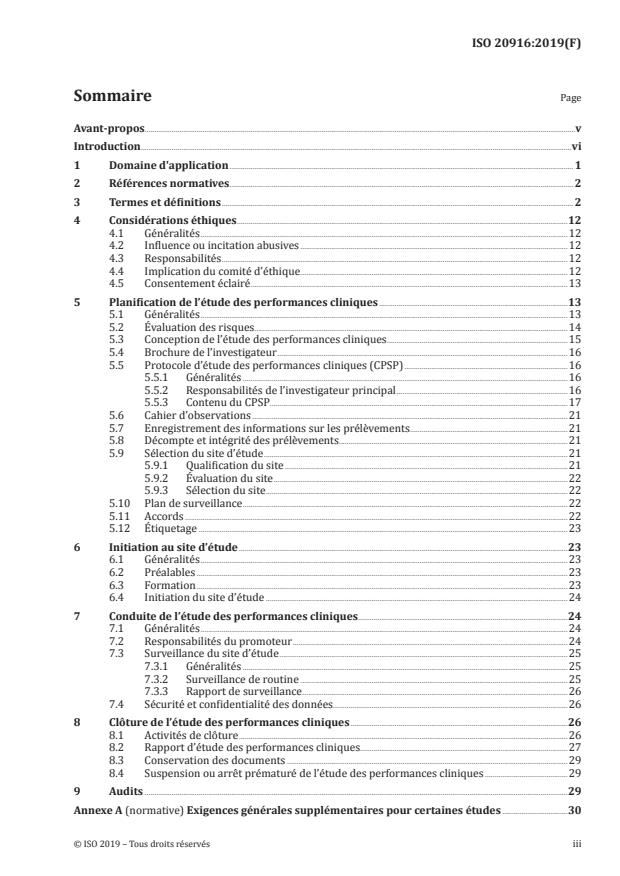
Sommaire Page
Avant-propos .v
Introduction .vi
1 Domaine d'application . 1
2 Références normatives . 2
3 Termes et définitions . 2
4 Considérations éthiques .12
4.1 Généralités .12
4.2 Influence ou incitation abusives .12
4.3 Responsabilités .12
4.4 Implication du comité d’éthique .12
4.5 Consentement éclairé .13
5 Planification de l’étude des performances cliniques .13
5.1 Généralités .13
5.2 Évaluation des risques.14
5.3 Conception de l’étude des performances cliniques .15
5.4 Brochure de l’investigateur .16
5.5 Protocole d’étude des performances cliniques (CPSP) .16
5.5.1 Généralités .16
5.5.2 Responsabilités de l’investigateur principal .16
5.5.3 Contenu du CPSP . . .17
5.6 Cahier d’observations .21
5.7 Enregistrement des informations sur les prélèvements .21
5.8 Décompte et intégrité des prélèvements.21
5.9 Sélection du site d’étude .21
5.9.1 Qualification du site .21
5.9.2 Évaluation du site .22
5.9.3 Sélection du site .22
5.10 Plan de surveillance .22
5.11 Accords .22
5.12 Étiquetage .23
6 Initiation au site d’étude .23
6.1 Généralités .23
6.2 Préalables .23
6.3 Formation .23
6.4 Initiation du site d’étude .24
7 Conduite de l’étude des performances cliniques .24
7.1 Généralités .24
7.2 Responsabilités du promoteur .24
7.3 Surveillance du site d’étude .25
7.3.1 Généralités .25
7.3.2 Surveillance de routine .25
7.3.3 Rapport de surveillance .26
7.4 Sécurité et confidentialité des données .26
8 Clôture de l’étude des performances cliniques .26
8.1 Activités de clôture .26
8.2 Rapport d’étude des performances cliniques.27
8.3 Conservation des documents .29
8.4 Suspension ou arrêt prématuré de l’étude des performances cliniques .29
9 Audits .29
Annexe A (normative) Exigences générales supplémentaires pour certaines études .30
Annexe B (normative) Protocole d’étude des performances cliniques (CPSP) .33
Annexe C (normative) Brochure de l’investigateur .37
Annexe D (normative) Rapport d’étude des performances cliniques .39
Annexe E (normative) Communication avec le comité d’éthique .43
Annexe F (normative) Consentement éclairé .45
Annexe G (normative) Catégorisation des événements indésirables .49
Annexe H (informative) Documentation relative aux bonnes pratiques d’étude des
performances cliniques.53
Annexe I (informative) Audits .59
Bibliographie .60
iv © ISO 2019 – Tous droits réservés
Avant-propos
L'ISO (Organisation internationale de normalisation) est une fédération mondiale d'organismes
nationaux de normalisation (comités membres de l'ISO). L'élaboration des Normes internationales est
en général confiée aux comités techniques de l'ISO. Chaque comité membre intéressé par une étude
a le droit de faire partie du comité technique créé à cet effet. Les organisations internationales,
gouvernementales et non gouvernementales, en liaison avec l'ISO, participent également aux travaux.
L'ISO collabore étroitement avec la Commission électrotechnique internationale (IEC) en ce qui
concerne la normalisation électrotechnique.
Les procédures utilisées pour élaborer le présent document et celles destinées à sa mise à jour sont
décrites dans les Directives ISO/IEC, Partie 1. Il convient, en particulier de prendre note des différents
critères d'approbation requis pour les différents types de documents ISO. Le présent document a été
rédigé conformément aux règles de rédaction données dans les Directives ISO/IEC, Partie 2 (voir www
.iso .org/directives).
L'attention est attirée sur le fait que certains des éléments du présent document peuvent faire l'objet de
droits de propriété intellectuelle ou de droits analogues. L'ISO ne saurait être tenue pour responsable
de ne pas avoir identifié de tels droits de propriété et averti de leur existence. Les détails concernant
les références aux droits de propriété intellectuelle ou autres droits analogues identifiés lors de
l'élaboration du document sont indiqués dans l'Introduction et/ou dans la liste des déclarations de
brevets reçues par l'ISO (voir www .iso .org/brevets).
Les appellations commerciales éventuellement mentionnées dans le présent document sont données
pour information, par souci de commodité, à l’intention des utilisateurs et ne sauraient constituer un
engagement.
Pour une explication de la nature volontaire des normes, la signification des termes et expressions
spécifiques de l'ISO liés à l'évaluation de la conformité, ou pour toute information au sujet de l'adhésion
de l'ISO aux principes de l’Organisation mondiale du commerce (OMC) concernant les obstacles
techniques au commerce (OTC), voir www .iso .org/iso/fr/avant -propos.
Le présent document a été élaboré par le comité technique ISO/TC 212, Laboratoires d'analyses de
biologie médicale et systèmes de diagnostic in vitro.
Il convient que l’utilisateur adresse tout retour d’information ou toute question concernant le présent
document à l’organisme national de normalisation de son pays. Une liste exhaustive desdits organismes
se trouve à l’adresse www .iso .org/fr/members .html.
Introduction
Les dispositifs médicaux de diagnostic in vitro (DIV) sont utilisés pour effectuer des essais en dehors du
corps humain afin de fournir des informations utiles sur la santé ou l’état physiologique d’une personne.
Ils comprennent les dispositifs d’essai et des dispositifs apparentés, notamment les bandelettes réactives
et les réactifs, qui utilisent des prélèvements de sang, de tissu ou d’urine, pour effectuer un dépistage,
un diagnostic, un pronostic, des essais prédictifs et une surveillance des affections. Les dispositifs
médicaux DIV sont fondamentalement différents des autres dispositifs médicaux car ils exécutent
leur fonction en dehors du corps, sur des prélèvements sur le corps humain. Généralement, les sujets
humains ne sont pas exposés aux risques liés aux essais de performances des dispositifs médicaux DIV,
sauf en ce qui concerne le risque associé aux modes opératoires de collecte de prélèvements ou lorsque
les informations obtenues sont utilisées pour la prise en charge des patients. Les prélèvements sont
obtenus par le biais de fonctions normales du corps (par exemple, urine) ou en utilisant des dispositifs
médicaux invasifs pour obtenir le prélèvement (par exemple, biopsie). Les prélèvements ne sont jamais
réintroduits dans le corps humain. Ces différences font que les caractéristiques de performances et de
risques des dispositifs médicaux DIV sont différentes et distinctes des autres dispositifs médicaux.
La plupart des études menées sur les dispositifs médicaux DIV sont effectuées sur des restes de
prélèvements réalisés dans le cadre des soins courants (fonds de tube ou prélèvements archivés). Dans
ces études, il n’existe pour les sujets aucun risque découlant des informations fournies par le dispositif
médical DIV ou du mode opératoire de collecte de prélèvements. Toutefois, lorsque les fonds de tube ne
sont pas utilisés, il convient de prendre en compte des exigences supplémentaires:
— lorsque les prélèvements sont collectés spécifiquement pour l’étude et que les modes opératoires
de collecte de prélèvements présentent un risque supplémentaire de dommage direct du sujet
(par exemple, ponction lombaire ou biopsie tissulaire, prélèvement de sang de nouveau-nés ou de
patients gravement malades), et/ou
— lorsque, pendant l’étude, les informations fournies par le dispositif médical DIV sont utilisées pour
la décision de prise en charge du patient (par exemple, études interventionnelles), présentant
un risque de dommage indirect pour le sujet (par exemple, résultat faux négatif ou faux positif
conduisant à des décisions inappropriées de prise en charge du patient).
Pour la majorité des études des performances cliniques DIV, les problèmes liés à l’utilisation de sujets
vulnérables ont peu de chance de se produire mais il convient de les considérer au cas par cas.
Compte tenu de l’importance des prélèvements sur le corps et de l’absence de contact direct du DIV
avec le patient, les problèmes liés aux procédures d’obtention du consentement éclairé pour les études
des performances cliniques des DIV sont différents de ceux associés à d’autres dispositifs médicaux,
notamment pour les études utilisant des fonds de tube ou des prélèvements archivés. Le présent
document fournira des recommandations sur les exigences applicables aux différentes situations
décrites ci-dessus pour les dispositifs médicaux DIV.
Le présent document est destiné aux études des performances cliniques impliquant des prélèvements
sur le corps humain. L’utilisation de prélèvements autres que les fonds de tube ou les prélèvements
archivés peut impliquer des risques de collecte supplémentaires pour le sujet. De plus, les études
interventionnelles peuvent impliquer un risque pour le sujet dû aux informations fournies par le
résultat du DIV évalué.
Le présent document étant spécifique aux dispositifs médicaux DIV, il utilise les définitions et les
concepts correspondant aux dispositifs médicaux DIV. Il s’agit d’une norme indépendante applicable
aux études des performances cliniques pour les dispositifs médicaux DIV. Si un dispositif médical DIV et
un dispositif médical sont utilisés dans un système intégré (par exemple, une lancette, une bandelette
réactive DIV et un glucomètre), la réglementation juridictionnelle respective le définira comme un
dispositif médical DIV ou un dispositif médical et il peut être nécessaire de prendre en considération les
aspects du présent document et de l’ISO 14155.
Hormis dans ces situations, il convient de ne pas lire le présent document en association avec l’ISO 14155,
qui exclut les dispositifs médicaux DIV de son domaine d’application.
vi © ISO 2019 – Tous droits réservés
Le logigramme représenté à la Figure 1 fournit des recommandations sur la manière d’utiliser le
présent document.
Figure 1 — Logigramme de l’étude des performances cliniques
Le corps principal du document, en plus de l’Annexe G, comprend les exigences minimales applicables
à toutes les études. Aucune exigence supplémentaire ne s’applique aux études utilisant des fonds de
tube/prélèvements archivés ou aux études utilisant des modes opératoires de collecte de prélèvements
n’impliquant aucun risque supplémentaire pour le sujet.
Cependant, les exigences supplémentaires applicables aux études interventionnelles et aux études
dans lesquelles les modes opératoires de collecte de prélèvements impliquent un risque pour les sujets
principalement recrutés pour l’étude sont décrites aux Annexes A à F. La nature de ces études garantit
un niveau de rigueur accru des exigences de conduite de l’étude. Le logigramme illustre les annexes qui
décrivent les exigences supplémentaires pour chaque type d’études plus complexes. Lorsque cela est
nécessaire, les annexes décrivent les différences d’exigences pour les différents types d’étude. De plus,
des annexes informatives sont ajoutées pour donner des informations sur la documentation relative
aux bonnes pratiques d’étude (voir Annexe H) et l’audit (voir Annexe I).
NORME INTERNATIONALE ISO 20916:2019(F)
Dispositifs médicaux de diagnostic in vitro — Études des
performances cliniques utilisant des prélèvements de
sujets humains — Bonnes pratiques d'étude
1 Domaine d'application
Le présent document définit les bonnes pratiques pour la planification, la conception, la conduite,
l'enregistrement et l'établissement du rapport d’études des performances cliniques menées en vue
d'évaluer les performances cliniques et la sécurité de dispositifs médicaux de diagnostic in vitro (DIV) à
des fins réglementaires.
NOTE 1 Ces études visent à évaluer la capacité d’un dispositif médical DIV, mis à disposition de l’utilisateur
concerné, à produire des résultats propres à une affection particulière ou à un état physiologique/pathologique
particulier, au sein de la population concernée.
Le document n’est pas destiné à décrire si les spécifications techniques du dispositif médical DIV en
question sont adéquatement prises en compte ou non par l’étude des performances cliniques.
Le présent document identifie les principes étayant les études des performances cliniques et spécifie
les exigences générales visant à
— assurer que la conduite de l’étude des performances cliniques donnera des résultats d’étude fiables
et robustes,
— définir les responsabilités du promoteur et de l'investigateur principal,
— aider les promoteurs, les organismes de recherche clinique, les investigateurs, les comités d'éthique,
les autorités réglementaires et les autres organismes impliqués dans l'évaluation de la conformité
des dispositifs médicaux DIV, et
— protéger les droits, la sécurité, la dignité et le bien-être des sujets fournissant des prélèvements
utilisables dans les études des performances cliniques.
Les études des performances analytiques ne font pas partie du domaine d’application du présent
document.
NOTE 2 Lorsque la collecte de prélèvements spécifiques à l’étude des performances analytiques crée un
risque de collecte supplémentaire pour les sujets, certains des éléments du présent document (en particulier les
annexes) peuvent être utiles pour assurer la sécurité du sujet.
Les études des performances cliniques menées à des fins autres que réglementaires pré- et post-
commercialisation, notamment dans le cadre d’une demande de remboursement, ne font pas partie du
domaine d’application du présent document.
NOTE 3 Certains des éléments du présent document peuvent être utiles pour concevoir ces études, notamment
la sécurité du sujet et l’intégrité des données.
Le présent document ne comprend pas d’informations de sécurité pour les personnels de laboratoire ou
les autres personnels les prélèvements d’étude.
[1][12][13]
NOTE 4 Ces informations figurent dans d’autres publications .
NOTE 5 Les utilisateurs du présent document peuvent tenir compte du fait que d’autres normes et/ou
exigences s’appliquent également au dispositif médical DIV qui fait l’objet de l’étude des performances cliniques ;
par exemple, si un dispositif médical DIV et un dispositif médical sont utilisés dans un système intégré (par
exemple, une lancette, une bandelette réactive DIV et un glucomètre), les aspects du présent document et de
l’ISO 14155 peuvent être pris en considération.
2 Références normatives
Le présent document ne contient aucune référence normative.
3 Termes et définitions
Pour les besoins du présent document, les termes et définitions suivants s’appliquent.
L’ISO et l’IEC tiennent à jour des bases de données terminologiques destinées à être utilisées en
normalisation, consultables aux adresses suivantes:
— ISO Online Browsing Platform (OBP): disponible à l’adresse https: //www .iso .org/obp
— IEC Electropedia: disponible à l’adresse http: //www .electropedia .org/
3.1
effet indésirable du dispositif
événement indésirable (3.2) lié à l'utilisation du dispositif médical DIV sous investigation
Note 1 à l'article: Cette définition inclut tout événement indésirable résultant d'insuffisances ou d'inadéquations
dans les instructions d'utilisation, l'installation et le fonctionnement, ou tout dysfonctionnement du dispositif
médical DIV sous investigation.
Note 2 à l'article: Cette définition inclut tout événement résultant d'une erreur d'utilisation ou d'un usage
impropre intentionnel du dispositif médical DIV sous investigation.
1)
[SOURCE: ISO 14155:— , 3.1, modifiée – Adaptée pour les dispositifs médicaux DIV.]
3.2
événement indésirable
EI
manifestation clinique indésirable, décision inappropriée de prise en charge du patient, maladie ou
blessure imprévue, ou signe clinique indésirable chez un sujet, un utilisateur ou une autre personne,
en rapport avec les activités liées à l’étude, en relation ou non avec le dispositif médical DIV sous
investigation
Note 1 à l'article: Les événements indésirables peuvent résulter, par exemple, d'insuffisances ou d'inadéquations
dans les instructions d'utilisation, le déploiement, l'installation et le fonctionnement, ou tout dysfonctionnement
du dispositif médical DIV sous investigation.
Note 2 à l'article: Cette définition inclut le dysfonctionnement ou la détérioration d’un dispositif qui n’a pas encore
provoqué la mort ou une blessure grave, mais qui pourrait entraîner la mort ou une blessure grave.
Note 3 à l'article: Cette définition n’est pas destinée à être utilisée pour déterminer si un événement doit être
signalé à une autorité réglementaire.
Note 4 à l'article: Pour les utilisateurs ou les autres personnes, cette définition concerne uniquement les
événements liés aux dispositifs médicaux sous investigation (DIV).
Note 5 à l'article: Les résultats faux négatifs ou faux positifs ne sont pas considérés comme un événement
indésirable sauf si, lors d’une étude interventionnelle, des décisions inappropriées de prise en charge du patient
sont prises d’après ces résultats erronés.
1) En cours de préparation. Stade au moment de la publication : ISO/DIS 14155:2019.
2 © ISO 2019 – Tous droits réservés
3.3
performances analytiques
capacité d’un dispositif médical DIV de déceler ou mesurer correctement un analyte donné
[S OU RC E: GH T F/S G5/ N6: 2012]
Note 1 à l'article: Les performances analytiques peuvent comprendre la sensibilité analytique (par exemple,
limite de détection), la spécificité analytique (par exemple, interférence, réactivité croisée), l’exactitude (dérivée
de la justesse et de la fidélité), la linéarité, etc.
3.4
étude des performances analytiques
étude destinée à établir ou à confirmer la capacité d’un dispositif médical DIV à déceler ou mesurer
correctement un analyte donné
3.5
effet indésirable grave attendu du dispositif
effet dont la nature, l’incidence, la gravité ou les conséquences ont été identifiées dans le rapport
d’analyse du risque
Note 1 à l'article: Les effets indésirables graves attendus du dispositif peuvent également être décrits dans le
protocole d’étude, la brochure d’investigation et le consentement éclairé du sujet, le cas échéant.
3.6
prélèvement archivé
échantillon archivé
prélèvement ou échantillon (3.42) collecté par le passé et disponible dans des collections (par exemple,
banques de tissus, collections de vendeurs)
[S OU RC E: GH T F/S G5/ N8: 2012]
3.7
audit
examen indépendant systématique des activités et des documents liés à l’étude des performances
cliniques afin de déterminer si ces activités ont été menées et si les données ont été enregistrées,
analysées et communiquées avec précision et conformément au protocole d’étude clinique, aux
procédures et aux exigences spécifiées
1)
[SOURCE: ISO 14155:— , 3.3, modifiée – Adaptée pour les dispositifs médicaux DIV.]
Note 1 à l'article: Les exigences spécifiées sont les exigences décrites dans le présent document et peuvent
comprendre toute autre exigence applicable telle que les dispositions réglementaires.
3.8
mise en aveugle
masquage
procédure visant à ne pas communiquer à une ou plusieurs des parties prenantes de l’étude des
performances cliniques les informations liées à l’affection ou à l’état physiologique, au traitement,
aux résultats d’essai antérieurs, aux données démographiques, etc., de la personne sur laquelle le
prélèvement d’essai a été obtenu afin de réduire le biais
3.9
cahier d’observations
CRF (case report form)
ensemble de documents imprimés ou électroniques concernant chaque sujet sur lesquels les
informations à communiquer à un promoteur sont enregistrées, comme l'exige le protocole d’étude des
performances cliniques
1)
[SOURCE: ISO 14155:— , 3.6, modifiée — Adaptée pour les dispositifs médicaux DIV.]
3.10
performances cliniques d’un dispositif médical DIV
capacité d’un dispositif médical DIV à produire des résultats en corrélation avec une affection
particulière ou un processus/état physiologique/pathologique particulier selon l’utilisation prévue
(objectif de l’essai clinique, population cible et utilisateur concerné)
Note 1 à l'article: Selon l’utilisation prévue, les performances cliniques peuvent inclure les valeurs attendues,
la sensibilité diagnostique et la spécificité diagnostique reposant sur l’affection connue ou le processus/l’état
physiologique/pathologique connu de la personne, et les valeurs prédictives négatives et positives fondées sur la
prévalence de la maladie.
[S OU RC E: GH T F/S G5/ N6: 2012]
3.11
étude des performances cliniques
étude destinée à établir ou à confirmer les performances cliniques d’un dispositif médical DIV (3.10)
Note 1 à l'article: Les essais effectués avant commercialisation, qui ne sont pas conçus pour évaluer les
performances cliniques d’un dispositif médical DIV, ne sont pas considérés comme une étude des performances
cliniques (par exemple, étude de commentaires des clients, études externes des performances analytiques,
études de recherche).
[S OU RC E: GH T F/S G5/ N6: 2012]
3.12
protocole d’étude des performances cliniques
CPSP (clinical performance study protocol)
document établissant les justifications, les objectifs, la conception, le risque, l'analyse proposée,
la méthodologie, la surveillance, la conduite et la conservation des enregistrements de l’étude des
performances cliniques (3.11)
Note 1 à l'article: Le CPSP n’est pas nécessairement un seul document mais une série de documents liés et
référencés entre eux pour créer le CPSP.
[S OU RC E: GH T F/S G5/ N8: 2012]
3.13
rapport d’étude des performances cliniques
CPSR (clinical performance study report)
document décrivant les objectifs de conception, l’exécution, l’analyse statistique, les résultats et la ou
les conclusion(s) d’une étude des performances cliniques
Note 1 à l'article: Certains éléments du rapport d’étude des performances cliniques peuvent être traités par des
documents indépendants qui sont mentionnés dans le rapport d’étude des performances cliniques.
Note 2 à l'article: Le CPSR n’est pas nécessairement un seul document mais une série de documents liés et
référencés entre eux pour créer le CPSR.
[S OU RC E: GH T F/S G5/ N8: 2012]
3.14
organisation contractuelle de recherche
personne ou organisation engagée par le promoteur (3.49) pour exercer une ou plusieurs responsabilités
ou tâches liées à l’étude des performances cliniques incombant au promoteur
3.15
enregistrements de décompte des dispositifs
enregistrements indiquant l’emplacement physique de tous les dispositifs médicaux DIV sous
investigation, de l’expédition des dispositifs vers le site d’étude jusqu’au retour ou à la mise au rebut,
ainsi que les enregistrements documentant la réception, l’utilisation, le retour et la mise au rebut des
dispositifs médicaux DIV sous investigation
4 © ISO 2019 – Tous droits réservés
3.16
défectuosité du dispositif
insuffisance du dispositif médical liée à son identité, sa qualité, sa durabilité, sa fiabilité, son aptitude à
l’utilisation, sa sécurité ou ses performances
Note 1 à l'article: Les défectuosités des dispositifs comprennent les dysfonctionnements, les erreurs d’utilisation
et l’inadéquation des informations fournies par le fabricant, y compris l'étiquetage.
Note 2 à l'article: Cette définition comprend les défectuosités liées au dispositif médical sous investigation ou au
comparateur.
1)
[SOURCE: ISO 14155:— , 3.19]
3.17
critère de jugement
indicateur principal (primaire) ou secondaire utilisé lors d'une étude des performances cliniques pour
évaluer les performances du dispositif médical DIV (3.24)
Note 1 à l'article: Par exemple, les critères de jugement peuvent être des mesures statistiques de la performance
ou des événements/résultats cliniques.
3.18
comité d'éthique
CE
organisme indépendant dont la responsabilité consiste à examiner les investigations cliniques pour
protéger les droits, la sécurité (3.41) et le bien-être des sujets participant à l’investigation clinique
1)
[SOURCE: ISO 14155:— , 3.24, modifiée — La Note 1 à l’article a été supprimée.]
3.19
consentement éclairé
processus par lequel une personne confirme, de son plein gré, sa volonté de participer à une étude
des performances cliniques particulière, après avoir été informé de tous les aspects de l’investigation
susceptibles d’influer sur la décision de participer
1)
[SOURCE: ISO 14155:— , 3.27]
Note 1 à l'article: Pour les besoins du présent document, l’autorisation s’applique généralement à la fourniture de
prélèvements ou à la participation à une étude des performances cliniques.
Note 2 à l'article: Le consentement éclairé répertorie le(s) risque(s) et le(s) bénéfice(s) pour le sujet, le cas échéant.
Note 3 à l'article: Les informations fournies peuvent être vagues, ce qui permet d’utiliser le prélèvement pour des
études indéterminées ultérieures, ou les informations peuvent être spécifiques à une étude particulière.
3.20
utilisation prévue
usage prévu
intention objective du fabricant concernant l’utilisation d’un produit, d’un procédé ou d’un service, telle
que reflétée dans les spécifications, les instructions et les informations fournies par le fabricant de DIV
Note 1 à l'article: Les déclarations d’utilisation prévue relatives à l'étiquetage en DIV peuvent comprendre deux
composantes: une description de la fonctionnalité du dispositif médical DIV (par exemple une procédure de
mesure immunochimique pour la détection de l'analyte «x» dans le sérum ou dans le plasma) et une déclaration
de l'utilisation médicale prévue des résultats d'analyse.
[SOURCE: ISO 18113-1:2009, 3.31, modifiée]
3.21
étude interventionnelle des performances cliniques
étude dans laquelle les résultats d’essai obtenus peuvent influencer les décisions de prise en charge du
patient et peuvent être utilisés pour orienter les soins
EXEMPLE Études de diagnostics compagnons.
[S OU RC E: GH T F/S G5/ N8: 2012]
3.22
brochure de l’investigateur
compilation de données de performances cliniques et analytiques correspondant à l’étude des
performances cliniques
Note 1 à l'article: La brochure de l’investigateur inclut des informations sur le rapport risques/bénéfices du
dispositif DIV sous investigation et sur les modes opératoires d’échantillonnage.
3.23
investigateur
sous-investigateur
co-investigateur
membre de l'équipe du site d’étude nommé et encadré par l'investigateur principal de ce site pour
réaliser des procédures essentielles liées à l’étude ou pour prendre des décisions importantes
concernant celle-ci
3.24
dispositif médical DIV
dispositif médical (3.28), utilisé seul ou en combinaison, désigné par le fabricant pour l’examen in vitro
d’échantillons prélevés sur le corps humain uniquement ou principalement dans le but de fournir des
informations à des fins de diagnostic, de surveillance ou de compatibilité
Note 1 à l'article: Les dispositifs médicaux DIV comprennent les réactifs, les étalons, les matériaux de contrôle,
les réceptacles d’échantillons, les logiciels et les instruments ou appareillages associés ou d’autres articles
et sont utilisés, par exemple, pour les fins suivantes: diagnostic, aide au diagnostic, dépistage, surveillance,
prédisposition, pronostic, prédiction, détermination de l’état physiologique.
[SOURCE: ISO 18113-1:2009, 3.27, modifiée — La Note 1 à l’article a été supprimée, GHTF/SG1/N071: 2012.]
3.25
fond de tube
restes purs de prélèvements d’origine humaine collectés dans le cadre d’une pratique clinique de
routine et après réalisation de l’ensemble de l’analyse standard
Note 1 à l'article: Sinon, ces prélèvements/échantillons seraient jetés car ils n’auraient plus aucune utilité clinique.
Note 2 à l'article: Il peut s’agir de prélèvements collectés à des fins de recherche ou à d’autres fins sans relation
avec l’étude des performances cliniques en question.
3.26
représentant légal
représentant légalement désigné
personne, organisme judiciaire ou autre organisme autorisé par la loi en vigueur à consentir, pour le
compte d'un sujet pressenti, à la participation de ce dernier à une investigation clinique
1)
[SOURCE: ISO 14155:— , 3.32, modifiée – La Note 1 à l'article a été supprimée, le premier terme
recommandé a été ajouté et «représentant légalement désigné» est devenu un terme toléré.]
6 © ISO 2019 – Tous droits réservés
3.27
dysfonctionnement
manquement d’un dispositif médical DIV sous investigation à fonctionner conformément à son
utilisation prévue (3.20) lors d'une utilisation conforme aux instructions ou au CPSP (3.12)
1)
[SOURCE: ISO 14155:— , 3.33, modifiée – Adaptée pour les dispositifs médicaux DIV.]
3.28
dispositif médical
instrument, appareil, équipement, machine, dispositif, implant, réactif destiné à une utilisation in vitro,
logiciel, matériel ou autre article similaire ou associé, dont le fabricant prévoit qu’il sera utilisé seul ou
en association chez l'être humain pour une ou plusieurs des fins spécifiques suivantes:
— diagnostic, prévention, contrôle, traitement ou atténuation d'une maladie,
— diagnostic, contrôle, traitement, atténuation ou compensation d'une blessure,
— étude, remplacement, modification ou entretien de l’anatomie ou d’un état ou processus physiologique,
— entretien (artificiel) ou maintien de la vie,
— maîtrise de la conception,
— désinfection ou stérilisation des dispositifs médicaux, ou
— communication d'informations par un examen in vitro de prélèvements provenant du corps humain,
et dont l’action principale voulue dans le corps humain ou sur celui-ci n’est pas obtenue par des moyens
pharmacologiques, immunologiques ou par métabolisme, mais dont la fonction peut être assistée par
de tels moyens
[SOURCE: ISO 18113-1:2009, 3.47, modifiée — La terminologie a été légèrement modifiée, GHTF/SG1/
N071: 2012 .]
3.29
moniteur
personne, qualifiée en vertu de ses études, de sa formation ou de son expérience, responsable de la
surveillance (3.30) de l’étude des performances cliniques
3.30
surveillance
action de superviser l'avancement d'une étude des performances cliniques pour s'assurer que celle-ci
est conduite, enregistrée et communiquée conformément au CPSP, aux procédures écrites, aux modes
opératoires et aux exigences spécifiées
Note 1 à l'article: Les exigences spécifiées sont les exigences décrites dans le présent document et peuvent
comprendre toute autre exigence applicable telle que les dispositions réglementaires.
3.31
moment de l'enrôlement
moment où un sujet signe et date le formulaire de consentement éclairé, après le recrutement (3.34), si
le comité d’éthique (3.18) l’exige, ou commence à participer à l’étude
1)
[SOURCE: ISO 14155:— , 3.38, modifiée — La définition a été élargie.]
3.32
investigateur principal
personne qualifiée responsable de la conduite de l’étude des performances cliniques sur un site
d’étude (3.50)
Note 1 à l'article: Lorsqu’une étude des performances cliniques est conduite par une équipe sur un site d’étude,
l'investigateur principal est le responsable de l'équipe.
Note 2 à l'article: En fonction des réglementations nationales, la responsabilité incombe soit à une personne soit
à une institution.
3.33
écart par rapport au protocole
cas de non-respect, délibéré ou non, des exigences du protocole d’étude des performances cliniques (3.12)
3.34
recrutement
efforts soutenus d'identification des sujets (3.51) susceptibles d'être engagés dans une étude des
performances cliniques
3.35
procédure de mesure de référence
procédure de mesure considérée comme fournissant des résultats de mesure adaptés à leur usage
pour l’évaluation de la justesse de valeurs mesurées obtenues à partir d’autres procédures de mesure
pour des grandeurs de la même nature, pour un étalonnage ou pour la caractérisation de matériaux de
référence
[SOURCE: ISO 15193:2009, 3.7, modifiée — Les Notes à l’article ont été supprimées.]
3.36
autorité réglementaire
agence gouvernementale ou autre entité habilitée à contrôler l’utilisation ou la commercialisation de
dispositifs médicaux dans sa juridiction, et pouvant prendre des mesures légales pour s’assurer que les
dispositifs médicaux commercialisés dans sa juridiction sont conformes aux exigences légales
[S OU RC E: GH T F/S G1/ N6 8: 2012]
3.37
risque
combinaison de la probabilité d'un dommage et de sa gravité
[SOURCE: ISO/IEC Guide 51:2014, 3.9]
3.38
analyse du risque
utilisation systématique des informations disponibles pour identifier les phénomènes dangereux
et estimer le risque (3.37) pour les sujets de l’étude et les utilisateurs du dispositif médical DIV sous
investigation
Note 1 à l'article: L'analyse du risque comprend l'examen de différentes séquences d'événements pouvant
provoquer des situations dangereuses et des dommages.
Note 2 à l'article: Pour les DIV, il convient que l’analyse du risque tienne compte des risques associés à
l’enregistrement de résultats d’essai inexacts dans une étude interventionnelle.
[SOURCE: ISO/IEC Guide 51:2014, 3.10, modifiée — La définition a été adaptée pour les DIV, la Note 1 à
l’article a été modifiée et la Note 2 à l’article a été ajoutée.]
3.39
appréciation du risque
processus englobant une analyse du risque (3.38) et une évaluation du risque (3.40)
[SOURCE: ISO/IEC Guide 51:2014, 3.11]
8 © ISO 2019 – Tous droits réservés
3.40
évaluation du risque
processus de comparaison des risques estimés avec les critères de risque donnés afin de déterminer
l'acceptabilité du risque
2)
[SOURCE: ISO 14971:— , 3.23]
3.41
sécurité
absence de risque inacceptable
[SOURCE: ISO/IEC Guide 51:2014, 3.14]
3.42
échantillon
une ou plusieurs parties représentatives collectées sur un prélèvement (3.47) en vue de fournir des
informations
EXEMPLE Un volume de sérum collecté sur un prélèvement de sang coagulé.
[SOURCE: ISO 18113-1:2009, 3.64, modifiée — La définition a été reformulée.]
3.43
effet indésirable grave du dispositif
effet indésirable du dispositif (3.1) entraînant l’une des conséquences caractéristiques d’un événement
indésirable gr
...