


ISO 4378-3:1983
(Main)Plain bearings — Terms, definitions and classification — Part 3: Lubrication
Plain bearings — Terms, definitions and classification — Part 3: Lubrication
Gives the most commonly used terms applied in the field of plain bearings lubrication as well as their definitions and classification. For some terms and word-combinations their short forms are given which are recommended for use when they are unambiguous; self-explanatory terms are given without definitions.
Paliers lisses — Termes, définitions et classification — Partie 3: Lubrification
La présente partie de l'ISO 4378 donne les termes les plus couramment utilisés, avec leur définition, en matière de lubrification des paliers lisses, et elle en établit une classification. Les formes abrégées données pour certains termes peuvent être employées dans les cas où elles ne créent aucune ambiguîté possible quant à leur interprétation. Les termes suffisamment explicites par eux-mêmes ne sont pas définis. NOTE - En supplément aux termes et définitions donnés dans les trois langues officielles de l'ISO (anglais, français, russe), la présente partie de l'ISO 4378 donne les termes équivalents et leurs définitions en allemand; ces termes et définitions ont été inclus à la demande du comité technique ISO/TC 123, et sont publiés sous la responsabilité du comité membre de l'Allemagne, R.F. (DIN). Toutefois seuls les termes et définitions donnés dans les langues officielles peuvent être considérés comme termes et définitions ISO.
Drsni ležaji - Izrazi, definicije in klasifikacija - 3. del: Mazanje
General Information
- Status
- Withdrawn
- Publication Date
- 31-Jul-1983
- Withdrawal Date
- 31-Jul-1983
- Technical Committee
- ISO/TC 123/SC 6 - Terms and common items
- Drafting Committee
- ISO/TC 123/SC 6 - Terms and common items
- Current Stage
- 9599 - Withdrawal of International Standard
- Start Date
- 02-Sep-2009
- Completion Date
- 12-Feb-2026
Relations
- Effective Date
- 15-Apr-2008

ISO 4378-3:2002 (sl)
Frequently Asked Questions
ISO 4378-3:1983 is a standard published by the International Organization for Standardization (ISO). Its full title is "Plain bearings — Terms, definitions and classification — Part 3: Lubrication". This standard covers: Gives the most commonly used terms applied in the field of plain bearings lubrication as well as their definitions and classification. For some terms and word-combinations their short forms are given which are recommended for use when they are unambiguous; self-explanatory terms are given without definitions.
Gives the most commonly used terms applied in the field of plain bearings lubrication as well as their definitions and classification. For some terms and word-combinations their short forms are given which are recommended for use when they are unambiguous; self-explanatory terms are given without definitions.
ISO 4378-3:1983 is classified under the following ICS (International Classification for Standards) categories: 01.040.21 - Mechanical systems and components for general use (Vocabularies); 21.100.10 - Plain bearings. The ICS classification helps identify the subject area and facilitates finding related standards.
ISO 4378-3:1983 has the following relationships with other standards: It is inter standard links to ISO 4378-3:2009. Understanding these relationships helps ensure you are using the most current and applicable version of the standard.
ISO 4378-3:1983 is available in PDF format for immediate download after purchase. The document can be added to your cart and obtained through the secure checkout process. Digital delivery ensures instant access to the complete standard document.
Standards Content (Sample)
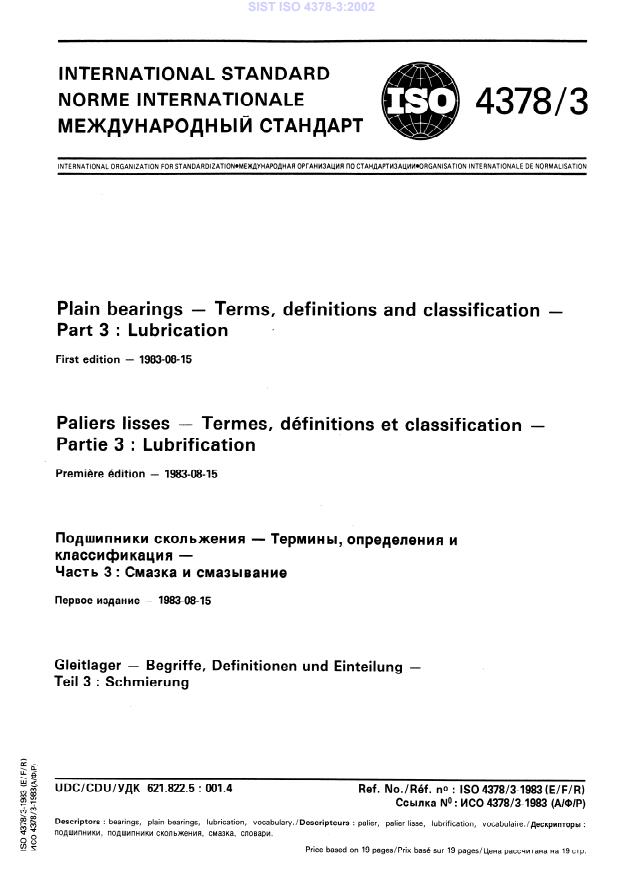
INTERNATIONAL STANDARD
NORME INTERNATIONALE
MEXAyHAPOflHblL(1 CTAHAAPT
INTERNATIONAL ORGANIZATION FOR STANDARDIZATION.ME)I(~YHAPO~HAR OPrAHM3A~klR fl0 CTAH,QAPTkl3Al&lM.ORGANISATION INTERNATIONALE DE NQRMALISATION
Plain bearings - Terms, definitions and classification -
Part 3 : Lubrication ’
First edition - 1983-08-15
Paliers lisses - Termes, definitions et classification -
Partie 3 : Lubrification
Premiere Edition - 1983-08-15
I~~~IUWIHHKH CKOJlbXeHldfl - TepMHHbl, onpe/qeneHHn WI
KJlaccw#wlKaqldfl -
qaCTb 3: cMa3Ka ld CMa3blBaHVW
llepeoe u3Aatiwe - 19834845
Gleitlager - Begriffe, Definitionen und Einteilung -
Teil 3 I Schmierung
UDClCDUlvAK 621.822.5 : 001.4 Ref. No./Rhf. no : ISO 4378/3-1983 (E/F/R)
CCbUlKa No : MC0 4378/3-1983 (AWP)
Descriptors : bearings, plain bearings, lubrication, vocabulary. / Descripteurs : palier, palier lisse, lubrification, vocabulaire. /AecKpmTopbl :
no~wlnHMKl4, nO/JUJMnH1/IKkl CKOflbXeHMR, CMa3Ka, CflOBapkl.
Price based on 19 pages/Prix bas6 sur 19 pages/ueHa paccwTaHa Ha 19 mp.
Foreword
ISO (the International Organization for Standardization) is a worldwide federation of national
Standards institutes (ISO member bodies). The work of developing International Standards is car-
ried out through ISO technical committees. Every member body interested in a subject for which
a technical committee has been set up has the right to be represented on that committee. Interna-
tional organizations, governmental and non-governmental, in liaison with ISO, also take part in
the work.
the member
Draft International Standards adopted by the technical committees are circulated to
Council.
bodies for approval before their acceptance as International Standards by the ISO
was developed by Technical Committee ISO/TC 123, Hain
International Standard ISO 4378/3
July 1981.
bearings, and was circulated to the member bodies in
lt has been approved by the member bodies of the following countries :
United Kingdom
Korea, Rep. of
Czechoslova kia
USA
Egypt, Arab Rep. of Netherlands
France Poland USSR
Y ugoslavia
India Romania
Spain
Italy
Sweden
Korea, Dem. P. Rep. of
body of the following country expressed disapproval of the document on technical
The member
grounds :
Germany, F.R.
Avant-propos
L ’ISO (Organisation internationale de normalisation) est une federation mondiale d ’organismes
nationaux de normalisation (comites membres de I ’ISO). L ’elaboration des Normes internationa-
les est confiee aux comites techniques de I ’ISO. Chaque comite membre interesse par une etude
a Ie droit de faire Partie du comite technique correspondant. Les organisations internationales,
gouvernementales et non gouvernementales, en liaison avec I ’ISO, participent egalement aux tra-
vaux.
Les projets de Normes internationales adoptes par les comites techniques sont soumis aux comi-
tes membres pour approbation, avant leur acceptation comme Normes internationales par Ie
Conseil de I ’ISO.
technique ISO/TC 123,
La Norme internationale ISO 4378/3 a et6 elaboree par Ie comite
/;&es, et a et6 soumise aux comites membres en juillet 1981.
Les comites membres des pays suivants l ’ont approuvee :
Italie Tchecoslovaquie
Corde, Rep. de
Corde, Rep. dem. p. de Pays-Bas URSS
Egypte, Rep. arabe d’ Pologne USA
Espagne Roumanie Yougoslavie
France Royaume-Uni
Inde
Suede
Le comite membre du pays suivant I ’a desapprouvee pour des raisons techniques :
Allemagne, R. F.
BBeAeHble
MC0 (MeqyHapofliiafl Opram3a4m no CTaHjqapw3aq4@ mflfleTcfl BcerwpHoM @eRepaqMeM
HaqMOHanbHblX OpraHl43a~ldl I-IO CTaHaapTPl3auNl (KOMMTeTOB-qfleHOB MCO). AeRTeflbHOCTb l-l0
pa3pa60TKe MeNQyHapO~HblX CTaHF\apTOB npOBOC\klTCR TeXHM~eCKMMM KOMMTeTaMM MCO.
KamblM KOMMTeT-qneH, 3aHMTepeCOBaHHblti B ~eRTeJlbHOCTM, AflfI KOTOpOC;1 6bln CO3gaH TeXHkl-
qeCKPlti KOMMTeT, MMeeT IlpaBO 6blTb npeACTaBJleHHblM B 3TOM KOMMTeTe. hde>KflyHapOAHble npa-
BMTeflbCTBeHHble M HenpaBVlTeJlbCTBeHHble OpraHM3a~MM,
MMeiotqMe CBR~M c MCO, TaKxe
npMHMMatOT yqaCTr/te B pa6OTax.
npOeKTbl MeqyHapOC\HblX CTaHAapTOB, npMHFITble TeXHMqeCKMMM KOMMTeTatvlM, paCCblflatOTCfI
KOMMTeTaM- ‘4fleHaM Ha OAO6peHMe nepeA MX yTBepweHVleM COBeTOM MC0 B KaqeCTBe MewyHa-
pOAHblX CTaHJJapTOB.
Hblti CTaHAapT MC0 437813 6bln pa3pa60TaH TeXHi4 ’4eCKMM KOMMTeTOM K 123,
Mewwww
roAa.
nOdWUnHUKU CKOl7bMeHUR, M pa3OCflaH KOMlrlTeTaM-clneHaM B MKNle 1981
OH 6btn OAO6peH KOMMTeTaMM-ClneHaMM CneAyIO~m CTpaH :
ErmTa tiMAepnaHflOB CWA
MHA~~~I llonbulkl @paHqw
McnaHm4 PyMblHMM qexocnoBaKw4
MTanm keAklHeHHOr0 weelqml
KHfiP KOpOneBCTBa IOrocnaskm
CCCP
Kopeu, Pecny6nwM
AOKyMeHT 6bln OTKJlOIieH IlO TeXHM ’deCKMM i1pMYMHaM KOMMTeTOM-qneHOM CneAylOqeti CTpaHbl :
@eAepaTMBHOti Pecny6nmw
repMaHm4
@ International Organkation for Standardkation, 1983
0 Organisation internationale de normalisation, 1983 0
@ MexAyHapoAHaA OpraHwaqHA no CTaHaapTwaqw, 1983 0
Printed in Switzerland/lmprimb en Suisseh~aHo B WBetiqapm
. . .
Ill
Contents
Page
1 Generalterms . . . . . . . . . . . . . . . . . . . . . . . . . . . . . . . . . . . . . . . . . . . . . . . . . . . . . . .
2 Types of lubrication, classification . . . . . . . . . . . . . . . . . . . . . . . . . . . . . . . . . . . . . .
3 Methods of lubrication, classification . . . . . . . . . . . . . . . . . . . . . . . . . . . . . . . . . . . .
Lubricants and their components, types of lubricants . . . . . . . . . . . . . . . . . . . . . .
5 Basic characteristics of lubricants . . . . . . . . . . . . . . . . . . . . . . . . . . . . . . . . . . . . . . .
Alphabetical indexes
English . . . . . . . . . . . . . . . . . . . . . . . . . . . . . . . . . . . . . . . . . . . . . . . . . . . . . . . . . . . . .
French . . . . . . . . . . . . . . . . . . . . . . . . . . . . . . . . . . . . . . . . . . . . . . . . . . . . . . . . . . . . .
Russian. 18
German. 19
Sommaire
Page
1 Termesgeneraux. 2
2 Classification des types de lubrification . . . . . . . . . . . . . . . . . . . . . . . . . . . : . . . . . .
3 Classification des modes de lubrification . . . . . . . . . . . . . . . . . . . . . . . . . . . . . . . . .
4 Types de lubrifiants et leurs constituants. . . . . . . . . . . . . . . . . . . . . . . . . . . . . . . .
5 Caracteristiques de base des lubrifiants . . . . . . . . . . . . . . . . . . . . . . . . . . . . . . . . . . . .13
Index alphabetiques
Anglais. 16
Francais . . . . . . . . . . . . . . . . . . . . . . . . . . . . . . . . . . . . . . . . . . . . . . . . . . . . . . . . . . . .
,
Russe . . . . . . . . . . . . . . . . . . . . . . . . . . . . . . . . . . . . . . . . . . . . . . . . . . . . . . . . . . . . . .
Allemand . . . . . . . . . . . . . . . . . . . . . . . . . . . . . . . . . . . . . . . . . . . . . . . . . . . . . . . . . . .19
iv
CoAepxatiwe
CTP.
1 OCHOBH ble TePMMH bl . 3
2 f%lAbl CMa3KM, KflaCC@WlKa~Mfl.
........................................... 3
3 CMa3blBaHltle, Krlaccltlc@lKaLplfl . 5
4 CMa3OL(Hble MaTepVlaIlbl M VlX COCTaBflfUOllJPle, BVlAbl CMa30qHblX MaTepMaflOB
5 OCHOBHble XapaKTePMCTMKM CMa30 ’4HblX MaTepltlaJlOB
........................ 15
An*asmi ble yKa3aTenH
AHrJ ’UdCKMti. .
..............................................................
~paH~y3CKMM 17
PyCCK~M . 18
tieMeL&KMfi. . 19
Inhalt
Seite
1 Allgemeine Begriffe . 3
2 Schmierungsarten, Einteilung . 3
3 Methoden der Schmierstoffversorgung. . 5
4 Schmierstoffe und ihre Komponenten, Schmierstoffarten . 9
5 Haupteigenschaften von Schmierstoffen . 15
Alphabetische Stichwörterverzeichnisse
Englisch . 16
Französisch . 17
Russisch . 18
Deutsch . . . . . . . . . . . . . . . . . . . . . . . . . . . . . . . . . . . . . . . . . . . . . . . . . . . . . . . . . . . . .lg
This page intentionally left blank
INTERNATIONAL STANDARD
ISO 4378/3-1983 (E/F/R)
NORME INTERNATIONALE
M CO 4378134 983 (AWP)
MEXJJYHAPOAHblül CTAHJJAPT
Terms, definitions and classification -
Plain bearings -
Part 3 : Lubrication
- Termes, definitions et classification -
Paliers lisses
Partie 3 : Lubrification
I~~JI~U=IHHKH CKOJlbXeHWl - TepMklHbl, Onpe~eneH~fl H
KJlaccw#nlKaqmFl -
qaCTb 3: CMa3Ka ld CMa3blBaHW
Gleitlager - Begriffe, Definitionen und Einteilung -
Teil 3 : Schmierung
ISO 4378/3-1983 (E/F/R)
lt+l CO 4378/3-1983 (AIWP)
Scope and field of application Objet et domaine d ’application
La presente Partie de I ’ISO 4378 donne les termes les plus cou-
This part of ISO 4378 gives the most commonly used terms ap-
ramment utilises, avec leur definition, en matiere de lubrifica-
plied in the field of plain bearings lubrication as well as their
tion des paliers lisses, et elle en etablit une classification.
definitions and classification.
Les formes abregees donnees pour certains termes peuvent
For some terms and word-combinations their short forms are
etre employees dans les cas ou elles ne creent aucune ambi-
given which are recommended for use when they are unam-
gu ’ite possible quant a leur interpretation. Les termes suffisam-
biguous; self-explanatory terms are given without definitions.
ment explicites par eux-memes ne sont pas definis.
NOTE - In addition to the terms and definitions given in the three of-
ficial languages of ISO (English, French and Russian), this part. of NOTE - En Supplement aux termes et definitions donnes dans les trois
ISO 4378 gives the equivalent terms and their definitions in German; langues officielles de I ’ISO (anglais, francais, russe), Ia presente Partie
they have been included at the request of the technical committee, de I ’ISO 4378 donne les termes Äquivalents et leurs definitions en alle-
ISO/TC 123, and are published under the responsibility of the commit-
mand; ces termes et definitions ont et6 inclus a Ia demande du comite
tee member for Germany, F.R. (DIN). However, only the terms and technique ISO/TC 123, et sont publies sous Ia responsabilite du comite
definitions given in the official languages may be considered as ISO membre de I ’Allemagne, R.F. (DIN). Toutefois seuls les termes et defi-
terms and definitions. nitions donnes dans les langues officielles peuvent etre consideres
comme termes et definitions ISO.
1 Termes gknhaux
1 General terms
: Action visant a reduire a I ’aide de lubri-
1.1 lubrification
1 .l lubrication (type of) : Lubricant action, which results in
fiants I ’usure, Ia deterioration superficielle et/ou Ia forte de
reducing of wear, of surface deterioration and/or of friction
f rottement.
forte.
: Moyen d ’application du lubri-
1.2 mode de lubrification
1.2 lubrication (method of) : Supplying of a lubricant to
fiant sur des surfaces de frottement.
rubbing surfaces.
1.3 lubrifiant : Substance appliquee sur des surfaces de
1.3 lubricant : Substance applied on the rubbing surfaces to
frottement pour reduire I ’usure, les deteriorations superficielles
reduce wear, surface deterioration and/or friction forte.
et/ou Ia forte de frottement.
2 Classification des types de lubrification
2 Types of lubrication, classification
En fonction de l%tat ph ysique du lubrifiant :
According to ph ysical state of the lubricant :
- lubrification par gaz
gas-film lubrication
-
liquid-film lubrication lubrification par film liquide
-
lubrification par film solide
solid-film lubrication
du type de film lubrifian t /es surfaces
surfaces by a lubri- En fonction
According to the separa tion of the rubbing
fr0 ttemen t :
cant film :
-
- lubrification hydrodynamique
hydrodynamic lubrication
-
- lubrification hydrostatique
hydrostatic lubrication
-
- lubrification aerodynamique
aerodynamic lubrication
- - lubrification aerostatique
aerostatic lubrication
-
-
lubrification elasto-hydrodynamique
elasto-hydrodynamic lubrication
- lubrification limite
boundary lubrication
mixed-film lubrication - lu brif ication mixte
ISO 4378/3-1983 (E/F/R)
M CO 437813-1983 (AIWP)
06-beKT bd 06naCTb np~MetWki~~ Zweck und Anwendungsbereich
Der vorliegende Teil von ISO 4378 enthält die meist gebräuchli-
Hacroflujafl qacTb IX0 4378 ycTaHasnMsaeT HaM6onee pac-
npOCTpaHeHHble TepMVlHbl, OTHOCfI~t ’leCfl K CMa3blBaHt ’ltO llOA- chen Begriffe über Schmierung in Gleitlagern, ihre Definitionen
und ihre Einteilung.
UM~HMKOB cKonbxeHm, MX 0npeAeneHm i4 Knaccn@t4Ka~wo.
AJlR HeKOTOpblX TepMMHOB-CnOBOCOreTaHl ’lti llpl4BefleHbl MX Für einige Begriffe und Wortkombinationen sind Kurzformen
KOTOpble peKOMeHJJyDTCf4 flnfl CnyqaeB,
KpaTKVle @OpM bl, angegeben, die für den Gebrauch empfohlen werden, wenn sie
ticknroC(atorqtix Apyroe TonkoBaHt4e, caM00npeAenflrorqMecfl
eindeutig sind. Selbstverständliche Begriffe sind ohne weitere
TepMMHbl AaHbl 6e3 OrlpeAeneHVllh. Erklärung angegeben.
f-lPMMEYAHME - B ~OllOflHeHPle K TepMklHaM kl Onpe#SeHVlf4M Ha TpeX
ANMERKUNG - Zusätzlich zu den Begriffen und Definitionen in den
O@MLJMtWlbHbIX fl3blKaX MC0 (EiHWllkKOM, @PaHl#3CKOM M PYCCKOM) drei offiziellen Sprachen der ISO (Englisch, Französisch und Russisch)
HaCTOFIll@R qaCTb MC0 4378 ,qaeT 3KBMBafleHTHble TePMVIHbl VI MX enthält der vorliegende Teil der ISO 4378 die entsprechenden Begriffe
Ollpe~UlE?HMfl Ha HeMeqKOM fI3blKe; 3TlA TePMMHbl BBeAeHbl l-l0 npocb6e und ihre Definitionen in Deutsch; diese wurden auf Wunsch des Tech-
TeXHM~eCKOrO KOMMTeTa MCOITK 123 M ny6nkAKy0TCR IlOJj OTBeTCTBeH- nischen Komitees ISO/TC 123 aufgenommen und ihre Übereinstim-
HOCTb KOMPlTeTa-WleHa @eflepaTkIBHOh Pecny6nwwI kpMaHkll4 (AMH). mung wurde von der Mitgliedskörperschaft der Bundesrepubik
OAHaKO, Jll ’llllb TePMMHbl t ’l Ol-lpe~WleHVlFl Ha O@Wl~MallbHblX F13blKaX Deutschland (DIN) geprüft. Es können jedoch nur die in den offiziellen
MOTYT PaCCMaTpVlBaTbCR KaK TePMMHbl M OnpeflWleHWl MCO. Sprachen angegebenen Begriffe und Definitionen als ISO-Begriffe und
ISO-Definitionen angesehen werden.
1 Allgemeine Begriffe
i OCHOBH ble TePMHH bl
1 .l Schmierung : Anwendung eines Schmierstoffes zur
1.1 cMa3Ka : AevicrBMe cMa30qHoro MarepMana, B pesynb-
TaTe KOTOpOrO yMeH bWaeTCFl l43HOC, nOBpe>icAeHMFi IlOBep- Verminderung von Verse hlei 13, von Oberflächenschäden
und/oder der Reibungskraft.
XHOCTM VlhWl CMna TPeHVIFl.
e cMa30YHoro Marept4ana K 1.2 Methoden der Schmierstoffversorgung : Versorgung
1.2 CMa3blBaHble : l-l o#BeAeHvl
rlOBepXHOCTl4 TpeH lllfl. der Reibflächen mit Schmierstoff.
1.3 cnha30rlH bi ii MaTepbdan : MaTeptian, BBoflMMbl W Ha nosep- 1.3 Schmierstoff : Substanz, die auf die Reibflächen aufge-
bracht wird, um Verschleiß, Oberflächenschäden und/oder die
XHOCTM TpeHMFl AnFi yMeHblJJeHMfl M3HOCa, nOBpe>r
BepXHOCTelh VlhlnVl CMnbl TpeHMfl. Reibungskraft zu vermindern.
2 Bw/qbl CMa3KYI, KnaCCW#N4Ka~H~ 2 Schmierungsarten, Einteilung
CMa30YHOZO
CMa3Ka npu pa3JlWHOM C#Xl3UYeCKOM COCmOfJHUU Bezogen auf den Aggregatzustand des Schmierstoffes :
Mamepuana
- Gasschmierung
-
ra3oBafi cMa3Ka
- Flüssigkeitsschmierung
-
WlRKOCTHaR CMa3Ka
-
Feststoffschmierung
-
TBepjqaFl CMa3Ka
Bezogen auf die Art der
Reibflächen trennung durch einen
Schmierf2m :
CMa3Ka no mun y pa3deneHufl nosepxHocmeü mpeHu/r CMa30Y-
HblM CllOeM :
-
hydrodynamische Schmierung
-
rM~poqi4HaMwiecKafl cMa3Ka
- hydrostatische Schmierung
-
ri4jqpocTaTwdecKafl cMa3Ka
- gasdynamische Schmierung
-
ra30jqtiHaMtwecKafl cMa3Ka
- gasstatische Schmierung
-
ra30cTaTwecKafl cMa3Ka
elastohydrodynamische
Schmierung
=inacTo-ruApoAi4HaMwiecKafl cMa3Ka
Grenzschmierung
rpaHwiHafl cMa3Ka
Schmierung im Mischreibungsgebiet
nonyxM~KOCTHaFi (CMeuaHHaFI) CMa3Ka
I,SO 4378/3-1983 (E/F/R)
VICO 43781311983 (AIWP)
: Type of lubrication in which the 2.1 lubrification par gaz : Type de lubrification ou les surfa-
2.1 gas-film lubrication
ces de frottement des Corps en mouvement relatif sont sepa-
rubbing surfaces of the relatively moving bodies are separated
rees par leur lubrifiant gazeux.
by a gaseous lubricant.
: Type of lubrication in which the 2.2 lubrification par film liquide : Type de lubrification ou
2.2 liquid-film lubrication
les surfaces de frottement des Corps en mouvement relatif sont
rubbing surfaces of the relatively moving bodies are separated
separees par un lubrifiant liquide.
by a liquid lubricant.
2.3 solid-film lubrication : Type of lubrication in which the 2.3 lubrification par film solide : Type de lubrification ou
rubbing surfaces of the relatively moving bodies are separated les surfaces de frottement des Corps en mouvement relatif sont
separees par un lubrifiant solide.
by a solid Iubricant.
2.4 hydrodynamic lubrication : Liquid-film lubrication in 2.4 lubrification hydrodynamique : Type de lubrification
par film liquide ou une Separation complete des surfaces de
which the rubbing surfaces are separated completely due to the
self-generated pressure in a liquid film between the relatively frottement est obtenue grate a Ia Pression engendree dans Ie
moving surfaces. film liquide par Ie mouvement relatif des Corps.
2.5 hydrostatic lubrication : Liquid-film lubrication in 2.5 lubrification hydrostatique : Type de lubrification par
which the rubbing surfaces of the bodies in relative motion or in film liquide ou une Separation complete des surfaces de frotte-
a state of rest are completely separated by the externally pres- ment en mouvement relatif ou au repos est obtenue par injec-
surized liquid supplied into the gap between the surfaces. tion de liquide sous Pression externe entre les surfaces.
2.6 aerodynamic lubrication : Gas-film lubrication in 2.6 lubrification aerodynamique : Type de lubrification
which complete Separation of rubbing surfaces is the result of par gaz 06 une Separation complete des surfaces de frottement
self-generated pressure in the gas film by the relative motion of est obtenue grate a Ia Pression engendree dans Ie film gazeux
the surfaces. par Ie mouvement relatif des Corps.
: Gas-film lubrication in which 2.7 lubrification aerostatique : Type de lubrification par
2.7 aerostatic lubrication
gaz ou une Separation complete des surfaces de frottement en
the rubbing surfaces of the bodies in relative motion or in a
state of rest are completely separated by the externally pres- mouvement ou au repos est obtenue par injection de gaz saus
Pression externe entre les surfaces.
surized gas supplied into the gap between the surfaces.
2.8 elasto-hydrodynamic lubrication : Type of lubrication 2.8 lubrification elasto-hydrodynamique : Type de lubri-
fication ou Ie frottement et I ’epaisseur du film de lubrifiant
in which friction and film thickness of the liquid lubricant be-
tween the relatively moving surfaces are determined by the liquide entre les surfaces en mouvement relatif sont fonction
des proprietes elastiques des materiaux, ainsi que des proprie-
elastic properties of the materials as well as by the rheologic
properties of the lubricant. tes rheologiques du lubrifiant.
2.9 boundary lubrication : Type of lubrication in which 2.9 lubrification limite : Type de lubrification ou Ie frotte-
ment et I ’usure entre les surfaces en mouvement relatif sont
friction and wear between two surfaces in relative motion are
determined by the properties of the surface and by the proper- fonction des proprietes de Ia surface et des proprietes du lubri-
fiant autres que Ia viscosite volumique sous Pression hydrosta-
ties of the lubricant other than bulk viscosity.
tique.
2.10 mixed-film lubrication : Type of lubrication in which 2.10 lubrification mixte : Type de lubrification ou coexis-
there exists liquid-film lubrication and boundary lubrication. tent Ia lubrification par film liquide et Ia lubrification limite.
3 Methods of lubrication, classification 3 Classification des modes de lubrification
According to periodicity of applica tion of lubricant : En fonction de Ia pkriodicitk de Ia lubrifica tion :
continuous lubrication lubrification continue
periodical lubrication lubrification periodique
ISO 4378/3-1983 (E/F/R)
111 CO 437813-1983 (AIQIP)
2.1 Gasschmierung : Schmierungsart, bei der die Reibflä-
2.1 ra308afi cMa3Ka : CMasKa, npr4 ~0TopoW pa3ReneHMe no-
chen der sich relativ zueinander bewegenden Körper durch ei-
BepXHOCTer;i TpeHMfl JJeTaflel& HaXO~fl~MXCR B OTHOCMTen bHOM
ABWKeHlW, OCyl,&eCTBnfleTCFl ra30BblM CMa30LiHblM MaTept ’la- nen gasförmigen Schmierstoff getrennt werden.
nOM.
2.2 Flüssigkeitsschmierung : Schmierungsart, bei der die
2.2 mw~KocTHafi cfura3Ka : CMa3Ka, npr4 ~0TopoW pa3fleneHMe
llOBepXHOCTefi TpeHMFl fieTane& HaXO~n~VlXCfl B OTHOCMTen b- Reibflächen der sich relativ zueinander bewegenden Körper
durch einen flüssigen Schmierstoff getrennt werden.
HOM ABWKeHWl, OCy~eCTBnFleTCfl XMAKMM CMa30qHblM MaTe-
pr4anohn.
2.3 TsepAaA cMa3Ka : CMa3Ka, np~ KOTOPOW pa3AeneHMe no- 2.3 Feststoffschmierung : Schmierungsart, bei der die
Reibflächen der sich relativ zueinander bewegenden Körper
BepXHOCTeti TpeHMFl AeTaneti, HaXOjJn~lAXCfl B OTHOCMTen bHOM
~BWKeHWl, OCy~eCTBnneTCfl TBepAblM CMa30qHblM MaTepMa- durch einen festen Schmierstoff getrennt werden.
nOM.
2.4 rbIApoAbIHaw+wecKafi cMa3Ka : XrqqkocTHafr cMa%a, npM 2.4 hydrodynamische Schmierung : Flüssigkeitsschmie-
KOTOpOti hOnHOe pa3AeneHVle rlOBepXHOCTe# TpeHMFl OCyiqeCT- rung, bei der die Reibflächen vollständig getrennt werden infol-
BnneTcn B pe3ynbTaTe AaBneHMfl, caMoB03HMKarorqero B cnoe ge des im Flüssigkeitsfilm selbst erzeugten Druckes.
NWAKOCTM flpl4 OTHOCL ’lTen bHOM ~BWKeHWl llOBepXHOCTeti.
2.5 rHApocTaTwiecKafr cMa3Ka : ))
2.5 hydrostatische Schmierung : Flüssigkeitsschmierung,
~0TopoW nonHoe pa3AeneHMe noBepxHocTeM TpeHMn AeTanerA, bei der die Reibflächen sowohl im Stillstand als auch bei Bewe-
HaXO~fl~PlXCfl B OTHOCMTenbHOM ~BWKeHlWl MnM hOKOe, OCy- gung vollständig getrennt werden durch eine von außen zuge-
qecTBnfIeTcfl WlJJKOCTblO, nocTynatolqer;il B 3a3op Meqy no- führte Druckflüssigkeit.
BepXHOCTflMM hOA BHelllHMM AaBneHVleM.
2.6 ra3o~HHawwecKa~ cMa3Ka : rasosag cMa3ka, npM 2.6 gasdynamische Schmierung : Gasschmierung, bei der
KOTOpOti IlOnHOe pa3AeneHVle llOBepXHOCTeti TpeHMfl OCy-
die Reibflächen vollständig getrennt werden infolge des im
lqecTBJlfIeTcR B pesyn bTaTe AaBneHMfl, CaMOB03HMKatollJerO B Gasfilm selbst erzeugten Druckes unter der relativen Bewegung
CnOe ra3a hpl4 OTHOCMTen bHOM ABWKeHMM nOBepXHOCTe6l. der Oberflächen.
2.7 ra3ocTaTrwecKan cMa3Ka : rasosan cMa3ka, npti KOTOPOW 2.7 gasstatische Schmierung : Gasschmierung, bei der die
nonHoe pa3AeneHMe noBepxHocTeM TpeHMn AeTanetA, HaxoRfl-
Reibflächen sowohl im Stillstand als auch bei Bewegung voll-
WMXCfl B OTHOCMTenbHOM ABWKeHMPl MJlM llOKOe, OCyweCT- ständig getrennt werden durch ein von außen zugeführtes
BnneTcn ra30M, nocTynatowMM B sasop Meqy noBepxHocTnMt4
Druckgas.
no4 BHeuiHMM AaBneHMeM.
2.8 snacTo=rwAponHHanwrecKaH cMa3Ka : CMaska, npti KOTO-
2.8 elastohydrodynamische Schmierung : Schmierungs-
pofi TpeHMe M Toniqr4Ha nneHKM XMjqKoro cMa30qHoro MaTe-
art, bei der Reibung und Schmierfilmdicke des flüssigen
PVlana Mewy C/ByMR IlOBepXHOCTFIMM, HaXOJJFlU(MMMCfl B OTHO-
Schmierstoffes zwischen den relativ zueinander bewegten
CMTen bHOM ~BWKeHWl, Ohpe~ennlOTCn yhpyrMMM CBOtiCTBaMPl
Oberflächen sowohl durch die elastischen Eigenschaften des
MaTepManoB, a TaKxe peonorMqecKr4MM cBoMcTBaMM cMa30+
Werkstoffs als auch durch die rheologischen Eigenschaften be-
Horo MaTepMana.
stimmt sind.
2.9 rpaHwHas cMa3Ka : CMa3Ka, llpvi KOTOpOti TpeHVle VI M3-
2.9 Grenzschmierung : Schmierungsart, bei der Reibung
HOC Mewy hOBepXHOCTflMl4, HaXO~Fl~MMMCfi B OTHOCMTen b-
und Verschleiß zwischen zwei Gleitflächen bestimmt werden
HOM ABWKeHlWl, Ohpe~enFllOTCn CBOtiCTBaML ’l llOBepXHOCTeti M
durch die Eigenschaften der Oberflächen und andere Schmier-
CBOtiCTBaMM CMa30clHOrO MaTepMana, OTnM~HblMM OT 06beM-
stoff eigenschaften als die Volumenviskosität.
HOti Bfl3KOCTM.
2.10 flOJlyXbl~KOCTHa~ (CMeUlaHHaFI) CMa3Ka : CMa3Ka, llpPl 2.10 Schmierung im Mischreibungsgebiet : Schmie-
~0T0p0W ocyr.qecTBnneTcn qacTWH0 rr4ApoAtiHaMr4L4ecKaq
rungszustand, bei welchem sowohl Flüssigkeitsschmierung als
qacTMLIH0 rpaHr4qHan cMa3Ka.
auch Grenzschmierung durchgeführt wird.
3 CMaJblBaHW, KJlaCCW#NlKalJldfi 3 Methoden der Schmierstoffversorgung
Bezogen auf die zeitliche Anwendung des Schmierstoffes :
-
HehpepblBHOe CMa3blBaHMe - kontinuierliche Schmierung
- Intervallschmierung
nepi4oAr4qecKoe cMa3blBaHMe
ISO 4378/3-1983 (E/F/R)
M CO 4378/3-1983 (AWP)
According to the methods of renewing the lubricant : En fonction du mode de renouvellement du lubrifiant :
-
recirculating lubrication lubrification par recirculation
-
life-time prelubrication lubrification permanente
- -
once-through lubrication lubrification a lubrifiant perdu
En fonction du mode d ‘injec tion lubrifian t
According to the way of applying the lubricant to the friction du entre /es surfaces
de fr0 ttemen t :
surface :
-
forte-feed lubrication lubrification forcee (sous pression)
- -
dip-feed (Oil-bath) lubrication lubrification par barbottage
-
ring lubrication lubrification par bague
- -
drop-feed (drip-feed) lubrication lubrification goutte a goutte
- -
oil fog lubrication (oil mist lubrication) lubrification par brouillard d ’huile
- -
pad lubrication lubrification au tampon
- -
wick lubrication lubrification par meche
- -
rotaprint lubrication lubrification par contact solide
-
solid-film coating depot d ’un film solide
NOTE - This list may be added to in the future. NOTE - Cette liste pourra etre completee dans I ’avenir.
3.1 lubrification continue
3.1 continuous lubrication
3.2 lubrification periodique
3.2 periodical lubrication
3.3 recircuiating lubrication : Method of lubrication in 3.3 lubrification par recirculation : Mode de lubrification
ou Ie lubrifiant ayant impregne les surfaces de frottement est
which the lubricant having passed the rubbing surfaces is
recueilli par des moyens mecaniques et remis en circulation par
mechanically recirculated to them.
Ie meme chemin.
3.4 life-time prelubrication : Method of lubrication in 3.4 lubrification permanente : Mode de lubrification ou Ie
which the lubricant is applied only before the System is put into lubrifiant n ’est applique qu ’une fois avant Ia mise en fonction-
nement.
Operation.
3.5 lubrification a lubrifiant perdu : Mode de lubrification
3.5 once-through lubrication : Method of lubrication in
ou Ie lubrifiant est applique periodiquement ou en continu sur Ia
which the lubricant is periodically or continuously delivered to
the rubbing surfaces without returning to the lubricating surface de frottement, mais ne retourne pas au Systeme lubrifi-
cateur.
System.
: Method of lubrication in which 3.6 lubrification forcee (sous Pression) : Mode de lubrifi-
3.6 forte-feed lubrication
cation ou Ie lubrifiant est applique sous Pression sur Ia surface
the lubricant is supplied to the rubbing surface under pressure.
de frottement.
3.7 lubrification par barbottage : Mode de lubrification ou
3.7 dip-feed (Oil-bath) lubrication : Method of lubrication
Ia surface de frottement est partiellement, periodiquement ou
in which the rubbing surface is partially, permanently or
en permanente plongee dans un bain de lubrifiant liquide.
periodically submerged into a bath of liquid lubricant.
ISO 4378/3-1983 (E/F/R)
MC0 437813-1983 (AWP)
Bezogen auf die Erneuerung des Schmierstoffes :
n0 nosmopuocmu ucnonb30t3auuH cnßa30wo20 hdamepuana :
-
-
~VlpKynfI~VlOHHOe CMa3blBaHMe Umlaufschmierung
-
-
PeCypCHOe CMa3blBaHL ’le Lebensdauerschmierung
-
-
Verlustschmierung
OflHOpa3OBOe npOTO~HOe CMa3blBaHMe
K nosepxtiocmu Bezogen auf die Aufbringungsart des Schmierstoffes :
no cnoco6y nodauu CMa30YHOEO Mamepuana
mpeuuH :
- Druckschmierung
-
cMa3blBaHHe noA AaBneHtieM
- Tauchschmierung
-
cMa3blBaHMe norpy>t
- Ringschmierung
-
CMa3blBaHVle KOn bQOM
- Tropfschmierung
-
Kanen bHOe CMa3blBaHVle
- Ölnebelschmierung
-
CMa3blBaHL ’le MaCnFlHblM TyMaHOM
- Schmierkissen-Schmierung
-
CMa3blBaHMe Ha6MBKOti
- Dochtschmierung
-
@VlTWl bHOe CMa3blBaHL ’le
- Rotaprint-Schmierung
- POTanplAHTHOe CMa3blBaHVle
- Festfilm-Überzug
-
CMa3blBaHVle TBepAblM llOKpblTMeM
ANMERKUNG - Diese Aufstellung kann später erweitert werden.
IlPMMEYAHL ’lE - tiacToflu(W nepelreHb MOxeT 6blTb ,qononHeH B 6y-
31 . kontinuierliche Schmierung
3.1 HWlpepblBHOe CMa3blBaHb ’le
3.2 Intervallschmierung
3.2 flepblO~WeCKOe CMa3blBaHble
3.3 Umlaufschmierung : Verfahren, bei dem derselbe
3.3 l@dpKyJlfl~b4OHHOe CMa3blBaHHe : CMa3blBaHMe, npVl KOTO-
Schmierstoff den Reibflächen wiederholt mechanisch zuge-
Pol cMa30qHblM MaTepr4an nocne npoxo>KAeHMfl no nosepx-
führt wird.
HOCTM TpeHMfI BHOBb llOAaeTCFl K HMM MeXaHMqeCKMM CflOCO-
60~.
3.4 PeCypCHOe CMa3blBaHlAe : O~HOpa30BOe CMa3blBaHMe Ha 3.4 Lebensdauerschmierung : Verfahren, bei dem der
Schmierstoff für die gesamte Lebensdauer der Reibstelle nur
pecypc ysna nepeA HaqanoM pa60Tbl.
einmal vor Inbetriebnahme zugeführt wird.
3.5 OAHOpa30BOe llpOTO ’4HOe CMa3blBaHW : CMa3blBaHVle,
3.5 Verlustschmierung : Verfahren, bei dem der Schmier-
npM K~T~POM cMa30YHblti MaTept4an nepMoAwecKM wu4 He-
npepblBH0 llO~BO~MTCFl K nOBepXHOCTVl TpeHMFI M He BO3Bpa- Stoff periodisch oder kontinuierlich zugeführt wird, ohne in das
Schmiersystem zurückzukehren.
IqaeTCfl B ClACTeMy CMa3KM.
3.6 CMa3blBaHbde nOA AaBneHbIeM : CMa3blBaHMe, npM KOTO- 3.6 Druckschmierung : Verfahren, bei dem der Schmier-
pOM CMa30L(Hblti MaTepMan nOAaeTCFl K nOBepXHOCTt ’l TpeHMFl Stoff den Reibflächen unter Druck zugeführt wird.
noA AasneHMeM.
3.7 CMa3blBaHHe norpyxewem4 : CMa3blBaHMe, npu ~0T0p0~ 3.7 Tauchschmierung : Verfahren, bei dem die Reibflächen
llOBepXHOCTb TpeHMfI YaCTWHO, llOCTOFIHH0 uni4 nepi4oAw partiell, ständig oder periodisch in einen flüssigen Schmierstoff
eintauchen.
qeckr4 norpyxetia B saHHy c ~MAKMM cMa30qHblM MaTepMa-
nOM.
ISO 4378/3-1983 (E/F/R)
VI CO 4378/3-1983 (AIWP)
: Method of lubrication in which the 3.8 lubrification par bague : Mode de lubrification OU Ie
3.8 ring lubrication
lubricant is carried to the rubbing surfaces by a ring driven into lubrifiant est remonte a Ia surface de frottement par une bague
entrainee en rotation par un arbre.
rotation by a shaft.
which may or may not be La s ’effectue a I ’aide d ’une bague fixee ou non 2
NOTE - Lubrication is realized by a ring NOTE - lu brif ication
un arbre tournant.
fixed on a rotating shaft.
3.9 drop-feed (drip-feed) lubrication : Method of lubrica- 3.9 lubrification goutte 5 goutte : Mode de lubrification
tion in which the lubricant is supplied to the rubbing surfaces in ou Ie lubrifiant s ’ecoule goutte a goutte a intervalles reguliers
sur les surfaces de frottement.
the form of drops at regular intervals.
3.10 lubrification par brouillard d ’huile : Mode de lubrifi-
3.10 oil fog lubrication; oil mist lubrication : Method of
lubrication in which the Iubricant is delivered to the friction sur- cation ou Ie lubrifiant arrive Sur Ia surface de frottement sous
face as mist or fog produced by injecting the lubricant into a forme de brouillard, du fait de son injection dans un flux d ’air
stream of air or other gas. ou autre gaz.
: Method of lubrication in which the
3.11 pad lubrication 3.11 lubrification au tampon : Mode de lubrification ou Ie
liquid lubricant is delivered to the rubbing surface area by a lubrifiant liquide est applique sur Ia surface de frottement a
I ’aide d ’un tampon imbibe dont Ie materiau presente des pro-
contacting pad of a moistened material possessing capillary
properties. prietes de capillarite.
3.12 wick lubrication : Method of lubrication in which the 3.12 lubrification par meche : Mode de lubrification OU Ie
lubricant is delivered to the rubbing surface by means of a wick. lubrifiant monte vers Ia surface de frottement au travers d ’une
meche.
: Method of lubrication in which
3.13 rotaprint lubrication 3.13 lubrification par contact solide : Mode de lubrifica-
the surface of the body is supplied with the solid lubricant tion OU Ia surface du Corps est lubrifiee par contact avec un
Corps lubrifiant solide special.
detaching from a special lubricating solid body pressed to the
surface.
: Method of lubrication when the
3.14 solid-film coating 3.14 depot d ’un film solide : Mode de lubrification OU Ia
rubbing surface is coated with a solid film before the part is put surface de frottement est recouverte d ’une pellicule solide
into Operation. avant Ia mise en Service.
4 Lubricants and their components, types of 4 Types de lubrifiants et leurs constituants
lubricants
En fonction de leur 6tat physique :
According to their physical state :
- lubrifiant gazeux
gaseous lubricant
- lubrifiant liquide
liquid lubricant
- graisse
- grease
- Iubrifiant solide
-
solid lubricant
En fonction de l ’additif qu 7% con tiennen t :
According to the presence of additive :
- huile de base
- base oil
- lubrifiant complexe
- lubricant with additive
En fonction de leur origine :
According to their origin :
- - huile minerale
mineral oil
- lubrifiant petrolier
Petroleum oil
-
vegetable oil - lubrifiant vegetal
ISO 4378/3-1983 (E/F/R)
Ul CO 437813-1983 (AWP)
3.8 cMa3blBaHHe KOllb40M : CMa3blBaHMe, npM KOTOPOM CMa-
3.8 Ringschmierung : Verfahren, bei dem ein auf dem Zap-
30qHblti MaTepMafl IlOAaeTCfl K nOBepXHOCTRM TPeHMFI KOflb- fen mitlaufender Ring in den Schmierstoff eintaucht und ihn ZU
UOM, YBJleKaeMbiM BO BpaiqeHMe BaflOM. den Reibflächen fördert.
CB060flHblM
I-lPMMEc-IAHME - CMa3blBaHMf.5 MOxeT OCylJ@CTBJlfEbCR ANMERKUNG - Es gibt Festring- und Losringschmierung.
Plnl43aKpenneHHbl M Ha Bafly KOJI bqOM.
3.9 KanenbHOe CMa3blBaHHe : CMa3blBaHME?, nfNI KOTOPOM K
3.9 Tropfschmierung : Verfahren, bei dem der Schmier-
nOBepXHOCTVl TpeHMfl nOAaeTCfl WlAKti1;;1 CMa30clHblti MaTe-
Stoff in regelmäßigen Zeitabständen tropfenweise den Reibflä-
pl4aJ-l B Bl4fie Kalleflb Wpe3 PaBHble FlpOMWKYTKM BpeMeHM. chen zugeführt wird.
3.10 CMa3blBaHl4e MaCJlfiHblM TYMaHOM : CMa3blBaHMe, IlpM
3.10 Ölnebelschmierung : Verfahren, bei dem der
KOTOpOM CMa30L1H bl6l MaTepl4U-l nO/JaeTCFl K nOBepXHOCTl4 Tpe- Schmierstoff den Reibflächen in Form eines Schmierstoffne-
ti14fl B r3t4Ae nerkoro 14n14 ryct-oro TyMaHa, 06pa3yeMoro nyrehn bels zugeführt wird, der durch Schmierstoffeinspritzung in ei-
r3seAeriilfi cMa30clrioro MarepMana B cTpyI0 r303Ayxa r4nr4 ra3a.
nen Luft- oder Gasstrom entsteht.
3.11 CMa3blBaHHe Ha6HBKOih : CMa3blBaHMe, llpt ’l KOTOPOM 3.11 Schmierkissen-Schmierung : Verfahren, bei dem der
NU/JKVlti CMa30qHblti MaTepMaJl nOp(aeTCfI Ha CyweCTBeHHOM
flüssige Schmierstoff durch ein die Reibfläche berührendes, ge-
yWCTKe nOBepXHOCTVl TPeHVIfI C nOMOqbt0 COnfWlKaCalOlJ&-
tränktes Kissen zugeführt wird, dessen Material kapillare Eigen-
rocR c HeW cMa3brBaeMoro Mareptiana, o6naAatorqero kantin- schaften hat.
JlflPHblMM CBOlkTBaMl4.
3.12 C#NlTHJlbHOe CMa3blBaHHe : CMa3blBaHMe, npM KOTOPOM
3.12 Dochtschmierung : Verfahren, bei dem der Schmier-
NWJJKVlti CMa30CIHbl1/1 MaTepMEiJl nOfl%TCfl K IJOBepXHOCTM Tpe-
Stoff den Reibflächen über einen Docht zugeführt wird.
HVIfI C llOMOU(bl0 C+WlTWlFi.
3.13 POTaIlphlHTHOe CMa3blBaHHe : CMa3blBEWle, npl4 KOTO-
3.13 Rotaprint-Schmierung : Verfahren, bei dem ein Fest-
POM Ha nOBepXHOCTb fieTa!lkl HaHOCMTCFl TBepJjblti CMa30YHblti
Schmierstoff den Reibflächen durch Andrücken zugeführt wird.
MaTepMan, orflenfltoqt4Wcfl or cneqt4anbHoro chnasbieatorqero
TsepAoro Tena, npmwMaeMOr0 K n0eepxHOcTw
3.14 CMa3blBaHHe TBePAblM llOKPblTHeM : CMa3blBaHVle, llpl4
3.14 Festfilm-Überzug : Verfahren, bei dem die Reibfläche
KOTOpOM Ha nOBepXHOCTVl TpeHMfl AO pa60Tbl AeTaJlVl HaHO-
mit einem Feststoff beschichtet wird, bevor das Teil in Betrieb
CMTCR CMa30L(Hblti MaTepMaJl B BMfie TBep/JOrO flOKPblTMFl. genommen wird.
4 cMa30 ’4Hble MaTefWlaIlbl kl IAX COCTaBIlFIK)~He, 4 Schmierstoffe und ihre Komponenten,
BHAbl CMa30rlH blX MaTepHNlOB Schmierstoffarten
n0 C@l3WeCKOMy COCmORHUK) : Bezogen auf den Aggregatzustand :
-
ra3006pa3Hbir;i cMa30qHbiM Ma-repMan - gasförmiger Schmierstoff
-
XMplKMti CMa30I-IHbll/l Mareptian - flüssiger Schmierstoff
-
nnacTwHbih cMa30qHbiti MaTepMan - Schmierfett
-
TBepflblti CMa30 ’4Hblti MaTepMUl - Festschmierstoff
no HanUYUto npucadoK: Bezogen auf die Anwesenheit von Additiven :
- 6a30BOe Macno - Grundöl (Basisöl)
-
- Schmierstoff mit Zusätzen
cMa30LiHbiM MaTepr4an c npMcafikoW
Bezogen auf die Herkunft :
no npoucxoxdeHu0 :
-
rwHepanbHbil;l cMa30L(HbiM MaTepuan - Mineralöl
-
He@TflHOti CMa30CIHblti MaTep@lEUl - mineralisches Öl
- Pflanzenöl
- PaCTklTWl bHbl lil CMa30 ’4Hbl ti MaTepIlafl
ISO 4378/3-1983 (E/F/R)
V ’ICO 437813-1983 (AIWP)
- -
animal oil lubrifiant animal
- -
synthetic lubricant lubrifiant synthetique
NOTE - This list may be added to in the future. NOTE - Cette liste pourra 6tre compkee dans I ’avenir.
4.1 gaseous lubricant 4.1 lubrifiant gazeux
4.2 liquid lubricant 4.2 lubrifiant liquide
4.4 grease : Semi-solid or solid lubricant consisting essen- 4.4 graisse : Lubrifiant semi-solide ou solide, compose
tially of a stabilized mixture of mineral, or synthetic oil with essentiellement d ’un melange stabilise d ’huile synthetique ou
soaps or other thickeners. It may contain other ingredients. minerale et de saponifiants ou autres epaississeurs. II peut aussi
contenir d ’autres ingredients.
4.5 solid lubricant 4.5 lubrifiant solide
4.6 lubricant with additive 4.6 Iubrifiant complexe
several to be
4.7 base oil Oil to which one or 4.7 huile de base : Huile a laquelle ont etc ajoutes un ou plu-
added to obtai n a finished product n produ it fini.
sieurs additifs pour obtenir U
4.8 mineral oil : Oil consisting of a mixture of hydrocarbons 4.8 huile minerale : Huile composee d ’un melange d ’hydro-
either naturally occurring or obtained by treatment of materials
carbures, soit naturels, soit obtenus par traitement de mate-
sf mineral origin. riaux.
4.9 lubrifiant petrolier : Huile de lubrification raffinee obte-
4.9 Petroleum oil : Lubricating oil refined from crude
nue a partir de produit petrolier brut.
petroleum.
4.10 lubrifiant vegetal
4.10 vegetable oil
4.11 lubrifiant animal
4.11 animal oil
4.12 Iubrifiant synthetique
4.12 synthetic Iubricant
4.13 additif : Materiau ajoute au lubrifiant dans Ie but de lui
4.13 additive : Material added to the lubricant for the
donner des proprietes nouvelles ou d ’ameliorer les anciennes.
purpose of imparting new properties or of enhancing existing
properties.
ISO 4378/3-1983 (E/F/R)
MC0 437613-1983 (AIWP)
-
AWlBOTHbll/l CMa30qHblti MaTepMafl tierisches Öl
- -
CMHTeTMYeCKMti CMa30CIHblti MaTepMan synthetischer Schmierstoff
6blTb JJOIIOflHeH B 6y-
I-lPklME qAHM E - HacTomy W nepeqeH b MOXeT ANMERKUNG - Diese Aufstellung kann später erweitert werden.
AYWeM-
ra3006pa3H bi W cMa30wi bi ti MaTepwan 4.1 gasförmiger Schmierstoff
4.1
XHRKH W cMa3ow bi fi MarepHan 4.2 flüssiger Schmierstoff
4.2
4.3 cMa30rlHoe Macno : OqrqeHHoe Macno, npe#ra3HaCIei-r- 4.3 Schmieröl : Ein normalerweise raffiniertes Mineralöl vor-
HOe /Jnfl yMeHbUlHMFl TpeHMFl Me+Jy JJBWKyqt ’lMMCR lloBepX- wiegend zur Verminderung der Reibung zwischen bewegten
HOCTflMM. Oberflächen.
4.4 WlaCTblqH bl ih CMa30 ’1Hbl h MaTepIlan : nOIlyTBep~bl ti MiIPl 4.4 Schmierfett : Halbfester oder fester Schmierstoff, der
TBep&bllil llpOflyKT, COCTORlQMti Vl3 CMeCL ’l MPlHepaJlbHOrO MllM im wesentlichen aus einer stabilisierten Mischung von Mineralöl
CMHTeTMYeCKOrO Macna, cTa6WWl3t4pOBaHHOrO MblJlaMM MJlM oder synthetischem Öl mit Seifen oder anderen Verdickem be-
B03~0~~0 coAepxaHi4e Apyrux
flpyrMrvrM 3arycTMTenflMM. steht. Es kann weitere Bestandteile enthalten.
KOMflOHeHTOB.
TBepn bl ii CMa30rlH bl ii MaTepbIan
4.5 4.5 Festschmierstoff
CMa30 ’4H bl H MaTepwan C npHcaC\KoH 4.6 Schmierstoff mit Zusätzen
4.6
4.7 6asoeoe MacnO : Macno, K KOTOPOMY ~06aBnfVOTCfl OAHa 4.7 Grundöl : Öl, dem ein oder mehrere Zusätze beigegeben
w-w HeCKOnbKO npvlcaAoK C qenbm nonyqeHvw rOTOBOr0 werden müssen, um ein Fertigprodukt zu erhalten.
IIpO~yKTa.
4.8 MHHepanbHblih CMa30r(Hbl ii MaTepHaJl : CMa3OqHblti Ma- 4.8 Mineralöl : Öl, das aus einer Mischung von Kohlenwas-
TepMan MMHepan bHor0 npowxo>tc~eHMfi, nonyqeHHblM cMelue- serstoffen besteht und entweder natürlich vorkommt oder
HMeM yrneBO~OpOflOB B eCTeCTBeHHOM COCTOFIHMM MnM llony-
durch Behandlung von Stoffen mineralischen Ursprungs ge-
cleHHblti B pe3yn bTaTe 06pa60TWI MVlHepan bHblX npO/JyKTOB. Wonnen wird.
H Marepwan : Ow~eHHoe Macno,
4.9 He@T)lHOii CMa30 ’4Hbl 4.9 mineralisches Öl : Schmieröl durch Raffination aus
nonyreHHoe ~3 He@TfiHOrO CblpbR.
Rohöl gewonnen.
4.10 paCTHTen bH bi ii CMa30 ’4H bl ii MaTepblan 4.10 Pflanzenöl
4.11 XHBOTH bl ii CMa30rlH bl6l MaTepHan 4.11 tierisches Öl
4.12 CHHTeTWeCKHti CMa30rlHblii MaTepblU ’l 4.12 synthetischer Schmierstoff
4.14 cBfi3ytoqee TBepp(or0 cMa30rlHoro MaTepb4ana; cs~13yt0-
4.14 Festschmierstoffbinder; Bindemittel : Stoff, der
qee : BeiqecTBo, cnoco6cTsytoqee cuenneHtito c(acTrq Tsep- den Zusammenhalt der Teilchen eines Festschmierstoffes un-
AOro cMa30L(HOro MaTepMana Me>KFly COOOW M c llOBepXHOCTbK> tereinander und das Anhaften an den zu schmierenden Oberflä-
TPeHMR.
chen fördert.
4.15 aHT~Kopp03Hotitiafi npncaplKa : TlpMcaAka, npenFiT- 4.15 Antikorrosions-Additiv : Zusatz, der die Korrosion an
cTBytoiqan, orpaHwt4Baioiqa~ t4nM 3aAepxMBalolqafi BpeMfl geschmierten, metallischen Oberflächen verhindert, verzögert
pa3BMTMfI KOpp03MM CMa3bIBaeMblX MeTannMqeCKMX nOBepX-
oder begrenzt.
HOCTelh.
ISO 4378/3-1983 (E/F/R)
Pl CO 4378/3-1983 (AIWP)
antioxidant additive Additive which prevents, 4.16 additif anti-oxydant; inhibiteur d ’oxydation : Addi-
4.16
retards or limits the rate of Oxidation of a lubricant. tif empechant, retardant ou limitant Ie taux d ’oxydation d ’un
lubrifiant.
4.17 additif anti-rouille : Additif empechant, retardant ou
4.17 rust preventive additive : Additive which prevents,
retards or limits the time of rust occurring on the surfaces made limitant I ’apparition de rouille sur les surfaces en ferro-alliages.
of ferrous alloys.
reducing 4.18 additif anti-usure : Additif empechant ou reduisant
4.1 8 a nti-wear a dditive : Additive preventing or
the rate or intensity of wear of the rubbing surfaces. I ’usure des surfaces de frottement en intensite ou en rapidite.
: Additive which prevents, limits : Additif empechant, limitant ou
4.19 antiscoring additive 4.19 additif anti-grippage
retardant I ’eraillage des surfaces de frottement.
or retards scoring of the rubbing surfaces.
Cet additif est aussi appele «extreme-Pression (EPIK
NOTE - This additive is also known as extreme pressure (EP) additive. NOTE -
4.20 ameliorant de Point d ’ecoulement : Additif
4.20 pour-poi nt depressant : Additive which lowers the
sant Ie Point d ’ecoulement d ’un lubrifiant liquide.
pour Point of a I iq
...
SLOVENSKI STANDARD
01-marec-2002
Drsni ležaji - Izrazi, definicije in klasifikacija - 3. del: Mazanje
Plain bearings -- Terms, definitions and classification -- Part 3: Lubrication
Paliers lisses -- Termes, définitions et classification -- Partie 3: Lubrification
Ta slovenski standard je istoveten z: ISO 4378-3:1983
ICS:
01.040.21 Mehanski sistemi in deli za Mechanical systems and
splošno rabo (Slovarji) components for general use
(Vocabularies)
21.100.10 Drsni ležaji Plain bearings
2003-01.Slovenski inštitut za standardizacijo. Razmnoževanje celote ali delov tega standarda ni dovoljeno.
INTERNATIONAL STANDARD
NORME INTERNATIONALE
MEXAyHAPOflHblL(1 CTAHAAPT
INTERNATIONAL ORGANIZATION FOR STANDARDIZATION.ME)I(~YHAPO~HAR OPrAHM3A~klR fl0 CTAH,QAPTkl3Al&lM.ORGANISATION INTERNATIONALE DE NQRMALISATION
Plain bearings - Terms, definitions and classification -
Part 3 : Lubrication ’
First edition - 1983-08-15
Paliers lisses - Termes, definitions et classification -
Partie 3 : Lubrification
Premiere Edition - 1983-08-15
I~~~IUWIHHKH CKOJlbXeHldfl - TepMHHbl, onpe/qeneHHn WI
KJlaccw#wlKaqldfl -
qaCTb 3: cMa3Ka ld CMa3blBaHVW
llepeoe u3Aatiwe - 19834845
Gleitlager - Begriffe, Definitionen und Einteilung -
Teil 3 I Schmierung
UDClCDUlvAK 621.822.5 : 001.4 Ref. No./Rhf. no : ISO 4378/3-1983 (E/F/R)
CCbUlKa No : MC0 4378/3-1983 (AWP)
Descriptors : bearings, plain bearings, lubrication, vocabulary. / Descripteurs : palier, palier lisse, lubrification, vocabulaire. /AecKpmTopbl :
no~wlnHMKl4, nO/JUJMnH1/IKkl CKOflbXeHMR, CMa3Ka, CflOBapkl.
Price based on 19 pages/Prix bas6 sur 19 pages/ueHa paccwTaHa Ha 19 mp.
Foreword
ISO (the International Organization for Standardization) is a worldwide federation of national
Standards institutes (ISO member bodies). The work of developing International Standards is car-
ried out through ISO technical committees. Every member body interested in a subject for which
a technical committee has been set up has the right to be represented on that committee. Interna-
tional organizations, governmental and non-governmental, in liaison with ISO, also take part in
the work.
the member
Draft International Standards adopted by the technical committees are circulated to
Council.
bodies for approval before their acceptance as International Standards by the ISO
was developed by Technical Committee ISO/TC 123, Hain
International Standard ISO 4378/3
July 1981.
bearings, and was circulated to the member bodies in
lt has been approved by the member bodies of the following countries :
United Kingdom
Korea, Rep. of
Czechoslova kia
USA
Egypt, Arab Rep. of Netherlands
France Poland USSR
Y ugoslavia
India Romania
Spain
Italy
Sweden
Korea, Dem. P. Rep. of
body of the following country expressed disapproval of the document on technical
The member
grounds :
Germany, F.R.
Avant-propos
L ’ISO (Organisation internationale de normalisation) est une federation mondiale d ’organismes
nationaux de normalisation (comites membres de I ’ISO). L ’elaboration des Normes internationa-
les est confiee aux comites techniques de I ’ISO. Chaque comite membre interesse par une etude
a Ie droit de faire Partie du comite technique correspondant. Les organisations internationales,
gouvernementales et non gouvernementales, en liaison avec I ’ISO, participent egalement aux tra-
vaux.
Les projets de Normes internationales adoptes par les comites techniques sont soumis aux comi-
tes membres pour approbation, avant leur acceptation comme Normes internationales par Ie
Conseil de I ’ISO.
technique ISO/TC 123,
La Norme internationale ISO 4378/3 a et6 elaboree par Ie comite
/;&es, et a et6 soumise aux comites membres en juillet 1981.
Les comites membres des pays suivants l ’ont approuvee :
Italie Tchecoslovaquie
Corde, Rep. de
Corde, Rep. dem. p. de Pays-Bas URSS
Egypte, Rep. arabe d’ Pologne USA
Espagne Roumanie Yougoslavie
France Royaume-Uni
Inde
Suede
Le comite membre du pays suivant I ’a desapprouvee pour des raisons techniques :
Allemagne, R. F.
BBeAeHble
MC0 (MeqyHapofliiafl Opram3a4m no CTaHjqapw3aq4@ mflfleTcfl BcerwpHoM @eRepaqMeM
HaqMOHanbHblX OpraHl43a~ldl I-IO CTaHaapTPl3auNl (KOMMTeTOB-qfleHOB MCO). AeRTeflbHOCTb l-l0
pa3pa60TKe MeNQyHapO~HblX CTaHF\apTOB npOBOC\klTCR TeXHM~eCKMMM KOMMTeTaMM MCO.
KamblM KOMMTeT-qneH, 3aHMTepeCOBaHHblti B ~eRTeJlbHOCTM, AflfI KOTOpOC;1 6bln CO3gaH TeXHkl-
qeCKPlti KOMMTeT, MMeeT IlpaBO 6blTb npeACTaBJleHHblM B 3TOM KOMMTeTe. hde>KflyHapOAHble npa-
BMTeflbCTBeHHble M HenpaBVlTeJlbCTBeHHble OpraHM3a~MM,
MMeiotqMe CBR~M c MCO, TaKxe
npMHMMatOT yqaCTr/te B pa6OTax.
npOeKTbl MeqyHapOC\HblX CTaHAapTOB, npMHFITble TeXHMqeCKMMM KOMMTeTatvlM, paCCblflatOTCfI
KOMMTeTaM- ‘4fleHaM Ha OAO6peHMe nepeA MX yTBepweHVleM COBeTOM MC0 B KaqeCTBe MewyHa-
pOAHblX CTaHJJapTOB.
Hblti CTaHAapT MC0 437813 6bln pa3pa60TaH TeXHi4 ’4eCKMM KOMMTeTOM K 123,
Mewwww
roAa.
nOdWUnHUKU CKOl7bMeHUR, M pa3OCflaH KOMlrlTeTaM-clneHaM B MKNle 1981
OH 6btn OAO6peH KOMMTeTaMM-ClneHaMM CneAyIO~m CTpaH :
ErmTa tiMAepnaHflOB CWA
MHA~~~I llonbulkl @paHqw
McnaHm4 PyMblHMM qexocnoBaKw4
MTanm keAklHeHHOr0 weelqml
KHfiP KOpOneBCTBa IOrocnaskm
CCCP
Kopeu, Pecny6nwM
AOKyMeHT 6bln OTKJlOIieH IlO TeXHM ’deCKMM i1pMYMHaM KOMMTeTOM-qneHOM CneAylOqeti CTpaHbl :
@eAepaTMBHOti Pecny6nmw
repMaHm4
@ International Organkation for Standardkation, 1983
0 Organisation internationale de normalisation, 1983 0
@ MexAyHapoAHaA OpraHwaqHA no CTaHaapTwaqw, 1983 0
Printed in Switzerland/lmprimb en Suisseh~aHo B WBetiqapm
. . .
Ill
Contents
Page
1 Generalterms . . . . . . . . . . . . . . . . . . . . . . . . . . . . . . . . . . . . . . . . . . . . . . . . . . . . . . .
2 Types of lubrication, classification . . . . . . . . . . . . . . . . . . . . . . . . . . . . . . . . . . . . . .
3 Methods of lubrication, classification . . . . . . . . . . . . . . . . . . . . . . . . . . . . . . . . . . . .
Lubricants and their components, types of lubricants . . . . . . . . . . . . . . . . . . . . . .
5 Basic characteristics of lubricants . . . . . . . . . . . . . . . . . . . . . . . . . . . . . . . . . . . . . . .
Alphabetical indexes
English . . . . . . . . . . . . . . . . . . . . . . . . . . . . . . . . . . . . . . . . . . . . . . . . . . . . . . . . . . . . .
French . . . . . . . . . . . . . . . . . . . . . . . . . . . . . . . . . . . . . . . . . . . . . . . . . . . . . . . . . . . . .
Russian. 18
German. 19
Sommaire
Page
1 Termesgeneraux. 2
2 Classification des types de lubrification . . . . . . . . . . . . . . . . . . . . . . . . . . . : . . . . . .
3 Classification des modes de lubrification . . . . . . . . . . . . . . . . . . . . . . . . . . . . . . . . .
4 Types de lubrifiants et leurs constituants. . . . . . . . . . . . . . . . . . . . . . . . . . . . . . . .
5 Caracteristiques de base des lubrifiants . . . . . . . . . . . . . . . . . . . . . . . . . . . . . . . . . . . .13
Index alphabetiques
Anglais. 16
Francais . . . . . . . . . . . . . . . . . . . . . . . . . . . . . . . . . . . . . . . . . . . . . . . . . . . . . . . . . . . .
,
Russe . . . . . . . . . . . . . . . . . . . . . . . . . . . . . . . . . . . . . . . . . . . . . . . . . . . . . . . . . . . . . .
Allemand . . . . . . . . . . . . . . . . . . . . . . . . . . . . . . . . . . . . . . . . . . . . . . . . . . . . . . . . . . .19
iv
CoAepxatiwe
CTP.
1 OCHOBH ble TePMMH bl . 3
2 f%lAbl CMa3KM, KflaCC@WlKa~Mfl.
........................................... 3
3 CMa3blBaHltle, Krlaccltlc@lKaLplfl . 5
4 CMa3OL(Hble MaTepVlaIlbl M VlX COCTaBflfUOllJPle, BVlAbl CMa30qHblX MaTepMaflOB
5 OCHOBHble XapaKTePMCTMKM CMa30 ’4HblX MaTepltlaJlOB
........................ 15
An*asmi ble yKa3aTenH
AHrJ ’UdCKMti. .
..............................................................
~paH~y3CKMM 17
PyCCK~M . 18
tieMeL&KMfi. . 19
Inhalt
Seite
1 Allgemeine Begriffe . 3
2 Schmierungsarten, Einteilung . 3
3 Methoden der Schmierstoffversorgung. . 5
4 Schmierstoffe und ihre Komponenten, Schmierstoffarten . 9
5 Haupteigenschaften von Schmierstoffen . 15
Alphabetische Stichwörterverzeichnisse
Englisch . 16
Französisch . 17
Russisch . 18
Deutsch . . . . . . . . . . . . . . . . . . . . . . . . . . . . . . . . . . . . . . . . . . . . . . . . . . . . . . . . . . . . .lg
This page intentionally left blank
INTERNATIONAL STANDARD
ISO 4378/3-1983 (E/F/R)
NORME INTERNATIONALE
M CO 4378134 983 (AWP)
MEXJJYHAPOAHblül CTAHJJAPT
Terms, definitions and classification -
Plain bearings -
Part 3 : Lubrication
- Termes, definitions et classification -
Paliers lisses
Partie 3 : Lubrification
I~~JI~U=IHHKH CKOJlbXeHWl - TepMklHbl, Onpe~eneH~fl H
KJlaccw#nlKaqmFl -
qaCTb 3: CMa3Ka ld CMa3blBaHW
Gleitlager - Begriffe, Definitionen und Einteilung -
Teil 3 : Schmierung
ISO 4378/3-1983 (E/F/R)
lt+l CO 4378/3-1983 (AIWP)
Scope and field of application Objet et domaine d ’application
La presente Partie de I ’ISO 4378 donne les termes les plus cou-
This part of ISO 4378 gives the most commonly used terms ap-
ramment utilises, avec leur definition, en matiere de lubrifica-
plied in the field of plain bearings lubrication as well as their
tion des paliers lisses, et elle en etablit une classification.
definitions and classification.
Les formes abregees donnees pour certains termes peuvent
For some terms and word-combinations their short forms are
etre employees dans les cas ou elles ne creent aucune ambi-
given which are recommended for use when they are unam-
gu ’ite possible quant a leur interpretation. Les termes suffisam-
biguous; self-explanatory terms are given without definitions.
ment explicites par eux-memes ne sont pas definis.
NOTE - In addition to the terms and definitions given in the three of-
ficial languages of ISO (English, French and Russian), this part. of NOTE - En Supplement aux termes et definitions donnes dans les trois
ISO 4378 gives the equivalent terms and their definitions in German; langues officielles de I ’ISO (anglais, francais, russe), Ia presente Partie
they have been included at the request of the technical committee, de I ’ISO 4378 donne les termes Äquivalents et leurs definitions en alle-
ISO/TC 123, and are published under the responsibility of the commit-
mand; ces termes et definitions ont et6 inclus a Ia demande du comite
tee member for Germany, F.R. (DIN). However, only the terms and technique ISO/TC 123, et sont publies sous Ia responsabilite du comite
definitions given in the official languages may be considered as ISO membre de I ’Allemagne, R.F. (DIN). Toutefois seuls les termes et defi-
terms and definitions. nitions donnes dans les langues officielles peuvent etre consideres
comme termes et definitions ISO.
1 Termes gknhaux
1 General terms
: Action visant a reduire a I ’aide de lubri-
1.1 lubrification
1 .l lubrication (type of) : Lubricant action, which results in
fiants I ’usure, Ia deterioration superficielle et/ou Ia forte de
reducing of wear, of surface deterioration and/or of friction
f rottement.
forte.
: Moyen d ’application du lubri-
1.2 mode de lubrification
1.2 lubrication (method of) : Supplying of a lubricant to
fiant sur des surfaces de frottement.
rubbing surfaces.
1.3 lubrifiant : Substance appliquee sur des surfaces de
1.3 lubricant : Substance applied on the rubbing surfaces to
frottement pour reduire I ’usure, les deteriorations superficielles
reduce wear, surface deterioration and/or friction forte.
et/ou Ia forte de frottement.
2 Classification des types de lubrification
2 Types of lubrication, classification
En fonction de l%tat ph ysique du lubrifiant :
According to ph ysical state of the lubricant :
- lubrification par gaz
gas-film lubrication
-
liquid-film lubrication lubrification par film liquide
-
lubrification par film solide
solid-film lubrication
du type de film lubrifian t /es surfaces
surfaces by a lubri- En fonction
According to the separa tion of the rubbing
fr0 ttemen t :
cant film :
-
- lubrification hydrodynamique
hydrodynamic lubrication
-
- lubrification hydrostatique
hydrostatic lubrication
-
- lubrification aerodynamique
aerodynamic lubrication
- - lubrification aerostatique
aerostatic lubrication
-
-
lubrification elasto-hydrodynamique
elasto-hydrodynamic lubrication
- lubrification limite
boundary lubrication
mixed-film lubrication - lu brif ication mixte
ISO 4378/3-1983 (E/F/R)
M CO 437813-1983 (AIWP)
06-beKT bd 06naCTb np~MetWki~~ Zweck und Anwendungsbereich
Der vorliegende Teil von ISO 4378 enthält die meist gebräuchli-
Hacroflujafl qacTb IX0 4378 ycTaHasnMsaeT HaM6onee pac-
npOCTpaHeHHble TepMVlHbl, OTHOCfI~t ’leCfl K CMa3blBaHt ’ltO llOA- chen Begriffe über Schmierung in Gleitlagern, ihre Definitionen
und ihre Einteilung.
UM~HMKOB cKonbxeHm, MX 0npeAeneHm i4 Knaccn@t4Ka~wo.
AJlR HeKOTOpblX TepMMHOB-CnOBOCOreTaHl ’lti llpl4BefleHbl MX Für einige Begriffe und Wortkombinationen sind Kurzformen
KOTOpble peKOMeHJJyDTCf4 flnfl CnyqaeB,
KpaTKVle @OpM bl, angegeben, die für den Gebrauch empfohlen werden, wenn sie
ticknroC(atorqtix Apyroe TonkoBaHt4e, caM00npeAenflrorqMecfl
eindeutig sind. Selbstverständliche Begriffe sind ohne weitere
TepMMHbl AaHbl 6e3 OrlpeAeneHVllh. Erklärung angegeben.
f-lPMMEYAHME - B ~OllOflHeHPle K TepMklHaM kl Onpe#SeHVlf4M Ha TpeX
ANMERKUNG - Zusätzlich zu den Begriffen und Definitionen in den
O@MLJMtWlbHbIX fl3blKaX MC0 (EiHWllkKOM, @PaHl#3CKOM M PYCCKOM) drei offiziellen Sprachen der ISO (Englisch, Französisch und Russisch)
HaCTOFIll@R qaCTb MC0 4378 ,qaeT 3KBMBafleHTHble TePMVIHbl VI MX enthält der vorliegende Teil der ISO 4378 die entsprechenden Begriffe
Ollpe~UlE?HMfl Ha HeMeqKOM fI3blKe; 3TlA TePMMHbl BBeAeHbl l-l0 npocb6e und ihre Definitionen in Deutsch; diese wurden auf Wunsch des Tech-
TeXHM~eCKOrO KOMMTeTa MCOITK 123 M ny6nkAKy0TCR IlOJj OTBeTCTBeH- nischen Komitees ISO/TC 123 aufgenommen und ihre Übereinstim-
HOCTb KOMPlTeTa-WleHa @eflepaTkIBHOh Pecny6nwwI kpMaHkll4 (AMH). mung wurde von der Mitgliedskörperschaft der Bundesrepubik
OAHaKO, Jll ’llllb TePMMHbl t ’l Ol-lpe~WleHVlFl Ha O@Wl~MallbHblX F13blKaX Deutschland (DIN) geprüft. Es können jedoch nur die in den offiziellen
MOTYT PaCCMaTpVlBaTbCR KaK TePMMHbl M OnpeflWleHWl MCO. Sprachen angegebenen Begriffe und Definitionen als ISO-Begriffe und
ISO-Definitionen angesehen werden.
1 Allgemeine Begriffe
i OCHOBH ble TePMHH bl
1 .l Schmierung : Anwendung eines Schmierstoffes zur
1.1 cMa3Ka : AevicrBMe cMa30qHoro MarepMana, B pesynb-
TaTe KOTOpOrO yMeH bWaeTCFl l43HOC, nOBpe>icAeHMFi IlOBep- Verminderung von Verse hlei 13, von Oberflächenschäden
und/oder der Reibungskraft.
XHOCTM VlhWl CMna TPeHVIFl.
e cMa30YHoro Marept4ana K 1.2 Methoden der Schmierstoffversorgung : Versorgung
1.2 CMa3blBaHble : l-l o#BeAeHvl
rlOBepXHOCTl4 TpeH lllfl. der Reibflächen mit Schmierstoff.
1.3 cnha30rlH bi ii MaTepbdan : MaTeptian, BBoflMMbl W Ha nosep- 1.3 Schmierstoff : Substanz, die auf die Reibflächen aufge-
bracht wird, um Verschleiß, Oberflächenschäden und/oder die
XHOCTM TpeHMFl AnFi yMeHblJJeHMfl M3HOCa, nOBpe>r
BepXHOCTelh VlhlnVl CMnbl TpeHMfl. Reibungskraft zu vermindern.
2 Bw/qbl CMa3KYI, KnaCCW#N4Ka~H~ 2 Schmierungsarten, Einteilung
CMa30YHOZO
CMa3Ka npu pa3JlWHOM C#Xl3UYeCKOM COCmOfJHUU Bezogen auf den Aggregatzustand des Schmierstoffes :
Mamepuana
- Gasschmierung
-
ra3oBafi cMa3Ka
- Flüssigkeitsschmierung
-
WlRKOCTHaR CMa3Ka
-
Feststoffschmierung
-
TBepjqaFl CMa3Ka
Bezogen auf die Art der
Reibflächen trennung durch einen
Schmierf2m :
CMa3Ka no mun y pa3deneHufl nosepxHocmeü mpeHu/r CMa30Y-
HblM CllOeM :
-
hydrodynamische Schmierung
-
rM~poqi4HaMwiecKafl cMa3Ka
- hydrostatische Schmierung
-
ri4jqpocTaTwdecKafl cMa3Ka
- gasdynamische Schmierung
-
ra30jqtiHaMtwecKafl cMa3Ka
- gasstatische Schmierung
-
ra30cTaTwecKafl cMa3Ka
elastohydrodynamische
Schmierung
=inacTo-ruApoAi4HaMwiecKafl cMa3Ka
Grenzschmierung
rpaHwiHafl cMa3Ka
Schmierung im Mischreibungsgebiet
nonyxM~KOCTHaFi (CMeuaHHaFI) CMa3Ka
I,SO 4378/3-1983 (E/F/R)
VICO 43781311983 (AIWP)
: Type of lubrication in which the 2.1 lubrification par gaz : Type de lubrification ou les surfa-
2.1 gas-film lubrication
ces de frottement des Corps en mouvement relatif sont sepa-
rubbing surfaces of the relatively moving bodies are separated
rees par leur lubrifiant gazeux.
by a gaseous lubricant.
: Type of lubrication in which the 2.2 lubrification par film liquide : Type de lubrification ou
2.2 liquid-film lubrication
les surfaces de frottement des Corps en mouvement relatif sont
rubbing surfaces of the relatively moving bodies are separated
separees par un lubrifiant liquide.
by a liquid lubricant.
2.3 solid-film lubrication : Type of lubrication in which the 2.3 lubrification par film solide : Type de lubrification ou
rubbing surfaces of the relatively moving bodies are separated les surfaces de frottement des Corps en mouvement relatif sont
separees par un lubrifiant solide.
by a solid Iubricant.
2.4 hydrodynamic lubrication : Liquid-film lubrication in 2.4 lubrification hydrodynamique : Type de lubrification
par film liquide ou une Separation complete des surfaces de
which the rubbing surfaces are separated completely due to the
self-generated pressure in a liquid film between the relatively frottement est obtenue grate a Ia Pression engendree dans Ie
moving surfaces. film liquide par Ie mouvement relatif des Corps.
2.5 hydrostatic lubrication : Liquid-film lubrication in 2.5 lubrification hydrostatique : Type de lubrification par
which the rubbing surfaces of the bodies in relative motion or in film liquide ou une Separation complete des surfaces de frotte-
a state of rest are completely separated by the externally pres- ment en mouvement relatif ou au repos est obtenue par injec-
surized liquid supplied into the gap between the surfaces. tion de liquide sous Pression externe entre les surfaces.
2.6 aerodynamic lubrication : Gas-film lubrication in 2.6 lubrification aerodynamique : Type de lubrification
which complete Separation of rubbing surfaces is the result of par gaz 06 une Separation complete des surfaces de frottement
self-generated pressure in the gas film by the relative motion of est obtenue grate a Ia Pression engendree dans Ie film gazeux
the surfaces. par Ie mouvement relatif des Corps.
: Gas-film lubrication in which 2.7 lubrification aerostatique : Type de lubrification par
2.7 aerostatic lubrication
gaz ou une Separation complete des surfaces de frottement en
the rubbing surfaces of the bodies in relative motion or in a
state of rest are completely separated by the externally pres- mouvement ou au repos est obtenue par injection de gaz saus
Pression externe entre les surfaces.
surized gas supplied into the gap between the surfaces.
2.8 elasto-hydrodynamic lubrication : Type of lubrication 2.8 lubrification elasto-hydrodynamique : Type de lubri-
fication ou Ie frottement et I ’epaisseur du film de lubrifiant
in which friction and film thickness of the liquid lubricant be-
tween the relatively moving surfaces are determined by the liquide entre les surfaces en mouvement relatif sont fonction
des proprietes elastiques des materiaux, ainsi que des proprie-
elastic properties of the materials as well as by the rheologic
properties of the lubricant. tes rheologiques du lubrifiant.
2.9 boundary lubrication : Type of lubrication in which 2.9 lubrification limite : Type de lubrification ou Ie frotte-
ment et I ’usure entre les surfaces en mouvement relatif sont
friction and wear between two surfaces in relative motion are
determined by the properties of the surface and by the proper- fonction des proprietes de Ia surface et des proprietes du lubri-
fiant autres que Ia viscosite volumique sous Pression hydrosta-
ties of the lubricant other than bulk viscosity.
tique.
2.10 mixed-film lubrication : Type of lubrication in which 2.10 lubrification mixte : Type de lubrification ou coexis-
there exists liquid-film lubrication and boundary lubrication. tent Ia lubrification par film liquide et Ia lubrification limite.
3 Methods of lubrication, classification 3 Classification des modes de lubrification
According to periodicity of applica tion of lubricant : En fonction de Ia pkriodicitk de Ia lubrifica tion :
continuous lubrication lubrification continue
periodical lubrication lubrification periodique
ISO 4378/3-1983 (E/F/R)
111 CO 437813-1983 (AIQIP)
2.1 Gasschmierung : Schmierungsart, bei der die Reibflä-
2.1 ra308afi cMa3Ka : CMasKa, npr4 ~0TopoW pa3ReneHMe no-
chen der sich relativ zueinander bewegenden Körper durch ei-
BepXHOCTer;i TpeHMfl JJeTaflel& HaXO~fl~MXCR B OTHOCMTen bHOM
ABWKeHlW, OCyl,&eCTBnfleTCFl ra30BblM CMa30LiHblM MaTept ’la- nen gasförmigen Schmierstoff getrennt werden.
nOM.
2.2 Flüssigkeitsschmierung : Schmierungsart, bei der die
2.2 mw~KocTHafi cfura3Ka : CMa3Ka, npr4 ~0TopoW pa3fleneHMe
llOBepXHOCTefi TpeHMFl fieTane& HaXO~n~VlXCfl B OTHOCMTen b- Reibflächen der sich relativ zueinander bewegenden Körper
durch einen flüssigen Schmierstoff getrennt werden.
HOM ABWKeHWl, OCy~eCTBnFleTCfl XMAKMM CMa30qHblM MaTe-
pr4anohn.
2.3 TsepAaA cMa3Ka : CMa3Ka, np~ KOTOPOW pa3AeneHMe no- 2.3 Feststoffschmierung : Schmierungsart, bei der die
Reibflächen der sich relativ zueinander bewegenden Körper
BepXHOCTeti TpeHMFl AeTaneti, HaXOjJn~lAXCfl B OTHOCMTen bHOM
~BWKeHWl, OCy~eCTBnneTCfl TBepAblM CMa30qHblM MaTepMa- durch einen festen Schmierstoff getrennt werden.
nOM.
2.4 rbIApoAbIHaw+wecKafi cMa3Ka : XrqqkocTHafr cMa%a, npM 2.4 hydrodynamische Schmierung : Flüssigkeitsschmie-
KOTOpOti hOnHOe pa3AeneHVle rlOBepXHOCTe# TpeHMFl OCyiqeCT- rung, bei der die Reibflächen vollständig getrennt werden infol-
BnneTcn B pe3ynbTaTe AaBneHMfl, caMoB03HMKarorqero B cnoe ge des im Flüssigkeitsfilm selbst erzeugten Druckes.
NWAKOCTM flpl4 OTHOCL ’lTen bHOM ~BWKeHWl llOBepXHOCTeti.
2.5 rHApocTaTwiecKafr cMa3Ka : ))
2.5 hydrostatische Schmierung : Flüssigkeitsschmierung,
~0TopoW nonHoe pa3AeneHMe noBepxHocTeM TpeHMn AeTanerA, bei der die Reibflächen sowohl im Stillstand als auch bei Bewe-
HaXO~fl~PlXCfl B OTHOCMTenbHOM ~BWKeHlWl MnM hOKOe, OCy- gung vollständig getrennt werden durch eine von außen zuge-
qecTBnfIeTcfl WlJJKOCTblO, nocTynatolqer;il B 3a3op Meqy no- führte Druckflüssigkeit.
BepXHOCTflMM hOA BHelllHMM AaBneHVleM.
2.6 ra3o~HHawwecKa~ cMa3Ka : rasosag cMa3ka, npM 2.6 gasdynamische Schmierung : Gasschmierung, bei der
KOTOpOti IlOnHOe pa3AeneHVle llOBepXHOCTeti TpeHMfl OCy-
die Reibflächen vollständig getrennt werden infolge des im
lqecTBJlfIeTcR B pesyn bTaTe AaBneHMfl, CaMOB03HMKatollJerO B Gasfilm selbst erzeugten Druckes unter der relativen Bewegung
CnOe ra3a hpl4 OTHOCMTen bHOM ABWKeHMM nOBepXHOCTe6l. der Oberflächen.
2.7 ra3ocTaTrwecKan cMa3Ka : rasosan cMa3ka, npti KOTOPOW 2.7 gasstatische Schmierung : Gasschmierung, bei der die
nonHoe pa3AeneHMe noBepxHocTeM TpeHMn AeTanetA, HaxoRfl-
Reibflächen sowohl im Stillstand als auch bei Bewegung voll-
WMXCfl B OTHOCMTenbHOM ABWKeHMPl MJlM llOKOe, OCyweCT- ständig getrennt werden durch ein von außen zugeführtes
BnneTcn ra30M, nocTynatowMM B sasop Meqy noBepxHocTnMt4
Druckgas.
no4 BHeuiHMM AaBneHMeM.
2.8 snacTo=rwAponHHanwrecKaH cMa3Ka : CMaska, npti KOTO-
2.8 elastohydrodynamische Schmierung : Schmierungs-
pofi TpeHMe M Toniqr4Ha nneHKM XMjqKoro cMa30qHoro MaTe-
art, bei der Reibung und Schmierfilmdicke des flüssigen
PVlana Mewy C/ByMR IlOBepXHOCTFIMM, HaXOJJFlU(MMMCfl B OTHO-
Schmierstoffes zwischen den relativ zueinander bewegten
CMTen bHOM ~BWKeHWl, Ohpe~ennlOTCn yhpyrMMM CBOtiCTBaMPl
Oberflächen sowohl durch die elastischen Eigenschaften des
MaTepManoB, a TaKxe peonorMqecKr4MM cBoMcTBaMM cMa30+
Werkstoffs als auch durch die rheologischen Eigenschaften be-
Horo MaTepMana.
stimmt sind.
2.9 rpaHwHas cMa3Ka : CMa3Ka, llpvi KOTOpOti TpeHVle VI M3-
2.9 Grenzschmierung : Schmierungsart, bei der Reibung
HOC Mewy hOBepXHOCTflMl4, HaXO~Fl~MMMCfi B OTHOCMTen b-
und Verschleiß zwischen zwei Gleitflächen bestimmt werden
HOM ABWKeHlWl, Ohpe~enFllOTCn CBOtiCTBaML ’l llOBepXHOCTeti M
durch die Eigenschaften der Oberflächen und andere Schmier-
CBOtiCTBaMM CMa30clHOrO MaTepMana, OTnM~HblMM OT 06beM-
stoff eigenschaften als die Volumenviskosität.
HOti Bfl3KOCTM.
2.10 flOJlyXbl~KOCTHa~ (CMeUlaHHaFI) CMa3Ka : CMa3Ka, llpPl 2.10 Schmierung im Mischreibungsgebiet : Schmie-
~0T0p0W ocyr.qecTBnneTcn qacTWH0 rr4ApoAtiHaMr4L4ecKaq
rungszustand, bei welchem sowohl Flüssigkeitsschmierung als
qacTMLIH0 rpaHr4qHan cMa3Ka.
auch Grenzschmierung durchgeführt wird.
3 CMaJblBaHW, KJlaCCW#NlKalJldfi 3 Methoden der Schmierstoffversorgung
Bezogen auf die zeitliche Anwendung des Schmierstoffes :
-
HehpepblBHOe CMa3blBaHMe - kontinuierliche Schmierung
- Intervallschmierung
nepi4oAr4qecKoe cMa3blBaHMe
ISO 4378/3-1983 (E/F/R)
M CO 4378/3-1983 (AWP)
According to the methods of renewing the lubricant : En fonction du mode de renouvellement du lubrifiant :
-
recirculating lubrication lubrification par recirculation
-
life-time prelubrication lubrification permanente
- -
once-through lubrication lubrification a lubrifiant perdu
En fonction du mode d ‘injec tion lubrifian t
According to the way of applying the lubricant to the friction du entre /es surfaces
de fr0 ttemen t :
surface :
-
forte-feed lubrication lubrification forcee (sous pression)
- -
dip-feed (Oil-bath) lubrication lubrification par barbottage
-
ring lubrication lubrification par bague
- -
drop-feed (drip-feed) lubrication lubrification goutte a goutte
- -
oil fog lubrication (oil mist lubrication) lubrification par brouillard d ’huile
- -
pad lubrication lubrification au tampon
- -
wick lubrication lubrification par meche
- -
rotaprint lubrication lubrification par contact solide
-
solid-film coating depot d ’un film solide
NOTE - This list may be added to in the future. NOTE - Cette liste pourra etre completee dans I ’avenir.
3.1 lubrification continue
3.1 continuous lubrication
3.2 lubrification periodique
3.2 periodical lubrication
3.3 recircuiating lubrication : Method of lubrication in 3.3 lubrification par recirculation : Mode de lubrification
ou Ie lubrifiant ayant impregne les surfaces de frottement est
which the lubricant having passed the rubbing surfaces is
recueilli par des moyens mecaniques et remis en circulation par
mechanically recirculated to them.
Ie meme chemin.
3.4 life-time prelubrication : Method of lubrication in 3.4 lubrification permanente : Mode de lubrification ou Ie
which the lubricant is applied only before the System is put into lubrifiant n ’est applique qu ’une fois avant Ia mise en fonction-
nement.
Operation.
3.5 lubrification a lubrifiant perdu : Mode de lubrification
3.5 once-through lubrication : Method of lubrication in
ou Ie lubrifiant est applique periodiquement ou en continu sur Ia
which the lubricant is periodically or continuously delivered to
the rubbing surfaces without returning to the lubricating surface de frottement, mais ne retourne pas au Systeme lubrifi-
cateur.
System.
: Method of lubrication in which 3.6 lubrification forcee (sous Pression) : Mode de lubrifi-
3.6 forte-feed lubrication
cation ou Ie lubrifiant est applique sous Pression sur Ia surface
the lubricant is supplied to the rubbing surface under pressure.
de frottement.
3.7 lubrification par barbottage : Mode de lubrification ou
3.7 dip-feed (Oil-bath) lubrication : Method of lubrication
Ia surface de frottement est partiellement, periodiquement ou
in which the rubbing surface is partially, permanently or
en permanente plongee dans un bain de lubrifiant liquide.
periodically submerged into a bath of liquid lubricant.
ISO 4378/3-1983 (E/F/R)
MC0 437813-1983 (AWP)
Bezogen auf die Erneuerung des Schmierstoffes :
n0 nosmopuocmu ucnonb30t3auuH cnßa30wo20 hdamepuana :
-
-
~VlpKynfI~VlOHHOe CMa3blBaHMe Umlaufschmierung
-
-
PeCypCHOe CMa3blBaHL ’le Lebensdauerschmierung
-
-
Verlustschmierung
OflHOpa3OBOe npOTO~HOe CMa3blBaHMe
K nosepxtiocmu Bezogen auf die Aufbringungsart des Schmierstoffes :
no cnoco6y nodauu CMa30YHOEO Mamepuana
mpeuuH :
- Druckschmierung
-
cMa3blBaHHe noA AaBneHtieM
- Tauchschmierung
-
cMa3blBaHMe norpy>t
- Ringschmierung
-
CMa3blBaHVle KOn bQOM
- Tropfschmierung
-
Kanen bHOe CMa3blBaHVle
- Ölnebelschmierung
-
CMa3blBaHL ’le MaCnFlHblM TyMaHOM
- Schmierkissen-Schmierung
-
CMa3blBaHMe Ha6MBKOti
- Dochtschmierung
-
@VlTWl bHOe CMa3blBaHL ’le
- Rotaprint-Schmierung
- POTanplAHTHOe CMa3blBaHVle
- Festfilm-Überzug
-
CMa3blBaHVle TBepAblM llOKpblTMeM
ANMERKUNG - Diese Aufstellung kann später erweitert werden.
IlPMMEYAHL ’lE - tiacToflu(W nepelreHb MOxeT 6blTb ,qononHeH B 6y-
31 . kontinuierliche Schmierung
3.1 HWlpepblBHOe CMa3blBaHb ’le
3.2 Intervallschmierung
3.2 flepblO~WeCKOe CMa3blBaHble
3.3 Umlaufschmierung : Verfahren, bei dem derselbe
3.3 l@dpKyJlfl~b4OHHOe CMa3blBaHHe : CMa3blBaHMe, npVl KOTO-
Schmierstoff den Reibflächen wiederholt mechanisch zuge-
Pol cMa30qHblM MaTepr4an nocne npoxo>KAeHMfl no nosepx-
führt wird.
HOCTM TpeHMfI BHOBb llOAaeTCFl K HMM MeXaHMqeCKMM CflOCO-
60~.
3.4 PeCypCHOe CMa3blBaHlAe : O~HOpa30BOe CMa3blBaHMe Ha 3.4 Lebensdauerschmierung : Verfahren, bei dem der
Schmierstoff für die gesamte Lebensdauer der Reibstelle nur
pecypc ysna nepeA HaqanoM pa60Tbl.
einmal vor Inbetriebnahme zugeführt wird.
3.5 OAHOpa30BOe llpOTO ’4HOe CMa3blBaHW : CMa3blBaHVle,
3.5 Verlustschmierung : Verfahren, bei dem der Schmier-
npM K~T~POM cMa30YHblti MaTept4an nepMoAwecKM wu4 He-
npepblBH0 llO~BO~MTCFl K nOBepXHOCTVl TpeHMFI M He BO3Bpa- Stoff periodisch oder kontinuierlich zugeführt wird, ohne in das
Schmiersystem zurückzukehren.
IqaeTCfl B ClACTeMy CMa3KM.
3.6 CMa3blBaHbde nOA AaBneHbIeM : CMa3blBaHMe, npM KOTO- 3.6 Druckschmierung : Verfahren, bei dem der Schmier-
pOM CMa30L(Hblti MaTepMan nOAaeTCFl K nOBepXHOCTt ’l TpeHMFl Stoff den Reibflächen unter Druck zugeführt wird.
noA AasneHMeM.
3.7 CMa3blBaHHe norpyxewem4 : CMa3blBaHMe, npu ~0T0p0~ 3.7 Tauchschmierung : Verfahren, bei dem die Reibflächen
llOBepXHOCTb TpeHMfI YaCTWHO, llOCTOFIHH0 uni4 nepi4oAw partiell, ständig oder periodisch in einen flüssigen Schmierstoff
eintauchen.
qeckr4 norpyxetia B saHHy c ~MAKMM cMa30qHblM MaTepMa-
nOM.
ISO 4378/3-1983 (E/F/R)
VI CO 4378/3-1983 (AIWP)
: Method of lubrication in which the 3.8 lubrification par bague : Mode de lubrification OU Ie
3.8 ring lubrication
lubricant is carried to the rubbing surfaces by a ring driven into lubrifiant est remonte a Ia surface de frottement par une bague
entrainee en rotation par un arbre.
rotation by a shaft.
which may or may not be La s ’effectue a I ’aide d ’une bague fixee ou non 2
NOTE - Lubrication is realized by a ring NOTE - lu brif ication
un arbre tournant.
fixed on a rotating shaft.
3.9 drop-feed (drip-feed) lubrication : Method of lubrica- 3.9 lubrification goutte 5 goutte : Mode de lubrification
tion in which the lubricant is supplied to the rubbing surfaces in ou Ie lubrifiant s ’ecoule goutte a goutte a intervalles reguliers
sur les surfaces de frottement.
the form of drops at regular intervals.
3.10 lubrification par brouillard d ’huile : Mode de lubrifi-
3.10 oil fog lubrication; oil mist lubrication : Method of
lubrication in which the Iubricant is delivered to the friction sur- cation ou Ie lubrifiant arrive Sur Ia surface de frottement sous
face as mist or fog produced by injecting the lubricant into a forme de brouillard, du fait de son injection dans un flux d ’air
stream of air or other gas. ou autre gaz.
: Method of lubrication in which the
3.11 pad lubrication 3.11 lubrification au tampon : Mode de lubrification ou Ie
liquid lubricant is delivered to the rubbing surface area by a lubrifiant liquide est applique sur Ia surface de frottement a
I ’aide d ’un tampon imbibe dont Ie materiau presente des pro-
contacting pad of a moistened material possessing capillary
properties. prietes de capillarite.
3.12 wick lubrication : Method of lubrication in which the 3.12 lubrification par meche : Mode de lubrification OU Ie
lubricant is delivered to the rubbing surface by means of a wick. lubrifiant monte vers Ia surface de frottement au travers d ’une
meche.
: Method of lubrication in which
3.13 rotaprint lubrication 3.13 lubrification par contact solide : Mode de lubrifica-
the surface of the body is supplied with the solid lubricant tion OU Ia surface du Corps est lubrifiee par contact avec un
Corps lubrifiant solide special.
detaching from a special lubricating solid body pressed to the
surface.
: Method of lubrication when the
3.14 solid-film coating 3.14 depot d ’un film solide : Mode de lubrification OU Ia
rubbing surface is coated with a solid film before the part is put surface de frottement est recouverte d ’une pellicule solide
into Operation. avant Ia mise en Service.
4 Lubricants and their components, types of 4 Types de lubrifiants et leurs constituants
lubricants
En fonction de leur 6tat physique :
According to their physical state :
- lubrifiant gazeux
gaseous lubricant
- lubrifiant liquide
liquid lubricant
- graisse
- grease
- Iubrifiant solide
-
solid lubricant
En fonction de l ’additif qu 7% con tiennen t :
According to the presence of additive :
- huile de base
- base oil
- lubrifiant complexe
- lubricant with additive
En fonction de leur origine :
According to their origin :
- - huile minerale
mineral oil
- lubrifiant petrolier
Petroleum oil
-
vegetable oil - lubrifiant vegetal
ISO 4378/3-1983 (E/F/R)
Ul CO 437813-1983 (AWP)
3.8 cMa3blBaHHe KOllb40M : CMa3blBaHMe, npM KOTOPOM CMa-
3.8 Ringschmierung : Verfahren, bei dem ein auf dem Zap-
30qHblti MaTepMafl IlOAaeTCfl K nOBepXHOCTRM TPeHMFI KOflb- fen mitlaufender Ring in den Schmierstoff eintaucht und ihn ZU
UOM, YBJleKaeMbiM BO BpaiqeHMe BaflOM. den Reibflächen fördert.
CB060flHblM
I-lPMMEc-IAHME - CMa3blBaHMf.5 MOxeT OCylJ@CTBJlfEbCR ANMERKUNG - Es gibt Festring- und Losringschmierung.
Plnl43aKpenneHHbl M Ha Bafly KOJI bqOM.
3.9 KanenbHOe CMa3blBaHHe : CMa3blBaHME?, nfNI KOTOPOM K
3.9 Tropfschmierung : Verfahren, bei dem der Schmier-
nOBepXHOCTVl TpeHMfl nOAaeTCfl WlAKti1;;1 CMa30clHblti MaTe-
Stoff in regelmäßigen Zeitabständen tropfenweise den Reibflä-
pl4aJ-l B Bl4fie Kalleflb Wpe3 PaBHble FlpOMWKYTKM BpeMeHM. chen zugeführt wird.
3.10 CMa3blBaHl4e MaCJlfiHblM TYMaHOM : CMa3blBaHMe, IlpM
3.10 Ölnebelschmierung : Verfahren, bei dem der
KOTOpOM CMa30L1H bl6l MaTepl4U-l nO/JaeTCFl K nOBepXHOCTl4 Tpe- Schmierstoff den Reibflächen in Form eines Schmierstoffne-
ti14fl B r3t4Ae nerkoro 14n14 ryct-oro TyMaHa, 06pa3yeMoro nyrehn bels zugeführt wird, der durch Schmierstoffeinspritzung in ei-
r3seAeriilfi cMa30clrioro MarepMana B cTpyI0 r303Ayxa r4nr4 ra3a.
nen Luft- oder Gasstrom entsteht.
3.11 CMa3blBaHHe Ha6HBKOih : CMa3blBaHMe, llpt ’l KOTOPOM 3.11 Schmierkissen-Schmierung : Verfahren, bei dem der
NU/JKVlti CMa30qHblti MaTepMaJl nOp(aeTCfI Ha CyweCTBeHHOM
flüssige Schmierstoff durch ein die Reibfläche berührendes, ge-
yWCTKe nOBepXHOCTVl TPeHVIfI C nOMOqbt0 COnfWlKaCalOlJ&-
tränktes Kissen zugeführt wird, dessen Material kapillare Eigen-
rocR c HeW cMa3brBaeMoro Mareptiana, o6naAatorqero kantin- schaften hat.
JlflPHblMM CBOlkTBaMl4.
3.12 C#NlTHJlbHOe CMa3blBaHHe : CMa3blBaHMe, npM KOTOPOM
3.12 Dochtschmierung : Verfahren, bei dem der Schmier-
NWJJKVlti CMa30CIHbl1/1 MaTepMEiJl nOfl%TCfl K IJOBepXHOCTM Tpe-
Stoff den Reibflächen über einen Docht zugeführt wird.
HVIfI C llOMOU(bl0 C+WlTWlFi.
3.13 POTaIlphlHTHOe CMa3blBaHHe : CMa3blBEWle, npl4 KOTO-
3.13 Rotaprint-Schmierung : Verfahren, bei dem ein Fest-
POM Ha nOBepXHOCTb fieTa!lkl HaHOCMTCFl TBepJjblti CMa30YHblti
Schmierstoff den Reibflächen durch Andrücken zugeführt wird.
MaTepMan, orflenfltoqt4Wcfl or cneqt4anbHoro chnasbieatorqero
TsepAoro Tena, npmwMaeMOr0 K n0eepxHOcTw
3.14 CMa3blBaHHe TBePAblM llOKPblTHeM : CMa3blBaHVle, llpl4
3.14 Festfilm-Überzug : Verfahren, bei dem die Reibfläche
KOTOpOM Ha nOBepXHOCTVl TpeHMfl AO pa60Tbl AeTaJlVl HaHO-
mit einem Feststoff beschichtet wird, bevor das Teil in Betrieb
CMTCR CMa30L(Hblti MaTepMaJl B BMfie TBep/JOrO flOKPblTMFl. genommen wird.
4 cMa30 ’4Hble MaTefWlaIlbl kl IAX COCTaBIlFIK)~He, 4 Schmierstoffe und ihre Komponenten,
BHAbl CMa30rlH blX MaTepHNlOB Schmierstoffarten
n0 C@l3WeCKOMy COCmORHUK) : Bezogen auf den Aggregatzustand :
-
ra3006pa3Hbir;i cMa30qHbiM Ma-repMan - gasförmiger Schmierstoff
-
XMplKMti CMa30I-IHbll/l Mareptian - flüssiger Schmierstoff
-
nnacTwHbih cMa30qHbiti MaTepMan - Schmierfett
-
TBepflblti CMa30 ’4Hblti MaTepMUl - Festschmierstoff
no HanUYUto npucadoK: Bezogen auf die Anwesenheit von Additiven :
- 6a30BOe Macno - Grundöl (Basisöl)
-
- Schmierstoff mit Zusätzen
cMa30LiHbiM MaTepr4an c npMcafikoW
Bezogen auf die Herkunft :
no npoucxoxdeHu0 :
-
rwHepanbHbil;l cMa30L(HbiM MaTepuan - Mineralöl
-
He@TflHOti CMa30CIHblti MaTep@lEUl - mineralisches Öl
- Pflanzenöl
- PaCTklTWl bHbl lil CMa30 ’4Hbl ti MaTepIlafl
ISO 4378/3-1983 (E/F/R)
V ’ICO 437813-1983 (AIWP)
- -
animal oil lubrifiant animal
- -
synthetic lubricant lubrifiant synthetique
NOTE - This list may be added to in the future. NOTE - Cette liste pourra 6tre compkee dans I ’avenir.
4.1 gaseous lubricant 4.1 lubrifiant gazeux
4.2 liquid lubricant 4.2 lubrifiant liquide
4.4 grease : Semi-solid or solid lubricant consisting essen- 4.4 graisse : Lubrifiant semi-solide ou solide, compose
tially of a stabilized mixture of mineral, or synthetic oil with essentiellement d ’un melange stabilise d ’huile synthetique ou
soaps or other thickeners. It may contain other ingredients. minerale et de saponifiants ou autres epaississeurs. II peut aussi
contenir d ’autres ingredients.
4.5 solid lubricant 4.5 lubrifiant solide
4.6 lubricant with additive 4.6 Iubrifiant complexe
several to be
4.7 base oil Oil to which one or 4.7 huile de base : Huile a laquelle ont etc ajoutes un ou plu-
added to obtai n a finished product n produ it fini.
sieurs additifs pour obtenir U
4.8 mineral oil : Oil consisting of a mixture of hydrocarbons 4.8 huile minerale : Huile composee d ’un melange d ’hydro-
either naturally occurring or obtained by treatment of materials
carbures, soit naturels, soit obtenus par traitement de mate-
sf mineral origin. riaux.
4.9 lubrifiant petrolier : Huile de lubrification raffinee obte-
4.9 Petroleum oil : Lubricating oil refined from crude
nue a partir de produit petrolier brut.
petroleum.
4.10 lubrifiant vegetal
4.10 vegetable oil
4.11 lubrifiant animal
4.11 animal oil
4.12 Iubrifiant synthetique
4.12 synthetic Iubricant
4.13 additif : Materiau ajoute au lubrifiant dans Ie but de lui
4.13 additive : Material added to the lubricant for the
donner des proprietes nouvelles ou d ’ameliorer les anciennes.
purpose of imparting new properties or of enhancing existing
properties.
ISO 4378/3-1983 (E/F/R)
MC0 437613-1983 (AIWP)
-
AWlBOTHbll/l CMa30qHblti MaTepMafl tierisches Öl
- -
CMHTeTMYeCKMti CMa30CIHblti MaTepMan synthetischer Schmierstoff
6blTb JJOIIOflHeH B 6y-
I-lPklME qAHM E - HacTomy W nepeqeH b MOXeT ANMERKUNG - Diese Aufstellung kann später erweitert werden.
AYWeM-
ra3006pa3H bi W cMa30wi bi ti MaTepwan 4.1 gasförmiger Schmierstoff
4.1
XHRKH W cMa3ow bi fi MarepHan 4.2 flüssiger Schmierstoff
4.2
4.3 cMa30rlHoe Macno : OqrqeHHoe Macno, npe#ra3HaCIei-r- 4.3 Schmieröl : Ein normalerweise raffiniertes Mineralöl vor-
HOe /Jnfl yMeHbUlHMFl TpeHMFl Me+Jy JJBWKyqt ’lMMCR lloBepX- wiegend zur Verminderung der Reibung zwischen bewegten
HOCTflMM. Oberflächen.
4.4 WlaCTblqH bl ih CMa30 ’1Hbl h MaTepIlan : nOIlyTBep~bl ti MiIPl 4.4 Schmierfett : Halbfester oder fester Schmierstoff, der
TBep&bllil llpOflyKT, COCTORlQMti Vl3 CMeCL ’l MPlHepaJlbHOrO MllM im wesentlichen aus einer stabilisierten Mischung von Mineralöl
CMHTeTMYeCKOrO Macna, cTa6WWl3t4pOBaHHOrO MblJlaMM MJlM oder synthetischem Öl mit Seifen oder anderen Verdickem be-
B03~0~~0 coAepxaHi4e Apyrux
flpyrMrvrM 3arycTMTenflMM. steht. Es kann weitere Bestandteile enthalten.
KOMflOHeHTOB.
TBepn bl ii CMa30rlH bl ii MaTepbIan
4.5 4.5 Festschmierstoff
CMa30 ’4H bl H MaTepwan C npHcaC\KoH 4.6 Schmierstoff mit Zusätzen
4.6
4.7 6asoeoe MacnO : Macno, K KOTOPOMY ~06aBnfVOTCfl OAHa 4.7 Grundöl : Öl, dem ein oder mehrere Zusätze beigegeben
w-w HeCKOnbKO npvlcaAoK C qenbm nonyqeHvw rOTOBOr0 werden müssen, um ein Fertigprodukt zu erhalten.
IIpO~yKTa.
4.8 MHHepanbHblih CMa30r(Hbl ii MaTepHaJl : CMa3OqHblti Ma- 4.8 Mineralöl : Öl, das aus einer Mischung von Kohlenwas-
TepMan MMHepan bHor0 npowxo>tc~eHMfi, nonyqeHHblM cMelue- serstoffen besteht und entweder natürlich vorkommt oder
HMeM yrneBO~OpOflOB B eCTeCTBeHHOM COCTOFIHMM MnM llony-
durch Behandlung von Stoffen mineralischen Ursprungs ge-
cleHHblti B pe3yn bTaTe 06pa60TWI MVlHepan bHblX npO/JyKTOB. Wonnen wird.
H Marepwan : Ow~eHHoe Macno,
4.9 He@T)lHOii CMa30 ’4Hbl 4.9 mineralisches Öl : Schmieröl durch Raffination aus
nonyreHHoe ~3 He@TfiHOrO CblpbR.
Rohöl gewonnen.
4.10 paCTHTen bH bi ii CMa30 ’4H bl ii MaTepblan 4.10 Pflanzenöl
4.11 XHBOTH bl ii CMa30rlH bl6l MaTepHan 4.11 tierisches Öl
4.12 CHHTeTWeCKHti CMa30rlHblii MaTepblU ’l 4.12 synthetischer Schmierstoff
4.14 cBfi3ytoqee TBepp(or0 cMa30rlHoro MaTepb4ana; cs~13yt0-
4.14 Festschmierstoffbinder; Bindemittel : Stoff, der
qee : BeiqecTBo, cnoco6cTsytoqee cuenneHtito c(acTrq Tsep- den Zusammenhalt der Teilchen eines Festschmierstoffes un-
AOro cMa30L(HOro MaTepMana Me>KFly COOOW M c llOBepXHOCTbK> tereinander und das Anhaften an den zu schmierenden Oberflä-
TPeHMR.
chen fördert.
4.15 aHT~Kopp03Hotitiafi npncaplKa : TlpMcaAka, npenFiT- 4.15 Antikorrosions-Additiv : Zusatz, der die Korrosion an
cTBytoiqan, orpaHwt4Baioiqa~ t4nM 3aAepxMBalolqafi BpeMfl geschmierten, metallischen Oberflächen verhindert, verzögert
pa3BMTMfI KOpp03MM CMa3bIBaeMblX MeTannMqeCKMX nOBepX-
oder begrenzt.
HOCTelh.
ISO 4378/3-1983 (E/F/R)
Pl CO 4378/3-1983 (AIWP)
antioxidant additive Additive which prevents, 4.16 additif anti-oxydant; inhibiteur d ’ox
...
SLOVENSKI STANDARD
SIST ISO 4378-3
marec 2002
Drsni ležaji – Izrazi, definicije in klasifikacija – 3. del: Mazanje
Plain bearings – Terms, definitions and classification – Part 3: Lubrication
Paliers lisses – Termes, définitions et classification – Partie 3: Lubrification
Gleitlager – Begriffe, Definitionen und Einteilung – Teil 3: Schmierung
Ta slovenski standard je enakovreden z ISO 4378-3:1983.
Referenčna oznaka
ICS 21.100.10 SIST ISO 4378-3:2002 ((sl),en,fr,ru,de)
Nadaljevanje na straneh II do IX in od 1 do 19
© 2005-01. Slovenski inštitut za standardizacijo. Razmnoževanje celote ali delov tega standarda ni dovoljeno.
SIST ISO 4378-3 : 2002
NACIONALNI UVOD
Standard SIST ISO 4378-3 ((sl),en,fr,ru,de), Drsni ležaji - Izrazi, definicije in klasifikacija -
3. del: Mazanje, 2002, ima status slovenskega standarda in enakovreden mednarodnemu standardu
ISO 4378-3 (en,fr,ru), Plain bearings - Terms, definitions and classification - Part 3: Lubrication, prva
izdaja, 1983-08-15.
NACIONALNI PREDGOVOR
Mednarodni standard ISO 4378-3:1983 je pripravil tehnični odbor Mednarodne organizacije za
standardizacijo ISO/TC 123 Drsni ležaji, pododbor SC 1 Izrazi, definicije in klasifikacije.
Slovenski standard SIST ISO 4378-3:2002 je z metodo ponatisa z nacionalnim predgovorom privzet
mednarodni standard ISO 4378-3:1983. Slovensko izdajo standarda je pripravil tehnični odbor
SIST/TC SEL Strojni elementi. Nacionalni predgovor vključuje prevod izrazov in definicij ter abecedni
seznam slovenskih izrazov.
ISO 4378 je sestavljen iz naslednjih delov, ki imajo skupen naslov Drsni ležaji - Izrazi, definicije in
klasifikacija:
– 1. del: Konstrukcija, ležajni materiali in njihove lastnosti
– 2. del: Trenje in obraba
– 3. del: Mazanje
– 4. del: Parametri za izračun in njihovi simboli
V standardu ISO 4378-3 so navedeni najpogosteje uporabljeni izrazi, povezani z mazanjem drsnih
ležajev, njihove definicije in klasifikacija.
Za nekatere izraze in besedne zveze so podane kratke oblike izrazov, ki naj se uporabljajo, kadar to
ne povzroča dvomov. Samoumevni izrazi so podani brez definicij.
OPOMBA: Poleg izrazov in definicij v treh uradnih jezikih ISO (angleškem, francoskem in ruskem) ta del standarda ISO
4378 podaja enakovredne izraze in definicije v nemškem jeziku, za izdajo katerega je odgovoren DIN. Seveda
pa veljajo za izraze in definicije ISO le tisti v uradnih jezikih.
OSNOVA ZA IZDAJO STANDARDA
– Privzem standarda iso 4378-3:1983
OPOMBI
– Povsod, kjer se v besedilu standarda uporablja izraz “mednarodni standard”, v
– Nacionalni uvod in nacionalni predgovor nista sestavni del standarda.
II
SIST ISO 4378-3 : 2002
VSEBINA Stran
1 Osnovni izrazi. IV
2 Vrste mazanja, klasifikacija . IV
3 Načini mazanja. V
4 Maziva in njihove sestavine, vrste maziv . VI
5 Osnovne značilnosti maziv. VIII
Abecedni slovar slovenskih izrazov. IX
ISO 4378-3 . 1 do 19
III
SIST ISO 4378-3 : 2002
Drsni ležaji – Izrazi, definicije in klasifikacija – 3. del: Mazanje
1 Osnovni izrazi
1.1 Mazanje: delovanje mazalnega sredstva (maziva) za zmanjšanje obrabe in poškodb površin in/ali
za zmanjšanje sile trenja.
1.2 Način mazanja: oskrbovanje tornih površin z mazalnim sredstvom (mazivom).
1.3 Mazivo: snov, nanesena na torne površine za zmanjšanje obrabe, poškodb površin in/ali za
zmanjšanje sile trenja.
2 Vrste mazanja, klasifikacija
Glede na agregatno stanje maziva:
− plinsko mazanje
− tekočinsko mazanje
− mazanje s trdnim mazivom
Glede na način ločevanja drsnih površin:
- hidrodinamično mazanje
- hidrostatično mazanje
- aerodinamično mazanje
- aerostatično mazanje
- elastohidrodinamično mazanje
- mejno mazanje
- mešano mazanje
2.1 Plinsko mazanje: vrsta mazanja, pri katerem plinsko mazivo ločuje torni površini pri relativnem
gibanju.
2.2 Tekočinsko mazanje: vrsta mazanja, pri katerem tekoče mazivo ločuje torni površini pri
relativnem gibanju.
2.3 Mazanje s trdnim mazivom: vrsta mazanja, pri katerem trdno mazivo ločuje torni površini pri
relativnem gibanju.
2.4 Hidrodinamično mazanje: mazanje s tekočinskim mazalnim slojem (filmom), ki pri relativnem
gibanju s samodejnim ustvarjanjem tlaka popolnoma ločuje torni površini.
2.5 Hidrostatično mazanje: mazanje s tekočinskim mazalnim slojem (filmom), ki pri relativnem
gibanju ali mirovanju popolnoma ločuje torni površini s tlakom maziva, ki se dovaja od zunaj.
2.6 Aerodinamično mazanje: mazanje s plinskim mazalnim slojem (filmom), ki pri relativnem gibanju
s samodejnim ustvarjanjem tlaka popolnoma ločuje torni površini.
2.7 Aerostatično mazanje: mazanje s plinskim mazalnim slojem (filmom), ki pri relativnem gibanju ali
mirovanju popolnoma ločuje torni površini s tlakom plina, ki se dovaja od zunaj.
2.8 Elastohidrodinamično mazanje: mazanje, pri katerem sta trenje in debelina tekočinskega sloja
med površinama, ki se med seboj relativno gibljeta, odvisna od elastičnih lastnosti materiala površin in
od reoloških lastnosti maziva.
IV
SIST ISO 4378-3 : 2002
2.9 Mejno mazanje: mazanje, pri katerem sta trenje in obraba površin pri relativnem gibanju določena z
značilnimi vrednostmi površin in lastnostmi mazalnega sredstva, razen volumske viskoznosti.
2.10 Mešano mazanje: mazanje, pri katerem sočasno obstajata tekočinsko in mejno mazanje.
3 Načini mazanja
Glede na časovni potek mazanja:
− kontinuirano mazanje
− periodično mazanje
Glede na način zamenjave maziva:
− obtočno mazanje
− doživljenjsko mazanje
− enkratno mazanje
Glede na način nanašanja maziva na drsno površino:
− tlačno mazanje
− mazanje s kopeljo
− mazanje z obročem
− kapalno mazanje
− mazanje z oljno meglo
− mazanje z mazalno blazinico
− mazanje s stenjem
− mazanje rotaprint
− mazanje s trdno prevleko
OPOMBA: Ta pregled bo v prihodnosti po potrebi dopolnjen.
3.1 Kontinuirano mazanje
3.2 Periodično mazanje
3.3 Obtočno mazanje: način mazanja, pri katerem se isto mazivo ponavljajoče mehanično dovaja
med torni površini.
3.4 Doživljenjsko mazanje: način mazanja, pri katerem se mazalno mesto napolni z mazivom samo
enkrat pred uporabo.
3.5 Enkratno mazanje: način mazanja, pri katerem se mazivo periodično ali kontinuirano dovaja med
torni površini, ne da bi se vračalo nazaj v mazalni sistem.
3.6 Tlačno mazanje: način mazanja, pri katerem se mazivo pod tlakom dovaja med torni površini.
3.7 Mazanje s kopeljo: način mazanja, pri katerem sta torni površini delno, stalno ali občasno
potopljeni v kopel s tekočim mazivom.
3.8 Mazanje z obročem: način mazanja, pri katerem obroč, ki se vrti z gredjo in se namaka v oljni
kopeli, dovaja mazivo tornima površinama.
OPOMBA: Obroč je lahko nepremično ali prosto nameščen na gred.
V
SIST ISO 4378-3 : 2002
3.9 Kapalno mazanje: način mazanja, pri katerem se mazivo dovaja tornima površinama v obliki
kapljic, ki kapljajo v enakomernih presledkih.
3.10 Mazanje z oljno meglo: način mazanja, pri katerem se mazivo dovaja tornima površinama z
razpršenimi oljnimi kapljicami (oljno meglo), ki nastanejo z vbrizgavanjem olja v tok zraka ali kakega
drugega plina.
3.11 Mazanje z mazalno blazinico: način mazanja, pri katerem se mazivo dovaja tornima
površinama z dotikanjem in kapilarnim delovanjem iz blazinice, prepojene z mazivom.
3.12 Mazanje s stenjem: način mazanja, pri katerem se mazivo dovaja tornima površinama s
kapilarnim delovanjem stenja.
3.13 Mazanje rotaprint: način mazanja s slojem trdnega maziva, ki se s tiskanjem nanaša na torni
površini.
3.14 Mazanje s trdno prevleko: način mazanja s slojem maziva iz trdne prevleke torne površine, s
katero je prekrita pred prvim zagonom.
4 Maziva in njihove sestavine, vrste maziv
Glede na fizikalne lastnosti:
− plinasto mazivo
− tekoče mazivo
− mast za mazanje
− trdno mazivo
Glede na vsebino aditivov:
− osnovno olje
− olje z aditivi
Glede na njihov izvor:
− mineralno olje
− naftno olje
− rastlinsko olje
− živalsko olje
− sintetično mazivo
OPOMBA: Ta pregled bo v prihodnosti po potrebi dopolnjen.
4.1 Plinasto mazivo
4.2 Tekoče mazivo
4.3 Olje za mazanje: olje, praviloma prečiščeno (rafinirano), namenjeno predvsem za zmanjševanje
trenja med drsnimi površinami.
4.4 Mast za mazanje: poltrdno ali trdno mazivo, sestavljeno iz stabilne mešanice mineralnega ali
sintetičnega olja z mili ali drugimi zgoščevali. Vsebuje lahko še druge sestavine.
4.5 Trdno mazivo
4.6 Mazivo z aditivi
VI
SIST ISO 4378-3 : 2002
4.7 Osnovno olje: olje z enim ali več aditivi, da se dobi končni izdelek.
4.8 Mineralno olje: olje, ki je mešanica čisto naravnih ali predelanih ogljikovodikov naravnega izvora.
4.9 Naftno olje: rafinirano olje za mazanje, pridobljeno iz surove nafte.
4.10 Rastlinsko olje
4.11 Živalsko olje
4.12 Sintetično mazivo
4.13 Aditiv: snov, ki doda mazivu nove lastnosti ali izboljša obstoječe.
4.14 Vezivo trdnega maziva: snov, ki se doda mazivu za okrepitev vezave delcev trdnega maziva
med seboj in z drsno površino.
4.15 Antikorozijski aditiv: snov, ki se doda mazivu za preprečevanje, zaviranje ali omejevanje
korozije kovinskih mazanih drsnih površin.
4.16 Antioksidacijski aditiv: snov, ki se doda mazivu za preprečevanje, zaviranje ali omejevanje
oksidacije maziva.
4.17 Aditiv proti rjavenju: snov, ki se doda mazivu za preprečevanje, zaviranje ali omejevanje
rjavenja na površinah iz železovih zlitin.
4.18 Aditiv proti obrabi: snov, ki se doda mazivu za preprečevanje ali zmanjševanje intenzivnosti
obrabe drsnih površin.
4.19 Aditiv proti zajedanju: snov, ki se doda mazivu za preprečevanje, zmanjševanje ali omejevanje
zajedanja drsnih površin.
OPOMBA: Ta vrsta snovi se imenuje tudi aditiv EP (extreme pressure additive).
4.20 Aditiv za znižanje strdišča: snov, ki se doda mazivu za znižanje strdišča (točke tečenja) pri
tekočih mazivih.
4.21 Indeks viskoznosti: brezdimenzijska veličina na empirični lestvici, ki opredeljuje odvisnost
viskoznosti olja od spremembe temperature.
OPOMBA: Visok indeks viskoznosti pomeni relativno majhno spreminjanje viskoznosti olja glede na spremembo
temperature in obratno.
4.22 Aditiv za izboljšanje indeksa viskoznosti: snov, ponavadi polimer, ki se doda mazivu za
zmanjšanje odvisnosti viskoznosti olja od spremembe temperature tako, da poveča indeks viskoznosti olja.
4.23 Aditiv proti penjenju: snov, ki se doda mazivu za preprečevanje ali zmanjševanje penjenja
tekočih maziv.
4.24 Detergentni aditiv: snov, ki se doda mazivu in pomaga trdnim delcem nečistoče, da ostanejo
lebdeči v oljni suspenziji.
4.25 Disperzijski aditiv: snov, ki se doda tekočemu mazivu za pospeševanje stabilnosti disperzije
netopnih delcev nečistoče, posebno pri nizkih temperaturah.
4.26 Večnamenski aditiv: snov, ki se doda mazivu za sočasno izboljšanje več različnih lastnosti maziva.
4.27 Sestav aditivov: mešanica različnih dodatkov k mazivu.
VII
SIST ISO 4378-3 : 2002
5 Osnovne značilnosti maziv
5.1 Viskoznost: lastnost tekočine, poltekočih fluidov ali poltrdnih substanc, ki določa njihovo
odpornost proti tečenju. Viskoznost se zmanjšuje s povečanjem temperature.
5.2 Mazalnost: lastnost maziva, da zmanjšuje obrabo in trenje ne glede na njegovo viskoznost.
5.3 Združljivost maziv: sposobnost mešanja dveh ali več vrst maziv, ne da bi se poslabšala njihova
mazalnost med obratovanjem ali pri skladiščenju.
5.4 Konsistenca: sposobnost ohranjanja odpornosti masti za mazanje proti deformacijam zaradi
delovanja zunanjih sil.
VIII
SIST ISO 4378-3 : 2002
Abecedni seznam slovenskih izrazov
A K
aditiv proti obrabi .4.18 kapalno mazanje .3.9 olje za mazanje .4.3
aditiv proti penjenju.4.23 konsistenca .5.4 osnovno olje .4.7
aditiv proti rjavenju.4.17 kontinuirano mazanje .3.1
aditiv proti zajedanju.4.19 P
aditiv za izboljšanje M periodično mazanje .3.2
indeksa viskoznosti .4.22 mast za mazanje .4.4 plinasto mazivo .4.1
aditiv za znižanje mazalnost .5.2 plinsko mazanje .2.1
strdišča.4.20 mazanje rotaprint.3.13
aditiv .4.13 mazanje s kopeljo.3.7 R
aerodinamično mazanje .2.6 mazanje s stenjem .3.12 rastlinsko olje .4.10
aerostatično mazanje .2.7 mazanje s trdnim
antikorozijski aditiv.4.15 mazivom.2.3 S
antioksidacijski aditiv .4.16 mazanje s trdno prevleko .3.14 sestav aditivov.4.27
mazanje z mazalno sintetično mazivo.4.12
D blazinico.3.11
detergentni aditiv .4.24 mazanje z obročem.3.8 T
disperzijski aditiv.4.25 mazanje z oljno meglo.3.10 tekoče mazivo .4.2
doživljenjsko mazanje.3.4 mazanje.1.1 tekočinsko mazanje.2.2
mazivo z aditivi .4.6 tlačno mazanje .3.6
E mazivo .1.3 trdno mazivo.4.5
elastohidrodinamično mejno mazanje .2.9
mazanje.2.8 mešano mazanje .2.10 V
enkratno mazanje.3.5 mineralno olje .4.8 večnamenski aditiv.4.26
vezivo trdnega maziva .4.14
H N viskoznost.5.1
hidrodinamično mazanje.2.4 način mazanja .1.2
hidrostatično mazanje.2.5 naftno olje.4.9 Z
združljivost maziv .5.3
I O
indeks viskoznosti.4.21 obtočno mazanje .3.3 Ž
živalsko olje.4.11
IX
INTERNATIONAL STANDARD
NORME INTERNATIONALE
MEXAyHAPOflHblL(1 CTAHAAPT
INTERNATIONAL ORGANIZATION FOR STANDARDIZATION.ME)I(~YHAPO~HAR OPrAHM3A~klR fl0 CTAH,QAPTkl3Al&lM.ORGANISATION INTERNATIONALE DE NQRMALISATION
Plain bearings - Terms, definitions and classification -
Part 3 : Lubrication ’
First edition - 1983-08-15
Paliers lisses - Termes, definitions et classification -
Partie 3 : Lubrification
Premiere Edition - 1983-08-15
I~~~IUWIHHKH CKOJlbXeHldfl - TepMHHbl, onpe/qeneHHn WI
KJlaccw#wlKaqldfl -
qaCTb 3: cMa3Ka ld CMa3blBaHVW
llepeoe u3Aatiwe - 19834845
Gleitlager - Begriffe, Definitionen und Einteilung -
Teil 3 I Schmierung
UDClCDUlvAK 621.822.5 : 001.4 Ref. No./Rhf. no : ISO 4378/3-1983 (E/F/R)
CCbUlKa No : MC0 4378/3-1983 (AWP)
Descriptors : bearings, plain bearings, lubrication, vocabulary. / Descripteurs : palier, palier lisse, lubrification, vocabulaire. /AecKpmTopbl :
no~wlnHMKl4, nO/JUJMnH1/IKkl CKOflbXeHMR, CMa3Ka, CflOBapkl.
Price based on 19 pages/Prix bas6 sur 19 pages/ueHa paccwTaHa Ha 19 mp.
Foreword
ISO (the International Organization for Standardization) is a worldwide federation of national
Standards institutes (ISO member bodies). The work of developing International Standards is car-
ried out through ISO technical committees. Every member body interested in a subject for which
a technical committee has been set up has the right to be represented on that committee. Interna-
tional organizations, governmental and non-governmental, in liaison with ISO, also take part in
the work.
the member
Draft International Standards adopted by the technical committees are circulated to
Council.
bodies for approval before their acceptance as International Standards by the ISO
was developed by Technical Committee ISO/TC 123, Hain
International Standard ISO 4378/3
July 1981.
bearings, and was circulated to the member bodies in
lt has been approved by the member bodies of the following countries :
United Kingdom
Korea, Rep. of
Czechoslova kia
USA
Egypt, Arab Rep. of Netherlands
France Poland USSR
Y ugoslavia
India Romania
Spain
Italy
Sweden
Korea, Dem. P. Rep. of
body of the following country expressed disapproval of the document on technical
The member
grounds :
Germany, F.R.
Avant-propos
L ’ISO (Organisation internationale de normalisation) est une federation mondiale d ’organismes
nationaux de normalisation (comites membres de I ’ISO). L ’elaboration des Normes internationa-
les est confiee aux comites techniques de I ’ISO. Chaque comite membre interesse par une etude
a Ie droit de faire Partie du comite technique correspondant. Les organisations internationales,
gouvernementales et non gouvernementales, en liaison avec I ’ISO, participent egalement aux tra-
vaux.
Les projets de Normes internationales adoptes par les comites techniques sont soumis aux comi-
tes membres pour approbation, avant leur acceptation comme Normes internationales par Ie
Conseil de I ’ISO.
technique ISO/TC 123,
La Norme internationale ISO 4378/3 a et6 elaboree par Ie comite
/;&es, et a et6 soumise aux comites membres en juillet 1981.
Les comites membres des pays suivants l ’ont approuvee :
Italie Tchecoslovaquie
Corde, Rep. de
Corde, Rep. dem. p. de Pays-Bas URSS
Egypte, Rep. arabe d’ Pologne USA
Espagne Roumanie Yougoslavie
France Royaume-Uni
Inde
Suede
Le comite membre du pays suivant I ’a desapprouvee pour des raisons techniques :
Allemagne, R. F.
BBeAeHble
MC0 (MeqyHapofliiafl Opram3a4m no CTaHjqapw3aq4@ mflfleTcfl BcerwpHoM @eRepaqMeM
HaqMOHanbHblX OpraHl43a~ldl I-IO CTaHaapTPl3auNl (KOMMTeTOB-qfleHOB MCO). AeRTeflbHOCTb l-l0
pa3pa60TKe MeNQyHapO~HblX CTaHF\apTOB npOBOC\klTCR TeXHM~eCKMMM KOMMTeTaMM MCO.
KamblM KOMMTeT-qneH, 3aHMTepeCOBaHHblti B ~eRTeJlbHOCTM, AflfI KOTOpOC;1 6bln CO3gaH TeXHkl-
qeCKPlti KOMMTeT, MMeeT IlpaBO 6blTb npeACTaBJleHHblM B 3TOM KOMMTeTe. hde>KflyHapOAHble npa-
BMTeflbCTBeHHble M HenpaBVlTeJlbCTBeHHble OpraHM3a~MM,
MMeiotqMe CBR~M c MCO, TaKxe
npMHMMatOT yqaCTr/te B pa6OTax.
npOeKTbl MeqyHapOC\HblX CTaHAapTOB, npMHFITble TeXHMqeCKMMM KOMMTeTatvlM, paCCblflatOTCfI
KOMMTeTaM- ‘4fleHaM Ha OAO6peHMe nepeA MX yTBepweHVleM COBeTOM MC0 B KaqeCTBe MewyHa-
pOAHblX CTaHJJapTOB.
Hblti CTaHAapT MC0 437813 6bln pa3pa60TaH TeXHi4 ’4eCKMM KOMMTeTOM K 123,
Mewwww
roAa.
nOdWUnHUKU CKOl7bMeHUR, M pa3OCflaH KOMlrlTeTaM-clneHaM B MKNle 1981
OH 6btn OAO6peH KOMMTeTaMM-ClneHaMM CneAyIO~m CTpaH :
ErmTa tiMAepnaHflOB CWA
MHA~~~I llonbulkl @paHqw
McnaHm4 PyMblHMM qexocnoBaKw4
MTanm keAklHeHHOr0 weelqml
KHfiP KOpOneBCTBa IOrocnaskm
CCCP
Kopeu, Pecny6nwM
AOKyMeHT 6bln OTKJlOIieH IlO TeXHM ’deCKMM i1pMYMHaM KOMMTeTOM-qneHOM CneAylOqeti CTpaHbl :
@eAepaTMBHOti Pecny6nmw
repMaHm4
@ International Organkation for Standardkation, 1983
0 Organisation internationale de normalisation, 1983 0
@ MexAyHapoAHaA OpraHwaqHA no CTaHaapTwaqw, 1983 0
Printed in Switzerland/lmprimb en Suisseh~aHo B WBetiqapm
. . .
Ill
Contents
Page
1 Generalterms . . . . . . . . . . . . . . . . . . . . . . . . . . . . . . . . . . . . . . . . . . . . . . . . . . . . . . .
2 Types of lubrication, classification . . . . . . . . . . . . . . . . . . . . . . . . . . . . . . . . . . . . . .
3 Methods of lubrication, classification . . . . . . . . . . . . . . . . . . . . . . . . . . . . . . . . . . . .
Lubricants and their components, types of lubricants . . . . . . . . . . . . . . . . . . . . . .
5 Basic characteristics of lubricants . . . . . . . . . . . . . . . . . . . . . . . . . . . . . . . . . . . . . . .
Alphabetical indexes
English . . . . . . . . . . . . . . . . . . . . . . . . . . . . . . . . . . . . . . . . . . . . . . . . . . . . . . . . . . . . .
French . . . . . . . . . . . . . . . . . . . . . . . . . . . . . . . . . . . . . . . . . . . . . . . . . . . . . . . . . . . . .
Russian. 18
German. 19
Sommaire
Page
1 Termesgeneraux. 2
2 Classification des types de lubrification . . . . . . . . . . . . . . . . . . . . . . . . . . . : . . . . . .
3 Classification des modes de lubrification . . . . . . . . . . . . . . . . . . . . . . . . . . . . . . . . .
4 Types de lubrifiants et leurs constituants. . . . . . . . . . . . . . . . . . . . . . . . . . . . . . . .
5 Caracteristiques de base des lubrifiants . . . . . . . . . . . . . . . . . . . . . . . . . . . . . . . . . . . .13
Index alphabetiques
Anglais. 16
Francais . . . . . . . . . . . . . . . . . . . . . . . . . . . . . . . . . . . . . . . . . . . . . . . . . . . . . . . . . . . .
,
Russe . . . . . . . . . . . . . . . . . . . . . . . . . . . . . . . . . . . . . . . . . . . . . . . . . . . . . . . . . . . . . .
Allemand . . . . . . . . . . . . . . . . . . . . . . . . . . . . . . . . . . . . . . . . . . . . . . . . . . . . . . . . . . .19
iv
CoAepxatiwe
CTP.
1 OCHOBH ble TePMMH bl . 3
2 f%lAbl CMa3KM, KflaCC@WlKa~Mfl.
........................................... 3
3 CMa3blBaHltle, Krlaccltlc@lKaLplfl . 5
4 CMa3OL(Hble MaTepVlaIlbl M VlX COCTaBflfUOllJPle, BVlAbl CMa30qHblX MaTepMaflOB
5 OCHOBHble XapaKTePMCTMKM CMa30 ’4HblX MaTepltlaJlOB
........................ 15
An*asmi ble yKa3aTenH
AHrJ ’UdCKMti. .
..............................................................
~paH~y3CKMM 17
PyCCK~M . 18
tieMeL&KMfi. . 19
Inhalt
Seite
1 Allgemeine Begriffe . 3
2 Schmierungsarten, Einteilung . 3
3 Methoden der Schmierstoffversorgung. . 5
4 Schmierstoffe und ihre Komponenten, Schmierstoffarten . 9
5 Haupteigenschaften von Schmierstoffen . 15
Alphabetische Stichwörterverzeichnisse
Englisch . 16
Französisch . 17
Russisch . 18
Deutsch . . . . . . . . . . . . . . . . . . . . . . . . . . . . . . . . . . . . . . . . . . . . . . . . . . . . . . . . . . . . .lg
This page intentionally left blank
INTERNATIONAL STANDARD
ISO 4378/3-1983 (E/F/R)
NORME INTERNATIONALE
M CO 4378134 983 (AWP)
MEXJJYHAPOAHblül CTAHJJAPT
Terms, definitions and classification -
Plain bearings -
Part 3 : Lubrication
- Termes, definitions et classification -
Paliers lisses
Partie 3 : Lubrification
I~~JI~U=IHHKH CKOJlbXeHWl - TepMklHbl, Onpe~eneH~fl H
KJlaccw#nlKaqmFl -
qaCTb 3: CMa3Ka ld CMa3blBaHW
Gleitlager - Begriffe, Definitionen und Einteilung -
Teil 3 : Schmierung
ISO 4378/3-1983 (E/F/R)
lt+l CO 4378/3-1983 (AIWP)
Scope and field of application Objet et domaine d ’application
La presente Partie de I ’ISO 4378 donne les termes les plus cou-
This part of ISO 4378 gives the most commonly used terms ap-
ramment utilises, avec leur definition, en matiere de lubrifica-
plied in the field of plain bearings lubrication as well as their
tion des paliers lisses, et elle en etablit une classification.
definitions and classification.
Les formes abregees donnees pour certains termes peuvent
For some terms and word-combinations their short forms are
etre employees dans les cas ou elles ne creent aucune ambi-
given which are recommended for use when they are unam-
gu ’ite possible quant a leur interpretation. Les termes suffisam-
biguous; self-explanatory terms are given without definitions.
ment explicites par eux-memes ne sont pas definis.
NOTE - In addition to the terms and definitions given in the three of-
ficial languages of ISO (English, French and Russian), this part. of NOTE - En Supplement aux termes et definitions donnes dans les trois
ISO 4378 gives the equivalent terms and their definitions in German; langues officielles de I ’ISO (anglais, francais, russe), Ia presente Partie
they have been included at the request of the technical committee, de I ’ISO 4378 donne les termes Äquivalents et leurs definitions en alle-
ISO/TC 123, and are published under the responsibility of the commit-
mand; ces termes et definitions ont et6 inclus a Ia demande du comite
tee member for Germany, F.R. (DIN). However, only the terms and technique ISO/TC 123, et sont publies sous Ia responsabilite du comite
definitions given in the official languages may be considered as ISO membre de I ’Allemagne, R.F. (DIN). Toutefois seuls les termes et defi-
terms and definitions. nitions donnes dans les langues officielles peuvent etre consideres
comme termes et definitions ISO.
1 Termes gknhaux
1 General terms
: Action visant a reduire a I ’aide de lubri-
1.1 lubrification
1 .l lubrication (type of) : Lubricant action, which results in
fiants I ’usure, Ia deterioration superficielle et/ou Ia forte de
reducing of wear, of surface deterioration and/or of friction
f rottement.
forte.
: Moyen d ’application du lubri-
1.2 mode de lubrification
1.2 lubrication (method of) : Supplying of a lubricant to
fiant sur des surfaces de frottement.
rubbing surfaces.
1.3 lubrifiant : Substance appliquee sur des surfaces de
1.3 lubricant : Substance applied on the rubbing surfaces to
frottement pour reduire I ’usure, les deteriorations superficielles
reduce wear, surface deterioration and/or friction forte.
et/ou Ia forte de frottement.
2 Classification des types de lubrification
2 Types of lubrication, classification
En fonction de l%tat ph ysique du lubrifiant :
According to ph ysical state of the lubricant :
- lubrification par gaz
gas-film lubrication
-
liquid-film lubrication lubrification par film liquide
-
lubrification par film solide
solid-film lubrication
du type de film lubrifian t /es surfaces
surfaces by a lubri- En fonction
According to the separa tion of the rubbing
fr0 ttemen t :
cant film :
-
- lubrification hydrodynamique
hydrodynamic lubrication
-
- lubrification hydrostatique
hydrostatic lubrication
-
- lubrification aerodynamique
aerodynamic lubrication
- - lubrification aerostatique
aerostatic lubrication
-
-
lubrification elasto-hydrodynamique
elasto-hydrodynamic lubrication
- lubrification limite
boundary lubrication
mixed-film lubrication - lu brif ication mixte
ISO 4378/3-1983 (E/F/R)
M CO 437813-1983 (AIWP)
06-beKT bd 06naCTb np~MetWki~~ Zweck und Anwendungsbereich
Der vorliegende Teil von ISO 4378 enthält die meist gebräuchli-
Hacroflujafl qacTb IX0 4378 ycTaHasnMsaeT HaM6onee pac-
npOCTpaHeHHble TepMVlHbl, OTHOCfI~t ’leCfl K CMa3blBaHt ’ltO llOA- chen Begriffe über Schmierung in Gleitlagern, ihre Definitionen
und ihre Einteilung.
UM~HMKOB cKonbxeHm, MX 0npeAeneHm i4 Knaccn@t4Ka~wo.
AJlR HeKOTOpblX TepMMHOB-CnOBOCOreTaHl ’lti llpl4BefleHbl MX Für einige Begriffe und Wortkombinationen sind Kurzformen
KOTOpble peKOMeHJJyDTCf4 flnfl CnyqaeB,
KpaTKVle @OpM bl, angegeben, die für den Gebrauch empfohlen werden, wenn sie
ticknroC(atorqtix Apyroe TonkoBaHt4e, caM00npeAenflrorqMecfl
eindeutig sind. Selbstverständliche Begriffe sind ohne weitere
TepMMHbl AaHbl 6e3 OrlpeAeneHVllh. Erklärung angegeben.
f-lPMMEYAHME - B ~OllOflHeHPle K TepMklHaM kl Onpe#SeHVlf4M Ha TpeX
ANMERKUNG - Zusätzlich zu den Begriffen und Definitionen in den
O@MLJMtWlbHbIX fl3blKaX MC0 (EiHWllkKOM, @PaHl#3CKOM M PYCCKOM) drei offiziellen Sprachen der ISO (Englisch, Französisch und Russisch)
HaCTOFIll@R qaCTb MC0 4378 ,qaeT 3KBMBafleHTHble TePMVIHbl VI MX enthält der vorliegende Teil der ISO 4378 die entsprechenden Begriffe
Ollpe~UlE?HMfl Ha HeMeqKOM fI3blKe; 3TlA TePMMHbl BBeAeHbl l-l0 npocb6e und ihre Definitionen in Deutsch; diese wurden auf Wunsch des Tech-
TeXHM~eCKOrO KOMMTeTa MCOITK 123 M ny6nkAKy0TCR IlOJj OTBeTCTBeH- nischen Komitees ISO/TC 123 aufgenommen und ihre Übereinstim-
HOCTb KOMPlTeTa-WleHa @eflepaTkIBHOh Pecny6nwwI kpMaHkll4 (AMH). mung wurde von der Mitgliedskörperschaft der Bundesrepubik
OAHaKO, Jll ’llllb TePMMHbl t ’l Ol-lpe~WleHVlFl Ha O@Wl~MallbHblX F13blKaX Deutschland (DIN) geprüft. Es können jedoch nur die in den offiziellen
MOTYT PaCCMaTpVlBaTbCR KaK TePMMHbl M OnpeflWleHWl MCO. Sprachen angegebenen Begriffe und Definitionen als ISO-Begriffe und
ISO-Definitionen angesehen werden.
1 Allgemeine Begriffe
i OCHOBH ble TePMHH bl
1 .l Schmierung : Anwendung eines Schmierstoffes zur
1.1 cMa3Ka : AevicrBMe cMa30qHoro MarepMana, B pesynb-
TaTe KOTOpOrO yMeH bWaeTCFl l43HOC, nOBpe>icAeHMFi IlOBep- Verminderung von Verse hlei 13, von Oberflächenschäden
und/oder der Reibungskraft.
XHOCTM VlhWl CMna TPeHVIFl.
e cMa30YHoro Marept4ana K 1.2 Methoden der Schmierstoffversorgung : Versorgung
1.2 CMa3blBaHble : l-l o#BeAeHvl
rlOBepXHOCTl4 TpeH lllfl. der Reibflächen mit Schmierstoff.
1.3 cnha30rlH bi ii MaTepbdan : MaTeptian, BBoflMMbl W Ha nosep- 1.3 Schmierstoff : Substanz, die auf die Reibflächen aufge-
bracht wird, um Verschleiß, Oberflächenschäden und/oder die
XHOCTM TpeHMFl AnFi yMeHblJJeHMfl M3HOCa, nOBpe>r
BepXHOCTelh VlhlnVl CMnbl TpeHMfl. Reibungskraft zu vermindern.
2 Bw/qbl CMa3KYI, KnaCCW#N4Ka~H~ 2 Schmierungsarten, Einteilung
CMa30YHOZO
CMa3Ka npu pa3JlWHOM C#Xl3UYeCKOM COCmOfJHUU Bezogen auf den Aggregatzustand des Schmierstoffes :
Mamepuana
- Gasschmierung
-
ra3oBafi cMa3Ka
- Flüssigkeitsschmierung
-
WlRKOCTHaR CMa3Ka
-
Feststoffschmierung
-
TBepjqaFl CMa3Ka
Bezogen auf die Art der
Reibflächen trennung durch einen
Schmierf2m :
CMa3Ka no mun y pa3deneHufl nosepxHocmeü mpeHu/r CMa30Y-
HblM CllOeM :
-
hydrodynamische Schmierung
-
rM~poqi4HaMwiecKafl cMa3Ka
- hydrostatische Schmierung
-
ri4jqpocTaTwdecKafl cMa3Ka
- gasdynamische Schmierung
-
ra30jqtiHaMtwecKafl cMa3Ka
- gasstatische Schmierung
-
ra30cTaTwecKafl cMa3Ka
elastohydrodynamische
Schmierung
=inacTo-ruApoAi4HaMwiecKafl cMa3Ka
Grenzschmierung
rpaHwiHafl cMa3Ka
Schmierung im Mischreibungsgebiet
nonyxM~KOCTHaFi (CMeuaHHaFI) CMa3Ka
I,SO 4378/3-1983 (E/F/R)
VICO 43781311983 (AIWP)
: Type of lubrication in which the 2.1 lubrification par gaz : Type de lubrification ou les surfa-
2.1 gas-film lubrication
ces de frottement des Corps en mouvement relatif sont sepa-
rubbing surfaces of the relatively moving bodies are separated
rees par leur lubrifiant gazeux.
by a gaseous lubricant.
: Type of lubrication in which the 2.2 lubrification par film liquide : Type de lubrification ou
2.2 liquid-film lubrication
les surfaces de frottement des Corps en mouvement relatif sont
rubbing surfaces of the relatively moving bodies are separated
separees par un lubrifiant liquide.
by a liquid lubricant.
2.3 solid-film lubrication : Type of lubrication in which the 2.3 lubrification par film solide : Type de lubrification ou
rubbing surfaces of the relatively moving bodies are separated les surfaces de frottement des Corps en mouvement relatif sont
separees par un lubrifiant solide.
by a solid Iubricant.
2.4 hydrodynamic lubrication : Liquid-film lubrication in 2.4 lubrification hydrodynamique : Type de lubrification
par film liquide ou une Separation complete des surfaces de
which the rubbing surfaces are separated completely due to the
self-generated pressure in a liquid film between the relatively frottement est obtenue grate a Ia Pression engendree dans Ie
moving surfaces. film liquide par Ie mouvement relatif des Corps.
2.5 hydrostatic lubrication : Liquid-film lubrication in 2.5 lubrification hydrostatique : Type de lubrification par
which the rubbing surfaces of the bodies in relative motion or in film liquide ou une Separation complete des surfaces de frotte-
a state of rest are completely separated by the externally pres- ment en mouvement relatif ou au repos est obtenue par injec-
surized liquid supplied into the gap between the surfaces. tion de liquide sous Pression externe entre les surfaces.
2.6 aerodynamic lubrication : Gas-film lubrication in 2.6 lubrification aerodynamique : Type de lubrification
which complete Separation of rubbing surfaces is the result of par gaz 06 une Separation complete des surfaces de frottement
self-generated pressure in the gas film by the relative motion of est obtenue grate a Ia Pression engendree dans Ie film gazeux
the surfaces. par Ie mouvement relatif des Corps.
: Gas-film lubrication in which 2.7 lubrification aerostatique : Type de lubrification par
2.7 aerostatic lubrication
gaz ou une Separation complete des surfaces de frottement en
the rubbing surfaces of the bodies in relative motion or in a
state of rest are completely separated by the externally pres- mouvement ou au repos est obtenue par injection de gaz saus
Pression externe entre les surfaces.
surized gas supplied into the gap between the surfaces.
2.8 elasto-hydrodynamic lubrication : Type of lubrication 2.8 lubrification elasto-hydrodynamique : Type de lubri-
fication ou Ie frottement et I ’epaisseur du film de lubrifiant
in which friction and film thickness of the liquid lubricant be-
tween the relatively moving surfaces are determined by the liquide entre les surfaces en mouvement relatif sont fonction
des proprietes elastiques des materiaux, ainsi que des proprie-
elastic properties of the materials as well as by the rheologic
properties of the lubricant. tes rheologiques du lubrifiant.
2.9 boundary lubrication : Type of lubrication in which 2.9 lubrification limite : Type de lubrification ou Ie frotte-
ment et I ’usure entre les surfaces en mouvement relatif sont
friction and wear between two surfaces in relative motion are
determined by the properties of the surface and by the proper- fonction des proprietes de Ia surface et des proprietes du lubri-
fiant autres que Ia viscosite volumique sous Pression hydrosta-
ties of the lubricant other than bulk viscosity.
tique.
2.10 mixed-film lubrication : Type of lubrication in which 2.10 lubrification mixte : Type de lubrification ou coexis-
there exists liquid-film lubrication and boundary lubrication. tent Ia lubrification par film liquide et Ia lubrification limite.
3 Methods of lubrication, classification 3 Classification des modes de lubrification
According to periodicity of applica tion of lubricant : En fonction de Ia pkriodicitk de Ia lubrifica tion :
continuous lubrication lubrification continue
periodical lubrication lubrification periodique
ISO 4378/3-1983 (E/F/R)
111 CO 437813-1983 (AIQIP)
2.1 Gasschmierung : Schmierungsart, bei der die Reibflä-
2.1 ra308afi cMa3Ka : CMasKa, npr4 ~0TopoW pa3ReneHMe no-
chen der sich relativ zueinander bewegenden Körper durch ei-
BepXHOCTer;i TpeHMfl JJeTaflel& HaXO~fl~MXCR B OTHOCMTen bHOM
ABWKeHlW, OCyl,&eCTBnfleTCFl ra30BblM CMa30LiHblM MaTept ’la- nen gasförmigen Schmierstoff getrennt werden.
nOM.
2.2 Flüssigkeitsschmierung : Schmierungsart, bei der die
2.2 mw~KocTHafi cfura3Ka : CMa3Ka, npr4 ~0TopoW pa3fleneHMe
llOBepXHOCTefi TpeHMFl fieTane& HaXO~n~VlXCfl B OTHOCMTen b- Reibflächen der sich relativ zueinander bewegenden Körper
durch einen flüssigen Schmierstoff getrennt werden.
HOM ABWKeHWl, OCy~eCTBnFleTCfl XMAKMM CMa30qHblM MaTe-
pr4anohn.
2.3 TsepAaA cMa3Ka : CMa3Ka, np~ KOTOPOW pa3AeneHMe no- 2.3 Feststoffschmierung : Schmierungsart, bei der die
Reibflächen der sich relativ zueinander bewegenden Körper
BepXHOCTeti TpeHMFl AeTaneti, HaXOjJn~lAXCfl B OTHOCMTen bHOM
~BWKeHWl, OCy~eCTBnneTCfl TBepAblM CMa30qHblM MaTepMa- durch einen festen Schmierstoff getrennt werden.
nOM.
2.4 rbIApoAbIHaw+wecKafi cMa3Ka : XrqqkocTHafr cMa%a, npM 2.4 hydrodynamische Schmierung : Flüssigkeitsschmie-
KOTOpOti hOnHOe pa3AeneHVle rlOBepXHOCTe# TpeHMFl OCyiqeCT- rung, bei der die Reibflächen vollständig getrennt werden infol-
BnneTcn B pe3ynbTaTe AaBneHMfl, caMoB03HMKarorqero B cnoe ge des im Flüssigkeitsfilm selbst erzeugten Druckes.
NWAKOCTM flpl4 OTHOCL ’lTen bHOM ~BWKeHWl llOBepXHOCTeti.
2.5 rHApocTaTwiecKafr cMa3Ka : ))
2.5 hydrostatische Schmierung : Flüssigkeitsschmierung,
~0TopoW nonHoe pa3AeneHMe noBepxHocTeM TpeHMn AeTanerA, bei der die Reibflächen sowohl im Stillstand als auch bei Bewe-
HaXO~fl~PlXCfl B OTHOCMTenbHOM ~BWKeHlWl MnM hOKOe, OCy- gung vollständig getrennt werden durch eine von außen zuge-
qecTBnfIeTcfl WlJJKOCTblO, nocTynatolqer;il B 3a3op Meqy no- führte Druckflüssigkeit.
BepXHOCTflMM hOA BHelllHMM AaBneHVleM.
2.6 ra3o~HHawwecKa~ cMa3Ka : rasosag cMa3ka, npM 2.6 gasdynamische Schmierung : Gasschmierung, bei der
KOTOpOti IlOnHOe pa3AeneHVle llOBepXHOCTeti TpeHMfl OCy-
die Reibflächen vollständig getrennt werden infolge des im
lqecTBJlfIeTcR B pesyn bTaTe AaBneHMfl, CaMOB03HMKatollJerO B Gasfilm selbst erzeugten Druckes unter der relativen Bewegung
CnOe ra3a hpl4 OTHOCMTen bHOM ABWKeHMM nOBepXHOCTe6l. der Oberflächen.
2.7 ra3ocTaTrwecKan cMa3Ka : rasosan cMa3ka, npti KOTOPOW 2.7 gasstatische Schmierung : Gasschmierung, bei der die
nonHoe pa3AeneHMe noBepxHocTeM TpeHMn AeTanetA, HaxoRfl-
Reibflächen sowohl im Stillstand als auch bei Bewegung voll-
WMXCfl B OTHOCMTenbHOM ABWKeHMPl MJlM llOKOe, OCyweCT- ständig getrennt werden durch ein von außen zugeführtes
BnneTcn ra30M, nocTynatowMM B sasop Meqy noBepxHocTnMt4
Druckgas.
no4 BHeuiHMM AaBneHMeM.
2.8 snacTo=rwAponHHanwrecKaH cMa3Ka : CMaska, npti KOTO-
2.8 elastohydrodynamische Schmierung : Schmierungs-
pofi TpeHMe M Toniqr4Ha nneHKM XMjqKoro cMa30qHoro MaTe-
art, bei der Reibung und Schmierfilmdicke des flüssigen
PVlana Mewy C/ByMR IlOBepXHOCTFIMM, HaXOJJFlU(MMMCfl B OTHO-
Schmierstoffes zwischen den relativ zueinander bewegten
CMTen bHOM ~BWKeHWl, Ohpe~ennlOTCn yhpyrMMM CBOtiCTBaMPl
Oberflächen sowohl durch die elastischen Eigenschaften des
MaTepManoB, a TaKxe peonorMqecKr4MM cBoMcTBaMM cMa30+
Werkstoffs als auch durch die rheologischen Eigenschaften be-
Horo MaTepMana.
stimmt sind.
2.9 rpaHwHas cMa3Ka : CMa3Ka, llpvi KOTOpOti TpeHVle VI M3-
2.9 Grenzschmierung : Schmierungsart, bei der Reibung
HOC Mewy hOBepXHOCTflMl4, HaXO~Fl~MMMCfi B OTHOCMTen b-
und Verschleiß zwischen zwei Gleitflächen bestimmt werden
HOM ABWKeHlWl, Ohpe~enFllOTCn CBOtiCTBaML ’l llOBepXHOCTeti M
durch die Eigenschaften der Oberflächen und andere Schmier-
CBOtiCTBaMM CMa30clHOrO MaTepMana, OTnM~HblMM OT 06beM-
stoff eigenschaften als die Volumenviskosität.
HOti Bfl3KOCTM.
2.10 flOJlyXbl~KOCTHa~ (CMeUlaHHaFI) CMa3Ka : CMa3Ka, llpPl 2.10 Schmierung im Mischreibungsgebiet : Schmie-
~0T0p0W ocyr.qecTBnneTcn qacTWH0 rr4ApoAtiHaMr4L4ecKaq
rungszustand, bei welchem sowohl Flüssigkeitsschmierung als
qacTMLIH0 rpaHr4qHan cMa3Ka.
auch Grenzschmierung durchgeführt wird.
3 CMaJblBaHW, KJlaCCW#NlKalJldfi 3 Methoden der Schmierstoffversorgung
Bezogen auf die zeitliche Anwendung des Schmierstoffes :
-
HehpepblBHOe CMa3blBaHMe - kontinuierliche Schmierung
- Intervallschmierung
nepi4oAr4qecKoe cMa3blBaHMe
ISO 4378/3-1983 (E/F/R)
M CO 4378/3-1983 (AWP)
According to the methods of renewing the lubricant : En fonction du mode de renouvellement du lubrifiant :
-
recirculating lubrication lubrification par recirculation
-
life-time prelubrication lubrification permanente
- -
once-through lubrication lubrification a lubrifiant perdu
En fonction du mode d ‘injec tion lubrifian t
According to the way of applying the lubricant to the friction du entre /es surfaces
de fr0 ttemen t :
surface :
-
forte-feed lubrication lubrification forcee (sous pression)
- -
dip-feed (Oil-bath) lubrication lubrification par barbottage
-
ring lubrication lubrification par bague
- -
drop-feed (drip-feed) lubrication lubrification goutte a goutte
- -
oil fog lubrication (oil mist lubrication) lubrification par brouillard d ’huile
- -
pad lubrication lubrification au tampon
- -
wick lubrication lubrification par meche
- -
rotaprint lubrication lubrification par contact solide
-
solid-film coating depot d ’un film solide
NOTE - This list may be added to in the future. NOTE - Cette liste pourra etre completee dans I ’avenir.
3.1 lubrification continue
3.1 continuous lubrication
3.2 lubrification periodique
3.2 periodical lubrication
3.3 recircuiating lubrication : Method of lubrication in 3.3 lubrification par recirculation : Mode de lubrification
ou Ie lubrifiant ayant impregne les surfaces de frottement est
which the lubricant having passed the rubbing surfaces is
recueilli par des moyens mecaniques et remis en circulation par
mechanically recirculated to them.
Ie meme chemin.
3.4 life-time prelubrication : Method of lubrication in 3.4 lubrification permanente : Mode de lubrification ou Ie
which the lubricant is applied only before the System is put into lubrifiant n ’est applique qu ’une fois avant Ia mise en fonction-
nement.
Operation.
3.5 lubrification a lubrifiant perdu : Mode de lubrification
3.5 once-through lubrication : Method of lubrication in
ou Ie lubrifiant est applique periodiquement ou en continu sur Ia
which the lubricant is periodically or continuously delivered to
the rubbing surfaces without returning to the lubricating surface de frottement, mais ne retourne pas au Systeme lubrifi-
cateur.
System.
: Method of lubrication in which 3.6 lubrification forcee (sous Pression) : Mode de lubrifi-
3.6 forte-feed lubrication
cation ou Ie lubrifiant est applique sous Pression sur Ia surface
the lubricant is supplied to the rubbing surface under pressure.
de frottement.
3.7 lubrification par barbottage : Mode de lubrification ou
3.7 dip-feed (Oil-bath) lubrication : Method of lubrication
Ia surface de frottement est partiellement, periodiquement ou
in which the rubbing surface is partially, permanently or
en permanente plongee dans un bain de lubrifiant liquide.
periodically submerged into a bath of liquid lubricant.
ISO 4378/3-1983 (E/F/R)
MC0 437813-1983 (AWP)
Bezogen auf die Erneuerung des Schmierstoffes :
n0 nosmopuocmu ucnonb30t3auuH cnßa30wo20 hdamepuana :
-
-
~VlpKynfI~VlOHHOe CMa3blBaHMe Umlaufschmierung
-
-
PeCypCHOe CMa3blBaHL ’le Lebensdauerschmierung
-
-
Verlustschmierung
OflHOpa3OB
...
Questions, Comments and Discussion
Ask us and Technical Secretary will try to provide an answer. You can facilitate discussion about the standard in here.
Loading comments...