

ISO 37306:2025
(Main)Liquid petroleum products — Determination of distillation characteristics at atmospheric pressure — Micro-distillation
General Information
- Abstract
This document specifies a laboratory method for the determination of the distillation characteristics of light and middle distillates derived from petroleum and related products of synthetic or biological origin with initial boiling points above 20 °C and end-points below approximately 400 °C, at atmospheric pressure utilizing an automatic micro distillation apparatus. This test method is applicable to such products as light and middle distillates, automotive spark-ignition engine fuels, automotive spark-ignition engine fuels containing a volume fraction of up to 20 % ethanol, aviation gasolines, aviation turbine fuels, (paraffinic) diesel fuels, FAME (B100), diesel blends containing a volume fraction of up to 30 % fatty acid methyl esters (FAME), special petroleum spirits, naphthas, white spirits, kerosenes, burner fuels, and marine fuels. The test method is also applicable to hydrocarbons with a narrow boiling range, like organic solvents or oxygenated compounds. The test method is designed for the analysis of distillate products; it is not applicable to products containing appreciable quantities of residual material.
- Status
- Published
- Publication Date
- 02-Dec-2025
- Current Stage
- 9092 - International Standard to be revised
- Start Date
- 29-Sep-2026
- Completion Date
- 03-Oct-2026
Overview
ISO 37306:2025 specifies a laboratory micro‑distillation method for determining the distillation characteristics of liquid petroleum products at atmospheric pressure using an automatic micro distillation apparatus. It covers light and middle distillates (initial boiling points > 20 °C and end‑points below ≈ 400 °C) from petroleum, synthetic or biological sources, including automotive and aviation fuels, diesel and FAME blends, solvents and narrow‑boiling hydrocarbons. The method delivers fast results from small sample volumes and is technically equivalent to ASTM D7345.
Key topics and technical requirements
- Scope and applicability: Light and middle distillates, automotive spark‑ignition fuels (including up to 20% ethanol), aviation gasolines and turbine fuels, paraffinic diesel, FAME (B100), diesel blends up to 30% FAME, naphthas, kerosenes, burner and marine fuels, and narrow‑boiling solvents. Not applicable to products with appreciable residual material.
- Automatic apparatus: Uses a microprocessor‑controlled unit that automatically controls evaporation, measures vapour/liquid temperatures and flask internal pressure, and converts sensor data to percent recovered using defined algorithms.
- Measurements and definitions: Initial boiling point (IBP), final boiling point/end‑point (FBP), vapour and liquid temperature readings, per cent recovered/recovered predictions, and per cent residue.
- Apparatus and calibration: Requirements for micro distillation unit, barometer calibration, differential pressure sensors, temperature measurement systems, sampling devices and waste collection. Instrument verification, calibration and quality control procedures are specified.
- Procedure, calculations and reporting: Detailed test procedure, calculation methods, expression of results and required test report elements.
- Precision and performance: Repeatability and reproducibility statistics, bias considerations and specific precision guidance for FAME samples.
- Standards referenced: Sampling standards ISO 3170 and ISO 3171 are normative references; method is aligned with existing distillation methods.
Practical applications and users
- Who uses it: Petroleum and biofuel testing laboratories, refinery process control teams, fuel producers, quality control/assurance personnel, regulatory bodies, forensic/adulteration testing labs, and researchers.
- Why use it: Rapid, low‑volume assessment of boiling range and volatility for specification compliance, process monitoring, product quality screening, fuel blends verification and field/portable testing scenarios where conventional methods (e.g., ISO 3405, ASTM D1160) are slower or more sample‑intensive.
- Benefits: Faster turnaround, reduced operator subjectivity, small sample volume, and suitability for ethanol and FAME‑containing fuels within specified limits.
Related standards
- ISO 3170, ISO 3171 (sampling)
- ISO 3405 and ASTM D1160 (conventional distillation methods)
- ASTM D7345 (technical basis/equivalent)
Note: Follow all safety, hazardous materials and regulatory requirements when performing distillation testing.
Relations
- Effective Date
- 12-Feb-2026
- Effective Date
- 29-Mar-2025
Get Certified
Connect with accredited certification bodies for this standard

Element Materials Technology
Materials testing and product certification.

ABS Group Brazil
ABS Group certification services in Brazil.

ABS Quality Evaluations Inc.
American Bureau of Shipping quality certification.
Sponsored listings
Frequently Asked Questions
ISO 37306:2025 is a standard published by the International Organization for Standardization (ISO). Its full title is "Liquid petroleum products — Determination of distillation characteristics at atmospheric pressure — Micro-distillation". This standard covers: This document specifies a laboratory method for the determination of the distillation characteristics of light and middle distillates derived from petroleum and related products of synthetic or biological origin with initial boiling points above 20 °C and end-points below approximately 400 °C, at atmospheric pressure utilizing an automatic micro distillation apparatus. This test method is applicable to such products as light and middle distillates, automotive spark-ignition engine fuels, automotive spark-ignition engine fuels containing a volume fraction of up to 20 % ethanol, aviation gasolines, aviation turbine fuels, (paraffinic) diesel fuels, FAME (B100), diesel blends containing a volume fraction of up to 30 % fatty acid methyl esters (FAME), special petroleum spirits, naphthas, white spirits, kerosenes, burner fuels, and marine fuels. The test method is also applicable to hydrocarbons with a narrow boiling range, like organic solvents or oxygenated compounds. The test method is designed for the analysis of distillate products; it is not applicable to products containing appreciable quantities of residual material.
This document specifies a laboratory method for the determination of the distillation characteristics of light and middle distillates derived from petroleum and related products of synthetic or biological origin with initial boiling points above 20 °C and end-points below approximately 400 °C, at atmospheric pressure utilizing an automatic micro distillation apparatus. This test method is applicable to such products as light and middle distillates, automotive spark-ignition engine fuels, automotive spark-ignition engine fuels containing a volume fraction of up to 20 % ethanol, aviation gasolines, aviation turbine fuels, (paraffinic) diesel fuels, FAME (B100), diesel blends containing a volume fraction of up to 30 % fatty acid methyl esters (FAME), special petroleum spirits, naphthas, white spirits, kerosenes, burner fuels, and marine fuels. The test method is also applicable to hydrocarbons with a narrow boiling range, like organic solvents or oxygenated compounds. The test method is designed for the analysis of distillate products; it is not applicable to products containing appreciable quantities of residual material.
ISO 37306:2025 is classified under the following ICS (International Classification for Standards) categories: 75.160.20 - Liquid fuels. The ICS classification helps identify the subject area and facilitates finding related standards.
ISO 37306:2025 has the following relationships with other standards: It is inter standard links to EN 17306:2023, ISO 14145-1:2017. Understanding these relationships helps ensure you are using the most current and applicable version of the standard.
ISO 37306:2025 is available in PDF format for immediate download after purchase. The document can be added to your cart and obtained through the secure checkout process. Digital delivery ensures instant access to the complete standard document.
Standards Content (Sample)
International
Standard
ISO 37306
First edition
Liquid petroleum products —
2025-12
Determination of distillation
characteristics at atmospheric
pressure — Micro-distillation
Produits pétroliers liquides — Détermination des caractéristiques
de distillation à la pression atmosphérique — Micro-distillation
Reference number
© ISO 2025
All rights reserved. Unless otherwise specified, or required in the context of its implementation, no part of this publication may
be reproduced or utilized otherwise in any form or by any means, electronic or mechanical, including photocopying, or posting on
the internet or an intranet, without prior written permission. Permission can be requested from either ISO at the address below
or ISO’s member body in the country of the requester.
ISO copyright office
CP 401 • Ch. de Blandonnet 8
CH-1214 Vernier, Geneva
Phone: +41 22 749 01 11
Email: copyright@iso.org
Website: www.iso.org
Published in Switzerland
ii
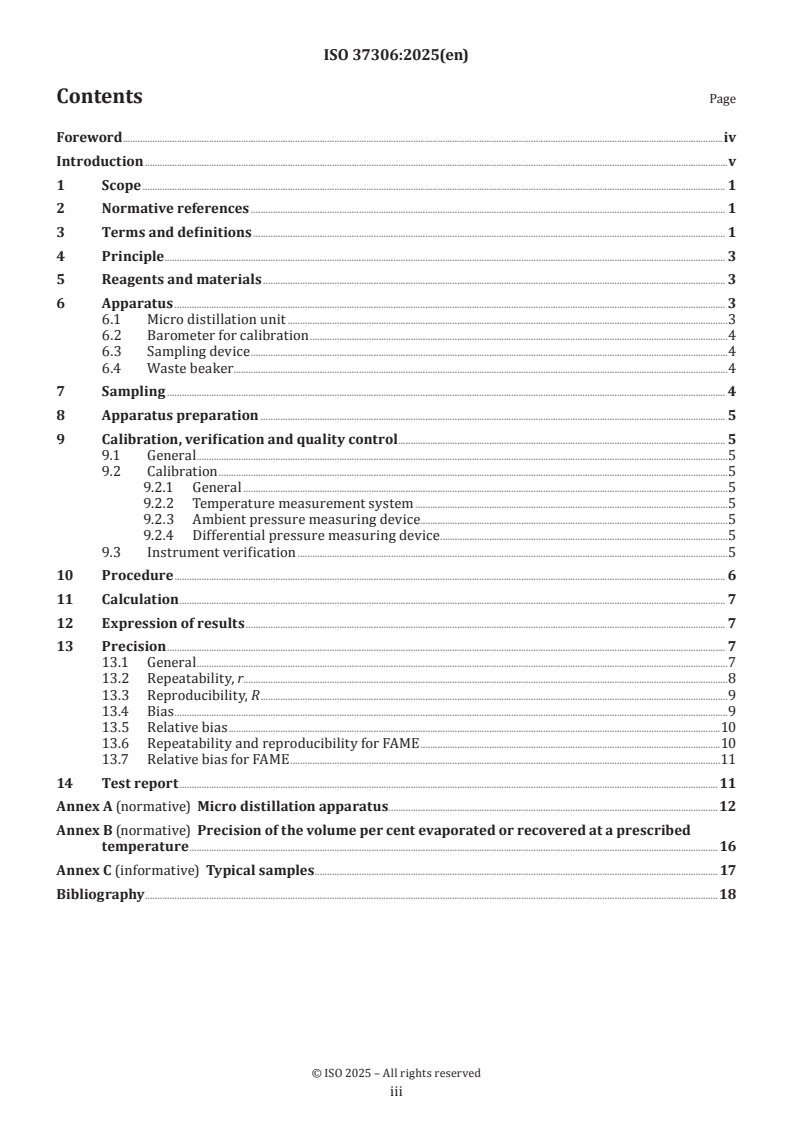
Contents Page
Foreword .iv
Introduction .v
1 Scope . 1
2 Normative references . 1
3 Terms and definitions . 1
4 Principle . 3
5 Reagents and materials . 3
6 Apparatus . 3
6.1 Micro distillation unit .3
6.2 Barometer for calibration .4
6.3 Sampling device .4
6.4 Waste beaker . .4
7 Sampling . 4
8 Apparatus preparation . 5
9 Calibration, verification and quality control . 5
9.1 General .5
9.2 Calibration .5
9.2.1 General .5
9.2.2 Temperature measurement system .5
9.2.3 Ambient pressure measuring device.5
9.2.4 Differential pressure measuring device .5
9.3 Instrument verification .5
10 Procedure . 6
11 Calculation . 7
12 Expression of results . 7
13 Precision . 7
13.1 General .7
13.2 Repeatability, r.8
13.3 Reproducibility, R .9
13.4 Bias .9
13.5 Relative bias .10
13.6 Repeatability and reproducibility for FAME .10
13.7 Relative bias for FAME .11
14 Test report .11
Annex A (normative) Micro distillation apparatus .12
Annex B (normative) Precision of the volume per cent evaporated or recovered at a prescribed
temperature .16
Annex C (informative) Typical samples . 17
Bibliography .18
iii
Foreword
ISO (the International Organization for Standardization) is a worldwide federation of national standards
bodies (ISO member bodies). The work of preparing International Standards is normally carried out through
ISO technical committees. Each member body interested in a subject for which a technical committee
has been established has the right to be represented on that committee. International organizations,
governmental and non-governmental, in liaison with ISO, also take part in the work. ISO collaborates closely
with the International Electrotechnical Commission (IEC) on all matters of electrotechnical standardization.
The procedures used to develop this document and those intended for its further maintenance are described
in the ISO/IEC Directives, Part 1. In particular, the different approval criteria needed for the different types
of ISO document should be noted. This document was drafted in accordance with the editorial rules of the
ISO/IEC Directives, Part 2 (see www.iso.org/directives).
ISO draws attention to the possibility that the implementation of this document may involve the use of (a)
patent(s). ISO takes no position concerning the evidence, validity or applicability of any claimed patent
rights in respect thereof. As of the date of publication of this document, ISO had not received notice of (a)
patent(s) which may be required to implement this document. However, implementers are cautioned that
this may not represent the latest information, which may be obtained from the patent database available at
www.iso.org/patents. ISO shall not be held responsible for identifying any or all such patent rights.
Any trade name used in this document is information given for the convenience of users and does not
constitute an endorsement.
For an explanation of the voluntary nature of standards, the meaning of ISO specific terms and expressions
related to conformity assessment, as well as information about ISO's adherence to the World Trade
Organization (WTO) principles in the Technical Barriers to Trade (TBT), see www.iso.org/iso/foreword.html.
This document was prepared by the European Committee for Standardization (CEN) (as EN 17306) and
was adopted without modification other than those given below. It was assigned to, Technical Committee
ISO/TC 28, Petroleum and related products, fuels and lubricants from natural or synthetic sources, and adopted
under a special “fast-track procedure”.
— EN ISO references changed to ISO references;
— "V/V" has been replaced with "volume fraction" throughout the text;
— the note has been removed in the scope;
— normative citation of Annex A added in 6.1;
— normative citation of Annex B added in 13.1;
— numbered lists have been introduced in A.1.3 and A.1.5 and subclause numbering updated accordingly.
Any feedback or questions on this document should be directed to the user’s national standards body. A
complete listing of these bodies can be found at www.iso.org/members.html.
iv
Introduction
The distillation (volatility) characteristics of hydrocarbons and other liquids have an important effect on
their safety and performance, especially in the case of fuels and solvents. The boiling range gives information
on the composition, the properties, and the behaviour of the fuel during storage and use. Volatility is the
major determinant of the tendency of a hydrocarbon mixture to produce potentially explosive vapours.
The distillation characteristics are critically important for both automotive and aviation gasolines, affecting
starting, warm-up and tendency to vapour lock at high operating temperature or at high altitude, or both.
The presence of high boiling point components in these and other fuels can significantly affect the degree of
formation of solid combustion deposits.
Distillation limits are often included in petroleum product specifications, in commercial contract
agreements, process refinery/control applications, and for compliance to regulatory rules.
This test method can be applied to contaminated products or hydrocarbon mixtures. This is valuable for
fast product quality screening, refining process monitoring, fuel adulteration control, or other purposes
including use as a portable apparatus for field testing.
[1]
This document is at of the time of publication technically equivalent to ASTM D7345, on which it is based.
This test method uses an automatic micro distillation apparatus, provides fast results using small
sample volume, and eliminates much of the operator time and subjectivity in comparison to ISO 3405 or
[2]
ASTM D1160.
v
International Standard ISO 37306:2025(en)
Liquid petroleum products — Determination of distillation
characteristics at atmospheric pressure — Micro-distillation
1 Scope
This document specifies a laboratory method for the determination of the distillation characteristics of
light and middle distillates derived from petroleum and related products of synthetic or biological origin
with initial boiling points above 20 °C and end-points below approximately 400 °C, at atmospheric pressure
utilizing an automatic micro distillation apparatus.
This test method is applicable to such products as light and middle distillates, automotive spark-ignition
engine fuels, automotive spark-ignition engine fuels containing a volume fraction of up to 20 % ethanol,
aviation gasolines, aviation turbine fuels, (paraffinic) diesel fuels, FAME (B100), diesel blends containing a
volume fraction of up to 30 % fatty acid methyl esters (FAME), special petroleum spirits, naphthas, white
spirits, kerosenes, burner fuels, and marine fuels.
The test method is also applicable to hydrocarbons with a narrow boiling range, like organic solvents or
oxygenated compounds.
The test method is designed for the analysis of distillate products; it is not applicable to products containing
appreciable quantities of residual material.
WARNING — The use of this document can involve hazardous materials, operations and equipment.
This document does not purport to address all of the safety problems associated with its use. It is
the responsibility of user of this document to take appropriate measures to ensure the safety and
health of personnel prior to application of the document, and to fulfil statutory and regulatory
requirements for this purpose.
2 Normative references
The following documents are referred to in the text in such a way that some or all of their content constitutes
requirements of this document. For dated references, only the edition cited applies. For undated references,
the latest edition of the referenced document (including any amendments) applies.
ISO 3170, Hydrocarbon Liquids — Manual sampling
ISO 3171, Petroleum liquids — Automatic pipeline sampling
3 Terms and definitions
For the purposes of this document, the following terms and definitions apply.
ISO and IEC maintain terminology databases for use in standardization at the following addresses:
— ISO Online browsing platform: available at https:// www .iso .org/ obp
— IEC Electropedia: available at https:// www .electropedia .org/
3.1
automatic apparatus
microprocessor-controlled unit that performs the procedures of automatically controlling the evaporation
of a liquid specimen under specific conditions of this test method, collecting measurement data and
converting this data by patented algorithm in order to predict distillation results in correlation with an
industry recognized reference method
3.2
end-point
final boiling point
FBP
maximum thermometer reading (corrected) obtained during the test
Note 1 to entry: This usually occurs after the evaporation of all liquid from the bottom of the distillation flask.
Note 2 to entry: The term maximum temperature is a frequently used synonym.
3.3
flask internal pressure
pressure within the distillation flask obtained during the test by a differential pressure sensor of automatic
apparatus (3.1)
Note 1 to entry: The flask internal pressure data recorded during the test is automatically converted to the volume
fraction, expressed in per cent, of recovered or evaporated data by a patented algorithm employed by automatic
apparatus.
3.4
initial boiling point
IBP
corrected temperature reading that corresponds to the instant of the flask internal pressure rise observed
Note 1 to entry: Temperature readings are corrected to 101,3 kPa barometric pressure.
3.5
liquid temperature
temperature of the liquid specimen in the distillation flask during the test obtained by a liquid temperature
measuring device of automatic apparatus
3.6
per cent recovered
volume of condensate observed by the automatic apparatus at any point in the distillation, expressed as a
percentage of the charge volume, in connection with a simultaneous temperature reading
3.7
per cent recovery
recovery predicted by the automatic apparatus and expressed as a percentage of the charge volume
3.8
per cent residue
volume of residue in the distillation flask expressed as a percentage of the charge volume
3.9
reference method
test method or its analogues which are widely used for expression of the distillation characteristics of
petroleum products in the industry
3.10
temperature reading
adjusted vapour and liquid temperature by using an algorithm of the automatic apparatus (3.1) to mimic the
same temperature lag and emergent stem effects as would be seen when using a liquid-in-glass thermometer
to determine the distillation characteristics
3.11
vapour temperature
temperature of the vapour in the distillation flask during the test obtained by a vapour temperature
measuring device of automatic apparatus (3.1)
4 Principle
A sample is transferred into the distillation flask, the distillation flask is placed into position on the automatic
apparatus, and heat is applied to the bottom of the distillation flask.
The automatic apparatus measures and records sample vapour and liquid temperatures, and pressure in
the distillation flask as the sample gradually distils under atmospheric pressure conditions. Automatic
recordings are made throughout the distillation and the data stored into the apparatus memory.
At the conclusion of the distillation, the collected data are treated by the data processing system, converted
to distillation characteristics and corrected for barometric pressure.
Test results are commonly expressed as per cent recovered or evaporated versus corresponding temperature
in compliance with industry recognized standard form and reference method either in a table or graphically,
as a plot of the distillation curve.
5 Reagents and materials
5.1 Cleaning solvents, suitable for cleaning and drying the test flask such as petroleum naphtha and
acetone.
5.2 Toluene, a volume fraction of 99,5 % purity.
5.3 n-Hexadecane, a volume fraction of 99 % purity.
5.4 Chemicals of at least 99 % purity shall be used in the calibration procedure (see 9.3).
5.5 Granular pumice stones, clean and dry fine grade pumice stones of diameter 0,8 mm to 3,0 mm;
approximately 10 grains are necessary for each test.
5.6 Sample drying agent, anhydrous sodium sulfate has been found to be suitable.
5.7 Verification fluids
5.7.1 Certified reference material (CRM), which is a stable mixture of hydrocarbon or other stable
petroleum product with a method-specific distillation characteristic established by a method-specific
[11] [3]
interlaboratory study produced in accordance with the principles of ISO 17034 or ISO 33405 or
equivalent standards. The method-specific distillation characteristic for each material of the current
production batch is provided on the certificate of the CRM.
5.7.2 Secondary working standard (SWS), which is a stable mixture of pure hydrocarbons, or other
petroleum product whose composition is known to remain appreciably stable. Establish the mean value of
control points and the statistical control limits for the SWS using standard statistical techniques.
6 Apparatus
6.1 Micro distillation unit
The basic components of the micro distillation unit are the distillation flask, a condensate recovery area with
waste beaker, an enclosure for the distillation flask with the heat source and flask support, the specimen
liquid temperature measuring device, the specimen vapour temperature measuring device, the distillation
flask internal pressure measuring device, the ambient pressure measuring device, the control systems for
regulating the distillation process, and the data processing system for converting recorded information into
typical industry recognized standard report form.
The apparatus shall be in accordance with Annex A.
6.2 Barometer for calibration
Use a pressure measuring device capable of measuring local station pressure with an accuracy of 0,1 kPa (or
better, at the same elevation relative to sea level where the apparatus is located).
WARNING — The barometer is only required for periodic calibration of the ambient pressure
measuring devices. Do not take readings from ordinary aneroid barometers, such as those used at
weather stations and airports, since these are pre-corrected to give sea level readings.
6.3 Sampling device
The sampling device shall have a glass or plastics syringe capacity (10 ± 0,3) ml or constant volume dispenser
capacity (10 ± 0,3) ml.
6.4 Waste beaker
The waste beaker shall have a glass approximately 200 ml capacity, outside diameter approximately 70 mm
and height approximately 130 mm fitted with a cover to reduce evaporation. The cover design shall allow
the beaker to remain open to atmospheric pressure.
7 Sampling
7.1 Unless otherwise specified, samples shall be taken as described in ISO 3170 or ISO 3171, whereas
requirements of national regulations for the sampling of the product under test should be taken into account.
At least 50 ml of sample is recommended.
7.2 The extreme sensitivity of volatility measurements to losses through evaporation and the resulting
change in composition is such as to require the utmost precaution in the drawing and handling of volatile
product samples.
7.3 Samples shall be free from any suspended solids or other insoluble contaminations. Obtain another
sample or remove solid particles by filtration. During filtration operation take care to minimize any loss of
light ends.
7.4 All samples shall be stored in a tightly closed and leak-free container away from direct sunlight or
sources of direct heat.
Protect samples containing light materials having expected initial boiling point lower than 100 °C from
excessive temperatures prior to testing. This should be accomplished by storage of the sample container
in an appropriate ice bath or refrigerator at a temperature below 10 °C. Other samples may be stored at
ambient or lower temperature.
7.5 If the sample has partially or completely solidified during storage, it shall be carefully heated to a
temperature when it is completely fluid. It shall be vigorously shaken after melting, prior to opening the
sample container, to ensure homogeneity.
7.6 Wet samples of materials that visibly contain water are not suitable for testing by this test method. If
the sample is not dry, obtain another sample that is free from suspended water.
If such a sample cannot be obtained, remove any free water by placing approximately 30 ml of the sample
to be tested in a glass conical flask containing approximately 10 g of the drying agent. Stopper and shake
gently. Allow the mixture to settle for approximately 15 min. Once the sample shows no visible signs of
water, use a decanted portion of the sample for the analysis. It is recommended to filter the test portion from
the residual
...