

ISO 13703-2:2023
(Main)Oil and gas industries including lower carbon energy — Piping systems on offshore platforms and onshore plants — Part 2: Materials
General Information
- Abstract
This document provides a set of common supplementary requirements for the most frequently used materials in upstream oil and gas piping systems. This document is applicable to offshore and onshore production facilities, processing and gas liquefaction plants. The materials covered in this document are intended to be used in the following piping systems services: — category D, category M, normal and high pressure, according to ASME B31.3; — sour environments as defined in the ISO 15156 series. NOTE For the purposes of this document, ANSI/NACE MR0175 is equivalent to the ISO 15156 series, and ANSI/NACE MR0103 is equivalent to ISO 17945. This document does not provide guidelines for material selection. The selection of suitable materials for a specific service including any necessary additional material requirements remains the responsibility of the end user. This document does not cover requirements related to: — sulfide stress cracking (SSC) in corrosive petroleum refining environments included in ISO 17945; — non-metallic piping systems according to ASME B31.3 or the ISO 14692 series; — marine piping systems, e.g. ballasting piping system, covered by classification rules; — subsea production systems; — downhole equipment; — transportation pipeline systems, including flowlines, designed in accordance with a recognized pipeline design code. Common requirements related to manufacture, inspection and procurement of piping and valve parts are included in Annex A and Annex B, providing material datasheets and element datasheets, respectively. These material and element datasheets can be applied for applications other than piping systems, e.g. pressure vessels and pumps based upon assessment of the end user and conformance with the selected design code for the relevant equipment. This document is not intended to limit the use of alternative materials or grades within a referenced material standard. Where the use of alternative materials/grades are considered appropriate, the end user is responsible for specifying any additional requirements necessary to meet the design code or specification.
- Status
- Published
- Publication Date
- 15-Oct-2023
- Technical Committee
- ISO/TC 67/SC 6 - Processing equipment and systems
- Drafting Committee
- ISO/TC 67/SC 6/WG 5 - Piping systems
- Current Stage
- 6060 - International Standard published
- Start Date
- 16-Oct-2023
- Due Date
- 07-Sep-2023
- Completion Date
- 16-Oct-2023
Buy Documents

ISO 13703-2:2023 - Oil and gas industries including lower carbon energy — Piping systems on offshore platforms and onshore plants — Part 2: Materials Released:16. 10. 2023

ISO 13703-2:2023 - Industries du pétrole et du gaz, y compris les énergies a faible teneur en carbone — Conception et installation des systemes de tuyauterie sur les plates-formes de production en mer et les installations a terre — Partie 2: Matériels Released:16. 10. 2023
Overview
ISO 13703-2:2023 provides common supplementary requirements for materials used in upstream oil & gas piping systems on offshore platforms and onshore plants. It is focused on the most frequently used metallic materials for piping services including category D and M, normal and high pressure per ASME B31.3, and sour environments as defined by the ISO 15156 series (ANSI/NACE MR0175 equivalence noted). The standard supplies material and element datasheets (Annex A and B) and common manufacturing, inspection and procurement requirements applicable across production, processing and gas liquefaction facilities.
Key topics and technical requirements
- Scope & applicability: Upstream production facilities, processing plants and gas liquefaction plants; does not cover subsea production, downhole equipment, transportation pipelines, marine/ballast piping or non-metallic piping per ISO 14692.
- Material and element datasheets: Normative Annex A (material datasheets) and Annex B (element datasheets) intended for specification and procurement; can be adapted for pressure vessels and pumps after end‑user assessment.
- Service environments: Requirements for normal/high pressure services and for sour (H2S-containing) environments in line with ISO 15156 (ANSI/NACE MR0175).
- Manufacture, inspection and procurement: Common requirements and datasheet templates to harmonize purchase specifications and QA/QC.
- Deviations & code interfacing: Guidance on deviations to ASME B31.3, rules for high-pressure systems, and parts designed to ASME BPVC Section VIII Division 2 or other BPVC rules.
- Qualification & testing: Manufacturer qualification (ISO 17782 or NORSOK M-650), mechanical testing, NDT of piping and valves, welding qualifications and relevant test methods.
- Special topics: Pilot castings (qualification ranges and NDT), ferritic–austenitic (duplex) stainless steels, machining of valve parts from bar and specific NDT/inspection considerations.
- Limitations: The standard does not provide material selection guidance - final selection and any additional requirements remain the responsibility of the end user. It also excludes SSC requirements in refining covered by ISO 17945 (ANSI/NACE MR0103 equivalence noted).
Practical applications and users
Who uses ISO 13703-2:2023:
- Pipe/material engineers specifying piping systems for offshore/onshore production and processing plants
- Procurement and QA/QC teams creating purchase specifications and inspection plans
- Fabricators, valve and component manufacturers, and welding supervisors needing standardized datasheets and NDT criteria
- Project owners and EPCs aligning material requirements with ASME B31.3 and sour‑service standards
Practical benefits:
- Streamlines material procurement with standardized datasheets
- Ensures consistent inspection and manufacturing requirements across projects
- Helps align piping materials with sour-service and high-pressure code interfaces
Related standards
- ASME B31.3 (Process piping)
- ISO 15156 series / ANSI/NACE MR0175 (sour-service materials)
- ISO 17782 and NORSOK M-650 (manufacturer qualification)
- ASME BPVC Section VIII, ISO 17945 (for scope cross-references)
Keywords: ISO 13703-2:2023, piping systems materials, offshore piping, onshore plant piping, sour environments, ASME B31.3, material datasheets, NDT, manufacturer qualification.
Relations
- Effective Date
- 12-Feb-2026
- Effective Date
- 12-Oct-2020
Buy Documents
ISO 13703-2:2023 - Oil and gas industries including lower carbon energy — Piping systems on offshore platforms and onshore plants — Part 2: Materials Released:16. 10. 2023
ISO 13703-2:2023 - Industries du pétrole et du gaz, y compris les énergies a faible teneur en carbone — Conception et installation des systemes de tuyauterie sur les plates-formes de production en mer et les installations a terre — Partie 2: Matériels Released:16. 10. 2023
Get Certified
Connect with accredited certification bodies for this standard

Element Materials Technology
Materials testing and product certification.

ABS Group Brazil
ABS Group certification services in Brazil.

ABS Quality Evaluations Inc.
American Bureau of Shipping quality certification.
Sponsored listings
Frequently Asked Questions
ISO 13703-2:2023 is a standard published by the International Organization for Standardization (ISO). Its full title is "Oil and gas industries including lower carbon energy — Piping systems on offshore platforms and onshore plants — Part 2: Materials". This standard covers: This document provides a set of common supplementary requirements for the most frequently used materials in upstream oil and gas piping systems. This document is applicable to offshore and onshore production facilities, processing and gas liquefaction plants. The materials covered in this document are intended to be used in the following piping systems services: — category D, category M, normal and high pressure, according to ASME B31.3; — sour environments as defined in the ISO 15156 series. NOTE For the purposes of this document, ANSI/NACE MR0175 is equivalent to the ISO 15156 series, and ANSI/NACE MR0103 is equivalent to ISO 17945. This document does not provide guidelines for material selection. The selection of suitable materials for a specific service including any necessary additional material requirements remains the responsibility of the end user. This document does not cover requirements related to: — sulfide stress cracking (SSC) in corrosive petroleum refining environments included in ISO 17945; — non-metallic piping systems according to ASME B31.3 or the ISO 14692 series; — marine piping systems, e.g. ballasting piping system, covered by classification rules; — subsea production systems; — downhole equipment; — transportation pipeline systems, including flowlines, designed in accordance with a recognized pipeline design code. Common requirements related to manufacture, inspection and procurement of piping and valve parts are included in Annex A and Annex B, providing material datasheets and element datasheets, respectively. These material and element datasheets can be applied for applications other than piping systems, e.g. pressure vessels and pumps based upon assessment of the end user and conformance with the selected design code for the relevant equipment. This document is not intended to limit the use of alternative materials or grades within a referenced material standard. Where the use of alternative materials/grades are considered appropriate, the end user is responsible for specifying any additional requirements necessary to meet the design code or specification.
This document provides a set of common supplementary requirements for the most frequently used materials in upstream oil and gas piping systems. This document is applicable to offshore and onshore production facilities, processing and gas liquefaction plants. The materials covered in this document are intended to be used in the following piping systems services: — category D, category M, normal and high pressure, according to ASME B31.3; — sour environments as defined in the ISO 15156 series. NOTE For the purposes of this document, ANSI/NACE MR0175 is equivalent to the ISO 15156 series, and ANSI/NACE MR0103 is equivalent to ISO 17945. This document does not provide guidelines for material selection. The selection of suitable materials for a specific service including any necessary additional material requirements remains the responsibility of the end user. This document does not cover requirements related to: — sulfide stress cracking (SSC) in corrosive petroleum refining environments included in ISO 17945; — non-metallic piping systems according to ASME B31.3 or the ISO 14692 series; — marine piping systems, e.g. ballasting piping system, covered by classification rules; — subsea production systems; — downhole equipment; — transportation pipeline systems, including flowlines, designed in accordance with a recognized pipeline design code. Common requirements related to manufacture, inspection and procurement of piping and valve parts are included in Annex A and Annex B, providing material datasheets and element datasheets, respectively. These material and element datasheets can be applied for applications other than piping systems, e.g. pressure vessels and pumps based upon assessment of the end user and conformance with the selected design code for the relevant equipment. This document is not intended to limit the use of alternative materials or grades within a referenced material standard. Where the use of alternative materials/grades are considered appropriate, the end user is responsible for specifying any additional requirements necessary to meet the design code or specification.
ISO 13703-2:2023 is classified under the following ICS (International Classification for Standards) categories: 75.180.10 - Exploratory, drilling and extraction equipment. The ICS classification helps identify the subject area and facilitates finding related standards.
ISO 13703-2:2023 has the following relationships with other standards: It is inter standard links to EN ISO 13703-2:2023, ISO 13703:2000. Understanding these relationships helps ensure you are using the most current and applicable version of the standard.
ISO 13703-2:2023 is available in PDF format for immediate download after purchase. The document can be added to your cart and obtained through the secure checkout process. Digital delivery ensures instant access to the complete standard document.
Standards Content (Sample)
INTERNATIONAL ISO
STANDARD 13703-2
First edition
2023-10
Oil and gas industries including lower
carbon energy — Piping systems
on offshore platforms and onshore
plants —
Part 2:
Materials
Industries du pétrole et du gaz, y compris les énergies à faible teneur
en carbone — Conception et installation des systèmes de tuyauterie
sur les plates-formes de production en mer et les installations à
terre —
Partie 2: Matériels
Reference number
© ISO 2023
All rights reserved. Unless otherwise specified, or required in the context of its implementation, no part of this publication may
be reproduced or utilized otherwise in any form or by any means, electronic or mechanical, including photocopying, or posting on
the internet or an intranet, without prior written permission. Permission can be requested from either ISO at the address below
or ISO’s member body in the country of the requester.
ISO copyright office
CP 401 • Ch. de Blandonnet 8
CH-1214 Vernier, Geneva
Phone: +41 22 749 01 11
Email: copyright@iso.org
Website: www.iso.org
Published in Switzerland
ii
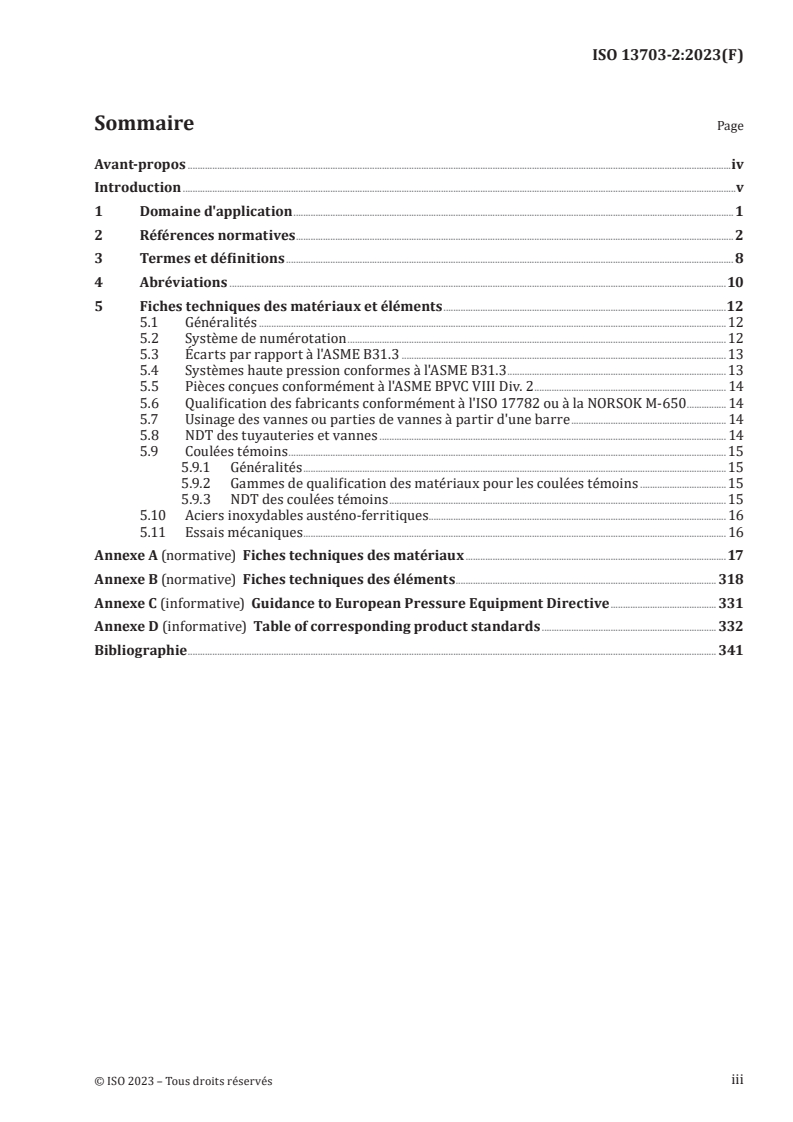
Contents Page
Foreword .iv
Introduction .v
1 Scope . 1
2 Normative references . 2
3 Terms and definitions . 8
4 Abbreviated terms . 9
5 Material and element datasheets .11
5.1 General . 11
5.2 Numbering system .12
5.3 Deviations to ASME B31.3 .12
5.4 High pressure systems according to ASME B31.3 . 13
5.5 Parts designed to ASME BPVC VIII Div. 2 . 13
5.6 Qualification of manufacturers to ISO 17782 or NORSOK M-650 .13
5.7 Machining of valves or valve parts from bar . 14
5.8 NDT of piping and valves . 14
5.9 Pilot castings . 14
5.9.1 General . 14
5.9.2 Material qualification ranges for pilot castings . 14
5.9.3 NDT of pilot castings . 15
5.10 Ferritic-austenitic stainless steels . 15
5.11 Mechanical testing . 15
Annex A (normative) Material datasheets .16
Annex B (normative) Element datasheets .286
Annex C (informative) Guidance to European Pressure Equipment Directive . 297
Annex D (informative) Table of corresponding product standards . 298
Bibliography .310
iii
Foreword
ISO (the International Organization for Standardization) is a worldwide federation of national standards
bodies (ISO member bodies). The work of preparing International Standards is normally carried out
through ISO technical committees. Each member body interested in a subject for which a technical
committee has been established has the right to be represented on that committee. International
organizations, governmental and non-governmental, in liaison with ISO, also take part in the work.
ISO collaborates closely with the International Electrotechnical Commission (IEC) on all matters of
electrotechnical standardization.
The procedures used to develop this document and those intended for its further maintenance are
described in the ISO/IEC Directives, Part 1. In particular, the different approval criteria needed for the
different types of ISO document should be noted. This document was drafted in accordance with the
editorial rules of the ISO/IEC Directives, Part 2 (see www.iso.org/directives).
ISO draws attention to the possibility that the implementation of this document may involve the use
of (a) patent(s). ISO takes no position concerning the evidence, validity or applicability of any claimed
patent rights in respect thereof. As of the date of publication of this document, ISO had not received
notice of (a) patent(s) which may be required to implement this document. However, implementers are
cautioned that this may not represent the latest information, which may be obtained from the patent
database available at www.iso.org/patents. ISO shall not be held responsible for identifying any or all
such patent rights.
Any trade name used in this document is information given for the convenience of users and does not
constitute an endorsement.
For an explanation of the voluntary nature of standards, the meaning of ISO specific terms and
expressions related to conformity assessment, as well as information about ISO's adherence to
the World Trade Organization (WTO) principles in the Technical Barriers to Trade (TBT), see
www.iso.org/iso/foreword.html.
This document was prepared by Technical Committee ISO/TC 67, Oil and gas industries including lower
carbon energy, Subcommittee SC 6, Process equipment, piping, systems, and related safety, in collaboration
with the European Committee for Standardization (CEN) Technical Committee CEN/TC 12, Oil and gas
industries including lower carbon energy, in accordance with the Agreement on technical cooperation
between ISO and CEN (Vienna Agreement).
This first edition of ISO 13703-2, together with ISO 13703-1 and ISO 13703-3, cancels and replaces
ISO 13703:2000, which has been technically revised. It also incorporates the Technical Corrigendum
ISO 13703:2000/Cor.1:2002.
The main changes compared to the previous edition are as follows:
— deletion of the installation and quality control requirements in Clause 10;
— deletion of former Annex C as requirements are addressed in ASME B31.3;
— addition of material data sheets.
A list of all parts in the ISO 13703 series can be found on the ISO website.
Any feedback or questions on this document should be directed to the user’s national standards body. A
complete listing of these bodies can be found at www.iso.org/members.html.
iv
Introduction
Requirements are defined in material datasheets and element datasheets, which can be used for
the specification and procurement of materials for piping systems. Common fabrication, welding,
inspection, examination and testing requirements of piping systems are covered by ISO 13703-3.
Local, national or regional regulations can also affect the specification of piping materials.
v
INTERNATIONAL STANDARD ISO 13703-2:2023(E)
Oil and gas industries including lower carbon energy —
Piping systems on offshore platforms and onshore
plants —
Part 2:
Materials
1 Scope
This document provides a set of common supplementary requirements for the most frequently used
materials in upstream oil and gas piping systems.
This document is applicable to offshore and onshore production facilities, processing and gas
liquefaction plants. The materials covered in this document are intended to be used in the following
piping systems services:
— category D, category M, normal and high pressure, according to ASME B31.3;
— sour environments as defined in the ISO 15156 series.
NOTE For the purposes of this document, ANSI/NACE MR0175 is equivalent to the ISO 15156 series, and
ANSI/NACE MR0103 is equivalent to ISO 17945.
This document does not provide guidelines for material selection. The selection of suitable materials for
a specific service including any necessary additional material requirements remains the responsibility
of the end user.
This document does not cover requirements related to:
— sulfide stress cracking (SSC) in corrosive petroleum refining environments included in ISO 17945;
— non-metallic piping systems according to ASME B31.3 or the ISO 14692 series;
— marine piping systems, e.g. ballasting piping system, covered by classification rules;
— subsea production systems;
— downhole equipment;
— transportation pipeline systems, including flowlines, designed in accordance with a recognized
pipeline design code.
Common requirements related to manufacture, inspection and procurement of piping and valve
parts are included in Annex A and Annex B, providing material datasheets and element datasheets,
respectively. These material and element datasheets can be applied for applications other than piping
systems, e.g. pressure vessels and pumps based upon assessment of the end user and conformance with
the selected design code for the relevant equipment. This document is not intended to limit the use of
alternative materials or grades within a referenced material standard. Where the use of alternative
materials/grades are considered appropriate, the end user is responsible for specifying any additional
requirements necessary to meet the design code or specification.
2 Normative references
The following documents are referred to in the text in such a way that some or all of their content
constitutes requirements of this document. For dated references, only the edition cited applies. For
undated references, the latest edition of the referenced document (including any amendments) applies.
ISO 3452 (all parts), Non-destructive testing — Penetrant testing
ISO 4499-2, Hardmetals — Metallographic determination of microstructure — Part 2: Measurement of WC
grain size
ISO 4499-4, Hardmetals — Metallographic determination of microstructure — Part 4: Characterisation of
porosity, carbon defects and eta-phase content
ISO 4624, Paints and varnishes — Pull-off test for adhesion
ISO 6892-1, Metallic materials — Tensile testing — Part 1: Method of test at room temperature
ISO 9606, Qualification testing of welders — Fusion welding
ISO 10474, Steel and steel products — Inspection documents
ISO 10684, Fasteners — Hot dip galvanized coatings
ISO 10893-11, Non-destructive testing of steel tubes — Part 11: Automated ultrasonic testing of the weld
seam of welded steel tubes for the detection of longitudinal and/or transverse imperfections
ISO 11970, Specification and qualification of welding procedures for production welding of steel castings
ISO 14732, Welding personnel — Qualification testing of welding operators and weld setters for mechanized
and automatic welding of metallic materials
ISO 15156 (all parts), Petroleum and natural gas industries — Materials for use in H S-containing
environments in oil and gas production
ISO 15614-1, Specification and qualification of welding procedures for metallic materials — Welding
procedure test — Part 1: Arc and gas welding of steels and arc welding of nickel and nickel alloys
ISO 15614-5, Specification and qualification of welding procedures for metallic materials — Welding
procedure test — Part 5: Arc welding of titanium, zirconium and their alloys
ISO 15614-7, Specification and qualification of welding procedures for metallic materials — Welding
procedure test — Part 7: Overlay welding
ISO 17637, Non-destructive testing of welds — Visual testing of fusion-welded joints
ISO 17781, Petroleum, petrochemical and natural gas industries — Test methods for quality control of
microstructure of ferritic/austenitic (duplex) stainless steels
ISO 17782, Petroleum, petrochemical and natural gas industries — Scheme for conformity assessment of
manufacturers of special materials
ISO 27509, Petroleum and natural gas industries — Compact flanged connections with IX seal ring
ISO 28079, Hardmetals — Palmqvist toughness test
ISO 6507-1, Metallic materials — Vickers hardness test — Part 1: Test method
ANSI/MSS SP-55, Quality standard for steel castings for valves, flanges, fittings, and other piping
components - visual method for evaluation of surface irregularities
ANSI/NACE TM0284, Evaluation of pipeline and pressure vessel steels for resistance to hydrogen-induced
cracking
ANSI/NACE MR0175, Petroleum and natural gas industries — Materials for use in H S-containing
environments in oil and gas production
API RP 934-A, Materials and fabrication of 2 1/4 Cr-1Mo, 2 1/4 Cr-1Mo 1/4 v, 3Cr-1Mo, and 3Cr-1Mo-1/4 V
steel heavy wall pressure vessels for high-temperature, high pressure Hydrogen service
API RP 934-C, Materials and fabrication of 1 1/4 Cr-1/2 Mo steel heavy wall pressure vessels for high-
pressure Hydrogen service operating at or below 825 degrees F (440 degrees C)
API Spec 5L, Specification for line pipe
API Std 6ACRA, Age-hardened Nickel-based alloys for oil and gas drilling and production equipment
ASME B16.20, Metallic gaskets for pipe flanges
ASME B16.34, Valves – Flanged, threaded and welding end
ASME B31.3, Process piping
ASME Boiler and pressure vessel code (BPVC), Section V: Nondestructive examination
ASME Boiler and pressure vessel code (BPVC), Section VIII, Division 1: Rules for construction of pressure
vessels
ASME Boiler and pressure vessel code (BPVC), Section VIII, Division 2: Alternative rules
ASME Boiler and pressure vessel code (BPVC), Section VIII, Division 3: Alternative rules for high pressure
vessels
ASME Boiler and pressure vessel code (BPVC), Section IX: Welding and brazing qualifications
ASTM A20/A20M, Standard specification for general requirements for steel plates for pressure vessels
ASTM A29/A29M, Standard specification for general requirements for steel bars, Carbon and alloy, hot-
wrought
ASTM A105/A105M, Standard specification for Carbon steel forgings for piping applications
ASTM A106/A106M, Standard specification for seamless Carbon steel pipe for high-temperature service
ASTM A182/A182M, Standard specification for forged or rolled alloy and stainless Steel pipe flanges, forged
fittings, and valves and parts for high-temperature service
ASTM A193/A193M, Standard specification for alloy-steel and stainless steel bolting for high temperature
or high pressure service and other special purpose applications
ASTM A194/A194M, Standard specification for Carbon steel, alloy steel, and stainless steel nuts for bolts
for high pressure or high temperature service, or both
ASTM A203/A203M, Standard specification for pressure vessel plates, alloy steel, Nickel
ASTM A216/A216M, Standard specification for steel castings, Carbon, suitable for fusion welding, for high-
temperature service
ASTM A217/217M, Standard Specification for Steel Castings, Martensitic Stainless and Alloy, for Pressure-
Containing Parts, Suitable for High-Temperature Service
ASTM A234/A234M, Standard specification for piping fittings of wrought Carbon steel and alloy steel for
moderate and high temperature service
ASTM A240/A240M, Standard specification for Chromium and Chromium-Nickel stainless steel plate, sheet,
and strip for pressure vessels and for general applications
ASTM A269/A269M, Standard specification for seamless and welded austenitic stainless steel tubing for
general service
ASTM A276/A276M, Standard specification for stainless steel bars and shapes
ASTM A312/A312M, Standard specification for seamless, welded, and heavily cold worked austenitic
stainless steel pipes
ASTM A320/A320M, Standard specification for alloy-steel and stainless steel bolting for low-temperature
service
ASTM A333/A333M, Standard specification for seamless and welded steel pipe for low-temperature service
and other applications with required notch toughness
ASTM A334/A334M, Standard specification for seamless and welded Carbon and alloy-steel tubes for low-
temperature service
ASTM A335/A335M, Standard specification for seamless Ferritic alloy-steel pipe for high-temperature
service
ASTM A350/A350M, Standard specification for Carbon and low-alloy steel forgings, requiring notch
toughness testing for piping components
ASTMA351/A351M, Standard specification for castings, austenitic, for pressure-containing parts
ASTM A352/A352M, Standard specification for steel castings, ferritic and martensitic, for pressure-
containing parts, suitable for low-temperature service
ASTM A358/A358M, Standard specification for electric-fusion-welded austenitic Chromium-Nickel
stainless steel pipe for high-temperature service and general applications
ASTM A363, Standard specification for Zinc-coated (galvanized) steel overhead ground wire strand
ASTM A370, Standard test methods and definitions for mechanical testing of steel products
ASTM A387/A387M, Standard specification for pressure vessel plates, alloy steel, Chromium-Molybdenum
ASTM A388/A388M, Standard practice for ultrasonic examination of steel forgings
ASTM A403/A403M, Standard specification for wrought austenitic stainless steel piping fittings
ASTM A420/A420M, Standard specification for piping fittings of wrought Carbon steel and alloy steel for
low-temperature service
ASTM A453/A453M, Standard specification for high-temperature bolting, with expansion coefficients
comparable to austenitic stainless steels
ASTM A479/A479M, Standard specification for stainless steel bars and shapes for use in boilers and other
pressure vessels
ASTM A484/A484M, Standard specification for general requirements for stainless steel bars, billets, and
forgings
ASTM A488/A488M, Standard practice for steel castings, welding, qualifications of procedures and
personnel
ASTM A494/A494M, Standard specification for castings, Nickel and Nickel alloy
ASTM A508/A508M, Standard specification for quenched and tempered vacuum-treated Carbon and alloy
steel forgings for pressure vessels
ASTM A516/A516M, Standard specification for pressure vessel plates, Carbon steel, for moderate- and
lower-temperature service
ASTM A564/A564M, Standard specification for hot-rolled and cold-finished age-hardening stainless steel
bars and shapes
ASTM A578/A578M, Standard specification for straight-beam ultrasonic examination of rolled steel plates
for special applications
ASTM A671/A671M, Standard specification for electric-fusion-welded steel pipe for atmospheric and lower
temperatures
ASTM A672/A672M, Standard specification for electric-fusion-welded steel pipe for high-pressure service
at moderate temperatures
ASTM A691/A691M, standard specification for Carbon and alloy steel pipe, electric-fusion-welded for high-
pressure service at high temperatures
ASTM A694/A694M, Standard specification for Carbon and alloy steel forgings for pipe flanges, fittings,
valves, and parts for high-pressure transmission service
ASTM A696, Standard specification for steel bars, Carbon, hot-wrought or cold-finished, special quality, for
pressure piping components
ASTM A703/A703M, standard specification for steel castings, creep-strength enhanced ferritic alloy, for
pressure-containing parts, suitable for high temperature service
ASTM A705/A705M, Standard specification for age-hardening stainless steel forgings
ASTM A739, Standard specification for steel bars, alloy, hot-wrought, for elevated temperature or pressure-
containing parts, or both
ASTM A781/A781M, Standard specification for castings, steel and alloy, common requirements, for general
industrial use
ASTM A788/A788M, Standard specification for steel forgings, general requirements
ASTM A789/A789M, Standard specification for seamless and welded ferritic/austenitic stainless steel
tubing for general service
ASTM A790/A790M, Standard specification for seamless and welded ferritic/austenitic stainless steel pipe
ASTM A815/A815M, Standard specification for wrought ferritic, ferritic/austenitic, and martensitic
stainless steel piping fittings
ASTM A860/A860M, Standard specification for wrought high-strength ferritic steel butt-welding fittings
ASTM A928/A928M, Standard specification for ferritic/austenitic (duplex) stainless steel pipe electric
fusion welded with addition of filler metal
ASTM A957/A957M, Standard specification for investment castings, steel and alloy, common requirements,
for general industrial use
ASTM A960/A960M, Standard specification for common requirements for wrought steel piping fittings
ASTM A961/A961M, Standard specification for common requirements for steel flanges, forged fittings,
valves, and parts for piping applications
ASTM A962/A962M, Standard specification for common requirements for bolting intended for use at any
temperature from cryogenic to the creep range
ASTM A966/A966M, Standard practice for magnetic particle examination of steel forgings using
alternating current
ASTM A985/A985M, Standard specification for steel investment castings general requirements, for
pressure-containing parts
ASTM A988/A988M, Standard specification for hot isostatically-pressed stainless steel flanges, fittings,
valves, and parts for high temperature service
ASTM A995/995M, Standard specification for castings, austenitic-ferritic (duplex) stainless steel, for
pressure-containing parts
ASTM A1058, Standard Test Methods for Mechanical Testing of Steel Products — Metric
ASTM A1080/A1080M, Standard practice for hot isostatic pressing of steel, stainless steel, and related
alloy castings
ASTM A1082/A1082M, Standard specification for high strength precipitation hardening and duplex
stainless steel bolting for special purpose applications
ASTM B124/B124M, Standard Specification for Copper and Copper Alloy Forging Rod, Bar, and Shapes
ASTM B148, Standard specification for Aluminum-Bronze sand castings
ASTM B150/150M, Standard Specification for Aluminum Bronze Rod, Bar, and Shapes
ASTM B151/B151M, Standard specification for Copper-Nickel-Zinc alloy (Nickel Silver) and Copper-Nickel
rod and bar
ASTM B171/B171M, Standard specification for Copper-alloy plate and sheet for pressure vessels,
condensers, and heat exchangers
ASTM B265, Standard specification for Titanium and Titanium alloy strip, sheet, and plate
ASTM B338, Standard specification for seamless and welded Titanium and Titanium alloy tubes for
condensers and heat exchangers
ASTM B348, Standard specification for Titanium and Titanium alloy bars and billets
ASTM B363, Standard specification for seamless and welded unalloyed Titanium and Titanium alloy
welding fittings
ASTM B366/B366M, Standard specification for factory-made wrought Nickel and Nickel alloy fittings
ASTM B367, Standard specification for Titanium and Titanium alloy castings
ASTM B381, Standard specification for Titanium and Titanium alloy forgings
ASTM B423, Standard Specification for Nickel-Iron-Chromium-Molybdenum-Copper Alloy Seamless Pipe
and Tube
ASTM B424, Standard Specification for Nickel-Iron-Chromium-Molybdenum-Copper Alloys Plate, Sheet, and
Strip
ASTM B425, Standard Specification for Nickel-Iron-Chromium-Molybdenum-Copper Alloys Rod and Bar
ASTM B443, Standard specification for Nickel-Chromium-Molybdenum-Columbium alloy and Nickel-
Chromium-Molybdenum-Silicon alloy plate, sheet, and strip
ASTM B444, Standard specification for Nickel-Chromium-Molybdenum-Columbium alloys (UNS N06625
and UNS N06852) and Nickel-Chromium-Molybdenum-Silicon alloy (UNS N06219) pipe and tube
ASTM B446, Standard specification for Nickel-Chromium-Molybdenum-Columbium Alloy (UNS N06625),
Nickel-Chromium-Molybdenum-Silicon alloy (UNS N06219), and Nickel-Chromium-Molybdenum-Tungsten
alloy (UNS N06650) rod and bar
ASTM B499, Standard test method for measurement of coating thicknesses by the magnetic method:
nonmagnetic coatings on magnetic basis metals
ASTM B564, Standard specification for Nickel alloy forgings
ASTM B571, Standard practice for qualitative adhesion testing of metallic coatings
ASTM B578, Standard test method for microhardness of electroplated coatings
ASTM B602, Standard test method for attribute sampling of metallic and inorganic coatings
ASTM B637, Standard specification for precipitation-hardening and cold worked Nickel alloy bars, forgings,
and forging stock for moderate or high temperature service
ASTM B705, Standard specification for Nickel-alloy (UNS N06625, N06219 and N08825) welded pipe
ASTM B733, Standard specification for autocatalytic (electroless) Nickel-Phosphorus coatings on metal
ASTM B834, Standard specification for pressure consolidated powder metallurgy Iron-Nickel-Chromium-
Molybdenum (UNS N08367), Nickel-Chromium-Molybdenum-Columbium (Nb) (UNS N06625), Nickel-
Chromium-Iron alloys (UNS N06600 and N06690), and Nickel-Chromium-Iron-Columbium-Molybdenum
(UNS N07718) alloy pipe flanges, fittings, valves, and parts
ASTM B861, Standard specification for Titanium and Titanium alloy seamless pipe
ASTM B862, Standard specification for Titanium and Titanium alloy welded pipe
ASTM C633, Standard test method for adhesion or cohesion strength of thermal spray coatings
ASTM E8/E8M, Standard test methods for tension testing of metallic materials
ASTM E94/E94M, Standard guide for radiographic examination using industrial radiographic film
ASTM E112, Standard test methods for determining average grain size
ASTM E165/E165M, Standard practice for liquid penetrant testing for general industry
ASTM E186, Standard reference radiographs for heavy-walled (2 to 412 in. (50,8 to 114 mm)) steel castings
ASTM E280, Standard reference radiographs for heavy-walled (412 to 12 in. (114 to 305 mm)) steel castings
ASTM E446, Standard reference radiographs for steel castings up to 2 in. (50,8 mm) in thickness
ASTM F467/F467M, Standard specification for nonferrous nuts for general use
ASTM F468/F468M, Standard specification for nonferrous bolts, hex cap screws, socket head cap screws,
and studs for general use
ASTM F788/F788M, Standard specification for surface discontinuities of bolts, screws, studs, and rivets,
inch and metric series
ASTM F812, Standard specification for surface discontinuities of nuts, inch and metric series
ASTM F2329/F2329M, Standard specification for Zinc coating, hot-dip, requirements for application to
Carbon and alloy steel bolts, screws, washers, nuts, and special threaded fasteners
ASTM G28, Standard Test Methods for Detecting Susceptibility to Intergranular Corrosion in Wrought,
Nickel-Rich, Chromium-Bearing Alloys
ASTM G48, Standard test methods for pitting and crevice corrosion resistance of stainless steels and related
alloys by use of ferric chloride solution
EEMUA 234, 90/10 Copper nickel alloy piping for offshore applications
EN 10204, Metallic products — Types of inspection documents
EN 10228-4:2016, Non-destructive testing of steel forgings - Part 4: Ultrasonic testing of austenitic and
austenitic-ferritic stainless steel forgings
MSS SP-93-2020, Quality standard for steel castings and forgings for valves, flanges, fittings, and other
piping components — Liquid penetrant examination method
MSS SP-147, Quality standard for steel castings used in standard class steel valves — sampling method for
evaluating casting quality
NORSOK M-650, Qualification of manufacturers of special materials
3 Terms and definitions
For the purposes of this document, the following terms and definitions apply.
ISO and IEC maintain terminology databases for use in standardization at the following addresses:
— ISO Online browsing platform: available at https:// www .iso .org/ obp
— IEC Electropedia: available at https:// www .electropedia .org/
3.1
austenitic stainless steel
stainless steel whose microstructure at room temperature consists predominantly of austenite
3.2
carbon steel
alloy of carbon and iron containing up to 2 % mass fraction carbon and up to 1,65 % mass fraction
manganese and residual quantities of other elements, except those intentionally added in specific
quantities for deoxidation (usually silicon and/or aluminium)
Note 1 to entry: Carbon steels used in the petroleum industry usually contain less than 0,8 % mass fraction
carbon.
3.3
end user
organization that is responsible for the operation of an installation/facility and its component (e.g.
piping, valve)
Note 1 to entry: In the context of this document, the end user is normally an oil and gas company.
3.4
low alloy steel
steel containing a total alloying element content of less than 5 % mass fraction, or less than 10,5 %
mass fraction chromium, but more than that specified for carbon steel (3.2)
3.5
manufacturer
organization, including subcontractors, which carries out operations (e.g. forming, heat treatment,
welding) that affect the material properties of the finished product
3.6
nickel-based alloys
metallic material in which nickel is the major element
3.7
pilot casting
casting made and tested as part of the initiation and development of the production method such as
the first casting from a new or modified pattern produced using identical foundry practices as the
production castings it is intended to represent
3.8
purchaser
organization that purchases a product from a manufacturer (3.5)
Note 1 to entry: A purchaser can be an oil and gas company, a contractor or a buyer.
3.9
stainless steel
steel containing 10,5 % mass fraction or more chromium, possibly with other elements added to secure
special properties
3.10
austenitic stainless steel type 304
austenitic stainless steel (3.1) certified to meet both 304/304L properties
3.11
austenitic stainless steel type 316
austenitic stainless steel (3.1) certified to meet both 316/316L properties
3.12
austenitic stainless steel type UNS S34565
highly alloyed austenitic stainless steel (3.1) alloys with SMYS ≥ 450 MPa and PREN ≥ 40
3.13
austenitic stainless steel type 6Mo
highly alloyed austenitic stainless steel (3.1) alloys with 6 % Mo and PREN ≥ 40,0
3.14
ferritic-austenitic stainless steel type 22Cr duplex
ferritic-austenitic stainless steel alloys with 30,0 ≤ PREN < 40,0 and Cr ≥ 19 % (by mass)
3.15
ferritic-austenitic stainless steel type 25Cr duplex
ferritic-austenitic stainless steel alloys with 40,0 ≤ PREN < 48,0
Note 1 to entry: Stainless steel type 25Cr duplex is often referred to as "super duplex".
3.16
ferritic-austenitic stainless steel type lean duplex
ferritic-austenitic stainless steel alloys with PREN ≥ 28
Note 1 to entry: In this document, stainless steel type lean duplex concerns UNS numbers S32003, S32304 and
S82441.
4 Abbreviated terms
ANSI American National Standards Institute
AOD argon oxygen decarburization
API American Petroleum Institute
ASTM American Society of Testing and Materials
ASME American Society of Mechanical Engineers
BPVC boiler and pressure vessel code
CE carbon equivalent, , calculated as follows: (% C + % Mn / 6 + (% Cr + % Mo + % V) / 5
+ (% Ni + % Cu) / 15), with chemical element concentration expressed in mass fraction
percent
CLR crack length ratio
CSR crack sensitivity ratio
CTR crack thickness ratio
DN nominal diameter
EBW electron beam welding
EDS element data sheet
EEA European Economic Area
FCAW flux-cored arc welding
GTAW gas tungsten arc welding
EEMUA Engineering Equipment & Materials Users Association
EN European standard
HAZ heat-affected zone
HBW Brinell hardness with Tungsten ball
HFW high frequency welded
HIC hydrogen-induced cracking
HIP hot isostatic pressing
HR Rockwell hardness
HRB Rockwell hardness, B scale
HRC Rockwell hardness, C scale
HV Vickers hardness
HVAF high velocity air fuel
HVOF high velocity oxygen fuel
ISO International Organization for Standardization
LBW laser beam welding
MDS material data sheet
MPCR manufacturing procedure conformity record
MPS manufacturing procedure summary
MSS Manufacturers Standardization Society
MT magnetic particle testing
NACE National Association of Corrosion Engineers
NDT non-destructive testing
NORSOK the Norwegian shelf’s competitive position
NPS nominal pipe size
OD outer diameter
PED Pressure Equipment Directive (European Directive 2014/68/EU)
PREN pitting resistance equivalent number, calculated as follows: (%Cr + 3,3 × % (Mo + 0,5W)
+ 16 × %N), with chemical element concentration expressed in mass fraction percent
PSL product specification level
PT penetrant testing
PTAW plasma transfer arc welding
PWHT post weld heat treatment
QL quality level
QTR qualification test record
RT radiographic testing
SAW submerged arc welding
SAWL submerged arc longitudinally welded
SMAW shielded-metal arc welding
SMYS specified minimum yield strength
SSC sulfide stress cracking
UNS unified numbering system
UT ultrasonic testing
VT visual testing
WC Tungsten carbide
5 Material and element datasheets
5.1 General
The material datasheets are collated in Annex A. Each MDS defines the requirements that supplement or
amend the referenced material standard or specification. The material shall be delivered in accordance
with the standard specification referenced in the MDS including any additional requirements specified
therein. Unless otherwise specified in the MDS, all the requirements of the referenced standard
specification shall be applied.
MDSs for welded parts specifying acceptance classes give weld joint quality factors ranging from 0,8
to 1,0 according to ASME B31.3. The required class shall be specified on the piping class sheet. The
purchase order shall specify acceptable class for each relevant item.
The element datasheets are included in Annex B. Each EDS defines the requirements for special
processes and parts used in connection with manufacturing and/or assembly of piping and valves.
Processes and parts shall conform with the requirement specified in the EDS in Annex B.
5.2 Numbering system
Each MDS number consists of a one-letter prefix indicating the material type and a three-digit
sequential number. The following one-letter prefixes apply:
— C – carbon steels;
— D – ferritic austenitic stainless steels (duplex stainless steels);
— K – copper-nickel alloy 90-10 and other copper alloys including nickel-aluminium bronze;
— L – nickel alloyed steel;
— M – martensitic stainless steel;
— N – nickel-based alloys;
— R – highly alloyed austenitic stainless steels;
— S – austenitic stainless steels;
— T – titanium;
— V – Cr and Cr-Mo alloyed steels;
— X – high strength low alloy steels.
The supplementary suffix “S” is used to designate a material delivered in accordance with the MDS plus
the supplementary requirements for sour service but excluding HIC testing.
The supplementary suffix “SH” is used to designate a material conforming with the MDS including the
supplementary requirements for sour service plus HIC testing and UT examination, where applicable to
the material and product form.
An MDS designated with supplementary suffix “S” or “SH” also satisfies all the MDS requirements for
general, non-sour service.
The supplementary suffix “K” is used to designate material suitable for hydrogen service at elevated
temperature.
The supplementary suffix “L” is used to designate material with lower impact testing temperature than
the original MDS.
The EDS number consists of the three-letter prefix “EDS” and a two-digit sequential number.
5.3 Deviations to ASME B31.3
The use of the MDSs in this document can result in deviations from ASME B31.3. All identified deviations
have been carefully considered and are regarded as industry standard. The following deviations are
identified:
— the thickness for requiring impact testing is specified to be ≥6 mm;
— if sub-size Charpy V-notch impact test specimens are used, the test temperature is not reduced;
NOTE 1 Instead of reduction in test temperature, the specified absorbed energy value is increased compared
to ASME B31.3, and the reduction factors for sub-size specimens are modified to be: 7,5 mm - 5/6 and 5 mm - 2/3.
— eddy current testing is accepted as replacement for spot radiography of longitudinal welds in type
6Mo stainless steel pipes for wall thickness less than 4,0 mm;
— thin walled (thickness up to 7,11 mm) longitudinal welded pipes in type 6Mo are accepted in the as
welded condition, provided the plate material used is solution annealed.
— HFW pipe according to API Spec 5L is allowed as an equal alternative to SAWL with automated
ultrasonic and/or electromagnetic testing of the weld.
In general, the MDSs have supplementary requirements beyond the product standard to ensure a safe
use of the material grades.
5.4 High pressure systems according to ASME B31.3
Materials for high pressure systems shall conform to the requirements in ASME B31.3. MDSs for
selected piping materials have been included in Clause A.3. The following requirements have been
added to the high pressure MDSs:
a) All pipe and fittings shall be in heat-treated condition, i.e. normalized, normalized and tempered,
quenched and tempered, annealed or solution annealed.
b) Impact test specimens shall be oriented in the transverse direction, where possible, and energy
values shall be aligned with ASME B31.3.
c) Impact testing at -46 °C is included with reduction factors for sub-size specimens: 7,5 mm - 5/6 and
5 mm - 2/3.
d) Ultrasonic testing of base material of longitudinal welded pipes for longitudinal defects.
e) Ultrasonic testing of forgings with thickness above 50 mm as described in 5.5.
f) NDT of the pipe base material is carried out according to ASME BPVC VIII Div. 3 instead of according
to ASME B31.3.
5.5 Parts designed to ASME BPVC VIII Div. 2
The material test requirements of parts shall be in accordance with BPVC VIII Div. 2 for pressure design
even if the part is intended to be used in piping systems assembled according to ASME B31.3 normal
service or another code with less stringent requirements than the actual design code for the parts.
ASME BPVC VIII Div. 2 specifies that carbon steel and low alloyed steel must be impact tested and the
impact test specimens may be oriented longitudinally and transverse, respectively, provided that the
shape and size of part permit the removal of transverse specimens. The minimum absorbed impact
energy requirement is made dependent of SMYS and section thickness.
All parts designed to ASME BPVC VIII Div. 2 shall be ultrasonically tested if the section thickness is
50 mm or above in nominal thickness.
The MDSs listed in Annex A are not considered in conformance with the requirements of ASME BPVC
VIII Div. 2.
5.6 Qualification of manufacturers to ISO 17782 or NORSOK M-650
Existing qualifications signed off in conformance with ISO 17782 or NORSOK M-650 with test scope
and requirements to other user specifications or standards, such as NORSOK M-630, IOGP S-563, or
IOSS P201-1, IOSS P201-2 and IOSS P201-3 are permitted subject to end user’s acceptance. Production
testing shall be carried out in according with the MDSs in this document.
5.7 Machining of valves or valve parts from bar
When allowed by the product standard specification, hollow cylindrically shaped parts, including
valve bodies with weld-end or integral flanges, and pressure-controlling parts of valves, may be
manufactured from cylindrically shaped bars, provided the requirements in the relevant MDS are met
in full.
5.8 NDT of piping and valves
Where MDSs specify NDT requirements, these requirements describe the minimum level of NDT that
shall be performed at the material manufacturing stage.
NDT of fabricated piping systems are covered by ISO 13703-3 and not included in the MDSs in this
document.
Additional NDT can be required for valve parts when this is specified by the purchaser in the valve data
sheet or purchase order documentation. For details of any additional NDT requirements for finished
valve parts or piping assembly, reference shall be made to the applicable valve specification or piping
fabrication specification.
Where the MDS does not specify additional NDT requirements, the relevant material standard shall
apply. At least one item per lot shall be examined if a frequency of inspection less than 100 % is
specified. If defects outside the acceptance criteria are detected, two or more items from the same lot
shall be tested. If any of these two tests fails, all items in the lot shall be examined.
5.9 Pilot castings
5.9.1 General
The casting foundry/manufacturer shall produce a pilot casting prior to the production of castings, in
accordance with MSS SP-147.
The pilot casting may be taken f
...
NORME ISO
INTERNATIONALE 13703-2
Première édition
2023-10
Industries du pétrole et du gaz, y
compris les énergies à faible teneur en
carbone — Conception et installation
des systèmes de tuyauterie sur les
plates-formes de production en mer et
les installations à terre —
Partie 2:
Matériels
Oil and gas industries including lower carbon energy — Piping
systems on offshore platforms and onshore plants —
Part 2: Materials
Numéro de référence
DOCUMENT PROTÉGÉ PAR COPYRIGHT
© ISO 2023
Tous droits réservés. Sauf prescription différente ou nécessité dans le contexte de sa mise en œuvre, aucune partie de cette
publication ne peut être reproduite ni utilisée sous quelque forme que ce soit et par aucun procédé, électronique ou mécanique,
y compris la photocopie, ou la diffusion sur l’internet ou sur un intranet, sans autorisation écrite préalable. Une autorisation peut
être demandée à l’ISO à l’adresse ci-après ou au comité membre de l’ISO dans le pays du demandeur.
ISO copyright office
Case postale 401 • Ch. de Blandonnet 8
CH-1214 Vernier, Genève
Tél.: +41 22 749 01 11
E-mail: copyright@iso.org
Web: www.iso.org
Publié en Suisse
ii
Sommaire Page
Avant-propos .iv
Introduction .v
1 Domaine d'application .1
2 Références normatives .2
3 Termes et définitions . 8
4 Abréviations .10
5 Fiches techniques des matériaux et éléments .12
5.1 Généralités .12
5.2 Système de numérotation . 12
5.3 Écarts par rapport à l'ASME B31.3 . 13
5.4 Systèmes haute pression conformes à l'ASME B31.3 . 13
5.5 Pièces conçues conformément à l'ASME BPVC VIII Div. 2 . 14
5.6 Qualification des fabricants conformément à l'ISO 17782 ou à la NORSOK M-650 . 14
5.7 Usinage des vannes ou parties de vannes à partir d'une barre . 14
5.8 NDT des tuyauteries et vannes . 14
5.9 Coulées témoins . 15
5.9.1 Généralités .15
5.9.2 Gammes de qualification des matériaux pour les coulées témoins .15
5.9.3 NDT des coulées témoins . 15
5.10 Aciers inoxydables austéno-ferritiques. 16
5.11 Essais mécaniques . 16
Annexe A (normative) Fiches techniques des matériaux .17
Annexe B (normative) Fiches techniques des éléments . 318
Annexe C (informative) Guidance to European Pressure Equipment Directive . 331
Annexe D (informative) Table of corresponding product standards . 332
Bibliographie . 341
iii
Avant-propos
L'ISO (Organisation internationale de normalisation) est une fédération mondiale d'organismes
nationaux de normalisation (comités membres de l'ISO). L'élaboration des Normes internationales est
en général confiée aux comités techniques de l'ISO. Chaque comité membre intéressé par une étude
a le droit de faire partie du comité technique créé à cet effet. Les organisations internationales,
gouvernementales et non gouvernementales, en liaison avec l'ISO participent également aux travaux.
L'ISO collabore étroitement avec la Commission électrotechnique internationale (IEC) en ce qui
concerne la normalisation électrotechnique.
Les procédures utilisées pour élaborer le présent document et celles destinées à sa mise à jour sont
décrites dans les Directives ISO/IEC, Partie 1. Il convient, en particulier, de prendre note des différents
critères d'approbation requis pour les différents types de documents ISO. Le présent document
a été rédigé conformément aux règles de rédaction données dans les Directives ISO/IEC, Partie 2
(voir www.iso.org/directives).
L'ISO attire l'attention sur le fait que la mise en application du présent document peut entraîner
l'utilisation d'un ou de plusieurs brevets. L'ISO ne prend pas position quant à la preuve, à la validité et
à l'applicabilité de tout droit de propriété revendiqué à cet égard. À la date de publication du présent
document, l'ISO n'avait pas reçu notification qu'un ou plusieurs brevets pouvaient être nécessaires à sa
mise en application. Toutefois, il y a lieu d'avertir les responsables de la mise en application du présent
document que des informations plus récentes sont susceptibles de figurer dans la base de données de
brevets, disponible à l'adresse www.iso.org/brevets. L'ISO ne saurait être tenue pour responsable de ne
pas avoir identifié de tels droits de propriété et averti de leur existence.
Les appellations commerciales éventuellement mentionnées dans le présent document sont données
pour information, par souci de commodité, à l'intention des utilisateurs et ne sauraient constituer un
engagement.
Pour une explication de la nature volontaire des normes, la signification des termes et expressions
spécifiques de l'ISO liés à l'évaluation de la conformité, ou pour toute information au sujet de l'adhésion
de l'ISO aux principes de l'Organisation mondiale du commerce (OMC) concernant les obstacles
techniques au commerce (OTC), voir www.iso.org/iso/fr/avant-propos.
Le présent document a été élaboré par le comité technique ISO/TC 67, Industries du pétrole et du gaz, y
compris les énergies à faible teneur en carbone, sous-comité SC 6, Équipements des procédés, tuyauterie,
systèmes, et sécurité qui y est rattachée, en collaboration avec le comité technique CEN/TC 12, Industries
du pétrole et du gaz, y compris les énergies à faible teneur en carbone du Comité européen de normalisation
(CEN), conformément à l'Accord de coopération technique entre l'ISO et le CEN (Accord de Vienne).
Cette première édition de l'ISO 13703-2, avec l'ISO 13703-1 et l'ISO 13703-3, annule et remplace
l'ISO 13703:2000, qui a fait l'objet d'une révision technique. Elle incorpore également le Corrigendum
technique ISO 13703:2000/Cor.1:2002.
Les principales modifications par rapport à l'édition précédente sont les suivantes:
— suppression des exigences relatives à l'installation et au contrôle de la qualité à l'Article 10;
— suppression de l'ancienne Annexe C, ces exigences étant traitées dans la norme ASME B31.3;
— ajout de fiches techniques des matériaux de tuyauterie.
Une liste de toutes les parties de la série ISO 13703 se trouve sur le site web de l'ISO.
Il convient que l'utilisateur adresse tout retour d'information ou toute question concernant le présent
document à l'organisme national de normalisation de son pays. Une liste exhaustive desdits organismes
se trouve à l'adresse www.iso.org/fr/members.html.
iv
Introduction
Les exigences sont définies dans des fiches techniques des matériaux de tuyauterie et dans des fiches
techniques des éléments de tuyauterie, lesquelles peuvent être utilisées pour la spécification et
l'approvisionnement de matériaux destinés à des systèmes de tuyauterie. Les exigences communes
pour la fabrication, le soudage, l'inspection, l'examen et l'essai de systèmes de tuyauteries sont traitées
dans l'ISO 13703-3.
Les réglementations locales, nationales ou régionales peuvent également influencer la spécification des
matériaux de tuyauterie.
v
NORME INTERNATIONALE ISO 13703-2:2023(F)
Industries du pétrole et du gaz, y compris les énergies à
faible teneur en carbone — Conception et installation des
systèmes de tuyauterie sur les plates-formes de production
en mer et les installations à terre —
Partie 2:
Matériels
1 Domaine d'application
Le présent document fournit un ensemble d'exigences supplémentaires communes pour les matériaux
les plus fréquemment utilisés dans les systèmes de tuyauterie pétroliers et gaziers en amont.
Le présent document s'applique aux installations de production en mer et à terre, aux centrales de
traitement et aux installations de liquéfaction de gaz. Les matériaux traités dans le présent document
sont destinés à être utilisés dans les services de systèmes de tuyauterie suivants:
— catégorie D, catégorie M, pression normale et haute pression, conformément à l'ASME B31.3;
— environnements H S tels qu'ils sont définis dans la série ISO 15156.
NOTE Pour les besoins du présent document, l'ANSI/NACE MR0175 équivaut à la série ISO 15156 et l'ANSI/
NACE MR0103 équivaut à l'ISO 17945.
Le présent document ne fournit aucune ligne directrice concernant le choix des matériaux. Il appartient
à l'utilisateur final de choisir les matériaux appropriés pour un service spécifique, ainsi que pour toute
exigence de matériau additionnelle qui serait éventuellement nécessaire.
Le présent document ne fournit aucune exigence concernant:
— la fissuration sous contrainte par l'H2S (SSC) dans les environnements de raffinage de pétrole
corrosifs sont traitées dans l'ISO 17945;
— les systèmes de tuyauterie non métalliques conformes à l'ASME B31.3 ou à la série ISO 14692;
— les systèmes de tuyauterie marins, par exemple les systèmes de tuyauterie de ballast, couverts par
des règles de classification;
— les systèmes de production sous-marins;
— les équipements de fond de trou;
— les systèmes de conduite de transport, y compris les conduites d'écoulement, conçus conformément
à un code de conception de conduites reconnu.
Les exigences communes relatives à la fabrication, à l'inspection et à l'approvisionnement de parties de
tuyauteries et de vannes sont présentées dans l'Annexe A et l'Annexe B, qui fournissent respectivement
des fiches techniques des matériaux et des fiches techniques des éléments. Ces fiches techniques
des matériaux et des éléments peuvent être utilisées pour d'autres applications que les systèmes de
tuyauterie, par exemple pour des récipients sous pression et des pompes, sous réserve qu'elles soient
évaluées par l'utilisateur final et qu'elles soient conforme au code de conception retenu pour l'équipement
concerné. Le présent document n'est pas destiné à limiter l'utilisation d'autres matériaux ou qualités de
matériaux dans une norme de matériau référencée. Lorsque l'utilisation d'autres matériaux/qualités de
matériaux est jugée appropriée, il incombe à l'utilisateur final de spécifier toute exigence additionnelle
nécessaire pour se conformer au code de conception ou à la spécification.
2 Références normatives
Les documents suivants sont cités dans le texte de sorte qu'ils constituent, pour tout ou partie de leur
contenu, des exigences du présent document. Pour les références datées, seule l'édition citée s'applique.
Pour les références non datées, la dernière édition du document de référence s'applique (y compris les
éventuels amendements).
ISO 3452 (toutes les parties), Essais non destructifs — Examen par ressuage
ISO 4499-2, Métaux-durs — Détermination métallographique de la microstructure — Partie 2: Mesurage
de la taille des grains de WC
ISO 4499-4, Métaux-durs — Détermination métallographique de la microstructure — Partie 4:
Caractérisation de la porosité, des défauts carbone et de la teneur en phase êta
ISO 4624, Peintures et vernis — Essai de traction
ISO 6892-1, Matériaux métalliques — Essai de traction — Partie 1: Méthode d'essai à température ambiante
ISO 9606, Épreuve de qualification des soudeurs — Soudage par fusion
ISO 10474, Aciers et produits sidérurgiques — Documents de contrôle
ISO 10684, Éléments de fixation — Revêtements de galvanisation à chaud
ISO 10893-11, Essais non destructifs des tubes en acier — Partie 11: Contrôle automatisé par ultrasons
du cordon de soudure des tubes en acier soudés pour la détection des imperfections longitudinales et/ou
transversales
ISO 11970, Descriptif et qualification de modes opératoires de soudage pour le soudage de production des
aciers moulés
ISO 14732, Personnel en soudage — Épreuve de qualification des opérateurs soudeurs et des régleurs en
soudage pour le soudage mécanisé et le soudage automatique des matériaux métalliques
ISO 15156 (toutes les parties), Industries du pétrole et du gaz naturel — Matériaux pour utilisation dans
des environnements contenant de l’hydrogène sulfuré (H S) dans la production de pétrole et de gaz
ISO 15614-1, Descriptif et qualification d'un mode opératoire de soudage pour les matériaux métalliques —
Épreuve de qualification d'un mode opératoire de soudage — Partie 1: Soudage à l'arc et aux gaz des aciers
et soudage à l'arc du nickel et des alliages de nickel
ISO 15614-5, Descriptif et qualification d’un mode opératoire de soudage pour les matériaux métalliques —
Épreuve de qualification d’un mode opératoire de soudage — Partie 5: Soudage à l’arc sur titane, zirconium
et leurs alliages
ISO 15614-7, Descriptif et qualification d'un mode opératoire de soudage pour les matériaux métalliques —
Épreuve de qualification d'un mode opératoire de soudage — Partie 7: Rechargement par soudage
ISO 17637, Contrôle non destructif des assemblages soudés — Contrôle visuel des assemblages soudés par
fusion
ISO 17781, Industries du pétrole, de la pétrochimie et du gaz naturel — Méthodes d'essai pour le contrôle
de la qualité de la microstructure des aciers inoxydables austénitiques/ferritiques (duplex)
ISO 17782, Industries du pétrole, de la pétrochimie et du gaz naturel — Système d'évaluation de la
conformité des fabricants de matériaux spéciaux
ISO 27509, Industries du pétrole et du gaz naturel — Raccordements à brides compactes avec bague
d'étanchéité IX
ISO 28079, Métaux durs — Méthode d'essai de dureté de Palmqvist
ISO 6507-1, Matériaux métalliques — Essai de dureté Vickers — Partie 1: Méthode d’essai
ANSI/MSS SP-55, Quality standard for steel castings for valves, flanges, fittings, and other piping
components - visual method for evaluation of surface irregularities
ANSI/NACE TM0284, Evaluation of pipeline and pressure vessel steels for resistance to hydrogen-induced
cracking
ANSI/NACE MR0175, Petroleum and natural gas industries — Materials for use in H S-containing
environments in oil and gas production
API RP 934-A, Materials and fabrication of 2 1/4 Cr-1Mo, 2 1/4 Cr-1Mo 1/4 v, 3Cr-1Mo, and 3Cr-1Mo-1/4 V
steel heavy wall pressure vessels for high-temperature, high pressure Hydrogen service
API RP 934-C, Materials and fabrication of 1 1/4 Cr-1/2 Mo steel heavy wall pressure vessels for
high-pressure Hydrogen service operating at or below 825 degrees F (440 degrees C)
API Spec 5L, 46th edition, Specification for line pipe
API Std 6ACRA, Age-hardened Nickel-based alloys for oil and gas drilling and production equipment
ASME B16.20, Metallic gaskets for pipe flanges
ASME B16.34, Valves – Flanged, threaded and welding end
ASME B31.3, Process piping
ASME Boiler and pressure vessel code (BPVC), Section V: Nondestructive examination
ASME Boiler and pressure vessel code (BPVC), Section VIII, Division 1: Rules for construction of pressure
vessels
ASME Boiler and pressure vessel code (BPVC), Section VIII, Division 2: Alternative rules
ASME Boiler and pressure vessel code (BPVC), Section VIII, Division 3: Alternative rules for high pressure
vessels
ASME Boiler and pressure vessel code (BPVC), Section IX: Welding and brazing qualifications
ASTM A20/A20M, Standard specification for general requirements for steel plates for pressure vessels
ASTM A29/A29M, Standard specification for general requirements for steel bars, Carbon and alloy,
hot-wrought
ASTM A105/A105M, Standard specification for Carbon steel forgings for piping applications
ASTM A106/A106M, Standard specification for seamless Carbon steel pipe for high-temperature service
ASTM A182/A182M, Standard specification for forged or rolled alloy and stainless Steel pipe flanges, forged
fittings, and valves and parts for high-temperature service
ASTM A193/A193M, Standard specification for alloy-steel and stainless steel bolting for high temperature
or high pressure service and other special purpose applications
ASTM A194/A194M, Standard specification for Carbon steel, alloy steel, and stainless steel nuts for bolts
for high pressure or high temperature service, or both
ASTM A203/A203M, Standard specification for pressure vessel plates, alloy steel, Nickel
ASTM A216/A216M, Standard specification for steel castings, Carbon, suitable for fusion welding, for high-
temperature service
ASTM A217/217M, Standard Specification for Steel Castings, Martensitic Stainless and Alloy, for Pressure-
Containing Parts, Suitable for High-Temperature Service
ASTM A234/A234M, Standard specification for piping fittings of wrought Carbon steel and alloy steel for
moderate and high temperature service
ASTM A240/A240M, Standard specification for Chromium and Chromium-Nickel stainless steel plate, sheet,
and strip for pressure vessels and for general applications
ASTM A269/A269M, Standard specification for seamless and welded austenitic stainless steel tubing for
general service
ASTM A276/A276M, Standard specification for stainless steel bars and shapes
ASTM A312/A312M, Standard specification for seamless, welded, and heavily cold worked austenitic
stainless steel pipes
ASTM A320/A320M, Standard specification for alloy-steel and stainless steel bolting for low-temperature
service
ASTM A333/A333M, Standard specification for seamless and welded steel pipe for low-temperature service
and other applications with required notch toughness
ASTM A334/A334M, Standard specification for seamless and welded Carbon and alloy-steel tubes for low-
temperature service
ASTM A335/A335M, Standard specification for seamless Ferritic alloy-steel pipe for high-temperature
service
ASTM A350/A350M, Standard specification for Carbon and low-alloy steel forgings, requiring notch
toughness testing for piping components
ASTM A351/A351M, Standard specification for castings, austenitic, for pressure-containing parts
ASTM A352/A352M, Standard specification for steel castings, ferritic and martensitic, for
pressure-containing parts, suitable for low-temperature service
ASTM A358/A358M, Standard specification for electric-fusion-welded austenitic Chromium-Nickel
stainless steel pipe for high-temperature service and general applications
ASTM A363, Standard specification for Zinc-coated (galvanized) steel overhead ground wire strand
ASTM A370, Standard test methods and definitions for mechanical testing of steel products
ASTM A387/A387M, Standard specification for pressure vessel plates, alloy steel, Chromium-Molybdenum
ASTM A388/A388M, Standard practice for ultrasonic examination of steel forgings
ASTM A403/A403M, Standard specification for wrought austenitic stainless steel piping fittings
ASTM A420/A420M, Standard specification for piping fittings of wrought Carbon steel and alloy steel for
low-temperature service
ASTM A453/A453M, Standard specification for high-temperature bolting, with expansion coefficients
comparable to austenitic stainless steels
ASTM A479/A479M, Standard specification for stainless steel bars and shapes for use in boilers and other
pressure vessels
ASTM A484/A484M, Standard specification for general requirements for stainless steel bars, billets, and
forgings
ASTM A488/A488M, Standard practice for steel castings, welding, qualifications of procedures and
personnel
ASTM A494/A494M, Standard specification for castings, Nickel and Nickel alloy
ASTM A508/A508M, Standard specification for quenched and tempered vacuum-treated Carbon and alloy
steel forgings for pressure vessels
ASTM A516/A516M, Standard specification for pressure vessel plates, Carbon steel, for moderate- and
lower-temperature service
ASTM A564/A564M, Standard specification for hot-rolled and cold-finished age-hardening stainless steel
bars and shapes
ASTM A578/A578M, Standard specification for straight-beam ultrasonic examination of rolled steel plates
for special applications
ASTM A671/A671M, Standard specification for electric-fusion-welded steel pipe for atmospheric and lower
temperatures
ASTM A672/A672M, Standard specification for electric-fusion-welded steel pipe for high-pressure service
at moderate temperatures
ASTM A691/A691M, standard specification for Carbon and alloy steel pipe, electric-fusion-welded for high-
pressure service at high temperatures
ASTM A694/A694M, Standard specification for Carbon and alloy steel forgings for pipe flanges, fittings,
valves, and parts for high-pressure transmission service
ASTM A696, Standard specification for steel bars, Carbon, hot-wrought or cold-finished, special quality, for
pressure piping components
ASTM A703/A703M, standard specification for steel castings, creep-strength enhanced ferritic alloy, for
pressure-containing parts, suitable for high temperature service
ASTM A705/A705M, Standard specification for age-hardening stainless steel forgings
ASTM A739, Standard specification for steel bars, alloy, hot-wrought, for elevated temperature or
pressure-containing parts, or both
ASTM A781/A781M, Standard specification for castings, steel and alloy, common requirements, for general
industrial use
ASTM A788/A788M, Standard specification for steel forgings, general requirements
ASTM A789/A789M, Standard specification for seamless and welded ferritic/austenitic stainless steel
tubing for general service
ASTM A790/A790M, Standard specification for seamless and welded ferritic/austenitic stainless steel pipe
ASTM A815/A815M, Standard specification for wrought ferritic, ferritic/austenitic, and martensitic
stainless steel piping fittings
ASTM A860/A860M, Standard specification for wrought high-strength ferritic steel butt-welding fittings
ASTM A928/A928M, Standard specification for ferritic/austenitic (duplex) stainless steel pipe electric
fusion welded with addition of filler metal
ASTM A957/A957M, Standard specification for investment castings, steel and alloy, common requirements,
for general industrial use
ASTM A960/A960M, Standard specification for common requirements for wrought steel piping fittings
ASTM A961/A961M, Standard specification for common requirements for steel flanges, forged fittings,
valves, and parts for piping applications
ASTM A962/A962M, Standard specification for common requirements for bolting intended for use at any
temperature from cryogenic to the creep range
ASTM A966/A966M, Standard practice for magnetic particle examination of steel forgings using
alternating current
ASTM A985/A985M, Standard specification for steel investment castings general requirements, for
pressure-containing parts
ASTM A988/A988M, Standard specification for hot isostatically-pressed stainless steel flanges, fittings,
valves, and parts for high temperature service
ASTM A995/995M, Standard specification for castings, austenitic-ferritic (duplex) stainless steel, for
pressure-containing parts
ASTM A1058, Standard Test Methods for Mechanical Testing of Steel Products — Metric
ASTM A1080/A1080M, Standard practice for hot isostatic pressing of steel, stainless steel, and related
alloy castings
ASTM A1082/A1082M, Standard specification for high strength precipitation hardening and duplex
stainless steel bolting for special purpose applications
ASTM B124/B124M, Standard Specification for Copper and Copper Alloy Forging Rod, Bar, and Shapes
ASTM B148, Standard specification for Aluminum-Bronze sand castings
ASTM B150/150M, Standard Specification for Aluminum Bronze Rod, Bar, and Shapes
ASTM B151/B151M, Standard specification for Copper-Nickel-Zinc alloy (Nickel Silver) and Copper-Nickel
rod and bar
ASTM B171/B171M, Standard specification for Copper-alloy plate and sheet for pressure vessels,
condensers, and heat exchangers
ASTM B265, Standard specification for Titanium and Titanium alloy strip, sheet, and plate
ASTM B338, Standard specification for seamless and welded Titanium and Titanium alloy tubes for
condensers and heat exchangers
ASTM B348, Standard specification for Titanium and Titanium alloy bars and billets
ASTM B363, Standard specification for seamless and welded unalloyed Titanium and Titanium alloy
welding fittings
ASTM B366/B366M, Standard specification for factory-made wrought Nickel and Nickel alloy fittings
ASTM B367, Standard specification for Titanium and Titanium alloy castings
ASTM B381, Standard specification for Titanium and Titanium alloy forgings
ASTM B423, Standard Specification for Nickel-Iron-Chromium-Molybdenum-Copper Alloy Seamless Pipe
and Tube
ASTM B424, Standard Specification for Nickel-Iron-Chromium-Molybdenum-Copper Alloys Plate, Sheet, and
Strip
ASTM B425, Standard Specification for Nickel-Iron-Chromium-Molybdenum-Copper Alloys Rod and Bar
ASTM B443, Standard specification for Nickel-Chromium-Molybdenum-Columbium alloy and
Nickel-Chromium-Molybdenum-Silicon alloy plate, sheet, and strip
ASTM B444, Standard specification for Nickel-Chromium-Molybdenum-Columbium alloys (UNS N06625
and UNS N06852) and Nickel-Chromium-Molybdenum-Silicon alloy (UNS N06219) pipe and tube
ASTM B446, Standard specification for Nickel-Chromium-Molybdenum-Columbium Alloy (UNS N06625),
Nickel-Chromium-Molybdenum-Silicon alloy (UNS N06219), and Nickel-Chromium-Molybdenum-Tungsten
alloy (UNS N06650) rod and bar
ASTM B499, Standard test method for measurement of coating thicknesses by the magnetic
method: nonmagnetic coatings on magnetic basis metals
ASTM B564, Standard specification for Nickel alloy forgings
ASTM B571, Standard practice for qualitative adhesion testing of metallic coatings
ASTM B578, Standard test method for microhardness of electroplated coatings
ASTM B602, Standard test method for attribute sampling of metallic and inorganic coatings
ASTM B637, Standard specification for precipitation-hardening and cold worked Nickel alloy bars, forgings,
and forging stock for moderate or high temperature service
ASTM B705, Standard specification for Nickel-alloy (UNS N06625, N06219 and N08825) welded pipe
ASTM B733, Standard specification for autocatalytic (electroless) Nickel-Phosphorus coatings on metal
ASTM B834, Standard specification for pressure consolidated powder metallurgy
Iron-Nickel-Chromium-Molybdenum (UNS N08367), Nickel-Chromium-Molybdenum-
Columbium (Nb) (UNS N06625), Nickel-Chromium-Iron alloys (UNS N06600 and N06690), and
Nickel-Chromium-Iron-Columbium-Molybdenum (UNS N07718) alloy pipe flanges, fittings, valves, and parts
ASTM B861, Standard specification for Titanium and Titanium alloy seamless pipe
ASTM B862, Standard specification for Titanium and Titanium alloy welded pipe
ASTM C633, Standard test method for adhesion or cohesion strength of thermal spray coatings
ASTM E8/E8M, Standard test methods for tension testing of metallic materials
ASTM E94/E94M, Standard guide for radiographic examination using industrial radiographic film
ASTM E112, Standard test methods for determining average grain size
ASTM E165/E165M, Standard practice for liquid penetrant testing for general industry
ASTM E186, Standard reference radiographs for heavy-walled (2 to 412 in. (50,8 to 114 mm)) steel castings
ASTM E280, Standard reference radiographs for heavy-walled (412 to 12 in. (114 to 305 mm)) steel castings
ASTM E446, Standard reference radiographs for steel castings up to 2 in. (50,8 mm) in thickness
ASTM F467/F467M, Standard specification for nonferrous nuts for general use
ASTM F468/F468M, Standard specification for nonferrous bolts, hex cap screws, socket head cap screws,
and studs for general use
ASTM F788/F788M, Standard specification for surface discontinuities of bolts, screws, studs, and rivets,
inch and metric series
ASTM F812, Standard specification for surface discontinuities of nuts, inch and metric series
ASTM F2329/F2329M, Standard specification for Zinc coating, hot-dip, requirements for application to
Carbon and alloy steel bolts, screws, washers, nuts, and special threaded fasteners
ASTM G28, Standard Test Methods for Detecting Susceptibility to Intergranular Corrosion in Wrought,
Nickel-Rich, Chromium-Bearing Alloys
ASTM G48, Standard test methods for pitting and crevice corrosion resistance of stainless steels and related
alloys by use of ferric chloride solution
EEMU A 234, 90/10 Copper nickel alloy piping for offshore applications
EN 10204, Produits métalliques — Types de documents de contrôle
EN 10228-4:2016, Essais non destructifs des pièces forgées en acier — Partie 4: Contrôle par ultrasons des
pièces forgées en aciers inoxydables austénitiques et austéno-ferritiques
MSS SP-93-2020, Quality standard for steel castings and forgings for valves, flanges, fittings, and other
piping components — Liquid penetrant examination method
MSS SP-147, Quality standard for steel castings used in standard class steel valves — sampling method for
evaluating casting quality
NORSOK M-650, Qualification of manufacturers of special materials
3 Termes et définitions
Pour les besoins du présent document, les termes et les définitions suivants s'appliquent.
L'ISO et l'IEC tiennent à jour des bases de données terminologiques destinées à être utilisées en
normalisation, consultables aux adresses suivantes:
— ISO Online browsing platform: disponible à l'adresse https:// www .iso .org/ obp
— IEC Electropedia: disponible à l'adresse https:// www .electropedia .org/
3.1
acier inoxydable austénitique
acier inoxydable dont la microstructure, à température ambiante, se compose essentiellement
d'austénite
3.2
acier au carbone
alliage de carbone et de fer contenant un pourcentage maximal de 2 % de fraction massique de carbone
et de 1,65 % de fraction massique de manganèse ainsi que des quantités résiduelles d'autres éléments, à
l'exception de ceux ajoutés délibérément en quantités spécifiques pour désoxydation (généralement du
silicium et/ou de l'aluminium)
Note 1 à l'article: Les aciers au carbone utilisés dans l'industrie du pétrole contiennent généralement moins de
0,8 % de fraction massique de carbone.
3.3
utilisateur final
organisation responsable de l'exploitation d'une installation et de ses composants (par exemple,
tuyauterie, vanne)
Note 1 à l'article: Dans le contexte du présent document, l'utilisateur final est généralement une entreprise
d'exploitation pétrolière et gazière.
3.4
acier faiblement allié
acier dont la teneur totale en élément d'alliage est inférieure à 5 % de fraction massique, ou inférieure à
10,5 % de fraction massique de chrome, mais est supérieure à celle définie pour l'acier au carbone (3.2)
3.5
fabricant
organisation, y compris ses sous-traitants, qui exécute des opérations (par exemple, formage, traitement
thermique, soudage) qui influent sur les propriétés des matériaux du produit fini
3.6
alliages à base de nickel
matériau métallique constitué majoritairement de l'élément nickel
3.7
coulée témoin
coulée produite et soumise à l'essai comme première coulée dans le cadre du déclenchement et du
développement de la méthode de production, à partir d'un nouveau modèle ou d'un modèle modifié et
en utilisant des pratiques de fonderie identique à celles des coulées de production qu'elle est destinée à
représenter
3.8
acheteur
organisation qui achète un produit à un fabricant (3.5)
Note 1 à l'article: Un acheteur peut être une entreprise d'exploitation pétrolière et gazière, un maître d'œuvre ou
un client.
3.9
acier inoxydable
acier contenant une fraction massique de 10,5 % ou plus de chrome et éventuellement d'autres éléments
ajoutés pour obtenir des propriétés particulières
3.10
acier inoxydable austénitique type 304
acier inoxydable austénitique (3.1) certifié conforme aux propriétés 304/304L
3.11
acier inoxydable austénitique type 316
acier inoxydable austénitique (3.1) certifié conforme aux propriétés 316/316L
3.12
acier inoxydable austénitique type UNS S34565
alliages en acier inoxydable austénitique (3.1) fortement alliés caractérisés par une SMYS ≥ 450 MPa et
par un PREN ≥ 40
3.13
acier inoxydable austénitique type 6Mo
alliages en acier inoxydable austénitique (3.1) fortement alliés caractérisés par une teneur en molybdène
de 6 % et par un PREN ≥ 40,0
3.14
acier inoxydable austéno-ferritique type 22Cr duplex
alliages en acier inoxydable ferritique/austénitique caractérisés par un PREN > 30,0 et < 40,0 et par une
teneur en chrome ≥ 19 % (en masse)
3.15
acier inoxydable austéno-ferritique type 25Cr duplex
alliages en acier inoxydable austéno-ferritique caractérisés par un PREN ≥ 40,0 et < 48,0
Note 1 à l'article: L'acier inoxydable type 25Cr duplex est souvent appelé «super duplex».
3.16
acier inoxydable austéno-ferritique type lean duplex
alliages en acier inoxydable austéno-ferritique caractérisés par un PREN ≥ 28
Note 1 à l'article: Dans le présent document, l'acier inoxydable type lean duplex concerne les numéros UNS S32003,
S32304 et S82441.
4 Abréviations
ANSI American National Standards Institute
AOD décarburation argon-oxygène (argon oxygen decarburization)
API American Petroleum Institute
ASME American Society of Mechanical Engineers
ASTM American Society of Testing and Materials
BPVC Boiler and Pressure Vessel Code
CE équivalent carbone (carbon equivalent), calculé comme suit: (% C + % Mn / 6 + (% Cr
+ % Mo + % V) / 5 + (% Ni + % Cu) / 15), où la concentration d'éléments chimiques est
exprimée en pourcentage de fraction massique
CIC compression isostatique à chaud
CLR rapport des longueurs de fissure (crack length ratio)
CSR rapport des sensibilités des fissures (crack sensitivity ratio)
CTR épaisseur de fissure normalisée (crack thickness ratio)
DE diamètre extérieur
DESP Directive équipements sous pression (Directive européenne 2014/68/UE)
DN diamètre nominal
EBW soudage par faisceau d'électrons (electron beam welding)
EDS Fiche technique des éléments (element data sheet)
EEE Espace Économique Européen
EEMUA Engineering Equipment & Materials Users Association
EN norme européenne
FCAW soudage au fil fourré (flux-cored arc welding)
GTAW soudage à l'électrode de tungstène (gas tungsten arc welding)
HAZ zone affectée par la chaleur (heat affected zone)
HBW dureté Brinell carbure de tungstène (Brinell hardness with Tungsten ball)
HFW soudé à haute fréquence (high frequency welded)
HIC fissuration induite par hydrogène (hydrogen-induced cracking)
HR Dureté Rockwell (Rockwell hardness)
HRB dureté Rockwell, échelle B (Rockwell hardness, B scale)
HRC dureté Rockwell, échelle C (Rockwell hardness, C scale)
HV dureté Vickers (Vickers hardness)
HVAF projection à grande vitesse air-carburant (high velocity air fuel)
HVOF projection à grande vitesse oxygène-carburant (high velocity oxygen fuel)
ISO Organisation internationale de normalisation
LBW soudage par faisceau laser (laser beam welding)
MDS fiche technique des matériaux
MPCR document de conformité de la procédure de fabrication (manufacturing procedure
conformity record)
MPS résumé de la procédure de fabrication (manufacturing procedure summary)
MSS Manufacturers Standardization Society
MT essai par magnétoscopie (magnetic particle testing)
NACE National Association of Corrosion Engineers
NDT essai non destructif (non-destructive testing)
NORSOK the Norwegian shelf's competitive position
NPS diamètre nominal de la tuyauterie (nominal pipe size)
PREN indice de résistance à la corrosion par piqûres (pitting resistance equivalent number),
calculé comme suit: (%Cr + 3,3 × % (Mo + 0,5W) + 16 × %N), où la concentration d'élé-
ments chimiques est exprimée en pourcentage de fraction massique.
PSL niveau de spécification du produit( product specification level)
PT contrôle par ressuage (penetrant testing)
PTAW soudage plasma à arc transféré (plasma transfer arc welding)
PWHT traitement thermique après la soudure (post weld heat treatment)
QL niveau de qualité (quality level)
QTR document d'essai de qualification (qualification test record)
RT essai radiographique (radiographic testing)
SAW soudage à l'arc sous flux en poudre (submerged arc welding)
SAWL soudé longitudinalement à l'arc submergé (submerged arc longitudinally welded)
SMAW soudage à l'arc à l'électrode enrobée (shielded-metal arc welding)
SMYS limite spécifiée d'élasticité minimale (specified minimum yield strength)
SSC fissuration sous contrainte par l'H S (sulfide stress cracking)
UNS système de numérotation unifié (unified numbering system)
UT essai aux ultrasons (ultrasonic testing)
VT contrôle visuel (visual testing)
WC carbure de tungstène (tungsten carbide)
5 Fiches techniques des matériaux et éléments
5.1 Généralités
Les fiches techniques des matériaux sont regroupées dans l'Annexe A. Chaque MDS définit les exigences
qui complètent ou modifient la norme ou la spécification référencée du matériau. Le matériau doit être
livré conformément à la spécification standard référencée dans la MDS, y compris à toutes les exigences
supplémentaires qui y sont spécifiées. Sauf indication contraire dans la MDS, toutes les exigences de la
spécification standard référencée doivent être appliquées.
Les MDS relatives à des composants soudés qui spécifient des classes d'acceptation donnent pour le joint
soudé des facteurs de qualité compris entre 0,8 et 1,0 conformément à l'ASME B31.3. La classe exigée
doit être spécifiée sur la fiche de classification de la tuyauterie. Le bon de commande doit spécifier la
classe acceptable pour chaque article concerné.
Les fiches techniques des éléments sont données dans l'Annexe B. Chaque EDS définit les exigences
applicables aux procédés et pièces spéciaux utilisés en lien avec la fabrication et/ou l'assemblage de
tuyauteries et de vannes. Les procédés et pièces doivent satisfaire aux exigences spécifiées dans l'EDS
à l'Annexe B.
5.2 Système de numérotation
Chaque numéro de MDS se compose d'un préfixe à une lettre, qui indique le type, suivi d'un numéro
séquentiel à trois chiffres. Les préfixes à une lettre ci-dessous s'appliquent:
— C – aciers au carbone;
— D – aciers inoxydables austéno-ferritiques (aciers inoxydables duplex);
— K – alliages de cuivre-nickel 90-10 et autres alliages, y compris le bronze au nickel-aluminium;
— L – aciers alliés au nickel;
— M – aciers inoxydables martensitiques;
— N – alliages à base de nickel;
— R – aciers inoxydables austénitiques fortement alliés;
— S – aciers inoxydables austénitiques;
— T – titane;
— V – aciers alliés au Cr et Cr-Mo;
— X – aciers faiblement alliés haute résistance.
Le suffixe supplémentaire «S» est utilisé pour désigner un matériau livré conformément à la MDS ainsi
qu'aux exigences supplémentaires applicables à un service en milieu corrosif, à l'exclusion des essais
HIC.
Le suffixe supplémentaire «SH» est utilisé pour désigner un matériau conforme à la MDS ainsi qu'aux
exigences supplémentaires applicables à un service en milieu corrosif, et qui inclut également les essais
HIC et l'examen UT lorsque cela applique au matériau et à la forme du produit.
Une MDS désignée avec le suffixe supplémentaire «S» ou «SH» satisfait également à toutes les exigences
de MDS concernant un service général en milieu non corrosif.
Le suffixe supplémentaire «K» est utilisé pour désigner un matériau qui convient pour un service
d'hydrogène à température élevée.
Le suffixe supplémentaire «L» est utilisé pour désigner un matériau ayant une température d'essai de
résilience inférieure à celle de la MDS d'origine.
Le numéro d'EDS se compose du préfixe à trois lettres «EDS», suivi d'un numéro séquentiel à deux
chiffres.
5.3 Écarts par rapport à l'ASME B31.3
L'utilisation des MDS dans le présent document peut conduire à des écarts par rapport à l'ASME B31.3.
Tous les écarts identifiés ont été soigneusement pris en compte et sont considérés comme une norme de
l'industrie. Les écarts suivants sont identifiés:
— l'épaisseur exigée pour les essais de résilience est définie comme étant ≥6 mm;
— si l'essai de résilience Charpy est effectué sur des éprouvettes à entaille en V de taille inférieure, la
température d'essai n'est pas réduite;
NOTE 1 Plutôt que de réduire la température d'essai, la valeur de l'énergie absorbée est augmentée
comparativement à l'ASME B31.3, et les facteurs de réduction appliqués aux éprouvettes de taille inférieure sont
modifiés de la manière suivante: 7,5 mm - 5/6 et 5 mm - 2/3.
— les essais par courants
...