

ISO 22195-7:2024
(Main)Textiles — Determination of index ingredient from coloured textile — Part 7: Himalayan rhubarb
General Information
- Abstract
This document specifies a test method for the determination of the index ingredient of chemicals in coloured textile with aqueous extracts from the flowers of Himalayan rhubarb.
- Status
- Published
- Publication Date
- 19-Aug-2024
- Technical Committee
- ISO/TC 38 - Textiles
- Drafting Committee
- ISO/TC 38 - Textiles
- Current Stage
- 6060 - International Standard published
- Start Date
- 20-Aug-2024
- Due Date
- 04-Jan-2026
- Completion Date
- 20-Aug-2024


Overview
ISO 22195-7:2024 specifies a laboratory test method for identifying the index ingredient of Himalayan rhubarb in coloured textiles. The standard describes sample preparation, reagent and apparatus requirements, chromatographic analysis (LC‑MS and HPLC‑DAD) and calculation procedures to detect emodin and related marker compounds from Himalayan rhubarb dye extracts. While the scope refers to extracts from Himalayan rhubarb flowers, the published procedure uses ethanol extraction combined with LC‑MS/HPLC‑DAD detection to confirm the presence and quantify emodin in textile samples.
Key topics and technical requirements
- Scope and principle: Identification of characteristic natural colourant constituents (notably emodin) by chromatography; detection of an index component is indicative but not exclusive proof of Himalayan rhubarb use.
- Reagents: HPLC‑grade water (ISO 3696), ethanol, acetonitrile, 30% formic acid, and an emodin reference standard (≥~90% purity).
- Apparatus: analytical balance (0.001 g), ultrasonic bath (30 ± 2 °C), 50 ml borosilicate containers, 0.2 µm membrane filters, LC coupled with mass spectrometer (LC‑MS) and optional HPLC‑DAD.
- Procedure:
- Standard preparation: emodin stock and at least five calibration points (e.g., 1, 10, 20, 50, 100 mg/L).
- Specimen prep: cut ~1 g of textile into ~5×5 mm pieces, extract with 10 ml ethanol in an ultrasonic bath for 20 ± 1 min, cool, filter and dilute as needed.
- Analysis: LC‑MS (ESI ±) for detection/qualification; HPLC‑DAD (430 nm) can be used for complementary detection.
- Calibration and quantification: Calibration curve using peak area; correlation coefficient requirements given (calibration R values specified in the standard). Calculation converts extract concentration to µg/g using the provided formula (accounts for dilution factor, extraction volume and specimen mass).
- Reporting: test report must reference ISO 22195‑7:2024 and include specimen ID, emodin detection result, chromatographic conditions, any deviations and test date.
Applications and users
- Textile testing laboratories performing dye identification and natural‑dye verification.
- Quality control and compliance teams verifying natural dye claims or origin labeling.
- Museum conservation and forensic analysts investigating historic or archaeological textiles.
- Academic researchers studying plant‑based dyes and dye chemistry.
- Supply‑chain auditors assessing artisanal dyeing processes and authenticity.
Keywords: ISO 22195-7:2024, Himalayan rhubarb, emodin, textile dye identification, LC‑MS, HPLC‑DAD, natural colourant, extraction protocol.
Related standards
- Other parts of the ISO 22195 series (for additional natural colourant methods).
- ISO 3696 - Water for analytical laboratory use (normative reference used in ISO 22195‑7:2024).
Get Certified
Connect with accredited certification bodies for this standard

Control Union Certifications
Global certification for agriculture and sustainability.

Hohenstein Institut
Textile testing and certification.

Bureau Veritas Bangladesh
Bureau Veritas certification services in Bangladesh.
Sponsored listings
Frequently Asked Questions
ISO 22195-7:2024 is a standard published by the International Organization for Standardization (ISO). Its full title is "Textiles — Determination of index ingredient from coloured textile — Part 7: Himalayan rhubarb". This standard covers: This document specifies a test method for the determination of the index ingredient of chemicals in coloured textile with aqueous extracts from the flowers of Himalayan rhubarb.
This document specifies a test method for the determination of the index ingredient of chemicals in coloured textile with aqueous extracts from the flowers of Himalayan rhubarb.
ISO 22195-7:2024 is classified under the following ICS (International Classification for Standards) categories: 59.080.01 - Textiles in general. The ICS classification helps identify the subject area and facilitates finding related standards.
ISO 22195-7:2024 is available in PDF format for immediate download after purchase. The document can be added to your cart and obtained through the secure checkout process. Digital delivery ensures instant access to the complete standard document.
Standards Content (Sample)
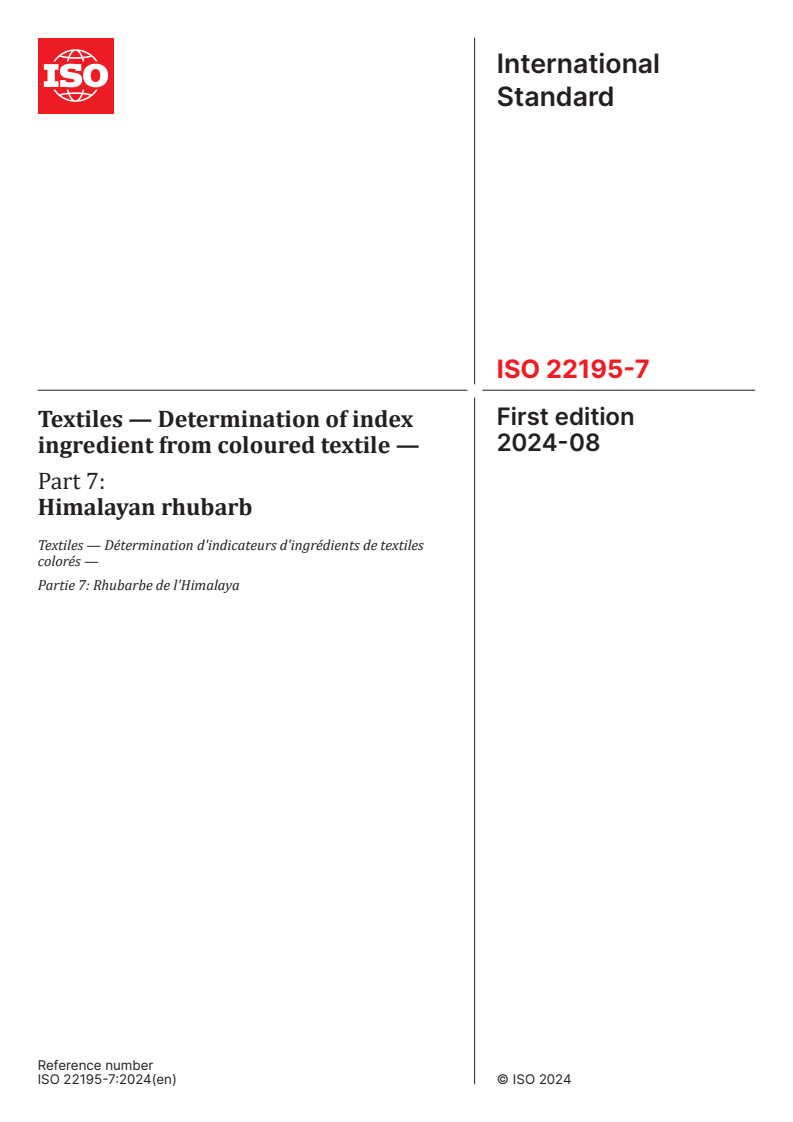
International
Standard
ISO 22195-7
First edition
Textiles — Determination of index
2024-08
ingredient from coloured textile —
Part 7:
Himalayan rhubarb
Textiles — Détermination d'indicateurs d'ingrédients de textiles
colorés —
Partie 7: Rhubarbe de l'Himalaya
Reference number
© ISO 2024
All rights reserved. Unless otherwise specified, or required in the context of its implementation, no part of this publication may
be reproduced or utilized otherwise in any form or by any means, electronic or mechanical, including photocopying, or posting on
the internet or an intranet, without prior written permission. Permission can be requested from either ISO at the address below
or ISO’s member body in the country of the requester.
ISO copyright office
CP 401 • Ch. de Blandonnet 8
CH-1214 Vernier, Geneva
Phone: +41 22 749 01 11
Email: copyright@iso.org
Website: www.iso.org
Published in Switzerland
ii
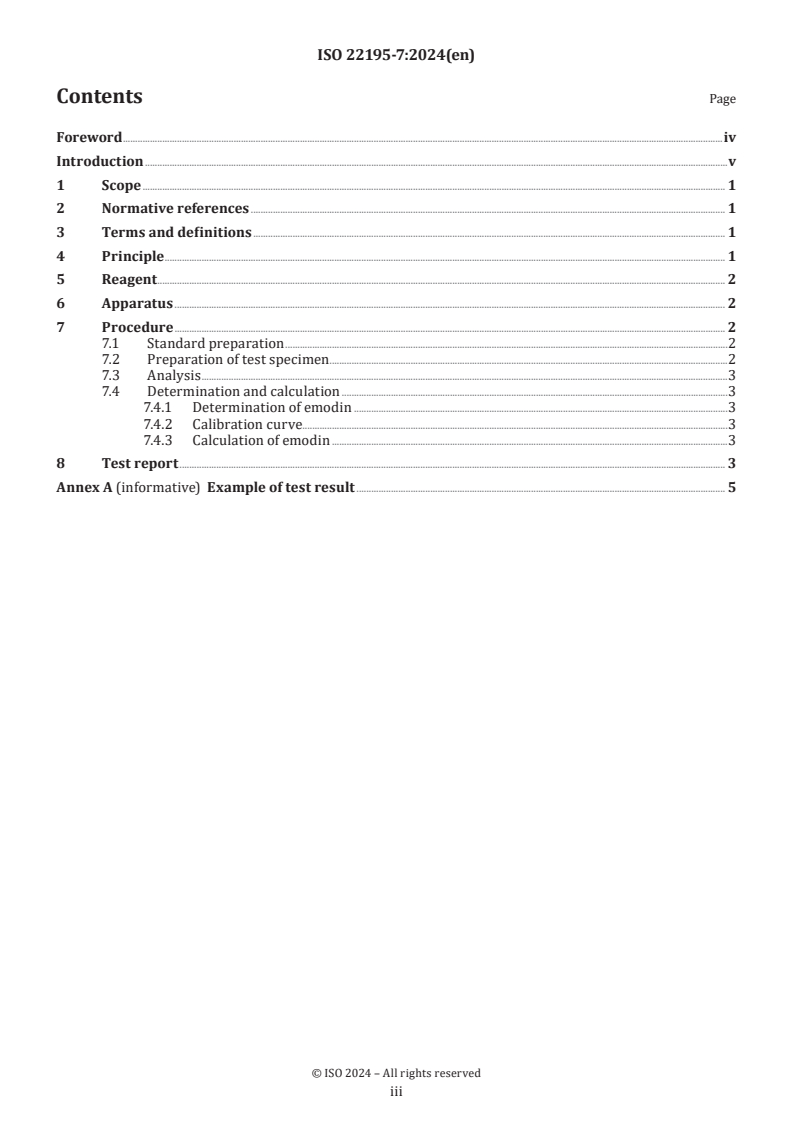
Contents Page
Foreword .iv
Introduction .v
1 Scope . 1
2 Normative references . 1
3 Terms and definitions . 1
4 Principle . 1
5 Reagent . 2
6 Apparatus . 2
7 Procedure . 2
7.1 Standard preparation .2
7.2 Preparation of test specimen .2
7.3 Analysis .3
7.4 Determination and calculation .3
7.4.1 Determination of emodin .3
7.4.2 Calibration curve.3
7.4.3 Calculation of emodin .3
8 Test report . 3
Annex A (informative) Example of test result . 5
iii
Foreword
ISO (the International Organization for Standardization) is a worldwide federation of national standards
bodies (ISO member bodies). The work of preparing International Standards is normally carried out through
ISO technical committees. Each member body interested in a subject for which a technical committee
has been established has the right to be represented on that committee. International organizations,
governmental and non-governmental, in liaison with ISO, also take part in the work. ISO collaborates closely
with the International Electrotechnical Commission (IEC) on all matters of electrotechnical standardization.
The procedures used to develop this document and those intended for its further maintenance are described
in the ISO/IEC Directives, Part 1. In particular, the different approval criteria needed for the different types
of ISO document should be noted. This document was drafted in accordance with the editorial rules of the
ISO/IEC Directives, Part 2 (see www.iso.org/directives).
ISO draws attention to the possibility that the implementation of this document may involve the use of (a)
patent(s). ISO takes no position concerning the evidence, validity or applicability of any claimed patent
rights in respect thereof. As of the date of publication of this document, ISO had not received notice of (a)
patent(s) which may be required to implement this document. However, implementers are cautioned that
this may not represent the latest information, which may be obtained from the patent database available at
www.iso.org/patents. ISO shall not be held responsible for identifying any or all such patent rights.
Any trade name used in this document is information given for the convenience of users and does not
constitute an endorsement.
For an explanation of the voluntary nature of standards, the meaning of ISO specific terms and expressions
related to conformity assessment, as well as information about ISO's adherence to the World Trade
Organization (WTO) principles in the Technical Barriers to Trade (TBT), see www.iso.org/iso/foreword.html.
This document was prepared by Technical Committee ISO/TC 38, Textiles.
A list of all parts in the ISO 22195 series can be found on the ISO website.
Any feedback or questions on this document should be directed to the user’s national standards body. A
complete listing of these bodies can be found at www.iso.org/members.html.
iv
Introduction
There is no doubt that dyeing plays the most important role in expressing the colour of clothes. Until the
invention of synthetic dyes capable of expressing diverse colours, materials obtained from nature to dye
fabric have been used. Typically, colourants were obtained from plants or various materials were extracted
from minerals or insects. When dyeing fabrics using materials derived from these natural substances, it
becomes necessary to identify which substances the colourant was derived from. In other words, there has
been a demand to confirm whether a fabric is dyed using a natural substance.
A test method is developed to identify which type of natural substances has been used.
v
International Standard ISO 22195-7:2024(en)
Textiles — Determination of index ingredient from coloured
textile —
Part 7:
Himalayan rhubarb
1 Scope
This document specifies a test method for the determination of the index ingredient of chemicals in coloured
textile with aqueous extracts from the flowers of Himalayan rhubarb.
2 Normative references
The following document is referred to in the text in such a way that some or all of their content constitutes
requirements of this document. For dated references, only the edition cited applies. For undated references,
the latest edition of the referenced document
...