

ISO 20932-1:2018
(Main)Textiles — Determination of the elasticity of fabrics — Part 1: Strip tests
General Information
- Abstract
This document describes the methods of test using strips of fabric in straight strip form or as loops, which can be used to measure elasticity and related properties of fabrics, excluding narrow fabrics.
- Status
- Published
- Publication Date
- 20-Nov-2018
- Current Stage
- 9093 - International Standard confirmed
- Start Date
- 30-Apr-2024
- Completion Date
- 29-Aug-2026
Buy Documents
ISO 20932-1:2018 - Textiles -- Determination of the elasticity of fabrics

ISO 20932-1:2018 - Textiles — Determination of the elasticity of fabrics — Part 1: Strip tests/21/2018
ISO 20932-1:2018 - Textiles -- Détermination de l'élasticité des étoffes
ISO 20932-1:2018 - Textiles — Détermination de l'élasticité des étoffes — Partie 1: Essais sur bande/10/2020
Overview
ISO 20932-1:2018 - Textiles: Determination of the elasticity of fabrics - Part 1: Strip tests - specifies laboratory methods for measuring fabric elasticity using straight strip tests or loop tests. The standard covers test specimen preparation, apparatus, testing procedures and result calculations for woven, knitted and non‑woven fabrics (excluding narrow fabrics). It is based on EN 14704-1 and references conditioning and equipment standards to ensure reliable, repeatable elasticity measurements.
Key topics and technical requirements
- Scope and terms: Defines key concepts such as elasticity, elongation, pretension, permanent deformation, force decay and cycle.
- Test methods: Two main specimen methods:
- Method A - Strip test specimens (full‑width gripped in line clamps).
- Method B - Loop test specimens (seamed loop placed on a loop bar assembly).
- Apparatus:
- CRE testing machine (constant‑rate‑of‑extension) with metrological confirmation per ISO 10012 and force/elongation accuracy at least class 1 of ISO 7500‑1.
- Data acquisition frequency: ≥ 8 samples/s.
- Extension rates 20–500 mm/min (±10 %); gauge lengths 100–250 mm (±1 mm).
- Line clamps designed to prevent slippage (convex jaw radius 3 mm) and wide enough for specimen width; pneumatic grips recommended.
- Loop bar assembly with bar diameters typically 4–8 mm and minimum internal dimension 80 mm.
- Specimen preparation: Procedures for woven, knitted and nonwoven fabrics, including cutting, fraying control and sewing (type 301 lockstitch per ISO 4915) for loop specimens.
- Testing and reporting: Cycling a specimen between gauge length and fixed load/extension; measurement of maximum force, elongation, force decay (time and exercising), permanent deformation and elastic recovery. Sampling guidance is provided (see Annex B).
Applications and practical value
ISO 20932-1:2018 is used to:
- Evaluate elastic performance of fabrics in quality control and product development.
- Compare materials for sportswear, medical textiles, upholstery, technical textiles and other applications where stretch and recovery are critical.
- Provide data for specification writing, supplier agreements and conformity testing.
- Support R&D teams in assessing the behaviour of elastane‑containing or engineered yarn/fabric constructions.
Who should use this standard
- Textile testing laboratories and quality control teams
- Textile engineers and product developers
- Manufacturers of garments, technical and medical textiles
- Standards bodies and compliance officers
Related standards
- ISO 139 - Standard atmospheres for conditioning and testing
- ISO 4915 - Stitch types (sewing for loop specimens)
- ISO 7500‑1 - Verification of tensile testing machines
- ISO 10012 - Measurement management systems
- EN 14704‑1 - Basis for this ISO document
Keywords: ISO 20932-1:2018, textile elasticity test, strip tests, loop tests, CRE testing machine, fabric elongation, elastic recovery, force decay.
Relations
- Effective Date
- 09-Feb-2026
- Effective Date
- 09-Feb-2026
- Effective Date
- 24-Apr-2021
Buy Documents
ISO 20932-1:2018 - Textiles -- Determination of the elasticity of fabrics
ISO 20932-1:2018 - Textiles — Determination of the elasticity of fabrics — Part 1: Strip tests/21/2018
ISO 20932-1:2018 - Textiles -- Détermination de l'élasticité des étoffes
ISO 20932-1:2018 - Textiles — Détermination de l'élasticité des étoffes — Partie 1: Essais sur bande/10/2020
Get Certified
Connect with accredited certification bodies for this standard

Control Union Certifications
Global certification for agriculture and sustainability.

Hohenstein Institut
Textile testing and certification.

Bureau Veritas Bangladesh
Bureau Veritas certification services in Bangladesh.
Sponsored listings
Frequently Asked Questions
ISO 20932-1:2018 is a standard published by the International Organization for Standardization (ISO). Its full title is "Textiles — Determination of the elasticity of fabrics — Part 1: Strip tests". This standard covers: This document describes the methods of test using strips of fabric in straight strip form or as loops, which can be used to measure elasticity and related properties of fabrics, excluding narrow fabrics.
This document describes the methods of test using strips of fabric in straight strip form or as loops, which can be used to measure elasticity and related properties of fabrics, excluding narrow fabrics.
ISO 20932-1:2018 is classified under the following ICS (International Classification for Standards) categories: 59.080.30 - Textile fabrics. The ICS classification helps identify the subject area and facilitates finding related standards.
ISO 20932-1:2018 has the following relationships with other standards: It is inter standard links to EN ISO 20932-2:2020, EN ISO 20932-3:2020, ISO 20932-1:2018/Amd 1:2021. Understanding these relationships helps ensure you are using the most current and applicable version of the standard.
ISO 20932-1:2018 is available in PDF format for immediate download after purchase. The document can be added to your cart and obtained through the secure checkout process. Digital delivery ensures instant access to the complete standard document.
Standards Content (Sample)
INTERNATIONAL ISO
STANDARD 20932-1
First edition
2018-11
Textiles — Determination of the
elasticity of fabrics —
Part 1:
Strip tests
Textiles — Détermination de l'élasticité des étoffes —
Partie 1: Essais sur bande
Reference number
©
ISO 2018
© ISO 2018
All rights reserved. Unless otherwise specified, or required in the context of its implementation, no part of this publication may
be reproduced or utilized otherwise in any form or by any means, electronic or mechanical, including photocopying, or posting
on the internet or an intranet, without prior written permission. Permission can be requested from either ISO at the address
below or ISO’s member body in the country of the requester.
ISO copyright office
CP 401 • Ch. de Blandonnet 8
CH-1214 Vernier, Geneva
Phone: +41 22 749 01 11
Fax: +41 22 749 09 47
Email: copyright@iso.org
Website: www.iso.org
Published in Switzerland
ii © ISO 2018 – All rights reserved
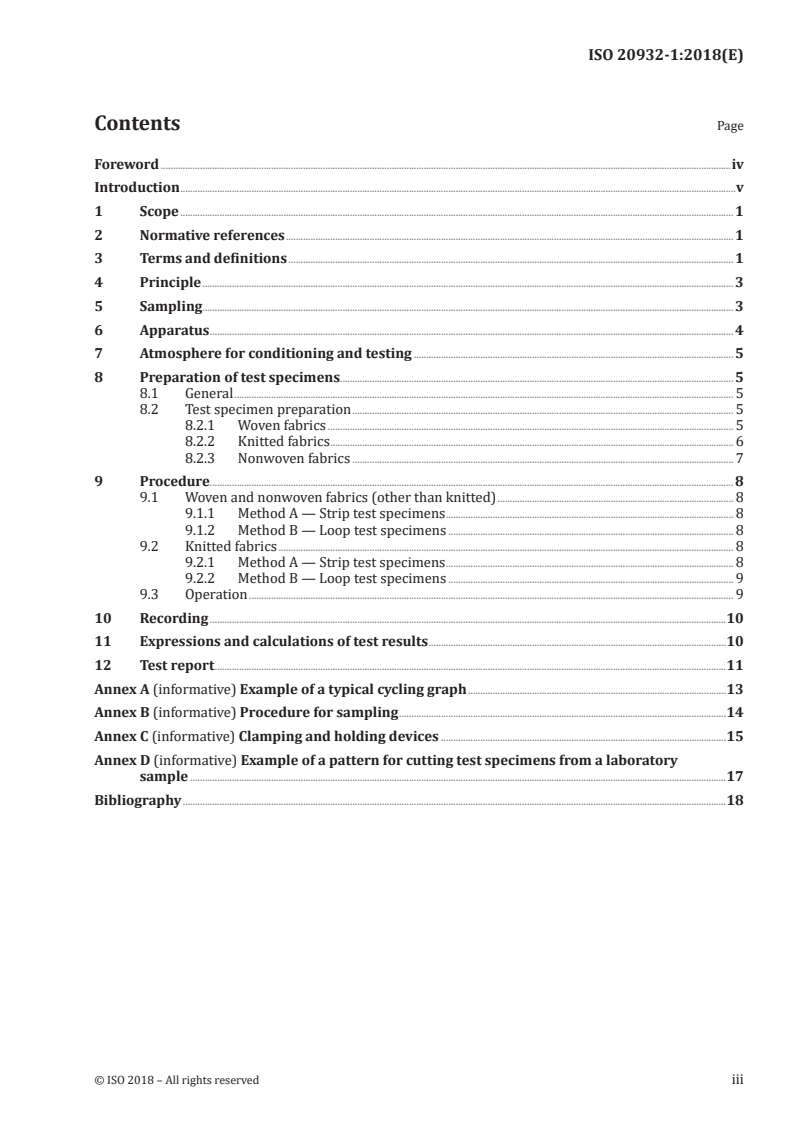
Contents Page
Foreword .iv
Introduction .v
1 Scope . 1
2 Normative references . 1
3 Terms and definitions . 1
4 Principle . 3
5 Sampling . 3
6 Apparatus . 4
7 Atmosphere for conditioning and testing . 5
8 Preparation of test specimens . 5
8.1 General . 5
8.2 Test specimen preparation . 5
8.2.1 Woven fabrics . 5
8.2.2 Knitted fabrics . 6
8.2.3 Nonwoven fabrics . 7
9 Procedure. 8
9.1 Woven and nonwoven fabrics (other than knitted) . 8
9.1.1 Method A — Strip test specimens . 8
9.1.2 Method B — Loop test specimens . 8
9.2 Knitted fabrics . 8
9.2.1 Method A — Strip test specimens . 8
9.2.2 Method B — Loop test specimens . 9
9.3 Operation . 9
10 Recording .10
11 Expressions and calculations of test results .10
12 Test report .11
Annex A (informative) Example of a typical cycling graph .13
Annex B (informative) Procedure for sampling .14
Annex C (informative) Clamping and holding devices .15
Annex D (informative) Example of a pattern for cutting test specimens from a laboratory
sample .17
Bibliography .18
Foreword
ISO (the International Organization for Standardization) is a worldwide federation of national standards
bodies (ISO member bodies). The work of preparing International Standards is normally carried out
through ISO technical committees. Each member body interested in a subject for which a technical
committee has been established has the right to be represented on that committee. International
organizations, governmental and non-governmental, in liaison with ISO, also take part in the work.
ISO collaborates closely with the International Electrotechnical Commission (IEC) on all matters of
electrotechnical standardization.
The procedures used to develop this document and those intended for its further maintenance are
described in the ISO/IEC Directives, Part 1. In particular the different approval criteria needed for the
different types of ISO documents should be noted. This document was drafted in accordance with the
editorial rules of the ISO/IEC Directives, Part 2 (see www .iso .org/directives).
Attention is drawn to the possibility that some of the elements of this document may be the subject of
patent rights. ISO shall not be held responsible for identifying any or all such patent rights. Details of
any patent rights identified during the development of the document will be in the Introduction and/or
on the ISO list of patent declarations received (see www .iso .org/patents).
Any trade name used in this document is information given for the convenience of users and does not
constitute an endorsement.
For an explanation on the voluntary nature of standards, the meaning of ISO specific terms and
expressions related to conformity assessment, as well as information about ISO's adherence to the
World Trade Organization (WTO) principles in the Technical Barriers to Trade (TBT) see the following
URL: www .iso .org/iso/foreword .html.
This document was prepared by Technical Committee ISO/TC 38, Textiles, Subcommittee SC 24,
Conditioning atmospheres and physical tests for textile fabrics.
Any feedback or questions on this document should be directed to the user’s national standards body. A
complete listing of these bodies can be found at www .iso .org/members .html.
A list of all parts in the ISO 20932 series can be found on the ISO website.
iv © ISO 2018 – All rights reserved
Introduction
This document was developed as a result of technical advancements in yarn and fabric structures and
properties, which increase product range and developments.
[1]
This document is based on EN 14704-1 .
INTERNATIONAL STANDARD ISO 20932-1:2018(E)
Textiles — Determination of the elasticity of fabrics —
Part 1:
Strip tests
1 Scope
This document describes the methods of test using strips of fabric in straight strip form or as loops,
which can be used to measure elasticity and related properties of fabrics, excluding narrow fabrics.
2 Normative references
The following documents are referred to in the text in such a way that some or all of their content
constitutes requirements of this document. For dated references, only the edition cited applies. For
undated references, the latest edition of the referenced document (including any amendments) applies.
ISO 139, Textiles — Standard atmospheres for conditioning and testing
ISO 4915, Textiles — Stitch types — Classification and terminology
ISO 7500-1, Metallic materials — Verification of static uniaxial testing machines — Part 1: Tension/
compression testing machines — Calibration and verification of the force-measuring system
ISO 10012, Measurement management systems — Requirements for measurement processes and measuring
equipment
3 Terms and definitions
For the purposes of this document, the following terms and definitions apply.
ISO and IEC maintain terminological databases for use in standardization at the following addresses:
— ISO Online browsing platform: available at https: //www .iso .org/obp
— IEC Electropedia: available at http: //www .electropedia .org/
3.1
narrow fabric
woven or knitted construction intended for use as a trim, binding, edging, strapping or harness, and
designed to be used in its full width
3.2
elasticity
ability to recover original size and shape immediately after the removal of the force causing
deformation
3.3
constant-rate-of-extension testing machine
CRE testing machine
tensile testing machine provided with one clamp, which is stationary, and another clamp, which moves
with a constant speed throughout the test, the entire testing system being virtually free from deflection
3.4
strip test specimen
test specimen in which the full width is gripped in the jaws of the testing machine
3.5
loop test specimen
test specimen in which a seam is made to create a loop of the full width of the specimen and which is
placed around a loop bar assembly positioned on the testing machine
Note 1 to entry: This method of preparation is useful when any ageing or exposure testing is to be carried out on
the specimens after measurement.
3.6
gauge length
distance between the two effective clamping or holding points of a testing device
Note 1 to entry: For strip tests, method A: distance between the two contact points of the line clamps.
Note 2 to entry: For loop tests, method B: half of the circumference around the loop bar assembly.
3.7
slack mounting
insertion of a strip test specimen (3.4) in the line clamps of the upper jaw, allowing it to hang freely
under its own weight, guided by the hand to ensure perpendicular alignment to the line of pulling force,
without any force being applied
3.8
initial length
length of the test specimen between the two effective clamping or holding points, at the beginning of
the test (after slack mounting (3.7) or under specified pretension)
3.9
pretension
force applied to a test specimen at the beginning of certain tests
Note 1 to entry: Pretension is used to determine the initial length of the test specimen.
[SOURCE: ISO 13934-1:2013, 3.5, modified — References to 3.4 and 3.7 have been removed from Note 1
to entry.]
3.10
extension
increase in length of a test specimen during testing
Note 1 to entry: Extension is expressed in units of the length.
3.11
elongation
ratio of the extension (3.10) of the test specimen to its initial length
Note 1 to entry: Elongation is expressed as a percentage.
3.12
maximum force
force at the position when a test specimen is taken to a fixed extension (3.10)
Note 1 to entry: Maximum force is expressed in newtons.
3.13
maximum extension
extension (3.10) recorded in millimetres at the position when a test specimen is taken to a fixed load
Note 1 to entry: Maximum extension is expressed in units of the length.
2 © ISO 2018 – All rights reserved
3.14
force at specified elongation
force measured at a given elongation (3.11) on either the load or unload curves
3.15
cycle
process whereby a fabric is taken from the gauge length (3.6) to a fixed load or fixed extension or
elongation and returned to gauge length
3.16
force decay due to time
loss of force measured over time when a test specimen is stretched to a specified elongation or force
and held at this position for a given time period
Note 1 to entry: The decay in force is expressed as a percentage of the original force recorded at the specified
position (see Annex A, Figure A.1).
3.17
force decay due to exercising
loss of force, calculated and expressed as a percentage, as measured and recorded at the same elongation
point on two different cycles when the test specimen is cycled several times between the gauge length
(3.6) and a specified elongation
Note 1 to entry: See Annex A, Figure A.1.
3.18
permanent deformation
ratio of unrecovered extension of the test specimen after cycling (to a specified force or specified
extension) to its initial length
Note 1 to entry: Permanent deformation is expressed as a percentage.
3.19
recovered elongation
complement of permanent deformation (3.18) to 100 %
Note 1 to entry: Recovered elongation is expressed as a percentage.
3.20
elastic recovery
recovered elongation (3.19) of the total elongation
Note 1 to entry: Elastic recovery is expressed as a percentage.
4 Principle
A fabric test specimen of specified dimensions is extended at a constant rate to either a specified
force or elongation for an agreed number of cycles, and its elasticity determined by measuring certain
characteristics.
5 Sampling
Fabric samples shall be selected in accordance with the product specification. In the absence of a
product specification for the fabric, the sampling method given in Annex B may be used.
6 Apparatus
6.1 CRE testing machine.
Metrological confirmation system of the tensile testing machine shall be in accordance with ISO 10012.
The constant-rate-of-extension (CRE) testing machine shall conform to the following.
a) The tensile testing machine shall be provided with the means for indicating or recording the force
and elongation values when cycling between gauge length and either a fixed load or fixed extension.
Under conditions of use, the accuracy of the apparatus shall be at least class 1 of ISO 7500-1. The
error of the indicated or recorded maximum force at any point in the range in which the machine
is used shall not exceed 1 %, and the error of the indicated or recorded jaw separation shall not
exceed 1 mm.
b) If recording of force or elongation is obtained by means of data acquisition boards and software,
the frequency of data collection shall be at least eight per second.
c) The machine shall be capable of constant rates of extension including 20 mm/min to 500 mm/min
with an accuracy of ±10 %.
d) The machine shall be capable of variable gauge length settings including 100 mm to 250 mm, to an
accuracy of ±1 mm.
e) The clamping or holding devices shall be positioned with their central point in line of the applied
force. The machine shall be calibrated with the clamping or holding devices in position and the jaw
faces closed, where applicable.
6.2 Line clamps (for method A).
The jaws shall be capable of holding the test specimen without allowing it to slip and designed so that
they do not cut or otherwise weaken the test specimen.
Line clamps, as shown in Annex C, Figure C.1, shall consist of two jaws, one being of steel plate, the
other having a convex 3 mm radius. The line of contact of the jaws shall be perpendicular to the line of
increasing force. The clamping faces shall be in the same plane.
The line clamp jaws shall not be less than the width of the test specimen.
NOTE Significant levels of work have shown this type of line clamp is the preferred type for elastane/
elastodiene containing fabrics as fabric slippage is insignificant. If a fabric slips, the elongation values are
inaccurate.
Pneumatic operated grips are recommended as hand tightening of manual grips can cause distortion
of the test specimen. The air pressure should be sufficient to prevent slippage when compensating the
decreasing thickness of the fabric but should not cut or otherwise weaken the test specimen.
6.3 Loop bar assembly (for method B).
The loop bar assembly shall be as shown in Annex C, Figure C.2 a) or b) and typically comprises two
steel bars of circular cross-section and the diameter between 4 mm and 8 mm. The specimen is looped
over these bars and extended as the bars move apart. The axes of the bars shall be perpendicular to the
line of increasing force. The steel bar holders shall have a minimum internal dimension of 80 mm.
6.4 Equipment, for cutting test specimens and for fraying, where applicable to the required
dimensions.
6.5 Sewing machine, capable of producing a type 301 lockstitch as defined in ISO 4915, furnished
with a medium ballpoint needle (90s SUK) and 470 decitex (ticket 75’s) polyester core-spun thread.
4 © ISO 2018 – All rights reserved
NOTE If there is a risk of damage to the fabric, a finer needle and corresponding polyester core spun thread
can be used.
6.6 Calibrated metal rule, graduated in millimetres.
7 Atmosphere for conditioning and testing
The atmospheres for preconditioning, conditioning and testing shall be as specified in ISO 139.
The fabric samples shall be conditioned for a minimum of 20 h in a tension free state. The prepared test
specimens shall be conditioned in a tension free state for a further 4 h after preparation, to minimize
the effects of handling during preparation.
8 Preparation of test specimens
8.1 General
From each laboratory sample, a set of test specimens shall be cut in the direction(s) of th
...
INTERNATIONAL ISO
STANDARD 20932-1
First edition
2018-11
Textiles — Determination of the
elasticity of fabrics —
Part 1:
Strip tests
Textiles — Détermination de l'élasticité des étoffes —
Partie 1: Essais sur bande
Reference number
©
ISO 2018
© ISO 2018
All rights reserved. Unless otherwise specified, or required in the context of its implementation, no part of this publication may
be reproduced or utilized otherwise in any form or by any means, electronic or mechanical, including photocopying, or posting
on the internet or an intranet, without prior written permission. Permission can be requested from either ISO at the address
below or ISO’s member body in the country of the requester.
ISO copyright office
CP 401 • Ch. de Blandonnet 8
CH-1214 Vernier, Geneva
Phone: +41 22 749 01 11
Fax: +41 22 749 09 47
Email: copyright@iso.org
Website: www.iso.org
Published in Switzerland
ii © ISO 2018 – All rights reserved
Contents Page
Foreword .iv
Introduction .v
1 Scope . 1
2 Normative references . 1
3 Terms and definitions . 1
4 Principle . 3
5 Sampling . 3
6 Apparatus . 4
7 Atmosphere for conditioning and testing . 5
8 Preparation of test specimens . 5
8.1 General . 5
8.2 Test specimen preparation . 5
8.2.1 Woven fabrics . 5
8.2.2 Knitted fabrics . 6
8.2.3 Nonwoven fabrics . 7
9 Procedure. 8
9.1 Woven and nonwoven fabrics (other than knitted) . 8
9.1.1 Method A — Strip test specimens . 8
9.1.2 Method B — Loop test specimens . 8
9.2 Knitted fabrics . 8
9.2.1 Method A — Strip test specimens . 8
9.2.2 Method B — Loop test specimens . 9
9.3 Operation . 9
10 Recording .10
11 Expressions and calculations of test results .10
12 Test report .11
Annex A (informative) Example of a typical cycling graph .13
Annex B (informative) Procedure for sampling .14
Annex C (informative) Clamping and holding devices .15
Annex D (informative) Example of a pattern for cutting test specimens from a laboratory
sample .17
Bibliography .18
Foreword
ISO (the International Organization for Standardization) is a worldwide federation of national standards
bodies (ISO member bodies). The work of preparing International Standards is normally carried out
through ISO technical committees. Each member body interested in a subject for which a technical
committee has been established has the right to be represented on that committee. International
organizations, governmental and non-governmental, in liaison with ISO, also take part in the work.
ISO collaborates closely with the International Electrotechnical Commission (IEC) on all matters of
electrotechnical standardization.
The procedures used to develop this document and those intended for its further maintenance are
described in the ISO/IEC Directives, Part 1. In particular the different approval criteria needed for the
different types of ISO documents should be noted. This document was drafted in accordance with the
editorial rules of the ISO/IEC Directives, Part 2 (see www .iso .org/directives).
Attention is drawn to the possibility that some of the elements of this document may be the subject of
patent rights. ISO shall not be held responsible for identifying any or all such patent rights. Details of
any patent rights identified during the development of the document will be in the Introduction and/or
on the ISO list of patent declarations received (see www .iso .org/patents).
Any trade name used in this document is information given for the convenience of users and does not
constitute an endorsement.
For an explanation on the voluntary nature of standards, the meaning of ISO specific terms and
expressions related to conformity assessment, as well as information about ISO's adherence to the
World Trade Organization (WTO) principles in the Technical Barriers to Trade (TBT) see the following
URL: www .iso .org/iso/foreword .html.
This document was prepared by Technical Committee ISO/TC 38, Textiles, Subcommittee SC 24,
Conditioning atmospheres and physical tests for textile fabrics.
Any feedback or questions on this document should be directed to the user’s national standards body. A
complete listing of these bodies can be found at www .iso .org/members .html.
A list of all parts in the ISO 20932 series can be found on the ISO website.
iv © ISO 2018 – All rights reserved
Introduction
This document was developed as a result of technical advancements in yarn and fabric structures and
properties, which increase product range and developments.
[1]
This document is based on EN 14704-1 .
INTERNATIONAL STANDARD ISO 20932-1:2018(E)
Textiles — Determination of the elasticity of fabrics —
Part 1:
Strip tests
1 Scope
This document describes the methods of test using strips of fabric in straight strip form or as loops,
which can be used to measure elasticity and related properties of fabrics, excluding narrow fabrics.
2 Normative references
The following documents are referred to in the text in such a way that some or all of their content
constitutes requirements of this document. For dated references, only the edition cited applies. For
undated references, the latest edition of the referenced document (including any amendments) applies.
ISO 139, Textiles — Standard atmospheres for conditioning and testing
ISO 4915, Textiles — Stitch types — Classification and terminology
ISO 7500-1, Metallic materials — Verification of static uniaxial testing machines — Part 1: Tension/
compression testing machines — Calibration and verification of the force-measuring system
ISO 10012, Measurement management systems — Requirements for measurement processes and measuring
equipment
3 Terms and definitions
For the purposes of this document, the following terms and definitions apply.
ISO and IEC maintain terminological databases for use in standardization at the following addresses:
— ISO Online browsing platform: available at https: //www .iso .org/obp
— IEC Electropedia: available at http: //www .electropedia .org/
3.1
narrow fabric
woven or knitted construction intended for use as a trim, binding, edging, strapping or harness, and
designed to be used in its full width
3.2
elasticity
ability to recover original size and shape immediately after the removal of the force causing
deformation
3.3
constant-rate-of-extension testing machine
CRE testing machine
tensile testing machine provided with one clamp, which is stationary, and another clamp, which moves
with a constant speed throughout the test, the entire testing system being virtually free from deflection
3.4
strip test specimen
test specimen in which the full width is gripped in the jaws of the testing machine
3.5
loop test specimen
test specimen in which a seam is made to create a loop of the full width of the specimen and which is
placed around a loop bar assembly positioned on the testing machine
Note 1 to entry: This method of preparation is useful when any ageing or exposure testing is to be carried out on
the specimens after measurement.
3.6
gauge length
distance between the two effective clamping or holding points of a testing device
Note 1 to entry: For strip tests, method A: distance between the two contact points of the line clamps.
Note 2 to entry: For loop tests, method B: half of the circumference around the loop bar assembly.
3.7
slack mounting
insertion of a strip test specimen (3.4) in the line clamps of the upper jaw, allowing it to hang freely
under its own weight, guided by the hand to ensure perpendicular alignment to the line of pulling force,
without any force being applied
3.8
initial length
length of the test specimen between the two effective clamping or holding points, at the beginning of
the test (after slack mounting (3.7) or under specified pretension)
3.9
pretension
force applied to a test specimen at the beginning of certain tests
Note 1 to entry: Pretension is used to determine the initial length of the test specimen.
[SOURCE: ISO 13934-1:2013, 3.5, modified — References to 3.4 and 3.7 have been removed from Note 1
to entry.]
3.10
extension
increase in length of a test specimen during testing
Note 1 to entry: Extension is expressed in units of the length.
3.11
elongation
ratio of the extension (3.10) of the test specimen to its initial length
Note 1 to entry: Elongation is expressed as a percentage.
3.12
maximum force
force at the position when a test specimen is taken to a fixed extension (3.10)
Note 1 to entry: Maximum force is expressed in newtons.
3.13
maximum extension
extension (3.10) recorded in millimetres at the position when a test specimen is taken to a fixed load
Note 1 to entry: Maximum extension is expressed in units of the length.
2 © ISO 2018 – All rights reserved
3.14
force at specified elongation
force measured at a given elongation (3.11) on either the load or unload curves
3.15
cycle
process whereby a fabric is taken from the gauge length (3.6) to a fixed load or fixed extension or
elongation and returned to gauge length
3.16
force decay due to time
loss of force measured over time when a test specimen is stretched to a specified elongation or force
and held at this position for a given time period
Note 1 to entry: The decay in force is expressed as a percentage of the original force recorded at the specified
position (see Annex A, Figure A.1).
3.17
force decay due to exercising
loss of force, calculated and expressed as a percentage, as measured and recorded at the same elongation
point on two different cycles when the test specimen is cycled several times between the gauge length
(3.6) and a specified elongation
Note 1 to entry: See Annex A, Figure A.1.
3.18
permanent deformation
ratio of unrecovered extension of the test specimen after cycling (to a specified force or specified
extension) to its initial length
Note 1 to entry: Permanent deformation is expressed as a percentage.
3.19
recovered elongation
complement of permanent deformation (3.18) to 100 %
Note 1 to entry: Recovered elongation is expressed as a percentage.
3.20
elastic recovery
recovered elongation (3.19) of the total elongation
Note 1 to entry: Elastic recovery is expressed as a percentage.
4 Principle
A fabric test specimen of specified dimensions is extended at a constant rate to either a specified
force or elongation for an agreed number of cycles, and its elasticity determined by measuring certain
characteristics.
5 Sampling
Fabric samples shall be selected in accordance with the product specification. In the absence of a
product specification for the fabric, the sampling method given in Annex B may be used.
6 Apparatus
6.1 CRE testing machine.
Metrological confirmation system of the tensile testing machine shall be in accordance with ISO 10012.
The constant-rate-of-extension (CRE) testing machine shall conform to the following.
a) The tensile testing machine shall be provided with the means for indicating or recording the force
and elongation values when cycling between gauge length and either a fixed load or fixed extension.
Under conditions of use, the accuracy of the apparatus shall be at least class 1 of ISO 7500-1. The
error of the indicated or recorded maximum force at any point in the range in which the machine
is used shall not exceed 1 %, and the error of the indicated or recorded jaw separation shall not
exceed 1 mm.
b) If recording of force or elongation is obtained by means of data acquisition boards and software,
the frequency of data collection shall be at least eight per second.
c) The machine shall be capable of constant rates of extension including 20 mm/min to 500 mm/min
with an accuracy of ±10 %.
d) The machine shall be capable of variable gauge length settings including 100 mm to 250 mm, to an
accuracy of ±1 mm.
e) The clamping or holding devices shall be positioned with their central point in line of the applied
force. The machine shall be calibrated with the clamping or holding devices in position and the jaw
faces closed, where applicable.
6.2 Line clamps (for method A).
The jaws shall be capable of holding the test specimen without allowing it to slip and designed so that
they do not cut or otherwise weaken the test specimen.
Line clamps, as shown in Annex C, Figure C.1, shall consist of two jaws, one being of steel plate, the
other having a convex 3 mm radius. The line of contact of the jaws shall be perpendicular to the line of
increasing force. The clamping faces shall be in the same plane.
The line clamp jaws shall not be less than the width of the test specimen.
NOTE Significant levels of work have shown this type of line clamp is the preferred type for elastane/
elastodiene containing fabrics as fabric slippage is insignificant. If a fabric slips, the elongation values are
inaccurate.
Pneumatic operated grips are recommended as hand tightening of manual grips can cause distortion
of the test specimen. The air pressure should be sufficient to prevent slippage when compensating the
decreasing thickness of the fabric but should not cut or otherwise weaken the test specimen.
6.3 Loop bar assembly (for method B).
The loop bar assembly shall be as shown in Annex C, Figure C.2 a) or b) and typically comprises two
steel bars of circular cross-section and the diameter between 4 mm and 8 mm. The specimen is looped
over these bars and extended as the bars move apart. The axes of the bars shall be perpendicular to the
line of increasing force. The steel bar holders shall have a minimum internal dimension of 80 mm.
6.4 Equipment, for cutting test specimens and for fraying, where applicable to the required
dimensions.
6.5 Sewing machine, capable of producing a type 301 lockstitch as defined in ISO 4915, furnished
with a medium ballpoint needle (90s SUK) and 470 decitex (ticket 75’s) polyester core-spun thread.
4 © ISO 2018 – All rights reserved
NOTE If there is a risk of damage to the fabric, a finer needle and corresponding polyester core spun thread
can be used.
6.6 Calibrated metal rule, graduated in millimetres.
7 Atmosphere for conditioning and testing
The atmospheres for preconditioning, conditioning and testing shall be as specified in ISO 139.
The fabric samples shall be conditioned for a minimum of 20 h in a tension free state. The prepared test
specimens shall be conditioned in a tension free state for a further 4 h after preparation, to minimize
the effects of handling during preparation.
8 Preparation of test specimens
8.1 General
From each laboratory sample, a set of test specimens shall be cut in the direction(s) of th
...
NORME ISO
INTERNATIONALE 20932-1
Première édition
2018-11
Textiles — Détermination de
l'élasticité des étoffes —
Partie 1:
Essais sur bande
Textiles — Determination of the elasticity of fabrics —
Part 1: Strip tests
Numéro de référence
©
ISO 2018
DOCUMENT PROTÉGÉ PAR COPYRIGHT
© ISO 2018
Tous droits réservés. Sauf prescription différente ou nécessité dans le contexte de sa mise en œuvre, aucune partie de cette
publication ne peut être reproduite ni utilisée sous quelque forme que ce soit et par aucun procédé, électronique ou mécanique,
y compris la photocopie, ou la diffusion sur l’internet ou sur un intranet, sans autorisation écrite préalable. Une autorisation peut
être demandée à l’ISO à l’adresse ci-après ou au comité membre de l’ISO dans le pays du demandeur.
ISO copyright office
Case postale 401 • Ch. de Blandonnet 8
CH-1214 Vernier, Genève
Tél.: +41 22 749 01 11
Fax: +41 22 749 09 47
E-mail: copyright@iso.org
Web: www.iso.org
Publié en Suisse
ii © ISO 2018 – Tous droits réservés
Sommaire Page
Avant-propos .iv
Introduction .v
1 Domaine d’application . 1
2 Références normatives . 1
3 Termes et définitions . 1
4 Principe . 4
5 Échantillonnage . 4
6 Appareillage . 4
7 Atmosphères de conditionnement et d’essai . 5
8 Préparation des éprouvettes . 5
8.1 Généralités . 5
8.2 Préparation des éprouvettes . 5
8.2.1 Étoffes tissées . 5
8.2.2 Étoffes tricotées . 6
8.2.3 Étoffes non tissées . 7
9 Mode opératoire. 8
9.1 Étoffes tissées et non tissées (autres que tricotées) . . 8
9.1.1 Méthode A — Éprouvettes en bande . 8
9.1.2 Méthode B — Éprouvettes en boucle . 8
9.2 Étoffes tricotées . 9
9.2.1 Méthode A — Éprouvettes en bande . 9
9.2.2 Méthode B — Éprouvettes en boucle . 9
9.3 Essai .10
10 Enregistrement .10
11 Expressions et calculs des résultats d’essai .11
12 Rapport d’essai .12
Annexe A (informative) Exemple de graphe type de cycle .13
Annexe B (informative) Mode d’échantillonnage .14
Annexe C (informative) Dispositifs de serrage et de fixation.15
Annexe D (informative) Exemple de schéma de découpage des éprouvettes à partir de
l’échantillon pour laboratoire .17
Bibliographie .18
Avant-propos
L’ISO (Organisation internationale de normalisation) est une fédération mondiale d’organismes
nationaux de normalisation (comités membres de l’ISO). L’élaboration des Normes internationales est
en général confiée aux comités techniques de l’ISO. Chaque comité membre intéressé par une étude
a le droit de faire partie du comité technique créé à cet effet. Les organisations internationales,
gouvernementales et non gouvernementales, en liaison avec l’ISO participent également aux travaux.
L’ISO collabore étroitement avec la Commission électrotechnique internationale (IEC) en ce qui
concerne la normalisation électrotechnique.
Les procédures utilisées pour élaborer le présent document et celles destinées à sa mise à jour sont
décrites dans les Directives ISO/IEC, Partie 1. Il convient, en particulier, de prendre note des différents
critères d’approbation requis pour les différents types de documents ISO. Le présent document a été
rédigé conformément aux règles de rédaction données dans les Directives ISO/IEC, Partie 2 (voir www
.iso .org/ directives).
L’attention est attirée sur le fait que certains des éléments du présent document peuvent faire l’objet de
droits de propriété intellectuelle ou de droits analogues. L’ISO ne saurait être tenue pour responsable
de ne pas avoir identifié de tels droits de propriété et averti de leur existence. Les détails concernant
les références aux droits de propriété intellectuelle ou autres droits analogues identifiés lors de
l’élaboration du document sont indiqués dans l’Introduction et/ou dans la liste des déclarations de
brevets reçues par l’ISO (voir www .iso .org/ brevets).
Les appellations commerciales éventuellement mentionnées dans le présent document sont données
pour information, par souci de commodité, à l’intention des utilisateurs et ne sauraient constituer un
engagement.
Pour une explication de la nature volontaire des normes, la signification des termes et expressions
spécifiques de l’ISO liés à l’évaluation de la conformité, ou pour toute information au sujet de l’adhésion
de l’ISO aux principes de l’Organisation mondiale du commerce (OMC) concernant les obstacles
techniques au commerce (OTC), voir le lien suivant: www .iso .org/ iso/ fr/ avant -propos .html.
Le présent document a été élaboré par le comité technique ISO/TC 38, Textiles, sous-comité SC 24,
Atmosphères de conditionnement et essais physiques des étoffes.
Il convient que l’utilisateur adresse tout retour d’information ou toute question concernant le présent
document à l’organisme national de normalisation de son pays. Une liste exhaustive desdits organismes
se trouve à l’adresse www .iso .org/ fr/ members .html.
Une liste de toutes les parties de la série ISO 20932 se trouve sur le site web de l’ISO.
iv © ISO 2018 – Tous droits réservés
Introduction
Le présent document a été élaboré faisant suite aux progrès techniques réalisés en matière de structures
et de propriétés des fils et des étoffes, progrès qui augmentent les gammes et les développements de
produits.
[1]
Le présent document est fondé sur l’EN 14704-1 .
NORME INTERNATIONALE ISO 20932-1:2018(F)
Textiles — Détermination de l'élasticité des étoffes —
Partie 1:
Essais sur bande
1 Domaine d’application
Le présent document décrit des méthodes d’essai utilisant des bandes droites d’étoffes ou en boucles,
qui peuvent être utilisées pour mesurer l’élasticité et les propriétés connexes des étoffes, à l’exclusion
des étoffes étroites.
2 Références normatives
Les documents suivants cités dans le texte constituent, pour tout ou partie de leur contenu, des
exigences du présent document. Pour les références datées, seule l’édition citée s’applique. Pour les
références non datées, la dernière édition du document de référence s’applique (y compris les éventuels
amendements).
ISO 139, Textiles — Atmosphères normales de conditionnement et d'essai
ISO 4915, Textiles — Types de points — Classification et terminologie
ISO 7500-1, Matériaux métalliques — Étalonnage et vérification des machines pour essais statiques
uniaxiaux — Partie 1: Machines d'essai de traction/compression — Étalonnage et vérification du système
de mesure de force
ISO 10012, Systèmes de management de la mesure — Exigences pour les processus et les équipements
de mesure
3 Termes et définitions
Pour les besoins du présent document, les termes et définitions suivants s’appliquent.
L’ISO et l’IEC tiennent à jour des bases de données terminologiques destinées à être utilisées en
normalisation, consultables aux adresses suivantes:
— ISO Online browsing platform: disponible à l’adresse https:// www .iso .org/ obp
— IEC Electropedia: disponible à l’adresse http:// www .electropedia .org/
3.1
étoffe étroite
construction tissée ou tricotée, destinée à servir en passementerie ou comme élément de liaison,
bordure, sangle ou harnais et conçue pour être utilisée dans toute sa largeur
3.2
élasticité
aptitude à retrouver sa dimension et sa forme d’origine immédiatement après la
suppression de la force qui a provoqué la déformation
3.3
appareil d’essai à vitesse constante d’allongement
appareil d’essai CRE
appareil d’essai de traction équipé d’une pince qui reste fixe et d’une autre qui se déplace à une vitesse
constante tout au long de l’essai, l’ensemble du dispositif d’essai ne présentant pratiquement aucune
déviation
3.4
éprouvette en bande
éprouvette d’essai dont la largeur totale est serrée dans les mâchoires de l’appareil d’essai
3.5
éprouvette en boucle
éprouvette d’essai pour laquelle une couture est réalisée pour créer une boucle sur toute la largeur de
l’éprouvette destinée à être mise en place autour d’un assemblage de barres pour boucle positionné sur
l’appareil d’essai
Note 1 à l'article: Cette méthode de préparation est utile lorsque les essais de vieillissement ou d’exposition
doivent être réalisés sur les éprouvettes après mesure.
3.6
longueur d’essai
distance entre les deux points utiles de serrage ou de fixation d’un dispositif d’essai
Note 1 à l'article: Pour les essais sur bande, méthode A: la longueur d’essai est la distance entre les deux lignes de
contact des pinces linéaires.
Note 2 à l'article: Pour les essais sur boucle, méthode B: la longueur d’essai est la moitié de la circonférence autour
des barres.
3.7
mise en place lâche
pour les éprouvettes en bande (3.4), mise en place dans laquelle l’éprouvette est insérée dans les
mâchoires supérieures et pend librement sous l’effet de sa propre masse, avec guidage à la main pour
assurer l’alignement perpendiculaire par rapport à la ligne de la force de traction, aucune force n’étant
appliquée
3.8
longueur initiale
longueur de l’éprouvette entre les deux points utiles de serrage ou de fixation, au début de l’essai (après
une mise en place lâche (3.7) ou sous une pré-tension spécifiée)
3.9
pré-tension
force appliquée à une éprouvette au début de certains essais
Note 1 à l'article: La pré-tension est utilisée pour déterminer la longueur initiale de l’éprouvette.
[SOURCE: ISO 13934-1:2013, 3.5, modifiée — Références à 3.4 et 3.7 supprimées de la Note 1 à l’article.]
3.10
extension
accroissement de la longueur de l’éprouvette pendant l’essai
Note 1 à l'article: L’extension est exprimée en unités de longueur.
3.11
allongement
rapport de l’extension (3.10) d’une éprouvette à sa longueur initiale
Note 1 à l'article: L’allongement est exprimé en pourcentage.
2 © ISO 2018 – Tous droits réservés
3.12
force maximale
force lorsqu’une éprouvette est étirée jusqu’à une extension (3.10) fixe
Note 1 à l'article: La force maximale est exprimée en newtons.
3.13
extension maximale
extension (3.10) maximale enregistrée en millimètres lorsqu’une éprouvette est étirée jusqu’à une
charge fixe
Note 1 à l'article: L’extension maximale est exprimée en unités de longueur.
3.14
force à un allongement spécifié
force mesurée à un allongement (3.11) donné soit sur la courbe de charge, soit sur la courbe de décharge
3.15
cycle
processus au cours duquel une étoffe est étirée à partir de la longueur d’essai (3.6) jusqu’à une charge
fixe ou jusqu’à une extension ou un allongement fixe, puis revient à la longueur d’essai
3.16
décroissance de la force due au temps
perte de force par rapport au temps lorsqu’une éprouvette est étirée jusqu’à un allongement ou une
force spécifiée puis maintenue dans cette position pendant une période donnée
Note 1 à l'article: La décroissance de la force est exprimée en pourcentage de la force initiale enregistrée à la
position spécifiée (voir Annexe A, Figure A.1).
3.17
décroissance de la force due aux variations de déformations
perte de force, calculée et exprimée en pourcentage, correspondant au même point d’allongement sur
deux cycles différents et enregistrée lorsqu’une éprouvette passe par plusieurs cycles entre la longueur
d’essai (3.6) et un allongement spécifié
Note 1 à l'article: Voir Annexe A, Figure A.1.
3.18
déformation permanente
rapport de l’extension non recouvrée de l’éprouvette après plusieurs cycles (à une force ou extension
spécifiée), à sa longueur initiale
Note 1 à l'article: La déformation permanente est exprimée en pourcentage.
3.19
allongement recouvré
complément de la déformation permanente (3.18) pour atteindre 100 %
Note 1 à l'article: L’allongement recouvré est exprimé en pourcentage.
3.20
récupération élastique
allongement recouvré (3.19) par rapport à l’allongement total
Note 1 à l'article: La récupération élastique est exprimée en pourcentage.
4 Principe
Une éprouvette d’étoffe de dimension spécifiée est étirée à vitesse constante jusqu’à soit une force
spécifiée, soit un allongement spécifié pour un nombre convenu de cycles, et son élasticité déterminée
en mesurant plusieurs caractéristiques.
5 Échantillonnage
Les échantillons d’étoffes doivent être sélectionnés selon la spécification du produit. En l’absence d’une
telle spécification, la méthode d’échantillonnage donnée dans l’Annexe B peut être utilisée.
6 Appareillage
6.1 Appareil d’essai CRE
La confirmation métrologique de l’appareil d’essai de traction doit être conforme à l’ISO 10012.
L’appareil d’essai à vitesse constante d’allongement (CRE) doit présenter les caractéristiques générales
indiquées ci-après:
a) L’appareil d’essai de traction doit être équipé de dispositifs d’indication ou d’enregistrement des
valeurs de la force et de l’allongement lorsque des cycles sont appliqués à l’éprouvette pour l’étirer
entre la longueur d’essai et une charge fixe ou une extension fixe. Dans les conditions d’utilisation, la
précision de l’appareil doit correspondre au moins à la classe 1 de l’ISO 7500-1. L’erreur d’indication
ou d’enregistrement de la force maximale en n’importe quel point du champ d’application de
l’appareil ne doit pas dépasser 1 % et l’erreur d’indication ou d’enregistrement de la séparation des
mâchoires ne doit pas dépasser 1 mm.
b) Si l’enregistrement de la force ou de l’allongement est obtenu à l’aide de cartes d’acquisition de
données ou de logiciels, la fréquence de collecte doit être d’au moins huit par seconde.
c) L’appareil doit pouvoir fonctionner à des vitesses constantes d’extension allant de 20 mm/min à
500 mm/min, avec une précision de ± 10 %.
d) L’appareil doit pouvoir régler les longueurs d’essai de 100 mm à 250 mm avec une précision
de ± 1 mm.
e) Le dispositif de serrage ou de fixation de l’appareil doit être placé de façon que l’axe passant par
son point central soit dans l’alignement de la force appliquée. L’appareil doit être étalonné avec le
dispositif de serrage ou de fixation en position et les faces des mâchoires fermées, lorsque cela est
applicable.
6.2 Pinces linéaires (pour la méthode A)
Les mâchoires doivent pouvoir maintenir l’éprouvette sans la laisser glisser et doivent être conçues de
façon à ne pas la couper ou la fragiliser d’une manière ou d’une autre.
Les pinces linéaires, illustrées à l’Annexe C, Figure C.1, doivent comporter deux mâchoires, l’une étant
une plaque en acier, l’autre ayant un rayon convexe de 3 mm. La ligne de contact des mâchoires doit être
perpendiculaire à la ligne de force croissante. Les faces de serrage doivent être dans le même plan.
Les mâchoires des pinces linéaires ne doivent pas être plus petites que la largeur de l’éprouvette.
NOTE Des travaux approfondis ont montré que ce type de pince linéaire est le type préféré pour les étoffes
contenant de l’élasthanne ou de l’élastodiène, car le glissement de l’étoffe est négligeable. Si une étoffe glisse, les
valeurs de l’allongement sont inexactes.
Le serrage pneumatique est recommandé, car le serrage à la main peut créer des distorsions de
l’éprouvette. Il convient d’appliquer une pression d’air suffisante pour éviter le glissement lors de la
4 © ISO 2018 – Tous droits réservés
compensation de la diminution de l’épaisseur de l’étoffe, mais sans couper l’éprouvette ni la fragiliser
d’une manière ou d’une autre.
6.3 Assemblage de barres pour boucle (pour la méthode B)
L’assemblage de barres pour boucle doit être tel qu’illustré à l’Annexe C, Figure C.2 a) ou b), et comporte
généralement deux barres en acier de section circulaire et de diamètre compris entre 4 mm et 8 mm.
L’éprouvette est enroulée autour de ces barres et étirée à mesure que les barres s’écartent. Les axes des
barres doivent être perpendiculaires au sens de la force croissante. Les porte-barres en acier doivent
avoir une dimension intérieure minimale de 80 mm.
6.4 Matériel, pour la découpe et l’effilochage des éprouvettes jusqu’à obtention des dimensions
requises.
6.5 Machine à coudre, capable de produire un point noué de type 301 comme défini dans l’ISO 4915,
munie d’une aiguille à pointe ronde (SUK 90s) et d’un fil à âme en polyester 470 décitex (ticket 75’s).
NOTE S’il y a risque d’endommagement de l’étoffe, une aiguille plus fine et un fil à âme en polyester
correspondant peuvent être utilisés.
6.6 Règle métallique étalonnée, graduée en millimètres.
7 Atmosphères de conditionnement et d’essai
Les atmosphères de conditionnement préalable, de conditionnement et d’essai doivent être celles
spécifiées dans l’ISO 139.
Les échantillons d’étoffes doivent être conditionnés pendant 20 h au minimum dans un état non
étiré. Les éprouvettes préparées et non étirées doivent être conditionnées pendant encore 4 h après
préparation, afin de réduire au minimum les effets des manipulations de la préparation.
8 Préparation des éprouvettes
8.1 Généralités
Un jeu d’éprouvettes de chaque laboratoire doit être coupé dans le(s) sens de l’étirement.
Chaque jeu doit comprendre au moins cinq éprouvettes. Aucune éprouvette ne doit être découpée à
moins de 150 mm de chaque bord de l’échantillon pour laboratoire. Aucune éprouvette prélevée dans le
sens longitudinal ne doit contenir les mêmes fils et aucune éprouvette prélevée dans le sens transversal
ne doit contenir les mêmes fils, sauf spécification contraire par les parties intéressées.
NOTE L’Annexe D, Figure D.1 donne un exemple de schéma approprié de décou
...
NORME ISO
INTERNATIONALE 20932-1
Première édition
2018-11
Textiles — Détermination de
l'élasticité des étoffes —
Partie 1:
Essais sur bande
Textiles — Determination of the elasticity of fabrics —
Part 1: Strip tests
Numéro de référence
©
ISO 2018
DOCUMENT PROTÉGÉ PAR COPYRIGHT
© ISO 2018
Tous droits réservés. Sauf prescription différente ou nécessité dans le contexte de sa mise en œuvre, aucune partie de cette
publication ne peut être reproduite ni utilisée sous quelque forme que ce soit et par aucun procédé, électronique ou mécanique,
y compris la photocopie, ou la diffusion sur l’internet ou sur un intranet, sans autorisation écrite préalable. Une autorisation peut
être demandée à l’ISO à l’adresse ci-après ou au comité membre de l’ISO dans le pays du demandeur.
ISO copyright office
Case postale 401 • Ch. de Blandonnet 8
CH-1214 Vernier, Genève
Tél.: +41 22 749 01 11
Fax: +41 22 749 09 47
E-mail: copyright@iso.org
Web: www.iso.org
Publié en Suisse
ii © ISO 2018 – Tous droits réservés
Sommaire Page
Avant-propos .iv
Introduction .v
1 Domaine d’application . 1
2 Références normatives . 1
3 Termes et définitions . 1
4 Principe . 4
5 Échantillonnage . 4
6 Appareillage . 4
7 Atmosphères de conditionnement et d’essai . 5
8 Préparation des éprouvettes . 5
8.1 Généralités . 5
8.2 Préparation des éprouvettes . 5
8.2.1 Étoffes tissées . 5
8.2.2 Étoffes tricotées . 6
8.2.3 Étoffes non tissées . 7
9 Mode opératoire. 8
9.1 Étoffes tissées et non tissées (autres que tricotées) . . 8
9.1.1 Méthode A — Éprouvettes en bande . 8
9.1.2 Méthode B — Éprouvettes en boucle . 8
9.2 Étoffes tricotées . 9
9.2.1 Méthode A — Éprouvettes en bande . 9
9.2.2 Méthode B — Éprouvettes en boucle . 9
9.3 Essai .10
10 Enregistrement .10
11 Expressions et calculs des résultats d’essai .11
12 Rapport d’essai .12
Annexe A (informative) Exemple de graphe type de cycle .13
Annexe B (informative) Mode d’échantillonnage .14
Annexe C (informative) Dispositifs de serrage et de fixation.15
Annexe D (informative) Exemple de schéma de découpage des éprouvettes à partir de
l’échantillon pour laboratoire .17
Bibliographie .18
Avant-propos
L’ISO (Organisation internationale de normalisation) est une fédération mondiale d’organismes
nationaux de normalisation (comités membres de l’ISO). L’élaboration des Normes internationales est
en général confiée aux comités techniques de l’ISO. Chaque comité membre intéressé par une étude
a le droit de faire partie du comité technique créé à cet effet. Les organisations internationales,
gouvernementales et non gouvernementales, en liaison avec l’ISO participent également aux travaux.
L’ISO collabore étroitement avec la Commission électrotechnique internationale (IEC) en ce qui
concerne la normalisation électrotechnique.
Les procédures utilisées pour élaborer le présent document et celles destinées à sa mise à jour sont
décrites dans les Directives ISO/IEC, Partie 1. Il convient, en particulier, de prendre note des différents
critères d’approbation requis pour les différents types de documents ISO. Le présent document a été
rédigé conformément aux règles de rédaction données dans les Directives ISO/IEC, Partie 2 (voir www
.iso .org/ directives).
L’attention est attirée sur le fait que certains des éléments du présent document peuvent faire l’objet de
droits de propriété intellectuelle ou de droits analogues. L’ISO ne saurait être tenue pour responsable
de ne pas avoir identifié de tels droits de propriété et averti de leur existence. Les détails concernant
les références aux droits de propriété intellectuelle ou autres droits analogues identifiés lors de
l’élaboration du document sont indiqués dans l’Introduction et/ou dans la liste des déclarations de
brevets reçues par l’ISO (voir www .iso .org/ brevets).
Les appellations commerciales éventuellement mentionnées dans le présent document sont données
pour information, par souci de commodité, à l’intention des utilisateurs et ne sauraient constituer un
engagement.
Pour une explication de la nature volontaire des normes, la signification des termes et expressions
spécifiques de l’ISO liés à l’évaluation de la conformité, ou pour toute information au sujet de l’adhésion
de l’ISO aux principes de l’Organisation mondiale du commerce (OMC) concernant les obstacles
techniques au commerce (OTC), voir le lien suivant: www .iso .org/ iso/ fr/ avant -propos .html.
Le présent document a été élaboré par le comité technique ISO/TC 38, Textiles, sous-comité SC 24,
Atmosphères de conditionnement et essais physiques des étoffes.
Il convient que l’utilisateur adresse tout retour d’information ou toute question concernant le présent
document à l’organisme national de normalisation de son pays. Une liste exhaustive desdits organismes
se trouve à l’adresse www .iso .org/ fr/ members .html.
Une liste de toutes les parties de la série ISO 20932 se trouve sur le site web de l’ISO.
iv © ISO 2018 – Tous droits réservés
Introduction
Le présent document a été élaboré faisant suite aux progrès techniques réalisés en matière de structures
et de propriétés des fils et des étoffes, progrès qui augmentent les gammes et les développements de
produits.
[1]
Le présent document est fondé sur l’EN 14704-1 .
NORME INTERNATIONALE ISO 20932-1:2018(F)
Textiles — Détermination de l'élasticité des étoffes —
Partie 1:
Essais sur bande
1 Domaine d’application
Le présent document décrit des méthodes d’essai utilisant des bandes droites d’étoffes ou en boucles,
qui peuvent être utilisées pour mesurer l’élasticité et les propriétés connexes des étoffes, à l’exclusion
des étoffes étroites.
2 Références normatives
Les documents suivants cités dans le texte constituent, pour tout ou partie de leur contenu, des
exigences du présent document. Pour les références datées, seule l’édition citée s’applique. Pour les
références non datées, la dernière édition du document de référence s’applique (y compris les éventuels
amendements).
ISO 139, Textiles — Atmosphères normales de conditionnement et d'essai
ISO 4915, Textiles — Types de points — Classification et terminologie
ISO 7500-1, Matériaux métalliques — Étalonnage et vérification des machines pour essais statiques
uniaxiaux — Partie 1: Machines d'essai de traction/compression — Étalonnage et vérification du système
de mesure de force
ISO 10012, Systèmes de management de la mesure — Exigences pour les processus et les équipements
de mesure
3 Termes et définitions
Pour les besoins du présent document, les termes et définitions suivants s’appliquent.
L’ISO et l’IEC tiennent à jour des bases de données terminologiques destinées à être utilisées en
normalisation, consultables aux adresses suivantes:
— ISO Online browsing platform: disponible à l’adresse https:// www .iso .org/ obp
— IEC Electropedia: disponible à l’adresse http:// www .electropedia .org/
3.1
étoffe étroite
construction tissée ou tricotée, destinée à servir en passementerie ou comme élément de liaison,
bordure, sangle ou harnais et conçue pour être utilisée dans toute sa largeur
3.2
élasticité
aptitude à retrouver sa dimension et sa forme d’origine immédiatement après la
suppression de la force qui a provoqué la déformation
3.3
appareil d’essai à vitesse constante d’allongement
appareil d’essai CRE
appareil d’essai de traction équipé d’une pince qui reste fixe et d’une autre qui se déplace à une vitesse
constante tout au long de l’essai, l’ensemble du dispositif d’essai ne présentant pratiquement aucune
déviation
3.4
éprouvette en bande
éprouvette d’essai dont la largeur totale est serrée dans les mâchoires de l’appareil d’essai
3.5
éprouvette en boucle
éprouvette d’essai pour laquelle une couture est réalisée pour créer une boucle sur toute la largeur de
l’éprouvette destinée à être mise en place autour d’un assemblage de barres pour boucle positionné sur
l’appareil d’essai
Note 1 à l'article: Cette méthode de préparation est utile lorsque les essais de vieillissement ou d’exposition
doivent être réalisés sur les éprouvettes après mesure.
3.6
longueur d’essai
distance entre les deux points utiles de serrage ou de fixation d’un dispositif d’essai
Note 1 à l'article: Pour les essais sur bande, méthode A: la longueur d’essai est la distance entre les deux lignes de
contact des pinces linéaires.
Note 2 à l'article: Pour les essais sur boucle, méthode B: la longueur d’essai est la moitié de la circonférence autour
des barres.
3.7
mise en place lâche
pour les éprouvettes en bande (3.4), mise en place dans laquelle l’éprouvette est insérée dans les
mâchoires supérieures et pend librement sous l’effet de sa propre masse, avec guidage à la main pour
assurer l’alignement perpendiculaire par rapport à la ligne de la force de traction, aucune force n’étant
appliquée
3.8
longueur initiale
longueur de l’éprouvette entre les deux points utiles de serrage ou de fixation, au début de l’essai (après
une mise en place lâche (3.7) ou sous une pré-tension spécifiée)
3.9
pré-tension
force appliquée à une éprouvette au début de certains essais
Note 1 à l'article: La pré-tension est utilisée pour déterminer la longueur initiale de l’éprouvette.
[SOURCE: ISO 13934-1:2013, 3.5, modifiée — Références à 3.4 et 3.7 supprimées de la Note 1 à l’article.]
3.10
extension
accroissement de la longueur de l’éprouvette pendant l’essai
Note 1 à l'article: L’extension est exprimée en unités de longueur.
3.11
allongement
rapport de l’extension (3.10) d’une éprouvette à sa longueur initiale
Note 1 à l'article: L’allongement est exprimé en pourcentage.
2 © ISO 2018 – Tous droits réservés
3.12
force maximale
force lorsqu’une éprouvette est étirée jusqu’à une extension (3.10) fixe
Note 1 à l'article: La force maximale est exprimée en newtons.
3.13
extension maximale
extension (3.10) maximale enregistrée en millimètres lorsqu’une éprouvette est étirée jusqu’à une
charge fixe
Note 1 à l'article: L’extension maximale est exprimée en unités de longueur.
3.14
force à un allongement spécifié
force mesurée à un allongement (3.11) donné soit sur la courbe de charge, soit sur la courbe de décharge
3.15
cycle
processus au cours duquel une étoffe est étirée à partir de la longueur d’essai (3.6) jusqu’à une charge
fixe ou jusqu’à une extension ou un allongement fixe, puis revient à la longueur d’essai
3.16
décroissance de la force due au temps
perte de force par rapport au temps lorsqu’une éprouvette est étirée jusqu’à un allongement ou une
force spécifiée puis maintenue dans cette position pendant une période donnée
Note 1 à l'article: La décroissance de la force est exprimée en pourcentage de la force initiale enregistrée à la
position spécifiée (voir Annexe A, Figure A.1).
3.17
décroissance de la force due aux variations de déformations
perte de force, calculée et exprimée en pourcentage, correspondant au même point d’allongement sur
deux cycles différents et enregistrée lorsqu’une éprouvette passe par plusieurs cycles entre la longueur
d’essai (3.6) et un allongement spécifié
Note 1 à l'article: Voir Annexe A, Figure A.1.
3.18
déformation permanente
rapport de l’extension non recouvrée de l’éprouvette après plusieurs cycles (à une force ou extension
spécifiée), à sa longueur initiale
Note 1 à l'article: La déformation permanente est exprimée en pourcentage.
3.19
allongement recouvré
complément de la déformation permanente (3.18) pour atteindre 100 %
Note 1 à l'article: L’allongement recouvré est exprimé en pourcentage.
3.20
récupération élastique
allongement recouvré (3.19) par rapport à l’allongement total
Note 1 à l'article: La récupération élastique est exprimée en pourcentage.
4 Principe
Une éprouvette d’étoffe de dimension spécifiée est étirée à vitesse constante jusqu’à soit une force
spécifiée, soit un allongement spécifié pour un nombre convenu de cycles, et son élasticité déterminée
en mesurant plusieurs caractéristiques.
5 Échantillonnage
Les échantillons d’étoffes doivent être sélectionnés selon la spécification du produit. En l’absence d’une
telle spécification, la méthode d’échantillonnage donnée dans l’Annexe B peut être utilisée.
6 Appareillage
6.1 Appareil d’essai CRE
La confirmation métrologique de l’appareil d’essai de traction doit être conforme à l’ISO 10012.
L’appareil d’essai à vitesse constante d’allongement (CRE) doit présenter les caractéristiques générales
indiquées ci-après:
a) L’appareil d’essai de traction doit être équipé de dispositifs d’indication ou d’enregistrement des
valeurs de la force et de l’allongement lorsque des cycles sont appliqués à l’éprouvette pour l’étirer
entre la longueur d’essai et une charge fixe ou une extension fixe. Dans les conditions d’utilisation, la
précision de l’appareil doit correspondre au moins à la classe 1 de l’ISO 7500-1. L’erreur d’indication
ou d’enregistrement de la force maximale en n’importe quel point du champ d’application de
l’appareil ne doit pas dépasser 1 % et l’erreur d’indication ou d’enregistrement de la séparation des
mâchoires ne doit pas dépasser 1 mm.
b) Si l’enregistrement de la force ou de l’allongement est obtenu à l’aide de cartes d’acquisition de
données ou de logiciels, la fréquence de collecte doit être d’au moins huit par seconde.
c) L’appareil doit pouvoir fonctionner à des vitesses constantes d’extension allant de 20 mm/min à
500 mm/min, avec une précision de ± 10 %.
d) L’appareil doit pouvoir régler les longueurs d’essai de 100 mm à 250 mm avec une précision
de ± 1 mm.
e) Le dispositif de serrage ou de fixation de l’appareil doit être placé de façon que l’axe passant par
son point central soit dans l’alignement de la force appliquée. L’appareil doit être étalonné avec le
dispositif de serrage ou de fixation en position et les faces des mâchoires fermées, lorsque cela est
applicable.
6.2 Pinces linéaires (pour la méthode A)
Les mâchoires doivent pouvoir maintenir l’éprouvette sans la laisser glisser et doivent être conçues de
façon à ne pas la couper ou la fragiliser d’une manière ou d’une autre.
Les pinces linéaires, illustrées à l’Annexe C, Figure C.1, doivent comporter deux mâchoires, l’une étant
une plaque en acier, l’autre ayant un rayon convexe de 3 mm. La ligne de contact des mâchoires doit être
perpendiculaire à la ligne de force croissante. Les faces de serrage doivent être dans le même plan.
Les mâchoires des pinces linéaires ne doivent pas être plus petites que la largeur de l’éprouvette.
NOTE Des travaux approfondis ont montré que ce type de pince linéaire est le type préféré pour les étoffes
contenant de l’élasthanne ou de l’élastodiène, car le glissement de l’étoffe est négligeable. Si une étoffe glisse, les
valeurs de l’allongement sont inexactes.
Le serrage pneumatique est recommandé, car le serrage à la main peut créer des distorsions de
l’éprouvette. Il convient d’appliquer une pression d’air suffisante pour éviter le glissement lors de la
4 © ISO 2018 – Tous droits réservés
compensation de la diminution de l’épaisseur de l’étoffe, mais sans couper l’éprouvette ni la fragiliser
d’une manière ou d’une autre.
6.3 Assemblage de barres pour boucle (pour la méthode B)
L’assemblage de barres pour boucle doit être tel qu’illustré à l’Annexe C, Figure C.2 a) ou b), et comporte
généralement deux barres en acier de section circulaire et de diamètre compris entre 4 mm et 8 mm.
L’éprouvette est enroulée autour de ces barres et étirée à mesure que les barres s’écartent. Les axes des
barres doivent être perpendiculaires au sens de la force croissante. Les porte-barres en acier doivent
avoir une dimension intérieure minimale de 80 mm.
6.4 Matériel, pour la découpe et l’effilochage des éprouvettes jusqu’à obtention des dimensions
requises.
6.5 Machine à coudre, capable de produire un point noué de type 301 comme défini dans l’ISO 4915,
munie d’une aiguille à pointe ronde (SUK 90s) et d’un fil à âme en polyester 470 décitex (ticket 75’s).
NOTE S’il y a risque d’endommagement de l’étoffe, une aiguille plus fine et un fil à âme en polyester
correspondant peuvent être utilisés.
6.6 Règle métallique étalonnée, graduée en millimètres.
7 Atmosphères de conditionnement et d’essai
Les atmosphères de conditionnement préalable, de conditionnement et d’essai doivent être celles
spécifiées dans l’ISO 139.
Les échantillons d’étoffes doivent être conditionnés pendant 20 h au minimum dans un état non
étiré. Les éprouvettes préparées et non étirées doivent être conditionnées pendant encore 4 h après
préparation, afin de réduire au minimum les effets des manipulations de la préparation.
8 Préparation des éprouvettes
8.1 Généralités
Un jeu d’éprouvettes de chaque laboratoire doit être coupé dans le(s) sens de l’étirement.
Chaque jeu doit comprendre au moins cinq éprouvettes. Aucune éprouvette ne doit être découpée à
moins de 150 mm de chaque bord de l’échantillon pour laboratoire. Aucune éprouvette prélevée dans le
sens longitudinal ne doit contenir les mêmes fils et aucune éprouvette prélevée dans le sens transversal
ne doit contenir les mêmes fils, sauf spécification contraire par les parties intéressées.
NOTE L’Annexe D, Figure D.1 donne un exemple de schéma approprié de décou
...