

ISO 11480:2017
(Main)Pulp, paper and board — Determination of total chlorine and organically bound chlorine
General Information
- Abstract
ISO 11480:2017 specifies two alternative procedures for the determination of total and organically bound chlorine in pulp, paper and board. It is applicable to all types of pulp, paper and board. The lower limit of the determination is about 20 mg/kg.
- Status
- Published
- Publication Date
- 02-May-2017
- Technical Committee
- ISO/TC 6 - Paper, board and pulps
- Drafting Committee
- ISO/TC 6/WG 4 - Chemical analysis
- Current Stage
- 9093 - International Standard confirmed
- Start Date
- 07-Sep-2022
- Completion Date
- 29-Aug-2026
Buy Documents

ISO 11480:2017 - Pulp, paper and board -- Determination of total chlorine and organically bound chlorine
ISO 11480:2017 - Pulp, paper and board — Determination of total chlorine and organically bound chlorine/3/2017

ISO 11480:2017 - Pâtes, papier et carton -- Dosage du chlore total et du chlore lié aux matieres organiques
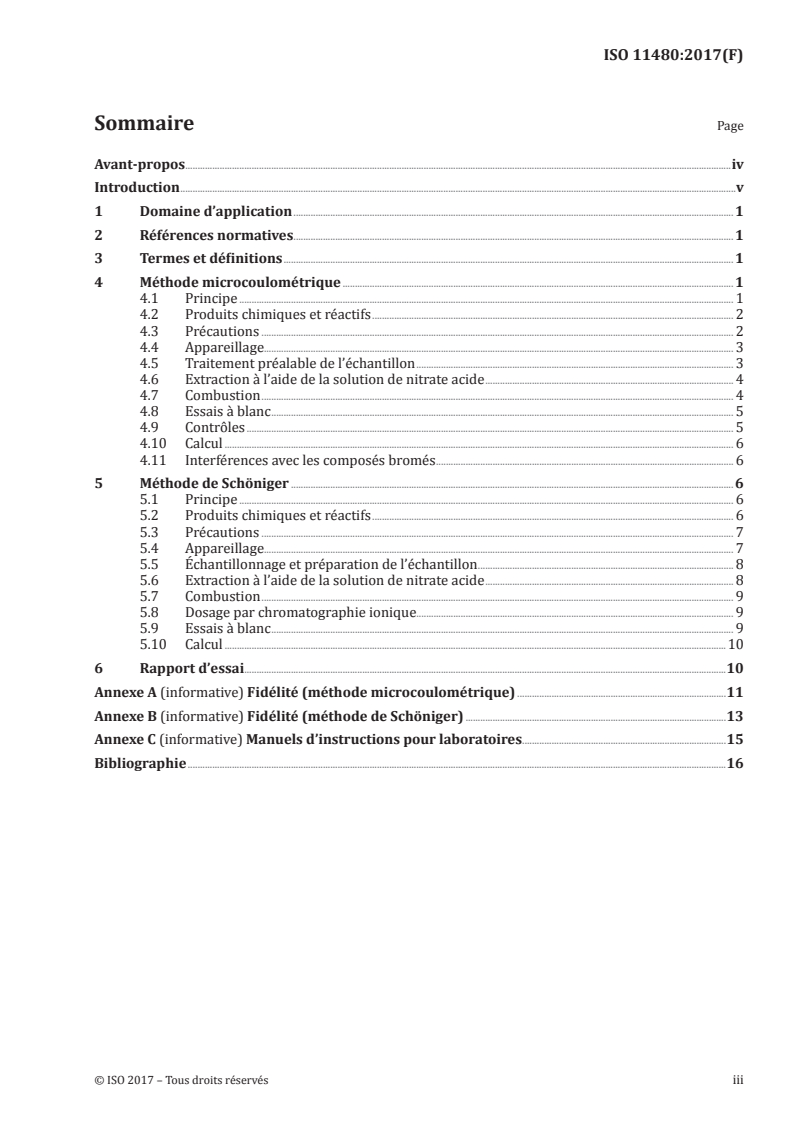
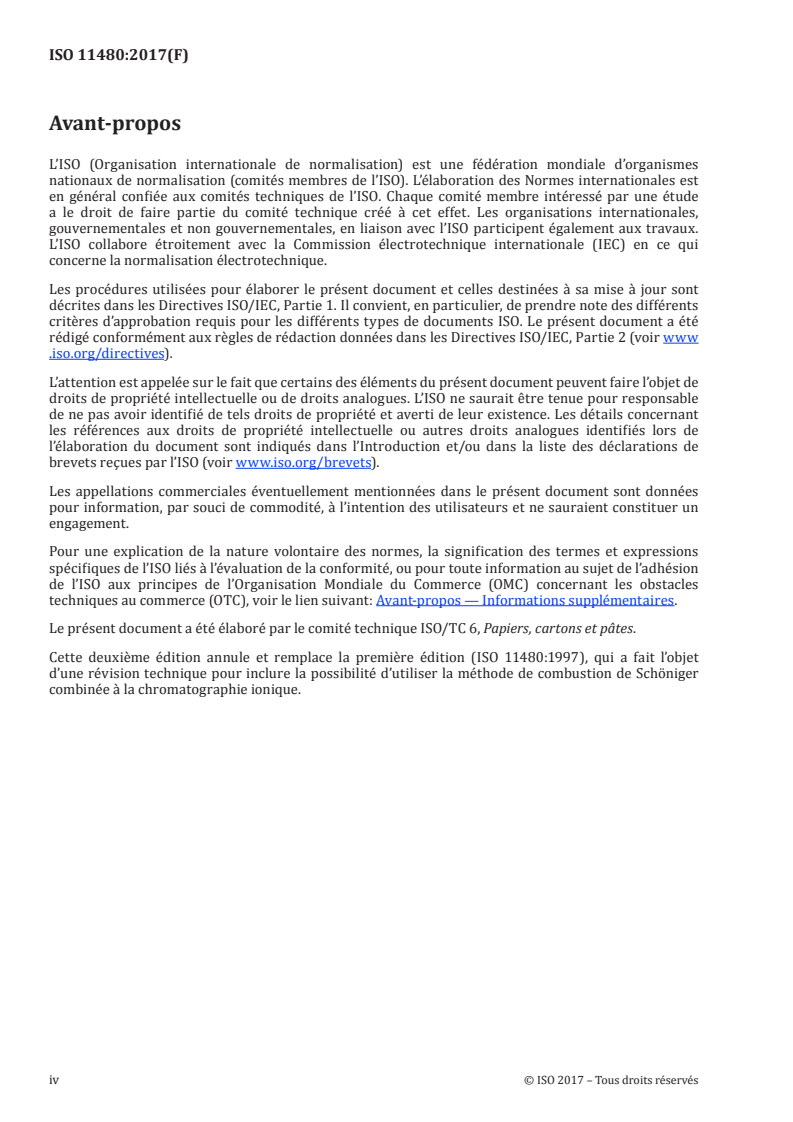
ISO 11480:2017 - Pâtes, papier et carton — Dosage du chlore total et du chlore lié aux matières organiques/16/2017
Overview
ISO 11480:2017 - "Pulp, paper and board - Determination of total chlorine and organically bound chlorine" specifies two validated laboratory procedures for measuring total chlorine and organically bound chlorine in all types of pulp, paper and board. The standard defines sample preparation, reagents, apparatus and calculation rules. The practical lower reporting limit is about 20 mg/kg. ISO 11480:2017 is published by ISO/TC 6 and replaces the 1997 edition, adding the Schöniger combustion option combined with ion chromatography.
Key topics and technical requirements
- Two alternative methods
- Microcoulometric method (Clause 4): sample combustion in a heated quartz tube, absorption of combustion gases and determination by microcoulometric titration. Faster, suitable for many replicate determinations.
- Schöniger method (Clause 5): Schöniger combustion followed by ion chromatography for chloride determination. More laborious but gives unambiguous chlorine results (no bromine interference).
- Sample pretreatment and sampling
- Protect samples from ambient contamination (polyethylene/aluminium packaging, gloves).
- Air-dry or determine dry matter per ISO 638 / ISO 287 as relevant; grind or cut samples to suit combustion equipment.
- Extraction for organically bound chlorine
- Inorganic chlorine is removed by extraction with a dilute acid nitrate solution before combustion when organically bound chlorine is required.
- Apparatus and reagents
- Combustion furnace (quartz tube), oxygen supply (gases must be free of chlorine and bromine), microcoulometer or ion chromatograph, filters, activated carbon and specified acids/reagents.
- Quality control and interferences
- Strict contamination control (lab air, reagents, filters).
- Bromine interference: microcoulometric results can include bromine as a positive bias; choose Schöniger + ion chromatography where bromine is possible.
- Performance
- Lower limit ~20 mg/kg; the microcoulometric cell sensitivity and repeatability are specified in the standard.
Practical applications and users
- Quality control and production monitoring in pulp, paper and board mills
- Environmental and regulatory labs assessing chlorinated organic content
- Recycled fiber testing and product certification
- R&D and analytical labs developing pulp/paper formulations or deinking/bleaching processes
- Consultants and compliance auditors who need traceable methods to report total and organically bound chlorine
Related standards
- ISO 638 - determination of dry matter content (oven-drying)
- ISO 287 - moisture content of a lot (oven-drying)
- ISO 11480:2017 aligns with ISO/TC 6 guidance and laboratory best practices for pulp and paper testing
Keywords: ISO 11480:2017, total chlorine determination, organically bound chlorine, pulp paper board testing, microcoulometric method, Schöniger method, ion chromatography, chlorine in paper, lab standard.
Relations
- Effective Date
- 04-Nov-2015
Buy Documents
ISO 11480:2017 - Pulp, paper and board -- Determination of total chlorine and organically bound chlorine
ISO 11480:2017 - Pulp, paper and board — Determination of total chlorine and organically bound chlorine/3/2017
ISO 11480:2017 - Pâtes, papier et carton -- Dosage du chlore total et du chlore lié aux matieres organiques
ISO 11480:2017 - Pâtes, papier et carton — Dosage du chlore total et du chlore lié aux matières organiques/16/2017
Get Certified
Connect with accredited certification bodies for this standard

Control Union Certifications
Global certification for agriculture and sustainability.

Gozdarski inštitut Slovenije
Slovenian Forestry Institute. Forest management certification support, timber testing.
Sponsored listings
Frequently Asked Questions
ISO 11480:2017 is a standard published by the International Organization for Standardization (ISO). Its full title is "Pulp, paper and board — Determination of total chlorine and organically bound chlorine". This standard covers: ISO 11480:2017 specifies two alternative procedures for the determination of total and organically bound chlorine in pulp, paper and board. It is applicable to all types of pulp, paper and board. The lower limit of the determination is about 20 mg/kg.
ISO 11480:2017 specifies two alternative procedures for the determination of total and organically bound chlorine in pulp, paper and board. It is applicable to all types of pulp, paper and board. The lower limit of the determination is about 20 mg/kg.
ISO 11480:2017 is classified under the following ICS (International Classification for Standards) categories: 85.040 - Pulps; 85.060 - Paper and board. The ICS classification helps identify the subject area and facilitates finding related standards.
ISO 11480:2017 has the following relationships with other standards: It is inter standard links to ISO 11480:1997. Understanding these relationships helps ensure you are using the most current and applicable version of the standard.
ISO 11480:2017 is available in PDF format for immediate download after purchase. The document can be added to your cart and obtained through the secure checkout process. Digital delivery ensures instant access to the complete standard document.
Standards Content (Sample)
INTERNATIONAL ISO
STANDARD 11480
Second edition
2017-05
Pulp, paper and board —
Determination of total chlorine and
organically bound chlorine
Pâtes, papier et carton — Dosage du chlore total et du chlore lié aux
matières organiques
Reference number
©
ISO 2017
© ISO 2017, Published in Switzerland
All rights reserved. Unless otherwise specified, no part of this publication may be reproduced or utilized otherwise in any form
or by any means, electronic or mechanical, including photocopying, or posting on the internet or an intranet, without prior
written permission. Permission can be requested from either ISO at the address below or ISO’s member body in the country of
the requester.
ISO copyright office
Ch. de Blandonnet 8 • CP 401
CH-1214 Vernier, Geneva, Switzerland
Tel. +41 22 749 01 11
Fax +41 22 749 09 47
copyright@iso.org
www.iso.org
ii © ISO 2017 – All rights reserved
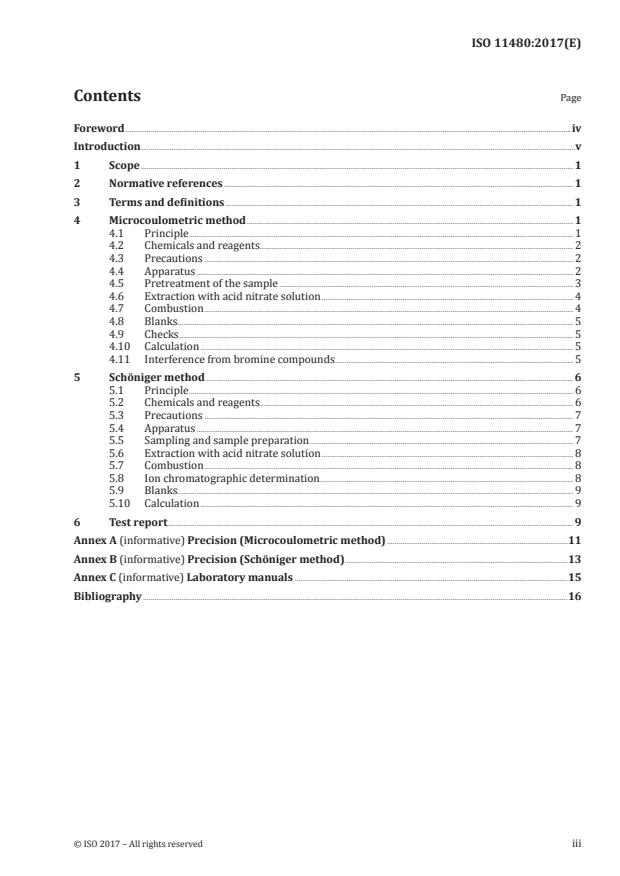
Contents Page
Foreword .iv
Introduction .v
1 Scope . 1
2 Normative references . 1
3 Terms and definitions . 1
4 Microcoulometric method . 1
4.1 Principle . 1
4.2 Chemicals and reagents . 2
4.3 Precautions . 2
4.4 Apparatus . 2
4.5 Pretreatment of the sample . 3
4.6 Extraction with acid nitrate solution . 4
4.7 Combustion . 4
4.8 Blanks . . 5
4.9 Checks . 5
4.10 Calculation . 5
4.11 Interference from bromine compounds . 5
5 Schöniger method . 6
5.1 Principle . 6
5.2 Chemicals and reagents . 6
5.3 Precautions . 7
5.4 Apparatus . 7
5.5 Sampling and sample preparation . 7
5.6 Extraction with acid nitrate solution . 8
5.7 Combustion . 8
5.8 Ion chromatographic determination. 8
5.9 Blanks . . 9
5.10 Calculation . 9
6 Test report . 9
Annex A (informative) Precision (Microcoulometric method) .11
Annex B (informative) Precision (Schöniger method) .13
Annex C (informative) Laboratory manuals .15
Bibliography .16
Foreword
ISO (the International Organization for Standardization) is a worldwide federation of national standards
bodies (ISO member bodies). The work of preparing International Standards is normally carried out
through ISO technical committees. Each member body interested in a subject for which a technical
committee has been established has the right to be represented on that committee. International
organizations, governmental and non-governmental, in liaison with ISO, also take part in the work.
ISO collaborates closely with the International Electrotechnical Commission (IEC) on all matters of
electrotechnical standardization.
The procedures used to develop this document and those intended for its further maintenance are
described in the ISO/IEC Directives, Part 1. In particular the different approval criteria needed for the
different types of ISO documents should be noted. This document was drafted in accordance with the
editorial rules of the ISO/IEC Directives, Part 2 (see www .iso .org/ directives).
Attention is drawn to the possibility that some of the elements of this document may be the subject of
patent rights. ISO shall not be held responsible for identifying any or all such patent rights. Details of
any patent rights identified during the development of the document will be in the Introduction and/or
on the ISO list of patent declarations received (see www .iso .org/ patents).
Any trade name used in this document is information given for the convenience of users and does not
constitute an endorsement.
For an explanation on the voluntary nature of standards, the meaning of ISO specific terms and
expressions related to conformity assessment, as well as information about ISO’s adherence to the
World Trade Organization (WTO) principles in the Technical Barriers to Trade (TBT) see the following
URL: w w w . i s o .org/ iso/ foreword .html.
This document was prepared by Technical Committee ISO/TC 6, Paper, board and pulps.
This second edition cancels and replaces the first edition (ISO 11480:1997), which has been
technically revised to include the option of using the Schöniger combustion method combined with ion
chromatography.
iv © ISO 2017 – All rights reserved
Introduction
This document specifies two procedures for the determination of total and organically bound chlorine
in pulp, paper and board. The microcoulometric method (Clause 4) is based on combustion in a heated
tube followed by microcoulometric titration. The Schöniger method (Clause 5) is based on the so-called
Schöniger combustion followed by ion chromatography.
The choice of procedure depends on the availability of the apparatus and on the risk of interference
by bromine compounds in the sample. In the microcoulometric method, the result does not strictly
represent the chlorine content since it includes part of any bromine present in the sample. This
procedure should thus be avoided if there is a risk that the sample has a high bromine content.
More work is involved in the Schöniger method than in the microcoulometric method. However, since
the end determination is performed by ion chromatography, the result is unambiguously chlorine. The
Schöniger method also requires a larger sample. Consequently, the result is more representative. On
the other hand, the microcoulometric method is faster and several replicate determinations can be
performed in a short time.
INTERNATIONAL STANDARD ISO 11480:2017(E)
Pulp, paper and board — Determination of total chlorine
and organically bound chlorine
1 Scope
This document specifies two alternative procedures for the determination of total and organically
bound chlorine in pulp, paper and board. It is applicable to all types of pulp, paper and board. The lower
limit of the determination is about 20 mg/kg.
2 Normative references
The following documents are referred to in the text in such a way that some or all of their content
constitutes requirements of this document. For dated references, only the edition cited applies. For
undated references, the latest edition of the referenced document (including any amendments) applies.
ISO 287, Paper and board — Determination of moisture content of a lot — Oven-drying method
ISO 638, Paper, board and pulps — Determination of dry matter content — Oven-drying method
3 Terms and definitions
For the purposes of this document, the following terms and definitions apply.
ISO and IEC maintain terminological databases for use in standardization at the following addresses:
— ISO Online browsing platform: available at http:// www .iso .org/ obp
— IEC Electropedia: available at http:// www .electropedia .org/
3.1
total chlorine
total amount of the element chlorine present
3.2
organically bound chlorine
amount of organically bound chlorine present
4 Microcoulometric method
4.1 Principle
Determination of the chlorine content of the sample by combustion under controlled conditions in a
quartz tube at high temperature. The combustion gases are fed through an electrolyte solution where
all chlorine, now transformed to hydrogen chloride, is absorbed and determined by microcoulometry.
For determination of the organically bound chlorine content, the inorganic chlorine compounds are
extracted with dilute nitric acid before combustion.
NOTE 1 If determination of organically bound chlorine is not required, the extraction with acid nitrate is
omitted.
NOTE 2 Any bromine present will interfere and cause a positive error. For details, see 4.11.
4.2 Chemicals and reagents
All chemicals used shall be of analytical reagent grade. Water for the preparation of solutions, or used
in the procedure, shall be distilled water of high purity or equivalent. High blanks (see 4.8) can be due
to impure water. The water can then be purified by treating it with activated carbon (4.2.4).
4.2.1 Acid nitrate solution, stock solution. Dissolve 17 g of sodium nitrate (NaNO ) in distilled water.
Add 1,4 ml of nitric acid (HNO ) density 1,40 g/ml, and dilute to 1 l with distilled water. (This solution is
only required for the determination of organically bound chlorine.)
4.2.2 Acid nitrate solution, working solution. Dilute 50 ml of the stock solution (4.2.1) to 1 l with
distilled water. (This solution is only required for the determination of organically bound chlorine.)
4.2.3 Sulfuric acid (H SO ), density 1,84 g/ml.
2 4
4.2.4 Activated carbon, for adsorption of water-soluble organic material in the determination of
organically bound chlorine. (Suitable carbon is provided by manufacturers of combustion apparatus.)
4.2.5 Electrolyte solution, for use in the microcoulometer. Dilute 75 ml of glacial (98 %) acetic acid
(CH COOH) to 100 ml with water.
Addition of sodium perchlorate (NaClO ) and sulfamic acid (NH SO H) to the absorption solution is
4 2 3
recommended by some manufacturers of microcoulometers. Such additions are optional.
One manufacturer recommends a solution prepared by dissolving 1,35 g of sodium acetate (NaCH COO)
in 850 ml of glacial acetic acid and diluting to 1 000 ml with water.
4.2.6 Hydrochloric acid, c(HCl) = 0,010 0 mol/l.
4.2.7 2-Chlorobenzoic acid reference solution. Dissolve 110,3 mg of ClC H COOH in distilled water
6 4
and dilute to 100 ml in a volumetric flask. This solution contains 250 mg of organically bound chlorine
per litre. Dilute the solution as required before use.
4.2.8 Compressed gases. Oxygen is required for the combustion. Other gases may also be required in
order to control the combustion. It is essential that all gases used are free from chlorine and bromine in
any form.
NOTE It has been reported that chlorinated solvents have been used to clean the gas containers.
4.3 Precautions
Chlorine compounds in small quantities are present almost everywhere, in chemicals, on the surfaces of
the equipment, on the skin and in the laboratory air. It is therefore of utmost importance to take every
measure to avoid contamination of samples and solutions. In particular, the risk of contamination from
the laboratory air should be observed. Such contamination can come from reagents (solvents) stored in
the laboratory, as well as from outdoor sources, for example, a bleaching plant.
Clean all equipment before use with dilute nitric acid and flush with pure water.
4.4 Apparatus
Of the items listed below, items 4.4.1 through 4.4.4 are required only if organic chlorine has to be
determined. Item 4.4.7 is required only if total chlorine has to be determined.
4.4.1 Conical flasks, 250 ml, of chemically resistant glass, with standard tapered glass stoppers or
polytetrafluoroethylene (PTFE)-lined screw caps.
2 © ISO 2017 – All rights reserved
4.4.2 Shaker for the flasks (4.4.1), giving their contents a circular motion. Its power shall be
adjustable so that the contents are kept in motion without reaching the stopper.
4.4.3 Filtering device, for vacuum filtration on filters of diameter about 25 mm.
4.4.4 Filters, polycarbonate, nominal pore width 0,4 µm, diameter to fit the filtering device (4.4.3) and
having a maximum chlorine content of 0,5 µg.
Alternatively, specially designed filtering cups of heat-resistant glass or ceramic material may be used.
If high blank values (4.8) are obtained, the reason could be contaminated filters. They should be washed
before use with stock solution (4.2.1) and then with water.
4.4.5 Combustion apparatus, consisting of a quartz tube connected to a cell for microcoulometric
titration (4.4.6). A multizone furnace can heat the middle section of the tube to at least 950 °C and
preferably 1 000 °C. A boat of quartz or other heat-resistant material fits into the tube. The boat can be
moved from the cold end of the tube to its hot section. The tube shall be wide enough to accommodate
a boat loaded with a filter (4.4.4). The apparatus has an oxygen supply and some means for maintaining
a constant flow of oxygen through the tube. The oxygen stream may be diluted with an inert gas, such
as argon or nitrogen. The combustion gases are fed through the microcoulometric cell for continuous
titration of chloride ions.
If required, a heated washing device containing sulfuric acid (4.2.3) for cleaning and drying the gas
stream may be inserted between the outlet of the combustion tube and the cell.
4.4.6 Microcoulometer, enabling the determination of 2 µg of chloride ion with a coefficient of
variation of less than 10 %, calculated from repeated determinations of chloride ion.
4.4.7 Sample cups, capacity about 1 ml, of quartz or other heat-resistant material, designed to fit into
the sample boat. The use of these cups is optional.
4.5 Pretreatment of the sample
Keep samples protected from ambient air in polyethylene bags or in packages of aluminium foil.
Use protective gloves whenever handling the sample. Check that no chlorine-containing material is
transferred from the gloves to the sample.
Air-dry wet pulp at a temperature not exceeding 40 °C. Using a separate sample, determine the dry
matter content as described in ISO 638 or ISO 287, as relevant.
Tear or cut the sample into small pieces using tweezers or scissors. The size of the pieces shall be
adapted to the nature of the sample, as well as to the dimensions of the combustion equipment.
Split samples of pulp or paperboard to ensure complete soaking of the sample during the extraction
step. If the soaking is incomplete, the results for organically bound chlorine may be too high.
Grind samples of coated or multi-ply paper and paperboard in a small mill, Wiley type or similar. The
mill shall not be used for other purposes in order to avoid contamination of samples. Clean the mill
carefully after each use.
The total amount of sample required depends on its chlorine content and is limited by the dimensions
of the combustion apparatus. Normally, the amount of sample required for each single determination is
between 10 mg to 60 mg.
For the determination of both parameters, a total of four sample portions is required. Weigh each
sample portion to the nearest 0,1 mg. All samples should have approximately the same mass.
Of the four samples, two are taken for determination of total chlorine, and two are extracted with acid
nitrate solution.
NOTE If determination of organically bound chlorine is not required, proceed directly to 4.7.
4.6 Extraction with acid nitrate solution
Transfer the two duplicate samples to 250 ml conical flasks with glass stoppers. Add 100 ml of the acid
nitrate solution (4.2.2) and 15 mg of activated carbon (4.2.4) to each flask. At the same time, start two
blanks without any sample. Close the flasks and shake them vigorously to wet the sample entirely. Place
the flasks in a mechanical shaking machine and shake them for at least 1 h.
When analysing coated or filled papers containing large amounts of carbonate pigments, check that the
mixture in the flask is still acid. If not, acidify the mixture by adding more of the acid nitrate solution
(4.2.2).
Using the filtering device (4.4.3), filter the contents of the flasks on a polycarbonate filter or in a filtering
cup (4.4.4).
Rinse the flask and the sides of the filtering funnel with small portions of the acid nitrate solution
(4.2.2), about 25 ml in all. Finally, wash with a small portion of water. Apply suction until excess liquid
has been removed.
Drawing large volumes of air through the filter should be avoided, as this can lead to contamination
from halogen compounds present in the ambient atmosphere. On the other hand, any excess washing
solution present in the filter can result in condensation of water in the combustion tube. Condensed
water in the tube can interfere with the combustion (4.7). If the filter is too dry, it can ignite in the
drying zone of the oven, which can lead to a low result.
4.7 Combustion
In principle, the procedure is the same for unextracted and extracted samples. In practice, the procedure
has to be adapted to the condition of the sample. Extracted samples (for the determination of organically
bound chlorine) are wet, and samples for the determination of total chlorine are normally dry.
Operate the combustion apparatus (4.4.5) as instructed by the manufacturer. Several makes of
apparatus are on the market. They differ in details and the procedure to be followed has to be adapted
to the type of apparatus used. (See Annex C.)
Check the performance of the microcoulometer (4.4.6) by adding known amounts of hydrochloric acid
(4.2.6) to the cell. The results should be within 5 % of the theoretical value.
Check the instrument regularly by operating it as instructed for samples, bu
...
INTERNATIONAL ISO
STANDARD 11480
Second edition
2017-05
Pulp, paper and board —
Determination of total chlorine and
organically bound chlorine
Pâtes, papier et carton — Dosage du chlore total et du chlore lié aux
matières organiques
Reference number
©
ISO 2017
© ISO 2017, Published in Switzerland
All rights reserved. Unless otherwise specified, no part of this publication may be reproduced or utilized otherwise in any form
or by any means, electronic or mechanical, including photocopying, or posting on the internet or an intranet, without prior
written permission. Permission can be requested from either ISO at the address below or ISO’s member body in the country of
the requester.
ISO copyright office
Ch. de Blandonnet 8 • CP 401
CH-1214 Vernier, Geneva, Switzerland
Tel. +41 22 749 01 11
Fax +41 22 749 09 47
copyright@iso.org
www.iso.org
ii © ISO 2017 – All rights reserved
Contents Page
Foreword .iv
Introduction .v
1 Scope . 1
2 Normative references . 1
3 Terms and definitions . 1
4 Microcoulometric method . 1
4.1 Principle . 1
4.2 Chemicals and reagents . 2
4.3 Precautions . 2
4.4 Apparatus . 2
4.5 Pretreatment of the sample . 3
4.6 Extraction with acid nitrate solution . 4
4.7 Combustion . 4
4.8 Blanks . . 5
4.9 Checks . 5
4.10 Calculation . 5
4.11 Interference from bromine compounds . 5
5 Schöniger method . 6
5.1 Principle . 6
5.2 Chemicals and reagents . 6
5.3 Precautions . 7
5.4 Apparatus . 7
5.5 Sampling and sample preparation . 7
5.6 Extraction with acid nitrate solution . 8
5.7 Combustion . 8
5.8 Ion chromatographic determination. 8
5.9 Blanks . . 9
5.10 Calculation . 9
6 Test report . 9
Annex A (informative) Precision (Microcoulometric method) .11
Annex B (informative) Precision (Schöniger method) .13
Annex C (informative) Laboratory manuals .15
Bibliography .16
Foreword
ISO (the International Organization for Standardization) is a worldwide federation of national standards
bodies (ISO member bodies). The work of preparing International Standards is normally carried out
through ISO technical committees. Each member body interested in a subject for which a technical
committee has been established has the right to be represented on that committee. International
organizations, governmental and non-governmental, in liaison with ISO, also take part in the work.
ISO collaborates closely with the International Electrotechnical Commission (IEC) on all matters of
electrotechnical standardization.
The procedures used to develop this document and those intended for its further maintenance are
described in the ISO/IEC Directives, Part 1. In particular the different approval criteria needed for the
different types of ISO documents should be noted. This document was drafted in accordance with the
editorial rules of the ISO/IEC Directives, Part 2 (see www .iso .org/ directives).
Attention is drawn to the possibility that some of the elements of this document may be the subject of
patent rights. ISO shall not be held responsible for identifying any or all such patent rights. Details of
any patent rights identified during the development of the document will be in the Introduction and/or
on the ISO list of patent declarations received (see www .iso .org/ patents).
Any trade name used in this document is information given for the convenience of users and does not
constitute an endorsement.
For an explanation on the voluntary nature of standards, the meaning of ISO specific terms and
expressions related to conformity assessment, as well as information about ISO’s adherence to the
World Trade Organization (WTO) principles in the Technical Barriers to Trade (TBT) see the following
URL: w w w . i s o .org/ iso/ foreword .html.
This document was prepared by Technical Committee ISO/TC 6, Paper, board and pulps.
This second edition cancels and replaces the first edition (ISO 11480:1997), which has been
technically revised to include the option of using the Schöniger combustion method combined with ion
chromatography.
iv © ISO 2017 – All rights reserved
Introduction
This document specifies two procedures for the determination of total and organically bound chlorine
in pulp, paper and board. The microcoulometric method (Clause 4) is based on combustion in a heated
tube followed by microcoulometric titration. The Schöniger method (Clause 5) is based on the so-called
Schöniger combustion followed by ion chromatography.
The choice of procedure depends on the availability of the apparatus and on the risk of interference
by bromine compounds in the sample. In the microcoulometric method, the result does not strictly
represent the chlorine content since it includes part of any bromine present in the sample. This
procedure should thus be avoided if there is a risk that the sample has a high bromine content.
More work is involved in the Schöniger method than in the microcoulometric method. However, since
the end determination is performed by ion chromatography, the result is unambiguously chlorine. The
Schöniger method also requires a larger sample. Consequently, the result is more representative. On
the other hand, the microcoulometric method is faster and several replicate determinations can be
performed in a short time.
INTERNATIONAL STANDARD ISO 11480:2017(E)
Pulp, paper and board — Determination of total chlorine
and organically bound chlorine
1 Scope
This document specifies two alternative procedures for the determination of total and organically
bound chlorine in pulp, paper and board. It is applicable to all types of pulp, paper and board. The lower
limit of the determination is about 20 mg/kg.
2 Normative references
The following documents are referred to in the text in such a way that some or all of their content
constitutes requirements of this document. For dated references, only the edition cited applies. For
undated references, the latest edition of the referenced document (including any amendments) applies.
ISO 287, Paper and board — Determination of moisture content of a lot — Oven-drying method
ISO 638, Paper, board and pulps — Determination of dry matter content — Oven-drying method
3 Terms and definitions
For the purposes of this document, the following terms and definitions apply.
ISO and IEC maintain terminological databases for use in standardization at the following addresses:
— ISO Online browsing platform: available at http:// www .iso .org/ obp
— IEC Electropedia: available at http:// www .electropedia .org/
3.1
total chlorine
total amount of the element chlorine present
3.2
organically bound chlorine
amount of organically bound chlorine present
4 Microcoulometric method
4.1 Principle
Determination of the chlorine content of the sample by combustion under controlled conditions in a
quartz tube at high temperature. The combustion gases are fed through an electrolyte solution where
all chlorine, now transformed to hydrogen chloride, is absorbed and determined by microcoulometry.
For determination of the organically bound chlorine content, the inorganic chlorine compounds are
extracted with dilute nitric acid before combustion.
NOTE 1 If determination of organically bound chlorine is not required, the extraction with acid nitrate is
omitted.
NOTE 2 Any bromine present will interfere and cause a positive error. For details, see 4.11.
4.2 Chemicals and reagents
All chemicals used shall be of analytical reagent grade. Water for the preparation of solutions, or used
in the procedure, shall be distilled water of high purity or equivalent. High blanks (see 4.8) can be due
to impure water. The water can then be purified by treating it with activated carbon (4.2.4).
4.2.1 Acid nitrate solution, stock solution. Dissolve 17 g of sodium nitrate (NaNO ) in distilled water.
Add 1,4 ml of nitric acid (HNO ) density 1,40 g/ml, and dilute to 1 l with distilled water. (This solution is
only required for the determination of organically bound chlorine.)
4.2.2 Acid nitrate solution, working solution. Dilute 50 ml of the stock solution (4.2.1) to 1 l with
distilled water. (This solution is only required for the determination of organically bound chlorine.)
4.2.3 Sulfuric acid (H SO ), density 1,84 g/ml.
2 4
4.2.4 Activated carbon, for adsorption of water-soluble organic material in the determination of
organically bound chlorine. (Suitable carbon is provided by manufacturers of combustion apparatus.)
4.2.5 Electrolyte solution, for use in the microcoulometer. Dilute 75 ml of glacial (98 %) acetic acid
(CH COOH) to 100 ml with water.
Addition of sodium perchlorate (NaClO ) and sulfamic acid (NH SO H) to the absorption solution is
4 2 3
recommended by some manufacturers of microcoulometers. Such additions are optional.
One manufacturer recommends a solution prepared by dissolving 1,35 g of sodium acetate (NaCH COO)
in 850 ml of glacial acetic acid and diluting to 1 000 ml with water.
4.2.6 Hydrochloric acid, c(HCl) = 0,010 0 mol/l.
4.2.7 2-Chlorobenzoic acid reference solution. Dissolve 110,3 mg of ClC H COOH in distilled water
6 4
and dilute to 100 ml in a volumetric flask. This solution contains 250 mg of organically bound chlorine
per litre. Dilute the solution as required before use.
4.2.8 Compressed gases. Oxygen is required for the combustion. Other gases may also be required in
order to control the combustion. It is essential that all gases used are free from chlorine and bromine in
any form.
NOTE It has been reported that chlorinated solvents have been used to clean the gas containers.
4.3 Precautions
Chlorine compounds in small quantities are present almost everywhere, in chemicals, on the surfaces of
the equipment, on the skin and in the laboratory air. It is therefore of utmost importance to take every
measure to avoid contamination of samples and solutions. In particular, the risk of contamination from
the laboratory air should be observed. Such contamination can come from reagents (solvents) stored in
the laboratory, as well as from outdoor sources, for example, a bleaching plant.
Clean all equipment before use with dilute nitric acid and flush with pure water.
4.4 Apparatus
Of the items listed below, items 4.4.1 through 4.4.4 are required only if organic chlorine has to be
determined. Item 4.4.7 is required only if total chlorine has to be determined.
4.4.1 Conical flasks, 250 ml, of chemically resistant glass, with standard tapered glass stoppers or
polytetrafluoroethylene (PTFE)-lined screw caps.
2 © ISO 2017 – All rights reserved
4.4.2 Shaker for the flasks (4.4.1), giving their contents a circular motion. Its power shall be
adjustable so that the contents are kept in motion without reaching the stopper.
4.4.3 Filtering device, for vacuum filtration on filters of diameter about 25 mm.
4.4.4 Filters, polycarbonate, nominal pore width 0,4 µm, diameter to fit the filtering device (4.4.3) and
having a maximum chlorine content of 0,5 µg.
Alternatively, specially designed filtering cups of heat-resistant glass or ceramic material may be used.
If high blank values (4.8) are obtained, the reason could be contaminated filters. They should be washed
before use with stock solution (4.2.1) and then with water.
4.4.5 Combustion apparatus, consisting of a quartz tube connected to a cell for microcoulometric
titration (4.4.6). A multizone furnace can heat the middle section of the tube to at least 950 °C and
preferably 1 000 °C. A boat of quartz or other heat-resistant material fits into the tube. The boat can be
moved from the cold end of the tube to its hot section. The tube shall be wide enough to accommodate
a boat loaded with a filter (4.4.4). The apparatus has an oxygen supply and some means for maintaining
a constant flow of oxygen through the tube. The oxygen stream may be diluted with an inert gas, such
as argon or nitrogen. The combustion gases are fed through the microcoulometric cell for continuous
titration of chloride ions.
If required, a heated washing device containing sulfuric acid (4.2.3) for cleaning and drying the gas
stream may be inserted between the outlet of the combustion tube and the cell.
4.4.6 Microcoulometer, enabling the determination of 2 µg of chloride ion with a coefficient of
variation of less than 10 %, calculated from repeated determinations of chloride ion.
4.4.7 Sample cups, capacity about 1 ml, of quartz or other heat-resistant material, designed to fit into
the sample boat. The use of these cups is optional.
4.5 Pretreatment of the sample
Keep samples protected from ambient air in polyethylene bags or in packages of aluminium foil.
Use protective gloves whenever handling the sample. Check that no chlorine-containing material is
transferred from the gloves to the sample.
Air-dry wet pulp at a temperature not exceeding 40 °C. Using a separate sample, determine the dry
matter content as described in ISO 638 or ISO 287, as relevant.
Tear or cut the sample into small pieces using tweezers or scissors. The size of the pieces shall be
adapted to the nature of the sample, as well as to the dimensions of the combustion equipment.
Split samples of pulp or paperboard to ensure complete soaking of the sample during the extraction
step. If the soaking is incomplete, the results for organically bound chlorine may be too high.
Grind samples of coated or multi-ply paper and paperboard in a small mill, Wiley type or similar. The
mill shall not be used for other purposes in order to avoid contamination of samples. Clean the mill
carefully after each use.
The total amount of sample required depends on its chlorine content and is limited by the dimensions
of the combustion apparatus. Normally, the amount of sample required for each single determination is
between 10 mg to 60 mg.
For the determination of both parameters, a total of four sample portions is required. Weigh each
sample portion to the nearest 0,1 mg. All samples should have approximately the same mass.
Of the four samples, two are taken for determination of total chlorine, and two are extracted with acid
nitrate solution.
NOTE If determination of organically bound chlorine is not required, proceed directly to 4.7.
4.6 Extraction with acid nitrate solution
Transfer the two duplicate samples to 250 ml conical flasks with glass stoppers. Add 100 ml of the acid
nitrate solution (4.2.2) and 15 mg of activated carbon (4.2.4) to each flask. At the same time, start two
blanks without any sample. Close the flasks and shake them vigorously to wet the sample entirely. Place
the flasks in a mechanical shaking machine and shake them for at least 1 h.
When analysing coated or filled papers containing large amounts of carbonate pigments, check that the
mixture in the flask is still acid. If not, acidify the mixture by adding more of the acid nitrate solution
(4.2.2).
Using the filtering device (4.4.3), filter the contents of the flasks on a polycarbonate filter or in a filtering
cup (4.4.4).
Rinse the flask and the sides of the filtering funnel with small portions of the acid nitrate solution
(4.2.2), about 25 ml in all. Finally, wash with a small portion of water. Apply suction until excess liquid
has been removed.
Drawing large volumes of air through the filter should be avoided, as this can lead to contamination
from halogen compounds present in the ambient atmosphere. On the other hand, any excess washing
solution present in the filter can result in condensation of water in the combustion tube. Condensed
water in the tube can interfere with the combustion (4.7). If the filter is too dry, it can ignite in the
drying zone of the oven, which can lead to a low result.
4.7 Combustion
In principle, the procedure is the same for unextracted and extracted samples. In practice, the procedure
has to be adapted to the condition of the sample. Extracted samples (for the determination of organically
bound chlorine) are wet, and samples for the determination of total chlorine are normally dry.
Operate the combustion apparatus (4.4.5) as instructed by the manufacturer. Several makes of
apparatus are on the market. They differ in details and the procedure to be followed has to be adapted
to the type of apparatus used. (See Annex C.)
Check the performance of the microcoulometer (4.4.6) by adding known amounts of hydrochloric acid
(4.2.6) to the cell. The results should be within 5 % of the theoretical value.
Check the instrument regularly by operating it as instructed for samples, bu
...
NORME ISO
INTERNATIONALE 11480
Deuxième édition
2017-05
Pâtes, papier et carton — Dosage
du chlore total et du chlore lié aux
matières organiques
Pulp, paper and board — Determination of total chlorine and
organically bound chlorine
Numéro de référence
©
ISO 2017
DOCUMENT PROTÉGÉ PAR COPYRIGHT
© ISO 2017, Publié en Suisse
Droits de reproduction réservés. Sauf indication contraire, aucune partie de cette publication ne peut être reproduite ni utilisée
sous quelque forme que ce soit et par aucun procédé, électronique ou mécanique, y compris la photocopie, l’affichage sur
l’internet ou sur un Intranet, sans autorisation écrite préalable. Les demandes d’autorisation peuvent être adressées à l’ISO à
l’adresse ci-après ou au comité membre de l’ISO dans le pays du demandeur.
ISO copyright office
Ch. de Blandonnet 8 • CP 401
CH-1214 Vernier, Geneva, Switzerland
Tel. +41 22 749 01 11
Fax +41 22 749 09 47
copyright@iso.org
www.iso.org
ii © ISO 2017 – Tous droits réservés
Sommaire Page
Avant-propos .iv
Introduction .v
1 Domaine d’application . 1
2 Références normatives . 1
3 Termes et définitions . 1
4 Méthode microcoulométrique . 1
4.1 Principe . 1
4.2 Produits chimiques et réactifs . 2
4.3 Précautions . 2
4.4 Appareillage. 3
4.5 Traitement préalable de l’échantillon . 3
4.6 Extraction à l’aide de la solution de nitrate acide . 4
4.7 Combustion . 4
4.8 Essais à blanc . 5
4.9 Contrôles . 5
4.10 Calcul . 6
4.11 Interférences avec les composés bromés . 6
5 Méthode de Schöniger . 6
5.1 Principe . 6
5.2 Produits chimiques et réactifs . 6
5.3 Précautions . 7
5.4 Appareillage. 7
5.5 Échantillonnage et préparation de l’échantillon . 8
5.6 Extraction à l’aide de la solution de nitrate acide . 8
5.7 Combustion . 9
5.8 Dosage par chromatographie ionique. 9
5.9 Essais à blanc . 9
5.10 Calcul .10
6 Rapport d’essai .10
Annexe A (informative) Fidélité (méthode microcoulométrique) .11
Annexe B (informative) Fidélité (méthode de Schöniger) .13
Annexe C (informative) Manuels d’instructions pour laboratoires .15
Bibliographie .16
Avant-propos
L’ISO (Organisation internationale de normalisation) est une fédération mondiale d’organismes
nationaux de normalisation (comités membres de l’ISO). L’élaboration des Normes internationales est
en général confiée aux comités techniques de l’ISO. Chaque comité membre intéressé par une étude
a le droit de faire partie du comité technique créé à cet effet. Les organisations internationales,
gouvernementales et non gouvernementales, en liaison avec l’ISO participent également aux travaux.
L’ISO collabore étroitement avec la Commission électrotechnique internationale (IEC) en ce qui
concerne la normalisation électrotechnique.
Les procédures utilisées pour élaborer le présent document et celles destinées à sa mise à jour sont
décrites dans les Directives ISO/IEC, Partie 1. Il convient, en particulier, de prendre note des différents
critères d’approbation requis pour les différents types de documents ISO. Le présent document a été
rédigé conformément aux règles de rédaction données dans les Directives ISO/IEC, Partie 2 (voir www
.iso .org/ directives).
L’attention est appelée sur le fait que certains des éléments du présent document peuvent faire l’objet de
droits de propriété intellectuelle ou de droits analogues. L’ISO ne saurait être tenue pour responsable
de ne pas avoir identifié de tels droits de propriété et averti de leur existence. Les détails concernant
les références aux droits de propriété intellectuelle ou autres droits analogues identifiés lors de
l’élaboration du document sont indiqués dans l’Introduction et/ou dans la liste des déclarations de
brevets reçues par l’ISO (voir www .iso .org/ brevets).
Les appellations commerciales éventuellement mentionnées dans le présent document sont données
pour information, par souci de commodité, à l’intention des utilisateurs et ne sauraient constituer un
engagement.
Pour une explication de la nature volontaire des normes, la signification des termes et expressions
spécifiques de l’ISO liés à l’évaluation de la conformité, ou pour toute information au sujet de l’adhésion
de l’ISO aux principes de l’Organisation Mondiale du Commerce (OMC) concernant les obstacles
techniques au commerce (OTC), voir le lien suivant: Avant-propos — Informations supplémentaires.
Le présent document a été élaboré par le comité technique ISO/TC 6, Papiers, cartons et pâtes.
Cette deuxième édition annule et remplace la première édition (ISO 11480:1997), qui a fait l’objet
d’une révision technique pour inclure la possibilité d’utiliser la méthode de combustion de Schöniger
combinée à la chromatographie ionique.
iv © ISO 2017 – Tous droits réservés
Introduction
Le présent document spécifie deux modes opératoires pour le dosage du chlore total et du chlore
organique contenus dans les pâtes, papiers et cartons. La méthode microcoulométrique (Article 4) est
basée sur la combustion dans un tube chauffé, suivie d’un titrage microcoulométrique. La méthode
de Schöniger (Article 5) est basée sur la combustion dite de Schöniger, suivie d’une chromatographie
ionique.
Le choix du mode opératoire dépend de la disponibilité de l’appareillage et du risque d’interférence par
les composés bromés dans l’échantillon. Dans la méthode microcoulométrique, le résultat ne représente
pas strictement la teneur en chlore étant donné qu’il inclut une partie du brome présent dans
l’échantillon. Il convient donc d’éviter d’utiliser ce mode opératoire car il y a un risque que l’échantillon
ait une haute teneur en brome.
La méthode de Schöniger est plus contraignante que la méthode microcoulométrique. Cependant,
étant donné que le dosage final est réalisé par chromatographie ionique, le résultat obtenu correspond
sans équivoque au chlore. La méthode de Schöniger exige également un échantillon plus grand. Par
conséquent, le résultat est plus représentatif. En revanche, la méthode microcoulométrique est plus
rapide et plusieurs dosages répétés peuvent être réalisés en un court intervalle de temps.
NORME INTERNATIONALE ISO 11480:2017(F)
Pâtes, papier et carton — Dosage du chlore total et du
chlore lié aux matières organiques
1 Domaine d’application
Le présent document spécifie deux modes opératoires possibles pour le dosage du chlore total et du
chlore organique contenus dans les pâtes, papiers et cartons. Il est applicable à tous les types de pâtes,
papiers et cartons. La limite inférieure de dosage est d’environ 20 mg/kg.
2 Références normatives
Les documents suivants cités dans le texte constituent, pour tout ou partie de leur contenu, des
exigences du présent document. Pour les références datées, seule l’édition citée s’applique. Pour les
références non datées, la dernière édition du document de référence s’applique (y compris les éventuels
amendements).
ISO 287, Papier et carton — Détermination de la teneur en humidité d’un lot — Méthode par séchage à l’étuve
ISO 638, Papiers, cartons et pâtes — Détermination de la teneur en matières sèches — Méthode par séchage
à l’étuve
3 Termes et définitions
Pour les besoins du présent document, les termes et définitions suivants s’appliquent.
L’ISO et l’IEC mettent à jour les bases de données terminologiques utilisées en normalisation aux
adresses suivantes:
— ISO Online browsing platform: accessible sur http:// www .iso .org/ obp
— IEC Electropedia: accessible sur http:// www .electropedia .org/
3.1
chlore total
quantité totale de l’élément chlore présent dans l’échantillon
3.2
chlore organique
quantité totale du chlore lié aux matières organiques présent dans l’échantillon
4 Méthode microcoulométrique
4.1 Principe
Dosage de la teneur en chlore de l’échantillon par combustion à haute température, dans des conditions
contrôlées, à l’intérieur d’un tube en quartz. Les gaz de combustion passent dans une solution
électrolytique où tout le chlore, une fois transformé en acide chlorhydrique, est absorbé et dosé par
microcoulométrie. Pour déterminer la teneur en chlore organique, les composés chlorés inorganiques
sont extraits à l’aide d’acide nitrique dilué avant combustion.
NOTE 1 S’il n’est pas nécessaire de réaliser le dosage du chlore organique, l’extraction au moyen de nitrate
acide est omise.
NOTE 2 Toute présence de brome est à l’origine d’interférences et d’erreurs positives dans les mesures. Pour
plus de détails, voir 4.11.
4.2 Produits chimiques et réactifs
Tous les produits chimiques employés doivent être de qualité analytique. L’eau utilisée pour la
préparation des solutions et au cours de l’essai doit être une eau distillée de pureté élevée ou une eau
équivalente. L’obtention de valeurs à blanc élevées (voir 4.8) peut être due à l’utilisation d’une eau
impure. Cette dernière peut être purifiée par traitement sur charbon actif (4.2.4).
4.2.1 Solution de nitrate acide de réserve. Dissoudre 17 g de nitrate de sodium (NaNO ) dans de
l’eau distillée. Ajouter 1,4 ml d’acide nitrique (HNO ) de masse volumique 1,40 g/ml et diluer à 1 l avec
de l’eau distillée. (Cette solution est nécessaire uniquement pour le dosage du chlore organique.)
4.2.2 Solution de nitrate acide pour essai. Diluer 50 ml de la solution de réserve (4.2.1) à 1 l avec de
l’eau distillée. (Cette solution est nécessaire uniquement pour le dosage du chlore organique.)
4.2.3 Acide sulfurique (H SO ), de masse volumique 1,84 g/ml.
2 4
4.2.4 Charbon actif, destiné à permettre l’absorption des matières organiques solubles dans l’eau
au cours du dosage du chlore organique. (Le charbon approprié est disponible auprès des fabricants
d’appareils de combustion.)
4.2.5 Solution électrolytique, pour utilisation dans le microcoulomètre. Diluer 75 ml d’acide acétique
cristallisable à 98 % (CH COOH) à 100 ml avec de l’eau.
Certains fabricants de microcoulomètres recommandent l’ajout de perchlorate de sodium (NaClO ) et
d’acide amidosulfonique (NH SO H) dans la solution absorbante. Ces ajouts sont facultatifs.
2 3
Un fabricant recommande une solution préparée en faisant fondre 1,35 g d’acétate de sodium
(NaCH COO) dans 850 ml d’acide acétique cristallisable pour ensuite le diluer dans 1 000 ml d’eau.
4.2.6 Acide chlorhydrique, c(HCl) = 0,010 0 mol/l.
4.2.7 Solution d’acide 2-chlorobenzoïque de référence. Dissoudre 110,3 mg de ClC H COOH
6 4
dans de l’eau distillée et diluer à 100 ml dans une fiole jaugée. Cette solution contient 250 mg de chlore
organique par litre. Diluer la solution avant usage selon les besoins.
4.2.8 Gaz comprimés. L’usage d’oxygène est nécessaire à la combustion. Le contrôle de cette dernière
peut nécessiter l’usage d’autres gaz. Il est primordial que tout gaz utilisé soit exempt de chlore et de
brome sous quelque forme que ce soit.
NOTE Il a été signalé que des solvants chlorés ont été utilisés pour nettoyer les récipients contenant les gaz.
4.3 Précautions
Les composés chlorés sont présents en petites quantités presque partout, dans les substances
chimiques, à la surface des équipements ou de la peau, ou dans l’atmosphère du laboratoire d’essai. Il est
donc absolument indispensable de prendre toute disposition nécessaire pour éviter la contamination
des échantillons et des solutions. Il convient en particulier d’être attentif aux risques de contamination
par l’atmosphère du laboratoire, contamination pouvant être provoquée aussi bien par des réactifs
(solvants) entreposés dans le laboratoire, que par des facteurs externes, tels que la proximité d’une
installation de blanchiment.
Procéder au nettoyage de l’ensemble de l’équipement avant usage, au moyen d’acide nitrique dilué, et
rincer à l’eau pure.
2 © ISO 2017 – Tous droits réservés
4.4 Appareillage
Parmi la liste des articles mentionnés ci-dessous, ceux numérotés 4.4.1 à 4.4.4 sont uniquement
nécessaires en cas de dosage du chlore organique. L’Article 4.4.7 est uniquement nécessaire en cas de
dosage du chlore total.
4.4.1 Fioles coniques, de 250 ml, en verre résistant aux substances chimiques, équipées de bouchons
coniques normalisés en verre ou de capuchons vissés en polytétrafluoroéthylène (PTFE).
4.4.2 Agitateur de fioles (4.4.1), permettant une agitation du contenu par mouvement circulaire. La
puissance doit être réglable de manière que le contenu des fioles soit agité sans atteindre les bouchons.
4.4.3 Dispositif de filtration, permettant le filtrage sous vide sur filtres d’un diamètre de 25 mm
environ.
4.4.4 Filtres, en polycarbonate, de largeur de pores nominale égale à 0,4 µm, de diamètre adapté au
dispositif de filtration (4.4.3), et de teneur en chlore maximale égale à 0,5 µg.
Il est également possible d’utiliser des récipients de filtration de conception spéciale, en verre
thermorésistant ou en matériau céramique.
L’obtention de valeurs à blanc élevées (4.8) peut être due à une contamination des filtres. Il convient de
procéder au nettoyage de ces derniers avant usage, au moyen de la solution de réserve (4.2.1), puis avec
de l’eau.
4.4.5 Appareil de combustion, constitué d’un tube en quartz relié à une cuve de titrage
microcoulométrique (4.4.6). Il est possible, au moyen du four à zones multiples, de porter la partie
médiane du tube à une température minimale de 950 °C, ou de préférence 1 000 °C. Une nacelle en
quartz ou en toute autre matière thermorésistante est introduite dans le tube. Elle peut être déplacée
à l’intérieur du tube, de l’extrémité froide vers la partie chauffée. La largeur du tube doit être suffisante
pour permettre l’utilisation d’une nacelle chargée d’un filtre (4.4.4). L’appareil est équipé d’une
alimentation en oxygène ainsi que d’un dispositif permettant le maintien d’un débit d’oxygène constant à
travers le tube. Il est possible de diluer le flux d’oxygène à l’aide d’un gaz inerte tel que l’argon ou l’azote.
L’alimentation en gaz de combustion est assurée à travers la cuve microcoulométrique afin de réaliser le
titrage en continu des ions chlorure.
En cas de nécessité, il est possible d’insérer, entre l’extrémité du tube à combustion et la cuve, un
dispositif de nettoyage chauffant contenant de l’acide sulfurique (4.2.3), destiné au nettoyage et au
séchage du courant gazeux.
4.4.6 Microcoulomètre, permettant d’effectuer le dosage de 2 µg d’ions chlorure, dont le coefficient
de variation est inférieur à 10 % et est calculé à partir des dosages répétés d’ions chlorure.
4.4.7 Coupelles à échantillons, de contenance approximative 1 ml, en quartz ou autre matière
thermorésistante, et de conception adaptée à la nacelle à échantillons. L’usage de ces coupelles est
facultatif.
4.5 Traitement préalable de l’échantillon
Conserver les échantillons à l’abri de l’air ambiant dans des sacs en polyéthylène ou en les emballant dans
des feuilles d’aluminium. Utiliser des gants de protection lors de toute manipulation des échantillons.
Vérifier qu’aucun matériel contenant du chlore n’a été transféré par les gants à l’échantillon.
Sécher les pâtes humides à l’air, à une température ne dépassant pas 40 °C. Déterminer la teneur en
matière sèche à l’aide d’un échantillon distinct, conformément à l’ISO 638 ou l’ISO 287, selon le cas.
Déchirer ou découper l’échantillon en petits morceaux, à l’aide d’une pince ou d’une paire de ciseaux. La
taille des morceaux doit être adaptée à la nature de l’échantillon, ainsi qu’aux dimensions de l’appareil
de combustion.
Cliver les échantillons de pâte de papier ou de carton, afin de garantir leur imprégnation complète lors
de la phase d’extraction. En cas d’imprégnation incomplète, les valeurs relevées lors du dosage du chlore
organique peuvent être trop élevées.
Broyer les échantillons de papier ou de carton couché ou multijets à l’aide d’un microbroyeur de
type Wiley ou autre. Ce dernier ne doit pas être utilisé à d’autres fins, de façon à éviter tout risque de
contamination des échantillons. Nettoyer soigneusement le broyeur après chaque utilisation.
La quantité totale d’échantillon nécessaire dépend de sa teneur en chlore et est limitée par les
dimensions de l’appareil de combustion. Normalement, la quantité d’échantillon nécessaire à chaque
dosage est comprise entre 10 mg et 60 mg.
Pour effectuer la détermination des deux paramètres, il est nécessaire d’utiliser quatre prises d’essai.
Peser chaque prise d’essai à 0,1 mg près. Il convient de veiller à ce que tous les échantillons soient de
masse à peu près identique.
Parmi les quatre échantillons, deux sont utilisés pour le dosage du chlore total, les deux autres étant
extraits au moyen de la solution de nitrate acide.
NOTE S’il n’est pas nécessaire de réaliser le dosage du chlore organique, passer directement à 4.7.
4.6 Extraction à l’aide de la solution de nitrate acide
Transvaser les deux échantillons dans deux fioles coniques de 250 ml munies de bouchons en verre.
Ajouter dans chaque fiole 100 ml de solution de nitrate acide (4.2.2) et 15 mg de charbon actif (4.2.4).
Au même moment, démarrer deux essais à blanc sans échantillons. Obturer les fioles, puis les agiter
vigoureusement jusqu’à provoquer un mouillage total de l’échantillon. Disposer les fioles sur l’agitateur
mécanique et les soumettre à une agitation d’une durée d’au moins 1 h.
Dans le cas d’essais menés sur papier couché ou papier chargé contenant de grandes quantités de
pigments carbonates, vérifier que le mélange contenu dans la fiole est toujours acide. Dans le cas
contraire, acidifier le mélange en ajoutant davantage de solution de nitrate acide (4.2.2).
Au moyen du dispositif de filtration (4.4.3), filtrer le contenu des fioles sur un filtre en polycarbonate ou
dans un récipient de filtration (4.4.4).
Rincer la fiole et les parois de l’entonnoir de filtration à l’aide de petites quantités de solution de nitrate
acide (4.2.2), d’environ 25 ml chacune. Procéder au rinçage final avec une petite quantité d’eau. Aspirer
l’excédent de liquide jusqu’à l’élimination de celui-ci.
Il convient d’éviter que de grandes quantités d’air traversent le filtre, car il peut en résulter une
contamination par les composés halogénures présents dans l’air ambiant. Par ailleurs, toute présence
excessive de solution de rinçage dans le filtre peut avoir pour conséquence une condensation d’eau à
l’intérieur du tube à combustion. La présence de condensation dans le tube à combustion peut interférer
avec la combustion (4.7). Si le filtre est trop sec, il peut s’enflammer dès son passage dans la zone de
séchage du four, d’où un résultat faible.
4.7 Combustion
En principe, les échantillons extraits ou non sont soumis à un mode opératoire identique. Dans la
pratique, il s’avère nécessaire d’adapter le mode opératoire à l’état des échantillons. Les échantillons
extraits (pour le dosage du chlore organique) sont à l’état humide, tandis que les échantillons destinés
au dosage du chlore total sont normalement à l’état sec.
4 © ISO 2017 – Tous droits réservés
Utiliser l’appareil de combustion (4.4.5) conformément aux instructions du fabricant. Plusieurs types
d’appareils sont disponibles sur le marché. Leurs paramètres sont différents et le mode opératoire à
suivre doit être adapté au type d’appareil utilisé. (Voir l’Annexe C.)
Vérifier le fonctionnement du microcoulomètre (4.4.6) en ajoutant des quantités définies d’acide
chlorhydrique (4.2.6) dans la cuve. Il convient d’obtenir des résultats se situant à 5 % au plus de la
valeur théorique.
Vérifier régulièrement l’appareil en opérant de la même manière qu’avec des échantillons, mais sans
utiliser ces derniers.
NOTE Des effets de mémoire peuvent être provoqués par la corrosion des tubes de combustion (on obtient
des mesures erronées sans échantillon, en particulier après avoir soumis à l’essai un échantillon à haute teneur
en chlore).
Si l’échantillon est un tampon fibreux humide disposé sur un filtre en polycarbonate, plier ce dernier à
l’aide d’une paire de brucelles et le placer dans la nacelle.
Si l’échantillon est à l’état sec, le placer dans
...
NORME ISO
INTERNATIONALE 11480
Deuxième édition
2017-05
Pâtes, papier et carton — Dosage
du chlore total et du chlore lié aux
matières organiques
Pulp, paper and board — Determination of total chlorine and
organically bound chlorine
Numéro de référence
©
ISO 2017
DOCUMENT PROTÉGÉ PAR COPYRIGHT
© ISO 2017, Publié en Suisse
Droits de reproduction réservés. Sauf indication contraire, aucune partie de cette publication ne peut être reproduite ni utilisée
sous quelque forme que ce soit et par aucun procédé, électronique ou mécanique, y compris la photocopie, l’affichage sur
l’internet ou sur un Intranet, sans autorisation écrite préalable. Les demandes d’autorisation peuvent être adressées à l’ISO à
l’adresse ci-après ou au comité membre de l’ISO dans le pays du demandeur.
ISO copyright office
Ch. de Blandonnet 8 • CP 401
CH-1214 Vernier, Geneva, Switzerland
Tel. +41 22 749 01 11
Fax +41 22 749 09 47
copyright@iso.org
www.iso.org
ii © ISO 2017 – Tous droits réservés
Sommaire Page
Avant-propos .iv
Introduction .v
1 Domaine d’application . 1
2 Références normatives . 1
3 Termes et définitions . 1
4 Méthode microcoulométrique . 1
4.1 Principe . 1
4.2 Produits chimiques et réactifs . 2
4.3 Précautions . 2
4.4 Appareillage. 3
4.5 Traitement préalable de l’échantillon . 3
4.6 Extraction à l’aide de la solution de nitrate acide . 4
4.7 Combustion . 4
4.8 Essais à blanc . 5
4.9 Contrôles . 5
4.10 Calcul . 6
4.11 Interférences avec les composés bromés . 6
5 Méthode de Schöniger . 6
5.1 Principe . 6
5.2 Produits chimiques et réactifs . 6
5.3 Précautions . 7
5.4 Appareillage. 7
5.5 Échantillonnage et préparation de l’échantillon . 8
5.6 Extraction à l’aide de la solution de nitrate acide . 8
5.7 Combustion . 9
5.8 Dosage par chromatographie ionique. 9
5.9 Essais à blanc . 9
5.10 Calcul .10
6 Rapport d’essai .10
Annexe A (informative) Fidélité (méthode microcoulométrique) .11
Annexe B (informative) Fidélité (méthode de Schöniger) .13
Annexe C (informative) Manuels d’instructions pour laboratoires .15
Bibliographie .16
Avant-propos
L’ISO (Organisation internationale de normalisation) est une fédération mondiale d’organismes
nationaux de normalisation (comités membres de l’ISO). L’élaboration des Normes internationales est
en général confiée aux comités techniques de l’ISO. Chaque comité membre intéressé par une étude
a le droit de faire partie du comité technique créé à cet effet. Les organisations internationales,
gouvernementales et non gouvernementales, en liaison avec l’ISO participent également aux travaux.
L’ISO collabore étroitement avec la Commission électrotechnique internationale (IEC) en ce qui
concerne la normalisation électrotechnique.
Les procédures utilisées pour élaborer le présent document et celles destinées à sa mise à jour sont
décrites dans les Directives ISO/IEC, Partie 1. Il convient, en particulier, de prendre note des différents
critères d’approbation requis pour les différents types de documents ISO. Le présent document a été
rédigé conformément aux règles de rédaction données dans les Directives ISO/IEC, Partie 2 (voir www
.iso .org/ directives).
L’attention est appelée sur le fait que certains des éléments du présent document peuvent faire l’objet de
droits de propriété intellectuelle ou de droits analogues. L’ISO ne saurait être tenue pour responsable
de ne pas avoir identifié de tels droits de propriété et averti de leur existence. Les détails concernant
les références aux droits de propriété intellectuelle ou autres droits analogues identifiés lors de
l’élaboration du document sont indiqués dans l’Introduction et/ou dans la liste des déclarations de
brevets reçues par l’ISO (voir www .iso .org/ brevets).
Les appellations commerciales éventuellement mentionnées dans le présent document sont données
pour information, par souci de commodité, à l’intention des utilisateurs et ne sauraient constituer un
engagement.
Pour une explication de la nature volontaire des normes, la signification des termes et expressions
spécifiques de l’ISO liés à l’évaluation de la conformité, ou pour toute information au sujet de l’adhésion
de l’ISO aux principes de l’Organisation Mondiale du Commerce (OMC) concernant les obstacles
techniques au commerce (OTC), voir le lien suivant: Avant-propos — Informations supplémentaires.
Le présent document a été élaboré par le comité technique ISO/TC 6, Papiers, cartons et pâtes.
Cette deuxième édition annule et remplace la première édition (ISO 11480:1997), qui a fait l’objet
d’une révision technique pour inclure la possibilité d’utiliser la méthode de combustion de Schöniger
combinée à la chromatographie ionique.
iv © ISO 2017 – Tous droits réservés
Introduction
Le présent document spécifie deux modes opératoires pour le dosage du chlore total et du chlore
organique contenus dans les pâtes, papiers et cartons. La méthode microcoulométrique (Article 4) est
basée sur la combustion dans un tube chauffé, suivie d’un titrage microcoulométrique. La méthode
de Schöniger (Article 5) est basée sur la combustion dite de Schöniger, suivie d’une chromatographie
ionique.
Le choix du mode opératoire dépend de la disponibilité de l’appareillage et du risque d’interférence par
les composés bromés dans l’échantillon. Dans la méthode microcoulométrique, le résultat ne représente
pas strictement la teneur en chlore étant donné qu’il inclut une partie du brome présent dans
l’échantillon. Il convient donc d’éviter d’utiliser ce mode opératoire car il y a un risque que l’échantillon
ait une haute teneur en brome.
La méthode de Schöniger est plus contraignante que la méthode microcoulométrique. Cependant,
étant donné que le dosage final est réalisé par chromatographie ionique, le résultat obtenu correspond
sans équivoque au chlore. La méthode de Schöniger exige également un échantillon plus grand. Par
conséquent, le résultat est plus représentatif. En revanche, la méthode microcoulométrique est plus
rapide et plusieurs dosages répétés peuvent être réalisés en un court intervalle de temps.
NORME INTERNATIONALE ISO 11480:2017(F)
Pâtes, papier et carton — Dosage du chlore total et du
chlore lié aux matières organiques
1 Domaine d’application
Le présent document spécifie deux modes opératoires possibles pour le dosage du chlore total et du
chlore organique contenus dans les pâtes, papiers et cartons. Il est applicable à tous les types de pâtes,
papiers et cartons. La limite inférieure de dosage est d’environ 20 mg/kg.
2 Références normatives
Les documents suivants cités dans le texte constituent, pour tout ou partie de leur contenu, des
exigences du présent document. Pour les références datées, seule l’édition citée s’applique. Pour les
références non datées, la dernière édition du document de référence s’applique (y compris les éventuels
amendements).
ISO 287, Papier et carton — Détermination de la teneur en humidité d’un lot — Méthode par séchage à l’étuve
ISO 638, Papiers, cartons et pâtes — Détermination de la teneur en matières sèches — Méthode par séchage
à l’étuve
3 Termes et définitions
Pour les besoins du présent document, les termes et définitions suivants s’appliquent.
L’ISO et l’IEC mettent à jour les bases de données terminologiques utilisées en normalisation aux
adresses suivantes:
— ISO Online browsing platform: accessible sur http:// www .iso .org/ obp
— IEC Electropedia: accessible sur http:// www .electropedia .org/
3.1
chlore total
quantité totale de l’élément chlore présent dans l’échantillon
3.2
chlore organique
quantité totale du chlore lié aux matières organiques présent dans l’échantillon
4 Méthode microcoulométrique
4.1 Principe
Dosage de la teneur en chlore de l’échantillon par combustion à haute température, dans des conditions
contrôlées, à l’intérieur d’un tube en quartz. Les gaz de combustion passent dans une solution
électrolytique où tout le chlore, une fois transformé en acide chlorhydrique, est absorbé et dosé par
microcoulométrie. Pour déterminer la teneur en chlore organique, les composés chlorés inorganiques
sont extraits à l’aide d’acide nitrique dilué avant combustion.
NOTE 1 S’il n’est pas nécessaire de réaliser le dosage du chlore organique, l’extraction au moyen de nitrate
acide est omise.
NOTE 2 Toute présence de brome est à l’origine d’interférences et d’erreurs positives dans les mesures. Pour
plus de détails, voir 4.11.
4.2 Produits chimiques et réactifs
Tous les produits chimiques employés doivent être de qualité analytique. L’eau utilisée pour la
préparation des solutions et au cours de l’essai doit être une eau distillée de pureté élevée ou une eau
équivalente. L’obtention de valeurs à blanc élevées (voir 4.8) peut être due à l’utilisation d’une eau
impure. Cette dernière peut être purifiée par traitement sur charbon actif (4.2.4).
4.2.1 Solution de nitrate acide de réserve. Dissoudre 17 g de nitrate de sodium (NaNO ) dans de
l’eau distillée. Ajouter 1,4 ml d’acide nitrique (HNO ) de masse volumique 1,40 g/ml et diluer à 1 l avec
de l’eau distillée. (Cette solution est nécessaire uniquement pour le dosage du chlore organique.)
4.2.2 Solution de nitrate acide pour essai. Diluer 50 ml de la solution de réserve (4.2.1) à 1 l avec de
l’eau distillée. (Cette solution est nécessaire uniquement pour le dosage du chlore organique.)
4.2.3 Acide sulfurique (H SO ), de masse volumique 1,84 g/ml.
2 4
4.2.4 Charbon actif, destiné à permettre l’absorption des matières organiques solubles dans l’eau
au cours du dosage du chlore organique. (Le charbon approprié est disponible auprès des fabricants
d’appareils de combustion.)
4.2.5 Solution électrolytique, pour utilisation dans le microcoulomètre. Diluer 75 ml d’acide acétique
cristallisable à 98 % (CH COOH) à 100 ml avec de l’eau.
Certains fabricants de microcoulomètres recommandent l’ajout de perchlorate de sodium (NaClO ) et
d’acide amidosulfonique (NH SO H) dans la solution absorbante. Ces ajouts sont facultatifs.
2 3
Un fabricant recommande une solution préparée en faisant fondre 1,35 g d’acétate de sodium
(NaCH COO) dans 850 ml d’acide acétique cristallisable pour ensuite le diluer dans 1 000 ml d’eau.
4.2.6 Acide chlorhydrique, c(HCl) = 0,010 0 mol/l.
4.2.7 Solution d’acide 2-chlorobenzoïque de référence. Dissoudre 110,3 mg de ClC H COOH
6 4
dans de l’eau distillée et diluer à 100 ml dans une fiole jaugée. Cette solution contient 250 mg de chlore
organique par litre. Diluer la solution avant usage selon les besoins.
4.2.8 Gaz comprimés. L’usage d’oxygène est nécessaire à la combustion. Le contrôle de cette dernière
peut nécessiter l’usage d’autres gaz. Il est primordial que tout gaz utilisé soit exempt de chlore et de
brome sous quelque forme que ce soit.
NOTE Il a été signalé que des solvants chlorés ont été utilisés pour nettoyer les récipients contenant les gaz.
4.3 Précautions
Les composés chlorés sont présents en petites quantités presque partout, dans les substances
chimiques, à la surface des équipements ou de la peau, ou dans l’atmosphère du laboratoire d’essai. Il est
donc absolument indispensable de prendre toute disposition nécessaire pour éviter la contamination
des échantillons et des solutions. Il convient en particulier d’être attentif aux risques de contamination
par l’atmosphère du laboratoire, contamination pouvant être provoquée aussi bien par des réactifs
(solvants) entreposés dans le laboratoire, que par des facteurs externes, tels que la proximité d’une
installation de blanchiment.
Procéder au nettoyage de l’ensemble de l’équipement avant usage, au moyen d’acide nitrique dilué, et
rincer à l’eau pure.
2 © ISO 2017 – Tous droits réservés
4.4 Appareillage
Parmi la liste des articles mentionnés ci-dessous, ceux numérotés 4.4.1 à 4.4.4 sont uniquement
nécessaires en cas de dosage du chlore organique. L’Article 4.4.7 est uniquement nécessaire en cas de
dosage du chlore total.
4.4.1 Fioles coniques, de 250 ml, en verre résistant aux substances chimiques, équipées de bouchons
coniques normalisés en verre ou de capuchons vissés en polytétrafluoroéthylène (PTFE).
4.4.2 Agitateur de fioles (4.4.1), permettant une agitation du contenu par mouvement circulaire. La
puissance doit être réglable de manière que le contenu des fioles soit agité sans atteindre les bouchons.
4.4.3 Dispositif de filtration, permettant le filtrage sous vide sur filtres d’un diamètre de 25 mm
environ.
4.4.4 Filtres, en polycarbonate, de largeur de pores nominale égale à 0,4 µm, de diamètre adapté au
dispositif de filtration (4.4.3), et de teneur en chlore maximale égale à 0,5 µg.
Il est également possible d’utiliser des récipients de filtration de conception spéciale, en verre
thermorésistant ou en matériau céramique.
L’obtention de valeurs à blanc élevées (4.8) peut être due à une contamination des filtres. Il convient de
procéder au nettoyage de ces derniers avant usage, au moyen de la solution de réserve (4.2.1), puis avec
de l’eau.
4.4.5 Appareil de combustion, constitué d’un tube en quartz relié à une cuve de titrage
microcoulométrique (4.4.6). Il est possible, au moyen du four à zones multiples, de porter la partie
médiane du tube à une température minimale de 950 °C, ou de préférence 1 000 °C. Une nacelle en
quartz ou en toute autre matière thermorésistante est introduite dans le tube. Elle peut être déplacée
à l’intérieur du tube, de l’extrémité froide vers la partie chauffée. La largeur du tube doit être suffisante
pour permettre l’utilisation d’une nacelle chargée d’un filtre (4.4.4). L’appareil est équipé d’une
alimentation en oxygène ainsi que d’un dispositif permettant le maintien d’un débit d’oxygène constant à
travers le tube. Il est possible de diluer le flux d’oxygène à l’aide d’un gaz inerte tel que l’argon ou l’azote.
L’alimentation en gaz de combustion est assurée à travers la cuve microcoulométrique afin de réaliser le
titrage en continu des ions chlorure.
En cas de nécessité, il est possible d’insérer, entre l’extrémité du tube à combustion et la cuve, un
dispositif de nettoyage chauffant contenant de l’acide sulfurique (4.2.3), destiné au nettoyage et au
séchage du courant gazeux.
4.4.6 Microcoulomètre, permettant d’effectuer le dosage de 2 µg d’ions chlorure, dont le coefficient
de variation est inférieur à 10 % et est calculé à partir des dosages répétés d’ions chlorure.
4.4.7 Coupelles à échantillons, de contenance approximative 1 ml, en quartz ou autre matière
thermorésistante, et de conception adaptée à la nacelle à échantillons. L’usage de ces coupelles est
facultatif.
4.5 Traitement préalable de l’échantillon
Conserver les échantillons à l’abri de l’air ambiant dans des sacs en polyéthylène ou en les emballant dans
des feuilles d’aluminium. Utiliser des gants de protection lors de toute manipulation des échantillons.
Vérifier qu’aucun matériel contenant du chlore n’a été transféré par les gants à l’échantillon.
Sécher les pâtes humides à l’air, à une température ne dépassant pas 40 °C. Déterminer la teneur en
matière sèche à l’aide d’un échantillon distinct, conformément à l’ISO 638 ou l’ISO 287, selon le cas.
Déchirer ou découper l’échantillon en petits morceaux, à l’aide d’une pince ou d’une paire de ciseaux. La
taille des morceaux doit être adaptée à la nature de l’échantillon, ainsi qu’aux dimensions de l’appareil
de combustion.
Cliver les échantillons de pâte de papier ou de carton, afin de garantir leur imprégnation complète lors
de la phase d’extraction. En cas d’imprégnation incomplète, les valeurs relevées lors du dosage du chlore
organique peuvent être trop élevées.
Broyer les échantillons de papier ou de carton couché ou multijets à l’aide d’un microbroyeur de
type Wiley ou autre. Ce dernier ne doit pas être utilisé à d’autres fins, de façon à éviter tout risque de
contamination des échantillons. Nettoyer soigneusement le broyeur après chaque utilisation.
La quantité totale d’échantillon nécessaire dépend de sa teneur en chlore et est limitée par les
dimensions de l’appareil de combustion. Normalement, la quantité d’échantillon nécessaire à chaque
dosage est comprise entre 10 mg et 60 mg.
Pour effectuer la détermination des deux paramètres, il est nécessaire d’utiliser quatre prises d’essai.
Peser chaque prise d’essai à 0,1 mg près. Il convient de veiller à ce que tous les échantillons soient de
masse à peu près identique.
Parmi les quatre échantillons, deux sont utilisés pour le dosage du chlore total, les deux autres étant
extraits au moyen de la solution de nitrate acide.
NOTE S’il n’est pas nécessaire de réaliser le dosage du chlore organique, passer directement à 4.7.
4.6 Extraction à l’aide de la solution de nitrate acide
Transvaser les deux échantillons dans deux fioles coniques de 250 ml munies de bouchons en verre.
Ajouter dans chaque fiole 100 ml de solution de nitrate acide (4.2.2) et 15 mg de charbon actif (4.2.4).
Au même moment, démarrer deux essais à blanc sans échantillons. Obturer les fioles, puis les agiter
vigoureusement jusqu’à provoquer un mouillage total de l’échantillon. Disposer les fioles sur l’agitateur
mécanique et les soumettre à une agitation d’une durée d’au moins 1 h.
Dans le cas d’essais menés sur papier couché ou papier chargé contenant de grandes quantités de
pigments carbonates, vérifier que le mélange contenu dans la fiole est toujours acide. Dans le cas
contraire, acidifier le mélange en ajoutant davantage de solution de nitrate acide (4.2.2).
Au moyen du dispositif de filtration (4.4.3), filtrer le contenu des fioles sur un filtre en polycarbonate ou
dans un récipient de filtration (4.4.4).
Rincer la fiole et les parois de l’entonnoir de filtration à l’aide de petites quantités de solution de nitrate
acide (4.2.2), d’environ 25 ml chacune. Procéder au rinçage final avec une petite quantité d’eau. Aspirer
l’excédent de liquide jusqu’à l’élimination de celui-ci.
Il convient d’éviter que de grandes quantités d’air traversent le filtre, car il peut en résulter une
contamination par les composés halogénures présents dans l’air ambiant. Par ailleurs, toute présence
excessive de solution de rinçage dans le filtre peut avoir pour conséquence une condensation d’eau à
l’intérieur du tube à combustion. La présence de condensation dans le tube à combustion peut interférer
avec la combustion (4.7). Si le filtre est trop sec, il peut s’enflammer dès son passage dans la zone de
séchage du four, d’où un résultat faible.
4.7 Combustion
En principe, les échantillons extraits ou non sont soumis à un mode opératoire identique. Dans la
pratique, il s’avère nécessaire d’adapter le mode opératoire à l’état des échantillons. Les échantillons
extraits (pour le dosage du chlore organique) sont à l’état humide, tandis que les échantillons destinés
au dosage du chlore total sont normalement à l’état sec.
4 © ISO 2017 – Tous droits réservés
Utiliser l’appareil de combustion (4.4.5) conformément aux instructions du fabricant. Plusieurs types
d’appareils sont disponibles sur le marché. Leurs paramètres sont différents et le mode opératoire à
suivre doit être adapté au type d’appareil utilisé. (Voir l’Annexe C.)
Vérifier le fonctionnement du microcoulomètre (4.4.6) en ajoutant des quantités définies d’acide
chlorhydrique (4.2.6) dans la cuve. Il convient d’obtenir des résultats se situant à 5 % au plus de la
valeur théorique.
Vérifier régulièrement l’appareil en opérant de la même manière qu’avec des échantillons, mais sans
utiliser ces derniers.
NOTE Des effets de mémoire peuvent être provoqués par la corrosion des tubes de combustion (on obtient
des mesures erronées sans échantillon, en particulier après avoir soumis à l’essai un échantillon à haute teneur
en chlore).
Si l’échantillon est un tampon fibreux humide disposé sur un filtre en polycarbonate, plier ce dernier à
l’aide d’une paire de brucelles et le placer dans la nacelle.
Si l’échantillon est à l’état sec, le placer dans
...