

ISO 5474-3:2024
(Main)Electrically propelled road vehicles — Functional and safety requirements for power transfer between vehicle and external electric circuit — Part 3: DC power transfer
General Information
- Abstract
This document in combination with ISO 5474-1 specifies requirements for conductive power transfer using direct current (DC) with a voltage up to 1 500 V d.c. between electrically propelled road vehicles and external electric circuits. This document provides requirements for conductive charging in mode 4 according to IEC 61851-1. For mode 4, this document provides requirements regarding the power transfer only with isolated DC EV supply equipment according to IEC 61851-23. The requirements in this document are applicable to vehicle power supply circuits. An outlook of requirements for megawatt charging applications is given in Annex B. This document does not provide: — requirements for simultaneous operation of multiple power transfer interfaces and — requirements for power transfer while driving (electric road systems) but they are under consideration. This document does not provide: — requirements for mopeds and motorcycles (which are specified in ISO 18246); — comprehensive safety information for manufacturing, maintenance and repair personnel.
- Status
- Published
- Publication Date
- 06-Jun-2024
- Technical Committee
- ISO/TC 22/SC 37 - Electrically propelled vehicles
- Drafting Committee
- ISO/TC 22/SC 37 - Electrically propelled vehicles
- Current Stage
- 9092 - International Standard to be revised
- Start Date
- 13-Jul-2026
- Completion Date
- 29-Aug-2026
Overview
ISO 5474-3:2024 - Electrically propelled road vehicles - Part 3: DC power transfer - defines functional and safety requirements for conductive DC power transfer between electrically propelled road vehicles and external electric circuits. Used together with ISO 5474-1, this standard covers conductive charging in mode 4 (per IEC 61851-1) for isolated DC EV supply equipment and applies to vehicle power supply circuits for voltages up to 1 500 V d.c.. Annex B gives an outlook on megawatt charging. The document focuses on power transfer and safety; it does not cover simultaneous multiple interfaces, power transfer while driving (electric road systems), mopeds/motorcycles (ISO 18246), or comprehensive manufacturing/repair safety guidance.
Key Topics
The standard addresses technical and safety aspects relevant to DC EV charging, including:
- System architecture and environmental/operational conditions for vehicle inlets and couplers.
- Protection against electric shock: insulation resistance, touch current, insulation coordination, compatibility with external safety devices, and requirements for unmated vehicle contacts.
- Insulation resistance monitoring (IMD/IM system) and compatibility with external insulation monitoring.
- Thermal protection and overcurrent: thermal sensing, thermal cut-outs, overcurrent protection, residual energy after disconnection, and arc protection.
- Protective conductor requirements and continuity monitoring.
- Electromagnetic compatibility (EMC) requirements to limit interference during DC power transfer.
- Protection against unintended power transfer and functional requirements like disconnection devices, control pilot functions, and latching device control for vehicle couplers.
- Reverse power transfer (additional requirements where applicable).
- Marking, owner’s manual requirements and comprehensive test procedures (protective conductor resistance, insulation resistance, withstand voltage tests, touch current, temperature tests).
- Informative annexes covering Y capacitance measurement and a forward look at megawatt charging applications.
Applications and Users
ISO 5474-3:2024 is intended for:
- EV manufacturers defining vehicle power supply circuit requirements.
- EVSE designers and charging station manufacturers implementing isolated DC charging systems (IEC 61851-23).
- Component suppliers (vehicle inlets, couplers, sensors, protective devices).
- Test laboratories and conformity assessors performing insulation, touch-current and withstand tests.
- Safety engineers, regulators and infrastructure operators assessing risk and ensuring compatibility between vehicle and external circuits.
Practical benefits include safer high-voltage DC charging, standardized interfaces for mode 4 conductive charging, and guidance for next‑generation high‑power (megawatt) charging systems.
Related Standards
- ISO 5474-1:2024 (General requirements for conductive power transfer)
- IEC 61851-1 (EV conductive charging - general)
- IEC 61851-23:2023 (DC EV charging stations)
- IEC 62196-3 (DC vehicle couplers)
- ISO 6469-3:2021 (Electrical safety of EVs)
- ISO 26262 (Functional safety for road vehicles)
Get Certified
Connect with accredited certification bodies for this standard

TÜV Rheinland
TÜV Rheinland is a leading international provider of technical services.

TÜV SÜD
TÜV SÜD is a trusted partner of choice for safety, security and sustainability solutions.

DEKRA Certification Inc.
DEKRA US certification services.
Sponsored listings
Frequently Asked Questions
ISO 5474-3:2024 is a standard published by the International Organization for Standardization (ISO). Its full title is "Electrically propelled road vehicles — Functional and safety requirements for power transfer between vehicle and external electric circuit — Part 3: DC power transfer". This standard covers: This document in combination with ISO 5474-1 specifies requirements for conductive power transfer using direct current (DC) with a voltage up to 1 500 V d.c. between electrically propelled road vehicles and external electric circuits. This document provides requirements for conductive charging in mode 4 according to IEC 61851-1. For mode 4, this document provides requirements regarding the power transfer only with isolated DC EV supply equipment according to IEC 61851-23. The requirements in this document are applicable to vehicle power supply circuits. An outlook of requirements for megawatt charging applications is given in Annex B. This document does not provide: — requirements for simultaneous operation of multiple power transfer interfaces and — requirements for power transfer while driving (electric road systems) but they are under consideration. This document does not provide: — requirements for mopeds and motorcycles (which are specified in ISO 18246); — comprehensive safety information for manufacturing, maintenance and repair personnel.
This document in combination with ISO 5474-1 specifies requirements for conductive power transfer using direct current (DC) with a voltage up to 1 500 V d.c. between electrically propelled road vehicles and external electric circuits. This document provides requirements for conductive charging in mode 4 according to IEC 61851-1. For mode 4, this document provides requirements regarding the power transfer only with isolated DC EV supply equipment according to IEC 61851-23. The requirements in this document are applicable to vehicle power supply circuits. An outlook of requirements for megawatt charging applications is given in Annex B. This document does not provide: — requirements for simultaneous operation of multiple power transfer interfaces and — requirements for power transfer while driving (electric road systems) but they are under consideration. This document does not provide: — requirements for mopeds and motorcycles (which are specified in ISO 18246); — comprehensive safety information for manufacturing, maintenance and repair personnel.
ISO 5474-3:2024 is classified under the following ICS (International Classification for Standards) categories: 43.120 - Electric road vehicles. The ICS classification helps identify the subject area and facilitates finding related standards.
ISO 5474-3:2024 is available in PDF format for immediate download after purchase. The document can be added to your cart and obtained through the secure checkout process. Digital delivery ensures instant access to the complete standard document.
Standards Content (Sample)
International
Standard
ISO 5474-3
First edition
Electrically propelled road
2024-06
vehicles — Functional and safety
requirements for power transfer
between vehicle and external
electric circuit —
Part 3:
DC power transfer
Véhicules routiers à propulsion électrique — Exigences
fonctionnelles et exigences de sécurité pour le transfert de
puissance entre le véhicule et le circuit électrique externe —
Partie 3: Transfert de puissance DC
Reference number
© ISO 2024
All rights reserved. Unless otherwise specified, or required in the context of its implementation, no part of this publication may
be reproduced or utilized otherwise in any form or by any means, electronic or mechanical, including photocopying, or posting on
the internet or an intranet, without prior written permission. Permission can be requested from either ISO at the address below
or ISO’s member body in the country of the requester.
ISO copyright office
CP 401 • Ch. de Blandonnet 8
CH-1214 Vernier, Geneva
Phone: +41 22 749 01 11
Email: copyright@iso.org
Website: www.iso.org
Published in Switzerland
ii
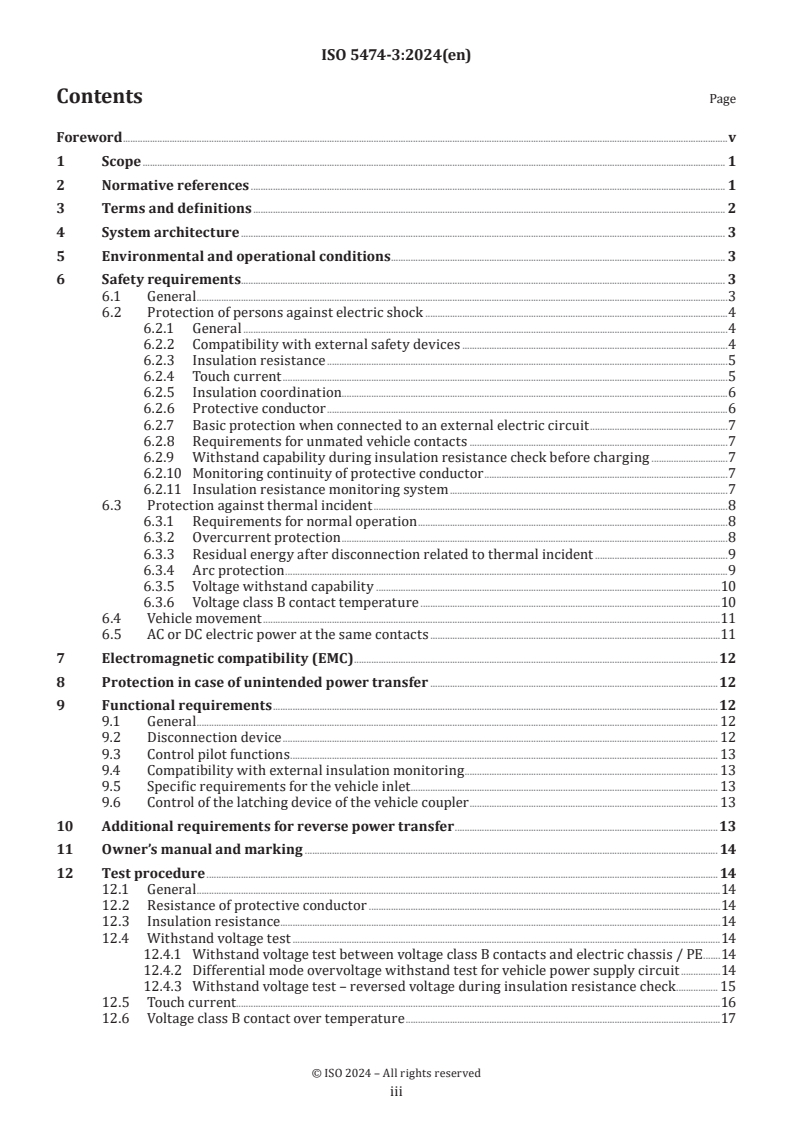
Contents Page
Foreword .v
1 Scope . 1
2 Normative references . 1
3 Terms and definitions . 2
4 System architecture . 3
5 Environmental and operational conditions . 3
6 Safety requirements. 3
6.1 General .3
6.2 Protection of persons against electric shock .4
6.2.1 General .4
6.2.2 Compatibility with external safety devices .4
6.2.3 Insulation resistance .5
6.2.4 Touch current .5
6.2.5 Insulation coordination.6
6.2.6 Protective conductor .6
6.2.7 Basic protection when connected to an external electric circuit .7
6.2.8 Requirements for unmated vehicle contacts .7
6.2.9 Withstand capability during insulation resistance check before charging .7
6.2.10 Monitoring continuity of protective conductor .7
6.2.11 Insulation resistance monitoring system .7
6.3 Protection against thermal incident .8
6.3.1 Requirements for normal operation .8
6.3.2 Overcurrent protection .8
6.3.3 Residual energy after disconnection related to thermal incident .9
6.3.4 Arc protection .9
6.3.5 Voltage withstand capability .10
6.3.6 Voltage class B contact temperature .10
6.4 Vehicle movement .11
6.5 AC or DC electric power at the same contacts .11
7 Electromagnetic compatibility (EMC) . .12
8 Protection in case of unintended power transfer .12
9 Functional requirements .12
9.1 General . 12
9.2 Disconnection device . 12
9.3 Control pilot functions . . 13
9.4 Compatibility with external insulation monitoring . 13
9.5 Specific requirements for the vehicle inlet . 13
9.6 Control of the latching device of the vehicle coupler . 13
10 Additional requirements for reverse power transfer .13
11 Owner’s manual and marking . 14
12 Test procedure . 14
12.1 General .14
12.2 Resistance of protective conductor .14
12.3 Insulation resistance.14
12.4 Withstand voltage test .14
12.4.1 Withstand voltage test between voltage class B contacts and electric chassis / PE .14
12.4.2 Differential mode overvoltage withstand test for vehicle power supply circuit .14
12.4.3 Withstand voltage test – reversed voltage during insulation resistance check . 15
12.5 Touch current.16
12.6 Voltage class B contact over temperature .17
iii
12.7 Monitoring continuity of protective conductor test .19
Annex A (informative) Y capacitance measurement .21
Annex B (informative) Outlook on megawatt charging applications .25
Annex C (informative) Examples for conformance tests of voltage class A protective provisions
for fault protection .29
Bibliography .33
iv
Foreword
ISO (the International Organization for Standardization) is a worldwide federation of national standards
bodies (ISO member bodies). The work of preparing International Standards is normally carried out through
ISO technical committees. Each member body interested in a subject for which a technical committee
has been established has the right to be represented on that committee. International organizations,
governmental and non-governmental, in liaison with ISO, also take part in the work. ISO collaborates closely
with the International Electrotechnical Commission (IEC) on all matters of electrotechnical standardization.
The procedures used to develop this document and those intended for its further maintenance are described
in the ISO/IEC Directives, Part 1. In particular, the different approval criteria needed for the different types
of ISO document should be noted. This document was drafted in accordance with the editorial rules of the
ISO/IEC Directives, Part 2 (see www.iso.org/directives).
ISO draws attention to the possibility that the implementation of this document may involve the use of (a)
patent(s). ISO takes no position concerning the evidence, validity or applicability of any claimed patent
rights in respect thereof. As of the date of publication of this document, ISO had not received notice of (a)
patent(s) which may be required to implement this document. However, implementers are cautioned that
this may not represent the latest information, which may be obtained from the patent database available at
www.iso.org/patents. ISO shall not be held responsible for identifying any or all such patent rights.
Any trade name used in this document is information given for the convenience of users and does not
constitute an endorsement.
For an explanation of the voluntary nature of standards, the meaning of ISO specific terms and expressions
related to conformity assessment, as well as information about ISO's adherence to the World Trade
Organization (WTO) principles in the Technical Barriers to Trade (TBT), see www.iso.org/iso/foreword.html.
This document was prepared by Technical Committee ISO/TC 22 Road vehicles, Subcommittee SC 37
Electrically propelled vehicles.
A list of all parts in the ISO 5474 series can be found on the ISO website.
Any feedback or questions on this document should be directed to the user’s national standards body. A
complete listing of these bodies can be found at www.iso.org/members.html.
v
International Standard ISO 5474-3:2024(en)
Electrically propelled road vehicles — Functional and safety
requirements for power transfer between vehicle and
external electric circuit —
Part 3:
DC power transfer
1 Scope
This document in combination with ISO 5474-1 specifies requirements for conductive power transfer
using direct current (DC) with a voltage up to 1 500 V d.c. between electrically propelled road vehicles and
external electric circuits.
This document provides requirements for conductive charging in mode 4 according to IEC 61851-1. For
mode 4, this document provides requirements regarding the power transfer only with isolated DC EV supply
equipment according to IEC 61851-23.
The requirements in this document are applicable to vehicle power supply circuits.
An outlook of requirements for megawatt charging applications is given in Annex B.
This document does not provide:
— requirements for simultaneous operation of multiple power transfer interfaces and
— requirements for power transfer while driving (electric road systems)
but they are under consideration.
This document does not provide:
— requirements for mopeds and motorcycles (which are specified in ISO 18246);
— comprehensive safety information for manufacturing, maintenance and repair personnel.
2 Normative references
The following documents are referred to in the text in such a way that some or all of their content constitutes
requirements of this document. For dated references, only the edition cited applies. For undated references,
the latest edition of the referenced document (including any amendments) applies.
ISO 5474-1:2024, Electrically propelled road vehicles —Functional requirements and safety requirements for
power transfer —Part 1: General requirements for conductive power transfer
ISO 6469-3:2021, Electrically propelled road vehicles — Safety specifications — Part 3: Electrical safety
ISO 26262 (all parts), Road vehicles — Functional safety
IEC 60364-4-43, Low-voltage electrical installations — Part 4-43: Protection for safety — Protection against
overcurrent (relevant parts will be specified during the project)
IEC 61000-4-5, Electromagnetic compatibility (EMC) — Part 4-5: Testing and measurement techniques - Surge
immunity test
IEC 61180, High-voltage test techniques for low-voltage equipment — Definitions, test and procedure
requirements, test equipment
IEC 61851-1, Electric vehicle conductive charging system — Part 1: General requirements
IEC 61851-23:2023, Electric vehicle conductive charging system — Part 23: DC electric vehicle charging station
IEC 62196-3, Plugs, socket-outlets, vehicle connectors and vehicle inlets — Conductive charging of electric
vehicles — Part 3: Dimensional compatibility and interchangeability requirements for d.c. and a.c./d.c. pin and
contact-tube vehicle couplers
IEC TS 62196-3-1, Plugs, socket-outlets, vehicle connectors and vehicle inlets — Conductive charging of electric
vehicles — Part 3-1: Vehicle connector, vehicle inlet and cable assembly for DC charging intended to be used with
a thermal management system
3 Terms and definitions
For the purposes of this document, the terms and definitions given in ISO 5474-1 and the following apply.
ISO and IEC maintain terminology databases for use in standardization at the following addresses:
— ISO Online browsing platform: available at https:// www .iso .org/ obp
— IEC Electropedia: available at https:// www .electropedia .org/
3.1
cut-off current
let-through current
maximum instantaneous value of current attained during the breaking operation of a switching device or a fuse
Note 1 to entry: This concept is of particular importance when the switching device or the fuse operates in such a
manner that the prospective peak current of the circuit is not reached.
[SOURCE: IEC 60050-441:1984, 441-17-12, modified — “is” added to the Note to entry.]
3.2
insulation monitoring device
IMD
device which permanently monitors the insulation resistance to earth of unearthed AC IT systems, AC
IT systems with galvanically connected DC circuits having nominal voltages up to 1 000 V a.c., as well as
monitoring the insulation resistance of unearthed DC IT systems with voltages up to 1 500 V d.c., independent
from the method of measuring
[SOURCE: IEC 61557-8:2014, 3.1.14]
3.3
insulation resistance monitoring system
system that periodically or continuously monitors the insulation resistance between live parts and the
electric chassis
[SOURCE: ISO 6469-3:2021, 3.24, modified — "isolation" has been replaced by "insulation".]
3.4
thermal cut-out
temperature sensing control device intended to switch-off automatically under abnormal operating
conditions and which has no provision for adjustment by the user
[SOURCE: IEC 60050-442:1998, 442-01-43]
3.5
thermal sensing
means for providing temperature data of accessories, cable assemblies or parts thereof
[SOURCE: IEC 61851-23:2023, 3.3.109]
3.6
RESS SOC
rechargeable energy storage system state of charge
residual capacity of RESS available to be discharged
Note 1 to entry: RESS state of charge is normally expressed as a percentage of full charge.
[SOURCE: ISO/TR 11954:2008, 2.2]
3.7
leakage current monitoring device
passive electrical device for monitoring insulation resistance of separated DC system by measuring leakage
current between live parts and exposed conductive parts or the protective conductor
[SOURCE: IEC 61851-23:2023, 3.2.104, modified — Deprecated term removed.]
3.8
SPD
surge protective device
device that contains at least one non-linear component that is intended to limit surge voltages and divert
surge currents
[SOURCE: IEC 61643-11:2011, 3.1.1]
4 System architecture
ISO 5474-1:2024, Clause 4 applies.
5 Environmental and operational conditions
ISO 5474-1:2024, Clause 5 applies.
6 Safety requirements
6.1 General
ISO 5474-1:2024, 6.1 applies except as follows.
Protection against electric shock for the vehicle power supply circuit shall comprise a provision for basic
protection and a provision for fault protection according to the requirements in 6.2.
Unless specified otherwise, “Alternative protection measures” according to ISO 6469-3:2021, 6.3.5 shall be
applied directly between live parts of the vehicle power supply circuit and an ordinary person.
For all safety related functions, the vehicle shall carry out its own measurement of current and voltage, and
shall not solely rely on values communicated via digital communication by the EV supply equipment.
NOTE Digital communication is considered to be not reliable in terms of safety.
6.2 Protection of persons against electric shock
6.2.1 General
ISO 5474-1:2024, 6.2.1 applies.
6.2.2 Compatibility with external safety devices
6.2.2.1 Insulation resistance monitoring system
The operation of the insulation monitoring device or/and the leakage current monitoring device of the
external electric circuit, as specified in IEC 61851-23, shall not be affected. The vehicle should deactivate or
disconnect its insulation resistance monitoring system to avoid such interference.
6.2.2.2 Compatibility of a 1 000 V vehicle with 500 V EV supply equipment
If the vehicle contains circuits with a maximum working voltage between DC+ and DC- above 500 V and it
is intended to be connected to DC EV supply equipment with a rated maximum DC output voltage below or
equal to 500 V d.c., there is a risk that the voltage between the live conductors and protective conductor
in the EV supply equipment exceeds 500 V. It can be caused by, but is not limited to, an insulation fault,
see Figure 1, or asymmetric distribution of the insulation resistance between DC+/DC- and the protective
conductor in the section of the vehicle with a working voltage above 500 V d.c.
The temporary overvoltage can trip SPDs in the EV supply equipment or damage components in the EV
supply equipment.
The current caused by those effects can subsequently:
— cause a touch voltage between earth and vehicle chassis, and/or
— damage the protective conductor connection between the vehicle and the DC supply equipment as a
secondary effect.
Figure 1 — Single fault scenario of a 1 000 V vehicle with 500 V EV supply equipment
The vehicle manufacturer shall perform a safety analysis to minimize the risk of a hazardous electric shock
caused by the effects above. The protection measures are, but not limited to:
— the vehicle shall disconnect the vehicle power supply circuit from the EV supply equipment in less than
5 s if the voltage between the live conductors and protective conductor exceeds 500 V in the section of
the vehicle power supply circuit with a working voltage of less than or equal to 500 V;
— the vehicle shall fulfil at least one of the following:
a) have a vehicle power supply circuit with a maximum working voltage up to 500 V and provide
simple separation between the vehicle power supply circuit and any circuit which has a working
voltage above 500 V;
b) implement double or reinforced insulation between the live parts of the vehicle power supply circuit
(including the RESS) with a working voltage above 500 V and electric chassis/voltage class A circuit;
c) limit the operating joule integral I t in consideration of IEC 60364-5-54 and limit the duration of
touch voltage between electric chassis and earth or EV supply equipment housing in consideration
of IEC 60479 series.
6.2.2.3 Y-capacitance coordination
The total y-capacitance of the vehicle power supply circuit shall not exceed 4 μF.
For a vehicle equipped with a vehicle inlet according to IEC TS 62196-3-1 or IEC 62196-3 configuration AA
with a maximum working voltage up to 500 V d.c., the y-capacitance of the vehicle power supply circuit shall
not exceed 1,1 μF per live conductor and 2,2 μF in total y-capacitance.
For a vehicle with a vehicle inlet according to IEC TS 62196-3-1 or IEC 62196-3 configuration AA, configuration
EE or configuration FF and a maximum working voltage above 500 V d.c., the total y-capacitance of the
vehicle power supply circuit shall not exceed the limits according to Formula (1).
16,
C = (1)
y
1 000*U
where
C is the total y-capacitance, expressed in Farad (F);
y
U is the maximum working voltage, expressed in Volt (V).
NOTE The formula assumes a measurement current of the IMD of 1 mA and limits the time to perform a single
measurement for one live conductor to 8 s. This supports a total time for a complete measurement cycle for the vehicle
of 30 s without consideration of the added y-capacitance of the external electric circuit.
For a vehicle with a vehicle inlet according to IEC TS 62196-3-1 or IEC 62196-3 configuration BB the
Y-capacitance of the EV supply equipment shall be considered.
The y-capacitance per live conductor should be balanced by choosing appropriate design values.
Conformance is checked by inspection and by test. An example for a test is given in Annex A.
6.2.2.4 Compatibility with the special protection of the DC EV supply equipment
To support the special protection of the DC EV supply equipment, the total y-capacitance of the vehicle power
supply circuit shall not exceed the limits according to 6.2.2.3.
NOTE 1 The special protection is provided by the DC EV supply equipment according to IEC 61851-23:2023, 8.105.1.
NOTE 2 The Y capacitance threshold from 6.2.2.3 by itself does not provide additional protection for vehicles with
a maximum working voltage above 500 V d.c. when the vehicle is disconnected from the DC EV supply equipment. For
protection of persons against electric shock when not connected to an external electric circuit, see ISO 6469-3.
6.2.3 Insulation resistance
ISO 5474-1:2024, 6.2.3 applies.
6.2.4 Touch current
ISO 5474-1:2024, 6.2.4 applies except as follows.
Conformance shall be tested in accordance with 12.5.
6.2.5 Insulation coordination
The vehicle shall provide one of the following provisions between voltage class B live parts of the vehicle
power supply circuit and an accessible voltage class A circuit:
— protective separation;
— basic insulation and, under single fault condition, limitation of the voltage at the accessible voltage class
A terminals of a voltage class B component to below 60 V d.c. (or 30 V a.c.). Voltage transients exceeding
60 V shall be limited with an adequate margin from ventricular fibrillation in accordance with IEC 60479
series. The margin shall be specified by the vehicle manufacturer;
Conformance shall be checked by either design review or conformance test as specified by the vehicle
manufacturer. An example is given in C.1.
— basic insulation and, under single fault condition, limitation of:
a) steady-state touch current between the accessible voltage class A terminals of a voltage class B
component and accessible conductive parts to 3,5 mA a.c. and 10 mA d.c.;
b) touch energy below a value with an adequate margin from the limit of ventricular fibrillation in
accordance with IEC 60479 series; the margin shall be specified by the vehicle manufacturer.
Conformance shall be checked by either design review or conformance test as specified by the vehicle
manufacturer. An example is given in C.2.
The insulation between DC+ and protective conductor as well as DC- and protective conductor of the vehicle
power supply circuit shall be designed to withstand:
— impulse withstand voltage of at least 2 500 V;
— short-term temporary overvoltage of 1 980 V d.c. with durations up to 5 s;
— long-term temporary overvoltage of 550 V d.c. with durations longer than 5 s if the vehicle power supply
circuit has a maximum working voltage between DC+ and DC- up to 500 V d.c.;
— long-term temporary overvoltage of 110 % of the maximum working voltage between DC+ and DC- with
durations longer than 5 s if the vehicle power supply circuit has a maximum working voltage between
DC+ and DC- above 500 V d.c.
NOTE 1 The value of 1 980 V is based on the equation (U + 1 200) · √2 from IEC 61851-23:2014 with an assumed
n
value of U = 200 V.
n
NOTE 2 IEC 61851-23:2023 specifies a short-term temporary overvoltage of 1 800 V.
NOTE 3 These requirements are derived from IEC 61851-23. See also IEC 60664-1:2020, Clause 5.
Conformance shall be tested in accordance with 12.4.1.
For normal operation the vehicle power supply circuit shall be designed for a maximum voltage between
DC+ and protective conductor as well as between DC− and protective conductor of at least the maximum DC
working voltage.
Additional voltages of the insulation monitoring device (IMD) of the external electric circuit (see
IEC 61851-23) shall be considered.
6.2.6 Protective conductor
ISO 5474-1:2024, 6.2.6 applies except as follows.
For cross-sectional area of the protective conductor, see also IEC 61851-23:2023, 8.105.11.
6.2.7 Basic protection when connected to an external electric circuit
ISO 5474-1:2024, 6.2.7 applies.
6.2.8 Requirements for unmated vehicle contacts
ISO 5474-1:2024, 6.2.8 applies.
6.2.9 Withstand capability during insulation resistance check before charging
The vehicle shall withstand the voltage applied during insulation resistance check before charging, as
specified in IEC 61851-23. If the vehicle detects an unexpected or reversed voltage it shall not close its
disconnection devices and shall stop the charging process.
Conformance shall be tested in accordance with 12.4.3.
6.2.10 Monitoring continuity of protective conductor
For a vehicle equipped with a vehicle inlet according to IEC TS 62196-3-1 or IEC 62196-3 configuration AA,
when an unintended transition from CP state ‘ON’ to ‘OFF’ or any other unknown state occurs during energy
transfer phase according to IEC 61851-23:2023, AA.4.3.1, the vehicle shall fulfil the criteria for the ‘maximum
time to reach safe voltage from fault occurrence’ as specified in IEC 61851-23:2023, Table AA.8 and trigger a
normal or error shutdown within 3 s.
NOTE 1 The discontinuity of PE or CP3 triggers the transition of CP state from ‘ON’ to ‘OFF’ and the opening EV
disconnection device Sv1 by hardware, see IEC 61851-23:2023, Figure AA.1.
In order to prevent the unintentional current flow through CP3 in case of PE conductor discontinuity (i.e.
CP bypassing) during the energy transfer phase, the vehicle shall open CS after the permission of insulation
resistance check in the initialization 1 phase and until the opening of the EV disconnection device Sv1 in the
shutdown 1 phase according to IEC 61851-23:2023, AA.4.3.1.
NOTE 2 CS can be opened by a disconnection device such as relay and transistor. Refer to ‘unintentional current
flow prevention circuit’ in IEC 61851-23:2023, Figure AA.1.
For a vehicle equipped with a vehicle inlet according to IEC TS 62196-3-1 or IEC 62196-3 configuration BB,
when an unintended transition from CC2 state ‘low’ to ‘high’ or any other unknown state occurs during
charging phase according to IEC 61851-23:2023, BB.4.4, the vehicle shall trigger an emergency shutdown,
send "vehicle stopping command" by digital communication according to IEC 61851-24:2023, Clause B.4 to
the EV supply equipment and open the EV disconnection device Sv1 within 300 ms.
For a vehicle equipped with a vehicle inlet according to IEC TS 62196-3-1 or IEC 62196-3 configuration
EE or configuration FF, monitoring of the continuity of the protective conductor shall be implemented in
accordance with IEC 61851-23:2023, CC.4.3 and CC.4.7.
Conformance shall be checked by either design review or conformance test in accordance with 12.7.
6.2.11 Insulation resistance monitoring system
The vehicle shall monitor the vehicle power supply circuit with an insulation resistance monitoring system
according to ISO 6469-3.
If the insulation resistance of the vehicle power supply circuit divided by its maximum working voltage is
less than 100 Ω/V, the vehicle shall not close its disconnection device.
The section between the disconnection device and the vehicle inlet may be omitted in the measurement.
For a vehicle equipped with a vehicle inlet according to IEC TS 62196-3-1 or IEC 62196-3 configuration AA,
the vehicle shall monitor the insulation resistance from the beginning of the initialization 1 phase and until
the end of the initialization 3 phase according to IEC 61851-23:2023, AA.4.3.1.The vehicle may reactivate the
insulation resistance monitoring after opening the EV disconnection device in the shutdown 1 phase.
For a vehicle equipped with a vehicle inlet according to IEC TS 62196-3-1 or IEC 62196-3 configuration BB
the insulation monitoring system of the vehicle shall remain active in accordance with IEC61851-23.
For a vehicle equipped with a vehicle inlet according to IEC TS 62196-3-1 or IEC 62196-3 configuration
EE and FF, the vehicle shall monitor the insulation resistance in accordance with the timings specified in
IEC 61851-23:2023, CC.3.
6.3 Protection against thermal incident
6.3.1 Requirements for normal operation
ISO 5474-1:2024, 6.3.1 applies except as follows.
The cross-sectional area of the live conductors may be reduced as long as temperature limits according to
6.3.6 are not exceeded. In this case, protection against thermal incidents of the vehicle power supply circuit
shall be provided. The maximum ambient temperature of the vehicle shall be considered.
The vehicle may allow a current exceeding the rated current of the vehicle inlet according to IEC TS 62196-3-1
or IEC 62196-3 as long as the temperature requirement for the voltage class B contacts of the vehicle inlet
according to 6.3.6 is fulfilled.
6.3.2 Overcurrent protection
6.3.2.1 General
ISO 5474-1:2024, 6.3.2.1 applies except as follows.
NOTE 1 When determining the necessary breaking capability of the vehicle overcurrent protection device, also
consider the impedance of the external electric circuit. Measures to mitigate short circuit energy by the EV supply
equipment are under consideration.
NOTE 2 Requirements for impedance of the external electric circuit are under consideration in
IEC 61851-23:2023, 101.1.8.
6.3.2.2 Overload protection
ISO 5474-1:2024, 6.3.2.2 applies.
6.3.2.3 Short-circuit protection
ISO 5474-1:2024, 6.3.2.3 applies except as follows.
6.3.2.3.1 Short-circuit energy supplied by external electric circuit
In case of a short circuit, the vehicle shall be capable of withstanding a peak current, including transient
effects, according to the IEC 61851-23:2023, 13.101.
For short-circuit current supplied by external electric circuit, the requirements in a) or b) shall be fulfilled
for short-circuit protection.
a) The vehicle power supply circuit shall have a I t value of at least the following values:
— 1 000 000 A s, if a vehicle is equipped with a vehicle inlet of configuration AA, configuration BB,
configuration EE, configuration FF according to IEC TS 62196-3-1 or IEC 62196-3, or
— an I t value to be coordinated for any other DC charging system.
The minimum cross-sectional area of the live conductors shall be calculated in accordance with
IEC 60364-4-43:2008, Equation (3).
NOTE This I t value corresponds to the characteristics of the overcurrent protection of the external electric
power supply. The given I t values are coordinated with IEC 61851-23.
b) An overcurrent protection (e.g. fuse, circuit breaker) shall be provided in the vehicle power supply
circuit. The cross-sectional area of the live conductors to be protected by this overcurrent protection
shall be designed according to the short-circuit interrupt rating of this overcurrent protection. The
cross-sectional area of the live conductors between the vehicle inlet and this overcurrent protection
shall conform to the requirement of 6.3.2.3.1 a).
6.3.2.3.2 Short-circuit energy supplied by the vehicle
To limit the short-circuit energy supplied from the vehicle to the external electric circuit, the vehicle power
supply circuit shall provide overcurrent protection with the following characteristics:
— the cut-off current supplied by vehicle sources does not exceed 30 kA at the voltage class B contacts of
the vehicle inlet, and
— the supply to the external electric circuit is switched off within 1 s after start of the short-circuit
condition, and
— the maximum I t value at the voltage class B contacts of the vehicle inlet:
— of 2 500 000 A s, if the vehicle is equipped with an inlet of configuration AA according to
IEC TS 62196-3-1 or IEC 62196-3, or
— of 5 000 000 A s, if the vehicle is equipped with a vehicle inlet of configuration BB, EE or configuration
FF according to IEC TS 62196-3-1 or IEC 62196-3,
— an I t value to be coordinated for any other DC charging system.
NOTE 1 The I t value requirement for vehicles equipped with a configuration EE or configuration FF vehicle
inlet according to IEC TS 62196-3-1 or IEC 62196-3 (System C according to IEC 61851-23) was 12 000 000 A s in
ISO 17409:2015.
Conformance is checked:
— by inspection, assuming a fault resistance of R = 5 mΩ and a fault inductance of L = 2 µH, or
fault fault
— by test, applying a fault resistance of R ≤ 5 mΩ and a fault inductance of L ≤ 2 µH for the short
fault fault
circuit condition external to the vehicle.
The cross-sectional area of the live conductors between the vehicle inlet and the overcurrent protection
shall be designed according to the characteristics of the overcurrent protection.
The cross-sectional area of the live conductors shall be calculated from IEC 60364-4-43:2008, Equation (3).
NOTE 2 The short-circuit withstand capabilities of the external electric circuit (see IEC 61851-23) correspond to
these characteristics of the overcurrent protection of the vehicle power supply circuit.
Requirements for external impedance are under consideration in IEC 61851-23:2023, 101.1.8.
Conformance is checked by inspection.
6.3.3 Residual energy after disconnection related to thermal incident
ISO 5474-1:2024, 6.3.3 applies.
6.3.4 Arc protection
ISO 5474-1:2024, 6.3.4 applies except as follows.
Arc protection shall be covered by the requirement of control of the latching device of the vehicle coupler. For
a vehicle equipped with a configuration EE or configuration FF vehicle inlet according to IEC TS 62196-3-1 or
IEC 62196-3, the following requirements shall be met:
— the vehicle shall engage the latching device of the vehicle inlet at the beginning of the power transfer
process, before the vehicle changes the system state to state C in accordance with IEC 61851-1;
— the vehicle shall check the proper engagement of the latching device and shall only close S2 if the latching
device is properly engaged;
NOTE 1 The proper engagement of the latching device is typically checked by the detection of the end position
of the actuator of the latching device.
— if the latching device disengages falsely, the vehicle shall change the system state of the control pilot
function to state B, in accordance with the sequence diagrams as specified in IEC 61851-23:2023, CC.3, in
order to trigger an emergency shutdown;
— the vehicle shall only disengage the latching device if the vehicle power supply circuit is in a condition
that does not cause hazardous arcing.
In case of a malfunction, a means for disconnection specified by vehicle manufacturer is allowed to be
provided.
The vehicle manufacturer shall analyse the system design including the EV supply equipment to specify
the thresholds to prevent from hazardous arcing.
EXAMPLE
— the voltage and the current of the vehicle power supply circuit are below values specified by the vehicle
manufacturer (e.g. 60 V and 5 A);
— disconnection device detected open.
NOTE 2 For a vehicle equipped with a configuration AA or configuration BB vehicle inlet according to
IEC TS 62196-3-1 or IEC 62196-3, the latching device of the vehicle coupler is provided by the DC EV supply equipment.
Furthermore, a vehicle equipped with a configuration EE or configuration FF vehicle inlet according to
IEC TS 62196-3-1 or IEC 62196-3 shall detect the loss of electric continuity of the control pilot conductor and
shall react in accordance with IEC 61851-23:2023, CC.4.3.
6.3.5 Voltage withstand capability
The vehicle power supply circuit from vehicle inlet up to and including the disconnection device, shall be
designed according to an impulse withstand voltage of at least the maximum working voltage of the vehicle
power supply circuit plus 500 V between DC+ and DC- according to IEC 61851-23:2023, 12.7.101.
The relevant parts of the voltage class B electric circuit shall withstand a temporary overvoltage caused by
load dump in accordance with the system specific requirements of IEC 61851-23:2023, 101.1.7.
The output inductance of the EV supply equipment shall be considered.
NOTE The maximum value of the output inductance of the EV supply equipment is under consideration in
IEC 61851-23.
Conformance shall be tested in accordance with 12.4.2.
6.3.6 Voltage class B contact temperature
The temperature of the voltage class B contacts of the vehicle inlet shall not exceed the temperature limit as
specified by the manufacturer of the vehicle inlet.
For an ambient temperature up to 40 °C, if the contact temperature of the voltage class B contacts of the
vehicle inlet exceeds 90 °C for 8 consecutive seconds, the vehicle shall trigger an error shutdown according
to IEC 61851-23 within 1 s.
Conformance is checked by inspection and test 12.6.
For an ambient temperature up to 40 °C, if the contact temperature of the voltage class B contacts of the
vehicle inlet exceeds 95 °C for 1 s, the vehicle shall trigger an error shutdown according to IEC 61851-23
within 1 s.
Conformance is checked by inspection.
NOTE 1 The temperature limits are derived from the IEC 62196 series and IEC 61851-23.
For vehicles equipped with a vehicle inlet according to IEC TS 62196-3-1 one of the following requirements
applies.
a) The vehicle shall implement thermal sensing for each DC power contact. The vehicle shall control
the current by evaluating the measured temperature values. The vehicle shall periodically check the
plausibility of thermal sensing and provide an appropriate warning if the check fails.
NOTE 2 Plausibility check of thermal sensing can be implemented by comparing the ambient temperature of the
vehicle with the temperature of the power contacts while the vehicle inlet or the automated coupler is not used.
b) The vehicle shall provide a thermal cut-out for each DC power contact.
6.4 Vehicle movement
ISO 5474-1:2024, 6.4 applies.
6.5 AC or DC electric power at the same contacts
The disconnection device (see 9.2) shall interrupt all live conductors of the vehicle power supply circuit
according to this document. The relevant parts of the vehicle power supply circuits shall fulfil the
requirements for AC electric power transfer and for DC electric power transfer, or they shall be disconnected
by a disconnection device which provides simple separation between the circuits.
If the vehicle is using contacts for DC electric power transfer at the vehicle inlet, which also can be used
for AC electric power transfer, the vehicle shall connect its vehicle power supply circuit according to this
document only to an external DC electric circuit if the following requirements are fulfilled:
— a communication between the external DC electric circuit and the vehicle that is required to start DC
electric power transfer is
...