

ISO 22547:2021
(Main)Ships and marine technology — Performance test procedures for high-pressure pumps in LNG fuel gas supply systems (FGSS) for ships
General Information
- Abstract
This document specifies performance and additional tests for high-pressure pumps in marine fuel gas supply systems (FGSS) supplying liquefied natural gas (LNG) to ships. It is applicable to positive displacement pumps (hereinafter "pumps") to assess the mechanical features of the pumps and their auxiliary devices.
- Status
- Published
- Publication Date
- 20-May-2021
- Technical Committee
- ISO/TC 8 - Ships and marine technology
- Drafting Committee
- ISO/TC 8/WG 8 - Liquid and gas fueled vessels
- Current Stage
- 9060 - Close of review
- Completion Date
- 02-Dec-2031
Buy Documents



ISO 22547:2021 - Ships and marine technology -- Performance test procedures for high-pressure pumps in LNG fuel gas supply systems (FGSS) for ships
ISO 22547:2021 - Ships and marine technology — Performance test procedures for high-pressure pumps in LNG fuel gas supply systems (FGSS) for ships/21/2021
Overview
ISO 22547:2021 - Ships and marine technology - Performance test procedures for high‑pressure pumps in LNG fuel gas supply systems (FGSS) for ships - defines standardized test methods to verify mechanical and hydraulic performance of high‑pressure positive displacement pumps used to supply liquefied natural gas (LNG) as marine fuel. The standard covers test arrangement, test fluids, measurement parameters, performance test sequences, and additional tests (unit, type, endurance, overhaul, vibration and noise) to ensure safe, repeatable verification of pump performance under cryogenic conditions.
Key topics and requirements
- Scope and applicability: Applies to positive displacement pumps in shipboard FGSS to assess mechanical features and auxiliary devices.
- Test arrangement & preparation: Requires a controlled supply of cryogenic test fluid to the pump inlet, pre‑test inspections, and review of manufacturer data by the client.
- Test fluid: LNG is the preferred medium; colder alternatives (e.g., liquefied nitrogen) may be used if practical with correction values (per ISO 6976 or equivalent).
- Measured parameters: At minimum, pressure, temperature and flow rate. Sensors must be calibrated and located as close to the pump as practicable; data recorded at 5‑minute intervals during each load step.
- Performance metrics:
- Total pressure: determined from discharge minus suction pressure.
- Total efficiency: defined as the ratio of theoretical hydraulic power to actual pump input power (measured from motor torque/rev speed).
- Test procedure: Includes precooling to cryogenic temperatures, temperature stabilization, and staged load steps (25%, 50%, 75%, 100% of test flow rate with hold times) with recorded data for each step.
- Additional tests: Unit production, type testing, optional endurance testing, overhaul inspection; pressure testing at 1.5× design pressure for production tests, and vibration/noise testing in accordance with ISO 10816‑6 and ISO 1996‑1.
- Documentation: A detailed test report is required (pump ID, manufacturer, serial no., test conditions, fluid, results, tester) with an Annex A example report.
Applications and users
ISO 22547 is used by:
- Pump manufacturers and test facilities for factory acceptance and type certification.
- Shipbuilders and naval architects specifying FGSS components.
- Classification societies, flag states and regulatory bodies auditing compliance with IGC/IGF Codes.
- Shipowners, operators and procurement teams validating pump performance, reliability and safety in LNG‑fuelled vessels.
- Third‑party testing laboratories performing cryogenic pump verification.
Keywords: ISO 22547, LNG fuel gas supply systems, FGSS, high‑pressure pumps, performance test procedures, positive displacement pumps, cryogenic pump testing, pump efficiency.
Related standards
- ISO 10816‑6 - mechanical vibration (reciprocating machines)
- ISO 1996‑1 - environmental noise measurement
- ISO 6976 - gas calorific value/corrections (referenced for test fluid corrections)
- IGC Code and IGF Code - ship safety requirements for liquefied gases and low‑flashpoint fuels
Relations
- Effective Date
- 06-Jun-2022
Buy Documents
ISO 22547:2021 - Ships and marine technology -- Performance test procedures for high-pressure pumps in LNG fuel gas supply systems (FGSS) for ships
ISO 22547:2021 - Ships and marine technology — Performance test procedures for high-pressure pumps in LNG fuel gas supply systems (FGSS) for ships/21/2021
Get Certified
Connect with accredited certification bodies for this standard

DNV
DNV is an independent assurance and risk management provider.

Lloyd's Register
Lloyd's Register is a global professional services organisation specialising in engineering and technology.

FSC International
Forest Stewardship Council certification.
Sponsored listings
Frequently Asked Questions
ISO 22547:2021 is a standard published by the International Organization for Standardization (ISO). Its full title is "Ships and marine technology — Performance test procedures for high-pressure pumps in LNG fuel gas supply systems (FGSS) for ships". This standard covers: This document specifies performance and additional tests for high-pressure pumps in marine fuel gas supply systems (FGSS) supplying liquefied natural gas (LNG) to ships. It is applicable to positive displacement pumps (hereinafter "pumps") to assess the mechanical features of the pumps and their auxiliary devices.
This document specifies performance and additional tests for high-pressure pumps in marine fuel gas supply systems (FGSS) supplying liquefied natural gas (LNG) to ships. It is applicable to positive displacement pumps (hereinafter "pumps") to assess the mechanical features of the pumps and their auxiliary devices.
ISO 22547:2021 is classified under the following ICS (International Classification for Standards) categories: 47.020.99 - Other standards related to shipbuilding and marine structures. The ICS classification helps identify the subject area and facilitates finding related standards.
ISO 22547:2021 has the following relationships with other standards: It is inter standard links to ISO/ASTM 52938-1:2025. Understanding these relationships helps ensure you are using the most current and applicable version of the standard.
ISO 22547:2021 is available in PDF format for immediate download after purchase. The document can be added to your cart and obtained through the secure checkout process. Digital delivery ensures instant access to the complete standard document.
Standards Content (Sample)
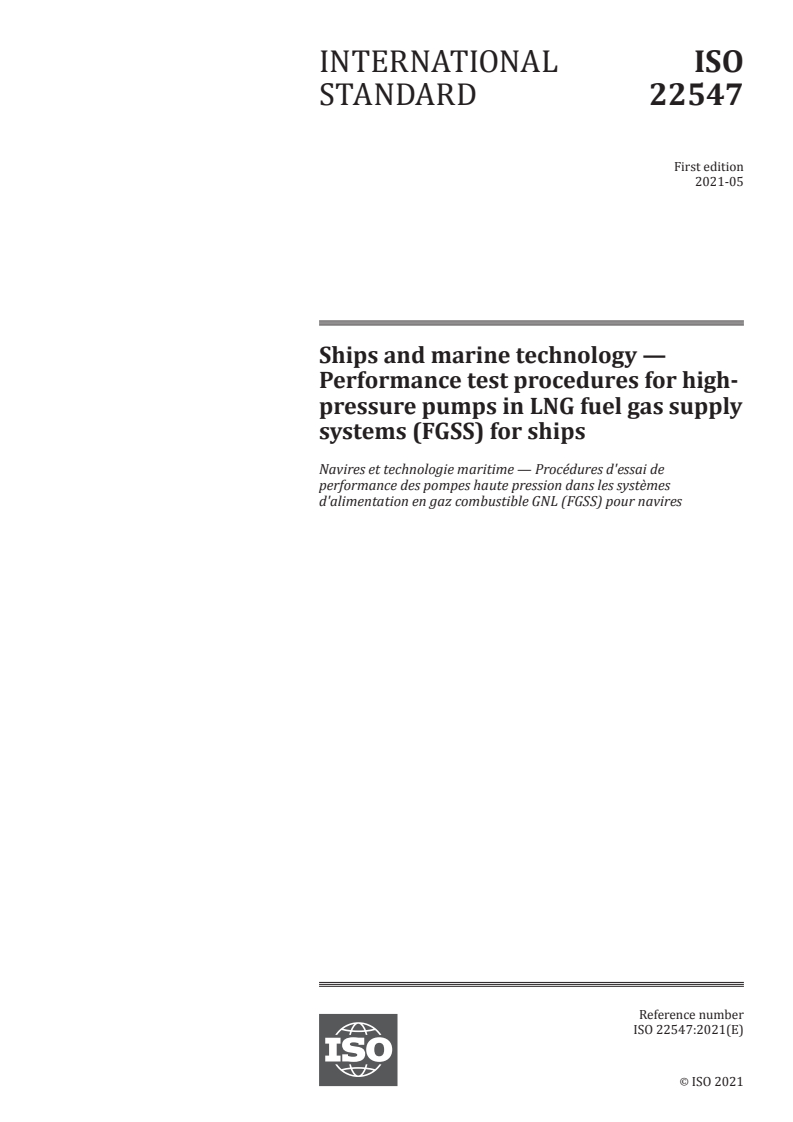
INTERNATIONAL ISO
STANDARD 22547
First edition
2021-05
Ships and marine technology —
Performance test procedures for high-
pressure pumps in LNG fuel gas supply
systems (FGSS) for ships
Navires et technologie maritime — Procédures d'essai de
performance des pompes haute pression dans les systèmes
d'alimentation en gaz combustible GNL (FGSS) pour navires
Reference number
©
ISO 2021
© ISO 2021
All rights reserved. Unless otherwise specified, or required in the context of its implementation, no part of this publication may
be reproduced or utilized otherwise in any form or by any means, electronic or mechanical, including photocopying, or posting
on the internet or an intranet, without prior written permission. Permission can be requested from either ISO at the address
below or ISO’s member body in the country of the requester.
ISO copyright office
CP 401 • Ch. de Blandonnet 8
CH-1214 Vernier, Geneva
Phone: +41 22 749 01 11
Email: copyright@iso.org
Website: www.iso.org
Published in Switzerland
ii © ISO 2021 – All rights reserved
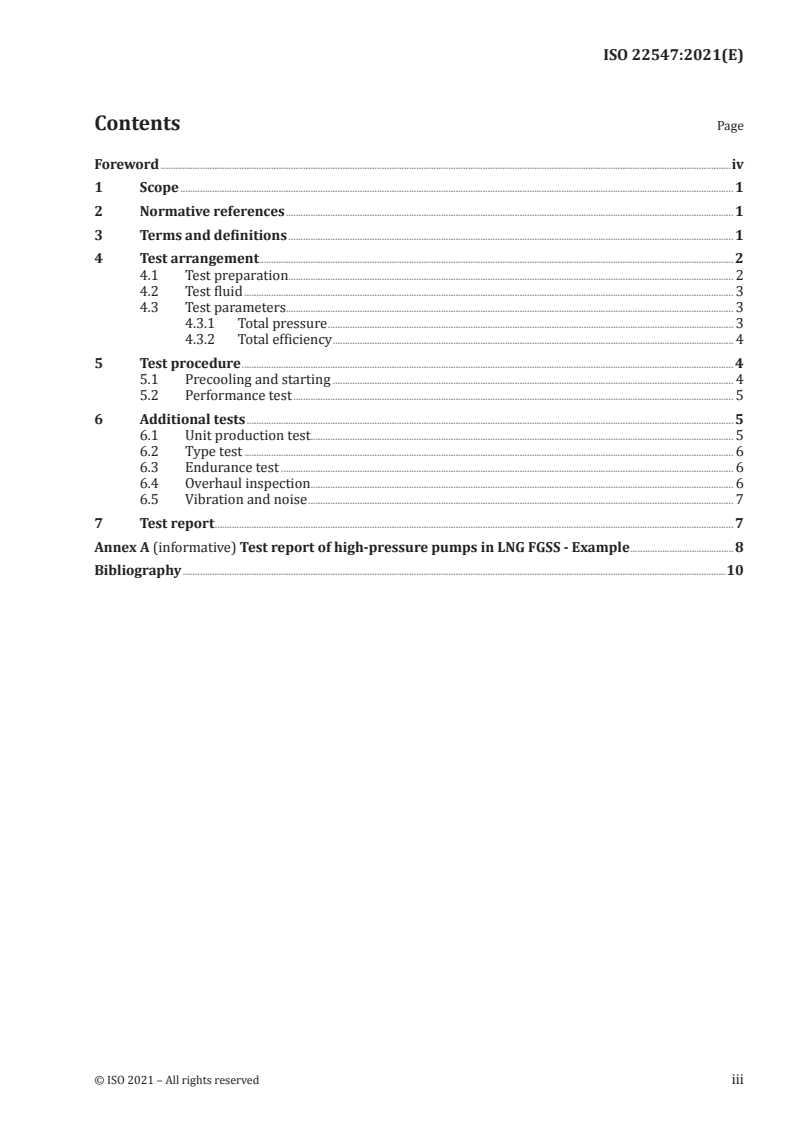
Contents Page
Foreword .iv
1 Scope . 1
2 Normative references . 1
3 Terms and definitions . 1
4 Test arrangement . 2
4.1 Test preparation . 2
4.2 Test fluid . 3
4.3 Test parameters . 3
4.3.1 Total pressure . 3
4.3.2 Total efficiency . 4
5 Test procedure . 4
5.1 Precooling and starting . 4
5.2 Performance test . 5
6 Additional tests . 5
6.1 Unit production test. 5
6.2 Type test . 6
6.3 Endurance test . 6
6.4 Overhaul inspection . 6
6.5 Vibration and noise . 7
7 Test report . 7
Annex A (informative) Test report of high-pressure pumps in LNG FGSS - Example .8
Bibliography .10
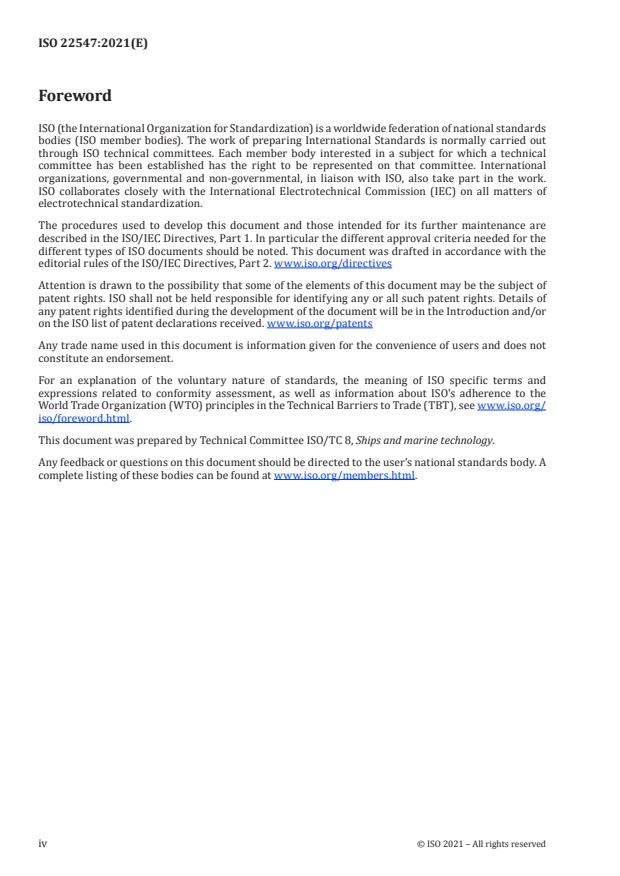
Foreword
ISO (the International Organization for Standardization) is a worldwide federation of national standards
bodies (ISO member bodies). The work of preparing International Standards is normally carried out
through ISO technical committees. Each member body interested in a subject for which a technical
committee has been established has the right to be represented on that committee. International
organizations, governmental and non-governmental, in liaison with ISO, also take part in the work.
ISO collaborates closely with the International Electrotechnical Commission (IEC) on all matters of
electrotechnical standardization.
The procedures used to develop this document and those intended for its further maintenance are
described in the ISO/IEC Directives, Part 1. In particular the different approval criteria needed for the
different types of ISO documents should be noted. This document was drafted in accordance with the
editorial rules of the ISO/IEC Directives, Part 2. www .iso .org/ directives
Attention is drawn to the possibility that some of the elements of this document may be the subject of
patent rights. ISO shall not be held responsible for identifying any or all such patent rights. Details of
any patent rights identified during the development of the document will be in the Introduction and/or
on the ISO list of patent declarations received. www .iso .org/ patents
Any trade name used in this document is information given for the convenience of users and does not
constitute an endorsement.
For an explanation of the voluntary nature of standards, the meaning of ISO specific terms and
expressions related to conformity assessment, as well as information about ISO's adherence to the
World Trade Organization (WTO) principles in the Technical Barriers to Trade (TBT), see www .iso .org/
iso/ foreword .html.
This document was prepared by Technical Committee ISO/TC 8, Ships and marine technology.
Any feedback or questions on this document should be directed to the user’s national standards body. A
complete listing of these bodies can be found at www .iso .org/ members .html.
iv © ISO 2021 – All rights reserved
INTERNATIONAL STANDARD ISO 22547:2021(E)
Ships and marine technology — Performance test
procedures for high-pressure pumps in LNG fuel gas supply
systems (FGSS) for ships
1 Scope
This document specifies performance and additional tests for high-pressure pumps in marine fuel
gas supply systems (FGSS) supplying liquefied natural gas (LNG) to ships. It is applicable to positive
displacement pumps (hereinafter "pumps") to assess the mechanical features of the pumps and their
auxiliary devices.
2 Normative references
The following documents are referred to in the text in such a way that some or all of their content
constitutes requirements of this document. For dated references, only the edition cited applies. For
undated references, the latest edition of the referenced document (including any amendments) applies.
ISO 1996-1, Acoustics — Description, measurement and assessment of environmental noise — Part 1: Basic
quantities and assessment procedures
ISO 10816-6, Mechanical vibration — Evaluation of machine vibration by measurements on non-rotating
parts — Part 6: Reciprocating machines with power ratings above 100 kW
IGC Code, International Code for the Construction and Equipment of Ships carrying Liquefied Gases in Bulk
IGF Code, International Code of Safety for Ships using Gases or other Low-flashpoint Fuels
3 Terms and definitions
For the purpose of this document, the following terms and definitions apply.
ISO and IEC maintain terminological databases for use in standardization at the following addresses:
— ISO Online browsing platform: available at https:// www .iso .org/ obp
— IEC Electropedia: available at http:// www .electropedia .org/
3.1
high pressure
maximum working pressure greater than 1,0 MPa
3.2
LOS
lubricating oil system
system to supply lubricant to the pump crank chamber
3.3
seal gas
gas used to separate the pump piston from the driving part and to prevent ice formation
3.4
test temperature
temperature of the fluid during the test, designated by the client
3.5
test pressure
pressure of the fluid during the test, designated by the client
3.6
test flow rate
flow rate of the fluid during the test, designated by the client
3.7
temperature stabilization
state at the conclusion of cool-down, when the temperature variation of the pump is within ±2 °C/min
4 Test arrangement
4.1 Test preparation
The client, prior to setting the test parameters, shall review the information provided by the
manufacturer to ensure that the test parameters at a minimum meet the requirements of the
manufacturer.
The test arrangement used for the performance test shall supply a test fluid to the inlet of the pump and
related devices, at the required test pressure, test temperature and test flow rate without disruption.
In order to prevent industrial accidents during the test, the test arrangement and/or the equipment
shall be reviewed and checked in advance.
Figures 1 and 2 show a conceptual diagram of a typical
...
INTERNATIONAL ISO
STANDARD 22547
First edition
2021-05
Ships and marine technology —
Performance test procedures for high-
pressure pumps in LNG fuel gas supply
systems (FGSS) for ships
Navires et technologie maritime — Procédures d'essai de
performance des pompes haute pression dans les systèmes
d'alimentation en gaz combustible GNL (FGSS) pour navires
Reference number
©
ISO 2021
© ISO 2021
All rights reserved. Unless otherwise specified, or required in the context of its implementation, no part of this publication may
be reproduced or utilized otherwise in any form or by any means, electronic or mechanical, including photocopying, or posting
on the internet or an intranet, without prior written permission. Permission can be requested from either ISO at the address
below or ISO’s member body in the country of the requester.
ISO copyright office
CP 401 • Ch. de Blandonnet 8
CH-1214 Vernier, Geneva
Phone: +41 22 749 01 11
Email: copyright@iso.org
Website: www.iso.org
Published in Switzerland
ii © ISO 2021 – All rights reserved
Contents Page
Foreword .iv
1 Scope . 1
2 Normative references . 1
3 Terms and definitions . 1
4 Test arrangement . 2
4.1 Test preparation . 2
4.2 Test fluid . 3
4.3 Test parameters . 3
4.3.1 Total pressure . 3
4.3.2 Total efficiency . 4
5 Test procedure . 4
5.1 Precooling and starting . 4
5.2 Performance test . 5
6 Additional tests . 5
6.1 Unit production test. 5
6.2 Type test . 6
6.3 Endurance test . 6
6.4 Overhaul inspection . 6
6.5 Vibration and noise . 7
7 Test report . 7
Annex A (informative) Test report of high-pressure pumps in LNG FGSS - Example .8
Bibliography .10
Foreword
ISO (the International Organization for Standardization) is a worldwide federation of national standards
bodies (ISO member bodies). The work of preparing International Standards is normally carried out
through ISO technical committees. Each member body interested in a subject for which a technical
committee has been established has the right to be represented on that committee. International
organizations, governmental and non-governmental, in liaison with ISO, also take part in the work.
ISO collaborates closely with the International Electrotechnical Commission (IEC) on all matters of
electrotechnical standardization.
The procedures used to develop this document and those intended for its further maintenance are
described in the ISO/IEC Directives, Part 1. In particular the different approval criteria needed for the
different types of ISO documents should be noted. This document was drafted in accordance with the
editorial rules of the ISO/IEC Directives, Part 2. www .iso .org/ directives
Attention is drawn to the possibility that some of the elements of this document may be the subject of
patent rights. ISO shall not be held responsible for identifying any or all such patent rights. Details of
any patent rights identified during the development of the document will be in the Introduction and/or
on the ISO list of patent declarations received. www .iso .org/ patents
Any trade name used in this document is information given for the convenience of users and does not
constitute an endorsement.
For an explanation of the voluntary nature of standards, the meaning of ISO specific terms and
expressions related to conformity assessment, as well as information about ISO's adherence to the
World Trade Organization (WTO) principles in the Technical Barriers to Trade (TBT), see www .iso .org/
iso/ foreword .html.
This document was prepared by Technical Committee ISO/TC 8, Ships and marine technology.
Any feedback or questions on this document should be directed to the user’s national standards body. A
complete listing of these bodies can be found at www .iso .org/ members .html.
iv © ISO 2021 – All rights reserved
INTERNATIONAL STANDARD ISO 22547:2021(E)
Ships and marine technology — Performance test
procedures for high-pressure pumps in LNG fuel gas supply
systems (FGSS) for ships
1 Scope
This document specifies performance and additional tests for high-pressure pumps in marine fuel
gas supply systems (FGSS) supplying liquefied natural gas (LNG) to ships. It is applicable to positive
displacement pumps (hereinafter "pumps") to assess the mechanical features of the pumps and their
auxiliary devices.
2 Normative references
The following documents are referred to in the text in such a way that some or all of their content
constitutes requirements of this document. For dated references, only the edition cited applies. For
undated references, the latest edition of the referenced document (including any amendments) applies.
ISO 1996-1, Acoustics — Description, measurement and assessment of environmental noise — Part 1: Basic
quantities and assessment procedures
ISO 10816-6, Mechanical vibration — Evaluation of machine vibration by measurements on non-rotating
parts — Part 6: Reciprocating machines with power ratings above 100 kW
IGC Code, International Code for the Construction and Equipment of Ships carrying Liquefied Gases in Bulk
IGF Code, International Code of Safety for Ships using Gases or other Low-flashpoint Fuels
3 Terms and definitions
For the purpose of this document, the following terms and definitions apply.
ISO and IEC maintain terminological databases for use in standardization at the following addresses:
— ISO Online browsing platform: available at https:// www .iso .org/ obp
— IEC Electropedia: available at http:// www .electropedia .org/
3.1
high pressure
maximum working pressure greater than 1,0 MPa
3.2
LOS
lubricating oil system
system to supply lubricant to the pump crank chamber
3.3
seal gas
gas used to separate the pump piston from the driving part and to prevent ice formation
3.4
test temperature
temperature of the fluid during the test, designated by the client
3.5
test pressure
pressure of the fluid during the test, designated by the client
3.6
test flow rate
flow rate of the fluid during the test, designated by the client
3.7
temperature stabilization
state at the conclusion of cool-down, when the temperature variation of the pump is within ±2 °C/min
4 Test arrangement
4.1 Test preparation
The client, prior to setting the test parameters, shall review the information provided by the
manufacturer to ensure that the test parameters at a minimum meet the requirements of the
manufacturer.
The test arrangement used for the performance test shall supply a test fluid to the inlet of the pump and
related devices, at the required test pressure, test temperature and test flow rate without disruption.
In order to prevent industrial accidents during the test, the test arrangement and/or the equipment
shall be reviewed and checked in advance.
Figures 1 and 2 show a conceptual diagram of a typical
...