


ISO/FDIS 18651
(Main)Building construction machinery and equipment - Internal vibrators for concrete - Vocabulary and commercial specifications
Building construction machinery and equipment - Internal vibrators for concrete - Vocabulary and commercial specifications
ISO 18651:2011 specifies the terminology and gives commercial specifications for internal vibrators used for concrete mix compaction.
Machines et matériels pour la construction des bâtiments — Vibrateurs internes pour le béton — Vocabulaire et spécifications commerciales
L'ISO 18651-1:2011 spécifie la terminologie et donne les spécifications commerciales des vibrateurs internes utilisés pour le compactage des mélanges de béton.
General Information
- Status
- Not Published
- Technical Committee
- ISO/TC 195/SC 1 - Machinery and equipment for concrete work
- Drafting Committee
- ISO/TC 195/SC 1 - Machinery and equipment for concrete work
- Current Stage
- 5020 - FDIS ballot initiated: 2 months. Proof sent to secretariat
- Start Date
- 08-Dec-2025
- Completion Date
- 08-Dec-2025
Relations
- Effective Date
- 29-Oct-2022
Overview
ISO/FDIS 18651:2025 is an international standard issued by the International Organization for Standardization (ISO) that defines the vocabulary and commercial specifications for internal vibrators used in concrete compaction during building construction. This standard provides clear terminology and essential data requirements for various types of internal vibrators, ensuring uniformity and quality in their commercial description. Internal vibrators are critical construction machinery components used for compacting uncured concrete mix to improve structural integrity and surface finish.
Key Topics
Terminology and Definitions: The standard establishes precise definitions related to internal vibrators, including different types such as:
- Internal vibrator (immersion vibrator)
- Internal vibrator with flexible drive
- Electric internal vibrator
- Combustion engine internal vibrator
- Built-in motor-type electric internal vibrator
- Hydraulic internal vibrator
- Pneumatic internal vibrator
- Portable-type internal vibrator
- Vibrator assembly and vibration generator mechanisms (eccentric-type and pendulum-type)
Commercial Specifications: ISO 18651 outlines the minimum commercial data manufacturers must provide, such as:
- Dimensions (diameter, length)
- Total mass
- Centrifugal force and vibration frequency (no load)
- Bi-amplitude of vibration
- Electric motor data (power, current, voltage, frequency)
- Generator and converter specifications
- Hose and flexible shaft lengths
- Engine type and output for combustion engines
- Air pressure and consumption for pneumatic units
- Hydraulic system recommendations for hydraulic vibrators
Classification and Components: It details the structure and classification of internal vibrators, including the flexible shaft characteristics, protective hose, and vibrator assemblies, supported by informative annexes and diagrams illustrating typical configurations.
Standardization Process and Updates: The 2025 edition cancels and replaces the 2011 version, refining definitions and removing ambiguity, for example clarifying terms like “internal vibrator” and revising the definition of “hydraulic internal vibrator.” It also aligns terminology with ISO 11375 and incorporates technical feedback from global industry experts.
Applications
Concrete Compaction in Construction: Internal vibrators compliant with ISO 18651 are widely used in building construction projects to compact freshly poured concrete, ensuring:
- Elimination of air pockets and voids
- Improved concrete density and strength
- Enhanced surface finish quality
- Prevention of honeycombing and segregation in concrete structure
Machinery Manufacturing and Sales: Manufacturers and suppliers utilize this standard to:
- Produce machinery that meets uniform quality and performance parameters
- Provide clear and complete product data sheets for buyers
- Facilitate interoperability and maintenance by using standardized terminology
Quality Control and Procurement: Construction companies and contractors reference this standard to:
- Specify compliant internal vibrators in tenders and contracts
- Compare product offerings objectively
- Ensure safety and performance requirements are met according to recognized international standards
Related Standards
- ISO 11375 – Building construction machinery and equipment - Terms and definitions: Provides foundational terminology referenced by ISO 18651.
- Other ISO standards on concrete machinery may intersect, particularly those addressing external vibrators, concrete mixers, and compaction testing.
- IEC Electropedia and ISO Online Browsing Platform provide additional terminology and guidance on electrotechnical components used in internal vibrators.
ISO/FDIS 18651:2025 serves as an authoritative guide for internal vibrators in concrete work, fostering standardized vocabulary and commercial parameters that benefit manufacturers, buyers, and users in the global construction machinery industry. Using this standard supports improved equipment selection, safety, and concrete quality for durable building construction projects.

ISO/FDIS 18651 - Building construction machinery and equipment — Internal vibrators for concrete — Vocabulary and commercial specifications Released:11/25/2025
REDLINE ISO/FDIS 18651 - Building construction machinery and equipment — Internal vibrators for concrete — Vocabulary and commercial specifications Released:11/25/2025

ISO/FDIS 18651 - Machines et matériels pour la construction des bâtiments — Vibrateurs internes pour le béton — Vocabulaire et spécifications commerciales Released:8. 12. 2025
Frequently Asked Questions
ISO/FDIS 18651 is a draft published by the International Organization for Standardization (ISO). Its full title is "Building construction machinery and equipment - Internal vibrators for concrete - Vocabulary and commercial specifications". This standard covers: ISO 18651:2011 specifies the terminology and gives commercial specifications for internal vibrators used for concrete mix compaction.
ISO 18651:2011 specifies the terminology and gives commercial specifications for internal vibrators used for concrete mix compaction.
ISO/FDIS 18651 is classified under the following ICS (International Classification for Standards) categories: 01.040.91 - Construction materials and building (Vocabularies); 91.220 - Construction equipment. The ICS classification helps identify the subject area and facilitates finding related standards.
ISO/FDIS 18651 has the following relationships with other standards: It is inter standard links to ISO 18651-1:2011. Understanding these relationships helps ensure you are using the most current and applicable version of the standard.
ISO/FDIS 18651 is available in PDF format for immediate download after purchase. The document can be added to your cart and obtained through the secure checkout process. Digital delivery ensures instant access to the complete standard document.
Standards Content (Sample)
FINAL DRAFT
International
Standard
ISO/TC 195/SC 1
Building construction machinery
Secretariat: JISC
and equipment — Internal vibrators
Voting begins on:
for concrete — Vocabulary and
2025-12-08
commercial specifications
Voting terminates on:
2026-02-02
Machines et matériels pour la construction des bâtiments —
Vibrateurs internes pour le béton — Vocabulaire et spécifications
commerciales
RECIPIENTS OF THIS DRAFT ARE INVITED TO SUBMIT,
WITH THEIR COMMENTS, NOTIFICATION OF ANY
RELEVANT PATENT RIGHTS OF WHICH THEY ARE AWARE
AND TO PROVIDE SUPPOR TING DOCUMENTATION.
IN ADDITION TO THEIR EVALUATION AS
BEING ACCEPTABLE FOR INDUSTRIAL, TECHNO
LOGICAL, COMMERCIAL AND USER PURPOSES, DRAFT
INTERNATIONAL STANDARDS MAY ON OCCASION HAVE
TO BE CONSIDERED IN THE LIGHT OF THEIR POTENTIAL
TO BECOME STAN DARDS TO WHICH REFERENCE MAY BE
MADE IN NATIONAL REGULATIONS.
Reference number
FINAL DRAFT
International
Standard
ISO/TC 195/SC 1
Building construction machinery
Secretariat: JISC
and equipment — Internal vibrators
Voting begins on:
for concrete — Vocabulary and
commercial specifications
Voting terminates on:
Machines et matériels pour la construction des bâtiments —
Vibrateurs internes pour le béton — Vocabulaire et spécifications
commerciales
RECIPIENTS OF THIS DRAFT ARE INVITED TO SUBMIT,
WITH THEIR COMMENTS, NOTIFICATION OF ANY
RELEVANT PATENT RIGHTS OF WHICH THEY ARE AWARE
AND TO PROVIDE SUPPOR TING DOCUMENTATION.
© ISO 2025
IN ADDITION TO THEIR EVALUATION AS
All rights reserved. Unless otherwise specified, or required in the context of its implementation, no part of this publication may
BEING ACCEPTABLE FOR INDUSTRIAL, TECHNO
LOGICAL, COMMERCIAL AND USER PURPOSES, DRAFT
be reproduced or utilized otherwise in any form or by any means, electronic or mechanical, including photocopying, or posting on
INTERNATIONAL STANDARDS MAY ON OCCASION HAVE
the internet or an intranet, without prior written permission. Permission can be requested from either ISO at the address below
TO BE CONSIDERED IN THE LIGHT OF THEIR POTENTIAL
or ISO’s member body in the country of the requester.
TO BECOME STAN DARDS TO WHICH REFERENCE MAY BE
MADE IN NATIONAL REGULATIONS.
ISO copyright office
CP 401 • Ch. de Blandonnet 8
CH-1214 Vernier, Geneva
Phone: +41 22 749 01 11
Email: copyright@iso.org
Website: www.iso.org
Published in Switzerland Reference number
ii
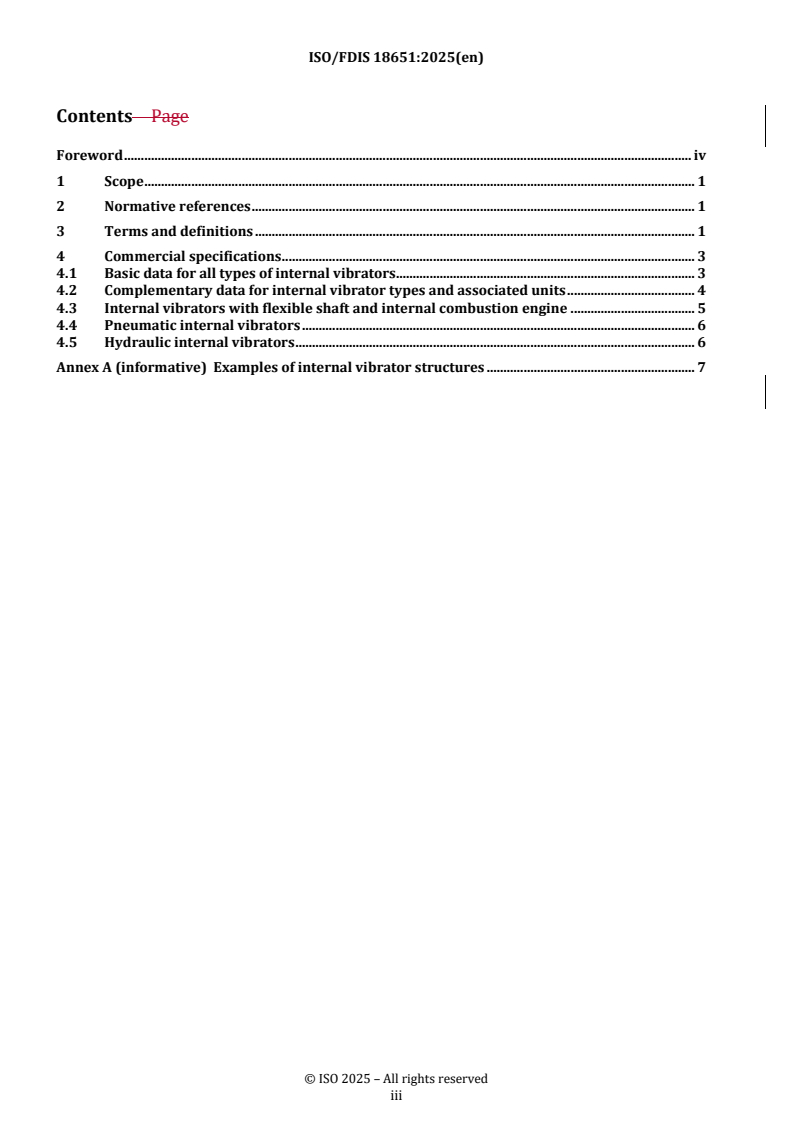
Contents Page
Foreword .iv
1 Scope . 1
2 Normative references . 1
3 Terms and definitions . 1
4 Commercial specifications . 3
4.1 Basic data for all types of internal vibrators .3
4.2 Complementary data for internal vibrator types and associated units .3
4.2.1 Electric internal vibrators with flexible drive .3
4.2.2 Built-in motor type electric internal vibrators .4
4.2.3 Frequency and voltage converters .4
4.2.4 Generating set for electric supply .5
4.3 Internal vibrators with flexible shaft and internal combustion engine .5
4.4 Pneumatic internal vibrators .6
4.5 Hydraulic internal vibrators .6
Annex A (informative) Examples of internal vibrator structures . 7
iii
Foreword
ISO (the International Organization for Standardization) is a worldwide federation of national standards
bodies (ISO member bodies). The work of preparing International Standards is normally carried out through
ISO technical committees. Each member body interested in a subject for which a technical committee
has been established has the right to be represented on that committee. International organizations,
governmental and non-governmental, in liaison with ISO, also take part in the work. ISO collaborates closely
with the International Electrotechnical Commission (IEC) on all matters of electrotechnical standardization.
The procedures used to develop this document and those intended for its further maintenance are described
in the ISO/IEC Directives, Part 1. In particular, the different approval criteria needed for the different types
of ISO document should be noted. This document was drafted in accordance with the editorial rules of the
ISO/IEC Directives, Part 2 (see www.iso.org/directives).
ISO draws attention to the possibility that the implementation of this document may involve the use of (a)
patent(s). ISO takes no position concerning the evidence, validity or applicability of any claimed patent
rights in respect thereof. As of the date of publication of this document, ISO had not received notice of (a)
patent(s) which may be required to implement this document. However, implementers are cautioned that
this may not represent the latest information, which may be obtained from the patent database available at
www.iso.org/patents. ISO shall not be held responsible for identifying any or all such patent rights.
Any trade name used in this document is information given for the convenience of users and does not
constitute an endorsement.
For an explanation of the voluntary nature of standards, the meaning of ISO specific terms and expressions
related to conformity assessment, as well as information about ISO's adherence to the World Trade
Organization (WTO) principles in the Technical Barriers to Trade (TBT), see www.iso.org/iso/foreword.html.
This document was prepared by Technical Committee ISO/TC 195, Building construction machinery and
equipment, Subcommittee SC 1, Machinery and equipment for concrete work.
Any feedback or questions on this document should be directed to the user’s national standards body. A
complete listing of these bodies can be found at www.iso.org/members.html.
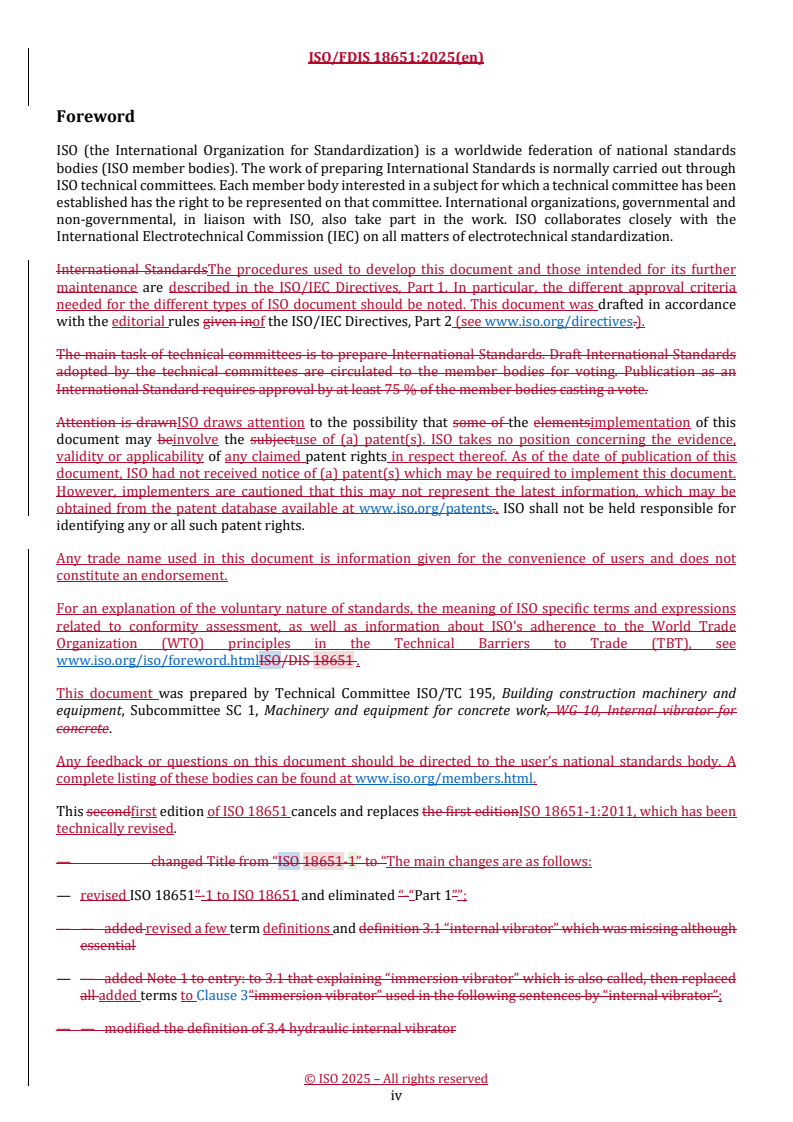
This first edition of ISO 18651 cancels and replaces ISO 18651-1:2011, which has been technically revised.
The main changes are as follows:
— revised ISO 18651-1 to ISO 18651 and eliminated “Part 1”;
— revised a few term definitions and added terms to Clause 3;
— changed term 3.7 “vibration head” to “vibrator assembly” and designated respective component in
Figures A.1 to A.9;
— changed term 3.10 “flexible drive shaft” to “flexible shaft”;
— removed Clause 4 "Structure";
— removed 5.2 "Complementary data for all types of immersion vibrator";
— removed “c) length of the hose-handle m” in 5.3.2;
— modified Figure A.1 a) to replace the section by correct one without electric motor;
— modified the title of Figure A.1 and subfigures a), b);
— deleted Figure A.10 which was not mentioned in the body.
Any feedback or questions on this document should be directed to the user’s national standards body. A
complete listing of these bodies can be found at www.iso.org/members.html.
iv
FINAL DRAFT International Standard ISO/FDIS 18651:2025(en)
Building construction machinery and equipment — Internal
vibrators for concrete — Vocabulary and commercial
specifications
1 Scope
This document defines vocabulary and provides commercial specifications for internal vibrators used for
compacting uncured concrete mix.
2 Normative references
The following documents referred to in this text in such a way that some or all of their content constitutes
requirements for this document. For dated references, only the edition cited applies. For undated references,
the latest edition of the referenced document (including any amendments) applies.
ISO 11375, Building construction machinery and equipment — Terms and definitions
3 Terms and definitions
For the purposes of this document, the terms and definitions given in ISO 11375 and the following apply.
ISO and IEC maintain terminology databases for use in standardization at the following addresses:
— ISO Online browsing platform: available at https:// www .iso .org/ obp
— IEC Electropedia: available at https:// www .electropedia .org/
3.1
internal vibrator
immersion vibrator
straight bar-shaped equipment with extended hose or handle used to compact uncured concrete mix by
generating or transmitting vibration
Note 1 to entry: The vibrator assembly (3.7) is immersed into uncured concrete mix, so it is called an internal vibrator
or immersion vibrator.
3.2
internal vibrator with flexible drive
vibrator with drive transmission from prime mover to vibrator assembly (3.7) in the form of a flexible shaft
Note 1 to entry: The flexible shaft (3.10) can be enclosed within an outer sheath to permit handling during use.
3.2.1
electric internal vibrator
vibrator in which the drive for the vibration generator is composed of an electric motor with a flexible shaft
to the vibrator assembly
Note 1 to entry: The
...
ISO/TC 195/SC 1
Secretariat: JISC
Date: 2025-10-1011-24
Building construction machinery and equipment — Internal
vibrators for concrete — Vocabulary and commercial specifications
Machines et matériels pour la construction des bâtiments — Vibrateurs internes pour le béton — ????? —
Vocabulaire et spécifications commerciales
FDIS stage
All rights reserved. Unless otherwise specified, or required in the context of its implementation, no part of this publication
may be reproduced or utilized otherwise in any form or by any means, electronic or mechanical, including photocopying,
or posting on the internet or an intranet, without prior written permission. Permission can be requested from either ISO
at the address below or ISO'sISO’s member body in the country of the requester.
ISO Copyright Officecopyright office
CP 401 • Ch. de Blandonnet 8
CH-1214 Vernier, Geneva
Phone: + 41 22 749 01 11
Email: E-mail: copyright@iso.org
Website: www.iso.org
Published in Switzerland.
ii
Contents Page
Foreword . iv
1 Scope . 1
2 Normative references . 1
3 Terms and definitions . 1
4 Commercial specifications . 3
4.1 Basic data for all types of internal vibrators. 3
4.2 Complementary data for internal vibrator types and associated units . 4
4.3 Internal vibrators with flexible shaft and internal combustion engine . 5
4.4 Pneumatic internal vibrators . 6
4.5 Hydraulic internal vibrators . 6
Annex A (informative) Examples of internal vibrator structures . 7
iii
Foreword
ISO (the International Organization for Standardization) is a worldwide federation of national standards
bodies (ISO member bodies). The work of preparing International Standards is normally carried out through
ISO technical committees. Each member body interested in a subject for which a technical committee has been
established has the right to be represented on that committee. International organizations, governmental and
non-governmental, in liaison with ISO, also take part in the work. ISO collaborates closely with the
International Electrotechnical Commission (IEC) on all matters of electrotechnical standardization.
International StandardsThe procedures used to develop this document and those intended for its further
maintenance are described in the ISO/IEC Directives, Part 1. In particular, the different approval criteria
needed for the different types of ISO document should be noted. This document was drafted in accordance
with the editorial rules given inof the ISO/IEC Directives, Part 2 (see www.iso.org/directives.).
The main task of technical committees is to prepare International Standards. Draft International Standards
adopted by the technical committees are circulated to the member bodies for voting. Publication as an
International Standard requires approval by at least 75 % of the member bodies casting a vote.
Attention is drawnISO draws attention to the possibility that some of the elementsimplementation of this
document may beinvolve the subjectuse of (a) patent(s). ISO takes no position concerning the evidence,
validity or applicability of any claimed patent rights in respect thereof. As of the date of publication of this
document, ISO had not received notice of (a) patent(s) which may be required to implement this document.
However, implementers are cautioned that this may not represent the latest information, which may be
obtained from the patent database available at www.iso.org/patents. ISO shall not be held responsible for
identifying any or all such patent rights.
Any trade name used in this document is information given for the convenience of users and does not
constitute an endorsement.
For an explanation of the voluntary nature of standards, the meaning of ISO specific terms and expressions
related to conformity assessment, as well as information about ISO's adherence to the World Trade
Organization (WTO) principles in the Technical Barriers to Trade (TBT), see
www.iso.org/iso/foreword.htmlISO/DIS 18651 .
This document was prepared by Technical Committee ISO/TC 195, Building construction machinery and
equipment, Subcommittee SC 1, Machinery and equipment for concrete work, WG 10, Internal vibrator for
concrete.
Any feedback or questions on this document should be directed to the user’s national standards body. A
complete listing of these bodies can be found at www.iso.org/members.html.
This secondfirst edition of ISO 18651 cancels and replaces the first editionISO 18651-1:2011, which has been
technically revised.
— changed Title from “ISO 18651-1” to “The main changes are as follows:
— revised ISO 18651”-1 to ISO 18651 and eliminated “-“Part 1””;
— — added revised a few term definitions and definition 3.1 “internal vibrator” which was missing although
essential
— — added Note 1 to entry: to 3.1 that explaining “immersion vibrator” which is also called, then replaced
all added terms to Clause 3“immersion vibrator” used in the following sentences by “internal vibrator”;
— — modified the definition of 3.4 hydraulic internal vibrator
iv
— — changed term 3.73.7 “vibration head” to “vibrator assembly” and designated respective component in
Figures A.1 to A.9Figures A.1 thru A.9;
— — changed term 3.103.10 “flexible drive shaft” to “flexible shaft””;
— — modified NOTE for compaction diameter
— — modified definition for “high and normal frequency generating set” from “unit composed of an internal
combustion engine, electric generator and frequency converter” to “unit consist either of an internal
combustion engine, electric generator or frequency converter” to eliminate confusion
— — deleted clause removed Clause 4 "Structure";
— — deleted subclauseremoved 5.2 "Complementary data for all types of immersion vibrator";
— — deletedremoved “c) length of the hose-handle m;”” in subclause 5.3.2;
— — modified Figures A.1 thru A.9 to add key for enclosed boundary designating “vibrator assembly”
— — modified Figure A.1modified Figure A.1 a) to replace the section by correct one without electric motor;
— — modified the title of Figure A.1Figure A.1 and sub figuressubfigures a), b));
— — deleted Figure A.10 which was not mentioned in the body.
Any feedback or questions on this document should be directed to the user’s national standards body. A
complete listing of these bodies can be found at www.iso.org/members.html.
v
Final DRAFT International Standard ISO/FDIS 18651:2025(en)
Building construction machinery and equipment — Internal vibrators
for concrete — Vocabulary and commercial specifications
1 Scope
This document defines vocabulary and provides commercial specifications for internal vibrators used for
compacting uncured concrete mix.
2 Normative references
The following documents referred to in this text in such a way that some or all of their content constitutes
requirements for this document. For dated references, only the edition cited applies. For undated references,
the latest edition of the referenced document (including any amendments) applies.
ISO 11375, Building construction machinery and equipment — Terms and definitions
3 Terms and definitions
For the purposes of this document, the terms and definitions given in ISO 11375 and the following apply.
ISO and IEC maintain terminology databases for use in standardization at the following addresses:
— ISO Online browsing platform: available at https://www.iso.org/obp3.1
— IEC Electropedia: available at https://www.electropedia.org/
3.1
internal vibrator
immersion vibrator
straight bar-shaped equipment with extended hose or handle used to compact uncured concrete mix by
generating or transmitting vibration
Note 1 to entry: The vibrator assembly (3.7(3.7)) is immersed into uncured concrete mix, so it is called an internal
vibrator or immersion vibrator.
3.2 3.2
internal vibrator with flexible drive
vibrator with drive transmission from prime mover to vibrator assembly (3.7(3.7)) in the form of a flexible
shaft
Note 1 to entry: The flexible shaft (3.10(3.10)) can be enclosed within an outer sheath to permit handling during use.
3.2.1 3.2.1
electric internal vibrator
vibrator in which the drive for the vibration generator is composed of an electric motor with a flexible shaft
to the vibrator assembly
Note 1 to entry: The flexible shaft can be enclosed within an outer sheath to permit handling during use.
Note 2 to entry: For an example, see Annex A, Figure A.8Figure A.8.
3.2.2 3.2.2
combustion engine internal vibrator
vibrator in which the drive for the vibration generator is composed of an internal combustion engine with a
flexible shaft to the vibrator assembly
Note 1 to entry: For an example, see Annex A, Figure A.9Figure A.9.
3.3 3.3
built-in motor-type electric internal vibrator
vibrator in which an electric motor and the vibration generator are both enclosed in the vibrator assembly
Note 1 to entry: It is typically composed of a frequency and voltage converter, protective hose and control box with
contactor.
Note 2 to entry: It can be classified as either an external converter type or integrated converter type.
Note 3 to entry: For examples, see Annex A, Figures A.2Figures A.2, A.3, A.3 and A.4A.4.
3.4 3.4
hydraulic internal vibrator
vibrator comprised of a rotating eccentric mass directly coupled to a hydraulic motor to produce a stable and
powerful vibration that typically enables precise regulation of frequency
Note 1 to entry: It is usually designed for use in the production of large concrete elements with large aggregate
Note 2 to entry: For an example, see Annex A, Figure A.5Figure A.5.
3.5 3.5
pneumatic internal vibrator
vibrator comprised of a pneumatic motor powered by compressed air
Note 1 to entry: It is typically composed of a vibrator assembly, protective hose (incorporating air supply) and twist grip
throttle control
Note 2 to entry: For an example, see Annex A, Figure A.6Figure A.6.
3.6 3.6
portable-type internal vibrator
vibrator all of whose components are all handled by an operator during operation
Note 1 to entry: For an example, see Annex A, Figure A.7Figure A.7.
3.7 3.7
vibrator assembly
sealed component consistsconsisting of head, housing and vibration generator (3.8, 3.9) which is designed for
immersion into uncured concrete mix
Note 1 to entry: Vibrator assembly typically has a cylindrical form a
...
PROJET FINAL
Norme
internationale
ISO/TC 195/SC 1
Machines et matériels pour la
Secrétariat: JISC
construction des bâtiments —
Début de vote:
Vibrateurs internes pour le béton
2025-12-08
— Vocabulaire et spécifications
Vote clos le:
commerciales
2026-02-02
Building construction machinery and equipment — Internal
vibrators for concrete — Vocabulary and commercial
specifications
LES DESTINATAIRES DU PRÉSENT PROJET SONT
INVITÉS À PRÉSENTER, AVEC LEURS OBSERVATIONS,
NOTIFICATION DES DROITS DE PROPRIÉTÉ DONT ILS
AURAIENT ÉVENTUELLEMENT CONNAISSANCE ET À
FOURNIR UNE DOCUMENTATION EXPLICATIVE.
OUTRE LE FAIT D’ÊTRE EXAMINÉS POUR
ÉTABLIR S’ILS SONT ACCEPTABLES À DES FINS
INDUSTRIELLES, TECHNOLOGIQUES ET COM-MERCIALES,
AINSI QUE DU POINT DE VUE DES UTILISATEURS, LES
PROJETS DE NORMES
INTERNATIONALES DOIVENT PARFOIS ÊTRE CONSIDÉRÉS
DU POINT DE VUE DE LEUR POSSI BILITÉ DE DEVENIR DES
NORMES POUVANT
SERVIR DE RÉFÉRENCE DANS LA RÉGLEMENTATION
NATIONALE.
Numéro de référence
PROJET FINAL
Norme
internationale
ISO/TC 195/SC 1
Machines et matériels pour la
Secrétariat: JISC
construction des bâtiments —
Début de vote:
Vibrateurs internes pour le béton
2025-12-08
— Vocabulaire et spécifications
Vote clos le:
commerciales
2026-02-02
Building construction machinery and equipment — Internal
vibrators for concrete — Vocabulary and commercial
specifications
LES DESTINATAIRES DU PRÉSENT PROJET SONT
INVITÉS À PRÉSENTER, AVEC LEURS OBSERVATIONS,
NOTIFICATION DES DROITS DE PROPRIÉTÉ DONT ILS
AURAIENT ÉVENTUELLEMENT CONNAISSANCE ET À
FOURNIR UNE DOCUMENTATION EXPLICATIVE.
DOCUMENT PROTÉGÉ PAR COPYRIGHT
OUTRE LE FAIT D’ÊTRE EXAMINÉS POUR
ÉTABLIR S’ILS SONT ACCEPTABLES À DES FINS
© ISO 2025 INDUSTRIELLES, TECHNOLOGIQUES ET COM-MERCIALES,
AINSI QUE DU POINT DE VUE DES UTILISATEURS, LES
Tous droits réservés. Sauf prescription différente ou nécessité dans le contexte de sa mise en œuvre, aucune partie de cette
PROJETS DE NORMES
INTERNATIONALES DOIVENT PARFOIS ÊTRE CONSIDÉRÉS
publication ne peut être reproduite ni utilisée sous quelque forme que ce soit et par aucun procédé, électronique ou mécanique,
DU POINT DE VUE DE LEUR POSSI BILITÉ DE DEVENIR DES
y compris la photocopie, ou la diffusion sur l’internet ou sur un intranet, sans autorisation écrite préalable. Une autorisation peut
NORMES POUVANT
être demandée à l’ISO à l’adresse ci-après ou au comité membre de l’ISO dans le pays du demandeur.
SERVIR DE RÉFÉRENCE DANS LA RÉGLEMENTATION
NATIONALE.
ISO copyright office
Case postale 401 • Ch. de Blandonnet 8
CH-1214 Vernier, Genève
Tél.: +41 22 749 01 11
E-mail: copyright@iso.org
Web: www.iso.org
Publié en Suisse Numéro de référence
ii
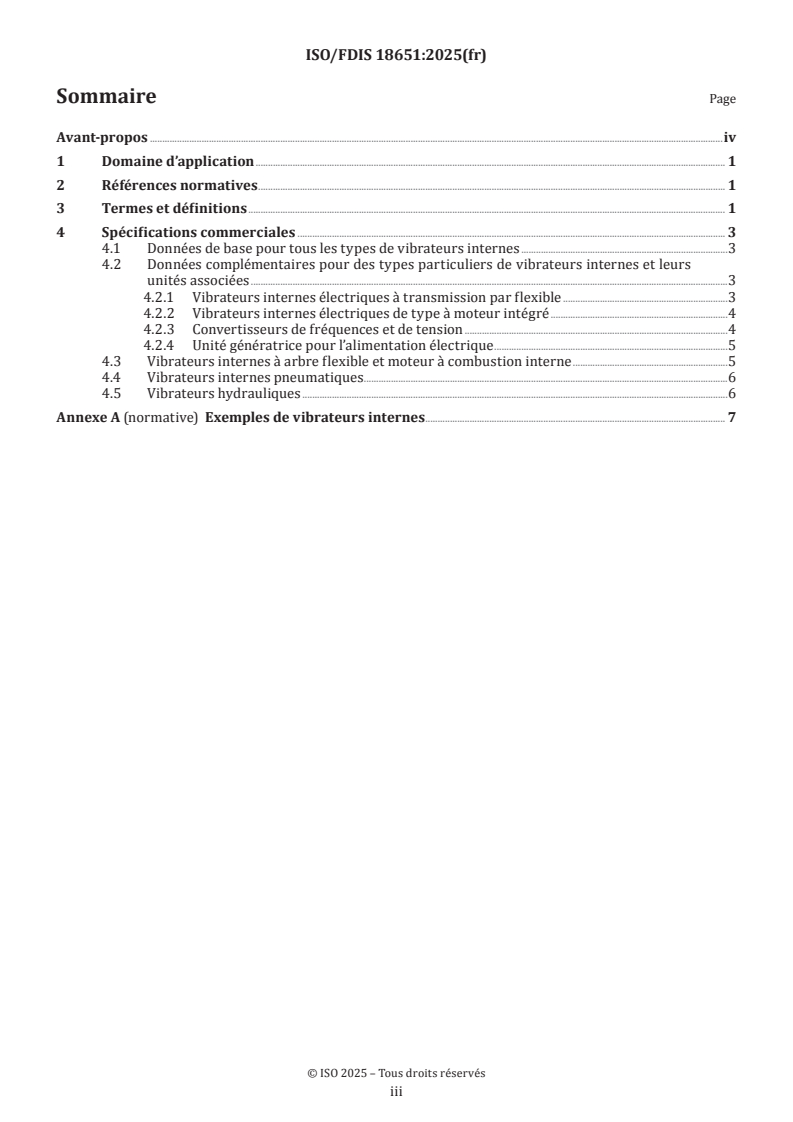
Sommaire Page
Avant-propos .iv
1 Domaine d’application . 1
2 Références normatives . 1
3 Termes et définitions . 1
4 Spécifications commerciales . 3
4.1 Données de base pour tous les types de vibrateurs internes .3
4.2 Données complémentaires pour des types particuliers de vibrateurs internes et leurs
unités associées .3
4.2.1 Vibrateurs internes électriques à transmission par flexible .3
4.2.2 Vibrateurs internes électriques de type à moteur intégré .4
4.2.3 Convertisseurs de fréquences et de tension .4
4.2.4 Unité génératrice pour l’alimentation électrique .5
4.3 Vibrateurs internes à arbre flexible et moteur à combustion interne .5
4.4 Vibrateurs internes pneumatiques .6
4.5 Vibrateurs hydrauliques .6
Annexe A (normative) Exemples de vibrateurs internes . 7
iii
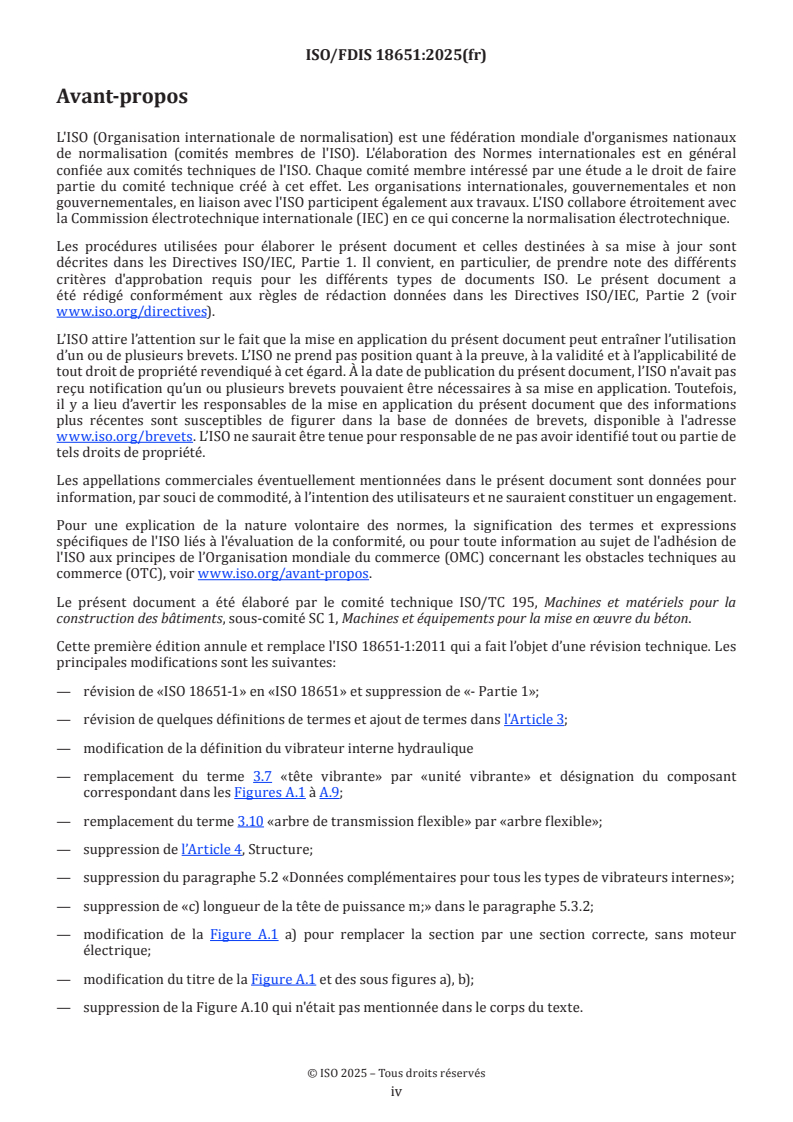
Avant-propos
L'ISO (Organisation internationale de normalisation) est une fédération mondiale d'organismes nationaux
de normalisation (comités membres de l'ISO). L'élaboration des Normes internationales est en général
confiée aux comités techniques de l'ISO. Chaque comité membre intéressé par une étude a le droit de faire
partie du comité technique créé à cet effet. Les organisations internationales, gouvernementales et non
gouvernementales, en liaison avec l'ISO participent également aux travaux. L'ISO collabore étroitement avec
la Commission électrotechnique internationale (IEC) en ce qui concerne la normalisation électrotechnique.
Les procédures utilisées pour élaborer le présent document et celles destinées à sa mise à jour sont
décrites dans les Directives ISO/IEC, Partie 1. Il convient, en particulier, de prendre note des différents
critères d'approbation requis pour les différents types de documents ISO. Le présent document a
été rédigé conformément aux règles de rédaction données dans les Directives ISO/IEC, Partie 2 (voir
www.iso.org/directives).
L’ISO attire l’attention sur le fait que la mise en application du présent document peut entraîner l’utilisation
d’un ou de plusieurs brevets. L’ISO ne prend pas position quant à la preuve, à la validité et à l’applicabilité de
tout droit de propriété revendiqué à cet égard. À la date de publication du présent document, l’ISO n'avait pas
reçu notification qu’un ou plusieurs brevets pouvaient être nécessaires à sa mise en application. Toutefois,
il y a lieu d’avertir les responsables de la mise en application du présent document que des informations
plus récentes sont susceptibles de figurer dans la base de données de brevets, disponible à l'adresse
www.iso.org/brevets. L’ISO ne saurait être tenue pour responsable de ne pas avoir identifié tout ou partie de
tels droits de propriété.
Les appellations commerciales éventuellement mentionnées dans le présent document sont données pour
information, par souci de commodité, à l’intention des utilisateurs et ne sauraient constituer un engagement.
Pour une explication de la nature volontaire des normes, la signification des termes et expressions
spécifiques de l'ISO liés à l'évaluation de la conformité, ou pour toute information au sujet de l'adhésion de
l'ISO aux principes de l’Organisation mondiale du commerce (OMC) concernant les obstacles techniques au
commerce (OTC), voir www.iso.org/avant-propos.
Le présent document a été élaboré par le comité technique ISO/TC 195, Machines et matériels pour la
construction des bâtiments, sous-comité SC 1, Machines et équipements pour la mise en œuvre du béton.
Cette première édition annule et remplace l'ISO 18651-1:2011 qui a fait l’objet d’une révision technique. Les
principales modifications sont les suivantes:
— révision de «ISO 18651-1» en «ISO 18651» et suppression de «- Partie 1»;
— révision de quelques définitions de termes et ajout de termes dans l'Article 3;
— modification de la définition du vibrateur interne hydraulique
— remplacement du terme 3.7 «tête vibrante» par «unité vibrante» et désignation du composant
correspondant dans les Figures A.1 à A.9;
— remplacement du terme 3.10 «arbre de transmission flexible» par «arbre flexible»;
— suppression de l’Article 4, Structure;
— suppression du paragraphe 5.2 «Données complémentaires pour tous les types de vibrateurs internes»;
— suppression de «c) longueur de la tête de puissance m;» dans le paragraphe 5.3.2;
— modification de la Figure A.1 a) pour remplacer la section par une section correcte, sans moteur
électrique;
— modification du titre de la Figure A.1 et des sous figures a), b);
— suppression de la Figure A.10 qui n'était pas mentionnée dans le corps du texte.
iv
Il convient que l’utilisateur adresse tout retour d’information ou toute question concernant le présent
document à l’organisme national de normalisation de son pays. Une liste exhaustive desdits organismes se
trouve à l’adresse www.iso.org/fr/members.html.
v
PROJET FINAL Norme internationale ISO/FDIS 18651:2025(fr)
Machines et matériels pour la construction des bâtiments —
Vibrateurs internes pour le béton — Vocabulaire et
spécifications commerciales
1 Domaine d’application
Le présent document définit le vocabulaire et fournit les spécifications commerciales des vibrateurs internes
utilisés pour le compactage des mélanges de béton frais.
2 Références normatives
Les documents suivants sont cités dans le texte de sorte qu’ils constituent, pour tout ou partie de leur
contenu, des exigences du présent document. Pour les références datées, seule l’édition citée s’applique. Pour
les références non datées, la dernière édition du document de référence s'applique (y compris les éventuels
amendements).
ISO 11375, Machines et matériels pour la construction des bâtiments — Termes et définitions
3 Termes et définitions
Pour les besoins du présent document, les termes et les définitions de l’ISO 11375:1998 ainsi que les suivants
s'appliquent.
L'ISO et l'IEC tiennent à jour des bases de données terminologiques destinées à être utilisées en normalisation,
consultables aux adresses suivantes:
— ISO Online browsing platform: disponible à l'adresse https:// www .iso .org/ obp
— IEC Electropedia: disponible à l'adresse https:// www .electropedia .org/
3.1
vibrateur interne
vibrateur à immersion
équipement en forme de barre droite avec un tuyau prolongé ou une poignée, utilisé pour compacter le
mélange de béton frais en générant ou en transmettant des vibrations
Note 1 à l'article: L'unité vibrante (3.7) est immergée dans le mélange de béton frais, c'est pourquoi il est appelé
vibrateur interne ou vibrateur à immersion.
3.2
vibrateur interne à transmission par flexible
vibrateur avec transmission de puissance du moteur principal à la tête vibrante sous forme d'arbre flexible
Note 1 à l'article: L’arbre flexible peut être enfermé dans un manchon externe pour permettre de le tenir pendant
l’utilisation.
3.2.1
vibrateur interne électrique à transmission par flexible
vibrateur dans lequel la transmission d'un générateur de vibrations est composée d'un moteur électrique
reliant l’unité vibrante (3.7) par un arbre flexible
Note 1 à l'article: L’arbre flexible (3.10) peut être enfermé dans un manchon externe pour
...
Questions, Comments and Discussion
Ask us and Technical Secretary will try to provide an answer. You can facilitate discussion about the standard in here.
Loading comments...