

ISO 24090:2021
(Main)Dried barberry — Specification and test methods
General Information
- Abstract
This document specifies requirements and test methods for the dried barberry fruit of the Berberis vulgaris L. tree. It is applicable to dried red barberries only.
- Status
- Published
- Publication Date
- 14-Feb-2021
- Technical Committee
- ISO/TC 34/SC 3 - Fruits and vegetables and their derived products
- Drafting Committee
- ISO/TC 34/SC 3 - Fruits and vegetables and their derived products
- Current Stage
- 9060 - Close of review
- Completion Date
- 02-Sep-2031
Buy Documents
ISO 24090:2021 - Dried barberry -- Specification and test methods
ISO 24090:2021 - Dried barberry — Specification and test methods/15/2021
Overview
ISO 24090:2021 sets forth comprehensive specifications and test methods for dried barberry (Berberis vulgaris L.), focusing exclusively on dried red barberries. As a globally recognized international standard, it establishes the quality criteria, classification, sampling techniques, testing protocols, packaging, labeling, storage, and transport requirements to ensure product safety, consistency, and consumer satisfaction.
This standard supports producers, suppliers, regulators, and quality control laboratories in maintaining the integrity and marketability of dried barberry fruits, which are valued for their sour taste and culinary uses. It is applicable worldwide, especially relevant for food industries handling dried fruits.
Key Topics
Classification and Quality Classes
Dried barberries are classified into two groups by color: red and black. Quality classes are divided into:- Extra Class (diameter ≥ 7 mm)
- Class I (diameter > 5 mm and < 7 mm)
- Class II (diameter > 3 mm and ≤ 5 mm)
Quality Requirements
The standard mandates that dried barberries be whole, sound, and retain a natural color with characteristic odor and taste. Limits are specified for:- Foreign matter (max 10 g/kg)
- Pest infestation (max 10 g/kg)
- Tailed barberry or cap-stem residue (max 30 g/kg)
- Moisture content (max 160 g/kg)
- Total ash and acid-insoluble ash content
Sampling Procedures
Representative sampling from lots is defined, ensuring consistent quality assessment with respect to type, class, packaging, and inspection time, following the OECD Fruit and Vegetable Standards.Test Methods
Methods include:- Visual examination for defects such as extraneous matter, pest infestation, and immaturity
- Determination of moisture content (ISO 1026)
- Total ash measurement (ISO 5520)
- Acid-insoluble ash determination (ISO 763)
Packaging and Labeling
Requirements mandate clean, food-grade packaging materials that do not compromise product quality. Labeling must provide essential information including product name, manufacturer details, batch number, weight, origin, and expiry date.Storage and Transport Conditions
Dried barberries require controlled environments-preferably 2 °C to 7 °C with 50% to 60% relative humidity for 6 months, or, for extended storage, -10 °C to 4 °C for up to one year. Protection from moisture, sunlight, freezing, and contamination is critical to preserve quality.
Applications
ISO 24090:2021 benefits stakeholders across various sectors:
- Food Industry: Ensures dried barberries imported, exported, or used in culinary applications meet stringent safety and quality benchmarks.
- Quality Control Laboratories: Provides standardized protocols for sampling and testing to confirm product conformity.
- Packaging Manufacturers: Guides in developing suitable packaging that preserves dried barberry quality and complies with labeling regulations.
- Supply Chain and Logistics: Informs best practices for storage and transportation to minimize spoilage and maintain freshness.
- Regulatory Authorities: Supports harmonized inspection and certification processes for dried barberry products in international trade.
Related Standards
ISO 24090:2021 references and aligns with other key standards that complement the quality assurance framework for dried barberries:
- ISO 763 - Determination of ash insoluble in hydrochloric acid, essential for assessing mineral residue in fruit products.
- ISO 1026 - Methods for determining dry matter and moisture content in fruits and vegetables, critical for evaluating shelf life and quality.
- ISO 5520 - Procedure for total ash and water-soluble ash content measurement, important for compositional analysis.
- OECD Scheme for Application of International Standards for Fruit and Vegetables (2012) - Provides guidelines for sampling and harmonizing trade standards globally.
By adhering to ISO 24090:2021, businesses and regulatory bodies ensure that dried red barberries meet internationally accepted quality and safety criteria, enhancing consumer confidence and facilitating global trade in this nutritious fruit product.
Buy Documents
ISO 24090:2021 - Dried barberry -- Specification and test methods
ISO 24090:2021 - Dried barberry — Specification and test methods/15/2021
Get Certified
Connect with accredited certification bodies for this standard

BSI Group
BSI (British Standards Institution) is the business standards company that helps organizations make excellence a habit.

Bureau Veritas
Bureau Veritas is a world leader in laboratory testing, inspection and certification services.

DNV
DNV is an independent assurance and risk management provider.
Sponsored listings
Frequently Asked Questions
ISO 24090:2021 is a standard published by the International Organization for Standardization (ISO). Its full title is "Dried barberry — Specification and test methods". This standard covers: This document specifies requirements and test methods for the dried barberry fruit of the Berberis vulgaris L. tree. It is applicable to dried red barberries only.
This document specifies requirements and test methods for the dried barberry fruit of the Berberis vulgaris L. tree. It is applicable to dried red barberries only.
ISO 24090:2021 is classified under the following ICS (International Classification for Standards) categories: 67.080.10 - Fruits and derived products. The ICS classification helps identify the subject area and facilitates finding related standards.
ISO 24090:2021 is available in PDF format for immediate download after purchase. The document can be added to your cart and obtained through the secure checkout process. Digital delivery ensures instant access to the complete standard document.
Standards Content (Sample)
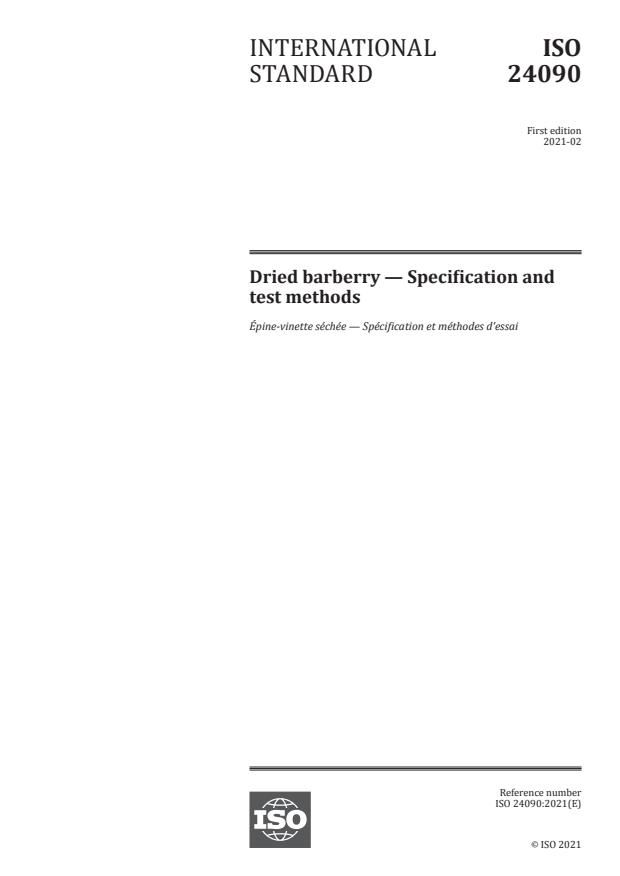
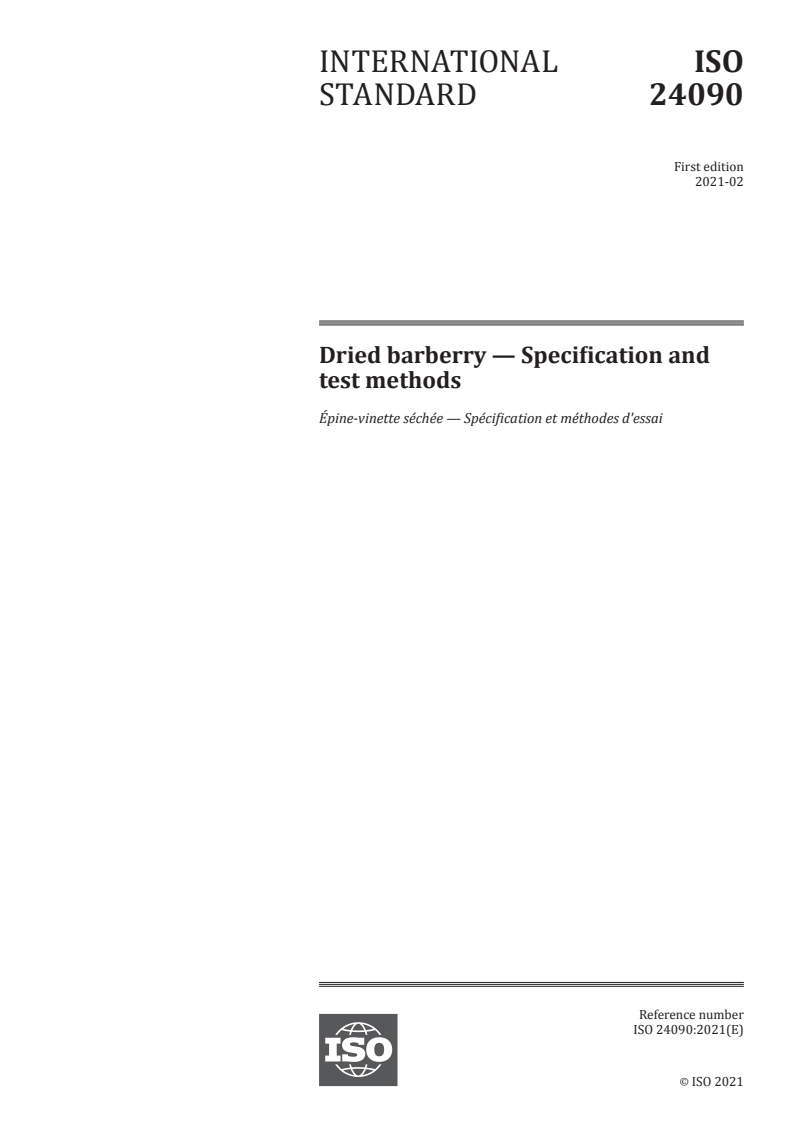
INTERNATIONAL ISO
STANDARD 24090
First edition
2021-02
Dried barberry — Specification and
test methods
Épine-vinette séchée — Spécification et méthodes d'essai
Reference number
©
ISO 2021
© ISO 2021
All rights reserved. Unless otherwise specified, or required in the context of its implementation, no part of this publication may
be reproduced or utilized otherwise in any form or by any means, electronic or mechanical, including photocopying, or posting
on the internet or an intranet, without prior written permission. Permission can be requested from either ISO at the address
below or ISO’s member body in the country of the requester.
ISO copyright office
CP 401 • Ch. de Blandonnet 8
CH-1214 Vernier, Geneva
Phone: +41 22 749 01 11
Email: copyright@iso.org
Website: www.iso.org
Published in Switzerland
ii © ISO 2021 – All rights reserved
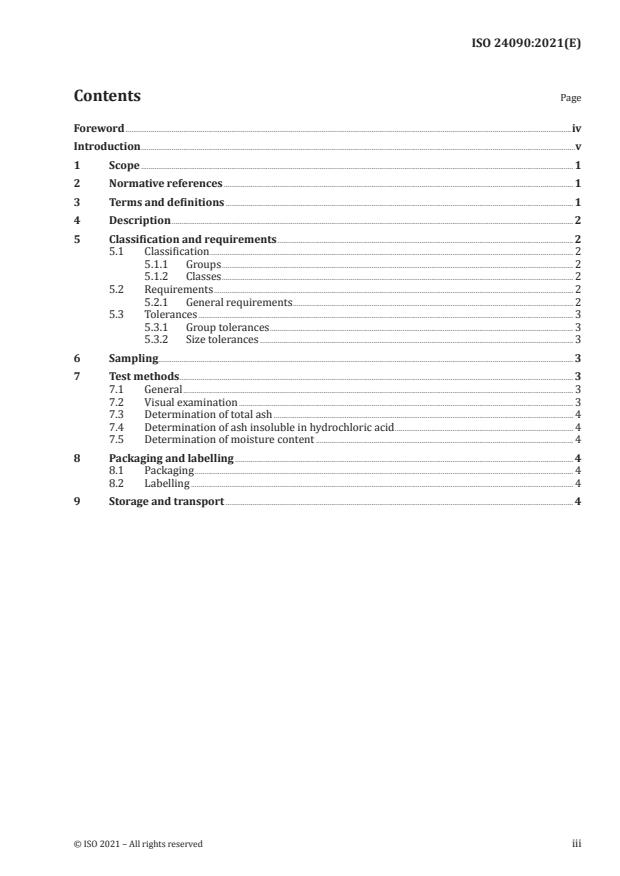
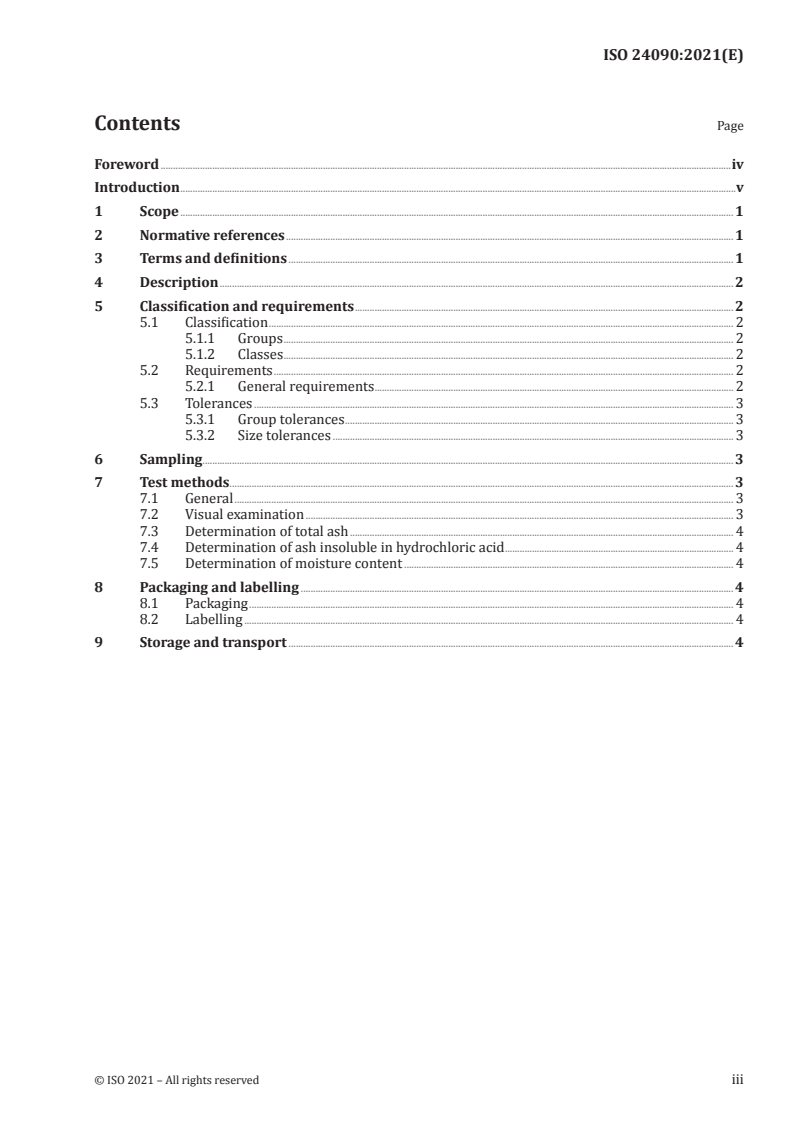
Contents Page
Foreword .iv
Introduction .v
1 Scope . 1
2 Normative references . 1
3 Terms and definitions . 1
4 Description . 2
5 Classification and requirements . 2
5.1 Classification . 2
5.1.1 Groups . 2
5.1.2 Classes . 2
5.2 Requirements . 2
5.2.1 General requirements . 2
5.3 Tolerances . 3
5.3.1 Group tolerances . 3
5.3.2 Size tolerances . 3
6 Sampling . 3
7 Test methods . 3
7.1 General . 3
7.2 Visual examination . 3
7.3 Determination of total ash . 4
7.4 Determination of ash insoluble in hydrochloric acid . 4
7.5 Determination of moisture content . 4
8 Packaging and labelling . 4
8.1 Packaging . 4
8.2 Labelling . 4
9 Storage and transport . 4
Foreword
ISO (the International Organization for Standardization) is a worldwide federation of national standards
bodies (ISO member bodies). The work of preparing International Standards is normally carried out
through ISO technical committees. Each member body interested in a subject for which a technical
committee has been established has the right to be represented on that committee. International
organizations, governmental and non-governmental, in liaison with ISO, also take part in the work.
ISO collaborates closely with the International Electrotechnical Commission (IEC) on all matters of
electrotechnical standardization.
The procedures used to develop this document and those intended for its further maintenance are
described in the ISO/IEC Directives, Part 1. In particular, the different approval criteria needed for the
different types of ISO documents should be noted. This document was drafted in accordance with the
editorial rules of the ISO/IEC Directives, Part 2 (see www .iso .org/ directives).
Attention is drawn to the possibility that some of the elements of this document may be the subject of
patent rights. ISO shall not be held responsible for identifying any or all such patent rights. Details of
any patent rights identified during the development of the document will be in the Introduction and/or
on the ISO list of patent declarations received (see www .iso .org/ patents).
Any trade name used in this document is information given for the convenience of users and does not
constitute an endorsement.
For an explanation of the voluntary nature of standards, the meaning of ISO specific terms and
expressions related to conformity assessment, as well as information about ISO’s adherence to the
World Trade Organization (WTO) principles in the Technical Barriers to Trade (TBT), see www .iso .org/
iso/ foreword .html.
This document was prepared by Technical Committee ISO/TC 34, Food products, Subcommittee SC 3,
Fruits and vegetables and their derived products.
Any feedback or questions on this document should be directed to the user’s national standards body. A
complete listing of these bodies can be found at www .iso .org/ members .html.
iv © ISO 2021 – All rights reserved
...
INTERNATIONAL ISO
STANDARD 24090
First edition
2021-02
Dried barberry — Specification and
test methods
Épine-vinette séchée — Spécification et méthodes d'essai
Reference number
©
ISO 2021
© ISO 2021
All rights reserved. Unless otherwise specified, or required in the context of its implementation, no part of this publication may
be reproduced or utilized otherwise in any form or by any means, electronic or mechanical, including photocopying, or posting
on the internet or an intranet, without prior written permission. Permission can be requested from either ISO at the address
below or ISO’s member body in the country of the requester.
ISO copyright office
CP 401 • Ch. de Blandonnet 8
CH-1214 Vernier, Geneva
Phone: +41 22 749 01 11
Email: copyright@iso.org
Website: www.iso.org
Published in Switzerland
ii © ISO 2021 – All rights reserved
Contents Page
Foreword .iv
Introduction .v
1 Scope . 1
2 Normative references . 1
3 Terms and definitions . 1
4 Description . 2
5 Classification and requirements . 2
5.1 Classification . 2
5.1.1 Groups . 2
5.1.2 Classes . 2
5.2 Requirements . 2
5.2.1 General requirements . 2
5.3 Tolerances . 3
5.3.1 Group tolerances . 3
5.3.2 Size tolerances . 3
6 Sampling . 3
7 Test methods . 3
7.1 General . 3
7.2 Visual examination . 3
7.3 Determination of total ash . 4
7.4 Determination of ash insoluble in hydrochloric acid . 4
7.5 Determination of moisture content . 4
8 Packaging and labelling . 4
8.1 Packaging . 4
8.2 Labelling . 4
9 Storage and transport . 4
Foreword
ISO (the International Organization for Standardization) is a worldwide federation of national standards
bodies (ISO member bodies). The work of preparing International Standards is normally carried out
through ISO technical committees. Each member body interested in a subject for which a technical
committee has been established has the right to be represented on that committee. International
organizations, governmental and non-governmental, in liaison with ISO, also take part in the work.
ISO collaborates closely with the International Electrotechnical Commission (IEC) on all matters of
electrotechnical standardization.
The procedures used to develop this document and those intended for its further maintenance are
described in the ISO/IEC Directives, Part 1. In particular, the different approval criteria needed for the
different types of ISO documents should be noted. This document was drafted in accordance with the
editorial rules of the ISO/IEC Directives, Part 2 (see www .iso .org/ directives).
Attention is drawn to the possibility that some of the elements of this document may be the subject of
patent rights. ISO shall not be held responsible for identifying any or all such patent rights. Details of
any patent rights identified during the development of the document will be in the Introduction and/or
on the ISO list of patent declarations received (see www .iso .org/ patents).
Any trade name used in this document is information given for the convenience of users and does not
constitute an endorsement.
For an explanation of the voluntary nature of standards, the meaning of ISO specific terms and
expressions related to conformity assessment, as well as information about ISO’s adherence to the
World Trade Organization (WTO) principles in the Technical Barriers to Trade (TBT), see www .iso .org/
iso/ foreword .html.
This document was prepared by Technical Committee ISO/TC 34, Food products, Subcommittee SC 3,
Fruits and vegetables and their derived products.
Any feedback or questions on this document should be directed to the user’s national standards body. A
complete listing of these bodies can be found at www .iso .org/ members .html.
iv © ISO 2021 – All rights reserved
...