

ISO 5540:2023
(Main)Ships and marine technology — Sea-going vessels — Dual traction/stowage winches for oceanographic research
General Information
- Abstract
This document specifies requirements for the design, construction, safety, performance and acceptance testing of dual traction/stowage winches for oceanographic research (hereafter referred as to “dual traction/stowage winches”), with hydraulic and electric drive. Dual traction/stowage winches are mainly used for fixed-point and towing marine survey, involving marine geological sampling, seawater water body parameter measurement and marine biological survey.
- Status
- Published
- Publication Date
- 17-May-2023
- Technical Committee
- ISO/TC 8/SC 4 - Outfitting and deck machinery
- Drafting Committee
- ISO/TC 8/SC 4 - Outfitting and deck machinery
- Current Stage
- 6060 - International Standard published
- Start Date
- 18-May-2023
- Due Date
- 14-Oct-2023
- Completion Date
- 18-May-2023
Overview - ISO 5540:2023 - Dual traction/stowage winches for oceanographic research
ISO 5540:2023 specifies requirements for the design, construction, safety, performance and acceptance testing of dual traction/stowage winches with hydraulic and electric drives used on sea‑going vessels for oceanographic research. The standard covers winch components and systems used for fixed‑point and towing marine surveys, including marine geological sampling, seawater parameter measurement and marine biological surveys.
Key topics and technical requirements
- Scope and terminology: Defines key terms such as safe working load (SWL), nominal speed, dynamic factor and winch orientation types (LVR, RVR, LVL, RVL).
- Design & strength:
- Structural stress limits under maximum load (allowable stress ≤ 0.45 × material upper yield strength or specified p0.2 yield).
- Holding load requirements: holding load ≥ SWL × dynamic factor (minimum 1.5 × SWL when dynamic factor < 1.5).
- Drum and spooling:
- Drum diameter for steel wire ropes ≥ 16 × rope diameter; maintain ≥ 5 laps remaining rope; flange clearance ≥ 2.5 × rope diameter.
- Spooling and guide sheave ratios aligned with rope/manufacturer requirements; spooling device driven independently or via drum transmission.
- Traction & buffer devices:
- Multi‑groove traction drums, anti‑jump devices, optional buffer devices to attenuate sudden tension changes.
- Drive, brakes and control:
- Electric systems conform to IEC 60092; minimum deck enclosure protection IP56 (IEC 60529).
- Hydraulic systems conform to ISO 4413.
- Continuous operation under SWL at nominal speed (generally ≥ 30 min), overload protection, normally‑closed brakes able to withstand holding load without damage.
- Stepless speed control, alarm functions (overload, overspeed, low rope margin, hydraulic alarms), optional Active Heave Compensation (AHC).
- Instrumentation & tests:
- Required subsidiary devices: tension, speed and rope length measuring devices.
- Acceptance tests include function test, static and dynamic load tests, AHC test and inspection documentation.
Practical applications and users
ISO 5540:2023 is used by:
- Marine equipment manufacturers and winch designers (winch design and acceptance criteria)
- Shipbuilders and naval architects (deck machinery integration, structural verification)
- Oceanographic institutions and vessel operators (specifying and procuring survey winches)
- Classification societies and surveyors (type approval and inspection)
- Maintenance engineers and safety officers (operation, testing and alarms)
This standard helps ensure reliable, safe and interoperable winch systems for marine survey operations, improving data collection continuity and crew safety in variable sea states.
Related standards
- ISO 3828 - Deck machinery vocabulary and symbols
- ISO 7825 - Deck machinery general requirements
- ISO 4413 - Hydraulic fluid power safety requirements
- IEC 60092 - Electrical installations in ships
- IEC 60529 - Degrees of protection (IP Code)
Keywords: ISO 5540:2023, dual traction/stowage winches, oceanographic research, winch design, AHC, SWL, hydraulic drive, electric drive, deck machinery, marine survey.
Get Certified
Connect with accredited certification bodies for this standard

DNV
DNV is an independent assurance and risk management provider.

Lloyd's Register
Lloyd's Register is a global professional services organisation specialising in engineering and technology.

FSC International
Forest Stewardship Council certification.
Sponsored listings
Frequently Asked Questions
ISO 5540:2023 is a standard published by the International Organization for Standardization (ISO). Its full title is "Ships and marine technology — Sea-going vessels — Dual traction/stowage winches for oceanographic research". This standard covers: This document specifies requirements for the design, construction, safety, performance and acceptance testing of dual traction/stowage winches for oceanographic research (hereafter referred as to “dual traction/stowage winches”), with hydraulic and electric drive. Dual traction/stowage winches are mainly used for fixed-point and towing marine survey, involving marine geological sampling, seawater water body parameter measurement and marine biological survey.
This document specifies requirements for the design, construction, safety, performance and acceptance testing of dual traction/stowage winches for oceanographic research (hereafter referred as to “dual traction/stowage winches”), with hydraulic and electric drive. Dual traction/stowage winches are mainly used for fixed-point and towing marine survey, involving marine geological sampling, seawater water body parameter measurement and marine biological survey.
ISO 5540:2023 is classified under the following ICS (International Classification for Standards) categories: 47.020.50 - Deck equipment and installations; 47.040 - Seagoing vessels. The ICS classification helps identify the subject area and facilitates finding related standards.
ISO 5540:2023 is available in PDF format for immediate download after purchase. The document can be added to your cart and obtained through the secure checkout process. Digital delivery ensures instant access to the complete standard document.
Standards Content (Sample)
INTERNATIONAL ISO
STANDARD 5540
First edition
2023-05
Ships and marine technology —
Sea-going vessels — Dual traction/
stowage winches for oceanographic
research
Reference number
© ISO 2023
All rights reserved. Unless otherwise specified, or required in the context of its implementation, no part of this publication may
be reproduced or utilized otherwise in any form or by any means, electronic or mechanical, including photocopying, or posting on
the internet or an intranet, without prior written permission. Permission can be requested from either ISO at the address below
or ISO’s member body in the country of the requester.
ISO copyright office
CP 401 • Ch. de Blandonnet 8
CH-1214 Vernier, Geneva
Phone: +41 22 749 01 11
Email: copyright@iso.org
Website: www.iso.org
Published in Switzerland
ii
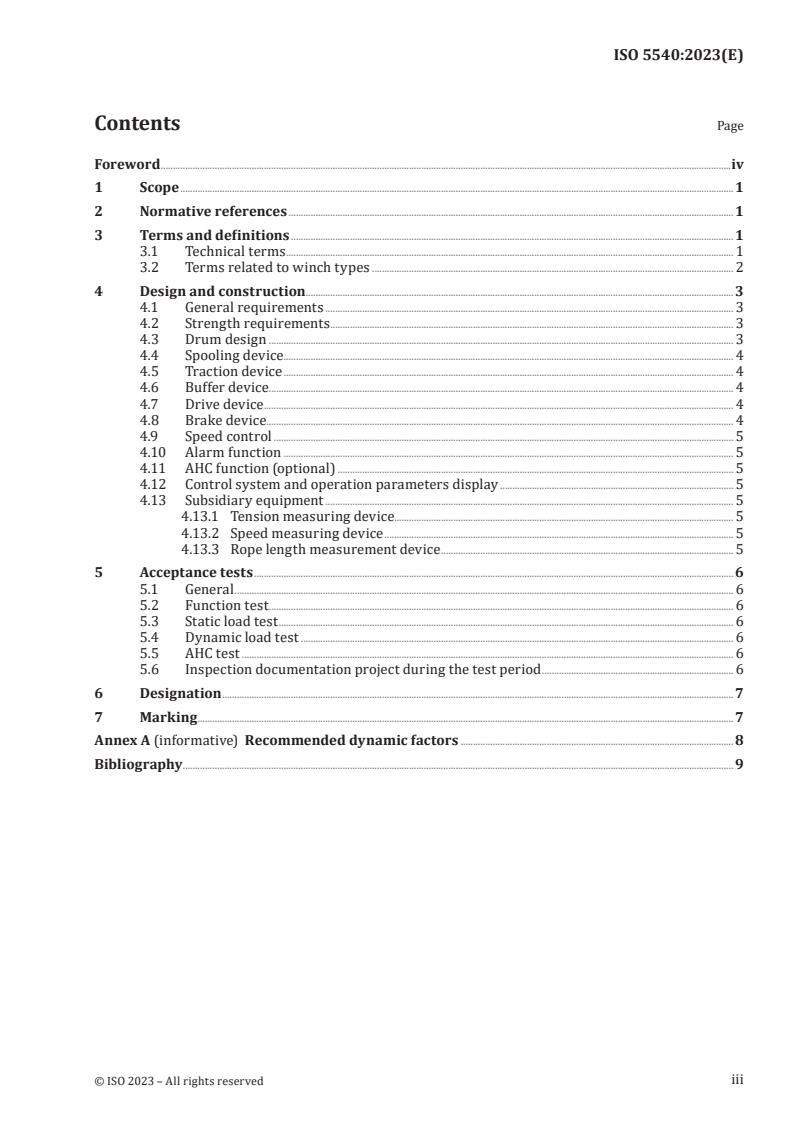
Contents Page
Foreword .iv
1 Scope . 1
2 Normative references . 1
3 Terms and definitions . 1
3.1 Technical terms . 1
3.2 Terms related to winch types . 2
4 Design and construction . 3
4.1 General requirements . 3
4.2 Strength requirements . 3
4.3 Drum design . 3
4.4 Spooling device. 4
4.5 Traction device . 4
4.6 Buffer device . . 4
4.7 Drive device . 4
4.8 Brake device. 4
4.9 Speed control . 5
4.10 Alarm function . 5
4.11 AHC function (optional) . 5
4.12 Control system and operation parameters display . 5
4.13 Subsidiary equipment . 5
4.13.1 Tension measuring device. 5
4.13.2 Speed measuring device . 5
4.13.3 Rope length measurement device . 5
5 Acceptance tests .6
5.1 General . 6
5.2 Function test . 6
5.3 Static load test . 6
5.4 Dynamic load test . 6
5.5 AHC test . 6
5.6 Inspection documentation project during the test period . 6
6 Designation . 7
7 Marking . . 7
Annex A (informative) Recommended dynamic factors . 8
Bibliography . 9
iii
Foreword
ISO (the International Organization for Standardization) is a worldwide federation of national standards
bodies (ISO member bodies). The work of preparing International Standards is normally carried out
through ISO technical committees. Each member body interested in a subject for which a technical
committee has been established has the right to be represented on that committee. International
organizations, governmental and non-governmental, in liaison with ISO, also take part in the work.
ISO collaborates closely with the International Electrotechnical Commission (IEC) on all matters of
electrotechnical standardization.
The procedures used to develop this document and those intended for its further maintenance are
described in the ISO/IEC Directives, Part 1. In particular, the different approval criteria needed for the
different types of ISO document should be noted. This document was drafted in accordance with the
editorial rules of the ISO/IEC Directives, Part 2 (see www.iso.org/directives).
ISO draws attention to the possibility that the implementation of this document may involve the use
of (a) patent(s). ISO takes no position concerning the evidence, validity or applicability of any claimed
patent rights in respect thereof. As of the date of publication of this document, ISO had not received
notice of (a) patent(s) which may be required to implement this document. However, implementers are
cautioned that this may not represent the latest information, which may be obtained from the patent
database available at www.iso.org/patents. ISO shall not be held responsible for identifying any or all
such patent rights.
Any trade name used in this document is information given for the convenience of users and does not
constitute an endorsement.
For an explanation of the voluntary nature of standards, the meaning of ISO specific terms and
expressions related to conformity assessment, as well as information about ISO’s adherence to
the World Trade Organization (WTO) principles in the Technical Barriers to Trade (TBT), see
www.iso.org/iso/foreword.html.
This document was prepared by Technical Committee ISO/TC 8, Ships and marine technology,
Subcommittee SC 4, Outfitting and deck machinery.
Any feedback or questions on this document should be directed to the user’s national standards body. A
complete listing of these bodies can be found at www.iso.org/members.html.
iv
INTERNATIONAL STANDARD ISO 5540:2023(E)
Ships and marine technology — Sea-going vessels — Dual
traction/stowage winches for oceanographic research
1 Scope
This document specifies requirements for the design, construction, safety, performance and acceptance
testing of dual traction/stowage winches for oceanographic research (hereafter referred as to “dual
traction/stowage winches”), with hydraulic and electric drive.
Dual traction/stowage winches are mainly used for fixed-point and towing marine survey, involving
marine geological sampling, seawater water body parameter measurement and marine biological
survey.
2 Normative references
The following documents are referred to in the text in such a way that some or all of their content
constitutes requirements of this document. For dated references, only the edition cited applies. For
undated references, the latest edition of the referenced document (including any amendments) applies.
ISO 3828, Shipbuilding and marine structures — Deck machinery — Vocabulary and symbols
ISO 4413, Hydraulic fluid power — General rules and safety requirements for systems and their components
ISO 7825, Shipbuilding — Deck machinery — General requirements
IEC 60092 (all parts), Electrical installations in ships
IEC 60529, Degrees of protection provided by enclosures (IP Code)
3 Terms and definitions
For the purposes of this document, the terms and definitions given in ISO 3828 and the following apply.
ISO and IEC maintain terminology databases for use in standardization at the following addresses:
— ISO Online browsing platform: available at https:// www .iso .org/ obp
— IEC Electropedia: available at https:// www .electropedia .org/
3.1 Technical terms
3.1.1
safe working load
SWL
maximum static load, under design operation seastate, which the winch is certified to recover while the
rope is at nominal speed (3.1.2)
3.1.2
nominal speed
maximum speed while the winch recovering the rope with the safe working load (3.1.1)
3.1.3
dynamic factor
variable factor representing the dynamic effects induced due to the ship motion including rolling, pitch
and heaving, whi
...