

ISO 3196:1975
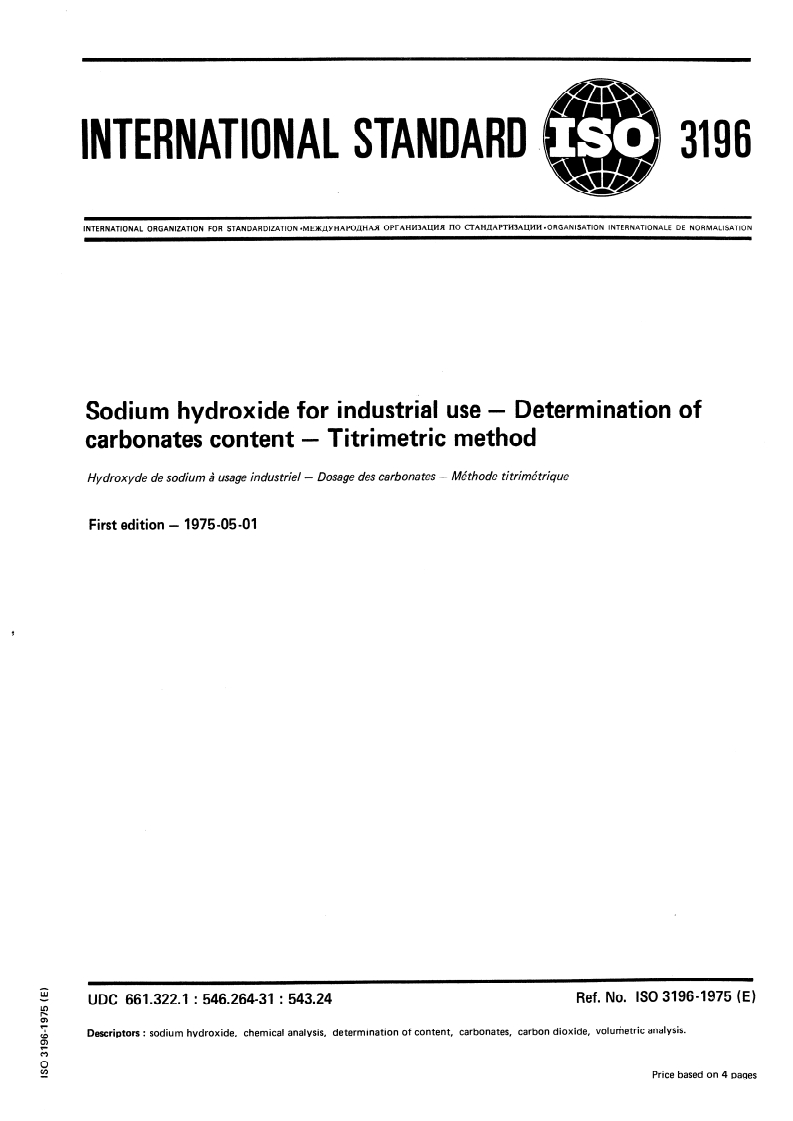
(Main)Sodium hydroxide for industrial use — Determination of carbonates content — Titrimetric method
General Information
- Abstract
Applicable to products having contents, expressed as CO2 , of more than 0.01 % (m/m). Relates to a procduct containing neither sulphides nor chlorates or only sulphides or only chlorates. Preliminary test by boiling an acidified test sample in the presence of methyl orange and with a lead acetate paper strip in the vapour. The sulphides blacken the paper and chlorates delolourize the methyl orange. Products containing neither sulphides nor chlorates: liberation of carbon dioxide by acidification and heating. Entrainment in a flow of gas and absorption in an excess of barium hydroxide solution. Titration of the excess barium hydroxide solution with a standard volumetric hydrochloric acid solution in the presence of thymolphthalein as indicator.
- Status
- Published
- Publication Date
- 30-Apr-1975
- Technical Committee
- ISO/TC 47 - Chemistry
- Drafting Committee
- ISO/TC 47 - Chemistry
- Current Stage
- 9093 - International Standard confirmed
- Start Date
- 20-Oct-2023
- Completion Date
- 29-Aug-2026
Buy Documents
ISO 3196:1975 - Sodium hydroxide for industrial use -- Determination of carbonates content -- Titrimetric method
ISO 3196:1975 - Sodium hydroxide for industrial use — Determination of carbonates content — Titrimetric method/1/1975
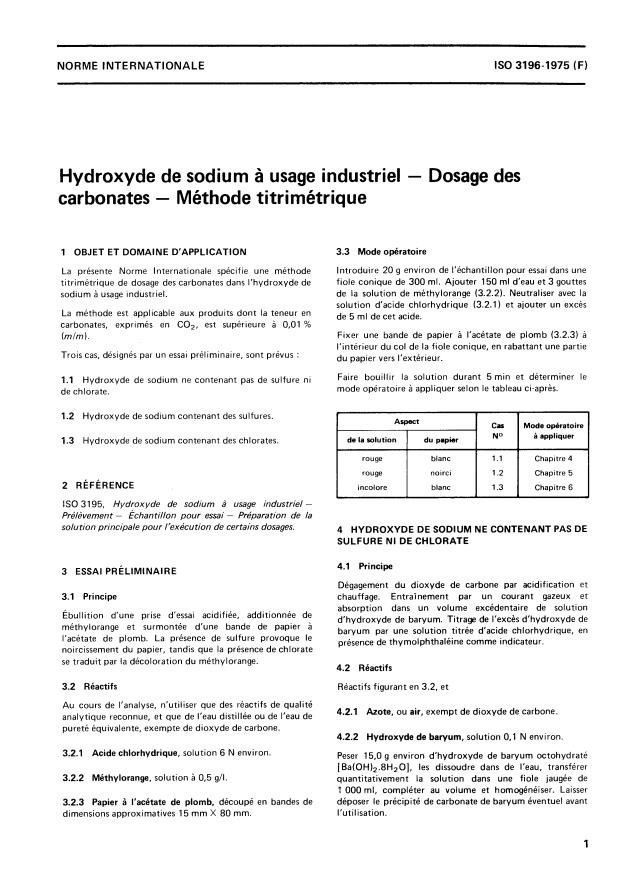
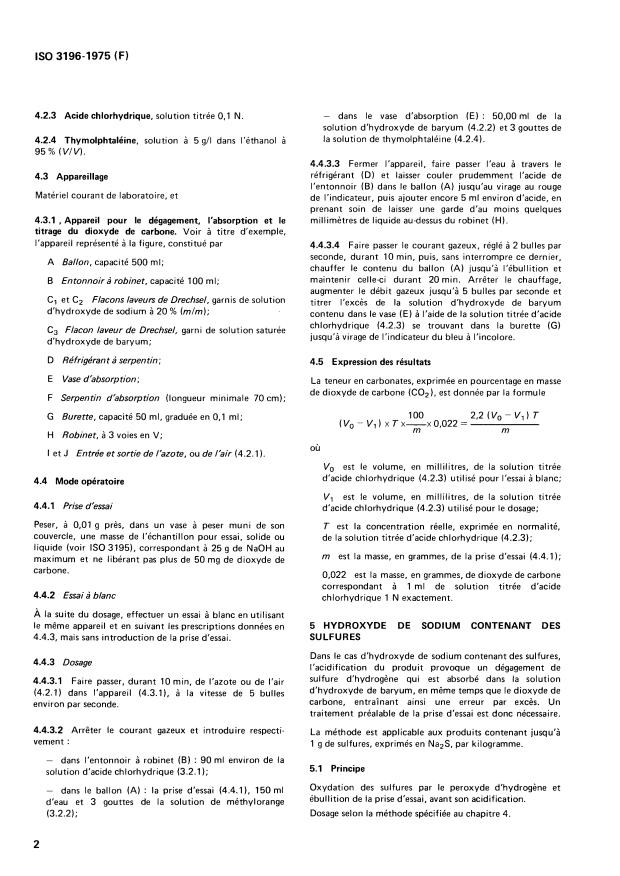
ISO 3196:1975 - Hydroxyde de sodium a usage industriel -- Dosage des carbonates -- Méthode titrimétrique
ISO 3196:1975 - Hydroxyde de sodium a usage industriel -- Dosage des carbonates -- Méthode titrimétrique
ISO 3196:1975 - Hydroxyde de sodium à usage industriel — Dosage des carbonates — Méthode titrimétrique/1/1975
ISO 3196:1975 - Hydroxyde de sodium à usage industriel — Dosage des carbonates — Méthode titrimétrique/1/1975
Overview
ISO 3196:1975 specifies a titrimetric method for determining carbonate content in sodium hydroxide used for industrial purposes. This international standard applies to sodium hydroxide products with carbonate contents, expressed as CO₂, greater than 0.01% (m/m). It provides a reliable and standardized procedure to measure carbonates, ensuring product quality and compliance in industrial chemical processes.
This method is particularly relevant as carbonates can influence the chemical behavior of sodium hydroxide, impacting its performance in various industrial applications. The standard addresses different compositions, including sodium hydroxide containing sulphides, chlorates, or neither, using appropriate preliminary tests and tailored procedures.
Key Topics
Scope and Applicability
The method applies to sodium hydroxide with carbonate content exceeding 0.01% CO₂. It covers three scenarios:- Sodium hydroxide containing neither sulphides nor chlorates.
- Sodium hydroxide containing sulphides.
- Sodium hydroxide containing chlorates.
Preliminary Testing
A key feature is the preliminary test involving boiling an acidified sample with methyl orange and using lead acetate paper. This determines the presence of sulphides (paper blackens) or chlorates (methyl orange decolorizes), helping select the correct testing procedure.Titrimetric Procedure
For products free from sulphides and chlorates, the method involves:- Acidification and heating of the sample to liberate CO₂.
- Absorption of CO₂ in an excess barium hydroxide solution.
- Titration of excess barium hydroxide using standardized hydrochloric acid with thymolphthalein indicator.
Special Treatment for Sulphides and Chlorates
- Sulphides-containing samples require oxidation with hydrogen peroxide before acidification to avoid interference by hydrogen sulphide.
- Chlorates-containing samples require prior reduction to chlorides using iron(II) sulphate to prevent chlorine interference.
Reagent and Apparatus Specifications
The standard details reagent concentrations, such as barium hydroxide (~0.1 N), hydrochloric acid (~6 N and 0.1 N), and indicators like methyl orange and thymolphthalein. It also specifies typical lab equipment setup including gas-washing bottles, volumetric flasks, separating funnel, and burette.Result Expression
Carbonate content is calculated and expressed as a percentage of carbon dioxide by mass, ensuring consistent interpretation across laboratories and industries.
Applications
Industrial Quality Control
Ensures the quality of sodium hydroxide used in manufacturing processes such as chemical synthesis, pulp and paper production, water treatment, and soap manufacturing.Chemical Industry Compliance
Helps manufacturers and suppliers comply with product specifications and regulatory standards by accurately quantifying carbonate impurities.Process Optimization
Knowing carbonate levels allows process engineers to optimize conditions in applications where sodium hydroxide’s reactivity and purity affect efficiency and product quality.Materials Verification
Essential for certifying batches of industrial-grade sodium hydroxide, preventing contamination effects from sulphides or chlorates.
Related Standards
ISO 3195: Sampling and Preparation of Sodium Hydroxide for Testing
Provides guidelines on sample collection and preparation, ensuring representative and reliable test results for chemical analyses including carbonate determination.General Volumetric Analysis Standards
Other ISO standards governing titrimetric and volumetric methods complement ISO 3196 by standardizing chemical analysis processes across different substances.Standards on Chemical Reagents and Indicators
ISO guidelines detail quality requirements for reagents such as barium hydroxide, hydrochloric acid, indicators like methyl orange and thymolphthalein, ensuring consistency and accuracy.
By following ISO 3196:1975, laboratories and industries can perform precise carbonate content determinations in sodium hydroxide, enhancing product reliability and operational control. This standardized titrimetric method supports rigorous quality assurance and regulatory adherence in diverse industrial applications.
Relations
- Effective Date
- 25-Aug-2026
- Consolidated By
ISO 898-1:1999 - Mechanical properties of fasteners made of carbon steel and alloy steel — Part 1: Bolts, screws and studs - Effective Date
- 06-Jun-2022
Buy Documents
ISO 3196:1975 - Sodium hydroxide for industrial use -- Determination of carbonates content -- Titrimetric method
ISO 3196:1975 - Sodium hydroxide for industrial use — Determination of carbonates content — Titrimetric method/1/1975
ISO 3196:1975 - Hydroxyde de sodium a usage industriel -- Dosage des carbonates -- Méthode titrimétrique
ISO 3196:1975 - Hydroxyde de sodium a usage industriel -- Dosage des carbonates -- Méthode titrimétrique
ISO 3196:1975 - Hydroxyde de sodium à usage industriel — Dosage des carbonates — Méthode titrimétrique/1/1975
ISO 3196:1975 - Hydroxyde de sodium à usage industriel — Dosage des carbonates — Méthode titrimétrique/1/1975
Get Certified
Connect with accredited certification bodies for this standard

ECOCERT
Organic and sustainability certification.

Eurofins Food Testing Global
Global leader in food, environment, and pharmaceutical product testing.

Intertek Bangladesh
Intertek certification and testing services in Bangladesh.
Sponsored listings
Frequently Asked Questions
ISO 3196:1975 is a standard published by the International Organization for Standardization (ISO). Its full title is "Sodium hydroxide for industrial use — Determination of carbonates content — Titrimetric method". This standard covers: Applicable to products having contents, expressed as CO2 , of more than 0.01 % (m/m). Relates to a procduct containing neither sulphides nor chlorates or only sulphides or only chlorates. Preliminary test by boiling an acidified test sample in the presence of methyl orange and with a lead acetate paper strip in the vapour. The sulphides blacken the paper and chlorates delolourize the methyl orange. Products containing neither sulphides nor chlorates: liberation of carbon dioxide by acidification and heating. Entrainment in a flow of gas and absorption in an excess of barium hydroxide solution. Titration of the excess barium hydroxide solution with a standard volumetric hydrochloric acid solution in the presence of thymolphthalein as indicator.
Applicable to products having contents, expressed as CO2 , of more than 0.01 % (m/m). Relates to a procduct containing neither sulphides nor chlorates or only sulphides or only chlorates. Preliminary test by boiling an acidified test sample in the presence of methyl orange and with a lead acetate paper strip in the vapour. The sulphides blacken the paper and chlorates delolourize the methyl orange. Products containing neither sulphides nor chlorates: liberation of carbon dioxide by acidification and heating. Entrainment in a flow of gas and absorption in an excess of barium hydroxide solution. Titration of the excess barium hydroxide solution with a standard volumetric hydrochloric acid solution in the presence of thymolphthalein as indicator.
ISO 3196:1975 is classified under the following ICS (International Classification for Standards) categories: 71.060.40 - Bases. The ICS classification helps identify the subject area and facilitates finding related standards.
ISO 3196:1975 has the following relationships with other standards: It is inter standard links to EN 896:2012, ISO 898-1:1999. Understanding these relationships helps ensure you are using the most current and applicable version of the standard.
ISO 3196:1975 is available in PDF format for immediate download after purchase. The document can be added to your cart and obtained through the secure checkout process. Digital delivery ensures instant access to the complete standard document.
Standards Content (Sample)
INTERNATIONAL STANDARD.
INTERNATIONAL ORGANIZATION FOR STANDARDIZATION *MEXAYHAPOAHtUI OPrAHM3AWR l-‘lo CTAHAAPTMSA~WM.ORGANlSATION INTERNATIONALE DE NORMALISATION
Sodium hydroxide for industrial use - Determination of
carbonates content - Titrimetric method
Hydroxyde de sodium 2 wage industriel - Dosage des carbonates - Mthode titrimktrique
First edition - 1975-05-01
Ref. No. ISO 31964975 (E)
UDC 661.322.1 : 546.264-31 : 543.24
carbonates, carbon dioxide, volutietric analysis.
Descriptors : sodium hydroxide, Chemical analysis, determination of content,
Price based on 4 pages
FOREWORD
ISO (the International Organization for Standardization) is a worldwide federation
of national Standards institutes (ISO Member Bodies). The work of developing
International Standards is carried out through ISO Technical Committees. Every
Member Body interested in a subject for which a Technical Committee has been set
up has the right to be represented on that Committee. International organizations,
governmental and non-governmental, in liaison with ISO, also take part in the work.
Draft International Standards adopted by the Technical Committees are circulated
to the Member Bodies for approval before their acceptance as International
Standards by the ISO Council.
International Standard ISO 3196 was drawn up by Technical Committee
lSO/TC 47, Chemistry, and circulated to the Member Bodies in September 1973.
lt has been approved by the Member Bodies of the following countries :
Austria Hungary South Africa, Rep. of
Belgium India Spain
Bulgaria Israel Switzerland
Chile I taly Thailand
Czechoslovakia Netherlands Turkey
United Kingdom
Egypt, Arab Rep. of New Zealand
France Poland U.S.S. R.
Germany Portugal Yugoslavia
No Member Body expressed disapproval of the document.
0 International Organkation for Standardkation, 1975 l
Printed in Switzerland
INTERNATIONAL STANDARD
Sodium hydroxide for industrial use - Determination of
carbonates content - Titrimetric method
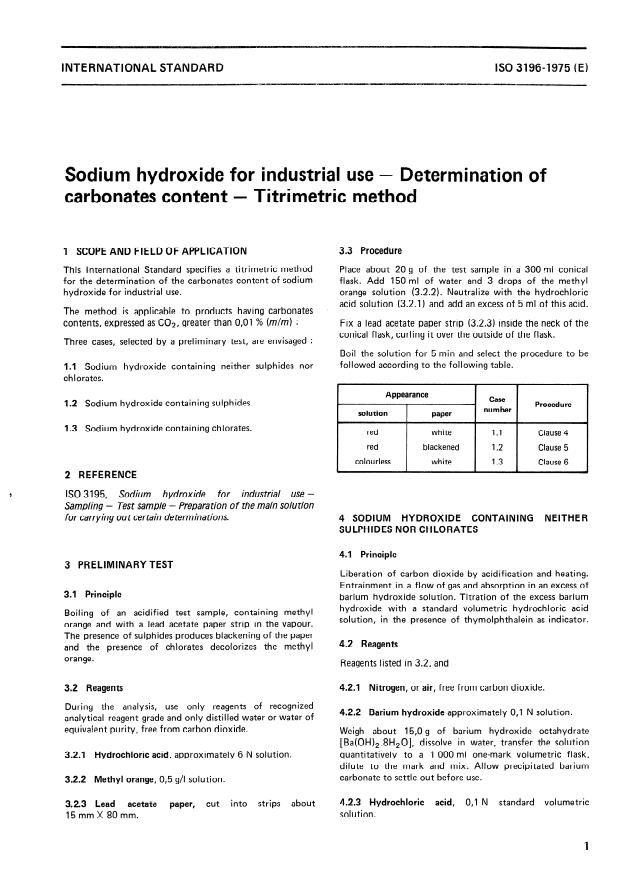
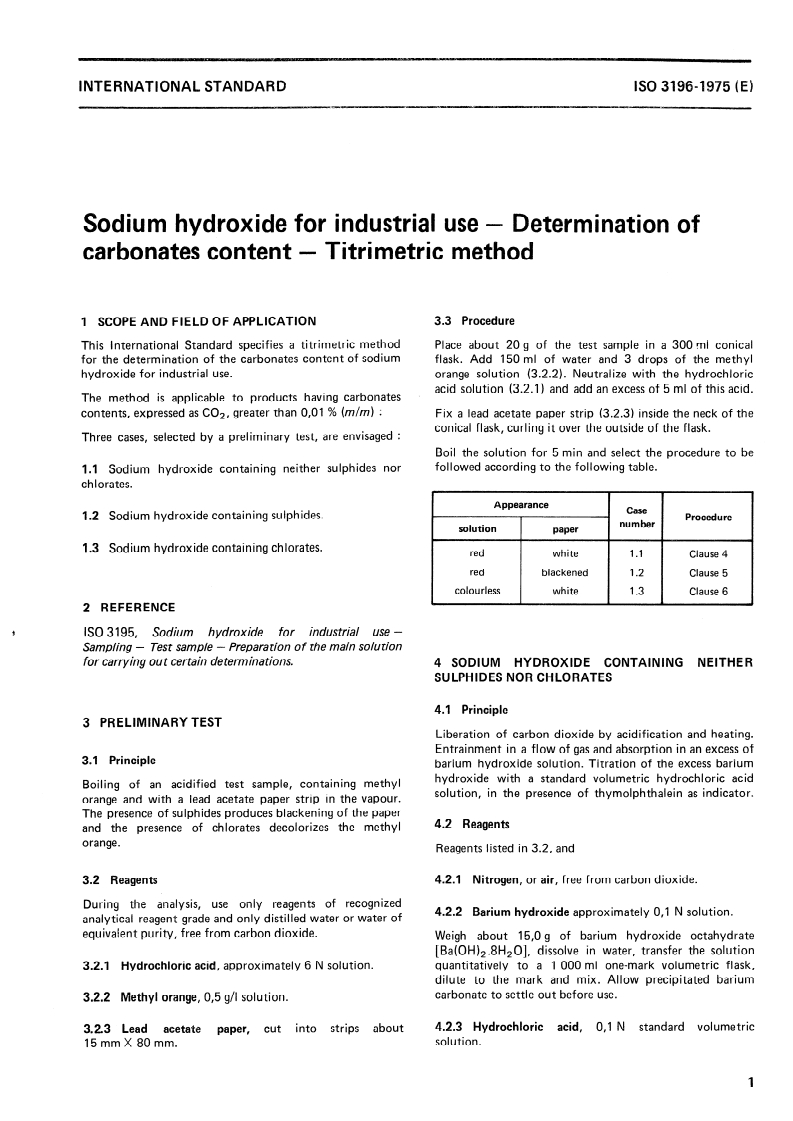
3.3 Procedure
1 SCOPE AND FIELD OF APPLICATION
This International Standard specifies a titrimetric method Place about 20 g of the test Sample in a 300 ml conical
for the determination of the carbonates content of sodium flask. Add 150 ml of water and 3 drops of the methyl
hydroxide for industrial use. orange Solution (3.22). Neutralize with the hydrochloric
acid Solution (3.2.1) and add an excess of 5 ml of this acid.
The method is applicable to products having carbonates
contents, expressed as CO*, greater than 0,Ol % (mlm) : Fix a lead acetate Paper Strip (3.2.3) inside the neck of the
conical flask, curling it over the outside of the flask.
Three cases, selected by a preliminary test, are envisaged :
Boil the Solution for 5 min and select the procedure to be
followed according to the following table.
1.1 Sodium hydroxide containing neither sulphides nor
chlorates.
1.2 Sodium hydroxide containing sulphides.
1.3 Sodium hydroxide containing chlorates.
red white 1.1 Clause 4
red blackened 1.2 Clause 5
colourless white 1.3 Clause 6
2 REFERENCE
ISO 3 195, Sodium hydroxide for industrial use -
Sampling - Test Sample - Prepara tion o f the main Solution
for carrying out certain de terminations.
4 SODIUM HYDROXIDE CONTAINING NEITHER
SULPHIDES NOR CHLORATES
4.1 Principle
3 PRELIMINARY TEST
hiberation of carbon dioxide by acidification and heating.
Entrainment in a flow of gas and absorption in an excess of
3.1 Principle
barium hydroxide Solution. Titration of the excess barium
hydroxide with a Standard volumetric hydrochloric acid
Boiling sf an acidified test Sample, containing methyl
Solution, in the presence of thymolphthalein as indicator.
orange and with a lead acetate Paper Strip in the vapour.
The presence of sulphides produces blackening of the Paper
4.2 Reagents
and the presence of chlorates decolorizes the methyl
orange.
Reagents listed in 3.2, and
3.2 Reagents 4.2.1 Nitrogen, or air, free from carbon dioxide.
During the analysis, use only reagents of recognized
4.2.2 Barium hydroxide approximately 0,l N Solution.
analytical reagent grade and only distilled water or water of
equivalent purity, free from carbon dioxide.
Weigh about 15,0 g of barium hydroxide octahydrate
issolve in water, transfer the Solution
[Ba(OH)2.8H20], d
quantitatively to a 1 000 ml one-mark volumetric flask,
3.2.1 Hydrochlorit acid, approximately 6 N Solution.
dilute to the mark and mix. Allow precipitated barium
carbonate to settle out before use.
3.2.2 Methyl orange, 0,5 g/l Solution.
4.2.3 Hydrochlorit acid, 0,l N Standard volumetric
3.2.3 Lead acetate Paper, tut into Strips about
Solution.
15mmX 80mm.
ISO3196-1975(E)
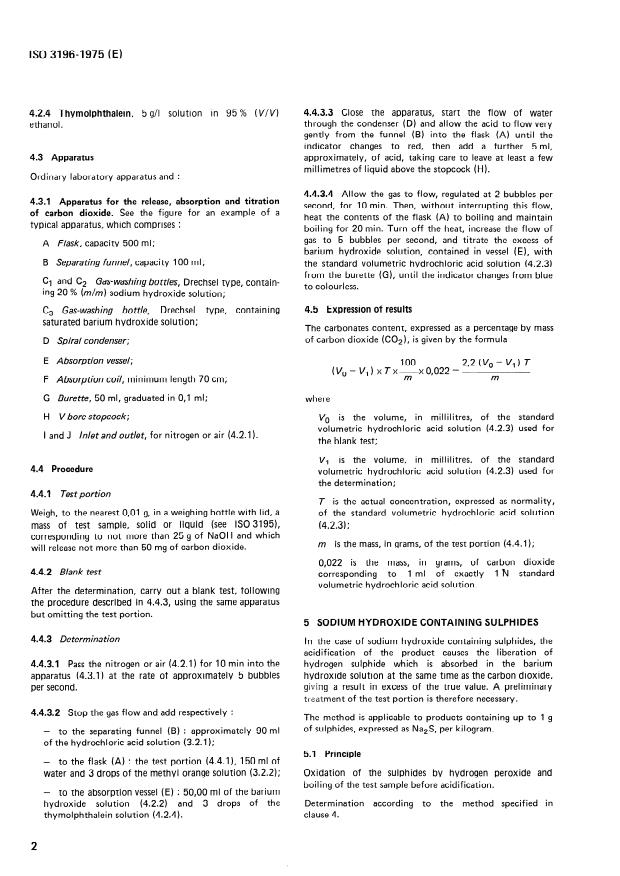
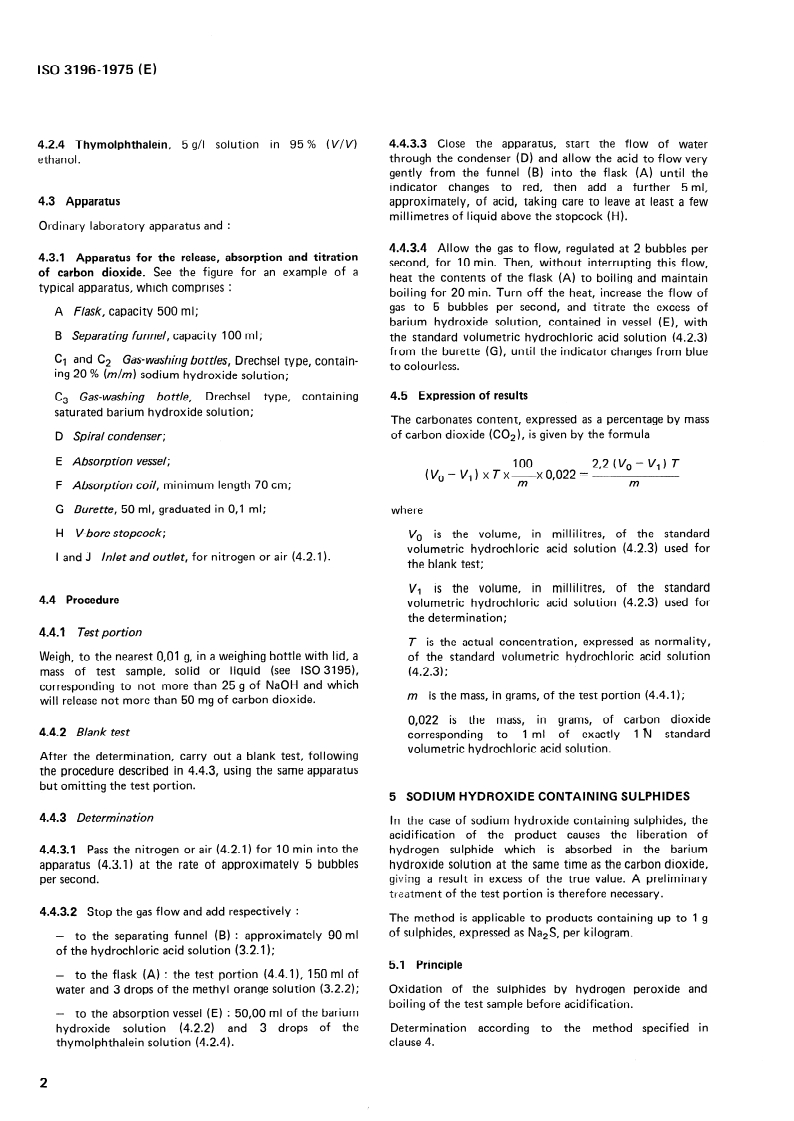
4.4.3.3 Close the apparatus, Start the flow of watet-
4.24 Thymolphthalein, 5 g/l Solution in 95 % (WV)
ethanol. through the condenser (D) and allow the acid to flow very
gently from the funnel (B) into the flask (A) until the
indicator changes
to red, then add a further 5 ml,
4.3 Apparatus approximately, of acid, taking care to leave at least a few
millimetres of liquid above the stopcock (H).
Ordinary laboratory apparatus and :
4.4.3.4 Allow the gas to flow, regulated at 2 bubbles per
4.3.1 Apparatus for the release, absorption and titration
second, for IO min. Then, without interrupting this flow,
of carbon dioxide. See the figure for an example of a
heat the contents of the flask (A) to boiling and maintain
typical apparatus, which comprises :
boiling for 20 min. Turn off the heat, increase the flow of
gas to 5 bubbles per second, and titrate
...
INTERNATIONAL STANDARD.
INTERNATIONAL ORGANIZATION FOR STANDARDIZATION *MEXAYHAPOAHtUI OPrAHM3AWR l-‘lo CTAHAAPTMSA~WM.ORGANlSATION INTERNATIONALE DE NORMALISATION
Sodium hydroxide for industrial use - Determination of
carbonates content - Titrimetric method
Hydroxyde de sodium 2 wage industriel - Dosage des carbonates - Mthode titrimktrique
First edition - 1975-05-01
Ref. No. ISO 31964975 (E)
UDC 661.322.1 : 546.264-31 : 543.24
carbonates, carbon dioxide, volutietric analysis.
Descriptors : sodium hydroxide, Chemical analysis, determination of content,
Price based on 4 pages
FOREWORD
ISO (the International Organization for Standardization) is a worldwide federation
of national Standards institutes (ISO Member Bodies). The work of developing
International Standards is carried out through ISO Technical Committees. Every
Member Body interested in a subject for which a Technical Committee has been set
up has the right to be represented on that Committee. International organizations,
governmental and non-governmental, in liaison with ISO, also take part in the work.
Draft International Standards adopted by the Technical Committees are circulated
to the Member Bodies for approval before their acceptance as International
Standards by the ISO Council.
International Standard ISO 3196 was drawn up by Technical Committee
lSO/TC 47, Chemistry, and circulated to the Member Bodies in September 1973.
lt has been approved by the Member Bodies of the following countries :
Austria Hungary South Africa, Rep. of
Belgium India Spain
Bulgaria Israel Switzerland
Chile I taly Thailand
Czechoslovakia Netherlands Turkey
United Kingdom
Egypt, Arab Rep. of New Zealand
France Poland U.S.S. R.
Germany Portugal Yugoslavia
No Member Body expressed disapproval of the document.
0 International Organkation for Standardkation, 1975 l
Printed in Switzerland
INTERNATIONAL STANDARD
Sodium hydroxide for industrial use - Determination of
carbonates content - Titrimetric method
3.3 Procedure
1 SCOPE AND FIELD OF APPLICATION
This International Standard specifies a titrimetric method Place about 20 g of the test Sample in a 300 ml conical
for the determination of the carbonates content of sodium flask. Add 150 ml of water and 3 drops of the methyl
hydroxide for industrial use. orange Solution (3.22). Neutralize with the hydrochloric
acid Solution (3.2.1) and add an excess of 5 ml of this acid.
The method is applicable to products having carbonates
contents, expressed as CO*, greater than 0,Ol % (mlm) : Fix a lead acetate Paper Strip (3.2.3) inside the neck of the
conical flask, curling it over the outside of the flask.
Three cases, selected by a preliminary test, are envisaged :
Boil the Solution for 5 min and select the procedure to be
followed according to the following table.
1.1 Sodium hydroxide containing neither sulphides nor
chlorates.
1.2 Sodium hydroxide containing sulphides.
1.3 Sodium hydroxide containing chlorates.
red white 1.1 Clause 4
red blackened 1.2 Clause 5
colourless white 1.3 Clause 6
2 REFERENCE
ISO 3 195, Sodium hydroxide for industrial use -
Sampling - Test Sample - Prepara tion o f the main Solution
for carrying out certain de terminations.
4 SODIUM HYDROXIDE CONTAINING NEITHER
SULPHIDES NOR CHLORATES
4.1 Principle
3 PRELIMINARY TEST
hiberation of carbon dioxide by acidification and heating.
Entrainment in a flow of gas and absorption in an excess of
3.1 Principle
barium hydroxide Solution. Titration of the excess barium
hydroxide with a Standard volumetric hydrochloric acid
Boiling sf an acidified test Sample, containing methyl
Solution, in the presence of thymolphthalein as indicator.
orange and with a lead acetate Paper Strip in the vapour.
The presence of sulphides produces blackening of the Paper
4.2 Reagents
and the presence of chlorates decolorizes the methyl
orange.
Reagents listed in 3.2, and
3.2 Reagents 4.2.1 Nitrogen, or air, free from carbon dioxide.
During the analysis, use only reagents of recognized
4.2.2 Barium hydroxide approximately 0,l N Solution.
analytical reagent grade and only distilled water or water of
equivalent purity, free from carbon dioxide.
Weigh about 15,0 g of barium hydroxide octahydrate
issolve in water, transfer the Solution
[Ba(OH)2.8H20], d
quantitatively to a 1 000 ml one-mark volumetric flask,
3.2.1 Hydrochlorit acid, approximately 6 N Solution.
dilute to the mark and mix. Allow precipitated barium
carbonate to settle out before use.
3.2.2 Methyl orange, 0,5 g/l Solution.
4.2.3 Hydrochlorit acid, 0,l N Standard volumetric
3.2.3 Lead acetate Paper, tut into Strips about
Solution.
15mmX 80mm.
ISO3196-1975(E)
4.4.3.3 Close the apparatus, Start the flow of watet-
4.24 Thymolphthalein, 5 g/l Solution in 95 % (WV)
ethanol. through the condenser (D) and allow the acid to flow very
gently from the funnel (B) into the flask (A) until the
indicator changes
to red, then add a further 5 ml,
4.3 Apparatus approximately, of acid, taking care to leave at least a few
millimetres of liquid above the stopcock (H).
Ordinary laboratory apparatus and :
4.4.3.4 Allow the gas to flow, regulated at 2 bubbles per
4.3.1 Apparatus for the release, absorption and titration
second, for IO min. Then, without interrupting this flow,
of carbon dioxide. See the figure for an example of a
heat the contents of the flask (A) to boiling and maintain
typical apparatus, which comprises :
boiling for 20 min. Turn off the heat, increase the flow of
gas to 5 bubbles per second, and titrate
...
NORME INTERNATIONALE 3196
INTERNATIONAL ORGANIZATION FOR STANCARDIZATION .MEXflYHAPOflHAI OPrAHM3AUHR no CTAHflAPTH3AUHH .ORGANISATION INTERNATIONALE DE NORMALISATION
Hydroxyde de sodium a usage industriel - Dosage des
carbonates - Méthode titrimétrique
Sodium hydroxide for industrial use - Determination of carbonates content - Titrimetric method
Première édition - 1975-05-01
~
-
LL
CDU 661.322.1 : 546.264-31 : 543.24
Réf. no : IS0 3196-1975 (F)
In
b
m
c
Descripteurs : hydroxyde de sodium, analyse chimique, dosage, carbonate, dioxyde de carbone, méthode volumétrique.
(D
c
m
Prix basé sur 4 pages
AVANT-PROPOS
L'ISO (Organisation Internationale de Normalisation) est une fédération mondiale
d'organismes nationaux de normalisation (Comités Membres ISO). L'élaboration de
Normes Internationales est confiée aux Comités Techniques ISO. Chaque Comité
Membre intéressé par une étude a le droit de faire partie du Comité Technique
correspondant. Les organisations internationales, gouvernementales et non
gouvernementales, en liaison avec I'ISO, participent également aux travaux.
Les Projets de Normes Internationales adoptés par les Comités Techniques sont
soumis aux Comités Membres pour approbation, avant leur acceptation comme
Normes Internationales par le Conseil de I'ISO.
La Norme Internationale IS03196 a été établie par le Comité Technique
ISO/TC 47, Chimie, et soumise aux Comités Membres en septembre 1973.
Elle a été approuvée par les Comités Membres des pays suivants :
Afrique du Sud, Rép. d' France Portugal
Al lemagne Hongrie Royaume-Uni
Autriche Inde Suisse
Belgique Israël Tchécoslovaquie
Bulgarie Italie Thaïlande
Chili Nouvelle-Zélande Turquie
Égypte, Rép. arabe d' Pays- Bas U.R.S.S.
Espagne Pologne Yougoslavie
Aucun Comité Membre n'a désapprouvé le document.
O Organisation Internationale de Normalisation, 1975 0
Imprimé en Suisse
IS0 3196-1975 (F)
NORME INTERNATIONALE
Hydroxyde de sodium à usage industriel - Dosage des
carbonates - Méthode titrimétrique
3.3 Mode opératoire
1 OBJET ET DOMAINE D'APPLICATION
Introduire 20 g environ de I'échantillon pour essai dans une
La présente Norme Internationale spécifie une méthode
fiole conique de 300 ml. Ajouter 150 ml d'eau et 3 gouttes
titrimétrique de dosage des carbonates dans l'hydroxyde de
sodium a usage industriel. de la solution de méthylorange (3.2.2). Neutraliser avec la
solution d'acide chlorhydrique (3.2.1) et ajouter un excès
est applicable aux produits dont la teneur en
La méthode
de 5 ml de cet acide.
carbonates, exprimés en CO2, est supérieure a 0,Ol %
Fixer une bande de papier à l'acétate de plomb (3.2.3) a
(mlm).
l'intérieur du col de la fiole conique, en rabattant une partie
Trois cas, désignés par un essai préliminaire, sont prévus :
du papier vers l'extérieur.
Faire bouillir la solution durant 5 min et déterminer le
Hydroxyde de sodium ne contenant pas de sulfure ni
1.1
mode opératoire a appliquer selon le tableau ci-après.
de chlorate.
r
1.2 Hydroxyde de sodium contenant des sulfures.
Aspect Cos Mode opératoire
NO à appliquer
de la solution du papier
1.3 Hydroxyde de sodium contenant des chlorates.
rouge blanc 1.1 Chapitre 4
rouge noirci 1.2 Chapitre 5
2 RÉFÉRENCE
incolore blanc 1.3 Chapitre 6
IS0 3195, Hydroxyde de sodium à usage industriel -
Prélèvement - Échantillon pour essai - Preparation de la
solution principale pour l'exécution de certains dosages.
4 HYDROXYDE DE SODIUM NE CONTENANT PAS DE
SULFURE NI DE CHLORATE
4.1 Principe
3 ESSAI PRÉLIMINAIRE
Dégagement du dioxyde de carbone par acidification et
3.1 Principe chauffage. Entraînement par un courant gazeux et
absorption dans un volume excédentaire de solution
Ébullition d'une prise d'essai acidifiée, additionnée de
d'hydroxyde de baryum. Titrage de l'excès d'hydroxyde de
méthylorange et surmontée d'une bande de papier a
baryum par une solution titrée d'acide chlorhydrique, en
l'acétate de plomb. La présence de sulfure provoque le
présence de thymolphthaléine comme indicateur.
noircissement du papier, tandis que la présence de chlorate
se traduit par la décoloration du méthylorange.
4.2 Réactifs
3.2 Réactifs
Réactifs figurant en 3.2, et
Au cours de l'analyse, n'utiliser que des réactifs de qualité
4.2.1 Azote, ou air, exempt de dioxyde de carbone.
analytique reconnue, et que de l'eau distillée ou de l'eau de
pureté équivalente, exempte de dioxyde de carbone.
4.2.2 Hydroxyde de baryum, solution 0.1 N environ.
3.2.1 Acide chlorhydrique, solution 6 N environ.
Peser 15.0 g environ d'hydroxyde de baryum octohydraté
[Ba(OH)2.8H20], les dissoudre dans de l'eau, transferer
3.2.2 Méthylorange, solution à 0,5 g/l.
quantitativement la solution dans une fiole jaugée de
1 O00 ml, compléter au volume et homogénéiser. Laisser
déposer le précipité de carbonate de baryum éventuel avant
3.2.3 Papier B l'acétate de plomb, découpé en bandes de
l'utilisation.
dimensions approximatives 15 mm X 80 mm.
IS0 3196-1975 (FI
4.2.3 Acide chlorhydrique, solution titrée 0,l N - dans le vase d'absorption (E) : 50,OO ml de la
solution d'hydroxyde de baryum (4.2.2) et 3 gouttes de
la solution de thymolphtaléine (4.2.4).
4.2.4 Thymolphtaléine, solution a 5 g/I dans I'éthanol 2
95 % (V/V).
4.4.3.3 Fermer l'appareil, faire passer l'eau à travers le
réfrigérant (D) et laisser couler prudemment l'acide de
4.3 Appareillage
l'entonnoir (B) dans le ballon (A) jusqu'au virage au rouge
et
Matériel courant de laboratoire,
de l'indicateur, puis ajouter encore 5 ml environ d'acide, en
prenant soin de laisser une garde d'au moins quelques
4.3.1 , Appareil pour le dégagement, l'absorption et le millimètres de liquide au-dessus du robinet (H).
titrage du dioxyde de carbone. Voir à titre d'exemple,
l'appareil représenté à la figure, const
...
NORME INTERNATIONALE 3196
INTERNATIONAL ORGANIZATION FOR STANCAROIZATION -MEXnYHAPOnHAR OPrAHH3AUHR IT0 CTAHAAPTH3AUHH *ORGANISATION INTERNATIONALE DE NORMALISATION
Hydroxyde de sodium à usage industriel - Dosage des
carbonates - Méthode titrimétrique
Sodium hydroxide for industrial use - Determination of carbonates content - Titrimetric method
Première édition - 1975-05-01
-
U
-
Réf. no : IS0 3196-1975 (FI
CDU 661.322.1 : 546.264-31 : 543.24
Lo
-.
-
Descripteurs : hydroxyde de sodium, analyse chimique, dosage, carbonate, dioxyde de carbone, méthode volumétrique
(D
m
Prix basé sur 4 pages
AVANT-PROPOS
L'ISO (Organisation Internationale de Normalisation) est une fédération mondiale
d'organismes nationaux de normalisation (Comités Membres ISO). L'élaboration de
Normes Internationales est confiée aux Comités Techniques ISO. Chaque Comité
Membre intéressé par une étude a le droit de faire partie du Comité Technique
correspondant. Les organisations internationales, gouvernementales et non
gouvernementales, en liaison avec I'ISO, participent également aux travaux.
.-
Les Projets de Normes Internationales adoptés par les Comités Techniques sont
soumis aux Comités Membres pour approbation, avant leur acceptation comme
Normes Internationales par le Conseil de I'ISO.
La Norme Internationale IS0 3196 a été établie par le Comité Technique
ISO/TC 47, Chimie, et soumise aux Comités Membres en septembre 1973.
Elle a été approuvée par les Comités Membres des pays suivants :
Afrique du Sud, Rép. d' France Portugal
Allemagne Hongrie Royaume-Uni
Autriche Inde Suisse
Belgique Israël Tchécoslovaquie
Bulgarie Italie Thaï I a nde
Chili Nouvelle-Zélande Turquie
Égypte, Rép. arabe d' Pays-Bas U.R.S.S.
Espagne Pologne Yougoslavie
Aucun Comité Membre n'a désapprouvé le document.
O Organisation Internationale de Normalisation, 1975 0
Imprimé en Suisse
IS0 3196-1975 (FI
NORME INTERNATIONALE
Hydroxyde de sodium à usage industriel - Dosage des
carbonates - Méthode titrimétrique
3.3 Mode opératoire
1 OBJET ET DOMAINE D'APPLICATION
La présente Norme Internationale spécifie une méthode Introduire 20 g environ de I'échantillon pour essai dans une
fiole conique de 300 ml. Ajouter 150 ml d'eau et 3 gouttes
titrimétrique de dosage des carbonates dans l'hydroxyde de
de la solution de .méthylorange (3.2.2). Neutraliser avec la
sodium a usage industriel.
solution d'acide chlorhydrique (3.2.1) et ajouter un excès
La méthode est applicable aux produits dont la teneur en
de 5 ml de cet acide.
carbonates, exprimés en CO2, est supérieure a 0,Ol %
Fixer une bande de papier a l'acétate de plomb (3.2.3) a
(mlm) -
l'intérieur du col de la fiole conique, en rabattant une partie
Trois cas, désignés par un essai préliminaire, sont prévus :
du papier vers l'extérieur.
Faire bouillir la solution durant 5 min et déterminer le
1.1 Hydroxyde de sodium ne contenant pas de sulfure ni
mode opératoire a appliquer selon le tableau ci-après.
de chlorate.
1 I I
1.2 Hydroxyde de sodium contenant des sulfures.
1.3 Hydroxyde de sodium contenant des chlorates.
Chapitre 4
rouge blanc
rouge noirci Chapitre 5
2 RÉFÉRENCE
incolore blanc Chapitre 6
IS0 31 95, Hydroxyde de sodium à usage industriel -
Prélèvement - Échantillon pour essai - Préparation de la
solution principale pour l'exécution de certains dosages.
4 HYDROXYDE DE SODIUM NE CONTENANT PAS DE
SULFURE NI DE CHLORATE
4.1 Principe
3 ESSAI PRÉLIMINAIRE
Dégagement du dioxyde de carbone par acidification et
3.1 Principe chauffage. Entraînement par un courant gazeux et
absorption dans un volume excédentaire de solution
Ébullition d'une prise d'essai acidifiée, additionnée de
d'hydroxyde de baryum. Titrage de l'excès d'hydroxyde de
méthylorange et surmontée d'une bande de papier b
baryum par une solution titrée d'acide chlorhydrique, en
l'acétate de plomb. La présence de sulfure provoque le
présence de thymolphthaléine comme indicateur.
noircissement du papier, tandis que la présence de chlorate
se traduit par la décoloration du méthylorange.
4.2 Réactifs
3.2 Réactifs
Réactifs figurant en 3.2, et
Au cours de l'analyse, n'utiliser que des réactifs de qualité
4.2.1 Azote, ou air, exempt de dioxyde de carbone.
analytique reconnue, et que de l'eau distillée ou de l'eau de
pureté équivalente, exempte de dioxyde de carbone.
4.2.2 Hydroxyde de baryum, solution 0.1 N environ.
3.2.1 Acide chlorhydrique, solution 6 N environ.
Peser 15,O g environ d'hydroxyde de baryum octohydraté
[Ba(OH)2.8H20], les dissoudre dans de l'eau, transferer
3.2.2 Méthylorange, solution à 0,5 g/l.
quantitativement la solution dans une fiole jaugée de
1 O00 ml, compléter au volume et homogénéiser. Laisser
déposer le précipité de carbonate de baryum éventuel avant
3.2.3 Papier 5 l'acétate de plomb, découpe en bandes de
I'u ti I isation.
dimensions approximatives 15 mm x 80 mm.
IS0 3196-1975 (F)
4.2.3 Acide chlorhydrique, solution titrée 0,l N. - dans le vase d‘absorption (E) : 50,OO ml de la
solution d‘hydroxyde de baryum (4.2.2) et 3 gouttes de
la solution de thymolphtaléine (4.2.4).
4.2.4 Thymolphtaléine, solution 2 5 g/l dans I‘éthanol I
95 % (V/V).
4.4.3.3 Fermer l‘appareil, faire passer l‘eau à travers le
réfrigérant (D) et laisser couler prudemment l’acide de
4.3 Appareillage
l‘entonnoir (B) dans le ballon (A) jusqu‘au virage au rouge
Matériel courant de laboratoire, et
de l’indicateur, puis ajouter encore 5 ml environ d’acide, en
prenant soin de laisser une garde d’au moins quelques
millimètres de liquide au-dessus du robinet (HI.
4.3.1 , Appareil pour le dégagement, l’absorption et le
titrage du dioxyde de carbone. Voir à titre d’exemple,
à la figure, constitué par
l’appareil représenté
4.4.3.4 Faire passer le courant gazeux, r
...
NORME INTERNATIONALE 3196
INTERNATIONAL ORGANIZATION FOR STANCAROIZATION -MEXnYHAPOnHAR OPrAHH3AUHR IT0 CTAHAAPTH3AUHH *ORGANISATION INTERNATIONALE DE NORMALISATION
Hydroxyde de sodium à usage industriel - Dosage des
carbonates - Méthode titrimétrique
Sodium hydroxide for industrial use - Determination of carbonates content - Titrimetric method
Première édition - 1975-05-01
-
U
-
Réf. no : IS0 3196-1975 (FI
CDU 661.322.1 : 546.264-31 : 543.24
Lo
-.
-
Descripteurs : hydroxyde de sodium, analyse chimique, dosage, carbonate, dioxyde de carbone, méthode volumétrique
(D
m
Prix basé sur 4 pages
AVANT-PROPOS
L'ISO (Organisation Internationale de Normalisation) est une fédération mondiale
d'organismes nationaux de normalisation (Comités Membres ISO). L'élaboration de
Normes Internationales est confiée aux Comités Techniques ISO. Chaque Comité
Membre intéressé par une étude a le droit de faire partie du Comité Technique
correspondant. Les organisations internationales, gouvernementales et non
gouvernementales, en liaison avec I'ISO, participent également aux travaux.
.-
Les Projets de Normes Internationales adoptés par les Comités Techniques sont
soumis aux Comités Membres pour approbation, avant leur acceptation comme
Normes Internationales par le Conseil de I'ISO.
La Norme Internationale IS0 3196 a été établie par le Comité Technique
ISO/TC 47, Chimie, et soumise aux Comités Membres en septembre 1973.
Elle a été approuvée par les Comités Membres des pays suivants :
Afrique du Sud, Rép. d' France Portugal
Allemagne Hongrie Royaume-Uni
Autriche Inde Suisse
Belgique Israël Tchécoslovaquie
Bulgarie Italie Thaï I a nde
Chili Nouvelle-Zélande Turquie
Égypte, Rép. arabe d' Pays-Bas U.R.S.S.
Espagne Pologne Yougoslavie
Aucun Comité Membre n'a désapprouvé le document.
O Organisation Internationale de Normalisation, 1975 0
Imprimé en Suisse
IS0 3196-1975 (FI
NORME INTERNATIONALE
Hydroxyde de sodium à usage industriel - Dosage des
carbonates - Méthode titrimétrique
3.3 Mode opératoire
1 OBJET ET DOMAINE D'APPLICATION
La présente Norme Internationale spécifie une méthode Introduire 20 g environ de I'échantillon pour essai dans une
fiole conique de 300 ml. Ajouter 150 ml d'eau et 3 gouttes
titrimétrique de dosage des carbonates dans l'hydroxyde de
de la solution de .méthylorange (3.2.2). Neutraliser avec la
sodium a usage industriel.
solution d'acide chlorhydrique (3.2.1) et ajouter un excès
La méthode est applicable aux produits dont la teneur en
de 5 ml de cet acide.
carbonates, exprimés en CO2, est supérieure a 0,Ol %
Fixer une bande de papier a l'acétate de plomb (3.2.3) a
(mlm) -
l'intérieur du col de la fiole conique, en rabattant une partie
Trois cas, désignés par un essai préliminaire, sont prévus :
du papier vers l'extérieur.
Faire bouillir la solution durant 5 min et déterminer le
1.1 Hydroxyde de sodium ne contenant pas de sulfure ni
mode opératoire a appliquer selon le tableau ci-après.
de chlorate.
1 I I
1.2 Hydroxyde de sodium contenant des sulfures.
1.3 Hydroxyde de sodium contenant des chlorates.
Chapitre 4
rouge blanc
rouge noirci Chapitre 5
2 RÉFÉRENCE
incolore blanc Chapitre 6
IS0 31 95, Hydroxyde de sodium à usage industriel -
Prélèvement - Échantillon pour essai - Préparation de la
solution principale pour l'exécution de certains dosages.
4 HYDROXYDE DE SODIUM NE CONTENANT PAS DE
SULFURE NI DE CHLORATE
4.1 Principe
3 ESSAI PRÉLIMINAIRE
Dégagement du dioxyde de carbone par acidification et
3.1 Principe chauffage. Entraînement par un courant gazeux et
absorption dans un volume excédentaire de solution
Ébullition d'une prise d'essai acidifiée, additionnée de
d'hydroxyde de baryum. Titrage de l'excès d'hydroxyde de
méthylorange et surmontée d'une bande de papier b
baryum par une solution titrée d'acide chlorhydrique, en
l'acétate de plomb. La présence de sulfure provoque le
présence de thymolphthaléine comme indicateur.
noircissement du papier, tandis que la présence de chlorate
se traduit par la décoloration du méthylorange.
4.2 Réactifs
3.2 Réactifs
Réactifs figurant en 3.2, et
Au cours de l'analyse, n'utiliser que des réactifs de qualité
4.2.1 Azote, ou air, exempt de dioxyde de carbone.
analytique reconnue, et que de l'eau distillée ou de l'eau de
pureté équivalente, exempte de dioxyde de carbone.
4.2.2 Hydroxyde de baryum, solution 0.1 N environ.
3.2.1 Acide chlorhydrique, solution 6 N environ.
Peser 15,O g environ d'hydroxyde de baryum octohydraté
[Ba(OH)2.8H20], les dissoudre dans de l'eau, transferer
3.2.2 Méthylorange, solution à 0,5 g/l.
quantitativement la solution dans une fiole jaugée de
1 O00 ml, compléter au volume et homogénéiser. Laisser
déposer le précipité de carbonate de baryum éventuel avant
3.2.3 Papier 5 l'acétate de plomb, découpe en bandes de
I'u ti I isation.
dimensions approximatives 15 mm x 80 mm.
IS0 3196-1975 (F)
4.2.3 Acide chlorhydrique, solution titrée 0,l N. - dans le vase d‘absorption (E) : 50,OO ml de la
solution d‘hydroxyde de baryum (4.2.2) et 3 gouttes de
la solution de thymolphtaléine (4.2.4).
4.2.4 Thymolphtaléine, solution 2 5 g/l dans I‘éthanol I
95 % (V/V).
4.4.3.3 Fermer l‘appareil, faire passer l‘eau à travers le
réfrigérant (D) et laisser couler prudemment l’acide de
4.3 Appareillage
l‘entonnoir (B) dans le ballon (A) jusqu‘au virage au rouge
Matériel courant de laboratoire, et
de l’indicateur, puis ajouter encore 5 ml environ d’acide, en
prenant soin de laisser une garde d’au moins quelques
millimètres de liquide au-dessus du robinet (HI.
4.3.1 , Appareil pour le dégagement, l’absorption et le
titrage du dioxyde de carbone. Voir à titre d’exemple,
à la figure, constitué par
l’appareil représenté
4.4.3.4 Faire passer le courant gazeux, r
...
NORME INTERNATIONALE 3196
INTERNATIONAL ORGANIZATION FOR STANCARDIZATION .MEXflYHAPOflHAI OPrAHM3AUHR no CTAHflAPTH3AUHH .ORGANISATION INTERNATIONALE DE NORMALISATION
Hydroxyde de sodium a usage industriel - Dosage des
carbonates - Méthode titrimétrique
Sodium hydroxide for industrial use - Determination of carbonates content - Titrimetric method
Première édition - 1975-05-01
~
-
LL
CDU 661.322.1 : 546.264-31 : 543.24
Réf. no : IS0 3196-1975 (F)
In
b
m
c
Descripteurs : hydroxyde de sodium, analyse chimique, dosage, carbonate, dioxyde de carbone, méthode volumétrique.
(D
c
m
Prix basé sur 4 pages
AVANT-PROPOS
L'ISO (Organisation Internationale de Normalisation) est une fédération mondiale
d'organismes nationaux de normalisation (Comités Membres ISO). L'élaboration de
Normes Internationales est confiée aux Comités Techniques ISO. Chaque Comité
Membre intéressé par une étude a le droit de faire partie du Comité Technique
correspondant. Les organisations internationales, gouvernementales et non
gouvernementales, en liaison avec I'ISO, participent également aux travaux.
Les Projets de Normes Internationales adoptés par les Comités Techniques sont
soumis aux Comités Membres pour approbation, avant leur acceptation comme
Normes Internationales par le Conseil de I'ISO.
La Norme Internationale IS03196 a été établie par le Comité Technique
ISO/TC 47, Chimie, et soumise aux Comités Membres en septembre 1973.
Elle a été approuvée par les Comités Membres des pays suivants :
Afrique du Sud, Rép. d' France Portugal
Al lemagne Hongrie Royaume-Uni
Autriche Inde Suisse
Belgique Israël Tchécoslovaquie
Bulgarie Italie Thaïlande
Chili Nouvelle-Zélande Turquie
Égypte, Rép. arabe d' Pays- Bas U.R.S.S.
Espagne Pologne Yougoslavie
Aucun Comité Membre n'a désapprouvé le document.
O Organisation Internationale de Normalisation, 1975 0
Imprimé en Suisse
IS0 3196-1975 (F)
NORME INTERNATIONALE
Hydroxyde de sodium à usage industriel - Dosage des
carbonates - Méthode titrimétrique
3.3 Mode opératoire
1 OBJET ET DOMAINE D'APPLICATION
Introduire 20 g environ de I'échantillon pour essai dans une
La présente Norme Internationale spécifie une méthode
fiole conique de 300 ml. Ajouter 150 ml d'eau et 3 gouttes
titrimétrique de dosage des carbonates dans l'hydroxyde de
sodium a usage industriel. de la solution de méthylorange (3.2.2). Neutraliser avec la
solution d'acide chlorhydrique (3.2.1) et ajouter un excès
est applicable aux produits dont la teneur en
La méthode
de 5 ml de cet acide.
carbonates, exprimés en CO2, est supérieure a 0,Ol %
Fixer une bande de papier à l'acétate de plomb (3.2.3) a
(mlm).
l'intérieur du col de la fiole conique, en rabattant une partie
Trois cas, désignés par un essai préliminaire, sont prévus :
du papier vers l'extérieur.
Faire bouillir la solution durant 5 min et déterminer le
Hydroxyde de sodium ne contenant pas de sulfure ni
1.1
mode opératoire a appliquer selon le tableau ci-après.
de chlorate.
r
1.2 Hydroxyde de sodium contenant des sulfures.
Aspect Cos Mode opératoire
NO à appliquer
de la solution du papier
1.3 Hydroxyde de sodium contenant des chlorates.
rouge blanc 1.1 Chapitre 4
rouge noirci 1.2 Chapitre 5
2 RÉFÉRENCE
incolore blanc 1.3 Chapitre 6
IS0 3195, Hydroxyde de sodium à usage industriel -
Prélèvement - Échantillon pour essai - Preparation de la
solution principale pour l'exécution de certains dosages.
4 HYDROXYDE DE SODIUM NE CONTENANT PAS DE
SULFURE NI DE CHLORATE
4.1 Principe
3 ESSAI PRÉLIMINAIRE
Dégagement du dioxyde de carbone par acidification et
3.1 Principe chauffage. Entraînement par un courant gazeux et
absorption dans un volume excédentaire de solution
Ébullition d'une prise d'essai acidifiée, additionnée de
d'hydroxyde de baryum. Titrage de l'excès d'hydroxyde de
méthylorange et surmontée d'une bande de papier a
baryum par une solution titrée d'acide chlorhydrique, en
l'acétate de plomb. La présence de sulfure provoque le
présence de thymolphthaléine comme indicateur.
noircissement du papier, tandis que la présence de chlorate
se traduit par la décoloration du méthylorange.
4.2 Réactifs
3.2 Réactifs
Réactifs figurant en 3.2, et
Au cours de l'analyse, n'utiliser que des réactifs de qualité
4.2.1 Azote, ou air, exempt de dioxyde de carbone.
analytique reconnue, et que de l'eau distillée ou de l'eau de
pureté équivalente, exempte de dioxyde de carbone.
4.2.2 Hydroxyde de baryum, solution 0.1 N environ.
3.2.1 Acide chlorhydrique, solution 6 N environ.
Peser 15.0 g environ d'hydroxyde de baryum octohydraté
[Ba(OH)2.8H20], les dissoudre dans de l'eau, transferer
3.2.2 Méthylorange, solution à 0,5 g/l.
quantitativement la solution dans une fiole jaugée de
1 O00 ml, compléter au volume et homogénéiser. Laisser
déposer le précipité de carbonate de baryum éventuel avant
3.2.3 Papier B l'acétate de plomb, découpé en bandes de
l'utilisation.
dimensions approximatives 15 mm X 80 mm.
IS0 3196-1975 (FI
4.2.3 Acide chlorhydrique, solution titrée 0,l N - dans le vase d'absorption (E) : 50,OO ml de la
solution d'hydroxyde de baryum (4.2.2) et 3 gouttes de
la solution de thymolphtaléine (4.2.4).
4.2.4 Thymolphtaléine, solution a 5 g/I dans I'éthanol 2
95 % (V/V).
4.4.3.3 Fermer l'appareil, faire passer l'eau à travers le
réfrigérant (D) et laisser couler prudemment l'acide de
4.3 Appareillage
l'entonnoir (B) dans le ballon (A) jusqu'au virage au rouge
et
Matériel courant de laboratoire,
de l'indicateur, puis ajouter encore 5 ml environ d'acide, en
prenant soin de laisser une garde d'au moins quelques
4.3.1 , Appareil pour le dégagement, l'absorption et le millimètres de liquide au-dessus du robinet (H).
titrage du dioxyde de carbone. Voir à titre d'exemple,
l'appareil représenté à la figure, const
...