

ISO 18254-2:2018
(Main)Textiles — Method for the detection and determination of alkylphenol ethoxylates (APEO) — Part 2: Method using NPLC
General Information
- Abstract
This document specifies the normal phase liquid chromatography (NPLC) separation method for the qualitative and quantitative analysis of extractable alkylphenol ethoxylates (APEO) in textiles and textile products. This method provides several instrument options for the determination of alkylphenol ethoxylates (APEO) such as normal phase liquid chromatograph with mass spectrometer (NPLC/MS), normal phase liquid chromatograph with fluorescence detector (NPLC/FLD), normal phase liquid chromatograph with charged aerosol detector (NPLC/CAD) and normal phase liquid chromatograph with evaporative light scattering detector (NPLC/ELSD).
- Status
- Published
- Publication Date
- 18-Dec-2018
- Technical Committee
- ISO/TC 38 - Textiles
- Drafting Committee
- ISO/TC 38/WG 22 - Composition and chemical testing
- Current Stage
- 9093 - International Standard confirmed
- Start Date
- 30-Apr-2024
- Completion Date
- 29-Aug-2026
Buy Documents



ISO 18254-2:2018 - Textiles -- Method for the detection and determination of alkylphenol ethoxylates (APEO)
ISO 18254-2:2018 - Textiles — Method for the detection and determination of alkylphenol ethoxylates (APEO) — Part 2: Method using NPLC/19/2018

ISO 18254-2:2018 - Textiles -- Méthode de détection et de détermination des alkylphénols éthoxylés (APEO)
ISO 18254-2:2018 - Textiles — Méthode de détection et de détermination des alkylphénols éthoxylés (APEO) — Partie 2: Méthode utilisant la CLPN/19/2018
Overview
ISO 18254-2:2018 specifies a normal phase liquid chromatography (NPLC) method for the qualitative and quantitative detection of extractable alkylphenol ethoxylates (APEO) in textiles and textile products. The standard defines sample preparation, extraction and chromatographic separation steps and provides instrument options for detection such as NPLC/MS, NPLC/FLD, NPLC/CAD and NPLC/ELSD. The method targets APEO congeners with ethoxylate groups EO2 to EO16 and is part of the ISO 18254 series for textile APEO analysis.
Key topics and technical requirements
- Scope and principle: Extraction of textile samples followed by NPLC separation and detection. Warning on hazardous substances and laboratory safety.
- Sample preparation & extraction:
- Cut specimen to 5 × 5 mm pieces, homogenize and weigh 1.00 g (±0.01 g).
- Extract with 20 ml methanol using an ultrasonic water bath at 70 °C for 60 min.
- Filter (≤0.45 µm) into HPLC vial; optional SPE cleanup if matrix interferences occur.
- Chromatography & columns:
- Normal phase column (hydrogen-bond adsorption) recommended for separation of congeners by ethoxylate number (e.g., 4.6 × 150 mm, 3 µm).
- C18 short column suggested for OPEO/NPEO separation (e.g., 4.6 × 50 mm, 1.7 µm).
- Mobile phases:
- Methanol with 0.1% formic acid and 0.01% ammonium formate.
- Acetonitrile with 0.1% formic acid.
- Standards and reagents: Examples given include OPEO (Triton® X-100) and NPEO (IGEPAL® CO-630). Analytical grade solvents (methanol, acetonitrile, acetone) and buffers (ammonium formate, formic acid) are specified.
- Quantification & calculations:
- Congeners EO2–EO16 used for quantification.
- Calibration curves with at least three points; correlation coefficient guidance stated (target ≥0.995; note ≥0.990 referenced).
- Formulas provided for calculating congener contribution, individual and total APEO concentrations (mg/kg).
- Quality and reporting: Test report must reference ISO 18254-2:2018 and list method, standards, individual congener sums and any deviations.
Applications and users
- Textile testing laboratories performing regulatory compliance or supplier verification.
- Quality control teams in textile, apparel and home textiles manufacturing.
- Environmental and chemical testing labs assessing APEO content for product safety, REACH or restricted substances lists.
- R&D groups developing low-APEO formulations or alternative surfactants.
Related standards
- ISO 18254 series (other parts cover alternative analytical approaches) - consult the ISO website for the complete listing.
- Prepared by ISO/TC 38 (Textiles); users should consider related regulatory guidance for APEO restrictions.
Keywords: ISO 18254-2:2018, APEO, alkylphenol ethoxylates, NPLC, textiles, NPLC/MS, NPLC/FLD, NPLC/CAD, NPLC/ELSD, textile testing, SPE, chromatographic conditions.
Relations
- Effective Date
- 12-Feb-2026
Buy Documents
ISO 18254-2:2018 - Textiles -- Method for the detection and determination of alkylphenol ethoxylates (APEO)
ISO 18254-2:2018 - Textiles — Method for the detection and determination of alkylphenol ethoxylates (APEO) — Part 2: Method using NPLC/19/2018
ISO 18254-2:2018 - Textiles -- Méthode de détection et de détermination des alkylphénols éthoxylés (APEO)
ISO 18254-2:2018 - Textiles — Méthode de détection et de détermination des alkylphénols éthoxylés (APEO) — Partie 2: Méthode utilisant la CLPN/19/2018
Get Certified
Connect with accredited certification bodies for this standard

Control Union Certifications
Global certification for agriculture and sustainability.

Hohenstein Institut
Textile testing and certification.

Bureau Veritas Bangladesh
Bureau Veritas certification services in Bangladesh.
Sponsored listings
Frequently Asked Questions
ISO 18254-2:2018 is a standard published by the International Organization for Standardization (ISO). Its full title is "Textiles — Method for the detection and determination of alkylphenol ethoxylates (APEO) — Part 2: Method using NPLC". This standard covers: This document specifies the normal phase liquid chromatography (NPLC) separation method for the qualitative and quantitative analysis of extractable alkylphenol ethoxylates (APEO) in textiles and textile products. This method provides several instrument options for the determination of alkylphenol ethoxylates (APEO) such as normal phase liquid chromatograph with mass spectrometer (NPLC/MS), normal phase liquid chromatograph with fluorescence detector (NPLC/FLD), normal phase liquid chromatograph with charged aerosol detector (NPLC/CAD) and normal phase liquid chromatograph with evaporative light scattering detector (NPLC/ELSD).
This document specifies the normal phase liquid chromatography (NPLC) separation method for the qualitative and quantitative analysis of extractable alkylphenol ethoxylates (APEO) in textiles and textile products. This method provides several instrument options for the determination of alkylphenol ethoxylates (APEO) such as normal phase liquid chromatograph with mass spectrometer (NPLC/MS), normal phase liquid chromatograph with fluorescence detector (NPLC/FLD), normal phase liquid chromatograph with charged aerosol detector (NPLC/CAD) and normal phase liquid chromatograph with evaporative light scattering detector (NPLC/ELSD).
ISO 18254-2:2018 is classified under the following ICS (International Classification for Standards) categories: 59.080.01 - Textiles in general. The ICS classification helps identify the subject area and facilitates finding related standards.
ISO 18254-2:2018 has the following relationships with other standards: It is inter standard links to EN ISO 18254-2:2019. Understanding these relationships helps ensure you are using the most current and applicable version of the standard.
ISO 18254-2:2018 is available in PDF format for immediate download after purchase. The document can be added to your cart and obtained through the secure checkout process. Digital delivery ensures instant access to the complete standard document.
Standards Content (Sample)
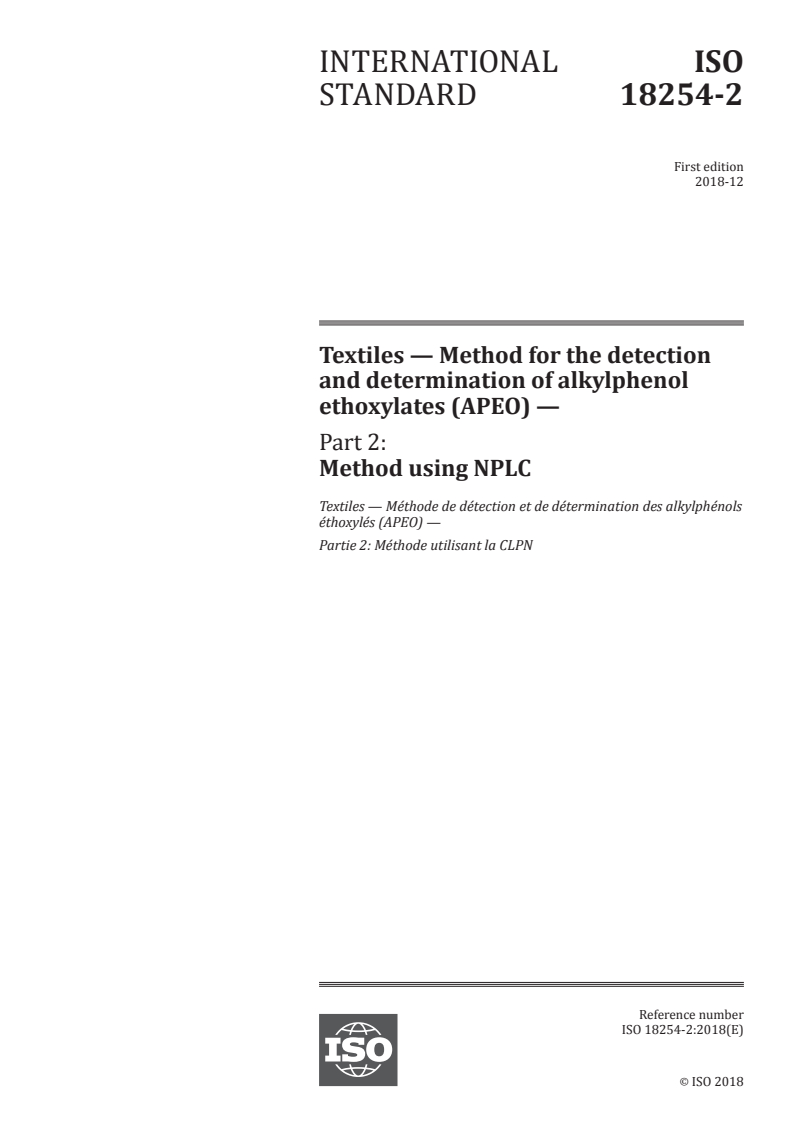
INTERNATIONAL ISO
STANDARD 18254-2
First edition
2018-12
Textiles — Method for the detection
and determination of alkylphenol
ethoxylates (APEO) —
Part 2:
Method using NPLC
Textiles — Méthode de détection et de détermination des alkylphénols
éthoxylés (APEO) —
Partie 2: Méthode utilisant la CLPN
Reference number
©
ISO 2018
© ISO 2018
All rights reserved. Unless otherwise specified, or required in the context of its implementation, no part of this publication may
be reproduced or utilized otherwise in any form or by any means, electronic or mechanical, including photocopying, or posting
on the internet or an intranet, without prior written permission. Permission can be requested from either ISO at the address
below or ISO’s member body in the country of the requester.
ISO copyright office
CP 401 • Ch. de Blandonnet 8
CH-1214 Vernier, Geneva
Phone: +41 22 749 01 11
Fax: +41 22 749 09 47
Email: copyright@iso.org
Website: www.iso.org
Published in Switzerland
ii © ISO 2018 – All rights reserved
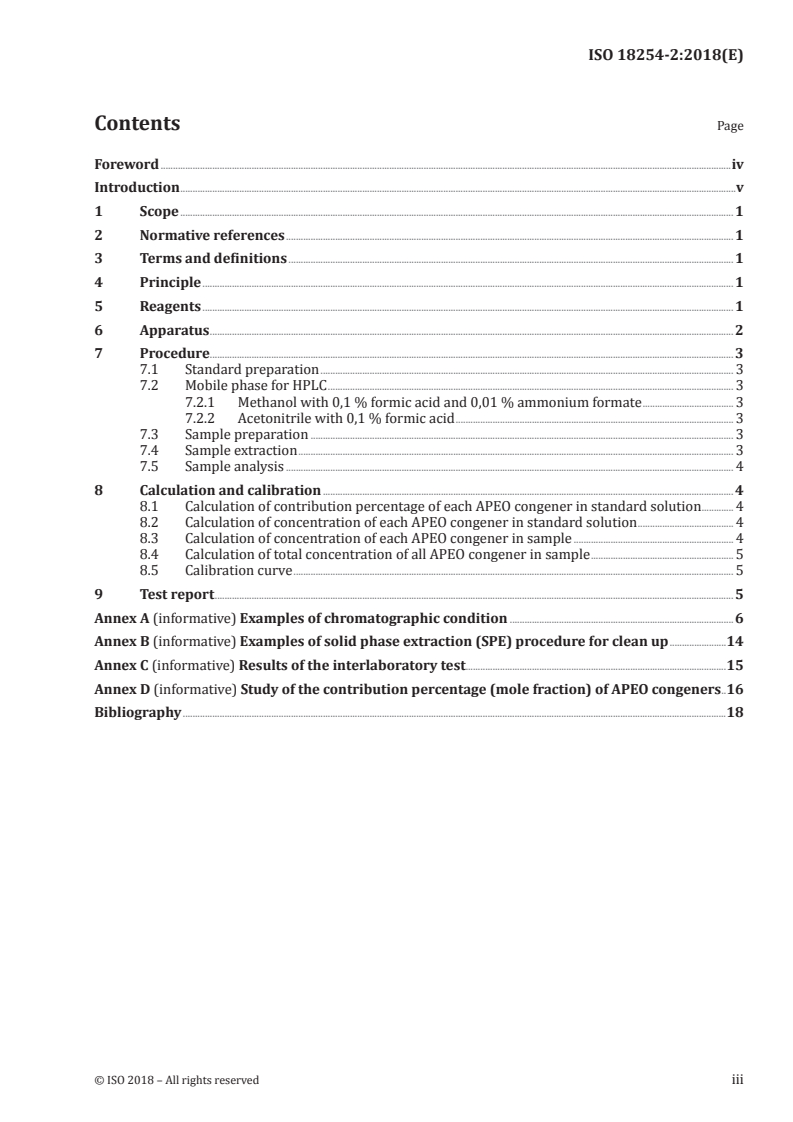
Contents Page
Foreword .iv
Introduction .v
1 Scope . 1
2 Normative references . 1
3 Terms and definitions . 1
4 Principle . 1
5 Reagents . 1
6 Apparatus . 2
7 Procedure. 3
7.1 Standard preparation . 3
7.2 Mobile phase for HPLC . 3
7.2.1 Methanol with 0,1 % formic acid and 0,01 % ammonium formate . 3
7.2.2 Acetonitrile with 0,1 % formic acid . 3
7.3 Sample preparation . 3
7.4 Sample extraction . 3
7.5 Sample analysis . 4
8 Calculation and calibration . 4
8.1 Calculation of contribution percentage of each APEO congener in standard solution . 4
8.2 Calculation of concentration of each APEO congener in standard solution . 4
8.3 Calculation of concentration of each APEO congener in sample . 4
8.4 Calculation of total concentration of all APEO congener in sample . 5
8.5 Calibration curve . 5
9 Test report . 5
Annex A (informative) Examples of chromatographic condition . 6
Annex B (informative) Examples of solid phase extraction (SPE) procedure for clean up .14
Annex C (informative) Results of the interlaboratory test.15
Annex D (informative) Study of the contribution percentage (mole fraction) of APEO congeners .16
Bibliography .18
Foreword
ISO (the International Organization for Standardization) is a worldwide federation of national standards
bodies (ISO member bodies). The work of preparing International Standards is normally carried out
through ISO technical committees. Each member body interested in a subject for which a technical
committee has been established has the right to be represented on that committee. International
organizations, governmental and non-governmental, in liaison with ISO, also take part in the work.
ISO collaborates closely with the International Electrotechnical Commission (IEC) on all matters of
electrotechnical standardization.
The procedures used to develop this document and those intended for its further maintenance are
described in the ISO/IEC Directives, Part 1. In particular, the different approval criteria needed for the
different types of ISO documents should be noted. This document was drafted in accordance with the
editorial rules of the ISO/IEC Directives, Part 2 (see www .iso .org/directives).
Attention is drawn to the possibility that some of the elements of this document may be the subject of
patent rights. ISO shall not be held responsible for identifying any or all such patent rights. Details of
any patent rights identified during the development of the document will be in the Introduction and/or
on the ISO list of patent declarations received (see www .iso .org/patents).
Any trade name used in this document is information given for the convenience of users and does not
constitute an endorsement.
For an explanation of the voluntary nature of standards, the meaning of ISO specific terms and
expressions related to conformity assessment, as well as information about ISO's adherence to the
World Trade Organization (WTO) principles in the Technical Barriers to Trade (TBT) see www .iso
.org/iso/foreword .html.
This document was prepared by Technical Committee ISO/TC 38, Textiles.
A list of all parts in the ISO 18254 series can be found on the ISO website.
Any feedback or questions on this document should be directed to the user’s national standards body. A
complete listing of these bodies can be found at www .iso .org/members .html.
iv © ISO 2018 – All rights reserved
Introduction
This document specifies the normal phase liquid chromatography (NPLC) separation method for the
quantitative and qualitative analysis of extractable alkylphenol ethoxylates (APEO) in textile and
textile products. NPLC separation method enables alkylphenol ethoxylates to be analysed by high
performance liquid chromatograph (HPLC) with Mass Spectrometer (MS), fluorescence detector (FD),
charged aerosol detector (CAD) and evaporative light scattering detector (ELSD).
A study of the contribution percentage (mole fraction) of APEO congeners is presented in Annex D.
INTERNATIONAL STANDARD ISO 18254-2:2018(E)
Textiles — Method for the detection and determination of
alkylphenol ethoxylates (APEO) —
Part 2:
Method using NPLC
WARNING — This document calls for the use of substances/procedures that may be injurious to
the health/environment if appropriate conditions are not observed. It refers only to technical
suitability and does not absolve the user from legal obligations relating to health and safety/
environment at any stage.
1 Scope
This document specifies the normal phase liquid chromatography (NPLC) separation method for the
qualitative and quantitative analysis of extractable alkylphenol ethoxylates (APEO) in textiles and
textile products.
This method provides several instrument options for the determination of alkylphenol ethoxylates
(APEO) such as normal phase liquid chromatograph with mass spectrometer (NPLC/MS), normal phase
liquid chromatograph with fluorescence detector (NPLC/FLD), normal phase liquid chromatograph
with charged aerosol detector (NPLC/CAD) and normal phase liquid chromatograph with evaporative
light scattering detector (NPLC/ELSD).
2 Normative references
There are no normative references in this document.
3 Terms and definitions
No terms and definitions are listed in this document.
ISO and IEC maintain terminological databases for use in standardization at the following addresses:
— ISO Online browsing platform: available at https: //www .iso .org/obp
— IEC Electropedia: available at http: //www .electropedia .org/
4 Principle
The test specimen is cut into small pieces, transferred to a sample vial and treated with methanol
in ultrasonic water bath. The extract is filtered and collected. Subsequently, the collected extract is
analysed by NPLC/MS, NPLC/FLD, NPLC/CAD or NPLC/ELSD.
5 Reagents
Unless otherwise specified, analytical grade chemicals shall be used.
1)
5.1 Octylphenol ethoxylates (Triton® X-100), (OPEO) CAS No.9002-93-1, Sigma Aldrich® Part
No.T9284 (see NOTE in 5.2).
2)
5.2 Nonylphenol ethoxylates (IGEPAL® CO-630), (NPEO) CAS No.68412-54-4, Sigma Aldrich® Part
No. 542334.
NOTE The mentioned brand names in 5.1 and 5.2 are given to improve the comparability of the test results
amongst laboratories. Using another batch or another supplier could lead to different results.
5.3 Methanol (HPLC grade).
5.4 Acetonitrile (HPLC grade).
5.5 Acetone (HPLC grade).
5.6 Ammonium formate (HPLC grade).
5.7 Formic acid (HPLC grade).
6 Apparatus
6.1 General
Clean all glassware by rinsing with acetone (5.5) prior to use. Avoid detergents when washing labware.
6.2 Apparatus and auxiliaries for preparing the sample
6.2.1 Standard laboratory equipment.
6.2.2 Analytical balance with resolution of 0,01 g (for test specimen preparation).
6.2.3 Analytical balance with resolution of 0,001 g (for standard preparation).
6.2.4 40 ml Glass vial with screw cap (for sample pre-treatment).
6.2.5 Ultrasonic water bath (to be set up at (70 ± 5) °C).
6.2.6 Disposable syringe and membrane filter (with 0,45 μm pore size or less).
6.2.7 Glass vial (with septum cap for HPLC).
6.2.8 Solid phase extraction (SPE) cartridge for clean up (optional).
The cartridge is packed with a minimum of 200 mg of sorbent (reverse phase or silica).
6.2.9 Solid phase extraction (SPE) vacuum manifold (optional).
1) Triton® is an example of a suitable product available commercially. This information is given for the convenience
of users of this document and does not constitute an endorsement by ISO of this product.
2) IGEPAL® is an example of a suitable product available commercially. This information is given for the
convenience of users of this document and does not constitute an endorsement by ISO of this product.
2 © ISO 2018 – All rights reserved
6.3 Chromatographic equipment
6.3.1 High performance liquid chromatograph with mass spectrometer (LC/MS), or
6.3.2 High performance liquid chromatograph with fluorescence detector (LC/FLD), or
6.3.3 High performance liquid chromatograph with charged aerosol detector (LC/CAD), or
6.3.4 High performance liquid chromatograph with evaporative light scattering detector
(LC/ELSD).
6.3.4.1 C18 short column for separation of OPEO and NPEO.
Dimension 4,6 mm × 50 mm, Particle size 1,7 μm, equivalent is available.
6.3.4.2 Normal phase column for the separation of each APEO congener by the number of
ethoxylate group.
Hydrogen bond adsorption column, dimension 4,6 mm × 150 mm, particle size 3 μm, equivalent is
available.
7 Procedure
7.1 Standard preparation
The OPEO and NPEO are weighed accurately with analytical balance (6.2.3) and dissolved with methanol
(5.3) containing 1 000 mg/l for stock solution. The reservation condition of solution is suggested to be
in dark and less than 4 °C.
7.2 Mobile phase for HPLC
7.2.1 Methanol with 0,1 % formic acid and 0,01 % ammonium formate
Dissolve 0,1 g of ammonium formate (5.6) in ml of methanol (5.3), subsequently add 1 ml of formic
acid (5.7).
7.2.2 Acetonitrile with 0,1 % formic acid
Add 1 ml of formic acid (5.7) in 1 000 ml of acetonitrile (5.4).
7.3 Sample preparation
The test specimen is cut into pieces with 5 mm × 5 mm and pieces are mixed homogeneously. The
specimen is weighed 1 g to the nearest 0,01 g with analytical balance (6.2.2) and put into the 40 ml
glass vial (6.2.4) for extraction.
7.4 Sample extraction
20 ml of methanol (5.3) are added to sample vial (see 7.3) and then ultrasonic extraction is performed
in ultrasonic water bath (6.2.5) at 70 °C for 60 min. Afterwards the extract is cooled down to room
temperature, 1 ml approximately 2 ml of extract is filtered into HPLC sample vial (6.2.7) using
disposable syringe equipped with membra
...
INTERNATIONAL ISO
STANDARD 18254-2
First edition
2018-12
Textiles — Method for the detection
and determination of alkylphenol
ethoxylates (APEO) —
Part 2:
Method using NPLC
Textiles — Méthode de détection et de détermination des alkylphénols
éthoxylés (APEO) —
Partie 2: Méthode utilisant la CLPN
Reference number
©
ISO 2018
© ISO 2018
All rights reserved. Unless otherwise specified, or required in the context of its implementation, no part of this publication may
be reproduced or utilized otherwise in any form or by any means, electronic or mechanical, including photocopying, or posting
on the internet or an intranet, without prior written permission. Permission can be requested from either ISO at the address
below or ISO’s member body in the country of the requester.
ISO copyright office
CP 401 • Ch. de Blandonnet 8
CH-1214 Vernier, Geneva
Phone: +41 22 749 01 11
Fax: +41 22 749 09 47
Email: copyright@iso.org
Website: www.iso.org
Published in Switzerland
ii © ISO 2018 – All rights reserved
Contents Page
Foreword .iv
Introduction .v
1 Scope . 1
2 Normative references . 1
3 Terms and definitions . 1
4 Principle . 1
5 Reagents . 1
6 Apparatus . 2
7 Procedure. 3
7.1 Standard preparation . 3
7.2 Mobile phase for HPLC . 3
7.2.1 Methanol with 0,1 % formic acid and 0,01 % ammonium formate . 3
7.2.2 Acetonitrile with 0,1 % formic acid . 3
7.3 Sample preparation . 3
7.4 Sample extraction . 3
7.5 Sample analysis . 4
8 Calculation and calibration . 4
8.1 Calculation of contribution percentage of each APEO congener in standard solution . 4
8.2 Calculation of concentration of each APEO congener in standard solution . 4
8.3 Calculation of concentration of each APEO congener in sample . 4
8.4 Calculation of total concentration of all APEO congener in sample . 5
8.5 Calibration curve . 5
9 Test report . 5
Annex A (informative) Examples of chromatographic condition . 6
Annex B (informative) Examples of solid phase extraction (SPE) procedure for clean up .14
Annex C (informative) Results of the interlaboratory test.15
Annex D (informative) Study of the contribution percentage (mole fraction) of APEO congeners .16
Bibliography .18
Foreword
ISO (the International Organization for Standardization) is a worldwide federation of national standards
bodies (ISO member bodies). The work of preparing International Standards is normally carried out
through ISO technical committees. Each member body interested in a subject for which a technical
committee has been established has the right to be represented on that committee. International
organizations, governmental and non-governmental, in liaison with ISO, also take part in the work.
ISO collaborates closely with the International Electrotechnical Commission (IEC) on all matters of
electrotechnical standardization.
The procedures used to develop this document and those intended for its further maintenance are
described in the ISO/IEC Directives, Part 1. In particular, the different approval criteria needed for the
different types of ISO documents should be noted. This document was drafted in accordance with the
editorial rules of the ISO/IEC Directives, Part 2 (see www .iso .org/directives).
Attention is drawn to the possibility that some of the elements of this document may be the subject of
patent rights. ISO shall not be held responsible for identifying any or all such patent rights. Details of
any patent rights identified during the development of the document will be in the Introduction and/or
on the ISO list of patent declarations received (see www .iso .org/patents).
Any trade name used in this document is information given for the convenience of users and does not
constitute an endorsement.
For an explanation of the voluntary nature of standards, the meaning of ISO specific terms and
expressions related to conformity assessment, as well as information about ISO's adherence to the
World Trade Organization (WTO) principles in the Technical Barriers to Trade (TBT) see www .iso
.org/iso/foreword .html.
This document was prepared by Technical Committee ISO/TC 38, Textiles.
A list of all parts in the ISO 18254 series can be found on the ISO website.
Any feedback or questions on this document should be directed to the user’s national standards body. A
complete listing of these bodies can be found at www .iso .org/members .html.
iv © ISO 2018 – All rights reserved
Introduction
This document specifies the normal phase liquid chromatography (NPLC) separation method for the
quantitative and qualitative analysis of extractable alkylphenol ethoxylates (APEO) in textile and
textile products. NPLC separation method enables alkylphenol ethoxylates to be analysed by high
performance liquid chromatograph (HPLC) with Mass Spectrometer (MS), fluorescence detector (FD),
charged aerosol detector (CAD) and evaporative light scattering detector (ELSD).
A study of the contribution percentage (mole fraction) of APEO congeners is presented in Annex D.
INTERNATIONAL STANDARD ISO 18254-2:2018(E)
Textiles — Method for the detection and determination of
alkylphenol ethoxylates (APEO) —
Part 2:
Method using NPLC
WARNING — This document calls for the use of substances/procedures that may be injurious to
the health/environment if appropriate conditions are not observed. It refers only to technical
suitability and does not absolve the user from legal obligations relating to health and safety/
environment at any stage.
1 Scope
This document specifies the normal phase liquid chromatography (NPLC) separation method for the
qualitative and quantitative analysis of extractable alkylphenol ethoxylates (APEO) in textiles and
textile products.
This method provides several instrument options for the determination of alkylphenol ethoxylates
(APEO) such as normal phase liquid chromatograph with mass spectrometer (NPLC/MS), normal phase
liquid chromatograph with fluorescence detector (NPLC/FLD), normal phase liquid chromatograph
with charged aerosol detector (NPLC/CAD) and normal phase liquid chromatograph with evaporative
light scattering detector (NPLC/ELSD).
2 Normative references
There are no normative references in this document.
3 Terms and definitions
No terms and definitions are listed in this document.
ISO and IEC maintain terminological databases for use in standardization at the following addresses:
— ISO Online browsing platform: available at https: //www .iso .org/obp
— IEC Electropedia: available at http: //www .electropedia .org/
4 Principle
The test specimen is cut into small pieces, transferred to a sample vial and treated with methanol
in ultrasonic water bath. The extract is filtered and collected. Subsequently, the collected extract is
analysed by NPLC/MS, NPLC/FLD, NPLC/CAD or NPLC/ELSD.
5 Reagents
Unless otherwise specified, analytical grade chemicals shall be used.
1)
5.1 Octylphenol ethoxylates (Triton® X-100), (OPEO) CAS No.9002-93-1, Sigma Aldrich® Part
No.T9284 (see NOTE in 5.2).
2)
5.2 Nonylphenol ethoxylates (IGEPAL® CO-630), (NPEO) CAS No.68412-54-4, Sigma Aldrich® Part
No. 542334.
NOTE The mentioned brand names in 5.1 and 5.2 are given to improve the comparability of the test results
amongst laboratories. Using another batch or another supplier could lead to different results.
5.3 Methanol (HPLC grade).
5.4 Acetonitrile (HPLC grade).
5.5 Acetone (HPLC grade).
5.6 Ammonium formate (HPLC grade).
5.7 Formic acid (HPLC grade).
6 Apparatus
6.1 General
Clean all glassware by rinsing with acetone (5.5) prior to use. Avoid detergents when washing labware.
6.2 Apparatus and auxiliaries for preparing the sample
6.2.1 Standard laboratory equipment.
6.2.2 Analytical balance with resolution of 0,01 g (for test specimen preparation).
6.2.3 Analytical balance with resolution of 0,001 g (for standard preparation).
6.2.4 40 ml Glass vial with screw cap (for sample pre-treatment).
6.2.5 Ultrasonic water bath (to be set up at (70 ± 5) °C).
6.2.6 Disposable syringe and membrane filter (with 0,45 μm pore size or less).
6.2.7 Glass vial (with septum cap for HPLC).
6.2.8 Solid phase extraction (SPE) cartridge for clean up (optional).
The cartridge is packed with a minimum of 200 mg of sorbent (reverse phase or silica).
6.2.9 Solid phase extraction (SPE) vacuum manifold (optional).
1) Triton® is an example of a suitable product available commercially. This information is given for the convenience
of users of this document and does not constitute an endorsement by ISO of this product.
2) IGEPAL® is an example of a suitable product available commercially. This information is given for the
convenience of users of this document and does not constitute an endorsement by ISO of this product.
2 © ISO 2018 – All rights reserved
6.3 Chromatographic equipment
6.3.1 High performance liquid chromatograph with mass spectrometer (LC/MS), or
6.3.2 High performance liquid chromatograph with fluorescence detector (LC/FLD), or
6.3.3 High performance liquid chromatograph with charged aerosol detector (LC/CAD), or
6.3.4 High performance liquid chromatograph with evaporative light scattering detector
(LC/ELSD).
6.3.4.1 C18 short column for separation of OPEO and NPEO.
Dimension 4,6 mm × 50 mm, Particle size 1,7 μm, equivalent is available.
6.3.4.2 Normal phase column for the separation of each APEO congener by the number of
ethoxylate group.
Hydrogen bond adsorption column, dimension 4,6 mm × 150 mm, particle size 3 μm, equivalent is
available.
7 Procedure
7.1 Standard preparation
The OPEO and NPEO are weighed accurately with analytical balance (6.2.3) and dissolved with methanol
(5.3) containing 1 000 mg/l for stock solution. The reservation condition of solution is suggested to be
in dark and less than 4 °C.
7.2 Mobile phase for HPLC
7.2.1 Methanol with 0,1 % formic acid and 0,01 % ammonium formate
Dissolve 0,1 g of ammonium formate (5.6) in ml of methanol (5.3), subsequently add 1 ml of formic
acid (5.7).
7.2.2 Acetonitrile with 0,1 % formic acid
Add 1 ml of formic acid (5.7) in 1 000 ml of acetonitrile (5.4).
7.3 Sample preparation
The test specimen is cut into pieces with 5 mm × 5 mm and pieces are mixed homogeneously. The
specimen is weighed 1 g to the nearest 0,01 g with analytical balance (6.2.2) and put into the 40 ml
glass vial (6.2.4) for extraction.
7.4 Sample extraction
20 ml of methanol (5.3) are added to sample vial (see 7.3) and then ultrasonic extraction is performed
in ultrasonic water bath (6.2.5) at 70 °C for 60 min. Afterwards the extract is cooled down to room
temperature, 1 ml approximately 2 ml of extract is filtered into HPLC sample vial (6.2.7) using
disposable syringe equipped with membra
...
NORME ISO
INTERNATIONALE 18254-2
Première édition
2018-12
Textiles — Méthode de détection et
de détermination des alkylphénols
éthoxylés (APEO) —
Partie 2:
Méthode utilisant la CLPN
Textiles — Method for the detection and determination of alkylphenol
ethoxylates (APEO) —
Part 2: Method using NPLC
Numéro de référence
©
ISO 2018
DOCUMENT PROTÉGÉ PAR COPYRIGHT
© ISO 2018
Tous droits réservés. Sauf prescription différente ou nécessité dans le contexte de sa mise en œuvre, aucune partie de cette
publication ne peut être reproduite ni utilisée sous quelque forme que ce soit et par aucun procédé, électronique ou mécanique,
y compris la photocopie, ou la diffusion sur l’internet ou sur un intranet, sans autorisation écrite préalable. Une autorisation peut
être demandée à l’ISO à l’adresse ci-après ou au comité membre de l’ISO dans le pays du demandeur.
ISO copyright office
Case postale 401 • Ch. de Blandonnet 8
CH-1214 Vernier, Genève
Tél.: +41 22 749 01 11
Fax: +41 22 749 09 47
E-mail: copyright@iso.org
Web: www.iso.org
Publié en Suisse
ii © ISO 2018 – Tous droits réservés
Sommaire Page
Avant-propos .iv
Introduction .v
1 Domaine d’application . 1
2 Références normatives . 1
3 Termes et définitions . 1
4 Principe . 1
5 Réactifs . 1
6 Appareillage . 2
7 Mode opératoire. 3
7.1 Préparation des étalons . 3
7.2 Phase mobile pour CLHP . 3
7.2.1 Méthanol avec acide formique à 0,1 % et formiate d’ammonium à 0,01 % . 3
7.2.2 Acétonitrile avec acide formique à 0,1 % . 3
7.3 Préparation de l’échantillon . 3
7.4 Extraction de l’échantillon . 3
7.5 Analyse de l’échantillon . 4
8 Calculs et étalonnage . 4
8.1 Calcul du pourcentage de contribution de chaque congénère APEO dans la
solution étalon . 4
8.2 Calcul de la concentration de chaque congénère APEO dans la solution étalon . 4
8.3 Calcul de la concentration de chaque congénère APEO dans l’échantillon . 5
8.4 Calcul de la concentration totale de tous les congénères APEO dans l’échantillon . 5
8.5 Courbe d’étalonnage . 5
9 Rapport d’essai . 5
Annexe A (informative) Exemples de conditions chromatographiques . 7
Annexe B (informative) Exemples de modes opératoires d’extraction en phase solide (SPE)
pour la purification .15
Annexe C (informative) Résultats de l’essai interlaboratoires .16
Annexe D (informative) Étude du pourcentage de contribution (fraction molaire) des
congénères APEO .17
Bibliographie .19
Avant-propos
L’ISO (Organisation internationale de normalisation) est une fédération mondiale d’organismes
nationaux de normalisation (comités membres de l’ISO). L’élaboration des Normes internationales est
en général confiée aux comités techniques de l’ISO. Chaque comité membre intéressé par une étude
a le droit de faire partie du comité technique créé à cet effet. Les organisations internationales,
gouvernementales et non gouvernementales, en liaison avec l’ISO participent également aux travaux.
L’ISO collabore étroitement avec la Commission électrotechnique internationale (IEC) en ce qui
concerne la normalisation électrotechnique.
Les procédures utilisées pour élaborer le présent document et celles destinées à sa mise à jour sont
décrites dans les Directives ISO/IEC, Partie 1. Il convient, en particulier de prendre note des différents
critères d’approbation requis pour les différents types de documents ISO. Le présent document a été
rédigé conformément aux règles de rédaction données dans les Directives ISO/IEC, Partie 2 (voir www
.iso .org/directives).
L’attention est attirée sur le fait que certains des éléments du présent document peuvent faire l’objet de
droits de propriété intellectuelle ou de droits analogues. L’ISO ne saurait être tenue pour responsable
de ne pas avoir identifié de tels droits de propriété et averti de leur existence. Les détails concernant
les références aux droits de propriété intellectuelle ou autres droits analogues identifiés lors de
l’élaboration du document sont indiqués dans l’Introduction et/ou dans la liste des déclarations de
brevets reçues par l’ISO (voir www .iso .org/brevets).
Les appellations commerciales éventuellement mentionnées dans le présent document sont données
pour information, par souci de commodité, à l’intention des utilisateurs et ne sauraient constituer un
engagement.
Pour une explication de la nature volontaire des normes, la signification des termes et expressions
spécifiques de l’ISO liés à l’évaluation de la conformité, ou pour toute information au sujet de l’adhésion
de l’ISO aux principes de l’Organisation mondiale du commerce (OMC) concernant les obstacles
techniques au commerce (OTC), voir le lien suivant: www .iso .org/iso/fr/avant -propos.
Le présent document a été élaboré par le comité technique ISO/TC 38, Textiles.
Une liste de toutes les parties de la série ISO 18254 se trouve sur le site web de l’ISO.
Il convient que l’utilisateur adresse tout retour d’information ou toute question concernant le présent
document à l’organisme national de normalisation de son pays. Une liste exhaustive desdits organismes
se trouve à l’adresse www .iso .org/fr/members .html.
iv © ISO 2018 – Tous droits réservés
Introduction
Le présent document spécifie la méthode de séparation par chromatographie liquide en phase normale
(CLPN) pour l’analyse quantitative et qualitative des alkylphénols éthoxylés (APEO) extractibles
dans les produits textiles et les produits connexes. La méthode de séparation CLPN permet l’analyse
des alkylphénols éthoxylés par chromatographie liquide à haute performance (CLHP) couplée à un
spectromètre de masse (SM), à un détecteur de fluorescence (FLD), à un détecteur d’aérosols chargés
(CAD) et à un détecteur évaporatif à diffusion de lumière (DEDL).
Une étude du pourcentage de contribution (fraction molaire) des congénères APEO est présentée à
l’Annexe D.
NORME INTERNATIONALE ISO 18254-2:2018(F)
Textiles — Méthode de détection et de détermination des
alkylphénols éthoxylés (APEO) —
Partie 2:
Méthode utilisant la CLPN
AVERTISSEMENT — Le présent document nécessite l’utilisation de substances/modes
opératoires qui peuvent être préjudiciables à la santé et/ou à l’environnement en cas de non-
respect des conditions appropriées. Il fait uniquement référence à l’aptitude technique et ne
dispense aucunement l’utilisateur de satisfaire à tout moment aux obligations légales en matière
de santé, de sécurité et d’environnement.
1 Domaine d’application
Le présent document spécifie la méthode de séparation par chromatographie liquide en phase normale
(CLPN) pour l’analyse qualitative et quantitative des alkylphénols éthoxylés (APEO) extractibles dans
les produits textiles et les produits connexes.
Cette méthode propose plusieurs options d’instruments pour la détermination des alkylphénols
éthoxylés (APEO), notamment la chromatographie liquide en phase normale couplée à un spectromètre
de masse (CLPN-MS), la chromatographie liquide en phase normale couplée à un détecteur de
fluorescence (CLPN-FLD), la chromatographie liquide en phase normale couplée à un détecteur
d’aérosols chargés (CLPN-CAD) et la chromatographie liquide en phase normale couplée à un détecteur
évaporatif à diffusion de lumière (CLPN-DEDL).
2 Références normatives
Le présent document ne contient aucune référence normative.
3 Termes et définitions
Aucun terme n’est défini dans le présent document.
L’ISO et l’IEC tiennent à jour des bases de données terminologiques destinées à être utilisées en
normalisation, consultables aux adresses suivantes:
— ISO Online browsing platform: disponible à l’adresse https: //www .iso .org/obp;
— IEC Electropedia: disponible à l’adresse http: //www .electropedia .org/.
4 Principe
L’éprouvette est coupée en petits morceaux, placée dans un flacon pour échantillon puis traitée avec du
méthanol dans un bain-marie à ultrasons. L’extrait est filtré, collecté, puis analysé par CLPN-SM, CLPN-
FLD, CLPN-CAD ou CLPN-DEDL.
5 Réactifs
Sauf indication contraire, des produits chimiques de qualité analytique doivent être utilisés.
1)
5.1 Octylphénols éthoxylés (Triton® X-100), (OPEO) n° CAS 9002-93-1, référence Sigma Aldrich®
T9284 (voir NOTE en 5.2).
2)
5.2 Nonylphénols éthoxylés (IGEPAL® CO-630), (NPEO) n° CAS 68412-54-4, référence Sigma
Aldrich® 542334.
NOTE Les noms de marque mentionnés en 5.1 et 5.2 sont donnés afin d’optimiser la comparabilité des
résultats d’essai entre laboratoires. L’utilisation d’un autre lot ou d’un autre fournisseur peut mener à des
résultats différents.
5.3 Méthanol (de qualité CLHP).
5.4 Acétonitrile (de qualité CLHP).
5.5 Acétone (de qualité CLHP).
5.6 Formiate d’ammonium (de qualité CLHP).
5.7 Acide formique (de qualité CLHP).
6 Appareillage
6.1 Généralités
Nettoyer l’ensemble de la verrerie en la rinçant à l’acétone (5.5) avant toute utilisation. Éviter l’emploi
de détergents lors du lavage du matériel de laboratoire.
6.2 Appareillage et équipement auxiliaire pour la préparation de l’échantillon
6.2.1 Matériel de laboratoire courant.
6.2.2 Balance analytique d’une résolution de 0,01 g (pour la préparation des éprouvettes).
6.2.3 Balance analytique d’une résolution de 0,001 g (pour la préparation des étalons).
6.2.4 Flacon en verre avec bouchon à vis d’une capacité de 40 ml (pour le prétraitement des
échantillons).
6.2.5 Bain-marie à ultrasons (maintenu à (70 ± 5) °C).
6.2.6 Seringue jetable et filtre à membrane (avec un diamètre de pore de 0,45 μm ou moins).
6.2.7 Flacon en verre (avec bouchon à septum pour CLHP).
6.2.8 Cartouche d’extraction en phase solide (SPE) pour la purification (facultatif).
La cartouche contient au minimum 200 mg d’adsorbant (phase inverse ou silice).
1) Triton® est un exemple de produit convenable disponible dans le commerce. Cette information est donnée par
souci de commodité à l’intention des utilisateurs du présent document et ne saurait constituer un engagement de
l’ISO à l’égard de ce produit.
2) IGEPAL® est un exemple de produit convenable disponible dans le commerce. Cette information est donnée par
souci de commodité à l’intention des utilisateurs du présent document et ne saurait constituer un engagement de
l’ISO à l’égard de ce produit.
2 © ISO 2018 – Tous droits réservés
6.2.9 Cuve d’extraction en phase solide (SPE) (facultatif).
6.3 Équipement de chromatographie
6.3.1 Chromatographe liquide à haute performance couplé à un spectromètre de masse (CL-SM),
ou
6.3.2 Chromatographe liquide à haute performance couplé à un détecteur de fluorescence (CL-
FLD), ou
6.3.3 Chromatographe liquide à haute performance couplé à un détecteur d’aérosols chargés
(CL-CAD), ou
6.3.4 Chromatographe liquide à haute performance couplé à un détecteur évaporatif à diffusion
de lumière (CL-DEDL).
6.3.4.1 Colonne courte C18 pour la séparation des OPEO et des NPEO.
Un équivalent, de dimensions 4,6 mm × 50 mm et de granulométrie 1,7 μm, est disponible.
6.3.4.2 Colonne en phase normale pour la séparation de chaque congénère APEO en fonction du
groupe d’éthoxylés.
Un équivalent, à savoir une colonne d’adsorption par liaisons hydrogènes, de dimensions
4,6 mm × 150 mm et de granulométrie 3 μm, est disponible.
7 Mode opératoire
7.1 Préparation des étalons
Peser les OPEO et NPEO avec précision sur la balance analytique (6.2.3) et les dissoudre dans du
méthanol (5.3) pour obtenir une solution mère à 1 000 mg/l. Il est conseillé de conserver la solution à
l’abri de la lumière et à une température inférieure à 4 °C.
7.2 Phase mobile pour CLHP
7.2.1 Méthanol avec acide formique à 0,1 % et formiate d’ammonium à 0,01 %
Dissoudre 0,1 g de formiate d’ammonium (5.6) dans xxx ml de méthanol (5.3), puis ajouter 1 ml d’acide
formique (5.7).
7.2.2 Acétonitrile avec acide formique à 0,1 %
Ajouter 1 ml d’acide formique (5.7) dans 1 000 ml d’acétonitrile (5.4).
7.3 Préparation de l’échantillon
Couper l’éprouvette en morceaux de 5 mm × 5 mm et les mélanger de manière homogène. À l’aide de la
balance analytique (6.2.2), peser pour obtenir un échantillon de 1 g, à 0,01 g près, et le placer dans le
flacon en verre de 40 ml (6.2.4) pour extraction.
7.4 Extraction de l’échantillon
Ajouter 20 ml de méthanol (5.3) dans le flacon pour échantillon (voir 7.3) puis procéder à l’extraction
par ultrasons en plaçant le flacon dans un bain
...
NORME ISO
INTERNATIONALE 18254-2
Première édition
2018-12
Textiles — Méthode de détection et
de détermination des alkylphénols
éthoxylés (APEO) —
Partie 2:
Méthode utilisant la CLPN
Textiles — Method for the detection and determination of alkylphenol
ethoxylates (APEO) —
Part 2: Method using NPLC
Numéro de référence
©
ISO 2018
DOCUMENT PROTÉGÉ PAR COPYRIGHT
© ISO 2018
Tous droits réservés. Sauf prescription différente ou nécessité dans le contexte de sa mise en œuvre, aucune partie de cette
publication ne peut être reproduite ni utilisée sous quelque forme que ce soit et par aucun procédé, électronique ou mécanique,
y compris la photocopie, ou la diffusion sur l’internet ou sur un intranet, sans autorisation écrite préalable. Une autorisation peut
être demandée à l’ISO à l’adresse ci-après ou au comité membre de l’ISO dans le pays du demandeur.
ISO copyright office
Case postale 401 • Ch. de Blandonnet 8
CH-1214 Vernier, Genève
Tél.: +41 22 749 01 11
Fax: +41 22 749 09 47
E-mail: copyright@iso.org
Web: www.iso.org
Publié en Suisse
ii © ISO 2018 – Tous droits réservés
Sommaire Page
Avant-propos .iv
Introduction .v
1 Domaine d’application . 1
2 Références normatives . 1
3 Termes et définitions . 1
4 Principe . 1
5 Réactifs . 1
6 Appareillage . 2
7 Mode opératoire. 3
7.1 Préparation des étalons . 3
7.2 Phase mobile pour CLHP . 3
7.2.1 Méthanol avec acide formique à 0,1 % et formiate d’ammonium à 0,01 % . 3
7.2.2 Acétonitrile avec acide formique à 0,1 % . 3
7.3 Préparation de l’échantillon . 3
7.4 Extraction de l’échantillon . 3
7.5 Analyse de l’échantillon . 4
8 Calculs et étalonnage . 4
8.1 Calcul du pourcentage de contribution de chaque congénère APEO dans la
solution étalon . 4
8.2 Calcul de la concentration de chaque congénère APEO dans la solution étalon . 4
8.3 Calcul de la concentration de chaque congénère APEO dans l’échantillon . 5
8.4 Calcul de la concentration totale de tous les congénères APEO dans l’échantillon . 5
8.5 Courbe d’étalonnage . 5
9 Rapport d’essai . 5
Annexe A (informative) Exemples de conditions chromatographiques . 7
Annexe B (informative) Exemples de modes opératoires d’extraction en phase solide (SPE)
pour la purification .15
Annexe C (informative) Résultats de l’essai interlaboratoires .16
Annexe D (informative) Étude du pourcentage de contribution (fraction molaire) des
congénères APEO .17
Bibliographie .19
Avant-propos
L’ISO (Organisation internationale de normalisation) est une fédération mondiale d’organismes
nationaux de normalisation (comités membres de l’ISO). L’élaboration des Normes internationales est
en général confiée aux comités techniques de l’ISO. Chaque comité membre intéressé par une étude
a le droit de faire partie du comité technique créé à cet effet. Les organisations internationales,
gouvernementales et non gouvernementales, en liaison avec l’ISO participent également aux travaux.
L’ISO collabore étroitement avec la Commission électrotechnique internationale (IEC) en ce qui
concerne la normalisation électrotechnique.
Les procédures utilisées pour élaborer le présent document et celles destinées à sa mise à jour sont
décrites dans les Directives ISO/IEC, Partie 1. Il convient, en particulier de prendre note des différents
critères d’approbation requis pour les différents types de documents ISO. Le présent document a été
rédigé conformément aux règles de rédaction données dans les Directives ISO/IEC, Partie 2 (voir www
.iso .org/directives).
L’attention est attirée sur le fait que certains des éléments du présent document peuvent faire l’objet de
droits de propriété intellectuelle ou de droits analogues. L’ISO ne saurait être tenue pour responsable
de ne pas avoir identifié de tels droits de propriété et averti de leur existence. Les détails concernant
les références aux droits de propriété intellectuelle ou autres droits analogues identifiés lors de
l’élaboration du document sont indiqués dans l’Introduction et/ou dans la liste des déclarations de
brevets reçues par l’ISO (voir www .iso .org/brevets).
Les appellations commerciales éventuellement mentionnées dans le présent document sont données
pour information, par souci de commodité, à l’intention des utilisateurs et ne sauraient constituer un
engagement.
Pour une explication de la nature volontaire des normes, la signification des termes et expressions
spécifiques de l’ISO liés à l’évaluation de la conformité, ou pour toute information au sujet de l’adhésion
de l’ISO aux principes de l’Organisation mondiale du commerce (OMC) concernant les obstacles
techniques au commerce (OTC), voir le lien suivant: www .iso .org/iso/fr/avant -propos.
Le présent document a été élaboré par le comité technique ISO/TC 38, Textiles.
Une liste de toutes les parties de la série ISO 18254 se trouve sur le site web de l’ISO.
Il convient que l’utilisateur adresse tout retour d’information ou toute question concernant le présent
document à l’organisme national de normalisation de son pays. Une liste exhaustive desdits organismes
se trouve à l’adresse www .iso .org/fr/members .html.
iv © ISO 2018 – Tous droits réservés
Introduction
Le présent document spécifie la méthode de séparation par chromatographie liquide en phase normale
(CLPN) pour l’analyse quantitative et qualitative des alkylphénols éthoxylés (APEO) extractibles
dans les produits textiles et les produits connexes. La méthode de séparation CLPN permet l’analyse
des alkylphénols éthoxylés par chromatographie liquide à haute performance (CLHP) couplée à un
spectromètre de masse (SM), à un détecteur de fluorescence (FLD), à un détecteur d’aérosols chargés
(CAD) et à un détecteur évaporatif à diffusion de lumière (DEDL).
Une étude du pourcentage de contribution (fraction molaire) des congénères APEO est présentée à
l’Annexe D.
NORME INTERNATIONALE ISO 18254-2:2018(F)
Textiles — Méthode de détection et de détermination des
alkylphénols éthoxylés (APEO) —
Partie 2:
Méthode utilisant la CLPN
AVERTISSEMENT — Le présent document nécessite l’utilisation de substances/modes
opératoires qui peuvent être préjudiciables à la santé et/ou à l’environnement en cas de non-
respect des conditions appropriées. Il fait uniquement référence à l’aptitude technique et ne
dispense aucunement l’utilisateur de satisfaire à tout moment aux obligations légales en matière
de santé, de sécurité et d’environnement.
1 Domaine d’application
Le présent document spécifie la méthode de séparation par chromatographie liquide en phase normale
(CLPN) pour l’analyse qualitative et quantitative des alkylphénols éthoxylés (APEO) extractibles dans
les produits textiles et les produits connexes.
Cette méthode propose plusieurs options d’instruments pour la détermination des alkylphénols
éthoxylés (APEO), notamment la chromatographie liquide en phase normale couplée à un spectromètre
de masse (CLPN-MS), la chromatographie liquide en phase normale couplée à un détecteur de
fluorescence (CLPN-FLD), la chromatographie liquide en phase normale couplée à un détecteur
d’aérosols chargés (CLPN-CAD) et la chromatographie liquide en phase normale couplée à un détecteur
évaporatif à diffusion de lumière (CLPN-DEDL).
2 Références normatives
Le présent document ne contient aucune référence normative.
3 Termes et définitions
Aucun terme n’est défini dans le présent document.
L’ISO et l’IEC tiennent à jour des bases de données terminologiques destinées à être utilisées en
normalisation, consultables aux adresses suivantes:
— ISO Online browsing platform: disponible à l’adresse https: //www .iso .org/obp;
— IEC Electropedia: disponible à l’adresse http: //www .electropedia .org/.
4 Principe
L’éprouvette est coupée en petits morceaux, placée dans un flacon pour échantillon puis traitée avec du
méthanol dans un bain-marie à ultrasons. L’extrait est filtré, collecté, puis analysé par CLPN-SM, CLPN-
FLD, CLPN-CAD ou CLPN-DEDL.
5 Réactifs
Sauf indication contraire, des produits chimiques de qualité analytique doivent être utilisés.
1)
5.1 Octylphénols éthoxylés (Triton® X-100), (OPEO) n° CAS 9002-93-1, référence Sigma Aldrich®
T9284 (voir NOTE en 5.2).
2)
5.2 Nonylphénols éthoxylés (IGEPAL® CO-630), (NPEO) n° CAS 68412-54-4, référence Sigma
Aldrich® 542334.
NOTE Les noms de marque mentionnés en 5.1 et 5.2 sont donnés afin d’optimiser la comparabilité des
résultats d’essai entre laboratoires. L’utilisation d’un autre lot ou d’un autre fournisseur peut mener à des
résultats différents.
5.3 Méthanol (de qualité CLHP).
5.4 Acétonitrile (de qualité CLHP).
5.5 Acétone (de qualité CLHP).
5.6 Formiate d’ammonium (de qualité CLHP).
5.7 Acide formique (de qualité CLHP).
6 Appareillage
6.1 Généralités
Nettoyer l’ensemble de la verrerie en la rinçant à l’acétone (5.5) avant toute utilisation. Éviter l’emploi
de détergents lors du lavage du matériel de laboratoire.
6.2 Appareillage et équipement auxiliaire pour la préparation de l’échantillon
6.2.1 Matériel de laboratoire courant.
6.2.2 Balance analytique d’une résolution de 0,01 g (pour la préparation des éprouvettes).
6.2.3 Balance analytique d’une résolution de 0,001 g (pour la préparation des étalons).
6.2.4 Flacon en verre avec bouchon à vis d’une capacité de 40 ml (pour le prétraitement des
échantillons).
6.2.5 Bain-marie à ultrasons (maintenu à (70 ± 5) °C).
6.2.6 Seringue jetable et filtre à membrane (avec un diamètre de pore de 0,45 μm ou moins).
6.2.7 Flacon en verre (avec bouchon à septum pour CLHP).
6.2.8 Cartouche d’extraction en phase solide (SPE) pour la purification (facultatif).
La cartouche contient au minimum 200 mg d’adsorbant (phase inverse ou silice).
1) Triton® est un exemple de produit convenable disponible dans le commerce. Cette information est donnée par
souci de commodité à l’intention des utilisateurs du présent document et ne saurait constituer un engagement de
l’ISO à l’égard de ce produit.
2) IGEPAL® est un exemple de produit convenable disponible dans le commerce. Cette information est donnée par
souci de commodité à l’intention des utilisateurs du présent document et ne saurait constituer un engagement de
l’ISO à l’égard de ce produit.
2 © ISO 2018 – Tous droits réservés
6.2.9 Cuve d’extraction en phase solide (SPE) (facultatif).
6.3 Équipement de chromatographie
6.3.1 Chromatographe liquide à haute performance couplé à un spectromètre de masse (CL-SM),
ou
6.3.2 Chromatographe liquide à haute performance couplé à un détecteur de fluorescence (CL-
FLD), ou
6.3.3 Chromatographe liquide à haute performance couplé à un détecteur d’aérosols chargés
(CL-CAD), ou
6.3.4 Chromatographe liquide à haute performance couplé à un détecteur évaporatif à diffusion
de lumière (CL-DEDL).
6.3.4.1 Colonne courte C18 pour la séparation des OPEO et des NPEO.
Un équivalent, de dimensions 4,6 mm × 50 mm et de granulométrie 1,7 μm, est disponible.
6.3.4.2 Colonne en phase normale pour la séparation de chaque congénère APEO en fonction du
groupe d’éthoxylés.
Un équivalent, à savoir une colonne d’adsorption par liaisons hydrogènes, de dimensions
4,6 mm × 150 mm et de granulométrie 3 μm, est disponible.
7 Mode opératoire
7.1 Préparation des étalons
Peser les OPEO et NPEO avec précision sur la balance analytique (6.2.3) et les dissoudre dans du
méthanol (5.3) pour obtenir une solution mère à 1 000 mg/l. Il est conseillé de conserver la solution à
l’abri de la lumière et à une température inférieure à 4 °C.
7.2 Phase mobile pour CLHP
7.2.1 Méthanol avec acide formique à 0,1 % et formiate d’ammonium à 0,01 %
Dissoudre 0,1 g de formiate d’ammonium (5.6) dans xxx ml de méthanol (5.3), puis ajouter 1 ml d’acide
formique (5.7).
7.2.2 Acétonitrile avec acide formique à 0,1 %
Ajouter 1 ml d’acide formique (5.7) dans 1 000 ml d’acétonitrile (5.4).
7.3 Préparation de l’échantillon
Couper l’éprouvette en morceaux de 5 mm × 5 mm et les mélanger de manière homogène. À l’aide de la
balance analytique (6.2.2), peser pour obtenir un échantillon de 1 g, à 0,01 g près, et le placer dans le
flacon en verre de 40 ml (6.2.4) pour extraction.
7.4 Extraction de l’échantillon
Ajouter 20 ml de méthanol (5.3) dans le flacon pour échantillon (voir 7.3) puis procéder à l’extraction
par ultrasons en plaçant le flacon dans un bain
...