

ISO 26602:2017
(Main)Fine ceramics (advanced ceramics, advanced technical ceramics) — Silicon nitride materials for rolling bearing balls and rollers
General Information
- Abstract
ISO 26602:2017 specifies the requirements for preprocessed silicon nitride materials for rolling bearing balls and rollers. ISO 26602:2017 provides a classification defining physical and mechanical properties of silicon nitride preprocessed bearing rolling element materials. The materials are classified in three categories by the specification of characteristics and microstructures. Methods for sample preparation and observation of microstructures are provided in Annex A. NOTE 1 The silicon nitride product means the sintered body of which the main component is silicon nitride material. NOTE 2 ISO 26602:2017 can be used for processed rolling bearing balls and rollers upon consultation between the parties concerned.
- Status
- Published
- Publication Date
- 11-Oct-2017
- Technical Committee
- ISO/TC 206 - Fine ceramics
- Drafting Committee
- ISO/TC 206/WG 12 - Engineering applications
- Current Stage
- 9093 - International Standard confirmed
- Start Date
- 29-Sep-2023
- Completion Date
- 29-Aug-2026
Buy Documents
ISO 26602:2017 - Fine ceramics (advanced ceramics, advanced technical ceramics) -- Silicon nitride materials for rolling bearing balls and rollers
ISO 26602:2017 - Fine ceramics (advanced ceramics, advanced technical ceramics) — Silicon nitride materials for rolling bearing balls and rollers/12/2017
Overview
ISO 26602:2017 - "Fine ceramics (advanced ceramics) - Silicon nitride materials for rolling bearing balls and rollers" specifies requirements and a classification system for preprocessed silicon nitride sintered bodies intended for rolling bearing elements. The standard defines physical and mechanical property ranges, microstructure criteria, test methods and reporting requirements to ensure consistent quality of silicon nitride rolling bearing balls and rollers.
Key topics and requirements
- Material classification: Three classes (Class 1, 2, 3) defined by flexural strength, Weibull modulus, Vickers hardness, indentation fracture resistance (IF/KIC), and microstructure limits (pore size and inclusion counts) - see Annex B for detailed limits.
- Physical property ranges: Typical preprocessed rolling element values are specified (e.g., density 3.0–3.6 g/cm³, elastic modulus 270–330 GPa, Poisson’s ratio 0.23–0.29, CTE 2.0–3.7×10⁻⁶/°C, room temperature to 500°C).
- Test methods: Mandated or referenced ISO test methods include:
- Density (ISO 18754)
- Elastic modulus and Poisson’s ratio (ISO 17561)
- Thermal expansion (ISO 17562)
- Flexural strength and Weibull statistics (ISO 14704, ISO 20501)
- Hardness (ISO 14705) - recommended Vickers test force HV20 (HV5/HV10 allowed for small samples)
- Indentation fracture resistance (ISO 14627)
- Microstructure inspection: Annex A gives sample preparation (polishing routes) and observation guidance (optical microscopy at about 100×–200×, or SEM as needed), and limits on pore and inclusion sizes.
- Test report content: The report must reference ISO 26602, list raw powder lot, test date and results (density, modulus, Poisson’s ratio, CTE, flexural strength, Weibull modulus, hardness, fracture resistance, microstructure) and declared material class.
Applications and practical value
- Ensures consistency and interchangeability of silicon nitride rolling elements used in high-speed, high-temperature, or corrosive environments.
- Useful for:
- Bearing manufacturers and suppliers verifying preprocessed silicon nitride lots
- Materials engineers and R&D teams developing advanced ceramic rolling elements
- Quality and testing laboratories performing acceptance testing and certification
- OEMs and design engineers specifying bearing materials for demanding applications (aerospace, automotive turbochargers, high-speed spindles, industrial machinery)
- Benefits include clearer acceptance criteria, reduced failure risk, and standardized communication between suppliers and customers. Note: ISO 26602:2017 can be applied to processed (finished) balls and rollers by agreement between parties.
Related standards
- ISO 14627 (IF fracture resistance)
- ISO 14704 (flexural strength)
- ISO 14705 (hardness)
- ISO 17561 (elastic moduli)
- ISO 17562 (thermal expansion)
- ISO 18754 (density and porosity)
- ISO 20501 / ISO 20507 (Weibull statistics, vocabulary)
Keywords: ISO 26602:2017, silicon nitride, rolling bearing balls, rollers, fine ceramics, material classification, microstructure, Vickers hardness, Weibull modulus, flexural strength, indentation fracture resistance, test methods.
Relations
- Effective Date
- 07-Dec-2013
Buy Documents
ISO 26602:2017 - Fine ceramics (advanced ceramics, advanced technical ceramics) -- Silicon nitride materials for rolling bearing balls and rollers
ISO 26602:2017 - Fine ceramics (advanced ceramics, advanced technical ceramics) — Silicon nitride materials for rolling bearing balls and rollers/12/2017
Frequently Asked Questions
ISO 26602:2017 is a standard published by the International Organization for Standardization (ISO). Its full title is "Fine ceramics (advanced ceramics, advanced technical ceramics) — Silicon nitride materials for rolling bearing balls and rollers". This standard covers: ISO 26602:2017 specifies the requirements for preprocessed silicon nitride materials for rolling bearing balls and rollers. ISO 26602:2017 provides a classification defining physical and mechanical properties of silicon nitride preprocessed bearing rolling element materials. The materials are classified in three categories by the specification of characteristics and microstructures. Methods for sample preparation and observation of microstructures are provided in Annex A. NOTE 1 The silicon nitride product means the sintered body of which the main component is silicon nitride material. NOTE 2 ISO 26602:2017 can be used for processed rolling bearing balls and rollers upon consultation between the parties concerned.
ISO 26602:2017 specifies the requirements for preprocessed silicon nitride materials for rolling bearing balls and rollers. ISO 26602:2017 provides a classification defining physical and mechanical properties of silicon nitride preprocessed bearing rolling element materials. The materials are classified in three categories by the specification of characteristics and microstructures. Methods for sample preparation and observation of microstructures are provided in Annex A. NOTE 1 The silicon nitride product means the sintered body of which the main component is silicon nitride material. NOTE 2 ISO 26602:2017 can be used for processed rolling bearing balls and rollers upon consultation between the parties concerned.
ISO 26602:2017 is classified under the following ICS (International Classification for Standards) categories: 81.060.30 - Advanced ceramics. The ICS classification helps identify the subject area and facilitates finding related standards.
ISO 26602:2017 has the following relationships with other standards: It is inter standard links to ISO 26602:2009. Understanding these relationships helps ensure you are using the most current and applicable version of the standard.
ISO 26602:2017 is available in PDF format for immediate download after purchase. The document can be added to your cart and obtained through the secure checkout process. Digital delivery ensures instant access to the complete standard document.
Standards Content (Sample)
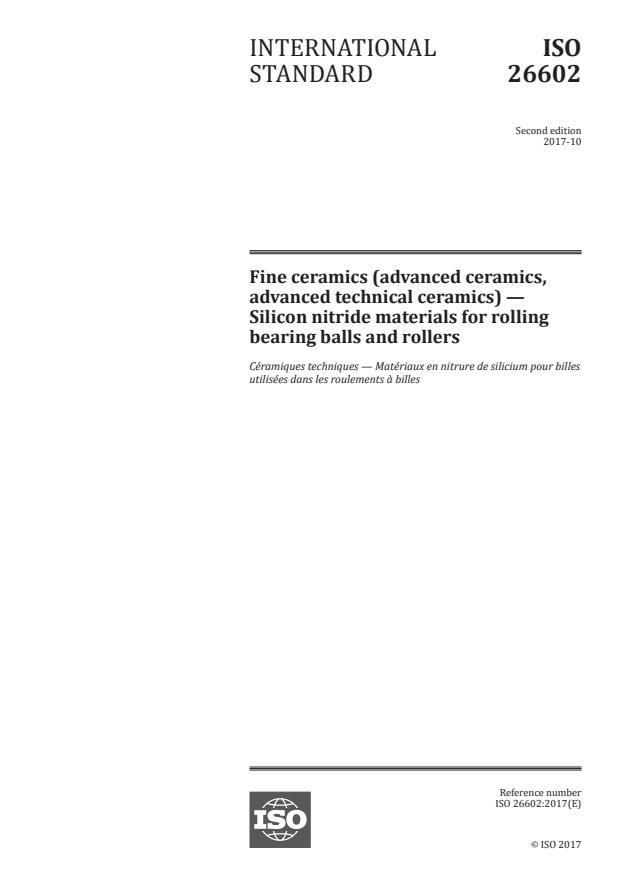
INTERNATIONAL ISO
STANDARD 26602
Second edition
2017-10
Fine ceramics (advanced ceramics,
advanced technical ceramics) —
Silicon nitride materials for rolling
bearing balls and rollers
Céramiques techniques — Matériaux en nitrure de silicium pour billes
utilisées dans les roulements à billes
Reference number
©
ISO 2017
© ISO 2017, Published in Switzerland
All rights reserved. Unless otherwise specified, no part of this publication may be reproduced or utilized otherwise in any form
or by any means, electronic or mechanical, including photocopying, or posting on the internet or an intranet, without prior
written permission. Permission can be requested from either ISO at the address below or ISO’s member body in the country of
the requester.
ISO copyright office
Ch. de Blandonnet 8 • CP 401
CH-1214 Vernier, Geneva, Switzerland
Tel. +41 22 749 01 11
Fax +41 22 749 09 47
copyright@iso.org
www.iso.org
ii © ISO 2017 – All rights reserved
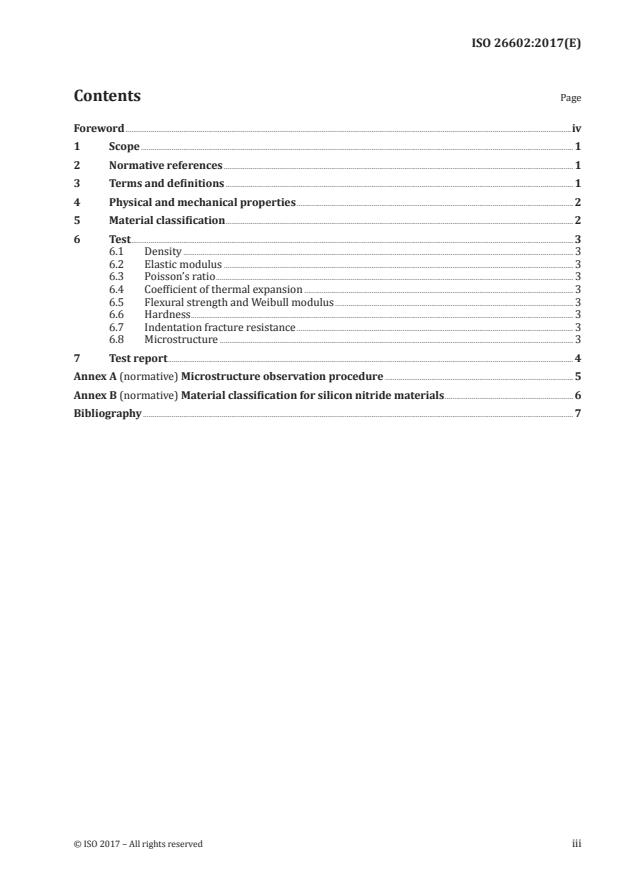
Contents Page
Foreword .iv
1 Scope . 1
2 Normative references . 1
3 Terms and definitions . 1
4 Physical and mechanical properties . 2
5 Material classification . 2
6 Test . 3
6.1 Density . 3
6.2 Elastic modulus . 3
6.3 Poisson’s ratio . 3
6.4 Coefficient of thermal expansion . 3
6.5 Flexural strength and Weibull modulus . 3
6.6 Hardness . 3
6.7 Indentation fracture resistance . 3
6.8 Microstructure . 3
7 Test report . 4
Annex A (normative) Microstructure observation procedure . 5
Annex B (normative) Material classification for silicon nitride materials .6
Bibliography . 7
Foreword
ISO (the International Organization for Standardization) is a worldwide federation of national standards
bodies (ISO member bodies). The work of preparing International Standards is normally carried out
through ISO technical committees. Each member body interested in a subject for which a technical
committee has been established has the right to be represented on that committee. International
organizations, governmental and non-governmental, in liaison with ISO, also take part in the work.
ISO collaborates closely with the International Electrotechnical Commission (IEC) on all matters of
electrotechnical standardization.
The procedures used to develop this document and those intended for its further maintenance are
described in the ISO/IEC Directives, Part 1. In particular the different approval criteria needed for the
different types of ISO documents should be noted. This document was drafted in accordance with the
editorial rules of the ISO/IEC Directives, Part 2 (see www.iso.org/directives).
Attention is drawn to the possibility that some of the elements of this document may be the subject of
patent rights. ISO shall not be held responsible for identifying any or all such patent rights. Details of
any patent rights identified during the development of the document will be in the Introduction and/or
on the ISO list of patent declarations received (see www.iso.org/patents).
Any trade name used in this document is information given for the convenience of users and does not
constitute an endorsement.
For an explanation on the voluntary nature of standards, the meaning of ISO specific terms and
expressions related to conformity assessment, as well as information about ISO's adherence to the
World Trade Organization (WTO) principles in the Technical Barriers to Trade (TBT) see the following
URL: www.iso.org/iso/foreword.html.
This document was prepared by Technical Committee ISO/TC 206, Fine ceramics.
This second edition cancels and replaces the first edition (ISO 26602:2009), which has been technically
revised.
The main changes compared to the previous edition are as follows:
— the title has been revised;
— Clauses 1, 2, 3, 5, 6 have been revised;
— Annex A has been revised;
— Table B.1 has been revised;
— bibliography has been revised.
iv © ISO 2017 – All rights reserved
INTERNATIONAL STANDARD ISO 26602:2017(E)
Fine ceramics (advanced ceramics, advanced technical
ceramics) — Silicon nitride materials for rolling bearing
balls and rollers
1 Scope
This document specifies the requirements for preprocessed silicon nitride materials for rolling bearing
balls and rollers.
This document provides a classification defining physical and mechanical properties of silicon nitride
preprocessed bearing rolling element materials. The materials are classified in three categories by the
specification of characteristics and microstructures. Methods for sample preparation and observation
of microstructures are provided in Annex A.
NOTE 1 The silicon nitride product means the sintered body of which the main component is silicon nitride
material.
NOTE 2 This document can be used for processed rolling bearing balls and rollers upon consultation between
the parties concerned.
2 Normative references
The following documents are referred to in the text in such a way that some or all of their content
constitutes requirements of this document. For dated references, only the edition cited applies. For
undated references, the latest edition of the referenced document (including any amendments) applies.
ISO 14627, Fine ceramics (advanced ceramics, advanced technical ceramics) — Test method for fracture
resistance of silicon nitride materials for rolling bearing balls at room temperature by indentation fracture
(IF) method
ISO 14704, Fine ceramics (advanced ceramics, advanced technical ceramics) — Test method for flexural
strength of monolithic ceramics at room temperature
ISO 14705, Fine ceramics (advanced ceramics, advanced technical ceramics) — Test method for hardness of
monolithic ceramics at room temperature
ISO 17561, Fine ceramics (advanced ceramics, advanced technical ceramics) — Test method for elastic
moduli of monolithic ceramics at room temperature by sonic resonance
ISO 17562, Fine ceramics (advanced ceramics, advanced technical ceramics) — Test method for linear
thermal expansion of monolithic ceramics by push-rod technique
ISO 18754, Fine ceramics (advanced ceramics, advanced technical ceramics) — Determination of density
and apparent porosity
ISO 20501, Fine ceramics (advanced ceramics, advanced technical ceramics) — Weibull statistics for
strength data
ISO 20507, Fine ceramics (advanced ceramics, advanced technical ceramics) — Vocabulary
3 Terms and definitions
For the purposes of t
...
INTERNATIONAL ISO
STANDARD 26602
Second edition
2017-10
Fine ceramics (advanced ceramics,
advanced technical ceramics) —
Silicon nitride materials for rolling
bearing balls and rollers
Céramiques techniques — Matériaux en nitrure de silicium pour billes
utilisées dans les roulements à billes
Reference number
©
ISO 2017
© ISO 2017, Published in Switzerland
All rights reserved. Unless otherwise specified, no part of this publication may be reproduced or utilized otherwise in any form
or by any means, electronic or mechanical, including photocopying, or posting on the internet or an intranet, without prior
written permission. Permission can be requested from either ISO at the address below or ISO’s member body in the country of
the requester.
ISO copyright office
Ch. de Blandonnet 8 • CP 401
CH-1214 Vernier, Geneva, Switzerland
Tel. +41 22 749 01 11
Fax +41 22 749 09 47
copyright@iso.org
www.iso.org
ii © ISO 2017 – All rights reserved
Contents Page
Foreword .iv
1 Scope . 1
2 Normative references . 1
3 Terms and definitions . 1
4 Physical and mechanical properties . 2
5 Material classification . 2
6 Test . 3
6.1 Density . 3
6.2 Elastic modulus . 3
6.3 Poisson’s ratio . 3
6.4 Coefficient of thermal expansion . 3
6.5 Flexural strength and Weibull modulus . 3
6.6 Hardness . 3
6.7 Indentation fracture resistance . 3
6.8 Microstructure . 3
7 Test report . 4
Annex A (normative) Microstructure observation procedure . 5
Annex B (normative) Material classification for silicon nitride materials .6
Bibliography . 7
Foreword
ISO (the International Organization for Standardization) is a worldwide federation of national standards
bodies (ISO member bodies). The work of preparing International Standards is normally carried out
through ISO technical committees. Each member body interested in a subject for which a technical
committee has been established has the right to be represented on that committee. International
organizations, governmental and non-governmental, in liaison with ISO, also take part in the work.
ISO collaborates closely with the International Electrotechnical Commission (IEC) on all matters of
electrotechnical standardization.
The procedures used to develop this document and those intended for its further maintenance are
described in the ISO/IEC Directives, Part 1. In particular the different approval criteria needed for the
different types of ISO documents should be noted. This document was drafted in accordance with the
editorial rules of the ISO/IEC Directives, Part 2 (see www.iso.org/directives).
Attention is drawn to the possibility that some of the elements of this document may be the subject of
patent rights. ISO shall not be held responsible for identifying any or all such patent rights. Details of
any patent rights identified during the development of the document will be in the Introduction and/or
on the ISO list of patent declarations received (see www.iso.org/patents).
Any trade name used in this document is information given for the convenience of users and does not
constitute an endorsement.
For an explanation on the voluntary nature of standards, the meaning of ISO specific terms and
expressions related to conformity assessment, as well as information about ISO's adherence to the
World Trade Organization (WTO) principles in the Technical Barriers to Trade (TBT) see the following
URL: www.iso.org/iso/foreword.html.
This document was prepared by Technical Committee ISO/TC 206, Fine ceramics.
This second edition cancels and replaces the first edition (ISO 26602:2009), which has been technically
revised.
The main changes compared to the previous edition are as follows:
— the title has been revised;
— Clauses 1, 2, 3, 5, 6 have been revised;
— Annex A has been revised;
— Table B.1 has been revised;
— bibliography has been revised.
iv © ISO 2017 – All rights reserved
INTERNATIONAL STANDARD ISO 26602:2017(E)
Fine ceramics (advanced ceramics, advanced technical
ceramics) — Silicon nitride materials for rolling bearing
balls and rollers
1 Scope
This document specifies the requirements for preprocessed silicon nitride materials for rolling bearing
balls and rollers.
This document provides a classification defining physical and mechanical properties of silicon nitride
preprocessed bearing rolling element materials. The materials are classified in three categories by the
specification of characteristics and microstructures. Methods for sample preparation and observation
of microstructures are provided in Annex A.
NOTE 1 The silicon nitride product means the sintered body of which the main component is silicon nitride
material.
NOTE 2 This document can be used for processed rolling bearing balls and rollers upon consultation between
the parties concerned.
2 Normative references
The following documents are referred to in the text in such a way that some or all of their content
constitutes requirements of this document. For dated references, only the edition cited applies. For
undated references, the latest edition of the referenced document (including any amendments) applies.
ISO 14627, Fine ceramics (advanced ceramics, advanced technical ceramics) — Test method for fracture
resistance of silicon nitride materials for rolling bearing balls at room temperature by indentation fracture
(IF) method
ISO 14704, Fine ceramics (advanced ceramics, advanced technical ceramics) — Test method for flexural
strength of monolithic ceramics at room temperature
ISO 14705, Fine ceramics (advanced ceramics, advanced technical ceramics) — Test method for hardness of
monolithic ceramics at room temperature
ISO 17561, Fine ceramics (advanced ceramics, advanced technical ceramics) — Test method for elastic
moduli of monolithic ceramics at room temperature by sonic resonance
ISO 17562, Fine ceramics (advanced ceramics, advanced technical ceramics) — Test method for linear
thermal expansion of monolithic ceramics by push-rod technique
ISO 18754, Fine ceramics (advanced ceramics, advanced technical ceramics) — Determination of density
and apparent porosity
ISO 20501, Fine ceramics (advanced ceramics, advanced technical ceramics) — Weibull statistics for
strength data
ISO 20507, Fine ceramics (advanced ceramics, advanced technical ceramics) — Vocabulary
3 Terms and definitions
For the purposes of t
...