

ISO 11058:2019
(Main)Geotextiles and geotextile-related products — Determination of water permeability characteristics normal to the plane, without load
General Information
- Abstract
This document specifies two test methods for determining the water permeability characteristics of a single layer of geotextile or geotextile-related product normal to the plane: a) the constant head method; and b) the falling head method.
- Status
- Published
- Publication Date
- 28-May-2019
- Technical Committee
- ISO/TC 221 - Geosynthetics
- Drafting Committee
- ISO/TC 221/WG 4 - Hydraulic properties
- Current Stage
- 9093 - International Standard confirmed
- Start Date
- 21-Nov-2024
- Completion Date
- 29-Aug-2026
Buy Documents
ISO 11058:2019 - Geotextiles and geotextile-related products -- Determination of water permeability characteristics normal to the plane, without load
ISO 11058:2019 - Geotextiles and geotextile-related products — Determination of water permeability characteristics normal to the plane, without load/29/2019
ISO 11058:2019 - Géotextiles et produits apparentés -- Détermination des caractéristiques de perméabilité a l'eau normalement au plan, sans contrainte mécanique
ISO 11058:2019 - Géotextiles et produits apparentés — Détermination des caractéristiques de perméabilité à l'eau normalement au plan, sans contrainte mécanique/29/2019
Overview
ISO 11058:2019 - "Geotextiles and geotextile-related products - Determination of water permeability characteristics normal to the plane, without load" specifies two laboratory test methods to measure water permeability through a single layer of geotextile normal to the plane. The standard defines the constant head method and the falling head method, procedures for specimen preparation and handling, measurement and calculation conventions (including temperature correction to 20 °C), and reporting requirements. This is the third edition (2019), replacing ISO 11058:2010.
Key topics and technical requirements
- Test methods
- Constant head: steady unidirectional flow with several constant heads (including a maximum head ≈ 70 mm).
- Falling head: unidirectional flow under a falling head (apparatus capable of at least 250 mm head).
- Specimens
- Samples handled flat, not folded; cut per ISO 9862.
- Typical test set uses five specimens of suitable dimension for the apparatus.
- Apparatus and measurement
- Apparatus must allow visual observation of bubbles and have a minimum exposed diameter (≥ 50 mm) with internal diameter accuracy to 0.1 mm.
- Support grid may be used to avoid deformation; head loss of apparatus alone (with grid) must be < 1 mm.
- Water supply quality: temperature normally 18–22 °C (temperature corrections to 20 °C via Annex A); recommended de-aired or stilling-tank feed; dissolved oxygen ≤ 10 mg/kg; filter if visible solids accumulate.
- Calculations and indices
- Flow velocity is corrected to 20 °C using a correction factor (Annex A).
- Plot head loss against velocity and select best-fit curve through the origin (Annex B).
- Velocity index (v-index): velocity corresponding to 50 mm head loss (expressed to ±1 mm/s).
- Procedure details
- Specimens saturated with 0.1% non-ionic surfactant for ≥ 12 h.
- Repeated measurements across head levels and reporting of temperature, apparatus details and results.
Applications
- Quality control and specification verification for geotextiles used in:
- Drainage and filtration systems
- Landfill liners and drainage layers
- Road, railway and civil engineering drainage applications
- Material selection, R&D and performance comparison where through-thickness permeability (normal to the plane) is critical.
Who uses ISO 11058:2019
- Geosynthetics manufacturers and product developers
- Independent testing laboratories and quality assurance teams
- Geotechnical, civil and environmental engineers specifying or verifying filter/drainage performance
- Procurement and compliance officers assessing product conformity
Related standards
- ISO 9862 - Sampling and preparation of test specimens (cited)
- ISO 2854 - Statistical interpretation of data (cited)
- ISO 5813 - Determination of dissolved oxygen (cited)
- ISO 10320 - Geosynthetics identification on site (cited)
Keywords: ISO 11058:2019, geotextiles, water permeability, constant head, falling head, velocity index, geosynthetics testing.
Relations
- Effective Date
- 12-Feb-2026
- Effective Date
- 06-Jun-2022
- Effective Date
- 20-Feb-2016
Buy Documents
ISO 11058:2019 - Geotextiles and geotextile-related products -- Determination of water permeability characteristics normal to the plane, without load
ISO 11058:2019 - Geotextiles and geotextile-related products — Determination of water permeability characteristics normal to the plane, without load/29/2019
ISO 11058:2019 - Géotextiles et produits apparentés -- Détermination des caractéristiques de perméabilité a l'eau normalement au plan, sans contrainte mécanique
ISO 11058:2019 - Géotextiles et produits apparentés — Détermination des caractéristiques de perméabilité à l'eau normalement au plan, sans contrainte mécanique/29/2019
Get Certified
Connect with accredited certification bodies for this standard

Control Union Certifications
Global certification for agriculture and sustainability.

Hohenstein Institut
Textile testing and certification.

Bureau Veritas Bangladesh
Bureau Veritas certification services in Bangladesh.
Sponsored listings
Frequently Asked Questions
ISO 11058:2019 is a standard published by the International Organization for Standardization (ISO). Its full title is "Geotextiles and geotextile-related products — Determination of water permeability characteristics normal to the plane, without load". This standard covers: This document specifies two test methods for determining the water permeability characteristics of a single layer of geotextile or geotextile-related product normal to the plane: a) the constant head method; and b) the falling head method.
This document specifies two test methods for determining the water permeability characteristics of a single layer of geotextile or geotextile-related product normal to the plane: a) the constant head method; and b) the falling head method.
ISO 11058:2019 is classified under the following ICS (International Classification for Standards) categories: 59.080.70 - Geotextiles. The ICS classification helps identify the subject area and facilitates finding related standards.
ISO 11058:2019 has the following relationships with other standards: It is inter standard links to EN ISO 11058:2019, ISO 2597-2:2015, ISO 11058:2010. Understanding these relationships helps ensure you are using the most current and applicable version of the standard.
ISO 11058:2019 is available in PDF format for immediate download after purchase. The document can be added to your cart and obtained through the secure checkout process. Digital delivery ensures instant access to the complete standard document.
Standards Content (Sample)
INTERNATIONAL ISO
STANDARD 11058
Third edition
2019-05
Geotextiles and geotextile-related
products — Determination of water
permeability characteristics normal to
the plane, without load
Géotextiles et produits apparentés — Détermination des
caractéristiques de perméabilité à l'eau normalement au plan, sans
contrainte mécanique
Reference number
©
ISO 2019
© ISO 2019
All rights reserved. Unless otherwise specified, or required in the context of its implementation, no part of this publication may
be reproduced or utilized otherwise in any form or by any means, electronic or mechanical, including photocopying, or posting
on the internet or an intranet, without prior written permission. Permission can be requested from either ISO at the address
below or ISO’s member body in the country of the requester.
ISO copyright office
CP 401 • Ch. de Blandonnet 8
CH-1214 Vernier, Geneva
Phone: +41 22 749 01 11
Fax: +41 22 749 09 47
Email: copyright@iso.org
Website: www.iso.org
Published in Switzerland
ii © ISO 2019 – All rights reserved
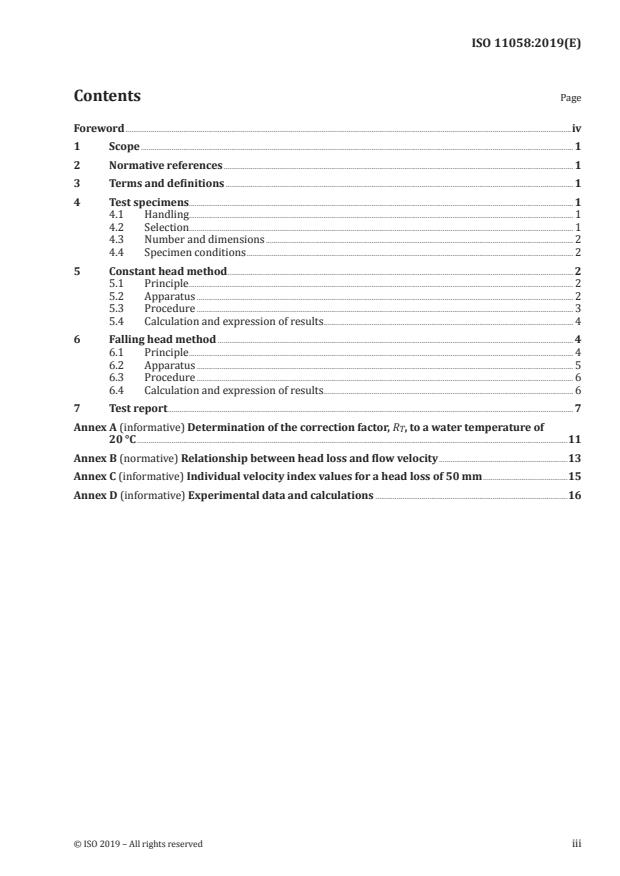
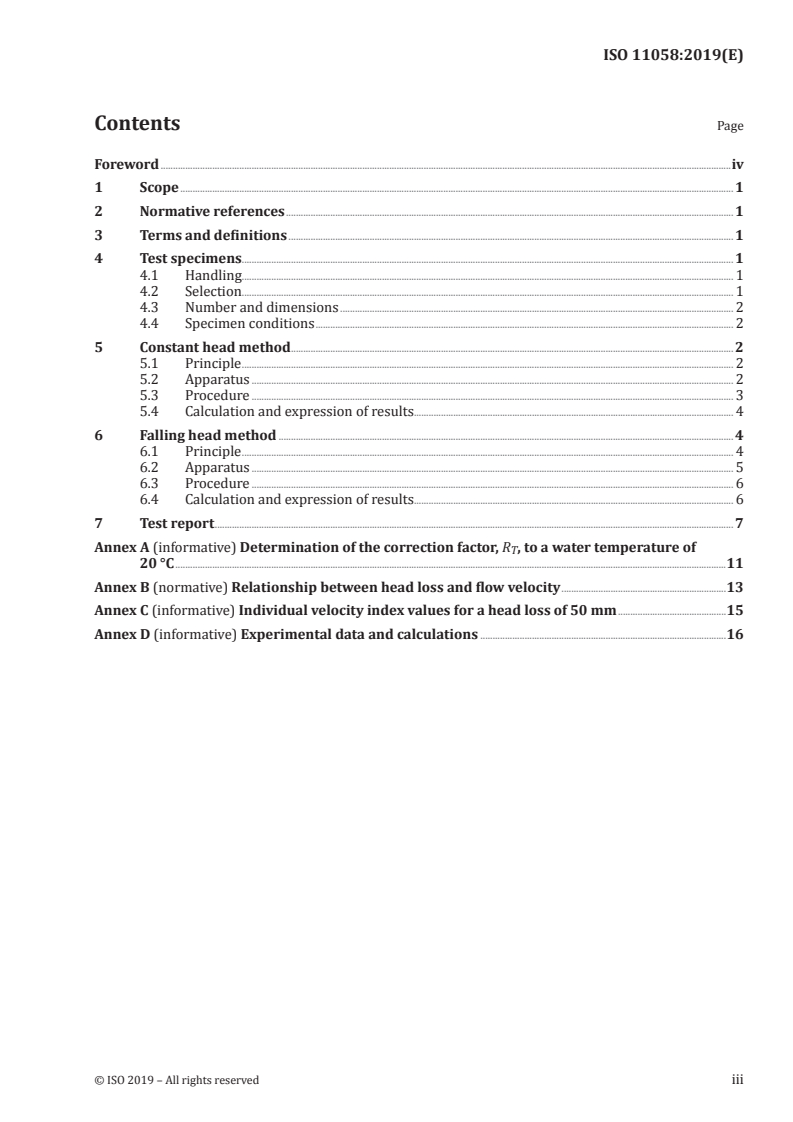
Contents Page
Foreword .iv
1 Scope . 1
2 Normative references . 1
3 Terms and definitions . 1
4 Test specimens. 1
4.1 Handling. 1
4.2 Selection. 1
4.3 Number and dimensions . 2
4.4 Specimen conditions . 2
5 Constant head method . 2
5.1 Principle . 2
5.2 Apparatus . 2
5.3 Procedure . 3
5.4 Calculation and expression of results. 4
6 Falling head method . 4
6.1 Principle . 4
6.2 Apparatus . 5
6.3 Procedure . 6
6.4 Calculation and expression of results. 6
7 Test report . 7
Annex A (informative) Determination of the correction factor, R , to a water temperature of
T
20 °C .11
Annex B (normative) Relationship between head loss and flow velocity .13
Annex C (informative) Individual velocity index values for a head loss of 50 mm .15
Annex D (informative) Experimental data and calculations .16
Foreword
ISO (the International Organization for Standardization) is a worldwide federation of national standards
bodies (ISO member bodies). The work of preparing International Standards is normally carried out
through ISO technical committees. Each member body interested in a subject for which a technical
committee has been established has the right to be represented on that committee. International
organizations, governmental and non-governmental, in liaison with ISO, also take part in the work.
ISO collaborates closely with the International Electrotechnical Commission (IEC) on all matters of
electrotechnical standardization.
The procedures used to develop this document and those intended for its further maintenance are
described in the ISO/IEC Directives, Part 1. In particular, the different approval criteria needed for the
different types of ISO documents should be noted. This document was drafted in accordance with the
editorial rules of the ISO/IEC Directives, Part 2 (see www .iso .org/directives).
Attention is drawn to the possibility that some of the elements of this document may be the subject of
patent rights. ISO shall not be held responsible for identifying any or all such patent rights. Details of
any patent rights identified during the development of the document will be in the Introduction and/or
on the ISO list of patent declarations received (see www .iso .org/patents).
Any trade name used in this document is information given for the convenience of users and does not
constitute an endorsement.
For an explanation of the voluntary nature of standards, the meaning of ISO specific terms and
expressions related to conformity assessment, as well as information about ISO's adherence to the
World Trade Organization (WTO) principles in the Technical Barriers to Trade (TBT) see www .iso
.org/iso/foreword .html.
This document was prepared by Technical Committee ISO/TC 221, Geosynthetics.
This third edition cancels and replaces the second edition (ISO 11058:2010), which has been technically
revised.
The main changes compared to the previous edition are as follows:
— editorial modifications;
— formula corrections.
Any feedback or questions on this document should be directed to the user’s national standards body. A
complete listing of these bodies can be found at www .iso .org/members .html.
iv © ISO 2019 – All rights reserved
INTERNATIONAL STANDARD ISO 11058:2019(E)
Geotextiles and geotextile-related products —
Determination of water permeability characteristics
normal to the plane, without load
1 Scope
This document specifies two test methods for determining the water permeability characteristics of a
single layer of geotextile or geotextile-related product normal to the plane:
a) the constant head method; and
b) the falling head method.
2 Normative references
The following referenced documents are referred to in such a way that some or all of their content
constitutes requirements of this document. For dated references, only the edition cited applies. For
undated references, the latest edition of the referenced document (including any amendments) applies.
ISO 2854, Statistical interpretation of data — Techniques of estimation and tests relating to means and
variances
ISO 5813, Water quality — Determination of dissolved oxygen — Iodometric method
ISO 9862, Geosynthetics — Sampling and preparation of test specimens
ISO 10320, Geosynthetics — Identification on site
3 Terms and definitions
For the purposes of this document, the following terms and definitions apply.
ISO and IEC maintain terminological databases for use in standardization at the following addresses:
— ISO Online browsing platform: available at https: //www .iso .org/obp
— IEC Electropedia: available at http: //www .electropedia .org/
3.1
velocity index
v-index
velocity corresponding to a head loss of 50 mm across a specimen, expressed to the nearest ±1 mm/s
4 Test specimens
4.1 Handling
The sample shall not be folded and shall be handled as infrequently as possible to avoid disturbance to
its structure. The sample shall be kept in a flat position without any load.
4.2 Selection
Test specimens shall be taken from the sample in accordance with ISO 9862.
4.3 Number and dimensions
Five test specimens shall be cut from the sample, each of suitable dimensions for the water permeability
apparatus to be used.
If it is necessary to determine the results to within a given confidence interval of the mean, the number
of test specimens shall be determined in accordance with ISO 2854.
4.4 Specimen conditions
The specimens shall be clean, free from surface deposits and without visible damage or folding marks.
5 Constant head method
5.1 Principle
A single, unloaded layer of geotextile or geotextile-related product is subjected to a unidirectional flow
of water normal to the plane under a range of constant heads.
5.2 Apparatus
5.2.1 Apparatus in which it is possible to observe the presence of air bubbles on the surface of
the specimen, with an internal diameter of minimum 50 mm, conforming to the following requirements.
a) The apparatus shall be capable of applying a maximum head loss of at least 70 mm and maintaining
a constant head for the duration of each test with water on both sides of the specimen.
NOTE Some examples of apparatus are shown in Figure 1.
b) The mean internal diameter of the apparatus shall be known to an accuracy of at least 0,1 mm. The
exposed diameter of the specimen shall be the same as the internal diameter of the apparatus. The
diameter of the apparatus shall remain identical on both sides of the specimen over a length of at
least twice its internal diameter [see Figures 1 a) and 1 b)]. Abrupt changes in diameter shall be
avoided.
Alternatively [see Figure 1 c)], the outflow may discharge into a reservoir with a diameter of at
least four times the exposed diameter of the specimen. In this case, the distance from the geotextile
to the base of the reservoir shall be at least 1,5 times the exposed diameter of the specimen.
If the product shows an obvious pattern, this pattern shall be included at least three times along
any diameter of the specimen.
c) Where necessary, to avoid any visible deformation, a grid of 1 mm diameter wire and a mesh size of
(10 ± 1) mm shall be placed downstream of the specimen to support it during the test.
d) The head loss measured at any velocity when a test is performed without the test specimen, but
including any specimen-supporting grid, shall be less than 1 mm.
5.2.2 Water supply, of the following quality and condition.
a) The water shall be at a temperature of between 18 °C and 22 °C.
As the temperature correction (see Annex A) relates only to laminar flow, it is advisable to work at
temperatures as close as possible to 20 °C to minimize inaccuracies associated with inappropriate
correction factors, should the flow be non-laminar.
b) Water shall not be fed into the apparatus directly from a main supply due to problems caused by
the release of air bubbles, which can be entrapped in the structure of the specimen. The water
2 © ISO 2019 – All rights reserved
should preferably be de-aired or fed from a stilling tank. The water should not be continuously
recycled.
c) The oxygen content shall not exceed 10 mg/kg. The oxygen content shall be measured at the point
at which the water enters the apparatus.
d) The water shall be filtered if suspended solids are visible to the naked eye or if solids accumulate
on or in the specimen, thus reducing the flow with time.
5.2.3 Dissolved-oxygen meter, or apparatus in accordance with ISO 5813.
5.2.4 Stopwatch, with an accuracy of 0,2 s.
5.2.5 Thermometer, with an accuracy of 0,5 °C.
5.2.6 Measuring vessel, of appropriate size for determining the volume of water to an accuracy of 1 %
of the capacity of the vessel.
When the water flow is determined by volume, use a measuring vessel for determining volume to an
accuracy of 1 %. When direct measurement of water flow velocity is made by gauge, the flow velocity
shall be measured to an accuracy of 5 %. When determining the water volume by mass, it shall be
determined to an accuracy of 1 %.
5.2.7 Measurement device for determining the applied head, to an accuracy of 3 %.
5.3 Procedure
5.3.1 Place the specimens under water containing 0,1 % volume (1 ml/l) non-ionic surfactant at
laboratory temperature, gently stir to remove air bubbles and leave to saturate for at least 12 h.
5.3.2 Place a specimen in the apparatus and ensure that all joints are watertight.
5.3.3 Fill the apparatus with water until there is a 50 mm water head difference across the specimen.
Shut off the water supply and, if the water heads do not equalize on each side of the specimen within
5 min, investigate the likelihood of any trapped air within the apparatus and repeat the procedure. If the
water heads cannot be equalized within 5 min, this shall be noted in the test report.
NOTE If the full permeability characteristics of the geotextile or geotextile-related product have previously
been established, then for control purposes it can be sufficient to determine the velocity index at a head loss of
50 mm only.
5.3.4 Adjust the flow to attain a head loss of (70 ± 5) mm and record this value to the nearest 1 mm.
When the head has been steady for a minimum of 30 s, collect the water passing through the system in
the measuring
...
INTERNATIONAL ISO
STANDARD 11058
Third edition
2019-05
Geotextiles and geotextile-related
products — Determination of water
permeability characteristics normal to
the plane, without load
Géotextiles et produits apparentés — Détermination des
caractéristiques de perméabilité à l'eau normalement au plan, sans
contrainte mécanique
Reference number
©
ISO 2019
© ISO 2019
All rights reserved. Unless otherwise specified, or required in the context of its implementation, no part of this publication may
be reproduced or utilized otherwise in any form or by any means, electronic or mechanical, including photocopying, or posting
on the internet or an intranet, without prior written permission. Permission can be requested from either ISO at the address
below or ISO’s member body in the country of the requester.
ISO copyright office
CP 401 • Ch. de Blandonnet 8
CH-1214 Vernier, Geneva
Phone: +41 22 749 01 11
Fax: +41 22 749 09 47
Email: copyright@iso.org
Website: www.iso.org
Published in Switzerland
ii © ISO 2019 – All rights reserved
Contents Page
Foreword .iv
1 Scope . 1
2 Normative references . 1
3 Terms and definitions . 1
4 Test specimens. 1
4.1 Handling. 1
4.2 Selection. 1
4.3 Number and dimensions . 2
4.4 Specimen conditions . 2
5 Constant head method . 2
5.1 Principle . 2
5.2 Apparatus . 2
5.3 Procedure . 3
5.4 Calculation and expression of results. 4
6 Falling head method . 4
6.1 Principle . 4
6.2 Apparatus . 5
6.3 Procedure . 6
6.4 Calculation and expression of results. 6
7 Test report . 7
Annex A (informative) Determination of the correction factor, R , to a water temperature of
T
20 °C .11
Annex B (normative) Relationship between head loss and flow velocity .13
Annex C (informative) Individual velocity index values for a head loss of 50 mm .15
Annex D (informative) Experimental data and calculations .16
Foreword
ISO (the International Organization for Standardization) is a worldwide federation of national standards
bodies (ISO member bodies). The work of preparing International Standards is normally carried out
through ISO technical committees. Each member body interested in a subject for which a technical
committee has been established has the right to be represented on that committee. International
organizations, governmental and non-governmental, in liaison with ISO, also take part in the work.
ISO collaborates closely with the International Electrotechnical Commission (IEC) on all matters of
electrotechnical standardization.
The procedures used to develop this document and those intended for its further maintenance are
described in the ISO/IEC Directives, Part 1. In particular, the different approval criteria needed for the
different types of ISO documents should be noted. This document was drafted in accordance with the
editorial rules of the ISO/IEC Directives, Part 2 (see www .iso .org/directives).
Attention is drawn to the possibility that some of the elements of this document may be the subject of
patent rights. ISO shall not be held responsible for identifying any or all such patent rights. Details of
any patent rights identified during the development of the document will be in the Introduction and/or
on the ISO list of patent declarations received (see www .iso .org/patents).
Any trade name used in this document is information given for the convenience of users and does not
constitute an endorsement.
For an explanation of the voluntary nature of standards, the meaning of ISO specific terms and
expressions related to conformity assessment, as well as information about ISO's adherence to the
World Trade Organization (WTO) principles in the Technical Barriers to Trade (TBT) see www .iso
.org/iso/foreword .html.
This document was prepared by Technical Committee ISO/TC 221, Geosynthetics.
This third edition cancels and replaces the second edition (ISO 11058:2010), which has been technically
revised.
The main changes compared to the previous edition are as follows:
— editorial modifications;
— formula corrections.
Any feedback or questions on this document should be directed to the user’s national standards body. A
complete listing of these bodies can be found at www .iso .org/members .html.
iv © ISO 2019 – All rights reserved
INTERNATIONAL STANDARD ISO 11058:2019(E)
Geotextiles and geotextile-related products —
Determination of water permeability characteristics
normal to the plane, without load
1 Scope
This document specifies two test methods for determining the water permeability characteristics of a
single layer of geotextile or geotextile-related product normal to the plane:
a) the constant head method; and
b) the falling head method.
2 Normative references
The following referenced documents are referred to in such a way that some or all of their content
constitutes requirements of this document. For dated references, only the edition cited applies. For
undated references, the latest edition of the referenced document (including any amendments) applies.
ISO 2854, Statistical interpretation of data — Techniques of estimation and tests relating to means and
variances
ISO 5813, Water quality — Determination of dissolved oxygen — Iodometric method
ISO 9862, Geosynthetics — Sampling and preparation of test specimens
ISO 10320, Geosynthetics — Identification on site
3 Terms and definitions
For the purposes of this document, the following terms and definitions apply.
ISO and IEC maintain terminological databases for use in standardization at the following addresses:
— ISO Online browsing platform: available at https: //www .iso .org/obp
— IEC Electropedia: available at http: //www .electropedia .org/
3.1
velocity index
v-index
velocity corresponding to a head loss of 50 mm across a specimen, expressed to the nearest ±1 mm/s
4 Test specimens
4.1 Handling
The sample shall not be folded and shall be handled as infrequently as possible to avoid disturbance to
its structure. The sample shall be kept in a flat position without any load.
4.2 Selection
Test specimens shall be taken from the sample in accordance with ISO 9862.
4.3 Number and dimensions
Five test specimens shall be cut from the sample, each of suitable dimensions for the water permeability
apparatus to be used.
If it is necessary to determine the results to within a given confidence interval of the mean, the number
of test specimens shall be determined in accordance with ISO 2854.
4.4 Specimen conditions
The specimens shall be clean, free from surface deposits and without visible damage or folding marks.
5 Constant head method
5.1 Principle
A single, unloaded layer of geotextile or geotextile-related product is subjected to a unidirectional flow
of water normal to the plane under a range of constant heads.
5.2 Apparatus
5.2.1 Apparatus in which it is possible to observe the presence of air bubbles on the surface of
the specimen, with an internal diameter of minimum 50 mm, conforming to the following requirements.
a) The apparatus shall be capable of applying a maximum head loss of at least 70 mm and maintaining
a constant head for the duration of each test with water on both sides of the specimen.
NOTE Some examples of apparatus are shown in Figure 1.
b) The mean internal diameter of the apparatus shall be known to an accuracy of at least 0,1 mm. The
exposed diameter of the specimen shall be the same as the internal diameter of the apparatus. The
diameter of the apparatus shall remain identical on both sides of the specimen over a length of at
least twice its internal diameter [see Figures 1 a) and 1 b)]. Abrupt changes in diameter shall be
avoided.
Alternatively [see Figure 1 c)], the outflow may discharge into a reservoir with a diameter of at
least four times the exposed diameter of the specimen. In this case, the distance from the geotextile
to the base of the reservoir shall be at least 1,5 times the exposed diameter of the specimen.
If the product shows an obvious pattern, this pattern shall be included at least three times along
any diameter of the specimen.
c) Where necessary, to avoid any visible deformation, a grid of 1 mm diameter wire and a mesh size of
(10 ± 1) mm shall be placed downstream of the specimen to support it during the test.
d) The head loss measured at any velocity when a test is performed without the test specimen, but
including any specimen-supporting grid, shall be less than 1 mm.
5.2.2 Water supply, of the following quality and condition.
a) The water shall be at a temperature of between 18 °C and 22 °C.
As the temperature correction (see Annex A) relates only to laminar flow, it is advisable to work at
temperatures as close as possible to 20 °C to minimize inaccuracies associated with inappropriate
correction factors, should the flow be non-laminar.
b) Water shall not be fed into the apparatus directly from a main supply due to problems caused by
the release of air bubbles, which can be entrapped in the structure of the specimen. The water
2 © ISO 2019 – All rights reserved
should preferably be de-aired or fed from a stilling tank. The water should not be continuously
recycled.
c) The oxygen content shall not exceed 10 mg/kg. The oxygen content shall be measured at the point
at which the water enters the apparatus.
d) The water shall be filtered if suspended solids are visible to the naked eye or if solids accumulate
on or in the specimen, thus reducing the flow with time.
5.2.3 Dissolved-oxygen meter, or apparatus in accordance with ISO 5813.
5.2.4 Stopwatch, with an accuracy of 0,2 s.
5.2.5 Thermometer, with an accuracy of 0,5 °C.
5.2.6 Measuring vessel, of appropriate size for determining the volume of water to an accuracy of 1 %
of the capacity of the vessel.
When the water flow is determined by volume, use a measuring vessel for determining volume to an
accuracy of 1 %. When direct measurement of water flow velocity is made by gauge, the flow velocity
shall be measured to an accuracy of 5 %. When determining the water volume by mass, it shall be
determined to an accuracy of 1 %.
5.2.7 Measurement device for determining the applied head, to an accuracy of 3 %.
5.3 Procedure
5.3.1 Place the specimens under water containing 0,1 % volume (1 ml/l) non-ionic surfactant at
laboratory temperature, gently stir to remove air bubbles and leave to saturate for at least 12 h.
5.3.2 Place a specimen in the apparatus and ensure that all joints are watertight.
5.3.3 Fill the apparatus with water until there is a 50 mm water head difference across the specimen.
Shut off the water supply and, if the water heads do not equalize on each side of the specimen within
5 min, investigate the likelihood of any trapped air within the apparatus and repeat the procedure. If the
water heads cannot be equalized within 5 min, this shall be noted in the test report.
NOTE If the full permeability characteristics of the geotextile or geotextile-related product have previously
been established, then for control purposes it can be sufficient to determine the velocity index at a head loss of
50 mm only.
5.3.4 Adjust the flow to attain a head loss of (70 ± 5) mm and record this value to the nearest 1 mm.
When the head has been steady for a minimum of 30 s, collect the water passing through the system in
the measuring
...
NORME ISO
INTERNATIONALE 11058
Troisième édition
2019-05
Géotextiles et produits apparentés —
Détermination des caractéristiques de
perméabilité à l'eau normalement au
plan, sans contrainte mécanique
Geotextiles and geotextile-related products — Determination of water
permeability characteristics normal to the plane, without load
Numéro de référence
©
ISO 2019
DOCUMENT PROTÉGÉ PAR COPYRIGHT
© ISO 2019
Tous droits réservés. Sauf prescription différente ou nécessité dans le contexte de sa mise en œuvre, aucune partie de cette
publication ne peut être reproduite ni utilisée sous quelque forme que ce soit et par aucun procédé, électronique ou mécanique,
y compris la photocopie, ou la diffusion sur l’internet ou sur un intranet, sans autorisation écrite préalable. Une autorisation peut
être demandée à l’ISO à l’adresse ci-après ou au comité membre de l’ISO dans le pays du demandeur.
ISO copyright office
Case postale 401 • Ch. de Blandonnet 8
CH-1214 Vernier, Genève
Tél.: +41 22 749 01 11
Fax: +41 22 749 09 47
E-mail: copyright@iso.org
Web: www.iso.org
Publié en Suisse
ii © ISO 2019 – Tous droits réservés
Sommaire Page
Avant-propos .iv
1 Domaine d’application . 1
2 Références normatives . 1
3 Termes et définitions . 1
4 Éprouvettes . 1
4.1 Maniement . 1
4.2 Sélection. 2
4.3 Nombre et dimensions . 2
4.4 État des éprouvettes . 2
5 Méthode à hauteur de charge constante. 2
5.1 Principe . 2
5.2 Appareillage. 2
5.3 Mode opératoire . 3
5.4 Calcul et expression des résultats . 4
6 Méthode avec hauteur de charge variable décroissante . 5
6.1 Principe . 5
6.2 Appareillage. 5
6.3 Mode opératoire . 6
6.4 Calcul et expression des résultats . 7
7 Rapport d’essai . 8
Annexe A (informative) Détermination du facteur de correction, R , à une température de
T
l'eau de 20 °C .12
Annexe B (normative) Relation entre la perte de charge et la vitesse d'écoulement .14
Annexe C (informative) Valeurs de l'Indice de vitesse individuel pour une perte de charge
de 50 mm .16
Annexe D (informative) Données expérimentales et calculs .17
Avant-propos
L'ISO (Organisation internationale de normalisation) est une fédération mondiale d'organismes
nationaux de normalisation (comités membres de l'ISO). L'élaboration des Normes internationales est
en général confiée aux comités techniques de l'ISO. Chaque comité membre intéressé par une étude
a le droit de faire partie du comité technique créé à cet effet. Les organisations internationales,
gouvernementales et non gouvernementales, en liaison avec l'ISO participent également aux travaux.
L'ISO collabore étroitement avec la Commission électrotechnique internationale (IEC) en ce qui
concerne la normalisation électrotechnique.
Les procédures utilisées pour élaborer le présent document et celles destinées à sa mise à jour sont
décrites dans les Directives ISO/IEC, Partie 1. Il convient, en particulier, de prendre note des différents
critères d'approbation requis pour les différents types de documents ISO. Le présent document a été
rédigé conformément aux règles de rédaction données dans les Directives ISO/IEC, Partie 2 (voir www
.iso .org/directives).
L'attention est attirée sur le fait que certains des éléments du présent document peuvent faire l'objet de
droits de propriété intellectuelle ou de droits analogues. L'ISO ne saurait être tenue pour responsable
de ne pas avoir identifié de tels droits de propriété et averti de leur existence. Les détails concernant
les références aux droits de propriété intellectuelle ou autres droits analogues identifiés lors de
l'élaboration du document sont indiqués dans l'Introduction et/ou dans la liste des déclarations de
brevets reçues par l'ISO (voir www .iso .org/brevets).
Les appellations commerciales éventuellement mentionnées dans le présent document sont données
pour information, par souci de commodité, à l’intention des utilisateurs et ne sauraient constituer un
engagement.
Pour une explication de la nature volontaire des normes, la signification des termes et expressions
spécifiques de l'ISO liés à l'évaluation de la conformité, ou pour toute information au sujet de l'adhésion
de l'ISO aux principes de l’Organisation mondiale du commerce (OMC) concernant les obstacles
techniques au commerce (OTC), voir www .iso .org/avant -propos.
Le présent document a été élaboré par le comité technique ISO/TC 221, Géosynthétiques.
Cette troisième édition annule et remplace la seconde édition (ISO 11058:2010), qui a fait l'objet d'une
révision technique.
Les principales modifications apportées par rapport à l'édition précédente sont:
— modifications éditoriales;
— correction des formules.
Il convient que l’utilisateur adresse tout retour d’information ou toute question concernant le présent
document à l’organisme national de normalisation de son pays. Une liste exhaustive desdits organismes
se trouve à l’adresse www .iso .org/fr/members .html.
iv © ISO 2019 – Tous droits réservés
NORME INTERNATIONALE ISO 11058:2019(F)
Géotextiles et produits apparentés — Détermination des
caractéristiques de perméabilité à l'eau normalement au
plan, sans contrainte mécanique
1 Domaine d’application
Le présent document décrit deux méthodes d'essai pour déterminer la perméabilité à l'eau d'une couche
d'un géotextile ou produit apparenté normalement à son plan:
a) la méthode à hauteur de charge constante; et
b) la méthode avec hauteur de charge variable décroissante.
2 Références normatives
Les documents suivants sont cités dans le texte de sorte qu’ils constituent, pour tout ou partie de leur
contenu, des exigences du présent document. Pour les références datées, seule l’édition citée s’applique.
Pour les références non datées, la dernière édition du document de référence s'applique (y compris les
éventuels amendements).
ISO 2854, Interprétation statistique des données — Techniques d'estimation et tests portant sur des
moyennes et des variances
ISO 5813, Qualité de l'eau — Dosage de l'oxygène dissous — Méthode iodométrique
ISO 9862, Géosynthétiques — Échantillonnage et préparation des éprouvettes
ISO 10320, Géosynthétiques — Identification sur site
3 Termes et définitions
Pour les besoins du présent document, les termes et définitions suivants s’appliquent.
L’ISO et l’IEC tiennent à jour des bases de données terminologiques destinées à être utilisées en
normalisation, consultables aux adresses suivantes:
— ISO Online browsing platform: disponible à l’adresse https: //www .iso .org/obp
— IEC Electropedia: disponible à l’adresse http: //www .electropedia .org/
3.1
indice de vitesse
ν index
vitesse correspondant à la perte de charge de 50 mm dans une éprouvette, exprimée à ±1 mm/s
4 Éprouvettes
4.1 Maniement
L'échantillon ne doit pas être plié et doit être manipulé le moins possible afin d'éviter d’en détériorer la
structure. Maintenir l'échantillon à plat sans contrainte mécanique.
4.2 Sélection
Prélever les éprouvettes dans l'échantillon, conformément à l'ISO 9862.
4.3 Nombre et dimensions
Découper cinq éprouvettes dans l'échantillon, chacune de dimensions compatibles avec celles de
l'appareil de perméabilité à l'eau prévu.
S'il est nécessaire de déterminer les résultats selon un intervalle de confiance de la moyenne donné,
déterminer le nombre d'éprouvettes conformément à l'ISO 2854.
4.4 État des éprouvettes
Les éprouvettes doivent être propres, exemptes de dépôts en surface et ne présenter aucune
détérioration visible ou marques de plis.
5 Méthode à hauteur de charge constante
5.1 Principe
Application, sans contrainte mécanique, d'un débit unidirectionnel d'eau normalement au plan d'une
couche d'un géotextile ou produit apparenté en utilisant une plage de hauteurs de charge constantes.
5.2 Appareillage
5.2.1 Appareil permettant d'observer si des bulles d'air sont présentes à la surface de
l'éprouvette, d'un diamètre interne minimum de 50 mm, conforme aux exigences suivantes.
a) L'appareil doit être capable de fournir une alimentation en eau jusqu'à une perte de charge
maximale de 70 mm et de maintenir une hauteur de charge constante pendant la durée de chacun
des essais avec l'eau présente des deux côtés de l'éprouvette.
NOTE Des exemples d'appareillage sont illustrés à la Figure 1.
b) Le diamètre interne moyen de l'appareil doit être connu avec une erreur maximale tolérée de 0,1 mm.
Le diamètre exposé de l'éprouvette doit être le même que le diamètre interne de l'appareillage. Les
diamètres de l'appareil en amont et en aval de l'éprouvette doivent rester identiques de chaque côté
de l'éprouvette sur une longueur égale à au moins deux fois le diamètre interne [voir les Figures 1a)
et 1b)]. Des modifications soudaines de diamètre doivent être évitées.
Alternativement [voir Figure 1c)], l'écoulement de sortie peut se déverser dans un réservoir d'un
diamètre d'au moins quatre fois le diamètre exposé de l'éprouvette. Dans ce cas la distance du
géotextile à la base de l'appareil doit être d'au moins 1,5 fois le diamètre exposé de l'éprouvette.
Si le produit présente un motif manifeste, celui-ci doit être compris au moins trois fois sur n'importe
quel diamètre de l'échantillon.
c) Si nécessaire, afin d'éviter toute déformation visible, placer en aval de l'éprouvette une grille
constituée d'un fil métallique d'un diamètre de 1 mm et d'une taille de maille de (10 ± 1) mm pour
la maintenir pendant l'essai.
d) La perte de charge mesurée, quelle que soit la vitesse, lorsque l'essai est effectué sans l'éprouvette
mais avec la grille porte-éprouvette, doit être inférieure à 1 mm.
2 © ISO 2019 – Tous droits réservés
5.2.2 Alimentation en eau, d'une qualité et dans les conditions spécifiées ci-après.
a) L'eau utilisée doit être à une température comprise entre 18 °C et 22 °C.
La correction de température (voir Annexe A) n'étant applicable que si l'écoulement est laminaire, il
est conseillé de travailler à des températures aussi proches que possible de 20 °C afin de réduire au
minimum les inexactitudes associées à des facteurs de correction inadaptés, au cas où l'écoulement
ne serait pas laminaire.
b) L'eau ne doit pas être introduite dans l'appareil directement à partir du réseau d'alimentation
principal, à cause des bulles d'air libérées qui peuvent s’accrocher à la structure de l'éprouvette. Il
convient de préférence que l'eau soit désaérée ou provienne d’un réservoir. Il convient de ne pas la
recycler en continu.
c) La teneur en oxygène ne doit pas excéder 10 mg/kg. La teneur en oxygène doit être mesurée au
point d'entrée de l'eau dans l'appareil.
d) L'eau doit être filtrée si des solides en suspension sont visibles à l'œil nu ou si des solides
s'accumulent sur ou dans l'éprouvette, empêchant ainsi l'écoulement.
5.2.3 Oxymètre, ou appareillage conforme à l'ISO 5813.
5.2.4 Chronomètre, ayant une erreur maximale tolérée de 0,2 s.
5.2.5 Thermomètre, ayant une erreur maximale tolérée de 0,5 °C.
5.2.6 Récipient de mesure, de capacité appropriée, permettant de déterminer le volume d'eau avec
une erreur maximale tolérée de 1 % de la capacité du récipient.
Lorsque le débit volumique est déterminé par mesure du volume, utiliser un récipient de mesure
permettant d'obtenir une erreur maximale tolérée de 1 %. Lorsque des mesures directes de la vitesse
d'écoulement sont réalisées à l'aide d'un vélocimètre, mesurer la vitesse d'écoulement avec une erreur
maximale tolérée de 5 %. Lorsque le volume d'eau est déterminé par pesée, il doit être déterminé avec
une erreur maximale tolérée de 1 %.
5.2.7 Dispositif de mesure de la charge hydraulique appliquée, avec une erreur maximale
tolérée de 3 %.
5.3 Mode opératoire
5.3.1 Placer les éprouvettes dans l'eau, contenant un agent mouillant non ionique à 0,1 % du volume
(1 ml/l), à la température du laboratoire, en agitant doucement pour enlever les bulles d'air, et les laisser
se saturer pendant au moins 12 h.
5.3.2 Mettre une éprouvette dans l'appareil et s'assurer que tous les joints sont étanches à l'eau.
5.3.3 Remplir le dispositif d'eau jusqu'à obtenir une charge hydraulique dans l'éprouvette de 50 mm.
Arrêter l'alimentation en eau et si les hauteurs d'eau ne s'égalisent pas de part et d'autre de l'éprouvette
en 5 min, rechercher la présence éventuelle d'air piégé dans le dispositif et répéter l'opération. S'il n'est
pas possible d'égaliser les hauteurs d'eau en moins de 5 min, cela doit être noté dans le rapport d'essai.
NOTE Si la totalité des caractéristiques de perméabilité du géotextile ou du produit apparenté a déjà été
établie, la détermination de l'indice de vitesse à une hauteur de charge de 50 mm uniquement peut suffire à des
fins de contrôle.
5.3.4 Régler l'écoulement de manière à atteindre une perte de charge de (70 ± 5) mm et enregistrer
cette valeur à ±1 mm. Lorsque la hauteur de charge est stable pendant au minimum 30 s, recueillir l'eau
circulant dans le dispositif dans le récipient de mesure pendant un laps de temps fixé et enregistrer
le volume d'eau à ±10 cm et le temps à ±1 s. Il convient de recueillir un volume d'eau minimum de
1 000 cm pour une durée de collecte
...
NORME ISO
INTERNATIONALE 11058
Troisième édition
2019-05
Géotextiles et produits apparentés —
Détermination des caractéristiques de
perméabilité à l'eau normalement au
plan, sans contrainte mécanique
Geotextiles and geotextile-related products — Determination of water
permeability characteristics normal to the plane, without load
Numéro de référence
©
ISO 2019
DOCUMENT PROTÉGÉ PAR COPYRIGHT
© ISO 2019
Tous droits réservés. Sauf prescription différente ou nécessité dans le contexte de sa mise en œuvre, aucune partie de cette
publication ne peut être reproduite ni utilisée sous quelque forme que ce soit et par aucun procédé, électronique ou mécanique,
y compris la photocopie, ou la diffusion sur l’internet ou sur un intranet, sans autorisation écrite préalable. Une autorisation peut
être demandée à l’ISO à l’adresse ci-après ou au comité membre de l’ISO dans le pays du demandeur.
ISO copyright office
Case postale 401 • Ch. de Blandonnet 8
CH-1214 Vernier, Genève
Tél.: +41 22 749 01 11
Fax: +41 22 749 09 47
E-mail: copyright@iso.org
Web: www.iso.org
Publié en Suisse
ii © ISO 2019 – Tous droits réservés
Sommaire Page
Avant-propos .iv
1 Domaine d’application . 1
2 Références normatives . 1
3 Termes et définitions . 1
4 Éprouvettes . 1
4.1 Maniement . 1
4.2 Sélection. 2
4.3 Nombre et dimensions . 2
4.4 État des éprouvettes . 2
5 Méthode à hauteur de charge constante. 2
5.1 Principe . 2
5.2 Appareillage. 2
5.3 Mode opératoire . 3
5.4 Calcul et expression des résultats . 4
6 Méthode avec hauteur de charge variable décroissante . 5
6.1 Principe . 5
6.2 Appareillage. 5
6.3 Mode opératoire . 6
6.4 Calcul et expression des résultats . 7
7 Rapport d’essai . 8
Annexe A (informative) Détermination du facteur de correction, R , à une température de
T
l'eau de 20 °C .12
Annexe B (normative) Relation entre la perte de charge et la vitesse d'écoulement .14
Annexe C (informative) Valeurs de l'Indice de vitesse individuel pour une perte de charge
de 50 mm .16
Annexe D (informative) Données expérimentales et calculs .17
Avant-propos
L'ISO (Organisation internationale de normalisation) est une fédération mondiale d'organismes
nationaux de normalisation (comités membres de l'ISO). L'élaboration des Normes internationales est
en général confiée aux comités techniques de l'ISO. Chaque comité membre intéressé par une étude
a le droit de faire partie du comité technique créé à cet effet. Les organisations internationales,
gouvernementales et non gouvernementales, en liaison avec l'ISO participent également aux travaux.
L'ISO collabore étroitement avec la Commission électrotechnique internationale (IEC) en ce qui
concerne la normalisation électrotechnique.
Les procédures utilisées pour élaborer le présent document et celles destinées à sa mise à jour sont
décrites dans les Directives ISO/IEC, Partie 1. Il convient, en particulier, de prendre note des différents
critères d'approbation requis pour les différents types de documents ISO. Le présent document a été
rédigé conformément aux règles de rédaction données dans les Directives ISO/IEC, Partie 2 (voir www
.iso .org/directives).
L'attention est attirée sur le fait que certains des éléments du présent document peuvent faire l'objet de
droits de propriété intellectuelle ou de droits analogues. L'ISO ne saurait être tenue pour responsable
de ne pas avoir identifié de tels droits de propriété et averti de leur existence. Les détails concernant
les références aux droits de propriété intellectuelle ou autres droits analogues identifiés lors de
l'élaboration du document sont indiqués dans l'Introduction et/ou dans la liste des déclarations de
brevets reçues par l'ISO (voir www .iso .org/brevets).
Les appellations commerciales éventuellement mentionnées dans le présent document sont données
pour information, par souci de commodité, à l’intention des utilisateurs et ne sauraient constituer un
engagement.
Pour une explication de la nature volontaire des normes, la signification des termes et expressions
spécifiques de l'ISO liés à l'évaluation de la conformité, ou pour toute information au sujet de l'adhésion
de l'ISO aux principes de l’Organisation mondiale du commerce (OMC) concernant les obstacles
techniques au commerce (OTC), voir www .iso .org/avant -propos.
Le présent document a été élaboré par le comité technique ISO/TC 221, Géosynthétiques.
Cette troisième édition annule et remplace la seconde édition (ISO 11058:2010), qui a fait l'objet d'une
révision technique.
Les principales modifications apportées par rapport à l'édition précédente sont:
— modifications éditoriales;
— correction des formules.
Il convient que l’utilisateur adresse tout retour d’information ou toute question concernant le présent
document à l’organisme national de normalisation de son pays. Une liste exhaustive desdits organismes
se trouve à l’adresse www .iso .org/fr/members .html.
iv © ISO 2019 – Tous droits réservés
NORME INTERNATIONALE ISO 11058:2019(F)
Géotextiles et produits apparentés — Détermination des
caractéristiques de perméabilité à l'eau normalement au
plan, sans contrainte mécanique
1 Domaine d’application
Le présent document décrit deux méthodes d'essai pour déterminer la perméabilité à l'eau d'une couche
d'un géotextile ou produit apparenté normalement à son plan:
a) la méthode à hauteur de charge constante; et
b) la méthode avec hauteur de charge variable décroissante.
2 Références normatives
Les documents suivants sont cités dans le texte de sorte qu’ils constituent, pour tout ou partie de leur
contenu, des exigences du présent document. Pour les références datées, seule l’édition citée s’applique.
Pour les références non datées, la dernière édition du document de référence s'applique (y compris les
éventuels amendements).
ISO 2854, Interprétation statistique des données — Techniques d'estimation et tests portant sur des
moyennes et des variances
ISO 5813, Qualité de l'eau — Dosage de l'oxygène dissous — Méthode iodométrique
ISO 9862, Géosynthétiques — Échantillonnage et préparation des éprouvettes
ISO 10320, Géosynthétiques — Identification sur site
3 Termes et définitions
Pour les besoins du présent document, les termes et définitions suivants s’appliquent.
L’ISO et l’IEC tiennent à jour des bases de données terminologiques destinées à être utilisées en
normalisation, consultables aux adresses suivantes:
— ISO Online browsing platform: disponible à l’adresse https: //www .iso .org/obp
— IEC Electropedia: disponible à l’adresse http: //www .electropedia .org/
3.1
indice de vitesse
ν index
vitesse correspondant à la perte de charge de 50 mm dans une éprouvette, exprimée à ±1 mm/s
4 Éprouvettes
4.1 Maniement
L'échantillon ne doit pas être plié et doit être manipulé le moins possible afin d'éviter d’en détériorer la
structure. Maintenir l'échantillon à plat sans contrainte mécanique.
4.2 Sélection
Prélever les éprouvettes dans l'échantillon, conformément à l'ISO 9862.
4.3 Nombre et dimensions
Découper cinq éprouvettes dans l'échantillon, chacune de dimensions compatibles avec celles de
l'appareil de perméabilité à l'eau prévu.
S'il est nécessaire de déterminer les résultats selon un intervalle de confiance de la moyenne donné,
déterminer le nombre d'éprouvettes conformément à l'ISO 2854.
4.4 État des éprouvettes
Les éprouvettes doivent être propres, exemptes de dépôts en surface et ne présenter aucune
détérioration visible ou marques de plis.
5 Méthode à hauteur de charge constante
5.1 Principe
Application, sans contrainte mécanique, d'un débit unidirectionnel d'eau normalement au plan d'une
couche d'un géotextile ou produit apparenté en utilisant une plage de hauteurs de charge constantes.
5.2 Appareillage
5.2.1 Appareil permettant d'observer si des bulles d'air sont présentes à la surface de
l'éprouvette, d'un diamètre interne minimum de 50 mm, conforme aux exigences suivantes.
a) L'appareil doit être capable de fournir une alimentation en eau jusqu'à une perte de charge
maximale de 70 mm et de maintenir une hauteur de charge constante pendant la durée de chacun
des essais avec l'eau présente des deux côtés de l'éprouvette.
NOTE Des exemples d'appareillage sont illustrés à la Figure 1.
b) Le diamètre interne moyen de l'appareil doit être connu avec une erreur maximale tolérée de 0,1 mm.
Le diamètre exposé de l'éprouvette doit être le même que le diamètre interne de l'appareillage. Les
diamètres de l'appareil en amont et en aval de l'éprouvette doivent rester identiques de chaque côté
de l'éprouvette sur une longueur égale à au moins deux fois le diamètre interne [voir les Figures 1a)
et 1b)]. Des modifications soudaines de diamètre doivent être évitées.
Alternativement [voir Figure 1c)], l'écoulement de sortie peut se déverser dans un réservoir d'un
diamètre d'au moins quatre fois le diamètre exposé de l'éprouvette. Dans ce cas la distance du
géotextile à la base de l'appareil doit être d'au moins 1,5 fois le diamètre exposé de l'éprouvette.
Si le produit présente un motif manifeste, celui-ci doit être compris au moins trois fois sur n'importe
quel diamètre de l'échantillon.
c) Si nécessaire, afin d'éviter toute déformation visible, placer en aval de l'éprouvette une grille
constituée d'un fil métallique d'un diamètre de 1 mm et d'une taille de maille de (10 ± 1) mm pour
la maintenir pendant l'essai.
d) La perte de charge mesurée, quelle que soit la vitesse, lorsque l'essai est effectué sans l'éprouvette
mais avec la grille porte-éprouvette, doit être inférieure à 1 mm.
2 © ISO 2019 – Tous droits réservés
5.2.2 Alimentation en eau, d'une qualité et dans les conditions spécifiées ci-après.
a) L'eau utilisée doit être à une température comprise entre 18 °C et 22 °C.
La correction de température (voir Annexe A) n'étant applicable que si l'écoulement est laminaire, il
est conseillé de travailler à des températures aussi proches que possible de 20 °C afin de réduire au
minimum les inexactitudes associées à des facteurs de correction inadaptés, au cas où l'écoulement
ne serait pas laminaire.
b) L'eau ne doit pas être introduite dans l'appareil directement à partir du réseau d'alimentation
principal, à cause des bulles d'air libérées qui peuvent s’accrocher à la structure de l'éprouvette. Il
convient de préférence que l'eau soit désaérée ou provienne d’un réservoir. Il convient de ne pas la
recycler en continu.
c) La teneur en oxygène ne doit pas excéder 10 mg/kg. La teneur en oxygène doit être mesurée au
point d'entrée de l'eau dans l'appareil.
d) L'eau doit être filtrée si des solides en suspension sont visibles à l'œil nu ou si des solides
s'accumulent sur ou dans l'éprouvette, empêchant ainsi l'écoulement.
5.2.3 Oxymètre, ou appareillage conforme à l'ISO 5813.
5.2.4 Chronomètre, ayant une erreur maximale tolérée de 0,2 s.
5.2.5 Thermomètre, ayant une erreur maximale tolérée de 0,5 °C.
5.2.6 Récipient de mesure, de capacité appropriée, permettant de déterminer le volume d'eau avec
une erreur maximale tolérée de 1 % de la capacité du récipient.
Lorsque le débit volumique est déterminé par mesure du volume, utiliser un récipient de mesure
permettant d'obtenir une erreur maximale tolérée de 1 %. Lorsque des mesures directes de la vitesse
d'écoulement sont réalisées à l'aide d'un vélocimètre, mesurer la vitesse d'écoulement avec une erreur
maximale tolérée de 5 %. Lorsque le volume d'eau est déterminé par pesée, il doit être déterminé avec
une erreur maximale tolérée de 1 %.
5.2.7 Dispositif de mesure de la charge hydraulique appliquée, avec une erreur maximale
tolérée de 3 %.
5.3 Mode opératoire
5.3.1 Placer les éprouvettes dans l'eau, contenant un agent mouillant non ionique à 0,1 % du volume
(1 ml/l), à la température du laboratoire, en agitant doucement pour enlever les bulles d'air, et les laisser
se saturer pendant au moins 12 h.
5.3.2 Mettre une éprouvette dans l'appareil et s'assurer que tous les joints sont étanches à l'eau.
5.3.3 Remplir le dispositif d'eau jusqu'à obtenir une charge hydraulique dans l'éprouvette de 50 mm.
Arrêter l'alimentation en eau et si les hauteurs d'eau ne s'égalisent pas de part et d'autre de l'éprouvette
en 5 min, rechercher la présence éventuelle d'air piégé dans le dispositif et répéter l'opération. S'il n'est
pas possible d'égaliser les hauteurs d'eau en moins de 5 min, cela doit être noté dans le rapport d'essai.
NOTE Si la totalité des caractéristiques de perméabilité du géotextile ou du produit apparenté a déjà été
établie, la détermination de l'indice de vitesse à une hauteur de charge de 50 mm uniquement peut suffire à des
fins de contrôle.
5.3.4 Régler l'écoulement de manière à atteindre une perte de charge de (70 ± 5) mm et enregistrer
cette valeur à ±1 mm. Lorsque la hauteur de charge est stable pendant au minimum 30 s, recueillir l'eau
circulant dans le dispositif dans le récipient de mesure pendant un laps de temps fixé et enregistrer
le volume d'eau à ±10 cm et le temps à ±1 s. Il convient de recueillir un volume d'eau minimum de
1 000 cm pour une durée de collecte
...