

ISO 24225:2022
(Main)Ships and marine technology — Pneumatic quick-closing control devices
General Information
- Abstract
This document specifies the terms and definitions, design, system components, classification, technical requirements and test methods of marine pneumatic quick-closing control devices. It also addresses system pressures, automatic controls, alarms, signal feedback, performance test methods, safety, packaging and handling of pneumatic quick-closing control devices. This document applies to the design, manufacture and acceptance of pneumatic quick-closing control devices.
- Status
- Published
- Publication Date
- 22-Jun-2022
- Technical Committee
- ISO/TC 8/SC 3 - Piping and machinery
- Drafting Committee
- ISO/TC 8/SC 3/WG 17 - Remote shutdown systems
- Current Stage
- 6060 - International Standard published
- Start Date
- 23-Jun-2022
- Due Date
- 24-Jun-2022
- Completion Date
- 23-Jun-2022
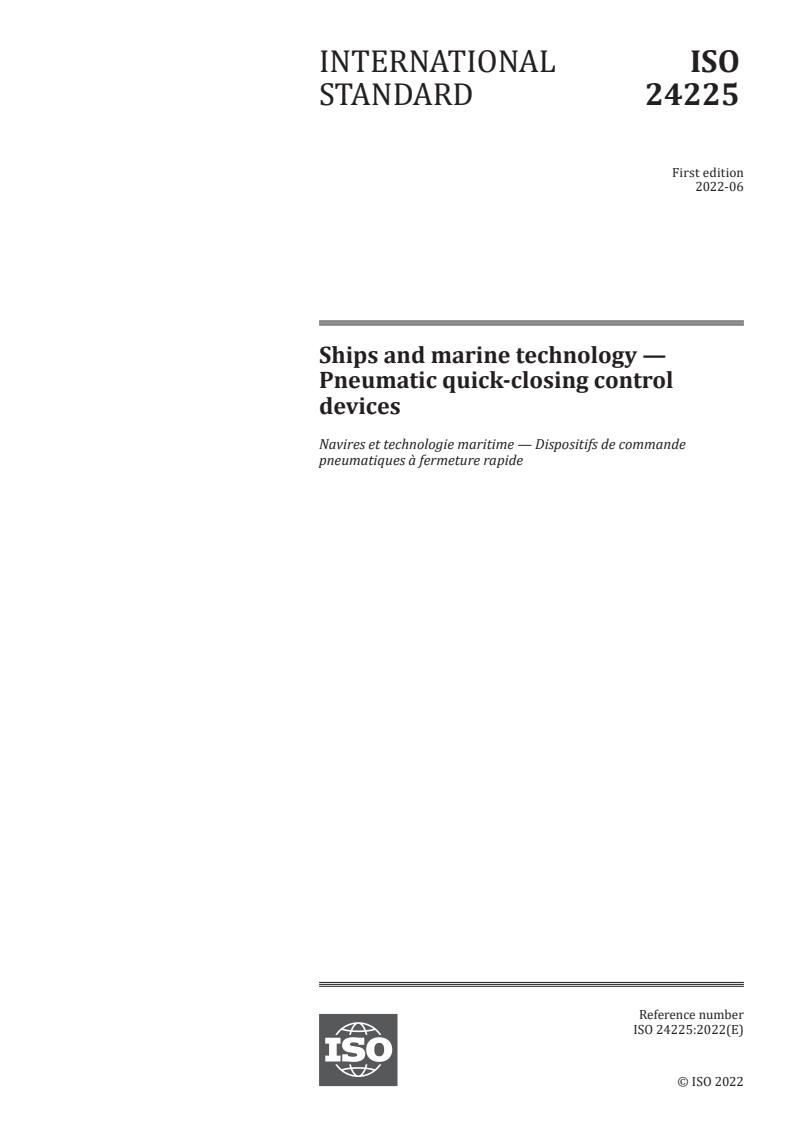
Overview
ISO 24225:2022 - Ships and marine technology - Pneumatic quick-closing control devices defines requirements for the design, manufacture, testing and acceptance of marine pneumatic quick-closing control devices (PQCD). The standard covers terminology, system composition, classification, technical requirements and test methods for PQCD systems used to operate pneumatic quick-closing valves, fire dampers and shutters on ships and offshore installations. It also addresses system pressures, automatic controls, alarms, signal feedback, safety (fail‑safe design), and packaging, handling and marking for supply and installation.
Keywords: ISO 24225:2022, pneumatic quick-closing control devices, PQCD, marine pneumatic systems, ships and marine technology, SOLAS compliance, marine safety.
Key Topics and Technical Requirements
- Terms & definitions - consistent vocabulary for PQCD, control/display panels and remote cabinets.
- System design & components - composition of PQCD with components such as air filters, inlet/outlet valves, compressed air tanks, safety valves, pressure transducers/gauges, three‑way control valves, silencers, pipelines and control panels.
- System pressures & operation - requirements for rated input/output and minimum working pressures, pressure regulation and independent air supply/pressure relief for controlled pipelines.
- Control, feedback & alarms - requirements for remote operation, valve position display, status monitoring and alarm signalling; systems must be fail‑safe and revert to a predefined safe state on component failure.
- Materials & classifications - guidance on material selection and device classification by type and function.
- Performance & testing - procedures for strength, leakage and operational tests, air and power supply fluctuation tests, electrical properties (insulation, voltage withstand), environmental adaptability (dry heat, cold, damp heat, vibration, salt mist) and electromagnetic compatibility (EMC).
- Marking, packaging & handling - identification, packaging symbols and storage/handling practices for marine distribution.
Applications
ISO 24225:2022 applies to the design, manufacture and acceptance testing of PQCDs used to:
- Remotely operate pneumatic quick-closing valves, fire dampers and shutters on ships and offshore platforms.
- Enhance fire safety and emergency isolation systems onboard vessels and marine installations.
- Support compliance with SOLAS and other maritime safety regulations where pneumatic quick‑closing systems are required.
Who uses this standard
- Shipbuilders and marine equipment manufacturers
- Naval architects and system integrators
- Ship operators, safety officers and maintenance teams
- Classification societies and marine certification bodies
- Test laboratories and procurement/specification engineers
Related standards
Normative references include environmental and EMC test standards such as IEC 60068 series (environmental testing), IEC 60529 (IP code), IEC 61000‑4‑5 (surge), IEC 60533 (ship EMC) and ISO 780 (packaging symbols). These provide complementary test and compliance guidance for PQCDs.
Relations
- Effective Date
- 13-Apr-2024
- Consolidated By
ISO 23649:2025 - Chemicals for the leather tanning industry — Determination of cyclosiloxanes - Effective Date
- 29-Jul-2023
Get Certified
Connect with accredited certification bodies for this standard

DNV
DNV is an independent assurance and risk management provider.

Lloyd's Register
Lloyd's Register is a global professional services organisation specialising in engineering and technology.

FSC International
Forest Stewardship Council certification.
Sponsored listings
Frequently Asked Questions
ISO 24225:2022 is a standard published by the International Organization for Standardization (ISO). Its full title is "Ships and marine technology — Pneumatic quick-closing control devices". This standard covers: This document specifies the terms and definitions, design, system components, classification, technical requirements and test methods of marine pneumatic quick-closing control devices. It also addresses system pressures, automatic controls, alarms, signal feedback, performance test methods, safety, packaging and handling of pneumatic quick-closing control devices. This document applies to the design, manufacture and acceptance of pneumatic quick-closing control devices.
This document specifies the terms and definitions, design, system components, classification, technical requirements and test methods of marine pneumatic quick-closing control devices. It also addresses system pressures, automatic controls, alarms, signal feedback, performance test methods, safety, packaging and handling of pneumatic quick-closing control devices. This document applies to the design, manufacture and acceptance of pneumatic quick-closing control devices.
ISO 24225:2022 is classified under the following ICS (International Classification for Standards) categories: 47.020.01 - General standards related to shipbuilding and marine structures. The ICS classification helps identify the subject area and facilitates finding related standards.
ISO 24225:2022 has the following relationships with other standards: It is inter standard links to ISO 25089:2025, ISO 23649:2025. Understanding these relationships helps ensure you are using the most current and applicable version of the standard.
ISO 24225:2022 is available in PDF format for immediate download after purchase. The document can be added to your cart and obtained through the secure checkout process. Digital delivery ensures instant access to the complete standard document.
Standards Content (Sample)
INTERNATIONAL ISO
STANDARD 24225
First edition
2022-06
Ships and marine technology —
Pneumatic quick-closing control
devices
Navires et technologie maritime — Dispositifs de commande
pneumatiques à fermeture rapide
Reference number
© ISO 2022
All rights reserved. Unless otherwise specified, or required in the context of its implementation, no part of this publication may
be reproduced or utilized otherwise in any form or by any means, electronic or mechanical, including photocopying, or posting on
the internet or an intranet, without prior written permission. Permission can be requested from either ISO at the address below
or ISO’s member body in the country of the requester.
ISO copyright office
CP 401 • Ch. de Blandonnet 8
CH-1214 Vernier, Geneva
Phone: +41 22 749 01 11
Email: copyright@iso.org
Website: www.iso.org
Published in Switzerland
ii
Contents Page
Foreword .iv
Introduction .v
1 Scope . 1
2 Normative references . 1
3 Terms and definitions . 1
4 Design . 2
4.1 System composition . 2
4.2 Requirements . 4
4.3 Materials . 5
4.4 Classifications and types . 5
5 Performance . 6
5.1 Strength . 6
5.2 Tightness . 6
5.3 Operational performance. 6
5.4 Air fluctuation . 6
5.5 Electrical properties. 6
5.5.1 Power supply fluctuation . 6
5.5.2 Power supply fault . 7
5.5.3 Insulation resistance . 7
5.5.4 Voltage withstanding . 7
5.6 Environmental adaptability . 7
5.6.1 Dry heat and cold . 7
5.6.2 Damp heat . 7
5.6.3 Inclination and swinging . 8
5.6.4 Vibration . 8
5.6.5 Salt mist . 8
5.6.6 IP code . 8
5.7 Electromagnetic compatibility. 8
6 Test and inspection .8
6.1 Strength test . 8
6.2 Leakage test . 8
6.3 Operational performance. 9
6.4 Air supply fluctuation . 9
6.5 Power supply fluctuation . 9
6.6 Power supply fault . 9
6.7 Insulation resistance. 9
6.8 Voltage withstanding . 9
6.9 Dry heat. 9
6.10 Cold . 9
6.11 Cyclic damp heat . 9
6.12 Inclination and swinging . 10
6.13 Vibration . 10
6.14 Salt mist . 10
6.15 IP code . 10
6.16 Electromagnetic compatibility. 10
7 Marking, packaging, handling and storage .10
7.1 Marking . 10
7.2 Packaging . 10
7.3 Handling and storage . 11
Bibliography .12
iii
Foreword
ISO (the International Organization for Standardization) is a worldwide federation of national standards
bodies (ISO member bodies). The work of preparing International Standards is normally carried out
through ISO technical committees. Each member body interested in a subject for which a technical
committee has been established has the right to be represented on that committee. International
organizations, governmental and non-governmental, in liaison with ISO, also take part in the work.
ISO collaborates closely with the International Electrotechnical Commission (IEC) on all matters of
electrotechnical standardization.
The procedures used to develop this document and those intended for its further maintenance are
described in the ISO/IEC Directives, Part 1. In particular, the different approval criteria needed for the
different types of ISO documents should be noted. This document was drafted in accordance with the
editorial rules of the ISO/IEC Directives, Part 2 (see www.iso.org/directives).
Attention is drawn to the possibility that some of the elements of this document may be the subject of
patent rights. ISO shall not be held responsible for identifying any or all such patent rights. Details of
any patent rights identified during the development of the document will be in the Introduction and/or
on the ISO list of patent declarations received (see www.iso.org/patents).
Any trade name used in this document is information given for the convenience of users and does not
constitute an endorsement.
For an explanation of the voluntary nature of standards, the meaning of ISO specific terms and
expressions related to conformity assessment, as well as information about ISO's adherence to
the World Trade Organization (WTO) principles in the Technical Barriers to Trade (TBT), see
www.iso.org/iso/foreword.html.
This document was prepared by Technical Committee ISO/TC8, Ships and marine technology,
Subcommittee SC3, Piping and machinery.
Any feedback or questions on this document should be directed to the user’s national standards body. A
complete listing of these bodies can be found at www.iso.org/members.html.
iv
Introduction
A pneumatic quick-closing control device is a remote operation system used to control quick-closing
valves, fire dampers and shutters of marine quick-closing systems. It plays a vital role in protecting the
safety of ships and offshore facilities, and reducing fire losses. It also helps to ensure compliance with
the requirements specified in the applicable sections of The International Convention for the Safety of
[1]
Life at Sea (SOLAS) .
v
INTERNATIONAL STANDARD ISO 24225:2022(E)
Ships and marine technology — Pneumatic quick-closing
control devices
1 Scope
This document specifies the terms and definitions, design, system components, classification, technical
requirements and test methods of marine pneumatic quick-closing control devices. It also addresses
system pressures, automatic controls, alarms, signal feedback, performance test methods, safety,
packaging and handling of pneumatic quick-closing control devices.
This document applies to the design, manufacture and acceptance of pneumatic quick-closing control
devices.
2 Normative references
The following documents are referred to in the text in such a way that some or all of their content
constitutes requirements of this document. For dated references, only the edition cited applies. For
undated references, the latest edition of the referenced document (including any amendments) applies.
ISO 780, Packaging — Distribution packaging — Graphical symbols for handling and storage of packages
GB/T 13306, Plates
IEC 60068-2-1, Environmental testing — Part 2-1: Tests — Test A: Cold
IEC 60068-2-2, Environmental testing — Part 2-2: Tests — Test B: Dry heat
IEC 60068-2-30, Environmental testing — Part 2-30: Tests — Test Db: Damp heat cyclic
IEC 60068-2-6, Environmental testing — Part 2-6: Tests — Test Fc: Vibration (sinusoidal)
IEC 60068-2-11, Basic environmental testing procedures — Part 2-11: Tests — Test Ka: Salt mist
IEC 61000-4-5, Electromagnetic compatibility — Testing and measurement techniques —Surge immunity
test
IEC 60529, Degrees of protection provided by enclosures (IP code)
IEC 60533, Electrical and electronic installations in ships — Electromagnetic compatibility (EMC) – Ships
with a metallic hull
3 Terms and definitions
For the purposes of this document, the following terms and definitions apply.
ISO and IEC maintain terminology databases for use in standardization at the following addresses:
— ISO Online browsing platform: available at https:// www .iso .org/ obp
— IEC Electropedia: available at https:// www .electropedia .org/
3.1
pneumatic quick-closing control device
PQCD
system installation that realizes remote fast operation, status display and alarms via remote control to
devices such as pneumatic quick-closing valves, pneumatic fire dampers and pneumatic shutters
3.2
control and display panel
electrical panel for electric-controlled operation and status display where the quick-closing device is
installed
3.3
remote control and display cabinet
electrical cabinet for electric-controlled operation and status display in a location away from the quick-
closing device (such as a control room)
4 Design
4.1 System composition
A pneumatic quick-closing system is composed of a pneumatic quick-closing control device (PQCD),
pipelines and the objects to be controlled, such as pneumatic quick-closing valves, pneumatic fire
dampers and pneumatic shutters.
Other components in the PQCD system, including valves and piping, are illustrated in Figure 1.
Key
1 air filter
2 inlet valve
3 compressed air tank
4 safety valve
5 pressure transducer
6 pressure gauge
7 meter three-way test valve
8 meter
...