

ISO 2818:2018
(Main)Plastics — Preparation of test specimens by machining
General Information
- Abstract
This document establishes the general principles and procedures to be followed when machining and notching test specimens from compression-moulded and injection-moulded plastics, extruded sheets, plates and partially finished or wholly finished products. In order to establish a basis for reproducible machining and notching conditions, the following general standardized conditions are applied. It is assumed, however, that the exact procedures used are selected or specified by the relevant material specification or by the standards on the particular test methods. If sufficiently detailed procedures are not thus specified, the interested parties agree upon the conditions to be used.
- Status
- Published
- Publication Date
- 12-Dec-2018
- Technical Committee
- ISO/TC 61/SC 9 - Thermoplastic materials
- Drafting Committee
- ISO/TC 61/SC 9/WG 18 - Preparation of test specimens
- Current Stage
- 9060 - Close of review
- Completion Date
- 04-Jun-2029
Buy Documents


ISO 2818:2018 - Plastics -- Preparation of test specimens by machining
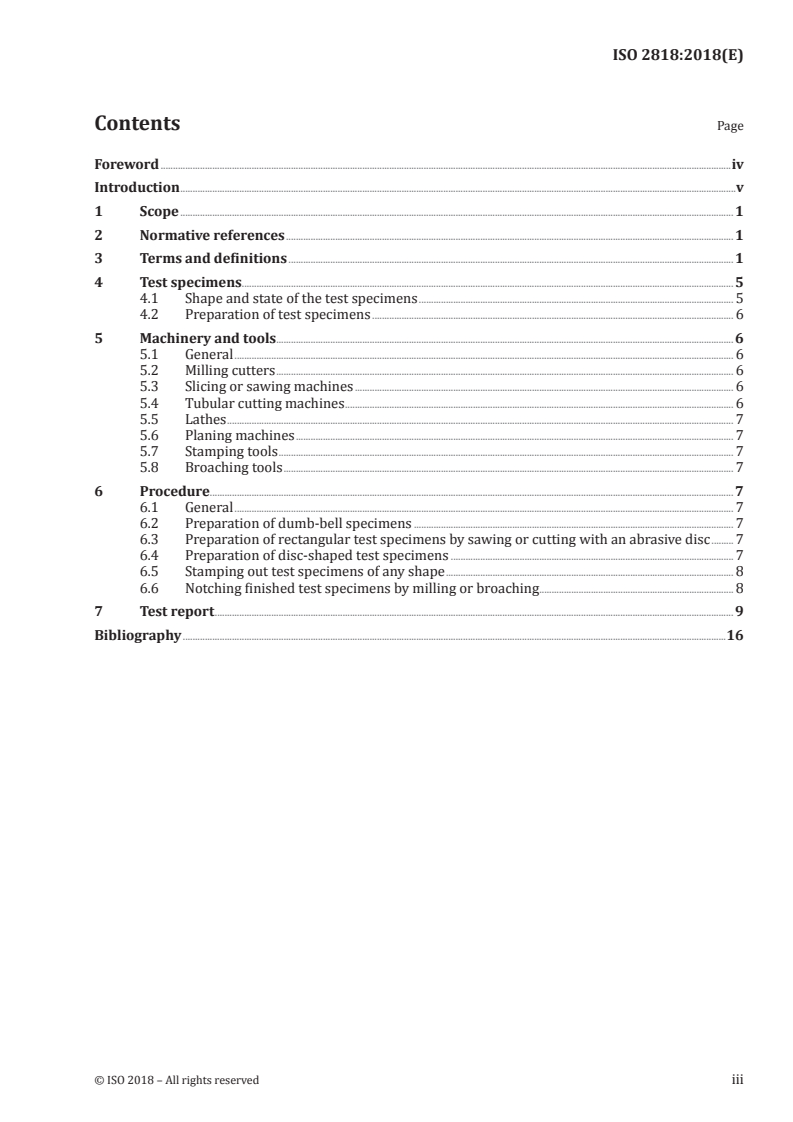
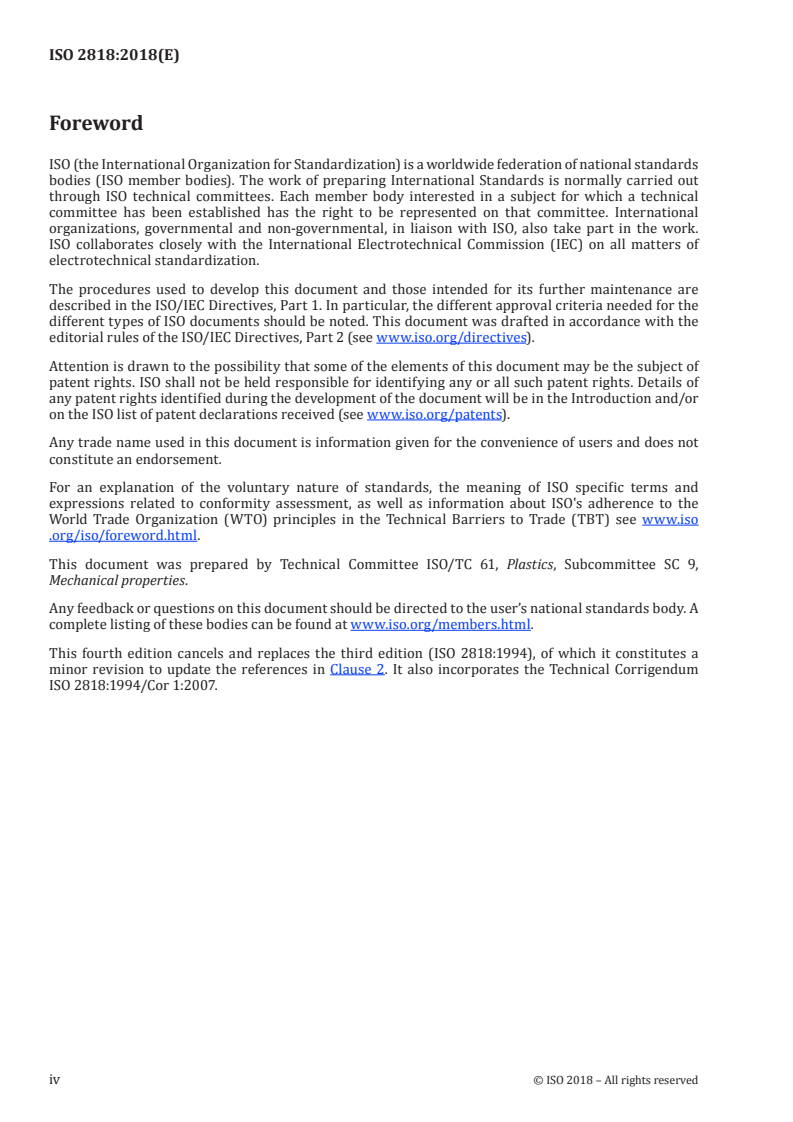
ISO 2818:2018 - Plastics — Preparation of test specimens by machining/13/2018


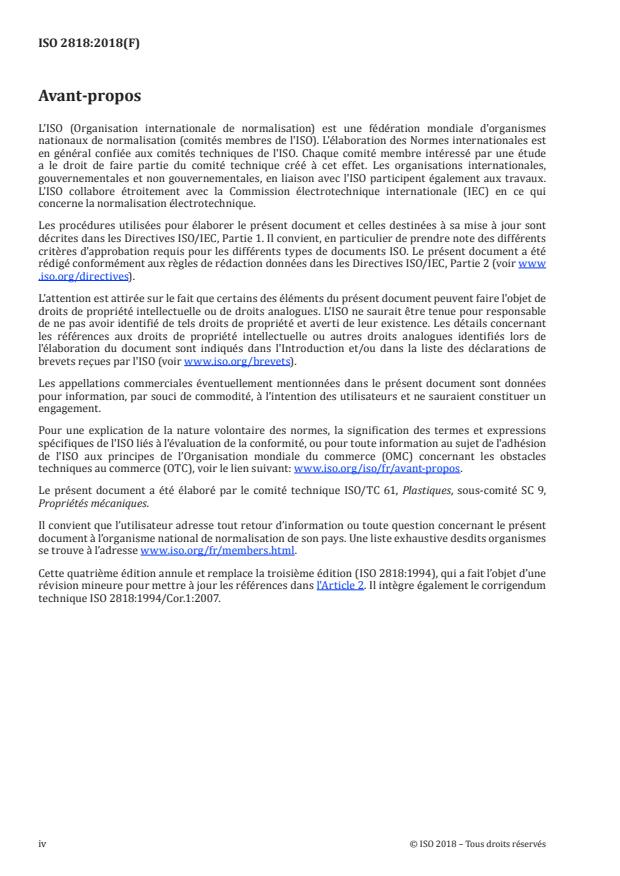
ISO 2818:2018 - Plastiques -- Préparation des éprouvettes par usinage
ISO 2818:2018 - Plastiques — Préparation des éprouvettes par usinage/13/2018
Overview
ISO 2818:2018 - Plastics - Preparation of test specimens by machining - defines general principles and procedures for machining and notching test specimens from compression‑moulded and injection‑moulded plastics, extruded sheets and plates, and finished or semi‑finished plastic products. The standard establishes standardized machining conditions to ensure reproducible specimen preparation for mechanical and physical testing, while recognizing that exact procedures may be set by the material specification or the specific test method.
Key topics and technical requirements
- Scope of specimen types: rectangular bars, notched bars, plates, curvilinear (dumb‑bell) specimens and discs.
- Surface and edge quality: machined surfaces and edges must be free of visible flaws, scratches or imperfections when examined with low‑power magnification (~×5). Rectangular bars must be free of twist and have perpendicular parallel faces.
- Machining processes covered: milling, sawing/cutting (circular or band saw, abrasive discs), cutting disc‑shaped specimens, planing/broaching for finishing or notching, stamping thin sheets, and lathe cutting.
- Tool geometry and machine parameters: definitions and control of tool cutting‑edge geometry, tool radius, number of cutting teeth, cutting speed, feed speed, cutting depth and feed path to achieve reproducible conditions.
- Notching methods: milling or broaching of finished specimens for controlled notch geometry and integrity.
- Inspection and reporting: finished specimens are to be checked against dimensional tolerances and surface quality; test reports should document machining conditions used (tooling, speeds, feeds and any deviations).
- Interplay with other standards: ISO 2818 provides general machining rules and refers to relevant tooling and abrasive standards when applicable.
Practical applications and who uses ISO 2818:2018
- Laboratories and test houses preparing mechanical test specimens (tensile, impact, flexural, hardness) from molded or extruded plastics.
- Material manufacturers specifying reproducible specimen preparation for quality control and product development.
- Standards committees and test method authors referencing uniform machining conditions to reduce variability between laboratories.
- Contract manufacturers and tooling shops producing test coupons or prototype parts that require standardized preparation.
Using ISO 2818 helps reduce variability in test outcomes caused by inconsistent machining, ensuring meaningful, comparable mechanical test results for plastics.
Related standards
- ISO 3002‑1 (milling tool geometry and terminology)
- ISO 3855 (machining terminology)
- ISO 21950 and ISO 6104 (abrasive discs and abrasive products)
Keywords: ISO 2818:2018, plastics test specimens, specimen preparation, machining plastics, milling, sawing, notching, injection‑moulded, compression‑moulded, reproducible machining conditions.
Relations
- Effective Date
- 25-Aug-2026
- Effective Date
- 25-Aug-2026
- Effective Date
- 25-Aug-2026
- Effective Date
- 25-Aug-2026
- Effective Date
- 25-Aug-2026
- Effective Date
- 25-Aug-2026
- Effective Date
- 25-Aug-2026
- Effective Date
- 25-Aug-2026
- Effective Date
- 25-Aug-2026
- Effective Date
- 25-Aug-2026
- Effective Date
- 25-Aug-2026
- Effective Date
- 25-Aug-2026
- Effective Date
- 25-Aug-2026
- Effective Date
- 25-Aug-2026
- Effective Date
- 25-Aug-2026
Buy Documents
ISO 2818:2018 - Plastics -- Preparation of test specimens by machining
ISO 2818:2018 - Plastics — Preparation of test specimens by machining/13/2018
ISO 2818:2018 - Plastiques -- Préparation des éprouvettes par usinage
ISO 2818:2018 - Plastiques — Préparation des éprouvettes par usinage/13/2018
Get Certified
Connect with accredited certification bodies for this standard

DIN CERTCO
DIN Group product certification.

Smithers Quality Assessments
US management systems and product certification.
Sponsored listings
Frequently Asked Questions
ISO 2818:2018 is a standard published by the International Organization for Standardization (ISO). Its full title is "Plastics — Preparation of test specimens by machining". This standard covers: This document establishes the general principles and procedures to be followed when machining and notching test specimens from compression-moulded and injection-moulded plastics, extruded sheets, plates and partially finished or wholly finished products. In order to establish a basis for reproducible machining and notching conditions, the following general standardized conditions are applied. It is assumed, however, that the exact procedures used are selected or specified by the relevant material specification or by the standards on the particular test methods. If sufficiently detailed procedures are not thus specified, the interested parties agree upon the conditions to be used.
This document establishes the general principles and procedures to be followed when machining and notching test specimens from compression-moulded and injection-moulded plastics, extruded sheets, plates and partially finished or wholly finished products. In order to establish a basis for reproducible machining and notching conditions, the following general standardized conditions are applied. It is assumed, however, that the exact procedures used are selected or specified by the relevant material specification or by the standards on the particular test methods. If sufficiently detailed procedures are not thus specified, the interested parties agree upon the conditions to be used.
ISO 2818:2018 is classified under the following ICS (International Classification for Standards) categories: 83.080.01 - Plastics in general. The ICS classification helps identify the subject area and facilitates finding related standards.
ISO 2818:2018 has the following relationships with other standards: It is inter standard links to EN ISO 180:2019, EN ISO 6603-2:2023, EN ISO 75-3:2025, EN ISO 21302-2:2019, EN ISO 7823-3:2021, EN ISO 17855-2:2024, EN ISO 15013:2022, EN ISO 11963:2019, EN ISO 178:2019, EN ISO 14632:2021, EN ISO 24023-2:2020, EN ISO 306:2022, EN ISO 20753:2023, EN ISO 19063-2:2020, EN 12814-1:2025. Understanding these relationships helps ensure you are using the most current and applicable version of the standard.
ISO 2818:2018 is available in PDF format for immediate download after purchase. The document can be added to your cart and obtained through the secure checkout process. Digital delivery ensures instant access to the complete standard document.
Standards Content (Sample)
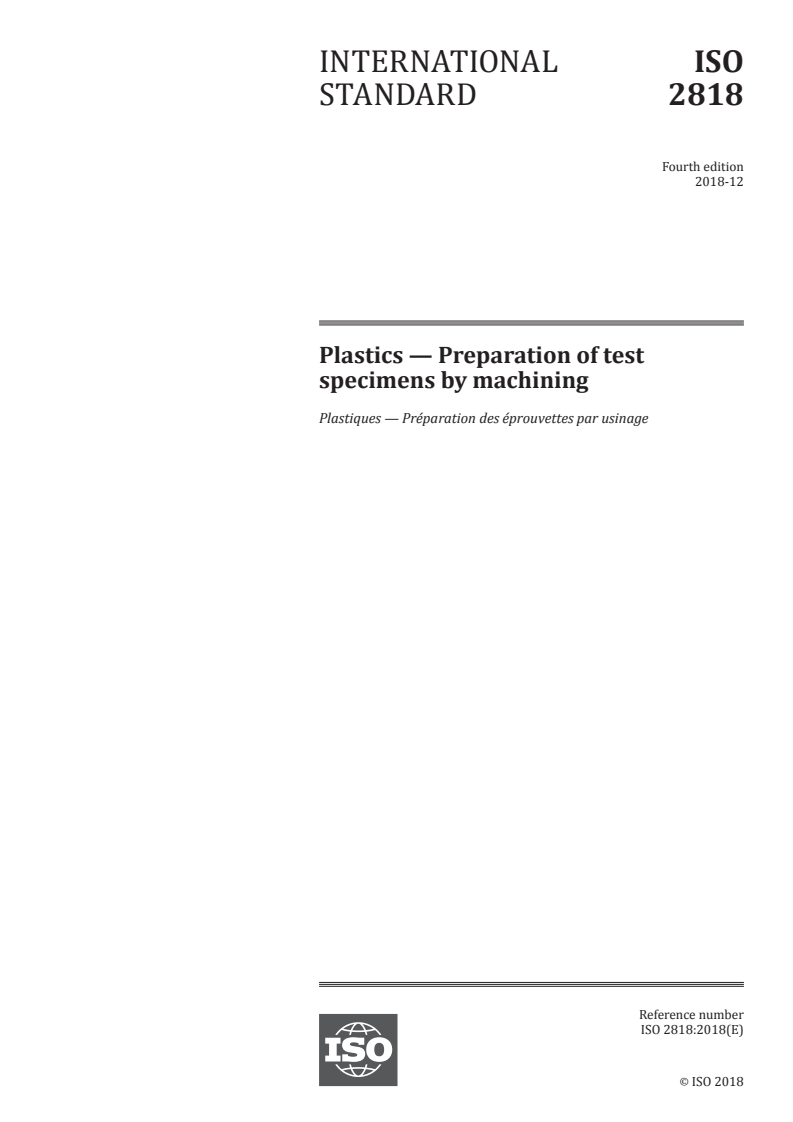
INTERNATIONAL ISO
STANDARD 2818
Fourth edition
2018-12
Plastics — Preparation of test
specimens by machining
Plastiques — Préparation des éprouvettes par usinage
Reference number
©
ISO 2018
© ISO 2018
All rights reserved. Unless otherwise specified, or required in the context of its implementation, no part of this publication may
be reproduced or utilized otherwise in any form or by any means, electronic or mechanical, including photocopying, or posting
on the internet or an intranet, without prior written permission. Permission can be requested from either ISO at the address
below or ISO’s member body in the country of the requester.
ISO copyright office
CP 401 • Ch. de Blandonnet 8
CH-1214 Vernier, Geneva
Phone: +41 22 749 01 11
Fax: +41 22 749 09 47
Email: copyright@iso.org
Website: www.iso.org
Published in Switzerland
ii © ISO 2018 – All rights reserved
Contents Page
Foreword .iv
Introduction .v
1 Scope . 1
2 Normative references . 1
3 Terms and definitions . 1
4 Test specimens. 5
4.1 Shape and state of the test specimens . 5
4.2 Preparation of test specimens . 6
5 Machinery and tools . 6
5.1 General . 6
5.2 Milling cutters . 6
5.3 Slicing or sawing machines . 6
5.4 Tubular cutting machines . 6
5.5 Lathes . 7
5.6 Planing machines . 7
5.7 Stamping tools . 7
5.8 Broaching tools . 7
6 Procedure. 7
6.1 General . 7
6.2 Preparation of dumb-bell specimens . 7
6.3 Preparation of rectangular test specimens by sawing or cutting with an abrasive disc . 7
6.4 Preparation of disc-shaped test specimens . 7
6.5 Stamping out test specimens of any shape . 8
6.6 Notching finished test specimens by milling or broaching . 8
7 Test report . 9
Bibliography .16
Foreword
ISO (the International Organization for Standardization) is a worldwide federation of national standards
bodies (ISO member bodies). The work of preparing International Standards is normally carried out
through ISO technical committees. Each member body interested in a subject for which a technical
committee has been established has the right to be represented on that committee. International
organizations, governmental and non-governmental, in liaison with ISO, also take part in the work.
ISO collaborates closely with the International Electrotechnical Commission (IEC) on all matters of
electrotechnical standardization.
The procedures used to develop this document and those intended for its further maintenance are
described in the ISO/IEC Directives, Part 1. In particular, the different approval criteria needed for the
different types of ISO documents should be noted. This document was drafted in accordance with the
editorial rules of the ISO/IEC Directives, Part 2 (see www .iso .org/directives).
Attention is drawn to the possibility that some of the elements of this document may be the subject of
patent rights. ISO shall not be held responsible for identifying any or all such patent rights. Details of
any patent rights identified during the development of the document will be in the Introduction and/or
on the ISO list of patent declarations received (see www .iso .org/patents).
Any trade name used in this document is information given for the convenience of users and does not
constitute an endorsement.
For an explanation of the voluntary nature of standards, the meaning of ISO specific terms and
expressions related to conformity assessment, as well as information about ISO's adherence to the
World Trade Organization (WTO) principles in the Technical Barriers to Trade (TBT) see www .iso
.org/iso/foreword .html.
This document was prepared by Technical Committee ISO/TC 61, Plastics, Subcommittee SC 9,
Mechanical properties.
Any feedback or questions on this document should be directed to the user’s national standards body. A
complete listing of these bodies can be found at www .iso .org/members .html.
This fourth edition cancels and replaces the third edition (ISO 2818:1994), of which it constitutes a
minor revision to update the references in Clause 2. It also incorporates the Technical Corrigendum
ISO 2818:1994/Cor 1:2007.
iv © ISO 2018 – All rights reserved
Introduction
The preparation of test specimens by machining influences the finished surfaces and, in some cases,
even the internal structure of the specimens. Since test results are strongly dependent on both of these
parameters, exact definitions of tools and machining conditions are required for reproducible test
results with machined specimens.
INTERNATIONAL STANDARD ISO 2818:2018(E)
Plastics — Preparation of test specimens by machining
1 Scope
This document establishes the general principles and procedures to be followed when machining and
notching test specimens from compression-moulded and injection-moulded plastics, extruded sheets,
plates and partially finished or wholly finished products.
In order to establish a basis for reproducible machining and notching conditions, the following general
standardized conditions are applied. It is assumed, however, that the exact procedures used are selected
or specified by the relevant material specification or by the standards on the particular test methods. If
sufficiently detailed procedures are not thus specified, the interested parties agree upon the conditions
to be used.
2 Normative references
There are no normative references in this document.
3 Terms and definitions
For the purposes of this document, the following terms and definitions apply.
ISO and IEC maintain terminological databases for use in standardization at the following addresses:
— ISO Online browsing platform: available at https: //www .iso .org/obp
— IEC Electropedia: available at http: //www .electropedia .org/
3.1 Milling
NOTE In this machining operation, the tool has a circular primary motion and the workpiece a suitable feed
motion. The axis of rotation of the primary motion retains its position with respect to the tool, independently
of the feed motion (see ISO 3855). Complete dumb-bell and rectangular test specimens, as well as notches in
finished specimens, may be prepared by milling.
3.1.1 Geometry (see ISO 3002-1 and Figure 1)
NOTE Only a few details of the exact geometrical conditions of the milling tool and its position with respect
to the workpiece given in ISO 3002-1 are relevant to this document.
3.1.1.1
tool-cutting-edge angle
α
r
angle between the tool-cutting-edge plane, P , and the assumed working plane, P , measured in the tool
s f
back plane, P
r
3.1.1.2
tool back clearance
α
p
angle between the flank, A , of the cutter and the tool-cutting-edge plane, P , measured in the tool back
α s
plane, P
p
3.1.1.3
tool side clearance
α
f
angle between the flank A of the cutter and the tool-cutting-edge plane P , measured in the assumed
α s
working plane, P
f
3.1.1.4
tool radius
R
distance between the axis of the circular primary motion of the tool and its cutting edge
3.1.1.5
number of cutting teeth
z
number of cutting edges on the outer periphery of the rotating milling tool
3.1.2 Tool and workpiece motions (see ISO 3002-1 and Figure 2)
3.1.2.1
rotational speed of tool
n
speed of the circular primary motion of the tool
Note 1 to entry: The rotational speed of tool is expressed in revolutions per minute (r/min).
3.1.2.2
cutting speed
v
c
instantaneous velocity of the primary motion of a selected point on the cutting edge relative to the
workpiece
Note 1 to entry: The relationship between v and n is given by the formula v = n·2πR.
c c
Note 2 to entry: The cutting speed is expressed in metres per minute.
3.1.2.3
feed speed
v
f
instantaneous velocity of the feed motion of a selected point on the cutting edge relative to the
workpiece
Note 1 to entry: The feed speed is expressed in metres per minute.
3.1.2.4
feed path
λ
distance at any given point on the surface of the workpiece covered during the time between two
successive cutting operations
Note 1 to entry: The feed path is given by the formula λ = v /z·n.
f
Note 2 to entry: The feed path is expressed in millimetres.
3.1.2.5
cutting depth
a
distance between the surfaces of the workpiece before and after one complete milling run
Note 1 to entry: The cutting depth is expressed in millimetres.
2 © ISO 2018 – All rights reserved
3.2 Cutting of rectangular test specimens
NOTE In this machining operation, rectangular test specimens are cut by means of a circular or band saw,
made from hardened steel or coated with diamond or cubic boron nitride powder, or cut with the aid of an
abrasive disc of which the cutting edge may be coated with diamond or boron nitride powder. For further details
on abrasive discs and abrasive products, see ISO 21950 and ISO 6104.
3.2.1 Geometry
3.2.1.1
tool radius
R
distance between the rotary axis of a circular saw or an abrasive disc and the cutting edges of the tool
Note 1 to entry: The tool radius is expressed in millimetres.
3.2.1.2
number of cutting teeth
z
number of cutting teeth on the periphery of a circular saw
3.2.2 Tool and workpiece motions
3.2.2.1
rotational speed of tool
n
speed of rotation of a circular saw or an abrasive disc
Note 1 to entry: Rotational speed of tool is expressed in revolutions per minute (r/min).
3.2.2.2
cutting speed
v
c
instantaneous velocity of the cutting tip of a saw tooth, or of a selected point on the cutting edge of an
abrasive disc, relative to the workpiece
Note 1 to entry: For a circular saw or an abrasive disc, the relationship between v and n is given by the formula
c
v = n·2πR.
c
Note 2 to entry: The cutting speed is expressed in metres per minute.
3.2.2.3
feed speed
v
f
instantaneous velocity of the tool feed parallel to the saw or disc plane and perpendicular to the cutting
direction relative to the workpiece
Note 1 to entry: The feed speed is expressed in metres per minute.
3.3 Cutting of disc-shaped test specimens (see Figure 4)
NOTE In this machining operation, disc-shaped test specimens are cut from sheet material with the aid
of a circular cutter with a saw-toothed edge of hardened steel or which may be coated with diamond or cubic
boron nitride powder. The test specimens may also be cut by means of a milling cutter with one or more teeth, as
described in 3.1, which moves in a circular orbit. Furthermore, the test specimens may also be cut from a roughly
preshaped pack of individual sheets with the aid of a turning lathe.
3.3.1 Geometry
3.3.1.1
tool radius
R
distance between the rotary axis of the circular cutter and the inner limit of the cutting edge
Note 1 to entry: The tool radius is equal to the radius of the finished test specimen. It is expressed in millimetres.
3.3.1.2
number of cutting teeth
z
number of teeth on the sawtooth cutting edge of a circular cutter
Note 1 to entry: If a lathe is used for cutting circular test specimens, the geometrical definitions of the cutting
tool are the same as those given in 3.1.
3.3.2 Tool and workpiece motions
3.3.2.1
rotational speed of tool
n
speed of rotation of a circular cutter
Note 1 to entry: The rotational speed of tool is expressed in revolutions per minute.
3.3.2.2
cutting speed
v
с
instantaneous velocity of a selected point on the cutting edge relative to the workpiece.
Note 1 to entry: The relationship between v and n is given by the formula v = n·2πR.
c c
Note 2 to entry: The cutting speed is expressed in metres per minute.
3.3.2.3
feed speed
v
f
instantaneous velocity, in metres per minute, of the tool feed parallel to the rotary axis of the circular
cutter and perpendicular to the cutting direction relative to the workpiece
3.4 Planing of rectangular bars and planing or broaching of notches in finished test specimens
NOTE In this machining operation, sawed or sliced rectangular bars are finished by planing. Also, notches in
finished specimens can be cut by planing or broaching.
3.4.1 Geometry
NOTE For this machining operation, the geometry of the tool-cutting-edge angle, the tool back clearance and
the tool side clearance is defined, respectively, in 3.1.1.1, 3.1.1.2 and 3.1.1.3.
3.4.2 Tool and workpiece motions
3.4.2.1
cutting speed
v
c
instantaneous velocity of the primary motion of a selected point on the cutting edge relative to the
workpiece
Note 1 to entry: The cutting speed is expressed in metres per minute.
4 © ISO 2018 – All rights reserved
3.4.2.2
cutting depth
a
distance between the surfaces of the workpiece before and after one planing run
Note 1 to entry: The cutting depth is expressed in millimetres.
3.5 Stamping of arbitrarily shaped test specimens fabricated from thin sheets
NOTE In this operation, arbitrarily shaped test specimens are stamped under high pressure from thin
sheets by means of a tool with a sharp edge made from hardened steel and located in a plane parallel to the plane
of the sheet.
3.5.1 Geometry
3.5.1.1
shape of the stamping tool
geometric shape of the stamping edge in a plane parallel to the sheet plane
Note 1 to entry: The shape of the stamping tool depends on the shape of the test specimen to be stamped, along
with its required dimensions and tolerances.
3.5.2 Forces on the tool and tool motion
3.5.2.1
contact force
F
c
force applied to the stamping tool in the direction perpendicular to the sheet plane
Note 1 to entr
...
INTERNATIONAL ISO
STANDARD 2818
Fourth edition
2018-12
Plastics — Preparation of test
specimens by machining
Plastiques — Préparation des éprouvettes par usinage
Reference number
©
ISO 2018
© ISO 2018
All rights reserved. Unless otherwise specified, or required in the context of its implementation, no part of this publication may
be reproduced or utilized otherwise in any form or by any means, electronic or mechanical, including photocopying, or posting
on the internet or an intranet, without prior written permission. Permission can be requested from either ISO at the address
below or ISO’s member body in the country of the requester.
ISO copyright office
CP 401 • Ch. de Blandonnet 8
CH-1214 Vernier, Geneva
Phone: +41 22 749 01 11
Fax: +41 22 749 09 47
Email: copyright@iso.org
Website: www.iso.org
Published in Switzerland
ii © ISO 2018 – All rights reserved
Contents Page
Foreword .iv
Introduction .v
1 Scope . 1
2 Normative references . 1
3 Terms and definitions . 1
4 Test specimens. 5
4.1 Shape and state of the test specimens . 5
4.2 Preparation of test specimens . 6
5 Machinery and tools . 6
5.1 General . 6
5.2 Milling cutters . 6
5.3 Slicing or sawing machines . 6
5.4 Tubular cutting machines . 6
5.5 Lathes . 7
5.6 Planing machines . 7
5.7 Stamping tools . 7
5.8 Broaching tools . 7
6 Procedure. 7
6.1 General . 7
6.2 Preparation of dumb-bell specimens . 7
6.3 Preparation of rectangular test specimens by sawing or cutting with an abrasive disc . 7
6.4 Preparation of disc-shaped test specimens . 7
6.5 Stamping out test specimens of any shape . 8
6.6 Notching finished test specimens by milling or broaching . 8
7 Test report . 9
Bibliography .16
Foreword
ISO (the International Organization for Standardization) is a worldwide federation of national standards
bodies (ISO member bodies). The work of preparing International Standards is normally carried out
through ISO technical committees. Each member body interested in a subject for which a technical
committee has been established has the right to be represented on that committee. International
organizations, governmental and non-governmental, in liaison with ISO, also take part in the work.
ISO collaborates closely with the International Electrotechnical Commission (IEC) on all matters of
electrotechnical standardization.
The procedures used to develop this document and those intended for its further maintenance are
described in the ISO/IEC Directives, Part 1. In particular, the different approval criteria needed for the
different types of ISO documents should be noted. This document was drafted in accordance with the
editorial rules of the ISO/IEC Directives, Part 2 (see www .iso .org/directives).
Attention is drawn to the possibility that some of the elements of this document may be the subject of
patent rights. ISO shall not be held responsible for identifying any or all such patent rights. Details of
any patent rights identified during the development of the document will be in the Introduction and/or
on the ISO list of patent declarations received (see www .iso .org/patents).
Any trade name used in this document is information given for the convenience of users and does not
constitute an endorsement.
For an explanation of the voluntary nature of standards, the meaning of ISO specific terms and
expressions related to conformity assessment, as well as information about ISO's adherence to the
World Trade Organization (WTO) principles in the Technical Barriers to Trade (TBT) see www .iso
.org/iso/foreword .html.
This document was prepared by Technical Committee ISO/TC 61, Plastics, Subcommittee SC 9,
Mechanical properties.
Any feedback or questions on this document should be directed to the user’s national standards body. A
complete listing of these bodies can be found at www .iso .org/members .html.
This fourth edition cancels and replaces the third edition (ISO 2818:1994), of which it constitutes a
minor revision to update the references in Clause 2. It also incorporates the Technical Corrigendum
ISO 2818:1994/Cor 1:2007.
iv © ISO 2018 – All rights reserved
Introduction
The preparation of test specimens by machining influences the finished surfaces and, in some cases,
even the internal structure of the specimens. Since test results are strongly dependent on both of these
parameters, exact definitions of tools and machining conditions are required for reproducible test
results with machined specimens.
INTERNATIONAL STANDARD ISO 2818:2018(E)
Plastics — Preparation of test specimens by machining
1 Scope
This document establishes the general principles and procedures to be followed when machining and
notching test specimens from compression-moulded and injection-moulded plastics, extruded sheets,
plates and partially finished or wholly finished products.
In order to establish a basis for reproducible machining and notching conditions, the following general
standardized conditions are applied. It is assumed, however, that the exact procedures used are selected
or specified by the relevant material specification or by the standards on the particular test methods. If
sufficiently detailed procedures are not thus specified, the interested parties agree upon the conditions
to be used.
2 Normative references
There are no normative references in this document.
3 Terms and definitions
For the purposes of this document, the following terms and definitions apply.
ISO and IEC maintain terminological databases for use in standardization at the following addresses:
— ISO Online browsing platform: available at https: //www .iso .org/obp
— IEC Electropedia: available at http: //www .electropedia .org/
3.1 Milling
NOTE In this machining operation, the tool has a circular primary motion and the workpiece a suitable feed
motion. The axis of rotation of the primary motion retains its position with respect to the tool, independently
of the feed motion (see ISO 3855). Complete dumb-bell and rectangular test specimens, as well as notches in
finished specimens, may be prepared by milling.
3.1.1 Geometry (see ISO 3002-1 and Figure 1)
NOTE Only a few details of the exact geometrical conditions of the milling tool and its position with respect
to the workpiece given in ISO 3002-1 are relevant to this document.
3.1.1.1
tool-cutting-edge angle
α
r
angle between the tool-cutting-edge plane, P , and the assumed working plane, P , measured in the tool
s f
back plane, P
r
3.1.1.2
tool back clearance
α
p
angle between the flank, A , of the cutter and the tool-cutting-edge plane, P , measured in the tool back
α s
plane, P
p
3.1.1.3
tool side clearance
α
f
angle between the flank A of the cutter and the tool-cutting-edge plane P , measured in the assumed
α s
working plane, P
f
3.1.1.4
tool radius
R
distance between the axis of the circular primary motion of the tool and its cutting edge
3.1.1.5
number of cutting teeth
z
number of cutting edges on the outer periphery of the rotating milling tool
3.1.2 Tool and workpiece motions (see ISO 3002-1 and Figure 2)
3.1.2.1
rotational speed of tool
n
speed of the circular primary motion of the tool
Note 1 to entry: The rotational speed of tool is expressed in revolutions per minute (r/min).
3.1.2.2
cutting speed
v
c
instantaneous velocity of the primary motion of a selected point on the cutting edge relative to the
workpiece
Note 1 to entry: The relationship between v and n is given by the formula v = n·2πR.
c c
Note 2 to entry: The cutting speed is expressed in metres per minute.
3.1.2.3
feed speed
v
f
instantaneous velocity of the feed motion of a selected point on the cutting edge relative to the
workpiece
Note 1 to entry: The feed speed is expressed in metres per minute.
3.1.2.4
feed path
λ
distance at any given point on the surface of the workpiece covered during the time between two
successive cutting operations
Note 1 to entry: The feed path is given by the formula λ = v /z·n.
f
Note 2 to entry: The feed path is expressed in millimetres.
3.1.2.5
cutting depth
a
distance between the surfaces of the workpiece before and after one complete milling run
Note 1 to entry: The cutting depth is expressed in millimetres.
2 © ISO 2018 – All rights reserved
3.2 Cutting of rectangular test specimens
NOTE In this machining operation, rectangular test specimens are cut by means of a circular or band saw,
made from hardened steel or coated with diamond or cubic boron nitride powder, or cut with the aid of an
abrasive disc of which the cutting edge may be coated with diamond or boron nitride powder. For further details
on abrasive discs and abrasive products, see ISO 21950 and ISO 6104.
3.2.1 Geometry
3.2.1.1
tool radius
R
distance between the rotary axis of a circular saw or an abrasive disc and the cutting edges of the tool
Note 1 to entry: The tool radius is expressed in millimetres.
3.2.1.2
number of cutting teeth
z
number of cutting teeth on the periphery of a circular saw
3.2.2 Tool and workpiece motions
3.2.2.1
rotational speed of tool
n
speed of rotation of a circular saw or an abrasive disc
Note 1 to entry: Rotational speed of tool is expressed in revolutions per minute (r/min).
3.2.2.2
cutting speed
v
c
instantaneous velocity of the cutting tip of a saw tooth, or of a selected point on the cutting edge of an
abrasive disc, relative to the workpiece
Note 1 to entry: For a circular saw or an abrasive disc, the relationship between v and n is given by the formula
c
v = n·2πR.
c
Note 2 to entry: The cutting speed is expressed in metres per minute.
3.2.2.3
feed speed
v
f
instantaneous velocity of the tool feed parallel to the saw or disc plane and perpendicular to the cutting
direction relative to the workpiece
Note 1 to entry: The feed speed is expressed in metres per minute.
3.3 Cutting of disc-shaped test specimens (see Figure 4)
NOTE In this machining operation, disc-shaped test specimens are cut from sheet material with the aid
of a circular cutter with a saw-toothed edge of hardened steel or which may be coated with diamond or cubic
boron nitride powder. The test specimens may also be cut by means of a milling cutter with one or more teeth, as
described in 3.1, which moves in a circular orbit. Furthermore, the test specimens may also be cut from a roughly
preshaped pack of individual sheets with the aid of a turning lathe.
3.3.1 Geometry
3.3.1.1
tool radius
R
distance between the rotary axis of the circular cutter and the inner limit of the cutting edge
Note 1 to entry: The tool radius is equal to the radius of the finished test specimen. It is expressed in millimetres.
3.3.1.2
number of cutting teeth
z
number of teeth on the sawtooth cutting edge of a circular cutter
Note 1 to entry: If a lathe is used for cutting circular test specimens, the geometrical definitions of the cutting
tool are the same as those given in 3.1.
3.3.2 Tool and workpiece motions
3.3.2.1
rotational speed of tool
n
speed of rotation of a circular cutter
Note 1 to entry: The rotational speed of tool is expressed in revolutions per minute.
3.3.2.2
cutting speed
v
с
instantaneous velocity of a selected point on the cutting edge relative to the workpiece.
Note 1 to entry: The relationship between v and n is given by the formula v = n·2πR.
c c
Note 2 to entry: The cutting speed is expressed in metres per minute.
3.3.2.3
feed speed
v
f
instantaneous velocity, in metres per minute, of the tool feed parallel to the rotary axis of the circular
cutter and perpendicular to the cutting direction relative to the workpiece
3.4 Planing of rectangular bars and planing or broaching of notches in finished test specimens
NOTE In this machining operation, sawed or sliced rectangular bars are finished by planing. Also, notches in
finished specimens can be cut by planing or broaching.
3.4.1 Geometry
NOTE For this machining operation, the geometry of the tool-cutting-edge angle, the tool back clearance and
the tool side clearance is defined, respectively, in 3.1.1.1, 3.1.1.2 and 3.1.1.3.
3.4.2 Tool and workpiece motions
3.4.2.1
cutting speed
v
c
instantaneous velocity of the primary motion of a selected point on the cutting edge relative to the
workpiece
Note 1 to entry: The cutting speed is expressed in metres per minute.
4 © ISO 2018 – All rights reserved
3.4.2.2
cutting depth
a
distance between the surfaces of the workpiece before and after one planing run
Note 1 to entry: The cutting depth is expressed in millimetres.
3.5 Stamping of arbitrarily shaped test specimens fabricated from thin sheets
NOTE In this operation, arbitrarily shaped test specimens are stamped under high pressure from thin
sheets by means of a tool with a sharp edge made from hardened steel and located in a plane parallel to the plane
of the sheet.
3.5.1 Geometry
3.5.1.1
shape of the stamping tool
geometric shape of the stamping edge in a plane parallel to the sheet plane
Note 1 to entry: The shape of the stamping tool depends on the shape of the test specimen to be stamped, along
with its required dimensions and tolerances.
3.5.2 Forces on the tool and tool motion
3.5.2.1
contact force
F
c
force applied to the stamping tool in the direction perpendicular to the sheet plane
Note 1 to entr
...
NORME ISO
INTERNATIONALE 2818
Quatrième édition
2018-12
Plastiques — Préparation des
éprouvettes par usinage
Plastics — Preparation of test specimens by machining
Numéro de référence
©
ISO 2018
DOCUMENT PROTÉGÉ PAR COPYRIGHT
© ISO 2018
Tous droits réservés. Sauf prescription différente ou nécessité dans le contexte de sa mise en œuvre, aucune partie de cette
publication ne peut être reproduite ni utilisée sous quelque forme que ce soit et par aucun procédé, électronique ou mécanique,
y compris la photocopie, ou la diffusion sur l’internet ou sur un intranet, sans autorisation écrite préalable. Une autorisation peut
être demandée à l’ISO à l’adresse ci-après ou au comité membre de l’ISO dans le pays du demandeur.
ISO copyright office
Case postale 401 • Ch. de Blandonnet 8
CH-1214 Vernier, Genève
Tél.: +41 22 749 01 11
Fax: +41 22 749 09 47
E-mail: copyright@iso.org
Web: www.iso.org
Publié en Suisse
ii © ISO 2018 – Tous droits réservés
Sommaire Page
Avant-propos .iv
Introduction .v
1 Domaine d'application . 1
2 Références normatives . 1
3 Termes et définitions . 1
4 Éprouvettes . 5
4.1 Forme et état des éprouvettes . 5
4.2 Préparation des éprouvettes . 6
5 Machines et outils . 6
5.1 Général . 6
5.2 Fraises . 6
5.3 Tronçonneuses ou scies . 6
5.4 Machines à découper tubulaires . 7
5.5 Tours . 7
5.6 Machines à raboter . 7
5.7 Outils d'estampage . 7
5.8 Outils à brocher . 7
6 Mode opératoire. 7
6.1 Général . 7
6.2 Préparation des éprouvettes haltères . 7
6.3 Préparation d'éprouvettes rectangulaires par sciage ou découpage au moyen
d'un disque abrasif . 7
6.4 Préparation d'éprouvettes en forme de disque . 8
6.5 Estampage des éprouvettes de forme quelconque . 8
6.6 Réalisation de l'entaille sur des éprouvettes finies, par fraisage ou brochage . 8
7 Rapport d'essai . 9
Bibliographie .16
Avant-propos
L'ISO (Organisation internationale de normalisation) est une fédération mondiale d'organismes
nationaux de normalisation (comités membres de l'ISO). L'élaboration des Normes internationales est
en général confiée aux comités techniques de l'ISO. Chaque comité membre intéressé par une étude
a le droit de faire partie du comité technique créé à cet effet. Les organisations internationales,
gouvernementales et non gouvernementales, en liaison avec l'ISO participent également aux travaux.
L'ISO collabore étroitement avec la Commission électrotechnique internationale (IEC) en ce qui
concerne la normalisation électrotechnique.
Les procédures utilisées pour élaborer le présent document et celles destinées à sa mise à jour sont
décrites dans les Directives ISO/IEC, Partie 1. Il convient, en particulier de prendre note des différents
critères d'approbation requis pour les différents types de documents ISO. Le présent document a été
rédigé conformément aux règles de rédaction données dans les Directives ISO/IEC, Partie 2 (voir www
.iso .org/directives).
L'attention est attirée sur le fait que certains des éléments du présent document peuvent faire l'objet de
droits de propriété intellectuelle ou de droits analogues. L'ISO ne saurait être tenue pour responsable
de ne pas avoir identifié de tels droits de propriété et averti de leur existence. Les détails concernant
les références aux droits de propriété intellectuelle ou autres droits analogues identifiés lors de
l'élaboration du document sont indiqués dans l'Introduction et/ou dans la liste des déclarations de
brevets reçues par l'ISO (voir www .iso .org/brevets).
Les appellations commerciales éventuellement mentionnées dans le présent document sont données
pour information, par souci de commodité, à l’intention des utilisateurs et ne sauraient constituer un
engagement.
Pour une explication de la nature volontaire des normes, la signification des termes et expressions
spécifiques de l'ISO liés à l'évaluation de la conformité, ou pour toute information au sujet de l'adhésion
de l'ISO aux principes de l’Organisation mondiale du commerce (OMC) concernant les obstacles
techniques au commerce (OTC), voir le lien suivant: www .iso .org/iso/fr/avant -propos.
Le présent document a été élaboré par le comité technique ISO/TC 61, Plastiques, sous-comité SC 9,
Propriétés mécaniques.
Il convient que l’utilisateur adresse tout retour d’information ou toute question concernant le présent
document à l’organisme national de normalisation de son pays. Une liste exhaustive desdits organismes
se trouve à l’adresse www .iso .org/fr/members .html.
Cette quatrième édition annule et remplace la troisième édition (ISO 2818:1994), qui a fait l’objet d’une
révision mineure pour mettre à jour les références dans l'Article 2. Il intègre également le corrigendum
technique ISO 2818:1994/Cor.1:2007.
iv © ISO 2018 – Tous droits réservés
Introduction
La préparation des éprouvettes par usinage a une influence sur les surfaces finies, et même dans
certains cas, sur la structure interne des éprouvettes. Les résultats d'essai dépendant fortement de
ces deux paramètres, il importe de définir exactement les outils et les conditions d'usinage nécessaires
pour obtenir des résultats d'essai reproductibles avec les éprouvettes usinées.
NORME INTERNATIONALE ISO 2818:2018(F)
Plastiques — Préparation des éprouvettes par usinage
1 Domaine d'application
Le présent document établit les principes et modes opératoires généraux à suivre lors de l'usinage et de
la production des entailles sur les éprouvettes produites à partir de plastiques moulés par compression
et par injection, de feuilles extrudées, de plaques, et de produits partiellement ou entièrement finis.
Il convient d'appliquer les conditions normalisées générales suivantes pour établir une base permettant
d'obtenir des conditions reproductibles en matière d'usinage et de production d'entailles. On présume,
cependant, que les modes opératoires exacts à utiliser sont choisis ou précisés dans les spécifications
relatives à la matière concernée ou dans les normes afférentes aux méthodes d'essai particulières.
Si les modes opératoires spécifiés ne sont pas suffisamment détaillés, il est essentiel que les parties
concernées s'accordent sur les conditions à utiliser.
2 Références normatives
Il n’y a pas de références normatives dans ce document.
3 Termes et définitions
Pour les besoins du présent document, les termes et définitions suivants s’appliquent.
L’ISO et l’IEC tiennent à jour des bases de données terminologiques destinées à être utilisées en
normalisation, consultables aux adresses suivantes:
— Online browsing platform de l’ISO: disponible à l’adresse https: //www .iso .org/obp
— Electropedia de l’IEC: disponible à l’adresse http: //www .electropedia .org/
3.1 Fraisage
NOTE Il s'agit d'une opération d'usinage au cours de laquelle l'outil décrit un mouvement de coupe circulaire
et la pièce un mouvement d'avance approprié. L'axe de rotation du mouvement de coupe conserve sa position par
rapport à l'outil, indépendamment du mouvement d'avance (voir l’ISO 3855). Le fraisage permet de préparer des
éprouvettes complètes, curvilignes (haltères) et rectangulaires, ainsi que des entailles sur des éprouvettes finies.
3.1.1 Géométrie (voir l’ISO 3002-1 et la Figure 1)
NOTE Parmi les conditions géométriques exactes de l'outil de fraisage et parmi les dispositions relatives à
sa position par rapport à la pièce qui figurent dans l'ISO 3002-1, seules les quelques données détaillées suivantes
s'avèrent importantes pour le présent document.
3.1.1.1
angle de direction d'arête de l'outil
α
r
angle entre le plan d'arête de l'outil, P , et le plan de travail conventionnel, P , mesuré dans le plan situé
s f
vers l'arrière de l'outil, P
r
3.1.1.2
dépouille vers l'arrière de l'outil
α
p
angle entre la face de dépouille, A , du dispositif de coupe et le plan d'arête de l'outil, P , mesuré dans le
α s
plan situé vers l'arrière de l'outil, P
p
3.1.1.3
dépouille latérale de l'outil
α
f
angle entre la face de dépouille, A , du dispositif de coupe et le plan d'arête de l'outil, P , mesuré dans le
α s
plan de travail présumé, P
f
3.1.1.4
rayon de l'outil
R
distance entre l'axe du mouvement de coupe circulaire décrit par l'outil et l'arête
3.1.1.5
nombre de dents coupantes
z
nombre d'arêtes situées sur le contour extérieur de l'outil de fraisage rotatif
3.1.2 Mouvement décrits par l'outil et la pièce (voir l’ISO 3002-1et la Figure 2)
3.1.2.1
vitesse de rotation de l'outil
n
vitesse de rotation caractérisant le mouvement de coupe circulaire de l'outil
Note 1 à l'article: La vitesse de rotation est exprimée en tours par minute (r/min).
3.1.2.2
vitesse de coupe
v
c
vitesse instantanée du mouvement de coupe du point considéré de l'arête, par rapport à la pièce
Note 1 à l'article: La relation existant entre v et n est donnée par la formule v = n·2πR
c c
Note 2 à l'article: La vitesse de coupe est exprimée en mètres par minute.
3.1.2.3
vitesse d'avance
v
f
vitesse instantanée du mouvement d'avance d'un point considéré de l'arête, par rapport à la pièce
Note 1 à l'article: La vitesse d’avance est exprimée en mètres par minute.
3.1.2.4
course
λ
distance d'un point donné de la surface de la pièce, parcourue entre deux opérations de coupe
successives
Note 1 à l'article: La course est donnée par la formule λ = v /z·n.
f
Note 2 à l'article: La course est exprimée en millimètres.
3.1.2.5
profondeur de coupe
a
distance (moyenne) entre les surfaces de la pièce avant et après un tour de fraisage complet
Note 1 à l'article: La profondeur de coupe est exprimée en millimètres.
2 © ISO 2018 – Tous droits réservés
3.2 Découpe des éprouvettes rectangulaires
NOTE Il s'agit d'une opération d'usinage au cours de laquelle on découpe des éprouvettes rectangulaires
au moyen d'une scie circulaire ou à ruban en acier trempé ou comportant un revêtement à base de poudre de
diamant ou de nitrure de bore, ou au moyen d'un disque abrasif dont l'arête peut être revêtue d'une poudre de
diamant ou de nitrure de bore. Pour obtenir de plus amples informations à propos des disques abrasifs et des
produits abrasifs, voir l’ISO 21950 et l’ISO 6104.
3.2.1 Géométrie
3.2.1.1
rayon de l'outil
R
distance entre l'axe de rotation d'une scie circulaire ou d'un disque abrasif et les arêtes de l'outil
Note 1 à l'article: Le rayon de l’outil est exprimé en millimètres.
3.2.1.2
nombre de dents coupantes
z
nombre d'arêtes situées sur le contour d'une scie circulaire
3.2.2 Mouvements décrits par l'outil et la pièce
3.2.2.1
vitesse de rotation de l'outil
n
vitesse de rotation d'une scie circulaire ou d'un disque abrasif
Note 1 à l'article: La vitesse de rotation de l’outil est exprimée en tours par minute (r/min).
3.2.2.2
vitesse de coupe
v
c
vitesse instantanée de la pointe coupante d'une dent de scie, ou d'un point donné de l'arête d'un disque
abrasif, par rapport à la pièce
Note 1 à l'article: Dans le cas d'une scie circulaire ou d'un disque abrasif, la relation existant entre v et n est
c
donnée par la formule v = n·2πR.
c
Note 2 à l'article: La vitesse de coupe est exprimée en mètres par minute.
3.2.2.3
vitesse d'avance
v
f
vitesse instantanée caractérisant le mouvement de l'outil parallèlement au plan de la scie ou du disque
et perpendiculairement à la direction de coupe par rapport à la pièce
Note 1 à l'article: La vitesse d’avance est exprimée en mètres par minute.
3.3 Découpe des éprouvettes en forme de disque (voir la Figure 4)
NOTE Il s'agit d'une opération d'usinage au cours de laquelle on découpe des éprouvettes circulaires
en forme de disque dans des feuilles au moyen d'un coupoir circulaire comportant une arête en dents de scie
en acier trempé, ou pouvant être revêtue d'une poudre de diamant ou de nitrure de bore. On peut également
découper les éprouvettes au moyen d'une fraise à une ou plusieurs dents, conforme à la description donnée en
3.1, se déplaçant sur une orbite circulaire, ou encore, au moyen d'un tour dans un paquet grossièrement préformé
de feuilles simples.
3.3.1 Géometrie
3.3.1.1
rayon de l'outil
R
Distance entre l'axe de rotation du coupoir circulaire et la limite intérieure de l'arête
Note 1 à l'article: Le rayon de l’outil est égal au rayon de l’éprouvette finie. Il est exprimé en millimètres.
3.3.1.2
nombre de dents coupantes
z
nombre de dents sur l'arête de la denture du coupoir circulaireNote 1 à l’article: En cas d'utilisation d'un
tour pour découper des éprouvettes circulaires, les caractéristiques géométriques de l'outil de coupe
sont identiques à celles indiquées en 3.1.
3.3.2 Mouvements décrits par l'outil et la pièce
3.3.2.1
vitesse de rotation de l'outil
n
vitesse de rotation du coupoir circulaire
Note 1 à l'article: La vitesse de rotation de l’outil est exprimée en tour par minute (r/min).
3.3.2.2
vitesse de coupe
v
с
vitesse instantanée d'un point donné de l'arête, par rapport à la pièce
Note 1 à l'article: La relation existant entre v et n est donnée par la formule v = n·2πR.
c c
Note 2 à l'article: La vitesse de coupe est exprimée en mètres par minute.
3.3.2.3
vitesse d'avance
v
f
vitesse instantanée, en mètres par minute, caractérisant le mouvement de l'outil parallèlement à l'axe
de rotation du coupoir circulaire et perpendiculairement à la direction de coupe par rapport à la pièce
3.4 Rabotage des barreaux rectangulaires et rabotage ou brochage des entailles sur des
éprouvettes finies
NOTE Il s'agit d'une opération d'usinage au cours de laquelle des barreaux rectangulaires sciés ou tronçonnés
sont finis par rabotage. Le rabotage ou le brochage permettent également de découper des entailles dans des
éprouvettes finies.
3.4.1 Géométrie
NOTE Pour cette opération d’usinage, la géométrie de l’angle de direction d'arête de l'outil, la dépouille vers
l'arrière de l'outil et la dépouille latérale de l'outil est définie, respectivement, en 3.1.1.1, 3.1.1.2 et 3.1.1.3.
3.4.2 Mouvements décrits par l'outil et la pièce
3.4.2.1
vitesse de coupe
v
c
vitesse instantanée du mouvement de coupe du point considéré de l'arête, par rapport à la pièce
Note 1 à l'article: La vitesse de coupe est exprimée en mètres par minute.
4 © ISO 2018 – Tous droits réservés
3.4.2.2
profondeur de coupe
a
distance (moyenne) entre la surface de la pièce avant et après une opération de rabotage
Note 1 à l'article: La profondeur de coupe est exprimée en millimètres.
3.5 Estampage des éprouvettes formées arbitrairement et fabriquées à partir de feuilles minces
NOTE Il s'agit d'une opération au cours de laquelle des éprouvettes formées arbitrairement sont estampées
sous une forte pression à partir de feuilles minces au moyen d'un outil comportant une arête coupante en acier
trempé, situé dans un plan parallèle au plan de la feuille.
3.5.1 Géométrie
3.5.1.1
forme de l'outil d'estampage
forme géométrique de l'arête d'estampage située dans un plan parallèle au plan de la feuille
Note 1 à l'article: La forme de l'outil d'estampage dépend de la forme de l'éprouvette à estamper, ainsi que de ses
dimensions requises et des tolérances.
3.5.2 Forces exercées sur l'outil et mouvement de l'outil
3.5.2.1
force de contact
F
c
Force appliquée à l'outil d'estampage perpendiculairement au plan de la feuille
Note 1 à l'article: La force de contact est exprimée en newtons.
3.5.2.2
vitesse d'avance
v
f
vitesse instantanée caractérisant le mouvement d'avance du plan de l'arête de l'outil d'estampage
perpendiculairement au plan de la feuille
Note 1 à l'article: La vitesse d’avance est exprimée en mètres par minute.
4 Éprouvettes
4.1 Forme et état des ép
...
NORME ISO
INTERNATIONALE 2818
Quatrième édition
2018-12
Plastiques — Préparation des
éprouvettes par usinage
Plastics — Preparation of test specimens by machining
Numéro de référence
©
ISO 2018
DOCUMENT PROTÉGÉ PAR COPYRIGHT
© ISO 2018
Tous droits réservés. Sauf prescription différente ou nécessité dans le contexte de sa mise en œuvre, aucune partie de cette
publication ne peut être reproduite ni utilisée sous quelque forme que ce soit et par aucun procédé, électronique ou mécanique,
y compris la photocopie, ou la diffusion sur l’internet ou sur un intranet, sans autorisation écrite préalable. Une autorisation peut
être demandée à l’ISO à l’adresse ci-après ou au comité membre de l’ISO dans le pays du demandeur.
ISO copyright office
Case postale 401 • Ch. de Blandonnet 8
CH-1214 Vernier, Genève
Tél.: +41 22 749 01 11
Fax: +41 22 749 09 47
E-mail: copyright@iso.org
Web: www.iso.org
Publié en Suisse
ii © ISO 2018 – Tous droits réservés
Sommaire Page
Avant-propos .iv
Introduction .v
1 Domaine d'application . 1
2 Références normatives . 1
3 Termes et définitions . 1
4 Éprouvettes . 5
4.1 Forme et état des éprouvettes . 5
4.2 Préparation des éprouvettes . 6
5 Machines et outils . 6
5.1 Général . 6
5.2 Fraises . 6
5.3 Tronçonneuses ou scies . 6
5.4 Machines à découper tubulaires . 7
5.5 Tours . 7
5.6 Machines à raboter . 7
5.7 Outils d'estampage . 7
5.8 Outils à brocher . 7
6 Mode opératoire. 7
6.1 Général . 7
6.2 Préparation des éprouvettes haltères . 7
6.3 Préparation d'éprouvettes rectangulaires par sciage ou découpage au moyen
d'un disque abrasif . 7
6.4 Préparation d'éprouvettes en forme de disque . 8
6.5 Estampage des éprouvettes de forme quelconque . 8
6.6 Réalisation de l'entaille sur des éprouvettes finies, par fraisage ou brochage . 8
7 Rapport d'essai . 9
Bibliographie .16
Avant-propos
L'ISO (Organisation internationale de normalisation) est une fédération mondiale d'organismes
nationaux de normalisation (comités membres de l'ISO). L'élaboration des Normes internationales est
en général confiée aux comités techniques de l'ISO. Chaque comité membre intéressé par une étude
a le droit de faire partie du comité technique créé à cet effet. Les organisations internationales,
gouvernementales et non gouvernementales, en liaison avec l'ISO participent également aux travaux.
L'ISO collabore étroitement avec la Commission électrotechnique internationale (IEC) en ce qui
concerne la normalisation électrotechnique.
Les procédures utilisées pour élaborer le présent document et celles destinées à sa mise à jour sont
décrites dans les Directives ISO/IEC, Partie 1. Il convient, en particulier de prendre note des différents
critères d'approbation requis pour les différents types de documents ISO. Le présent document a été
rédigé conformément aux règles de rédaction données dans les Directives ISO/IEC, Partie 2 (voir www
.iso .org/directives).
L'attention est attirée sur le fait que certains des éléments du présent document peuvent faire l'objet de
droits de propriété intellectuelle ou de droits analogues. L'ISO ne saurait être tenue pour responsable
de ne pas avoir identifié de tels droits de propriété et averti de leur existence. Les détails concernant
les références aux droits de propriété intellectuelle ou autres droits analogues identifiés lors de
l'élaboration du document sont indiqués dans l'Introduction et/ou dans la liste des déclarations de
brevets reçues par l'ISO (voir www .iso .org/brevets).
Les appellations commerciales éventuellement mentionnées dans le présent document sont données
pour information, par souci de commodité, à l’intention des utilisateurs et ne sauraient constituer un
engagement.
Pour une explication de la nature volontaire des normes, la signification des termes et expressions
spécifiques de l'ISO liés à l'évaluation de la conformité, ou pour toute information au sujet de l'adhésion
de l'ISO aux principes de l’Organisation mondiale du commerce (OMC) concernant les obstacles
techniques au commerce (OTC), voir le lien suivant: www .iso .org/iso/fr/avant -propos.
Le présent document a été élaboré par le comité technique ISO/TC 61, Plastiques, sous-comité SC 9,
Propriétés mécaniques.
Il convient que l’utilisateur adresse tout retour d’information ou toute question concernant le présent
document à l’organisme national de normalisation de son pays. Une liste exhaustive desdits organismes
se trouve à l’adresse www .iso .org/fr/members .html.
Cette quatrième édition annule et remplace la troisième édition (ISO 2818:1994), qui a fait l’objet d’une
révision mineure pour mettre à jour les références dans l'Article 2. Il intègre également le corrigendum
technique ISO 2818:1994/Cor.1:2007.
iv © ISO 2018 – Tous droits réservés
Introduction
La préparation des éprouvettes par usinage a une influence sur les surfaces finies, et même dans
certains cas, sur la structure interne des éprouvettes. Les résultats d'essai dépendant fortement de
ces deux paramètres, il importe de définir exactement les outils et les conditions d'usinage nécessaires
pour obtenir des résultats d'essai reproductibles avec les éprouvettes usinées.
NORME INTERNATIONALE ISO 2818:2018(F)
Plastiques — Préparation des éprouvettes par usinage
1 Domaine d'application
Le présent document établit les principes et modes opératoires généraux à suivre lors de l'usinage et de
la production des entailles sur les éprouvettes produites à partir de plastiques moulés par compression
et par injection, de feuilles extrudées, de plaques, et de produits partiellement ou entièrement finis.
Il convient d'appliquer les conditions normalisées générales suivantes pour établir une base permettant
d'obtenir des conditions reproductibles en matière d'usinage et de production d'entailles. On présume,
cependant, que les modes opératoires exacts à utiliser sont choisis ou précisés dans les spécifications
relatives à la matière concernée ou dans les normes afférentes aux méthodes d'essai particulières.
Si les modes opératoires spécifiés ne sont pas suffisamment détaillés, il est essentiel que les parties
concernées s'accordent sur les conditions à utiliser.
2 Références normatives
Il n’y a pas de références normatives dans ce document.
3 Termes et définitions
Pour les besoins du présent document, les termes et définitions suivants s’appliquent.
L’ISO et l’IEC tiennent à jour des bases de données terminologiques destinées à être utilisées en
normalisation, consultables aux adresses suivantes:
— Online browsing platform de l’ISO: disponible à l’adresse https: //www .iso .org/obp
— Electropedia de l’IEC: disponible à l’adresse http: //www .electropedia .org/
3.1 Fraisage
NOTE Il s'agit d'une opération d'usinage au cours de laquelle l'outil décrit un mouvement de coupe circulaire
et la pièce un mouvement d'avance approprié. L'axe de rotation du mouvement de coupe conserve sa position par
rapport à l'outil, indépendamment du mouvement d'avance (voir l’ISO 3855). Le fraisage permet de préparer des
éprouvettes complètes, curvilignes (haltères) et rectangulaires, ainsi que des entailles sur des éprouvettes finies.
3.1.1 Géométrie (voir l’ISO 3002-1 et la Figure 1)
NOTE Parmi les conditions géométriques exactes de l'outil de fraisage et parmi les dispositions relatives à
sa position par rapport à la pièce qui figurent dans l'ISO 3002-1, seules les quelques données détaillées suivantes
s'avèrent importantes pour le présent document.
3.1.1.1
angle de direction d'arête de l'outil
α
r
angle entre le plan d'arête de l'outil, P , et le plan de travail conventionnel, P , mesuré dans le plan situé
s f
vers l'arrière de l'outil, P
r
3.1.1.2
dépouille vers l'arrière de l'outil
α
p
angle entre la face de dépouille, A , du dispositif de coupe et le plan d'arête de l'outil, P , mesuré dans le
α s
plan situé vers l'arrière de l'outil, P
p
3.1.1.3
dépouille latérale de l'outil
α
f
angle entre la face de dépouille, A , du dispositif de coupe et le plan d'arête de l'outil, P , mesuré dans le
α s
plan de travail présumé, P
f
3.1.1.4
rayon de l'outil
R
distance entre l'axe du mouvement de coupe circulaire décrit par l'outil et l'arête
3.1.1.5
nombre de dents coupantes
z
nombre d'arêtes situées sur le contour extérieur de l'outil de fraisage rotatif
3.1.2 Mouvement décrits par l'outil et la pièce (voir l’ISO 3002-1et la Figure 2)
3.1.2.1
vitesse de rotation de l'outil
n
vitesse de rotation caractérisant le mouvement de coupe circulaire de l'outil
Note 1 à l'article: La vitesse de rotation est exprimée en tours par minute (r/min).
3.1.2.2
vitesse de coupe
v
c
vitesse instantanée du mouvement de coupe du point considéré de l'arête, par rapport à la pièce
Note 1 à l'article: La relation existant entre v et n est donnée par la formule v = n·2πR
c c
Note 2 à l'article: La vitesse de coupe est exprimée en mètres par minute.
3.1.2.3
vitesse d'avance
v
f
vitesse instantanée du mouvement d'avance d'un point considéré de l'arête, par rapport à la pièce
Note 1 à l'article: La vitesse d’avance est exprimée en mètres par minute.
3.1.2.4
course
λ
distance d'un point donné de la surface de la pièce, parcourue entre deux opérations de coupe
successives
Note 1 à l'article: La course est donnée par la formule λ = v /z·n.
f
Note 2 à l'article: La course est exprimée en millimètres.
3.1.2.5
profondeur de coupe
a
distance (moyenne) entre les surfaces de la pièce avant et après un tour de fraisage complet
Note 1 à l'article: La profondeur de coupe est exprimée en millimètres.
2 © ISO 2018 – Tous droits réservés
3.2 Découpe des éprouvettes rectangulaires
NOTE Il s'agit d'une opération d'usinage au cours de laquelle on découpe des éprouvettes rectangulaires
au moyen d'une scie circulaire ou à ruban en acier trempé ou comportant un revêtement à base de poudre de
diamant ou de nitrure de bore, ou au moyen d'un disque abrasif dont l'arête peut être revêtue d'une poudre de
diamant ou de nitrure de bore. Pour obtenir de plus amples informations à propos des disques abrasifs et des
produits abrasifs, voir l’ISO 21950 et l’ISO 6104.
3.2.1 Géométrie
3.2.1.1
rayon de l'outil
R
distance entre l'axe de rotation d'une scie circulaire ou d'un disque abrasif et les arêtes de l'outil
Note 1 à l'article: Le rayon de l’outil est exprimé en millimètres.
3.2.1.2
nombre de dents coupantes
z
nombre d'arêtes situées sur le contour d'une scie circulaire
3.2.2 Mouvements décrits par l'outil et la pièce
3.2.2.1
vitesse de rotation de l'outil
n
vitesse de rotation d'une scie circulaire ou d'un disque abrasif
Note 1 à l'article: La vitesse de rotation de l’outil est exprimée en tours par minute (r/min).
3.2.2.2
vitesse de coupe
v
c
vitesse instantanée de la pointe coupante d'une dent de scie, ou d'un point donné de l'arête d'un disque
abrasif, par rapport à la pièce
Note 1 à l'article: Dans le cas d'une scie circulaire ou d'un disque abrasif, la relation existant entre v et n est
c
donnée par la formule v = n·2πR.
c
Note 2 à l'article: La vitesse de coupe est exprimée en mètres par minute.
3.2.2.3
vitesse d'avance
v
f
vitesse instantanée caractérisant le mouvement de l'outil parallèlement au plan de la scie ou du disque
et perpendiculairement à la direction de coupe par rapport à la pièce
Note 1 à l'article: La vitesse d’avance est exprimée en mètres par minute.
3.3 Découpe des éprouvettes en forme de disque (voir la Figure 4)
NOTE Il s'agit d'une opération d'usinage au cours de laquelle on découpe des éprouvettes circulaires
en forme de disque dans des feuilles au moyen d'un coupoir circulaire comportant une arête en dents de scie
en acier trempé, ou pouvant être revêtue d'une poudre de diamant ou de nitrure de bore. On peut également
découper les éprouvettes au moyen d'une fraise à une ou plusieurs dents, conforme à la description donnée en
3.1, se déplaçant sur une orbite circulaire, ou encore, au moyen d'un tour dans un paquet grossièrement préformé
de feuilles simples.
3.3.1 Géometrie
3.3.1.1
rayon de l'outil
R
Distance entre l'axe de rotation du coupoir circulaire et la limite intérieure de l'arête
Note 1 à l'article: Le rayon de l’outil est égal au rayon de l’éprouvette finie. Il est exprimé en millimètres.
3.3.1.2
nombre de dents coupantes
z
nombre de dents sur l'arête de la denture du coupoir circulaireNote 1 à l’article: En cas d'utilisation d'un
tour pour découper des éprouvettes circulaires, les caractéristiques géométriques de l'outil de coupe
sont identiques à celles indiquées en 3.1.
3.3.2 Mouvements décrits par l'outil et la pièce
3.3.2.1
vitesse de rotation de l'outil
n
vitesse de rotation du coupoir circulaire
Note 1 à l'article: La vitesse de rotation de l’outil est exprimée en tour par minute (r/min).
3.3.2.2
vitesse de coupe
v
с
vitesse instantanée d'un point donné de l'arête, par rapport à la pièce
Note 1 à l'article: La relation existant entre v et n est donnée par la formule v = n·2πR.
c c
Note 2 à l'article: La vitesse de coupe est exprimée en mètres par minute.
3.3.2.3
vitesse d'avance
v
f
vitesse instantanée, en mètres par minute, caractérisant le mouvement de l'outil parallèlement à l'axe
de rotation du coupoir circulaire et perpendiculairement à la direction de coupe par rapport à la pièce
3.4 Rabotage des barreaux rectangulaires et rabotage ou brochage des entailles sur des
éprouvettes finies
NOTE Il s'agit d'une opération d'usinage au cours de laquelle des barreaux rectangulaires sciés ou tronçonnés
sont finis par rabotage. Le rabotage ou le brochage permettent également de découper des entailles dans des
éprouvettes finies.
3.4.1 Géométrie
NOTE Pour cette opération d’usinage, la géométrie de l’angle de direction d'arête de l'outil, la dépouille vers
l'arrière de l'outil et la dépouille latérale de l'outil est définie, respectivement, en 3.1.1.1, 3.1.1.2 et 3.1.1.3.
3.4.2 Mouvements décrits par l'outil et la pièce
3.4.2.1
vitesse de coupe
v
c
vitesse instantanée du mouvement de coupe du point considéré de l'arête, par rapport à la pièce
Note 1 à l'article: La vitesse de coupe est exprimée en mètres par minute.
4 © ISO 2018 – Tous droits réservés
3.4.2.2
profondeur de coupe
a
distance (moyenne) entre la surface de la pièce avant et après une opération de rabotage
Note 1 à l'article: La profondeur de coupe est exprimée en millimètres.
3.5 Estampage des éprouvettes formées arbitrairement et fabriquées à partir de feuilles minces
NOTE Il s'agit d'une opération au cours de laquelle des éprouvettes formées arbitrairement sont estampées
sous une forte pression à partir de feuilles minces au moyen d'un outil comportant une arête coupante en acier
trempé, situé dans un plan parallèle au plan de la feuille.
3.5.1 Géométrie
3.5.1.1
forme de l'outil d'estampage
forme géométrique de l'arête d'estampage située dans un plan parallèle au plan de la feuille
Note 1 à l'article: La forme de l'outil d'estampage dépend de la forme de l'éprouvette à estamper, ainsi que de ses
dimensions requises et des tolérances.
3.5.2 Forces exercées sur l'outil et mouvement de l'outil
3.5.2.1
force de contact
F
c
Force appliquée à l'outil d'estampage perpendiculairement au plan de la feuille
Note 1 à l'article: La force de contact est exprimée en newtons.
3.5.2.2
vitesse d'avance
v
f
vitesse instantanée caractérisant le mouvement d'avance du plan de l'arête de l'outil d'estampage
perpendiculairement au plan de la feuille
Note 1 à l'article: La vitesse d’avance est exprimée en mètres par minute.
4 Éprouvettes
4.1 Forme et état des ép
...