

ISO 18070:2015
(Main)Corrosion of metals and alloys — Crevice corrosion formers with disc springs for flat specimens or tubes made from stainless steel
General Information
- Abstract
ISO 18070:2015 specifies a crevice forming technique and crevice former which are intended to be used for crevice corrosion testing of flat specimens or tubes of stainless steels, in corrosive solutions. This International Standard specifies no information concerning how the crevice corrosion testing shall be performed and how the attack shall be evaluated. The crevice former specified in this International Standard can be used for electrochemical measurements, if the specimens are designed for electrical connections.
- Status
- Published
- Publication Date
- 04-Nov-2015
- Technical Committee
- ISO/TC 156 - Corrosion of metals and alloys
- Drafting Committee
- ISO/TC 156/WG 11 - Electrochemical test methods
- Current Stage
- 9093 - International Standard confirmed
- Start Date
- 09-Jun-2026
- Completion Date
- 29-Aug-2026
Buy Documents


ISO 18070:2015 - Corrosion of metals and alloys -- Crevice corrosion formers with disc springs for flat specimens or tubes made from stainless steel
ISO 18070:2015 - Corrosion of metals and alloys — Crevice corrosion formers with disc springs for flat specimens or tubes made from stainless steel/5/2015


ISO 18070:2015 - Corrosion des métaux et alliages -- Dispositif d'essai de corrosion par crevasse avec rondelles ressort pour échantillons plats ou tubulaires en acier inoxydable
ISO 18070:2015 - Corrosion des métaux et alliages — Dispositif d'essai de corrosion par crevasse avec rondelles ressort pour échantillons plats ou tubulaires en acier inoxydable/5/2015
Overview
ISO 18070:2015 - "Corrosion of metals and alloys - Crevice corrosion formers with disc springs for flat specimens or tubes made from stainless steel" specifies a standardized crevice-forming technique and hardware (crevice former) for laboratory crevice corrosion testing of stainless-steel flat specimens and tubes in corrosive solutions. The document defines the mechanical assembly, materials, specimen geometry and surface preparation of the crevice former and associated disc-spring loading system. It does not prescribe how to carry out the corrosion test procedure or how to evaluate attack - only the crevice former design and handling.
Key topics and technical requirements
- Crevice former design: PVDF crevice formers (OD 20 mm, ID 7 mm, height 15 mm) for flat specimens; tubular formers include a curvature matching the tube OD and minimum thickness 5 mm. PVDF usable to ~95 °C.
- Loading system: Disc springs (Belleville washers) with a calibrated linear force–deflection relationship (reference DIN 2093). Typical assembly uses four springs to achieve ~0.9 kN (~3 Nm torque for flat specimens).
- Assembly components & materials: Nut, bolt and washers (rings) typically made from titanium; disc springs made from titanium or nylon-coated steel. Insulating PVC/PE hose and PTFE centering rings prevent electrical contact and align parts.
- Specimen requirements: Minimum outer surface area ≥ 100 cm²; flat specimens and tubes require a central 7 mm hole; tubes at least 30 mm long.
- Surface preparation & cleanliness: Test surfaces normally abraded to at least P120 grit (ISO 6344-3); crevice formers wet-ground to at least P1200. Clean specimens with degreasing, high-purity water (conductivity < 1 µS/cm per ISO 3696) and solvent; allow 24 h in air above dew point to form stable oxide before testing.
- Calibration & documentation: Measure washer spacing before and after loading (LBL, LAL) and calculate deflection (ΔL). Use torque wrenches and verify deflection within calibration tolerances. Annex gives example test-report format.
Practical applications and users
- Useful for corrosion labs, materials scientists, and quality/engineering teams needing reproducible crevice corrosion testing of stainless steels.
- Valuable for R&D, failure analysis, alloy selection, and screening of materials and surface finishes for marine, chemical processing, and other corrosive environments.
- Enables integration with electrochemical measurements when specimens are configured for electrical connections.
Related standards
- ISO 3696 - Water for analytical laboratory use
- ISO 8044 - Corrosion basic terms and definitions
- ISO 6344-3 - Coated abrasives grain size
- DIN 2093 - Disc spring dimensions/quality
Keywords: ISO 18070:2015, crevice corrosion, crevice former, disc springs, stainless steel testing, PVDF, Belleville washers, crevice corrosion testing.
Buy Documents
ISO 18070:2015 - Corrosion of metals and alloys -- Crevice corrosion formers with disc springs for flat specimens or tubes made from stainless steel
ISO 18070:2015 - Corrosion of metals and alloys — Crevice corrosion formers with disc springs for flat specimens or tubes made from stainless steel/5/2015
ISO 18070:2015 - Corrosion des métaux et alliages -- Dispositif d'essai de corrosion par crevasse avec rondelles ressort pour échantillons plats ou tubulaires en acier inoxydable
ISO 18070:2015 - Corrosion des métaux et alliages — Dispositif d'essai de corrosion par crevasse avec rondelles ressort pour échantillons plats ou tubulaires en acier inoxydable/5/2015
Get Certified
Connect with accredited certification bodies for this standard

Element Materials Technology
Materials testing and product certification.

Inštitut za kovinske materiale in tehnologije
Institute of Metals and Technology. Materials testing, metallurgical analysis, NDT.
Sponsored listings
Frequently Asked Questions
ISO 18070:2015 is a standard published by the International Organization for Standardization (ISO). Its full title is "Corrosion of metals and alloys — Crevice corrosion formers with disc springs for flat specimens or tubes made from stainless steel". This standard covers: ISO 18070:2015 specifies a crevice forming technique and crevice former which are intended to be used for crevice corrosion testing of flat specimens or tubes of stainless steels, in corrosive solutions. This International Standard specifies no information concerning how the crevice corrosion testing shall be performed and how the attack shall be evaluated. The crevice former specified in this International Standard can be used for electrochemical measurements, if the specimens are designed for electrical connections.
ISO 18070:2015 specifies a crevice forming technique and crevice former which are intended to be used for crevice corrosion testing of flat specimens or tubes of stainless steels, in corrosive solutions. This International Standard specifies no information concerning how the crevice corrosion testing shall be performed and how the attack shall be evaluated. The crevice former specified in this International Standard can be used for electrochemical measurements, if the specimens are designed for electrical connections.
ISO 18070:2015 is classified under the following ICS (International Classification for Standards) categories: 77.060 - Corrosion of metals. The ICS classification helps identify the subject area and facilitates finding related standards.
ISO 18070:2015 is available in PDF format for immediate download after purchase. The document can be added to your cart and obtained through the secure checkout process. Digital delivery ensures instant access to the complete standard document.
Standards Content (Sample)
INTERNATIONAL ISO
STANDARD 18070
First edition
2015-11-01
Corrosion of metals and alloys —
Crevice corrosion formers with disc
springs for flat specimens or tubes
made from stainless steel
Corrosion des métaux et alliages — Dispositif d’essai de corrosion par
crevasse avec rondelles ressort pour échantillons plats ou tubulaires
en acier inoxydable
Reference number
©
ISO 2015
© ISO 2015, Published in Switzerland
All rights reserved. Unless otherwise specified, no part of this publication may be reproduced or utilized otherwise in any form
or by any means, electronic or mechanical, including photocopying, or posting on the internet or an intranet, without prior
written permission. Permission can be requested from either ISO at the address below or ISO’s member body in the country of
the requester.
ISO copyright office
Ch. de Blandonnet 8 • CP 401
CH-1214 Vernier, Geneva, Switzerland
Tel. +41 22 749 01 11
Fax +41 22 749 09 47
copyright@iso.org
www.iso.org
ii © ISO 2015 – All rights reserved
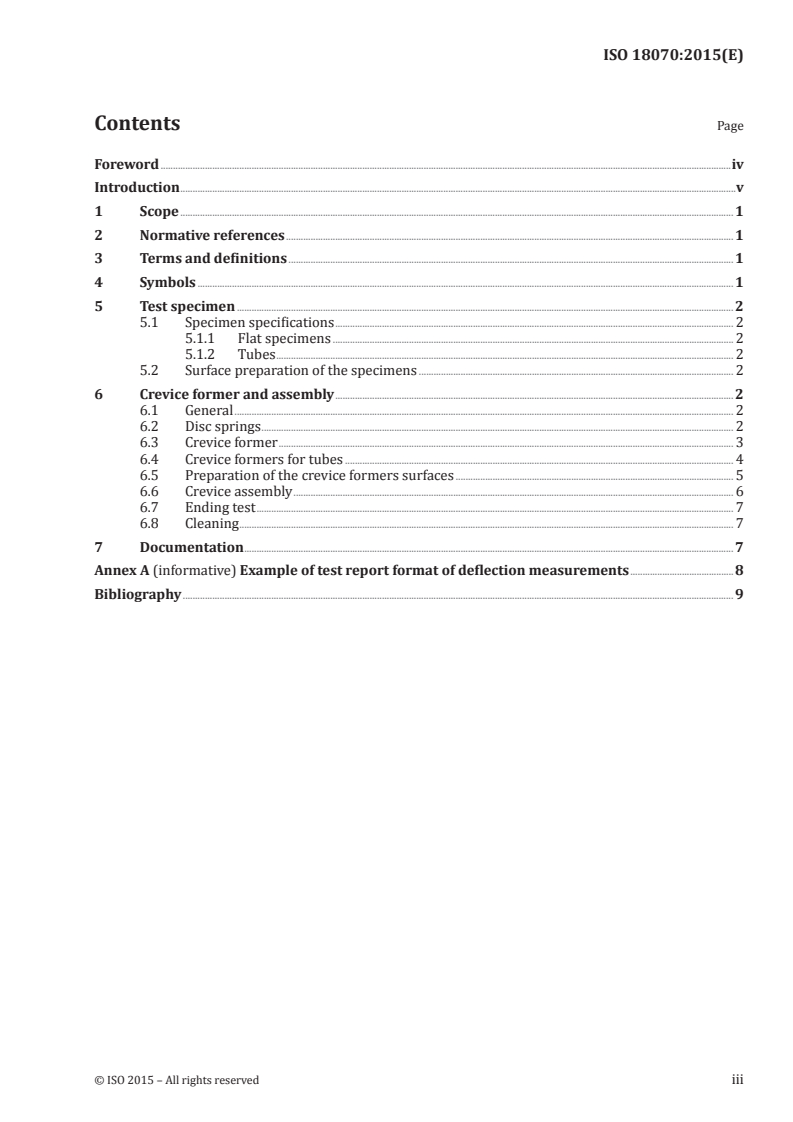
Contents Page
Foreword .iv
Introduction .v
1 Scope . 1
2 Normative references . 1
3 Terms and definitions . 1
4 Symbols . 1
5 Test specimen . 2
5.1 Specimen specifications . 2
5.1.1 Flat specimens . 2
5.1.2 Tubes . 2
5.2 Surface preparation of the specimens . 2
6 Crevice former and assembly . 2
6.1 General . 2
6.2 Disc springs . 2
6.3 Crevice former . 3
6.4 Crevice formers for tubes . 4
6.5 Preparation of the crevice formers surfaces . 5
6.6 Crevice assembly . 6
6.7 Ending test . 7
6.8 Cleaning . 7
7 Documentation . 7
Annex A (informative) Example of test report format of deflection measurements .8
Bibliography . 9
Foreword
ISO (the International Organization for Standardization) is a worldwide federation of national standards
bodies (ISO member bodies). The work of preparing International Standards is normally carried out
through ISO technical committees. Each member body interested in a subject for which a technical
committee has been established has the right to be represented on that committee. International
organizations, governmental and non-governmental, in liaison with ISO, also take part in the work.
ISO collaborates closely with the International Electrotechnical Commission (IEC) on all matters of
electrotechnical standardization.
The procedures used to develop this document and those intended for its further maintenance are
described in the ISO/IEC Directives, Part 1. In particular the different approval criteria needed for the
different types of ISO documents should be noted. This document was drafted in accordance with the
editorial rules of the ISO/IEC Directives, Part 2 (see www.iso.org/directives).
Attention is drawn to the possibility that some of the elements of this document may be the subject of
patent rights. ISO shall not be held responsible for identifying any or all such patent rights. Details of
any patent rights identified during the development of the document will be in the Introduction and/or
on the ISO list of patent declarations received (see www.iso.org/patents).
Any trade name used in this document is information given for the convenience of users and does not
constitute an endorsement.
For an explanation on the meaning of ISO specific terms and expressions related to conformity
assessment, as well as information about ISO’s adherence to the WTO principles in the Technical
Barriers to Trade (TBT) see the following URL: Foreword - Supplementary information.
The committee responsible for this document is ISO/TC 156, Corrosion of metals and alloys.
iv © ISO 2015 – All rights reserved
Introduction
The working party on Marine Corrosion in the European Federation of Corrosion (EFC) has found that
there is an industrial need for crevice corrosion testing for seawater applications that can estimate
the maximum service temperature in natural seawater for stainless steels. Several aspects of crevice
[1]
corrosion testing were elucidated by a research project. It was found that an important factor is the
crevice forming technique, and in order to have controlled crevices, the disc spring loaded crevice
former was introduced. The general idea is that the disc springs shall keep the clamping force as
constant as possible. In addition to the crevice forming technique for plate specimens, a technique for a
crevice former for tubular specimens was developed, which has given reproducible results.
Round robin testing for the crevice forming technique was performed for both laboratory testing
and in natural seawater and it showed improvement compared to traditional crevice formers. Good
correlation was found between the laboratory testing and natural seawater.
INTERNATIONAL STANDARD ISO 18070:2015(E)
Corrosion of metals and alloys — Crevice corrosion
formers with disc springs for flat specimens or tubes made
from stainless steel
1 Scope
This International Standard specifies a crevice forming technique and crevice former which are intended
to be used for crevice corrosion testing of flat specimens or tubes of stainless steels, in corrosive
solutions. This International Standard specifies no information concerning how the crevice corrosion
testing shall be performed and how the attack shall be evaluated. The crevice former specified in this
International Standard can be used for electrochemical measurements, if the specimens are designed
for electrical connections.
2 Normative references
The following documents, in whole or in part, are normatively referenced in this document and are
indispensable for its application. For dated references, only the edition cited applies. For undated
references, the latest edition of the referenced document (including any amendments) applies.
ISO 3696, Water for analytical laboratory use — Specification and test methods
ISO 8044, Corrosion of metals and alloys — Basic terms and definitions
ISO 6344-3, Coated abrasives — Grain size analysis — Part 3: Determination of grain size distribution of
microgrits P240 to P2500
DIN 2093, Disc springs — Quality specifications — Dimensions
3 Terms and definitions
For the purposes of this document, the terms and definitions given in ISO 8044 apply.
4 Symbols
LBL Length Before Loading
LAL Length After Loading
LAL Length After Loading and exposure
ΔL Deflection before ex
...
INTERNATIONAL ISO
STANDARD 18070
First edition
2015-11-01
Corrosion of metals and alloys —
Crevice corrosion formers with disc
springs for flat specimens or tubes
made from stainless steel
Corrosion des métaux et alliages — Dispositif d’essai de corrosion par
crevasse avec rondelles ressort pour échantillons plats ou tubulaires
en acier inoxydable
Reference number
©
ISO 2015
© ISO 2015, Published in Switzerland
All rights reserved. Unless otherwise specified, no part of this publication may be reproduced or utilized otherwise in any form
or by any means, electronic or mechanical, including photocopying, or posting on the internet or an intranet, without prior
written permission. Permission can be requested from either ISO at the address below or ISO’s member body in the country of
the requester.
ISO copyright office
Ch. de Blandonnet 8 • CP 401
CH-1214 Vernier, Geneva, Switzerland
Tel. +41 22 749 01 11
Fax +41 22 749 09 47
copyright@iso.org
www.iso.org
ii © ISO 2015 – All rights reserved
Contents Page
Foreword .iv
Introduction .v
1 Scope . 1
2 Normative references . 1
3 Terms and definitions . 1
4 Symbols . 1
5 Test specimen . 2
5.1 Specimen specifications . 2
5.1.1 Flat specimens . 2
5.1.2 Tubes . 2
5.2 Surface preparation of the specimens . 2
6 Crevice former and assembly . 2
6.1 General . 2
6.2 Disc springs . 2
6.3 Crevice former . 3
6.4 Crevice formers for tubes . 4
6.5 Preparation of the crevice formers surfaces . 5
6.6 Crevice assembly . 6
6.7 Ending test . 7
6.8 Cleaning . 7
7 Documentation . 7
Annex A (informative) Example of test report format of deflection measurements .8
Bibliography . 9
Foreword
ISO (the International Organization for Standardization) is a worldwide federation of national standards
bodies (ISO member bodies). The work of preparing International Standards is normally carried out
through ISO technical committees. Each member body interested in a subject for which a technical
committee has been established has the right to be represented on that committee. International
organizations, governmental and non-governmental, in liaison with ISO, also take part in the work.
ISO collaborates closely with the International Electrotechnical Commission (IEC) on all matters of
electrotechnical standardization.
The procedures used to develop this document and those intended for its further maintenance are
described in the ISO/IEC Directives, Part 1. In particular the different approval criteria needed for the
different types of ISO documents should be noted. This document was drafted in accordance with the
editorial rules of the ISO/IEC Directives, Part 2 (see www.iso.org/directives).
Attention is drawn to the possibility that some of the elements of this document may be the subject of
patent rights. ISO shall not be held responsible for identifying any or all such patent rights. Details of
any patent rights identified during the development of the document will be in the Introduction and/or
on the ISO list of patent declarations received (see www.iso.org/patents).
Any trade name used in this document is information given for the convenience of users and does not
constitute an endorsement.
For an explanation on the meaning of ISO specific terms and expressions related to conformity
assessment, as well as information about ISO’s adherence to the WTO principles in the Technical
Barriers to Trade (TBT) see the following URL: Foreword - Supplementary information.
The committee responsible for this document is ISO/TC 156, Corrosion of metals and alloys.
iv © ISO 2015 – All rights reserved
Introduction
The working party on Marine Corrosion in the European Federation of Corrosion (EFC) has found that
there is an industrial need for crevice corrosion testing for seawater applications that can estimate
the maximum service temperature in natural seawater for stainless steels. Several aspects of crevice
[1]
corrosion testing were elucidated by a research project. It was found that an important factor is the
crevice forming technique, and in order to have controlled crevices, the disc spring loaded crevice
former was introduced. The general idea is that the disc springs shall keep the clamping force as
constant as possible. In addition to the crevice forming technique for plate specimens, a technique for a
crevice former for tubular specimens was developed, which has given reproducible results.
Round robin testing for the crevice forming technique was performed for both laboratory testing
and in natural seawater and it showed improvement compared to traditional crevice formers. Good
correlation was found between the laboratory testing and natural seawater.
INTERNATIONAL STANDARD ISO 18070:2015(E)
Corrosion of metals and alloys — Crevice corrosion
formers with disc springs for flat specimens or tubes made
from stainless steel
1 Scope
This International Standard specifies a crevice forming technique and crevice former which are intended
to be used for crevice corrosion testing of flat specimens or tubes of stainless steels, in corrosive
solutions. This International Standard specifies no information concerning how the crevice corrosion
testing shall be performed and how the attack shall be evaluated. The crevice former specified in this
International Standard can be used for electrochemical measurements, if the specimens are designed
for electrical connections.
2 Normative references
The following documents, in whole or in part, are normatively referenced in this document and are
indispensable for its application. For dated references, only the edition cited applies. For undated
references, the latest edition of the referenced document (including any amendments) applies.
ISO 3696, Water for analytical laboratory use — Specification and test methods
ISO 8044, Corrosion of metals and alloys — Basic terms and definitions
ISO 6344-3, Coated abrasives — Grain size analysis — Part 3: Determination of grain size distribution of
microgrits P240 to P2500
DIN 2093, Disc springs — Quality specifications — Dimensions
3 Terms and definitions
For the purposes of this document, the terms and definitions given in ISO 8044 apply.
4 Symbols
LBL Length Before Loading
LAL Length After Loading
LAL Length After Loading and exposure
ΔL Deflection before ex
...
NORME ISO
INTERNATIONALE 18070
Première édition
2015-11-01
Corrosion des métaux et alliages —
Dispositif d’essai de corrosion par
crevasse avec rondelles ressort pour
échantillons plats ou tubulaires en
acier inoxydable
Corrosion of metals and alloys — Crevice corrosion formers with disc
springs for flat specimens or tubes made from stainless steel
Numéro de référence
©
ISO 2015
DOCUMENT PROTÉGÉ PAR COPYRIGHT
© ISO 2015, Publié en Suisse
Droits de reproduction réservés. Sauf indication contraire, aucune partie de cette publication ne peut être reproduite ni utilisée
sous quelque forme que ce soit et par aucun procédé, électronique ou mécanique, y compris la photocopie, l’affichage sur
l’internet ou sur un Intranet, sans autorisation écrite préalable. Les demandes d’autorisation peuvent être adressées à l’ISO à
l’adresse ci-après ou au comité membre de l’ISO dans le pays du demandeur.
ISO copyright office
Ch. de Blandonnet 8 • CP 401
CH-1214 Vernier, Geneva, Switzerland
Tel. +41 22 749 01 11
Fax +41 22 749 09 47
copyright@iso.org
www.iso.org
ii © ISO 2015 – Tous droits réservés
Sommaire Page
Avant-propos .iv
Introduction .v
1 Domaine d’application . 1
2 Références normatives . 1
3 Termes et définitions . 1
4 Symboles . 1
5 Échantillon . 2
5.1 Spécifications relatives aux échantillons . 2
5.1.1 Échantillons plats . 2
5.1.2 Échantillons tubulaires . 2
5.2 Préparation de la surface des échantillons . 2
6 Dispositif d’essai de corrosion par crevasse . 2
6.1 Généralités . 2
6.2 Rondelles ressort . 3
6.3 Dispositif d’essai de corrosion par crevasse. 3
6.4 Dispositif d’essai de corrosion par crevasse pour échantillons tubulaires . 5
6.5 Préparation de la surface des dispositifs d’essai de corrosion par crevasse . 6
6.6 Assemblage des pièces du dispositif d’essai de corrosion par crevasse . 7
6.7 Essai final . 8
6.8 Nettoyage . 8
7 Documentation . 8
Annexe A (informative) Exemple de format de rapport d’essai pour des mesures de déformation.9
Bibliographie .10
Avant-propos
L’ISO (Organisation internationale de normalisation) est une fédération mondiale d’organismes
nationaux de normalisation (comités membres de l’ISO). L’élaboration des Normes internationales est
en général confiée aux comités techniques de l’ISO. Chaque comité membre intéressé par une étude
a le droit de faire partie du comité technique créé à cet effet. Les organisations internationales,
gouvernementales et non gouvernementales, en liaison avec l’ISO participent également aux travaux.
L’ISO collabore étroitement avec la Commission électrotechnique internationale (IEC) en ce qui
concerne la normalisation électrotechnique.
Les procédures utilisées pour élaborer le présent document et celles destinées à sa mise à jour sont
décrites dans les Directives ISO/IEC, Partie 1. Il convient, en particulier de prendre note des différents
critères d’approbation requis pour les différents types de documents ISO. Le présent document a été
rédigé conformément aux règles de rédaction données dans les Directives ISO/IEC, Partie 2 (voir www.
iso.org/directives).
L’attention est appelée sur le fait que certains des éléments du présent document peuvent faire l’objet de
droits de propriété intellectuelle ou de droits analogues. L’ISO ne saurait être tenue pour responsable
de ne pas avoir identifié de tels droits de propriété et averti de leur existence. Les détails concernant
les références aux droits de propriété intellectuelle ou autres droits analogues identifiés lors de
l’élaboration du document sont indiqués dans l’Introduction et/ou dans la liste des déclarations de
brevets reçues par l’ISO (voir www.iso.org/brevets).
Les appellations commerciales éventuellement mentionnées dans le présent document sont données
pour information, par souci de commodité, à l’intention des utilisateurs et ne sauraient constituer
un engagement.
Pour une explication de la signification des termes et expressions spécifiques de l’ISO liés à
l’évaluation de la conformité, ou pour toute information au sujet de l’adhésion de l’ISO aux principes
de l’OMC concernant les obstacles techniques au commerce (OTC), voir le lien suivant: Avant-propos —
Informations supplémentaires.
Le comité chargé de l’élaboration du présent document est l’ISO/TC 156, Corrosion des métaux et alliages.
iv © ISO 2015 – Tous droits réservés
Introduction
Le groupe de travail sur la corrosion marine, au sein de la Fédération Européenne de la Corrosion (FEC),
a mis en avant la nécessité de mettre en place, au niveau industriel, des essais de corrosion par crevasse
pour les applications en eau de mer, permettant d’estimer la température maximale de service dans
l’eau de mer naturelle pour les aciers inoxydables. Plusieurs aspects des essais de corrosion caverneuse
[1]
ont été déterminés dans le cadre d’un projet d’étude. Il s’est avéré que la technique de formation de
crevasses était un élément important et que l’obtention de crevasses contrôlées nécessitait l’utilisation
d’un dispositif d’essai de corrosion par crevasse avec rondelles ressort. L’idée générale est que les
rondelles ressort doivent maintenir la force de serrage aussi constante que possible. En plus de la
technique de formation de crevasses pour échantillons plats, on a développé une technique de formation
de crevasses pour échantillons tubulaires qui a donné des résultats reproductibles.
La technique de formation de crevasses a fait l’objet d’essais croisés, aussi bien en laboratoire qu’en
mer; ces essais ont permis d’observer une amélioration par rapport aux techniques traditionnelles de
formation de crevasses. Il s’est avéré qu’il existait une bonne corrélation entre les essais en laboratoire
et les essais en mer.
NORME INTERNATIONALE ISO 18070:2015(F)
Corrosion des métaux et alliages — Dispositif d’essai
de corrosion par crevasse avec rondelles ressort pour
échantillons plats ou tubulaires en acier inoxydable
1 Domaine d’application
La présente Norme internationale spécifie une technique de formation de crevasses ainsi qu’un
dispositif d’essai de corrosion par crevasse destinés à être utilisés lors des essais de corrosion par
crevasse pour échantillons plats ou tubulaires d’acier inoxydable en solution corrosive. La présente
Norme internationale ne fournit pas d’informations sur la manière dont les essais de corrosion par
crevasse doivent être effectués et sur la manière dont l’attaque corrosive doit être évaluée. Le dispositif
d’essai de corrosion par crevasse spécifié dans la présente Norme internationale peut être utilisé pour
des mesurages électrochimiques si les échantillons sont conçus pour des connexions électriques.
2 Références normatives
Les documents ci-après, dans leur intégralité ou non, sont des références normatives indispensables
à l’application du présent document. Pour les références datées, seule l’édition citée s’applique. Pour
les références non datées, la dernière édition du document de référence (y compris les éventuels
amendements) s’applique.
ISO 3696, Eau pour laboratoire à usage analytique — Spécification et méthodes d’essai
ISO 8044, Corrosion des métaux et alliages — Termes principaux et définitions
ISO 6344-3, Abrasifs appliqués — Granulométrie — Partie 3: Détermination de la distribution
granulométrique des micrograins P240 à P2500
DIN 2093, Rondelles ressorts — Exigences de qualité — Dimensions
3 Termes et définitions
Pour les besoins du présent document, les termes et définitions donnés dans l’ISO 8044 s’appliquent.
4 Symboles
LBL Longueur avant application de charge
LAL Longueur après application de charge
LAL Longueur après application de charge et exposition
ΔL Déformation avant exposition
ΔL Déformation après exposition
5 Échantillon
5.1 Spécifications relatives aux échantillons
Des échantillons plats et tubulaires en acier inoxydable peuvent être utilisés comme éprouvettes dans
les dispositifs d’essai de corrosion par crevasse spécifiés dans la présente Norme internationale. L’aire
extérieure des échantillons doit être d’au moins 100 cm .
NOTE 1 Il est recommandé d’utiliser un échantillon de forme carrée avec un trou central car la distance entre
l’anode et la cathode peut s’avérer critique dans des solutions de faible conductivité.
NOTE 2 Si un potentiel d’électrode est appliqué, il est possible d’utiliser un échantillon de plus faibles dimensions.
5.1.1 Échantillons plats
Un trou de 7 mm de diamètre doit être percé au milieu de chaque échantillon.
NOTE Pour suspendre l’échantil
...
NORME ISO
INTERNATIONALE 18070
Première édition
2015-11-01
Corrosion des métaux et alliages —
Dispositif d’essai de corrosion par
crevasse avec rondelles ressort pour
échantillons plats ou tubulaires en
acier inoxydable
Corrosion of metals and alloys — Crevice corrosion formers with disc
springs for flat specimens or tubes made from stainless steel
Numéro de référence
©
ISO 2015
DOCUMENT PROTÉGÉ PAR COPYRIGHT
© ISO 2015, Publié en Suisse
Droits de reproduction réservés. Sauf indication contraire, aucune partie de cette publication ne peut être reproduite ni utilisée
sous quelque forme que ce soit et par aucun procédé, électronique ou mécanique, y compris la photocopie, l’affichage sur
l’internet ou sur un Intranet, sans autorisation écrite préalable. Les demandes d’autorisation peuvent être adressées à l’ISO à
l’adresse ci-après ou au comité membre de l’ISO dans le pays du demandeur.
ISO copyright office
Ch. de Blandonnet 8 • CP 401
CH-1214 Vernier, Geneva, Switzerland
Tel. +41 22 749 01 11
Fax +41 22 749 09 47
copyright@iso.org
www.iso.org
ii © ISO 2015 – Tous droits réservés
Sommaire Page
Avant-propos .iv
Introduction .v
1 Domaine d’application . 1
2 Références normatives . 1
3 Termes et définitions . 1
4 Symboles . 1
5 Échantillon . 2
5.1 Spécifications relatives aux échantillons . 2
5.1.1 Échantillons plats . 2
5.1.2 Échantillons tubulaires . 2
5.2 Préparation de la surface des échantillons . 2
6 Dispositif d’essai de corrosion par crevasse . 2
6.1 Généralités . 2
6.2 Rondelles ressort . 3
6.3 Dispositif d’essai de corrosion par crevasse. 3
6.4 Dispositif d’essai de corrosion par crevasse pour échantillons tubulaires . 5
6.5 Préparation de la surface des dispositifs d’essai de corrosion par crevasse . 6
6.6 Assemblage des pièces du dispositif d’essai de corrosion par crevasse . 7
6.7 Essai final . 8
6.8 Nettoyage . 8
7 Documentation . 8
Annexe A (informative) Exemple de format de rapport d’essai pour des mesures de déformation.9
Bibliographie .10
Avant-propos
L’ISO (Organisation internationale de normalisation) est une fédération mondiale d’organismes
nationaux de normalisation (comités membres de l’ISO). L’élaboration des Normes internationales est
en général confiée aux comités techniques de l’ISO. Chaque comité membre intéressé par une étude
a le droit de faire partie du comité technique créé à cet effet. Les organisations internationales,
gouvernementales et non gouvernementales, en liaison avec l’ISO participent également aux travaux.
L’ISO collabore étroitement avec la Commission électrotechnique internationale (IEC) en ce qui
concerne la normalisation électrotechnique.
Les procédures utilisées pour élaborer le présent document et celles destinées à sa mise à jour sont
décrites dans les Directives ISO/IEC, Partie 1. Il convient, en particulier de prendre note des différents
critères d’approbation requis pour les différents types de documents ISO. Le présent document a été
rédigé conformément aux règles de rédaction données dans les Directives ISO/IEC, Partie 2 (voir www.
iso.org/directives).
L’attention est appelée sur le fait que certains des éléments du présent document peuvent faire l’objet de
droits de propriété intellectuelle ou de droits analogues. L’ISO ne saurait être tenue pour responsable
de ne pas avoir identifié de tels droits de propriété et averti de leur existence. Les détails concernant
les références aux droits de propriété intellectuelle ou autres droits analogues identifiés lors de
l’élaboration du document sont indiqués dans l’Introduction et/ou dans la liste des déclarations de
brevets reçues par l’ISO (voir www.iso.org/brevets).
Les appellations commerciales éventuellement mentionnées dans le présent document sont données
pour information, par souci de commodité, à l’intention des utilisateurs et ne sauraient constituer
un engagement.
Pour une explication de la signification des termes et expressions spécifiques de l’ISO liés à
l’évaluation de la conformité, ou pour toute information au sujet de l’adhésion de l’ISO aux principes
de l’OMC concernant les obstacles techniques au commerce (OTC), voir le lien suivant: Avant-propos —
Informations supplémentaires.
Le comité chargé de l’élaboration du présent document est l’ISO/TC 156, Corrosion des métaux et alliages.
iv © ISO 2015 – Tous droits réservés
Introduction
Le groupe de travail sur la corrosion marine, au sein de la Fédération Européenne de la Corrosion (FEC),
a mis en avant la nécessité de mettre en place, au niveau industriel, des essais de corrosion par crevasse
pour les applications en eau de mer, permettant d’estimer la température maximale de service dans
l’eau de mer naturelle pour les aciers inoxydables. Plusieurs aspects des essais de corrosion caverneuse
[1]
ont été déterminés dans le cadre d’un projet d’étude. Il s’est avéré que la technique de formation de
crevasses était un élément important et que l’obtention de crevasses contrôlées nécessitait l’utilisation
d’un dispositif d’essai de corrosion par crevasse avec rondelles ressort. L’idée générale est que les
rondelles ressort doivent maintenir la force de serrage aussi constante que possible. En plus de la
technique de formation de crevasses pour échantillons plats, on a développé une technique de formation
de crevasses pour échantillons tubulaires qui a donné des résultats reproductibles.
La technique de formation de crevasses a fait l’objet d’essais croisés, aussi bien en laboratoire qu’en
mer; ces essais ont permis d’observer une amélioration par rapport aux techniques traditionnelles de
formation de crevasses. Il s’est avéré qu’il existait une bonne corrélation entre les essais en laboratoire
et les essais en mer.
NORME INTERNATIONALE ISO 18070:2015(F)
Corrosion des métaux et alliages — Dispositif d’essai
de corrosion par crevasse avec rondelles ressort pour
échantillons plats ou tubulaires en acier inoxydable
1 Domaine d’application
La présente Norme internationale spécifie une technique de formation de crevasses ainsi qu’un
dispositif d’essai de corrosion par crevasse destinés à être utilisés lors des essais de corrosion par
crevasse pour échantillons plats ou tubulaires d’acier inoxydable en solution corrosive. La présente
Norme internationale ne fournit pas d’informations sur la manière dont les essais de corrosion par
crevasse doivent être effectués et sur la manière dont l’attaque corrosive doit être évaluée. Le dispositif
d’essai de corrosion par crevasse spécifié dans la présente Norme internationale peut être utilisé pour
des mesurages électrochimiques si les échantillons sont conçus pour des connexions électriques.
2 Références normatives
Les documents ci-après, dans leur intégralité ou non, sont des références normatives indispensables
à l’application du présent document. Pour les références datées, seule l’édition citée s’applique. Pour
les références non datées, la dernière édition du document de référence (y compris les éventuels
amendements) s’applique.
ISO 3696, Eau pour laboratoire à usage analytique — Spécification et méthodes d’essai
ISO 8044, Corrosion des métaux et alliages — Termes principaux et définitions
ISO 6344-3, Abrasifs appliqués — Granulométrie — Partie 3: Détermination de la distribution
granulométrique des micrograins P240 à P2500
DIN 2093, Rondelles ressorts — Exigences de qualité — Dimensions
3 Termes et définitions
Pour les besoins du présent document, les termes et définitions donnés dans l’ISO 8044 s’appliquent.
4 Symboles
LBL Longueur avant application de charge
LAL Longueur après application de charge
LAL Longueur après application de charge et exposition
ΔL Déformation avant exposition
ΔL Déformation après exposition
5 Échantillon
5.1 Spécifications relatives aux échantillons
Des échantillons plats et tubulaires en acier inoxydable peuvent être utilisés comme éprouvettes dans
les dispositifs d’essai de corrosion par crevasse spécifiés dans la présente Norme internationale. L’aire
extérieure des échantillons doit être d’au moins 100 cm .
NOTE 1 Il est recommandé d’utiliser un échantillon de forme carrée avec un trou central car la distance entre
l’anode et la cathode peut s’avérer critique dans des solutions de faible conductivité.
NOTE 2 Si un potentiel d’électrode est appliqué, il est possible d’utiliser un échantillon de plus faibles dimensions.
5.1.1 Échantillons plats
Un trou de 7 mm de diamètre doit être percé au milieu de chaque échantillon.
NOTE Pour suspendre l’échantil
...