


ISO 7170:2005
(Main)Furniture — Storage units — Determination of strength and durability
Furniture — Storage units — Determination of strength and durability
ISO 7170:2005 specifies test methods for determining the strength and durability of storage units that are fully assembled and ready for use, including their movable and non-movable parts. The tests consist of the application, to various parts of the unit, of loads, forces and velocities simulating normal functional use, as well as misuse, that might reasonably be expected to occur. The test results are only valid for the unit/component tested. These results may be used to represent the performance of production models provided that the tested model is representative of the production model. Tests carried out according to ISO 7170:2005 are intended to demonstrate the ability of the item to give satisfactory service in its intended environment. The tests have been developed for units/components that have not been in use. However, when properly justified, they may be used for fault investigation. Assessment of ageing and degradation is not included.
Ameublement — Éléments de rangement — Détermination de la résistance et de la durabilité
L'ISO 7170:2005 spécifie les méthodes d'essai pour la détermination de la résistance et de la durabilité des articles de rangement complètement montés et prêts à l'usage incluant les parties mobiles et fixes. Les essais consistent en l'application, à diverses parties de l'article, de charges, forces et vitesses simulant l'usage normal fonctionnel, ainsi qu'un mauvais usage raisonnablement prévisible. Les résultats d'essai ne sont valables que pour l'article/le composant soumis à l'essai. Ces résultats peuvent toutefois être pris en compte pour caractériser les performances des modèles de production sous réserve que l'article testé soit représentatif des modèles de production. Les essais effectués selon l'ISO 7170:2005 sont prévus pour démontrer l'aptitude de l'article à donner satisfaction dans son usage prévu. Les essais ont été développés pour des articles/composants qui n'ont pas encore été mis en utilisation. Cependant, ils peuvent être utilisés pour déterminer les causes d'un défaut, quand cela se justifie pleinement. L'évaluation du vieillissement et de la dégradation n'est pas prise en compte.
General Information
- Status
- Withdrawn
- Publication Date
- 08-Dec-2005
- Withdrawal Date
- 08-Dec-2005
- Technical Committee
- ISO/TC 136 - Furniture
- Current Stage
- 9599 - Withdrawal of International Standard
- Start Date
- 20-Sep-2021
- Completion Date
- 14-Feb-2026
Relations
- Effective Date
- 23-Apr-2020
- Effective Date
- 12-May-2008
- Effective Date
- 15-Apr-2008
Buy Documents
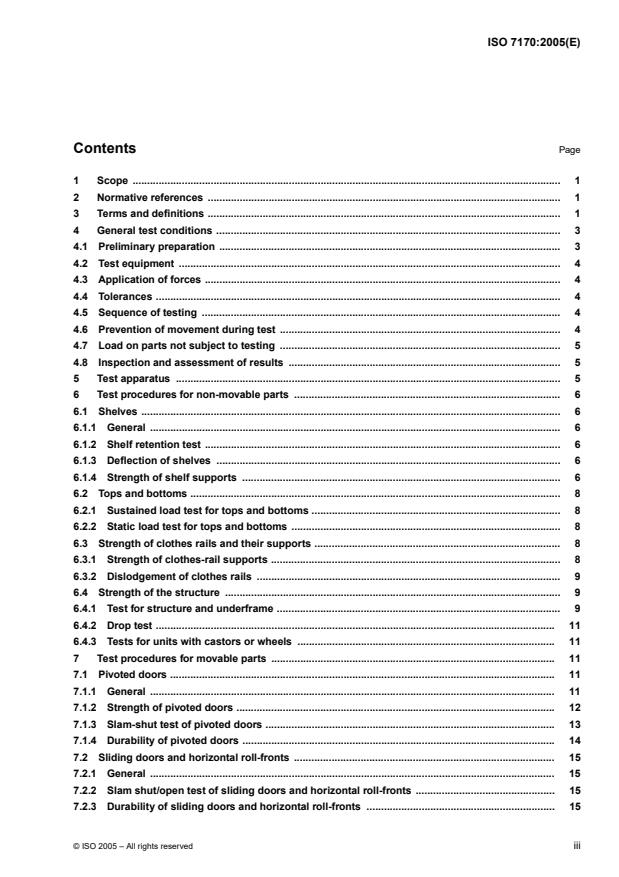
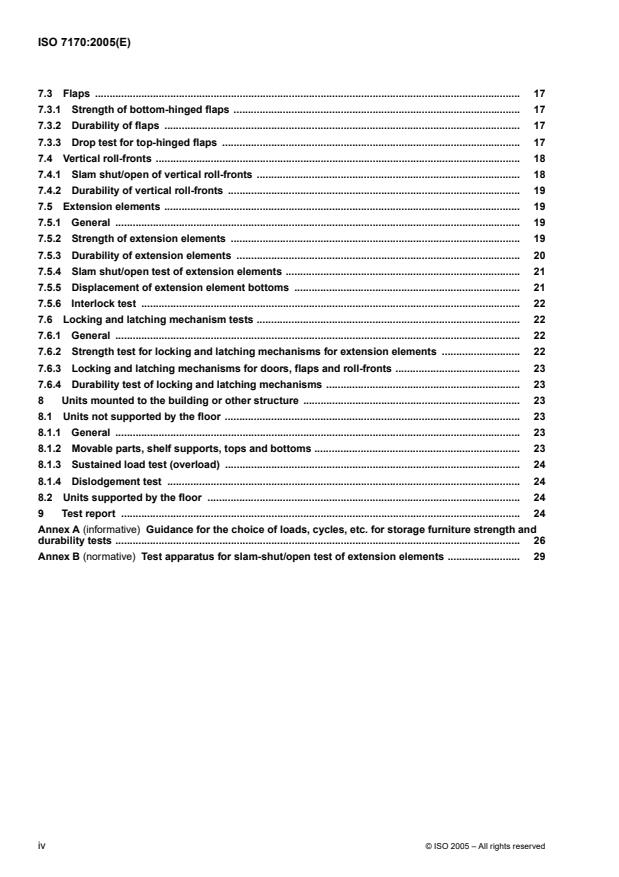
ISO 7170:2005 - Furniture -- Storage units -- Determination of strength and durability
ISO 7170:2005 - Ameublement -- Éléments de rangement -- Détermination de la résistance et de la durabilité
Frequently Asked Questions
ISO 7170:2005 is a standard published by the International Organization for Standardization (ISO). Its full title is "Furniture — Storage units — Determination of strength and durability". This standard covers: ISO 7170:2005 specifies test methods for determining the strength and durability of storage units that are fully assembled and ready for use, including their movable and non-movable parts. The tests consist of the application, to various parts of the unit, of loads, forces and velocities simulating normal functional use, as well as misuse, that might reasonably be expected to occur. The test results are only valid for the unit/component tested. These results may be used to represent the performance of production models provided that the tested model is representative of the production model. Tests carried out according to ISO 7170:2005 are intended to demonstrate the ability of the item to give satisfactory service in its intended environment. The tests have been developed for units/components that have not been in use. However, when properly justified, they may be used for fault investigation. Assessment of ageing and degradation is not included.
ISO 7170:2005 specifies test methods for determining the strength and durability of storage units that are fully assembled and ready for use, including their movable and non-movable parts. The tests consist of the application, to various parts of the unit, of loads, forces and velocities simulating normal functional use, as well as misuse, that might reasonably be expected to occur. The test results are only valid for the unit/component tested. These results may be used to represent the performance of production models provided that the tested model is representative of the production model. Tests carried out according to ISO 7170:2005 are intended to demonstrate the ability of the item to give satisfactory service in its intended environment. The tests have been developed for units/components that have not been in use. However, when properly justified, they may be used for fault investigation. Assessment of ageing and degradation is not included.
ISO 7170:2005 is classified under the following ICS (International Classification for Standards) categories: 97.140 - Furniture. The ICS classification helps identify the subject area and facilitates finding related standards.
ISO 7170:2005 has the following relationships with other standards: It is inter standard links to ISO 7170:2021, SIST ISO 7170:1996, ISO 7170:1993. Understanding these relationships helps ensure you are using the most current and applicable version of the standard.
ISO 7170:2005 is available in PDF format for immediate download after purchase. The document can be added to your cart and obtained through the secure checkout process. Digital delivery ensures instant access to the complete standard document.
Standards Content (Sample)
INTERNATIONAL ISO
STANDARD 7170
Second edition
2005-12-15
Furniture — Storage units —
Determination of strength and durability
Ameublement — Éléments de rangement — Détermination de la
résistance et de la durabilité
Reference number
©
ISO 2005
PDF disclaimer
This PDF file may contain embedded typefaces. In accordance with Adobe's licensing policy, this file may be printed or viewed but shall
not be edited unless the typefaces which are embedded are licensed to and installed on the computer performing the editing. In
downloading this file, parties accept therein the responsibility of not infringing Adobe's licensing policy. The ISO Central Secretariat
accepts no liability in this area.
Adobe is a trademark of Adobe Systems Incorporated.
Details of the software products used to create this PDF file can be found in the General Info relative to the file; the PDF-creation
parameters were optimized for printing. Every care has been taken to ensure that the file is suitable for use by ISO member bodies. In the
unlikely event that a problem relating to it is found, please inform the Central Secretariat at the address given below.
All rights reserved. Unless otherwise specified, no part of this publication may be reproduced or utilized in any form or by any means,
electronic or mechanical, including photocopying and microfilm, without permission in writing from either ISO at the address below or
ISO's member body in the country of the requester.
ISO copyright office
Case postale 56 CH-1211 Geneva 20
Tel. + 41 22 749 01 11
Fax + 41 22 749 09 47
E-mail copyright@iso.org
Web www.iso.org
Published in Switzerland
©
ii ISO 2005 – All rights reserved
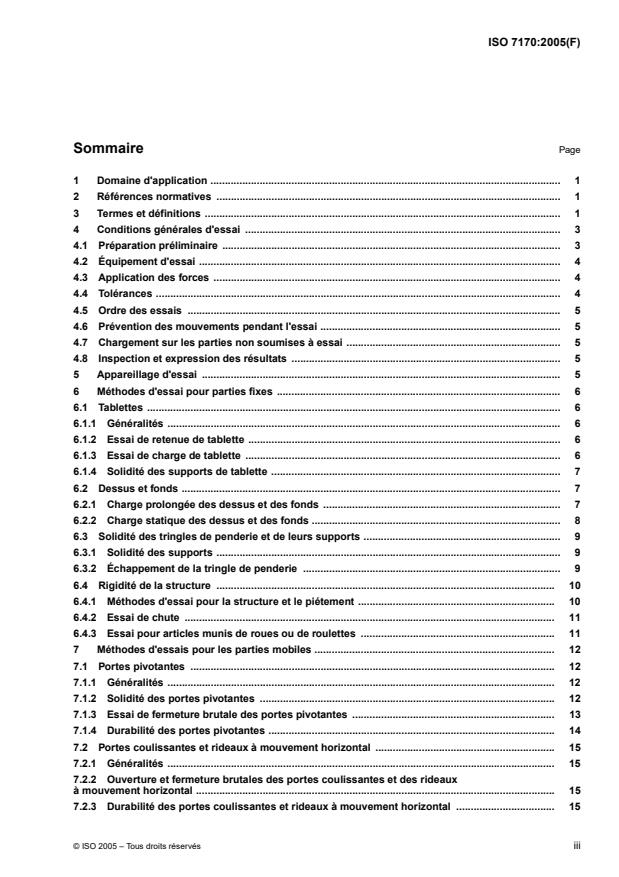
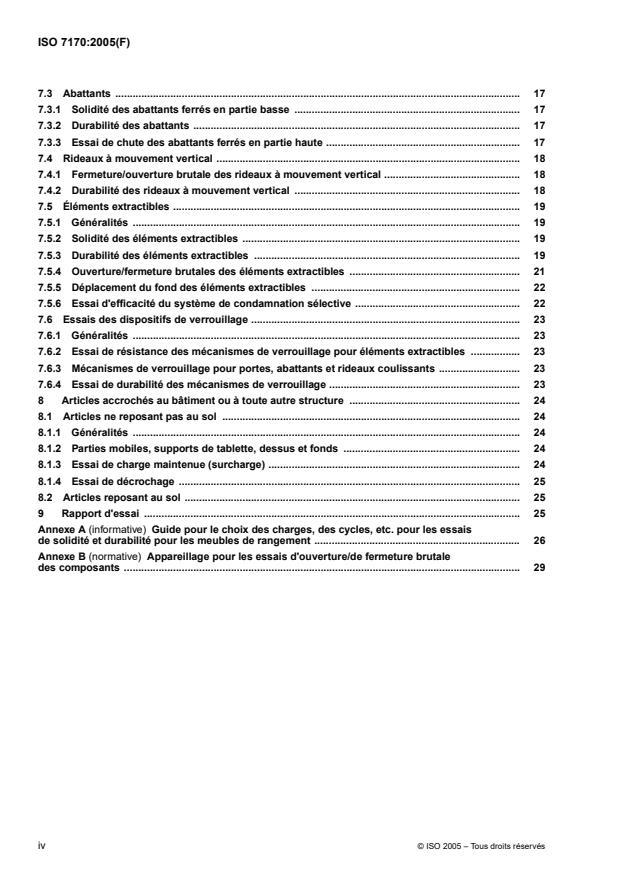
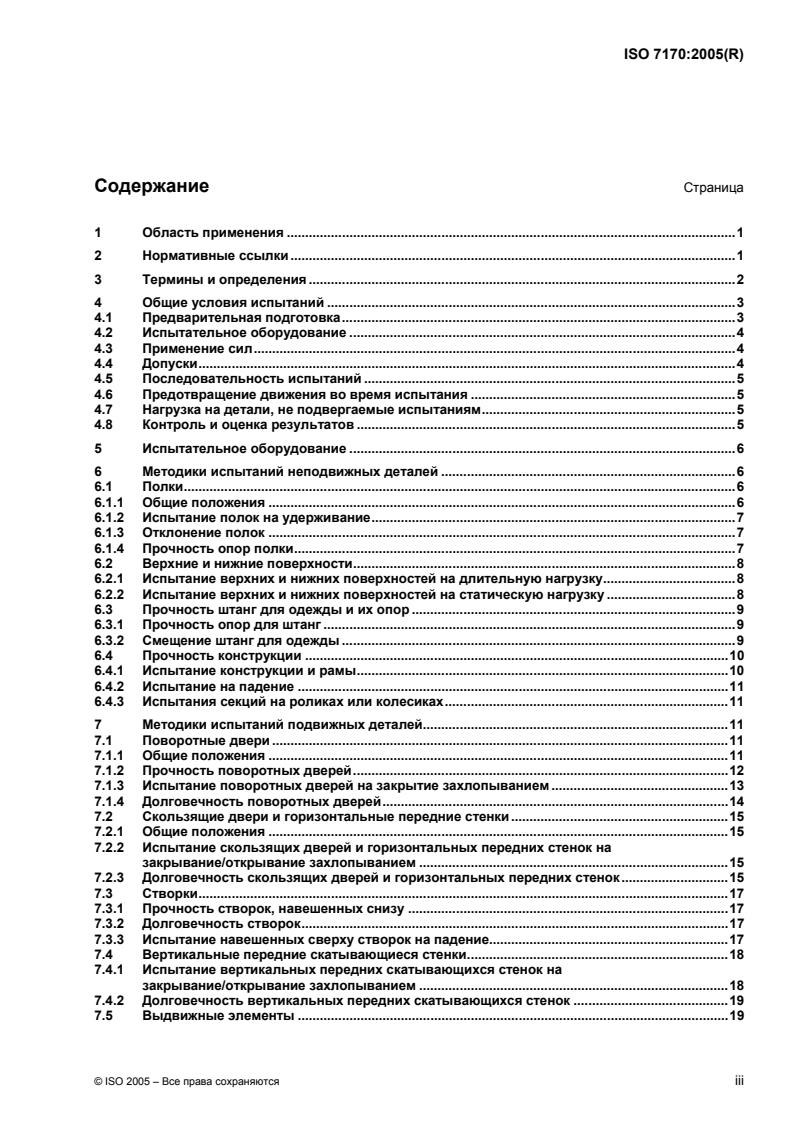
Contents Page
1 Scope . 1
2 Normative references . 1
3 Terms and definitions . 1
4 General test conditions . 3
4.1 Preliminary preparation . 3
4.2 Test equipment . 4
4.3 Application of forces . 4
4.4 Tolerances . 4
4.5 Sequence of testing . 4
4.6 Prevention of movement during test . 4
4.7 Load on parts not subject to testing . 5
4.8 Inspection and assessment of results . 5
5 Test apparatus . 5
6 Test procedures for non-movable parts . 6
6.1 Shelves . 6
6.1.1 General . 6
6.1.2 Shelf retention test . 6
6.1.3 Deflection of shelves . 6
6.1.4 Strength of shelf supports . 6
6.2 Tops and bottoms . 8
6.2.1 Sustained load test for tops and bottoms . 8
6.2.2 Static load test for tops and bottoms . 8
6.3 Strength of clothes rails and their supports . 8
6.3.1 Strength of clothes-rail supports . 8
6.3.2 Dislodgement of clothes rails . 9
6.4 Strength of the structure . 9
6.4.1 Test for structure and underframe . 9
6.4.2 Drop test . 11
6.4.3 Tests for units with castors or wheels . 11
7 Test procedures for movable parts . 11
7.1 Pivoted doors . 11
7.1.1 General . 11
7.1.2 Strength of pivoted doors . 12
7.1.3 Slam-shut test of pivoted doors . 13
7.1.4 Durability of pivoted doors . 14
7.2 Sliding doors and horizontal roll-fronts . 15
7.2.1 General . 15
7.2.2 Slam shut/open test of sliding doors and horizontal roll-fronts . 15
7.2.3 Durability of sliding doors and horizontal roll-fronts . 15
©
ISO 2005 – All rights reserved iii
7.3 Flaps . 17
7.3.1 Strength of bottom-hinged flaps . 17
7.3.2 Durability of flaps . 17
7.3.3 Drop test for top-hinged flaps . 17
7.4 Vertical roll-fronts . 18
7.4.1 Slam shut/open of vertical roll-fronts . 18
7.4.2 Durability of vertical roll-fronts . 19
7.5 Extension elements . 19
7.5.1 General . 19
7.5.2 Strength of extension elements . 19
7.5.3 Durability of extension elements . 20
7.5.4 Slam shut/open test of extension elements . 21
7.5.5 Displacement of extension element bottoms . 21
7.5.6 Interlock test . 22
7.6 Locking and latching mechanism tests . 22
7.6.1 General . 22
7.6.2 Strength test for locking and latching mechanisms for extension elements . 22
7.6.3 Locking and latching mechanisms for doors, flaps and roll-fronts . 23
7.6.4 Durability test of locking and latching mechanisms . 23
8 Units mounted to the building or other structure . 23
8.1 Units not supported by the floor . 23
8.1.1 General . 23
8.1.2 Movable parts, shelf supports, tops and bottoms . 23
8.1.3 Sustained load test (overload) . 24
8.1.4 Dislodgement test . 24
8.2 Units supported by the floor . 24
9 Test report . 24
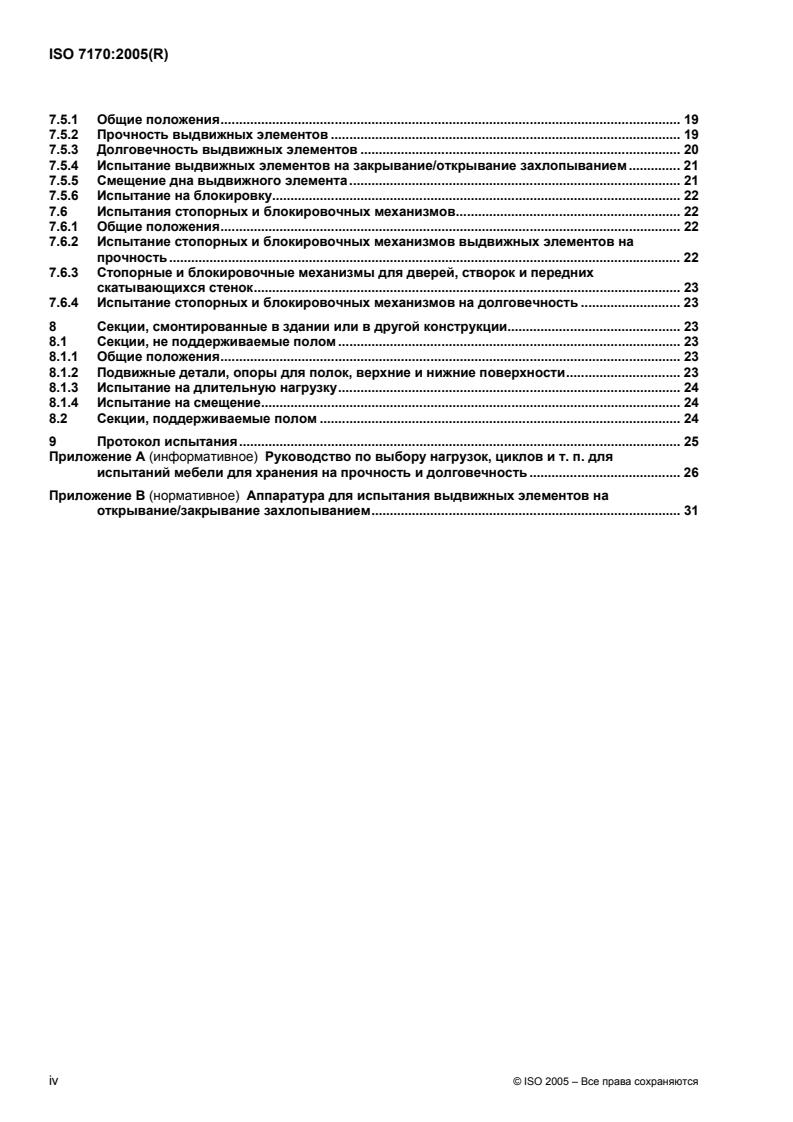
Annex A (informative) Guidance for the choice of loads, cycles, etc. for storage furniture strength and
durability tests . 26
Annex B (normative) Test apparatus for slam-shut/open test of extension elements . 29
©
iv ISO 2005 – All rights reserved
Foreword
ISO (the International Organization for Standardization) is a worldwide federation of national standards bodies
(ISO member bodies). The work of preparing International Standards is normally carried out through ISO
technical committees. Each member body interested in a subject for which a technical committee has been
established has the right to be represented on that committee. International organizations, governmental and
non-governmental, in liaison with ISO, also take part in the work. ISO collaborates closely with the International
Electrotechnical Commission (IEC) on all matters of electrotechnical standardization.
International Standards are drafted in accordance with the rules given in the ISO/IEC Directives, Part 2.
The main task of technical committees is to prepare International Standards. Draft International Standards
adopted by the technical committees are circulated to the member bodies for voting. Publication as an
International Standard requires approval by at least 75 % of the member bodies casting a vote.
Attention is drawn to the possibility that some of the elements of this document may be the subject of patent
rights. ISO shall not be held responsible for identifying any or all such patent rights.
ISO 7170 was prepared by Technical Committee ISO/TC 136, Furniture.
This second edition cancels and replaces the first edition (ISO 7170:1993), which has been technically revised.
©
ISO 2005 – All rights reserved v
.
vi
INTERNATIONAL STANDARD ISO 7170:2005(E)
Furniture — Storage units — Determination of strength and
durability
1Scope
This International Standard specifies test methods for determining the strength and durability of storage units
that are fully assembled and ready for use, including their movable and non-movable parts.
The tests consist of the application, to various parts of the unit, of loads, forces and velocities simulating normal
functional use, as well as misuse, that might reasonably be expected to occur.
With the exception of the sustained load tests in Clause 6, the tests are designed to evaluate properties without
regard to materials, design/construction or manufacturing processes.
The test results are only valid for the unit/component tested. These results may be used to represent the
performance of production models provided that the tested model is representative of the production model.
Tests carried out according to this International Standard are intended to demonstrate the ability of the item to
give satisfactory service in its intended environment. The tests have been developed for units/components that
have not been in use. However, when properly justified, they may be used for fault investigation.
The strength and durability tests do not assess the structure of the building, e.g. the strength of wall hanging
cabinets includes only the cabinet and the parts used for the attachment. The wall and the attachment into the
wall are not included.
Assessment of ageing and degradation is not included.
This International Standard specifies test methods only. It does not specify requirements. These should be
specified in a requirements document. If this is not available, suggested loads and cycles can be found in
Annex A.
Annex B describes two apparatuses used for slam-shut and slam-open tests of extension elements.
2 Normative references
The following referenced documents are indispensable for the application of this document. For dated
references, only the edition cited applies. For undated references, the latest edition of the referenced document
(including any amendments) applies.
ISO 7619-2:2004, Rubber, vulcanized or thermoplastic — Determination of indentation hardness — Part 2:
IRHD pocket meter method
3 Terms and definitions
For the purposes of this document, the following terms and definitions apply.
3.1
catch device
device, which keeps or pulls a component in place
NOTE It does not require a second action in order to release it, e.g. a magnetic catch or a self-closing-mechanism.
©
ISO 2005 – All rights reserved 1
3.2
clear height
unobstructed height above the top of the bottom surface, e.g. the top of the extension element bottom and the
lower edge of the extension element above, or the structure of the unit (see Figure 1)
Key
1 structure of the unit
2 clear height
Figure 1 — Clear height
3.3
damper mechanism
mechanism which closes the element gently
3.4
extension element
components that can be pulled out and pushed in
EXAMPLE Drawer, suspended pocket file, keyboard tray.
3.5
flap
horizontally-hinged door, which opens upwards or downwards
3.6
free standing unit
unit not intended to be attached to a load-bearing structure
3.7
interlock
device which restrains the opening of more than one extension element at a time
3.8
latching mechanism
mechanism which retains an extension element or a door in the closed positio
NOTE It requires a second action in order to release it.
©
2 ISO 2005 – All rights reserved
3.9
locking mechanism
mechanism that limits access to the interior of a unit or a storage element
NOTE It requires a key or a combination in order to activate it or to make it possible to activate it.
3.10
stay
hardware component usually used to hold a flap or door in the open position
3.11
top hanging unit
unit intended to be entirely supported by the ceiling
3.12
wall-, panel- and screen-hanging unit
unit intended to be supported by a wall, panel or screen
4 General test conditions
4.1 Preliminary preparation
The unit(s)/component(s) shall be tested as delivered. The unit(s)/component(s) shall be assembled and/or
configured according to the instructions supplied with it. The most adverse configuration shall be used for each
test. For testing a range of related models, only worst case(s) need to be tested. If mounting or assembly
instructions are not supplied, the mounting or assembly method shall be recorded in the test report. Fittings
shall be tightened before testing and shall not be re-tightened unless specifically required in the manufacturer's
instructions. If the configuration must be changed to produce the worst-case conditions, this shall be recorded
in the test report.
Combination of tests may be necessary to cover the properties of multifunction components; e.g. a receding
door shall be tested as a sliding door and as a pivoted door.
For furniture that includes hygroscopic materials, at least one week in normal indoor conditions shall have
elapsed between manufacturing (or assembly) and testing.
Except for the test for deflection of shelves (see below), the tests shall be carried out in indoor ambient
◦ ◦ ◦
conditions at a temperature between 15 C and 25 C. If during a test, the temperature is outside the 15 C to
◦
25 C range, the maximum and/or minimum temperature shall be recorded in the test report.
The test for deflection of shelves, except metal, stone and glass shelves, shall be carried out at a relative
humidity (RH) of 45 % to 55 %. If during a test, the relative humidity is outside this range, the maximum and/or
minimum shall be recorded in the test report.
NOTE The 45 % to 55 % RH range and the corresponding wood moisture content is representative of average indoor
conditions in Europe, USA and Canada. Other relative humidities may be appropriate in other parts of the world.
In the case of designs not addressed in the test procedures, the test shall be carried out as far as possible as
described, and deviations from the test procedure recorded in the test report.
Before beginning the testing, visually inspect the unit thoroughly. Record any defects so that they are not
assumed to have been caused by the tests. Carry out measurements if specified.
During testing, the unit shall be placed on the floor and levelled, unless otherwise specified.
©
ISO 2005 – All rights reserved 3
4.2 Test equipment
Unless otherwise specified, the tests may be applied by any suitable device, because results are dependent
only upon correctly applied forces and not on the apparatus.
The equipment shall not inhibit deformation of the unit/component, i.e. it shall be able to move so that it can
follow the deformation of the unit/component during testing, so that the loads are always applied at the specified
points and in the specified directions.
All loading pads shall be capable of pivoting in relation to the direction of the applied force. The pivot point shall
be as close as practically possible to the load surface.
4.3 Application of forces
The test forces in the static load tests shall be applied sufficiently slowly to ensure that negligible dynamic force
is applied. Unless otherwise specified, each specified force shall be maintained for not less than 10 s and not
more than 30 s.
In durability tests, the test forces shall be applied at a rate to ensure that excessive heating does not occur.
Unless otherwise specified, each test force shall be maintained for 2s±1s. If a pause is necessary, it shall be
in the closed position.
Forces shall be applied in a manner which ensures normal functioning of self-closing and damping
mechanisms.
The forces may be replaced by masses. The relationship 10 N = 1kg shall be used.
4.4 Tolerances
Unless otherwise stated, the following tolerances are applicable:
— forces: ±5% of the nominal force;
— velocities: ±5% of the nominal velocity;
— masses: ±1% of the nominal mass;
— dimensions: ±1mm of the nominal dimension;
◦
— angles: ± 2 of the nominal angle.
The accuracy for the positioning of loading pads and impact plates shall be ±5mm.
4.5 Sequence of testing
It is recommended that the tests be carried out in the same sequence as the clauses are numbered in this
International Standard, see however 8.1.1.
If the clause sequence is not followed, the sequence shall be noted in the test report.
All tests specified for a particular component shall be carried out on the same sample.
4.6 Prevention of movement during test
If a freestanding unit tends to overbalance during the tests specified in Clauses 6 and 7, load the unit until this
tendency stops, unless otherwise specified.
If a freestanding unit tends to slide during the tests specified in Clauses 6 and 7, with the exception of 6.4.2 and
6.4.3, the unit shall be restrained by stops (5.3).
©
4 ISO 2005 – All rights reserved
4.7 Load on parts not subject to testing
Unless otherwise specified, all storage components, other than the parts being tested, shall be uniformly loaded
according to Table 1.
Table 1 — Load on applied to parts other than the part being tested
a
Part Load
Horizontal surfaces, shelves, door baskets, etc. 0,65 kg/dm
Extension elements 0,2 kg/dm
a
Suspended pocket files 1,5 kg/dm
Clothes rails 2 kg/dm
a
Measured perpendicular to the plane of the filing pockets.
4.8 Inspection and assessment of results
After completion of each test, carry out the inspection again as specified in 4.1, after using adjustment options,
if instructions are available.
Record any changes that have taken place since the initial inspection (4.1). Inspection may include
measurements, e.g. opening or closing forces or deflections. The inspection shall include at least:
a) the fracture of any component or joint;
b) the loosening of any joint intended to be rigid, which can be demonstrated by hand pressure;
c) the deformation or wear of any part or component such that its functioning is impaired;
d) the loosening of any means of fixing components to the unit;
e) any impaired function of unit, component or part.
5 Test apparatus
5.1 Floor surface, a horizontal, rigid and flat surface.
For the strength test of the structure and underframe (6.4.1), the surface shall be smooth high-pressure plastics
laminate.
For the drop test (6.4.2), the floor shall be faced with a 3mm thick layer of rubber with a hardness of (85± 10)
IRHD, according to ISO 7619-2:2004.
5.2 Wall surface, a vertical, rigid and flat surface.
5.3 Stops, devices to prevent the article from sliding but not tilting. They should not be higher than 12 mm,
except in cases where the design of the unit necessitates the use of higher stops, in which case the lowest stop
that will prevent the item from moving shall be used.
5.4 Loading pad, rigid disc 100 mm in diameter (or 50 mm if it is to be used in a limited space), with a flat face
and a 12 mm front edge bend radius.
5.5 Apparatus for slam shut/open of extension elements, two apparatuses as well as calibration
instructions are given in Annex B.
5.6 Masses, shall be designed so that they do not reinforce the structure or re-distribute the stresses.
5.7 Glass marbles, shall be of solid glass with 10 mm to 15 mm diameter.
They shall be in a flexible bag large enough to allow them to move in the bag during the test.
©
ISO 2005 – All rights reserved 5
5.8 Loads for filing pockets, suspended filing pockets shall be loaded with typing paper or an equivalent
alternative as shown in Figure 18.
5.9 Steel impact plates, steel plates, 200 mm in length, with one surface faced with a 3mm thick layer of
rubber with a hardness of (85± 10) IRHD, according to ISO 7619-2:2004.
A range of steel plates is given in Table A.4.
6 Test procedures for non-movable parts
6.1 Shelves
6.1.1 General
When shelves are structurally interconnected (other than at their ends), all the shelves shall be equally loaded.
For units with an indeterminate number of shelves, unless otherwise specified, divide the internal height of the
unit, in millimetres, by 200 and take the lower integer. This number shall then be the number of shelves to be
fitted.
6.1.2 Shelf retention test
Apply the specified horizontal outwards force to the middle of the front edge of the shelf.
6.1.3 Deflection of shelves
Testing of the deflection of shelves, which are not made of metal, glass or stone, shall be carried out in a
controlled-humidity environment (see 4.1).
Place the shelf on its supports in the unit.
The deflection of the shelf shall be measured at the front edge where it is the greatest.
The deflection shall be measured to an accuracy of ± 0,1 mm with reference to a straight line parallel to the
front edge drawn between two adjacent supports.
Load the shelf uniformly (see Figure 2) with the load specified and apply for:
— one hour for shelves made of metal, glass and stone;
— one week for all other shelves.
At the same points as specified above, measure and record the deflection under load to an accuracy of
± 0,1 mm and as a percentage of the distance between the supports.
Carry out the inspection and assessment according to 4.8.
6.1.4 Strength of shelf supports
Load the shelf uniformly with half the load specified for 6.1.3, except at 220 mm from one support, where the
impact plate (5.9) shall be tipped over 10 times over the support (see Figure 3). The striking surface of the
impact plate (5.9) shall be that faced with rubber.
All supports of the shelf shall be tested.
Carry out the inspection and assessment according to 4.8.
©
6 ISO 2005 – All rights reserved
Key
1load
2 shelf support
Figure 2 — Deflection test of shelves
Dimensions in millimetres
Key
1 steel impact plate
2load
3 shelf support
Figure 3 — Strength test of shelf supports
©
ISO 2005 – All rights reserved 7
6.2 Tops and bottoms
6.2.1 Sustained load test for tops and bottoms
This test is only applicable to tops which are � 1 000 mm from the floor and to all bottoms.
The sustained load test of tops and bottoms shall be carried out in a controlled-humidity environment (see 4.1).
The deflection of the top or bottom shall be measured where it is the greatest.
The deflection shall be measured and recorded with reference to a straight line drawn between two adjacent
supports to an accuracy of ± 0,1 mm and expressed as a percentage of the distance between the supports.
Load the top or bottom uniformly (see Figure 2) with the load specified and apply for:
— one hour for tops and bottoms made of metal, glass and stone;
— one week for all other tops and bottoms.
Measure and record the deflection under load as specified above.
6.2.2 Static load test for tops and bottoms
This test is only applicable to tops which are � 1 000 mm from the floor and to bottoms where the clear height
(3.2) is � 1 600 mm.
Apply through the loading pad (5.4) a vertical downwards force 10 times at any position likely to cause failure
but not less than 50 mm from the edges. If there are several such positions, apply the load 10 times to a
maximum of three positions. If the top or bottom is adjustable, place it in the position most likely to result in
failure.
Carry out the inspection and assessment according to 4.8.
6.3 Strength of clothes rails and their supports
6.3.1 Strength of clothes-rail supports
Place the rail on its supports in the unit.
Apply the specified load as close as possible to the weakest support [see Figure 4 a)].
If there are three or more supports [see Figure 4 b)], each support shall be loaded simultaneously with the load
specified.
Carry out the inspection and assessment according to 4.8.
©
8 ISO 2005 – All rights reserved
a) Two supports b) Three or more supports
Key
1load
Figure 4 — Strength test of clothes-rail supports
6.3.2 Dislodgement of clothes rails
Place the rail on its supports in the unit (see Figure 5).
Load the rail uniformly with the load specified and apply for:
— one hour for metal rails;
— one week for all other rails.
Carry out the inspection and assessment according to 4.8.
Key
1load
Figure 5 — Dislodgement of clothes rails
6.4 Strength of the structure
6.4.1 Test for structure and underframe
This test is not applicable to units attached to another structure.
Place stops around the legs or base (see Figures 6 and 7). Levelling devices shall be opened 10 mm from the
fully-closed position.
Load all parts intended for storage purposes with the load specified in Table 1. Close extension elements, flaps,
roll-fronts and doors.
©
ISO 2005 – All rights reserved 9
Figure 6 — Strength test of structure and underframe — Force application points (A, B, C, D) and
directions
Dimensions in millimetres
Figure 7 — Strength test of structure and underframe — Force application points (A, B, C, D)
Apply the static force specified 10 times at point A in Figure 6, on the centre line of the side of the unit as high
as possible but not higher than 1 600 mm from the floor (see Figure 7). If no structural member exists at this
position, apply the load by means of a rigid bar.
Repeat this procedure 10 times at points B, C and D, with the legs or base still restrained by stops.
If the unit tends to tilt, lower the force application point until tilting is just prevented. Record this height.
Carry out the inspection and assessment according to 4.8.
©
10 ISO 2005 – All rights reserved
6.4.2 Drop test
The unit shall not be loaded.
Levelling devices shall be opened 10 mm from the fully-closed position.
Measure the force (F ), expressed in newtons, required to lift one end of the unit. Measure the force (F ),
1 2
expressed in newtons, required to lift the other end of the unit.
Determine the drop height as a percentage of the nominal drop height as follows.
For forces (F ), expressed in newtons, to lift the end of the unit, the drop height shall be as follows.
F � 200 N 100 % of the nominal drop height
� �
70× (F− 200)
F> 200 N and � 400 N
100− % of the nominal drop height
F> 400 N 30 % of
...
NORME ISO
INTERNATIONALE 7170
Deuxième édition
2005-12-15
Ameublement — Éléments de
rangement — Détermination de la
résistance et de la durabilité
Furniture — Storage units — Determination of strength and durability
Numéro de référence
©
ISO 2005
PDF — Exonération de responsabilité
Le présent fichier PDF peut contenir des polices de caractères intégrées. Conformément aux conditions de licence d'Adobe, ce fichier
peut être imprimé ou visualisé, mais ne doit pas être modifié à moins que l'ordinateur employé à cet effet ne bénéficie d'une licence
autorisant l'utilisation de ces polices et que celles-ci y soient installées. Lors du téléchargement de ce fichier, les parties concernées
acceptent de fait la responsabilité de ne pas enfreindre les conditions de licence d'Adobe. Le Secrétariat central de l'ISO décline toute
responsabilité en la matière.
Adobe est une marque déposée d'Adobe Systems Incorporated.
Les détails relatifs aux produits logiciels utilisés pour la création du présent fichier PDF sont disponibles dans la rubrique General Info du
fichier; les paramètres de création PDF ont été optimisés pour l'impression. Toutes les mesures ont été prises pour garantir l'exploitation
de ce fichier par les comités membres de l'ISO. Dans le cas peu probable où surviendrait un problème d'utilisation, veuillez en informer
le Secrétariat central à l'adresse donnée ci-dessous.
Droits de reproduction réservés. Sauf prescription différente, aucune partie de cette publication ne peut être reproduite ni utilisée sous
quelque forme que ce soit et par aucun procédé, électronique ou mécanique, y compris la photocopie et les microfilms, sans l'accord écrit
de l'ISO à l'adresse ci-après ou du comité membre de l'ISO dans le pays du demandeur.
ISO copyright office
Case postale 56 CH-1211 Geneva 20
Tel. + 41 22 749 01 11
Fax + 41 22 749 09 47
E-mail copyright@iso.org
Web www.iso.org
Publié en Suisse
©
ii ISO 2005 – Tous droits réservés
Sommaire Page
1 Domaine d'application . 1
2 Références normatives . 1
3 Termes et définitions . 1
4 Conditions générales d'essai . 3
4.1 Préparation préliminaire . 3
4.2 Équipement d'essai . 4
4.3 Application des forces . 4
4.4 Tolérances . 4
4.5 Ordre des essais . 5
4.6 Prévention des mouvements pendant l'essai . 5
4.7 Chargement sur les parties non soumises à essai . 5
4.8 Inspection et expression des résultats . 5
5 Appareillage d'essai . 5
6 Méthodes d'essai pour parties fixes . 6
6.1 Tablettes . 6
6.1.1 Généralités . 6
6.1.2 Essai de retenue de tablette . 6
6.1.3 Essai de charge de tablette . 6
6.1.4 Solidité des supports de tablette . 7
6.2 Dessus et fonds . 7
6.2.1 Charge prolongée des dessus et des fonds . 7
6.2.2 Charge statique des dessus et des fonds . 8
6.3 Solidité des tringles de penderie et de leurs supports . 9
6.3.1 Solidité des supports . 9
6.3.2 Échappement de la tringle de penderie . 9
6.4 Rigidité de la structure . 10
6.4.1 Méthodes d'essai pour la structure et le piétement . 10
6.4.2 Essai de chute . 11
6.4.3 Essai pour articles munis de roues ou de roulettes . 11
7 Méthodes d'essais pour les parties mobiles . 12
7.1 Portes pivotantes . 12
7.1.1 Généralités . 12
7.1.2 Solidité des portes pivotantes . 12
7.1.3 Essai de fermeture brutale des portes pivotantes . 13
7.1.4 Durabilité des portes pivotantes . 14
7.2 Portes coulissantes et rideaux à mouvement horizontal . 15
7.2.1 Généralités . 15
7.2.2 Ouverture et fermeture brutales des portes coulissantes et des rideaux
à mouvement horizontal . 15
7.2.3 Durabilité des portes coulissantes et rideaux à mouvement horizontal . 15
©
ISO 2005 – Tous droits réservés iii
7.3 Abattants . 17
7.3.1 Solidité des abattants ferrés en partie basse . 17
7.3.2 Durabilité des abattants . 17
7.3.3 Essai de chute des abattants ferrés en partie haute . 17
7.4 Rideaux à mouvement vertical . 18
7.4.1 Fermeture/ouverture brutale des rideaux à mouvement vertical . 18
7.4.2 Durabilité des rideaux à mouvement vertical . 18
7.5 Éléments extractibles . 19
7.5.1 Généralités . 19
7.5.2 Solidité des éléments extractibles . 19
7.5.3 Durabilité des éléments extractibles . 19
7.5.4 Ouverture/fermeture brutales des éléments extractibles . 21
7.5.5 Déplacement du fond des éléments extractibles . 22
7.5.6 Essai d'efficacité du système de condamnation sélective . 22
7.6 Essais des dispositifs de verrouillage . 23
7.6.1 Généralités . 23
7.6.2 Essai de résistance des mécanismes de verrouillage pour éléments extractibles . 23
7.6.3 Mécanismes de verrouillage pour portes, abattants et rideaux coulissants . 23
7.6.4 Essai de durabilité des mécanismes de verrouillage . 23
8 Articles accrochés au bâtiment ou à toute autre structure . 24
8.1 Articles ne reposant pas au sol . 24
8.1.1 Généralités . 24
8.1.2 Parties mobiles, supports de tablette, dessus et fonds . 24
8.1.3 Essai de charge maintenue (surcharge) . 24
8.1.4 Essai de décrochage . 25
8.2 Articles reposant au sol . 25
9 Rapport d'essai . 25
Annexe A (informative) Guide pour le choix des charges, des cycles, etc. pour les essais
de solidité et durabilité pour les meubles de rangement . 26
Annexe B (normative) Appareillage pour les essais d'ouverture/de fermeture brutale
des composants . 29
©
iv ISO 2005 – Tous droits réservés
Avant-propos
L'ISO (Organisation internationale de normalisation) est une fédération mondiale d'organismes nationaux de
normalisation (comités membres de l'ISO). L'élaboration des Normes internationales est en général confiée
aux comités techniques de l'ISO. Chaque comité membre intéressé par une étude a le droit de faire partie du
comité technique créé à cet effet. Les organisations internationales, gouvernementales et non
gouvernementales, en liaison avec l'ISO participent également aux travaux. L'ISO collabore étroitement avec la
Commission électrotechnique internationale (CEI) en ce qui concerne la normalisation électrotechnique.
Les Normes internationales sont rédigées conformément aux règles données dans les Directives ISO/CEI,
Partie 2.
La tâche principale des comités techniques est d'élaborer les Normes internationales. Les projets de Normes
internationales adoptés par les comités techniques sont soumis aux comités membres pour vote. Leur
publication comme Normes internationales requiert l'approbation de 75 % au moins des comités membres
votants.
L'attention est appelée sur le fait que certains des éléments du présent document peuvent faire l'objet de droits
de propriété intellectuelle ou de droits analogues. L'ISO ne saurait être tenue pour responsable de ne pas avoir
identifié de tels droits de propriété et averti de leur existence.
L'ISO 7170 a été élaborée par le comité technique ISO/TC 136, Ameublement.
Cette deuxième édition annule et remplace la première édition (ISO 7170:1993), dont elle constitue une
révision technique.
©
ISO 2005 – Tous droits réservés v
.
vi
NORME INTERNATIONALE ISO 7170:2005(F)
Ameublement — Éléments de rangement — Détermination de la
résistance et de la durabilité
1 Domaine d'application
La présente Norme internationale spécifie les méthodes d'essai pour la détermination de la résistance et de la
durabilité des articles de rangement complètement montés et prêts à l'usage incluant les parties mobiles et
fixes.
Les essais consistent en l'application, à diverses parties de l'article, de charges, forces et vitesses simulant
l'usage normal fonctionnel, ainsi qu'un mauvais usage raisonnablement prévisible.
À l'exception des essais de charge de longue durée de l'Article 6, les essais sont conçus pour évaluer les
propriétés du produit sans tenir compte des matériaux et des procédés de conception/construction ou de
fabrication.
Les résultats d'essai ne sont valables que pour l'article/le composant soumis à l'essai. Ces résultats peuvent
toutefois être pris en compte pour caractériser les performances des modèles de production sous réserve que
l'article testé soit représentatif des modèles de production.
Les essais effectués selon la présente Norme internationale sont prévus pour démontrer l'aptitude de l'article à
donner satisfaction dans son usage prévu. Les essais ont été développés pour des articles/composants qui
n'ont pas encore été mis en utilisation. Cependant, ils peuvent être utilisés pour déterminer les causes d'un
défaut, quand cela se justifie pleinement.
Les essais de solidité et de durabilité n'évaluent pas la structure du bâtiment, c'est-à-dire que la solidité des
articles accrochés est appréciée uniquement sur l'article lui-même et ses dispositifs d'accrochage. Le mur et le
dispositif d'accrochage dans le mur ne sont pas pris en compte.
L'évaluation du vieillissement et de la dégradation n'est pas prise en compte.
La présente Norme internationale spécifie uniquement des méthodes d'essai; elle ne contient pas les
exigences à remplir. Il convient d'inclure celles-ci dans un document de spécification des besoins. Si celui-ci
n'est pas disponible, l'Annexe A suggère des charges et des cycles.
L'Annexe B décrit deux dispositifs pour réaliser l'essai d'ouverture/fermeture brutale des éléments extractibles.
2 Références normatives
Les documents de référence suivants sont indispensables pour l'application du présent document. Pour les
références datées, seule l'édition citée s'applique. Pour les références non datées, la dernière édition du
document de référence s'applique (y compris les éventuels amendements).
ISO 7619-2:2004, Caoutchouc vulcanisé ou thermoplastique — Détermination de la dureté par pénétration —
Partie 2: Méthode au duromètre de poche étalonné en DIDC
3 Termes et définitions
Pour les besoins du présent document, les termes et définitions suivants s'appliquent.
©
ISO 2005 – Tous droits réservés 1
3.1
dispositif de maintien en fermeture
dispositif qui maintient ou attire un élément en place
NOTE Il n'exige pas une deuxième action afin de le libérer, par exemple un loqueteau magnétique ou un mécanisme
d'autofermeture.
3.2
hauteur libre
distance sans obstacle au-dessus de la face supérieure d'un fond, par exemple entre la face supérieure du fond
d'un élément extractible et le chant inférieur de l'élément extractible situé au-dessus ou un élément de la
structure de l'article (voir Figure 1)
Légende
1 structure de l'article
2 hauteur libre
Figure 1 — Hauteur libre
3.3
dispositif d'amortissement
mécanisme qui ferme doucement l'élément
3.4
élément extractible
composant qui peut être extrait et rentré
EXEMPLE Un tiroir, un cadre à dossiers suspendus, une tirette pour clavier.
3.5
abattant
porte à axe de rotation horizontal, qui s'ouvre vers le haut ou vers le bas
3.6
article à poser
article non destiné à être attaché à une structure porteuse
©
2 ISO 2005 – Tous droits réservés
3.7
système de condamnation sélective
dispositif qui interdit l'ouverture de plus d'un élément extractible à la fois
3.8
dispositif de fermeture
mécanisme qui maintient un élément extractible ou une porte en position fermée
NOTE Il exige une deuxième action afin de le libérer.
3.9
dispositif de verrouillage
mécanisme qui interdit l'accès à l'intérieur d'un meuble ou d'un élément de rangement
NOTE Il exige une clé ou une combinaison afin de le libérer ou de permettre une action pour le libérer.
3.10
compas
composant utilisé couramment pour maintenir un abattant ou une porte en position ouverte
3.11
meuble suspendu
meuble destiné à être entièrement accroché au plafond
3.12
meuble accroché au mur, sur un panneau et sur un écran
meuble destiné à être accroché à un mur, à un panneau ou à un écran
4 Conditions générales d'essai
4.1 Préparation préliminaire
Le(s) meuble(s)/composant(s) doit(doivent) être essayé(s) tel qu'il(s) est(sont) livré(s). L'(Les)
article(s)/élément(s) doit(doivent) être assemblé(s) ou configuré(s) suivant les instruction fournies par le
fabricant. La configuration la plus défavorable doit être utilisée pour chaque essai. Pour tester une gamme de
modèles similaires seul(s) le(s) cas le(s) plus défavorable(s) peut(peuvent) être essayé(s). Si le meuble n'est
pas accompagné d'une notice de montage ou d'assemblage, la façon dont le meuble est monté ou assemblé
doit être notée dans le rapport d'essai. Les ferrures d'assemblage doivent être serrées avant essai et ne pas
être resserrées par la suite, sauf si cette opération est spécialement requise par le fabricant. Si la configuration
doit être changée pour se situer dans le cas le plus défavorable, cela doit être mentionné dans le rapport
d'essai.
Une combinaison de plusieurs essais peut être nécessaire pour couvrir les propriétés de composants
multifonctions; par exemple, une porte relevable escamotable doit subir l'essai de porte coulissante et celui de
porte pivotante.
Pour les meubles contenant des matériaux hygroscopiques, une semaine au moins doit s'écouler entre la
fabrication (ou l'assemblage) et les essais.
À l'exception de l'essai de flexion des tablettes (voir ci-après) les essais doivent être pratiqués dans les
◦ ◦
conditions d'ambiance intérieures à une température comprise entre 15 C et 25 C. Si pendant l'essai la
◦ ◦
température se trouve hors de cette plage de 15 C à 25 C, la température maximale et/ou minimale doit être
notée dans le rapport d'essai.
L'essai de flexion des tablettes, exceptées les tablettes métalliques, en pierre ou en verre, doit être pratiqué
dans une ambiance avec une humidité relative comprise entre 45 % et 55 %. Si pendant l'essai l'humidité
relative se trouve hors de cette plage de 45 % à 55 %, le maximum et/ou le minimum doit être noté dans le
rapport d'essai.
©
ISO 2005 – Tous droits réservés 3
NOTE La plage de 45 % à 55 % d'humidité relative et le taux d'humidité correspondant du bois sont représentatifs des
conditions intérieures normales en Europe, aux États-Unis et au Canada. D'autres conditions d'humidité relative pourraient
être appropriées pour d'autres parties du monde.
Dans le cas d'une conception pour laquelle la méthode d'essai ne peut pas être intégralement appliquée, l'essai
sera effectué aussi près que possible de sa description, et les déviations à la méthode d'essai seront
mentionnées dans le rapport d'essai.
Avant de commencer les essais, examiner visuellement l'article avec soin. Enregistrer tous les défauts
éventuels de sorte qu'ils ne soient pas supposés avoir été provoqués par les essais. Effectuer des mesurages
si demandé.
Sauf spécification contraire, l'article doit reposer sur le sol et mis de niveau durant les essais.
4.2 Équipement d'essai
Sauf spécification contraire, les essais peuvent être pratiqués avec tout dispositif adéquat car les résultats ne
sont dépendants que de la bonne application des forces et pas de l'équipement d'essai.
L'équipement d'essai ne doit pas empêcher la déformation de l'article/composant, c'est-à-dire qu'il doit pouvoir
suivre la déformation de l'article/composant pendant l'essai afin que les charges soient constamment
appliquées aux points et dans les directions spécifiées.
Tous les patins de charge doivent être capables de pivoter par rapport à la direction de la force appliquée. Le
point de pivotement doit être positionné aussi près que possible de la surface de contact.
4.3 Application des forces
Lors des essais statiques, les forces doivent être appliquées suffisamment lentement pour s’assurer que l'effet
dynamique est négligeable. Sauf spécification contraire, chaque force doit être maintenue au moins 10 s et au
plus .30 s
Lors des essais de durabilité, les forces doivent être appliquées avec une fréquence suffisamment lente pour
éviter tout échauffement excessif. Sauf spécification contraire, chaque force doit être maintenue pendant
2s±1s. Si une pause est nécessaire, elle doit être faite dans la position fermée.
Les forces doivent être appliquées de façon à assurer le fonctionnement normal des mécanismes de fermeture
automatique et des mécanismes amortisseurs.
Les forces peuvent être remplacées par des masses. La relation 10 N = 1kg doit être utilisée.
4.4 Tolérances
Sauf spécification contraire, les tolérances suivantes s'appliquent:
— forces ±5% de la force nominale;
— vitesses ±5% de la vitesse nominale;
— masses ±1% de la masse nominale;
— dimensions ±1mm par rapport à la dimension nominale;
◦
— angles ± 2 par rapport à l'angle nominal.
La précision pour le positionnement des patins de charge doit être de ±5mm.
©
4 ISO 2005 – Tous droits réservés
4.5 Ordre des essais
Il convient de pratiquer les essais dans l'ordre dans lequel ils apparaissent dans les articles de la présente
Norme internationale, voir cependant 8.1.1.
Si l'ordre n'est pas suivi, celui pratiqué doit être précisé dans le rapport d'essai.
Tous les essais spécifiés pour un composant particulier doivent être pratiqués sur le même échantillon.
4.6 Prévention des mouvements pendant l'essai
Si un article à poser a tendance à basculer pendant les essais spécifiés dans les Articles 6 et 7, sauf indication
contraire, il faut le charger pour éviter ce phénomène.
Si un article à poser a tendance à glisser sur le sol d'essai pendant les essais spécifiés dans les Articles 6 et 7,
à l'exception des Paragraphes 6.4.2 et 6.4.3, il faut le maintenir par des butées d'arrêt (5.3).
4.7 Chargement sur les parties non soumises à essai
Sauf indication contraire, tous les composants destinés au rangement ne faisant pas l'objet de l'essai, doivent
être uniformément chargés suivant le Tableau 1.
Tableau 1 — Charges appliquées aux parties autres que celles essayées
Parties Charges
Surfaces horizontales, tablettes, corbeilles de porte, etc. 0,65 kg/dm
Éléments extractibles 0,2 kg/dm
a
Dossiers suspendus 1,5 kg/dm
Tringles de penderie 2 kg/dm
a
Mesuré perpendiculairement au plan des dossiers suspendus.
4.8 Inspection et expression des résultats
À la fin de chaque essai, effectuer l'inspection comme indiqué en 4.1, après utilisation des options de réglage si
des instructions sont disponibles.
Enregistrer tous les changements intervenus depuis l'inspection initiale (4.1). L'inspection peut inclure des
mesures, par exemple des forces d'ouverture/fermeture ou des flèches. L'inspection doit porter au moins sur les
points suivants:
a) la rupture d'un composant et/ou d'un assemblage;
b) le desserrage d'un assemblage prévu pour être rigide, défaut pouvant être mis en évidence à la main;
c) la déformation ou l'usure de toute partie ou composant qui altère son fonctionnement;
d) le desserrage de tout système de fixation des composants à l'article;
e) toute altération de fonction de l'unité, de composant ou de partie d'article.
5 Appareillage d'essai
5.1 Sol d'essai, une surface horizontale, rigide et plane.
Pour l'essai de solidité de la structure et du piétement (6.4.1) utiliser un panneau lisse stratifié à haute pression.
Pour l'essai de chute (6.4.2), utiliser une plaque de caoutchouc d'épaisseur 3mm disposée sur le sol d'essai
avec une dureté par indentation de (85± 10) DIDC, suivant l’ISO 7619-2:2004.
©
ISO 2005 – Tous droits réservés 5
5.2 Mur d'essai, une surface verticale, rigide et plane.
5.3 Butées d'arrêt, destinées à empêcher le meuble de glisser mais non pas de basculer. Il convient qu’elles
aient une hauteur maximale de 12 mm, sauf dans les cas où la conception du meuble nécessite l’utilisation de
butées plus hautes; dans ce cas, on doit utiliser la hauteur juste nécessaire pour empêcher le meuble de se
déplacer.
100 mm 50 mm
5.4 Patin de charge, objet rigide de diamètre (ou s'il doit être utilisé dans un espace restreint)
avec une face d'appui plane et un rayon de courbure périphérique de 12 mm.
5.5 Appareillage pour l'ouverture/la fermeture brutale des éléments extractibles, deux appareillages
ainsi que les instructions de calibrage sont décrits à l’Annexe B.
5.6 Masses, elles doivent être conçues de telle manière qu'elles ne renforcent pas la structure ni ne
redistribuent les contraintes.
5.7 Billes de verre, elles doivent être en verre solide d'un diamètre compris entre 10 mm et 15 mm.
Elles doivent être contenues dans des poches souples suffisamment grandes pour leur permettre de se
mouvoir pendant l'essai
5.8 Charges pour dossiers suspendus, les pochettes pour dossiers suspendus doivent être chargées avec
du papier machine ou une alternative équivalente comme indiqué à la Figure 18.
5.9 Plaques d'acier pour les essais de chocs, plaques d'acier de 200 mm de long, avec une face
recouverte d'une plaque de caoutchouc d'épaisseur 3mm et de dureté par indentation de (85± 10) DIDC,
suivant l'ISO 7619-2:2004.
Une gamme de plaques d'acier est donnée dans le Tableau A.4.
6 Méthodes d'essai pour parties fixes
6.1 Tablettes
6.1.1 Généralités
Si les tablettes sont structurellement interconnectées (autrement que par leurs extrémités), elles doivent toutes
être chargées identiquement.
Pour les articles dont le nombre de tablettes n'est pas prédéfini, sauf indication contraire, diviser la hauteur
intérieure de l'article, exprimée en millimètres, par 200 et prendre en considération le nombre entier le plus bas.
Ce nombre doit représenter le nombre de tablettes à utiliser.
6.1.2 Essai de retenue de tablette
Appliquer horizontalement, vers l'extérieur, la force spécifiée au milieu du chant avant de la tablette.
6.1.3 Essai de charge de tablette
L'essai de charge pour les tablettes composées d'autres matériaux que le métal, le verre ou la pierre doit se
pratiquer en atmosphère à humidité contrôlée (voir 4.1).
Placer la tablette sur ses supports dans l'article.
La flèche de la tablette doit être mesurée au chant avant, à l'endroit où elle est la plus importante.
©
6 ISO 2005 – Tous droits réservés
La flèche doit être mesurée avec une précision de ± 0,1 mm, par rapport à une ligne de référence, parallèle au
chant avant et passant par deux supports adjacents.
Charger la tablette uniformément (voir Figure 2) avec la charge spécifiée durant:
— une heure pour les tablettes en métal, en verre ou en pierre;
— une semaine pour tous les autres types de tablettes.
Mesurer et enregistrer la flèche sous charge aux même points que mentionnés ci-dessus, avec une précision
de ± 0,1 mm et exprimée en pourcentage de la portée entre les supports.
À l'issue de l'essai pratiquer l'examen et l'évaluation selon 4.8.
Légende
1 charges
2 supports de tablette
Figure 2 — Essai de charge de tablette
6.1.4 Solidité des supports de tablette
Charger uniformément la tablette avec la moitié de la charge spécifiée en 6.1.3, à l'exception d'une zone de
220 mm au niveau du support sur laquelle doit chuter 10 fois la plaque pour les essais de choc (5.9), au-dessus
du support (voir Figure 3). La face d'impact de la plaque pour les essais de choc (5.9) est celle qui est
recouverte de caoutchouc.
Tous les supports de la tablette doivent être essayés.
À l'issue de l'essai pratiquer l'examen et l'évaluation selon 4.8.
6.2 Dessus et fonds
6.2.1 Charge prolongée des dessus et des fonds
Cet essai ne s'applique qu'aux dessus dont la hauteur par rapport au sol est et à tous les fonds.
� 1 000 mm
L'essai prolongé des dessus et des fonds doit être pratiqué en atmosphère à humidité contrôlée (voir 4.1).
La flèche du dessus ou du fond doit être mesurée à l'endroit où elle est la plus importante.
©
ISO 2005 – Tous droits réservés 7
Dimensions en millimètres
Légende
1 plaque d'acier pour les essais de choc
2charges
3 supports de tablette
Figure 3 — Essai de solidité des supports de tablette
La flèche doit être mesurée par rapport à une ligne de référence passant par deux supports adjacents, avec
une précision de ± 0,1 mm et exprimée en pourcentage de la portée entre les deux supports.
Charger le dessus ou le fond uniformément (voir Figure 2) avec la charge spécifiée durant:
— une heure pour les dessus ou les fonds en métal, en verre ou en pierre
— une semaine pour tous les autres types de dessus ou de fonds
Mesurer et enregistrer la flèche sous charge comme spécifié ci-dessus.
6.2.2 Charge statique des dessus et des fonds
Cet essai ne s'applique qu'aux dessus dont la hauteur par rapport au sol est � 1 000 mm et aux fonds à
condition que la hauteur libre (3.2) soit � 1 600 mm.
Par l'intermédiaire du patin de charge (5.4) appliquer 10 fois une force verticale dirigée vers le bas en tous
points susceptibles de causer un dommage mais pas à moins de 50 mm des bords. S'il y a plusieurs de ces
points, appliquer la force 10 fois en trois points au maximum. Si le dessus ou le fond est ajustable, pratiquer
l'essai dans la position la plus défavorable.
À l'issue de l'essai pratiquer l'examen et l'évaluation selon 4.8.
©
8 ISO 2005 – Tous droits réservés
6.3 Solidité des tringles de penderie et de leurs supports
6.3.1 Solidité des supports
Placer la tringle sur ses supports dans l'article.
Appliquer la charge spécifiée aussi près que possible du support le plus défavorable [voir Figure 4 a)].
Si la configuration compte trois supports ou plus [voir Figure4b)], chaque support doit être chargé
simultanément avec la charge spécifiée.
À l'issue de l'essai pratiquer l'examen et l'évaluation selon 4.8.
a) Deux supports b) Trois supports ou plus
Légende
1 charges
Figure 4 — Essai de solidité des supports de tringle de penderie
6.3.2 Échappement de la tringle de penderie
Placer la tringle sur ses supports dans l'article (voir Figure 5).
Charger la tringle uniformément avec la charge spécifiée durant:
— une heure pour les tringles métalliques;
— une semaine pour toutes les autres tringles.
À l'issue de l'essai pratiquer l'examen et l'évaluation selon 4.8.
Légende
1 charges
Figure 5 — Échappement de la tringle de penderie
©
ISO 2005 – Tous droits réservés 9
6.4 Rigidité de la structure
6.4.1 Méthodes d'essai pour la structure et le piétement
Cet essai n'est pas applicable aux articles fixés à une autre structure.
Placer les pieds ou le socle contre les butées d'arrêt (voir les Figures 6 et 7). Les dispositifs de mise à niveau
doivent être sortis de 10 mm depuis la position complètement fermée.
Charger toutes les parties destinées au rangement avec les charges spécifiées au Tableau 1. Rentrer les
éléments extractibles et fermer les abattants, les rideaux et les portes.
Figure 6 — Rigidité de la structure et du piétement — Points d'application (A, B, C, D) et directions
des forces
Dimensions en millimètres
Figure 7 — Essai de rigidité de la structure et du piétement — Points d'application des forces
(A, B, C, D)
©
10 ISO 2005 – Tous droits réservés
Appliquer la force statique spécifiée 10 fois au point A (voir Figure 6) sur l'axe latéral et aussi haut que possible,
sans toutefois dépasser 1 600 mm par rapport au sol (voir Figure 7). Si au point d'application il n'y a pas
d'article de structure, appliquer la force au moyen d'une barre rigide.
Répéter cette procédure 10 fois en chaque point B, C et D, avec les pieds ou le socle en butée sur les taquets
d'arrêt.
Si l'article tend à basculer, abaisser le point d'application de manière juste nécessaire pour éviter le
basculement. Noter cette hauteur.
À l'issue de l'essai pratiquer l'examen et l'évaluation selon 4.8.
6.4.2 Essai de chute
L'article ne doit pas être chargé.
Les dispositifs de mise à niveau doivent être sortis de 10 mm depuis la position complètement fermée.
Mesurer la force, F , exprimée en newtons, nécessaire pour lever une extrémité du meuble. Mesurer la force,
F , exprimée en newtons, nécessaire pour lever l'autre extrémité du meuble.
Déterminer la hauteur de chute en pourcentage de la hauteur nominale spécifiée.
Pour les forces nécessaires pour soulever une extrémité du meuble, F, exprimées en newtons, la hauteur de
chute doit être la suivante:
F � 200 N 100 % de la hauteur de chute nominale spécifiée
� �
70× (F − 200)
F> 200 N et � 400 N
100− % de la hauteur de chute nominale spécifiée
F> 400 N 30 % de la hauteur de chute nominale spécifiée
Soulever la même extrémité de l'article de la hauteur de chute définie et laisser retomber librement le meuble
sur le sol d'essai (5.1). Si l'article tend à basculer à la hauteur de chute spécifiée, abaisser la hauteur de chute
au point d'équilibre et le noter dans le rapport d'essai.
Pratiquer cet essai 6 fois. Les articles ajustables en hauteur doivent être essayés 3 fois dans leur position la
plus basse et 3 fois dans leur position la plus haute.
Répéter l'essai à l'autre extrémité de l'article.
À l'issue de l'essai pratiquer l'examen et l'évaluation selon 4.8.
6.4.3 Essai pour articles munis de roues ou de roulettes
Appliquer la force au même point que pour l'essai 6.4.1, sur l'axe latéral et aussi haut que possible sans
toutefois dépasser 1 600 mm par rapport au sol. Si au point d'application il n'y a pas d'article de structure,
appliquer la force au moyen d'une barre rigide.
Déplacer l'article sur une course de (600± 20) mm d'avant en arrière avec une fréquence de (10± 2) cycles
par minute pendant le nombre de cycles spécifié. Un cycle est constitué par un mouvement aller et retour.
Inspecter les dommages causés aux roulettes et/ou à la structure qui pourraient affecter les fonctions,
immédiatement à l'issue de l'essai et après une période de repos de 24 h.
©
ISO 2005 – Tous droits réservés 11
7 Méthodes d'essais pour les parties mobiles
7.1 Portes pivotantes
7.1.1 Généralités
Ces essais s'appliquent à toutes les portes articulées verticalement, y compris les portes pliantes.
Positionner les taquets d'arrêt autour des pieds ou du socle pour éviter que l'article ne bouge sur le sol en cours
d'essai.
Charger les parties de la porte à essayer destinées au rangement avec la charge spécifiée, le cas échéant.
7.1.2 Solidité des portes pivotantes
7.1.2.1 Charge verticale sur les portes pivotantes
100 mm
Charger la porte comme illustré à la Figure 8 avec la masse spécifiée. La masse doit être suspendue à
du chant vertical opposé aux organes de pivotement.
Dimensions en millimètres
Figure 8 — Essai de charge verticale sur porte pivotante
◦
Ouvrir et fermer la porte 10 cycles complets (ouverture et fermeture) de sa position à 45 depuis la position de
◦ ◦
fermeture complète jusqu'à sa position à 10 avant la position d'ouverture complète, avec un maximum de 135
depuis la position de fermeture complète.
L'ouverture et la fermeture peuvent être pratiquées manuellement, en comptant de 3s à 5s pour l'ouverture et
3s à 5s pour la fermeture.
À l'issue de l'essai déposer la masse et pratiquer l'examen et l'évaluation selon 4.8.
©
12 ISO 2005 – Tous droits réservés
7.1.2.2 Charge horizontale sur les portes pivotantes
Appliquer la charge statique horizontale spécifiée, perpendiculairement au plan de la porte, le point
d'application se situant sur son axe horizontal à 100 mm du chant opposé aux organes de pivotement comme
illustré à la Figure 9.
Réaliser l'essai 10 fois.
À l'issue de l'essai déposer la masse et pratiquer l'examen et l'évaluation selon 4.8.
Dimensions en millimètres
Figure 9 — Charge horizontale sur porte pivotante
7.1.3 Essai de fermeture brutale des portes pivotantes
Cet essai n'est pas applicable aux portes pivotantes munies de mécanismes d'amortissement.
La porte doit être manœuvrée en fermeture au moyen d'une ficelle ou d'une corde attachée sur la face
intérieure de la porte en un point correspondant le plus possible au centre de l'organe de préhension. Si celui-ci
a une longueur supérieure à 200 mm, la corde doit être attachée à 100 mm de la partie supérieure de l'organe
de préhension et au maximum à 1 200 mm du sol. Si la porte n'est pas munie d'organe de préhension, la corde
doit être attachée à 25 mm du chant côté ouverture (le plus éloigné de l'articulation) et au milieu de la hauteur
de la porte. La corde doit être perpendiculaire à la face de la porte quand celle-ci est complètement fermée et
◦
sa direction angulaire ne doit pas varier de plus de 10 pendant le mouvement.
Déterminer la masse, m , juste nécessaire pour mouvoir la porte. La masse d'essai spécifiée doit être
m + m .
1 2
Fermer brutalement la porte 10 fois en utilisant les masses (m + m ).
1 2
Cette masse doit agir jusqu'à 10 mm avant fermeture complète. La chute de la masse doit se faire sur la plus
courte des distances, soit une distance de 300 mm, soit si la porte est plus étroite, sur la distance nécessaire
◦
pour fermer la porte ouverte à 30 . L'essai doit être pratiqué comme illustré à la Figure 10.
À l'issue de l'essai pratiquer l'examen et l'évaluation selon 4.8
©
ISO 2005 – Tous droits réservés 13
Légende
1 masses (m + m )
1 2
Figure 10 — Essai de fermeture brutale des portes pivotantes
7.1.4 Durabilité des portes pivotantes
Attacher deux masses de 1kg chacune, chacune de part et d'autre de la porte au milieu de l'axe vertical (voir
Figure 11).
◦
Ouvrir complètement la porte sans dépasser 130 et la fermer avec le nombre de cycles spécifié (ouverture et
fermeture), sans forcer sur la butée en ouverture.
Figure 11 — Essai de durabilité des portes pivotantes
Si la porte dispose d'un mécanisme de retenue en toute position, laisser opérer ce mécanisme à chaque cycle.
La porte doit être manœuvrée «doucement» en comptant approximativement 3s pour l'ouverture et 3s pour la
fermeture.
©
14 ISO 2005 – Tous droits réservés
Une fréquence de 6 cycles par minute au maximum est recommandée.
À l'issue de l'essai pratiquer l'examen et l'évaluation selon 4.8.
7.2 Portes coulissantes et rideaux à mouvement horizontal
7.2.1 Généralités
Ces essais s'appliquent à toutes les portes à mouvement horizontal, y compris celles constituées d'articles
articulés.
Positionner les taquets d'arrêt autour des pieds ou du socle pour éviter que l'article ne bouge sur le sol en cours
d'essai.
7.2.2 Ouverture et fermeture brutales des portes coulissantes et des rideaux à mouvement horizontal
La porte doit être manœuvrée en ouverture/fermeture au moyen d'une ficelle ou d'une corde fixée au centre de
l'organe de préhension. Si celui-ci a une longueur supérieure à 200 mm, la corde doit être attachée à 100 mm
sous la partie supérieure de l'organe de préhension et au maximum à 1 200 mm du sol. Si la porte n'est pas
munie d'organe de préhension, la corde doit être attachée au milieu de la hauteur de la porte.
Déterminer la masse, m , juste nécessaire pour mouvoir la porte. La masse d'essai spécifiée est m + m .
1 1 2
Fermer/ouvrir la porte/le rideau 10 fois jusqu'à la position complètement fermée/ouverte en utilisant les masses
()m + m.
1 2
Démarrer le mouvement à 300 mm respectivement de la position fermée/ouverte. La masse d'essai doit agir
jusqu'à 10 mm avant fermeture/ouverture complète. L'essai doit être pratiqué comme illustré à la Figure 12.
À l'issue de l'essai pratiquer l'examen et l'évaluation selon 4.8.
7.2.3 Durabilité des portes coulissantes et rideaux à mouvement horizontal
Ouvrir et fermer la porte/le rideau selon le nombre de cycles spécifié. Le mouvement doit aller de la position
complètement fermée, sans forcer sur les butées, à approximativement 50 mm de la position entièrement
ouverte (voir Figure 13).
La porte doit être ouverte/fermée doucement avec une fréquence de 6 à 15 cycles par minute.
Une vitesse moyenne de (0,25± 0,1) m/s est recommandée.
Si la porte/le rideau dispose d'un mécanisme de retenue en toute position, laisser opérer ce mécanisme à
chaque cycle.
À l'issue de l'essai pratiquer l'examen et l'évaluation selon 4.8.
©
ISO 2005 – Tous droits réservés 15
Dimensions en millimètres
Légende
1 masses (m + m )
1 2
Figure 12 — Essai d'ouverture/fermeture brutales des portes coulissantes
Dimensions en millimètres
Figure 13 — Essai de durabilité des portes coulissantes
©
16 ISO 2005 – Tous droits réservés
7.3 Abattants
7.3.1 Solidité des abattants ferrés en partie basse
Cet essai n'est applicable qu'aux abattants qui peuvent être chargés en position ouverte, sauf si les instructions
du fabricant l'interdisent spécifiquement.
L'abattant étant entièrement en position ouverte/extraite, appliquer la force statique spécifiée, 10 fois à 50 mm
du coin le plus faible (voir Figure 14).
À l'issue de l'essai pratiquer l'examen et l'évaluation selon 4.8.
Dimensions en millimètres
Figure 14 — Essai de solidité des abattants
7.3.2 Durabilité des abattants
Ouvrir/fermer l'abattant avec le nombre de cycles spécifié. Compter approximativement 3s pour l'ouverture et
3s pour la fermeture de l'abattant.
Une fréquence de 6 cycles par minute au maximum est recommandée.
Si l'abattant dispose d'un mécanisme de retenue en toute position, laisser opérer ce mécanisme à chaque
cycle.
Si l'abattant dispose d'un système de verrouillage automatique le mouvement doit être limité juste avant que ce
mécanisme ne se verrouille, et ensuite fermé depuis cette position.
Si l'abattant dispose d'un compas à frein ajustable celui-ci doit être réglé de telle manière que l'abattant ne
s'ouvre que sous son propre poids, et ne pourra être réglé à nouveau qu'au maximum 10 fois sur la durée de
l'essai.
À l'issue de l'essai pratiquer l'examen e
...
МЕЖДУНАРОДНЫЙ ISO
СТАНДАРТ 7170
Второе издание
2005-12-15
Мебель. Секции для хранения.
Определение прочности и
долговечности
Furniture — Storage units — Determination of strength and durability
Ответственность за подготовку русской версии несёт GOST R
(Российская Федерация) в соответствии со статьёй 18.1 Устава ISO
Ссылочный номер
©
ISO 2005
Отказ от ответственности при работе в PDF
Настоящий файл PDF может содержать интегрированные шрифты. В соответствии с условиями лицензирования, принятыми
фирмой Adobe, этот файл можно распечатать или смотреть на экране, но его нельзя изменить, пока не будет получена
лицензия на интегрированные шрифты и они не будут установлены на компьютере, на котором ведется редактирование. В
случае загрузки настоящего файла заинтересованные стороны принимают на себя ответственность за соблюдение
лицензионных условий фирмы Adobe. Центральный секретариат ISO не несет никакой ответственности в этом отношении.
Adobe - торговый знак фирмы Adobe Systems Incorporated.
Подробности, относящиеся к программным продуктам, использованные для создания настоящего файла PDF, можно найти в
рубрике General Info файла; параметры создания PDF были оптимизированы для печати. Были приняты во внимание все
меры предосторожности с тем, чтобы обеспечить пригодность настоящего файла для использования комитетами-членами
ISO. В редких случаях возникновения проблемы, связанной со сказанным выше, просьба проинформировать Центральный
секретариат по адресу, приведенному ниже.
ДОКУМЕНТ ЗАЩИЩЕН АВТОРСКИМ ПРАВОМ
Все права сохраняются. Если не указано иное, никакую часть настоящей публикации нельзя копировать или использовать в
какой-либо форме или каким-либо электронным или механическим способом, включая фотокопии и микрофильмы, без
предварительного письменного согласия ISO, которое должно быть получено после запроса о разрешении, направленного по
адресу, приведенному ниже, или в комитет-член ISO в стране запрашивающей стороны.
ISO copyright office
Case postale 56 • CH-1211 Geneva 20
Tel. + 41 22 749 01 11
Fax + 41 22 749 09 47
E-mail copyright@iso.org
Web www.iso.org
Опубликовано в Швейцарии
ii © ISO 2005 – Все права сохраняются
Содержание Страница
1 Область применения .1
2 Нормативные ссылки .1
3 Термины и определения .2
4 Общие условия испытаний .3
4.1 Предварительная подготовка.3
4.2 Испытательное оборудование .4
4.3 Применение сил.4
4.4 Допуски.4
4.5 Последовательность испытаний .5
4.6 Предотвращение движения во время испытания .5
4.7 Нагрузка на детали, не подвергаемые испытаниям.5
4.8 Контроль и оценка результатов .5
5 Испытательное оборудование .6
6 Методики испытаний неподвижных деталей .6
6.1 Полки.6
6.1.1 Общие положения .6
6.1.2 Испытание полок на удерживание.7
6.1.3 Отклонение полок .7
6.1.4 Прочность опор полки.7
6.2 Верхние и нижние поверхности.8
6.2.1 Испытание верхних и нижних поверхностей на длительную нагрузку.8
6.2.2 Испытание верхних и нижних поверхностей на статическую нагрузку .8
6.3 Прочность штанг для одежды и их опор .9
6.3.1 Прочность опор для штанг .9
6.3.2 Смещение штанг для одежды .9
6.4 Прочность конструкции .10
6.4.1 Испытание конструкции и рамы.10
6.4.2 Испытание на падение .11
6.4.3 Испытания секций на роликах или колесиках.11
7 Методики испытаний подвижных деталей.11
7.1 Поворотные двери .11
7.1.1 Общие положения .11
7.1.2 Прочность поворотных дверей.12
7.1.3 Испытание поворотных дверей на закрытие захлопыванием .13
7.1.4 Долговечность поворотных дверей.14
7.2 Скользящие двери и горизонтальные передние стенки.15
7.2.1 Общие положения .15
7.2.2 Испытание скользящих дверей и горизонтальных передних стенок на
закрывание/открывание захлопыванием .15
7.2.3 Долговечность скользящих дверей и горизонтальных передних стенок.15
7.3 Створки.17
7.3.1 Прочность створок, навешенных снизу .17
7.3.2 Долговечность створок.17
7.3.3 Испытание навешенных сверху створок на падение.17
7.4 Вертикальные передние скатывающиеся стенки.18
7.4.1 Испытание вертикальных передних скатывающихся стенок на
закрывание/открывание захлопыванием .18
7.4.2 Долговечность вертикальных передних скатывающихся стенок .19
7.5 Выдвижные элементы .19
7.5.1 Общие положения. 19
7.5.2 Прочность выдвижных элементов . 19
7.5.3 Долговечность выдвижных элементов . 20
7.5.4 Испытание выдвижных элементов на закрывание/открывание захлопыванием . 21
7.5.5 Смещение дна выдвижного элемента . 21
7.5.6 Испытание на блокировку. 22
7.6 Испытания стопорных и блокировочных механизмов. 22
7.6.1 Общие положения. 22
7.6.2 Испытание стопорных и блокировочных механизмов выдвижных элементов на
прочность . 22
7.6.3 Стопорные и блокировочные механизмы для дверей, створок и передних
скатывающихся стенок. 23
7.6.4 Испытание стопорных и блокировочных механизмов на долговечность . 23
8 Секции, смонтированные в здании или в другой конструкции. 23
8.1 Секции, не поддерживаемые полом . 23
8.1.1 Общие положения. 23
8.1.2 Подвижные детали, опоры для полок, верхние и нижние поверхности. 23
8.1.3 Испытание на длительную нагрузку. 24
8.1.4 Испытание на смещение. 24
8.2 Секции, поддерживаемые полом . 24
9 Протокол испытания. 25
Приложение А (информативное) Руководство по выбору нагрузок, циклов и т. п. для
испытаний мебели для хранения на прочность и долговечность . 26
Приложение В (нормативное) Аппаратура для испытания выдвижных элементов на
открывание/закрывание захлопыванием. 31
iv © ISO 2005 – Все права сохраняются
Предисловие
Международная организация по стандартизации (ISO) является всемирной федерацией национальных
организаций по стандартизации (комитетов-членов ISO). Разработка международных стандартов
обычно осуществляется техническими комитетами ISO. Каждый комитет-член, заинтересованный в
деятельности, для которой был создан технический комитет, имеет право быть представленным в
этом комитете. Международные правительственные и неправительственные организации, имеющие
связи с ISO, также принимают участие в работах. Что касается стандартизации в области
электротехники, ISO работает в тесном сотрудничестве с Международной электротехнической
комиссией (IEC).
Проекты международных стандартов разрабатываются по правилам, указанным в Директивах ISO/IEC,
Часть 2.
Главная задача технических комитетов состоит в разработке международных стандартов. Проекты
международных стандартов, принятые техническими комитетами, рассылаются комитетам-членам на
голосование. Их опубликование в качестве международных стандартов требует одобрения, по
меньшей мере, 75 % комитетов-членов, принимающих участие в голосовании.
Следует обратить внимание на возможность того, что некоторые элементы данного международного
стандарта могут быть объектом патентного права. ISO не несет ответственности за идентификацию
какого-либо или всех таких патентных прав.
Международный стандарт ISO 7170 был подготовлен Техническим комитетом ISO/TC 136, Мебель.
Это второе издание отменяет и заменяет первое издание (ISO 7170:1993), которое было технически
пересмотрено.
МЕЖДУНАРОДНЫЙ СТАНДАРТ ISO 7170:2005(R)
Мебель. Секции для хранения. Определение прочности и
долговечности
1 Область применения
В международном стандарте ISO 7170 определяется прочность и долговечность секций для хранения,
которые полностью смонтированы и готовы к использованию, включая их подвижные и неподвижные части.
Испытания состоят из приложения к различным частям секции сил и скоростей, моделирующих
нормальное функциональное использование, a также неправильное использование, которое, как
можно предположить, является вполне ожидаемым.
За исключением испытаний на длительную нагрузку в Разделе 6, испытания спроектированы так,
чтобы оценить характеристики без учета материалов, проекта/конструкции и технологических
процессов.
Результаты испытаний действительны только для испытанной секции/компонента. Эти результаты
могут быть использованы для представления рабочих характеристик производственных моделей при
условии, что испытанная модель представляет модель производственную.
Испытания, выполненные согласно этому стандарту, должны продемонстрировать способность
изделия к удовлетворительной службе в предназначенном окружении. Испытания разработаны для
секций/компонентов, не бывших в употреблении. Однако, при соответствующем обосновании, их
можно использовать для исследования отказов.
При испытании на прочность и долговечность не оценивается конструкция здания, то есть, прочность
настенных подвесных шкафов имеет отношение только к шкафу и деталям, используемым для
крепления. К стене и креплениям в стене она отношения не имеет.
Старение и ухудшение характеристик не оценивается.
В этом стандарте устанавливаются только методы испытаний. Требования в нем не устанавливаются.
Их следует установить в документе на требования. Если такового нет, предлагаемые нагрузки и циклы
можно найти в Приложении А.
В Приложении В описаны два прибора, используемые для испытаний выдвижных элементов на
открывание и закрывание захлопыванием.
2 Нормативные ссылки
Следующие нормативные документы являются обязательными для применения с настоящим
международным стандартом. Для жестких ссылок применяются только указанное по тексту издание.
Для плавающих ссылок необходимо использовать самое последнее издание нормативного ссылочного
документа (включая любые изменения).
ISO 7619-2:2004, Каучук вулканизованный или термопластичный. Определение твердости
вдавливанием. Часть 2. Метод с применением карманного твердомера IRHD
3 Термины и определения
Применительно к этому документу используются следующие ниже термины и определения.
3.1
сцепляющее устройство
catch device
устройство, которое удерживает компонент на месте или притягивает его на место
ПРИМЕЧАНИЕ Оно не требует следующего действия для высвобождения, например, магнитная защелка или
самозапирающийся механизм.
3.2
высота в свету
clear height
высота без препятствий над нижней поверхностью, то есть, верхнее пространство над нижней частью
выдвижного элемента и нижним краем выдвижного элемента над ним, или базовым элементом (см.
Рисунок 1)
Обозначение
1 базовый элемент секции
2 высота в свету
Рисунок 1 — Высота в свету
3.3
демпферный механизм
damper mechanism
механизм, который мягко закрывает элемент
3.4
выдвижной элемент
extension element
компоненты, которые можно выдвинуть и задвинуть
ПРИМЕР Ящик, подвесной картотечный ящик, клавишная панель.
3.5
створка
flap
горизонтальная навесная дверь, которая открывается вверх или вниз
2 © ISO 2005 – Все права сохраняются
3.6
свободно стоящая секция
free standing unit
секция, не предназначенная для прикрепления к базовому несущему нагрузку элементу
3.7
блокировочное устройство
interlock
устройство, которое ограничивает открывание более одного выдвижного элемента одновременно
3.8
блокировочный механизм
latching mechanism
механизм, который удерживает выдвижной элемент или дверь в закрытом положении
ПРИМЕЧАНИЕ Оно требует последующего действия для высвобождения.
3.9
стопорный механизм
locking mechanism
механизм, который ограничивает доступ внутрь секции или элемента для хранения
ПРИМЕЧАНИЕ Он требует ключа или кода для приведения в действие или появления возможности для этого.
3.10
анкер
stay
металлический компонент, обычно используемый для удерживания створки или двери в открытом
положении
3.11
подвесная секция
top hanging unit
секция, полностью поддерживаемая потолком
3.12
секция, навешенная на стену, панель или перегородку
wall-, panel- and screen-hanging unit
секция, поддерживаемая стеной, панелью или перегородкой
4 Общие условия испытаний
4.1 Предварительная подготовка
Компонент(ы) секции(й) должен(ны) испытываться сразу после поставки. Компонент(ы) секции(й) должен(ны)
быть собраны и расположены согласно инструкциям, поставляемым вместе с ним(и). Для каждого испытания
должна использоваться наиболее сложная конфигурация. Для испытания всего диапазона связанных между
собой моделей надо брать самые трудные из них. Если инструкции по монтажу или сборке отсутствуют в
поставке, метод монтажа или сборки должен быть указан в протоколе испытания. Крепежные детали должны
быть плотно закручены перед испытаниями и не должны повторно подкручиваться, если только этого не
потребуют инструкции изготовителя. Если конфигурацию надо изменить, чтобы ухудшить условия, это
необходимо занести в протокол испытания.
Может потребоваться скомбинировать испытания, чтобы охватить свойства многофункциональных
компонентов; например, утопленная дверь должна быть испытана как скользящая или шарнирная
дверь.
Для мебели, включающей гигроскопические материалы, должно пройти не менее недели при
нормальных внутренних условиях между изготовлением (или сборкой) и испытаниями.
За исключением испытания на отклонение полок (см. ниже), испытания должны проводиться внутри
помещения при температуре между 15 °С и 25 °С. Если во время испытания температура будет вне
этого диапазона, в протоколе испытания следует указать максимальное и минимальное значения
температуры.
Испытание на отклонение полок, кроме полок из металла, камня и стекла, должно проводиться при
относительной влажности (RH) от 45 % до 55 %. Если во время испытания относительная влажность
будет вне этого диапазона, в протоколе испытания следует указать максимальное и минимальное
значение относительной влажности.
ПРИМЕЧАНИЕ Диапазон RH от 45 % до 55 % и соответствующее содержание влаги в дереве
представительны для средних внутренних условий в Европе, США и Канаде. Другие значения относительной
влажности могут быть подходящими для других частей света.
В случае конструкций, не рассматриваемых в приведенной методике испытаний, испытание должно
проводиться, по возможности так, как описано, и отклонения записаны в протоколе.
Перед началом испытаний визуально тщательно проверьте секцию. Запишите все дефекты, чтобы
нельзя было приписать их испытанию. Выполните предписанные измерения, если таковые имеются.
Во время испытаний секция должна находиться на полу в быть выровненной, если не указано другое.
4.2 Испытательное оборудование
Если не указано другое, испытания можно проводить с любым подходящим прибором, так как
результаты зависят только от правильно приложенных усилий, а не от аппаратуры.
Оборудование не должно препятствовать деформации секции/компонента, то есть, оно должно быть
способным двигаться так, чтобы следовать за деформацией секции/компонента во время испытаний и
чтобы нагрузка прилагалась в оговоренных точках и в указанных направлениях.
Все нагрузочные прокладки должны быть способными поворачиваться относительно направления
прилагаемой силы. Поворотная точка должна находиться как можно ближе к поверхности нагрузки.
4.3 Применение сил
Силы при испытаниях со статической нагрузкой должны прилагаться достаточно медленно, чтобы
обеспечить применение динамической силы, которой можно пренебречь. Если не указано другое,
каждую силу следует прикладывать не менее чем на 10 с и не более чем на 30 с.
При испытаниях на долговечность силы должны применяться с номинальной скоростью,
обеспечивающей отсутствие чрезмерного нагрева. Если не указано другое, каждую силу следует
прикладывать не менее чем на 2 с ± 1 с. Если необходима пауза, ее необходимо сделать в закрытом
положении.
Силы должны прилагаться так, чтобы обеспечивалось нормальное функционирование
самозакрывающегося и демпфирующего механизмов.
Силы можно заменить массами. Должно быть использовано соотношение 10 N = 1 kg.
4.4 Допуски
Если не указано другое, применяются следующие допуски:
— силы: ± 5 % от номинальной силы;
— скорости: ± 5 % от номинальной скорости;
— массы: ± 1 % от номинальной массы;
4 © ISO 2005 – Все права сохраняются
— размеры: ± 1 мм от номинального размера;
— углы: ± 2º от номинального угла.
Точность размещения прокладок с нагрузкой и ударных пластин должна быть ± 5 мм.
4.5 Последовательность испытаний
Рекомендуется выполнять испытания в той же последовательности, в которой пронумерованы
разделы этого стандарта.
Если последовательность разделов не соблюдается, то принятую последовательность необходимо
отметить в протоколе испытаний.
Все испытания, оговоренные для конкретного компонента должны выполняться на одном образце.
4.6 Предотвращение движения во время испытания
Если свободностоящая секция имеет тенденцию к перевешиванию во время испытаний в Разделах 6 и
7, нагружайте ее до тех пор, пока эта тенденция не исчезнет, если не указано другое.
Если свободностоящая секция имеет тенденцию к скольжению во время испытаний в Разделах 6 и 7,
за исключением 6.4.2 и 6.4.3, ее необходимо удерживать с помощью ограничителей (5.3).
4.7 Нагрузка на детали, не подвергаемые испытаниям
Если не указано другое, все компоненты для хранения, кроме испытанных, должны быть единообразно
нагружены согласно Таблице 1.
Таблица1 — Нагрузка, прикладываемая к деталям, кроме испытанных
а
Предмет мебели Нагрузка
Горизонтальные поверхности, полки, дверные коробки и т.д. 0,65 кг/дм
Выдвижные элементы 0.2 кг/дм
а
Подвесные файловые карманы 1,5 кг/дм
Штанги для одежды 2 кг/дм
а
Измерения перпендикулярно плоскости карманов
4.8 Контроль и оценка результатов
После завершения каждого испытания снова проведите контроль по 4.1, как после использования
вариантов регулировки, если есть инструкции.
Запишите все изменения, появившиеся после проведения первого контроля (4.1). Контроль может
включать измерения, например силы открывания или закрывания, или отклонения. Контроль должен,
как минимум, включать:
а) разрушение любого компонента или соединения;
b) ослабление любого соединения, которое должно быть жестким, что можно продемонстрировать
нажатием руки;
с) такую деформацию или такой износ любой детали или компонента, что они начинают работать
неправильно;
d) ослабление любого средства присоединения компонента к секции;
e) любое неправильное функционирование секции, компонента или детали.
5 Испытательное оборудование
5.1 Поверхность пола, горизонтальная, жесткая и ровная поверхность.
Для испытания на прочность конструкции (6.4.2) рамы поверхность должна быть гладким слоистым
пластиком высокого давления.
Для испытания на падение (6.4.2) пол надо покрыть 3 мм слоем резины жесткостью (85 ± 10) IRDH
согласно ISO 7619-2:2004.
5.2 Поверхность стены, вертикальная, жесткая и ровная поверхность.
5.3 Ограничители, устройства для предотвращения скольжения, но не наклона, предмета мебели.
Они не должны быть выше 12 мм, кроме тех случаев, когда конструкция секции требует более высоких
ограничителей. Тогда необходимо использовать самый низкий ограничитель, способный удержать
предмет от передвижения.
5.4 Нагрузочная прокладка, жесткий диск диаметром 100 мм (или 50 мм, если пространство
ограничено), с ровной лицевой стороной и 12 мм радиусом изгиба переднего края.
5.5 Аппаратура для закрывания/открывания выдвижных элементов, описание двух аппаратов и
инструкции по калибровке приведены в Приложении В.
5.6 Массы, должны быть такими, чтобы они не утяжеляли конструкцию или перераспределяли
напряжения.
5.7 Стеклянные шарики, должны быть из толстого стекла, диаметром от 10 мм до 15 мм.
Они должны находиться в гибком мешке, достаточно большом, чтобы свободно перемещаться в нем
во время испытания.
5.8 Нагрузка для файловых карманов, подвешенные файловые карманы должны нагружаться
бумагой для печати или эквивалентной альтернативой, как показано на Рисунке 18.
5.9 Стальные ударные пластинки, стальные пластинки длиной 200 мм, одна поверхность которых
покрыта 3 мм слоем резины жесткостью (85 ± 10) IRDH согласно ISO 7619-2:2004.
Размеры пластинок даны в Таблице А.4
6 Методики испытаний неподвижных деталей
6.1 Полки
6.1.1 Общие положения
Если полки конструктивно взаимосвязаны (не только на концах), они все должны нагружаться
одинаково.
Для секций с неопределенным количеством полок, если не указано другое, разделите внутреннюю
высоту секции в миллиметрах на 200 и возьмите самое низкое целое число. Это число должно быть
числом монтируемых полок.
6 © ISO 2005 – Все права сохраняются
6.1.2 Испытание полок на удерживание
Приложите установленную горизонтальную направленную наружу силу к середине переднего края
полки.
6.1.3 Отклонение полок
Испытания на отклонение полок, сделанных не из металла, стекла или камня, должны проводиться в
среде с контролируемой влажностью (см. 4.1).
Поместите полку на ее опоры в секции.
Отклонение полки должно измеряться на переднем краю, где оно наибольшее.
Отклонение должно измеряться с точностью ± 0,1 мм относительно прямой линии, параллельной
переднему краю, проведенной между двумя соседними опорами.
Нагрузите полку равномерно (см. Рисунок 2) заданной нагрузкой и держите ее
─ один час для полок из металла, стекла или камня;
─ одну неделю для всех остальных полок.
В тех же точках, что указаны выше, измерьте и запишите значение отклонения под нагрузкой с
точностью ± 0,1 мм и как процент от расстояния между опорами.
Выполните контроль и оценку согласно 4.8.
6.1.4 Прочность опор полки
Нагрузите равномерно полку половиной нагрузки, указанной для 6.1.3, кроме как на расстоянии 220 мм
от одной опоры, где ударная пластинка (5.9) должна опрокидываться над опорой (см. Рисунок 3) 10
раз. Ударная поверхность пластинки (5.9) должна быть поверхностью, покрытой резиной.
Пройти испытание должны все опоры.
Выполните контроль и оценку согласно 4.8.
Обозначение
1 нагрузка
2 опоры полки
Рисунок 2 — Испытание полок на отклонение
Размеры в миллиметрах
Обозначение
1 стальная ударная пластинка
2 нагрузка
3 опоры полки
Рисунок 3 — Испытание полок на прочность
6.2 Верхние и нижние поверхности
6.2.1 Испытание верхних и нижних поверхностей на длительную нагрузку
Это испытание применимо только к верхним поверхностям, которые отстоят на ≤ 1 000 мм от пола, и ко
всем нижним поверхностям.
Испытание должно проводиться в среде с контролируемой влажностью (см.4 1).
Отклонение верхней и нижней поверхностей должно измеряться там, где оно самое большое.
Отклонение должно измеряться и записываться с точностью ± 0,1 мм относительно прямой линии,
проведенной между двумя соседними опорами, и выражаться как процент расстояния между опорами.
Нагрузите верхнюю или нижнюю поверхность равномерно (см. Рисунок 2) заданной нагрузкой и
держите ее.
— один час для верхних и нижних поверхностей из металла, стекла или камня;
— одну неделю для всех остальных поверхностей.
Измерьте и запишите отклонение под нагрузкой, как указано выше.
6.2.2 Испытание верхних и нижних поверхностей на статическую нагрузку
Это испытание применимо только к верхним поверхностям, которые отстоят на ≤ 1 000 мм от пола, и к
нижним поверхностям, где высота в свету (3.2) составляет ≤ 1 600 мм.
8 © ISO 2005 – Все права сохраняются
Приложите через нагрузочную прокладку (5.4) вертикальную, направленную вниз силу 10 раз в любом
положении, которое, вероятнее всего, вызовет отказ, но не менее чем на расстоянии 50 мм от краев.
Если таких положений несколько, приложите нагрузку 10 раз, максимум, к трем из них. Если
поверхность регулируема, поместите ее в положение наиболее вероятное для отказа.
Выполните контроль и оценку согласно 4.8.
6.3 Прочность штанг для одежды и их опор
6.3.1 Прочность опор для штанг
Поместите штангу на опоры в секции.
Приложите заданную нагрузку как можно ближе к самой слабой опоре [см. Рисунок 4а)].
Если опоры три или более [см. Рисунок 4а)], каждая опора нагружается одинаковой заданной
нагрузкой.
Выполните контроль и оценку согласно 4.8.
a) Две опоры b) Три или более опор
Обозначение
1 нагрузка
Рисунок 4 — Испытание опор штанг для одежды
6.3.2 Смещение штанг для одежды
Поместите штангу на опоры в секции (см. Рисунок 5).
Нагрузите штангу равномерно заданной нагрузкой и держите ее
— один час для металлических штанг;
— одну неделю для всех остальных штанг.
Выполните контроль и оценку согласно 4.8.
Обозначение
1 нагрузка
Рисунок 5 — Смещение штанг для одежды
6.4 Прочность конструкции
6.4.1 Испытание конструкции и рамы
Это испытание не применимо к секциям, прикрепляемым к другим конструкциям.
Поместите опоры вокруг ножек или базы (см. Рисунок 6 и 7). Выравнивающие аппараты должны быть
открыты на 10 мм от полностью закрытого положения.
Нагрузите все детали, предназначенные для хранения, заданным грузом согласно Таблица 1.
Закройте выдвижные элементы, створки, раздвижные передние стенки и двери.
Рисунок 6 — Испытание конструкции и рамы на прочность. Точки приложения сил (A,B,C,D) и
направления
Размеры в миллиметрах
Рисунок 7 — Испытание конструкции и рамы на прочность. Точки приложения сил (A,B,C,D)
Приложите заданную статическую силу 10 раз в точке А на Рисунке 6, на центральной линии боковой
стороны секции как можно выше, но не выше 1 600 мм от пола (см. Рисунок 7). Если в этом месте нет
никакого конструктивного элемента, приложите нагрузку с помощью жесткого стержня.
Повторите процедуру 10 раз в точках B, C и D, при этом ножки или база удерживаются
ограничителями.
Если секция имеет тенденцию к наклону, снижайте точку приложения силы до тех пор, пока
наклонение будет только предотвращено. Запишите высоту.
10 © ISO 2005 – Все права сохраняются
Выполните контроль и оценку согласно 4.8.
6.4.2 Испытание на падение
Секция не должна быть нагружена.
Выравнивающие аппараты должны быть открыты на 10 мм от полностью закрытого положения.
Измерьте силу (F ), выраженную в ньютонах, необходимую для поднятия одного конца секции.
Измерьте силу (F ), выраженную в ньютонах, необходимую для поднятия другого конца секции.
Определите высоту падения как процент от номинальной высоты падения, как следует ниже.
Для сил (F), выраженных в ньютонах, требуемых для поднятия конца секции, высота падения должна
быть такой, как следует ниже.
F ≤ 200 Н 100 % от номинальной высоты падения
70х(F− 200)
⎡ ⎤
F >200 Н и ≤ 400 Н 100− % от номинальной высоты падения
⎢ ⎥
⎣ ⎦
F >400 Н 30 % от номинальной высоты падения
Поднимите тот же конец секции на высоту падения и дайте ему свободно упасть на пол (5.1). Если
секция имеет тенденцию опрокинуться на заданной высоте падения, снизьте высоту до точки
равновесия и запишите это в протокол.
Выполните испытание 6 раз. Секции с регулируемой высотой должны испытываться 3 раза в самом
низком положении и 3 раза в самом высоком положении.
Повторите испытание с другим концом.
Выполните контроль и оценку согласно 4.8.
6.4.3 Испытания секций на роликах или колесиках
Приложите силу к тем же точкам, что и в 6.4.1 на центральной линии боковой стороны секции как
можно выше, но не выше 1600 мм от пола. Если в этом месте нет никакого конструктивного элемента,
приложите нагрузку с помощью жесткого стержня.
Передвигайте секцию заданное количество циклов на (600 ± 20) мм назад и вперед со скоростью
(10 ± 2) цикла в мин. Один цикл состоит из одного хода вперед и одного хода назад.
Проверьте ролики и конструкцию на повреждение, которые могут отрицательно повлиять на
функционирование, сразу после испытания и потом после восстановительного периода 24 ч.
7 Методики испытаний подвижных деталей
7.1 Поворотные двери
7.1.1 Общие положения
Это испытание применимо ко всем дверям, навешенным на вертикальной стороне, включая складные
двери.
Смонтируйте ограничители вокруг ножек или базы, чтобы предотвратить передвижение секции по полу
во время испытаний.
Нагрузите любой компонент на испытуемой двери, как указано.
7.1.2 Прочность поворотных дверей
7.1.2.1 Вертикальная нагрузка на поворотные двери
Нагрузите дверь, как показано на Рисунке 8, заданной массой. Груз должен быть подвешен должен
быть подвешен на расстоянии 100 мм от края, самого дальнего от петли.
Рисунок 8 — Испытание поворотных дверей на вертикальную нагрузку
Открывайте и закрывайте дверь 10 полных циклов (вперед и назад) начиная с положения 45° от
полностью закрытого положения до 10° от полностью открытого положения, и до максимум 135° от
полностью закрытого положения.
Открывать и закрывать можно рукой, от 3 с до 5 с тратя на открывание и столько же на закрывание.
Выполните контроль и оценку без испытательной нагрузки согласно 4.8.
7.1.2.2 Горизонтальная нагрузка на поворотные двери
Приложите заданную горизонтальную статическую нагрузку перпендикулярно плоскости двери на ее
центральную горизонтальную линию, за 100 мм от края, самого дальнего от петли, как показано на
Рисунке 9.
Выполните испытание 10 раз.
Выполните контроль и оценку согласно 4.8.
12 © ISO 2005 – Все права сохраняются
Размеры в миллиметрах
Рисунок 9 — Испытание на горизонтальную нагрузку поворотных дверей
7.1.3 Испытание поворотных дверей на закрытие захлопыванием
Это испытание неприменимо к поворотным дверям, снабженным демпфирующими механизмами.
Дверь должна быть закрыта с помощью шнура или веревки, прикрепленной к спинке двери как можно
ближе к центру дверной ручки. Если длина ручки более 200 мм, шнур должен прикрепляться на 100 мм
ниже верхней части ручки, до максимальной высоты от пола 1 200 мм. Если у двери нет ручки, шнур
должен прикрепляться на расстоянии 25 мм от переднего края (дальше от петли) на середине высоты
двери. Веревка должна идти перпендикулярно лицевой стороны двери, когда она полностью закрыта, и
не должна изменять при движении направление на угол больший, чем 10°.
Определите массу, m , необходимую просто для перемещения двери. Испытательная масса должна
быть m + m .
1 2
Захлопывайте дверь 10 раз, используя массы (m + m ).
1 2
Испытательная масса должна действовать до тех пор, пока не останется 10 мм до полного закрытия
двери. Масса должна пройти расстояние 300 мм или расстояние, требуемое для закрытия двери через
угол 30°, что меньше. Испытание должно выполняться так, как показано на Рисунке 10.
Выполните контроль и оценку согласно 4.8.
Обозначение
1 масса (m + m )
1 2
Рисунок 10 — Испытание поворотных дверей на закрытие захлопыванием
7.1.4 Долговечность поворотных дверей
Прикрепите два груза, 1 кг каждый, по одному на обе стороны двери в середине центральной
вертикальной линии (см. Рисунок 11).
Рисунок 11 — Долговечность поворотных дверей
Полностью открывайте дверь, максимум, до 130° и закрывайте ее заданное число циклов (назад и
вперед) без ограничителей в открытом положении.
Если дверь имеет захватывающее приспособление в любом положении, используйте его в каждом
цикле.
14 © ISO 2005 – Все права сохраняются
Дверь должна мягко открываться и закрываться за 3 с открывания и 3 с для закрывания.
Рекомендуемая скорость максимум 6 циклов в мин.
Выполните контроль и оценку согласно 4.8.
7.2 Скользящие двери и горизонтальные передние стенки
7.2.1 Общие положения
Это испытание применимо ко всем горизонтально скользящим дверям, включая двери с навесными
элементами.
Смонтируйте ограничители вокруг ножек или базы, чтобы предотвратить передвижение секции по полу
во время испытания.
7.2.2 Испытание скользящих дверей и горизонтальных передних стенок на
закрывание/открывание захлопыванием
Дверь должна закрываться /открываться с помощью шнура или веревки, прикрепленной к центру
дверной ручки. Если длина ручки более 200 мм, шнур должен прикрепляться на 100 мм ниже верхней
части ручки, до максимальной высоты от пола 1 200 мм. Если у двери нет ручки, шнур должен
прикрепляться на середине высоты двери.
Определите массу, m , необходимую для перемещения двери. Испытательная масса должна быть
m + m .
1 2
Закрывайте/открывайте дверь/переднюю стенку 10 раз в направлении полностью закрытого/открытого
положения, используя массы (m + m ).
1 2
Начинайте движение за 300 мм от закрытого/открытого положения соответственно. Испытательная
масса должна действовать до тех пор, пока не останется 10 мм до полного закрытия/открытия
двери/передней стенки. Испытание должно выполняться так, как показано на Рисунке 12.
Выполните контроль и оценку согласно 4.8.
7.2.3 Долговечность скользящих дверей и горизонтальных передних стенок
Открывайте и закрывайте дверь /переднюю стенку заданное число циклов. Начинайте движение из
полностью закрытого положения без ограничителей до положения примерно 50 мм от полностью
открытого положения (см. Рисунок 13).
Дверь должна мягко открываться и закрываться со скоростью от 6 до 16 циклов в мин.
Рекомендуемая средняя скорость (0,25 ± 0,1) м/с.
Если дверь/передняя стенка имеет захватывающее приспособление в любом положении, используйте
его в каждом цикле.
Выполните контроль и оценку согласно 4.8
Размеры в миллиметрах
Обозначения
1 масса (m + m )
1 2
Рисунок 12 — Испытание скользящих дверей на закрывание и открывание захлопыванием
Размеры в миллиметрах
Рисунок 13 — Долговечность скользящих дверей
16 © ISO 2005 – Все права сохраняются
7.3 Створки
7.3.1 Прочность створок, навешенных снизу
Испытание применимо только к створкам, которые можно нагрузить в открытом положении, если
только инструкции не запрещают этого.
При полностью открытом/выдвинутом положении створки приложите нагрузку с помощью заданной
статической силы. Приложите силу 10 раз на расстоянии 50 мм от самого слабого угла (см. Рисунок 14).
Выполните контроль и оценку согласно 4.8.
Размеры в миллиметрах
Рисунок 14 — Испытание створок на прочность
7.3.2 Долговечность створок
Открывайте/закрывайте сворку заданное число циклов. Тратьте на открывание 3 с и столько же на
закрывание.
Рекомендуемая максимальная скорость 6 циклов в мин.
Если створка имеет захватывающее приспособление в любом положении, используйте его в каждом цикле.
Самозапирающиеся анкерные болты должны быть открыты до тех пор, пока они не запрутся и потом
не закроются из этого положения.
Если створка снабжена регулируемым фрикционным болтом, он должен быть отрегулирован так,
чтобы створка открывалась под своим собственным весом и повторно регулировалась во время
испытания не более 10 раз.
Выполните контроль и оценку согласно 4.8.
7.3.3 Испытание навешенных сверху створок на падение
Испытание не применимо к навешенным сверху створкам, снабженным демпферными механизмами.
Поднимайте дверь/створку до горизонтального положения и давайте ей свободно падать заданное
число циклов (см. Рисунок 15).
Рекомендуемая скорость 6 циклов в мин.
Выполните контроль и оценку согласно 4.8.
Рисунок 15 — Испытание навешенных сверху дверей/створок на падение
7.4 Вертикальные передние скатывающиеся стенки
7.4.1 Испытание вертикальных передних скатывающихся стенок на закрывание/открывание
захлопыванием
Пусть передняя стенка на роликах свободно падает в обоих направлениях от самой близкой, по
возможности, точки равновесия (см. Рисунок 16) заданное число циклов. Если стенка не падает,
испытание проводится согласно методу, описанному в 7.2.2, с приложением силы на центральной
вертикальной линии.
Выполните контроль и оценку согласно 4.8.
Рисунок 16 — Закрывание/открывание передней стенки захлопыванием
18 © ISO 2005 – Все права сохраняются
7.4.2 Долговечность вертикальных передних скатывающихся стенок
С помощью силы, прикладываемой к центральной вертикальной линии полностью и мягко открывайте
и закрывайте переднюю стенку на роликах со скоростью от 6 до 15 циклов в минуту заданное число
циклов.
Рекомендуемая средняя скорость (0,25 ± 0,1) м/с.
Если передняя стенка имеет захватывающее приспособление в любом положении, используйте его в
каждом цикле.
Выполните контроль и оценку согласно 4.8.
7.5 Выдвижные элементы
7.5.1 Общие положения
Разместите ограничители вокруг ножек или базы, чтобы предотвратить перемещение секции во время
испытаний.
7.5.2 Прочность выдвижных элементов
Откройте выдвижной элемент до ограничителей открывания или, если таковых нет, до точки, в которой
одна треть внутренней длины (глубины) выдвижного элемента или, по меньшей мере, 100 мм,
останется внутри секции (см. Рисунок 17).
Приложите вертикально вниз заданную статическую силу к одному верхнему углу переда выдвижного
элемента.
Повторите 10 раз.
Выполните контроль и оценку согласно 4.8.
Размеры в миллиметрах
Рисунок 17 — Испытание ящиков и полозьев на прочность
7.5.3 Долговечность выдвижных элементов
Нагружайте выдвижной элемент, как указано. Если он подогнан под карман для файлов, нагрузите его
равномерно бумагой (5.8), как показано на Рисунке 18.
а) Вид сбоку b) Вид сверху
Обозначение
1 бумага для печати
2 легкий прокладочный материал, например пенопласт
3 перёд вы
...
Questions, Comments and Discussion
Ask us and Technical Secretary will try to provide an answer. You can facilitate discussion about the standard in here.
Loading comments...