

ISO 4454:2022
(Main)Genomics informatics — Phenopackets: A format for phenotypic data exchange
General Information
- Abstract
This document specifies a uniform, machine-readable, phenotypic description of an individual, patient or sample in the context of rare disease, common/complex disease or cancer. It is applicable to academic, clinical and commercial research, as well as clinical diagnostics. While intended for human data collection, it can be used in other areas (e.g. mouse research). It does not define the phenotypic information that needs to be collected for a particular use but represents that information in an appropriately descriptive manner that allows it to be computationally exchanged between systems.
- Status
- Published
- Publication Date
- 06-Jul-2022
- Technical Committee
- ISO/TC 215/SC 1 - Genomics Informatics
- Drafting Committee
- ISO/TC 215/SC 1/WG 1 - Genomics data sharing
- Current Stage
- 6060 - International Standard published
- Start Date
- 07-Jul-2022
- Due Date
- 22-Jul-2023
- Completion Date
- 07-Jul-2022

Overview
ISO 4454:2022 - Genomics informatics - Phenopackets defines a uniform, machine-readable format for exchanging phenotypic descriptions of an individual, patient or sample. The standard focuses on practical, computable representation of phenotype information so it can be shared across research, clinical diagnostics and commercial systems. While primarily intended for human data (rare disease, complex disease, cancer), the schema is flexible enough for other organisms (for example, mouse research).
Key topics and technical requirements
- Phenopacket Schema: A defined schema and required elements for representing an individual phenotypically, including identity, clinical features and contextual data.
- Top-level elements: Standardized containers such as phenopacket, subject, phenotypic_features, measurements, biosamples, interpretation, diseases, medical_actions, files, and meta_data.
- Building blocks: Reusable components for Age, AgeRange, Biosample, Disease, Measurements, Evidence, ExternalReference, and more to enable consistent modeling.
- Requirement levels and multiplicity: Rules that indicate which elements are required, optional, and how many instances are permitted, supporting consistent validation.
- Ontology use: Guidance on integrating controlled vocabularies and ontologies to ensure semantic interoperability and precise phenotype representation.
- Family and cohort models: Structures for capturing familial relationships (proband/relatives, pedigree) and cohort-level metadata for research aggregation.
Practical applications
- Clinical diagnostics: Exchange of standardized phenotype data to support variant interpretation and diagnostic workflows.
- Rare disease research: Consistent phenotype recording to enable cross-institutional case matching and phenotype-driven discovery.
- Cancer and complex disease studies: Capture tumor attributes, clinical staging and treatments alongside phenotype data for integrative analyses.
- Biobanking and biosample tracking: Attach structured sample metadata and measurements to individuals and cohorts.
- Interoperability and data sharing: Machine-readable phenopackets facilitate automated pipelines, federated queries and clinical–research integration.
Who should use ISO 4454:2022
- Clinical laboratories and diagnostic services
- Genomics and biomedical researchers (academic and commercial)
- EHR and LIMS vendors, data integration teams
- Biobanks, registries and consortiums working on phenotype-driven studies
Related standards and integration
ISO 4454:2022 is intended to work alongside ontologies and other genomics/clinical data standards to achieve semantic interoperability. Implementers commonly integrate phenotype ontologies, clinical terminologies and existing genomic data formats to build end-to-end, machine-actionable workflows.
Keywords: ISO 4454:2022, Phenopackets, phenotypic data exchange, genomics informatics, machine-readable phenotypic description, interoperability, clinical diagnostics, rare disease, biosamples, ontology.
Get Certified
Connect with accredited certification bodies for this standard

BSI Group
BSI (British Standards Institution) is the business standards company that helps organizations make excellence a habit.

NYCE
Mexican standards and certification body.
Sponsored listings
Frequently Asked Questions
ISO 4454:2022 is a standard published by the International Organization for Standardization (ISO). Its full title is "Genomics informatics — Phenopackets: A format for phenotypic data exchange". This standard covers: This document specifies a uniform, machine-readable, phenotypic description of an individual, patient or sample in the context of rare disease, common/complex disease or cancer. It is applicable to academic, clinical and commercial research, as well as clinical diagnostics. While intended for human data collection, it can be used in other areas (e.g. mouse research). It does not define the phenotypic information that needs to be collected for a particular use but represents that information in an appropriately descriptive manner that allows it to be computationally exchanged between systems.
This document specifies a uniform, machine-readable, phenotypic description of an individual, patient or sample in the context of rare disease, common/complex disease or cancer. It is applicable to academic, clinical and commercial research, as well as clinical diagnostics. While intended for human data collection, it can be used in other areas (e.g. mouse research). It does not define the phenotypic information that needs to be collected for a particular use but represents that information in an appropriately descriptive manner that allows it to be computationally exchanged between systems.
ISO 4454:2022 is classified under the following ICS (International Classification for Standards) categories: 35.240.80 - IT applications in health care technology. The ICS classification helps identify the subject area and facilitates finding related standards.
ISO 4454:2022 is available in PDF format for immediate download after purchase. The document can be added to your cart and obtained through the secure checkout process. Digital delivery ensures instant access to the complete standard document.
Standards Content (Sample)
INTERNATIONAL ISO
STANDARD 4454
First edition
2022-07
Genomics informatics —
Phenopackets: A format for
phenotypic data exchange
Reference number
© ISO 2022
All rights reserved. Unless otherwise specified, or required in the context of its implementation, no part of this publication may
be reproduced or utilized otherwise in any form or by any means, electronic or mechanical, including photocopying, or posting on
the internet or an intranet, without prior written permission. Permission can be requested from either ISO at the address below
or ISO’s member body in the country of the requester.
ISO copyright office
CP 401 • Ch. de Blandonnet 8
CH-1214 Vernier, Geneva
Phone: +41 22 749 01 11
Email: copyright@iso.org
Website: www.iso.org
Published in Switzerland
ii
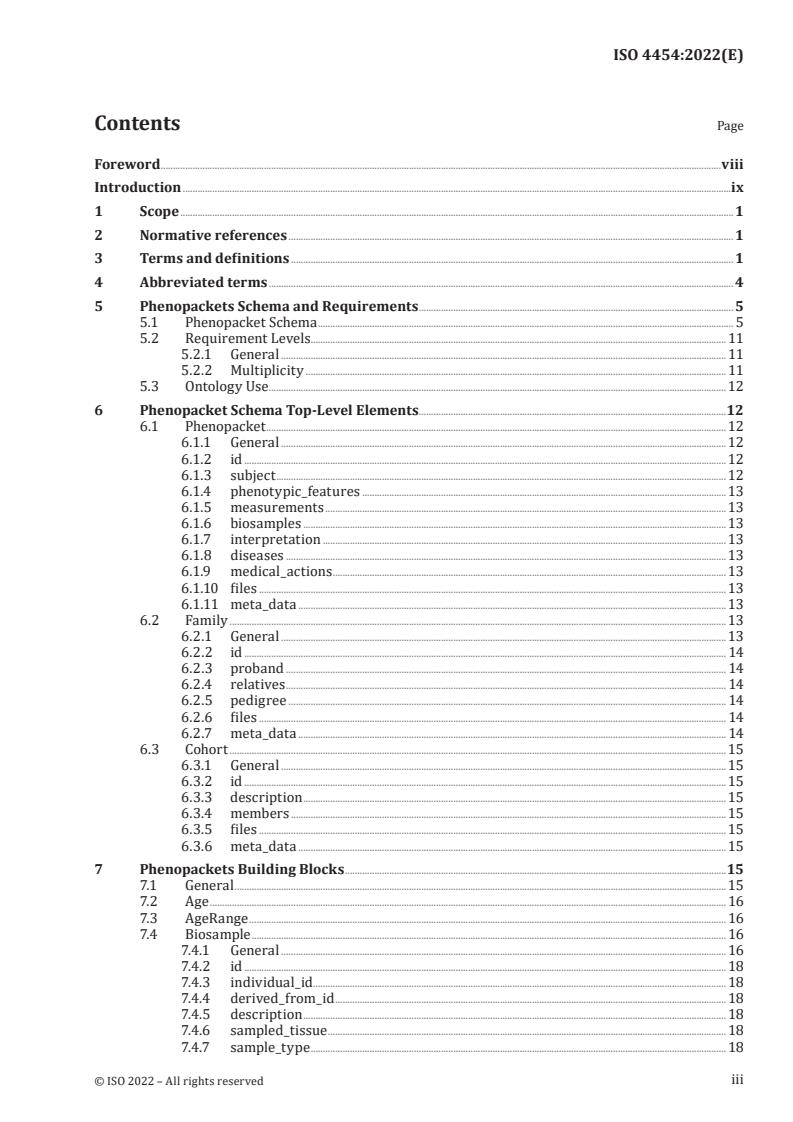
Contents Page
Foreword .viii
Introduction .ix
1 Scope . 1
2 Normative references . 1
3 Terms and definitions . 1
4 Abbreviated terms . 4
5 Phenopackets Schema and Requirements . 5
5.1 Phenopacket Schema . 5
5.2 Requirement Levels. 11
5.2.1 General . 11
5.2.2 Multiplicity . 11
5.3 Ontology Use .12
6 Phenopacket Schema Top-Level Elements.12
6.1 Phenopacket .12
6.1.1 General .12
6.1.2 id .12
6.1.3 subject . 12
6.1.4 phenotypic_features .13
6.1.5 measurements .13
6.1.6 biosamples .13
6.1.7 interpretation . 13
6.1.8 diseases .13
6.1.9 medical_actions . 13
6.1.10 files . 13
6.1.11 meta_data .13
6.2 Family .13
6.2.1 General .13
6.2.2 id . 14
6.2.3 proband . 14
6.2.4 relatives . 14
6.2.5 pedigree . 14
6.2.6 files . 14
6.2.7 meta_data . 14
6.3 Cohort . 15
6.3.1 General .15
6.3.2 id . 15
6.3.3 description . 15
6.3.4 members .15
6.3.5 files . 15
6.3.6 meta_data .15
7 Phenopackets Building Blocks .15
7.1 General . 15
7.2 Age . 16
7.3 AgeRange . 16
7.4 Biosample . 16
7.4.1 General . 16
7.4.2 id . 18
7.4.3 individual_id . 18
7.4.4 derived_from_id . 18
7.4.5 description . 18
7.4.6 sampled_tissue . 18
7.4.7 sample_type . 18
iii
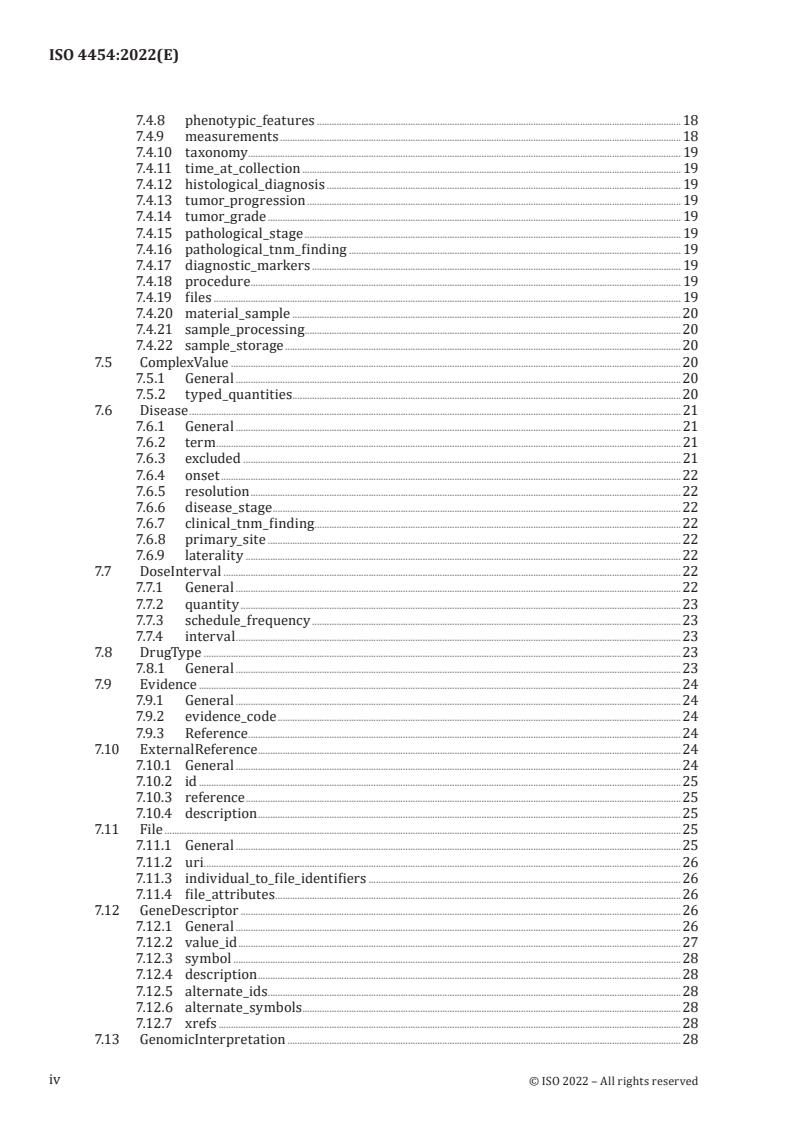
7.4.8 phenotypic_features . 18
7.4.9 measurements . 18
7.4.10 taxonomy . 19
7.4.11 time_at_collection . 19
7.4.12 histological_diagnosis . 19
7.4.13 tumor_progression . 19
7.4.14 tumor_grade . 19
7.4.15 pathological_stage . 19
7.4.16 pathological_tnm_finding . 19
7.4.17 diagnostic_markers . 19
7.4.18 procedure . . 19
7.4.19 files . 19
7.4.20 material_sample . 20
7.4.21 sample_processing . .20
7.4.22 sample_storage . 20
7.5 ComplexValue . 20
7.5.1 General .20
7.5.2 typed_quantities . . .20
7.6 Disease . 21
7.6.1 General . 21
7.6.2 term . 21
7.6.3 excluded . 21
7.6.4 onset .22
7.6.5 resolution . 22
7.6.6 disease_stage . 22
7.6.7 clinical_tnm_finding . .22
7.6.8 primary_site . 22
7.6.9 laterality . 22
7.7 DoseInterval . 22
7.7.1 General .22
7.7.2 quantity .23
7.7.3 schedule_frequency . 23
7.7.4 interval . 23
7.8 DrugType .23
7.8.1 General .23
7.9 Evidence . 24
7.9.1 General . 24
7.9.2 evidence_code . 24
7.9.3 Reference . 24
7.10 ExternalReference . 24
7.10.1 General . 24
7.10.2 id . 25
7.10.3 reference . 25
7.10.4 description . 25
7.11 File . 25
7.11.1 General . 25
7.11.2 uri . 26
7.11.3 individual_to_file_identifiers . 26
7.11.4 file_attributes .26
7.12 GeneDescriptor . 26
7.12.1 General . 26
7.12.2 value_id . 27
7.12.3 symbol .28
7.12.4 description .28
7.12.5 alternate_ids . .28
7.12.6 alternate_symbols .28
7.12.7 xrefs .28
7.13 GenomicInterpretation .28
iv
7.13.1 General .28
7.13.2 subject_or_biosample_id .29
7.13.3 interpretation_status .29
7.13.4 call .29
7.14 GestationalAge .29
7.14.1 General .29
7.15 Individual . 30
7.15.1 General .30
7.15.2 id .30
7.15.3 alternate_ids . . 31
7.15.4 date_of_birth . 31
7.15.5 time_at_last_encounter . 31
7.15.6 vital_status . 32
7.15.7 sex . 32
7.15.8 karyotypic_sex . 32
7.15.9 gender . . 32
7.15.10 taxonomy . 32
7.16 Interpretation . 32
7.16.1 General . 32
7.16.2 id . 33
7.16.3 progress_status .33
7.16.4 diagnosis .34
7.16.5 summary .34
7.17 KaryotypicSex .34
7.18 Measurement . 35
7.18.1 General . 35
7.18.2 description . 36
7.18.3 assay .36
7.18.4 value .36
7.18.5 time_observed .36
7.18.6 procedure . . 36
7.19 MedicalAction. 36
7.19.1 General .36
7.19.2 action . 37
7.19.3 treatment_target . 37
7.19.4 treatment_intent . 37
7.19.5 response_to_treatment . 37
7.19.6 adverse_events . 37
7.19.7 treatment_termination_reason . 37
7.20 MetaData . 37
7.20.1 General . 37
7.20.2 created .38
7.20.3 created_by .38
7.20.4 submitted_by .38
7.20.5 resources .38
7.20.6 updates .39
7.20.7 phenopacket_schema_version .39
7.20.8 external_references . 39
7.21 OntologyClass . 39
7.21.1 General .39
7.21.2 id .39
7.21.3 label . 39
7.22 Pedigree .40
7.22.1 General .40
7.22.2 persons .40
7.23 PhenotypicFeature . 42
7.23.1 General . 42
7.23.2 description . 42
v
7.23.3 type . 42
7.23.4 excluded . 43
7.23.5 severity . 43
7.23.6 modifiers . 43
7.23.7 onset . 43
7.23.8 resolution . 43
7.23.9 evidence. 43
7.24 Procedure . 43
7.24.1 General . 43
7.24.2 code .44
7.24.3 body site .44
7.24.4 performed .44
7.25 Quantity .44
7.25.1 General .44
7.25.2 unit . 45
7.25.3 value . 45
7.25.4 reference_range . . . 45
7.26 RadiationTherapy . 45
7.26.1 General . 45
7.26.2 modality . 45
7.26.3 body_site . 45
7.26.4 dosage .46
7.26.5 fractions .46
7.27 ReferenceRange .46
7.27.1 General .46
7.27.2 unit .46
7.27.3 low .46
7.27.4 high .46
7.28 Resource .46
7.28.1 General .46
7.28.2 id . 47
7.28.3 name .48
7.28.4 url .48
7.28.5 version .48
7.28.6 namespace_prefix . .48
7.28.7 iriPrefix.48
7.28.8 CURIE .48
7.28.9 Identifier resolution .49
7.29 Sex .49
7.30 TherapeuticRegimen .49
7.30.1 General .49
7.30.2 identifier . 50
7.30.3 start_time .50
7.30.4 end_time. 50
7.30.5 regimen_status .50
7.31 TimeElement.50
7.31.1 General .50
7.31.2 gestational_age . 51
7.31.3 age . 51
7.31.4 age_range . 51
7.31.5 ontology_class . 51
7.31.6 timestamp . 51
7.31.7 interval .
...