

ISO/IEC TS 11801-9903:2025
(Main)Information technology — Generic cabling for customer premises — Part 9903: Modelling of channels and links
General Information
- Abstract
This document establishes modelling of limits for mixed-mode transmission parameters within and between two pairs of balanced cabling. This document consists of a detailed description of matrix modelling and gives explanations on how to convert matrices, by using the S to T and T to S matrix conversion. Further it consists of terms and definitions used, how specific parameters are modelled, alternative calculation and signal-to-noise ratio (SNR) modelling. Chain parameters and alternative approaches and formulas are described for combining component cable and connector transmission parameters into cabling link and channel transmission parameters. S-parameter limit matrix formulas are covered, which can be transformed into T-parameter limit matrices for use in chain parameter link and channel limit formulas. The formulas are applicable to all transmission parameters for forming complete differential-mode, mixed-mode, and common-mode link and channel models. Terms and definitions used for modelling are discussed, together with how modelling is done for specific transmission parameters. Alternative calculation models are explained, and the SNR modelling introduced. This second edition cancels and replaces the first edition published in 2021. This edition constitutes a technical revision. This edition includes the following significant technical changes with respect to the previous edition: a) the expansion of the list of specified parameters to include mixed-mode mode-conversion and related unbalance attenuation parameters; b) the addition of an informative annex covering the topic of signal-to-noise ratio and its relation to the S-parameter matrix channel model.
- Status
- Published
- Publication Date
- 30-Sep-2025
- Technical Committee
- ISO/IEC JTC 1/SC 25 - Interconnection of information technology equipment
- Current Stage
- 6060 - International Standard published
- Start Date
- 01-Oct-2025
- Due Date
- 23-Mar-2027
- Completion Date
- 01-Oct-2025
Overview
ISO/IEC TS 11801-9903:2025 - Information technology - Generic cabling systems for customer premises - Part 9903: Modelling of channels and links specifies matrix-based modelling methods for mixed‑mode transmission parameters in two‑pair balanced cabling. The technical specification describes how to form and convert S-parameter and T-parameter limit matrices, combine component cable and connector transmission parameters into link and channel models, and model differential‑mode, mixed‑mode and common‑mode behavior. The 2025 edition updates the parameter set to include mixed‑mode mode‑conversion and related unbalance attenuation terms and adds an informative annex on signal‑to‑noise ratio (SNR) modelling.
Key topics and requirements
- Matrix modelling framework: detailed definition of quadriport/multiport matrices and operational scattering (S) and transmission (T) matrices for two‑pair systems.
- S ↔ T conversion: prescribed methods and formulas to convert S‑parameter matrices to T‑parameter matrices and vice versa (Annex A).
- Mixed‑mode parameters: modelling of differential, common and mixed‑mode terms including mode conversion and unbalance attenuation.
- Chain/concatenation modelling: rules and formulas for concatenating component T‑matrices (chain parameters) to form permanent link and channel transmission models.
- Limit matrix extraction: approaches and alternative calculations for deriving cabling limit lines from component statistics (Annex D).
- SNR and system performance: informative guidance on SNR modelling, PSD, noise definitions, modulation and BER relations to S‑parameter channel models (Annex E).
- Terms and definitions: unified nomenclature for transmission, insertion loss, NEXT, ACR‑F and return‑loss modelling (Annexes B and C).
Practical applications
- Combining measured or specified component S‑parameters (cables, connectors) into accurate link and channel models for design verification.
- Establishing limit matrices and compliance criteria for cabling subsystem performance in product development and qualification.
- Predicting mixed‑mode crosstalk, mode conversion and SNR impacts on high‑speed Ethernet and other balanced‑pair communication systems.
- Feeding channel models into system simulations for signaling, modulation and BER analysis.
Who should use this standard
- Cable and connector manufacturers, test laboratories and product engineers.
- Network designers, integrators and consultants working on structured cabling and high‑speed links.
- Standards and compliance engineers developing test plans and limit lines for customer‑premises cabling.
Related standards
- Part of the ISO/IEC 11801 generic cabling family; intended to be used alongside other 11801 parts that define cabling classes, installation and testing requirements.
Keywords: ISO/IEC TS 11801-9903:2025, generic cabling, modelling of channels and links, S-parameters, T-parameters, mixed‑mode, SNR, mode conversion.
Relations
- Effective Date
- 16-Oct-2025
Get Certified
Connect with accredited certification bodies for this standard

BSI Group
BSI (British Standards Institution) is the business standards company that helps organizations make excellence a habit.

NYCE
Mexican standards and certification body.
Sponsored listings
Frequently Asked Questions
ISO/IEC TS 11801-9903:2025 is a technical specification published by the International Organization for Standardization (ISO). Its full title is "Information technology — Generic cabling for customer premises — Part 9903: Modelling of channels and links". This standard covers: This document establishes modelling of limits for mixed-mode transmission parameters within and between two pairs of balanced cabling. This document consists of a detailed description of matrix modelling and gives explanations on how to convert matrices, by using the S to T and T to S matrix conversion. Further it consists of terms and definitions used, how specific parameters are modelled, alternative calculation and signal-to-noise ratio (SNR) modelling. Chain parameters and alternative approaches and formulas are described for combining component cable and connector transmission parameters into cabling link and channel transmission parameters. S-parameter limit matrix formulas are covered, which can be transformed into T-parameter limit matrices for use in chain parameter link and channel limit formulas. The formulas are applicable to all transmission parameters for forming complete differential-mode, mixed-mode, and common-mode link and channel models. Terms and definitions used for modelling are discussed, together with how modelling is done for specific transmission parameters. Alternative calculation models are explained, and the SNR modelling introduced. This second edition cancels and replaces the first edition published in 2021. This edition constitutes a technical revision. This edition includes the following significant technical changes with respect to the previous edition: a) the expansion of the list of specified parameters to include mixed-mode mode-conversion and related unbalance attenuation parameters; b) the addition of an informative annex covering the topic of signal-to-noise ratio and its relation to the S-parameter matrix channel model.
This document establishes modelling of limits for mixed-mode transmission parameters within and between two pairs of balanced cabling. This document consists of a detailed description of matrix modelling and gives explanations on how to convert matrices, by using the S to T and T to S matrix conversion. Further it consists of terms and definitions used, how specific parameters are modelled, alternative calculation and signal-to-noise ratio (SNR) modelling. Chain parameters and alternative approaches and formulas are described for combining component cable and connector transmission parameters into cabling link and channel transmission parameters. S-parameter limit matrix formulas are covered, which can be transformed into T-parameter limit matrices for use in chain parameter link and channel limit formulas. The formulas are applicable to all transmission parameters for forming complete differential-mode, mixed-mode, and common-mode link and channel models. Terms and definitions used for modelling are discussed, together with how modelling is done for specific transmission parameters. Alternative calculation models are explained, and the SNR modelling introduced. This second edition cancels and replaces the first edition published in 2021. This edition constitutes a technical revision. This edition includes the following significant technical changes with respect to the previous edition: a) the expansion of the list of specified parameters to include mixed-mode mode-conversion and related unbalance attenuation parameters; b) the addition of an informative annex covering the topic of signal-to-noise ratio and its relation to the S-parameter matrix channel model.
ISO/IEC TS 11801-9903:2025 is classified under the following ICS (International Classification for Standards) categories: 35.200 - Interface and interconnection equipment. The ICS classification helps identify the subject area and facilitates finding related standards.
ISO/IEC TS 11801-9903:2025 has the following relationships with other standards: It is inter standard links to ISO/IEC TS 11801-9903:2021. Understanding these relationships helps ensure you are using the most current and applicable version of the standard.
ISO/IEC TS 11801-9903:2025 is available in PDF format for immediate download after purchase. The document can be added to your cart and obtained through the secure checkout process. Digital delivery ensures instant access to the complete standard document.
Standards Content (Sample)
ISO/IEC TS 11801-9903
Edition 2.0 2025-09
TECHNICAL
SPECIFICATION
Information technology - Generic cabling for customer premises -
Part 9903: Modelling of channels and links
ICS 35.200 ISBN 978-2-8327-0698-5
ISO/IEC TS 11801-9903: 2025-09(en)
All rights reserved. Unless otherwise specified, no part of this publication may be reproduced or utilized in any form or
by any means, electronic or mechanical, including photocopying and microfilm, without permission in writing from either
IEC or IEC's member National Committee in the country of the requester. If you have any questions about IEC copyright
or have an enquiry about obtaining additional rights to this publication, please contact the address below or your local
IEC member National Committee for further information.
IEC Secretariat Tel.: +41 22 919 02 11
3, rue de Varembé info@iec.ch
CH-1211 Geneva 20 www.iec.ch
Switzerland
About the IEC
The International Electrotechnical Commission (IEC) is the leading global organization that prepares and publishes
International Standards for all electrical, electronic and related technologies.
About IEC publications
The technical content of IEC publications is kept under constant review by the IEC. Please make sure that you have the
latest edition, a corrigendum or an amendment might have been published.
IEC publications search - IEC Products & Services Portal - products.iec.ch
webstore.iec.ch/advsearchform Discover our powerful search engine and read freely all the
The advanced search enables to find IEC publications by a publications previews, graphical symbols and the glossary.
variety of criteria (reference number, text, technical With a subscription you will always have access to up to date
committee, …). It also gives information on projects, content tailored to your needs.
replaced and withdrawn publications.
Electropedia - www.electropedia.org
The world's leading online dictionary on electrotechnology,
IEC Just Published - webstore.iec.ch/justpublished
Stay up to date on all new IEC publications. Just Published containing more than 22 500 terminological entries in English
details all new publications released. Available online and and French, with equivalent terms in 25 additional languages.
once a month by email. Also known as the International Electrotechnical Vocabulary
(IEV) online.
IEC Customer Service Centre - webstore.iec.ch/csc
If you wish to give us your feedback on this publication or
need further assistance, please contact the Customer
Service Centre: sales@iec.ch.
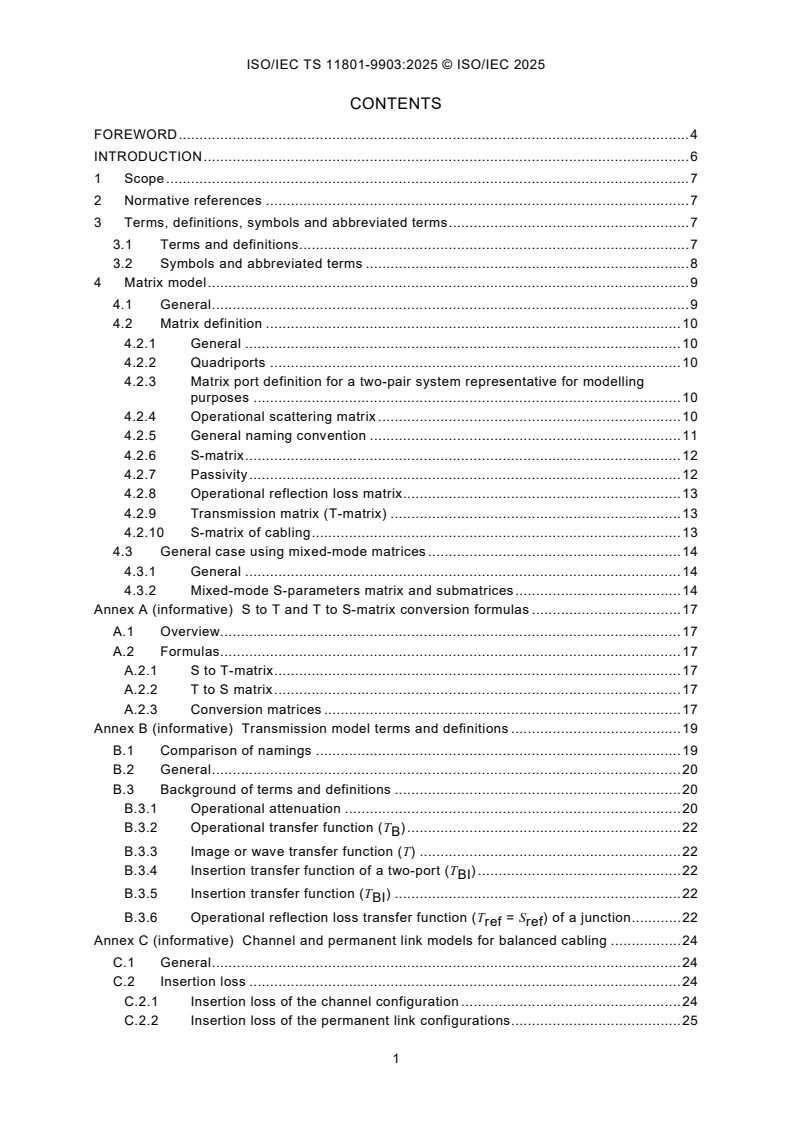
CONTENTS
FOREWORD . 4
INTRODUCTION . 6
1 Scope . 7
2 Normative references . 7
3 Terms, definitions, symbols and abbreviated terms . 7
3.1 Terms and definitions . 7
3.2 Symbols and abbreviated terms . 8
4 Matrix model . 9
4.1 General . 9
4.2 Matrix definition . 10
4.2.1 General . 10
4.2.2 Quadriports . 10
4.2.3 Matrix port definition for a two-pair system representative for modelling
purposes . 10
4.2.4 Operational scattering matrix . 10
4.2.5 General naming convention . 11
4.2.6 S-matrix . 12
4.2.7 Passivity . 12
4.2.8 Operational reflection loss matrix . 13
4.2.9 Transmission matrix (T-matrix) . 13
4.2.10 S-matrix of cabling . 13
4.3 General case using mixed-mode matrices . 14
4.3.1 General . 14
4.3.2 Mixed-mode S-parameters matrix and submatrices . 14
Annex A (informative) S to T and T to S-matrix conversion formulas . 17
A.1 Overview. 17
A.2 Formulas. 17
A.2.1 S to T-matrix . 17
A.2.2 T to S matrix . 17
A.2.3 Conversion matrices . 17
Annex B (informative) Transmission model terms and definitions . 19
B.1 Comparison of namings . 19
B.2 General . 20
B.3 Background of terms and definitions . 20
B.3.1 Operational attenuation . 20
B.3.2 Operational transfer function (T ) . 22
B
B.3.3 Image or wave transfer function (T) . 22
B.3.4 Insertion transfer function of a two-port (T ) . 22
BI
B.3.5 Insertion transfer function (T ) . 22
BI
B.3.6 Operational reflection loss transfer function (T = S ) of a junction . 22
ref ref
Annex C (informative) Channel and permanent link models for balanced cabling . 24
C.1 General . 24
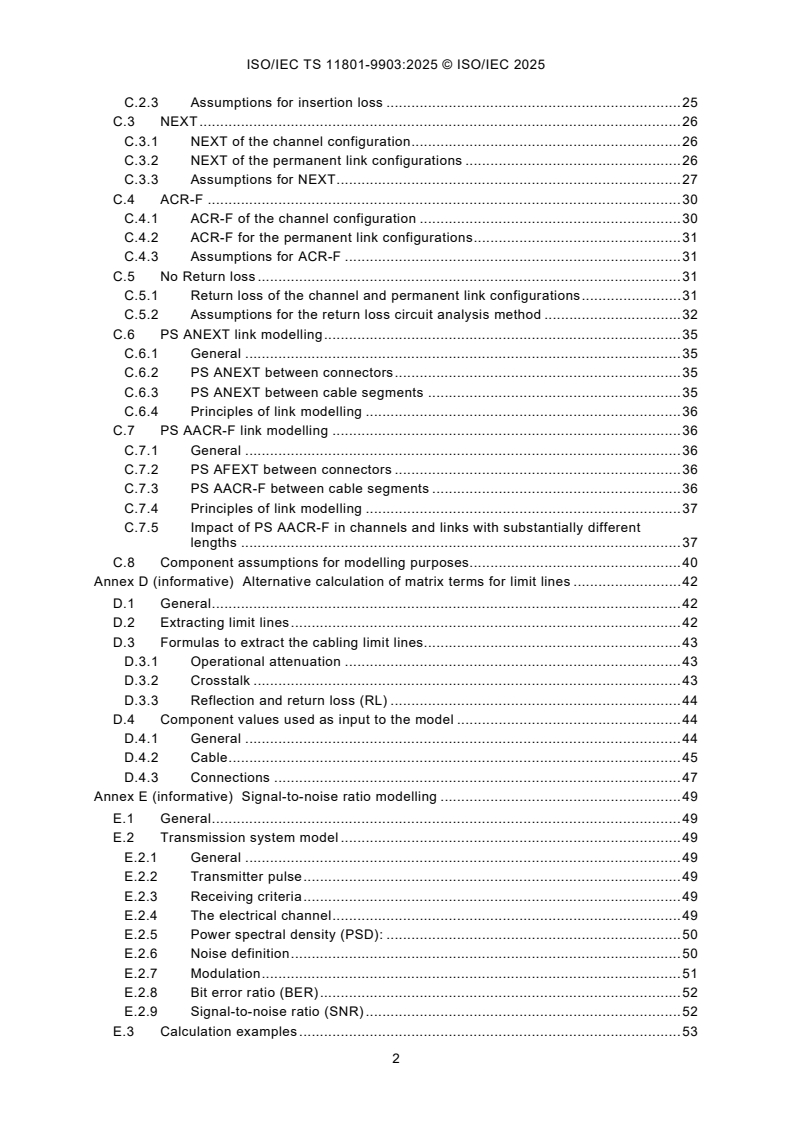
C.2 Insertion loss . 24
C.2.1 Insertion loss of the channel configuration . 24
C.2.2 Insertion loss of the permanent link configurations . 25
C.2.3 Assumptions for insertion loss . 25
C.3 NEXT . 26
C.3.1 NEXT of the channel configuration . 26
C.3.2 NEXT of the permanent link configurations . 26
C.3.3 Assumptions for NEXT . 27
C.4 ACR-F . 30
C.4.1 ACR-F of the channel configuration . 30
C.4.2 ACR-F for the permanent link configurations . 31
C.4.3 Assumptions for ACR-F . 31
C.5 No Return loss . 31
C.5.1 Return loss of the channel and permanent link configurations . 31
C.5.2 Assumptions for the return loss circuit analysis method . 32
C.6 PS ANEXT link modelling . 35
C.6.1 General . 35
C.6.2 PS ANEXT between connectors . 35
C.6.3 PS ANEXT between cable segments . 35
C.6.4 Principles of link modelling . 36
C.7 PS AACR-F link modelling . 36
C.7.1 General . 36
C.7.2 PS AFEXT between connectors . 36
C.7.3 PS AACR-F between cable segments . 36
C.7.4 Principles of link modelling . 37
C.7.5 Impact of PS AACR-F in channels and links with substantially different
lengths . 37
C.8 Component assumptions for modelling purposes. 40
Annex D (informative) Alternative calculation of matrix terms for limit lines . 42
D.1 General . 42
D.2 Extracting limit lines . 42
D.3 Formulas to extract the cabling limit lines. 43
D.3.1 Operational attenuation . 43
D.3.2 Crosstalk . 43
D.3.3 Reflection and return loss (RL) . 44
D.4 Component values used as input to the model . 44
D.4.1 General . 44
D.4.2 Cable . 45
D.4.3 Connections . 47
Annex E (informative) Signal-to-noise ratio modelling . 49
E.1 General . 49
E.2 Transmission system model . 49
E.2.1 General . 49
E.2.2 Transmitter pulse . 49
E.2.3 Receiving criteria . 49
E.2.4 The electrical channel . 49
E.2.5 Power spectral density (PSD): . 50
E.2.6 Noise definition . 50
E.2.7 Modulation . 51
E.2.8 Bit error ratio (BER) . 52
E.2.9 Signal-to-noise ratio (SNR) . 52
E.3 Calculation examples . 53
E.3.1 General . 53
E.3.2 Comparison with other calculations: . 53
Bibliography . 56
Figure 1 – Matrix definition of a 4-port two twisted pair system . 10
Figure 2 – Operational scattering parameters example from port 2 . 11
Figure 3 – Transmission matrix concatenation showing an example of a 2-connector
permanent link . 13
Figure B.1 – Defining the operational attenuation and the operational transfer functions
of a two-port . 21
Figure B.2 – Defining the reflection transfer functions and the return loss of a junction . 23
Figure C.1 – Example of computation of NEXT with higher precision . 27
Figure C.2 – Example of increased impact of PS AFEXT. 37
Figure D.1 – Graphical example of a NEXT calculation showing statistical results (red
dots) and final calculation (blue line) . 43
Figure D.2 – 100 m cable return loss without reflection at both ends . 47
Figure D.3 – 100 m cable return loss with a reflection of 0,03 at both ends
(6 Ω mismatch, ~23 dB return loss at 1 MHz) . 47
Figure E.1 – Different noise spectra . 51
Figure E.2 – Results using this calculation, which show good agreement with similar
calculations in [12] . 54
Figure E.3 – Presentation on best modulation scheme (PAM4) and signal-to-noise ratio
(SNR) . 55
Table 1 – All four ports operational scattering parameter definition . 11
Table 2 – TCL/TCTL and LCL/LCTL port designations . 11
Table 3 – Equal S-parameters for real components . 12
Table 4 – Interrelation of mixed-mode mode-conversion and related parameters . 14
Table 5 – Mixed-mode S-parameter notation . 15
Table B.1 – Comparison of naming in ISO/IEC 11801-1 and ISO/IEC TS 11801-9903 . 19
Table C.1 – Insertion loss deviation . 25
Table C.2 – Modelling assumptions for cable transmission parameters . 40
Table C.3 – Model input assumptions used in the statistical calculation (Class E ). 41
A
Table C.4 – Model input assumptions used in the statistical calculation (Class F ) . 41
A
Table E.1 – Typical noise limits for 1-pair channels . 51
Table E.2 – Comparison of different modulation PAM levels . 52
Table E.3 – Summary . 54
Information technology -
Generic cabling for customer premises -
Part 9903: Modelling of channels and links
FOREWORD
1) ISO (the International Organization for Standardization) and IEC (the International Electrotechnical Commission)
form the specialized system for worldwide standardization. National bodies that are members of ISO or IEC
participate in the development of International Standards through technical committees established by the
respective organization to deal with particular fields of technical activity. ISO and IEC technical committees
collaborate in fields of mutual interest. Other international organizations, governmental and non-governmental,
in liaison with ISO and IEC, also take part in the work.
2) The formal decisions or agreements of IEC and ISO on technical matters express, as nearly as possible, an
international consensus of opinion on the relevant subjects since each technical committee has representation
from all interested IEC and ISO National bodies.
3) IEC and ISO documents have the form of recommendations for international use and are accepted by IEC and
ISO National bodies in that sense. While all reasonable efforts are made to ensure that the technical content of
IEC and ISO documents is accurate, IEC and ISO cannot be held responsible for the way in which they are used
or for any misinterpretation by any end user.
4) In order to promote international uniformity, IEC and ISO National bodies undertake to apply IEC and ISO
documents transparently to the maximum extent possible in their national and regional publications. Any
divergence between any IEC and ISO document and the corresponding national or regional publication shall be
clearly indicated in the latter.
5) IEC and ISO do not provide any attestation of conformity. Independent certification bodies provide conformity
assessment services and, in some areas, access to IEC and ISO marks of conformity. IEC and ISO are not
responsible for any services carried out by independent certification bodies.
6) All users should ensure that they have the latest edition of this document.
7) No liability shall attach to IEC and ISO or their directors, employees, servants or agents including individual
experts and members of its technical committees and IEC and ISO National bodies for any personal injury,
property damage or other damage of any nature whatsoever, whether direct or indirect, or for costs (including
legal fees) and expenses arising out of the publication, use of, or reliance upon, this ISO/IEC document or any
other IEC and ISO documents.
8) Attention is drawn to the Normative references cited in this document. Use of the referenced publications is
indispensable for the correct application of this document.
9) IEC and ISO draw attention to the possibility that the implementation of this document may involve the use of (a)
patent(s). IEC and ISO take no position concerning the evidence, validity or applicability of any claimed patent
rights in respect thereof. As of the date of publication of this document, IEC and ISO had not received notice of
(a) patent(s), which may be required to implement this document. However, implementers are cautioned that this
may not represent the latest information, which may be obtained from the patent database available at
https://patents.iec.ch and www.iso.org/patents. IEC and ISO shall not be held responsible for identifying any or
all such patent rights.
ISO/IEC 11801-9903 has been prepared by subcommittee 25: Interconnection of information
technology equipment, of ISO/IEC joint technical committee 1: Information technology. It is a
Technical Specification.
This second edition cancels and replaces the first edition published in 2021. This edition
constitutes a technical revision.
This edition includes the following significant technical changes with respect to the previous
edition:
a) the expansion of the list of specified parameters to include mixed-mode mode-conversion
and related unbalance attenuation parameters;
b) the addition of an informative annex covering the topic of signal-to-noise ratio and its relation
to the S-parameter matrix channel model.
The text of this Technical Specification is based on the following documents:
Draft Report on voting
JTC1-SC25/3324/DTS JTC1-SC25/3333/RVDTS
Full information on the voting for its approval can be found in the report on voting indicated in
the above table.
The language used for the development of this Technical Specification is English.
A list of all parts in the ISO/IEC 11801 series, published under the general title Information
technology - Generic cabling for customer premises, can be found on the IEC website.
This document was drafted in accordance with ISO/IEC Directives, Part 2, and developed in
accordance with ISO/IEC Directives, Part 1, and the ISO/IEC Directives, JTC 1 Supplement
available at www.iec.ch/members_experts/refdocs and www.iso.org/directives.
INTRODUCTION
This document includes models and assumptions, which support the limits for the channel and
permanent link test configurations in ISO/IEC 11801-1. These are based on the performance
requirements of cable and connecting hardware as specified in IEC standards. Modelling of
channels and links can be done in different ways.
This document provides models that assure that a channel created by adding compliant patch
cords to a permanent link will meet the applicable channel performance limits.
1 Scope
This part of ISO/IEC 11801, which is a Technical Specification, establishes modelling of limits
for mixed-mode transmission parameters within and between two pairs of balanced cabling.
This document consists of a detailed description of matrix modelling and gives explanations on
how to convert matrices, by using the S to T and T to S matrix conversion. Further it consists
of terms and definitions used, how specific parameters are modelled, alternative calculation
and signal-to-noise ratio (SNR) modelling.
Chain parameters and alternative approaches and formulas are described for combining
component cable and connector transmission parameters into cabling link and channel
transmission parameters. S-parameter limit matrix formulas are covered, which can be
transformed into T-parameter limit matrices for use in chain parameter link and channel limit
formulas. The formulas are applicable to all transmission parameters for forming complete
differential-mode, mixed-mode, and common-mode link and channel models.
Terms and definitions used for modelling are discussed, together with how modelling is done
for specific transmission parameters. Alternative calculation models are explained, and the SNR
modelling introduced.
2 Normative references
The following documents are referred to in the text in such a way that some or all of their content
constitutes requirements of this document. For dated references, only the edition cited applies.
For undated references, the latest edition of the referenced document (including any
amendments) applies.
ISO/IEC 11801-1, Information technology - Generic cabling for customer premises - Part 1:
General requirements
3 Terms, definitions, symbols and abbreviated terms
3.1 Terms and definitions
For the purposes of this document, the terms and definitions given in ISO/IEC 11801-1 and the
following apply.
ISO and IEC maintain terminology databases for use in standardization at the following
addresses:
• IEC Electropedia: available at https://www.electropedia.org/
• ISO Online browsing platform: available at https://www.iso.org/obp
3.1.1
attenuation
decrease in magnitude of power of a signal that propagates along a single conductor or pair of
conductors of a cable
Note 1 to entry: Attenuation is expressed in dB/m; see IEC 61156-1.
3.1.2
connection
mated device or combination of devices including terminations used to connect cables or cable
elements to other cables, cable elements or application-specific equipment
EXAMPLE Jack and plug; see ISO/IEC 11801-1.
3.1.3
image attenuation
wave attenuation
attenuation when a two-port is terminated by its input and output characteristic impedances with
no reflections at input and output
Note 1 to entry: The wave attenuation of cables is length scalable; see B.3.3.
3.1.4
insertion loss
loss incurred by inserting a device between a source and load of equal impedance
Note 1 to entry: The device itself can have a different impedance from the load and source impedance.
Note 2 to entry: The terms operational attenuation and operational insertion loss are sometimes associated with
this definition; see B.3.2.
3.1.5
insertion loss deviation
difference between the measured insertion loss of cascaded components and the insertion loss
determined by the sum of the individual component insertion losses
3.1.6
operational attenuation
ratio of the square root of the maximum available power wave vector emitted by the generator
and the square root of the power wave vector absorbed by the load of the two-port
Note 1 to entry: The operational attenuation is not length scalable (see also B.3.1 and B.3.2).
Note 2 to entry: The operational attenuation is expressed in decibels (dB) and radians (rad).
3.1.7
unitarity
mathematical concept for matrices to define passivity
Note 1 to entry: Unitarity is a necessary property of the reflection matrix used for the mismatch loss between two
cabling segment matrices for the cascaded segment’s operational attenuation. This assures linearity or passivity,
thus the forward loss and reverse loss are equal at the junction; see 4.2.8
3.1.8
operational reflection
loss due to the reflection at a junction
Note 1 to entry: See also B.3.6.
Note 2 to entry: See also 4.2.8
3.1.9
raised cosine
special pulse and spectra shape suited for baseband data transmission
3.2 Symbols and abbreviated terms
A operational wave attenuation (Np)
A operational wave transfer function (Np)
T
AWGN additive white Gaussian noise
B operational phase (rad)
B random phase (rad)
RAND
B operational phase transfer function (rad)
T
BER bit error ratio
DRL distributed return loss (dB)
f frequency (MHz)
FEXT operational far-end crosstalk loss (dB)
FEXT operational FEXT transfer function (dB)
T
IL insertion loss (dB)
LCL operational longitudinal conversion loss (dB)
LCL operational LCL transfer function (dB)
T
LCTL operational longitudinal conversion transfer loss (dB)
LCTL operational LCTL transfer function (dB)
T
NEXT operational near-end crosstalk loss (dB)
NEXT operational NEXT transfer function (dB)
T
PHY physical layer interface
PSD power spectrum density
RL return loss (dB)
SNR signal-to-noise ratio
TCL operational transverse conversion loss (dB)
TCL operational TCL transfer function (dB)
T
TCTL operational transverse conversion transfer loss (dB)
TCTL operational TCTL transfer function (dB)
T
ρ (rho) operational reflection transfer function, junction reflection coefficient
4 Matrix model
4.1 General
The model that is used is a concatenated matrix calculation as discussed in IEC TR 62152 [1]
for a 2-port system. For a 2-pair balanced cabling calculation, a 4-port differential matrix as
shown in Figure 1 shall be used.
The model assumes that all components are specified with S-parameters and these parameters
are then used to fill an S-matrix for every cabling component.
To concatenate components these S-matrices are transformed into transmission T-matrices,
which can then be multiplied in the appropriate order to simulate the transmission
characteristics of the concatenated components (for details see IEC TR 62152 [1]). The relation
between impedance parameters used in the IEC TR 62152 transmission line model and the
S-parameters used in the ISO/IEC 11801-1 [2] channel and permanent link models is covered
in Annex B.
To evaluate the transmission performance of the modelled channel or permanent link, the
calculated T-matrix of the cabling is transformed back into an S-matrix providing the expected
transmission parameters of the cabling system. The relation between S-parameters and
T-parameters is covered in Annex A.
______________
Numbers in square brackets refer to the Bibliography.
The matrix calculation is done mathematically with S-parameters in amplitude and phase.
a) Measured S-parameters are usually known in amplitude and phase.
b) Parameter limit lines for components and for cabling are specified in amplitude only, usually
in decibel. For modelling purposes these amplitudes shall be transformed into a linear value.
c) For the calculation of matrix terms representing limit lines, the phase is added as a random
value to simulate power sum addition (see 4.3).
The ISO/IEC 11801-1 standard formulas for assembling channel and permanent link
S-parameter models from cable and connector component S-parameter models is covered in
Annex C. An alternative approach and formulas for assembling channel and permanent link
S-parameter models from cable and connector component S-parameter models is covered in
Annex D.
The relation of ISO/IEC 11801-1 standard passive channel S-parameter model and the
respective passive channel signal-to-noise ratio (SNR) model is covered in Annex E.
4.2 Matrix definition
4.2.1 General
In 4.2.3 only the part with the balanced components is described. For the unbalanced part
see 4.3.2.
4.2.2 Quadriports
In IEC TR 62152 [1] voltage and currents of the input and output waves are specified for two
ports. In Figure 1, Figure 2, Table 1, and Formula (1), the cabling specific notation needed for
quadriports (two pairs) is detailed.
4.2.3 Matrix port definition for a two-pair system representative for modelling
purposes
In Figure 1, a 4-port matrix is presented. The definition is one line per port per twisted pair.
Key
a designates a wave entering the quadriport
b designates a wave leaving the quadriport
Figure 1 – Matrix definition of a 4-port two twisted pair system
4.2.4 Operational scattering matrix
In Figure 2, the S-parameters for a source at port 2 are shown. For all definitions, see 4.2.5.
Key
Definition of S-parameters: S
output, input
S = near-end operational crosstalk transfer function (NEXT )
12 T
S = operational reflections coefficient (ρ)
S = far-end operational crosstalk transfer function (FEXT )
32 T
S = forward operational transfer function (A )
42 T
Figure 2 – Operational scattering parameters example from port 2
4.2.5 General naming convention
The naming convention for the four ports is given in Table 1.
Table 1 – All four ports operational scattering parameter definition
From port 1: From port 2: From port 3: From port 4:
S A S A S A S A
31 T 42 T 13 T 24 T
S ρ S ρ S ρ S ρ
11 22 33 44
S FEXT S FEXT S FEXT S FEXT
41 T 32 T 23 T 14 T
S NEXT S NEXT S NEXT S NEXT
21 T 12 T 43 T 34 T
S TCTL S TCTL S TCTL S TCTL
31 T 42 T 13 T 24 T
S TCL S TCL S TCL S TCL
11 T 22 T 33 T 44 T
S LCTL S LCTL S LCTL S LCTL
31 T 42 T 13 T 24 T
S LCL S LCL S LCL S LCL
11 T 22 T 33 T 44 T
The naming convention for the TCL/TCTL and LCL/LCTL ports is given in Table 2.
Table 2 – TCL/TCTL and LCL/LCTL port designations
Near-end Far-end
Common-mode Differential-mode Common-mode Differential-mode
circuit circuit circuit circuit
Near-end TCL Receiver Generator – –
LCL Generator Receiver – –
Far-end TCTL – Generator Receiver –
LCTL Generator – – Receiver
4.2.6 S-matrix
For each cabling component (for cables for each length and type involved, for connections for
each type) an S-matrix shall be developed, see Formula (1). The matrix numbering starts with
1 to be compatible with scattering parameters and generally used definitions (see 4.2.5) and
IEC TR 62152.
S S S S
11 12 13 14
S S S S
21 22 23 24
S=
(1)
S S S S
31 32 33 34
S S S S
41 42 43 44
The following transmission parameters can be substituted into the matrix in Formula (1).
A : S , S , S , S
T 13 31 24 42
, S , S , S
ρ: S
11 22 33 44
NEXT : S , S , S , S
T 12 21 34 43
FEXT : S , S , S , S
T 14 41 23 32
The equal scattering coefficient due to symmetrical nature of component parameters results in
the set of equalities in Table 3.
Table 3 – Equal S-parameters for real components
Parameter Equality For pair number(s)
A
S = S 1
T
13 31
A S = S 2
T 24 42
FEXT S = S 1 and 2
T 14 41
FEXT S = S 1 and 2
T 23 32
NEXT S = S 1 and 2
T 21 12
NEXT S = S 1 and 2
T 34 43
The equalities provided in Table 3 apply to the component scattering matrix in Formula (1).
4.2.7 Passivity
There is a general assumption that all transmission parameters loss values, e.g. NEXT and
FEXT, are much less than one, in linear value, or much greater than 0, in dB.
At higher frequencies it is important that this be taken care of. Otherwise, the output power at
ports in total can be calculated as being higher than the input power.
This is defined as passivity and should be implemented. An example is shown in 4.2.8.
4.2.8 Operational reflection loss matrix
To account for the impedance mismatch between two cabling segments a reflection matrix is
defined. Unitarity should be taken care of especially when phase randomization is applied. As
in the cabling matrix only the wave attenuation is inserted, it is important to add this operational
reflection transfer function to get the operational attenuation as defined, see Formula (2), see
B.3.6.
2
ρρ01− 0
0 ρρ01−
S =
(2)
ρ
10−ρρ 0
01−ρρ0
where
S is the operational reflection loss, transfer function matrix;
ρ
ρ (rho) is the operational reflection transfer function, junction reflection coefficient.
The reflection loss between two cabling sections is defined as ρ, reflection transfer function
(rho), where:
ρ is constant over frequency (for similar cable types);
ρ is a function of frequency, e.g. at the end of cables (cabling) and connectors;
ρ is a real function assuming the reflected wave is in phase, or
ρ is a complex function taking a phase shift of the reflected wave into account.
4.2.9 Transmission matrix (T-matrix)
The component S-matrices are transformed into component transmission (T) matrices (for an
example mathematical transform, see Annex A) which can then be multiplied in the appropriate
order. See Figure 3.
Key
T T matrix of a connection
CO
T T matrix of a cable
C
Figure 3 – Transmission matrix concatenation showing an example
of a 2-connector permanent link
4.2.10 S-matrix of cabling
The resulting concatenated T-matrix is then transformed back to an S-matrix. The derived
S-parameters describe the parameters of the cascaded components, i.e. of the cabling.
4.3 General case using mixed-mode matrices
4.3.1 General
S-parameters can also be used for analysis of mixed differential mode and common mode
parameters. See Table 4.
Table 4 – Interrelation of mixed-mode mode-conversion and related parameters
Launch near-end Launch far-end
CM DM CM DM
Detect near-end CM RL TCL IL TCTL
NEXT NEXT FEXT FEXT
DM LCL RL LCTL IL
NEXT NEXT FEXT FEXT
Detect far-end CM IL TCTL RL TCL
FEXT FEXT NEXT NEXT
DM LCTL IL LCL RL
FEXT FEXT NEXT NEXT
NOTE 1 CM is common-mode; DM is differential-mode.
NOTE 2 Intra-pair parameters are IL, RL, TCL, TCTL, LCL, LCTL; inter-pair parameters are NEXT, FEXT.
4.3.2 Mixed-mode S-parameters matrix and submatrices
4.3.2.1 Mixed-mode S-parameters matrix
The mixed-mode S-parameters matrix is shown in its general form in an example of one pair;
see Formula (3).
SS SS
DD11 DD12 DC11 DC12
SS SS
DD21 DD22 DC21 DC22
S =
(3)
MM
SS SS
CD11 CD12 CC11 CC12
SS SS
CD21 CD22 CC21 CC22
In this case the submatrices are 2 × 2. For the two-pair simulation the structure remains, just
the submatrices grow to 4 × 4. To compare it to practical components each submatrix is given
a special name.
a) DD – differential (in) differential (out) submatrix. This submatrix includes values of insertion
loss, return loss, near-end and far-end crosstalk, as known.
b) CD – differential (in) common mode (out) submatrix. This submatrix includes the transverse
conversion loss (TCL) and the transverse conversion transfer loss (TCTL) values.
c) DC – common mode (in) differential (out) submatrix. This submatrix includes the longitudinal
conversion loss (LCL) and longitudinal conversion transfer loss (LCTL) values.
d) CC – common mode (in) common mode (out) submatrix: This submatrix includes the same
values as the DD submatrix but for the common mode.
The mixed-mode S-parameter matrix, Formula (3), notation is shown in Table 5.
Table 5 – Mixed-mode S-parameter notation
Differential-mode stimulus Common mode stimulus
Port 1 Port 2 Port 1 Port 2
Differential-mode response Port 1 S S S S
DD11 DD12 DC11 DC12
S S S S
Port 2
DD21 DD22 DC21 DC22
Common mode response Port 1 S S S S
CD11 CD12 CC11 CC12
Port 2 S S S S
CD21 CD22 CC21 CC22
For real components, some values in these matrices will be equal because there is no difference
if the transmitter is differential mode and the result is common mode or vice versa.
4.3.2.2 Mixed-mode S-parameters submatrix DD
Submatrix DD contains the following parameters:
RL NEXT IL FEXT
dd11 dd12 dd13 dd14
NEXT RL FEXT IL
dd21 dd22 dd23 dd24
DD=
(4)
IL FEXT RL NEXT
dd31 dd32 dd33 dd34
FEXT IL NEXT RL
dd41 dd42 dd43 dd44
4.3.2.3 Mixed-mode S-parameters submatrix CD
Submatrix CD contains the following parameters:
TCL NEXT TCTL FEXT
cd11 cd12 cd13 cd14
NEXT TCL FEXT TCTL
cd21 cd22 cd23 cd24
CD=
(5)
TCTL FEXT TCL NEXT
cd31 cd32 cd33 cd34
FEXT TCTL NEXT TCL
cd41 cd42 cd43 cd44
4.3.2.4 Mixed-mode S-parameters submatrix DC
Submatrix DC contains the following parameters:
LCL NEXT LCTL FEXT
dc11 dc12 dc13 dc14
NEXT LCL FEXT LCTL
dc21 dc22 dc23 dc24
DC= (6)
LCTL FEXT LCL NEXT
dc31 dc32 dc33 dc34
FEXT LCTL NEXT LCL
dc41 dc42 dc43 dc44
Mode conversion coupling is the same for common-to-differential as differential-to-common,
thus submatrix DC has the same values as submatrix CD.
4.3.2.5 Mixed-mode S-parameters submatrix CC
Submatrix CC is similar to submatrix DD and the four mixed-mode parameters have similar
length dependency.
RL NEXT IL FEXT
cc11 cc12 cc13 cc14
NEXT RL FEXT IL
cc21 cc22 cc23 cc24
CC=
(7)
IL FEXT RL NEXT
cc31 cc32 cc33 cc34
FEXT IL NEXT RL
cc41 cc42 cc43 cc44
Annex A
(informative)
S to T and T to S-matrix conversion formulas
A.1 Overview
Generally, only the four S to T and T to S-matrix conversion formulas for 2-port matrices are
presented, e.g. in IEC TR 62152:2009, Annex C. The corresponding formulas for a 16-port
matrix (using the port numbering introduced in Figure 2) are provided here for information.
A.2 Formulas
A.2.1 S to T-matrix
The S to T matrix conversion formula for 16-port matrices is given in Formula (A.1).
−1
(A.1)
T= X+ XS×+X X S
[ ] ([ ] [ ][ ]) ([ ] [ ][ ])
ca ca da db
where
T is the calculated chain matrix of a component;
S is the mixed-mode matrix of a component;
X are the conversion matrices, given below.
xy
A.2.2 T to S matrix
The T to S matrix conversion formula for 16-port matrices is given in Formula (A.2).
−1
S TX− X×−X TX (A.2)
[ ] [ ][ ] [ ] [ ] [ ][ ]
( ) ( )
db cb ca da
where
S is the calculated mixed-mode matrix of a component;
T is the chain matrix of a component;
X are the conversion matrices, given below.
xy
A.2.3 Conversion matrices
The conversion matrices are given in Formulas (A.3), (A.4), (A.5), and (A.6).
=
1 0000000
0 1 000000
X =
(A.3)
ca
0000 1 000
00000 1 00
00 1 00000
000 1 0000
X =
(A.4)
da
000000 1 0
0000000 1
1 0000000
0 1 000000
X =
(A.5)
cb
0000 1 000
00000 1 00
00 1 00000
000 1 0000
X =
(A.6)
db
000000 1 0
0000000 1
Annex B
(informative)
Transmission model terms and definitions
B.1 Comparison of namings
Table B.1 provides a comparative table of naming conventions.
Table B.1 – Comparison of naming in ISO/IEC 11801-1 and ISO/IEC TS 11801-9903
Current Used in ISO/IEC TS 11801-9903 Definition Abbreviation
General usage
ISO/IEC 11801-1
operational attenuation Forward A
T
operational
transfer
function (not
length
scalable)
insertion loss operational attenuation loss in Forward A
decibel operational
Insertion loss transfer loss
(not length
scalable)
wave or image attenuation Forward wave —
transfer
function (no
reflections,
length
scalable)
Only in definition As a general term for diminishing — —
Attenuation
of signal strength
insertion loss insertion loss deviation Insertion loss ILD
Insertion loss
deviation deviation (in
deviaton
decibel)
NEXT transfer function Near-end NEXT
T
cr
...