


ISO/FDIS 19947
(Main)Engineered stone — Vocabulary
Engineered stone — Vocabulary
This document specifies terms and definitions of engineered stone intended for use in finished products such as countertops and vanities, floor and wall coverings and accessories including its raw materials, manufacturing, fabrication and installation.
Pierre agglomérée — Vocabulaire
General Information
- Status
- Not Published
- Technical Committee
- ISO/TC 328 - Engineered stones
- Drafting Committee
- ISO/TC 328 - Engineered stones
- Current Stage
- 5020 - FDIS ballot initiated: 2 months. Proof sent to secretariat
- Start Date
- 23-Dec-2025
- Completion Date
- 23-Dec-2025
Overview
ISO/FDIS 19947:2025, titled Engineered Stone - Vocabulary, is an international standard developed by ISO Technical Committee ISO/TC 328/WG 3. This standard establishes clear and internationally recognized terms and definitions related to engineered stone products. Engineered stone refers to composite materials made from aggregates, binders, and additives that are primarily used in finished products such as countertops, vanities, floor and wall coverings, and related accessories for both interior and exterior applications.
This document serves as an essential terminology guide for manufacturers, fabricators, installers, and professionals involved in the engineered stone industry. It supports consistent communication and quality control by defining key concepts related to raw materials, manufacturing processes, product classifications, and installation.
Key Topics
ISO/FDIS 19947:2025 covers a comprehensive range of terms and definitions crucial for understanding and working with engineered stone:
Definitions of Engineered Stone and Product Classifications
- Engineered stone is defined as a composite material used for various finished products.
- Products are classified based on the mineral nature of aggregates (calcareous, siliceous, or combined) and type of binders (resin, hydraulic cement, or mixtures).
- Terms such as engineered stone slab, panel, rough slab, tile, and cut-to-size product are precisely described to clarify product specifications.
Raw Materials Terminology
- Clear definitions differentiate between indigenous raw materials, pre-consumer and post-consumer materials, recycled contents, and reclaimed waste.
- Aggregates and fillers are classified by mineral type (carbonate or silicate) including terms such as quartz, granite, marble, limestone, and feldspar.
- Binder types like thermosetting resin, unsaturated polyester resin, terephthalic resin, and hydraulic cement are detailed.
Additives and Chemical Components
- Definitions include pigments, adhesion promoters, cement fluidifiers, initiators (hardeners), and reaction accelerators.
- These additives influence the physical and aesthetic properties of engineered stone products.
Manufacturing and Processing Operations
- Key process terms such as mixing, moulding, calibration, cold and hot curing, distribution, and surface finishing are defined.
- These terms help ensure quality control and reproducibility in engineered stone production.
Applications
The terminology established by ISO/FDIS 19947:2025 has practical value across multiple facets of engineered stone use:
Manufacturing: Standardized terms ensure clear specifications for raw materials, additives, and processing operations, enabling manufacturers to communicate requirements efficiently and produce consistent quality engineered stone products.
Architecture and Construction: Architects, builders, and installers benefit from precise vocabulary when specifying engineered stone slabs, tiles, panels, or custom cut sizes for projects involving countertops, floors, walls, and decorative accessories.
Quality Control and Testing: Consistent terminology supports laboratories and certification bodies in assessing engineered stone products based on clearly defined characteristics and production steps.
Sustainability and Recycling: Definitions related to recycled content, post-consumer, and pre-consumer materials encourage the use of sustainable practices in raw material sourcing and waste management.
Global Trade and Compliance: Harmonized vocabulary facilitates international trade by reducing misunderstandings in product descriptions, ensuring conformity with global standards, and supporting regulatory compliance.
Related Standards
ISO/FDIS 19947:2025 complements and references several related standards and resources, including:
- EN 16954: European standard on engineered stone products.
- ISO/IEC Directives: Editorial rules used for drafting ISO standards.
- ISO 10426-1: Portable cement classification.
- ISO 14618 and ISO 14692-1: Standards related to polyester resin and thermosetting resins.
- ISO 8781-1 and ISO 1382: Standards on pigments and compounding ingredients.
- ISO/TR 17870-2: Related to thin engineered stone panels.
Additional terminologies can also be referenced from databases such as the ISO Online Browsing Platform and the IEC Electropedia.
By adopting the standardized terminology defined in ISO/FDIS 19947:2025, stakeholders across engineered stone production, design, and installation can ensure clarity, accuracy, and efficiency throughout the product lifecycle. This vocabulary standard is an indispensable resource for advancing best practices in engineered stone manufacturing and application worldwide.

Get Certified
Connect with accredited certification bodies for this standard

ICC Evaluation Service
Building products evaluation and certification.

QAI Laboratories
Building and construction product testing and certification.

Aboma Certification B.V.
Specialized in construction, metal, and transport sectors.
Sponsored listings
Frequently Asked Questions
ISO/FDIS 19947 is a draft published by the International Organization for Standardization (ISO). Its full title is "Engineered stone — Vocabulary". This standard covers: This document specifies terms and definitions of engineered stone intended for use in finished products such as countertops and vanities, floor and wall coverings and accessories including its raw materials, manufacturing, fabrication and installation.
This document specifies terms and definitions of engineered stone intended for use in finished products such as countertops and vanities, floor and wall coverings and accessories including its raw materials, manufacturing, fabrication and installation.
ISO/FDIS 19947 is classified under the following ICS (International Classification for Standards) categories: 01.040.91 - Construction materials and building (Vocabularies); 91.100.99 - Other construction materials. The ICS classification helps identify the subject area and facilitates finding related standards.
ISO/FDIS 19947 is available in PDF format for immediate download after purchase. The document can be added to your cart and obtained through the secure checkout process. Digital delivery ensures instant access to the complete standard document.
Standards Content (Sample)
FINAL DRAFT
International
Standard
ISO/TC 328
Engineered stone — Vocabulary
Secretariat: UNI
Voting begins on:
2025-12-23
Voting terminates on:
2026-02-17
RECIPIENTS OF THIS DRAFT ARE INVITED TO SUBMIT,
WITH THEIR COMMENTS, NOTIFICATION OF ANY
RELEVANT PATENT RIGHTS OF WHICH THEY ARE AWARE
AND TO PROVIDE SUPPOR TING DOCUMENTATION.
IN ADDITION TO THEIR EVALUATION AS
BEING ACCEPTABLE FOR INDUSTRIAL, TECHNO
LOGICAL, COMMERCIAL AND USER PURPOSES, DRAFT
INTERNATIONAL STANDARDS MAY ON OCCASION HAVE
TO BE CONSIDERED IN THE LIGHT OF THEIR POTENTIAL
TO BECOME STAN DARDS TO WHICH REFERENCE MAY BE
MADE IN NATIONAL REGULATIONS.
Reference number
FINAL DRAFT
International
Standard
ISO/TC 328
Engineered stone — Vocabulary
Secretariat: UNI
Voting begins on:
Voting terminates on:
RECIPIENTS OF THIS DRAFT ARE INVITED TO SUBMIT,
WITH THEIR COMMENTS, NOTIFICATION OF ANY
RELEVANT PATENT RIGHTS OF WHICH THEY ARE AWARE
AND TO PROVIDE SUPPOR TING DOCUMENTATION.
© ISO 2025
IN ADDITION TO THEIR EVALUATION AS
All rights reserved. Unless otherwise specified, or required in the context of its implementation, no part of this publication may
BEING ACCEPTABLE FOR INDUSTRIAL, TECHNO
LOGICAL, COMMERCIAL AND USER PURPOSES, DRAFT
be reproduced or utilized otherwise in any form or by any means, electronic or mechanical, including photocopying, or posting on
INTERNATIONAL STANDARDS MAY ON OCCASION HAVE
the internet or an intranet, without prior written permission. Permission can be requested from either ISO at the address below
TO BE CONSIDERED IN THE LIGHT OF THEIR POTENTIAL
or ISO’s member body in the country of the requester.
TO BECOME STAN DARDS TO WHICH REFERENCE MAY BE
MADE IN NATIONAL REGULATIONS.
ISO copyright office
CP 401 • Ch. de Blandonnet 8
CH-1214 Vernier, Geneva
Phone: +41 22 749 01 11
Email: copyright@iso.org
Website: www.iso.org
Published in Switzerland Reference number
ii
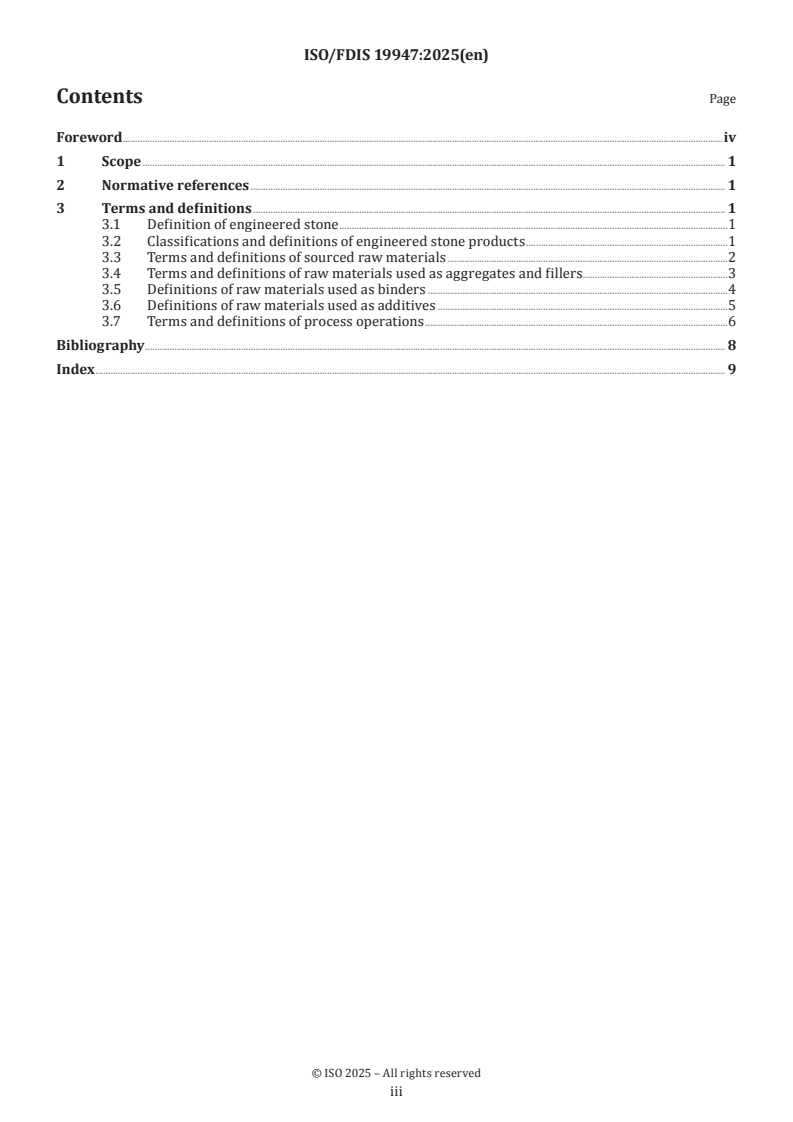
Contents Page
Foreword .iv
1 Scope . 1
2 Normative references . 1
3 Terms and definitions . 1
3.1 Definition of engineered stone .1
3.2 Classifications and definitions of engineered stone products .1
3.3 Terms and definitions of sourced raw materials .2
3.4 Terms and definitions of raw materials used as aggregates and fillers .3
3.5 Definitions of raw materials used as binders .4
3.6 Definitions of raw materials used as additives .5
3.7 Terms and definitions of process operations .6
Bibliography . 8
Index . 9
iii
Foreword
ISO (the International Organization for Standardization) is a worldwide federation of national standards
bodies (ISO member bodies). The work of preparing International Standards is normally carried out through
ISO technical committees. Each member body interested in a subject for which a technical committee
has been established has the right to be represented on that committee. International organizations,
governmental and non-governmental, in liaison with ISO, also take part in the work. ISO collaborates closely
with the International Electrotechnical Commission (IEC) on all matters of electrotechnical standardization.
The procedures used to develop this document and those intended for its further maintenance are described
in the ISO/IEC Directives, Part 1. In particular, the different approval criteria needed for the different types
of ISO document should be noted. This document was drafted in accordance with the editorial rules of the
ISO/IEC Directives, Part 2 (see www.iso.org/directives).
ISO draws attention to the possibility that the implementation of this document may involve the use of (a)
patent(s). ISO takes no position concerning the evidence, validity or applicability of any claimed patent
rights in respect thereof. As of the date of publication of this document, ISO had not received notice of (a)
patent(s) which may be required to implement this document. However, implementers are cautioned that
this may not represent the latest information, which may be obtained from the patent database available at
www.iso.org/patents. ISO shall not be held responsible for identifying any or all such patent rights.
Any trade name used in this document is information given for the convenience of users and does not
constitute an endorsement.
For an explanation of the voluntary nature of standards, the meaning of ISO specific terms and expressions
related to conformity assessment, as well as information about ISO's adherence to the World Trade
Organization (WTO) principles in the Technical Barriers to Trade (TBT), see www.iso.org/iso/foreword.html.
This document was prepared by Technical Committee ISO/TC 328, Engineered stones.
Any feedback or questions on this document should be directed to the user’s national standards body. A
complete listing of these bodies can be found at www.iso.org/members.html.
iv
FINAL DRAFT International Standard ISO/FDIS 19947:2025(en)
Engineered stone — Vocabulary
1 Scope
This document specifies terms and definitions of engineered stone intended for use in finished products
such as countertops and vanities, floor and wall coverings and accessories including its raw materials,
manufacturing, fabrication and installation.
2 Normative references
There are no normative references in this document.
3 Terms and definitions
ISO and IEC maintain terminology databases for use in standardization at the following addresses:
— ISO Online browsing platform: available at https:// www .iso .org/ obp
— IEC Electropedia: available at https:// www .electropedia .org/
3.1 Definition of engineered stone
3.1.1
engineered stone
composite material manufactured from a mixture of aggregates, binders and additives intended for
fabrication of countertops and vanities, floor and wall coverings and ancillary uses, for both interior and
exterior applications
Note 1 to entry: Engineered stone has also been known as artificial marble, artificial stone, manufactured stone,
agglomerated stone, engineered quartz, quartz, quartz surfacing etc.
3.2 Classifications and definitions of engineered stone products
3.2.1
classification according to the mineral nature of the aggregates
engineered stone product can be classified, as calcareous nature, siliceous nature or a combination of the
two
3.2.2
classification according to the type of the binder
engineered stone product can be classified as resin, hydraulic cement or mixtures of resin and cement
3.2.3
engineered stone cut to size product
finished product obtained from a rough slab or a slab, the dimensions of which must be referred to a template
or a drawing
[SOURCE: EN 16954:2018, 3.3 modified — “engineered stone” added in the term, "need to be" changed to
"must", “agglomerated” deleted from the definition, Note 1 to entry deleted]
3.2.4
engineered stone panel
finished product with thickness ≤5,5 mm, surface area >1 m , and any tile edge > 1 200 mm or an engineered
stone tile declared as a thin engineered stone panel by its manufacturer or having properties meeting an
international or national standard for thin engineered stone panels
[SOURCE: ISO/TR 17870-2:2015, 3.1.3 modified — “thin ceramic” replaced with “engineered stone” in the
term and the definition]
3.2.5
engineered stone rough slab
semi-finished engineered stone product with edges obtained either by sawing from a block or by moulding
the surface of which may or may not be the finished surface
Note 1 to entry: The size is given by nominal dimensions in this order: length, width, thickness expressed in
millimetres.
[SOURCE: EN 16954:2018, 3.1 modified — “engineered stone” added in the term, “agglomerated” replaced
by “engineered” in the definition, “the size is given by nominal dimensions in this order: length, width,
thickness expressed in millimetres” moved to the Note 1 to entry]
3.2.6
engineered stone slab
finished product obtained from rough slabs, the surface of which is a finished surface ready to use
Note 1 to entry: The dimensions of which are given by length - width - thickness (in this order), expressed in
millimetres according to defined tolerances.
[SOURCE: EN 16954:2018, 3.2 modified — “engineered stone” added in the term, “agglomerated” deleted
from the definition, “the dimensions of which are given by length - width - thickness (in this order), expressed
in millimetres according to defined tolerances” moved to the Note 1 to entry]
3.2.7
engineered stone tile
element made from engineered stone and used as covering for floors and walls
Note 1 to entry: Engineered stone generally consists of an area less than or equal to 1 m and up to 30 mm thick.
3.3 Terms and definitions of sourced raw materials
3.3.1
indigenous raw material
raw material that is recovered, harvested, or extracted within an 800 km radius of the manufacturing site
Note 1 to entry: Where materials are transported by water or rail, the distance to the manufacturing site shall be
determined by multiplying the distance that the materials are transported by water or rail by 0,25 and adding that
number to the
...
ISO/DISFDIS 19947:2025(en)
ISO/TC 328/WG 3
Date:2025-07-07
Secretariat: UNI
Date: 2025-12-08
Engineered stone — Vocabulary
© ISO2025
FDIS stage
ISO/DISFDIS 19947:2025(en)
All rights reserved. Unless otherwise specified, or required in the context of its implementation, no part of this publication
may be reproduced or utilized otherwise in any form or by any means, electronic or mechanical, including photocopying,
or posting on the internet or an intranet, without prior written permission. Permission can be requested from either ISO
at the address below or ISO'sISO’s member body in the country of the requester.
ISO Copyright Officecopyright office
CP 401 • Ch. de Blandonnet 8
CH-1214 Vernier, Geneva
Phone: + 41 22 749 01 11
Email:
E-mail: copyright@iso.org
Website: www.iso.org
Published in Switzerland.
© ISO 2025 – All rights reserved
iii
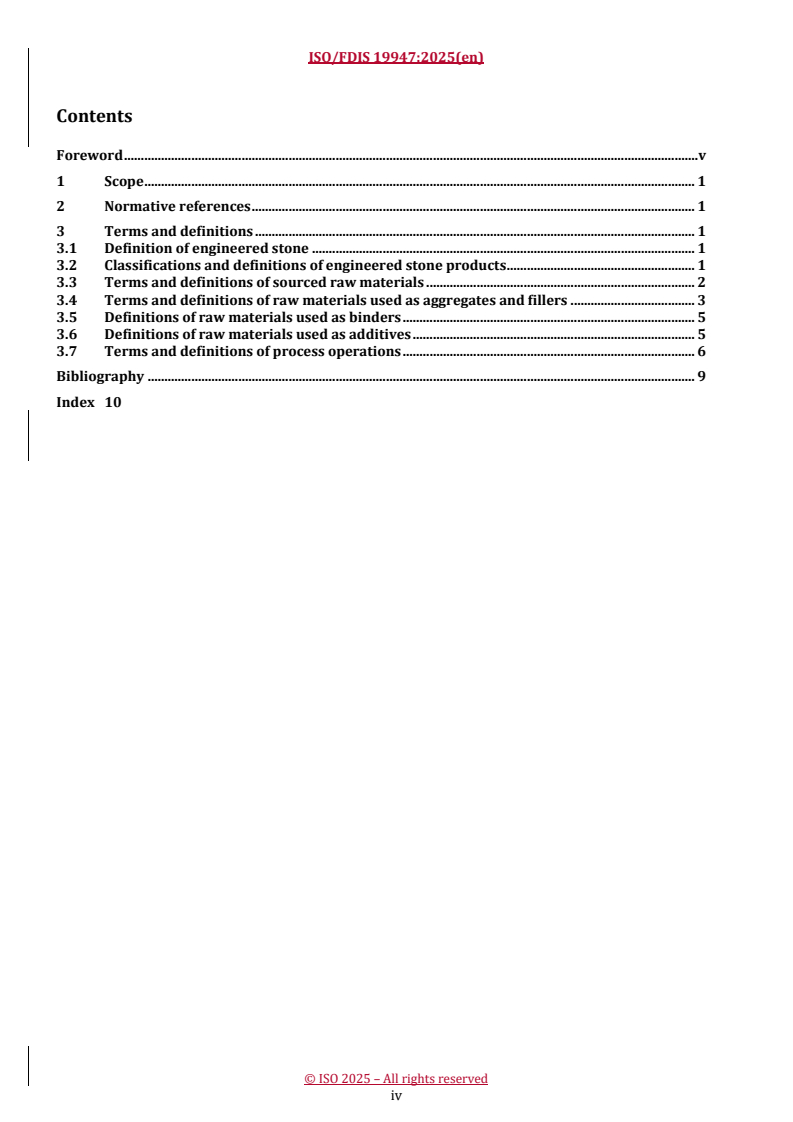
Contents
Foreword . v
1 Scope . 1
2 Normative references . 1
3 Terms and definitions . 1
3.1 Definition of engineered stone . 1
3.2 Classifications and definitions of engineered stone products . 1
3.3 Terms and definitions of sourced raw materials . 2
3.4 Terms and definitions of raw materials used as aggregates and fillers . 3
3.5 Definitions of raw materials used as binders . 5
3.6 Definitions of raw materials used as additives . 5
3.7 Terms and definitions of process operations . 6
Bibliography . 9
Index 10
iv
ISO/DISFDIS 19947:2025(en)
Foreword
ISO (the International Organization for Standardization) is a worldwide federation of national standards
bodies (ISO member bodies). The work of preparing International Standards is normally carried out through
ISO technical committees. Each member body interested in a subject for which a technical committee has been
established has the right to be represented on that committee. International organizations, governmental and
non-governmental, in liaison with ISO, also take part in the work. ISO collaborates closely with the
International Electrotechnical Commission (IEC) on all matters of electrotechnical standardization.
The procedures used to develop this document and those intended for its further maintenance are described
in the ISO/IEC Directives, Part 1. In particular, the different approval criteria needed for the different types of
ISO document should be noted. This document was drafted in accordance with the editorial rules of the
ISO/IEC Directives, Part 2 (see www.iso.org/directives).
ISO draws attention to the possibility that the implementation of this document may involve the use of (a)
patent(s). ISO takes no position concerning the evidence, validity or applicability of any claimed patent rights
in respect thereof. As of the date of publication of this document, ISO [had/had not] received notice of (a)
patent(s) which may be required to implement this document. However, implementers are cautioned that this
may not represent the latest information, which may be obtained from the patent database available at
www.iso.org/patents. ISO shall not be held responsible for identifying any or all such patent rights.
Any trade name used in this document is information given for the convenience of users and does not
constitute an endorsement.
For an explanation of the voluntary nature of standards, the meaning of ISO specific terms and expressions
related to conformity assessment, as well as information about ISO's adherence to the World Trade
Organization (WTO) principles in the Technical Barriers to Trade (TBT), see www.iso.org/iso/foreword.html.
This document was prepared by Technical Committee ISO/TC 328, Engineered stones.
Any feedback or questions on this document should be directed to the user’s national standards body. A
complete listing of these bodies can be found at www.iso.org/members.html.
© ISO 2025 – All rights reserved
v
DRAFT International Standard ISO/DIS 19947:2025(en)
Engineered stone — Terms and definitions — Vocabulary
1 Scope
This document specifies terms and definitions of engineered stone intended for use in finished products such
as countertops and vanities, floor and wall coverings and accessories including its raw materials,
manufacturing, fabrication and installation.
2 Normative references
There are no normative references in this document.
3 Terms and definitions
ISO and IEC maintain terminology databases for use in standardization at the following addresses:
— — ISO Online browsing platform: available at https://www.iso.org/obphttps://www.iso.org/obp
— — IEC Electropedia: available at https://www.electropedia.org/https://www.electropedia.org/
3.1 Definition of engineered stone
3.1.1 3.1.1
engineered stone
composite material manufactured from a mixture of aggregates, binders and additives intended for fabrication
of countertops and vanities, floor and wall coverings and ancillary uses, for both interior and exterior
applications
Note 1 to entry: Engineered stone has also been known as artificial marble, artificial stone, manufactured stone,
agglomerated stone, engineered quartz, quartz, quartz surfacing etc.
3.2 Classifications and definitions of engineered stone products
3.2.1 3.2.1
classification according to the mineral nature of the aggregates
engineered stone product can be classified, as calcareous nature, siliceous nature or a combination of the two
3.2.2 3.2.2
classification according to the type of the binder
engineered stone product can be classified as resin, hydraulic cement or mixtures of resin and cement
3.2.3 3.2.3
engineered stone cut to size product
finished product obtained from a rough slab or a slab, the dimensions of which need tomust be referred to a
template or a drawing
[SOURCE: EN 16954:2018, 3.3 modified — “engineered stone” added in the term, "need to be" changed to
"must", “agglomerated” deleted from the definition, Note 1 to entry deleted]
3.2.4 3.2.4
engineered stone panel
finished product with thickness ≤5,5 mm, surface area >1 m , and any tile edge > 1 200 mm or an engineered
stone tile declared as a thin engineered stone panel by its manufacturer or having properties meeting an
international or national standard for thin engineered stone panels
[SOURCE: ISO/TR 17870-2:2015, 3.1.3 modified — “thin ceramic” replaced with “engineered stone” in the
term and the definition]
3.2.5 3.2.5
engineered stone rough slab
semi-finished engineered stone product with edges obtained either by sawing from a block or by moulding
the surface of which may or may not be the finished surface. ,
Note 1 to entry: the The size is given by nominal dimensions in this order: length, width, thickness expressed in
millimitresmillimetres.
[SOURCE: EN 16954:2018, 3.1 modified — “engineered stone” added in the term, “agglomerated” replaced by
“engineered” in the definition, “the size is given by nominal dimensions in this order: length, width, thickness
expressed in millimetres” moved to the Note 1 to entry]
3.2.6 3.2.6
engineered stone slab
finished product obtained from rough slabs, the surface of which is a finished surface ready to use
Note 1 to entry: the The dimensions of which are given by length - width - thickness (in this order), expressed in
millimetres according to defined tolerances.
[SOURCE: EN 16954:2018, 3.2 modified — “engineered stone” added in the term, “agglomerated” deleted from
the definition, “the dimensions of which are given by length - width - thickness (in this order), expressed in
millimetres according to defined tolerances” moved to the Note 1 to entry]
3.2.7 3.2.7
engineered stone tile
element made from engineered stone and used as covering for floors and walls
Note 1 to entry: Engineered stone generally consists of an area less than or equal to 1 m and up to 30 mm thick.
3.3 Terms and definitions of sourced raw materials
3.3.1 3.3.1
indigenous raw material
raw material that is recovered, harvested, or extracted within an 800 km radius of the manufacturing site
Note 1 to entry: Where materials are transported by water or rail, the distance to the manufacturing site shall be
determined by multiplying the distance that the materials are transported by water or rail by 0,25 and adding that
number to the distance transported by means other than water or rail.
3.3.2 3.3.2
post-consumer material
waste material generated by households or by commercial, industrial and institutional facilities in their role
as end-users of the product, which can no longer be used for its original intended purpose
3.3.3 3.3.3
pre-consumer material
material, solid and/or liquid, diverted from a waste stream generated by the manufacturing process
ISO/DISFDIS 19947:2025(en)
Note 1 to entry: Reutilization of materials (i.e. rework, regrind or scrap generated in a process that does not enter the
waste stream and that is capable of being reclaimed within the same process that generated it) is excluded.
3.3.4 3.3.4
raw material
basic material that can be converted by processing or manufacturing, or a combination of both, into a new
product
Note 1 to entry: A raw material can be virgin, recycled, harvested, extracted, recovered, or manufactured when used as
an ingredient in a new material.
3.3.5 3.3.5
reclaimed waste
waste, scrap material, or water generated during manufacturing processes that, in lieu of disposal, is captured
and reused to manufacture more of the same product
3.4 Terms and definitions of raw materi
...
Questions, Comments and Discussion
Ask us and Technical Secretary will try to provide an answer. You can facilitate discussion about the standard in here.
Loading comments...