

ISO 3980:1977
(Main)Aluminium and aluminium alloys — Determination of copper — Atomic absorption spectrophotometric method
General Information
- Abstract
The method is applicable to copper contents between 0,005 and 5 % (m/m). Specifies principle, reagents, apparatus, sampling, procedure, expression of results and test report.
- Status
- Published
- Publication Date
- 31-Jan-1977
- Technical Committee
- ISO/TC 79 - Light metals and their alloys
- Drafting Committee
- ISO/TC 79 - Light metals and their alloys
- Current Stage
- 9060 - Close of review
- Completion Date
- 02-Sep-2027
Buy Documents
ISO 3980:1977 - Aluminium and aluminium alloys -- Determination of copper -- Atomic absorption spectrophotometric method
ISO 3980:1977 - Aluminium and aluminium alloys — Determination of copper — Atomic absorption spectrophotometric method/1/1977
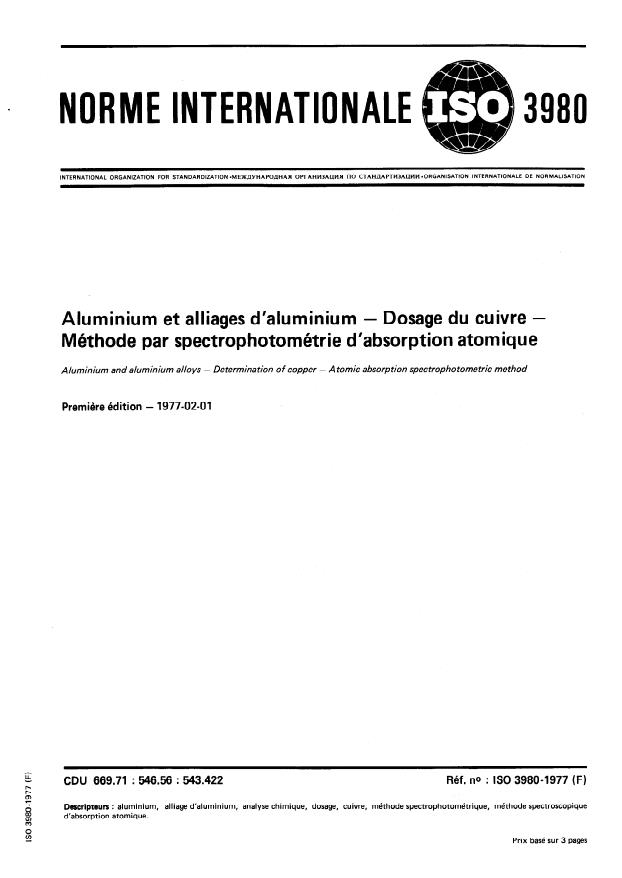
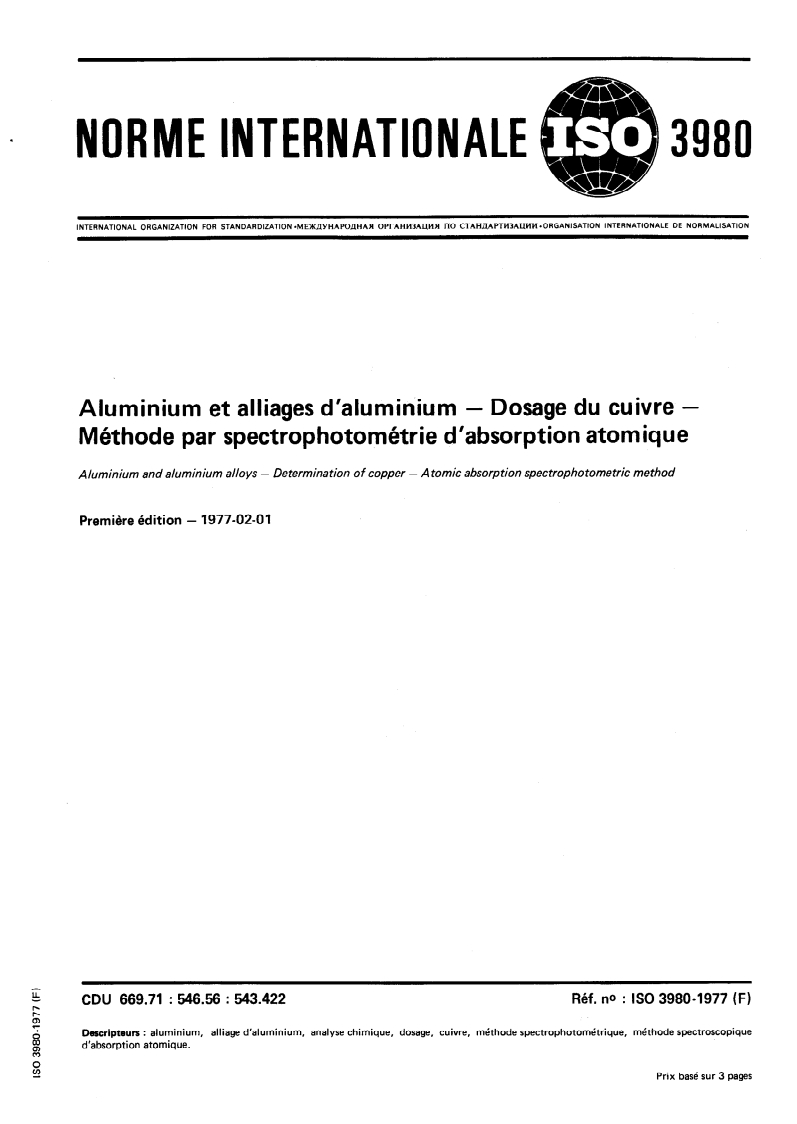
ISO 3980:1977 - Aluminium et alliages d'aluminium -- Dosage du cuivre -- Méthode par spectrophotométrie d'absorption atomique
ISO 3980:1977 - Aluminium et alliages d'aluminium -- Dosage du cuivre -- Méthode par spectrophotométrie d'absorption atomique
ISO 3980:1977 - Aluminium et alliages d'aluminium — Dosage du cuivre — Méthode par spectrophotométrie d'absorption atomique/1/1977
ISO 3980:1977 - Aluminium et alliages d'aluminium — Dosage du cuivre — Méthode par spectrophotométrie d'absorption atomique/1/1977
Overview
ISO 3980:1977 specifies an internationally recognized method for the determination of copper content in aluminium and aluminium alloys using atomic absorption spectrophotometry. This standard is applicable for copper concentrations ranging from 0.005% to 5% by mass. It outlines the full analytical procedure including the principle, reagents, apparatus, sampling, calibration, and result expression.
This method provides precise and reliable chemical analysis essential for quality control and compliance in aluminium alloy production, ensuring materials meet required specifications for industrial and commercial applications.
Key Topics
- Scope and Application: Suitable for copper content between 0.005% and 5% in aluminium and its alloys.
- Analytical Principle: Dissolution of the test sample using hydrochloric acid and hydrogen peroxide, followed by atomization in a flame (air-acetylene or nitrous oxide-acetylene) and measurement of copper absorption at 324.7 nm.
- Reagents: Utilizes high-purity reagents including hydrochloric acid, hydrogen peroxide, sulphuric acid, hydrofluoric acid, nitric acid, and standard copper solutions.
- Sample Preparation: Requires careful dissolution and removal of excess reagents with attention to alloy composition, especially for silicon content above 1%.
- Apparatus: Employs standard laboratory equipment and a specialized atomic absorption spectrophotometer fitted with a copper hollow-cathode lamp.
- Calibration: Involves preparation of standard reference solutions for different copper concentration ranges and plotting calibration curves for accurate quantification.
- Expression of Results: Calculation based on spectrophotometric measurements adjusted by dilution factors and recorded in mass percentages.
- Test Report Requirements: Includes method reference, results, observations, and optionally any non-standard procedures applied.
Applications
ISO 3980:1977 plays a crucial role in various industries where aluminium alloys are used and copper content is a critical parameter:
- Metallurgical Quality Control: Ensures alloy batches comply with copper specifications to maintain mechanical properties and corrosion resistance.
- Aerospace and Automotive Industries: Accurate copper determination assists in verifying alloy composition essential for performance and safety.
- Manufacturing and Fabrication: Supports materials testing during production, recycling, and certification of aluminium components.
- Research and Development: Provides a standardized method for evaluating new aluminium alloy formulations and their copper content impact.
- Regulatory Compliance: Facilitates adherence to international trade and material standards by providing consistent chemical analysis methodology.
Related Standards
For comprehensive aluminium alloy analysis and material testing, ISO 3980:1977 is often used alongside other ISO standards such as:
- ISO 377 - Sampling of metallic materials: Specifies sampling methods for metallic materials, including aluminium and its alloys.
- ISO 11969 - Aluminium and aluminium alloys: Chemical analysis by various spectrometric methods.
- ISO 14284 - Soil quality - Determination of trace elements by atomic absorption spectrometry: shares methodological principles applicable in metal spectroscopy.
- ISO 3556 - Aluminium and aluminium alloys - Determination of silicon - Gravimetric method after sodium hydroxide fusion: complements copper determination where silicon content affects analysis.
- ISO 17025 - General requirements for the competence of testing and calibration laboratories, ensuring quality in the application of methods like ISO 3980.
ISO 3980:1977 remains a vital reference offering a precise, validated, and reproducible technique for copper determination in aluminium alloys. Utilizing this standard supports enhanced quality assurance, regulatory adherence, and technological advancement in metallurgical practices worldwide.
Buy Documents
ISO 3980:1977 - Aluminium and aluminium alloys -- Determination of copper -- Atomic absorption spectrophotometric method
ISO 3980:1977 - Aluminium and aluminium alloys — Determination of copper — Atomic absorption spectrophotometric method/1/1977
ISO 3980:1977 - Aluminium et alliages d'aluminium -- Dosage du cuivre -- Méthode par spectrophotométrie d'absorption atomique
ISO 3980:1977 - Aluminium et alliages d'aluminium -- Dosage du cuivre -- Méthode par spectrophotométrie d'absorption atomique
ISO 3980:1977 - Aluminium et alliages d'aluminium — Dosage du cuivre — Méthode par spectrophotométrie d'absorption atomique/1/1977
ISO 3980:1977 - Aluminium et alliages d'aluminium — Dosage du cuivre — Méthode par spectrophotométrie d'absorption atomique/1/1977
Get Certified
Connect with accredited certification bodies for this standard

Element Materials Technology
Materials testing and product certification.

Inštitut za kovinske materiale in tehnologije
Institute of Metals and Technology. Materials testing, metallurgical analysis, NDT.
Sponsored listings
Frequently Asked Questions
ISO 3980:1977 is a standard published by the International Organization for Standardization (ISO). Its full title is "Aluminium and aluminium alloys — Determination of copper — Atomic absorption spectrophotometric method". This standard covers: The method is applicable to copper contents between 0,005 and 5 % (m/m). Specifies principle, reagents, apparatus, sampling, procedure, expression of results and test report.
The method is applicable to copper contents between 0,005 and 5 % (m/m). Specifies principle, reagents, apparatus, sampling, procedure, expression of results and test report.
ISO 3980:1977 is classified under the following ICS (International Classification for Standards) categories: 77.120.10 - Aluminium and aluminium alloys. The ICS classification helps identify the subject area and facilitates finding related standards.
ISO 3980:1977 is available in PDF format for immediate download after purchase. The document can be added to your cart and obtained through the secure checkout process. Digital delivery ensures instant access to the complete standard document.
Standards Content (Sample)
~~
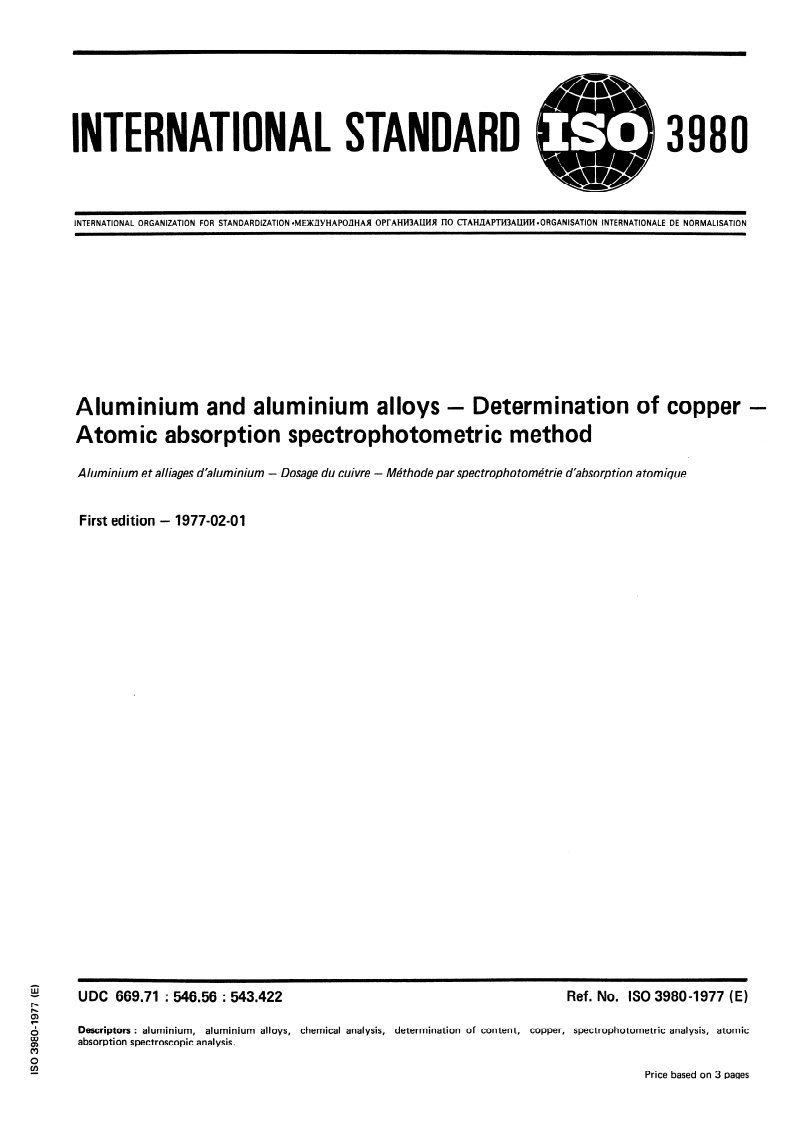
INTERNATIONAL STANDARD
INTERNATIONAL ORGANIZATION FOR STANDARDIZATION l MEXAYHAPOAHAR OPI-AHM3ALWi n0 ~AHAAPTW3ALWi.ORGANISATION INTERNATIONALE DE NORMALISATION
Aluminium and aluminium alloys - Determination of topper -
Atomic absorption spectrophotometric method
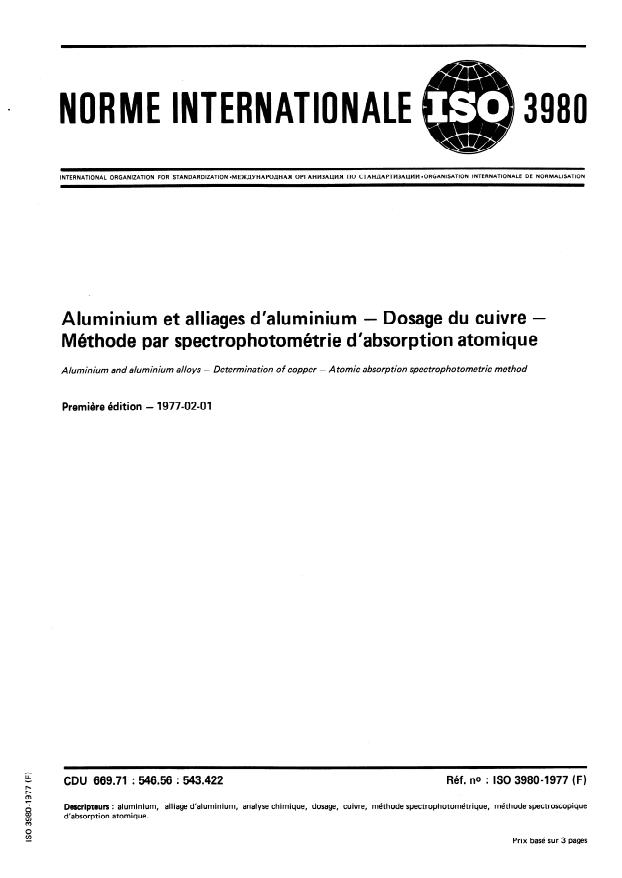
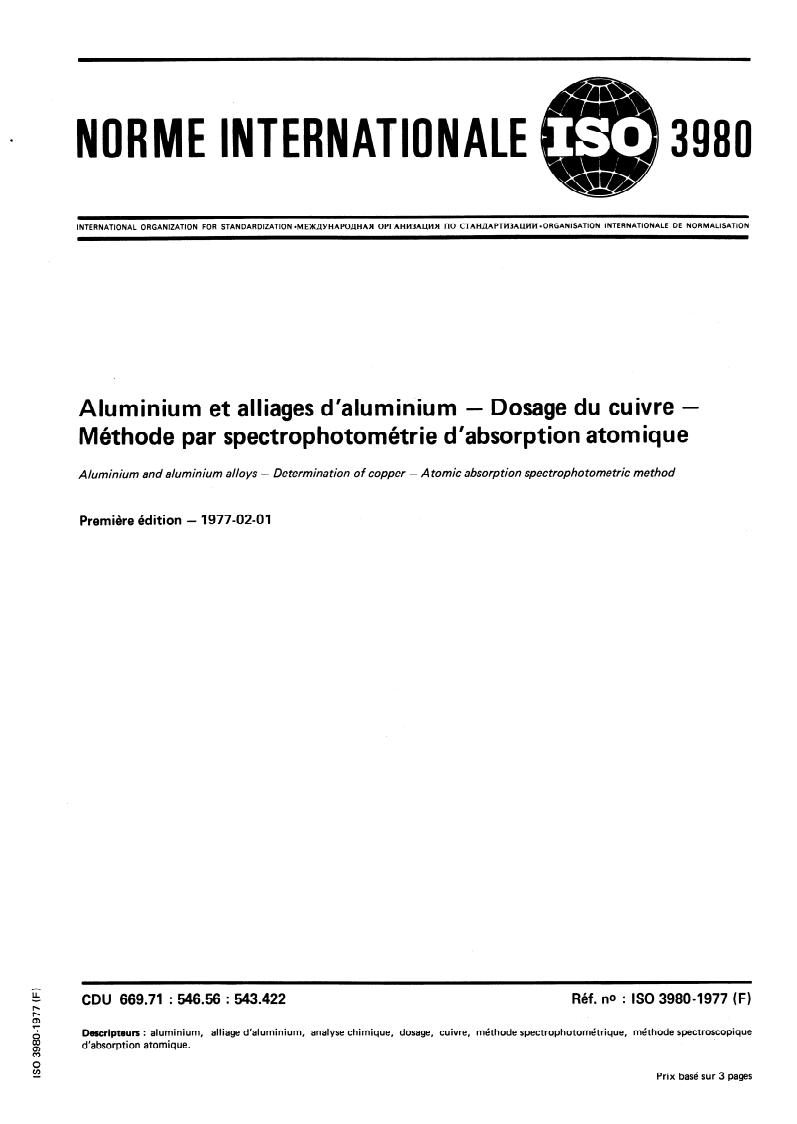
Aluminium et alliages dlaluminium - Dosage du cuivre - Mthode par spectropho tometrie d’absorption a tomique
First edition - 1977-02-01
UDC 669.71 : 546.56 : 543.422 Ref. No. ISO 3980-1977 (E)
spectrophotometric analysis, atomic
Descriptors : aluminium, aluminium alloys, Chemical analysis, determination of content, topper,
absorption spectroscopic analysis.
Price based on 3 pages
FOREWORD
ISO (the International Organization for Standardization) is a worldwide federation
of national Standards institutes (ISO member bodies). The work of deweloping
International Standards is carried out through ISO technical committees. Every
member body interested in a subject for which a technical committee has been set
up has the right to be represented on that committee. International organizations,
governmental and non-governmental, in liaison with ISO, also take part in the work.
Draft International Standards adopted by the technical committees are circulated
to the member bodies for approval before their acceptance as International
Standards by the ISO Council.
International Standard ISO 3980 was drawn up by Technical Committee
ISO/TC 79, Light metals and their #oys, and was circulated to the member bodies
in November 1975.
lt has been approved by the member bodies of the following countries :
Austria Japan Spain
Belgium Korea, Rep. of Switzerland
Czechoslova kia Wlexico Turkey
France United Kingdom
Norway
Germany Poland U.S.A.
Hungary Portugal U.S.S.R.
India Romania Yugoslavia
I taly South Africa, Rep. of
Th e member body of the following country expressed di sapprova I of the document
on technical grounds :
Austral ia
0 International Organization for Standardization, 1977 l
Printed in Switzerland
ISO 39804977 (E)
INTERNATIONAL STANDARD
Aluminium and aluminium alloys - Determination of topper -
Atomic absorption spectrophotometric method
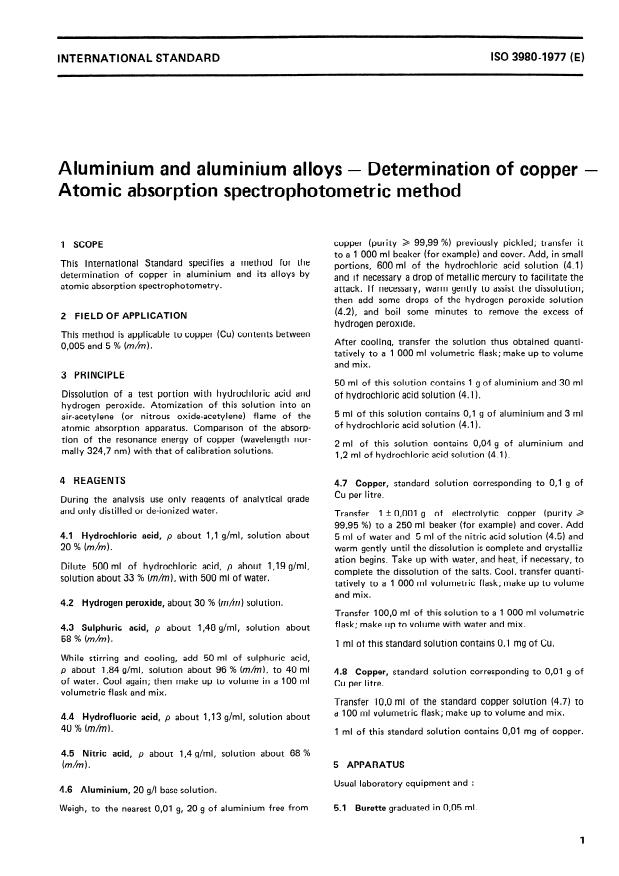
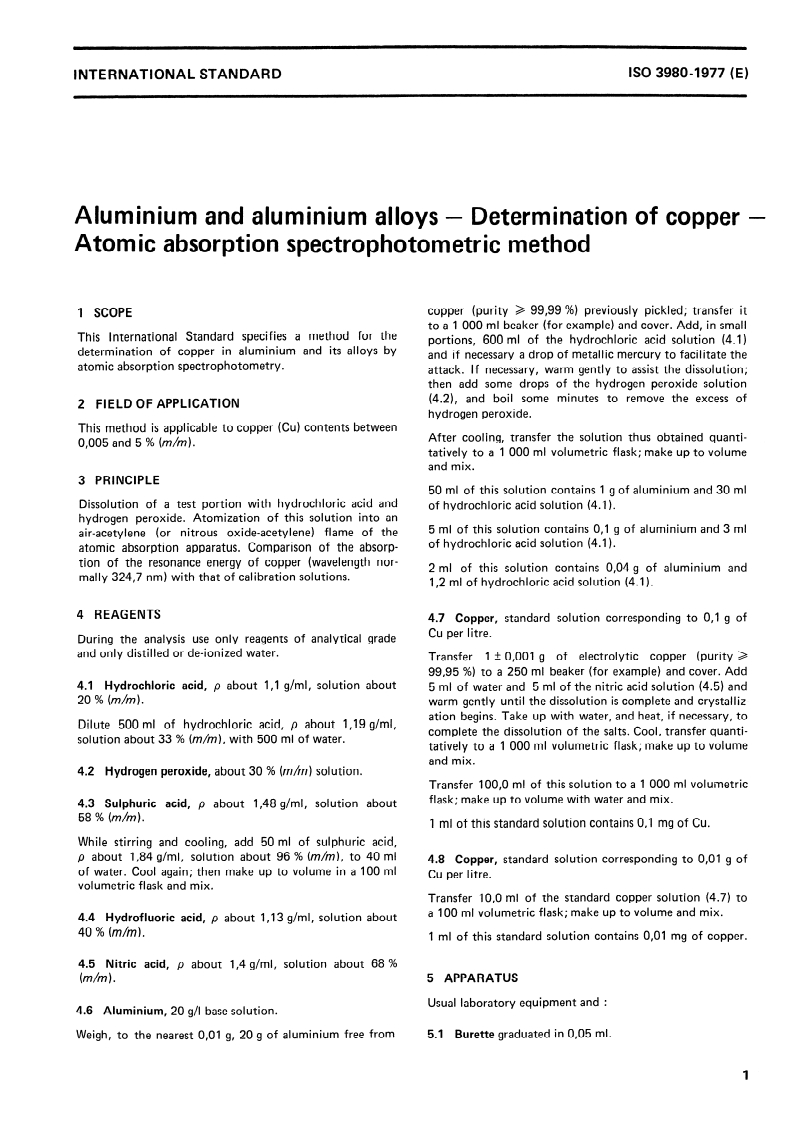
topper (purity > 9999 %) previously pickled; transfer it
1 SCOPE
to a 1 000 ml beaker (for example) and cover. Add, in small
This International Standard specifies a method for the
portions, 600 ml of the hydrochloric acid Solution (4.1)
determination of topper in aluminium and its alloys by
and if necessary a drop of metallic mercury to facilitate the
atomic absorption spectrophotometry.
attack. If necessary, warm gently to assist the dissolution;
then add some drops of the hydrogen peroxide Solution
(4.2) and boil some minutes to remove the excess of
2 FIELD OF APPLICATION
hydrogen Peroxide.
This method is applicable to topper (Cu) contents between
After cooling, transfer the Solution thus obtained quanti-
0,005 and 5 % (m/m).
tatively to a 1 000 ml volumetric flask; make up to volume
and mix.
3 PRINCIPLE
50 ml of this Solution contains 1 g of aluminium and 30 ml
Dissolution of a test Portion with hydrochloric acid and
of hydrochloric acid Solution (4.1).
hydrogen Peroxide. Atomization of this Solution into an
5 ml of this Solution contains 0,l g of aluminium and 3 ml
air-acetylene (or nitrous Oxide-acetylene) flame of the
of hydrochloric acid Solution (4.1).
atomic absorption apparatus. Comparison of the absorp-
tion of the resonance energy of topper (wavelength nor-
2 ml of this Solution contains 0,04 g of aluminium and
mally 324,7 nm) with that of calibration solutions.
1,2 ml of hydrochloric acid Solution (4.1).
4 REAGENTS
4.7 Copper, Standard Solution corresponding to 0,l g of
Cu per litre.
During the analysis use only reagents of analytical grade
and only distilled or de-ionized water.
+ 0,001 g of electrolytic topper (purity >
Transfer 1
99,95 %) to a 250 ml beaker (for example) and cover. Add
4.1 Hydrochlorit acid, p about 1,l g/ml, Solution about
5 ml of water and 5 ml of the nitric acid Solution (4.5) and
20 % (m/m).
warm gently until the dissolution is complete and crystalliz-
ation begins. Take up with water, and heat, if necessary, to
Dilute 500 ml of hydrochloric acid, p about 1,19 g/ml,
complete the dissolution of the salts. Cool, transfer quanti-
solution about 33 % (m/m), with 500 ml of water.
tatively to a 1 000 ml volumetric flask; make up to volume
and mix.
4.2 Hydrogen Peroxide, about 30 % (m/m) Solution.
Transfer 100,O ml of this Solution to a 1 000 ml volumetric
flask; make up to volume with water and mix.
4.3 Sulphuric acid, p about 1,48 g/mI, solution about
58 % (m/m).
1 ml of this Standard Solution contains 0,l mg of Cu.
While stirring and cooling, add 50 ml of sulphuric acid,
p about 1,84 g/ml, Solution about 96 % (m/m), to 40 ml
4.8 Copper, Standard Solution corresponding to 0,Ol g of
of water. Cool again; then make up to volume in a 100 ml
Cu per litre.
volumetric flask and mix.
Transfer IO,0 ml of the Standard topper Solution (4.7) to
a 100 ml volumetric flask; make up to volume and mix.
4.4 Hydrofluoric acid, p about 1,13 g/ml, Solution about
40 % (m/m).
1 ml of this Standard Solution contains 0,Ol mg of topper.
4.5 Nitrit acid, p about 1,4 g/ml, Solution about 68 %
5 APPARATUS
(m/m) .
Usual laboratory equipment and :
4.6 Aluminium, 20 g/l base Solution.
5.1 Burette graduated in 0,05 ml.
Weigh, to the nearest 0,Ol g, 20 g of aluminium free from
ISO 39804977 (E)
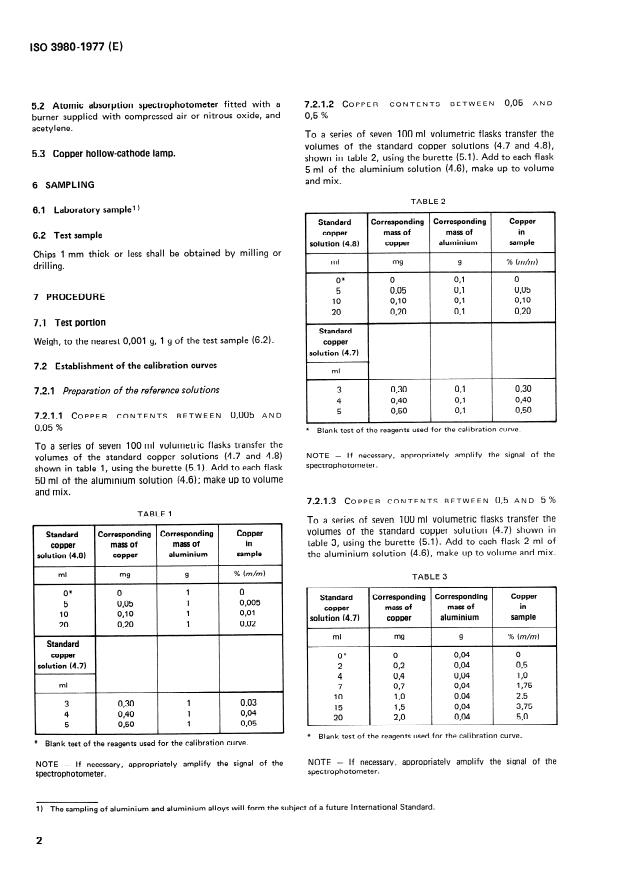
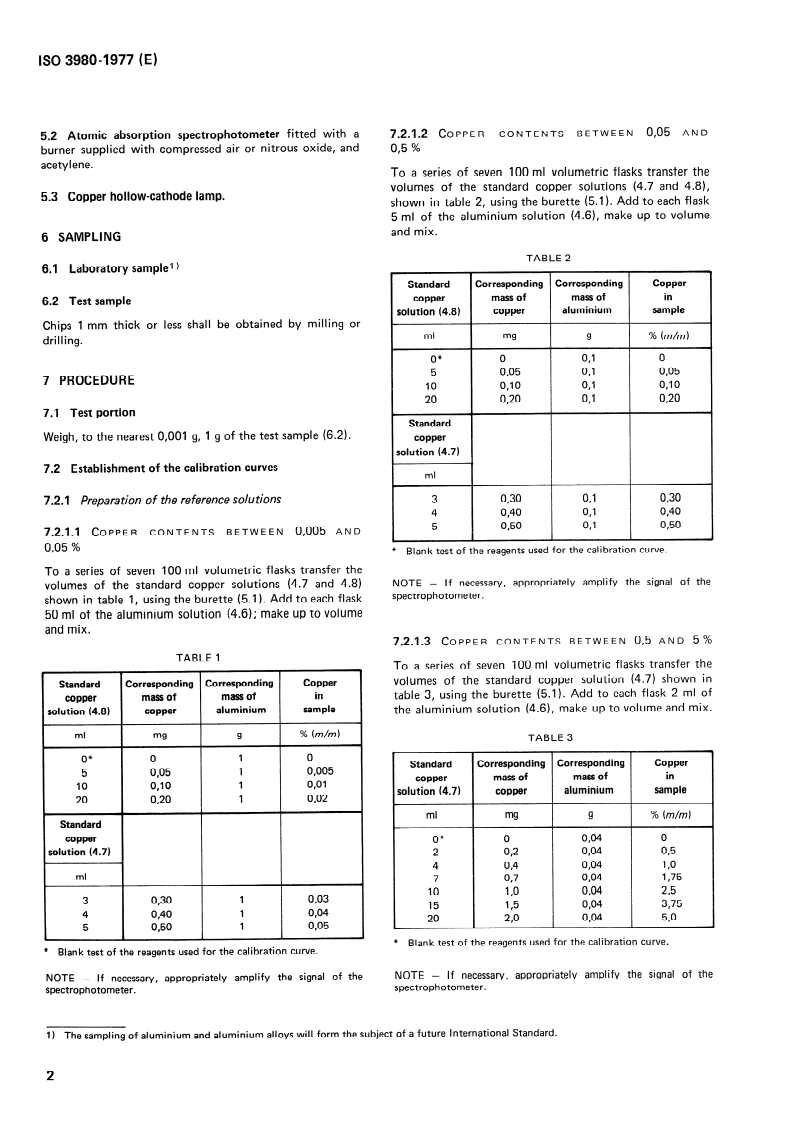
5.2 Atomic absorption spectrophotometer fitted with a 7.2.1.2 COPPER CONTENTS BETWEEN 0,05 AND
burner supplied with compressed air or nitrous Oxide,
...
~~
INTERNATIONAL STANDARD
INTERNATIONAL ORGANIZATION FOR STANDARDIZATION l MEXAYHAPOAHAR OPI-AHM3ALWi n0 ~AHAAPTW3ALWi.ORGANISATION INTERNATIONALE DE NORMALISATION
Aluminium and aluminium alloys - Determination of topper -
Atomic absorption spectrophotometric method
Aluminium et alliages dlaluminium - Dosage du cuivre - Mthode par spectropho tometrie d’absorption a tomique
First edition - 1977-02-01
UDC 669.71 : 546.56 : 543.422 Ref. No. ISO 3980-1977 (E)
spectrophotometric analysis, atomic
Descriptors : aluminium, aluminium alloys, Chemical analysis, determination of content, topper,
absorption spectroscopic analysis.
Price based on 3 pages
FOREWORD
ISO (the International Organization for Standardization) is a worldwide federation
of national Standards institutes (ISO member bodies). The work of deweloping
International Standards is carried out through ISO technical committees. Every
member body interested in a subject for which a technical committee has been set
up has the right to be represented on that committee. International organizations,
governmental and non-governmental, in liaison with ISO, also take part in the work.
Draft International Standards adopted by the technical committees are circulated
to the member bodies for approval before their acceptance as International
Standards by the ISO Council.
International Standard ISO 3980 was drawn up by Technical Committee
ISO/TC 79, Light metals and their #oys, and was circulated to the member bodies
in November 1975.
lt has been approved by the member bodies of the following countries :
Austria Japan Spain
Belgium Korea, Rep. of Switzerland
Czechoslova kia Wlexico Turkey
France United Kingdom
Norway
Germany Poland U.S.A.
Hungary Portugal U.S.S.R.
India Romania Yugoslavia
I taly South Africa, Rep. of
Th e member body of the following country expressed di sapprova I of the document
on technical grounds :
Austral ia
0 International Organization for Standardization, 1977 l
Printed in Switzerland
ISO 39804977 (E)
INTERNATIONAL STANDARD
Aluminium and aluminium alloys - Determination of topper -
Atomic absorption spectrophotometric method
topper (purity > 9999 %) previously pickled; transfer it
1 SCOPE
to a 1 000 ml beaker (for example) and cover. Add, in small
This International Standard specifies a method for the
portions, 600 ml of the hydrochloric acid Solution (4.1)
determination of topper in aluminium and its alloys by
and if necessary a drop of metallic mercury to facilitate the
atomic absorption spectrophotometry.
attack. If necessary, warm gently to assist the dissolution;
then add some drops of the hydrogen peroxide Solution
(4.2) and boil some minutes to remove the excess of
2 FIELD OF APPLICATION
hydrogen Peroxide.
This method is applicable to topper (Cu) contents between
After cooling, transfer the Solution thus obtained quanti-
0,005 and 5 % (m/m).
tatively to a 1 000 ml volumetric flask; make up to volume
and mix.
3 PRINCIPLE
50 ml of this Solution contains 1 g of aluminium and 30 ml
Dissolution of a test Portion with hydrochloric acid and
of hydrochloric acid Solution (4.1).
hydrogen Peroxide. Atomization of this Solution into an
5 ml of this Solution contains 0,l g of aluminium and 3 ml
air-acetylene (or nitrous Oxide-acetylene) flame of the
of hydrochloric acid Solution (4.1).
atomic absorption apparatus. Comparison of the absorp-
tion of the resonance energy of topper (wavelength nor-
2 ml of this Solution contains 0,04 g of aluminium and
mally 324,7 nm) with that of calibration solutions.
1,2 ml of hydrochloric acid Solution (4.1).
4 REAGENTS
4.7 Copper, Standard Solution corresponding to 0,l g of
Cu per litre.
During the analysis use only reagents of analytical grade
and only distilled or de-ionized water.
+ 0,001 g of electrolytic topper (purity >
Transfer 1
99,95 %) to a 250 ml beaker (for example) and cover. Add
4.1 Hydrochlorit acid, p about 1,l g/ml, Solution about
5 ml of water and 5 ml of the nitric acid Solution (4.5) and
20 % (m/m).
warm gently until the dissolution is complete and crystalliz-
ation begins. Take up with water, and heat, if necessary, to
Dilute 500 ml of hydrochloric acid, p about 1,19 g/ml,
complete the dissolution of the salts. Cool, transfer quanti-
solution about 33 % (m/m), with 500 ml of water.
tatively to a 1 000 ml volumetric flask; make up to volume
and mix.
4.2 Hydrogen Peroxide, about 30 % (m/m) Solution.
Transfer 100,O ml of this Solution to a 1 000 ml volumetric
flask; make up to volume with water and mix.
4.3 Sulphuric acid, p about 1,48 g/mI, solution about
58 % (m/m).
1 ml of this Standard Solution contains 0,l mg of Cu.
While stirring and cooling, add 50 ml of sulphuric acid,
p about 1,84 g/ml, Solution about 96 % (m/m), to 40 ml
4.8 Copper, Standard Solution corresponding to 0,Ol g of
of water. Cool again; then make up to volume in a 100 ml
Cu per litre.
volumetric flask and mix.
Transfer IO,0 ml of the Standard topper Solution (4.7) to
a 100 ml volumetric flask; make up to volume and mix.
4.4 Hydrofluoric acid, p about 1,13 g/ml, Solution about
40 % (m/m).
1 ml of this Standard Solution contains 0,Ol mg of topper.
4.5 Nitrit acid, p about 1,4 g/ml, Solution about 68 %
5 APPARATUS
(m/m) .
Usual laboratory equipment and :
4.6 Aluminium, 20 g/l base Solution.
5.1 Burette graduated in 0,05 ml.
Weigh, to the nearest 0,Ol g, 20 g of aluminium free from
ISO 39804977 (E)
5.2 Atomic absorption spectrophotometer fitted with a 7.2.1.2 COPPER CONTENTS BETWEEN 0,05 AND
burner supplied with compressed air or nitrous Oxide,
...
NORME INTERNATIONALE
INTERNATIONAL ORGANIZATION FOR STANDARDIZATION l EX~YHAPOflHAR OPl-AHMSALWUI n0 CTAH~APTM3AWïM *ORGANISATION INTERNATIONALE DE NORMALISATION
Aluminium et alliages d’alumiriium - Dosage du cuivre -
Méthode par spectrophotométrie d’absorption atomique
Aluminium and aluminium allo ys - Determination of copper -
A tomic absorption spectropho tome trie method
Première édition - 1977-02-01
CDU 669.71 : 546.56 : 543.422
Réf. no : ISO 3980-1977 (F)
Descripteurs : aluminium, alliage d’aluminium,
analyse chimique, dosage, cuivre, méthode spectrophotométrique, méthode spectroscopique
d’absorption atomique.
Prix basé sur 3 pages
AVANT-PROPOS
L’ISO (Organisation internationale de normalisation) est une fédération mondiale
d’organismes nationaux de normalisation (comités membres de I’ISO). L’élaboration
des Normes internationales est confiée aux comités techniques de I’ISO. Chaque
comité membre intéressé par une étude a le droit de faire partiedu comité technique
correspondant. Les organisations internationales, gouvernementales et non
gouvernementales, en liaison avec I’ISO, participent également aux travaux.
Les projets de Normes internationales adoptés par les comités techniques sont
soumis aux comités membres pour approbation, avant leur acceptation comme
Normes internationales par le Conseil de I’ISO.
La Norme internationale ISO 3980 a été établie par le comité technique
ISO/TC 79, Métaux /égers et leurs aliages, et a été soumise aux comités membres en
novembre 1975.
Elle a été approuvée par les comités membres des pays suivants :
Inde
Afrique du Sud, Rép. d’ Royaume-Uni
Allemagne I tal’ie Suisse
Autriche Japon Tchécoslovaquie
Belgique Mexique Turquie
Corée, Rép. de Norvège U.R.S.S.
Espagne Pologne U.S.A.
Portugal
France Yougoslavie
Hongrie Roumanie
Le comité membre du pays suivant a désapprouvé le document pour des raisons
techniques :
Australie
o Organisation internationale de normalisation, 1977 l
Imprimé en Suisse
NORME INTERNATIONALE
603980-1977(F)
Aluminium et alliages d’aluminium - Dosage du cuivre -
Méthode par spectrophotométrie d’absorption atomique
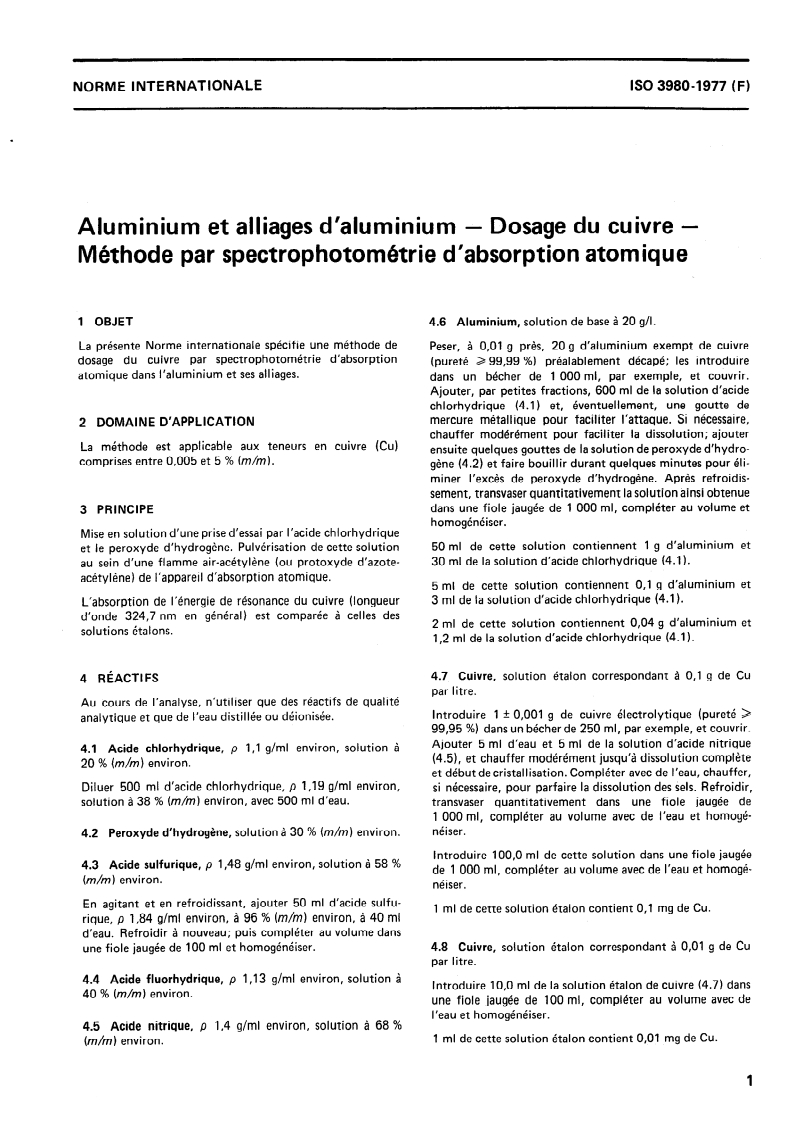
1 OBJET
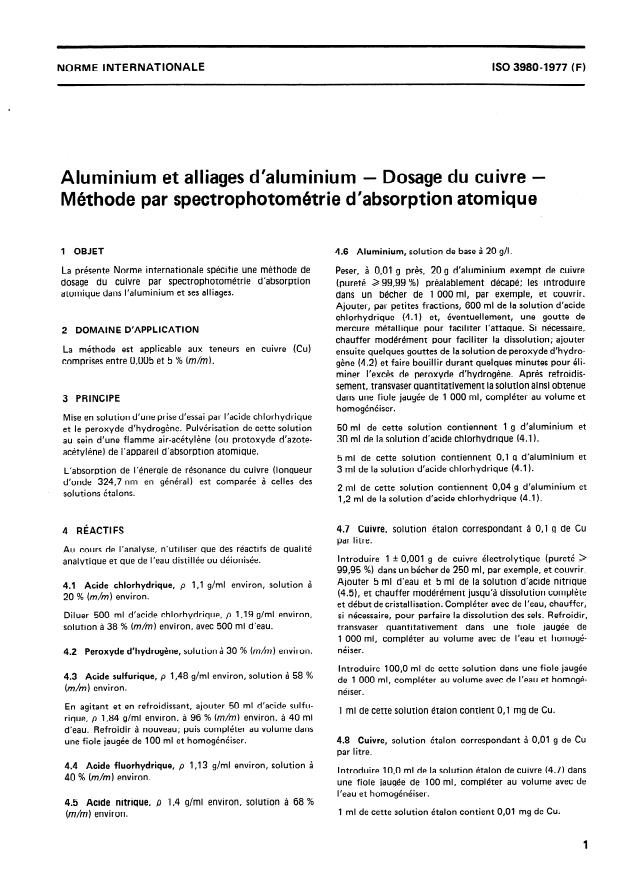
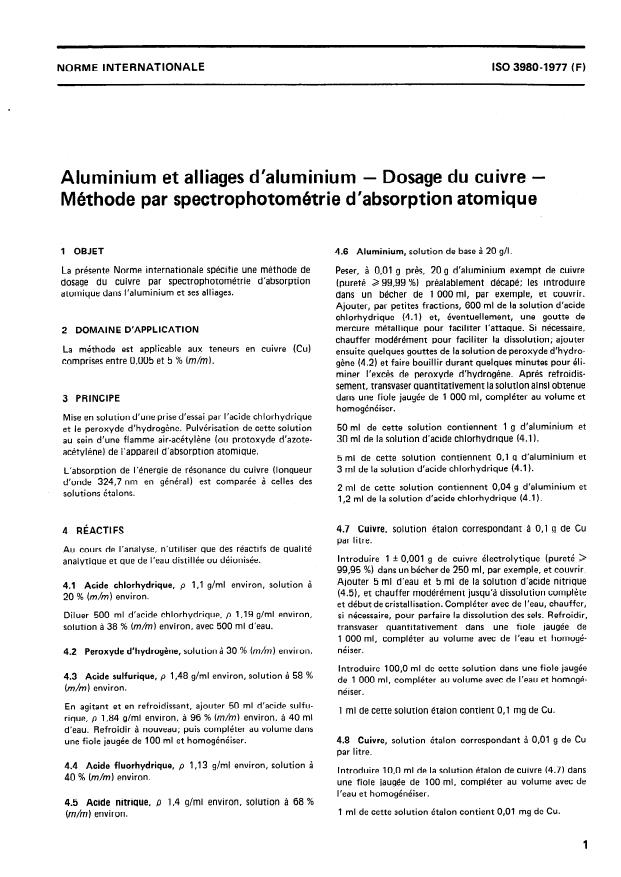
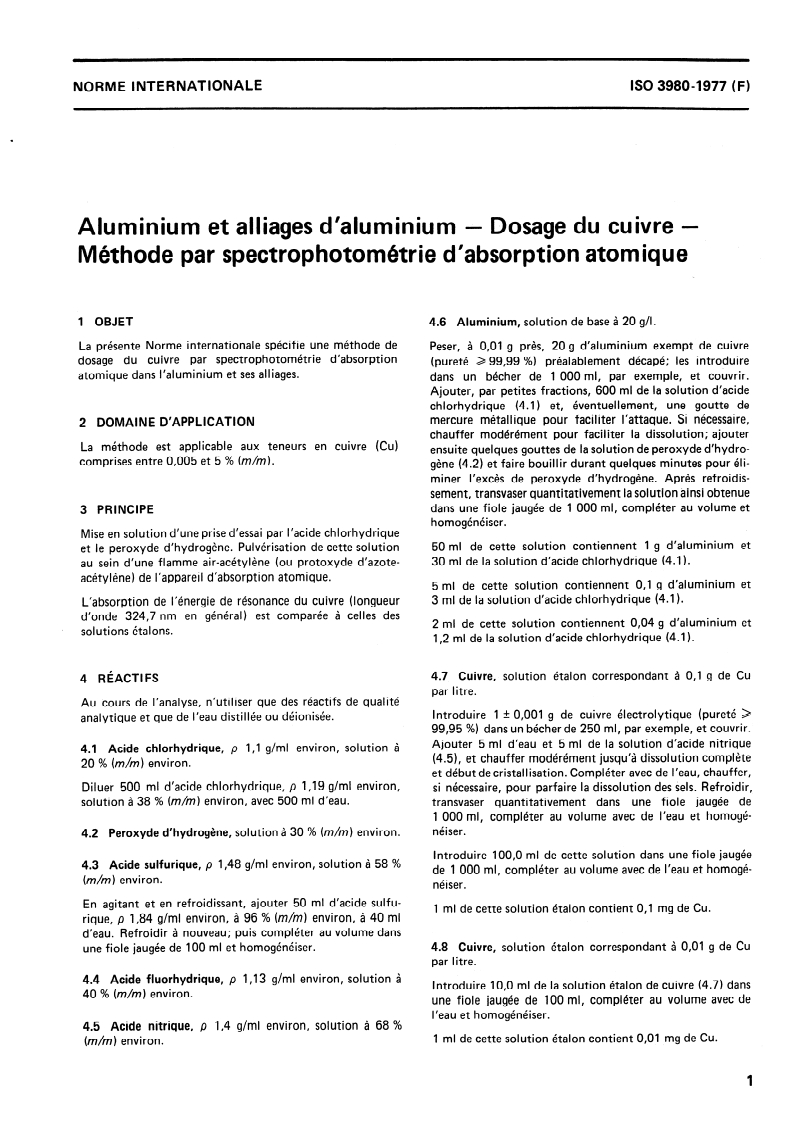
4.6 Aluminium, solution de base à 20 g/l.
La présente Norme internationale spécifie une méthode de
Peser, à 0,Ol g près, 20 g d’aluminium exempt de cuivre
dosage du cuivre par spectrophotométrie d’absorption
(pureté > 99,99 %) préalablement décapé; les introduire
atomique dans l’aluminium et ses alliages.
dans un bécher de 1 000 ml, par exemple, et couvrir.
Ajouter, par petites fractions, 600 ml de la solution d’acide
chlorhydrique (4.1) et, éventuellement, une goutte de
mercure métallique pour faciliter l’attaque. Si nécessaire,
2 DOMAINE D’APPLICATION
chauffer modérément pour faciliter la dissolution; ajouter
La méthode est applicable aux teneurs en cuivre (CU)
ensuite quelques gouttes de la solution de peroxyde d’hydro-
comprises entre 0,005 et 5 % (m/m).
gène (4.2) et faire bouillir durant quelques minutes pour éli-
miner l’excès de peroxyde d’hydrogène. Après refroidis-
sement, transvaser quantitativement la solution ainsi obtenue
3 PRINCIPE dans une fiole jaugée de 1 000 ml, compléter au volume et
homogénéiser.
Mise en solution d’une prise d’essai par l’acide chlorhydrique
et le peroxyde d’hydrogène. Pulvérisation de cette solution 50 ml de cette solution contiennent 1 g d’aluminium et
30 ml de la solution d’acide chlorhydrique (4.1).
au sein d’une flamme air-acétylène (ou protoxyde d’azote-
acétylène) de l’appareil d’absorption atomique.
5 ml de cette solution contiennent 0,l g d’aluminium et
3 ml de la solution d’acide chlorhydrique (4.1).
L’absorption de l’énergie de résonance du cuivre (longueur
d’onde 324,7 nm en général) est comparée à celles des
2 ml de cette solution contiennent 0,04 g d’aluminium et
solutions étalons.
1,2 ml de la solution d’acide chlorhydrique (4.1).
4.7 Cuivre, solution étalon correspondant à 0,l g de CU
4 RÉACTIFS
par litre.
Au cours de l’analyse, n’utiliser que des réactifs de qualité
Introduire 1 k 0,001 g de cuivre électrolytique (pureté >
analytique et que de l’eau distillée ou déionisée.
99,95 %) dans un bécher de 250 ml, par exemple, et couvrir.
Ajouter 5 ml d’eau et 5 ml de la solution d’acide nitrique
4.1 Acide chlorhydrique, p 1,l g/ml environ, solution à
(4.5) et chauffer modérément jusqu’à dissolution complète
20 % (m/m) environ.
et début de cristallisation. Compléter avec de l’eau, chauffer,
Diluer 500 ml d’acide chlorhydrique, p 1,19 g/ml environ,
si nécessaire, pour parfaire la dissolution des sels. Refroidir,
solution à 38 % (m/m) environ, avec 500 ml d’eau.
transvaser quantitativement dans une fiole jaugée de
1 000 ml, compléter au volume avec de l’eau et homogé-
néiser.
4.2 Peroxyde d’hydrogène, solution à 30 % (m/m) environ.
Introduire 100,O ml de cette solution dans une fiole jaugée
4.3 Acide sulfurique, p 1,48 g/ml environ, solution à 58 %
de 1 000 ml, compléter au volume avec de l’eau et homogé-
(m/m) environ.
néiser.
En agitant et en refroidissant, ajouter 50 ml d’acide sulfu-
1 ml de cette solution étalon contient 0,l mg de CU.
rique, p 1,84 g/ml environ, à 96 % (m/m) environ, à 40 ml
d’eau. Refroidir à nouveau; puis compléter au volume dans
une fiole jaugée de 100 ml et homogénéiser. 4.8 Cuivre, solution étalon correspondant à 0,Ol g de CU
par litre.
4.4 Acide fluorhydrique, p 1,13 g/ml environ, solution à
Introduire 10,O ml de la solution étalon de cuivre (4.7) dans
40 % (m/m) environ.
une fiole jaugée de 100 ml, compléter au volume avec de
l’eau et homogénéiser.
4.5 Acide nitrique, p 1,4 g/ml environ, solution à 68 %
1 ml de cette solution étalon contient 0,Ol mg de CU.
(m/m) environ.
ISO 39804977 (F)
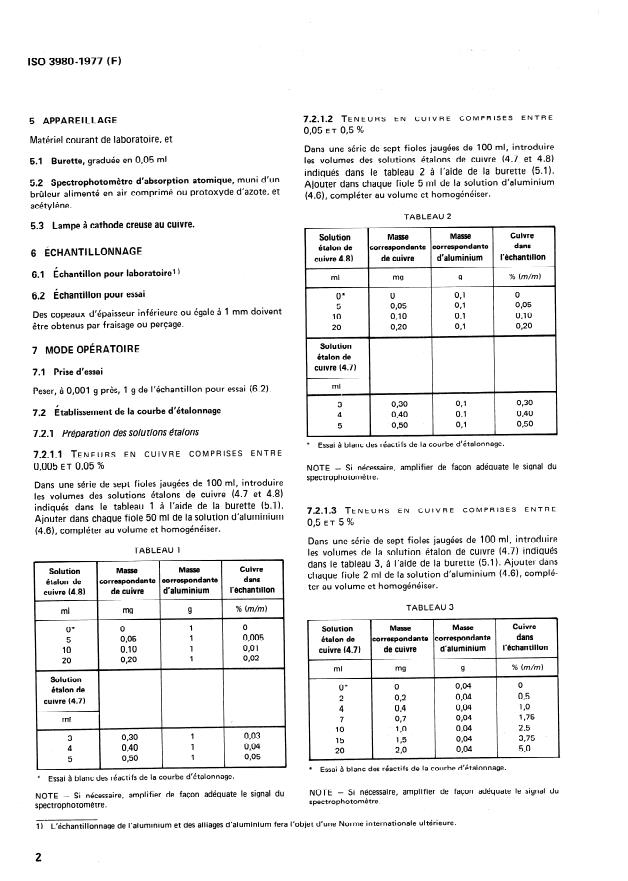
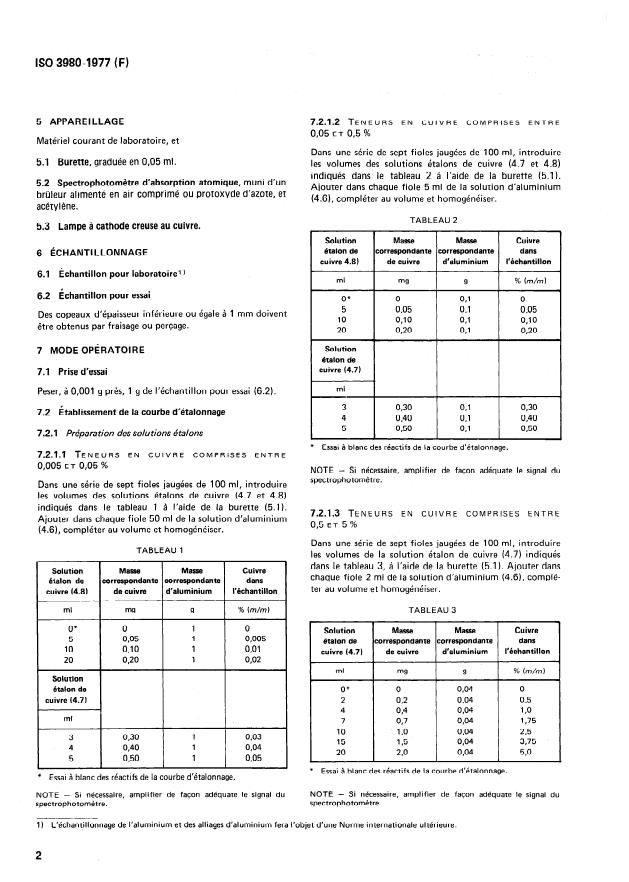
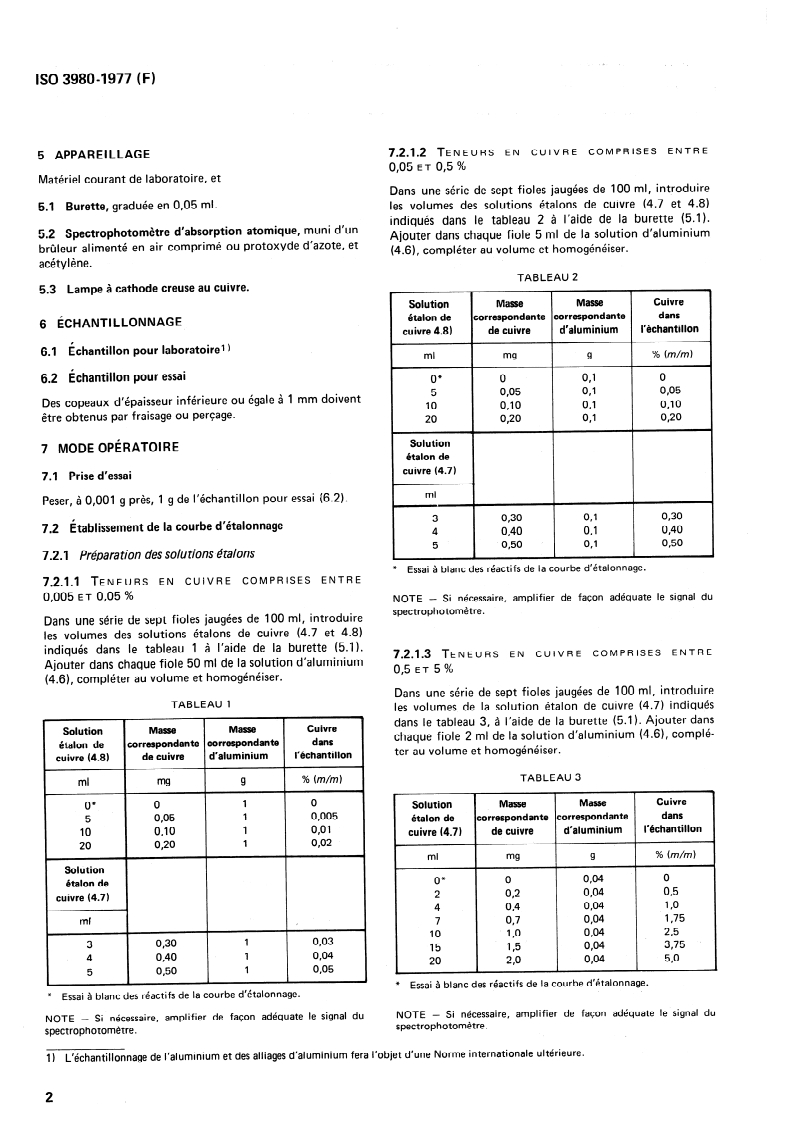
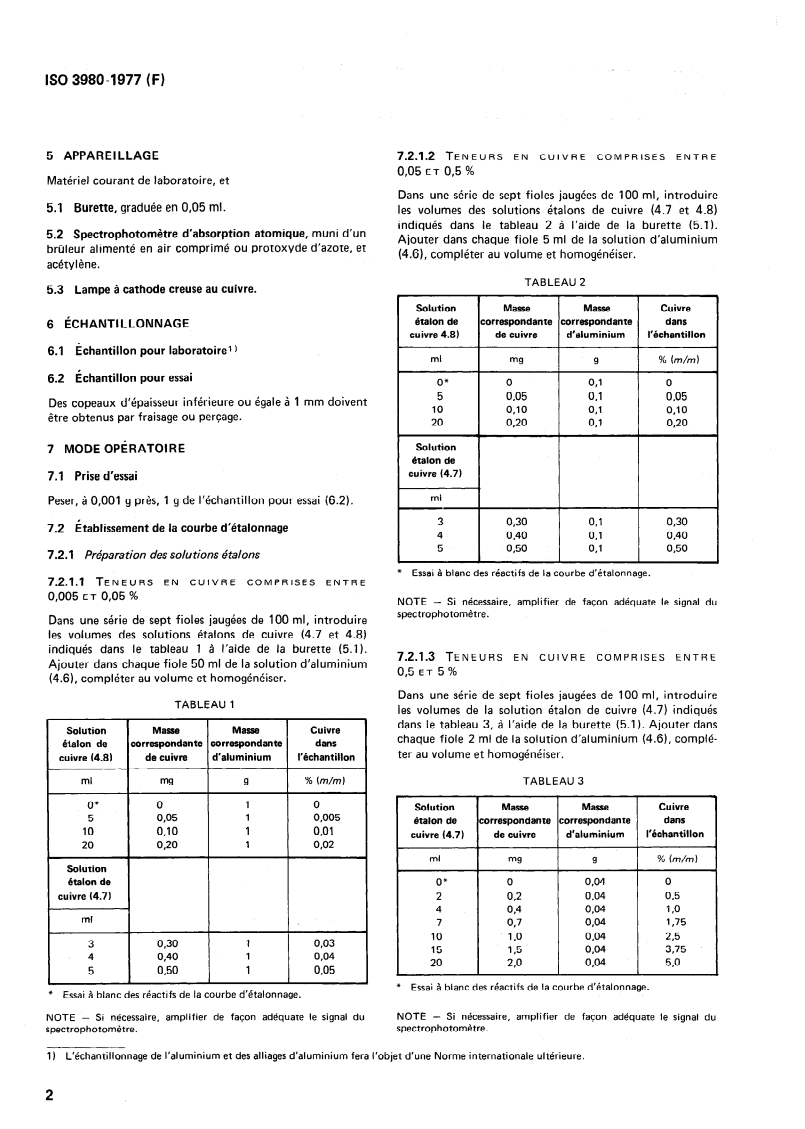
5 APPAREILLAGE 7.2.1.2 TENEURS EN CUIVRE COMPRISES ENTRE
0,05 ET 0,5 %
Matériel courant de laboratoire, et
Dans une série de sept fioles jaugées de 100 ml, introduire
5.1 Burette, graduée en 0,05 ml.
les volumes des solutions étalons de cuivre (4.7 et 4.8)
indiqués dans le tableau 2 à l’aide de la burette (5.1).
5.2 Spectrophotomètre d’absorption atomique, muni d’un
Ajouter dans chaque fiole 5 ml de la solution d’aluminium
brûleur alimenté en air comprimé ou protoxyde d’azote, et
(4.6) compléter au volume et homogénéise
...
NORME INTERNATIONALE
INTERNATIONAL ORGANIZATION FOR STANDARDIZATION l EX~YHAPOflHAR OPl-AHMSALWUI n0 CTAH~APTM3AWïM *ORGANISATION INTERNATIONALE DE NORMALISATION
Aluminium et alliages d’alumiriium - Dosage du cuivre -
Méthode par spectrophotométrie d’absorption atomique
Aluminium and aluminium allo ys - Determination of copper -
A tomic absorption spectropho tome trie method
Première édition - 1977-02-01
CDU 669.71 : 546.56 : 543.422
Réf. no : ISO 3980-1977 (F)
Descripteurs : aluminium, alliage d’aluminium,
analyse chimique, dosage, cuivre, méthode spectrophotométrique, méthode spectroscopique
d’absorption atomique.
Prix basé sur 3 pages
AVANT-PROPOS
L’ISO (Organisation internationale de normalisation) est une fédération mondiale
d’organismes nationaux de normalisation (comités membres de I’ISO). L’élaboration
des Normes internationales est confiée aux comités techniques de I’ISO. Chaque
comité membre intéressé par une étude a le droit de faire partiedu comité technique
correspondant. Les organisations internationales, gouvernementales et non
gouvernementales, en liaison avec I’ISO, participent également aux travaux.
Les projets de Normes internationales adoptés par les comités techniques sont
soumis aux comités membres pour approbation, avant leur acceptation comme
Normes internationales par le Conseil de I’ISO.
La Norme internationale ISO 3980 a été établie par le comité technique
ISO/TC 79, Métaux /égers et leurs aliages, et a été soumise aux comités membres en
novembre 1975.
Elle a été approuvée par les comités membres des pays suivants :
Inde
Afrique du Sud, Rép. d’ Royaume-Uni
Allemagne I tal’ie Suisse
Autriche Japon Tchécoslovaquie
Belgique Mexique Turquie
Corée, Rép. de Norvège U.R.S.S.
Espagne Pologne U.S.A.
Portugal
France Yougoslavie
Hongrie Roumanie
Le comité membre du pays suivant a désapprouvé le document pour des raisons
techniques :
Australie
o Organisation internationale de normalisation, 1977 l
Imprimé en Suisse
NORME INTERNATIONALE
603980-1977(F)
Aluminium et alliages d’aluminium - Dosage du cuivre -
Méthode par spectrophotométrie d’absorption atomique
1 OBJET
4.6 Aluminium, solution de base à 20 g/l.
La présente Norme internationale spécifie une méthode de
Peser, à 0,Ol g près, 20 g d’aluminium exempt de cuivre
dosage du cuivre par spectrophotométrie d’absorption
(pureté > 99,99 %) préalablement décapé; les introduire
atomique dans l’aluminium et ses alliages.
dans un bécher de 1 000 ml, par exemple, et couvrir.
Ajouter, par petites fractions, 600 ml de la solution d’acide
chlorhydrique (4.1) et, éventuellement, une goutte de
mercure métallique pour faciliter l’attaque. Si nécessaire,
2 DOMAINE D’APPLICATION
chauffer modérément pour faciliter la dissolution; ajouter
La méthode est applicable aux teneurs en cuivre (CU)
ensuite quelques gouttes de la solution de peroxyde d’hydro-
comprises entre 0,005 et 5 % (m/m).
gène (4.2) et faire bouillir durant quelques minutes pour éli-
miner l’excès de peroxyde d’hydrogène. Après refroidis-
sement, transvaser quantitativement la solution ainsi obtenue
3 PRINCIPE dans une fiole jaugée de 1 000 ml, compléter au volume et
homogénéiser.
Mise en solution d’une prise d’essai par l’acide chlorhydrique
et le peroxyde d’hydrogène. Pulvérisation de cette solution 50 ml de cette solution contiennent 1 g d’aluminium et
30 ml de la solution d’acide chlorhydrique (4.1).
au sein d’une flamme air-acétylène (ou protoxyde d’azote-
acétylène) de l’appareil d’absorption atomique.
5 ml de cette solution contiennent 0,l g d’aluminium et
3 ml de la solution d’acide chlorhydrique (4.1).
L’absorption de l’énergie de résonance du cuivre (longueur
d’onde 324,7 nm en général) est comparée à celles des
2 ml de cette solution contiennent 0,04 g d’aluminium et
solutions étalons.
1,2 ml de la solution d’acide chlorhydrique (4.1).
4.7 Cuivre, solution étalon correspondant à 0,l g de CU
4 RÉACTIFS
par litre.
Au cours de l’analyse, n’utiliser que des réactifs de qualité
Introduire 1 k 0,001 g de cuivre électrolytique (pureté >
analytique et que de l’eau distillée ou déionisée.
99,95 %) dans un bécher de 250 ml, par exemple, et couvrir.
Ajouter 5 ml d’eau et 5 ml de la solution d’acide nitrique
4.1 Acide chlorhydrique, p 1,l g/ml environ, solution à
(4.5) et chauffer modérément jusqu’à dissolution complète
20 % (m/m) environ.
et début de cristallisation. Compléter avec de l’eau, chauffer,
Diluer 500 ml d’acide chlorhydrique, p 1,19 g/ml environ,
si nécessaire, pour parfaire la dissolution des sels. Refroidir,
solution à 38 % (m/m) environ, avec 500 ml d’eau.
transvaser quantitativement dans une fiole jaugée de
1 000 ml, compléter au volume avec de l’eau et homogé-
néiser.
4.2 Peroxyde d’hydrogène, solution à 30 % (m/m) environ.
Introduire 100,O ml de cette solution dans une fiole jaugée
4.3 Acide sulfurique, p 1,48 g/ml environ, solution à 58 %
de 1 000 ml, compléter au volume avec de l’eau et homogé-
(m/m) environ.
néiser.
En agitant et en refroidissant, ajouter 50 ml d’acide sulfu-
1 ml de cette solution étalon contient 0,l mg de CU.
rique, p 1,84 g/ml environ, à 96 % (m/m) environ, à 40 ml
d’eau. Refroidir à nouveau; puis compléter au volume dans
une fiole jaugée de 100 ml et homogénéiser. 4.8 Cuivre, solution étalon correspondant à 0,Ol g de CU
par litre.
4.4 Acide fluorhydrique, p 1,13 g/ml environ, solution à
Introduire 10,O ml de la solution étalon de cuivre (4.7) dans
40 % (m/m) environ.
une fiole jaugée de 100 ml, compléter au volume avec de
l’eau et homogénéiser.
4.5 Acide nitrique, p 1,4 g/ml environ, solution à 68 %
1 ml de cette solution étalon contient 0,Ol mg de CU.
(m/m) environ.
ISO 39804977 (F)
5 APPAREILLAGE 7.2.1.2 TENEURS EN CUIVRE COMPRISES ENTRE
0,05 ET 0,5 %
Matériel courant de laboratoire, et
Dans une série de sept fioles jaugées de 100 ml, introduire
5.1 Burette, graduée en 0,05 ml.
les volumes des solutions étalons de cuivre (4.7 et 4.8)
indiqués dans le tableau 2 à l’aide de la burette (5.1).
5.2 Spectrophotomètre d’absorption atomique, muni d’un
Ajouter dans chaque fiole 5 ml de la solution d’aluminium
brûleur alimenté en air comprimé ou protoxyde d’azote, et
(4.6) compl
...
NORME INTERNATIONALE
INTERNATIONAL ORGANIZATION FOR STANDARDIZATION l EX~YHAPOflHAR OPl-AHMSALWUI n0 CTAH~APTM3AWïM *ORGANISATION INTERNATIONALE DE NORMALISATION
Aluminium et alliages d’alumiriium - Dosage du cuivre -
Méthode par spectrophotométrie d’absorption atomique
Aluminium and aluminium allo ys - Determination of copper -
A tomic absorption spectropho tome trie method
Première édition - 1977-02-01
CDU 669.71 : 546.56 : 543.422
Réf. no : ISO 3980-1977 (F)
Descripteurs : aluminium, alliage d’aluminium,
analyse chimique, dosage, cuivre, méthode spectrophotométrique, méthode spectroscopique
d’absorption atomique.
Prix basé sur 3 pages
AVANT-PROPOS
L’ISO (Organisation internationale de normalisation) est une fédération mondiale
d’organismes nationaux de normalisation (comités membres de I’ISO). L’élaboration
des Normes internationales est confiée aux comités techniques de I’ISO. Chaque
comité membre intéressé par une étude a le droit de faire partiedu comité technique
correspondant. Les organisations internationales, gouvernementales et non
gouvernementales, en liaison avec I’ISO, participent également aux travaux.
Les projets de Normes internationales adoptés par les comités techniques sont
soumis aux comités membres pour approbation, avant leur acceptation comme
Normes internationales par le Conseil de I’ISO.
La Norme internationale ISO 3980 a été établie par le comité technique
ISO/TC 79, Métaux /égers et leurs aliages, et a été soumise aux comités membres en
novembre 1975.
Elle a été approuvée par les comités membres des pays suivants :
Inde
Afrique du Sud, Rép. d’ Royaume-Uni
Allemagne I tal’ie Suisse
Autriche Japon Tchécoslovaquie
Belgique Mexique Turquie
Corée, Rép. de Norvège U.R.S.S.
Espagne Pologne U.S.A.
Portugal
France Yougoslavie
Hongrie Roumanie
Le comité membre du pays suivant a désapprouvé le document pour des raisons
techniques :
Australie
o Organisation internationale de normalisation, 1977 l
Imprimé en Suisse
NORME INTERNATIONALE
603980-1977(F)
Aluminium et alliages d’aluminium - Dosage du cuivre -
Méthode par spectrophotométrie d’absorption atomique
1 OBJET
4.6 Aluminium, solution de base à 20 g/l.
La présente Norme internationale spécifie une méthode de
Peser, à 0,Ol g près, 20 g d’aluminium exempt de cuivre
dosage du cuivre par spectrophotométrie d’absorption
(pureté > 99,99 %) préalablement décapé; les introduire
atomique dans l’aluminium et ses alliages.
dans un bécher de 1 000 ml, par exemple, et couvrir.
Ajouter, par petites fractions, 600 ml de la solution d’acide
chlorhydrique (4.1) et, éventuellement, une goutte de
mercure métallique pour faciliter l’attaque. Si nécessaire,
2 DOMAINE D’APPLICATION
chauffer modérément pour faciliter la dissolution; ajouter
La méthode est applicable aux teneurs en cuivre (CU)
ensuite quelques gouttes de la solution de peroxyde d’hydro-
comprises entre 0,005 et 5 % (m/m).
gène (4.2) et faire bouillir durant quelques minutes pour éli-
miner l’excès de peroxyde d’hydrogène. Après refroidis-
sement, transvaser quantitativement la solution ainsi obtenue
3 PRINCIPE dans une fiole jaugée de 1 000 ml, compléter au volume et
homogénéiser.
Mise en solution d’une prise d’essai par l’acide chlorhydrique
et le peroxyde d’hydrogène. Pulvérisation de cette solution 50 ml de cette solution contiennent 1 g d’aluminium et
30 ml de la solution d’acide chlorhydrique (4.1).
au sein d’une flamme air-acétylène (ou protoxyde d’azote-
acétylène) de l’appareil d’absorption atomique.
5 ml de cette solution contiennent 0,l g d’aluminium et
3 ml de la solution d’acide chlorhydrique (4.1).
L’absorption de l’énergie de résonance du cuivre (longueur
d’onde 324,7 nm en général) est comparée à celles des
2 ml de cette solution contiennent 0,04 g d’aluminium et
solutions étalons.
1,2 ml de la solution d’acide chlorhydrique (4.1).
4.7 Cuivre, solution étalon correspondant à 0,l g de CU
4 RÉACTIFS
par litre.
Au cours de l’analyse, n’utiliser que des réactifs de qualité
Introduire 1 k 0,001 g de cuivre électrolytique (pureté >
analytique et que de l’eau distillée ou déionisée.
99,95 %) dans un bécher de 250 ml, par exemple, et couvrir.
Ajouter 5 ml d’eau et 5 ml de la solution d’acide nitrique
4.1 Acide chlorhydrique, p 1,l g/ml environ, solution à
(4.5) et chauffer modérément jusqu’à dissolution complète
20 % (m/m) environ.
et début de cristallisation. Compléter avec de l’eau, chauffer,
Diluer 500 ml d’acide chlorhydrique, p 1,19 g/ml environ,
si nécessaire, pour parfaire la dissolution des sels. Refroidir,
solution à 38 % (m/m) environ, avec 500 ml d’eau.
transvaser quantitativement dans une fiole jaugée de
1 000 ml, compléter au volume avec de l’eau et homogé-
néiser.
4.2 Peroxyde d’hydrogène, solution à 30 % (m/m) environ.
Introduire 100,O ml de cette solution dans une fiole jaugée
4.3 Acide sulfurique, p 1,48 g/ml environ, solution à 58 %
de 1 000 ml, compléter au volume avec de l’eau et homogé-
(m/m) environ.
néiser.
En agitant et en refroidissant, ajouter 50 ml d’acide sulfu-
1 ml de cette solution étalon contient 0,l mg de CU.
rique, p 1,84 g/ml environ, à 96 % (m/m) environ, à 40 ml
d’eau. Refroidir à nouveau; puis compléter au volume dans
une fiole jaugée de 100 ml et homogénéiser. 4.8 Cuivre, solution étalon correspondant à 0,Ol g de CU
par litre.
4.4 Acide fluorhydrique, p 1,13 g/ml environ, solution à
Introduire 10,O ml de la solution étalon de cuivre (4.7) dans
40 % (m/m) environ.
une fiole jaugée de 100 ml, compléter au volume avec de
l’eau et homogénéiser.
4.5 Acide nitrique, p 1,4 g/ml environ, solution à 68 %
1 ml de cette solution étalon contient 0,Ol mg de CU.
(m/m) environ.
ISO 39804977 (F)
5 APPAREILLAGE 7.2.1.2 TENEURS EN CUIVRE COMPRISES ENTRE
0,05 ET 0,5 %
Matériel courant de laboratoire, et
Dans une série de sept fioles jaugées de 100 ml, introduire
5.1 Burette, graduée en 0,05 ml.
les volumes des solutions étalons de cuivre (4.7 et 4.8)
indiqués dans le tableau 2 à l’aide de la burette (5.1).
5.2 Spectrophotomètre d’absorption atomique, muni d’un
Ajouter dans chaque fiole 5 ml de la solution d’aluminium
brûleur alimenté en air comprimé ou protoxyde d’azote, et
(4.6) compléter au volume et homogénéise
...
NORME INTERNATIONALE
INTERNATIONAL ORGANIZATION FOR STANDARDIZATION l EX~YHAPOflHAR OPl-AHMSALWUI n0 CTAH~APTM3AWïM *ORGANISATION INTERNATIONALE DE NORMALISATION
Aluminium et alliages d’alumiriium - Dosage du cuivre -
Méthode par spectrophotométrie d’absorption atomique
Aluminium and aluminium allo ys - Determination of copper -
A tomic absorption spectropho tome trie method
Première édition - 1977-02-01
CDU 669.71 : 546.56 : 543.422
Réf. no : ISO 3980-1977 (F)
Descripteurs : aluminium, alliage d’aluminium,
analyse chimique, dosage, cuivre, méthode spectrophotométrique, méthode spectroscopique
d’absorption atomique.
Prix basé sur 3 pages
AVANT-PROPOS
L’ISO (Organisation internationale de normalisation) est une fédération mondiale
d’organismes nationaux de normalisation (comités membres de I’ISO). L’élaboration
des Normes internationales est confiée aux comités techniques de I’ISO. Chaque
comité membre intéressé par une étude a le droit de faire partiedu comité technique
correspondant. Les organisations internationales, gouvernementales et non
gouvernementales, en liaison avec I’ISO, participent également aux travaux.
Les projets de Normes internationales adoptés par les comités techniques sont
soumis aux comités membres pour approbation, avant leur acceptation comme
Normes internationales par le Conseil de I’ISO.
La Norme internationale ISO 3980 a été établie par le comité technique
ISO/TC 79, Métaux /égers et leurs aliages, et a été soumise aux comités membres en
novembre 1975.
Elle a été approuvée par les comités membres des pays suivants :
Inde
Afrique du Sud, Rép. d’ Royaume-Uni
Allemagne I tal’ie Suisse
Autriche Japon Tchécoslovaquie
Belgique Mexique Turquie
Corée, Rép. de Norvège U.R.S.S.
Espagne Pologne U.S.A.
Portugal
France Yougoslavie
Hongrie Roumanie
Le comité membre du pays suivant a désapprouvé le document pour des raisons
techniques :
Australie
o Organisation internationale de normalisation, 1977 l
Imprimé en Suisse
NORME INTERNATIONALE
603980-1977(F)
Aluminium et alliages d’aluminium - Dosage du cuivre -
Méthode par spectrophotométrie d’absorption atomique
1 OBJET
4.6 Aluminium, solution de base à 20 g/l.
La présente Norme internationale spécifie une méthode de
Peser, à 0,Ol g près, 20 g d’aluminium exempt de cuivre
dosage du cuivre par spectrophotométrie d’absorption
(pureté > 99,99 %) préalablement décapé; les introduire
atomique dans l’aluminium et ses alliages.
dans un bécher de 1 000 ml, par exemple, et couvrir.
Ajouter, par petites fractions, 600 ml de la solution d’acide
chlorhydrique (4.1) et, éventuellement, une goutte de
mercure métallique pour faciliter l’attaque. Si nécessaire,
2 DOMAINE D’APPLICATION
chauffer modérément pour faciliter la dissolution; ajouter
La méthode est applicable aux teneurs en cuivre (CU)
ensuite quelques gouttes de la solution de peroxyde d’hydro-
comprises entre 0,005 et 5 % (m/m).
gène (4.2) et faire bouillir durant quelques minutes pour éli-
miner l’excès de peroxyde d’hydrogène. Après refroidis-
sement, transvaser quantitativement la solution ainsi obtenue
3 PRINCIPE dans une fiole jaugée de 1 000 ml, compléter au volume et
homogénéiser.
Mise en solution d’une prise d’essai par l’acide chlorhydrique
et le peroxyde d’hydrogène. Pulvérisation de cette solution 50 ml de cette solution contiennent 1 g d’aluminium et
30 ml de la solution d’acide chlorhydrique (4.1).
au sein d’une flamme air-acétylène (ou protoxyde d’azote-
acétylène) de l’appareil d’absorption atomique.
5 ml de cette solution contiennent 0,l g d’aluminium et
3 ml de la solution d’acide chlorhydrique (4.1).
L’absorption de l’énergie de résonance du cuivre (longueur
d’onde 324,7 nm en général) est comparée à celles des
2 ml de cette solution contiennent 0,04 g d’aluminium et
solutions étalons.
1,2 ml de la solution d’acide chlorhydrique (4.1).
4.7 Cuivre, solution étalon correspondant à 0,l g de CU
4 RÉACTIFS
par litre.
Au cours de l’analyse, n’utiliser que des réactifs de qualité
Introduire 1 k 0,001 g de cuivre électrolytique (pureté >
analytique et que de l’eau distillée ou déionisée.
99,95 %) dans un bécher de 250 ml, par exemple, et couvrir.
Ajouter 5 ml d’eau et 5 ml de la solution d’acide nitrique
4.1 Acide chlorhydrique, p 1,l g/ml environ, solution à
(4.5) et chauffer modérément jusqu’à dissolution complète
20 % (m/m) environ.
et début de cristallisation. Compléter avec de l’eau, chauffer,
Diluer 500 ml d’acide chlorhydrique, p 1,19 g/ml environ,
si nécessaire, pour parfaire la dissolution des sels. Refroidir,
solution à 38 % (m/m) environ, avec 500 ml d’eau.
transvaser quantitativement dans une fiole jaugée de
1 000 ml, compléter au volume avec de l’eau et homogé-
néiser.
4.2 Peroxyde d’hydrogène, solution à 30 % (m/m) environ.
Introduire 100,O ml de cette solution dans une fiole jaugée
4.3 Acide sulfurique, p 1,48 g/ml environ, solution à 58 %
de 1 000 ml, compléter au volume avec de l’eau et homogé-
(m/m) environ.
néiser.
En agitant et en refroidissant, ajouter 50 ml d’acide sulfu-
1 ml de cette solution étalon contient 0,l mg de CU.
rique, p 1,84 g/ml environ, à 96 % (m/m) environ, à 40 ml
d’eau. Refroidir à nouveau; puis compléter au volume dans
une fiole jaugée de 100 ml et homogénéiser. 4.8 Cuivre, solution étalon correspondant à 0,Ol g de CU
par litre.
4.4 Acide fluorhydrique, p 1,13 g/ml environ, solution à
Introduire 10,O ml de la solution étalon de cuivre (4.7) dans
40 % (m/m) environ.
une fiole jaugée de 100 ml, compléter au volume avec de
l’eau et homogénéiser.
4.5 Acide nitrique, p 1,4 g/ml environ, solution à 68 %
1 ml de cette solution étalon contient 0,Ol mg de CU.
(m/m) environ.
ISO 39804977 (F)
5 APPAREILLAGE 7.2.1.2 TENEURS EN CUIVRE COMPRISES ENTRE
0,05 ET 0,5 %
Matériel courant de laboratoire, et
Dans une série de sept fioles jaugées de 100 ml, introduire
5.1 Burette, graduée en 0,05 ml.
les volumes des solutions étalons de cuivre (4.7 et 4.8)
indiqués dans le tableau 2 à l’aide de la burette (5.1).
5.2 Spectrophotomètre d’absorption atomique, muni d’un
Ajouter dans chaque fiole 5 ml de la solution d’aluminium
brûleur alimenté en air comprimé ou protoxyde d’azote, et
(4.6) compl
...