

ISO 3010:2017
(Main)Bases for design of structures — Seismic actions on structures
General Information
- Abstract
ISO 3010:2017 (including both the super structure and foundation) and other structures. ISO 3010:2017 is not applicable to certain structures, such as bridges, dams, geotechnical works and tunnels, although some of the principles can be referred to for the seismic design of those structures. ISO 3010:2017 is not applicable to nuclear power plants, since these are dealt with separately in other International Standards. In regions where the seismic hazard is low, methods of design for structural integrity can be used in lieu of methods based on a consideration of seismic actions. ISO 3010:2017 is not a legally binding and enforceable code. It can be viewed as a source document that is utilized in the development of codes of practice by the competent authority responsible for issuing structural design regulations. NOTE 1 This document has been prepared mainly for new engineered structures. The principles are, however, applicable to developing appropriate prescriptive rules for non-engineered structures (see Annex N). The principles could also be applied to evaluating seismic actions on existing structures. NOTE 2 Other structures include self-supporting structures other than buildings that carry gravity loads and are required to resist seismic actions. These structures include seismic force-resisting systems similar to those in buildings, such as a trussed tower or a pipe rack, or systems very different from those in buildings, such as a liquid storage tank or a chimney. Additional examples include structures found at chemical plants, mines, power plants, harbours, amusement parks and civil infrastructure facilities. NOTE 3 The level of seismic hazard that would be considered low depends not only on the seismicity of the region but also on other factors, including types of construction, traditional practices, etc. Methods of design for structural integrity include nominal design horizontal forces (such as an equivalent static loading determined from a simplified equivalent static analysis) which provide a measure of protection against seismic actions.
- Status
- Published
- Publication Date
- 29-Mar-2017
- Technical Committee
- ISO/TC 98/SC 3 - Loads, forces and other actions
- Drafting Committee
- ISO/TC 98/SC 3 - Loads, forces and other actions
- Current Stage
- 9092 - International Standard to be revised
- Start Date
- 13-Oct-2025
- Completion Date
- 29-Aug-2026
Buy Documents

ISO 3010:2017 - Bases for design of structures -- Seismic actions on structures


ISO 3010:2017 - Bases for design of structures — Seismic actions on structures/30/2017
Overview
ISO 3010:2017 - Bases for design of structures: Seismic actions on structures - defines principles for evaluating seismic actions used in the seismic design of buildings (superstructure and foundation) and other self-supporting structures. It is a guidance/source document (not a legally binding code) intended mainly for new engineered structures, but its principles can be applied to existing and non‑engineered construction (Annex N). ISO 3010:2017 is not applicable to certain categories (for example, bridges, dams, geotechnical works, tunnels or nuclear power plants), although some principles may still be referenced for those structures.
Key Topics
- Principles of seismic design: site conditions, structural configuration, plan and vertical irregularities, influence of nonstructural elements, strength and ductility, deformation limits, response control systems and foundations.
- Evaluation methods for seismic actions:
- Equivalent static analysis (simplified base shear and distribution methods)
- Dynamic analysis (response spectrum and response history analysis)
- Nonlinear static analysis (capacity spectrum and pushover approaches)
- Seismic action criteria: seismicity of the region, site-specific ground motion, dynamic properties of the structure, consequences of failure, and spatial variation of ground motion.
- Design load considerations: ULS and SLS combinations, seismic force-resisting system effects, torsional moments, damping ratios and load factors related to reliability.
- Modeling and interaction: modeling requirements, soil–structure interaction, selection/use of recorded or simulated earthquake ground motions.
- Informative annexes: normalized design response spectra, seismic force distribution parameters, damping guidance, nonlinear analysis details, seismic design for high-rise buildings, tsunami and paraseismic influences.
Applications
ISO 3010:2017 is used by:
- Structural engineers and seismic designers for establishing seismic action inputs and selecting appropriate analysis methods (equivalent static, dynamic or nonlinear).
- Code developers and regulatory authorities as a source document when developing national or regional seismic design codes.
- Consultants and risk analysts assessing building performance, retrofit strategies or seismic vulnerability of industrial structures (tanks, chimneys, trussed towers, pipe racks).
- Researchers and educators studying seismic design principles, response spectra and modeling techniques.
Practical use cases include deriving design ground motions, calculating base shear, selecting analysis procedures, checking deformation limits and incorporating nonstructural component demands.
Related Standards
- ISO 13033 (seismic actions on nonstructural components)
- ISO 23469 (geotechnical seismic design criteria)
Keywords: ISO 3010:2017, seismic actions, seismic design, equivalent static analysis, response spectrum, nonlinear static analysis, soil-structure interaction, seismic force-resisting system.
Relations
- Effective Date
- 08-Dec-2012
Buy Documents
ISO 3010:2017 - Bases for design of structures -- Seismic actions on structures
ISO 3010:2017 - Bases for design of structures — Seismic actions on structures/30/2017
Get Certified
Connect with accredited certification bodies for this standard

DIBt (Deutsches Institut für Bautechnik)
German Institute for Building Technology.
DIN CERTCO
DIN Group product certification.

Aboma Certification B.V.
Specialized in construction, metal, and transport sectors.
Sponsored listings
Frequently Asked Questions
ISO 3010:2017 is a standard published by the International Organization for Standardization (ISO). Its full title is "Bases for design of structures — Seismic actions on structures". This standard covers: ISO 3010:2017 (including both the super structure and foundation) and other structures. ISO 3010:2017 is not applicable to certain structures, such as bridges, dams, geotechnical works and tunnels, although some of the principles can be referred to for the seismic design of those structures. ISO 3010:2017 is not applicable to nuclear power plants, since these are dealt with separately in other International Standards. In regions where the seismic hazard is low, methods of design for structural integrity can be used in lieu of methods based on a consideration of seismic actions. ISO 3010:2017 is not a legally binding and enforceable code. It can be viewed as a source document that is utilized in the development of codes of practice by the competent authority responsible for issuing structural design regulations. NOTE 1 This document has been prepared mainly for new engineered structures. The principles are, however, applicable to developing appropriate prescriptive rules for non-engineered structures (see Annex N). The principles could also be applied to evaluating seismic actions on existing structures. NOTE 2 Other structures include self-supporting structures other than buildings that carry gravity loads and are required to resist seismic actions. These structures include seismic force-resisting systems similar to those in buildings, such as a trussed tower or a pipe rack, or systems very different from those in buildings, such as a liquid storage tank or a chimney. Additional examples include structures found at chemical plants, mines, power plants, harbours, amusement parks and civil infrastructure facilities. NOTE 3 The level of seismic hazard that would be considered low depends not only on the seismicity of the region but also on other factors, including types of construction, traditional practices, etc. Methods of design for structural integrity include nominal design horizontal forces (such as an equivalent static loading determined from a simplified equivalent static analysis) which provide a measure of protection against seismic actions.
ISO 3010:2017 (including both the super structure and foundation) and other structures. ISO 3010:2017 is not applicable to certain structures, such as bridges, dams, geotechnical works and tunnels, although some of the principles can be referred to for the seismic design of those structures. ISO 3010:2017 is not applicable to nuclear power plants, since these are dealt with separately in other International Standards. In regions where the seismic hazard is low, methods of design for structural integrity can be used in lieu of methods based on a consideration of seismic actions. ISO 3010:2017 is not a legally binding and enforceable code. It can be viewed as a source document that is utilized in the development of codes of practice by the competent authority responsible for issuing structural design regulations. NOTE 1 This document has been prepared mainly for new engineered structures. The principles are, however, applicable to developing appropriate prescriptive rules for non-engineered structures (see Annex N). The principles could also be applied to evaluating seismic actions on existing structures. NOTE 2 Other structures include self-supporting structures other than buildings that carry gravity loads and are required to resist seismic actions. These structures include seismic force-resisting systems similar to those in buildings, such as a trussed tower or a pipe rack, or systems very different from those in buildings, such as a liquid storage tank or a chimney. Additional examples include structures found at chemical plants, mines, power plants, harbours, amusement parks and civil infrastructure facilities. NOTE 3 The level of seismic hazard that would be considered low depends not only on the seismicity of the region but also on other factors, including types of construction, traditional practices, etc. Methods of design for structural integrity include nominal design horizontal forces (such as an equivalent static loading determined from a simplified equivalent static analysis) which provide a measure of protection against seismic actions.
ISO 3010:2017 is classified under the following ICS (International Classification for Standards) categories: 91.080.01 - Structures of buildings in general; 91.120.25 - Seismic and vibration protection. The ICS classification helps identify the subject area and facilitates finding related standards.
ISO 3010:2017 has the following relationships with other standards: It is inter standard links to ISO 3010:2001. Understanding these relationships helps ensure you are using the most current and applicable version of the standard.
ISO 3010:2017 is available in PDF format for immediate download after purchase. The document can be added to your cart and obtained through the secure checkout process. Digital delivery ensures instant access to the complete standard document.
Standards Content (Sample)
INTERNATIONAL ISO
STANDARD 3010
Third edition
2017-03
Bases for design of structures —
Seismic actions on structures
Bases du calcul des constructions — Actions sismiques sur les
structures
Reference number
©
ISO 2017
© ISO 2017, Published in Switzerland
All rights reserved. Unless otherwise specified, no part of this publication may be reproduced or utilized otherwise in any form
or by any means, electronic or mechanical, including photocopying, or posting on the internet or an intranet, without prior
written permission. Permission can be requested from either ISO at the address below or ISO’s member body in the country of
the requester.
ISO copyright office
Ch. de Blandonnet 8 • CP 401
CH-1214 Vernier, Geneva, Switzerland
Tel. +41 22 749 01 11
Fax +41 22 749 09 47
copyright@iso.org
www.iso.org
ii © ISO 2017 – All rights reserved
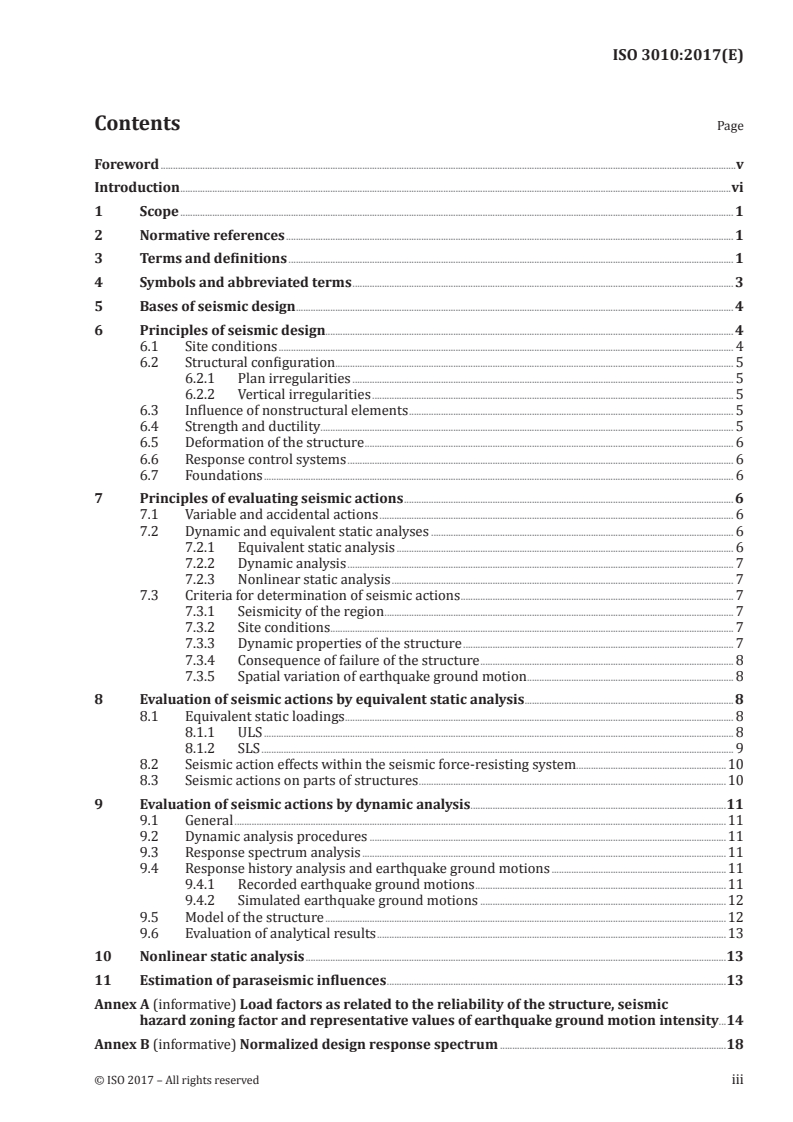
Contents Page
Foreword .v
Introduction .vi
1 Scope . 1
2 Normative references . 1
3 Terms and definitions . 1
4 Symbols and abbreviated terms . 3
5 Bases of seismic design . 4
6 Principles of seismic design. 4
6.1 Site conditions . 4
6.2 Structural configuration . 5
6.2.1 Plan irregularities . 5
6.2.2 Vertical irregularities . 5
6.3 Influence of nonstructural elements . 5
6.4 Strength and ductility. 5
6.5 Deformation of the structure . 6
6.6 Response control systems . 6
6.7 Foundations . 6
7 Principles of evaluating seismic actions . 6
7.1 Variable and accidental actions . 6
7.2 Dynamic and equivalent static analyses . 6
7.2.1 Equivalent static analysis . 6
7.2.2 Dynamic analysis . 7
7.2.3 Nonlinear static analysis . 7
7.3 Criteria for determination of seismic actions . 7
7.3.1 Seismicity of the region . 7
7.3.2 Site conditions . . 7
7.3.3 Dynamic properties of the structure . 7
7.3.4 Consequence of failure of the structure . 8
7.3.5 Spatial variation of earthquake ground motion . 8
8 Evaluation of seismic actions by equivalent static analysis . 8
8.1 Equivalent static loadings . 8
8.1.1 ULS . 8
8.1.2 SLS . 9
8.2 Seismic action effects within the seismic force-resisting system .10
8.3 Seismic actions on parts of structures .10
9 Evaluation of seismic actions by dynamic analysis.11
9.1 General .11
9.2 Dynamic analysis procedures .11
9.3 Response spectrum analysis .11
9.4 Response history analysis and earthquake ground motions .11
9.4.1 Recorded earthquake ground motions .11
9.4.2 Simulated earthquake ground motions .12
9.5 Model of the structure .12
9.6 Evaluation of analytical results .13
10 Nonlinear static analysis .13
11 Estimation of paraseismic influences .13
Annex A (informative) Load factors as related to the reliability of the structure, seismic
hazard zoning factor and representative values of earthquake ground motion intensity.14
Annex B (informative) Normalized design response spectrum .18
Annex C (informative) Seismic force distribution parameters for equivalent static analysis .21
Annex D (informative) Structural design factor for linear analysis .25
Annex E (informative) Combination of components of seismic action .28
Annex F (informative) Torsional moments .30
Annex G (informative) Damping ratio .32
Annex H (informative) Dynamic analysis .35
Annex I (informative) Nonlinear static analysis and capacity spectrum method.40
Annex J (informative) Soil-structure interaction .44
Annex K (informative) Seismic design of high-rise buildings .47
Annex L (informative) Deformation limits .49
Annex M (informative) Response control systems .50
Annex N (informative) Non-engineered construction .54
Annex O (informative) Tsunami actions .56
Annex P (informative) Paraseismic influences .59
Bibliography .60
iv © ISO 2017 – All rights reserved
Foreword
ISO (the International Organization for Standardization) is a worldwide federation of national standards
bodies (ISO member bodies). The work of preparing International Standards is normally carried out
through ISO technical committees. Each member body interested in a subject for which a technical
committee has been established has the right to be represented on that committee. International
organizations, governmental and non-governmental, in liaison with ISO, also take part in the work.
ISO collaborates closely with the International Electrotechnical Commission (IEC) on all matters of
electrotechnical standardization.
The procedures used to develop this document and those intended for its further maintenance are
described in the ISO/IEC Directives, Part 1. In particular the different approval criteria needed for the
different types of ISO documents should be noted. This document was drafted in accordance with the
editorial rules of the ISO/IEC Directives, Part 2 (see www. iso. org/d irectives).
Attention is drawn to the possibility that some of the elements of this document may be the subject of
patent rights. ISO shall not be held responsible for identifying any or all such patent rights. Details of
any patent rights identified during the development of the document will be in the Introduction and/or
on the ISO list of patent declarations received (see www. iso. org/p atents).
Any trade name used in this document is information given for the convenience of users and does not
constitute an endorsement.
For an explanation on the voluntary nature of standards, the meaning of ISO specific terms and
expressions related to conformity assessment, as well as information about ISO’s adherence to the
World Trade Organization (WTO) principles in the Technical Barriers to Trade (TBT) see the following
URL: ww w .iso. org/iso / foreword. html.
This document was prepared by ISO/TC 98, Bases for design of structures, Subcommittee SC 3, Loads,
forces and other actions.
This third edition cancels and replaces the second edition (ISO 3010:2001), which has been technically
revised.
Introduction
This document presents basic principles for the evaluation of seismic actions on structures. The seismic
actions described are fundamentally compatible with ISO 2394.
It also includes principles of seismic design, since the evaluation of seismic actions on structures and
the design of the structures are closely related.
Annexes A to P of this document are for information only.
NOTE 1 ISO 23469 and ISO 13033 are companion documents to this document. They provide basic design
criteria for geotechnical works and for nonstructural components and systems, respectively.
NOTE 2 ISO 23469 specifies the procedure to determine the design ground motion for the dynamic analysis of
geotechnical works. The procedure in ISO 23469 is applicable to the generation of design ground motion for the
structures that exhibit interaction with the ground or the geotechnical works.
NOTE 3 ISO 13033 and its annexes use the same terms and definitions that are used in this document. The
ground motion criteria specified in ISO 13033 are the same criteria that are used in this document. The demand
on nonstructural components and systems is directly related to the response of the building in which they are
located. Therefore, the procedures used to determine the design ground motion and building seismic response
are directly referenced to this document.
vi © ISO 2017 – All rights reserved
INTERNATIONAL STANDARD ISO 3010:2017(E)
Bases for design of structures — Seismic actions on
structures
1 Scope
This document specifies principles of evaluating seismic actions for the seismic design of buildings
(including both the super structure and foundation) and other structures.
This document is not applicable to certain structures, such as bridges, dams, geotechnical works and
tunnels, although some of the principles can be referred to for the seismic design of those structures.
This document is not applicable to nuclear power plants, since these are dealt with separately in other
International Standards.
In regions where the seismic hazard is low, methods of design for structural integrity can be used in
lieu of methods based on a consideration of seismic actions.
This document is not a legally binding and enforceable code. It can be viewed as a source document that
is utilized in the development of codes of practice by the competent authority responsible for issuing
structural design regulations.
NOTE 1 This document has been prepared mainly for new engineered structures. The principles are, however,
applicable to developing appropriate prescriptive rules for non-engineered structures (see Annex N). The
principles could also be applied to evaluating seismic actions on existing structures.
NOTE 2 Other structures include self-supporting structures other than buildings that carry gravity loads and
are required to resist seismic actions. These structures include seismic force-resisting systems similar to those
in buildings, such as a trussed tower or a pipe rack, or systems very different from those in buildings, such as a
liquid storage tank or a chimney. Additional examples include structures found at chemical plants, mines, power
plants, harbours, amusement parks and civil infrastructure facilities.
NOTE 3 The level of seismic hazard that would be considered low depends not only on the seismicity of the
region but also on other factors, including types of construction, traditional practices, etc. Methods of design for
structural integrity include nominal design horizontal forces (such as an equivalent static loading determined
from a simplified equivalent static analysis) which provide a measure of protection against seismic actions.
2 Normative references
The following documents are referred to in the text in such a way that some or all of their content
constitutes requirements of this document. For dated references, only the edition cited applies. For
undated references, the latest edition of the referenced document (including any amendments) applies.
ISO 13033, Bases for design of structures — Loads, forces and other actions — Seismic actions on
nonstructural components for building applications
3 Terms and definitions
For the purposes of this document, the following terms and definitions apply.
ISO and IEC maintain terminological databases for use in standardization at the following addresses:
— IEC Electropedia: available at http:// www .electropedia .org/
— ISO Online browsing platform: available at http:// www .iso .org/ obp
3.1
base shear
design horizontal force acting at the base of the structure
3.2
complete quadratic combination method
CQC
method to evaluate the maximum response of a structure by the quadratic combination of modal
response values
3.3
ductility
ability to deform beyond the elastic limit under cyclic loadings without significant reduction in strength
or energy absorption capacity
3.4
liquefaction
loss or significant reduction of shear strength and stiffness under cyclic loadings in saturated, loose,
cohesionless soils
3.5
moderate earthquake ground motion
ground motion used for SLS caused by earthquakes which may be expected to occur at the site during
the service life of the structure
Note 1 to entry: See Annex A.
3.6
normalized design response spectrum
spectrum to determine the base shear factor relative to the maximum ground acceleration as a function
of the fundamental natural period of the structure
3.7
paraseismic influences
ground motion whose characteristics are similar to those of earthquake ground motions, but its sources
are mainly due to industrial, explosive, traffic, and other human activities
3.8
P-delta effect
second-order effect which is caused by the action of gravity on the displaced mass
3.9
restoring force
force exerted by the deformed structure or structural elements which tends to move the structure or
structural elements to the original position
3.10
seismic force distribution factor of the ith level
k
F,i
factor to distribute the seismic base shear to the ith level, which characterizes the distribution of
seismic forces in elevation, where k = 1
å
F,i
Note 1 to entry: See Annex C.
3.11
seismic hazard zoning factor
k
Z
factor to express the relative seismic hazard of the region
2 © ISO 2017 – All rights reserved
3.12
seismic shear factor
factor to give seismic shear of one level, that is defined as the seismic shear of the level divided by the
weight of the structure above the level
3.13
seismic shear distribution factor of the ith level
k
V,i
ratio of the seismic shear factor of the ith level to the seismic shear factor of the base, which
characterizes the distribution of seismic shears in elevation where k = 1 at the base and usually
V,i
becomes largest at the top
Note 1 to entry: See Annex C.
3.14
severe earthquake ground motion
ground motion used for ULS caused by an earthquake that could occur at the site
Note 1 to entry: See Annex A.
3.15
soil-structure interaction
effect by which structure and surrounding soil mutually affect their overall response
3.16
square root of sum of squares method
method to evaluate the maximum response of a structure by the square root of the sum of the squares
of modal response values
3.17
structural design factor
k
D
factor to reduce seismic forces or shears to levels to be used for design, taking into account ductility,
acceptable deformation, restoring force characteristics, and overstrength of the structure
4 Symbols and abbreviated terms
F design lateral seismic force of the ith level of a structure for SLS
E,s,i
F design lateral seismic force of the ith level of a structure for ULS
E,u,i
F gravity load at the ith level of the structure
G,i
k representative value of earthquake ground motion intensity for SLS
E,s
k representative value of earthquake ground motion intensity for ULS
E,u
k ordinate of the normalized design response spectrum
R
k soil factor
S
n number of levels above the base
SLS serviceability limit state
SRSS square root of sum of squares
SSI soil-structure interaction
ULS ultimate limit state
V design lateral seismic shear of the ith level of a structure for SLS
E,s,i
V design lateral seismic shear of the ith level of a structure for ULS
E,u,i
γ load factor as related to reliability of the structure for SLS
E,s
γ load factor as related to reliability of the structure for ULS
E,u
5 Bases of seismic design
The basic philosophy of seismic design of structures is, in the event of earthquakes
— to prevent human casualties,
— to ensure continuity of vital services, and
— to reduce damage to property.
In addition to these, societal goals for the environment should be considered.
It is recognized that to give complete protection against all earthquakes is not economically feasible for
most types of structures. This document states the following basic principles.
a) The structure should not collapse nor experience other similar forms of structural failure due to
severe earthquake ground motions that could occur at the site [ultimate limit state (ULS)]. Higher
reliability for this limit state should be provided for structures with high consequence of failure.
b) The structure should withstand moderate earthquake ground motions which may be expected
to occur at the site during the service life of the structure with damage within accepted limits
[serviceability limit state (SLS)].
Structural integrity should also be examined by considering the behaviour of the structure after
exceeding each of the limit states (SLS and ULS). If it is essential that services (e.g. mechanical and
electrical equipment including their distribution systems) retain their functions after severe or
moderate earthquake ground motions, then the seismic actions should be evaluated in accordance with
the requirements of ISO 13033. The structure itself should also be verified that essential functions
remain operational under the same level of the motions.
NOTE 1 In addition to the seismic design and construction of structures stated in this document, it is important
to consider adequate countermeasures against subsequent disasters (such as fire, leakage of hazardous materials
from industrial facilities or storage tanks, large-scale landslides and tsunami) which may be triggered by the
earthquake.
NOTE 2 Following an earthquake, earthquake-damaged structures might need to be evaluated for safe
occupation during a period of time when aftershocks occur. This document, however, does not address actions
that can be expected due to aftershocks. In this case, a model of the damaged structure is required to evaluate
seismic actions.
6 Principles of seismic design
6.1 Site conditions
Conditions of the site under seismic actions should be evaluated, taking into account microzonation
criteria (vicinity to active faults, soil profile, soil behaviour under large strain, liquefaction potential,
topography, subsurface irregularity, and other factors such as interactions between these).
In the case of liquefaction prone sites, appropriate foundations and/or ground improvement should be
introduced to accommodate or control such phenomena (see ISO 23469).
4 © ISO 2017 – All rights reserved
In areas prone to tsunami hazard, certain important structures (vertical evacuation refuges, hospitals,
emergency communication facilities, etc.) are required to resist tsunami actions (see Annex O).
6.2 Structural configuration
For better seismic resistance, it is recommended that structures have regular forms in both plan and
elevation.
6.2.1 Plan irregularities
Structural elements to resist horizontal seismic actions should be arranged such that torsional effects
become as small as possible. Irregular shapes in plan causing eccentric distribution of forces are not
desirable, since they produce torsional effects which are difficult to assess accurately and which may
amplify the dynamic response of the structure (see Annex F).
6.2.2 Vertical irregularities
Changes in mass, stiffness, and capacity along the height of the structure should be minimized to avoid
damage concentration (see Annex C).
When a structure with complex form is to be designed, an appropriate dynamic analysis is recommended
in order to check the potential behaviour of the structure.
6.3 Influence of nonstructural elements
The structure, including nonstructural as well as structural elements, should be clearly defined as
a seismic force-resisting system which can be analysed. In computing the earthquake response of a
structure, the influence of not only the structural system elements but also nonstructural walls,
partitions, stairs, windows, etc. should be considered when they are significant to the structural
response.
NOTE Nonstructural elements are often neglected in seismic analysis. In many cases, the nonstructural
elements can provide additional strength and stiffness to the structure, which may result in favourable behaviour
during earthquakes which justifies their being neglected. However, in some cases, the nonstructural elements
can cause unfavourable behaviour. Examples are: spandrel walls that reduce clear height of reinforced concrete
columns and cause the brittle shear failure to the columns, and unsymmetrical arrangement of partition walls
(which are considered to be nonstructural elements) that causes large torsional moments to the structure.
Therefore, it is important to consider all elements as they behave during earthquakes. If neglecting the stiffness
and strength of nonstructural elements does not cause any unfavourable behaviour, they need not be included
in seismic analysis. ISO 13033 provides additional criteria regarding when nonstructural components should be
included in the building seismic analysis model.
6.4 Strength and ductility
The structural system and its structural elements (both members and connections) should have both
adequate strength and ductility for the applied seismic actions. Adequate post-elastic performance
should be provided by appropriate choice of the structural system and/or ductile detailing. The
structure should have adequate strength for the applied seismic actions and sufficient ductility to
ensure adequate energy absorption (see Annex D). Special attention should be given to suppressing the
low ductile behaviour of structural elements, such as buckling, bond failure, shear failure, and brittle
fracture. The deterioration of the restoring force under cyclic loadings should be taken into account.
Local capacities of the structure may be higher than that assumed in the analysis. Such overcapacities
should be taken into account in evaluating the behaviour of the structure, including the failure mode of
structural elements, failure mechanism of the structure, and the behaviour of the foundations due to
severe earthquake ground motions.
6.5 Deformation of the structure
The deformation of the structure under seismic actions should be limited, in order to restrict damage
for moderate earthquake ground motions and to avoid collapse or other similar forms of structural
failure for severe earthquake ground motions.
For long period structures such as high-rise buildings and seismically isolated buildings, effects of
repeated large displacement response should be evaluated for severe ground motions with long period
and long duration and limited to be within the deformation capacity.
NOTE There are two kinds of deformation to control: (1) inter-storey drift to restrict damage to
nonstructural elements and (2) total lateral displacement to avoid damaging contact with adjoining structures
(see Annex L).
6.6 Response control systems
Response control systems for structures, e.g. seismic isolation or energy dissipating devices, can be
used to ensure continuous use of the structure for moderate and, in some cases, severe earthquake
ground motions and also to prevent collapse during severe earthquake ground motions (see Annex M).
6.7 Foundations
The type of foundation should be selected carefully in accordance with the type of structure and local
soil conditions, e.g. soil profile, subsurface irregularity, groundwater level. Both forces and deformations
transferred through the foundations should be evaluated properly considering the strains induced to
soils during earthquake ground motions as well as kinematic and inertial interactions between soils
and foundations.
7 Principles of evaluating seismic actions
7.1 Variable and accidental actions
Seismic actions should be taken either as variable actions or accidental actions.
Structures should be verified against design values of seismic actions for ULS and SLS.
Accidental seismic actions can be considered for structures in regions where seismic activity is low to
ensure structural integrity.
NOTE The verification for the SLS can be omitted provided that it is satisfied through the verification for the
ULS. The verification of the SLS can also be omitted in low seismicity regions, where the SLS actions are low, and
for stiff structures (e.g. shear wall buildings) which are designed to remain nearly elastic under ULS actions.
7.2 Dynamic and equivalent static analyses
The seismic analysis of structures should be performed either by dynamic analysis or by equivalent
static analysis. In both cases, the dynamic properties of the structure should be taken into consideration.
When performing nonlinear analysis, the sequence of nonlinear behaviours of the structure, including
the formation of the collapse mechanism, should be determined when nonlinear behaviour is anticipated
for severe earthquake ground motions.
NOTE Nonlinear static analysis can be used to determine collapse mechanisms (see Annex H and Annex I).
7.2.1 Equivalent static analysis
Ordinary and regular structures may be designed by the equivalent static method using conventional
linear elastic analysis.
6 © ISO 2017 – All rights reserved
7.2.2 Dynamic analysis
A dynamic analysis should be performed for structures whose seismic response may not be predicted
accurately by an equivalent static analysis. Examples include those structures with irregularities of
geometry, mass distribution or stiffness distribution, or very tall structures at sites with high seismic
hazard (see Annex K). A dynamic analysis is also recommended for structures with innovative structural
systems [e.g. response control systems (see 6.6)], structures made of new materials, structures built on
special soil conditions, and structures of special importance. Dynamic analysis is classified as either a)
the response spectrum analysis, b) linear response history analysis or c) nonlinear response history
analysis (see Annex H).
7.2.3 Nonlinear static analysis
Structures where nonlinear sequence of behaviour is difficult to predict should utilize nonlinear static
analysis to determine the sequence (see Annex I).
7.3 Criteria for determination of seismic actions
The design seismic actions should be determined based on the following considerations.
7.3.1 Seismicity of the region
The seismicity of the region where a structure is to be constructed is usually indicated by mapping a
seismic zoning parameter [peak ground motion value(s) or design ground motion spectral response
value(s)], which should be based on either the seismic history or on seismological data of the region
(including active faults), or on a combination of historical and seismological data. In addition, the
expected values of the maximum intensity of the earthquake ground motion in the region in a given
future period of time should be determined on the basis of the regional seismicity.
NOTE There exist many kinds of parameters which can be used to characterize the intensity of earthquake
ground motion. These are seismic intensity scales, peak ground acceleration and velocity, “effective” peak ground
acceleration and velocity, spectral response parameters that are related to smoothed response spectra, input
energy, etc. Often, these parameters are determined by a probabilistic seismic hazard analysis to give uniform
hazard for a range of natural periods of vibration. In some cases, the hazard analysis is extended to encompass
the variation in hazard level with probability level and to integrate that variation with structural fragility to
reach a consistent reliability against collapse.
7.3.2 Site conditions
Dynamic properties of the supporting soil layers of the structure should be investigated and the effect
on the ground motion at the site should be considered. Geographical and geological conditions and
influence of deep subsurface structure (basin effects) should also be taken into consideration.
The ground motion at a particular site during earthquakes has a predominant period of vibration
which, in general, is shorter on firm ground and longer on soft ground. Attention should be paid to the
possibility of local amplifications of earthquake ground motions, which may occur (inter alia) in the
presence of soft soils and near the edge of alluvial basins. The possibility of liquefaction should also be
considered, particularly in saturated, loose, cohesionless soils.
NOTE The properties of earthquake ground motions including intensity, frequency content and duration of
motion are important features as far as the destructiveness of earthquakes is concerned. Furthermore, structures
constructed on soft ground often suffer damage due to uneven or large settlements during earthquakes if not
constructed on deep foundations.
7.3.3 Dynamic properties of the structure
Dynamic properties, such as periods and modes of vibration and damping, should be considered for
the overall soil-structure system. The dynamic properties depend on the shape of the structure, mass
distribution, stiffness distribution, soil properties, and the type of construction. Nonlinear behaviour
of the structural elements should also be taken into account (see 8.1.1). A larger value of the seismic
design force should be considered for a structure having less ductility capacity or for a structure where
a structural element failure may lead to complete structural collapse.
7.3.4 Consequence of failure of the structure
Consequence of possible failures as well as expense and effort required to reduce the risk of those
failures should be taken into account. By considering them and minimizing risk, design with a higher
reliability level is appropriate for buildings where large numbers of people assemble, or structures
which are essential for public well-being during and after the earthquakes, such as hospitals, power
stations, fire stations, broadcasting stations, and water supply facilities (see Annex A). For high-rise
buildings, also see Annex K. For national and political economic reasons, a higher level of reliability may
be required in urban areas with a high damage potential and a high concentration of capital investment.
NOTE The load factors as related to reliability of the structure γ and γ (see 8.1) are generally increased
E,u E,s
when consequence class is high (see Annex A). For response history analysis, the input ground motions are either
amplified or more stringent acceptance criteria are used, consistent with the increase of the desired reliability.
7.3.5 Spatial variation of earthquake ground motion
Usually, the relative motion between different points of the ground may be disregarded. However, in the
case of long-span or widely spread structures, this action and the effect of a travelling wave which can
come with phase delay should be taken into account. Spatial variation of wave due to the differences of
the ground condition and subsurface geological structure should also be considered.
8 Evaluation of seismic actions by equivalent static analysis
8.1 Equivalent static loadings
In the seismic analysis of structures based on a method using equivalent static loadings, the variable
seismic actions for ULS and for SLS may be evaluated as follows.
8.1.1 ULS
The design lateral seismic force of the ith level of a structure for ULS, F , may be determined by
E,u,i
n
Fk=γ kk kk kF (1)
∑
Eu,,iiEu,,ZE uS DR FG,,j
j=1
or the design lateral seismic shear for ULS, V , may be used instead of the above seismic force:
E,u,i
n
Vk=γ kk kk kF (2)
∑
Eu,,iiEu,,ZE uS DR VG,,j
ji=
8 © ISO 2017 – All rights reserved
where
γ is the load factor as related to reliability of the structure for ULS (see Annex A);
E,u
k is the seismic hazard zoning factor to be specified in the national code or other national
Z
documents (see Annex A);
k is the representative value of earthquake ground motion intensity for ULS to be specified in
E,u
the national code or other national documents by considering the seismicity (see Annex A);
k is the ratio of the earthquake ground motion intensity considering the effect of soil con-
S
ditions to the earthquake ground motion intensity for the reference site condition (see
Annex A);
k is the structural design factor to be specified for various structural systems according to
D
their ductility, acceptable deformation, restoring force characteristics, and overstrength
(see Annex D);
k is the ordinate of the normalized design response spectrum, as a function of the fundamen-
R
tal natural period of the structure considering the effect of soil conditions (see Annex B) and
damping property of the structure (see Annex G);
k is the seismic force distribution factor of the ith level to distribute the seismic base shear to
F,i
each level, which characterizes the distribution of seismic forces in elevation, where k
F,i
satisfies the condition k = 1 (see Annex C);
å
F,i
k is the seismic shear distribution factor of the ith level which is the ratio of the seismic shear
V,i
factor of the ith level to the seismic shear factor of the base, and characterizes the distribu-
tion of seismic shears in elevation, where k = 1 at the base and usually becomes largest at
V,i
the top (see Annex C);
F is the gravity load at the jth level of the structure;
G,j
n is the number of levels above the base.
8.1.2 SLS
The design lateral seismic force of the ith level of a structure for SLS, F , may be determined by
E,s,i
n
Fk=γ kk kk F (3)
∑
Es,,iiEs,,ZE sS RF,,G j
j=1
or the design lateral seismic shear for SLS, V , may be used instead of the above seismic force:
E,s,i
n
Vk=γ kk kk F (4)
∑
Es,,iiEs,,ZE sS RV,,G j
ji=
where
γ is the load factor as related to reliability of the structure for SLS (see Annex A);
E,s
k is the representative value of earthquake ground motion intensity for SLS to be spec-
E,s
ified in the national code or other national documents by considering the seismicity
(see Annex A);
k and k may be replaced by a unique representative k , as specified in ISO 2394, in the ver-
E,u E,s E
ification procedure, by which the reliability of the structure and the consequences
of failure, including the significance of the type of failure, are taken into account to
specify the load factors γ and γ (see Table A.3).
E,u E,s
The values of the gravity load should be equal to the total permanent load plus a probable variable
imposed load (see Annex C). In snowy areas, a probable snow load is also to be considered.
NOTE Depending on the definition of the seismic actions as variable or accidental, the values for the
combination of seismic actions and other actions might be different. For the combination of actions, see ISO 2394.
8.2 Seismic action effects within the seismic force-resisting system
The two horizontal and the vertical components of the earthquake ground motion and their spatial
variation, leading to torsional excitation of structures, should be considered (see Annex F).
The torsional effects of seismic actions should, in general, be taken into account with due regard to the
following quantities: eccentricity between the centres of mass and stiffness; the dynamic magnification
caused mainly by the coupling between translational and torsional vibrations; effects of eccentricities
in other storeys; inaccuracy of computed eccentricity; and rotational components of earthquake ground
motions.
Modelling of the structure should include realistic stiffness of structural elements (including cracking
where pertinent, especially at ULS). Where the stiffness of horizontal diaphragm system(s) connecting
the frames resisting horizontal seismic forces is very low and transfer of horizontal forces between
horizontal lines of seismic resistance is negligible, each line of resistance may be analysed independently
with effective mass in its tributary area instead of constituting and analysing a three-dimensional
model of the total structure (flexible diaphragm assumption).
NOTE 1 Seismic actions in any direction do not always attain their maxima at the same time.
NOTE 2 The vertical component of the earthquake ground motion is characterized by higher frequencies than
the horizontal component. The peak vertical acceleration is usually less than the peak horizontal acceleration;
however, in the vicinity of the fault, the vertical peak can be higher than the horizontal.
In a number of structural forms, the m
...
INTERNATIONAL ISO
STANDARD 3010
Third edition
2017-03
Bases for design of structures —
Seismic actions on structures
Bases du calcul des constructions — Actions sismiques sur les
structures
Reference number
©
ISO 2017
© ISO 2017, Published in Switzerland
All rights reserved. Unless otherwise specified, no part of this publication may be reproduced or utilized otherwise in any form
or by any means, electronic or mechanical, including photocopying, or posting on the internet or an intranet, without prior
written permission. Permission can be requested from either ISO at the address below or ISO’s member body in the country of
the requester.
ISO copyright office
Ch. de Blandonnet 8 • CP 401
CH-1214 Vernier, Geneva, Switzerland
Tel. +41 22 749 01 11
Fax +41 22 749 09 47
copyright@iso.org
www.iso.org
ii © ISO 2017 – All rights reserved
Contents Page
Foreword .v
Introduction .vi
1 Scope . 1
2 Normative references . 1
3 Terms and definitions . 1
4 Symbols and abbreviated terms . 3
5 Bases of seismic design . 4
6 Principles of seismic design. 4
6.1 Site conditions . 4
6.2 Structural configuration . 5
6.2.1 Plan irregularities . 5
6.2.2 Vertical irregularities . 5
6.3 Influence of nonstructural elements . 5
6.4 Strength and ductility. 5
6.5 Deformation of the structure . 6
6.6 Response control systems . 6
6.7 Foundations . 6
7 Principles of evaluating seismic actions . 6
7.1 Variable and accidental actions . 6
7.2 Dynamic and equivalent static analyses . 6
7.2.1 Equivalent static analysis . 6
7.2.2 Dynamic analysis . 7
7.2.3 Nonlinear static analysis . 7
7.3 Criteria for determination of seismic actions . 7
7.3.1 Seismicity of the region . 7
7.3.2 Site conditions . . 7
7.3.3 Dynamic properties of the structure . 7
7.3.4 Consequence of failure of the structure . 8
7.3.5 Spatial variation of earthquake ground motion . 8
8 Evaluation of seismic actions by equivalent static analysis . 8
8.1 Equivalent static loadings . 8
8.1.1 ULS . 8
8.1.2 SLS . 9
8.2 Seismic action effects within the seismic force-resisting system .10
8.3 Seismic actions on parts of structures .10
9 Evaluation of seismic actions by dynamic analysis.11
9.1 General .11
9.2 Dynamic analysis procedures .11
9.3 Response spectrum analysis .11
9.4 Response history analysis and earthquake ground motions .11
9.4.1 Recorded earthquake ground motions .11
9.4.2 Simulated earthquake ground motions .12
9.5 Model of the structure .12
9.6 Evaluation of analytical results .13
10 Nonlinear static analysis .13
11 Estimation of paraseismic influences .13
Annex A (informative) Load factors as related to the reliability of the structure, seismic
hazard zoning factor and representative values of earthquake ground motion intensity.14
Annex B (informative) Normalized design response spectrum .18
Annex C (informative) Seismic force distribution parameters for equivalent static analysis .21
Annex D (informative) Structural design factor for linear analysis .25
Annex E (informative) Combination of components of seismic action .28
Annex F (informative) Torsional moments .30
Annex G (informative) Damping ratio .32
Annex H (informative) Dynamic analysis .35
Annex I (informative) Nonlinear static analysis and capacity spectrum method.40
Annex J (informative) Soil-structure interaction .44
Annex K (informative) Seismic design of high-rise buildings .47
Annex L (informative) Deformation limits .49
Annex M (informative) Response control systems .50
Annex N (informative) Non-engineered construction .54
Annex O (informative) Tsunami actions .56
Annex P (informative) Paraseismic influences .59
Bibliography .60
iv © ISO 2017 – All rights reserved
Foreword
ISO (the International Organization for Standardization) is a worldwide federation of national standards
bodies (ISO member bodies). The work of preparing International Standards is normally carried out
through ISO technical committees. Each member body interested in a subject for which a technical
committee has been established has the right to be represented on that committee. International
organizations, governmental and non-governmental, in liaison with ISO, also take part in the work.
ISO collaborates closely with the International Electrotechnical Commission (IEC) on all matters of
electrotechnical standardization.
The procedures used to develop this document and those intended for its further maintenance are
described in the ISO/IEC Directives, Part 1. In particular the different approval criteria needed for the
different types of ISO documents should be noted. This document was drafted in accordance with the
editorial rules of the ISO/IEC Directives, Part 2 (see www. iso. org/d irectives).
Attention is drawn to the possibility that some of the elements of this document may be the subject of
patent rights. ISO shall not be held responsible for identifying any or all such patent rights. Details of
any patent rights identified during the development of the document will be in the Introduction and/or
on the ISO list of patent declarations received (see www. iso. org/p atents).
Any trade name used in this document is information given for the convenience of users and does not
constitute an endorsement.
For an explanation on the voluntary nature of standards, the meaning of ISO specific terms and
expressions related to conformity assessment, as well as information about ISO’s adherence to the
World Trade Organization (WTO) principles in the Technical Barriers to Trade (TBT) see the following
URL: ww w .iso. org/iso / foreword. html.
This document was prepared by ISO/TC 98, Bases for design of structures, Subcommittee SC 3, Loads,
forces and other actions.
This third edition cancels and replaces the second edition (ISO 3010:2001), which has been technically
revised.
Introduction
This document presents basic principles for the evaluation of seismic actions on structures. The seismic
actions described are fundamentally compatible with ISO 2394.
It also includes principles of seismic design, since the evaluation of seismic actions on structures and
the design of the structures are closely related.
Annexes A to P of this document are for information only.
NOTE 1 ISO 23469 and ISO 13033 are companion documents to this document. They provide basic design
criteria for geotechnical works and for nonstructural components and systems, respectively.
NOTE 2 ISO 23469 specifies the procedure to determine the design ground motion for the dynamic analysis of
geotechnical works. The procedure in ISO 23469 is applicable to the generation of design ground motion for the
structures that exhibit interaction with the ground or the geotechnical works.
NOTE 3 ISO 13033 and its annexes use the same terms and definitions that are used in this document. The
ground motion criteria specified in ISO 13033 are the same criteria that are used in this document. The demand
on nonstructural components and systems is directly related to the response of the building in which they are
located. Therefore, the procedures used to determine the design ground motion and building seismic response
are directly referenced to this document.
vi © ISO 2017 – All rights reserved
INTERNATIONAL STANDARD ISO 3010:2017(E)
Bases for design of structures — Seismic actions on
structures
1 Scope
This document specifies principles of evaluating seismic actions for the seismic design of buildings
(including both the super structure and foundation) and other structures.
This document is not applicable to certain structures, such as bridges, dams, geotechnical works and
tunnels, although some of the principles can be referred to for the seismic design of those structures.
This document is not applicable to nuclear power plants, since these are dealt with separately in other
International Standards.
In regions where the seismic hazard is low, methods of design for structural integrity can be used in
lieu of methods based on a consideration of seismic actions.
This document is not a legally binding and enforceable code. It can be viewed as a source document that
is utilized in the development of codes of practice by the competent authority responsible for issuing
structural design regulations.
NOTE 1 This document has been prepared mainly for new engineered structures. The principles are, however,
applicable to developing appropriate prescriptive rules for non-engineered structures (see Annex N). The
principles could also be applied to evaluating seismic actions on existing structures.
NOTE 2 Other structures include self-supporting structures other than buildings that carry gravity loads and
are required to resist seismic actions. These structures include seismic force-resisting systems similar to those
in buildings, such as a trussed tower or a pipe rack, or systems very different from those in buildings, such as a
liquid storage tank or a chimney. Additional examples include structures found at chemical plants, mines, power
plants, harbours, amusement parks and civil infrastructure facilities.
NOTE 3 The level of seismic hazard that would be considered low depends not only on the seismicity of the
region but also on other factors, including types of construction, traditional practices, etc. Methods of design for
structural integrity include nominal design horizontal forces (such as an equivalent static loading determined
from a simplified equivalent static analysis) which provide a measure of protection against seismic actions.
2 Normative references
The following documents are referred to in the text in such a way that some or all of their content
constitutes requirements of this document. For dated references, only the edition cited applies. For
undated references, the latest edition of the referenced document (including any amendments) applies.
ISO 13033, Bases for design of structures — Loads, forces and other actions — Seismic actions on
nonstructural components for building applications
3 Terms and definitions
For the purposes of this document, the following terms and definitions apply.
ISO and IEC maintain terminological databases for use in standardization at the following addresses:
— IEC Electropedia: available at http:// www .electropedia .org/
— ISO Online browsing platform: available at http:// www .iso .org/ obp
3.1
base shear
design horizontal force acting at the base of the structure
3.2
complete quadratic combination method
CQC
method to evaluate the maximum response of a structure by the quadratic combination of modal
response values
3.3
ductility
ability to deform beyond the elastic limit under cyclic loadings without significant reduction in strength
or energy absorption capacity
3.4
liquefaction
loss or significant reduction of shear strength and stiffness under cyclic loadings in saturated, loose,
cohesionless soils
3.5
moderate earthquake ground motion
ground motion used for SLS caused by earthquakes which may be expected to occur at the site during
the service life of the structure
Note 1 to entry: See Annex A.
3.6
normalized design response spectrum
spectrum to determine the base shear factor relative to the maximum ground acceleration as a function
of the fundamental natural period of the structure
3.7
paraseismic influences
ground motion whose characteristics are similar to those of earthquake ground motions, but its sources
are mainly due to industrial, explosive, traffic, and other human activities
3.8
P-delta effect
second-order effect which is caused by the action of gravity on the displaced mass
3.9
restoring force
force exerted by the deformed structure or structural elements which tends to move the structure or
structural elements to the original position
3.10
seismic force distribution factor of the ith level
k
F,i
factor to distribute the seismic base shear to the ith level, which characterizes the distribution of
seismic forces in elevation, where k = 1
å
F,i
Note 1 to entry: See Annex C.
3.11
seismic hazard zoning factor
k
Z
factor to express the relative seismic hazard of the region
2 © ISO 2017 – All rights reserved
3.12
seismic shear factor
factor to give seismic shear of one level, that is defined as the seismic shear of the level divided by the
weight of the structure above the level
3.13
seismic shear distribution factor of the ith level
k
V,i
ratio of the seismic shear factor of the ith level to the seismic shear factor of the base, which
characterizes the distribution of seismic shears in elevation where k = 1 at the base and usually
V,i
becomes largest at the top
Note 1 to entry: See Annex C.
3.14
severe earthquake ground motion
ground motion used for ULS caused by an earthquake that could occur at the site
Note 1 to entry: See Annex A.
3.15
soil-structure interaction
effect by which structure and surrounding soil mutually affect their overall response
3.16
square root of sum of squares method
method to evaluate the maximum response of a structure by the square root of the sum of the squares
of modal response values
3.17
structural design factor
k
D
factor to reduce seismic forces or shears to levels to be used for design, taking into account ductility,
acceptable deformation, restoring force characteristics, and overstrength of the structure
4 Symbols and abbreviated terms
F design lateral seismic force of the ith level of a structure for SLS
E,s,i
F design lateral seismic force of the ith level of a structure for ULS
E,u,i
F gravity load at the ith level of the structure
G,i
k representative value of earthquake ground motion intensity for SLS
E,s
k representative value of earthquake ground motion intensity for ULS
E,u
k ordinate of the normalized design response spectrum
R
k soil factor
S
n number of levels above the base
SLS serviceability limit state
SRSS square root of sum of squares
SSI soil-structure interaction
ULS ultimate limit state
V design lateral seismic shear of the ith level of a structure for SLS
E,s,i
V design lateral seismic shear of the ith level of a structure for ULS
E,u,i
γ load factor as related to reliability of the structure for SLS
E,s
γ load factor as related to reliability of the structure for ULS
E,u
5 Bases of seismic design
The basic philosophy of seismic design of structures is, in the event of earthquakes
— to prevent human casualties,
— to ensure continuity of vital services, and
— to reduce damage to property.
In addition to these, societal goals for the environment should be considered.
It is recognized that to give complete protection against all earthquakes is not economically feasible for
most types of structures. This document states the following basic principles.
a) The structure should not collapse nor experience other similar forms of structural failure due to
severe earthquake ground motions that could occur at the site [ultimate limit state (ULS)]. Higher
reliability for this limit state should be provided for structures with high consequence of failure.
b) The structure should withstand moderate earthquake ground motions which may be expected
to occur at the site during the service life of the structure with damage within accepted limits
[serviceability limit state (SLS)].
Structural integrity should also be examined by considering the behaviour of the structure after
exceeding each of the limit states (SLS and ULS). If it is essential that services (e.g. mechanical and
electrical equipment including their distribution systems) retain their functions after severe or
moderate earthquake ground motions, then the seismic actions should be evaluated in accordance with
the requirements of ISO 13033. The structure itself should also be verified that essential functions
remain operational under the same level of the motions.
NOTE 1 In addition to the seismic design and construction of structures stated in this document, it is important
to consider adequate countermeasures against subsequent disasters (such as fire, leakage of hazardous materials
from industrial facilities or storage tanks, large-scale landslides and tsunami) which may be triggered by the
earthquake.
NOTE 2 Following an earthquake, earthquake-damaged structures might need to be evaluated for safe
occupation during a period of time when aftershocks occur. This document, however, does not address actions
that can be expected due to aftershocks. In this case, a model of the damaged structure is required to evaluate
seismic actions.
6 Principles of seismic design
6.1 Site conditions
Conditions of the site under seismic actions should be evaluated, taking into account microzonation
criteria (vicinity to active faults, soil profile, soil behaviour under large strain, liquefaction potential,
topography, subsurface irregularity, and other factors such as interactions between these).
In the case of liquefaction prone sites, appropriate foundations and/or ground improvement should be
introduced to accommodate or control such phenomena (see ISO 23469).
4 © ISO 2017 – All rights reserved
In areas prone to tsunami hazard, certain important structures (vertical evacuation refuges, hospitals,
emergency communication facilities, etc.) are required to resist tsunami actions (see Annex O).
6.2 Structural configuration
For better seismic resistance, it is recommended that structures have regular forms in both plan and
elevation.
6.2.1 Plan irregularities
Structural elements to resist horizontal seismic actions should be arranged such that torsional effects
become as small as possible. Irregular shapes in plan causing eccentric distribution of forces are not
desirable, since they produce torsional effects which are difficult to assess accurately and which may
amplify the dynamic response of the structure (see Annex F).
6.2.2 Vertical irregularities
Changes in mass, stiffness, and capacity along the height of the structure should be minimized to avoid
damage concentration (see Annex C).
When a structure with complex form is to be designed, an appropriate dynamic analysis is recommended
in order to check the potential behaviour of the structure.
6.3 Influence of nonstructural elements
The structure, including nonstructural as well as structural elements, should be clearly defined as
a seismic force-resisting system which can be analysed. In computing the earthquake response of a
structure, the influence of not only the structural system elements but also nonstructural walls,
partitions, stairs, windows, etc. should be considered when they are significant to the structural
response.
NOTE Nonstructural elements are often neglected in seismic analysis. In many cases, the nonstructural
elements can provide additional strength and stiffness to the structure, which may result in favourable behaviour
during earthquakes which justifies their being neglected. However, in some cases, the nonstructural elements
can cause unfavourable behaviour. Examples are: spandrel walls that reduce clear height of reinforced concrete
columns and cause the brittle shear failure to the columns, and unsymmetrical arrangement of partition walls
(which are considered to be nonstructural elements) that causes large torsional moments to the structure.
Therefore, it is important to consider all elements as they behave during earthquakes. If neglecting the stiffness
and strength of nonstructural elements does not cause any unfavourable behaviour, they need not be included
in seismic analysis. ISO 13033 provides additional criteria regarding when nonstructural components should be
included in the building seismic analysis model.
6.4 Strength and ductility
The structural system and its structural elements (both members and connections) should have both
adequate strength and ductility for the applied seismic actions. Adequate post-elastic performance
should be provided by appropriate choice of the structural system and/or ductile detailing. The
structure should have adequate strength for the applied seismic actions and sufficient ductility to
ensure adequate energy absorption (see Annex D). Special attention should be given to suppressing the
low ductile behaviour of structural elements, such as buckling, bond failure, shear failure, and brittle
fracture. The deterioration of the restoring force under cyclic loadings should be taken into account.
Local capacities of the structure may be higher than that assumed in the analysis. Such overcapacities
should be taken into account in evaluating the behaviour of the structure, including the failure mode of
structural elements, failure mechanism of the structure, and the behaviour of the foundations due to
severe earthquake ground motions.
6.5 Deformation of the structure
The deformation of the structure under seismic actions should be limited, in order to restrict damage
for moderate earthquake ground motions and to avoid collapse or other similar forms of structural
failure for severe earthquake ground motions.
For long period structures such as high-rise buildings and seismically isolated buildings, effects of
repeated large displacement response should be evaluated for severe ground motions with long period
and long duration and limited to be within the deformation capacity.
NOTE There are two kinds of deformation to control: (1) inter-storey drift to restrict damage to
nonstructural elements and (2) total lateral displacement to avoid damaging contact with adjoining structures
(see Annex L).
6.6 Response control systems
Response control systems for structures, e.g. seismic isolation or energy dissipating devices, can be
used to ensure continuous use of the structure for moderate and, in some cases, severe earthquake
ground motions and also to prevent collapse during severe earthquake ground motions (see Annex M).
6.7 Foundations
The type of foundation should be selected carefully in accordance with the type of structure and local
soil conditions, e.g. soil profile, subsurface irregularity, groundwater level. Both forces and deformations
transferred through the foundations should be evaluated properly considering the strains induced to
soils during earthquake ground motions as well as kinematic and inertial interactions between soils
and foundations.
7 Principles of evaluating seismic actions
7.1 Variable and accidental actions
Seismic actions should be taken either as variable actions or accidental actions.
Structures should be verified against design values of seismic actions for ULS and SLS.
Accidental seismic actions can be considered for structures in regions where seismic activity is low to
ensure structural integrity.
NOTE The verification for the SLS can be omitted provided that it is satisfied through the verification for the
ULS. The verification of the SLS can also be omitted in low seismicity regions, where the SLS actions are low, and
for stiff structures (e.g. shear wall buildings) which are designed to remain nearly elastic under ULS actions.
7.2 Dynamic and equivalent static analyses
The seismic analysis of structures should be performed either by dynamic analysis or by equivalent
static analysis. In both cases, the dynamic properties of the structure should be taken into consideration.
When performing nonlinear analysis, the sequence of nonlinear behaviours of the structure, including
the formation of the collapse mechanism, should be determined when nonlinear behaviour is anticipated
for severe earthquake ground motions.
NOTE Nonlinear static analysis can be used to determine collapse mechanisms (see Annex H and Annex I).
7.2.1 Equivalent static analysis
Ordinary and regular structures may be designed by the equivalent static method using conventional
linear elastic analysis.
6 © ISO 2017 – All rights reserved
7.2.2 Dynamic analysis
A dynamic analysis should be performed for structures whose seismic response may not be predicted
accurately by an equivalent static analysis. Examples include those structures with irregularities of
geometry, mass distribution or stiffness distribution, or very tall structures at sites with high seismic
hazard (see Annex K). A dynamic analysis is also recommended for structures with innovative structural
systems [e.g. response control systems (see 6.6)], structures made of new materials, structures built on
special soil conditions, and structures of special importance. Dynamic analysis is classified as either a)
the response spectrum analysis, b) linear response history analysis or c) nonlinear response history
analysis (see Annex H).
7.2.3 Nonlinear static analysis
Structures where nonlinear sequence of behaviour is difficult to predict should utilize nonlinear static
analysis to determine the sequence (see Annex I).
7.3 Criteria for determination of seismic actions
The design seismic actions should be determined based on the following considerations.
7.3.1 Seismicity of the region
The seismicity of the region where a structure is to be constructed is usually indicated by mapping a
seismic zoning parameter [peak ground motion value(s) or design ground motion spectral response
value(s)], which should be based on either the seismic history or on seismological data of the region
(including active faults), or on a combination of historical and seismological data. In addition, the
expected values of the maximum intensity of the earthquake ground motion in the region in a given
future period of time should be determined on the basis of the regional seismicity.
NOTE There exist many kinds of parameters which can be used to characterize the intensity of earthquake
ground motion. These are seismic intensity scales, peak ground acceleration and velocity, “effective” peak ground
acceleration and velocity, spectral response parameters that are related to smoothed response spectra, input
energy, etc. Often, these parameters are determined by a probabilistic seismic hazard analysis to give uniform
hazard for a range of natural periods of vibration. In some cases, the hazard analysis is extended to encompass
the variation in hazard level with probability level and to integrate that variation with structural fragility to
reach a consistent reliability against collapse.
7.3.2 Site conditions
Dynamic properties of the supporting soil layers of the structure should be investigated and the effect
on the ground motion at the site should be considered. Geographical and geological conditions and
influence of deep subsurface structure (basin effects) should also be taken into consideration.
The ground motion at a particular site during earthquakes has a predominant period of vibration
which, in general, is shorter on firm ground and longer on soft ground. Attention should be paid to the
possibility of local amplifications of earthquake ground motions, which may occur (inter alia) in the
presence of soft soils and near the edge of alluvial basins. The possibility of liquefaction should also be
considered, particularly in saturated, loose, cohesionless soils.
NOTE The properties of earthquake ground motions including intensity, frequency content and duration of
motion are important features as far as the destructiveness of earthquakes is concerned. Furthermore, structures
constructed on soft ground often suffer damage due to uneven or large settlements during earthquakes if not
constructed on deep foundations.
7.3.3 Dynamic properties of the structure
Dynamic properties, such as periods and modes of vibration and damping, should be considered for
the overall soil-structure system. The dynamic properties depend on the shape of the structure, mass
distribution, stiffness distribution, soil properties, and the type of construction. Nonlinear behaviour
of the structural elements should also be taken into account (see 8.1.1). A larger value of the seismic
design force should be considered for a structure having less ductility capacity or for a structure where
a structural element failure may lead to complete structural collapse.
7.3.4 Consequence of failure of the structure
Consequence of possible failures as well as expense and effort required to reduce the risk of those
failures should be taken into account. By considering them and minimizing risk, design with a higher
reliability level is appropriate for buildings where large numbers of people assemble, or structures
which are essential for public well-being during and after the earthquakes, such as hospitals, power
stations, fire stations, broadcasting stations, and water supply facilities (see Annex A). For high-rise
buildings, also see Annex K. For national and political economic reasons, a higher level of reliability may
be required in urban areas with a high damage potential and a high concentration of capital investment.
NOTE The load factors as related to reliability of the structure γ and γ (see 8.1) are generally increased
E,u E,s
when consequence class is high (see Annex A). For response history analysis, the input ground motions are either
amplified or more stringent acceptance criteria are used, consistent with the increase of the desired reliability.
7.3.5 Spatial variation of earthquake ground motion
Usually, the relative motion between different points of the ground may be disregarded. However, in the
case of long-span or widely spread structures, this action and the effect of a travelling wave which can
come with phase delay should be taken into account. Spatial variation of wave due to the differences of
the ground condition and subsurface geological structure should also be considered.
8 Evaluation of seismic actions by equivalent static analysis
8.1 Equivalent static loadings
In the seismic analysis of structures based on a method using equivalent static loadings, the variable
seismic actions for ULS and for SLS may be evaluated as follows.
8.1.1 ULS
The design lateral seismic force of the ith level of a structure for ULS, F , may be determined by
E,u,i
n
Fk=γ kk kk kF (1)
∑
Eu,,iiEu,,ZE uS DR FG,,j
j=1
or the design lateral seismic shear for ULS, V , may be used instead of the above seismic force:
E,u,i
n
Vk=γ kk kk kF (2)
∑
Eu,,iiEu,,ZE uS DR VG,,j
ji=
8 © ISO 2017 – All rights reserved
where
γ is the load factor as related to reliability of the structure for ULS (see Annex A);
E,u
k is the seismic hazard zoning factor to be specified in the national code or other national
Z
documents (see Annex A);
k is the representative value of earthquake ground motion intensity for ULS to be specified in
E,u
the national code or other national documents by considering the seismicity (see Annex A);
k is the ratio of the earthquake ground motion intensity considering the effect of soil con-
S
ditions to the earthquake ground motion intensity for the reference site condition (see
Annex A);
k is the structural design factor to be specified for various structural systems according to
D
their ductility, acceptable deformation, restoring force characteristics, and overstrength
(see Annex D);
k is the ordinate of the normalized design response spectrum, as a function of the fundamen-
R
tal natural period of the structure considering the effect of soil conditions (see Annex B) and
damping property of the structure (see Annex G);
k is the seismic force distribution factor of the ith level to distribute the seismic base shear to
F,i
each level, which characterizes the distribution of seismic forces in elevation, where k
F,i
satisfies the condition k = 1 (see Annex C);
å
F,i
k is the seismic shear distribution factor of the ith level which is the ratio of the seismic shear
V,i
factor of the ith level to the seismic shear factor of the base, and characterizes the distribu-
tion of seismic shears in elevation, where k = 1 at the base and usually becomes largest at
V,i
the top (see Annex C);
F is the gravity load at the jth level of the structure;
G,j
n is the number of levels above the base.
8.1.2 SLS
The design lateral seismic force of the ith level of a structure for SLS, F , may be determined by
E,s,i
n
Fk=γ kk kk F (3)
∑
Es,,iiEs,,ZE sS RF,,G j
j=1
or the design lateral seismic shear for SLS, V , may be used instead of the above seismic force:
E,s,i
n
Vk=γ kk kk F (4)
∑
Es,,iiEs,,ZE sS RV,,G j
ji=
where
γ is the load factor as related to reliability of the structure for SLS (see Annex A);
E,s
k is the representative value of earthquake ground motion intensity for SLS to be spec-
E,s
ified in the national code or other national documents by considering the seismicity
(see Annex A);
k and k may be replaced by a unique representative k , as specified in ISO 2394, in the ver-
E,u E,s E
ification procedure, by which the reliability of the structure and the consequences
of failure, including the significance of the type of failure, are taken into account to
specify the load factors γ and γ (see Table A.3).
E,u E,s
The values of the gravity load should be equal to the total permanent load plus a probable variable
imposed load (see Annex C). In snowy areas, a probable snow load is also to be considered.
NOTE Depending on the definition of the seismic actions as variable or accidental, the values for the
combination of seismic actions and other actions might be different. For the combination of actions, see ISO 2394.
8.2 Seismic action effects within the seismic force-resisting system
The two horizontal and the vertical components of the earthquake ground motion and their spatial
variation, leading to torsional excitation of structures, should be considered (see Annex F).
The torsional effects of seismic actions should, in general, be taken into account with due regard to the
following quantities: eccentricity between the centres of mass and stiffness; the dynamic magnification
caused mainly by the coupling between translational and torsional vibrations; effects of eccentricities
in other storeys; inaccuracy of computed eccentricity; and rotational components of earthquake ground
motions.
Modelling of the structure should include realistic stiffness of structural elements (including cracking
where pertinent, especially at ULS). Where the stiffness of horizontal diaphragm system(s) connecting
the frames resisting horizontal seismic forces is very low and transfer of horizontal forces between
horizontal lines of seismic resistance is negligible, each line of resistance may be analysed independently
with effective mass in its tributary area instead of constituting and analysing a three-dimensional
model of the total structure (flexible diaphragm assumption).
NOTE 1 Seismic actions in any direction do not always attain their maxima at the same time.
NOTE 2 The vertical component of the earthquake ground motion is characterized by higher frequencies than
the horizontal component. The peak vertical acceleration is usually less than the peak horizontal acceleration;
however, in the vicinity of the fault, the vertical peak can be higher than the horizontal.
In a number of structural forms, the m
...