

ISO 19281:2025
(Main)Air cargo — Fire-resistant containers — Design, performance and testing requirements
General Information
- Abstract
This document specifies the minimum design and performance criteria and testing methods of passive fire-resistant containers (FRCs) used in cargo compartments of civil transport aircraft to improve fire protection. This document does not cover requirements for fire detection or suppression devices. The specified fire-resistant containers (FRCs) are passive devices capable of containing a fire for a specific duration.
- Status
- Published
- Publication Date
- 30-Apr-2025
- Technical Committee
- ISO/TC 20/SC 9 - Air cargo and ground equipment
- Drafting Committee
- ISO/TC 20/SC 9 - Air cargo and ground equipment
- Current Stage
- 6060 - International Standard published
- Start Date
- 01-May-2025
- Due Date
- 14-Apr-2025
- Completion Date
- 01-May-2025

Overview
ISO 19281:2025 - Air cargo - Fire-resistant containers - Design, performance and testing requirements specifies minimum design, performance and test methods for passive fire‑resistant containers (FRCs) used in civil transport aircraft cargo compartments. The standard covers fully enclosed unit load devices (ULDs) that are intended to contain a cargo fire for a rated duration. It does not cover fire detection or active suppression systems. ISO 19281:2025 is the second edition (revising the 2016 edition) and is intended to support airworthiness approval of FRC type designs and their safe use in aircraft cargo compartments.
Key topics and technical requirements
- Scope and definitions - Clear definitions for FRC, fire containment and related ULD terminology.
- General requirements (Clause 4) - Approval and airworthiness responsibilities; construction and materials; dimensional/contour limits for aircraft compatibility; weight, environment and maintenance considerations.
- Materials and construction - Containers must be built of materials that meet the fire resistance requirements specified in the standard and comply with related ULD design criteria.
- Performance and testing (Clause 5) - Component- and full‑scale testing requirements, including:
- Container body and base tests
- 45° angle test
- Accessories evaluation
- Environmental testing
- FRC assembly and full-scale fire tests
- Allowable damage limits and data collection/preservation requirements
- Operational and marking requirements - Markings, manufacturer instructions and operator requirements (training, handling and inspection) are specified to ensure safe in-service use.
- Annex A - Thermocouple locations and instrumentation guidance for full‑scale tests.
Practical applications and users
ISO 19281:2025 is used to:
- Guide ULD and FRC manufacturers in designing and certifying fire‑resistant containers for air cargo.
- Support airworthiness authorities and certification bodies when evaluating FRC conformity and approvals.
- Inform airlines, cargo operators and ground handling organizations on inspection, maintenance and operational requirements for FRCs.
- Assist safety engineers and regulatory compliance teams in integrating passive fire containment solutions into cargo fire protection strategies.
Keywords: ISO 19281:2025, fire-resistant containers, FRC, air cargo, ULD, cargo fire containment, design performance testing, airworthiness.
Related standards
Relevant normative references include:
- ISO 21100, ISO 8097, ISO 10327 (ULD/container design and testing)
- ISO 14186 (fire containment covers)
- ISO 10046 (cargo volumes), ISO 10254 (vocabulary), ISO 11242 (pressure equalization)
- ISO 877-1, ISO 4892 series (material exposure/testing)
Relations
- Effective Date
- 06-Jun-2022
Get Certified
Connect with accredited certification bodies for this standard

BRCGS (Brand Reputation Compliance Global Standards)
Global food safety and quality standards owner.
Sponsored listings
Frequently Asked Questions
ISO 19281:2025 is a standard published by the International Organization for Standardization (ISO). Its full title is "Air cargo — Fire-resistant containers — Design, performance and testing requirements". This standard covers: This document specifies the minimum design and performance criteria and testing methods of passive fire-resistant containers (FRCs) used in cargo compartments of civil transport aircraft to improve fire protection. This document does not cover requirements for fire detection or suppression devices. The specified fire-resistant containers (FRCs) are passive devices capable of containing a fire for a specific duration.
This document specifies the minimum design and performance criteria and testing methods of passive fire-resistant containers (FRCs) used in cargo compartments of civil transport aircraft to improve fire protection. This document does not cover requirements for fire detection or suppression devices. The specified fire-resistant containers (FRCs) are passive devices capable of containing a fire for a specific duration.
ISO 19281:2025 is classified under the following ICS (International Classification for Standards) categories: 55.180.30 - Air mode containers, pallets and nets. The ICS classification helps identify the subject area and facilitates finding related standards.
ISO 19281:2025 has the following relationships with other standards: It is inter standard links to ISO 19281:2016. Understanding these relationships helps ensure you are using the most current and applicable version of the standard.
ISO 19281:2025 is available in PDF format for immediate download after purchase. The document can be added to your cart and obtained through the secure checkout process. Digital delivery ensures instant access to the complete standard document.
Standards Content (Sample)
International
Standard
ISO 19281
Second edition
Air cargo — Fire-resistant
2025-05
containers — Design, performance
and testing requirements
Fret aérien — Conteneurs résistant au feu — Exigences de
conception, performances et essais
Reference number
© ISO 2025
All rights reserved. Unless otherwise specified, or required in the context of its implementation, no part of this publication may
be reproduced or utilized otherwise in any form or by any means, electronic or mechanical, including photocopying, or posting on
the internet or an intranet, without prior written permission. Permission can be requested from either ISO at the address below
or ISO’s member body in the country of the requester.
ISO copyright office
CP 401 • Ch. de Blandonnet 8
CH-1214 Vernier, Geneva
Phone: +41 22 749 01 11
Email: copyright@iso.org
Website: www.iso.org
Published in Switzerland
ii
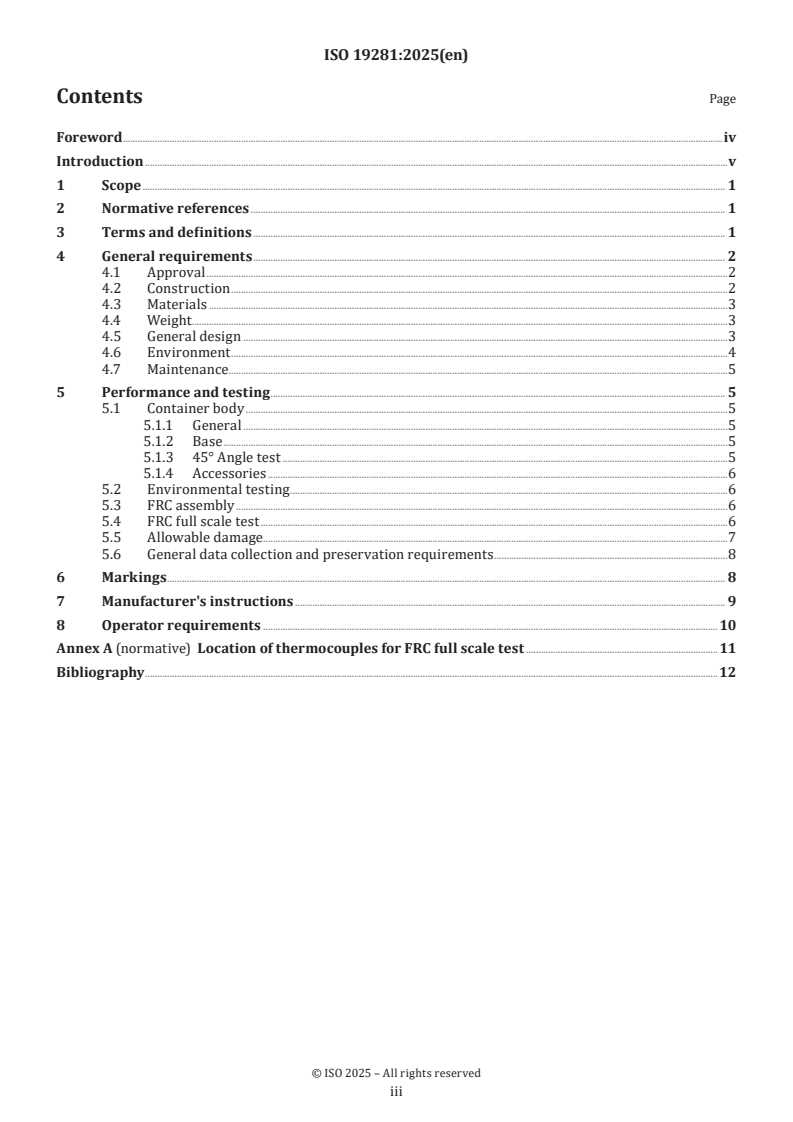
Contents Page
Foreword .iv
Introduction .v
1 Scope . 1
2 Normative references . 1
3 Terms and definitions . 1
4 General requirements . 2
4.1 Approval .2
4.2 Construction .2
4.3 Materials .3
4.4 Weight . .3
4.5 General design .3
4.6 Environment .4
4.7 Maintenance .5
5 Performance and testing . 5
5.1 Container body .5
5.1.1 General .5
5.1.2 Base .5
5.1.3 45° Angle test .5
5.1.4 Accessories .6
5.2 Environmental testing .6
5.3 FRC assembly .6
5.4 FRC full scale test .6
5.5 Allowable damage .7
5.6 General data collection and preservation requirements .8
6 Markings . 8
7 Manufacturer's instructions . 9
8 Operator requirements . 10
Annex A (normative) Location of thermocouples for FRC full scale test .11
Bibliography .12
iii
Foreword
ISO (the International Organization for Standardization) is a worldwide federation of national standards
bodies (ISO member bodies). The work of preparing International Standards is normally carried out through
ISO technical committees. Each member body interested in a subject for which a technical committee
has been established has the right to be represented on that committee. International organizations,
governmental and non-governmental, in liaison with ISO, also take part in the work. ISO collaborates closely
with the International Electrotechnical Commission (IEC) on all matters of electrotechnical standardization.
The procedures used to develop this document and those intended for its further maintenance are described
in the ISO/IEC Directives, Part 1. In particular, the different approval criteria needed for the different types
of ISO document should be noted. This document was drafted in accordance with the editorial rules of the
ISO/IEC Directives, Part 2 (see www.iso.org/directives).
ISO draws attention to the possibility that the implementation of this document may involve the use of (a)
patent(s). ISO takes no position concerning the evidence, validity or applicability of any claimed patent
rights in respect thereof. As of the date of publication of this document, ISO had not received notice of (a)
patent(s) which may be required to implement this document. However, implementers are cautioned that
this may not represent the latest information, which may be obtained from the patent database available at
www.iso.org/patents. ISO shall not be held responsible for identifying any or all such patent rights.
Any trade name used in this document is information given for the convenience of users and does not
constitute an endorsement.
For an explanation of the voluntary nature of standards, the meaning of ISO specific terms and expressions
related to conformity assessment, as well as information about ISO's adherence to the World Trade
Organization (WTO) principles in the Technical Barriers to Trade (TBT), see www.iso.org/iso/foreword.html.
This document was prepared by Technical Committee ISO/TC 20, Aircraft and space vehicles, Subcommittee
SC 9, Air cargo and ground equipment.
This second edition cancels and replaces the first edition (ISO 19281:2016), which has been
technically revised.
The main changes are as follows:
— Clause 1: revision of the scope;
— Clause 3: revision of the original term entries 3.4 and 3.5, suppression of definitions 3.6, 3.8 and 3.9;
— Clause 4: revision of the general requirements, suppression of 4.1.3, 4.2.1, 4.6.6 and 4.6.7, addition of
4.5.5 and 4.7.2;
— Clause 5: revision of performance with the addition of testing (5.2 “Environmental testing”, 5.4 “FRC full
scale test”);
— Clause 8 (previous Clause 9): revision of the operator requirements with the suppression of 9.2 “Operating
instructions”, 9.3 “Training and qualification” and 9.4 “Quality control”.
Any feedback or questions on this document should be directed to the user’s national standards body. A
complete listing of these bodies can be found at www.iso.org/members.html.
iv
Introduction
Fatal accidents have demonstrated the risk of uncontrolled fires occurring within cargo to transport
aircraft; it is evident that the use of fire protecting devices can improve flight safety.
This document specifies the design and performance criteria and testing methods for fire-resistant
containers used to provide enhanced protection against cargo fires in civil transport aircraft cargo
compartments.
The fire-resistant containers (FRCs) specified by this document are intended to be used to contain and
restrain unitized cargo for loading into aircraft cargo compartments, for example:
a) Class E aircraft cargo compartments according to CS-25, CCAR-25, JAS Part 3 or 14CFR Part 25 25.857 (e);
b) Class F aircraft cargo compartments according to CS-25 § 25.857(f) and AMC to CS-25.855 and 25.857,
or 14CFR Part 25 § 25.857(f) and FAA Advisory Circular AC25.857-X.
NOTE Though nothing formally prevents a fire-resistant container (FRC) from being carried in a Class C aircraft
cargo compartment, it is not intended for this use since its fire containment capability is redundant with that of the
aircraft's fire detection and suppression system. Current regulatory guidance materials and aircraft type's Weight
and Balance Manual can be consulted whenever available.
This document only specifies the flammability requirements and fire resistance performance for FRCs.
Nonetheless the other applicable general standards shall be taken into account (e.g. ISO 21100, ISO 8097,
ISO 10327, ISO 11242).
The containers specified in this document shall be designed and tested at both the full-scale and component
levels to demonstrate performance.
The use of fire-resistant containers meeting the requirements of this document alone is not sufficient to
ensure flight safety: this document is based on the assumption that the approved fire-resistant containers
are built up, installed, and checked prior to aircraft loading in accordance with appropriate operating
instructions, by competent, suitably trained, personnel (see Clause 8).
Recommended criteria are, while not mandatory, considered to be of primary importance in providing fire-
resistant containers meeting the applicable regulatory requirements and ensuring effective protection
against fires. Deviation from recommended criteria should only occur after careful consideration, extensive
testing, and thorough service evaluation have shown alternate methods to be satisfactory.
The requirements of this document are expressed in the applicable SI units, with approximate inch-pound
unit conversion between brackets for the convenience of countries using that system. Where it is deemed
necessary to use exact values, the values in SI units are used.
v
International Standard ISO 19281:2025(en)
Air cargo — Fire-resistant containers — Design, performance
and testing requirements
1 Scope
This document specifies the minimum design and performance criteria and testing methods of passive fire-
resistant containers (FRCs) used in cargo compartments of civil transport aircraft to improve fire protection.
This document does not cover requirements for fire detection or suppression devices. The specified fire-
resistant containers (FRCs) are passive devices capable of containing a fire for a specific duration.
2 Normative references
The following documents are referred to in the text in such a way that some or all of their content constitutes
requirements of this document. For dated references, only the edition cited applies. For undated references,
the latest edition of the referenced document (including any amendments) applies.
ISO 877-1, Plastics — Methods of exposure to solar radiation — Part 1: General guidance
ISO 4892-1, Plastics — Methods of exposure to laboratory light sources — Part 1: General guidance
ISO 4892-3, Plastics — Methods of exposure to laboratory light sources — Part 3: Fluorescent UV lamps
ISO 8097, Aircraft — Minimum airworthiness requirements and test conditions for certified air cargo unit
load devices
ISO 10046, Aircraft — Methodology of calculating cargo compartment volumes
ISO 10254, Air cargo and ground equipment — Vocabulary
ISO 10327, Air cargo — Main deck containers — Design and testing
ISO 11242, Aircraft — Pressure equalization requirements for cargo containers
ISO 12236, Geosynthetics — Static puncture test (CBR test)
ISO 14186:2013, Air cargo — Fire containment covers — Design, performance and testing requirements
ISO 21100, Air cargo unit load devices — Performance requirements and test parameters
3 Terms and definitions
For the purposes of this document, the terms and definitions given in ISO 10254 and the following apply.
ISO and IEC maintain terminology databases for use in standardization at the following addresses:
— ISO Online browsing platform: available at https:// www .iso .org/ obp
— IEC Electropedia: available at https:// www .electropedia .org/
3.1
fire containment
fire control
ensuring that a fire does not grow to a state where damage to the aeroplane or harm to passengers or crew
occurs during the time for which the fire containment system is demonstrated to be effective
3.2
fire-resistant container
FRC
completely enclosed container, airworthiness approved under applicable general performance criteria, with
a demonstrated additional capability to contain a possible cargo fire within it for a rated period
Note 1 to entry: Guidance addressing the use of FRCs can be provided in airworthiness regulatory guidance documents
when they are one allowable means of compliance with fire containment (3.1) requirements in certain classes of
aircraft cargo compartments.
3.3
unit load device
ULD
device for grouping, transferring, and restraining cargo for transit
Note 1 to entry: It may consist of a pallet with a net or it may be a container.
Note 2 to entry: In this document, it is a synonym of “container”.
3.4
class A fire
fire in ordinary combustible materials, such as wood, cloth, paper, rubber, and plastics, for which the
quenching and cooling effects of quantities of water, or of solutions containing a large percentage of water,
are of prime importance
4 General requirements
4.1 Approval
4.1.1 The fire-resistant container's type design shall be approved for this purpose on the basis of
demonstration of conformity with this document. Where the fire-resistant container is intended to
constitute a means of complying with applicable airworthiness regulations, additional requirements from
the airworthiness authority concerned can apply.
4.1.2 The fire-resistant container shall, in addition, be airworthiness approved under the ultimate load
criteria in accordance with ISO 21100, or ISO 8097 if its size is not contained therein. The ultimate load
requirements and the fire resistance requirements are not required to be met simultaneously because it
is highly improbable that a cargo fire and maximum flight load condition would simultaneously occur. The
ULD manufacturer is responsible for authority approval.
4.2 Construction
4.2.1 In the case of a standard container fitted with protective linings or coatings, the expression “fire-
resistant container” exclusively designates throughout this document the complete assembly fully fitted
with intended coating, protections, or other appurtenances. The container's manufacturer shall be solely
responsible for required testing. See 4.3.1, NOTE regarding applicable approval procedures.
In this case, inner coatings or protective materials are exposed to interference from stacking cargo in the
container. Specific inner damage limits are required and can present container inspection and damage
assessment difficulties, see applicable requirements in 5.5.5.
4.2.2 The minimum performance requirements to be met are specified by this document and in addition
the container shall satisfy all general design and testing requirements of ISO 10327 for main deck containers.
4.2.3 This document does not cover the possibility of placing over a container a fire containment cover
(FCC) meeting the requirements of ISO 14186.
4.2.4 The fire-resistant container's dimensions and outer contour shall be within the maximum allowable
contour in accordance with ISO 10046, appropriate to the aircraft type(s) and loading positions it is designed
for. All other aspects shall meet the applicable requirements of ISO 21100 or ISO 8097 and ISO 10327 for
containers.
NOTE Industry standard maximum ULD contours applicable to containers are specified in Reference [4] and
identified by alphabetic codes in its Appendix E.
4.3 Materials
4.3.1 The fire-resistant container shall be constructed of materials meeting the fire resistance
requirements specified in 5.1.
NOTE With regard to container bases, bases consisting in a single aluminium alloy sheet are sufficient to meet the
requirements in 5.1.2 by themselves and can be exempted from the testing requirements of 5.1.3, while subject to the
FRC full scale test in 5.4.
4.3.2 Any other elements of the fire-resistant container's construction or equipment (e.g. joints of
sidewalls, roof and base panels, closure devices, seals), the failure of which would affect the capability of the
container to safely contain a fire, shall meet the requirements specified for them in 5.1.1.
4.3.3 Materials selection should ensure the highest possible wear, abrasion, shearing, tearing, and
puncture resistance. See 5.2 for environmental tests, including puncture resistance, U.V. and humidity, and
abrasion, applicable for non-metallic materials where used, e.g. flexible materials for doors.
4.3.4 During materials selection, preference shall be given to recyclable materials where this does not
compromise best fire protection performance. Asbestos or asbestos compounds shall not be used. Other
materials shall be assessed prior to selection as to potential detrimental effects on human health.
4.3.5 Where a composite material of a non-permanently attached component, for example, closure, is such
that one side shall be the inner one to withstand fire, the inner and outer colours shall be different to prevent
inverted installation (see 6.4).
4.4 Weight
The fire-resistant container's weight should be kept to a minimum while meeting structural and fire
containment requirements.
4.5 General design
4.5.1 The fire-resistant container's design shall be such that any inner features or components provide the
minimum required fire resistance.
4.5.2 Container closure devices shall provide the minimum fire and flame resistance.
4.5.3 The fire-resistant container's outer surface should be as smooth as possible to avoid any interference
with the aircraft's doors, compartment linings, and lights, and/or risk of snagging on adjacent ULDs
hardware.
4.5.4 In order to:
a) maintain normal pressure during flight, as well as the depressurization case in a class E cargo
compartment as a result of a fire;
b) allow venting of any flammable gases to prevent their accumulation.
The container's normal and emergency (rapid decompression) pressure equalization functions shall meet
the requirements in ISO 11242. The venting area for normal pressure equalization shall meet the minimum
2 3
5 cm /m internal volume in accordance with ISO 11242 and should allow for venting of flammable gases
and smoke within the upper and lower 30 cm (12 in) of the container’s doorway “chimney effect”.
2 3 3 3
NOTE 1 5 cm /m opening corresponds for typical main deck containers (inner volume between 13 m and 21 m ),
to a minimum door seals clearance of approximately 1 mm to 1,5 mm, all around the door's periphery. Due to the fact
that there is an extremely low probability that a rapid decompression and a fire occur simultaneously, there is no need
to require the fire containment performance to be maintained during a rapid decompression.
NOTE 2 The minimum required venting area is intended to maintain aircraft fire detection system performance at
the same level as with standard containers, and also to allow venting of gases other than air.
4.5.5 In addition to the requirements in ISO 11242, the design of containers shall take into account the
possibility of controlled depressurization of class E cargo compartments in the event of an in-flight fire,
to ensure that no permanent damage or deformation of the container will result, and container venting
areas will, after this event, remain in accordance with 4.5.4 during the rest of the flight. For this purpose,
2 2
depressurization from a 81 kPa (11,8 lb/in ) ambient cabin pressure down to 19 kPa (2,72 lb/in ) cruise
flight pressure in a duration of 1 min shall be considered, independently from the depressurization case in
1 s in ISO 11242:1996, 5.2 (see 4.5.4, NOTE 1). Demonstration may be by either test or analysis.
4.5.6 Where the normal pressure equalization venting area is not permanent but operates under a
pressure differential (e.g. door seals deformation), it shall open under a pressure differential between
2 2
3,5 kPa and 7 kPa (0,5 lbf/in to 1 lbf/in ) in accordance with ISO 11242.
4.5.7 If the fire-resistant container is equipped with self-contained automatic fire detection and/or
suppression or any other device not specified by this document, devices installation shall not compromise
the function and performance of the fire-resistant container or the safety of the aircraft, which shall remain
in accordance with the minimum performance and other requirements of this document.
4.6 Environment
4.6.1 The fire-resistant container shal
...